
TWELVE
At the present moment, [Alfred] is suffering from megalomania, the German Emperor having offered him a high decoration for the part he had played in establishing a better feeling between England and Germany.
SCHOMBERG MCDONNELL TO LORD SALISBURY, JANUARY 1899
No doubt politics and finance often go hand in hand...
LORD ROTHSCHILD
The history of Europe between 1870 and 1914 has often been written as a history of imperial rivalry, leading to the formation of a polarised alliance system and ultimately a calamitous war. Yet there are reasons to be sceptical about this narrative. For if there was a war which imperialism should have caused it was the war between Britain and Russia which failed to break out in the 1870s and 1880s; or the war between Britain and France which failed to break out in the 1880s or 1890s. These three powers were, after all, the real imperial rivals, coming into repeated con-Hict with one another from Constantinople to Kabul (in the case of Britain and Russia), from the Sudan to Siam (in the case of Britain and France). Few contemporaries would have predicted they would end up fighting a war on the same side.
Nor should it be assumed that there were insuperable forces generating an ultimately lethal “Anglo-German antagonism.” Indeed, from the Rothschilds’ point of view, precisely the opposite outcome seemed not only desirable but possible: an Anglo-German understanding (if not an outright alliance) seemed a logical response to the imperial differences between Britain, France and Russia. There is always a strong temptation for the historian to be condescending to diplomatic intitiatives that fail, by assuming or seeking to prove that they were bound to do so. The efforts to secure some kind of understanding between Britain and Germany in the years before the outbreak of the First World War have very frequently been the object of such condescension. The fact that Alfred de Rothschild played such an important role in trying to broker an Anglo-German alliance has only encouraged the tendency to dismiss the enterprise as futile. As we have seen, Alfred was not greatly admired by his contemporaries, and his reputation as a dilettante has inclined later writers to assume that everything he did lacked seriousness—as if he genuinely imagined that an alliance could be achieved “by the simple expedient of inviting Chamberlain and Hatzfeldt (or Eckardstein) to dinner.” The role of Baron Hermann von Eckardstein, the first secretary at the German embassy, has also tended to be discounted by historians, following the disparaging remarks of contemporaries like Edward Hamilton, who dismissed him as “a sort of unofficial go-between on Anglo-German affairs at the beck and call of the firm of Rothschild.” At best, the idea of an Anglo-German alliance has been seen as appealing too narrowly to the bankers of the City of London, particularly those of German and Jewish origin—a view which, of course, Germanophobe contemporaries did not hesitate to express.
Yet the ultimate descent of the relationship between Britain and Germany into the disastrous war of 1914-18 should not be retrospectively “over-determined.” In many ways, the arguments for some kind of understanding, if not a full alliance, were founded on common international interests. This is not to resuscitate the old argument about “missed opportunities” in Anglo-German relations which could have averted the carnage of the trenches, a line which has all too often rested on the wisdom of hindsight and unreliable memoirs; it is merely to suggest that the failure of the Anglo-German entente to develop was a more contingent than predetermined outcome—something which cannot be said of all the diplomatic combinations of the pre-1914 period.
Wars Not Fought
From the moment Egypt was occupied, Britain found herself at a diplomatic disadvantage when trying to check analogous expansion by her imperial rivals. In one case, that of Germany, there was no real attempt to do so; but in the case of Russia and France British diplomacy was less pliant.
The German Chancellor’s map of Africa was, as he said, subordinate to his map of Europe; nevertheless, he enjoyed pretending (as his son told Gladstone) that “there is and can be no quarrel about Egypt if colonial matters are amicably settled.” Natty relayed a similar message from the German ambassador Count Paul von Hatzfeldt to Randolph Churchill in September 1886. The obvious place to look for colonial compensations was in sub-Saharan Africa, where the Belgian King Leopold II had established a vast private empire through his International Association of the Congo. British interests lay further south, but it seemed prudent to establish some kind of indirect strategic foothold by encouraging the reliably Anglophile Portuguese to claim some territory in the Lower Congo: it was the Rothschilds’ tacit approval of this strategy which disinclined them to assist Leopold in his activities. Beginning in 1884, Bismarck used Egypt as the pretext for a series of audacious German interventions in the region, menacing Britain with a Franco-German “League of Neutrals” in Africa, asserting German control over Angra Pequena in South-West Africa and claiming all the territory between Cape Colony and Portuguese West Africa. The British response was to appease Germany by accepting the South-West African colony and conceding further territorial acquisitions in the Cameroons and East Africa. The issue of Zanzibar raised by Hatzfeldt in 1886 was typical: Germany had no economic interest worth talking about in Zanzibar (and indeed exchanged it for Heligoland in the North Sea in 1890); but it was worth asking for such territory so long as Britain was embarrassed by her position in Egypt.
There were at least two regions where Russia could legitimately stake comparable claims: in Central Asia and the Balkans. In neither case was it entirely credible for Britain to resist. For this reason, the Rothschilds were inclined to press for a British policy of conciliation and concession—despite their own growing hostility towards the anti-Semitic Tsarist regime.
In April 1885, in the dying days of Gladstone’s second ministry, an Anglo-Russian conflict threatened to break out following the Russian victory over Afghan forces at Penjdeh. Natty at once sought to avert war by sounding out (at Reginald Brett’s suggestion) the Russian ambassador Count de Staal. When Staal asked what Britain would be “satisfied” with as the basis for a diplomatic compromise, Natty suggested “the immediate recall of the Russian forces from the debated country,” but added: “Do this, and you will get a boundary line not unlike the one which you Russians have drawn for yourselves.” Staal duly responded with a proposal of this sort to Brett, who forwarded it to Gladstone. Usually sceptical about Natty’s initiatives, even Edward Hamilton had to admit that it was “something to have got anything out of the Russian Embassy, however unofficially it may be put forward.” In classic Rothschild fashion, Natty sought to accelerate the process of pacification by inviting Staal to dine with a group of Liberal and Tory politicians, among them Harcourt, now Home Secretary, Brett, Drummond Wolff and the rising Conservative star Arthur Balfour. When Churchill took over the India Office in the summer of 1885, he hastened to tell him the good news that the Russians wished to settle the Afghan frontier issue, and Churchill was able to announce an agreement in a typically flamboyant speech at Sheffield on September 3. This, however, was premature. No sooner had the Liberals returned to office in January 1886 than Alfred had to warn Rosebery that:
affairs in Afghanistan are looking very bad for England. The Russians have completely got round the Afghans and ... the position of the English Boundary Commission is one of actual danger. The Afghans are openly hostile to us and whilst our Commission is almost unguarded the Russians have 30,000 men close at hand and are pushing on their railway as fast as possible.
The crisis abated once again, but the Rothschilds continued to keep a close watch on the North-Western frontier. Indeed, in 1888 Edmond travelled under Russian escort to Samarkand, ostensibly to look into “commercial conditions” but more probably to assess the extent of the Russian military threat to Kabul.1
It was a similar story when a crisis blew up over Bulgaria in 1885. To the Rothschilds, there seemed no very good reason for Britain to get mixed up in the affairs of Bulgaria at this time of growing diplomatic isolation. If Britain had a right to run the affairs of Egypt, then Russia had every right to prevent the Bulgarian King Alexander from unifying Bulgaria and Eastern Rumelia on his own terms, as he sought to do in September 1885. The only reasons for opposing Russian intervention were dynastic (one of Queen Victoria’s daughters was married to Alexander’s brother Henry) and moralistic (the fate of the Bulgarians had been an emotive issue since Gladstone’s atrocitarian campaign, and the Russian kidnapping of Alexander aroused fresh indignation). Though Natty accepted the need to “keep the Prince of Bulgaria on the throne and keep the minor states like Serbia from helping themselves,” he immediately discerned that Russia meant “to meddle in the Balkans.” His attitude, in essence, was that Britain should tolerate this.
In this, Natty was at one with Bismarck; and in many ways the Rothschilds’ interest in the project of Anglo-German rapprochement has its origins in this period. Writing to Randolph Churchill in September 1886, he evidently relished relaying the German ambassador Hatzfeldt’s objections to British policy over Bulgaria:
[H]e said here you are illogical and by your want of logic are running great risks. Your statesmen and yr press say you have no direct interest in the Danube or the Balkan Peninsula, you recognise Russia’s rights and you ask her not to interfere in Egypt and to remain within her sphere in Asia but today our agent in Sophia renews his telegrams that Sir [Frank] Lascelles [the consul-general in Bulgaria] is continually and continuously intriguing and manoeuvring against Russia, if this goes on you may be astonished at finding your hands forced in different parts of the world. Your conduct in Bulgaria is inexplicable[,] we shall not and cannot support such a policy and you must not be astonished if to bother you Russia listened to France.
Churchill, Natty evidently hoped, would take a more Bismarckian line than the Foreign Secretary Lord Iddesleigh (as Stafford Northcote had become). When the latter—variously dismissed by Natty as an “old goat” and a “cackling ... old hen”—sent Alexander Condie Stephen to New Court to request a £400,000 loan for the anti-Russian regime at Sofia, Natty was incredulous. “[N]aturally I refused,” he told Churchill; “was there ever such folly?” Churchill responded by blocking Stephen’s appointment as envoy to Sofia (even sending a telegraph to Salisbury in Foreign Office cipher signed “Iddesleigh”). To reinforce the argument for passivity, Natty went so far as to relay (via Balfour to Salisbury) Hatzfeldt’s warning of a possible German attack on France—the implication being that a simultaneous Anglo-Russian conflict would risk a general war. Natty’s letters to Reginald Brett and Rosebery after the Liberals came back in took the same line: Russian policy in Bulgaria should be tolerated—and increasingly Natty justified this argument with reference to the wishes of Germany. Bismarck, he told Rosebery in November, was “put out with the French for pushing themselves forward as the protectors of Russia in Bulgaria.” A month later, he reported that Bismarck had “isolated France and I should not be in the least astonished if he made England and Russia staunch friends.” “My own belief,” he concluded the following February, “is that there will be no war ... France has been flirting with Russia. The result as anyone could have foreseen is that Bismarck will let Russia do what she likes in the Balkans.”
Not for the last time, the Rothschild hope that Britain and Germany could co-operate was not fulfilled. This was partly because it suited Salisbury better to negotiate a new Triple Entente with Italy and Austria to preserve the status quo in the Mediterranean and the Black Sea. Though an unimpressive pair of allies for Britain, this sufficed to deter Russia from drastic action when a new Bulgarian king was elected who was also distantly related to English royalty (he was Ferdinand of Saxe-Coburg, the son of one of Prince Albert’s cousins) but, more important, had an Austro-Hungarian military background. At the same time, so Salisbury argued, the Triple Entente created an indirect link to Berlin through the German Triple Alliance, of which Italy and Austria were also members. It was an uneasy equilibrium, which logically implied (despite all Bismarck’s efforts to preserve some vestige of the Three Emperors’ League) a Russo-French rapprochement, though it remained to be seen how easy that would be to achieve and whether its existence would reinforce or weaken the case for Anglo-German co-operation.
Of all the other imperial powers, it was France which reacted most aggressively to the British takeover in Egypt: indeed, in many ways it was the Anglo-French antagonism which was the most important feature of the diplomatic scene in the 1880s and 1890s. As in the past, this was more awkward for the Rothschilds than any other international division for the obvious reason that the two Rothschild houses which still worked closely together were in London and Paris. But it was not easy to see what could be done. In 1886, at the time of the French expedition to Tonkin in Indo-China, the French Rothschilds uneasily predicted to Herbert von Bismarck “that the next European war will be between England and France.” They hoped briefly that the return of Rosebery as Foreign Secretary in 1892 might improve matters; but it rapidly became apparent that, despite his reluctance to confirm Britain’s anti-French Mediterranean agreements with Austria and Italy, Rosebery was inclined to continue the previous government’s Francophobe policy. He was dismayed by rumours (which were vehemently repudiated by the French Rothschilds) that France intended some kind of takeover of Siam following a naval confrontation on the River Mekong in July 1893. And the following January, Rosebery responded to Austrian worries about Russian designs on the Straits by assuring the Austrian ambassador that he “would not recoil from the danger of involving England in a war with Russia,” adding that, if France sided with Russia, “we should require the assistance of the Triple Alliance to hold France in check.”
Predictably, it was Egypt and her southern neighbour the Sudan which proved the main cause of Anglo-French antagonism—so much so that a war between England and France seemed a real possibility in 1895. As we have seen, Rosebery tipped off the Rothschilds about the government’s intention to reinforce the Egyptian garrison in January 1893. In January and February 1894, Alfred reciprocated by passing on to Rosebery alarming reports they had received about the growing mood of hostility to British rule in Cairo. It was now increasingly apparent that the French government intended to make some kind of bid for control of Fashoda on the Upper Nile. Fearful that French control of Fashoda would compromise the British position in Egypt, Rosebery—who became Prime Minister in March—hastily concluded an agreement with the King of the Belgians to lease the area south of Fashoda to the Belgian Congo in return for a strip of the Western Congo, with the obvious intention of blocking French access to Fashoda. In the difficult negotiations which ensued, the French Rothschilds sought to mediate, assuring their English cousins that the French government was not “full of Anglophobes,” but warning them that British policy in Africa seemed intolerably “aggressive” in Paris. It was no use: attempts by the French Foreign Minister Gabriel Hanotaux to reach some kind of compromise over Fashoda failed and when an expedition led by the French explorer Marchand set off for the Upper Nile, Rosebery’s Under-Secretary at the Foreign Office, Sir Edward Grey, denounced it as “an unfriendly act.” It was at this critical moment (June 1895) that Rosebery resigned, leaving Britain in a position of unprecedented diplomatic isolation.
Fortunately for the incoming Salisbury government, the contemporaneous defeat of Italy by the Abyssinian forces at Adowa took the wind out of French sails, for reasons which Natty spelt out to McDonnell for Salisbury’s consideration. “The French are in desperate alarm lest the defeat of Italy should lead to a revival of the Three Emperors’ Alliance,” he argued, “the French Government [is therefore] too weak to give us any real trouble.” But he warned Salisbury that “if the powers combined to reopen the question of evacuation [of Egypt], it would be impossible for the Government to resist.” This was an encouragement to act swiftly. Exactly a week later, the order was given to reconquer the Sudan.2 When Hanotaux’s successor Théophile Delcassé reacted to Kitchener’s victory over the Sudanese dervishes at Omdurman by occupying Fashoda, the Rothschilds egged Salisbury on to call the French bluff. Kitchener should be ordered to “to take Marchand prisoner,” Natty told McDonnell in September. At the height of the crisis two months later, Alfred assured him “that the French will yield and that there will be no war. He thinks,” added McDonnell, “the French army [is] in a very rotten state; but has a great opinion of the French navy ... (this is a pious opinion which Lord R[othschild] thinks is nonsense). M. de Staal [the Russian ambassador] also told Lord R. this morning that he thought there would be no war.”
Did Natty consciously put British strategic interests in Egypt ahead of his Paris cousins’ sensibilities? Possibly; but a more plausible explanation is that the French Rothschilds were, as in 1882, content to see British dominance in Egypt asserted, even at the expense of French pride. There is no evidence that Alphonse favoured Delcassé’s confrontational strategy. In any case, the Rothschilds knew enough to recognise the weakness of the French position. As the Russian ambassador indicated to Natty during the Fashoda crisis, St Petersburg would never support Paris on African issues—any more than Paris would support St Petersburg over the Black Sea Straits.
Fashoda is of interest because it reminds us of a war between the great powers which did not happen, but might have. Similarly, it is important to remember that in 1895 and 1896 both Britain and Russia toyed with the idea of using their navies to force the Straits and assert their direct control over Constantinople. In the event, neither side was sufficiently sure of its naval power to risk such a step; but had it been attempted, a diplomatic crisis as serious as that of 1878 would have been almost unavoidable. Here too there was an unrealised war, this time between Britain and Russia. If nothing else, all this goes to show that, if we are to explain why a war eventually broke out in which Britain, France and Russia fought on the same side, imperialism is unlikely to provide an answer.
The Franco-Russian Entente
Of all the diplomatic combinations which arose in this period, the Franco-Russian entente was the most logical both strategically and economically. France and Russia had common foes: Germany between them and Britain all around them. Moreover, France was a capital exporter, while industrialising Russia was hungry for foreign loans. Indeed, French diplomats and bankers began to discuss the possibility of a Franco-Russian entente based on French loans as early 1880.
Nevertheless, it is important to realise how many obstacles there were to such an alignment. There were, to begin with, financial difficulties. Recurrent instability on the Paris bourse—the Union Générate crisis of 1882 was followed by the failure of the Comptoir d‘Escompte in 1889 and the Panama Canal crisis in 1893—cast doubt on France’s basic capacity to cope with large scale Russian operations. On the Russian side too there were problems. It was only in 1894—7 that the rouble was finally put on the gold standard, so that exchange fluctuations further complicated negotiations up until that point.3 The bond markets also remained wary of Russian bonds. The price of Russian 5 per cents oscillated with unusual rapidity in the 1880s, dropping sharply at the end of 1886, recovering in the first half of 1887, then falling again to a nadir of 89.75 in early 1888, only to leap up to a peak of 104.25 in May 1889. There was another steep drop in 1891, however. Between March and November, the new 4 per cent Russians fell over 10 per cent from 100.25 to just 90. It was only after that crisis that a steady appreciation set in, culminating in August 1898 (105) (see illustration 12.i).
There were also serious diplomatic difficulties in the way of a Franco-Russian alliance. Firstly, Bismarck’s diplomacy appeared, at least outwardly, to hinge on maintaining the links between Germany, Austria and Russia which he had first forged in the Three Emperors’ Alliance. The rise of General Boulanger served to rekindle Franco-German animosity, but it did not lead Russia to side with France: the Russian ambassador in Berlin, Count Peter Shuvalov, merely spoke of Russian neutrality in the event of a war between Germany and France. The Russian objective in the early 1880s was to separate Germany and Austria-Hungary, not to risk alienating Bismarck for the sake of France. The secret Reinsurance Treaty signed between Germany and Russia in June 1887 may have been practically meaningless (it guaranteed Russian neutrality unless Germany attacked France and German neutrality unless Russia attacked Austria); but it at least indicated a desire in both Berlin and St Petersburg to maintain some sort of diplomatic connection. Moreover, as mentioned already, there were important limits to what France and Russia could offer one another. France was never willing to back Russian policy with respect to Turkey; Russia was never willing to back French policy in the Sudan.
Finally, there were political obstacles, and not just because of the obvious difference between Republican France and Tsarist Russia. The assassination of the “Tsar Liberator” Alexander II in March 1881 and the accession of his reactionary son Alexander III led to a marked deterioration in the treatment of the Empire’s four million Jews, most of whom continued to be confined to the so-called Pale of Permanent Settlement in Poland and western Russia. Under Alexander II there had been some relaxation in the restrictions on Jewish residence and occupation; but a wave of pogroms in 1881 and 1882 encouraged the Tsar and his new ministers in the belief that “the people” had to be protected from the “pernicious activity” of the “in many ways harmful” Jews. In the wake of the May Laws of 1882, which imposed new restrictions on where Jews could live and the business they could do, there was a sustained campaign against them. Educational opportunity, the right to own land, access to the professions, the right to reside in villages or outside the Pale—all were curtailed. Jews responded in various ways: around two million emigrated, as we have seen. Among those who remained, most struggled on as best they could, but some were attracted by the revolutionary politics of organisations like the Socialist Revolutionaries, the Social Democrats and the specifically Jewish Bund: enough to convince Tsarist ministers that they were right to regard the Jews as a menace. When new pogroms occurred at Kishinev in 1903 and more generally in 1905—accompanied by the kind of ritual-murder claims which had sparked off the Damascus affair more than sixty years before—there was enough evidence of official indifference, if not complicity, to confirm the impression abroad that the Tsarist regime was the most anti-Semitic in the world.
12.i: The weekly clsing price of Russian 5 per cents, 1860-1900. Notea From November 1889 based on prices of 4 per cents (as if they had a 5 per cent coupon).
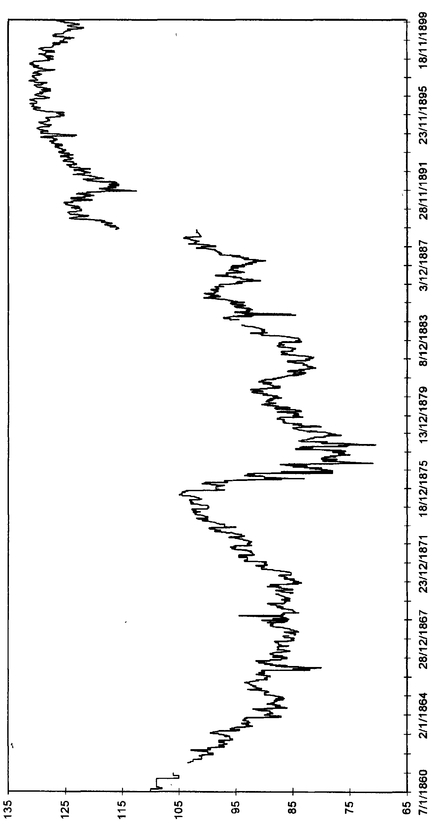
The Rothschilds were dismayed by all this. As early as May 1881, the Austrian, French and British partners began to discuss what practical steps could be taken “on behalf of our unfortunate co-religionists.” The marriage of Alphonse’s daughter to the Russian Jewish banker Maurice Ephrussi may have served to increase their interest in this question. Thus it was rumoured in diplomatic circles that the Rothschilds had secured the dismissal of the French ambassador in St Petersburg, Appert, when he informed the new Madame Ephrussi that she would not be considered presentable at court by the Tsar. What made Rothschild Russophobia matter was that de Rothschild Frères were still regarded by other French banks (and indeed by the Russian Finance Minister) as the Russian government’s preferred agent in Paris, without whom no major operation could be assured of success. When Shuvalov informally approached the Paris house in 1882 on behalf of the Finance Minister Bunge, Gustave did not beat about the bush: “[W]e can but reply that we wish for nothing more than to conclude a financial operation with the Russian Government, however we are unable to do so in view of the persecution of our Russian co-religionists.” That was to be a more or less constant refrain from the London partners too in the coming years.
This explains the limited success of Elie de Cyon (alias Ilya Fadeyevich Tsion), a Russian Jew of strongly Germanophobe views who sought to act as a go-between between the French and Russian governments at a time when rumours of a German attack on Boulangist France were at their height. His aim, as he later described it, was to achieve Russia’s “economic emancipation from Germany and the transfer of the market in Russian bonds to Paris.” Although he found the Tsar’s adviser Michael Katkov sceptical about the danger of war when he visited him in February 1887 (on the ground that Bismarck’s sabre-rattling was merely an electoral ploy), Cyon aroused his interest by communicating “the result of my discussions with several representatives of the Parisian haute banque,who were all very well disposed [towards Russia].” His trump card, as he thought, was that:
one of the Rothschilds brothers, with whom I had long conversation on the subject towards the end of January, [had] once again assured me that their house was always at the service of our [Russia‘s] ministry of finance, [and was ready] to resume the relations which had been forcibly interrupted twelve years before, at the moment when France was obliged to devote all her capital to her own internal needs.
Cyon then made a similar claim to the new Russian Finance Minister I. A. Vyshnegradsky, who expressed doubts about the likelihood of “obtaining the cooperation of the house of Rothschild, without which the Paris market did not have much value.” Vyshnegradsky intimated that until he had convincing evidence of Rothschild goodwill—he suggested the Paris house might offer to convert the mortgage bonds issued by the Russian Credit Foncier—he was unwilling to make a direct governmental approach to the rue Laffitte. According to Cyon’s account, he then returned to Paris and began negotiating along these lines with the Rothschilds, talks which were ultimately crowned with success. Although in April—at the peak of the Boulanger crisis—Katkov informed him that the terms being discussed were unacceptable, Cyon rushed back to St Petersburg and secured the government’s approval. On May 5 Vyshnegradsky and an unnamed Rothschild representative signed an agreement reducing the interest on mortgage bonds totalling around 108 million marks. Cyon later published a letter from the Paris house congratulating him on his achievement, and expressing “satisfaction that we have felt at being able to profit from this occasion to renew direct relations with the Russian Imperial Minister of Finance.”
The significance of Cyon’s activities should not be exaggerated, however. While he protested his altruistic motives, the Rothschilds themselves regarded him as “a man of dubious honorability” and commented shrewdly: “Nothing proves that he did not begin by presenting himself there in our name just as he presents himself here in the name of the minister, by virtue of a dual mandate which he has voluntarily taken upon himself.” More to the point, Cyon very probably misrepresented in his memoir the nature of the mortgage bond operation. It must be remembered that the months of April and May 1887 witnessed the culmination of the Boulanger crisis. It is apparent even from Cyon’s own account that Bismarck, recognising what was afoot, sought to interfere in his negotiations. Nor was Cyon able to conclude the deal without securing the consent of Bleichröder in Berlin: after all, the original mortgage bonds had been floated by Bleichröder, not by the Rothschilds, though the Paris house had taken a share in the issue. Given that more of the mortgage bonds were in German hands than in French, Cyon had really done nothing more than secure Rothschild approval of a transaction which was between Berlin and St Petersburg. This was easily given as it meant nothing; it did not represent the decisive shift of Russian finance to Paris. What is more, when that shift began to happen in September 1887, the Rothschilds were not involved.
It was a financial reorientation which was encouraged by the low price of Russian bonds and propelled by Bismarck’s decision to prohibit their use as collateral for Reichsbank loans (the famous “Lombardverbot”). The striking thing—pace Cyon—is that, far from leading the Paris market, the Rothschilds followed it at some distance. It was a syndicate of rival banks including Mallet and Hottinguer which proposed creating a French bank in St Petersburg. The first major loan floated for the imperial government—for 500 million francs—was underwritten by a syndicate of deposit banks including the-Banque Paribas, the Credit Lyonnais, the Comptoir d‘Escompte and Herman Hoskier of the British firm Brown, Shipley. This occurred in the autumn of 1888, by which time the rise of Russian bonds seemed well established.
What made the French Rothschilds change their minds about Russia? From an early stage they had admitted that it would be harder for them to take positive action in response to Russian anti-Semitism (beyond assisting Russian Jews to emigrate) than for their English cousins. The problem was partly, as Gustave explained, that religious “intolerance” was a more delicate subject in France than in England, because of the efforts of the Republican government to restrict clerical influence over education; in addition, however, he and his brothers had to take into consideration “our Government[‘s] relations with the Russian Government.” The French Rothschilds may also have been more susceptible to the argument which the Russians themselves liked to advance, that “there might be some reasonable improvement in this question of the Jews inside Russia and that ... our attitude respecting the financial operations with the Russian Government could contribute to such an improvement.” Secondly, the fall of Boulanger in May 1887 and the Republican victory in the 1889 elections seemed to be the harbinger of a more stable period in French politics. Thirdly, Alphonse had been genuinely alarmed in early 1888 by Bismarck’s attempts (as he put it) to build a “golden bridge for Russia, in order to break up, if not the alliance, at least the existing friendship presently between our country and Russia.” If anything was calculated to change his attitude towards Russia, it was the prospect of “a quadruple alliance of England, Russia, Germany and Austria” which would leave France out in the cold. Finally, there were strictly financial reasons for a change of policy. The crisis on the French market caused by the crash of the Comptoir d’Escompte enhanced the Rothschilds’ reputation in Russia: it appeared to be Alphonse who had intervened at the Banque de France to avert a complete collapse. The bonds which the Russian government now proposed to convert into 4 per cent paper had mainly been issued through the Rothschilds in the early 1870s. Under these circumstances, it is not wholly surprising that the Paris house agreed to undertake two major Russian bond issues in 1889 with a total face value of some £77 million. Rather less easily explained is the readiness of the London house to join in these operations, and to take a share in a third £12 million issue in 1890.
True to past form, this new Rothschild-Russian connection was to prove a highly unstable one. Right away there was controversy in St Petersburg about the terms of the first loan: had Vyshnegradsky agreed to excessively generous terms in return for a private share of the business? As Girault has shown, the cost of the 1889 loan to the Russian Treasury was indeed slightly higher than that of the non-Rothschild loan the previous year; on the other hand, by reducing the margin between the price they paid for the bonds and the price at which they sold them to the public, the Rothschilds were able to attract more subscribers. Similarly, Vyshnegradsky’s “cut” was in reality intended for Hoskier, who had arranged the 1888 loan and insisted on being involved again. It is also worth bearing in mind that some German bankers, notably Bleichröder and Hansemann, acted as more or less equal partners in what was effectively a syndicate, so that the idea of a straightforward switch of Russian borrowing from Berlin to Paris is misleading. Indeed, the second loan of 1889 seems to have been initiated by the Germans—prematurely in the eyes of Alphonse—and by 1891 Bleichröder was keenly anticipating another major loan (of around £24 million) in which he expected to take a substantial share.
Having re-established their financial links to St Petersburg, the Rothschilds now sought to exert pressure on the Russian government by renewing their criticism of its anti-Jewish policies. In May 1891 the French house unexpectedly withdrew from negotiations leading up to the issue of the new loan which Bleichröder had been anticipating. At the time, it was assumed in the Russian press that this was because “Messrs Rothschild of Paris [had] made certain demands upon the Russian Government regarding the Jews of Russia” and had pulled out when these were rejected. According to one newspaper, there had been “a strong pressure” on Alphonse “by the Israelite and Judaeophile party in England which, as it appears, has been irritated by certain administrative measures taken in Russian towards a portion of the Israelite population.” It has been suggested that this was merely a pretext: the real aim was not to force the Russian government to treat Russian Jews better, but to agree to a more binding military alliance with France than had hitherto been contemplated in St Petersburg. Another possibility is that the French premier Ribot regarded the Rothschild syndicate as too “German” precisely because of Bleichröder’s involvement. If either of these interpretations were true, it would be a classic illustration of the persistence of Rothschild financial power in the sphere of international relations. On close inspection, however, neither is persuasive.
In the first place, there were a number of non-financial reasons for closer Franco-Russian ties, not least the increasingly unfriendly attitude of the German government following the accession of William II in 1888 and the dismissal of Bismarck two years later. The assurances of William and the new Chancellor Caprivi that Germany would support Austria in the event of a war with Russia and their blunt refusal to renew the secret Reinsurance Treaty made financial inducements superfluous: logically, France and Russia were likely to gravitate towards one another, even if the Russian Foreign Minister Giers was in less of a hurry to conclude a binding military alliance than the Tsar himself.
Secondly, the Rothschilds’ sense of outrage at the Russian government’s continuing anti-Semitism seems to have been as genuine as ever. In August 1890 Natty’s son Walter wrote to Bleichröder urging him to “use your powerful influence at St. Petersburg to prevent the Government from putting into force the old cruel and senseless laws ... which are so harsh and oppressive that they may be the cause of many Jews becoming violent Nihilists.” It may be that Vyshnegradsky had made some kind of promise that the persecution of the Jews would be eased and that his failure to honour this was genuinely taken amiss. For their part, the London Rothschilds felt that “Alphonse could not have done otherwise” in view of the “mediaeval barbarities” which had been committed.4 Nor is there any reason to doubt Edmond’s sincerity when he decried “the never ending horrors to which our poor co-religionists are subjected in Russia.” In another private letter to his London cousins, Alphonse likened Alexander III’s religious intolerance to that of Louis XIV and Philip II of Spain and expressed deep scepticism about the attempt by the arch-reactionary Konstantin Pobedonostsev to strike a more conciliatory note in September 1892. It is hard to believe that the Russian and French press would have overlooked a diplomatic significance to the Rothschilds’ withdrawal from the 1891 loan if there had been any; instead there was agreement that the religious issue was the cause of the breach.
Finally, the Rothschilds had strictly financial reasons for blowing hot and cold towards Russia. The large short-term deposits of Russian gold with the London house during the Barings crisis in 1890, for example, obliged the English partners to be circumspect in their political criticisms; by 1891 that constraint had been removed. The growing investments of the French Rothschilds in the Russian oil industry also need to be taken into account. Indeed, Girault has suggested that it was really disagreements about Russian trade policy—specifically its protective tariffs on imports of rails and its new tax on oil exports—which led the Rothschilds to pull out of the 1891 loan. The catastrophic Russian famine of 1891, which was at least to some degree exacerbated by Vyshnegradsky’s policies, may have played a part too. Above all, it is important to notice that the renewed slump in Russian bond prices predated the Rothschild withdrawal from the loan by over a month. That in itself provides a plausible explanation for the decision.
If there was a political subtext to the 1891 “incident” it related to French domestic politics and the difficulties of the Panama Canal Company, which helped to topple the Ribot government later the following year. The Rothschilds had kept a safe distance from the Panama affair, as we have seen; but there is some evidence to suggest they also viewed with hostility the far from disinterested efforts of Ribot to keep it afloat. The diplomatic significance of this governmental crisis in France was that it delayed the ratification of a Franco-Russian military convention, under which Russia agreed to assist France in the event of German aggression, until the beginning of 1894. Continuing political instability in France acted as an impediment to diplomatic convergence. Alphonse himself expressed pessimism to Witte’s agent Raffalovich about the ability of the French market to continue its support of Russia if the government continued with its protectionist policy and tax increases.
It was the appointment of Witte as Finance Minister which persuaded the Rothschilds to resume financial relations with Russia. Once again the treatment of the Jews was a key issue. In October 1892 the German ambassador in Paris, Count Münster, gave an assessment which may not have been far wide of the mark:
Whereas I have hitherto always assumed that His Majesty the Emperor of Russia will never bind himself to the Democratic Republic, or enter into a treaty of alliance, I am now no longer quite certain whether some agreements have not been entered into. The Rothschilds, who have so far always asserted that nothing of the kind existed, no longer so definitely deny this; and they have suddenly changed their attitude towards Russia and are negotiating a 500,000,000 [franc] loan. The Rothschilds who have so far been Royalists, have approached the Republic, and are now hand in glove with the Government whereby they regain their influence. The prospect of making a profit and, according to Alphonse Rothschild, the hope of attaining better conditions for the Jews in Russia, have induced the House here to enter into negotiations for a loan ... That the wife of the new Finance Minister, Witte, whom Russian ladies here have described to me as being an intelligent and very intriguing Jewess, is of great help in bringing about an understanding with the Jewish bankers, seems to me to be not improbable. The Paris Bourse is afraid of being overshadowed by the Bourse of Berlin, and the big Jews believe that if they can earn money they can best help the small Jews, with the result that although the French market is saturated with Russian securities, the French give their good francs for bad roubles.
The fact that the Rothschilds privately alluded to the Jewish origins of Witte’s wife lends credibility to this interpretation. However, there were once again economic considerations at work. The loan which Münster heard discussed in 1892 did not in fact come off, and it was not until 1894 that the Rothschild-led syndicate issued a 3.5 per cent loan worth around £16 million (400 million francs). This was followed by a 3 per cent loan for the same amount in 1896, for which Alphonse was awarded the Grand Cross. By that time, the rise in Russian funds was beginning to look sustainable, though the second loan was only placed with investors slowly—even with the timely assistance of a visit by the Tsar to Paris. The Rothschilds may also have been attracted by Witte’s stated objective of putting Russia on to the gold standard, which accorded with their global interests in gold mining and refining. Indeed, there had been talk at New Court in 1891 of making an approach to Baron Gunzberg, the owner of the Lena gold mines.5
There remains, however, a paradox. Confidential Rothschild correspondence shows that the London house participated in the 1894 loan and did not oppose the 1896 loan. Yet Münster and others had the strong impression that “the London House [would] have nothing to do with” Russian finance, an impression which was strongly confirmed five years later. To Münster, this was merely a proof of “how cunning these great Jews are. They always have a back door open.” More recently, historians have tended to argue that the British Rothschilds felt more strongly on the question of their co-religionists’ rights than the French. The archival evidence, nevertheless, suggests that more subtle considerations were involved. Essentially, the Rothschilds drew a distinction between Franco-Russian rapprochement, which they favoured, and Anglo-Russian rapprochement, which they were against. This might seem contradictory, but it was in many ways a rational application of the principle of the balance of power. In Natty’s eyes, an alliance between France and Russia might be acceptable; but its corollary was some kind of understanding between Britain and Germany. This explains the hostility he and his brothers expressed towards Russia when Witte was considering the possibility of floating a loan in London.
This initiative originated in the fatigue of the Paris market. As we have seen, the price of Russian bonds peaked in August 1898 and when Witte visited Paris later that summer Alphonse indicated that he would be unwilling to contemplate a new Russian loan in the face of rising yields across the board.6 This refusal was made after consultation with Natty, who in turn had asked Salisbury, observing that “it would neither be in accordance with the interest nor the inclination of Ld. Rothschild to encourage M. de Witte, unless Y[our] L[ordship] thought it desirable that he should do so.” In a reply which perfectly illustrates how the bond market and diplomacy interacted, Salisbury agreed:
that, as matters stand, it is not in our interest to encourage the borrowing operations of Monsieur de Witte. But it may by some unforeseen turn of events, become so: & therefore it would not be prudent to show reluctance to help him too manifestly. The most useful condition to bring him to is a belief that he has still a chance of getting our assistance.
This hint was duly taken, and in January 1899 the Russians broached the idea of a loan in London.
To understand the Rothschild response to this approach, it is necessary to bear in mind the role of Germany, whose policy towards Russia was in a state of flux at this period. Despite the anti-Russian signals of the early Wilhelmine years, the German banks had been positively encouraged by the German Foreign Office to participate in the 1894 and 1896 Russian loans, precisely in order to prevent a French monopoly on Russian finance. Indeed, by 1898 the German government was beginning to think in terms of a return to the Russo-German option. Thus, when the idea of a Russian loan in London was floated in 1899, it was closely linked to a parallel suggestion of a diplomatic deal between Russia and Germany, the implication being that, if Britain refused to lend to Russia, she should turn to Berlin. The dilemma for the Rothschilds was acute: on the one hand, they were against an Anglo-Russian rapprochement, but nor did they wish to see Berlin and St Petersburg reconciled in such a way that their own pet scheme for Anglo-German rapprochement fell by the wayside. This explains why the proposal split the London partners along lines summarised by McDonnell for Salisbury:
The question will then arise whether or not the English market shall be permitted to raise a loan [of] probably £15,000,000 ... for Russia, Mr Alfred Rothschild, who is violently Russophobe, says No: on no account.
Lord Rothschild is less decided: he thinks that his House could make or mar such a loan: if they brought it out, it would not be particularly lucrative: and his inclination is adverse to the operation.
But if the London market remains closed he is afraid that Russia may learn her own financial strength ... [A]s a last resource [sic] Russia can find the money herself, though it would involve the depletion of her war chest.
Natty was relieved to learn three days later that the proposed Russo-German agreement had foundered—partly, he claimed, because of the German “desire to combine with England (and possibly with America and Japan) for commercial purposes in China.” He warmed to this theme a week later, gleefully reporting that “Germany meanwhile is evidently alarmed at Russia’s recent proposal: she has sent a large order for Maxim guns and for quick firing field guns to Messrs Vickers of Sheffield.” “No one here,” he told the German ambassador in May, “would think of lending them [the Russians] money which would be used for armaments directed against England, and he regarded it as certain that all the efforts by Witte and his local agents in the city would remain unsuccessful.” Hatzfeldt attributed this “to the anti-Russian feeling by the family because of the Jewish question” (noting that this was not shared by other City houses); but diplomatic considerations were as important, if not more so. Between August 1899 and May 1901, the Russians reverted to Paris, with Delcassé’s broadening of the terms of the entente “to maintain the balance of power in Europe” reinforced by a new 4 per cent 425 million franc loan, floated by the old Rothschild-led consortium in May 1901. Again, it was symbolic of the interdependence of diplomacy and finance in the alliance system that Delcassé’s visit to St Petersburg in 1899 was followed by Edmond’s in 1901. Hatzfeldt’s report to Holstein on this loan speaks volumes for the continuing influence of the Rothschilds in international relations: “It is not easy to see how, even with the best will in the world, the French will find the necessary money, as they have already invested [so much] money in Russian bonds. But if Rothschild considers it possible, then it probably is possible.” The new German Chancellor, Prince Bernhard von Bülow, noted in the margin: “Yes.”
Italy
The alliance between Russia and France was far from being the only diplomatic development of the pre-war decades which had a financial subtext. The case of Italy—the only other power as reliant as Russia on foreign finance to fund her deficit—was not so very different. Italy had become closely tied to the Paris capital market even before her unification, thanks to James de Rothschild’s shrewd backing of Cavour and Piedmont and his ambitious schemes to link north Italy to the rest of Europe by rail. However, by the late 1880s the financial influence of France in Italy was declining relative to that of Germany. In both Paris and Berlin this tendency was seen in strongly political terms at a time when Italy was closely aligned with Germany and Austria through the Triple Alliance and at odds with France over the Mediterranean and trade policy. In July 1889, for example, the German ambassador in Rome complained that “the so-called Rothschild group” (which as usual included Bleichröder and the Disconto-Gesellschaft) had been “able to present itself as the principal group” in Italian business, despite the fact that its “relations must be called French rather than German.” His hope was that a purely German group of banks led by the Deutsche Bank and the Berliner Handels-Gesellschaft would be able to take over Italy’s bond-issuing business, and this was duly agreed with the Italian Prime Minister Francesco Crispi in September 1889. Conversely, the French government wished de Rothschild Frères to refuse any request for financial assistance from Rome. In October 1890 there was delight at the Quai d‘Orsay when Alphonse reported the following exchange between Padoa, the Rothschild agent in Rome, and the Italian Finance Minister, who had evidently been discomfited by the German group’s terms for supporting the price of Italian bonds:
The minister did not conceal the distress in which the Italian Treasury found itself. He spoke bitterly about the exigencies of the Germans and their bad faith. He demanded forcefully that the Rothschild representative should himself decide to buy secretly six million [lire of] Italian 5 per cent rentes [that is, 120 million lire nominal] from the government’s pension fund. M. de Rothschild’s response was negative ... [His letter] explains that it would be impossible for him to involve himself in a clandestine operation and that unfortunately the rapprochement which, seems to be developing between the two countries is not sufficiently advanced to permit a public operation.
Needless to say, the French Foreign Minister Ribot “enouraged M. de Rothschild to maintain this attitude. Our policy... must consist in being friendly towards Italy, not to make difficulties for her, to avoid needlessly offending her, but also not to make our bourse available to her and not to open our market to her until she has properly learnt the lesson she is learning at the moment about the benefits of the Triple Alliance.”
With the lira exchange rate and bond prices sliding sharply between 1890 and 1894, the French had good reason to gloat over the Italians’ predicament. However, it proved harder to break the link between Rome and Berlin than Ribot had anticipated. In 1891, following Crispi’s fall from power, a rather unsubtle attempt was made to woo his successor the Marquis di Rudinì. When the latter approached Padoa for a loan of 140 million lire, the suggestion was made that this would be forthcoming if Italy altered her policy over North Africa and tariffs in a pro-French sense. Rudinì recalled that his first impulse on hearing this suggestion was “to take the dirty Jew by the neck and kick him downstairs,” but he restrained himself on the grounds that such conduct “would have been unbecoming in a Marquis di Rudinì.” The Triple Alliance with Germany and Austria was renewed three months later, and in the years up until 1896 the German role in Italian finance continued to grow at the expense of the French. Partly for this reason, Alfred’s claim that Italy was about to desert the Triple Alliance in 1897 was viewed with scepticism by McDonnell and Salisbury.
Anglo-German Amity
If France and Russia could be brought together partly on the basis of floating Tsarist bonds on the Paris bourse, it is worth asking what economic factors might have contributed towards an Anglo-German rapprochement. An encouraging precedent seemed to be set by the 1890 agreement between Britain and Germany, which gave Britain Zanzibar in return for the North Sea island of Heligoland and a narrow strip of land affording German South-West Africa access to the Zambezi River. Nor should the failure of this and other colonial agreements to develop into an alliance be seen as leading necessarily to war.
It was over China that some form of Anglo-German co-operation seemed most likely to develop. Since 1874, the date of the first foreign loan raised for Imperial China, the Chinese government’s principal source of external finance had been two British firms based in Hong Kong, the Hong Kong & Shanghai Banking Corporation and Jardine, Matheson & Co. The British government, in the person of Sir Robert Hart, also controlled the Imperial Maritime Customs. In March 1885, however, Alphonse heard rumours of “the great master of the world”—Bismarck—“wishing to meddle in the Chinese question.” The intelligence was soon confirmed when Hansemann approached New Court and the Hong Kong & Shanghai Bank with a proposal to divide Chinese government and railway finance equally between the British and German members of a new syndicate. The Rothschilds had no objection to this: as Alphonse said, it was “much to be desired that the excessive growth of German activities and ambitions should be directed to the Far East and we shall not feel uneasy about their conquest in that direction.” The only concern at this stage was that Hansemann might aim at something more than a 50:50 partnership. Relaying information about a visit to Germany by the Chinese ambassador in London, Natty urged the Foreign Secretary Lord Iddesleigh to take “such steps as will tend to secure for English manufacturers a fair proportion of any future contracts with the Chinese Goverment.” Reassurance came, however, when Hansemann involved Wilhelm Carl in the negotiations which culminated with the creation of the Deutsch-Asiatische Bank in February 1889, a joint venture involving more than thirteen leading German banks including the Frankfurt house. When one of the younger Oppenheims travelled to China to investigate its economic prospects on behalf of this group, the London Rothschilds actually financed his trip.
The period between 1888 and 1893 saw a series of important changes of personnel in Berlin which threw German foreign policy into confusion and put the idea of Anglo-German co-operation in China temporarily on the back-burner. The first was the succession of William II as Kaiser in 1888, following the belated death of his grandfather and the premature death of his father after just ninety-nine days on the throne. For the French Rothschilds, this was nothing less than a “nightmare” given the new Kaiser’s reputation for instability and bellicosity. Indeed, Gustave went so far as to make a remarkable prediction:
Should the Emperor Frederick III die and his son Prince William ascend to the throne there would be no change of policy as long as M. von Bismarck is alive and carries on; however, should he retire voluntarily or die, it is believed that nothing could then prevent Prince William from pursuing his warlike objectives and this would mean a world war.7
In fact, as Alphonse anticipated, Bismarck’s departure was involuntary: by March 1890 the differences between the Chancellor and the new monarch on both foreign and domestic policy could no longer be bridged and Bismarck was forced to resign. “[C]apricious, adventurous and imperious, confident in his destiny,” William seemed to pose a threat to a European order of which the Rothschilds had come to see Bismarck as the custodian. “[I]n the interest of world peace,” Alphonse told Bleichröder, “we deeply regret his departure, because we are convinced that to a large extent its maintenance in the last years was his doing.” The sense of discontinuity was heightened three years later when Bleichröder himself died.
It is tempting to see these anxieties as prescient, and it is undeniable that German foreign policy after 1890 became clumsy and often self-defeating in a way that it had never been under Bismarck. In the context of the 1890s, however, it would be more accurate to say that Alphonse and Gustave were tending to idealise Bismarck—who only two decades earlier had seemed to them the personification of caprice and adventure—and to demonise the Kaiser. As early as September 1891, the French partners were admitting that their fears of William had been exaggerated; in truth, the defects of Wilhelmine foreign policy may have owed as much to the influence of the excessively devious Friedrich von Holstein—the éminence grise at the Foreign Office—than to the Kaiser, whose power was always a good deal more institution-ally circumscribed than he himself realised. Nor was the death of Bleichröder an irreparable loss: as we have seen, the Rothschilds had tended to rate Hansemann above him, and the essentially diplomatic function Bleichröder had played was carried on without much interruption by Paul Schwabach. It did not therefore take long for the idea of an Anglo-German overseas partnership to resurface.
As usual, the key was imperial rivalry between Britain on the one hand and France and Russia on the other. By raising the spectre of increased Russian influence in the Far East, the Japanese defeat of China in 1894 created a perfect opportunity for co-operation between Berlin and London; and as before it was the Rothschilds and Hansemann who were the driving forces. In essence, Natty and Hansemann sought to promote a partnership between the Hong Kong & Shanghai Bank and the new Deutsch-Asiatische Bank which they hoped, with suitable official backing from their respective governments, would prevent Russia from gaining an excessive influence over China. To be sure, the aspirations of the bankers were far from being the same as those of the diplomats and politicians. Holstein, for example, wanted Germany to side with Russia and France rather than with Britain, and joined in their objections to the Japanese annexation of Liaotung at Shimoneseki in April 1895. Other officials in the Wilhelmstrasse wrongly suspected the Rothschilds of wanting to exclude the German banks from the Chinese market. Nor was Ewen Cameron of the Hong Kong & Shanghai Bank convinced of the necessity of giving up his firm’s traditional monopoly in Chinese finance. But events bore out the wisdom of the Hansemann-Rothschild view. The announcement in May 1895 that China would finance her indemnity payment to Japan with a Russian loan of £15 million—as opposed to the multinational loan favoured by Natty and Hansemann—was, as Alphonse remarked, “a bitter pill” for both the British and German governments. The loan of course could not be financed by Russia herself, given that Russia was an international debtor; in effect, it was a French loan, issued by the Banque Paribas, Credit Lyonnais and Hottinguer, but the benefits were divided evenly between Russia and France, the former gaining the right to extend its Trans-Siberian Railway through Manchuria, the latter securing railway concessions in China. There was even a new Russo-Chinese bank, founded by the Russian banker Rothstein with predominantly French funding, and a formal Russo-Chinese alliance in May 1896. The only British financial success was a £1 million gold loan issued by the Chartered Bank of India, Australia and China, which had been arranged by Ernest Cassel.
In the wake of this reverse, Hansemann’s proposal that the Hong Kong & Shanghai Bank should join forces with the Deutsch-Asiatische looked a good deal more attractive, and an agreement between the two banks was signed in July 1895. For Natty, the main aim of this alliance was to end competition between the great powers by putting Chinese foreign loans in the hands of a single multinational consortium, as had been done in the past for Greece and Turkey, though with an implicit Anglo-German predominance. After much diplomatic manoeuvring, this was finally achieved when a second Chinese loan (this time for £16 million) was issued in 1898. There continued to be difficulties, admittedly. Natty was unable to persuade Salisbury to give the loan a government guarantee, with the result that the British share of the loan proved embarrassingly hard to place. The diplomats also remained suspicious of one another’s territorial ambitions, especially when Britain seemed willing to risk war with Russia over Port Arthur in March 1898.8 A few months later, a bitter dispute broke out between Cameron of the Hong Kong & Shanghai Bank and Hansemann over a railway concession in the Shantung province. However, by August these tensions had been substantially dispelled thanks in large part to the efforts of Alfred and Natty.
At the height of the Port Arthur crisis in March, Alfred held a dinner attended by Chamberlain, Balfour, Harry Chaplin, Hatzfeldt and Eckardstein, at which the Germans had a chance to voice their grievances about China in a “friendly, private, and quite unofficial conversation ... on strictly neutral territory.” This occurred on the very day that the majority of the Cabinet overruled Chamberlain on the question of Port Arthur, agreeing to rest content with the “territorial or cartographic consolation” of Wei-hai-wei (the harbour opposite Port Arthur).9 A similar conciliatory function was performed by Natty with respect to Hansemann, whom Cameron had enraged by accusing him of breaching the Deutsch-Asiatische Bank’s contract with the Hong Kong & Shanghai. At a conference of bankers and politicians in London at the beginning of September it was agreed to divide China into “spheres of influence” for the purpose of allocating rail concessions, leaving the Yangtse Valley to the British banks, Shantung to the Germans and splitting the Tientsin-Chinkiang route. Interviewed by McDonnell in January 1899, Natty assured the Prime Minister of Germany’s sincere “desire to combine with England (and possibly with America and Japan) for commercial purposes in China.”
Disputes about railways continued—Hansemann and Carl Meyer crossed swords on the subject at the end of 1899—but the pattern of collaboration had been established. When the Germans sent an expedition to China following the Boxer Rising and the Russian invasion of Manchuria in 1900, they used the Rothschilds to assure London that “the Russians won’t risk a war,” and in October Britain and Germany signed a new agreement to maintain the integrity of the Chinese Empire and an “Open Door” trade regime. This was without doubt the high watermark of Anglo-German political co-operation in China; but it is important to recognise that business co-operation continued for some years to come. Further disagreements (prompted by the intrusion of the so-called Peking Syndicate into the Hoangho region) were resolved at another bankers’ conference arranged by Natty and Hansemann in Berlin in 1902. As late as 1905, when the Times correspondent in Peking attacked the cosy arrangement between the British and German banks, Natty complained to his editor.
The dinner at Alfred’s at the time of the Port Arthur crisis in March 1898 illustrates the way minor imperial issues could be seized upon as the basis for much more ambitious diplomatic proposals. Easy though it is to dismiss such “amateur negotiation,” Balfour’s account suggests that it was on this occasion that new life was breathed into the idea of an Anglo-German alliance, ten years after Bismarck had first bruited it:
[B]etween the courses ... there was an infinity of talk, out of the nebulous friendliness of which I really gathered very little except that the Germans ... felt aggrieved at our protest about Shantung railways. This took place on Friday the 25th [of March]—the day on which, at an afternoon Cabinet, the Government took their courage in both hands and (Joe [Chamberlain] dissenting) agreed on the Wei-hai-wei policy. The next incident was that Joe informed me that he had been asked to meet Hatzfeldt under like conditions. I raised no objection and (again I believe at Alfred’s) another unofficial and informal conversation took place. Joe is very impulsive: and the Cabinet discussion of the preceding days had forced on his attention our isolated and occasionally therefore difficult diplomatic position. He certainly went far in the expression of his own personal leaning towards a German alliance; he combated the notion that our form of Parliamentary government rendered such an alliance precarious (a notion which apparently haunts the German mind), and I believe even threw out a vague suggestion as to the form which an arrangement between the two countries might take.
The response from the German Foreign Secretary Prince Bernhard von Bülow, Balfour recalled, was “immediate”:
[H]is telegraphic reply (paraphrased to Joe at a second interview) dwelt again on the Parliamentary difficulty,—but also expressed with happy frankness the German view of England’s position in the European system. They hold, it seems, that we are more than a match for France, but not more than a match for Russia and France combined. The issue of such a contest would be doubtful. They could not afford to see us succumb,—not because they loved us, but because they know that they would be the next victims—and so on. The whole tenor of the conversation (as represented to me) being in favour of a closer union between the countries.
This was the start of a protracted period of diplomatic toing and froing between Berlin and London in which the Rothschilds played a pivotal role. Not only did key meetings take place in the “neutral” dining room of Seamore Place; Hatzfeldt sent his son to spend weekends at Tring “in order to stay as much as possible ‘au courant’ of Rothschild’s news,” while Alfred and Paul Schwabach soon came to be regarded by Bülow as a “safe and useful ... channel” for diplomatic communication.
It is usually argued that Hatzfeldt and Chamberlain were talking at cross purposes: where the former wanted Britain to join the German-Austrian-Italian Triple Alliance, the latter had in mind a more limited “Treaty or Arrangement between Germany and Great Britain for a term of years ... of a defensive character based upon a mutual understanding as to policy in China and elsewhere.” But one might conceivably have led to the other, as happened with the Anglo-French entente which came later. Another familiar objection is that colonial disputes elsewhere—over Portuguese Mozambique and the Samoan Islands, for example—militated against Anglo-German rapprochement. But this is not persuasive for the same reason: Britain’s relations with France were bedevilled by as many if not more colonial flashpoints and, as we shall see, most of the points at issue between London and Berlin had been amicably settled by 1903.
Many historians cite the German naval programme initiated in 1897 as the key to the “rise of the Anglo-German antagonism.” Bülow, so the argument runs, wished to keep a “free hand,” which meant in practice that he wished to build a navy capable of challenging Britain’s maritime supremacy. There is, of course, no question that Tirpitz’s navy was regarded as a direct threat in London. And as we shall see, even so keen a proponent of good relations with Germany as Natty was not immune to the dreadnought mania of the period. Yet it is too easily forgotten that Britain won the maritime arms race. As early as 1905, with the completion of the First Sea Lord “Jackie” Fisher’s initial naval reforms, the Director of Naval Intelligence could confidently describe as “overwhelming” Britain’s “maritime preponderance” over Germany. This was quite right: the number of German battleships only increased from thirteen to sixteen between 1898 and 1905, whereas the British battle fleet rose from twenty-nine to forty-four ships. This did not maintain the 1889 two-power standard, but it sufficed to check a purely German threat. Although naval “scares” recurred thereafter, the Germans were in fact never able to reach the target set by Tirpitz of a navy big enough to make an Anglo-German naval war too risky for the western power to contemplate. By 1912 the naval race was effectively over because the Germans—economically strong but fiscally weak— could not afford to match the British rate of construction. In the light of all this, the project of an Anglo-German alliance was far from an idle dream.
It is important to remember that it was not only in China that British and German interests seemed to be complementary. The protracted haggling with Portugal over the future of her African colonies (and especially Delagoa Bay) finally produced an agreement in 1898 whereby Britain and Germany jointly lent money to Portugal secured on her colonial property, but with a secret clause dividing the Portuguese territory into spheres of influence. Nor were the Rothschilds unrealistic in urging compromise in London with respect to German claims in West Africa: there was no real conflict of interest there. The Samoan crisis which blew up in April 1899 was resolved by the end of the year, with Alfred and Schwabach acting as unofficial intermediaries. The two countries even co-operated over Venezuela’s external debt in 1902.
Another more strategically important region where Anglo-German co-operation seemed viable was the Ottoman Empire. The Germans had begun to show an interest in Turkish finance even before 1889, when the Kaiser made the first of his visits to Constantinople. The year before, Gustave heard a rumour that the German government wished to establish a Turkish administration of the public debt “the same as in Egypt, however, with Germany predominant.” So long as Russia seemed to menace the Straits—as the Rothschilds were convinced was the case—the prospects for some sort of Anglo-German co-operation in the region remained good. Thus the two countries worked closely together following the military defeat of Greece by Turkey in 1897, hammering out the details of a new financial control over Athens. In revealing terms, Natty urged McDonnell that
the right policy for England at the present moment is to come to terms with Germany on the Greek question; we must look facts in the face as they are, we have an avowed Franco-Russian Alliance and although the Egyptian question may not be raised at present we must play the game of those whose sentiments, if not their acts, are hostile to this country. I am in no sense a philo-German, nor do I believe in the divine right of Kings but I am sure that the right thing now would be to settle the Greek things as soon as possible and to come to terms with old Hatzfeldt.
A better known opportunity for cooperation came in 1899—a year after the Kaiser’s second visit to the Bosphorus—when the Sultan agreed to the proposal for an Imperial Ottoman Baghdad Railway, the brainchild of Georg von Siemens of the Deutsche Bank (hence the “Berlin—Baghdad railway”). Siemens and his successor Arthur von Gwinner always intended to secure British as well as French participation in the venture; the problem was the lack of interest in the City, which had largely lost faith in the future of the Ottoman regime. Remembering the example of the Suez Canal, Natty advised the government itself to “take a part of the ordinary shares” in the enterprise, but the Foreign Secretary Lord Lansdowne was sceptical, preferring to tempt private finance with subsidies. In March 1903, an agreement was drawn up for an extension of the line to Basra which would have given the British members of a consortium—led by Sir Ernest Cassel and Revelstoke—25 per cent; but the fact that German investors would hold 35 per cent prompted a barrage of criticism in right-wing journals like the Spectator and the National Review, and Balfour—now Prime Minister—chose to pull out. To those whose memories extended back to the 1870s, this was a bizarre decision: on that basis, Disraeli’s purchase of the Khedive’s Suez Canal shares would have been disavowed because French shareholders were in a majority.
It should be stressed that in all this the Rothschilds were acting with singular disinterestedness. They did no business whatever in Samoa, Venezuela or West Africa. Their involvement in Chinese finance was also limited and had ceased altogether by the time of the revolution which overthrew the last Emperor in 1911 (though Carl Meyer remained a useful contact on the Hong Kong & Shanghai board). Even the Ottoman Empire did not much concern them in this period, save where the colonisation of Palestine was concerned. Edward Hamilton thought Natty had stayed out of the proposed Baghdad consortium out of “timidity”; but Natty’s allusions to “the terrible Turk” and “the Turkish mess” in his correspondence with Paris reflected a genuine (and not unjustified) scepticism about the Ottoman regime’s stability. “I always dread the reopening of any Eastern Question,” he exclaimed in May 1906, and, as long as there was a chance of such a reopening, he and most other City bankers generally gave Constantinople a wide berth. “If the [British] Government calls on us for definite object,” Natty explained to his cousins a year later, “we shall always be ready to examine any business that is brought before us and will do our best to bring it to a successful issue if possible, but I should be very sorry to hear if nolens volens our name was to be associated with the various kinds of cat[‘]s meat which abound in the Ottoman Empire ... [N]o prudent person can be particularly anxious to endorse all the Ottoman cat[’]s meat.” Though Natty enthusiastically welcomed the Young Turk revolution of 1908, his enthusiasm stopped short of lending to it: the efforts of Ernest Cassel “to direct the policy of the Ottoman Empire” by financial means were the subject of scathing comment at New Court. Perhaps it was a fundamental weakness of the projected Anglo-German entente that its foundations were supposed to be laid in ground the Rothschilds themselves regarded as infirm.
There was one region of potential Anglo-German conflict where the Rothschilds very definitely did have an interest, however: South Africa. Apart from its deleterious effect on mining shares, what made the Jameson Raid especially deplorable in the eyes of the Rothschilds was the damage it did to Anglo-German relations: William II’s telegram congratulating Kruger on repelling the invaders “without appealing to the help of friendly powers” did lasting damage to Anglo-German relations, and it is significant that the Rothschilds relied on the Warburgs as intermediaries in trying to conciliate Kruger. When Alfred sought to join in the continuing debate on the Uitlanders’ franchise in 1897, he proposed to involve Germany in the negotiations with Kruger—a suggestion swiftly dismissed by Chamberlain. German expressions of sympathy for the Boers during the war between Britain and the Transvaal Republic were a further cause of tension between London and Berlin. Was it here therefore over South Africa that the idea of an Anglo-German alliance came to grief?
Perhaps: a crucial part of the Rothschild argument against war was that “a certain person in Berlin”—meaning the Kaiser—would be “very cross” if the Boers were to be attacked. The point of the 1898 agreement with Germany over Portuguese Mozambique was partly that it was supposed to discourage the Germans from siding with Kruger, but the possibility of outright war seemed to cast doubt on that arrangement. Alfred was in close touch with Hatzfeldt during the crisis, assuring him in September that, despite the expectations of war in the City, there were as yet “no definite grounds for this panic”; but this was empty reassurance. Renewed German talk of a “continental league” against Britain at the end of 1899 and the British interception of German mail steamers in South African waters in January 1900 unquestionably stalled progress towards an Anglo-German understanding. Indeed, attacks on British policy in the German press became so violent that Alfred felt bound to protest to Eckardstein about what he called a “ ‘pinprick’ policy”—“and, although a pin is not a very impressive instrument, repeated pricks may cause a wound ...” At the same time, Alfred attempted to exert pressure on The Times, whose Berlin correspondent Saunders was taking an increasingly strident Germanophobe line. Alfred invited the paper’s manager, Charles Moberly Bell, to dine with him in June 1902 and intimated that the King himself was concerned about the tone of Saunders’s reports. When Bell reported his conversation to his correspondent, Saunders exploded in terms which illustrate the way Rothschild Germanophilia could be represented as unpatriotic—and worse:
I know the power of German influence dynastic, racial &c., including the Rothschilds. It is not business. It is dining, shooting, toasts, finance, honours, marriages, dynastic friendships. It is not hard steel, like Joe Chamberlain, or even Lansdowne, It is notEnglish ... I regret that you told Alfred Rothschild that you would give him your decision in writing ... What you write will go to the Emperor. He wants to explore your counsels ... They want to bind both England and you.10
Yet the Boer War did not do as much damage to Anglo-German relations as Alfred feared. German banks like M. M. Warburg had no qualms about applying for a share of the 1903 Transvaal loan.11 Perhaps more important, in undermining British self-confidence the war strengthened the arguments for ending diplomatic isolation.12 Indeed, it was actually during the war—in the early months of 1901—that Alfred was involved in a renewed effort to bring Chamberlain and the new Foreign Secretary Lansdowne into contact with German representatives on the basis of (in Chamberlain’s words) “co-operation with Germany and adherence to Triple Alliance.”
The territory which was now brought into the discussions in earnest—Chamberlain had first raised it in 1899—was Morocco. Because of later events, it is easy to assume there was something inevitable about disagreements between Britain and Germany over Morocco; but that seemed far from likely in 1901. Indeed, French designs in the entire north-west African region (further advanced by a secret deal with Italy in 1900) seemed positively to favour some sort of joint action. Britain was already concerned by Spanish fortifications at Algeciras, which seemed to pose a threat to Gibraltar, that vital Mediterranean gatepost. Indeed, Balfour had requested that Rothschilds refuse any loan requests from Spain in 1898. The possibility of a joint Franco-Spanish “liquidation” of Morocco was a real one. The obvious alternative was to divide Morocco into British and German spheres of influence, with Britain taking Tangier and Germany the Atlantic coast. This was the basic thrust of a draft agreement discussed in May and again in December. The talks continued sporadically into 1902, with Holstein once again using the “safe and useful ... channel Schwabach-Rothschild.” It was in fact German lack of interest in Morocco—as expressed unambiguously by both Bülow and the Kaiser in early 1903—which prevented any such scheme being realised.
So why did the idea of an Anglo-German entente fail? Why was it with France rather than with Germany that Britain concluded a wide-ranging colonial agreement in April 1904? One rather unsophisticated answer relates to the personalities involved. Edward VII’s Francophilia is occasionally cited, while Eckardstein somewhat implausibly blamed “the fact that the ‘haute finance’ has drawn closer to France and Russia” on “the allegedly discourteous treatment ... of Alfred Rothschild ... by H[is] M[ajesty]” (the Kaiser) during a state visit to Britain. The crucial stumbling block was probably Salisbury’s fundamental lack of enthusiasm and even suspicion, which was echoed by his private secretary McDonnell. He was deeply sceptical when Alfred and Natty themselves began to agitate for an Anglo-German combination against Russia, telling Salisbury that Alfred was “suffering from megalomania” having been offered a decoration by the Kaiser for his contribution to Anglo-German amity. Alfred accepted the honour (Order of the Crown, First Class), though he felt obliged to write a long letter to Salisbury, protesting (rather too much) that any “services rendered ... were the result of my being absolutely imbued with the sole desire of doing that which I considered was in the interests of my countryand I therefore exerted my best efforts to try to bring about a better feeling between England and Germany on several occasions when the relations between these two countries were seriously strained.”13 By July McDonnell was reporting Alfred’s initiatives in the form of facetious stage directions:
The German Emperor
The usual autumn farce is about to be played.
Act I
Eckardstein, the heavy friend of England, has been to tell Alfred Rothschild that the Emperor is convinced that war between us and the Transvaal is inevitable ... Two days later Eckardstein reappears on the stage and tells Rothschild that the Emperor is furious because the Queen has slighted him by not inviting him to Windsor: that H.LM. desires nothing more than to be friends with us; but unless we give him speedy evidence of our good will by deeds not words, he will ally himself with Russia and France, all the preliminaries having been arranged for such an alliance.
When Eckardstein repeated this threat in October, Salisbury drily minuted: “I think I have heard all this before.” The Germans evidently detected the Prime Minister’s scepticism. Asked by Alfred to provide “a short memorandum on the questions at issue (Samoa, Morocco) which he could give to Mr Balfour,” Hatzfeldt told Berlin he doubted “if he could attempt to influence foreign questions, or do so successfully. My feeling is that Lord Salisbury is quite determined to enter into no special arrangements with us at present.” It was not until after Salisbury’s departure that Holstein felt Alfred could “once again be used in political matters,” telling Bülow in July 1902: “He is on good terms with Balfour and Chamberlain; Salisbury used to cut him.”
Chamberlain was also temperamentally ill suited to a policy of conciliation. In public, he had talked grandly of “New Triple Alliance between the Teutonic race and the two great branches of the Anglo-Saxon race”; but he seemed oblivious to the limits on what Bülow could say in reply. In his Reichstag speech of December 11, 1899, the German Chancellor had expressed his readiness and willingness “on the basis of full reciprocity and mutual consideration to live with [England] in peace and harmony.” Yet inexplicably Chamberlain regarded this as the “cold shoulder” and although, as Eckardstein lamented, “the great mass of people saw in it no sharpness or coolness towards England, on the other hand I have had to face for a few days the assaults of newspaper proprietors, Cabinet Ministers, the Rothschilds, as well as the Royal Family.” When difficulties arose, Chamberlain lost patience, telling Alfred petulantly: “If they are so short-sighted and cannot see that it is a question of the rise of a new constellation in the world, they are beyond help.” The conclusion is therefore tempting that the opportunity for some kind of Anglo-German entente comparable with that agreed with France in 1904 was needlessly thrown away. There were other factors, however, which counted for more than mere personal foibles.
The Rationale of the Entente
There were several reasons why an entente with France ultimately came to seem preferable to one with Germany. The first was that the French had a bigger and better concession to offer Britain than anything Germany might have offered: namely final acceptance of the British position in Egypt. After more than twenty years of recurrent friction, this was a major diplomatic climb-down by Delcassé, and it is easy to see why Lansdowne hastened to commit it to paper. From a financial point of view, Cassel was by now a more important force in Egypt than the Rothschilds—it was he who raised the money for the Aswan dam and other infrastructural improvements after 1897, thereby winning the confidence of Lord Cromer. Still, the Rothschilds added their voice to the argument for Anglo-French compromise over Egypt when Natty’s son Walter told Cromer that “our cousins in Paris” were prepared to support his plans for redeeming part of the Egyptian debt only “with the agreement of the French Government.” The price of this agreement was that France acquired the right “to preserve order in Morocco and to provide assistance for the purpose of all administrative, economic, financial and military reforms which it may require”—a concession which the French regarded as giving them the same position of de facto power in Morocco as Britain had enjoyed in Egypt since 1882. In the subsequent rows about Morocco, the Germans were often in the right; but the fact was that Britain had opted for France and so was bound to back French claims even when they went beyond the formal status quo.
A second (and probably more important) reason why the entente with France came about, however, was the dramatic alteration in the Asian balance of power. If Britain had continued to feel menaced by Russia in the East—if Russia had defeated Japan in 1904, for example—then the arguments for an Anglo-German entente might ultimately have prevailed. But the advent of Japan as an effective counterweight to Russian ambitions in Manchuria introduced a new variable into the equation. The German government had always felt uneasy about the prospect of an arrangement with Britain which conceivably could have meant Germany fighting a war against Russia in Europe for the sake of British interests in China. This explains the assurances given by Bülow and the Kaiser in 1901 of German neutrality in the event of an Anglo-Russian conflict in the Far East. Japan, by contrast, had every reason to look for a European ally. When the Russian government refused to compromise over Manchuria, Tokyo turned readily to London and in January 1902 a defensive alliance was concluded. This was the real watershed which marked the end of British isolationism: for at this stage French policy was still based on the assumption of military and financial support for Russia in Asia, if necessary against England.
Historians have sometimes wondered why the Rothschilds were slow to seize the opportunity of lending to Japan, the most economically dynamic and self-consciously “Western” of all the Asian countries. It is true that N. M. Rothschild and Parr’s had jointly underwritten a loan for the construction of Japan’s first railway between Edo and Yokohama in 1872, but the connection subsequently lapsed and it was Barings who took the lead when Japan returned to the City in 1898. When, in the wake of the Anglo-Japanese alliance, the Japanese government sought a loan of £5.1 million, Natty was emphatically told that Lansdowne regarded it “as a matter of political importance that Japan should be able to raise in this country rather than elsewhere the money which she requires ... and on reasonable terms.” But he declined to play a leading role and the initiative passed back to Barings and the Hong Kong & Shanghai Bank. The issue was a success. Given the Rothschilds’ continuing aversion to Russia, it seems curious that Natty missed this chance: 1903, after all, was the year of the pogrom at Kishinev (near the Rumanian border) in which forty-five Jews died, and the Germans were quite right to expect this to intensify Rothschild Russophobia. A fresh wave of anti-Jewish violence in 1905 prompted Natty, as one of the four members of the Russo-Jewish Committee, to denounce in a letter to The Times:
the unspeakable calamities [which] have befallen the Jews in Russia. They have again become the victims of outrages to which there is probably no parallel in history. At numerous places they have been mercilessly struck down and massacred. Fiendish savagery has characterised the attitude of the ferocious mobs which have been allowed by the official protectors of life and property to perpetrate their work of murder, mutilation and pillage.
To start the process of fund-raising for the victims, New Court matched the £10,000 donation already made by Jacob Schiff of Kuhn, Loeb & Co. in New York. In addition, Natty pressed Balfour—who had now succeeded Salisbury as Prime Minister—to protest on behalf of “the Jewish victims of law and lawlessness in Russia” and to urge the Russian government “to put an end to the atrocious attacks on the Jews.”
The explanation for the Rothschilds’ initial hesitation about Japan would seem to be threefold. Firstly, the Anglo-Japanese alliance was a blow to the strategy of rapprochement with Germany; indeed, it may even be said to have made that strategy redundant. Secondly, the Rothschilds did not imagine that Japan could by herself take on Russia: in December 1903 Leo had a bet with the Duke of Devonshire that there would be no war between Russia and Japan—to the amusement of the Japanese ambassador Hayashi, who told Eckardstein that the Duke would win the bet. Even when Hayashi approached Alfred less than a month before hostilities broke out, the Rothschilds still declined to make a firm financial commitment. Thirdly, when the war began, the Paris Rothschilds found themselves struggling to support the price of Russian bonds, which predictably slumped on the outbreak of hostilities, and fell precipitously as the Russian campaign disintegrated.14 It was therefore only after the war broke out that the Rothschilds took an interest in Japan, participating in a new £5 million loan as part of a consortium led by Kuhn, Loeb and M. M. Warburg. This coincided with an “absolute” refusal “to have anything to do with a Russian loan,” as Walter informed Herbert Gladstone. Even the French Rothschilds now refused their assistance to St Petersburg, albeit less irrevocably. As Alphonse told the German ambassador in Paris in August 1904:
The Paris House of Rothschild is hostile to Russia, and at the present time is standing somewhat aloof from Russian operations ... Russia had made fine promises regarding the future treatment of his co-religionists, if only the money were forthcoming, but ... his attitude was that these were empty promises. Since, however, as a good Frenchman he feels that he is more or less called upon to support the Russian Alliance (and that is what I infer), he will possibly soften in the end and open his purse, however unfavourable a view he may take of the present situation.
The Japanese victories at Port Arthur, at Mukden and, decisively, at Tsushima in May 1905 vindicated the decision to back Japan against Russia on economic as well as religious grounds. In the aftermath of the war, the new ties between Britain, the US and Japan were reinforced not only diplomatically but also financially. In 1906 both the London and the Paris houses were involved in another £25 million loan, which this time also attracted subscriptions in France and Germany; and they jointly undertook a further £11.5 million loan the following year. Natty was by now confident of “the future prosperity of Japan, both financially & economically,” assuring his initially more sceptical Parisian relatives that “their dense & intelligent population, their loyalty zeal & intelligence, will soon bring them to the front rank both in commerce & manufacture.” On the other hand, he could hardly deny that “the success of Japanese financial undertakings [was] owing to intermediaries who initiated the world into the value of Japanese Bonds when hardly anyone would look at them.” It was Jacob Schiff who was now the “welcome & much honoured guest at Tokio” and who had “incense ... poured on his devoted head”; and it was “his dear nephew Warburg at Hamburg” who, following the success of the Japanese loan in Hamburg, “resemble[d] the frog in the fable & [was] swollen up with vanity & the belief in his own power to control the European markets, & interest all big houses in any & every syndicate.” They, along with Revelstoke, had appreciated Japan’s potential long before the Rothschilds latched on. It was not quite true to claim, as Natty did in May 1907, that “We have always had great faith in Japan, faith in their military and naval prowess which the late war amply justified, faith in the resources of the country and still greater faith in the wisdom of the Japanese rulers.”
Nor were the wider diplomatic implications of the Japanese victory entirely congenial to the Rothschilds. By discrediting Russia as an imperial power—and plunging the country into revolution—the war removed at a stroke one of the strongest arguments for Anglo-German rapprochment. But it did not (as the Germans had hoped it might) force France to “choose between Russia and Germany or England.” Natty himself saw the 1907 loan to Japan as a way of forging a colonial entente between France and Japan. “I never for one moment thought that the Japanese had any designs on the French Colonies or were imbued with those ambitious designs which were attributed to them,” he explained in two illuminating letters to his cousins:
But as a matter of course in order to obtain the object the French Government had in view, it was necessary that a quid pro quo should be offered to the Japanese Government and you can flatter yourself and flatter yourself most justly that by introducing two loans to the French Capitalists you brought about this desired consummation ... No doubt politics and finance often go hand in hand, & if a capitalist is directly interested in the stocks of a country, he is naturally anxious that that country should increase in prosperity & development, which can only occur in times of peace & tranquillity.
Such a rapprochement between France and Japan, coming as it did in the wake of the Anglo-Japanese alliance, implied a convergence of British and French interests; and this was more or less impossible to reconcile with the Rothschilds’ earlier goal of Anglo-German amity.
It was not, in fact, in the Far East that this contradiction made itself most apparent, but in Morocco, where previously the auspices for Anglo-German harmony had been quite good. “Lord Rothschild told me yesterday it was stupid of us to believe England had warlike intentions,” the German ambassador Count Metternich informed Büllow in January 1905. “Such never existed here, and this Government especially wished to maintain good relations with us. Mr Balfour had said this to him a few days before.” But the very fact that such an assurance had to be given was proof itself of how rapidly the two countries were drifting apart. The new pro-French orientation of British policy was confirmed when the Kaiser landed at Tangier on March 31 and demanded an international conference to reaffirm Morocco’s independence. Far from supporting the German arguments for an “Open Door” in Morocco, Lansdowne worried that the crisis might topple Delcassé and end with a French retreat. The British concern now seemed to be to bolster the French position in Morocco, in order to see off a German bid for an Atlantic port. This Francophile tendency became even more pronounced following the Liberal election victory which brought Henry Campbell-Bannerman to power in January 1906. To Natty, this spelt the end for German policy in Morocco: “[N]o sane person can believe that the Emperor of Germany will wish to oppose the wishes & feelings of a united Europe,” he told his cousins in Paris on January 3, “& much less can he hope for any success at all, now that a Liberal Government in England fully endorses the Anglo French entente.” Natty vaguely hoped for “a compromise which would please both sides & wound the vanity of neither,” and sought to quell fears at the rue Laffitte that Bülow might be contemplating a military solution. But on the substantive issues—the internationalisation of the Moroccan police and a proposed Moroccan bank—he regarded Germany as isolated: as he told Edouard in late February 1906,
[O]ur Government is supporting yours on the various questions connected with Morocco, & in fact I may go so far as to say that they think the French proposals both reasonable & moderate ... your Government has the firm support of ours, and ... Mr Rouvier’s wishes find a warm re-echo in Sir Edward Grey’s mind. And no doubt the feeling of this perfect entente will considerably help towards the solution, and probably the feeling of this entente is what most rankles in the minds of those who direct the policy in the Wilhelmstrasse.
Natty declared that he regarded the German police proposals as “most dangerous [and] certain to meet with failure” as they “could never be approved of here.” Yet when this was relayed by Metternich to Berlin, the Kaiser minuted bluntly “darin stehe ich fest”—“he was determined,” in other words, “to hold out on the police question.” This sort of intransigence tended to erode Natty’s patience with the German government, and particularly with “His Teutonic (or Satanic) Majesty.” “If the very conciliatory attitude your Government is now taking does not produce the desired effect,” he told his French cousins, “it will be for the single reason that they are determined on the Banks of the Spree, that no oil should be poured on the troubled waters.” “The line taken at Berlin, or rather the official language of the Wilhelmstrasse,” he wrote a fortnight later, “is somewhat circular: they say Germany has made so many sacrifices, & has shown her good will so much, that it devolves on France to hold out the olive branch & make some concession, but they do not tell us what sacrifices Germany has made.” If a “modus vivendi” was to be found, he added, it would have to be “satisfactory to Teuton arrogance, without interfering with Gallic rights.” In the end, Natty hailed the outcome of the Algeciras conference as “gratifying to French political interests, but also to the financial interests of your country.” In addition to averting war, he concluded, it had “proved the value of the Anglo French Entente & ... demonstrated the solidarity of a Franco Russian Alliance; & personally I should very much doubt the desire of the Emperor of Germany to make war upon France for no reason at all.” This was a very different kind of language from that which had been current at New Court ten years before.
The improvement in France’s diplomatic position was not a purely diplomatic phenomenon, however. As Natty repeated time and again, it was firmly based on financial strength. The entente with Japan mentioned above was not the only French diplomatic initiative reinforced by bond issues on the Paris capital market. In the wake of the Russo-Japanese War, there was a brief moment when it seemed that monarchical diplomacy might undo the achievements of a decade of French foreign policy. This was the meeting between William II and Nicholas II at Björkö in July 1905 at which the two emperors agreed a European defensive alliance—a realignment which would have transformed the international scene if it had been formally ratified. But, as A. J. P. Taylor put it, “the Paris bourse made a stronger appeal than monarchical solidarity.” Russia, in dire financial straits after Tsushima, desperately needed fresh loans to help reconstruct her military capability, and the Paris market was still capable of tapping a deeper pool of savings for foreign issues than that of Berlin, where the insatiable needs of German industry and German government were paramount.
Italy too could be wooed in this way. The conversion of Italian rentes in the summer of 1906 was undertaken by a consortium led by the French Rothschilds, and although seven Berlin banks were members of the syndicate, the German share of the 1 billion franc operation was smaller than the French, and the diplomats in both Paris and Berlin interpreted that as a French success. The agreement was only signed on June 26, after the Algeciras conference had ended; throughout it, Italy had consistently sided with France, marking the effective end of the Triple Alliance which had bound her to Germany and Austria—Hungary.
These aspects of pre-war financial diplomacy are quite well known. What is less obvious is the role of finance in underpinning the Anglo-French entente. The Rothschild archives show how close co-operation was between London and Paris in the period after 1905, especially with respect to monetary policy. As in the past, the Rothschilds acted as private helpmeets to the Bank of England and the Banque de France, facilitating that co-operation between the two financial centres which was so vital to the stability of the pre-war gold standard. Sometimes the role they played had a directly political significance, as when the Rothschilds brokered the secret purchase by the Bank of England of shares in the Constantinople Quay company in 1906—7 (part of a joint Anglo-French bid to acquire a controlling interest in the concern). To Natty, it was self-evident that—even when they were primarily diplomatic in their inspiration—such complex transactions could not be left to the Foreign Office mandarins. “[A]lthough they may be diplomatists,” he observed acidly, “[they] are certainly not men of business.”
More often, however, the Rothschilds’ cross-Channel role was a matter of equilibrating the gold reserves of the two central banks, ensuring that British and French monetary policy did not come into conflict. In November 1906, for example, when Bank rate stood at 6 per cent and large quantities of gold were being withdrawn from London by Brazil, India and other large holders of sterling balances, Natty and Edouard arranged advances of gold sovereigns worth £600,000 from the Banque de France. This “policy of courtesy & of aid” was extremely welcome in London, and as Natty observed: “It is very important to know that in the future, if at any moment it should be thought necessary & imperative, a helping hand will be ready to come forward from the other side of the Channel to the rescue of the Old Lady in Threadneedle Street.” No sooner had this letter been sent than Natty was asked by the Bank to seek a further delivery of £400,000 in sovereigns. This too was promptly arranged, and topped up with a further £600,000 in the course of the month. These exchanges of gold for bills—which totalled £1.4 million in all—may well have averted a further increase in Bank rate, and indeed allowed the Bank to cut it in stages back to 4 per cent by April 1907. The point to be emphasised is that the Rothschilds had stepped in after direct negotiations between the central banks had broken down.
The great test of Anglo-French monetary co-operation came in the second half of 1907, when the crisis which had been gathering in the United States broke, sending waves throughout the international economy. As early as March, Natty and Edouard had exchanged uncharacteristically harsh words following the Banque de France’s decision to raise its own discount rate: plainly Edouard was unimpressed by his relative’s request for a further “2 or 3 millions” of French gold for Threadneedle Street. “I regret very much,” Natty hastened to write in response, “that you should have considered us such ninnies as to suppose that the Bank of France would come forward and stem any depression which might be caused by over-speculation in America.” Natty knew when he was in a tight spot: in the course of April and May, he mutely bowed to French requests that the sovereigns borrowed the previous December be returned to Paris. But in August the position in London began to deteriorate. Natty was forewarned (and so was able to alert his cousins) about the Bank’s decision to put Bank rate back up to 4.5 per cent, but he later complained that his advice to tighten policy still further had been ignored. By the end of October, with the American crisis in full spate, Bank rate had to be raised again, and Natty was once again deputed to ask for French gold to replenish the Old Lady’s reserves. This time, he was in no mood for cousinly prevarication: Robert’s objections to a repeat of the previous year’s lending were, he wrote impatiently, “singularly fallacious.” The French Rothschilds felt that a crisis which (in their view) had its roots in President Roosevelt’s misguided attacks on Wall Street did not concern the Banque de France. “It would be just as wise,” retorted Natty, “to lay down as a rule that in no case the fire brigade was to extinguish a fire if it originally arose out of the action of an incendiary.”
On November 4 the Governor, William Campbell, raised Bank rate to 6 per cent and sent for Natty—a testament to the key role the Rothschilds still played in the money market. It was, Natty told his cousins, “unanimously decided to ask me to telegraph to you and ask you to use your best endeavours to renew with the Bank of France the operation which you did last year, and which was so successful then.” This was no sooner requested than done, this time to the tune of £3 million, of which the Rothschilds provided £400,000. Although Bank rate went up another percentage point on November 7—and remained there until the New Year—this once again did much to stabilise the London market: as Campbell wrote to the Paris house, their assistance had “prevented my taking even more stringent means to protect our Gold Reserves.” It was a further proof of the enduring value of the Rothschilds’ cross-Channel link that when J. P Morgan directly approached the Banque de France for assistance for the American market, he was rebuffed—a vindication of Natty’s view, expressed in a blunt telegram to Morgan on November 6, that the Americans should set their own house in order. By contrast, Campbell could count on being able to borrow further gold from Paris through the Rothschilds if the Bank’s reserve fell any lower. Conversely, his counterpart in Paris could discreetly hint that a British rate cut would be welcome once the crisis was over in January 1908; he could rely on the Rothschilds to give him advance warning of any such reduction.
The crisis of 1907 was the most serious financial crisis before 1914 itself and it revealed the economic dimension to the Anglo-French entente. Nor did such co operation end as market conditions eased. In July 1908, for example, the Banque de France bought consols worth over £1 million through New Court. Later the same year, the Bank of England consulted Natty about the possibility of large scale withdrawals of gold from the London market by French banks. It was a matter of routine that, when the London money market tightened again in late 1909, the Rothschilds discussed the possibility of yet another swap of bills for French gold.
At the height of the 1907 crisis, Natty wrote an uncharacteristically long and reflective letter to his Paris relatives in which he spelt out the functioning of the gold standard as he understood it, and the crucial role performed by the Anglo-French relationship. The key, he argued, was that “the whole trade of the world is carried on by bills on London.” There were always “running on London between £300 and £400 Millions of drafts, of which probably more than half are for foreign account.” According to the classical theory, “When the Bank is obliged to raise the rate of discount owing to an efflux of gold ... the rate of exchange rises automatically and gold comes back to the Bank of England.” But this had profound implications for the rest of the world—and particularly the Banque de France. The conclusion Natty drew was one with which modern historians of the gold standard would agree—namely that central bank co-operation was essential to the stability of the system:
Our excellent brother in law Alphonse used often to talk this question over with me ... He was always afraid that unless the Bank of France and others acted generously on these occasions the exchange on London would rise to such a height that large quantities of gold in circulation would find its [sic] way to London and that that would create greater inconvenience and would be far worse than any step which the Bank of France or other great institutions thought right in a moment of crisis to take. I have troubled you with these details as I wish to impress on you as far as I can how intimately and of necessity all countries are bound together.
In other words, the world’s principal creditor economies, France and Britain were “bound together” by a common interest in monetary stability. The Rothschild contribution to this system was all the more important if, as Natty believed, the Bank of England was failing to build up its gold reserves to a level commensurate with its global role. He and his French cousins thus continued to see themselves as auxiliaries to their respective central banks; even if they themselves were no longer, as they had been in the past, the lenders to the lenders of resort.
The Anglo-Russian Antagonism
Yet it would be quite wrong to conclude that the final political and military consummation of the Anglo-French entente in 1914 was in some sense economically determined. These financial considerations undoubtedly helped to elevate the Anglo-French relationship above the Anglo-German relationship in British eyes; but that was far from meaning a defensive alliance, guaranteeing British intervention in the case of a continental war. In fact, prior to August 2, 1914, there was never any guarantee that Britain would support France militarily if war broke out (though the Foreign Secretary Sir Edward Grey gave personal assurances which encouraged the French to expect such support). In June 1908 Natty himself felt obliged to point out to his Paris cousins that “there was no question of alliance, offensive or defensive .. . and nothing would be so unwise as to make use of that word.” To be sure, he was “equally certain that an unwarranted attack by Germany on France would arouse sympathies and feeling which no government could withstand”; but he insisted that “Germany [had] no idea of an unwarranted attack.”
This raises an important point. Historians usually talk as if Germany’s relatively rapid economic growth before 1914 implied an equal growth of German international power. Informed contemporaries knew better. The combination of a decentralised federal system and a relatively democratic imperial parliament meant that the Reich found it extremely difficult to finance its increased armaments expenditure after 1897 by raising taxes. This helps explain the relatively high level of German government borrowing in the pre-war period, though in fact much of the borrowing was undertaken by the federal states and local authorities to finance non-military expenditures. The high level of public sector borrowing in itself put a strain on the German capital market; the fact that it coincided with very high levels of private sector investment (mainly to finance the rapid growth of the electrical engineering and chemical sectors) compounded the difficulty. The resulting upward pressure on German interest rates—most apparent in the rising yields on German bonds—was widely seen by contemporaries as a sign of German financial weakness.
By now, Natty was no longer sympathetic towards “the German octopus” (or “Deutschland über alles,” as he sometimes called it). He was, he told his cousins in April 1907, “no admirer of German statesmanship and I am never enamoured of their policy, nor do I trust what they choose to call Weltpolitik.” He was especially hostile to the efforts of Admiral Tirpitz to narrow the naval gap between Britain and Germany. Yet he was quick to discern the limits of German power. “There is no doubt,” he observed, “that the foreign policy of Germany has resulted in her isolation and also that there has been a comparative failure of securing by political means what is euphemistically called commercial and industrial enterprise and which would be better designated under the term financial concessions [overseas].” Moreover, he knew perfectly well that the Germans could not afford a prolonged naval race, and this financial weakness made the “scaremongering” notion of a German threat to British security seem fundamentally implausible. “[T]he German Government is very hard up,” noted Natty in April 1906, as yet another Reich loan was put on the market. Nor did he overlook the difficulties experienced by the Reichsbank during 1907, which were in many ways more serious than anything experienced in London. “Germans are scientific and symmetrical in everything,” he wrote (with more than a hint of irony), “and their Bank act has been held up to the admiration of the world by those speculators who grumble at high rates of interest here as a marvel of scientific simplicity and elasticity.” But although “elastic conditions [had] enabled them to inflate their currency ... the length of their [tether?] has been reached as the German Government has Treasury Bonds and Treasury Notes to issue.” Natty was especially struck by the German need to sell bonds on foreign capital markets, an expedient which neither Britain nor France had to resort to in peace-time.
Of course, the Rothschilds saw that financial constraints might positively encourage the German government to pursue an aggressive foreign policy, because by “rattl[ing] the sword in the scabbard” the Kaiser and Bülow hoped to “defer the realisation of many socialistic dreams.” Yet such sabre-rattling could only “incur fresh military and naval expenditure on a grand scale” and thus worsen the internal position. This explains why Alfred renewed his old links to the German court when the Kaiser visited England in December 1907. As Natty observed shrewdly, “it is hardly likely that the German Emperor will want to be quarrelsome ... [when] he has his hands full with all his socialists.” The impression of an over-stretched Reich was promptly confirmed by a huge Prussian bond issue in April 1908 and by the Reich budget, which showed “a large deficit ... due to an ambitious naval programme, to the necessity of increasing the pay of all their civil servants, and to what they practically call ‘miscalculations’ in their old age pension scheme.” Small wonder the Rothschilds, like the Warburgs in Hamburg, expected the German government to seek some sort of agreement limiting naval construction. The second Moroccan crisis in 1911—when the German government sent the Panther to Agadir—underlined the vulnerability of the Berlin market to withdrawals of foreign capital. To the bankers, Germany seemed weak, not strong.
Nor could it be taken for granted that a Liberal government would ever be able to bring itself to fight on the same side as Russia in a war. Here too the Rothschilds sought to resist the tendency for Europe to divide into “armed camps” by opposing the idea of an Anglo-Russian entente. Perhaps if the 1905 revolution had led to an enduring liberalisation of Russia, their attitude might have been different. The French socialist leader Jaurès hoped that the Rothschilds would use their financial power to force Russia down the road of parliamentarisation, recalling how “in 1848 the Rothschilds, as creditors of the King of Prussia, had imposed on him the budgetary control of a Landtag and the granting of a constitution for the sake of their loans.” Natty did indeed express the hope in January 1906 that “wise counsels will prevail at St. Petersburg & that a liberal regime may be instituted.” But the Rothschilds were sceptical when the post-revolutionary government approached the Paris house in the hope of securing financial assistance in exchange for promises of reform. In the hope of overcoming the English partners’ hostility, an informal approach was made by one Dr Brandt, a minor figure at the Russian embassy in London (whom Natty described as “an ugly hump-backed Russian Jew, evidently full of his own importance”) who “came here in order to explain to us the position of Russian Jews & to point out to us how their fate might be ameliorated”:
The Jew, said Dr Brandt, is an object of horror & detestation to everyone in Russia. The Emperor & the Court hate him, hatred which is shared by Witte & the Ministers, the Russian people loathe him, & the Duma, which is about to be elected, will reflect the wishes of the Court & the opinion of the Russian people. You cannot emigrate 5 millions of Russian Jews, & if you do not do something, you may have, & probably will have a “Red letter” Saturday, a second Saint Barthélémy, & nearly the whole Jewish Russian population sacrificed to the fury & orthodoxy of the holy Russian people. As far as I understood him, the remedy is a very simple one. Make a big loan for Russia, & something may be done for the Jews!
But Natty had heard this tale too many times before: “I told him not precisely in the words that I am using to you, but words to the same effect: that he was putting the cart before the horse, namely, that when the Russian Jew has liberty & equal rights, Russian finance would improve & the Treasury difficulties would be considerably less.”
It was the same story when the somewhat more plausible figure of Arthur Raffalovich called on Alfred the following month:
He said that 6 months ago his Master, Mr de Witte & the Emperor, were anxious, most anxious to ameliorate the fate of the Jewish population in Russia, but that now public opinion in Russia was excited and the Emperor & the Imperial Family, as well as the Ministers, were both hurt & grieved at the fact that the Russian Jews had attempted to defy a just & paternal government, that the Hebrew population were the authors of the Socialistic & Revolutionary movement, & that when everything was quieting down in Russia, they alone of his numerous subjects had refrained from sending congratulatory addresses expressing their loyalty & devotion to the Throne & their love for the country that treats them so well! He naturally supposed that we wished to ameliorate the fate of our coreligionists, and that there was only one way of doing so, namely, by our consenting to place ourselves at the head of an International Syndicate who would be prepared to accommodate the Czar with untold millions, anything between £60 to £120,000,000! Should we agree to the proposal, he gave us his word of honour that those reforms we have at heart would be immediately effected, & on our answer, the fate of our coreligionists depended, and the responsibility lay with us, & not with the governing power at St Petersburg.
Again Natty was unbending. Similar promises had been made when the Paris house had arranged large loans for Vyshnegradsky, but had not been kept. Nor had Witte given Edmond and Edouard any reason to believe in a real change of policy in St Petersburg when they had last seen him in Paris. “[T]aking all the circumstances into consideration,” Natty replied, “we could & would not help Russia in her need until she had done for our co-religionists that which would make them happy & contented subjects of the Czar & prosperous citizens of the Russian Empire.” He added for good measure that “it was absurd to suppose that the Jewish population hated the Czar. A large number of alien emigrants only [prayed?] to go home & dwell in their own country ... & I also told him that when the Cesarewitch was born, strange to say, in the ghettos of London & New York, the health of the Czar was drunk, and blessings invoked on the new born babe.” This was Raffalovich’s cue to produce a draft message to be sent back to Russia which Natty “slightly altered, as I. was particularly desirous that he should only lay stress on the Jewish Question.” A final approach by a Russian purporting to speak on behalf of “our co-religionists” was dismissed out of hand:
[W]e should not think of associating ourselves with it until the fate of our co-religionists in that country was assured. We know from very good sources that that their present position is as bad as it has ever been; & probably much worse. The Jewish population live in dread of fresh outrages at any moment, & particularly when our Passover holiday occurs. The Liberal Party in Russia are also very anxious & the prospect of a huge Loan being made in Paris or Berlin fills them with dismay. They think that the money, which is often called the “sinews of war,” will be in this case a fresh emblem of oppression.
“We can have no direct or financial interest in the Russian Loan” was Natty’s last word.
Perhaps as a way reinforcing his case for consumption in the rue Laffitte, Natty also added a financial objection: he suspected that Russia was heading for a financial crisis and might even have to abandon the convertibility of the rouble. The difficulty with this was, as he himself conceded, “that there are a great many people in the world who look at Russian finance with very different eyes from what we do. A friend of mine who was staying with me on Sunday, who is a prominent Radical in this country ... told me on Sunday that the Russian Government were rapidly getting the better of all their troubles & disorder. He acknowledged that their finances were at present in an awful state; but, with a chuckle, he said, time & the resources of the country will bring them through.” Both Revelstoke and Morgan had been in St Petersburg before the revolution broke out in 1905 and it was predictable that once order was restored they would resume negotiations for a Russian loan. With the blessing of both Asquith and Grey, they arranged to place £13 million of a massive £89 million Russian bond issue on the London market. The main source of financial support for Russia remained France, of course: as Natty might have realised, French banks and bondholders had already put too much into Russia to risk the collapse of the currency and the devaluation of their own investments. But in Berlin too there were eager takers, led by Mendelssohn. To make matters worse, it was widely reported in the financial press that the Rothschilds had covertly subscribed to the loan.15
Natty sometimes maintained that he opposed lending to Russia on “purely financial” grounds, quite apart from his religious scruples. He was firmly convinced that the new Russian loan would fail outright or that those who subscribed to it would soon lose out as a result of “renewed discontent [and] rioting which may be sporadic in various places but which will become general.” The political situation in Russia, he warned, remained “in a very critical and parlous state” and he predicted “periodic outbreaks of dynamite outrages, of bomb throwing and assassination.” He even went so far as to compare the election of the first Duma to the calling of the Estates General in 1789. Although in the medium term Natty was right to foresee another and much bigger Russian revolution, it might be thought that, at least in the short term, there was an element of wishful thinking in all this; even as he made the pessimistic argument, Natty could not conceal his envy of the “very magnificent profit” which he assumed Barings were making. Yet it soon became evident that the Rothschilds had been justified in refusing the loan on purely financial grounds: although it was relatively firm to begin with, by July the price of the new bonds had slumped and Revelstoke was left holding a large parcel at a loss. “As we have been wise enough to eschew Russian finance for some considerable time,” Natty was able to gloat, “& lucky enough not to be inveigled by false promises into taking any part in the Russian Loan, the fall in Russian securities only affects us indirectly & only so far as [it] may have a considerable effect on the price of other securities.—We are naturally more affected by the fate of our unfortunate co-religionists in Russia & by the barbarities which are again being practised.”
Nevetheless, the persistent political instability of Russia did not mean, as Natty fervently hoped, that “all these beautiful detailed accounts in the papers, of understandings between England and Russia are myths & inventions.” In June 1906, as news reached London of more “hideous slaughter” of Russian Jews, Natty went to see the Foreign Secretary to “ask him if international action cannot be taken, & on this ground, [that] the continuance of this monstrous policy will send fugitives in hundreds if not in thousands to countries where they are not wanted, & where there are already many seeking work.” But Grey was evidently not much moved by this argument; he attached a good deal more significance to strengthening the diplomatic links between Britain, France and Russia which he regarded as essential if German ambitions were to be kept in check. The most he was prepared to offer Natty was “unofficial & verbal communications to be made to the effect that a recurrence of these outrages would alienate public opinion & prevent the good feeling which ought to exist between the two countries.” Although Natty was pleased to see that “my friend” seemed “very nervous about the future of Russia,” this was self-delusion. Grey was already much too firmly committed to the policy of Anglo-Russian entente to be distracted by the plight of the Russian Jews.
As the extent of the government’s commitment to Russia emerged, there were moments when Natty and his brothers tempered their Russophobia. They donated a thousand guineas to a Russian Relief Fund established by Revelstoke in 1907 without specifying that their contribution should be for Jews only. They did not do anything positively to worsen the Russian financial position, for, as Leo said, “however much we may dislike the great Northern power, no one can wish to see a financial disaster on the Banks of the Neva.” At times, Natty even began to speak as if he felt the post-revolutionary reforms might endure. When the Anglo-Russian entente was formally announced in September 1907, he was lukewarm, but worried that excessive criticism in the Radical press might encourage the Russian belief that the newspapers were in Jewish hands and might therefore “be very prejudicial to the fate of our Russian co-religionists.” “Some of our co-religionists will not be over pleased with this rapprochement,” he admitted a few weeks later, “but I always tell them the cause of the Jews in Russia will not be improved if it is supposed that they stir up enmity between England and Russia.” He even seemed prepared to countenance the idea of a Russian loan on the London market (though in the end the loans of 1907 and 1909 were left to Revelstoke and Cassel).
Yet this was a momentary wavering. Taking advantage of a chance meeting at Epsom racecourse in June 1908, Leo buttonholed the King on the eve of his visit to St Petersburg. The upshot of their meeting was a long and carefully worded’ letter signed by all three English brothers. Blaming the recent pogroms on organisations like the Octobrists and the Union of the Russian People—though without denying the involvement of “a certain number of Jews ... in the Anarchical movement”—the Rothschilds complained that little had been done to punish the culprits and that there had consequently been:
a recrudescence of the persecution of the Jewish population artificially hidden under legal devices. The Jewish population is again terrified and naturally there are fears both in Russia and elsewhere that emigration may take place on a large and unprecedented scale, which would have the double effect of depriving Russia of industrious and sober workmen and this extra influx of immigrants would certainly disorganise the position and condition of all workmen in many parts of the world.
Through his private secretary Sir Francis Knollys, the King “promised to take the matter into his serious consideration and [to] consult with Sir Charles Hardinge, who accompanies him and with the English Ambassador in St Petersburg what is the best course to pursue.” In the end, it was decided that the ambassador (Sir Arthur Nicolson) should raise the issue with the new Russian premier Stolypin;16 but Natty regarded the latter’s response as “most unsatisfactory”:
[I]t is quite true that he promises legislation in a year or two, but it will be very mild legislation and in fact Mr Stolopine [sic] not only blames the Jews themselves for everything which has taken place, but he declares most positively, which is particularly ridiculous, that if the Jews had equal rights they would soon hold all the land in Russia and be masters of the country and that the pogroms in fact were risings of unfortunate debtors against modern Shylocks.
The King (or “Meilach,” as Natty liked to call him, recalling the old days of Hebrew codewords) put a more positive gloss on this response, insisting “that in a short time something will be done for the Jews and he was assured that there would be no Russian Loan this year which he considered a good sign.” But when the charge of ritual murder was revived in 1912 during a trial at Kiev any hopes of progress on the “Jewish question” were scotched, and Natty had to resume his campaign, corresponding publicly on the issue with Cardinal Merry del Val and drawing up a formal letter of protest which was signed by various political grandees including Rosebery and Cromer. Natty continued to hope that the Anglo-Russian entente would founder—if not over the treatment of the Jews, then on some traditional bone of contention like the Straits—but he underestimated Grey’s willingness to appease the Tsarist regime, and the City’s willingness to absorb new Russian bonds. From their low point in August 1906 of 71.5, Russian 4 per cents rose to a peak of 96.25 in December 1910, ensuring handsome profits to compensate Revelstoke and the other Russophiles for their losses on the first post-revolutionary loan.
Austria
It is tempting to conclude, then, that the direction of capital flows in pre-1914 Europe made the Triple Entente with France and Russia the most likely diplomatic combination for Britain. In that sense, the Rothschilds had been swimming against a powerful economic tide in trying to broker some kind of Anglo-German understanding, or in trying to keep Britain and Russia apart. Yet they did not give up. There remained one other possibility which had not been tried since the 1850s—namely, a renewal of the financial links between London and Austria-Hungary. Of course, the London house had been much involved in Hungarian finance in the 1870s and 1880s, so the once vital link between the London capital market and the Habsburg monarchy had not wholly faded from memory. But by the turn of the century Austro-Hungarian finance had become more introverted, reflecting the somewhat autarkic character of the post-1867 Habsburg economy—essentially a protectionist Central European customs and monetary union. As we have seen, the links between the Vienna house and the other Rothschild houses had tended to weaken after Anselm’s death: indeed, the surviving records of the Austrian bank suggest that such links were more or less non-existent by 1900. Moreover, the highly decentralised Austro-Hungarian financial system meant that arms expenditure remained relatively low compared with the other great powers, so that in theory there was less need for foreign loans than in Russia. Nevertheless, stagnating tax revenues, the increased military costs arising from naval construction and the annexation of Bosnia-Hercegovina, as well as the rising cost of governing a fissiparous, multi-ethnic conglomerate, led to recurrent deficits on both the Austrian and Hungarian budgets. “Notwithstanding all the new taxes,” ran one report to Holstein in the late 1880s, “the balancing of the budget is known to be a pium desiderium. Meanwhile they continue to borrow merrily from Rothschilds.”
Throughout the 1890s and into the early 1900s, new issues of Austrian and Hungarian rentes were more or less monopolised by a Rothschild-led consortium whose other members were the Creditanstalt, the Bodencreditanstalt and the Ungarische Creditbank. Indeed, even after 1900 the group was involved either solely or in partnership with Austrian and Hungarian issues worth around 2.8 billion crowns (c. £120 million). This so-called “Rothschild group” offered, even if it did not always deliver, access to foreign capital markets. Could the polarisation of European politics have been arrested by increasing British or French holdings of Austro-Hungarian rentes? The question is not wholly unrealistic. In 1907 and again in 1910 the idea of issuing a major Hungarian loan in Paris was seriously discussed, though in the end it foundered in the face of political opposition. In 1914 the London Rothschilds, in partnership with Schröders, successfully arranged two separate bond issues by Austria and Hungary worth a total of £ 19.5 million.
There were four reasons why the loans of 1914 were too little and came too late to extricate Austria-Hungary from the Dual Alliance with Germany. Firstly, despite repeated efforts to broaden the international market for Austrian and Hungarian rentes, investors in Paris and London were markedly less keen than those in Berlin. For most of the period, such external finance as was required came from Germany, and specifically Mendelssohn and the Darmstädter and Deutsche Banks. Indeed, so close were the links between the Vienna Rothschilds and these Berlin banks that in 1910 the British consul general in Budapest regarded the Rothschild group as “the chain which binds the Dual Monarchy ... nolens volens to Germany.” Secondly, the Rothschild group began to fall apart. Previously, Albert’s dominance had been more or less uncontested: as Alexander Spitzmüller of the Creditanstalt recalled, although he had “absolutely no well-defined influence,” his advice was hard to ignore when major decisions were being taken. This reflected the distinctive system of interlocking directorships which was such an important feature of Austro-Hungarian business. Albert, Spitzmüller later recalled, was “represented on the board of directors by many personalities from the world of business who were close to him ... [H]e used to make his influence, through the occupation of places on the board of directors, a sort of tyranny ... [and] always appeared to me to be a peculiar mix of gentleman and brutal potentate.” The situation was similar at the Bodencreditanstalt, where Albert “did not have a determining role but his word had weight.” In the eyes of Julius Blum, Albert was always the master of the Rothschild group. But under the leadership of Theodor von Taussig and his successor, the Bodencreditanstalt increasingly pursued a more independent course, as did the Creditanstalt when Spitzmüller took command in 1910. By the time of Albert’s death in 1911, the group had ceased to exist.
Thirdly, and partly because of this disunity, the Austrian and Hungarian governments succeeded in freeing themselves from the dominance of the Rothschild group by tapping new sources of domestic finance. After 1897, a share of any new issues of rentes had to be allotted to the Postal Savings Banks. Six years later, the Austrian Finance Minister Böhm-Bawerk allowed the big non-Rothschild banks like the Wiener Bankverein to participate in a major conversion operation; and in 1908 both Austria and Hungary finally adopted the system of public subscription for new bond issues which by this time was virtually the norm in most West European states. The last vestiges of the Rothschild group’s monopoly were swept away in January 1910 when a new Austrian issue of rentes was sold exclusively to the Postal Savings Banks, leading to the creation of a new and much more broadly based consortium. Despite Albert’s attempt to boycott the new system, the Bodencreditanstalt broke ranks; and although his son and successor Louis was able to construct a new Rothschild-led group embracing the Creditanstalt, the Wiener Bankverein and the Länderbank, it was never able to re-establish the previous group’s role in public finance.
The fourth reason why there was never much likelihood of reviving the old, financially based partnership between Britain and Austria was purely political. “[A]s a matter of course,” wrote Natty to Paris in April 1906, “we do not know if our dear cousin Salbert [Albert] is on speaking terms with the new Hungarian Government.” This was symptomatic of the extreme difficulty of operating in a political system as decentralised and volatile as the Austro-Hungarian. Natty visited Vienna in 1907, but seems to have gleaned little from the visit; and subsequent communications during the crisis-ridden year which followed from Albert were anodyne—sometimes even omitting to mention important financial news. Although the Austrian ambassador in London hoped that Rothschild influence over The Times and Daily Telegraph might moderate the British response to the annexation of Bosnia in October 1908, he was exaggerating Natty’s influence and the scope for generating pro-Austrian sentiment. The truth was that in both London and Vienna the political influence of the Rothschilds was on the wane. “I openly recognise,” Albert told Sieghart in 1910, “that I overestimated the influence of the Archduke Franz Ferdinand.” It was a telling admission, suggesting that Albert had shared Franz Ferdinand’s hostility to the policy of compromise with Russia in the Balkans favoured by Count Aer enthal, the Austrian Foreign Minister between 1906 and 1912. That, in reality, was the right option for Vienna: the more policy came to be characterised by hostility to Russia and subservience to Germany, the closer Austria-Hungary edged towards the disaster of a great power war over the Balkans. The Rothschilds, who had hever cared much for that turbulent region, could do little to prevent this.
In the final analysis, therefore, there were economic forces at work which at least made some combinations of powers more likely than others. To put it simply, there was an important difference between those countries which were net creditors (Britain and France), those which were self-financing but not capital exporting (Austria-Hungary and to some extent Germany), and those which had to borrow large amounts from abroad (Russia and Italy). These financial factors had a bearing on diplomacy. Of all the great powers, Russia relied most heavily on foreign lending in the period before 1914; and the predominance of France as Russia’s main source of external finance had as its corollary a diplomatic rapprochement between the two powers, despite the fact that they had less in common in terms of their internal politics than any other two-power combination, and despite the fact that for most of the nineteenth century they had been diplomatically at odds. This Franco-Russian entente was one of the defining diplomatic developments of the 1890s; and the Rothschilds played a central role in it—despite their strong antipathy towards the Tsarist regime’s anti-Jewish policies. A similar financial gravitation attracted Italy and Turkey towards Germany (though it was not strong enough to ensure diplomatic loyalty from Italy in 1914).
No such financial relationship drew Britain and Germany together, however, despite the strong desire of Alfred in particular to build some kind of Anglo-German entente. Nor did it prove possible to restore the old financial ties between Britain and Austria. In truth, neither Germany nor Austria-Hungary needed much in the way of outside capital; they could manage together, and so they did. By contrast, and despite their colonial disagreements, London and Paris were gradually drawn together after 1900, not just by shared Germanophobia, but also by their common interest as international financial centres in monetary stability: here too the Rothschilds played a key role as agents mediating between and bolstering the Bank of England and the Banque de France. What remained undetermined was the extent of Britain’s military commitment to France, not to mention the extent of her diplomatic commitment to Russia.
With hindsight, it is possible to see that the ideal diplomatic constellation from the Rothschilds’ point of view had been the Crimean coalition of Britain and France against Russia, with Austria and Prussia more or less neutral, but inclining to the West; but this was not to return until almost a century after the Crimean War, under the very different circumstances of the Cold War. The constellation which finally emerged in 1914, by contrast, was almost the worst of all possible worlds.