
THIRTEEN
A Democratic form of Government has an unfortunate way of spending more money every year, & fresh sources of revenue have to be found, until & unless the various peoples of the earth, weary of the load they have to carry, agree to a millennium & a general disarmament: that however is a long way off, and under the circumstances one will have to work harder to meet the increased charges.
LORD ROTHSCHILD, 1906.
Really, in all of these things we are having too much Lord Rothschild.
LLOYD GEORGE, 1909
Writing in 1902, Hobson had confidently asserted that “a great war” could not “be undertaken by any European state ... if the house of Rothschild and its connexions set their face against it.” The idea that the Rothschilds and other bankers had the financial power to stop a war which might harm their material interests was hardly new. But it enjoyed something of a vogue in the decade and a half which preceded the outbreak of the First World War. In 1899 the Polish writer Ivan Bloch—himself a banker—had estimated the cost of a war between the principal continental powers at £4 million a day; the rising cost and destructive capability of armaments, he suggested, made a major war almost “impossible.” The English journalist Norman Angell took a similar view: the idea that war could be an instrument of a rational foreign policy had become a “great illusion,” he argued in his book of that name (published in 1912), because of “the delicate interdependence of international finance.” Nor was the notion of a financial opposition to war peculiar to the political left. On the very eve of war in July 1914, the foreign editor of The Times, Henry Wickham Steed, described Natty’s efforts to avert a war between Germany and Britain as “a dirty German-Jewish international financial attempt to bully us into advocating neutrality.”
Why, if the Rothschilds were at once so powerful and so pacific, did a “world war” of unprecedented intensity and destructiveness break out nonetheless? A crude argument, implicit in Hobson, is that this war, like the Boer War before it, in some way benefited them and other bankers. According to Lenin, there was no real paradox here: the outbreak of the First World War was a necessary consequence of the internal contradictions of imperialism. The contest between the great powers for overseas markets, spurred on by the falling rate of profit in their domestic economies, could only have ended in a suicidal war; in turn, the social consequences of the conflagration—what the German Social Democrat August Bebel had prophesied as “the twilight of the gods of the bourgeois world”—would precipitate the long-awaited international proletarian revolution. Such views were widely aired during the war, and not just on the extreme left. Shortly after Natty’s death in 1915, the Nation published an article which, looking back on the imperialist conflicts which had preceded the war, lamented “The Nationality of Money”:
The broad fact is that, wherever politics can be made the servant of trade, money is forced to develop a national personality. Finance may be in its essence cosmopolitan, but the modern world has compelled it to acquire nationality ... In a world where the practice of Protection and the quest for places in the sun has obliged financiers to constitute themselves into national groups, it is clear that this economic rivalry makes for Imperialism, which itself underlies the whole struggle for a balance of power. The national groups of financiers may not desire war; but they do and must desire that the diplomacy on which they rely for their future expansion shall be strong enough to seize and hold the concession or the sphere of penetration which they desire. This rivalry helped to maintain armed peace, and in due course the armed peace broke out in the world war.
It is tempting to agree with this verdict. In many ways, the Rothschilds of the Edwardian era did succumb to the “militarisation of the bourgeoisie” which historians have for so long denounced as a cause of the war. Prior to the fourth generation, the Rothschilds had been anything but keen soldiers. Natty, however, had been commissioned a cornet in the Bucks Yeomanry in 1863 and was later promoted to the rank of lieutenant (1871) and captain (1884). His son followed in his footsteps and reached the rank of major in 1903. In his capacity as Lord Lieutenant of Buckinghamshire, Natty continued to take an interest in the army, welcoming back men of the Oxfordshire Light Infantry who had served in the Boer War with a laudatory speech and free tobacco. Soldiers in the 2nd Life Guards fighting under Kitchener in Egypt were also the grateful recipients of “Rothschild’s soothing weed.” More important, Natty was a supporter of army reform and a keen proponent of increases in the strength of the Royal Navy. “[T]he strengthening of the Navy is always popular amongst all classes,” he assured his French relations in 1908; a year later he spoke publicly in favour of building eight dreadnoughts at a large meeting at the Guildhall also addressed by Arthur Balfour.
There is no doubt that the Rothschilds had their own economic interests in the rearmament. In 1888 the London house issued shares worth £225,000 for the Naval Construction and Armaments Company and subsequently issued £1.9 million of shares and debentures to finance the merger of the Maxim Gun Company with the Nordenfelt Guns and Ammunition Company. This was one of the first deals Rothschilds did with Ernest Cassel and marked the start of a prolonged period of direct involvement; Natty retained a substantial shareholding in the new Maxim-Nordenfelt company and exerted a direct influence over the firm’s management. The wider significance of this lies in the fact that Maxim-Nordenfelt’s flagship product was the lethal automatic gun, used to devastating effect against opponents of British imperial expansion from the Sudan to Matabeleland, and famously cited by Hilaire Belloc as the key to European hegemony.1 Similarly, when Cassel and Rothschilds also financed the Vickers brothers’ takeover of the company (along with the Naval Construction and Armaments Company) in 1897, they were responding to an increase in British naval construction which was rooted in imperial policy. Natty had grasped early on the importance of increased naval construction: in 1888 he had sought to lure the future First Sea Lord “Jacky” Fisher—then still a captain but head of the Ordnance and Torpedo Department—away from the navy to join Whitworths. He remained an enthusiast for naval construction even when it was obvious that the costs were likely to lead to higher taxes.
The Austrian Rothschilds also had an interest in the arms industry. In addition to their railway interests, they retained a substantial stake in the Witkowitz ironworks, which became an important supplier of iron and steel to the Austrian navy and later of bullets to the Austrian army—though it is revealing that the director of the ironworks Paul Kupelweiser felt Albert had “not the slightest interest in the industrial installations that his house possesses. He seems rather to consider them as a disagreeable duty.” When Kupelweiser asked for 400,000 gulden to invest in plant to produce armour plating, Albert replied that “for 400,000 gulden he preferred to buy himself a [country] property.” By going into partnership with Max von Gutmann in this and other industrial ventures in which the Vienna house had a stake, Albert evidently wished to delegate the responsibility for them. Nevertheless, the fact of his continuing involvement is as noteworthy as his personal lack of enthusiasm. If late-nineteenth-century imperialism had its “military—industrial complex” the Rothschilds were unquestionably part of it.
Yet there is a paradox: namely, that the growth of military expenditure had political consequences which were less than congenial to the wealthy elite of which the Rothschilds were members.
Prior to around 1890, the cost of empire-building had been relatively low. Expeditions like the one sent to Egypt by Gladstone in 1882 had been run on a shoe-string. The military budgets of the great powers were not much higher in the early 1890s than they had been in the early 1870s. As table 13a shows, that changed in the two decades before 1914. Taking Britain, France and Russia together, total military expenditure (expressed in sterling terms) increased by 57 per cent. For Germany and Austria together, the increase was even higher—around 160 per cent.
Even allowing for the substantial economic growth experienced by most economies in this period, this represented a perceptible increase in the “military burden” for all the great powers. As table 13b shows, defence expenditure also increased in relation to the economy as a whole in Britain, France, Russia, Germany and Italy from between 2 and 3 per cent of net national product in the period before 1893 to between 3 and 5 per cent by 1913. Austria-Hungary is the exception because the highly decentralised system of dualism kept the “common” Austro-Hungarian defence budget at a relatively low level.
Table 13a: Military expenditures of the great powers, 1890-1913 (£ million).
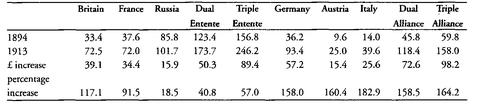
Source: Hobson, Wary Titan, pp. 464f.
Table 13b: Defence expenditure as a percentage of net national product, 1873-1913.
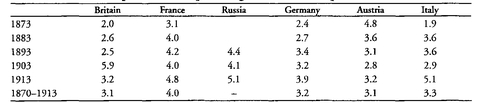
Source: as table 13a.
Financing these increased expenditures was one of the central political problems of the period. Symbolically, it was rising military spending which precipitated both Randolph Churchill’s resignation as Chancellor in 1886 and Gladstone’s as Prime Minister in 1894. They were among the first of many political casualties of the new military-financial complex.
The problem of how to pay for rising military costs was compounded by the rising cost of government as a whole. At both the national and local level—as well as at the regional level in federal systems like the German and Austrian—the 1890s saw the end the “nightwatchman state” era, which had been characterised in most European countries by a contraction in the size of the state relative to the economy. Whether to appease politically powerful (or potentially dangerous) social groups or to increase “national efficiency,” governments began to spend increasing amounts on urban infrastructure, education, provision for the sick, poor and elderly. Though by modern standards the amounts involved were still small, the increases in expenditure were generally ahead of aggregate economic growth. There were two ways in which this increased expenditure could be met, and each had profound political implications.
One way of raising public revenue was, of course, by putting up taxation: the great question was whether this should be indirect taxation (principally in the form of customs and excise duties on articles of consumption from bread to beer) or direct (for example, a tax on higher incomes or inheritances). In Britain, where the break with protectionism had been more decisive than elsewhere, taxes on imported food were rejected by the electorate, despite the efforts of Chamberlain and others to give tariffs an imperialist rationale. This inevitably put the onus on the rich, and that, needless to say, included the exceptionally wealthy Rothschilds. The key to Natty’s political marginalisation in the period after around 1905 lies here. On the one hand, he was a keen proponent of increased naval expenditure; on the other, he was reluctant to pay for it. In March 1909 he spelt out this ultimately untenable position in a speech to the Institute of Directors and the Naval and Military Defence Committee of the London Chamber of Commerce:
At the present time we were threatened with a great increase of taxation. He [Natty] did not know if the revenue would come up to expectation, but a large expenditure had been incurred, and he supposed a good deal more would be be necessary, because all would agree that the Fleet must be maintained in the highest state of efficiency. (Cheers). That being the case, heavier burdens would be thrown on the entire community, and an institute of this kind might be able to say a few words to the Chancellor of the Exchequer with the object of preventing the incidence of taxation from disturbing the commercial arrangements of the country more than was necessary. (Cheers).
A month later, he told a large City audience at the Guildhall “to pledge their support to the Government in any financial arrangements that might be necessary to maintain our naval supremacy”; yet he failed to spell out which arrangements he had in mind. Natty knew full well that “the two absorbent questions ... namely the Budget and the Navy estimates,” were “closely allied”; but he underestimated the political and constitutional implications of this alliance.
In Germany, by contrast, where the Reich was conventionally restricted to financing itself (and hence the German army and navy) exclusively from indirect taxes, the tendency was for tariffs to rise; but working-class dissatisfaction with the combination of “dear bread” and “militarism” was so successfully exploited by the Social Democratic Party (SPD) that the government was soon forced to contemplate introducing property taxes at the Reich level. Here again, Natty misread the implications of increased “militarism.” In 1907 he interpreted Prince Bülow’s election victory over the SPD as a victory for what the strategy historians have dubbed “social imperialism”:
The elections which took place in Germany at the end of the last week are a striking example of how national sentiments and imperialistic tendencies have more than anything else contributed to the rout of socialistic ideas, in all probability the Kaiser and his favourite henchman Prince Bülow will go ahead with their Welt-Politik, will rattle the sword in the scabbard, will incur fresh military and naval expenditure on a grand scale, expenditure which no doubt will be felt in England and in France and must in the state of European finance defer the realisation of many socialistic dreams.
In reality, the 1907 result was an ephemeral victory obtained by uniting the so-called “bourgeois” parties in the wake of the successful war against the Herero in South-West Africa. By the time of the next general election in 1912, that unity had crumbled precisely because of disagreements about the funding of military expenditure. Contrary to the assumptions of many on the German right, spending more on the army and navy tended to strengthen the position of the Social Democrats by focusing voters’ attention on the regressive way in which defence spending was financed.
The other way of paying for the rising costs of domestic and foreign policy was, of course, by borrowing. As table 13c shows, this was an option favoured in some countries more than in others. Both Germany and Russia borrowed heavily in the period after 1890, roughly doubling their national debts in the period to 1913; however, when adjustment is made for the depreciation of the rouble in sterling terms, the debt burden in the Russian case rose by just two-thirds, a significantly smaller increase. In absolute terms, France borrowed a lot too, though from a starting point of higher indebtedness than Germany (hence the lower percentage increase). Britain was unusual among the great powers in reducing the level of her national debt between 1887 and 1913. This achievement is all the more impressive when one remembers that the cost of the Boer War drove up government borrowing—by £132 million in total—in the years between 1900 and 1903.
Table 13c: National debts in millions of national currencies (and sterling), 1887-1913.
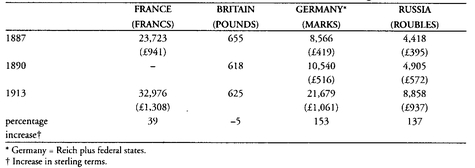
Sources: Schremmer, “Public finance,” p. 398; Mitchell, British historical statistics, pp. 402f; Hoffmann et al, Wachstum, pp. 789f.; Apostol, Bernatzky and Michelson, Russian public finances, pp. 234, 239.
These were not unsustainable burdens at a time of unprecedented economic growth. Indeed, in all four cases total debt tended to fall in relation to net national product, as table 13d shows. By modern standards, only France had a high ratio of debt to net national product and the tendency was for the burden to diminish.
Table 13d: National debt as a percentage of net national product, 1887-1913.

Sources: as table 13c and Hobson, “Wary Titan,” pp. 505f.
Nevertheless, contemporaries were disturbed by the absolute increase in government borrowing. This was because of the decline in bond prices—or rise in yields (see table 13e)—which manifested itself after around 1890.
The principal cause of this decline was in fact the acceleration of inflation, a monetary phenomenon caused by the increase in gold production and, more important, the rapid development of banking intermediation, which was increasing the use of paper money and cashless transaction methods (especially inter-bank clearing). Contemporaries, however, interpreted rising bond yields as a form of market protest against lax fiscal policies. This was only really true in so far as public sector bond issues were tending to push up the cost of borrowing across the board by “crowding out” or competing with private sector claims on the capital market. Nevertheless, the accusation of fiscal incontinence was repeatedly levelled at most governments—even the British—by critics on both the left and right. Table 13f shows that rising yields were a universal phenomenon; of more interest, however, is the fact that there were pronounced differences or “spreads” between the yields on the various countries’ bonds. These yield spreads genuinely did express market assessments not just of fiscal policy but more generally of political stability and foreign policy, given the traditionally close correlations between the perils of revolution, war and insolvency. Perhaps predictably, because of the experience of 1904-5 and her more general problems of economic and political “backwardness,” Russia was regarded as the biggest credit risk among the great powers. More surprising is the wide differential between German yields and those for British and French bonds, which were remarkably similar. This cannot be explained in terms of the greater demands by the German private sector on the Berlin capital market, as these are London prices (and in any case investors were generally choosing between different governments’ bonds, not between industrial securities or bonds). It seems investors shared the view of the better-informed political observers of the time that Wilhelmine Germany was financially less strong than its Western rivals.
Table 13e: Major European bond prices, c. 1896—1914.
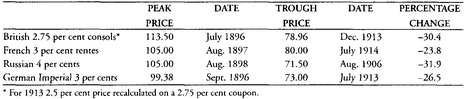
Source: Economist (weekly closing prices).
Table 13f: Bond yields of the major powers, 1911-1914.

Source: Economist (average monthly London prices).
“Too Much Lord Rothschild”
By the turn of the century, the Rothschild identification with the Conservative party was more or less complete. Dorothy Pinto (who later married Edmond’s son James) recalled how “as a child I thought Lord Rothschild lived at the Foreign Office, because from my schoolroom window I used to watch his carriage standing outside every afternoon—while in reality of course he was closeted with Arthur Balfour.” The two men had their differences, to be sure: in 1901, for example, Natty wrote to complain about a speech Balfour had made in the Commons which had made inaccurate criticisms of De Beers, and they seem to have disagreed on the question of immigration controls. But for most of Balfour’s three-year term as Prime Minister they worked closely together.
There was a danger to this proximity. As Edward Hamilton commented, even before Salisbury retired in July 1902 Natty had “become so strong a party man, he will now be ‘out of it’ whenever the other side comes in.” This was astute. In the past, the Rothschilds had been adept at maintaining lines of communication with both government and Opposition. By the early 1900s, however, a new generation of Liberals had come to the fore with whom Natty and his brothers had virtually no social or political contact. Had Rosebery retained the Liberal leadership, there would have been no problem, but after his resignation as Prime Minister in 1895, and as Liberal leader the following year, his influence waned. As president of the imperialist Liberal League, he was profoundly out of sympathy with the more Radical “New” Liberal wing of the party which filled the majority of ministerial posts when the party regained power in 1906. By that time Rosebery had left the party altogether, having denounced both the Anglo-French entente and Irish Home Rule the year before. As the husband of Hannah’s daughter Peggy, Rosebery’s son-in-law the Earl of Crewe was naturally part of the broader Rothschild familial circle, but there is little evidence that he was politically close to Natty. True, it was a matter of course that Herbert Asquith, the new Chancellor, was invited to dine with the Lords Rothschild and Revelstoke at the Lord Mayor’s annual dinner. But neither Asquith nor the City grandees had any illusions about their deep differences of opinion. As Natty put it, “the City Magnates who were present ... came to the very easy conclusion that Mr Asquith did not understand much about business. The frigid way in which his remarks were listened to will, I hope, be a damper to some of his rash & enthusiastic advisers.” He and his brothers were not wholly excluded from the corridors of power; but their views, frigid or otherwise, carried little weight. Once, the Rothschilds had mixed with politicians regardless of party allegiance in order to obtain the best possible political intelligence and to influence financial and foreign policy. Now Natty was himself a politician, making remarkably frequent public speeches and donating substantial sums to the Tory party machine. He had become so overtly partisan that he was effectively cut off from both intelligence and influence under a Liberal administration.
An electoral landslide on the scale of the Liberal triumph in 1906 usually owes as much to the exhaustion and disunity of the vanquished party as to the programme of the victor. Central to the Conservatives’ demise were the rising costs of their imperial policies after 1899, and their inability to agree on a way to pay for them. It was not just a question of beating the Boers and building new battleships. The administrative and even physical deficiencies exposed by the war in South Africa prompted widespread criticism—even a sense of national crisis—on both left and right. The Conservatives lacked a coherent response. It was typical that, when asked by Chamberlain to chair a Treasury committee to consider improving the piecemeal system of old-age pensions, Natty made little secret of his scepticism about the possibility of some kind of state contributory system on the German model, and he was even more hostile to any idea of non-contributory handouts to the elderly. Following Chamberlain’s conversion to the idea of increased protectionist tariffs as a solution to Britain’s domestic and imperial problems, the Rothschilds’ response was as ambivalent as that of the party as a whole.
For most of the second half of the nineteenth century, the family had been firmly committed to free trade. Alphonse’s vitriolic comments on American and French tariff policy in the 1890s show that such attitudes were alive and well even at the turn of the century. “France is going to die from suffocation under protectionism,” he warned in 1896. “The best of socialisms is the free exchange of international production, and were M. Jaurès (the socialist leader) to preach nothing else we would unanimously be of his opinion.” But by 1903 his London cousins were wavering in their allegiance to “the sacred principles of free trade.” On July 3, Natty confessed to Edward Hamilton that he was “rather taken by Chamberlain’s plan”—a remarkable volte face for a man who had once dismissed the Colonial Secretary as “a Radical wolf in Tory sheep’s clothing ... the typical democrat—a spendthrift and jingo.” When Chamberlain resigned from the Cabinet over the issue on September 17, Natty defended both him and Balfour against the complaints of the Duke of Devonshire who “ought to have known at the Cabinet what Chamberlain intended doing, but ... was either asleep or woolgathering.” On October 7, the day after Chamberlain’s curtain-raising call for a policy of “imperial preference” at Glasgow, his keen supporter Harry Chaplin dined with Alfred and two other “City men”:
I asked in an innocent way what they thought of the Glasgow Speech in the City and they all burst out at once. Only one opinion!!!!! Some well-known and prominent Free Traders and others who had always been opposed—come round entirely, general satisfaction, followed by a boom—Consols going up 1 or 3/4—the precise details in City matters I can never remember and it doesn’t matter. Alfred R, whom I asked afterwards privately, more than confirmed all this. He has been in the City today, and entirely agreed that there is no doubt as to the impression you have made in those circles, and after all, the City is very important.
In reality, Chamberlain’s proposals divided the City elite. Lining up behind Chamberlain and alongside the Rothschild brothers were Cassel, Clinton Dawkins of J. S. Morgan, Everard Hambro (who became honorary treasurer of the Tariff Reform League), the Gibbs family, Robert Benson, Edward Stern and Philip Sassoon. Influential names, no doubt; but the opponents included not only Felix Schuster, the increasingly authoritative governor of the Union Bank of London and one of the City’s staunchest Liberals, but also Conservative Free Traders like Lord Avebury and Sir James Mackay (later Lord Inchcape). These were formidable opponents, and it may have been their rejection of Chamberlain which persuaded Natty to row back from his initial support. By the time “Joe” addressed a public meeting at the Guildhall in January 1904, it was becoming apparent that, as Dawkins put it after the speech, “banking opinion [was] on the whole against him”—perhaps understandably, when he tactlessly told his audience that “banking was not the creator of our prosperity, but its creation ... not the cause of our wealth but the consequence.” Significantly, when the Duke of Devonshire addressed a free trade meeting in the same venue two weeks later, Natty was on the platform. This would seem to bear out Hamilton’s snide comment (in relation to another fiscal question) that Natty now thought “it necessary to consult every broker” and had “no idea of having an opinion of his own.”
Perhaps Natty was not confused; it seems more likely that, like Balfour himself, he was sitting on the fence for tactical reasons, in the hope of maintaining a semblance of party unity. Either way, he could do nothing to limit the damage done by Chamberlain’s campaign. Natty had “no doubt,” even before the voting began in January 1906, that “Sir H[enr]y Campbell-Bannerman [would] have a majority.” What the Rothschilds were not prepared for was the scale of the Conservative rout: the Liberals not only increased their share of the vote from 45 to 49 per cent, but—more important—won an immense majority in the Commons, taking 400 out of 670 seats to the Conservatives’ 157. Given the Liberals’ proximity to the Labour and Irish Nationalist parties on key issues, their MPs (30 and 83 respectively in number) could be regarded as pro-government too. Contrary to Leo’s expectation, even Balfour lost his seat (though it was quickly agreed to install him in place of Alban Gibbs as one of the two City members). It was, as Natty lamented even before the final results were in, a “disastrous” result—“unexpectedly bad.”
Why had it happened? Besides the obvious point that “the country has had 20 years of Unionist Government & naturally wanted a change,” Natty offered a long list of factors:
Education, the Religious Question connected with it, Ultra protes tantism, in some cases orders from the Catholic Hierarchy to their labouring men to vote Radical & for Socialists, Chinese Labour [in South Africa], the Temperance Question, dissatisfaction of the Jewish voters with the Alien Immigration Act, and last but not least the Taff Vale decision ... that Trades’ Unions could be sued for damages caused by a strike, that their funds were not as supposed, inalienable.
But the key was surely the Tory split over tariffs. Even within the Rothschild family, there was division, with Natty’s son Walter winning Mid Bucks as a Unionist Free Trader, and even going so far as to vote with the Liberal government against the Chamberlainites in March 1906, while in the City of London constituency itself, the Conservative vote split evenly between the Tariff Reformer Gibbs and the Free Trader Sir Edward Clarke. In analysing the results, Natty sometimes sought to play down the significance of the tariff issue. Walter’s large majority, he insisted, was merely a sign of local “loyalty” to the family, rather than a vote for free trade; while the City result “in no way represented ... a feeling for Tariff Reform, & certainly not for Chamberlainism.” But privately he could not deny that the split had been fatal, and his comments on the subject show where his sympathies really lay. “One thing however I feel quite certain of,” he remarked bitterly, “[and] that is that a great many of the Free fooders, & Free traders, like the Duke of Devonshire, are by no means satisfied with the situation they have helped to create.” Natty was obliquely critical of Chamberlain too, contrasting his ambition to “build up a new party & a new policy” with Balfour’s pragmatic desire simply to “increase the power of the opposition just at present.” Both he and Leo agreed that “the late Prime Minister” would have to stay on as Tory leader “because his views on the fiscal question are more in accordance with those of the country than Mr Chamberlain’s.” But they felt closer on the issue of principle to Chamberlain than to Devonshire. Natty’s support for a strategy of “sit[ting] & watch[ing] the course of events” rather than “pro-pound [ing] a policy” was tactical rather than ideological; he evidently hoped that under Balfour’s leadership unity on the tariff issue might ultimately be attainable. Thus in 1910—by which time Balfour had come off the fence in favour of protection—Natty was able to be more open about “the advantages of Tariff Reform.” “[T]he subject is the most popular one for the moment,” he told his French cousins, “and probably will turn the election.”
Such political misjudgements became a regular feature of Natty’s correspondence in the Liberal era. He was, it should be remembered, no longer a young man: he was in his seventieth year when he wrote those lines. But the belief that an election could be won on a protectionist platform was not the greatest of his political miscalculations. On a wide range of issues, the Liberals could confidently be expected to disagree among themselves. On Chinese labour in South Africa, they did so almost at once, to his great glee. On education, as Natty said, it was indeed difficult to produce “a measure acceptable alike to the Dissenters, the Church, & the Non Conformists.” There were Liberal businessmen who were bound to oppose a trade union bill which placed the unions “under a different law from the rest of the community.” Above all, there was little reason to expect the issue of Home Rule to be any easier for Campbell-Bannerman than it had been for Gladstone. Yet Natty was wildly over-optimistic in thinking that such divisions might make the government “a very short lived one, & the Unionist Party may be again restored to strength & power much more quickly than they expected.” Of course, the Conservatives could only really recover from the nadir of 1906, and it was reasonable to draw encouragement from local and by-election results. But there were a few subjects which were very likely to unite the Liberals: and one of them was the question of taxation.
Natty was not unaware of the significance of this. “[T]he chief bone of contention besides the Education question,” he predicted even before the voting had begun in 1906, “will be the Budget, which is to be of a very Radical character.” From an early stage, he recognised that the vociferous contingent of Labour MPs—“the gentlemen who wear red neckties, & are sorry they cannot doff the Phrygian Cap”—would put pressure on the government to consider measures such as “a large & comprehensive scheme of old age pensions, & a square meal once a day for every child in school.” Although he was inclined to think that the government would “not do anything rash or violent,” he grasped that any measures which implied an increase in government expenditure must imply some kind of increase in the burden of direct taxation: after all, the Liberals had been elected as unequivocal Free Traders, and so could hardly be expected substantially to increase indirect taxation.
To begin with, the fiscal issue lay more or less dormant: the government inherited a surplus and Natty did not expect “any rash experiments in finance ... the difficulties connected with a graduated income tax may be hinted at & the taxation of site values talked of, but probably everything will go on in the same humdrum fashion.” “No doubt there are a good many crude ideas in the air about new forms of taxation . or confiscation,” he airily told his cousins in Paris. “I could not say that the Government would not be inclined to adopt them if they thought they were feasible or likely to bring grist to their mill.” But they would not, because such measures “would defeat their own object & be illusory sources of revenue, besides doing a great deal of harm.” Natty was more or less dismissive of Asquith’s first budget, which had disappointed some commentators who had been hoping for more radical retrenchment. At first, it had been hoped by the likes of Schuster and Holden “that Mr Asquith was going to put on extra taxation in order to buy up the National Debt; and now they heap coals of fire on the Chancellor of the Exchequer’s head” because his budget reduced taxation. Natty put this down to the fact that the deposit banks had large holdings of consols, the price of which they wished to see pushed up; for his part he was more alarmed by Asquith’s decision to set up a Commons Committee “on the incidence of the Income Tax, & various schemes for graduating that obnoxious impost.” But even the prospect of a graduated tax and a surcharge for higher incomes did not worry him much at this stage “as the number of millionaires was very few, they already paid very heavy death duties and a great many of them might send their fortunes to America or elsewhere, where they could not be taxed.”
Considering the size of the government’s majority in the Commons, Natty’s equanimity was strange. It had two bases. Firstly, he retained the old Rothschild faith that an excessively radical fiscal policy would be punished by the financial markets : capital would be sent abroad to avoid higher taxes and consols would fall, embarrassing a Radical Chancellor into compromising. The already low price of consols when the Liberals came to office seemed to reinforce that argument; it was even more gratifying when they dropped two percentage points in the summer. Natty outlined his views on the subject in a series of letters to Paris:
As English securities were dull, I hope it will give the Chancellor of the Exchequer food for reflection & will convince him of the folly of the greater part of the Government’s Radical programme ... [is] the lowest price Consols have been since the war. It is ... an ironical answer to Lloyd George who boasted at Manchester the other day that the Rise in Consols was a proof of the Confidence the country had in His Majesty’s Ministers ... This state of affairs should have a salutary effect at both the Treasury & the Local Government Board; because, whether they like it or not, it would be quite impossible for the County & Municipal Authorities to borrow money, & without money they cannot carry on their Socialistic programme & destroy private enterprise. The Chancellor of the Exchequer will, I suppose, also learn that the Socialistic taxation he talked of is not conducive to public credit ... [N]othing is more likely to defeat socialistic legislation than the depreciation of Home Securities.
Nor did Natty see this as a peculiarity of British politics. His letters to Paris in this period constantly allude to the parallel between British events and the attempts by left-of-centre French governments to introduce income tax or to increase state control over the railways. He saw it as a general rule of democratic politics in a capitalist economy: financial “nervousness on account of the socialistic tendencies of modern legislative bodies ... is very disagreeable but it is perhaps the best cure for the socialistic tendencies.” And again: “the fear of socialistic legislation is the real cause of the depression in both hemispheres.” Natty constantly hoped that “the small bona-fide holders of English securities ... many of [whom] helped to put a radical government in power” would turn against the government’s fiscal policy en masse. Indeed, he went so far as to outline his argument in an interview with the left-leaning Daily News in October 1907—one of the first occasions a journalist had ever been admitted to New Court, and a calculated bid to reach a wider audience. The message was straightforward: “‘Stocks are low,’ said Lord Rothschild, ‘because Governments all over the world are hitting at capital.”’
This marked the start of an escalating campaign of public opposition to the government’s fiscal policy. When the government proposed radical reform of the licensing laws—a sop to the Temperance lobby—Natty chaired a meeting of brewery debenture holders to protest at the negative financial consequences. When Lloyd George became Chancellor and hinted at the need to “rob henroosts” to pay for the new non-contributory pensions, he harped on the same old theme. The culmination of his campaign came with the unveiling of Lloyd George’s so-called “People’s Budget” of 1909, the key features of which were an increase in tax on “unearned” income to 1s 2d in the pound, the introduction of a super-tax on incomes above £5,000, an increase in inheritance tax and levies on land values. With the exception of the last item (which implied the first systematic survey of land values for centuries), none of these changes was actually unprecedented: differentiated taxation had been introduced by Asquith in 1907, the principle of graduation had always been implicit in the existence of an income tax threshold and Goschen—a Conservative Chancellor—had been the first to tax inheritances in 1889. Yet the apparently radical intent of the budget as a whole galvanised Natty into a kind of high-profile political engagement which went beyond even his father’s campaign for Jewish admission to the Commons.
No sooner had the Finance Bill been introduced than he organised the letter to Asquith signed by twenty-one leading City figures (representing fourteen City houses, including Barings, Gibbs, Hambros and J. S. Morgan), which warned that the new taxes—particularly the “great increase and graduation of the death duties”—would not only “prove seriously injurious to the commerce and industries of the country” by eating into capital, but would also “discourage private enterprise and thrift, thus in the long-run diminishing employment and reducing wages.” He then called and chaired a protest meeting “representative of all interests in the City, and independent of political associations” at the Cannon Street Hotel on June 23, which passed a resolution that “the main proposals in the Budget weaken the security in all private property, discourage enterprise and thrift, and would prove seriously injurious to the commerce and industries of the country.”2 His own speech at this meeting took a somewhat different tack, arguing that the Chancellor had no historic right to raise a surplus for unspecified purposes and that the taxes on land were an underhand ploy to “establish the principles of Socialism and collectivism.” But, speaking later in the Lords, Natty reverted to his original economic critique, assuring fellow peers that both capital flight and increased unemployment in the building trade were due to the damage Lloyd George had done to “credit” and “confidence.” He was still peddling the same line when it was confirmed that the Tories had failed to secure a majority in the first 1910 election.
Just as he believed firmly in the power of the City’s banking elite, Natty also remained confident that the House of Lords would be able “to alter considerably or to throw out” any excessively radical measures. As early as January 1906, he had consoled himself with the thought that “it doesn’t matter what takes place in the House of Commons, as the House of Lords will put it all right.” “The Lords play with loaded dice,” declared Leo on the eve of the Liberals’ second session in early 1907, so that if “very many extreme measures [are] brought in ... it is doubtful if they will be passed, at all events in the shape in which they were introduced.” Even if these included, as he expected, “the abolition of the House of Lords, Home Rule for Ireland, a licensing bill, increased taxation with many other socialistic measures,” the Prime Minister would have to “put a good deal of water into his wine.” Nor did they take seriously the possibility that the Lords’ right of veto might be challenged. “I do not think,” declared Natty blithely later that summer, “that the House of Lords is in any peril whatsoever.” Talk in the Commons of “materially diminishing its power & influence” was “looked upon as a farce, & will probably be forgotten in a few days”; he mentioned it to his cousins only “to show how weak our Government must be, if they seriously introduce a plan which has no chance of ultimate success, & which exposes them to the ridicule of everyone, with the exception of their immediate followers.” Natty thus felt no qualms about voting with the other Tory peers to throw out the government’s Licensing Bill in November 1908; and he and his brothers were delighted when their relative and friend Rosebery joined the campaign against the People’s Budget, denouncing it as “the end of all, the negation of faith, of family, of property, of Monarchy, of Empire”—in short, “revolution.” The link between City opposition and the peers’ opposition was deliberately symbolised when Natty presented the Budget Protest League’s petition—carrying 14,000 signatures—to the Lords on November 22.
Yet Natty overestimated the power of both the City and the House of Lords. For one thing, it was not at all convincing to blame the “low price of English funds” on the government’s “socialistic doctrines.” As Lipman has shown with reference to the period 1859 to 1914, there was a difference between the average yield of consols under Conservative governments and the average yield under Liberal governments, but it was very small (less than ten basis points), and is much better explained by changes in inflation and the international situation. Consol prices did indeed fall under Campbell-Bannerman and Asquith, from a peak of 90.4 in February 1906 to a pre-war low of 71.8 at the end of 1913. But it was difficult to blame this slide on Liberal fiscal policy, and it did not have the effect of constraining Asquith or his more radical successor Lloyd George. “Politics,” as Natty occasionally had to admit, “but little influence our Stock Exchange.” Possibly some bears in the market were “influenced by the fear of prospective legislation, a temperance measure and various wild schemes which are spoken of in connection with old age pensions”; but “the chief anxiety of the City and the Stock Exchange [was] always the money market,” and that was much more influenced by the state of gold reserves, the Bank’s discounting policy and aggregate new debt creation in the global economy as a whole.
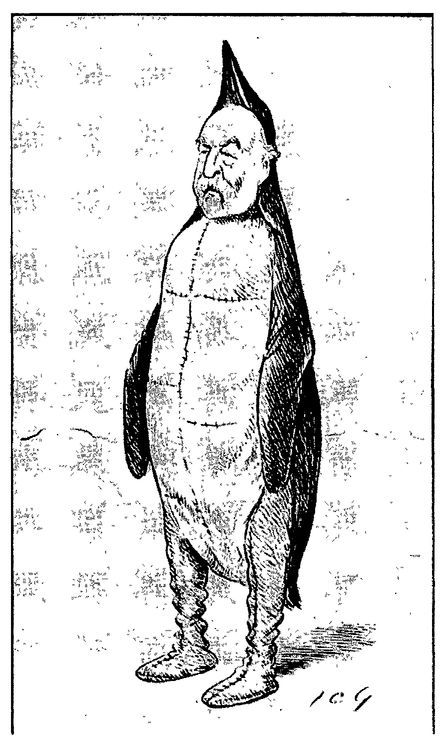
Time and again, the markets refused to back up Natty’s condemnation of Liberal fiscal policy by falling when they were supposed to. There was no negative reaction to Asquith’s 1907 budget, despite the fact that Natty denounced it as “immoral” and tending towards “the gradual extinction of all private fortunes.” In truth, he later had to acknowledge, it was “very doubtful if the markets are at all affected by political news just now. The prices improve or decline according to the financial news of the day, the state of the money-market and the news which is received from other financial centres.” “[I]n the long run,” he conceded in early 1908 as the markets once again refused to be moved by the Licensing Bill, “very easy money always tells.” The 1908 budget was also roundly condemned by Natty, but “all the markets [were] good” after its presentation, and the stock exchange seemed not to care about the new Chancellor’s explicit warnings of “further and heavy increased taxation on what he calls the idle rich.” A slight drop in the price of consols later that summer and a sustained decline in the second half of the year offered some support for Natty’s interpretation, but neither was solely caused by Lloyd George’s talk of “robbing henroosts.” Indeed, the clearer Lloyd George’s intentions became, the less consols fell: prices actually rose in the first five months of 1909. The most that can be said is that the City discounted the People’s Budget six months before its publication and even then the effect was modest and ephemeral. The Westminster Gazette cruelly summed up the absurdity of Natty’s position when its cartoonist depicted him “escaping to the Antarctic region disguised as a Penguin” to avoid Lloyd George’s taxes (see illustration 13.i).
Only when a tax measure threatened to bear directly on financial transactions was the argument plausible that fiscal policy was depressing the stock market. Thus Natty was on strong ground when he—along with a large number of other City representatives Lloyd George consulted—argued against an increase in the stamp duties on domestic and foreign bills of exchange on the ground that it would cause “a large diminution of business” and therefore of revenue. This argument was ultimately accepted by the Chancellor and the original scale of duties was altered to reduce the charge on “transactions of average magnitude” (defined as those greater than £1,000). Here the bankers had real leverage. But Lloyd George’s more important proposals apparently caused “no perturbation in the minds of the public” (meaning investors in aggregate): despite Natty’s campaign, the markets as a whole were “firm” in the wake of the 1909 budget. Indeed, a loan by the London County Council which was issued just after the budget was heavily oversubscribed. Nor can Natty’s claims that the markets improved on the news of the Lords’ rejection of the budget be taken seriously. As the Economist put it, the stock exchange had “now persuaded itself [that] its own interests will not be greatly affected. Prices have, therefore, been left very much to purely market influences.” So long as the markets seemed neutral, it was just as plausible for supporters of the government to argue that the Lords’ rejection would cause a financial crisis.
The key to the ultimate failure of Natty’s opposition to Liberal finance lies here: although Liberal tax policy was unprecedentedly progressive, it was entirely orthodox in that the aim of increased taxation was to balance the budget and indeed to reduce the national debt. Lloyd George inherited a deficit when he became Chancellor, largely the result of the 1907 economic downturn, the new pensions scheme and increasing defence expenditure. The principal objective of the People’s Budget was to reduce that deficit; and, for the majority of investors interested in consols, that was the crucial thing. How the money was raised was less important, and Natty’s claim that any surplus would be squandered on “socialistic expenditure which would pander to the lower classes” was absurd. To write about “the destruction of capital” and “firm and brilliant markets” in one and the same letter was to encapsulate the contradiction in the argument.
Natty also exaggerated the strength of the Lords on fiscal questions. As he himself admitted, “the House of Lords cannot amend [a Finance Bill], but can only reject en bloc, [and] that is a very serious thing to do.” If a budget were rejected principally because it increased tax on the very social group which was over-represented in the Lords—the wealthy elite—then a good case could be made for a constitutional reform. As early as December 1906, Lansdowne indicated that he did not wish to see a head-to-head confrontation with the government when he argued that the Trades Disputes Bill was “a test question at the last election.” When “the conflict between Lords and Commons” began in earnest over peers’ amendments to the Education Bill, Natty was right to feel nervous and wrong to assume that the resulting “agitation” would “damage the Government a good deal.” If, as he suspected in February 1907, the government wished to provoke the Lords into rejecting “very popular measures” in order to fight a new election on the constitutional issue, the stakes would be high indeed. It was all very well to sneer at “the much pampered and not over-worked British workman”; but there were now enough lower-income voters enfranchised to make the position of “those who have got something”—a typical Natty euphemism for the very rich—politically vulnerable.
13.i: Potted Peers: Lord Rothschild, “The whole of the British capital having been exported to the South Pole as a result of the Budget Revolution, Lord Rothschild flies from St Swithin’s Lane and succeeds in escaping to the Antarctic regions disguised as a Penguin,” Westminster Gazette (1909).
It must be added that Natty’s arguments against higher income taxes and death duties have not worn well. “[D]iminished incomes,” he reasoned, “mean a diminution of money to spend and a diminution of employment, increased death duties mean a diminution of capital and less Income Tax, increased Income Tax means less money to save and less Capital liable to death duty.” As a justification for leaving the rich in peace to enjoy their largely unearned and inherited wealth this was weak stuff. In an increasingly democratic system, a policy of “making the Income Tax ... still more disagreeable to the capitalists & to the wealthy” had undoubted and not easily refutable attractions. Even if Natty was not wholly wrong that relatively modest increases in death duties represented the thin end of a wedge, he was doomed to lose the debate—especially when he admitted the force of the argument that “the burden of taxation should fall on the shoulders of those best able to bear it.” In just the same way, the Rothschilds’ arguments against land reform to increase the number of small proprietors in the British Isles were economically reasonable, but sounded at the time like the special pleading of big landowners. It was to stretch the antiquated principle of virtual representation too far to justify the Lords’ opposition to government measures on the basis of Opposition by-election successes. To be sure, the Liberals saw their commanding majority in the Commons shrink as a consequence of the 1910 elections. But in the end it was the Lords who lost their power to veto finance bills. And of course Lloyd George’s taxes were ultimately put in place. “I cannot suppose,” Natty mused in January 1910, “that ... the masses ... can have any sympathy for the rich men who are to be taxed.” It was as if this had only just dawned on him.
To make life easier for the Liberals, Natty had also unwittingly handed the government the perfect stick with which to beat him even before the People’s Budget was unveiled. It would undoubtedly have been hard for the government to justify new taxes if the surpluses which had characterised its first two years in office had continued. And it might just have been credible to oppose higher direct taxes if the budget had been unbalanced by “Old Age Pensions and various other sops which [the government‘s] democratic supporters are clamouring for.” But the reality was that a large part of the hole Lloyd George was trying to fill was due to the increased defence spending; and this was something Natty and his associates in the City had vehemently supported. Natty had publicly endorsed Richard Haldane’s programme of army reforms (though he privately opposed the conversion of the old militias into the Special Reserve).3 He and Leo had been even more enthused by the decision to increase expenditure on the navy (not least because it put the Radicals’ noses out of joint). But Natty’s involvement in the campaign for eight rather than four dreadnoughts in early 1909 was a grievous tactical blunder. When he explicitly admitted that “a large expenditure had been incurred, and he supposed a good deal more would be be necessary” if the navy were to be kept “in the highest state of efficiency,” he was giving Lloyd George the perfect opening. And when the Chancellor hit back at “the inevitable Lord Rothschild” in a speech at the Holborn Restaurant—the very day after the anti-budget meeting at which Natty had accused him of “Socialism and collectivism”—he did not miss his chance:
Really, in all of these things we are having too much Lord Rothschild. We are not to have temperance reform in this country. Why? Because Lord Rothschild has sent a circular to the Peers saying so. (Laughter.) We must have more Dreadnoughts. Why? Because Lord Rothschild said so at a meeting in the City. (Laughter.) We must not pay for them when we have them. Why? Because Lord Rothschild said so at another meeting. (Laughter and cheers.) You must not have estate duties and a super-tax. Why? Because Lord Rothschild signed a protest on behalf of the bankers to say he would not stand it. (Laughter.) You must not have a tax on reversions. Why? Because Lord Rothschild, as chairman of an insurance company, has said it would not do. (Laughter.) You must not have a tax on undeveloped land. Why? Because Lord Rothschild is chairman of an industrial dwellings company. (Laughter.) You ought not to have old-age pensions. Why? Because Lord Rothschild was a member of a committee that said it could not be done. (Laughter.) Now, really, I should like to know, is Lord Rothschild the dictator of this country? (Cheers.) Are we really to have all the ways of reform blocked simply by a noticeboard, “No thoroughfare. By order of Nathaniel Rothschild?” (Laughter and cheers.) There are countries where they have made it perfectly clear that they are not going to have their policy dictated merely by great financiers, and if this sort of thing goes on this country will join the rest of them. (Cheers.) Apart from purely party moves ... there is really no move against the Budget at all.
This was characteristically strong, not to say demagogic stuff (especially if the other countries alluded to implicitly included Russia); but it struck the Rothschild campaign at its weakest point. Natty had wanted more dreadnoughts. How did he propose they should be paid for, if not partly from his own pocket?
Lloyd George knew when he had an opponent on the run. Speaking at a meeting at Walworth Hall in London on December 18, he warmed to his theme:
Who clamoured for additional Dreadnoughts? He [Lloyd George] remembered a great meeting in the City, presided over by Lord Rothschild, who demanded that eight Dreadnoughts should be instantly laid down. The Government had ordered four, and Lord Rothschild would not pay (laughter). There had been a very cruel king in the past who ordered Lord Rothschild’s ancestors to make bricks without straw (loud laughter). That was a much easier job than making Dreadnoughts without money.
As has often been pointed out, there was a fairly unmistakable anti-Semitic connotation to this last jibe (reminiscent of Thomas Carlyle’s allusion many years before to King John’s treatment of the Jews and of Gladstone’s swipes at Disraeli during the Bulgarian agitation). On this occasion, the lack of taste did not much diminish the effectiveness of the attack. Nor did Natty have much of an answer when a Jewish member of the government—the Chancellor of the Duchy of Lancaster Herbert Samuel—reminded him of the House of Lords’ ignominious role in opposing his own father’s admission to Parliament. Natty’s unconvincing response at an election meeting in the East End was that he was opposing “the new bureaucracy which the Government wish to introduce in this country”—a bureaucracy “similar” to the one which members of his audience had “fled from Russia to escape”! As they trundled around the country from one speaking engagement to the next, the abuse he and Lloyd George hurled at one another grew steadily cruder; the difference was that Lloyd George was winning the argument.4 Never in the history of the house of Rothschild had a partner put himself in such a politically exposed position.
Yet within five years, the tables were turned. Lloyd George’s “ruinous financial policy” might not frighten the markets as much as it financed the Rothschilds; but by the summer of 1914 the Liberal government’s majority in the House of Commons had been so whittled away at by-elections that the Chancellor suffered a humiliating defeat: the rejection of his Finance Bill. “Mr Lloyd George,” Natty gloated on July 10, “is ... even a discredited person in the eyes of the Government’s own supporters.” Moreover, the Chancellor was about to be engulfed by a financial crisis of such magnitude that he would be driven to seek the assistance of none other than the despised Lord Rothschild.
The cause of the crisis was an unforeseen and little regarded event in Sarajevo.
“Hatred Let Loose”
War was not a certainty in 1914; neither imperialism, nor the alliance system, nor any other impersonal forces made it inevitable. But it was a possibility. The question was what kind of war there would be. Another Balkan war? A continental war involving Russia and Austria, and therefore probably also France and Germany? It is important to remember that the third possibility—a world war involving the British Empire—was, of all the possible scenarios, one of the least likely. To most observers in London, including the Rothschilds, a civil war in Ireland seemed a more imminent danger.
Even as the financial and constitutional conflict between Lords and Commons had raged in 1909 and 1910, Natty had not lost sight of the old questions of land reform and Home Rule in Ireland. By putting the Irish MPs in a pivotal position at Westminster—the two big parties were almost exactly matched—the 1910 elections resurrected the Irish question. Partly for that reason, Natty became suddenly more cautious in his attitude to the constitutional question. He was willing to do a great deal to get the Conservatives back into power, even offering to lend to a minority Balfour government if it was denied supply by the Liberals in the Commons—an extraordinary proposal. But like Lansdowne and Balfour he feared a drastic inundation of Liberal peers. No sooner had Parliament reconvened than the previous year’s battle over the budget was put to one side as a lost cause; the older and more bitter question of Ireland, by contrast, seemed as winnable as ever—provided the Unionist majority in the Lords could be preserved. There was therefore a need to restrain the “hot-headed young bloods and old bloods too, who do not weigh the consequences of their action.”
The question which has sometimes been asked is whether Natty was himself hot-headed on the subject of Ulster. Was he in any way associated with those in the Conservative party who encouraged the Ulster Unionists to contemplate armed resistance to Home Rule? According to one account, he “personally contributed at least £10,000 to support the Ulster Volunteer Force resistance.” The evidence in the Milner papers on which this assertion based is, however, problematic: it is not inconceivable that Natty was the individual identified by the letter “D” on a list of contributors to an Ulster defence fund. What makes it seem unlikely is that in his letters to his Paris cousins Natty was anything but militant. “It is very unpleasant, disagreeable, I may even say painful,” he told his cousins on March 19, 1914,
to read of warlike preparations being made on both sides and sailors and artillery men spoken of as if England was going to embark on a real and serious military campaign. Hitherto at the crucial moment common sense and good will on both sides have proved to be such very strong factors that the danger has been averted and the problem has been solved. Will history repeat itself on this occasion? I earnestly hope so.
A few months later, he insisted that the view of “the great majority of Unionists can be summed up in a few words—‘It is our imperative duty to do everything which will in all probability prevent Civil War”’ By the beginning of July, he was optimistic : “[T]he ‘Peace barometer’ is decidedly rising,” he was able to report to Paris; there was now “a belief in City circles that civil war will be avoided in Ulster” and that “the Ulster question will be settled, at all events for the time being.” Natty “sincerely hoped” this would be the case and that “the shadow [of civil war] which has been hanging for so many months over the Country” would be lifted.
The truth was that, quite apart from the damage he had done to his relations with the Liberals, Natty was no longer being kept closely informed by the Conservative leadership by 1914. Balfour had been a close friend; his successor, the Glaswegian Bonar Law, was not—hence Natty’s “pain” when Balfour decided to resign the leadership in November 1911. Natty, barely knew Law and a handful of meetings in 1911 and 1912 did not change that. Personal and perhaps political differences can also be detected. According to the Conservative chairman Sir Arthur Steel-Maitland, the family contributed “£12,000 a year and large sums at Elections and subscribe [d] very largely to the L[iberal] U[nionist]s also,” as well as controlling at least one parliamentary seat at Hythe. But the Rothschilds’ favoured candidate for this seat—Philip Sassoon—no longer met with the leadership’s approval.5 When Herbert Gibbs approached Natty about raising additional funds in the City for Central Office in October 1911, Natty did not even reply; when Gibbs suggested that Bonar Law be invited to explain his financial policy to the City, Natty opposed the suggestion.
This froideur was more than merely personal. Under Bonar Law, the Conservatives not only became more aggressive on the Ulster question; they also became more aggressive on matters of foreign policy, and especially where Germany was concerned—a mood encouraged by the increasingly Germanophobe Tory-supporting press. It may seem odd that a man who in 1909 advocated an enlarged dreadnought programme should still have cherished hopes of preserving peace between Britain and Germany; but Natty evidently did. (He had after all emphasised that “in advocating a very strong Navy [he] had no intention of urging an aggressive policy.”) In 1912, Natty published a heartfelt essay in a collection entitled England and Germany which reveals his enduring Germanophilia: “What have we ... not got in common with Germany?” he asked. “Nothing perhaps except their army and our navy. But a combination of the most powerful military nation with the most powerful naval nation ought to be such as to command the respect of the whole world, and ensure universal peace.” With the benefit of hindsight this seems almost pathetic. Yet 1912—the year the Germans effectively abandoned the naval race—saw the beginning of a renewed effort to promote Anglo-German co-operation by Paul Schwabach, who remained in regular communication with the Rothschilds up until August 1914.
Even in 1914 there seemed little reason to expect the calamity of a war between Britain and Germany. Sir Edward Holden might fret about the size of the German “war chest” in the Julius tower at Spandau, and urge the City banks to pool their gold to give the Bank of England an adequate reserve in case of war; but Natty dismissed these as “very ridiculous ideas.” When he saw the German ambassador at Tring in March, “he said most decidedly that as far as he could see and as far as he knew, there was no reason for fear of war and no complications ahead.” June and July 1914 were dominated at New Court by Ulster worries and Brazilian loan negotiations. It was just another symptom of the good financial relations then prevailing between Britain and Germany that Max Warburg was in London on three separate occasions to finalise his firm’s role in the operation.
It has been suggested that the Rothschilds failed to grasp the significance of the July crisis—until, that is, it became the August war. As Cassis has observed, of twenty-five letters between New Court and the rue Laffitte between June 29 and July 23, only five mention the diplomatic ramifications of the assassination of the Archduke Franz Ferdinand at Sarajevo—“a sad example,” as Natty observed somewhat otiosely, “both [sic] of Servian brutality, the hatred of the Greek Church for those of the Catholic Faith and last but not least of the morals and doctrines of the anarchical party.” As early as July 6, however, Natty was wondering nervously: “Will the Austrian Monarchy and people remain quiet? or may a war be precipitated, the consequences of which no one can foresee?” Eight days later, he reported “a considerable amount of anxiety in some circles about Austro-Servian relations.” It is true that even on July 22, Natty remained confident, “rather fancy[ing] the well founded belief in influential quarters that unless Russia backed up Servia the latter will eat humble pie and that the inclination in Russia is to remain quiet, circumstances there not favouring a forward movement.” That, however, was not a wholly unreasonable assumption at that stage. Nor was the “general idea” he relayed the following day “that the various matters in dispute will be arranged without appeal to arms.” Before the details of the Austrian ultimatum to Serbia were known, it seemed quite likely that the Serbs would “give every satisfaction.” Natty was not complacent. As he told his cousins on July 27, “[N]o one thinks and talks about anything else but the European situation and the consequences which might arise if serious steps were not taken to prevent a European conflagration.” But it was “the universal opinion that Austria was quite justified in the demands she made on Servia and it would ill-become the great Powers if by a hasty and ill-conceived action they did anything which might be viewed as condoning a brutal murder,” even if “as usual from time immemorial” Austria had “not acted with diplomatic skill.” He was confident that Asquith’s government would leave “no stone ... unturned in the attempts which will be made to preserve the peace of Europe and in this policy, although the ... two rival parties in the state are more sharply divided than they have ever been, Mr Asquith will have the entire country at his back.”
Throughout the critical days from June 28 until August 3, Natty hoped for a diplomatic resolution of the crisis. He can undoubtedly be accused of naivety in believing that the German government did not want war. “It is very difficult to express any very positive opinion,” he told his French relatives one June 29, “but I think I may say we believe you to be wrong, not you personally, but French opinion, in attributing sinister motives and underhand dealings to the German Emperor[;] he is bound by certain treaties and engagements to come to the assistance of Austria if she is attacked by Russia but that is the last thing he wishes to do.” It was quite true that “the Czar and the Kaiser [were] corresponding directly over the wires in the interests of peace”; where Natty erred was in thinking that the Kaiser’s ministers (and more particularly his generals) sincerely wished the war to be “localised.” “The Powers are still talking and negotiating between themselves and endeavouring to localize the bloodshed and misery,” he reported hopefully on July 30. “[C]lumsy as Austria may have been, it would be ultra-criminal if millions of lives were sacrificed in order to sanctify the theory of murder, a brutal murder which the Servians have committed.” It is not difficult to infer from the tone of these letters that he was having difficulty persuading the Parisians of this view. His last attempt the next day, which implied that it was up to France to restrain Russia, shows the extent to which Natty was still a Germanophile at heart; it also deserves to be quoted as a last vain expression of faith in Rothschild financial leverage:
[T]here are persistent rumours in the City that the German Emperor is using all of his influence at both St. Petersburg & Vienna to find a solution which would not be distasteful either to Austria or to Russia. I am convinced also that this very laudatory example is being strenuously followed here. Now I venture to ask you what the French govt is doing at the present moment and what is their policy? I hope and trust M. Poin care who is undoubtedly a “persona gratiosus” with the Czar is not only pointing out to but also impressing upon the Russian Govt 1) that the result of a war, however powerful a country their ally may be, is doubtful, but whatever the result may be, the sacrifices and misery attendant upon it are stupendous & untold. In this case the calamity would be greater than anything ever seen or known before. 2) France is Russia’s greatest creditor, in fact the financial and economic conditions of the two countries are intimately connected & we hope you will do your best to bring any influence you may have, to bear upon your statesmen even at the last moment, to prevent this hideous struggle from taking place, and to point out to Russia that she owes this to France.
At the time, however, this was not so ingenuous as it may seem now. For one thing, similar attempts at mediation had averted war often enough in the past (over the Morocco, for example). At the same time, Natty’s comments indicate that he for one had no illusions about the likely duration and intensity of a war. Given the widespread belief among historians that people in August 1914 expected a short war, this is an important point. Even more important, he was by no means unique in the City. Nothing testifies more clearly to the extent of pessimism in the financial world than the severity of the financial crisis precipitated by the July crisis.
The Vienna stock exchange had begun to slide as early as July 13, but the crisis was not really detectable in London until July 27—the day before the Austrian declaration of war on Serbia. “All the foreign Banks and particularly the German ones took a very large amount of money out of the Stock Exchange to-day,” Natty informed the Paris house, “and although the brokers found most of the money they wanted if not all, the markets were at one time quite demoralized, a good many weak speculators selling à nil prix and all the foreign speculators selling Consols ...” That this was only the beginning became apparent the next day when—in a development which took Natty wholly by surprise—the Paris house sent a coded telegram requesting the sale of “a vast quantity of Consols here for the French Govt & Savings banks.” He refused, first on the purely technical ground that “in the actual state of our markets it is quite impossible to do anything at all as prices are quite nominal and very few transactions of any importance have taken place”; then adding that the more political argument that it would produce “a deplorable effect ... if we were to send gold to a Continental Power for the purpose of strengthening itself at a moment when ‘War’ is in the mouths of everyone.” Despite his assurances to the French Rothschilds that their telegrams were being kept strictly secret, Natty at once warned Asquith of what had happened. With heroic understatement, Asquith called this “ominous.” The possibility was now dawning that an acute liquidity crisis emanating from the acceptance houses could threaten the entire British financial system.
On July 29—the day after the rue Laffitte’s request for gold—consols plunged from above 74 to 69.5 and continued to fall when the market re-opened. By the 30th the Bank of England had advanced £14 million to the discount market and a similar amount to the banks, but was forced to protect its reserve by pushing up Bank rate from 3 to 4 per cent. Already, as Natty reported, there was “talk in a rather loose way” of closing the stock exchange. Firms who did a large continental acceptance business—like Kleinworts and Schröders—were in desperate straits, with around £350 million bills of exchange outstanding and an unknowable proportion of them unlikely to be honoured. When Bank rate was doubled to 8 per cent on July 31—followed by a further 2 per cent hike the following day—it suddenly became apparent that writers like Bloch, Angell and Hobson had been wrong: the banks could not stop a war, but war could stop the banks. To avert a complete collapse, the stock exchange was closed on the 31st, a step which not even the worst crisis of the preceding hundred years had necessitated. The next day (as in 1847, 1857 and 1866), Lloyd George gave the Governor of the Bank a letter permitting him to exceed, if need be, the note-issue limit set by the Bank Charter Act. Fortuitously, August 1 was a Saturday and the following Monday a Bank Holiday; further breathing space was provided by extending the holiday for the rest of the week. The stock exchange remained closed “until further notice.”
The financial crisis was inevitable; what remained uncertain until August 3 was whether Britain would actually enter the war. We can infer what the City expected to happen if Britain stayed out. Between July 18 and August 1 (the last day when quotations were published), the bonds of all the major powers slumped, but some fell further than others. Russian 4 per cents fell by 8.7 per cent, French 3 per cents by 7.8 per cent—but German 3 per cents by just 4 per cent. In the absence of British intervention, the City was putting its money on Moltke, just as it had in 1870. The Parisians remembered 1870 too. In August, fearing a second siege of Paris, Edouard sent his family to England. (Although they later returned, he felt nervous enough during the second battle of the Marne to send them away again, this time to his Lafite estate.) At the same time, he moved the bank’s offices temporarily to Bordeaux.
But the British decision to tip the balance in favour of France by intervening—taken by a deeply divided Cabinet after long hours of debate—was not one the Rothschilds or any other bankers could influence. On July 31 Natty implored The Times to tone down its leading articles, which were “hounding the country into war”; but both Wickham Steed and his proprietor Lord Northcliffe regarded this as “a dirty German-Jewish international financial attempt to bully us into advocating neutrality” and concluded that “the proper answer would be a still stiffer leading article tomorrow.” “We dare not stand aside,” Saturday’s leader duly thundered. “Our strongest interest is the law of self-preservation.” As Schwabach lamented to Alfred on August 1, British intervention now seemed likely, “though at this precise moment there seem to be no grounds for it ... [But] you and I are conscious of having tried, with all our might, to improve relations between our countries.” Natty even sent a personal appeal for peace to the Kaiser, who minuted irrelevantly that he was “an old and much respected acquaintance of mine. Some 75 to 80 years old.” This too was in vain: before a reply could be sent communications were interrupted. On August 3 Grey addressed the Commons to the effect that Britain would not “stand aside”; as Natty put it to his cousins, the German invasion of Belgium was “an act which England could never tolerate.” Of course, there were other, more compelling reasons for the government’s decision: the belief that if Germany defeated France, Britain’s own security would be at risk, and perhaps also a desire to keep the Unionists out of power. Still, it is understandable that the Rothschilds, who had been so much involved in the events leading up to the treaty of 1839, should have emphasised Belgian neutrality as the reason for British intervention.
There was no euphoria in New Court. There they rightly foresaw, as Natty put it, “the greatest military fight in the annals of the world,” a “horrid war,” the duration of which no one could foresee. “No Government has ever had a more serious and painful task before it,” Alfred wrote to Paris. He could not think of the “military & moral spectacle which we have before us with its painful details looming in the distance ... without shuddering.” For once, he and his Liberal cousin Annie were in agreement: “[T]he awful tragedy of a European war” struck her as “almost unthinkable.” “One cannot help wondering,” she exclaimed, “where is the use of diplomacy, of arbitration, of that worn-out sentence, the ‘resources of civilization,’ if war is to be the only arbitrator!” It was symbolic of the way in which the war was going to sever the Rothschilds’ traditional familial links to the continent that she and her husband were holidaying in Bergen at the end of July, while Natty’s son Charles was in Hungary with his wife—herself a Hungarian by birth.
Was there any consolation? Of all the Rothschilds, Annie’s sister Constance was unusual in catching right away the euphoric, anti-German mood which swept the country after war was declared. She also welcomed the war as an apparent solution to the Ulster crisis:
August 5: ... Edward Grey is doing well, Redmond made a very fine speech. For the present, the Irish peril is at an end. Both North and South combine to come to our aid. A generous people! We hope that Lord Kitchener will be given command of the Army, at all events of the organization.
August 7: Kitchener Secretary of War, Thank God.
August 13: Hatred let loose. Splendid behaviour of the Belgians. Cruelty of the Germans.
September 9: ... Last night’s news were better. If only the Russians could get quickly to Berlin.
September 30: Home Rule Bill on the Statute Book. Great disgust evinced by Carson and Bonar Law, but splendid and dramatic scene in the House of Commons! Hope and pray that Covenanters and Nationalists will fight side by side.
There is no sign that Natty or his brothers felt any such relief, however: after all, their views on Ireland were diametrically opposed to those of their ardent Gladstonian cousin. The only possible consolation for the partners at New Court was that, having failed to avert the calamity, they could at least perform the traditional Rothschild role of financing the war effort.
But were they able to do so? Certainly, they were soon called upon by the politicians to assist with the financial consequences of war much as they had been in previous crises. In his War Memoirs, for example, Lloyd George poetically recalled how the war had reconciled him with his erstwhile enemy:
One of those whose advice I sought was Lord Rothschild. My previous contact with him was not of a propitiatory character ... However, this was not the time to allow political quarrels to intrude into our counsel. The nation was in peril. I invited him to the Treasury for a talk. He came promptly. We shook hands. I said, “Lord Rothschild, we have had some political unpleasantness.” He interrupted me: “Mr Lloyd George, this is no time to recall those things. What can I do to help?” I told him. He undertook to do it at once. It was done.
Lloyd George saw many City bankers in the first week of August, but few impressed him. Sir Edward Holden was one; Natty seemingly another. “Only the old Jew made sense,” he was heard to comment to his private secretary—though “old Jew” became “great Prince of Israel” in the memoirs. Writing in Reynolds Weekly Newspaper in 1915, he enlarged on Natty’s contribution:
Lord Rothschild had a high sense of duty to the State, and although his interpretation of what was best for the country did not always coincide with mine, when the war fell upon us he readily and cheerfully forgot all past differences and encounters ... He was prepared to make sacrifices for what he genuinely believed in. It will therefore surprise no one who knew him that he was one of those who recommended the double income tax, with a heavier super-tax, for the war expenditure.
Asked many years later by his son to name his “ideal cabinet,” he named Natty as Chancellor of the Exchequer, alongside Winston Churchill and Jan Smuts. Haldane left a rather similar impression in his memoirs. Learning (while standing in for Grey at the Foreign Office in 1915) “that a steamer had started from South America and that, although neutral, there was reason to suppose that she contained supplies intended for the Germans,” Haldane
motored to Lord Rothschild’s house in Piccadilly, and found him lying down and obviously very ill. But he stretched out his hand before I could speak, and said, “Haldane, I do not know what you are come for except to see me, but I have said to myself that if Haldane asks me to write a cheque for him for £25,000 and to ask no questions, I will do it on the spot.” I told him that it was not for a cheque, but only to get a ship stopped that I was come. He sent a message to stop the ship at once.
If all this sounds rather too good to be true—and especially Lloyd George’s image of a heretic recanting his opposition to super-tax—the clue lies in Haldane’s reference to Natty’s physical condition. In fact, both Lloyd George and Haldane were applying something of the obituarist’s rose tint to their recollections. The reality was that the war had plunged the Rothschilds—and indeed the entire City—into a profound crisis. Keynes’s analysis at the time was succinct: “The [clearing] banks ... are depending on the accepting houses and on the discount houses; the discount houses are depending on the accepting houses; and the accepting houses are depending on foreign clients who are unable to remit.” Table 13g shows the extent of the problem and reveals that Kleinworts and Schröders were especially exposed; but N. M. Rothschild was affected too. It was not wholly persuasive when Natty assured Lloyd George on August 6 that he was “perfectly disinterested” in the debate between the Chancellor, the Governor of the Bank and the clearing banks.
Table 13g: The London acceptance market: liabilities on acceptances at year end, 1912- 1914 (£ million).

Source: Chapman, Merchant Banking, p. 209.
The dispute which caused Lloyd George to seek Natty’s advice was a technical one: the big clearing banks wanted a full suspension of gold convertibility as had happened in Britain in 1797, and as had already happened officially or practically in Russia, Germany and France in 1914. This would have allowed them to supply their clients with liquidity at a rate lower than Bank rate (which went back down to 6 per cent on August 6). The Treasury and Bank preferred to follow post-1844 convention and to avoid suspension if at all possible. The compromise which Natty helped to broker was that convertibility should be maintained but Bank rate lowered by a further 1 per cent. A week later, the acceptance market was relieved by a further decision that the Bank would discount all bills accepted before August 4 at the new lower rate. This was a success; there is no mistaking the relief behind the congratulations which Alfred and Leo sent to Lloyd George on August 13. Their “very great appreciation of the most successful manner with which you dealt with a difficulty quite unparalleled in the history of the finances of this Country” was understandable, even if allusions to the Chancellor’s “masterly eye” and “masterly hand” were a bit rich coming so soon after the denunciations of 1909-10. Natty wrote in rather more measured tones more than two weeks later after Lloyd George had effectively rejected his recommendation (on August 27) that the moratorium be ended and the stock exchange reopened.
Yet the real significance of Natty’s role—compared with his role in the less serious crisis of 1890—was the changed balance of power in the City it revealed. “They can play you a nasty trick,” he told the Governor of the Bank at one stage during the negotiations in Lloyd George’s office. “They are very powerful.” Once that might have been said of the Rothschilds themselves. But Natty was referring to the clearing banks. It is also striking that, despite the steps taken to stabilise the acceptance market, N. M. Rothschild & Sons lost close to £1.5 million in 1914—an immense sum equivalent to 23 per cent of its capital. In terms of their capital, none of the other major City banks was so drastically affected by the outbreak of war.
To be sure, there was no shortage of cross-Channel business as the British Treasury began to subsidise the French war effort, though communications were difficult during the first week of the war. Indeed, it was not until early 1915 that regular and reliable communications could be established through the diplomatic telegraph service. Nevertheless, an initial loan of £1.7 million from Britain to France was quickly agreed through the Rothschilds, and this was followed by advances against Treasury bills totalling £8 million between October 1914 and October 1917. In the grand scheme of inter-Allied finance, however, this was small beer. All told, France borrowed £610 million from Britain during the war; but even this sum was dwarfed by the £738 million borrowed from the United States, and most of the money lent by Britain was in fact recycled from the £936 million of American money she herself had to borrow. The key to the financing of the war, as very soon became apparent, lay not in London or in Paris but in New York: that transatlantic shift of the financial centre of gravity which had been first been intimated during the Boer War now became a reality. In this regard, it was not without significance that when Edouard had telegraphed J. P. Morgan on August 1 to request a loan to the French government of $100 million he had drawn a blank. Morgan had not forgotten the way his London subsidiary had been refused a share of the South African loan twelve years before. Far more than Lloyd George’s death duties and other taxes, it was the Rothschilds’ poor representation on Wall Street which now condemned them to a period of contraction far more rapid than anything they had hitherto suffered. “In this very painful episode,” Natty wrote to Paris at the outbreak of war, “it is at all events satisfactory to know that you and ourselves are standing shoulder-to-shoulder.” “United on the battlefields, we are also united in finance!” telegraphed Edouard to New Court the following year. But these rallying calls to arms had a very hollow ring; what united the Rothschilds after 1914 was decline—and it was a decline that was to continue for at least half a century.