
III
FOURTEEN
This is indeed a time of terror and tribulation.
CONSTANCE, LADY BATTERSEA, TO HER SISTER ANNIE YORKE. 1916
What Churchill called “the world crisis” of the First World War coincided with, and intensified, a deep crisis within the Rothschild family. Between the death of Alphonse in 1905 and that of Alfred in 1918, the generation which had dominated Rothschild finance since around 1875 disappeared. In Paris Gustave died just six years after his elder brother, leaving only Edmond as the last and least business-minded of James’s sons; and although he lived until 1934 he was already sixty-nine in 1914. In Vienna Anselm’s last surviving son Albert died in 1911. Lionel’s three sons Natty, Leo and Alfred died within a few years of one another in 1915, 1917 and 1918. These deaths seemed to many observers to mark the end of an era.
“The death of Lord Rothschild is an event which not even the war can overshadow,” declared the Western Morning News:
This prince of financiers and friend of King Edward probably knew more of the inner history of European wars and diplomacy in general than the greatest statesman we have ever had. Every great stroke of policy by the nation in the last half-century has been preceded by the brief but all-significant announcement, “Lord Rothschild visited the Prime Minister yesterday.” It was one of the signs for which those behind the scenes looked when big decisions were pending.
It was, in the words of the Financier and Bullionist, “an open secret ... that he was the confidant of Kings and Cabinet Ministers, and that his invaluable advice was constantly sought and as constantly acted upon.” There were enough senior politicians at the funeral at Willesden to confirm such claims about Natty’s influence. Three Cabinet ministers attended: the Chancellor Lloyd George, the President of the Local Government Board Herbert Samuel and the Lord Chief Justice Lord Reading, as well as the former Tory leader (and future Foreign Secretary) Arthur Balfour. “To me,” Balfour confided to Lady Wemyss, “Natty’s death is a greater blow than most people would suppose, I was really fond of him; and really admired that self-contained and somewhat joyless character. He had a high ideal of public duty and was utterly indifferent to worldly pomps and vanities.” The Chief Rabbi was unequivocal in his memorial sermon a few weeks later: Natty had been quite simply the “foremost Jew of the world.”
None of those who came to praise Natty, however, could claim that he had been a great banker. The City editor of the New Witness came close to damning Natty with faint praise:
He made less mistakes than any financier of his age. His instinct was always right. His sense of honour was acute, he could not do anything that he did not approve just because his firm was likely to make money ... To be head of the greatest business house in the greatest business city in the world; to be consulted by kings and rulers and to control imperial policies and yet to die without an enemy. Is not that a great achievement?
Possibly; but the fact remained that N. M. Rothschild & Sons under Natty’s leadership had begun to underperform relative to its City rivals—the victim, perhaps, of his own political preoccupations and the complacent attitude towards business he shared with his brothers. Indeed, to some observers, Natty’s death prompted pessimistic reflections about the future of the Rothschilds as a financial force. “In England,” reflected the Daily News,
the Joint Stock Banks have entered the field, and there is no longer any question of a Rothschild predominance, still less of a Rothschild monopoly. Not less noteworthy, the whole business of public loans has declined in importance. Modern financial institutions make their vastest profits as well as exercise their weightiest influence in financing industry and commerce. The house of Rothschild has not ignored this form of enterprise, but it has not engaged in it with the same zeal as the great banking houses or companies of the United States and Germany. The effect of these and other tendencies has been to reduce, relatively ... the part of the Rothschilds in the money world.
The liberal Nation was more blunt: Natty’s tastes, it remarked with disdain, had been “largely those of an English country gentleman ... Did this later conservatism of habit have anything to do with the fact that much of the new business of the world did not get into the Rothschilds’ hands? Certainly, one could not pick out the great financier in any member of the English branch. Great farmers, great collectors, great organizers of social life—yes. But hardly a modern money king.”
The Fifth Generation
That phrase was well chosen if it was intended to suggest a comparison with Natty’s grandfather, who had pulled off his most celebrated (and mythologised) coup in the previous world war almost exactly a century before. Natty had been no Nathan. It was symptomatic of the increasingly sclerotic condition of the bank at the time of his death that Joseph Nauheim, one of the bank’s senior clerks, could argue against the introduction of double-entry book-keeping when this was proposed by a committee set up “to enquire into the system of accounts ... to consider what steps, if any, could be adopted to expedite the preparation of the Balance Sheet, and whether any improvements could be introduced into the system of account-keeping with a view to mak[ing] it more efficient and up to date.” It is quite astonishing that a firm with the resources of N. M. Rothschild was still using the single-entry system in 1915. Yet Nauheim opposed the committee’s recommendations—which ranged from the rationalisation of the system of classifying accounts to the abolition of knife erasers and the standardisation of book sizes—on the ground that the changes would be too time-consuming. The committee’s report is unusual for another reason: it is one of the earliest Rothschild documents to have been typed rather than handwritten. In fact, there was only one typewriter at New Court in 1915.
The real problem, however, lay with the next generation. Writing in the 1870s, Walter Bagehot had foreseen the problem when he asked how long the “large private banks” would be able to hold their own against the joint-stock banks:
I am sure I should be very sorry to say that they certainly cannot, but at the same time I cannot be blind to the great difficulties which they must surmount. In the first place, an hereditary business of great magnitude is dangerous. The management of such a business needs more than common industry and more than common ability. But there is no security at all that these will be regularly combined in each generation ... [If] the size of the banks is augmented and greater ability is required, the constant difficulty of an hereditary government will begin to be felt. “The father had great brains and created the business: but the son had less brains and lost or lessened it.” This is the great history of all monarchies, and it may be the history of great private banks.
It certainly appeared to be the history of the fifth generation of Rothschilds. In 1901 Clinton Dawkins put it bluntly: “The coming generation of the Rothschilds est faire pleurer.”
Natty’s eldest son Walter had begun collecting animals, stuffed and live, at the age of six and was already a knowledgeable zoologist when he went to study natural science at the University of Bonn and then at Cambridge. In this, he had the more or less unqualified encouragement of his parents; as a twenty-first birthday present his father built him a museum at Tring to house his collection. But the expectation persisted that he would follow in his forefathers’ footsteps and enter the bank, a notion abandoned only in 1908 when it was discovered that “poor fat Walter” had been speculating wildly and disastrously on the stock exchange.1 The sin of financial incompetence was compounded when it emerged that he was vainly trying to pay off a former mistress who had been blackmailing him—one of several scandalous liaisons which belied his awkward manner and bear-like appearance. Although an indefatigable scientist who described 5,000 previously unclassified species in over a thousand publications, Walter was the last person capable of leading the family firm through the storms which loomed ahead, as much out of place in a bank as his zebras were when he drove them as a four-in-hand down Piccadilly. Even as an MP, he contrived to antagonise both Arthur Balfour and Herbert Gladstone in a single speech.
His brother Charles was better able to accept the burdens of City life and dutifully prepared to inherit a partnership at New Court; it was he who chaired the committee on the modernisation of the bank’s accounting system. But Charles too was a scientist at heart.2A dedicated amateur botanist and entomologist who published 150 papers and described 500 new species of flea, he was also one of the country’s first modern conservationists who delighted in the woodland around Ashton Wold, where he built himself a picturesque retreat.3 After Natty’s death, it was decided that Charles should succeed his father as senior partner; but two years later he succumbed to the Spanish influenza which swept Europe in 1917-19, contracted encephalitis lethargica (a neurological condition caused by the virus) and after a long, debilitating illness took his own life in 1923.4
This reorientation of intellectual ability away from business and into science (or the arts, in a case such as Aby Warburg) was a common phenomenon among business families of the fin de siècle, and especially Jewish families, reflecting the great widening of educational opportunities for Jews of that class and generation. In the cases of Walter and Charles, it is tempting to suggest a further genetic explanation. Throughout the nineteenth century, numerous members of the Rothschild family had evinced predispositions towards collecting and gardening. In Walter and Charles, these tendencies fused to produce an exceptional aptitude for zoological and botanical classification. Their cousin Lionel, Leo’s eldest son, had similar inclinations, devoting much of his life to horticulture (though he also had a fondness for fast cars and boats). His younger brother Anthony was also academically inclined, in a quite different direction: at Cambridge he secured a Double First in history (despite reputedly hunting five days out of seven) and it was often said of him in later years that he would have been happier as a don than as a banker.
The French house suffered similar problems as the old generation made way for the new. Edmond’s son Jimmy had settled and married in England before the war; he showed no interest in banking, dividing his time between helping his father with his Palestinian schemes, the untaxing duties of a backbench Liberal MP and the Turf. An even less likely prospect—as it then seemed—was Edmond’s second son Maurice who at the age of twenty-six had inherited an immense fortune, including the château at Pregny, from his second cousin Julie (Adolph’s widow). He appeared content to devote his wealth to collecting works of modern art by the likes of Picasso, Braque and Chagall—an investment strategy much underrated at the time. There was therefore a certain piquancy about Jimmy’s decision in 1913 to commission (for his London dining room) a series of panels by Diaghilev’s set-designer Léon Bakst on the theme of The Sleeping Beauty. A number of family members acted as models for these, including Jimmy’s wife Dorothy, his sister Miriam, Edouard’s wife Germaine, Robert’s wife Nelly and Edmond’s wife Adelheid—as well as the Marquess of Crewe and his wife, Hannah Rosebery’s daughter Peggy. Was the choice of subject mere whimsy? It is tempting to suggest that it was an appropriate one; for, in the eyes of many contemporaries, the Rothschilds themselves seemed to be lapsing into a deep slumber.
The other branch of the family which had settled in France—the descendants of the English-born Nat—ceased altogether to play a part in the bank. Although still formally a partner, Nat’s grandson Henri was another of the fifth generation’s scientists. A qualified if misanthropic doctor, he had his own private laboratory, published extensively on the subject of infant nutrition and took an interest in the Curies“ work on the medical use of radium. He also dabbled in the theatre, as a sponsor of the famous 1909 tour by Diaghilev’s Ballet Russe, and as an amateur playwright using thenom de plume ”André Pascal.“ With his Parisian château de la Muette, his mock-Tudor villa at Deauville and a yacht suggestively called Eros, Henri lived not to make money, but to spend it. His various attempts at entrepre neurship (he tried at various times to manufacture cars, mustard, soap and canned pheasant) were commercial failures.
This meant that most of the responsibility for the running of de Rothschild Frères after 1905 devolved on Alphonse’s only son, Edouard. He, however, was scarcely swashbuckling in his approach to business. Fastidious and ostentatiously old-fashioned—he still wore a frock coat at the Nord line’s annual general meeting—he argued against offering investment advice to clients: “If they make a profit, they’ll consider it their due; if they lose money, they’ll say that they were ruined by the Rothschilds.” Edouard also had his share of extra-mural distractions, though they were rather more conventional than Henri’s: bridge when in town, shooting at Ferrières and horse-racing at Longchamp.
In Vienna too, the Rothschilds of the fifth generation tended to neglect the “counting house” for high culture or high life. After the death of Albert in 1911, control of the bank passed almost entirely to his second son Louis, despite the fact that he was not yet thirty; rather as Anselm before had handed power to Albert, effectively sidelining his other two sons. It has been said that Louis brought a modernising spirit to the Vienna house, involving it in such unfamiliar fields of activity as the New York Interborough Rapid Transit Company. But he was no slave to work: the archetypal playboy bachelor (he married in his sixties), he was an accomplished rider and mountaineer who also found time to dabble in anatomy, botany and art. Freed almost entirely from business responsibility, his brothers were in a position to indulge their enthusiasms still more. The elder, Alphonse, trained as a lawyer but after the war settled down to the life of a gentleman scholar, specialising in classical literature; the younger brother Eugène’s most notable achievement was to write a monograph on Titian.
The Impact of War
Was any European family unaffected by the First World War? It seems doubtful. Not even the continent’s richest could avoid sacrificing blood, time and money in the great slaughter of those years.
On the face of it, the Rothschilds were swept along by the patriotic fervour which historians usually see as the typical “mood” of 1914. Although they were all in their thirties when the war broke out, all three of Leo’s sons (as officers in the Bucks Yeomanry) itched to fight for their country. The second son, Evelyn, saw action early on the Western Front and was invalided home in November 1915. Within a matter of months, he was back in the trenches and in March 1916 was mentioned in despatches. He was then sent to Palestine, where he met his younger brother Anthony, who had earlier been wounded at Gallipoli and ended the war as a major with the General Staff. To his frustration, Lionel was obliged to remain at New Court, where he sought an outlet for his bellicose urges in organising Jewish recruitment in the City. At least four of the French Rothschilds ended up in uniform. Jimmy was seconded to the British 3rd Army as an interpreter and, like his English relations, served in Palestine towards the end of the war. Henri concealed his chronic albuminuria and became an officer in the medical corps, but was invalided out by the effects of a typhus vaccination. His elder brother James served as a pilot in the Balkan theatre and Gustave’s son Robert acted as interpreter on the Western Front. Of the Austrians, Alphonse and Eugène served as officers in the 6th Dragoons on the Italian front. In practice, therefore, Rothschild did not fight against Rothschild: the English and French Rothschilds who fought were active only on the Western Front and in the Middle East, though James might conceivably have found himself flying over his Austrian cousins had he been deployed further west. Only one Rothschild was killed—Leo’s son Evelyn in November 1917, from wounds sustained in a cavalry charge against Turkish positions at El Mughar—though the war claimed two other close relatives: Hannah Rosebery’s son Neil Primrose, who was also killed in Palestine,5 and the son of Charles’s Hungarian sister-in-law.
Even for members of the family who were far from the Front, the war was a traumatic experience. Alfred and his cousins Constance and Annie—the last of Nathan’s grandchildren—lived in terror of German air raids. At his insistence, the Dividend Office gallery at New Court was packed with sandbags to protect the Bullion Room below and a personal shelter was built for his use in the corner of the Drawn Bond Department. A special system was also designed to relay official air-raid warnings from the Royal Mint refinery (temporarily converted to munitions production) to New Court, and Alfred even had a wire net erected above the roof of his own house in the hope of intercepting falling bombs. Constance’s war-time letters to her sister are full of anxious references to the same danger. “I hope if there are Zeppelins about,” she wrote in January 1915, “that the airmen may be blinded and frozen [by the snow] ... The Subway is ready for us ... I always wear my pearls (as I do not want to lose them in a débâcle) and at night have a fur cloak at the foot of the bed, a shawl and warm slippers, and next to me, candles and matches.” Even when she was out of London she was “full of nervous forebodings ... one thinks that one hears Zepps. at all hours of the evening and night, and there are constant explosions and gun-firing out at sea.”6 These fears were, of course, somewhat exaggerated as aerial bombardment was as yet in its infancy. Alfred died naturally—a month after the war had ended. Constance lived until 1931.
Nevertheless, those who remained at home endeavoured to do their “bit” for the war effort. As early as September 1914, Constance made her house at Aston Clinton available to Belgian refugees (whom she lectured on the wickedness of German war aims and the virtue of Temperance), and helped to run a small hospital for the Red Cross. “The servants have all conformed to some necessities of this economising time,” she boasted, apparently oblivious to the irony of delegating sacrifice to the domestics. “Lester has no men-servants under him. A bright, neat pretty little parlour-maid has taken their place ... My Iron-room a canteen! ... Cricket pavilion much used and liked as billiard-and reading-room—Tennis pavilion used as library for the village.” With slightly more self-awareness, she even welcomed the introduction of food rationing in 1917. “I fancy there will be some difficulty in large establishments and in public places like restaurants, etc.,” she reflected, “but in small (!!) households like mine, the experiment will be quite interesting. Oh! dear, what strange experiences we are having!”
While Charles continued to work at the bank, he served on the committee of the Volunteer Munitions Brigade and offered his services as a financial expert to Lloyd George’s new Ministry of Munitions. In the same spirit, Alfred forwarded a petition to Lloyd George urging that cotton be declared contraband to prevent its reaching Germany. His estate at Halton became a military camp and in 1917, at his suggestion, its beech woods were felled to provide pit props. In all this, a general enthusiasm for Lloyd George’s dynamic approach to the war effort is detectable. In October 1915—more than a year before he became Prime Minister—Constance was already dismissing his predecessor Asquith as “simply played out, not a bit up to the situation! ... I think there is a rising tide of anger against the Government. If Mr. A. were to resign there is only one man to take his place, Lloyd George.” “Oh dear,” she exclaimed two months later, “we want a very different PM.” Alfred too seems to have become a devotee. By contrast, Jimmy remained a loyal Asquithian and was one of the circle of his friends who rallied round immediately after his fall a year later.
Yet the fact that members of the family were now fighting on opposite sides inevitably brought back to the surface the old questions about loyalty and identity which had first been raised by the wars of German unification. Five of Mayer Carl’s seven daughters—all of whom had been raised in Frankfurt—had married French or English nationals: Adèle to James’s son Salomon, Emma to Natty, Laura Thérèse to Nat’s son James Edouard, Margaretha to the duc de Gramont and Bertha to the prince de Wagram. Wilhelm Carl’s daughter Adelheid had married her French second cousin Edmond; and the Viennese Albert had married Alphonse’s daughter Bettina. In each case the national loyalties of bride and groom were—at least in terms of their place of birth—to opposite sides in the war. The problem was compounded in the cases of three of the children produced by these marriages. In 1907 Natty’s son Charles had married a Hungarian, Rozsika von Wertheimstein; three years later, Edmond’s daughter Miriam had married a German relation, Albert von Goldschmidt-Rothschild; and in 1912 Albert’s son Alphonse had married an Eng- lishwoman (also a distant relation), Clarice Sebag-Montefiore. At the time, all of these marriages had made sense in the terms of the European Jewish “cousinhood” —indeed, Miriam and Albert were cousins (his mother was Minna von Rothschild). Yet in 1914 the claims of the fatherland trumped those of the cousinhood. When the war broke out, Albert left his wife in Paris and returned to Germany.
Moreover, there was a mood of public hostility towards “the enemy” which made even German names and accents suspect in London and Paris (and English and French names suspect in Berlin and Vienna). Although the Rothschilds did not follow the British royal family in Anglicising their no less German surname, one of their clerks—a man named Schönfelder—elected to become “Fairfield,” a reaction perhaps to pressure from “patriotic” employees. It became impossible to converse in German during the lunch-break at New Court following the appearance there of a poster (published by the Daily Mail) bearing the legend “Intern Them All.” Walter resigned from Tring council when, in his absence, a resolution was passed in the same spirit. It was a similar story in France, where the Rothschilds were accused in the Chamber of Deputies of profiting from French military reverses and helping to supply the Germans with contraband nickel from New Caledonia.
Matters were further complicated by the question of religion. Committed assimilationists as they had been for three generations, the London Rothschilds hastened to reinforce the patriotism of the British Jewish community, in which they continued to play a leading role.7 The text of a poster produced by the British Board of Deputies’ Jewish Recruiting Committee gives a flavour of the mood of the time:
THE COUNTRY’S CALL FOR MEN HAS BEEN NOBLY RESPONDED TO BY JEWS OF ALL CLASSES. ARE YOU HOLDING BACK? On the VICTORY OF THE ALLIES depends THE CAUSE OF FREEDOM AND TOLERATION which is the cause of England. Apply at the Recruiting Office at MESSRS. ROTHSCHILD’ S, NEW COURT ST SWITHIN’S LANE, E.C. and Major Lionel de Rothschild M.P. will enlist you. THERE MUST BE NO JEWISH SLACKERS. JEWISH YOUNG MEN! Do your duty to your faith and your Country. All British Born Jews ENLIST NOW DON’T FORGET—Ask advice of Major LIONEL DE ROTHSCHILD M.P. at the Jewish Recruiting Committee.
As might be inferred from the tone of this, however, there were those who were inclined to question the commitment of Jews to the war effort. Thus one of the war’s many bitter ironies: German-born Jews who had settled in Britain or America were viewed with suspicion because of their birthplace; those who had remained in Germany were viewed with suspicion because of their faith.
An obvious source of embarrassment for assimilationists like Lionel and his father was the fact that Liberal England was fighting on the same side as Tsarist Russia, the object of so much Rothschild-led criticism for its treatment of Jews. When the Jewish author Israel Zangwill denounced the entente with Russia in a letter to The Times, Natty publicly distanced himself and the Board of Deputies. He even disowned the proposal of the American Jewish leader Oscar S. Straus that Britain should press her ally to grant the Jews civil and political rights, arguing that their lot would inevitably improve after the war as (in the words of the Jewish Chronicle) “the militarism of Russia’s next door neighbour ... has in the main been responsible for the reactionary spirit in Russia.” But this was not a line which went down well among the more recent Jewish immigrants from the Russian Pale, and not all the members of the family adhered to it. In early 1915 Leo was one of those who lobbied Kitchener and other ministers on the subject of Russian Jewry in advance of the visit of the Russian Finance Minister, P. L. Bark. The message was duly relayed to Petrograd: in his report to the Council of Ministers, Bark attributed to “the all powerful Leopold de Rothschild” the fact that Kitchener “repeated constantly that one of the most important conditions for the success of the war is the amelioration of the lot of the Jews in Russia.” In Paris, Edmond appears to have made similar representations to Protopopov, the last Tsarist Minister of the Interior.
This and other injunctions to the Romanov regime to reform itself were, of course, in vain; but the advent of a new parliamentary republic in Russia proved to be anything but a solution to the problem. At first, there was optimism at New Court that the provisional government’s Finance Minister, an obscure Ukrainian businessman named Mikhail Tereshchenko (who at once wrote “asking us to continue ... and extend ... our business relations”), would prove “a friend of the Jews.” Later, the Rothschilds subscribed a million roubles to the “freedom loan” issued by Kerensky to keep Russia in the war. The Bolshevik Revolution of October dashed these hopes. French bondholders were effectively expropriated as Lenin repudiated the imperial debt, while Russian Jews found their plight positively worsened as the country descended into a barbaric civil war. As late as 1924, in the period of the New Economic Policy, Rothschild views of Soviet Russia remained so hostile as to preclude even the acceptance of a deposit from one of the new Soviet state banks.
The paradox was that, to many commentators, the revolutions which swept westwards from Petrograd in 1917-19 appeared in large part to be the work of Jews, though the number of Bolshevik leaders who were of Jewish origin tended to be exaggerated. A few members of the family did in fact welcome the fall of the great Central and European monarchies. Writing to her sister on November 7, 1918, as the German and Austrian revolutions gathered momentum, that inveterate Liberal optimist Constance confessed to feeling:
quite giddy when I read the morning papers with all the wonderful news. Everything topsy-turvy; a gigantic cataclysm, rather a kind of “Alice in Wonderland” or “Through the Looking Glass” effect. I seem to be always seeing Emperors and Kings and their Consorts running, and their thrones toppling over. Is it not wonderful!
But for those Rothschilds who were still closely involved with the family firm, such optimism was impossible in the face of such an explicitly anti-capitalist revolution. Even Constance had to acknowledge that the revolution might be “somewhat disastrous from a financial point of view” for the Vienna house. And there was also the faint but conceivable possibility that the “revolutionary element in this country” might draw inspiration from the continent. Walter ghoulishly warned his eight-year-old nephew (and future heir) Victor that when the war was over he would be “put up against a wall and shot.” The few remaining Frankfurt Rothschilds identified much more closely with the deposed Hohenzollerns than with the new Weimar Republic, judging by the friendship which persisted between Hannah Mathilde and members of the deposed German royal family.
“Dear Lord Rothschild”: The Balfour Declaration
Perhaps the most profound conflict of identity which the war exacerbated, however, related to the future of Palestine and, specifically, to the Zionist aspiration to establish a Jewish nation state there. As we have seen, none of the Rothschilds had wholly embraced the projects of Herzl and Weizmann, although Edmond’s colonisation schemes were in some ways compatible with Zionism. By pitting England, France and Russia against the Ottoman empire—an unprecedented combination in modern times—the war seemed to weaken his reservations about the Zionist dream of a Jewish state in Palestine. As he said in 1917, he had always expected:
that a time might come when the fate of Palestine could be in the balance, and I desired that the world should have to reckon with the Jews there at such a time. We did a good deal in the last ten to fifteen years; we meant to do still more in the years to come; the present crisis has caught us in the middle of our activities, still one has to reckon with the facts and now we have to use the opportunity which will probably never return again.
In the same way, the war did much to move the British Rothschilds closer to Zionism, though the extent of their conversion has often been overstated because of Walter’s role as the addressee of the 1917 Balfour declaration. The enthusiasts in London were Jimmy and Charles’s wife Rozsika, whom Jimmy introduced to Weizmann in July 1915. Through her, Weizmann met a wide range of influential figures, including Lady Crewe, Lord Robert Cecil (the Under-Secretary at the Foreign Office) and General Allenby, later the “liberator” of Jerusalem. Charles himself became directly involved following the Foreign Secretary Grey’s March 1916 proposal for a Jewish Commonwealth in Palestine. Plainly, however, the best way of associating (in Weizmann’s words) “the name of the greatest house in Jewry ... with the granting of the Magna Carta of Jewish liberation” was to secure the backing of Walter; for as “Lord Rothschild” he was the heir of Natty’s quasimonarchical status within British Jewry. It was with this aim in mind that a declaration of Jewish objectives in Palestine was laboriously drafted and redrafted between November 15 and January 26.
Walter’s reasons for becoming involved were complex. Shortly before his death, his father had further revised his views on the issue in the light of Herbert Samuel’s Cabinet memorandum on “The Future of Palestine” (January 1915), which argued that Palestine should become a British protectorate, “into which the scattered Jews would in time swarm back from all quarters of the globe, and in due course obtain Home Rule.” This had as much to do with British imperialism as with Zionism; and Walter generally followed his father in regarding the two as now being complementary. Shortly before an important meeting with Sir Mark Sykes at the Foreign Office, Walter wrote to Weizmann, opposing the idea that power in Palestine might be shared between England and France. “England must have sole control,” he argued, and the Development Company which he envisaged running the Palestinian economy was to be firmly “under the tutelage and control of the British administration.” This was the way the editor of the Manchester Guardian C. P. Scott was thinking too: talk of a system of Anglo-French dual control over post-war Palestine had to be resisted, he argued, if there was not to be a repeat of the unhappy experiment with dual control in Egypt. It was presumably this line of argument which attracted Walter’s cousin Lionel. According to Constance that March, even he was “convinced that we shall march upon Jerusalem, and found our protectorate there. When I suggested that Zionism was at an end, on account of Russia’s new and wonderful move [revolution], he said certainly not ...” If nothing else, Lionel realised that the Revolution was unlikely to benefit Russian Jews in practice, despite the Bolsheviks’ anticlerical rhetoric.
Other members of the London and Paris Jewish “establishments” were more cautious, however; and Lionel himself soon changed his tune. In London the opposition to Zionism was led by Lucien Wolf, secretary of the Conjoint Foreign Committee of the Anglo-Jewish Association (after 1918, the Joint Foreign Committee) and head of the Board of Deputies’ “Special Branch,” who argued that Zionism would tend to fuel anti-Semitism and endanger the position of assimilated Jews in Western Europe. Wolf had influential supporters, including the Liberal Minister Edwin Montagu (who returned to the Cabinet in July 1917) and the Conjoint Committee presidents Claude Montefiore and David Alexander, who wrote a strongly anti-Zionist letter to The Times on May 24, 1917, supposedly expressing the “Views of Anglo-Jewry.” Shortly before his death, Leo intimated that he agreed with Montefiore and Alexander’s view “that it was advisable to adopt a conciliatory tone towards Zionism, whilst maintaining the cardinal points of our own position, viz., that we would not concur in any proposals which implied the idea of nationality for the Jews in Palestine, or the granting of privileges detrimental to the other inhabitants.” After Leo’s death, his widow Marie continued to take this line, as increasingly did Lionel. In Paris a similar line was taken by the secretary of the Alliance Israelite, Jacques Bigart.
In the end, as Miriam Rothschild has shown, Walter prevailed—and in doing so revealed himself to be a good deal less unworldly than had hitherto been supposed. He shot back a letter to The Times in response to the Montefiore-Alexander letter of May 1917, denying that a Jewish state would undermine the loyalty of Jews to their countries of birth and residence. He then secured (narrowly) a vote of censure against Montefiore and Alexander at the Board of Deputies, which led the latter to resign, and got himself elected vice-president of the Board on July 20.
The final outcome naturally depended on the balance of forces within the Cabinet, but this too Walter was able to influence. Against the Zionists were Montagu, now elevated to the India Office, and another old India hand, the former Viceroy Earl Curzon, who argued that Palestine’s economic resources were too limited to sustain a Jewish state and that any step in that direction would antagonise the Arabs of the region. It was crucial, therefore, to secure more weighty support, and to this end Walter bent the ears of Lloyd George—now Prime Minister—and the Foreign Secretary Balfour, the latter of whom suggested that they submit a declaration for the Cabinet to consider. After much drafting and redrafting, this was duly done on July 18. Matters moved slowly: pressing military questions inevitably took precedence over post-war pipe-dreams, and it was also now felt necessary to take soundings in Washington. Even at the crucial meetings in October 1917, the future of Palestine was close to the bottom of the Cabinet’s crowded agenda. Finally, however, Lloyd George was converted to the idea of a British-controlled Palestine; he and two other members of the inner War Cabinet—the South African Jan Smuts and Milner—began to worry that (as Walter had persuasively warned) the Germans might get their own pro-Zionist declaration out first, in a bid to win Jewish support in the United States and Russia. Tipped off by Balfour that Montagu was still holding matters up, Walter sent another memorandum to the Foreign Office on October 3, which Balfour followed up in Cabinet the next day.
Three weeks later, the Cabinet at last authorised Balfour “to take a suitable opportunity of making the following declaration of sympathy with the Zionist aspirations”:
His Majesty’s Government view with favour the establishment in Palestine of a national home for the Jewish people, and will use their best endeavours to facilitate the achievement of this object, it being clearly understood that nothing shall be done which may prejudice the civil and religious rights of existing non-Jewish communities in Palestine, or the rights and political status enjoyed by Jews in any other country.
This text—which had been prepared by Leo Amery, assistant secretary to the War Cabinet—was sent by Balfour to Walter on November 2. Thus the origins of the state of Israel can indeed be traced back to a letter to Lord Rothschild. To underline the Rothschilds’ contribution to this historic breakthrough, a huge celebration was held at the Covent Garden opera house on December 2 at which both Walter and Jimmy spoke. It was, Walter told the excited audience, “the greatest event that has occurred in Jewish history for the last eighteen hundred years.” “The British government,” declared Jimmy, “had ratified the Zionist scheme”:
What was wanted from the Jewish people was no longer schemes but deeds, and he hoped that in the near future cohorts of modern Mac cabees would be fighting their way through the hills of Judaea. The Jewish claim was one for justice and that also was the basis of the claims of the Arabs and Armenians, claims which Jews fully endorsed and were pledged to support. Britain stood as the foster mother of the new-born Jewish nation and he looked forward to the day when the nation, steeled in adversity but proud in hope, had proved itself by dint of its work to be a real daughter.
Yet such portentous rhetoric was far from agreeable to other members of the family. Leo’s widow Marie angrily denounced Walter as a traitor to the assimilationist principles of the family. Within a week of the issue of the declaration, Lionel took the lead in establishing a League of British Jews “to uphold the status of persons professing the Jewish religion; to resist the allegation that Jews constitute a separate political nationality” and “the tendency ... to fix upon the Jews the acceptance of a nationality other than, and in addition to, that of the country of our birth or where we have lived and worked.” He was joined in this enterprise by Sir Philip Magnus and Lord Swaythling, respectively the president and president-designate of the United Synagogue, Reform Synagogue and Federation of Synagogues, as well as another influential anti-Zionist Robert Waley-Cohen. As Waley-Cohen put it in a pointed dig at the Zionists, the aim was to enable “Jews of British nationality, who are at home in this country, and who are proud of their British nationality, to voice their views independently of the Jews of foreign origin who are residing in this country but who feel no strong attachment to their British nationality.”
In a similar spirit, the Joint Foreign Committee accepted the Balfour Declaration only with the explicit reservation “that nothing in the letter shall be held to imply that Jews constitute a separate political nationality all over the world or that Jewish citizens of countries outside Palestine owe political allegiance to the government of that country.” It is revealing that around this time Waley-Cohen and Swaythling wrote to Lionel proposing the establishment of a Jewish college as “a permanent War Memorial ... to the Jews of the British Empire who have fallen in the War” in order to “carry on and interpret the Jewish and British traditions and give them their place as the permanent ennobling forces in the lives of future generations of Jewish citizens of the British Empire.” Even Edmond had moments of doubt, fearing that putting the Zionists in charge in Palestine would be “handing over control of the National Home to European Bolsheviks.”
These disagreements became increasingly acrimonious during the Paris peace conference of 1919. While Walter sought to exclude Montefiore from the Jewish delegation, Weizmann countered the assimilationists’ argument by warning of “subversive and anti-institutional forces in the Ghettos” which would gain the upper hand if the Zionists were thwarted. It was the assimilationists who had the better of the arguments at Paris. In the absence of Walter, who was supposed to represent pro-Zionist Anglo-Jewry, Wolf succeeded in exerting a dominant co-ordinating influence over the various Jewish groups present, especially over the question of Jews’ rights and minority status in the new successor states of Central and Eastern Europe.
In fact, the Balfour Declaration was less revolutionary than the Zionists claimed and the assimilationists feared. Balfour himself “hope[d] that the Jews will make good in Palestine and eventually found a Jewish state.” Like Lord Robert Cecil, his philo-Semitism had an almost Disraelian quality: as he put it in 1917, the Jews were “the most gifted race that mankind has seen since the Greeks of the fifth century.” But he regarded the Declaration as envisaging “some sort of British, American or other protectorate”; it “did not necessarily involve the early establishment of an independent Jewish state, which was matter for gradual development in accordance with the ordinary laws of political evolution.” Any idea of “a Jewish Government of Palestine,” he assured Curzon in January 1919, was “certainly inadmissible.” Moreover, Curzon’s fears about friction between Jews and Arabs proved all too well founded. Despite the hopes expressed in December 1918 when Walter gave a dinner for the Emir Feisal (attended also by Weizmann, Milner, Cecil, Crewe and T. E. Lawrence) and the agreement between Weizmann and Feisal which was signed the following month, trouble was not slow in coming. Jews and Arabs clashed violently as early as 1921 (which led the British authorities to limit immigration) and again in 1929. Walter was inclined to blame such problems on the high commissioner, Herbert Samuel, whose decision to appoint Haj Amin al Husseini as Grand Mufti of Jerusalem he especially deplored. On the other hand, his efforts to reconcile the Zionists and the assimilationists were undermined when radicals at the World Zionist Conference in July 1921 called for the nationalisation of all land in Palestine.
By 1924 Walter was beginning to tire of the whole vexed question. Although he had been the first signatory of the Palestine Foundation Fund (Keren Heyesod) in 1920, he declined an invitation to chair the opening of the Hebrew University in 1925. Jimmy remained more active, briefing both Lloyd George and his Conservative successor Bonar Law about the problems not only of Palestine but also of Syria. In 1919, for example, he urged Lloyd George not to allow the Treasury to cut off funds needed for the economic development of Haifa, for fear of alienating the Arab population. As soon as he heard of Lloyd George’s fall in October 1922, he hastened to offer his expertise on Palestine to Bonar Law. Jimmy’s father Edmond also continued his involvement with Palestine, reorganising the old Palestine Committee of the Jewish Colonisation Association as the Palestine Jewish Colonisation Association—an autonomous organisation under his (and later Jimmy’s) control.8 However, Edmond worried that British policy ran the risk of “alienating public opinion in France by favouring the Arabs regarding Syria at the expense of the French ... His only anxiety was the enormous importance of keeping the Anglo-French Alliance intact, as very powerful Catholic influences were doing their best to undermine it.” Even on this issue father and son disagreed: a good illustration of the way the question of Palestine’s future tended to divide the Rothschild family.
The Doldrums
Yet it would be a mistake to explain the Rothschilds’ economic difficulties after 1914 exclusively—if at all—in terms of the conflicts of loyalty engendered by the war. The diminution of Rothschild influence had as much to do with the war’s economic consequences as with the generational changes of 1905-18 and the contemporaneous fragmentation of allegiances.
Although there is no question that the Rothschilds gained in one or two isolated respects from the war—which boosted demand for Vickers’ guns, New Caledonian nickel and De Beers’ diamonds—its net effect was unquestionably negative. It is only a slight exaggeration to say that the world in which the Rothschilds had thrived came to an end in 1914. For one thing, the war finally killed off what remained of co-operation between the Vienna house and its former associates in London and, Paris. More seriously, it severed the ties between the Rothschilds and German banks like Bleichröders, Warburgs and the Disconto-Gesellschaft. The overseas trade which they and other acceptance houses had financed with scarcely an interruption for a century was suddenly disrupted, first by a paroxysm of panic in the major financial markets, then by blockades and submarines. The monetary system based on the gold standard—around which so much Rothschild business revolved—ceased to operate, as most of the major combatants suspended the convertibility of their currencies into specie and imposed exchange controls. The railways they had helped to build across Western Europe were used to transport troops into battle. Moreover, the costs of the four-year slaughter accelerated the process—discernible in the pre-war decade—whereby the European tax systems became more progressive. For the first time, the Rothschilds found themselves paying high taxes on their income and inheritances.
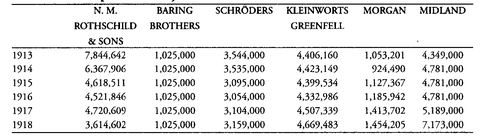
Table 14a shows the exceptionally sharp contraction experienced by the London house in the war years. It was in 1915 that N. M. Rothschild & Sons were at long last overtaken in terms of capital (by the Midland Bank), after nearly a century of being by far and away the country’s largest bank. By 1918, Kleinworts too had grown larger than N. M. Rothschild, and Schröders were not far behind. The available balance sheets reveal that Barings’ assets outstripped those of N. M. Rothschild in the years 1915-18, and although Schröders was also hard hit by the war, its balance sheet contracted less sharply than Rothschilds. A closer look at the Rothschild balances suggests a very sharp contraction in the bank’s holding of British government bonds.
Table 14a: The capital of six major British banks, 1913-1918 (£).
Sources: RAL, RFamFD/13F; RFamFD/13E; Ziegler, Sixth great power, pp. 372-8; Roberts, Schroders, pp. 527-35; Wake,
Kleinwort Benson, pp. 472f.; Burk, Morgan Grenfell, pp. 260-70, 278-81; Holmes and Green, Midland, pp. 331-3.
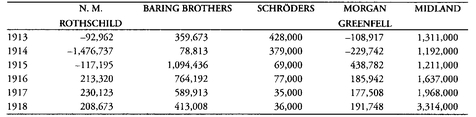
Table 14b confirms that a large part—but not all—of the explanation for this contraction lies in the heavy losses suffered by the Rothschilds in 1913-15. Barings and the Midland did far better; and if profits are expressed as a percentage of capital, the differentials are even wider (though Schröders did even worse overall). The other explanation for the bank’s contraction in terms of capital must be the effect of the three partners’ deaths; in particular Alfred’s decision to bequeath such a large part of his estate outside the family explains the capital reduction of more than £1 million in 1918, despite moderately good profits for the third year running.
Table 14b: Profits at five major British banks, 1913-1918 (£).
Sources: as table 14a.
A puzzle remains, however. For in many ways the First World War was financed in ways which were little different from those which had paid for the wars of the nineteenth century. Indeed, in strictly financial terms the scale of the war relative to the available economic resources was not that much greater than the cost of the Napoleonic Wars, though the latter were fought less intensively over a longer period. Governments raised some money by introducing new taxes, but mostly they resorted to borrowing. To give just three examples: the German national debt increased by around $19 billion between 1914 and 1919, the French by $25 billion and the British by $32 billion, so that by the end of the war national debts amounted to close to 200 per cent of GNP in each case. When bond yields became prohibitively high, all the combatant governments asked their central banks to print money in return for treasury bills. This was possible on a large scale because, as in the Napoleonic period, the convertibility of paper notes into gold had been suspended to prevent banking crises; as then, the result was inflation, with prices doubling or trebling. Why then did the Rothschilds fail to capitalise on the financial opportunities of the First World War? After all, it had been the Napoleonic Wars which had given Mayer Amschel and his sons their crucial business opportunities a century before.
The answer is plain enough. The defeat of France in the Napoleonic Wars had been financed to a large extent by British loans and subsidies to Austria, Russia and Prussia. With their establishments in Frankfurt, London and Paris, the Rothschilds had been in a uniquely good position to facilitate these transfers. The defeat of the Central Powers in the First World War also involved transfers (amounting to $9.7 billion) from Britain to her allies; but only in the case of France were the Rothschilds really in a position to play a part, and even then a minor one. Once they had been the principal agents for international transfers between Allied powers; now, with the British war effort so dependent on American credits, it was J. P Morgan who succeeded N. M. Rothschild as the linchpin of war finance—confirming what a strategic error it had been not to establish a Rothschild house on the other side of the Atlantic.
There were also resemblances between the post-war periods after 1815 and after 1918. In both cases, there was an attempt to make the loser pay for part of the costs of the war. In both cases, wartime inflation had so reduced the internal debt of the loser state that it was better able to make such payments than was generally admitted or realised. After 1815 copious amounts of British capital stood available to finance the restored continental regimes; after 1918, it was American capital which the various “successor states” of Central Europe—not only Germany but also Austria, Hungary and Czechoslovakia—could draw on. Nevertheless, in both cases the new regimes in the defeated states proved unstable. The Weimar Republic, like restored Bourbon France, lasted just fifteen years. Britain, like Austria in the 1820s, lacked the financial resources to “police” post-war Europe. America, like Britain in the 1820s, gradually withdrew from continental commitments, despite being well able to afford them. The biggest differences between the 1820s and the 1920s were that Britain wrote off most of her allies’ war debts, unlike America after 1918; the reparations burden imposed on France in 1815 was substantially less as a proportion of national income (around 7 per cent) than that imposed on Germany in 1921 (around 300 per cent); and, finally, the regimes which had to deal with the problems of the 1920s were democratic. This meant that bankers, bondholders and direct tax payers were no longer politically over-represented as they had been in the 1820s. It was partly for this reason that Morgans could not play in the 1930s an analogous role to that played by the Rothschilds in the 1830s, using their financial influence via the bond market to discourage aggressive foreign policies. The economic and political crises of the 1930s exposed the limits of financial power in a way without parallel in the nineteenth century.
All this provides some excuse for the Rothschilds’ inter-war·difficulties. Yet, if the period had given the bank a much smoother ride, it is debatable how much more successful it would have been. The bank which Ronald Palin joined as a young clerk in 1925 seemed to belong to the age of Dombey & Son. Save at lunchtime, when a green blind was drawn across the glass door, the partners could be seen at their desks in the panelled and upholstered splendour of “The Room,” but to Palin they seemed “a higher order of creation” with whom communication was minimal. They had their own entrance, their own dining room, and their desks were fitted with a row of bell-pushes which could be used to summon any member of staff. There was even a special office on the top floor called the Private Accounts Department (“Whores and Jockeys” to the staff) which handled the partners’ private affairs. In the words of Lionel’s son Edmund, who joined the bank in 1939, “The family who sat in the Room and the staff who occupied the General Office or sat in the Front Hall were two races apart.”
At the top of the hierarchy of clerks was the general manager, an office occupied for most of the inter-war years by the Hungarian-born Samuel Stephany, and the various departmental heads and senior clerks like the Nauheim brothers. The New Court office layout had a haphazard quality: located above the Room were the offices of the staff manager and the chief accountant, as well as the Control Department and the Private Accounts Department. The “General Office” was in fact a cramped public counter reached through a narrow back hall, which also contained the Cashiers and Bullion Department. In spite of its name, the Stock Department handled the business of bills of exchange and was divided into a Bills Receivable and a Bills Payable department. There, at rows of high sloping desks, clerks laboriously numbered and cancelled bills, then presented them for acceptance to the “walks” man. Even more cumbersome was the mode of operation of the Dividend Office, which dealt with issues and interest payments on foreign bond issues as well as dividends on the bearer shares of the bank’s small number of corporate clients like Royal Dutch. It was, in Palin’s words, “a time-and-motion student’s nightmare,” with its old-fashioned machines for cancelling coupons in the Coupon Department, its Brunsviga calculating machine and its actuarial tables. Speed was at a heavy discount. According to one anecdote, when the future Dividend Office chief Lionel Stewart was asked by one of the partners to tell him what 1 per cent of a hundred million was, he replied immediately: “One million.” “Don’t guess, boy,” he was rebuked. “Go away and work it out.” The maxims of the general manager Stephany were intended to foster the same mentality. “Anyone can make a mistake,” he was fond of saying. “The man who never made a mistake never made anything. But Heaven help the man who misses a mistake when checking.” Another piece of Stephany advice to younger employees was: “Never copy a total, always make it.”
This emphasis on punctiliousness would be more comprehensible had it not been combined with the most leisurely working practices imaginable. The chief of the Coupon Department, George Littlehales, lived in Mersea, for example, and rarely arrived at work before noon. At one o‘clock he went to lunch; at 2.30 he set off again for home. As a junior clerk, Palin “rarely arrived much before 10.30 in the morning and could always count on two free days at the weekend.” It was characteristic of the New Court order of priorities that there were three tape machines in the partners’ waiting room: one for stock exchange prices, one for general news and one for sporting news. Like dons, the senior clerks had their own dining room and butler, while their juniors perpetuated the ambience of a minor public school, bestowing nicknames (Littlehales was known as “the Egg”), playing practical jokes and looking forward impatiently to the lunch break (“Children’s Hour”). Long-serving Rothschild employees like George Tite and Shirley Snell lived like P. G. Wodehouse characters who had been obliged by a deficiency of inherited wealth to finance their leisure pursuits in the City. Tite summed the inter-war atmosphere up perfectly when he told Palin: “This, my boy, is the best club in London. We really ought to be paying a subscription instead of receiving a salary.” In fact, he and his colleagues received more than just their salaries. In addition to his basic pay of £100 a year, paid quarterly, Palin received “lunch money” of £48 a year; “poundage” (notionally a payment from the Inland Revenue for the work of collecting income tax on foreign dividends); “touchings” from the partners on birthdays and anniversaries ; one-eighth per cent brokerage on allotments of bonds and shares to applicants they had introduced to the bank; as well as holiday money.
This relatively generous remuneration perhaps explains why Rothschilds still managed to recruit talented figures like Michael Bucks (later general manager) and Peter Hobbs (later investment manager), who both joined the firm at around the same time as Palin. Generally, however, the system of recruitment was feudal in style. One senior employee had joined the bank as a porter on the strength of his mother’s years of domestic service for the Roseberys. Palin himself was introduced to the firm because his father knew a director of the Bank of England. His interview consisted of being asked by the staff manager to spell “parallel” and “acknowledgement.” Many employees were from families which had worked at New Court for generations: the Williamses and the Mercers, for example (typically, the young Ernest Mercer was referred to as “Mercer’s son’s brother’s son”), while Rothschild couriers were still recruited from Folkestone families who had worked for Nathan himself. The first women employed at New Court were the unmarried daughters of two rabbis. They were confined to segregated offices at the top of the house and given lunch in a separate room in the basement (a practice which continued, like that of Saturday closing, until the 1960s). Palin’s verdict does not seem unduly harsh: Rothschilds had become “an organisation ... managed largely by amiable eccentrics who did very little work and that without much seriousness and by antiquated methods.” It seemed to be sinking into “genteel inactivity.”
Nor was this air of stagnation peculiar to the London house. When Edouard’s son Guy joined the Paris house in 1931, he was struck by the way “the past clung to everything and everyone.” His training took the form of learning to quote interest rates in fractions instead of decimals, which he was taught by a clerk whose other function was to read him selections from the newspapers in the morning. “The staff,” Guy later recalled, “were imbued with the grandeur of ‘the name’ and of the responsibilities [it] imposed. Vestiges of the previous century were encountered at every moment and in every corner, even some that no longer had any reason for being,” like the trifling account kept for the Vatican which dated back to the time of Baron James. Just as the London partners insulated themselves from the day-to-day running of business in the Room, Edouard and Robert passed their working hours in the vast “grand bureau,” using the identical system of bell-pushes to communicate with their employees. “The bare-walled ... ill-lit ... depressing and drab” offices which housed the clerks “also recalled the past in their haphazard arrangement and their odour of stale tobacco and mustiness. After decades of underemployment, everyone worked slowly, without supervision or discipline.” Guy quickly realised that “Rothschild Frères was more of a family secretariat than a working bank,” whose main activity was “gently prolonging the nineteenth century.”
Yet such impressionistic accounts understate the extent of Rothschild activity in the 1920s and 1930s. It would perhaps be more historically accurate to regard the memory of “immobility” as a consequence of the two great economic traumas of the inter-war period, rather than a cause of problems peculiar to the Rothschilds.
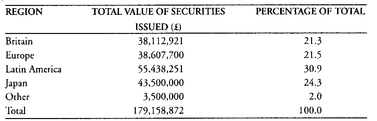
In some ways the 1920s and 1930s were no less active periods for N. M. Rothschild & Sons than the previous two decades had been. If one adds together the nominal amounts of bond and share issues which the bank underwrote, the total for 1920-39 is only 5 per cent lower than the period 1900-19. The difference was twofold. Firstly, the bulk of inter-war business was done in partnership with other City firms, principally the Rothschilds’ erstwhile rivals Barings and Schröders, rather than with the Paris and Vienna houses. Other examples of collaboration include the Rothschilds’ entry into the Chinese loan consortium in 1919 (a field still dominated by the Hong Kong & Shanghai Bank), and their involvement with the purchase of various German-owned Turkish railway companies (via Swiss intermediaries) in conjunction with Schröders, Lloyds, the Westminster Bank and the National Provincial Bank. For reasons which are not wholly clear, it seems to have proved very difficult to resume the traditional co-operation between the three Rothshild houses after the war; and this may help to explain why the links which still remained with Paris and Vienna ultimately proved so problematic. The second difference was that the bond issues of the 1920s proved to be among the most disastrous investments of modern times because of the successive economic and political crises which afflicted the borrowing countries. Table 14c gives a geographical breakdown of the Rothschilds’ major inter-war loans and share issues, which shows that British and European issues predominated, followed by Latin American and Asian—primarily Japanese (though here the Rothschilds were members of a large group led by the Westminster Bank, so the figure in the table substantially exaggerates their role).
Table 14c: Major bond and share issues in which N. M. Rothschild & Sons participated, 1921-1937.
Source: RAL.
Closer examination reveals, however, that the Rothschilds were involved in lending to some of the most unstable regimes of the inter-war era. This was the unintended consequence of a rather uncritical resumption of pre-war patterns of business activity.
It was, of course, logical enough for a firm with such close historical links to Central Europe to play a leading role in financing the new states established in the ruins of the Habsburg and Hohenzollern empires. Unfortunately, even the most stable of these proved to be less than easy to deal with. Czechoslovakian bonds worth around £10 million were issued by a Barings-led consortium of N. M. Rothschild, Schröders and the New York firm of Kidder Peabody in 1922 and 1923; but the first tranche of bonds dipped below par because of an ill-timed attempt by the City of Prague to issue its own paper. The Rothschilds appear to have eschewed the disastrous German bond issues of the early 1920s, most of which were reduced to near-worthlessness by the hyperinflation of 1922-3; but they were drawn back to the German market (partly under the influence of Max Warburg, then at the height of his powers), raising £835,000 for the Prussian province of Westphalia and combining with Barings and Schröders to float major loans for the cities of Hamburg and Berlin in 1926 and 1927. In addition, the London house joined the Vienna house as shareholders in the Warburgs’ ambitious International Acceptance Bank (IAB), founded in 1921 to help finance the yawning post-war German trade deficit; and were later involved in another Warburg project, the London-based Industrial Finance and Investment Corporation Ltd. Hungary was perhaps the most important Central European client of the period: here it was New Court which took the lead, issuing loans for £7.9 million in 1924, £2.25 million in 1925-26 and £1.6 million in 1936.
Finally, there was Austria. In addition to the £3 million government loan of 1930, which was handled jointly with Barings, Schröders and Morgan Grenfell, the London house was indirectly interested in the Austrian economy—perhaps more than it realised before 1931—through its sister house in Vienna. Louis perhaps rather resembled Max Warburg in his over-optimistic assessment of the Central European economy in the 1920s. He elected to hold on to the Witkowitz ironworks once they became part of an independent Czechoslovakia (though he might have acted differently had they gone to Poland). More important, he increased Rothschilds’ involvement in the bank founded by his grandfather some six decades before: the Creditanstalt. In July 1921, he accepted the post of president of the Creditanstalt board (Verwaltungsrat), and it was in conjunction with the Creditanstalt that the Vienna house involved itself in concerns like the IAB and the Dutch-based Amstelbank. It was a former Creditanstalt director and supervisory board member, Wilhelm Regendanz, who managed to persuade the London Rothschilds to issue £2 million bonds for an Austrian firm, the Vorarlberger Illwerke at Bregenz, the failure of which was an early warning of what lay ahead for the Central European economies.
When the Bodenkreditanstalt got into difficulties in October 1929, it was to Louis that the Austrian government turned. He obliged by agreeing to what amounted to a merger of the two banks. On Wednesday October 18, the Paris house wrote to congratulate him on his action. “Thanks to your decisiveness and courageous attitude,” wrote Edouard, “you saved Vienna’s finances and avoided events that could have been extremely serious for your country and that would certainly have had repercussions in other financial capitals and markets.” Had he known what the following Tuesday would bring, he would have been offering anything but congratulations. Neither he nor Louis realised that history was about to repeat itself: just as Louis’s great-grandfather Salomon had bailed out Arnstein & Eskeles on the eve of the 1848 crisis, so Louis’s decision to bail out the Bodencreditanstalt was to bring the Vienna house to the brink of ruin.
It seemed equally logical for the London house to continue its traditionally close relationship with Latin America and above all with Brazil and Chile.9 During the war, the American ambassador in Brazil had commented that “the Rothschilds have so mortgaged Brazil’s financial future that ... they will place every obstacle in the way of her entering into banking relations with any other house than their own or with any other nation than England.” This was a pardonable exaggeration. The London house issued bonds with a nominal value of more than £28 million for the Brazilian federal government in the inter-war years, plus an additional £17.5 million for Brazilian states and railways. (The total figure for Chile was around £10 million.) In the case of Brazil, financial (and political) stability hinged in large part on the world market for coffee; the 1922 loan of £9 million—in conjunction, once again, with Barings and Schröders—was specifically designed to finance the government’s coffee price-support scheme and placed control of coffee exports in the hands of a committee of City banks (a repeat of what had been attempted, despite Rothschild reservations, in 1908).
Doubts about the reliability of the Banco de Brasil persisted, however, and when the Brazilian government approached New Court for another £25 million loan in 1923 “to liquidate the floating debt and set Brazilian finances in order,” Lionel asked Edwin Montagu to lead a mission to Brazil in the hope of imposing “some palatable form of foreign financial control” on the Banco de Brasil. Unfortunately, the best that Montagu and his colleagues could come up with was a suggestion that the London banks might buy the Brazilian government’s shares in the Banco, which Lionel rejected on the ground that it would be “most unpopular in Brazil for the national bank to be owned by foreigners.” In any case, the Bank of England’s temporary embargo on foreign loans undercut the planned loan, and three years later—after a spat between Brazil and Britain over the admission of Germany to the League of Nations—the Brazilian government turned instead to Wall Street. The London house nevertheless continued to exercise control over the coffee support scheme, which was transferred to the São Paulo state goverment in 1924, and resumed its dominant role in Brazilian federal bond issues when Brazil returned to the gold standard in 1927. The Rothschild agent in Brazil, Henry Lynch (known locally as “Sir Lynch” after his knighthood), remained a key figure in the country’s finances throughout the period. In Chile the stability of government finance was also linked closely with a staple export—nitrates for use in fertilisers and explosives.
In addition to this traditional bond market business, the Rothschilds maintained their pre-war interests in mining. Their influence as the principal shareholders in Rio Tinto became even greater as the firm expanded its interests from copper and pyrite to embrace sulphur-recovery, cinder-treatment and silica gel, and its geographical range from Spain to Belgium, Rhodesia and the Americas.10 Key members of the board such as Lord Milner, Sir Arthur Steel-Maitland (the managing director of the Company in 1920) and Sir Auckland Geddes (who succeeded Milner as chairman in 1925) worked closely with New Court as the firm tried to cope with the volatility of the inter-war raw-materials markets. In South Africa the London and Paris houses together remained major shareholders in De Beers, though increasingly its direction was determined by Ernest Oppenheimer’s Anglo American Corporation (founded in 1917), which had acquired an even larger stake than the Rothschilds. The only reverse was in Spain, where the Almadén mines were nationalised in 1929; but that had ceased to be a major source of revenue even before the war.
All this business hardly constituted immobility. The firm’s familiar circle of stockbrokers—Cazenove, Messels, Panmure Gordon and Sebags—were kept occupied, as were the firm’s lawyers. The trouble was that activity was not always matched by profitability. For when the world economy plunged into the great deflation of 1929—32—with prices, production and employment levels falling by unprecedented amounts—the areas of greatest Rothschild involvement were among the worst affected.
It is arguable, of course, that this greatest crisis of the capitalist system was caused by “structural” factors beyond the control of bankers and politicians alike. The legacy of the First World War was one of over-capacity and distorted markets for many staple agricultural and industrial products. But there can be no doubt that misguided fiscal and monetary policies—allied with the impossible tangle of international war debts and reparations obligations—did much to exacerbate and perpetuate the slump. In the early 1920s, too many countries sought to evade difficult political choices by running excessive public sector deficits and financing them with the help of the printing press: inflation and hyperinflation were the results, and in their wake financial instability as investors (especially bondholders) demanded higher yields to compensate them for the risk of more inflation. Austria was one of the states which experienced high post-war inflation. In the aftermath, the Vienna house had a hand in stabilising the new schilling, thwarting the efforts of inflation enthusiasts like the financier and industrialist Camilio Castiglione; but it is probable that, like virtually every Central European bank in the 1920s, its post-inflation balance sheet was long on deposits and short on reserves. From the mid-1920s onwards, the prevalent policy error was a fixation with unsustainable exchange rates, as governments sought vainly to imitate the gold standard system of the pre-1914 period, ignoring the absence of many of the essential preconditions for its earlier success. The result was that, especially after 1929, politicians sought to balance budgets and tighten monetary policy in the teeth of recession, subordinating all other policy objectives to the maintenance of gold equivalence.
There is no question that the Rothschilds had a hand in this, though the error was so widespread as to constitute a near-universal “conventional wisdom.” Perhaps the London house’s continuing importance in the international gold market was a factor. When the war-time ban on gold exports from London was lifted, N. M. Rothschild took on the role of intermediary between the bullion market and the Bank of England, to which the South African mine companies agreed to ship all their gold (roughly half of world output). The system adopted was that N. M. Rothschild advanced £3 17s 9d per standard ounce to the producers on receipt of the refined gold and then sold it at “the best price obtainable, giving the London market and the bullion brokers a chance to bid,” pooling any premium and remitting it to the mines every six months. Thus was born the so-called “Fix,” whereby the world market price for gold was set every morning at 11 a.m.—beginning on September 12, 1919—following an auction conducted at New Court.11 The choice of venue reflected the London house’s dual role: as refiners and agents for the South African producers (the biggest seller).12 It thus played a pivotal role in the stabilisation of the Indian and British currencies after the war.
Yet it is hard to believe that this was the only reason the Rothschilds adhered to the reconstituted gold exchange standard. Ultimately, they liked gold for the same reason that the rest of the City liked gold: they feared that, if the pound were allowed to float, London would see its central role as the world’s financial capital pass irrevocably to New York. Nor was their faith in the gold standard unthinking: in 1931 Walter argued—rightly—that the breakdown of the system in the Great Depression had “nothing to do with the rights or wrongs of Capitalism or Socialism, but ... is owing to the greed of [certain] countries for gold. What they have succeeded in doing is to injure their own trade by withdrawing the means of barter from the rest of the world.” This was fair comment: the biggest difference between the pre-1914 gold standard and the gold exchange system of the 1920s was that two of the most important players—the United States and France—bent the rules by “sterilising” additions to their reserves in order to avoid domestic inflation. Without central bank co-operation, the system could not survive.
Compared with Britain, France compromised. So long as French tax-payers persisted in believing that the budget would be balanced by reparations which the Germans were determined not to pay, there was no chance of restoring the franc to its pre-war exchange rate. Indeed, it was only after protracted debate that the currency was pegged at 20 per cent of its old external value in 1928. This was a compromise which Edouard vehemently and vainly opposed in his capacity as one of the twelve regents of the Banque de France. In the summer of 1924 he was openly critical of the Left Cartel government led by Edouard Herriot for what he saw as its soft line towards striking railway workers—an important preoccupation for de Rothschild Frères in their role as major Nord shareholders. Early the following year, with the franc depreciating rapidly, he led a delegation from the Banque to discuss the currency question with Herriot. Though Edouard tactfully laid part of the blame for the weakness of the franc on “the clerical right and Communist extremists,” he was also critical of excessive public sector pay settlements and called for a coalition of the Left Cartel with the more right-wing National Bloc it had replaced, with the aim of balancing the budget. However, the appointment of Emile Moreau as Governor of the Banque in June 1926 led to a diminution of Rothschild influence, for, while Edouard continued to dream of a return to pre-war parity, Moreau more realistically argued for stabilisation at something closer to the existing rate. This division came close to outright conflict the following spring. Edouard had a powerful supporter in the industrialist François de Wendel as well as leverage when the French government sought to raise money in London in 1927, but he was asking the politically impossible. Even a new government led by Poincaré and empowered to balance the budget by decree could do no more than peg the franc at 25.52 to the dollar. Under Poin care, the 3 per cent rente rose from 48.25 francs to 67.60; by contrast, Rothschild influence declined.
Edouard’s position was not strengthened by the chequered political career of his cousin Maurice (Edmond’s second son). In 1919 Maurice had been elected to the Chamber of Deputies on Clemenceau’s National Bloc ticket for the constituency of Hautes-Pyrénées. From the outset he had made the most of his family background, using the slogan “My name is my platform” on election posters and, in order to secure the clerical vote, shamelessly assuring the clergy at Lourdes that he would “organise special trains for pilgrims, and on political and religious matters [press for] freedom of teaching in religious schools [and] the recall of teaching nuns.” “Governments can do nothing,” a local priest was given to understand, “without his family. The Rothschilds are, thanks to their banks, the finance ministry—the real one, the one that we can’t do without.” These tactics evidently worked in 1919, but five years later they could not avert defeat at the hands of Herriot’s Left Cartel. Undaunted, Maurice changed his political allegiance, accepting an invitation from the socialist newspaper owner Louis Cluzel to stand in a by-election for the Hautes-Alpes constituency. He won; but this time his electioneering methods were challenged. In a report to the Chamber, he was accused of spending 1.6 million francs (around £15,000) in order to secure victory, paying 5,000 francs to one small town to enable it to buy uniforms for its fire brigade, and even sending out 200 letters each containing twenty francs to individual voters. A motion calling for the election to be annulled was only narrowly defeated by 180 to 178, but when a committee of enquiry concluded that Maurice’s contributions had been essentially charitable and therefore legitimate its report was resoundingly rejected (by 209 votes to 86). The election had to be re-run and although Maurice won (as he did again in April 1928) his reputation—and by association that of his family—had scarcely been enhanced. Venal parliaments and gold-hoarding central banks bear at least some of the blame for the 1929-32 world crisis; the French Rothschilds were represented in both.
The Crash
It is usual, though slightly misleading, to regard Wall Street’s “Black Thursday”—October 24, 1929—as marking the start of the Great Depression. In fact, there had been signs of declining economic activity in Europe for over a year. On the other hand, it is hard to overstate the knock-on effects of the unprecedented collapse of the American stock market, which wiped $30 billion off stocks worth $80 billion in the space of a month and drove the Dow Jones Industrials index from its peak of 381 on September 1929 to a final trough of 50 in May 1932. This asset-price deflation led to immense flows of American capital out of Europe. This in turn led to a generalised monetary contraction which central banks and governments worsened by trying to hang on to their gold exchange rates. One way of doing this was to increase interest rates; another was to cut public spending or put up taxes; a third was to raise tariffs in an effort to reduce imports. The principal effect of such policies was to push up unemployment to undreamt-of heights, as firms laid off workers, investors fled into liquidity, consumers tightened their belts and international trade dried up. This in turn generated a political reaction—sometimes violent—against the whole complex of institutions which seemed to be to blame.
For the Rothschilds, the first great crisis of the Depression came in Brazil. As commodity prices slid further in the global deflation, the government turned once again to the London house for assistance. Armed with the now familiar list of conditions, Stephany and Palin were despatched to Rio in February 1930, but their negotiations were undercut by the coup of Getulio Vargas—among the first of many shifts to dictatorship triggered by the Depression. The following year the Treasury sent Sir Otto Niemeyer in the hope of imposing some kind of stabilisation package on the new regime, but in September Vargas suspended payments on foreign debt, following the precedents set in 1898 and 1914. Now the most that could be done was to negotiate some kind of rescheduling agreement. After protracted conferences with the Council of Foreign Bondholders, an agreement was reached with Vargas in March 1932 which secured preferential treatment for the oldest and best-secured loans. It was not until 1934, however, that a complete restructuring of the Brazilian debt was arranged with the principal foreign banks (the Rothschilds, Paribas and Dillon Read). By issuing new bonds, the government was able to pay around £6-8 million annually between 1932 and 1937, though it was not until 1962 that all the sterling bonds were finally liquidated. It was a similar story in Chile, where a new Compania de Salitre de Chile (COSACH) was set up in 1931 to rationalise the nitrate industry on the basis of a loan worth £2 million issued jointly by N. M. Rothschild, Barings, Schröders and Morgan Grenfell. The scheme was doomed to fail as exports continued to decline. In January 1933 COSACH was liquidated and a moratorium on debt service announced. It took twenty years before an agreement was reached between the bondholders and the new Chilean Nitrate and Iodine Sales Corporation.
It was in Europe, however, that the worst blow fell. On May 11, 1931, Creditanstalt officials showed the Austrian government the bank’s annual balance sheet for 1930, which it was due to publish a few days later. It revealed losses of 140 million schillings (around £4 million) compared with paid up capital of 125 million schillings. Given that its balance sheet was as large as total central government expenditure, these were horrific figures; and as they were four months old the actual losses were probably closer to 160 million schillings. Under Austrian law, a bank whose losses exceeded half its capital had no option but to close down. The prospect for the Vienna house, which held around 16.7 million schillings of the Creditanstalt’s capital, was therefore grim. It was not much better for the 130 foreign banks (including de Rothschild Frères) who between them accounted for more than a third of its liabilities. However, the Austrian government was fearful that the collapse of the Creditanstalt would devastate between 60 and 80 per cent of Austrian industry (an exaggerated figure—in terms of capital, probably no more than 14 per cent of Austrian limited companies would have been affected). It was also pointed out that most of the losses were attributable to the merger with the Bodencreditanstalt which the government itself had insisted on. Accordingly, it was decided to replenish the Creditanstalt’s capital with 100 million schillings in return for a 33 per cent shareholding. As part of the rescue package, the Paris house lent the Creditanstalt a further 136 million francs for six years.13
Yet this did not suffice to avert a financial panic which quickly spread from Vienna to Hungary, Germany and throughout the entire European economy. The National Bank did its utmost to keep the Austrian banking system liquid by discounting bills, but it was slow to raise its discount rate and public confidence spiralled downwards: memories of hyperinflation ten years before inclined Austrians to assume that the schilling would soon go the way of the crown before it, and there was a general flight into foreign currency and goods. Because of diplomatic complications, it took three weeks to organise a £3 million loan to the National Bank from the Bank of International Settlements and when this was exhausted the Austrians had to rely on a short-term loan of £4.3 million from the Bank of England. In July a similar crisis struck the Darmstädter und Nationalbank in Germany. In September a run on the Bank of England ended the pound’s brief return to the gold standard.
The Creditanstalt crisis thus quickly became part of a general breakdown of the post-war monetary system. From the Rothschilds’ point of view, however, it represented the final break between the Vienna house and the London house. When Lionel became chairman of a hastily constituted Austrian Creditanstalt Committee, set up to represent the foreign depositors and shareholders, he declared that to put any more money into the still haemorrhaging bank would be “inexpedient.” Given the close links between the Creditanstalt and the Vienna house, this amounted to a refusal to bail Louis out. By 1933 the Paris Rothschilds were inclined to take the same view. Edmond advised Edouard that it would be “dangerous” even to look at the Vienna house’s accounts “because it suggests involvement or support from the Paris house.” His argument shows that the memories of 1848 had not faded:
What is happening in the Vienna bank does not concern us. We advanced funds, it’s a question of honour for Vienna to reimburse them ... This matter of honour in our families has always been the overriding point of view. One need only recall the sale of the silverware [in 1848]. The Vienna house is not our business and in sum, as one of the heads of the Paris house, I do not wish to give them any money, not a penny more.
Edmond at least had no desire to “sell the silverware” a second time. Louis therefore had little option but to turn once again to the Austrian government. In September 1933 he finally wound up his involvement in the Creditanstalt, which now effectively became a state-controlled concern, absorbing the Wiener Bank-Verein and part of the Niederösterreichische-Escompte-Gesellschaft.
There is little doubt that the Creditanstalt crisis was the single most serious blow to the Rothschilds’ position of the post-war period, biting deep into the capital of all three houses. Yet it is worth adding that the impact of the 1929-31 crash could have been worse. They were fortunate too that their involvement with the Swedish financier Ivan Kreuger—whose financial empire was literally based on matches—was not greater. In 1929 the London house had joined forces with the Boston bank of Lee, Higginson & Co. to issue shares for Kreuger totalling $10 million. Three years later, the Swede committed suicide and his empire collapsed, taking Lee, Higginson down with it. At least the Rothschild houses survived the slump. The same could not be said of the bank which had been acquired by Max von Goldschmidt-Rothschild and his sons Albert and Erich in 1920. Goldschmidt-Rothschild & Co. (formerly A. Falkenberger) was handed over to the Reichs-Kredit-Gesellschaft in 1932—one of the lesser casualties of the German banking crisis.
Under these circumstances it is not wholly surprising that the London house sought to increase its involvement in domestic corporate finance, especially as the British economy enjoyed a modest but nevertheless real recovery after the 1931 devaluation. Before 1914 N. M. Rothschild had been hesitant to involve itself in the domestic economy, and it was not until 1928 that this changed with a succession of issues of debenture stock—in partnership with Barings and Schröders—for various London underground railway companies. Two years later, the London National Property Co. raised £2 million through Rothschilds to finance the purchase of Shell-Mex House in the Strand, which it then let to the Shell Transport and Trading Co., and a year later the Woolworths retail chain was persuaded by Philip Hill to issue £9.36 million shares through New Court. Other early corporate clients included the brewers Charrington & Co.
These were ventures into unfamiliar terrain for a bank which had been almost exclusively concerned with overseas business for more than a century, and inevitably there were teething troubles. News of the London National Property issue leaked into the press, occasioning an ugly confrontation between Stephany and the veteran City editor of the Financial News, whom he accused of “picking up rumours in railway lavatories.” Although heavily oversubscribed, the Woolworths share offer was nearly wrecked by a minor City panic the weekend before the lists closed. With the letters of acceptance still waiting to be sent out, last-minute withdrawals began to pour in on the Monday morning. Staff had to work all night behind locked doors, completing and sending out acceptance letters before any more subscribers could pull out. Of course, by comparison with the Paris house, with its extensive investments in railways and electricity companies, the London house remained a minor force in the world of domestic corporate finance. But an important step had been taken in a direction which would prove vital to its recovery after 1945.
The extent of the Rothschilds’ relative decline in the inter-war period should not therefore be overstated. The generation of Rothschilds who grew up in those years detected no waning of the family’s wealth: indeed, the mores of the previous century were preserved as if in aspic. Guy and his sister Jacqueline had one English nanny each, though the two women disliked one another so intensely that they refused even to lunch together. The children thus grew up in a bizarre isolation not only from their parents, whom they lunched with once a week, but also from one another. They were isolated from the outside world too. As a schoolboy, Guy was driven to and from the lycée by one of his father’s chauffeurs with a footman to provide additional protection. Much of his time was spent not in Paris but at one or other of the family’s country houses. Each year the entire household progressed from Ferrières (November to January) to Cannes (February or March) and then on to Chantilly (Easter and July to September). Similarly, Edmund’s youth was divided between the house his father leased at 18 Kensington Palace Gardens and his 2,500 acre estate at Exbury in Hampshire. Here and on the other great family estates, their parents pursued their expensive pastimes much as their grandparents had done before them. While Lionel indulged his passion for horticulture with the aid of up to 400 gardeners at Exbury, Edouard had his beloved racehorses at Chantilly. Maurice’s wife Noémie meanwhile moved with the times by building an Alpine sports complex at Megève. As they came into their money, therefore, the younger Rothschilds felt no embarrassment about consuming conspicuously. For Guy, the 1930s meant golf, American cars, dancing at Biarritz and baccarat at Deauville. Philippe built himself a seaside villa at Arcachon, the better to entertain other men’s wives, and helped his father to squander yet more money by building his own theatre in the rue Pigalle (a suitably louche location).14
Yet there were signs that the grandeur was beginning to fade. In 1922, Jimmy had rather unexpectedly inherited Waddesdon when Ferdinand’s unmarried sister Alice died; but when Harold Nicolson stayed there in July 1939 he was unimpressed (as he complained to Vita Sackville-West):
Hardly a thing has been changed since the old Baron [Ferdinand]’s time. There are marvellous pictures and Sèvres, but execrable taste. Jimmy hates anything being altered, and the lavatories still have handles you pull up instead of chains you pull down. There is no running water in the bedrooms, and although it is very luxurious as regards food and drink and flowers, it is really less comfortable than our mud-pie in the Weald.
Was this merely aesthetic conservatism, or were the huge running costs of the great houses beginning to pinch? Certainly, some of the old Rothschild houses had to be relinquished altogether. Halton was sold to the Royal Air Force after the war for £112,000, Aston Clinton was turned into a hotel and Gunnersbury became a public park. Tring would also have gone if the Museum of Natural History could have been persuaded to accept it as a gift.15 The first Rothschild house in the West End, 107 Piccadilly, was demolished to make way for a hotel ballroom in 1929; nine years later, Alfred’s grand house at 1 Seamore Place went the same way to allow the extension of Curzon Street. The lease on 148 Piccadilly was surrendered and its contents auctioned off in 1937.16 Three of the French Rothschilds’ houses were also given up.17 Perhaps the most poignant symbol of the times was Walter’s decision to sell almost all his Tring collection of stuffed birds (apart from 200 ostriches, rheas and cassowaries) to the American Museum of Natural History for $225,000 (less than a dollar per specimen).
In 1935 the Jewish Chronicle ventured to suggest (with perhaps a hint of relief) that the Rothschilds’ “heyday” was “waning”: “The age of rationalisation and of multiple stores, of chemicals and oil has dawned ... the sway of the former ruling families [is] no longer absolute.” Once there had been a certain grudging, deferential respect for the Rothschilds’ grandiose way of life. Now, in the straitened circumstances of the 1930s, it came to seem faintly absurd—witness the two anecdotes most often related about Lionel. “No garden, however small,” he is said to have proclaimed in a speech to the City Horticultural Society, “should contain less than two acres of rough woodland.” Confronted with a canteen of cutlery (to be given as a wedding present to an employee), he was mystified. “Well, that’s not much good,” he exclaimed. “You could never have more than twelve people to dinner.” There are similar jokes about the French Rothschilds’ luxurious bathing habits and their diet of puréed pearls in Albert Cohen’s surreally comic novelMangeclous. Even a sympathetic writer like Cecil Roth detected the intimations of decline. His book The Magnificent Rothschilds (1938) could be read as an epitaph not only for the third and fourth generations (the last of whom had died the previous year), but also for the family’s magnificence: “All had passed away ... It was a different world.”18
In the light of all this, perhaps it is understandable that the most intellectually gifted of the next generation of Rothschild men turned his back on the family business. In part, this was a vote of no confidence in the profession of banking, understandable given the “moribund, boring, rather painful” aspect of the City in the 1930s. But it may also have been due to the influence on Victor at Cambridge of that generation of Apostles which included Anthony Blunt and Guy Burgess, whose political sympathies were inimical to capitalism per se. Years later there would be speculation about Victor’s relationship with the Cambridge spies, culminating in the false allegation that he was the “fifth man” (a last, hitherto unexposed Soviet “mole” within the British secret service). His relationship with Blunt and Burgess after both had been recruited by the NKVD remained close enough to furnish circumstantial evidence for such claims. Not only did they rent his house in Bentinck Street during the war; it was also Victor who, in August 1940, recommended Blunt to MI5 (less than a year after he had been discharged from an intelligence course at Camberley because of his Marxist beliefs). And in Paris in 1944 Victor strongly seconded Kim Philby’s argument that the Soviets should have been given the “Ultra” intercepts.19 Yet it seems that Rothschild knew nothing of his friends’ treachery at this time. Though unquestionably left of centre in his politics in the 1930s and 1940s, Victor found communism “rather dull,” as he confessed to Keynes, an Apostle of the older generation. (Nor was he a homosexual, one of the “weaknesses” which attracted the Russians to Blunt and Burgess.) When he finally discovered in 1962 that Philby was a communist, he had no hesitation in passing the information on to his former MI5 colleagues.20
At any event, Victor’s decision to eschew finance left a gap which his cousins were too young to fill. After an undistinguished Cambridge career, Edmund, the elder of Lionel’s two sons, embarked on a round-the-world trip in October 1937 which he did not complete until May 1939. Although the tour included visits to a number of important Rothschild agents (for example, in Brazil and Chile), it was far from obvious that he had a financial vocation.
The French house lost a partner too at this time, though under very different circumstances. The death of Edmond in 1934 transformed overnight the balance of power in the rue Laffitte. Because Edmond’s eldest son Jimmy had made over his share to his father, his brother Maurice—the maverick politician—now stood to inherit fully a third of the equity, to say nothing of half Edmond’s 33 per cent stake in château Lafite. Possibly because of his political activities, possibly because of his involvement with a disreputable property company, his cousins Edouard and Robert decided to buy him out. Maurice, however, refused to go quietly. After the three partners had failed to reach agreement over an unprofitable Moroccan company in which de Rothschild Frères had invested 80 million francs, Maurice sued, citing his grandfather James’s stipulation “that the three branches of the family descended from him always be represented.” Only in September 1939, after arbitration, was the buy-out settled. Subsequent developments have perhaps cast doubt on the wisdom of this splitting of the French family’s resources. At the time, however, Maurice seemed dispensable, especially as Guy had now settled into the partners’ bureau. In any case, more and more of the day-to-day management of the Paris house and its vast business empire was being entrusted to outsiders, notably the former civil servant and Minister of Public Works René Mayer.
The Flood
The great irony is that it was precisely at this time of their greatest weakness that the myth of Rothschild power reached its zenith. Propelled into power by the miseries of the Depression, both the radical left and the radical right in France, Germany and Austria directed propaganda of unprecedented intensity against the family. This combined assault from both ends of the political spectrum was, of course, nothing new: the Rothschilds had been attracting such opprobrium for more than a hundred years. What was new was the fact that for the first time rhetoric was translated into political action.
In France the events of 1934 did much to revive hostile interest in the Rothschilds. The suicide of a minor-league fraudster named Stavisky in January exposed yet another of those financial scandals which were such a characteristic feature of the Third Republic. The following month—partly as a consequence of the government’s botched attempts to get to the bottom of the affair—there was an attempted right-wing coup by a loose coalition of “leagues” ranging from the now somewhat grey-haired Action Française of Charles Maurras to the more youthful Croix de Feu, a veterans’ association led by Colonel Francois de la Rocque. Although the coup failed, it forced the government of Edouard Daladier to resign. Later that year, at the Radical party’s annual congress, Daladier launched a tirade against the “two hundred families”21 who, he alleged, were “masters of the French economy and therefore of French policy.” “These are forces,” he added with the hint of a threat, “that a democratic state should not tolerate.” The hint was enlarged upon a year later by the Communist newspaper L‘Humanité which alleged links between the Rothschilds and La Rocque. In fact, La Rocque was on the payroll of the industrialist Ernest Mercier and Robert de Rothschild had no objection to being seen alongside him at the rue de la Victoire Synagogue on June 14, 1936. But virtually all other elements of the French right—including writers like Céline and Pierre Gaxotte (editor of Je suis partout)—were anti-Semitic. In January 1939 Maurras“ journal L’Action Françaiseaccused the Rothschilds of fomenting war between France and Germany to defend the position of German Jews.
It was the left which had the first opportunity to carry out its threats. In 1936 the Radicals, socialists and communists united to form the Popular Front government, pledged to achieve, among other things, “the liberation of the State from the grips of financial feudalism by establishing the nation’s sovereignty over the Banque de France through the dismissal of its board of directors.” Robert rightly foresaw “difficult days, weeks, months, as all skies—internal, financial and external—are terribly black.” Once in power, the Popular Front achieved much less than its more radical supporters had hoped. True, the new government sought to dilute the power of the “two hundred families” by giving the Banque de France a new council in which shareholders were outnumbered by “experts.” But it did not nationalise the Banque outright. Even the termination of the private railway companies’ concessions for the seven principal railway lines could hardly be portrayed as confiscation. When the state took over the operation of the Nord line, the Compagnie du Nord did not cease to exist; on the contrary, it received in return 270,000 shares in the new Société Nationale des Chemins de Fer, a guaranteed annual royalty on its revenues and a seat on its board. It is arguable that, thanks partly to the hard bargaining of René Mayer, the companies came out ahead, as the state took over from them debts totalling 6 billion francs, while the companies were able to retain their non-rail assets.
An altogether more ruthless coalition had come to power in Germany in 1933, dominated by the National Socialist German Workers’ Party. Hostility to the Rothschilds had been a feature of Nazi propaganda from the movement’s infancy (see introduction to volume 1) despite the fact that the Frankfurt house had been wound up when Hitler was barely twelve years old. It was a hostility which was soon translated into action. At first the attacks were largely symbolic: in December 1933 the Frankfurt Rothschildallee was renamed Karolingerallee, while the Luisenplatz and Mathildenstrasse lost the plaques identifying them with members of the family. It was not until April 1938, with the “Ordinance on the Registration of Jewish Assets,” that Rothschild property came under direct attack. In the wake of the orchestrated anti-Semitic demonstrations of the following November (Reichskristallnacht), nearly all the myriad Rothschild charitable and educational foundations—of which there were around twenty—were dissolved, with the exception of the Carolinum Dental Clinic, which had become part of Frankfurt university. The largest of these, the Baron Wilhelm Carl von Rothschild Foundation, was “Aryanised” under pressure from the city authorities, so that all references to its founder were expunged. At the same time, the Reich Association of Jews in Germany was forced to sell the Mathilde von Rothschild Paediatric Hospital, the Georgine Sara von Rothschild Foundation for Infirm Foreign Israelites and the Rothschild residence at Grosser Wollgraben 26 to the Frankfurt municipality. The Gestapo also confiscated the A. M. von Rothschild Sanatorium for Lung Diseases in the Black Forest. At least four other Rothschild-founded institutions suffered the same fate.22
The private property of the few family members still resident in Germany was expropriated by similar methods, though there was in fact relatively little of it left by 1938. Before the process of confiscation began, Max von Goldschmidt-Rothschild’s sons Albert, Rudolf and Erich sold the family houses at the Grüneburg and Königstein and opted to emigrate (Albert to Switzerland, where he committed suicide in 1941 when faced with the threat of expulsion). But Maximilian—now 95—was too old to leave. He stayed on in the house in the Bockenheimer Landstrasse, with the garden which his wife’s great-uncle Amschel had acquired over a century before in the earliest days of Jewish emancipation in Frankfurt. Or rather he was allowed to occupy a room in the house; for in a tragic fulfilment of Amschel’s nightmare—dating back to the nights in 1815 when he first slept in the “free air” of the garden—Maximilian was forced to sell the property to the city of Frankfurt for just 610,000 reichsmarks (less tax). In the aftermath of Kristallnacht he was also obliged to sell his art collection to the city for 2.3 million reichsmarks (again less tax) and to donate a further 25 per cent of his remaining assets to the Reich as an “atonement payment” (Göring’s characteristic device to make the Jews pay for the damage to property caused by Nazi vandalism). When Maximilian died in 1940 the rest of his property was confiscated. Five years later, when Allied bombers destroyed not only the house where he had spent his last days but also the old Fahrgasse office building and the oldStammhaus in the Börnestrasse, they were thus destroying relics which had ceased to belong to the Rothschilds. The pseudo-legal obliteration of the Rothschilds from the town of their origin preceded the partial physical obliteration by some years.23
It had not been difficult to foresee what the rise of Nazism meant for the Rothschilds in Vienna—the city so inextricably associated in Hitler’s mind with the threat posed by Jewry. When the Duke of Windsor stayed with Eugène at Schloss Enzesfeld immediately after his abdication for the sake of Wallis Simpson, he is said to have discussed with his host the idea of a book about the persecution of the German Jews. Not long after that, Eugène left Austria for England, followed later by his eldest brother Alphonse. Louis elected to stay at the bank; but he took the precaution of transferring ownership of the Witkowitz ironworks to the Alliance Assurance company (in which the London house still had a controlling interest).24 He also transferred rights of disposal over all his Austrian assets to the New York bank of Kuhn, Loeb & Co. This was inadequate insurance. The day after the Austro-German Anschluss of March 11, 1938, as cheering crowds welcomed Hitler’s troops into Vienna, Louis attempted to leave the city. His passport was confiscated, and the next day he was arrested and taken to the Gestapo headquarters at the Hotel Metropol on Morzin-Platz (where he found himself rubbing shoulders with the former Austrian Chancellor, Kurt von Schuschnigg, whose attempts to appease Hitler had so disastrously failed, and the socialist leader Leopold Kuntschak). The process of confiscating Rothschild property began at once. SS men were seen looting artworks from Louis’s palace almost immediately after his arrest. On March 30 the firm of S. M. von Rothschild was placed under compulsory administration by a new Austrian Credit Institute for Public Enterprises and Works at the orders of the Vienna Gauleiter’s economic adviser Walter Rafelsberger, who was charged with the systematic confiscation of all Jewish assets in Austria. It was then put under the temporary control of the German firm of Merck, Finck & Co. and finally sold to them in October 1939.
The next target was the Witkowitz ironworks, which Goring had already identified as a potentially profitable addition to his burgeoning industrial empire centred around the Reichswerke Hermann-Göring. Of course, Witkowitz remained on Czech territory and, as Göring’s emissary Otto Weber soon discovered, was no longer owned by the Vienna house but by the Alliance. In addition, the Witkowitz board had safeguarded against sequestration the company’s stake in the Swedish Freya ore mines as well as £200,000 in foreign currency. Louis therefore had a real bargaining position. When Himmler sought to ingratiate himself by sending some ornate French furniture to the prison, he was able to send it away complaining that it made his cell look like a “Cracow bordello.” Although Louis had to hand over most of his Austrian assets to secure his own release, the family was able to insist that a price be paid for Witkowitz (albeit a discounted price). But such legal niceties were ultimately bound to be swept aside by Nazi force majeure.Eugène’s hopes of selling the ironworks to the Czechoslovak state for £10 million were dashed when Hitler bullied the Prague government into accepting partition in March 1939. With the works effectively under German control, Göring’s commissioner Hans Kehrl, assisted by the Deutsche Bank board member Karl Rasche, turned up the pressure. A new supervisory board was set up, including Kehrl, Rasche and Paul Pleiger (the Reichswerke’s general director). At the same time, Fritz Kranefuss—Himmler’s adjutant and a supervisory board member of the Dresdner Bank—informed Rasche on the basis of Sicherheitsdienst intelligence that the transfer abroad of the ownership of Witkowitz had been illegal under currency laws. Finally, in July 1939, it was agreed to sell the plant for £2.9 million. However, the outbreak of war gave the Germans the perfect excuse not to pay. As a result, Witkowitz joined the lengthening list of Rothschild properties confiscated without compensation by the Nazi regime. In January 1941 Goring was able to take the process a step further when 43,300 Witkowitz shares were seized from the vaults of the Paris house (though even this did not give him a technical controlling interest). (It was not until 1953 that the communist government established in Czechoslovakia in 1948 finally paid compensation to the Rothschilds—amounting to £1 million—for the works.)
Yet it was not their industrial investments which Hitler and his lackeys really coveted so much as their investments in art—the Old Masters, the Sèvres, the Louis Quinze bureaus—which were the most dazzling fruits of the family’s financial success. In fleeing Austria, Alphonse had left behind one of the great European private collections; and attempts to buy it by Lord Duveen (possibly bidding on behalf of the original owners) were in vain. For the acquisition of so many old masters had given Hitler the idea of establishing a new German gallery at Linz, to give the Reich its Louvre. In June 1939 he authorised Hans Posse to begin work on the project, putting the best works seized from Austrian Jews into a “Führer Reserve” for this purpose. It was the beginning of one of the greatest art thefts in history.
Up until the outbreak of the war in 1939, the corollary of the expropriation of the Jews was their emigration from German territory. (It was significant in this respect that the Rothschild palace in the Prinz Eugenstrasse was occupied by Adolf Eichmann’s Central Office for Jewish Emigration, which worked closely with Rafelsberger’s Asset Transactions Office.) Naturally, many (though not all) German and Austrian Jews wanted to get out, while the Nazis had no objection to their leaving, provided they could be mulcted in the process. Leading German Jewish bankers—notably Max Warburg—saw little alternative but to facilitate this process. However, for Jews like the Rothschilds who remained outside the area of German control, this created a number of acute dilemmas. As early as June 1933, Lionel became one of the five presidents of a new Appeal Council of the Central British Fund for German Jewry (later the Council for German Jewry), to which the London house made an initial donation of £10,000.25 Five years later, in early 1938, it was reported that the Council had raised £1 million, including a further Rothschild donation of £90,000; this was followed by £50,000 in November. It was not obvious, however, how best to use this money to help the German Jews. There were disagreements within the Board of Deputies over the idea of a boycott of German goods, for example, which may have precipitated Walter’s resignation as vice-president. When James G. McDonald and Felix Warburg addressed a meeting of Jewish businessmen in January 1934, they found little enthusiasm for the alternative strategy of encouraging emigration from Germany. The following year McDonald returned with a more coherent plan (devised by Max Warburg) for a new bank with £3 million capital to finance the emigration of German Jews to Palestine. But despite Lionel’s initial “almost amazing enthusiasm” the scheme foundered when details leaked prematurely to the press. Both Anthony and Lionel were even more wary of a later Warburg scheme for an Anglo-American Jewish political bureau, arguing that “one can endanger his [sic] English citizenship if one becomes too strongly active in Jewish world actions.”
Lionel’s nephew Victor also became involved in the Central British Fund. “But for an accident of birth,” he told a meeting of the Zionist Federation in October 1938, “I might be a refugee, or I might be in a concentration camp, or I might be a guest in the Hotel Metropol, Vienna.”26 However, the rest of his speech was a (somewhat muted) defence of the government’s policy of restricting Jewish immigration to Palestine. He struck a similar note of ambivalence when he addressed a meeting of the Earl Baldwin Fund for Refugees at the Mansion House that December:
I know that children have been shot dead. I have interviewed people who have escaped from the concentration camps, and I can tell you that their experiences make the many horrors we read about nowadays seem like some nursery game. I have been the unhappy recipient of so many heart-rending letters from children, of documented reports and personal accounts from observers that it is difficult for me to believe that I shall ever become again the rather care-free and happy scientist that I was before all this began.
“The slow murder of 600,000 people,” he told his audience, “is an act which has rarely happened in history.” Yet he went on: “In spite of humanitarian feelings, we probably all agree that there is something unsatisfactory in refugees encroaching on the privacy of our country, even for relatively short periods of time.” As for increasing migration to Palestine, the British government’s position there was “appallingly complicated.” In March 1939, after visiting the United States to meet American refugee organisations, Victor appealed for a further £160,000 for the Council for German Jewry to promote emigration from Germany. Again there were qualifications. “No matter what doubts we may feel,” he argued, “we can only make an impression on this immense problem if we can get an orderly exodus and some slight financial concessions from the German side”; he remained pessimistic about the possibilities of “mass colonisation of hundreds of thousands of people.” Even in 1946, speaking in the House of Lords, Victor defended the policy of restricting immigration to Palestine, despite the fact that “he himself had had a 75 year old aunt clubbed to death by the SS outside an extermination camp.”
Rather different anxieties beset the Rothschilds in France, where more than a thousand Jews arrived in the first year of the Nazi regime by crossing the border. Although Robert gave his support to an informal agency set up to assist these refugees—which in 1936 was reconstituted as the Committee of Assistance to Refugees—he worried about the effect of the influx on the established Jewish community in France. In May 1935 he made remarks to the general assembly of the Paris Consistory (of which he had become president two years before) which could only be construed as a criticism of the newcomers. “It is essential,” he declared, “that foreign elements assimilate as quickly as possible ... Immigrants, like guests, must learn how to behave and not criticise too much ... and if they aren’t happy here, they’d do better to leave.”27 This was the old assimilationist lament about new Jewish immigrants.
The only logical solution was therefore to find some alternative territory for the Jews to go to. The Nazis themselves thought of Madagascar. Interestingly, Guy Burgess’s first assignment (when he was still a freelance intelligence agent) from MI6’s D Section was—as he faithfully reported to Moscow in December 1938—“to activate Lord Rothschild” in an attempt to “split the Jewish movement” and “create an opposition towards Zionism and Dr Weitzmann [sic].” At around the same time, the Paris house forwarded to New Court a proposal to purchase 200,000 acres of Brazil’s Mato Grosso “for colonisation purposes”; and another to settle Jews in Sudan’s Upper Nile Valley between Malakhal and Bor—supposedly “a huge territory ... with no population and where Jews might organize themselves an important colony.” Kenya, Northern Rhodesia and Guiana were also considered. Only at the eleventh hour, it seems, did the Rothschilds recognise the need to admit refugees into Britain and France. In March 1939 Edouard’s wife Germaine turned an old house at the edge of the Ferrières estate into a hostel for around 150 refugee children. After the German invasion, they were evacuated south and later dispersed, some escaping to the United States. A more secure refuge was found at Waddesdon for thirty children who were rescued from an orphanage in Frankfurt shortly before the outbreak of war.
By 1939, of course, numerous members of the Rothschild family were themselves refugees. The German invasion of France in May 1940 increased their number substantially. Even before the fall of Paris, Robert had already reached the safety of Montreal, taking with him his wife Nelly and daughters Diane and Cécile. It was not until July, however, that his cousin and senior partner Edouard—now in his seventies—opted to leave France, finally reaching the United States after a circuitous journey through Spain and Portugal. (He too was accompanied by his wife Germaine and daughter Bethsabée, his elder daughter Jacqueline having already settled in America with her second husband.) Their former partner Maurice also ended up in Canada, while his ex-wife Noémie and son Edmond took refuge on the estate at Pregny. The other French Rothschild of that generation, Henri, was already resident in Portugal. Finally, Alain’s pregnant wife reached the US via Spain and Brazil, while Guy’s wife Alix took the route through Argentina, though she later rejoined her husband.
That left the men of the younger generation to fight. Robert’s sons Alain and Elie were both taken prisoner by the Germans and ended up spending much of the war in a POW camp in Lübeck (and, in the case of Elie, Colditz). Edouard’s son Guy was luckier. As a cavalry officer in charge of a hastily motorised platoon, he saw heavy fighting in Northern France (for which he was awarded the Croix de Guerre), narrowly eluding capture by the Germans on at least two occasions. After the French capitulation, Guy returned to the part of France left unoccupied by the regime, settling in the small Auvergne spa town of La Bourboule, where the offices of de Rothschild Frères had been moved. But in 1941, increasingly aware of the Vichy regime’s readiness to echo and even anticipate German anti-Jewish measures, he decided to leave, securing the necessary papers after an initial abortive attempt to get out through Morocco.
Both Henri’s sons, James and Philippe, had rather similar experiences. The former served in the air force (as he had in the First World War) before escaping through Spain to Britain. Philippe was prevented by illness and a skiing injury from taking a part in the fighting, but endured perhaps the most difficult escape from France. Having been arrested in Morocco on his first attempt, he finally ended up crossing the Pyrenees on foot and flying to England from Portugal. Many of the French Rothschilds then elected to return to the continent with General de Gaulle’s Free French (though it should be emphasised that there were elements within de Gaulle’s army which were far from philo-Semitic).28 Guy’s decision to join de Gaulle nearly cost him his life when the ship taking him back across the Atlantic was torpedoed. He survived, was given a job with de Gaulle’s Mission Militaire de Liaison Administrative and returned to France with General Pierre Koenig in 1944. James also joined the Free French, as did his brother Philippe, his wife and elder daughter.
As had happened in Austria, the victorious Germans wasted no time in laying hands on the family’s assets. The Paris house had managed to send some things abroad before the invasion of France (its shares in Royal Dutch were deposited with a Montreal bank, for instance, though these were then frozen as enemy assets when France fell). In addition, some family members were able to take jewellery with them when they fled: according to one report, Edouard arrived in New York with precious stones worth $1 million. However, the bulk of the family’s wealth remained within relatively easy reach of the occupiers. On September 27, 1940, as the Germans began the process of identifying Jewish-owned companies, Field-Marshal Keitel issued a specific instruction to the Military Government in Occupied France to confiscate “possessions of the Palais Rothschild,” including any which had been handed over to the French state. The following month, the Germans ordered that administrators be put in charge of Jewish firms. The Luftwaffe and later a German general occupied the Rothschild house at 23 avenue de Marigny.
Yet the Germans soon found themselves in competition with the puppet Vichy regime they themselves had called into being. Even before Keitel’s order, the Pétain regime issued a decree which declared that all Frenchmen who had left mainland France after May 10 had “removed themselves from the responsibilities and duties of members of the national community”: accordingly, their assets were to be confiscated and sold, the proceeds going to the Vichy state. This was explicitly applied to Edouard, Robert and Henri. Soon after this, Pétain laid claim to the Rothschild offices in the rue Laffitte for a government welfare agency and showed every sign of intending to treat other buildings belonging to the family in a similar fashion, putting them all in the hands of a new Public Property Office.
In some ways, it made little difference to the Rothschilds whether it was the Germans or the Vichy regime which stole their property. The latter was motivated by anti-Semitism too, as evidenced by the decrees Pétain issued on October 3, 1940 and June 2, 1941, which drastically restricted the rights of French Jews, and the constant vitriolic attacks on the Rothschilds in pro-German papers like Paris-Soir and Au Pilori. Nor can it seriously be argued that Vichy officials were somehow more lenient in their treatment of Rothschild property than the Germans would have been. Maurice Janicot, who ran Pétain’s Public Property Office, is said to have prevented the Germans from clearing the cellars of Lafite, for example; but a lack of buyers seems the most likely explanation for his failure to sell Elie’s Neuilly stable of horses, Alain’s house on the rue du Cirque and Miriam’s houses in Boulogne and Paris. As can be seen from his statement to the German authorities in May 1941—to the effect that de Rothschild Frères now belonged to the Vichy state—the aim was to pre-empt the Germans, not to protect the Rothschilds. The attempt by Pétain’s Commissariat for Jewish Questions to convert the Institut de biologie physico-chimique founded by Edmond in 1927 into a laboratory for the eugenicist Alexis Carrel says much about the fundamental compatibility of Vichy and the Third Reich.
If Vichy had managed to beat the Germans to the assets of the Paris house, the Germans beat Vichy in the race to loot the private art collections of the French Rothschilds. This was partly because so much of it could not be moved out of the occupied zone in time. In the panic of May and June 1940, Miriam hastily buried part of her collection among sand dunes at Dieppe (the pictures hidden there were never recovered); while Edouard’s collection was dispersed and hidden at his Reux estate, near Pont l‘Evêque in Normandy, and at his stud farm at Meautry. Robert’s collection from Laversine and elsewhere was hidden at Marmande in the south-west, while Philippe’s pictures were mostly in Bordeaux. All these caches were soon discovered. Even more readily accessible was the huge collection at Ferrières (though the Boucher tapestries were so well concealed that the occupiers did not realise they were still there); Henri’s collection at the chateau de la Muette; Maurice’s at the château d’Armainvilliers; and the paintings in the major Paris residences (Maurice’s at 41 rue du Faubourg Saint-Honoré and Robert’s at 23 avenue de Marigny).
It was Alfred Rosenberg—the Nazi racial theorist and “Führer’s Delegate for the Total Spiritual and Philosophical Development of the NSDAP”—who took the lead in tracking down and plundering these collections, arguing that “the Rothschilds are an enemy Jewish family and all their machinations to save their possessions should leave us cold.” Within a remarkably short space of time he had rounded up 203 private collections including most of those listed above: a total of 21,903 works. These were then stored at the Jeu de Paume, where Goring duly arrived in November 1940 to act as Hitler’s “buyer.” The Reichsmarschall grabbed a number of choice items for himself, including some Dutch and French works from Edouard’s collection, and a Memling Madonna for his wife; but the most prized Rothschild possessions—Vermeer’s Astronomer, Boucher’sMadame de Pompadour and thirty other masterpieces including portraits by Hals and Rembrandt—he earmarked for Hitler. Needless to say, these were not purchases in any meaningful sense: the valuations of the pictures he selected for himself and his master were absurdly low.29 Goring returned on similar sprees in February and March 1941, acquiring among other things a Rothshild-owned marble group depicting (fittingly) the Rape of Europa, which was transported to the grounds of his pseudo-Nordic hunting lodge, the Carinhall. On March 20 Rosenberg was able to report that he had completed his mission, sending a train loaded with stolen treasures to Neuschwanstein castle in Bavaria. When the files of his Einsatzstab were scrutinised after the war, the Rothschilds turned out to be the most important single source of plunder: altogether 3,978 items taken from nine different locations were identified as belonging to members of the family. The Vichy authorities did less well, though they did turn up Maurice’s collection (valued at 350 million francs) at Tarbes, and a truckload of paintings belonging to Robert, Maurice and Eugène.
As the war drew to a close, most of the stolen works were found by the advancing Allied armies, though a few pieces—a Watteau, for example, and the Rape of Europa taken by Göring—have never been recovered. The Memling Madonna was found when Goring offered it as a bribe to his American captors. But a great deal more could have been lost. Only the intervention of the SS Intelligence Chief Kaltenbrunner prevented the fanatical Gauleiter Eigruber of Oberdonau from blowing up the Alt Aussee salt mines (southeast of Salzburg) to stop the many paintings hidden there from being returned to “International Jewry.”
If Hitler had successfully launched “Operation Sealion” in the summer of 1940, when Britain was at her most vulnerable, a similar fate might have befallen the English Rothschilds and their remaining private collections—a worse fate probably, as the invasion of Britain would have made the ultimate defeat of Germany infinitely harder to achieve. He did not, and they survived. Yet it was a tenuous kind of survival. Of the fifth generation, only Anthony lived to see the Allied victory, serving as a private in the Home Guard; Charles and Walter had both died before the war began, and Lionel died in January 1942. The next generation was too busy fighting to think of the bank; or too young, in the case of Lionel’s second son Leo (born in 1927) and Anthony’s own son Evelyn (born in 1931), who spent the years from 1940 to 1943 in America. Lionel’s elder son Edmund refused to do as his father had felt compelled to do in the First World War: that is, to sit out the war in St Swithin’s Lane. As an artillery officer in the Bucks Yeomanry, he served with the British Expeditionary Force in France, narrowly escaping capture at Cherbourg, and subsequently fought in North Africa and Italy with the 77th (Highland) Field Regiment. Victor began the war in the commercial section of MI5, later becoming involved in bomb disposal (for which he was awarded the George Medal) and the Prime Minister’s personal security. This brought him into close contact with Churchill and his private secretary Jock Colville and probably explains why he was entrusted with the highly sensitive investigation into the death of the head of the Polish government-in-exile, General Wladyslaw Sikorksi, in July 1943. Another Rothschild link to Churchill was forged when Jimmy became Under-Secretary to the Ministry of Supply in March 1945 (though it was to prove the briefest of ministerial careers).
All this had little immediate significance for the family firm, however. For the Second World War even more than the First was financed in ways which left little room for the Rothschilds to play their traditional role. The sinews of war had ceased to be flexed by bankers and bondholders; a new Keynesian age was dawning, in which governments would manage economic life more directly, controlling the allocation of scarce factors of production, manipulating the level of aggregate demand and treating money as little more than a convenient unit for national accounting. In this age, the firm over which Anthony presided in the war years seemed an anachronism. New Court itself lay almost empty. More than half the clerical staff and all the current records were moved to Tring, out of reach of the Blitz. Others—the younger men like Palin—were called up. Only a few old hands like Philip Hoyland remained, using the basement as a bomb shelter. It was only by good luck that the offices escaped serious damage when they were hit by incendiary bombs on the night of May 10, 1941, during a ferocious bombardment of the City which destroyed the nearby Salters Hall and literally “surrounded New Court by fire.” Other Rothschild properties were also commandeered for war use. The Royal Mint refinery was converted to artillery-parts production. Exbury was taken over by the navy (and temporarily renamed HMS Mastodon). And Charles’s and Rozsika’s house at Ashton Wold was used by the Red Cross and the Ordnance Corps. Inevitably, these buildings also suffered some damage, not all of it through enemy action. In Evelyn Waugh’s Brideshead Revisited, such wartime depredations seem to herald the dissolution of an older, Catholic aristocracy. As she contemplated what remained of the gardens at Ashton before leaving for war work at Bletchley, Victor’s sister Miriam felt that her own family too was waning: “The Holocaust; the war; my parents’ deaths; the end of the garden. Nothing seemed to matter any more.”
Two members of the family died as a consequence of the Nazi policy of genocide. The aunt to whom Victor referred in his speech in the Lords in 1946 was his mother’s eldest sister Aranka, who perished at Buchenwald. The other victim was Philippe’s estranged wife Lili. “Why should the Germans harm me?” she had asked him in 1940. “I am from an old French Catholic family.” Despite reverting to her original title, the comtesse de Chambure, she was arrested by the Gestapo in July 1944 and sent by the last transport to Ravensbrück where, her husband was later told, she was brutally murdered. It is thus the blackest of ironies that the only person named Rothschild killed by the Nazis was not a Jew and had disowned the family name.
Only a few months later, Major Edmund de Rothschild led his battery of the 200 (Jewish) Field Regiment—part of the Jewish Infantry Brigade Group formed in November 1944—into the town of Mannheim “through an archway which still bore the repulsive legend judenrein.” As they drove into the town, people began to shout: “Die Juden kommen! Die Juden kommen!” (“The Jews are coming!”) A few months later, he paid a visit to Hitler’s mountain retreat, the “Eagle’s Nest.” “Seeing a mass of broken Sèvres porcelain,” he later recalled, “I wondered if it had been stolen from one of my cousins” homes.“ It probably had.