
I
ONE
I went to sleep at 5 and woke against 6; I had dreamt that a huge vampire was greedily sucking my blood . . . Apparently, when the result of the vote was declared, a loud, enthusiastic roar of approval resounded... throughout the House [of Lords]. Surely we do not deserve so much hatred.
CHARLOTTE DE ROTHSCHILD, MAY 1849
Though they had managed to weather its storms financially, 1848 might still have proved a fatal turning point for the Rothschilds—but for reasons unrelated to economics and politics. For in the years immediately after the revolution the very structure of the family and the firm was called into question. It is easy to forget as one reads their letters that the four remaining sons of Mayer Amschel were by now old men. Amschel was seventy-seven in 1850, Salomon seventy-six and Carl an ailing sixty-two. Only James was still indefatigable at fifty-six.
Longevity, on the other hand, was a family trait: though their father had died aged sixty-eight, their mother, born in 1753, lasted long enough to see the crown of a united Germany offered to a Prussian king by a national assembly gathered in her own home town. Indeed, Gutle Rothschild had become something of a by-word by the 1840s, as The Times reported:
The venerable Madame Rothschild, of Frankfort, now fast approaching to her hundredth year, being a little indisposed last week, remonstrated in a friendly way with her physician on the inefficiency of his prescriptions. “Que voulez-vous Madame?” said he, “unfortunately we cannot make you younger.” “You mistake, doctor,” replied the witty lady, “I do not ask you to make me younger. It is older I desire to become.”
Cartoons were published on the subject: one, entitled Grandmother’s 99th Birthday, depicted James, with Gutle in the background, telling a group of well-wishers: “When she reaches par, gentlemen, I will donate to the state a little capital of 100,000 gulden“ (see illustration 1.i). A different version of the same joke has a doctor assuring her she will ”live to be a hundred.“ ”What are you talking about?“ snaps Gutle. ”If God can get me for 81, He won’t take me at a hundred!“
1.i: Anon., Der 99ste Geburtstag der Groβmutter, Fliegende Blätter (c. 1848).
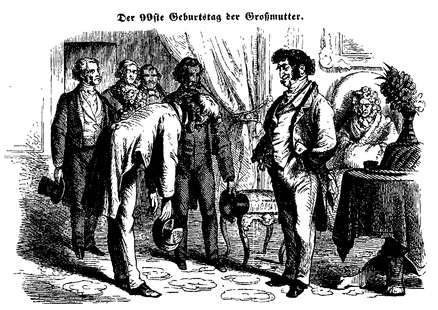
Her dogged refusal to quit the old house “zum grünen Schild” in the former Judengasse appealed to contemporaries, suggesting as it did that the ‘Rothschilds’ phenomenal economic success was rooted in a kind of Jewish asceticism. Ludwig Borne had sung her praises on this score as early as 1827: “Look, there she lives, in that little house ... and has no wish, despite the world-wide sovereignty exercised by her royal sons, to leave her hereditary little castle in the Jewish quarter.” When he visited Frankfurt sixteen years later, Charles Greville was amazed to behold “the old mother of the Rothschilds” emerging from her “same dark and decayed mansion ... not a bit better than any of the others” in the “Jews’ street”:
In this narrow gloomy street, and before this wretched tenement, a smart calèche was standing, fitted with blue silk, and a footman in blue livery was at the door. Presently the door opened, and the old woman was seen descending a dark, narrow staircase, supported by her granddaughter, the Baroness Charles Rothschild, whose carriage was also in waiting at the end of the street. Two footmen and some maids were in attendance to help the old lady into the carriage, and a number of inhabitants collected opposite to see her get in. A more curious and striking contrast I never saw than the dress of the ladies, both the old and the young one, and their equipages and liveries, with the dilapidated locality in which the old woman persists in remaining.1
But on May 7, 1849, in her ninety-sixth year and with her surviving sons at her bedside, Gutle finally died.
It was one of a spate of deaths in the family. The year before, Amschel’s wife Eva had died. In 1850, so did Nathan’s widow Hannah as well as—to the great distress of the Paris Rothschilds—her youngest grandson, Nat’s second son Mayer Albert. Carl’s wife Adelheid died in 1853, followed a year later by Salomon’s wife, Caroline. The effect of these events on the older members of the second generation may easily be imagined. Mayer Carl noticed how “deeply affected” Amschel had been by the death of his mother. “It is a great loss to [him] ... & I cannot tell you how many wretched hours we have spent lately ... Uncle A. is confined to his room but feels rather better after the first shock which was really fearful.” He was only slightly “calmer” when the family gathered in Frankfurt for Gutle’s funeral. Indeed, he and his brother Salomon cut rather forlorn figures in their twilight years, spending less and less time in the counting house and more and more time in Amschel’s garden.
To the new Prussian delegate to the Diet of the restored German Confederation—a mercurial and ultra-conservative Junker named Otto von Bismarck—Amschel seemed a pathetic old man. “[I]n monetary terms,” Rothschild was of course the “most distinguished” man in Frankfurt society, Bismarck reported to his wife shortly after arriving in the town. But “take their money and salaries away from the lot of them, and you would see how undistinguished” he and the other citizens of Frankfurt really were. The newcomer was characteristically rebarbative when Amschel invited him to dinner ten days in advance (to be sure of an acceptance), replying that he would come “if he was still alive.” This answer “alarmed him so much that he repeated it to everybody: ‘What, why shouldn’t he live, why should he die, the man is young and strong!’” With his limited private means and meagre stipend, the Junker diplomat was bound to be impressed as much as he was repelled by the “hundredweight of silverware, golden forks and spoons, fresh peaches and grapes, and excellent wines” which were laid before him on Amschel’s dinner table. But he could not conceal his disdain when the old man proudly showed off his beloved garden after their meal:
I like him because he’s a real old wheeling and dealing Jew, and does not pretend to be anything else; he is strictly Orthodox with it, and refuses to touch anything but kosher food at his dinners. “Johann, take some pread vit you for the deer,” he said to his servant, as he went out to show me his garden, in which he keeps tame deer. “Herr Paron, this plant cost me two tousand gulden, honestly, two tousand gulden cesh. You can hef it for a tousand; or if you’d like it es a present, he’ll pring it to your house. Gott knows I regard you highly, Paron, you’re a hendsome man, a fine man.” He is a short, thin, little man, and quite grey. The eldest of his line, but a poor man in his palace, a childless widower, cheated by his servants and despised by smart Frenchified and Anglicised nephews and nieces who will inherit his wealth without any love or gratitude.2
As Bismarck shrewdly divined, it was this last question—who should inherit their wealth—which most preoccupied the old Rothschilds, who accordingly spent long hours tinkering with their wills. Years before—in 1814—Amschel had joked that the difference between a rich German Jew and a rich Polish Jew was that the latter would “die just when he was losing, whilst the rich German Jew only dies when he has a great deal of money.” Forty years later, Amschel was living up to his own stereotype, with a share in the family firm worth nearly £2 million. But who should inherit this fortune? Denied the son he had so long prayed for, Amschel brooded on the merits of his twelve nephews, particularly those (principally Carl’s sons Mayer Carl and Wilhelm Carl) who had settled in Frankfurt. In the end, his share of the business was divided in such a way that James got a quarter, Anselm a quarter, Nathan’s four sons a quarter between them and Carl’s three sons the last quarter.
Salomon had an heir, of course, and a daughter well provided-for in Paris; but—perhaps because of the harsh words they had exchanged in Vienna at the height of the revolutionary crisis—he sought to avoid making Anselm his sole heir. Instead, he devised complicated provisions designed to transmit most of his personal wealth directly to his grandchildren. At first he seems to have considered leaving almost all of it (£1.75 million) to his daughter Betty’s children (£425,000 apiece for the boys and just £50,000 for Charlotte, whom he had already given £50,000 on the occasion of her marriage to Nat), leaving only his three houses to Anselm and his sons, and just £8,000 for their married sister Hannah Mathilde. Even his Paris hotel, he told Anselm, would go to “you and your sons ... I repeat it is for you and your sons. I have thought about it and put in a clause [to ensure it remains their property for] over a hundred years. No sons-in-law or daughters can have any claim on it.” This was partly a self-conscious strategy to exert the maximum posthumous influence, rather as Mayer Amschel had done in 1812; indeed, the exclusion of the female line was an idea he had inherited from his father. But, unlike his father, Salomon decided that only one of his grandsons would ultimately inherit his share of the family business from Anselm—a new development in a family which had hitherto treated all male heirs more or less equally. In a final codicil to his will dated 1853, he scrapped the clause which left the choice of successor to Anselm, specifying (unsuccessfully, as it turned out) his eldest grandson Nathaniel. Ultimately, all Salomon’s schemes came to naught; in practice, it was Anselm who inherited his fortune and who decided which of his sons should succeed him. Bismarck was right too that the younger Rothschilds ridiculed their old uncles. Visits to the invariably “sad and morose” Uncle Carl were especially dreaded. If there was great grief in 1855 when Salomon, Carl and Amschel one after another expired in the space of just nine months, no record of it has come to light.
This wave of mortality came in the wake of a dramatic upheaval in the Rothschilds’ financial affairs. As we have seen, the huge sums which had to be written off in the wake of the Vienna house’s effective collapse were not easily forgotten, especially by the London partners, whose worst fears about their uncles’ reckless business methods appeared to have been confirmed. Unfortunately, the structure of the firm meant that losses of the sort sustained by Salomon had to be borne collectively; his personal share of the firm’s total capital was not proportionately reduced. This explains why, in the period immediately after the revolution, unprecedented centrifugal forces threatened to break the links which Mayer Amschel had forged nearly forty years before to bind his sons and grandsons together. In particular, the London partners sought to “liberate” themselves from the commitments to the four continental houses which had cost them so dear in the wake of the revolution. As Nat put it in July 1848, he and his brothers wished to “come to some sort of an arrangement so that each house may be in an independent position.” Small wonder the prospect of a “commercial and financial congress” had filled Charlotte with such dread when it was first proposed in August 1848: “Uncle A. is weakened and depressed by the loss of his wife, Uncle Salomon by the loss of his money, Uncle James by the uncertain situation in France, my father [Carl] is nervous, my husband, though splendid, is stubborn when he is in the right.”
When James set off to see his brothers and nephews in Frankfurt in January 1849, Betty fully expected the congress to “alter the bases of our Houses, and following the London house, [to] grant mutual freedom from a solidarity which is incompatible with the movements in politics ...” Characteristic of the strained relations between Paris and London was the row later that year when James heard that Mayer had “ordered” one of the Davidson brothers “not to send any gold to France”—an assertion of English paramountcy he found intolerable. In Paris itself, there was constant friction between Nat and James. The former had always been a good deal more cautious than his uncle, but the revolution, as we have seen, all but broke his nerve as a businessman. “I advise you to be doubly cautious in business generally,” he exhorted his brothers in a typical letter at the height of the crisis:
As for me I have taken such a disgust to business that I should particularly like to have no more of any sort or description to transact ... What with the state of things all over the world, the revolutions that spring up in a minute & when least expected I think it downright madness to go & plunge oneself up to one’s neck into hot water for the chance of making a little money. Our good Uncles are so ridiculously fond of business for business’ sake and because they cannot bear the idea of anybody else doing anything that they can’t let anything go if they fancy another person wishes for it. For my part I am quite sure there is no risk of Baring advancing much [on Spanish mercury] & if he chooses so to do let him do it, be satisfied and take things easy.
Betty saw the force of this. As she commented, “Our good Uncle [Amschel] can’t tolerate a lessening of our fortune, and in his desire to restore it along previous lines, he wouldn’t think twice about throwing us back into the disturbance of hazardous affairs.” But James was increasingly impatient with Nat’s pusillanimity. Charlotte suspected that James would positively welcome his nephew’s withdrawing from the business as it would allow him to increase the involvement of his elder sons Alphonse and Gustave (who first begin to figure in the correspondence in 1846). As Betty put it, the “old ties of fraternal union” for a time seemed “pretty close to falling apart.”
Nor were these the only sources of familial disunity. Even before the 1848 revolution, there had been complaints from Frankfurt about the attitude of the London house. It was, complained Anselm, “very unpleasant to be the most humble servant, to execute your order without even knowing by the Spanish correspondence what is going forward. Very true it is that we do not merit any consideration, & that since a long time ago [sic] we are ranged in a secondary line in the Community of the different houses.” As this implies, Anselm was assuming that he, as the eldest of the next generation, would be Amschel’s successor in Frankfurt. Yet the collapse of the Vienna house changed everything, as it put pressure on him to take over permanently his father’s place in Austria. In the same way, Carl wished his eldest son Mayer Carl to succeed him in Italy. However, the childless Amschel was even more determined that Mayer Carl should take over from him in Frankfurt, leaving his younger and less able brother Adolph to go to Naples. As James observed, such arguments were not only between the elderly brothers but also between their sons and nephews, who were all evidently vying for control of the Frankfurt house, since it continued to be dominant over its Vienna and Naples branches: “Anselm is at odds with Mayer Carl. Mayer Carl is at odds with Adolph.” Although notably partisan in her eldest brother’s favour, Charlotte’s diary details some of the ill-feeling this rivalry generated:
Mayer Carl ... is mature; a man of the world and an international citizen. He is in his prime and at the height of his by no means inconsiderable powers. He has certainly earned himself a greater degree of popularity than Anselm through his engaging manner, his vivacious personality and witty conversation. Indeed he is a welcome and well liked figure in Frankfurt, far more so than my brother-in-law ever was, is or could be. I rather doubt that he possesses the solid breadth and depth of knowledge that Anselm has gained and I am in no position to assess whether he is an experienced businessman, or whether his judgement on important matters is sound and whether he is a good writer and speaker. But ... Anselm is utterly condescending towards my brother, which is quite unjustifiable for one would have to scour whole kingdoms to find such a gifted young man. Perhaps he does not have the aptitude for thorough research and lengthy study required for the pursuit of the scientific branches of intellectual thought. Yet, as a banker and a man of the world, as a refined and educated member of European Society (for he is at ease with all nationalities and classes), it seems to me he is without equal. It is unjust and unworthy of Anselm to treat him with such disdain.
Finally, it is important to bear in mind the anger felt in London and Paris towards the Vienna house after the débâcle of 1848. At times, James talked as if even he would not be sorry to sever his links with Vienna. “I have no interest in Vienna,” he wrote to New Court in December 1849. “While others speculate against the government there, our people in Vienna are not so smart and are unfortunately poor businessmen. They always think they are doing business for the good of the state.”
Yet in the end the partnership was renewed in 1852 with relatively limited alterations to the 1844 system and continued to function with as much success as ever in the following two decades. Why was this? The best explanation for the survival of the Rothschild houses as a multinational partnership lies in the vital role played by James in bridging the generation gap and binding the increasingly divergent branches of the family together again. As Charlotte remarked when she saw her uncle in Frankfurt in 1849, James had emerged from the crisis of 1848 with his lust for life and business undiminished:
I have seldom seen such a practically shrewd man, so worldly and canny, so mentally and physically active and indefatigable. When I reflect that he grew up in the Frankfurt Judengasse and never enjoyed the advantages of high.culture in his childhood and youth, I am amazed and admire him beyond words. He has fun and takes pleasure in everything. Every day he writes two or three letters and dictates at least six, reads all the French, German and English newspapers, bathes, has a one-hour morning nap, and plays whist for three or four hours.
And this was James’s routine when he was away from Paris. The James whom the young stockbroker Feydeau encountered in the rue Laffitte was as much a force of nature as he had been in Heine’s heyday; if anything, age made James only the more formidable.
For all his youthful vigour, James nevertheless remained deeply imbued with the familial ethos of his father’s day. Even before 1848, he had been worried by the signs of dissension between the five houses. Disagreements about the accounts, he warned Lionel in April 1847, were leading “to a state of affairs that in the end everyone deals for himself and this then creates a great deal of unpleasantness.” “It is only the reputation, the happiness and the unity of the family which lies close to my heart,” he wrote, echoing the familiar admonitions of Mayer Amschel, “and it is as a result of our business dealings that we remain united. If one shares and receives the accounts every day, then everything will stay united God willing.” It was to this theme that James returned with passionate urgency in the summer of 1850—a letter of such importance that it deserves to be quoted at length:
It is easier to break up a thing than to put it back together again. We have children enough to carry on the business for a hundred years and so we must not go against one another ... We must not delude ourselves: the day when a [single] company no longer exists—when we lose that unity and co-operation in business which in the eyes of the world gives us our true strength—the day that ceases to exist and each of us goes his own way, then good old Amschel will say, “I have £2 million in the business [but now] I am withdrawing it,” and what can we do to stop him? As soon as there is no longer majority [decision-making] he can marry himself to a Goldschmidt and say, “I am investing my money wherever I like,” and we shall never stop reproaching ourselves. I also believe, dear Lionel, that we two, who are the only ones with influence in Frankfurt, must really aim to restore peace between all [the partners] ... What will happen if we are not careful is that capital amounting to £3 million will fall into the hands of outsiders, instead of being passed on to our children. I ask you, have we gone mad? You will say that I am getting old and that I just want to increase the interest on my capital. But, firstly, all our reserves are, thank God, much stronger than when we made our last partnership contract, and secondly, as I said to you on the day I arrived here, you will find in me a faithful uncle who will do everything in his power to achieve the necessary compromise. I therefore believe that we must follow these lines of argument and do everything possible—make every sacrifice on both sides—to maintain this unity which, thanks be to the Almighty, has protected us from all the recent misfortunes, and each of us must try to see what he can do in order to achieve this objective.
These were themes James harped on throughout 1850 and 1851. “I assure you,” he told Lionel’s wife Charlotte (whom he had identified as an ally), “the family is everything: it is the only source of the happiness which with God’s help we possess, it is our attachment [to one another], it is our unity.”
It is in the light of James’s campaign for unity that the partnership contract of 1852 should therefore be understood—not as weakening the ties between the houses, but as preserving them through a compromise whereby the English partners dropped their demands for full independence in exchange for higher rates of return on their capital. As early as 1850, James had outlined the terms of this compromise: in Nat’s words, he proposed “that the rate of interest on the capital for us should be raised,” provided always that the London house was more profitable than the others. This was also the thrust of his letter to Lionel quoted above; and it was the system finally agreed to in 1852. The British partners received a variety of sweeteners: not only were they permitted to withdraw £260,250 from their share of the firm’s capital, but the interest on their share (now 20 per cent of the total) was increased to 3.5 per cent, compared with 3 per cent for James, 2.625 per cent for Carl and 2.5 for Amschel and Salomon. In addition, the rules governing the joint conduct of business were relaxed: henceforth, no partner could be obliged by the majority to go on business trips, while investments in real estate were no longer to be financed from the collective funds. In return for these concessions, the English partners accepted a new system of collaboration. Clause 12 of the agreement stated that “to secure an open and brotherly co-operation and the advancement of their general, reciprocal business interests” the partners would keep one another informed of any transactions worth more than 10 million gulden (c. £830,000), and offer participations of up to 10 per cent on a reciprocal basis. Otherwise, the terms of all previous agreements not specifically altered by the new contract remained in force including, for example, the procedures for common accounting. This undoubtedly represented a measure of decentralisation. But considering that the alternative (seriously discussed the following year) was the complete liquidation of the collective enterprise, it represented a victory for James.
What the 1852 agreement did not do was to decide the succession in Frankfurt (other than to rule out Adolph): henceforth, Anselm, Mayer Carl and Wilhelm Carl were all to sign for the Frankfurt house. (It also gave Alphonse and Gustave the right to sign for the Paris house.) Only after the deaths of James’s brothers in 1855 did the new structure of the firm emerge (see table 1 a). Despite the provisions of his will, all Salomon’s share of the collective capital passed to Anselm (an outcome which, for reasons which are obscure, James challenged only half-heartedly on his wife’s behalf). Carl’s share was divided equally between his sons after the deduction of a seventh, which went to his daughter Charlotte. Finally, and decisively, Amschel’s share was divided up in such a way that James and Anselm each received a quarter, as did the sons of Nathan and the sons of Carl. The net effect of all this was to give close to equal power to Anselm, James and the English-born partners, while reducing the influence of Carl’s sons. Their influence was further reduced by the decision to put Adolph in charge of the Naples house, and leave Frankfurt to Mayer Carl and his pious brother Wilhelm Carl.
Table 1a. Personal shares of combined Rothschild capital, 1852 and 1855.
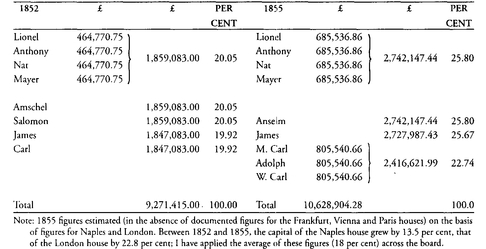
Sources: CPHDCM, 637/1/7/115-120, Socieräts-Übereinkunft, Oct. 31, 1852, between Amschel, Salomon, Carl, James, Lionel, Anthony, Nat and Mayer; AN, 132 AQ 3/1, Undated document, c. Dec. 1855, reallocating Amschel and Carl’s shares.
It was a compromise which worked in practice. After 1852, James was prepared to show a much greater degree of deference to his nephews’ wishes than in the past. New Court no longer took orders from James—as can easily be inferred from the diminished length of his letters to London after 1848. Increasingly, he scribbled no more than a postscript to Nat’s despatch and often concluded his suggestions about business—as if to remind himself that there was no longer a primus inter pares—with the telling phrase: “Do, dear nephews, what you wish.” This was doubtless gratifying to Lionel. Yet the compromise of 1852 meant that the pre-1848 system of co-operation between the five houses was in fact resumed with only a modest degree of decentralisation. The balance sheets of the Paris and London houses reveal a rate of interdependence which was less than had been the case in the 1820s, but it was still substantial. To give just one example, 17.4 per cent of the Paris house’s assets in December 1851 were monies owed to it by other Rothschild houses, principally London.
Moreover, the London partners’ assumption that their house would be more profitable than the others proved over-confident. Although the Naples and Frankfurt houses tended to stagnate (for reasons largely beyond the control of Adolph and Mayer Carl), it was James who made much of the running after 1852, expanding his continental railway interests so successfully that by the end of his life the capital of the Paris house far exceeded that of its partners. Anselm too proved unexpectedly adept at restoring the vitality of the shattered Vienna house. It turned out to be far from disadvantageous for the London partners to share in these continental successes. The new system thus inaugurated a new era of equality of status between the London and Paris houses, with Vienna reviving while Frankfurt and Naples declined in their influence.
As in the past, it was not only through partnership agreements and wills that the Rothschilds maintained the integrity of the family firm. Endogamy continued to play a crucial role. The period between 1848 and 1877 saw no fewer than nine marriages within the family, the manifest purpose of which was to strengthen the links between the different branches. In 1849 Carl’s third son Wilhelm Carl married his cousin Anselm’s second daughter Hannah Mathilde; a year later, his brother Adolph married her sister Julie; and in 1857 James’s eldest son Alphonse married his cousin Lionel’s daughter Leonora at Gunnersbury. To list the rest here would be tedious.3 With a single exception in the years before 1873, those who did not marry other Rothschilds did not stray far from the Jewish “cousinhood.”4 In 1850 Mayer married Juliana Cohen—defeating a rival suit from Joseph Montefiore—while his nephew Gustave married Cécile Anspach in 1859. If Wilhelm Carl had not married a Rothschild, he would have married a Schnapper—a member of his grandmother Gutle’s family.
The brokering of these alliances was, as it had been for nearly two generations, a major preoccupation of the female members of the family. Charlotte made no bones about their rationale. As she enthused on hearing of her brother Wilhelm Carl’s engagement to Hannah Mathilde, “My good parents will certainly be pleased that he has not chosen a stranger. For us Jews, and particularly for us Rothschilds, it is better not to come into contact with other families, as it always leads to unpleasantness and costs money” The idea that either the pious groom or the musical bride was making a spontaneous choice was, in this case, nonsense. Charlotte’s cousin Betty saw the match in a very different light, reporting to her son that “poor Mathilde only determined regretfully to marry Willy.” Now she was “preparing herself with a truly angelic resignation for the sacrifice of her young heart’s dearest illusions. It has to be said that the prospect of being Willy’s lifelong companion wouldn’t entice a young woman brought up as she has been and blessed with a cultivated mind.” The question which remained to be resolved was whom Betty’s sons Alphonse and Gustave should marry. It seems that Hannah Mathilde had in fact set her heart on the latter, while her sister Julie had hoped to marry Alphonse. But, after teasing her son on the subject, Betty reported that:
Papa, frank and honest man that he is ... brought up the subject without beating about the bush. He expressed all his regrets to the poor mother ... and he undeceived her of illusions that the desire for success might encourage wrongly, and he asked her in her own interest and for the happiness of her daughter to look elsewhere.
This was good news for Charlotte, who was planning a similar double match between Betty’s sons and her daughters Leonora and Evelina. In her diary, she coolly weighed up the respective merits of the two putative sons-in-law:
Gustave is an excellent young man. He has the best and warmest heart and is deeply devoted to his parents, brothers and sisters and relatives. He has a strongly developed sense of duty and his obedience could serve as an example to all young people of his generation. Whether he is talented or not, I could not in all honesty say. He has enjoyed the great benefits and advantages of a good education, but is, he claims, stupid, easily intimidated and unable to string ten words together in the company of strangers. They say he has acquired considerable skill in mathematics but I am ignorant of that subject and cannot pass judgement.
His brother, Alphonse, combines the extraordinary energy and vitality of our uncle [James] with Betty’s facility for languages. He is a good reader, listener and observer and he remembers everything he absorbs. He can converse on the topics of the day with an easy manner, without pedantry, but always in a direct, penetrating and amusing way, touching upon every subject in the most agreeable fashion. He cannot be relied upon for an opinion, since he never voices one, indeed, perhaps does not have opinions; but it is a pleasure to hear him, for he speaks without emotion in the most engaging and lively tone.
Mrs Disraeli calls Gustave handsome; I do not know whether I agree with her. He is the only one of the Jacobean line who can boast this advantage with his large, soft, blue-green eyes. In his early years they were apparently weak like all the Rothschild eyes, but now there is no trace of the childhood trouble, except a certain quality which one might almost call languishing. His eyebrows are finely drawn; his brow well formed, fair and clear; he has a full head of dark brown, silky hair; his nose is not oriental; he has a large mouth which, however, cannot be praised on account of its expression which is good natured at best and reveals neither understanding nor depth of feeling. Gustave is slim, his bearing is easy and his manners those of the highest society. I should like to see his profile at the altar.
She was only half-successful: nine years later it was Alphonse’s profile she saw at the altar, alongside her daughter Leonora. By that time, moreover, she had revised her opinion of the bridegroom. Now he seemed “a man, who perhaps for ten of fifteen years has run the round of the world—is completely blase, can neither admire nor love—and yet demands the entire devotion of his bride, her slavish devotion.” Still, she concluded, it was “better so—the man whose passions are dead, whose feelings have lost all freshness, all depth, is likely to prove a safe husband, and the wife will probably find happiness in the discharge, in the fulfilment of her duties. Her disenchantment will be bitter but not lasting.” In any case, her daughter attached “much importance to a certain position in the world, and would not like to descend from what she fancies to be the throne of the R’s to be the bride of a humbler man.”5 Such sentiments were doubtless based on Charlotte’s own experience, and tell us much about the distinctive quality of such arranged marriages.
The extent to which parental choice was decisive should not, of course, be exaggerated. The fact that Charlotte failed to secure Alphonse’s brother for her other daughter suggests that parents were less able to impose their choices of spouse on their children than had previously been the case. Anselm’s daughter Julie also successfully repelled the advances of her cousin Wilhelm Carl, as well as those of a more distant relation, Nathaniel Montefiore. On the other hand, her final “choice” of Adolph was strictly governed by her father and future father-in-law, who spent months drawing up the marriage contract; and although such negotiations often involved sums of money being settled individually on the bride-to-be to give her a measure of financial independence, this should not be mistaken for some sort of proto-feminism.6 There were limits to what the Rothschilds were prepared to inflict on their daughters, as became apparent when old Amschel announced shortly after his wife’s death that he wished to remarry none other than his own grand-niece, the much sought-after Julie (who was not yet twenty). The rest of the family—backed up by his doctors—closed ranks against this idea. But it is not known how far their opposition was actuated by fears for his health as opposed to the happiness of the young lady in question: James for one appears to have worried that, if Amschel’s proposal were rejected too abruptly, he might withdraw his capital from the firm and marry a stranger.
The Orthodox and the Reformed
As Charlotte emphasised, endogamy continued to be partly a function of the Rothschilds’ Judaism: the family policy remained that sons and daughters could not marry outside their faith (even if they were socially so superior to their co-religionists that they could not marry outside the family either). The extent of Rothschild religious commitment in this period should not be underestimated: if anything, it was greater than had been the case in the 1820s and 1830s, and this was another important source of familial unity in the period after 1848. James continued to be the least strict in his observance. “Well, I wish you a hearty good Sabbath,” he wrote to his nephews and son in 1847. “I hope you are having a good time and a good hunt. Are you eating well, drinking well and sleeping well as is the wish of your loving uncle and father?” As the existence of such a letter itself testifies, he saw nothing wrong with being at his desk on the Sabbath. He and Carl also were conspicuously erratic in their attendance at synagogue (unlike their wives).
Yet James remained as firmly convinced of the functional importance of the family’s Jewish identity as he had been in the days of Hannah Mayer’s apostasy. Although he very nearly forgot the date of Passover in 1850, he was nevertheless willing to cancel a business trip to London in order to read the Haggadah. He was happy to receive the Frankfurt rabbi Leopold Stein’s new book in 1860 (though the size of the donation he sent Stein is not recorded). His wife Betty was as secular-minded as her husband, but she too had a strong sense that observance was a social if not a spiritual imperative. When she heard that her son Alphonse had attended the synagogue in New York, she declared herself “over the moon,” adding:
It’s good thing, my good son, not only out of religious feeling, but out of patriotism, which in our high position is a stimulus to those who might forget it and encouraging to those who remain firmly attached to it. That way you reconcile those who might blame us even while they think as we do, and make sure you have the high esteem of those who hold different beliefs.
That said, it was evidently something of a surprise to her that Alphonse had gone to the synagogue of his own volition.
Wilhelm Carl meanwhile remained the only Orthodox member of the younger generation. Continuing his uncle Amschel’s campaign against the Reformist tendencies of the Frankfurt community, he supported the creation of a new Israelite Religious Community for Orthodox believers, donating the lion’s share of the funds to build a new synagogue in the Schützenstrasse. Yet he opposed the outright schism advocated by the new community’s rabbi, Samson Raphael Hirsch, who wished his followers to withdraw altogether from the main Frankfurt community. Orthodox though he was, Wilhelm Carl shared the Rothschild view that diversity of practice should not compromise Jewish communal unity.
His English cousins also continued to consider themselves “good Israelites,” observing holy days and avoiding work on the Sabbath. James once teased Anthony when he was visiting Paris that he liked to pick up his prayer books, an impression of piety confirmed when his nephew dutifully fasted at Yom Kippur in 1849, despite fearing (wrongly) that it was medically inadvisable given the outbreak of cholera then sweeping Paris. It was typical that he and Lionel had to supply Nat with matzot when he was in Paris during Passover. Even when on holiday in Brighton, Lionel and his family celebrated Yom Kippur, fasting and praying on the Day of Atonement. But the four London-born brothers were not Orthodox in the way that Wil helm Carl was. In 1851 Disraeli unthinkingly sent Charlotte and Lionel a large joint of venison he had been given by the Duke of Portland:
Not knowing what to do with it, with our establishment breaking up, I thought I had made a happy hit & sent it to Madame Rothschild (as we have dined there so often, & they never with us) it never striking me for an instant that it was an unclean meat, wh[ich] I fear it is. How[ever] as I mentioned the donor & they love Lords .... I think they will swallow it.7
He seems to have been right, though it seems unlikely that this was a reflection of love for the aristocracy; the fact was that Lionel’s family, like James‘s, did not keep strict kosher. Indeed, Mayer was such an enthusiast for venison that he defended stag hunting in a political speech at Folkestone in 1866!8
On broader religious questions, the English brothers inclined towards the Reform movement, such as it was in England. When an attempt was made (in 1853) to exclude representatives of the Reform-inclined West London Synagogue from their places on the Board of Deputies because they had fallen foul of the conservative Chief Rabbi, Lionel spoke out against what he called “popery.” “He had every respect for the ecclesiastical authorities,” he declared, “but he was not going to be led by them as by a Catholic priest. They might be, and no doubt were, very learned men but they had no right to enquire of him whether he kept one day or two days of the festivals”—an important distinction between Reform and Orthodox practice. Such views may explain why the Reform community in Frankfurt had appealed to Lionel for help in their struggle against the dominant Orthodoxy the previous year.
This tendency towards Reform was more pronounced in the case of their wives. This may have been because the traditional synagogue service had been a masculine affair: there is some evidence that Rothschild women had little or no knowledge of Hebrew. Anthony’s wife Louisa, for example, shared the Reform movement’s aspiration to modernise Jewish forms of worship precisely because synagogue services compared unfavourably with church services. “What a pity one cannot go to church and hear a good sermon,” she exclaimed in 1847, frustrated by her inability to understand Hebrew. This did not imply leanings towards apostasy, however. Rather, she was determined that her children should “be better instructed and able to join their brethren in public worship.” Accordingly, her daughters Constance and Annie were brought up on a strong blend of Jewish doctrine and Anglican forms. After a short family service at home on the Sabbath, she gave her daughters Bible lessons and spent the rest of the day reading Jewish and non-Jewish religious literature while they studied subjects like the “History and Literature of the Israelites.” Yom Kippur was solemnly observed, as Constance recorded in her diary in 1861. Yet the Sabbath lectures her mother published in 1857—with chapters on “Truthfulness,” “Peace in the Home” and “Charity”—contained much that could equally well have appeared in a contemporary Anglican book of homilies:
Oh Lord, Thou hast made me so much happier, Thou hast vouchsafed to me so many more blessings than to thousands of Thy creatures, that I know not how I can ever thank Thee sufficiently. I can only pray to Thee to make me charitable and compassionate towards those who suffer and are in want, and to prevent me from being selfish and from thinking only of my gratification. Place in my heart, O Lord, the wish and inclination to feed the hungry, to clothe the naked and to console the sorrowful, as long as I have the power and the means to do so, that I may thereby be less undeserving of all Thy bounteous goodness to me, and less unworthy of Thy favour and merciful protection, O my God, Amen.
Raised on a diet of this sort of thing, it is not wholly surprising that, like their mother, Louisa’s daughters preferred Westminster Abbey to the synagogue. What is more unusual is that Charlotte, who had been raised in a far more Orthodox atmosphere in Frankfurt, should have felt similar inclinations. Her letters to her son Leo show that she frequently attended non-Jewish services and institutions. She saw no reason not to participate in the affairs of the Anglican Church in her capacity as a landowner. She heard the Bishop of Oxford preach at the consecration of Acton church (near Gunnersbury) in 1866, confessing that she had been “really spell-bound” by his sermon, though she was less impressed when the Bishop of London performed the same office for a church in Ealing. In this she was far from unique: Mayer’s wife Juliana took such a close interest in one of the livings in the gift of the Mentmore estate that she drove one incumbent to resign.9 Charlotte was also attracted to the fashionable world of Anglo-Catholicism, witnessing (in the space of just over a year) a Catholic bazaar, the consecration of Nazareth House by Archbishop Manning, a service in a Carmelite chapel in Kensington and another at the House of the Sisters of Mercy. On each occasion, she owed her invitation to Catholic friends like Lady Lothian and Lady Lyndhurst.
Charlotte constantly compared what she saw on these occasions with analogous Jewish gatherings and, although the comparisons were not always unfavourable to her own faith, there was a strong vein of criticism. Attending a prize-giving at the Jews’ Free School, she was:
painfully struck by the contrast of those engaged in the ceremony among Jewish children, and the prelates, patrons, friends and visitors, who witnessed a similar function in the [Catholic] House of Charity ... Dr. Adler [probably the Chief Rabbi’s son Hermann, the first minister of Bayswater Synagogue], after having said a few words rushed away, as if the plague had been in the building, while Mr. Green [Rabbi A. L. Green of the Central Synagogue, who also acted as her almoner] escaped by a side door, without even saying a single word to any one. There was not one single visitor, man or woman, a large open space filled with empty chairs and I felt so shy at occupying the vast area that I was obliged to retire to a corner near the singing class.—Whatever may be said of the genuflexions and outward, showy ceremonies of the Catholics, their works, their good works, are noble and sublime, and among us there really is no heartiness.
In the light of this it seems less remarkable that explicitly Christian institutions appealed to members of the Rothschild family for financial assistance. These appeals were sometimes successful: in 1871, for example, a Catholic priest persuaded Charlotte to give £50 to his school in Brentford.
As this suggests, it was still mainly through charitable work that the Rothschilds continued to give expression to their religious impulses. The traditional forms of male philanthropy were remarkably long-lived. In Vienna Anselm began each working day at 9.30 a.m. by going through all the begging letters, personally determining the sums to be paid to each supplicant; and even when he went for his daily constitutional to the Schönbrunn zoo, a bank clerk accompanied him to distribute coins to the beggars he encountered. In Frankfurt Jacob Rosenheim acted as Wilhelm Carl’s “beggars’ secretary”; but Wilhelm Carl himself still made the decisions. As his son recalled:
Every evening, often as late as eight or nine o‘clock, my father would go to the Baron at his business premises on Fahrgasse, and sometimes also to the Grüneburg, in order to present him personally with a list, carefully drawn up by my mother, of the petitions—20 to 30 of them on average—received from all over the Jewish world, personal appeals for help, letters from the most esteemed rabbis in every country, the yeshivot and welfare institutions in the East and the West. In each individual case, the Baron personally decided on what seemed to him to be an appropriate amount. Incidentally, he also read with a certain amount of satisfaction every single letter of thanks received. Before it was presented to the Baron, information on each request had to be sought from one of the rabbis in the Baron’s confidence who were located throughout the world. Each item of information was registered and copied verbatim into a book.
The punctiliousness in each case is impressive. Yet there came a point when the volume of requests for aid could no longer be managed in this old-fashioned way, especially as the numbers of poor Jewish immigrants from eastern Europe began to rise. When a man like Lionel was dealing with millions, it was absurd to expect him personally to authorise contributions like the hundred pounds he paid in 1850 “towards the Fund for the erection of Almshouses for Indigent Foreigners”; or the comparable sum his uncle Amschel asked him to contribute to a Jewish girls’ school in Frankfurt two years later. Much of this work therefore began to be delegated. In London Asher Asher—a doctor from Scotland who worked as secretary of the Great Synagogue after 1866—acted as Lionel’s unpaid “private almoner,” virtually “the manager of the ‘Charitable Department’ of New Court,” according to one contemporary source. Likewise in Paris, Feydeau recalled “a special office ... where several employees were exclusively occupied with recording the requests for help, studying them, and gathering information on the actual position of those seeking help.” Charity was turning into a chore scarcely distinguishable from the more humdrum aspects of banking. After 1859, some of this work could be passed on to, or at least co-ordinated by, the new Board of Guardians for the Relief of the Jewish Poor. In 1868, for example, one Emanuel Sperling, a father of four and “a highly respectable man well worthy of recommendation” was “desirous of opening a small shop for which purpose he has got a little towards the same”; Sophie Bendheim, the daughter of a distant member of the Davidson family, needed money for her daughter’s dowry. This, however, was never a substitute for the philanthropic activities of the family and firm.
The women of the family were in a position to be more actively engaged; indeed to some extent philanthropy became their work, performed as assiduously as their husbands’ work at the bank. The Jews’ Free School had been an important focus of Rothschild benefaction since Nathan’s day; in the 1850s and 1860s it began to attract not just money but personal involvement in its affairs from Charlotte and Louisa (whose husband Anthony had become president of its board of governors in 1847). When she first visited it in 1848, Louisa found it “an excellent institution” providing “gratuitous instruction” to “about nine hundred poor children taken from the very lowest classes,” but its educational standards were low. Her sister-in-law Charlotte despaired of “the little learners in Bell Lane” whom she described to her son as “indescribably dingy and dirty—and uncouth.” “It is quite disheartening to be perpetually trying to improve those Caucasian10 arabs,” she declared in 1865, “and without ever being able to descry any real progress in them.” Her weekly visits to Bell Lane were “far from agreeable to me” as “the humble classes of our community [are] terribly dirty and ragged in bad weather.” On the other hand, she found it “impossible ... to go among all the poor, dirty little children without becoming deeply interested in their progress and general improvement.” By the 1870s, her efforts—which included arranging an inspection by Matthew Arnold—and those of her brother-in-law Anthony had transformed it, more than trebling the number of pupils, increasing its annual budget by a factor of twenty and raising the number of teachers twenty-five-fold.
Other educational institutions in which Rothschild women took an interest included the Jews’ College, founded in 1855; the Sabbath schools of the Association for the Diffusion of Religious Knowledge; and the Borough Jewish schools founded in south London by Mayer’s wife Juliana in 1867. There were also, as in the past, efforts to relieve the sick. In addition to being a member of the Jewish Ladies Benevolent Loan Society and the Ladies Benevolent Institution, Louisa established a Jewish Convalescent Home, which was supplied with food from a special kitchen financed by Charlotte in Artillery Lane. In addition, Charlotte established a Home for Aged Incurables, reorganised the London Lying-in Charity and was President of the Ladies’ Benevolent Loan Society and the Needlework Guild for the East End Maternity Home. There was also a Rothschild-founded Day Nursery for Jewish Infants in Whitechapel and a Jews’ Deaf and Dumb Home on Walmer Road, Not-ting Hill. Finally, Charlotte sought to involve herself in the new Board of Guardians. In 1861, for example, she enabled Rabbi Green to present the Board with ten sewing-machines which were to be hired out or sold to poor immigrant women who wished to earn money as seamstresses. She later donated £100-£200 a year to a “Girls’ Workroom” established by Green.
In his sermon at her memorial service in 1884, Hermann Adler recalled that the principal theme of Charlotte’s published Prayers and Meditations and Addresses to Young Children (originally composed for the Girls’ Free School) had been “that those who suffer and stand in need of assistance should be near to us and our sympathy ... that the rich must meet the poor by ‘giving not only gold, but time, which is life.’” This she had very definitely done. Her dying words, he told the congregation, had been: “Remember the Poor”—and by this was primarily meant the Jewish poor. However, Adler did not allude to an important distinction which Charlotte had made throughout her adult life between charitable “giving” and donations of a specifically religious character. In 1864, she had a revealing conversation with Rabbi Green when he
asked for a new scroll of law for his synagogue. He says that formerly there were religious persons who had great generosity—and superstitious people, who though not very wealthy or liberal, gave to the Temple from feelings of awe and dread; but that superstition has been annihilated by civilization, and that the religous Jews have ceased to be generous—while the generous Israelites allow their bounty to flow into secular channels.—I dare say he is right.—I would infinitely rather give twenty pounds to a school than expend it for a sepher ...
Sincere concern for the material needs of the Jewish community, in other words, could be accompanied by a critical stance towards Judaism as an organised religion. It is also worth noting the first signs of disquiet within the Jewish elite at the rising rate of immigration from Eastern Europe. In 1856 Charlotte organised an “Amateur Concert in aid of the Funds of the Jewish Emigration Loan Society” at which her children Evelina and Alfred performed, and Louisa was a member of the Society’s Committee. The purpose of this organisation may easily be inferred. As we shall see, the more poor Jews immigrated to England from Eastern and Central Europe, the more members of the Jewish elite wished to see emigrating elsewhere.
Perhaps the most marked change in Rothschild attitudes towards charity in this period was James’s. This was probably a reaction to the events of the 1840s, which had revealed two things: the extent of anti-Jewish feeling in French society as a whole, and the extent of his own personal unpopularity among the poor of Paris. Prior to 1848, James had been of all the five sons of Mayer Amschel the least publicly engaged in Jewish communal life. Though he had taken up the cudgels on behalf of the Jews of Damascus during his battle with Thiers in 1840, he had done relatively little for the Jews of Paris. That changed after the revolution. In 1850 James informed the Consistory of Paris of his intention to create a Jewish hospital at 76 rue Picpus to replace the inadequate “Maison centrale de secours pour israélites indigents de Paris” founded in 1841. Two years later, on December 20, 1852, the hospital—a spacious new building designed by Jean-Alexandre Thierry—was formally opened after what the Univers Israélite described as “one of the grandest [ceremonies] that Judaism has ever celebrated within our midst,” attended by the Minister of Public Works, the Director of the Department of Religion and the Prefect of the Seine. At around the same time, he also made a substantial contribution to the new Romano-Byzantine synagogue built by Thierry for the Consistory in the rue Notre-Dame-de-Nazareth. There were also substantial donations to establish two orphanages in the rue des Rosiers and the rue de Lamblardie (the latter named after Salomon and Caroline).
These benefactions coincided with increased Rothschild involvement in the institutions of French Jewry. In 1850, Alphonse became a member of the Central Consistory; two years later, Gustave was elected to the Paris Consistory and became its president in 1856. After 1858, the Consistory deposited its funds at de Rothschild Frères. It seems rather as if James’s self-conscious status as a political “outsider” under Napoleon III’s regime gave him the confidence to assume the role of lay leader of the Jewish community which his brothers and nephews already played elsewhere. Yet he was also careful to dispense some money without regard to creed, establishing a more or less permanent soup kitchen in the rue de Rivoli.
Perhaps nothing better illustrates the extent of Rothschild efforts on behalf of their poorer brethren than the sheer number and extent of the contributions made by the family to the new hospital in Jerusalem which had at last been established in the 1850s by Albert Cohn. The names of no fewer than eleven Rothschilds appear in a contemporary list of donors to the hospital and to related facilities: Charlotte set up “an industrial training institute” there, to which she sent an annual cheque; Anselm funded a small bank; Betty provided clothing for pregnant women and Alphonse and Gustave funded training in handicrafts for forty youths. The family also paid a total of 122,850 piastres in “voluntary contributions.” The fact that members of all branches of the family appear among the benefactors reminds us that although most of their charitable work went on at a national—or rather urban—level, the Rothschilds continued to feel a responsibility towards a wider, “universal” Jewish community.11
Lionel Stands
No history of the Rothschilds would be complete without a discussion of the decisive role played by Lionel in securing practising Jews the right to sit as Members of Parliament in the House of Commons. However, it is important not to consider this particular question in isolation or, for that matter, as a minor episode in the teleological “Whig” history of English constitutional progress. The institutional barrier which prevented Jews who were elected as MPs from taking their seats in the Commons—the Oath of Abjuration containing the words “upon the true faith of a Christian”—was only one of a number which members of the Rothschild family sought to challenge in the 1840s and 1850s.12 Of comparable importance to them were the obstacles to matriculation at Oxford and graduation at Cambridge.
In addition, there were social institutions which, although they did not formally exclude Jews, had never admitted them before: penetrating these was as important as overthrowing formal legal handicaps. Given the structure of British politics in the nineteenth century, a seat in the House of Commons by itself was of only limited value; local political power was just as important and in some ways a prerequisite for parliamentary representation. Moreover, there was an important social difference between local power based on urban votes and that rooted in a rural constituency. For many of the most important political decisions were taken not at Westminster but in “the country”—those complex circuits of aristocratic country houses where the political elite spent such a large proportion of the year. Even in town, Parliament was far from being the sole political forum: an MP who was not also a member of one or more of the London clubs clustered around Piccadilly and Pall Mall led a truncated political existence. And of course gaining access to the House of Commons did not automatically open the doors of the House of Lords to Jews.
Why did the Rothschilds want to improve their access to these institutions of the British establishment? The strictly instrumental interpretation that they wished to increase their political influence in order to maximise their leverage over government will not do. To be sure, many non-Jewish City families were represented in the House of Commons by this time (notably the Barings). But by the 1840s the Rothschilds were firmly established as the pre-eminent private bank in the City; and despite the chilly relations which developed with the Bank of England after Nathan’s death, there was little reason to doubt that, on the rare occasions when the British government required to borrow money, it would turn to New Court. Moreover, once they had gained access to the House of Commons, the Rothschilds appear to have made little use of its facilities—at least as a debating chamber. It is rather more convincing to argue that Lionel, influenced as he was by his mother, wished to win hitherto denied privileges for Jews as a matter of principle. His relatives on the continent never ceased to applaud Lionel’s efforts to secure admission to Parliament: for James, his nephew was fighting a symbolic battle on behalf of all Jews, one which stood in lineal succession to the battles fought by Mayer Amschel in Frankfurt forty years before. That said, there is no mistaking the authenticity of Lionel’s liberalism, though at the time most politicians (including Lord John Russell) were more inclined to label him a Whig. It was not just the “Jewish question” which lured him and his brothers away from the Tories, but also the much more important cause célèbre of the 1840s, free trade, which became identified with the Liberal party in the wake of the Tory revolt against Peel in 1846.
Here, then, is one of the great paradoxes of 1848: at a time when the Rothschilds were widely vilified by continental liberals as props of reaction, they were playing a leading role in an archetypal liberal campaign for legal equality in Britain. After all, Jewish emancipation was one of the achievements of the Frankfurt parliament, though it was subsequently rescinded in Frankfurt itself in 1852. Even Betty, that staunch Orléanist opponent of the revolution, had to admit it: “We Jews ought not ... to complain of this great movement and relocation of interests. Everywhere emancipation has brought down the chains of the Middle Ages, and has given back to these pariahs of fanaticism and intolerance the rights of humanity and equality. We should congratulate ourselves on this ...”
Yet here too there is a need for qualification. Firstly, there were elements of the revolutionary movement, as we have seen, which were markedly anti-Jewish; indeed, violence against Jews was one of the phenomena which most disgusted the Rothschilds about the revolutions of 1848—9. Secondly, in some ways what was really at issue was the Rothschilds’ status within the British Jewish community. Rivalry with other members of the Jewish elite—notably David Salomons—was without doubt a strong motivating force. The reality was that for most poor Jews in Britain (and even more so on the continent) the notion of representation in Parliament was as remote as the notion of study at Cambridge. For all the rhetoric of collective struggle for Jewry, the Rothschilds were to some extent pursuing their own interests as a family—specifically, their own claim to be the “royal family” of Judaism.
In the light of subsequent events, it is extraordinary to recall that in 1839 the Allgemeine Zeitung des Judenthums had launched a bitter attack against the Rothschilds, accusing them of positively harming the cause of Jewish emancipation:
Well we know to our dismay that the repulsive attitude towards the Jews in Germany, which had almost disappeared completely at the time of the Wars of Liberation, increased with the increase in the House of Rothschild; and that the latter’s great wealth and [that of] their partners have adversely affected the Jewish cause, so that as the former grew so the latter sank all the further ... We must sharply separate the Jewish cause from the whole House of Rothschild and their consorts.
At the time, however, it did appear that the family had lost sight of the wider interests of European Jewry. It was not a Rothschild but one of their business rivals, David Salomons of the London & Westminster Bank, who in 1835 won an early victory for the cause of Jewish political rights in England by getting himself elected Sheriff of the City of London. In the process, he and his Whig supporters secured the passage of an act which abolished the requirement that an elected Sheriff sign a declaration containing the words “upon the true faith of a Christian.” It was not a Rothschild but Francis Henry Goldsmid who became the first Jew admitted to the Bar. It was not a Rothschild but an in-law, Moses Montefiore, who was knighted and then made a baronet, thus (as James put it) “raising the standing of the Jews in England.” It was not a Rothschild but Isaac Lyon Goldsmid who led the Jewish Association for Obtaining Civil Rights and Privileges.
However, the Rothschilds took a renewed interest in the question of emancipation after the Damascus affair in 1840. The precedent set then of using Rothschild influence to improve conditions for Jews in the less tolerant states of Europe continued throughout the 1840s. In 1842 James went to see Guizot “concerning the Polish Jews,” while Anselm sought to orchestrate press opposition to new anti-Jewish measures proposed in Prussia. In 1844 “execrable” new measures proposed by Nicholas I to reduce still further the Jewish Pale (permitted area) of settlement and to bring the Russian Jews’ schools and communities under direct state control prompted Lionel to seek interviews with Lord Aberdeen and Peel in advance of a visit by the Tsar to London. When Montefiore travelled to Russia to protest at the government’s treatment of the Jews, Lionel again saw Peel to request letters of introduction for him to Count Nesselrode. In the same vein, we have already seen how the Rothschilds sought to use the political crisis in Rome in 1848—9 to extract concessions from the Pope with regard to the city’s Jews.
It was nevertheless in England—hardly a country renowned for its religious intolerance—that the most celebrated campaign for Jewish rights was fought and, eventually, won. The position of Jews in Britain at this time was in many ways anomalous, reflecting the relative smallness of the Jewish community by Central European standards. The total Jewish population of the British Isles had been just 27,000 in 1828; thirty-two years later (after decades of unprecedented demographic growth in the country as a whole) there were still only 40,000 Jews—around 0.2 per cent of the population, more than half of them living in London. By continental standards, and compared with popular attitudes to Catholics (and especially Irish Catholics, hostility to Jews was muted. Yet there remained on the statute books, albeit mainly as dead letters, a variety of disabilities including prohibitions on Jews owning landed property and endowing schools. More important, as we have seen, a variety of public offices, of which the most important was membership of Parliament, required the Christological oath. It was the abolition of this oath which was to become the paramount objective of Rothschild political activity.
Under the influence of his wife Hannah, Nathan had taken up the question of Jewish political rights in 1829-30, in the wake of the successful passage of the Catholic emancipation act. Rothschild disillusionment with the Tory party can be dated from this period, when it became obvious that the Whigs were far more likely to give their support to an equivalent measure for Jews. This political realignment continued after Nathan’s death as a succession of emancipation bills introduced by Robert Grant were thrown out in the Commons in the face of largely Tory opposition. Hitherto overlooked records suggest that Nat played a supporting role in the unsuccessful 1841 campaign to allow Jewish councillors on provincial corporations to swear the same amended oath Salomons had been able to use as Sheriff of London. Tory opposition to this measure in the Lords—which the Rothschilds monitored closely—did nothing to improve relations with the party. In the wake of the Conservative election victory in 1841, the Rothschilds’ old friend Herries warned the new Chancellor Henry Goulburn that he might face opposition from “the Jews and brokers” in the City:
It may be as well to bear in mind that the said gentry may not be so propitious to you as in former time. The part which Jones Lloyd, Sam Gurney and the Rothschilds etc. took in the City election indicates no kind feeling toward the Conservative Party. But they will not allow their feelings to stand much in the way of their own interest although they will not forgive the rejection of the bill to enable the Jews to be Common Council men and those Leviathans of the money market have much more power to promote or to obstruct a financial measure than any other description of men even possessing larger capitals than themselves.
A letter from a party activist confirms that Mayer had indeed been involved in registering voters in the City to boost the Liberal poll. 13 When Peel later asked Wellington to drum up support for his government, the Duke was equally pessimistic. “The Rothschilds,” he warned Peel, “are not without their political objects, particularly the old lady [Hannah] and Mr Lionel. They have long been anxious for support to the petitions of the Jews for concessions of political privileges.” Though he was “now more of a Tory than when [he] was in London,” Nat stressed that his support for Peel would be strictly conditional: “I trust he will be liberally inclined . towards us poor Jews & if he emancipates us, he shall have my support.” For Nat, it was the Jewish issue alone which alienated the Rothschilds from Conservatism. As he wrote half-seriously in 1842:
[Y]ou must know that altho’ a staunch whig in England I am an ultra redhot conservative here, I fancy you wd adopt the latter way of thinking also if it were not that the little bit which has been removed from a part of the body, & which part Billy [Anthony] in particular has always considered of the greatest importance, prevented our exercising the same rights & privileges as others not in the same predicament.
Altogether more Liberal in outlook, Anthony welcomed Peel’s difficulties with his party in the Commons in the belief—correct as it turned out—that they would make him “a little more liberal & I trust that Sir Robert if he is so will do something for the poor Jews.” As for Lionel, he did not hesitate to lend his support to the Liberal candidate James Pattison at the October 1843 by-election in the City, urging Jewish voters to break the Sabbath in order to vote. These votes were crucial, as Pattison only narrowly beat his Tory opponent, who was none other than one of the Rothschilds’ old rivals, Thomas Baring.
Yet Lionel hesitated to follow David Salomons’s example and involve himself directly in political activity. The most obvious explanation for this hesitation was purely practical: politics took up time which could not easily be spared by the senior partner of a bank as big as N. M. Rothschild & Sons. Perhaps Lionel shared James’s view—expressed as early as 1816—that “as soon as a merchant takes too much part in public affairs it is difficult for him to carry on with his bankers’ business.” On the other hand, the pressure from family members—including James—for him to do something to raise the family’s political profile in England was considerable. James’s notions of political activity remained rooted in his experience of the 1820s, when he and his elder brothers had energetically accumulated titles and decorations by ingratiating themselves with the monarchs of the various states with which they did business. He sought to encourage his nephews to do the same in England in 1838, telling Lionel that he had
had a long conversation with the King of Belgium and he promised us that he will write to the Queen of England and he will arrange for his wife to write that you should all be invited to all the balls ... The King has granted the four brothers [an] order ... and if you, my dear nephews, are devotees of such ribbons then I will ensure that next time you will be the recipients, God willing, [though] in England these are not worn.
Less old-fashioned was Anselm’s hope “in a year or two to be able to congratulate one of you on a seat in Parliament & to admire your eloquent speeches.” When Isaac Lyon Goldsmid became the first Jewish baronet in 1841, Anthony wrote from Paris that he “should have liked Sir Lionel de R. much better & he ought to have tried.” Similarly, when Salomon was made a “citizen of honour” of Vienna in 1843, Anthony pointedly hoped that it would “produce an effect in Old England.”
The pressure mounted in 1845 as David Salomons scored another important point. Having won a contested City ballot for the aldermanry of Portsoken, Salomons was confronted with the oath “upon a true faith of a Christian”; when he refused to take it, the Court of Aldermen declared his election void. Salomons complained to Peel, who—as Anthony had predicted—now proved more sympathetic, instructing the Lord Chancellor, Lyndhurst, to draft a bill removing all remaining municipal disabilities as they affected Jews. The bill was enacted on July 31, 1845.14 Lionel had in fact played a part in securing the passage of the act, having been one of the committee of five sent by the Board of Deputies to lobby Peel on the subject. But Salomons got the glory, and it rankled with Lionel’s competitive relatives. “I shall be glad to see [you] Ld M. of London & M.P for the city,” wrote his brother Nat. “You ought to be canvassing for the E[ast] Ind[ia Company] direction, my dear Lionel.” A year later, he was still harping on the same theme: “Our French fogies ... all say you will soon be in the House of Commons & are preparing yourself.” When Salomons visited Paris shortly after his triumph., Hannah was frosty. “We must allow him,” she wrote to Charlotte, “to enjoy the satisfaction of [the good cause‘s] success and ourselves fully to participate in the good which we so sincerely hope and trust may result to the community we belong to, from which I do not doubt individual merit and exertions will be duly appreciated.”15 Moses Montefiore’s baronetcy in 1846 made Anthony hope that “perhaps when the Whigs come in ... they will think they ought to give something to your Honour.” No sooner had Peel’s government collapsed than Nat was urging his brother to “stand or state officially you will stand for the City,” suggesting that he “engage some clever fellow to come & read with you in the evenings for an hour or so, to be a little more at home on the different questions of political economy.”
Nor was it only members of his own family who urged Lionel to be more politically active. In 1841 a political associate of the Irish leader Daniel O‘Connell invited him “as one of the most influential of your honored nation” to attend a public meeting (“in Exeter Hall in the Anchor Tavern”) at which he proposed to discuss “the political position of the Jews.” Two years later, he was being offered assistance on the assumption that he himself would want to contest the City of London by-election.
Still Lionel remained reluctant. While others wasted no time in entering the breach made by Salomons—among them his brother Mayer, who became High Sheriff of Buckinghamshire in February16—Lionel did nothing. Even when he himself was offered a baronetcy by the new Prime Minister, Lord John Russell, he stubbornly refused to accept it—to the dismay of his relatives.17 His stated reasons for doing so suggest that Lionel had a trait of petulance: he was reluctant to accept an honour which had already been bestowed on two other Jews, and would be content with nothing less than a peerage. Prince Albert reported him as saying: “[Y]ou have nothing higher to offer me?” This was bluntness worthy of his father, but his mother Hannah was incensed:
I do not think it good taste for you to refuse it, as your little friend [presumably Russell] remarks what [?more] can she bestow[?] The Peerage cannot be bestowed at present without taking the Oath and that I suppose you would not do. A Personal Compliment from the Highest Personage should be esteemed and may lead to other advantages but to repudiate it might create anger—and in accepting it you do not do away with your original Title. The Arms may be splendid. The previous granting to the other 2 gentlemen I think has nothing to do with yours—and decidedly does not reduce the Compliment—this is my opinion—excuse my candour.
His brothers, any one of whom would have accepted, were baffled. As Nat cheerily wrote, “If I were you I would accept an English Baronetage, it’s better than being a German Baron.—Old Billy thinks Sir Anthony would sound very well & if you do not wish it for yourself you might get it for him—We have all got very pretty names & Sir Mayer of Mentmore wd even shine in a romance.” James too weighed in:
I wish you, my dear Lionel, a lot of luck that your nice Queen has, thank God, taken such a liking to you. Do be very careful that your Prince Albert does not become jealous of you. Meanwhile I would urge you to accept it for one must never reject [such an honour] and one must never let such an opportunity pass by. A Minister can easily be replaced. Previously I could have become anything over here whereas now it is virtually impossible.
But Lionel was unmoved. In the end, the only way out of the impasse was for Anthony to accept the honour.18 Even his final capitulation—when he agreed to stand as a Liberal candidate in the general election of 1847—was made only after “hesitation.”
Lionel’s decision to stand for Parliament—he was adopted as a candidate by the Liberal London Registration Association on June 29, 1847—was a watershed in Rothschild history. As a result of his decision, the Rothschild name was to become inextricably linked to the campaign for Jewish political rights; he devoted much of the next decade to a succession of gruelling electoral and parliamentary battles. Why did this most reluctant of public figures do it, when he might easily have left the field to Salomons-or for that matter to Mayer, who simultaneously stood (against his eldest brother’s wishes) in Hythe? The obvious answer is that familial pressure finally proved irresistible. A second possibility is that he was talked into standing not by his own relations but by Lord John Russell, who was himself one of the sitting City MPs and who may have hoped to secure Jewish votes for himself. A third is that Lionel did not expect to win; that what ended up as a cause célèbre was intended to be a token gesture. One contemporary at least thought he would lose and that he had merely been drafted in by the Whigs to “pay the whole cost of their expenses.” And it is noteworthy that none of the other Jewish candidates was elected: it was a close contest, and the Whigs and Radicals would have had only a single-figure majority in the Commons had it not been for the Tory split.
The complex electoral politics of the Victorian City of London precluded confidence in victory. The constituency, which stretched as far east as Tower Hamlets, was a large one (nearly 50,000 votes were cast in 1847) which returned four MPs. On this occasion, there were nine candidates—four Liberals, one Peelite, three Protectionists and an independent—and the campaigning was intense, with around twelve public meetings in the space of a month. Lionel’s platform was at first sight unremarkable : in addition to the obvious issue of religious “liberty of conscience,” he declared himself in favour of free trade. He evidently did not follow Nat’s advice “to go a little farther than my Lord John” and “be as liberal as possible.” On closer inspection, he took stances which may even have counted against him: he argued for lower duties on tobacco and tea and the introduction of a property tax, a popular stance with the unenfranchised poor, but one which was hardly calculated to win over a propertied electorate. Despite an explicit offer of Catholic support from an enterprising priest named Lauch—which appears to have been accepted—Lionel declared himself against increasing the grant to the Maynooth Catholic college (though he hedged on the more general principle of state aid to denominational schools). Nor were Jewish votes necessarily as important as might be thought: not many Jews were as yet qualified or registered to vote. Although Lionel received an offer of support from at least one Jewish Conservative and was assured by his mother that that “the Jews ... will go up in a body all nicely dressed and vote for you,” the Peelite Masterman still managed to secure election despite his declared opposition to emancipation.
On the other hand, Lionel had two advantages. The press played a bigger role in London than in most parts of the country, and his contacts with newspapermen were rapidly developing. To be sure, a specifically Jewish press was in its infancy. In 1841 he and others had invested in Jacob Franklin’s Voice of Jacob, though this was soon supplanted by the Jewish Chronicle. But Lionel had a far more influential backer in the form of John Thadeus Delane, the twenty-nine-year-old editor of The Times, who was prevailed on to help him draft his election address. For his part, Delane believed he had secured Lionel’s victory: he found Charlotte “in a state of almost frenzied delight and gratitude” after the result and was “overwhelmed with thanks” by Nat and Anthony. The Economist also lent its support. On the other hand, the opponents of emancipation had arguably just as influential a journalist on their side. The historian J. A. Froude recalled Thomas Carlyle remarking as they stood in front of 148 Piccadilly:
I do not mean that I want King John back again, but if you ask me which mode of treating these people to have been the nearest to the will of the Almighty about them—to build them palaces like that, or to take the pincers for them, I declare for the pincers ... “Now Sir, the State requires some of these millions you have heaped together with your financing work. You won’t? Very well”—and the speaker gave a twist with his wrist—“Now will you[?]”—and another twist, till the millions were yielded.
Somewhat improbably, Carlyle claimed that Lionel had offered him generous remuneration if he would write a pamphlet in favour of the removal of disabilities. Carlyle supposedly told him “that it could not be ... I observed too that I could not conceive why he and his friends, who were supposed to be looking out for the coming of Shiloh, should be seeking seats in a Gentile legislature.” He expressed the same view in a letter to the MP Monckton Milnes: “A Jew is bad, but what is a Sham-Jew, a Quack-Jew? And how can a real Jew, by possibility, try to be a Senator, or even a Citizen of any country, except his own wretched Palestine, whither all his thoughts and steps and efforts tend?”19 Carlyle’s attitude stands in marked contrast to that of Thackeray, who underwent something of a conversion on the subject as a result of social contact with the Rothschilds.20
As the alleged approach to Carlyle suggests, the second and perhaps more important advantage Lionel enjoyed was money. According to Lord Grey, the Whig Secretary for War, he made “no secret of his determination to carry his election by money.” Nat’s subsequent letters from Paris suggest that his brother had indeed “cashed up” “large sums.” In the end, this may well have turned the scale. Lionel was elected third in the poll with 6,792 votes, compared with Russell’s 7,137, Pattison’s 7,030 and Masterman’s 6,772, which beat the other Liberal, Larpent, by just three votes. His Catholic agent Lauch believed that he had saved the day for Lionel; and his motives for supporting a Rothschild were nakedly mercenary.21
To the rest of the family, this was the political victory they had so long thirsted for. It was, wrote Nat, “one of the greatest triumphs for the Family as well as of the greatest advantage to the poor Jews in Germany and all over the world.” His wife called it “the beginning of a new era for the Jewish nation, having a most distinguished champion like you.” “The breach has been made,” exulted Betty, “the obstacle of imputation, prejudice and intolerance is distinctly foundering.” Congratulations even came from Metternich (who perhaps failed to see it as a victory for that liberalism which would drive him into English exile less than a year later). Yet all this euphoria overlooked the fact that, if he wished to take his seat as an MP, Lionel would still have to swear the oath “upon the true faith of the Christian” —unless, of course, the government could pass the measure which it had proved impossible to pass eleven years before, namely a bill doing away with the oath. Russell had already pledged to introduce one. In truth, Lionel’s victory would be complete only once a majority of both Houses of Parliament had voted in favour of such a measure.
Disraeli
The issue raised by Lionel’s election divided the British political elite along fascinating and far from predictable lines. Not the least unexpected development was that Russell’s bill to remove parliamentary disabilities attracted support not only from his own side of the House, but also from both factions of the divided Tories. When he introduced the bill in December 1847, the arch-Peelite Gladstone and the Protectionist leaders Lord George Bentinck and Disraeli all spoke in favour. Of these, Disraeli was the most personally interested, though his motivations and conduct were more complicated than might be imagined.
Disraeli had by now known the Rothschilds for nearly a decade. His earliest recorded social encounters with the family had been in 1838, and the acquaintance had become good enough to guarantee Disraeli a friendly reception when he visited Paris in 1842. By 1844-5, he and his wife Mary Anne were dining with the Rothschilds frequently: in May 1844, twice in June 1845 and again later that summer at Brighton. By 1846, Lionel was helping Disraeli speculate in French railways and later assisted him with his tangle of debts (in excess of £5,000 at this time). There was more to this friendship than his appreciation of their money and their appreciation of his wit, however. This was Disraeli’s most creative period as a novelist: Coningsby, or, The New Generation was published in 1844, Sybil, or, The Two Nations in 1845 and Tancred, or, The New Crusade in 1847. The contribution to these works made by his relationships with the Rothschilds is widely acknowledged, but still underestimated.
Having been baptised in large part because his father Isaac had fallen out with his synagogue and fancied himself as a country gentlemen, Disraeli remained fascinated by Judaism all his life. His enemies sought to use his origins against him; but Disraeli boldly turned what others saw as a weakness into a strength. Particularly in the fiction of the 1840s, he set out to reconcile what he regarded as his “racial” Jewishness with his Christian beliefs, arguing in effect that he enjoyed the best of both worlds. There is no question that contact with the Rothschilds had a substantial influence on his characterisation of Judaism. Lionel and Charlotte were unquestionably an attractive couple, he rich and influential, she intelligent and beautiful; but it was their Jewishness which most fascinated Disraeli—and indeed his wife. What made them doubly attractive to the childless Disraelis was their brood of five. They were, Disraeli wrote (inviting them to Grosvenor Gate to watch a parade in Hyde Park in June 1845), “beauteous children.”
Three months later, the family had a bizarre visit from a hysterical Mary Anne, who flung herself into Charlotte’s arms. After a preamble to the effect that she and Disraeli were in a state of exhaustion (“I have been so busy correcting proofsheets, the publishers are so tiresome ... poor Dis’ has been sitting up the whole night writing”) and were therefore about to depart for Paris, Mary Anne astonished Charlotte by announcing that she wished to make her six-year-old daughter Evelina the sole beneficiary of her will:
Mrs Disraeli heaved a deep sigh and said: “This is a farewell visit, I may never see you again—lire is so uncertain ... Disi and I may be blown up on the railroad or the steamer, there is not a human body that loves me in the world, and besides my adored husband I care for no one on earth, but Ilove your glorious race ...”
... I tried to calm and quiet my visitor [Charlotte wrote], who, after having enumerated her goods and chattels to me, took a paper out of her pocket saying: “This is my Will and you must read it, show it to the dear Baron, and take care of it for me.”
When Charlotte gently told her that she “could not accept such a great responsibility,” Mary Anne opened the paper and read it aloud: “‘In the event of my beloved Husband preceding me to the grave, I leave and bequeath to Evelina de Rothschild all my personal property.’ ... ‘I love the Jews [she went on]—I have attached myself to your children and she is my favourite, she shall, she must wear the butterfly [one of Mary Anne’s jewels].’”
The will was returned the next morning after “a scene, a very disagreeble one,” presumably between Disraeli and his wife. Yet the couple’s interest in the family showed no sign of waning. When Leo was born in 1845, Disraeli expressed the hope (in a letter from Paris) that “he will prove worthy of his pure and sacred race, and of his beautiful brothers and sisters.” “My dear,” exclaimed Mary Anne on seeing the child, “that beautiful baby may be the future Messiah whom we are led to expect—who knows? And you will be the most favoured of women.”
There was always an undertone of frustrated attraction in Charlotte’s relationship with Disraeli, as well as a jealous impatience with his wife Mary Anne. It was an attraction Disraeli did not deny. “Amid the struggles of my life,” he told her in March 1867, “the sympathy of those we love is balm, and there is no one I love more than you.” There is some reason to think that this was more than Disraelian hyperbole. On one occasion when Charlotte called on the Disraelis, there was evidently some kind of scene involving Mary Anne; Disraeli hastened to apologise (writing “in Cabinet”):
I think ... though I deeply regret the inconvenience to which you were subjected, that it was, on the whole, better you did not meet yesterday, for, from protracted want of sleep & other causes, she was in a state of great excitement, so that I myself never see her in the evening now.
She ... sends you many loves ... I wd. also send you my love, but I gave it you long ago.
The oddity about all this was Mary Anne’s highly demonstrative affection for Charlotte—perhaps a way of over-compensating for any jealousy she may have felt. When Mrs Disraeli was ill in 1869, “She murmured to me to write to you,” Disraeli scribbled in a note to Charlotte. The Rothschilds responded by sending the invalid delicacies from the Piccadilly kitchens. (After Mary Anne’s death, however, it was Charlotte’s turn to feel jealous as Disraeli spent increasing amounts of time “at the feet of Lady B [radford].” She responded by sending him “six large baskets of English strawberries, 200 head of gigantic Parisian asperges, and the largest and finest Strasburg foie gras that ever was seen,” a none too subtle reminder that her resources would always exceed those of the “wealthy old lady.”)
But perhaps the most singular aspect of their relationship is its religious ambiguity. As Charlotte recalled, Disraeli’s attitude to his own Jewish roots was always ambivalent. “Never shall I forget,” she wrote in 1866, “Mr. Disraeli’s look of blank astonishment when I ventured to assert that through the Montefiores, Mocattas and Lindos, Lady [Louisa] de R[othschild] had the great and delightful honor of being his cousin; but heaven descended is what Mr. Disraeli affects to be, though London is full of his relations, whose existence he completely ignores.” Yet the two found a good deal of common ground when they discussed religious questions. In 1863 he sent her a copy of Ernest Renan’s newly published and hugely contentious Life of Jesus. She found Renan’s attempt to demythologise Christ “delightful,” though she had reservations about its portrayal of his Jewish background:
It reads like a beautiful poem written by an ardent poet inspired to reveal the truth, to reveal it with tenderness, with reverence & with glowing zeal. For enlightened Jews there will not[,] I believe, be any novelty of appreciation in the book as regards the principal figure[,] the great founder of Christianity, of the religion which has ruled the world these eighteen hundred years; but many of our co-religionists will be deeply pained at having been painted by Renan in colours so stark & so repelling. When prejudices are believed to be waning it is doubly disturbing to see a long persecuted nation held up to the scorn of calm readers & earnest thinkers as incorrigibly sordid, cold, cunning and—even stubborn, hard-hearted & narrow-minded. A great writer apparently so fair & just, in the communication of his opinions—whose judgement is so correct, whose feelings seem so pure & noble, should not have condescended to heighten the dazzling brilliance of his great picture by introducing such deep shadows—as if he had felt it required to calumniate the Jews in order to atone to the religious world for the liberties taken with the greatest & highest of all subjects of human interest.
Ten years later, Disraeli thanked her for sending him a copy of her Addresses. “I have read your little volume with sympathy and admiration,” he wrote, “the tone of tenderness which pervades the Addresses and their devout and elevated feelings must touch the hearts of all of every creed. I had the gratification to read one aloud last evening (on the holiness of the Sabbath). Its piety & eloquence deeply touched my auditors ...”
Disraeli’s novels need to be read in the light of all this. In Coningsby, the character of Sidonia is, as Lord Blake has said, a cross between Lionel and Disraeli himself. To be more precise, he has Lionel’s background, profession, religion, temperament and perhaps even looks (“pale, with an impressive brow, and dark eyes of great intelligence”), though his political and philosophical views are Disraeli’s. Thus we are told that his father had made money in the Peninsular War, then “resolved to emigrate to England, with which he had in the course of years, formed considerable commercial connections. He arrived here after the peace of Paris, with his large capital. He staked all on the Waterloo loan; and the event made him one of the greatest capitalists in Europe.” After the war, he and his brothers lent their money to the European states—“France wanted some; Austria more; Prussia a little; Russia a few millions”—and he “became lord and master of the money-market of the world.” The younger Sidonia has all the skills of a banker: he is an accomplished mathematician and “possessed a complete mastery over the principal European languages,” skills honed by travels to Germany, Paris and Naples. He is formidably dispassionate, a quality detailed at considerable length (for example, “he shrank from sensibility, and often took refuge in sarcasm”). We are even told that “his devotion to field-sports ... was the safety valve of his energy,” and are treated to a detailed description of what can only be one of the Rothschild hotels in Paris. Interestingly, Sidonia is also the hero’s rival in love: he wrongly suspects his beloved Edith of being the object of Sidonia’s desires, though it transpires that the cold-hearted Sidonia is himself the object of another’s unrequited love.
In this context, the most intriguing passages in Coningsby are those which deal with Sidonia’s religion. We are told early on that he is “of that faith that the Apostles professed before they followed their master” and later that he is “as firm in his adherence to the code of the great Legislator as if the trumpet still sounded on Sinai.” He was “proud of his origin, and confident in the future of his kind.” In one important respect, Sidonia is more Disraeli than Lionel, as he is said to be descended from Spanish Marranos—Sephardic Jews who had outwardly conformed as Catholics while remaining Jews in secret—and Disraeli liked to fantasise that his own family were Sephardi. But much of the rest is manifestly Rothschild-inspired. Thus as a young man Sidonia is “shut out from universities and schools, those universities and schools which were indebted for their first knowledge of ancient philosophy to the learning and enterprise of his ancestors.” In addition, “his religion walled him out from the pursuits of a citizen.” Yet “no earthly considerations would ever induce him to impair that purity of race on which he prides himself” by marrying a Gentile. It is only when Sidonia’s views on his “race” are expounded that Disraeli takes over from Lionel:
The Hebrew is an unmixed race ... An unmixed race of a first rate organisation are the aristocracy of Nature ... In his comprehensive travels, Sidonia had visited and examined the Hebrew communities of the world. He had found in general, the lower orders debased; the superior immersed in sordid pursuits; but he perceived that the intellectual development was not impaired. This gave him hope. He was persuaded that organisation would outlive persecution. When he reflected on what they had endured, it was only marvellous the race had not disappeared ... In spite of centuries, of tens of centuries of degradation, the Jewish mind exercises a vast influence on the affairs of Europe. I speak not of their laws, which you still obey; of their literature, with which your minds are saturated; but of the living Hebrew intellect.
Yet even here the Rothschild influence is detectable. When Disraeli seeks to illustrate his point about the extent of Jewish influence, he draws with extraordinary directness from recent Rothschild history when he has Sidonia say:
“I told you just now that I was going up to town tomorrow, because I [have] always made it a rule to interpose when affairs of State were on the carpet. Otherwise, I never interfere. I read of peace and war in newspapers, but I am never alarmed, except when I am informed that the Sovereigns want more treasure ...
“A few years back we were applied to by Russia. Now, there has been no friendship between the Court of St Petersburgh and my family. It has Dutch connections, which have generally supplied it; and our representations in favour of the Polish Hebrews, a numerous race, but the most suffering and degraded of all the tribes, have not been very agreeable to the Czar. However, circumstances drew to an approximation between the Romanoffs. I resolved to go myself to St Petersburgh. I had, on my arrival, an interview with the Russian Minister of Finance Count Can crin; I beheld the son of a Lithuanian Jew. The loan was connected with the affairs of Spain; I resolved on repairing to Spain from Russia. I had an audience immediately on my arrival with the Spanish Minister, Senor Mendizabel [sic]; I beheld one like myself, the son of a Nuevo Chris tiano, a Jew of Arragon. In consequence of what transpired at Madrid, I went straight to Paris to consult the President of the French Council; I beheld the son of a French Jew [presumably Soult].
“... So you see my dear Coningsby, that the world is governed by very different personages from what is imagined by those who are not behind the scenes.”
Leaving aside the Disraelian fantasy that these eminent figures were themselves Jewish, this is unmistakably Rothschildian in inspiration.
There is even a pointed and very topical allusion to the Jews being politically “arrayed in the same ranks as the leveller and the latitudinarian, and prepared to support the policy which may even endanger his life and property, rather than tamely continue under a system which seeks to degrade him. The Tories lose an important election at a critical moment; ‘tis the Jews come forward to vote against them ... Yet the Jews, Coningsby, are essentially Tories. Toryism, indeed, is but copied from the mighty prototype which has fashioned Europe.” It is easy to see why Hannah, enjoyed the book. As she wrote to Charlotte, “in dwelling upon the good qualities of Sidonia’s race; in using many arguments for their emancipation he cleverly introduced many circumstances we might recognise and the character was finely drawn ... I have written a note to him expressing our admiration of his spiritual production.”
If Coningsby contains a coded dedication to Lionel, then Tancred has one to his wife. The scene in London is once again set with copious Rothschild allusions. We pay a visit to “Sequin Court,” as well as to Sidonia’s lavishly decorated house. There are topical allusions to Sidonia’s efforts to acquire a French railway called “The Great Northern.” Once again, Sidonia is a mouthpiece for Disraelian theory—which now sought to redefine Christianity as essentially a variant or development of Judaism:
“I believe [Sidonia declares] that God spoke to Moses on Mount Horeb, and you believe that he was crucified, in the person of Jesus on Mount Calvary. Both were, at least carnally, children of Israel: they spoke Hebrew to the Hebrews. The prophets were only Hebrews; the apostles were only Hebrews. The churches of Asia, which have vanished, were founded by a native Hebrew; and the church of Rome, which says it shall last for ever, and which converted this island to the faith of Moses and of Christ ... was also founded by a native Hebrew.”
It is the character of Eva, however, who makes the boldest pronouncements along these lines. As a Syrian-Jewish princess, of course, she bears little superficial resemblance to Charlotte; however, the description of her physiognomy suggests that she provided Disraeli with some kind of model. In the same way, though it seems improbable that Charlotte’s views bore any resemblance to Eva‘s, we should not rule it out. She has, for example, a Rothschildian aversion to the idea of mixed marriage and conversion. “The Hebrews have never blended with their conquerors,” she exclaims and later: “No; I will never become a Christian!” Similarly, Disraeli’s pet theme—the common origins of Judaism and Christianity—has its echoes in her own writings. “Are you of those Franks who worship a Jewess,” asks Eva when she meets Tancred for the first time (in an oasis in the Holy Land), “or of those others who revile her .. ?” Jesus, she reminds him, “was a great man, but he was a Jew; and you worship him.” So: “Half of Christendom worships a Jewess, and the other half a Jew.” Another Rothschildian passage has Eva ask Tancred:
“Which is the greatest city in Europe?”
“Without doubt, the capital of my country London.”
... “How rich the most honoured man must be there! Tell me, is he a Christian?”
“I believe he is one of your race and faith.”
“And in Paris; who is the richest man in Paris?”
“The brother, I believe, of the richest man in London.”
“I know all about Vienna,” said the lady, smiling, “Caesar makes my countrymen barons of the empire, and rightly, for it would fall to pieces in a week without their support.”
Where Disraeli left Charlotte behind was in his contrived (and to contemporaries outrageous) argument that, in “supply[ing] the victim and the immolators” at the crucifixion of Christ, the Jews had “fulfilled the beneficent intention” of God and “saved the human race.” Nor would she have accepted his argument (in Sybil) that “Christianity is completed Judaism, or it is nothing ... Judaism is incomplete without Christianity.”22
The arguments outlined in his fiction informed Disraeli’s attitude to Russell’s disabilities bill. He was prepared to support the bill, but on Tory terms, telling Lionel, Anthony and their wives two weeks before the first debate that “we must ask for our rights and privileges not for concessions and liberty of conscience.” This disconcerted the Liberals round the table: Louisa described Disraeli as talking in “his strange, Tancredian vein” and “wonder[ed] if he will have the courage to speak to the House in the same manner.” He did; and Charlotte was initially enthusiastic: “It was not possible,” she told Delane in March 1848, “to express oneself with greater intelligence ... power, wit or originality than our friend, Disraeli.”
Parliament and Peers
The problem for Disraeli was that what sold as fiction was well-nigh disastrous as practical politics. Less than a year before, he and the Protectionist leader Bentinck had divided their party and ousted Peel as Tory leader; yet in supporting Russell’s bill they were risking yet another split between the front and back benches. Neither of them initially appears to have anticipated the extent of the trouble they were letting themselves in for. Bentinck was especially insouciant, telling Croker in September 1847:
I have always, I believe, voted in favour of the Jews. I say I believe, because I never could work myself into caring two straws about the question one way or the other, and scarcely know how I may have voted, viewing it quite differently from the Roman Catholic question, which I have ever considered a great national concernment ... The Jew matter I look upon as a personal matter, as I would a great private estate or a Divorce Bill ... [L]ike the questions affecting the Roman Catholics, with the Protectionist party it should remain an open question. I shall probably give a silent vote, maintaining my own consistency in favour of the Jews, but not offending the larger portion of the party, who, I presume, will be the other way. Disraeli, of course, will warmly support the Jews, first from hereditary prepossession in their favour, and next because he and the Rothschilds are great allies ... The Rothschilds all stand high in private character, and the city of London having elected Lionel Rothschild one of her representatives, it is such a pronunciation of public opinion that I do not think the party, as a party, would do themselves any good by taking up the question against the Jews.23
As for Disraeli, he confidently assured Bentinck and John Manners on November 16 that “the peril is not so imminent ... & the battle will not be fought until next year. ”24
Both were much too sanguine. In fact only two other Protectionists joined them in voting for the bill (Milnes Gaskell and—probably from a conversionist standpoint—Thomas Baring). No fewer than 138, led by diehards like Sir Robert Inglis, voted against, plunging the party into fresh turmoil. “Must I ... cheer Disraeli when he declares that there is no difference between those who crucified Christ and those who kneel before Christ crucified?” Augustus Stafford demanded to know. Bentinck resigned, leaving the leadership of what he now called “the No Popery, No Jew Party” in the hands of Lord Stanley. It is understandable that Disraeli thereafter sought to tone down his views when the matter was debated in the Commons: the remarkable thing is that a man so widely regarded at the time and since as “conscience-less” (Dickens’s phrase) did not quietly drop his support for emancipation altogether. The frequent criticisms of his conduct—especially by Charlotte and Louisa—were unfair; for Disraeli continued to vote and occasionally speak on the same side he had taken in 1847. The uncharitable view would of course be that his financial dependence on Lionel at this period precluded a U-turn; that was what Charlotte suspected. In May 1848 she had another embarrassing scene with Mary Anne, who claimed that Lionel was not replying to Disraeli’s letters. One of these revealed “that her husband was still deeply in debt and was being hounded terribly by the money-lenders and implored my husband for help and support.” After yet another confrontation between the two women, Lionel resolved to lend Disraeli a further £1,000.25 .
There was division within the Peelite camp too. When Russell introduced his bill in December 1847, another who spoke in favour was Peel’s austere High Church protégé Gladstone, who had earlier been an opponent of Jewish emancipation. Although he found the decision “painful” (and confided to his dairy the thought that it might force him to leave Parliament), Gladstone’s logic was typically rigorous: having admitted Catholics, Quakers, Moravians, Separatists and Unitarians to the Commons and having admitted Jews to local government, to maintain the effective prohibition on Jewish MPs would be inconsistent. Peel himself spoke in favour during a later debate in February 1848, and nine other supporters joined him in the “ayes.” But their colleague Goulburn—formerly Peel’s Chancellor—spoke against, seeing the election of an ineligible candidate as a revolutionary challenge to Parliament; and forty other Peelites voted with him. On the second reading, the Peelites split again, 29 for and 43 against. The Tory and Peelite opposition did not suffice, however, to stop Russell’s bill: it was initially approved prior to its first reading by a majority of 67; secured a second reading by a majority of 73; and a third reading by 61 votes.
But it was in the Lords that support was wanting. A few Whigs expressed their support after relatively gentle persuasion. Unlike a bank such as Coutts, however, the Rothschilds had relatively few aristocratic debtors—Lady Ailesbury was a rare exception—and so their leverage in this quarter was limited. Whig grandees like the Duke of Devonshire and the Marquess of Lansdowne could be counted on, while the Marquess of Londonderry was won over by early 1848; but the Earl of Orford had told Hannah when she met him at the Duke of Bedford’s that he was opposed (though he assured her Lionel would “gain” in the end). Lord Ashley, the future Earl of Shaftesbury—responsible for some of the most important social legislation of the period—was another opponent. And among the bishops there was predictably dogged resistance. When Russell’s bill was debated in May 1848, it was strongly opposed by Wilberforce, Bishop of Oxford, and he was joined by the Archbishops of Canterbury and Armagh and sixteen bishops. Only the Archbishop of York and four Whiggish bishops voted in favour. With Lionel, Anthony, Mayer, Hannah and her sister Judith Montefiore watching from the gallery, the measure was rejected by a majority of 35.
Charlotte’s diary gives a vivid account of the impact of the debate and result on the family. She and Louisa were still waiting for their husbands to return from Westminster when, at 3.30 a.m.:
the men came into the room, Lionel with a smiling face—he always has so much firmness and self-control—Anthony and Mayer crimson in the face ... they said the speeches were scandalous and I was advised not to read a word of them. I went to sleep at 5 and woke again at 6; I had dreamt that a huge vampire was greedily sucking my blood ... Apparently, when the result of the vote was declared, a loud, enthusiastic roar of approval resounded ... throughout the House. Surely we do not deserve so much hatred. I spent all day Friday weeping and sobbing out of over-excitement.
Some idea of the flavour of the temporal lords’ arguments against emancipation can be found in the letters written on the subject by the Queen’s uncle, the Duke of Cumberland—now King of Hanover. In part, he shared the episcopal view that “the idea of admitting persons who deny the existence of our Saviour” was “horrible.” But his anxieties were partly social in nature, predicting that “the whole of the riches of the country would by degrees come into the hands of the Jews, manufacturers and calico-makers,“ and citing the example of Amschel’s entertainments in Frankfurt to illustrate Jewish social pretensions. He knew whereof he spoke, having dined at Hannah’s just a few years before. There was not a great deal to choose between this two-faced snobbery and the crude caricatures published on the subject during the period. One of the benefits of the Jewish emancipation depicted an old clothes-dealer bringing home a sucking pig to his wife and exclaiming: ”Dare mine dear, see vot I’ve pought you! tanks to de Paron Roast-child & de Pill“ (see illustration l.ii).
l.ii: Anon., ONE OF THE BENEFITS OF THE JEWISH EMANCIPATION.
Consequently, Lionel seems to have resolved to adopt a method which the older generation of Rothschilds had used to great effect (for rather less lofty purposes) in the 1820s and 1830s. On December 23, 1846, Nat wrote to his brother in terms which are unambiguous:
I regret much to observe that you think it necessary to use certain means to secure some votes in the House of Lords which are not peculiarly commendable, I must say I should have preferred to have seen it otherwise, after the late procès de corruption which we witnessed here one fights rather shy of being party to anything of the sort. To come however to the point, on this occasion our worthy uncle & yr humble servant are of opinion that we must not be too scrupulous and if it be necessary to ensure the success of the measure we must not mind a sac riftce—We can not fix theamount, you must know better how much is required than we do, I hope that as you say half the sum demanded will suffice, at all events our good Uncle has authorised me to write that he will take it upon himself to satisfy all the Family that whatever you do is for the best and that you may put down the sum to the house—of course you will not cash up until the bill passes the Lords, and you must not make any bargain or care about who gets it—The thing is this in our opinion, you place so much at the disposal of the individual in question upon the bill passing and you know nothing more about it—I wd not give money to support a petition nor for any other purpose that does not intimately concern us—all we have to do is to give the money in the event of the case being won to the lucky jockey—I think you can not be sufficiently cautious in managing this job & I therefore do not see how you can propose a subscription to yr friends—On what plea? & what do you suppose they will give? if merely a trifle it will not be worth while, if on the other hand they will cash up & not ask for particulars of course I wd take their money as they are as much benefited as ourselves.
In short, Lionel was proposing to buy votes in the Upper House. Still more striking is the revelation that he sought to win the support of Prince Albert (whose influence in the Lords was considerable) in a similar fashion. Of course, Albert was probably already sympathetic. Lionel had been in touch with him from the moment he embarked on his political career in 1847, and by 1848 Nat was able to record his “delight ... that Prince Albert is so favourably disposed towards you and that he will support our bills.” But he also advised Lionel to “pay him now & then a visit & coax him a little.” “You should now work the court party,” he wrote on February 14, “get yr. friend P. A. [Prince Albert] to use his influence and then perhaps [the bill] will go thro‘.” What this meant in practice is one of the most intriguing, but hitherto overlooked, episodes in the emancipation story.
By this time the Rothschilds’ early links to Prince Albert—in their capacity as postmen to the European elite—had developed into more serious financial dealings. In 1842, for example, James invested 100,000 francs in Nord shares for Albert’s adviser Baron Stockmar. Three years later, when Albert was planning a trip to Coburg to discuss financial matters with his brother, Stockmar relayed Lionel’s request “that the house of Rothschild might have the honour to act as banker in Germany for any financial requirement which Your Majesty might have on this journey.” In 1847 the Rothschilds gave Albert’s impecunious Bavarian relative Prince Ludwig von Oettingen- Wallerstein a £3,000 loan which Albert personally guaranteed; he thus became the debtor when Prince Oettingen defaulted after a year, leaving only an unsaleable art collection as security. This explains why Nat expected his brother to “cash up” in order to be sure of Albert’s support, though he and his uncle became vehemently opposed—on financial grounds—to making any payment after the outbreak of the revolution in Paris. In May, Albert summoned Anthony to the Palace to “request a loan for his brother the duke of Coblenz [should be Coburg] and [for himself?] a loan of [£] 13 or 12,000” (later raised to £15,000). Nat made his opposition abundantly clear:
[Y]ou ask my advice respecting a loan of £15/ [thousand] to P A. [Prince Albert]. I think there is not the slightest reason to consent to it, you will find yourselves in the same position with regard to him as we are with L. P [Louis Philippe]—If I do not mistake my dear Brother he already owes you £5,000 which we paid here to the Bavarian minister [Prince Oettingen], I really do not think you are authorised to advance so large a sum considering the state of things & you should in my opinion tell him so—There is not the slightest reason to make compliments with him & I am convinced that whether you give the cash or not it will not make the slightest difference in the fate of the Jews bill—I can only repeat that I am decidedly against the advance & under the present circumstances I do not think you are authorised to consenting to it.
It is not clear whether Lionel deferred to his brother’s wishes. We know that Albert bought the lease of Balmoral Castle and its 10,000 acres for £2,000 just ten days after Nat wrote his letter; but there is no indication in the Royal Archives of Rothschild involvement in this. On the other hand, Lionel did see Albert and Stockmar at Windsor in January 1849. And it is suggestive that in July 1850—just eleven days before Lionel’s famous attempt to take his seat by swearing a modified oath on the Old Testament—he contributed £50,000 to subsidise Albert’s pet but chronically under-funded project for a Great Exhibition of the “Industry of All Nations.” Three years later, it was apparently pressure from “the Court”—that is, Albert and Stockmar—which induced Lord Aberdeen to drop his opposition to emancipation in order to form a coalition between Peelites and Whigs. The evidence is circumstantial, but it does not seem unreasonable to infer that something had indeed been done to “get ... P.A. to use his influence.”
Yet whatever Lionel attempted in this direction proved insufficient: it was probably never realistic to imagine that opposition in the Lords could be overcome by paying sweeteners to the “court party.” As Russell rather acerbically put it, “You have such an abominable habit of assigning to anything a money value that you seem to think even principles may be purchased. Now throughout this country the parties hostile to your Bill all are [a] great section of the High Church Party and the Low Church Party to a man. Now get one of their organs to fight your battle if you can, for their opposition is a conscientious one.”26 Persuasion, the Prime Minister argued, rather than bribery was the only way forward. Although another bill was brought forward by Russell in the summer of 1849 and approved in the Commons, it was once again (as he had foreseen) thrown out by the Lords by 95 votes to 25.
This prompted Lionel finally to “accept the stewardship of the Chiltern Hundreds” —to force a by-election in the City—a move he announced in a statement “To the Electors of the City of London,” published in The Times: “The contest is now between the House of Lords and yourselves. They attempt to retain the last remnant of religious intolerance; you desire to remove it ... I believe that you are prepared to maintain the great constitutional struggle that is before you.” His more radical friends—notably the MPs J. Abel Smith and John Roebuck—had in fact urged him to force a by-election when the first Russell bill had been rejected over a year before; so the move itself was not unexpected. It was the confrontational language of Lionel’s address which provoked the “storm” of criticism described by Charlotte.
To understand why this was, it is important to bear in mind the broader European context in which these events took place. On January 1, 1848, Alphonse had written to Lionel to express the hope that the New Year would witness “the triumph of religious equality over the [rotten?] principles of superstition and intolerance.” Needless to say, it witnessed a good deal more than that. But although the 1848 revolution did give Jews in some European states legal equality (if only temporarily), its net effect on the campaign for emancipation in Britain was probably negative. As the letters which arrived from Paris, Frankfurt and Vienna indicated, the revolution precipitated isolated but alarming outbreaks of popular anti-Jewish violence, for example in parts of rural Germany and in Hungary. At the same time, however, many of the more radical liberals who considered themselves the leaders of the revolution were themselves Jews—hence Mayer Carl’s view that “the Jews themselves provoke anti-Semitism.” The association of the emancipation issue with the continental revolution was therefore doubly damaging. Lionel’s address suggested to many of his Whig and Tory supporters that the Rothschilds too were throwing in their lot with radicalism—even Chartism—at the very moment when the radicals were denouncing the Rothschilds for financing the defeat of the Hungarian revolution!
Whatever reservations he may have awoken among his supporters, Lionel’s ploy worked as an electoral gambit. He trounced his Tory opponent, Lord John Manners—who seems to have been persuaded to stand as a token gesture27—by 6,017 votes to 2,814. Having thrown in his lot with the radicals, however, Lionel now had little alternative but to follow their next piece of tactical advice: to present himself at the Commons to claim his seat. This was essentially to follow the examples of the Catholic O‘Connell and the Quaker Pease and represented Lionel’s most confrontational step yet; Peel explicitly warned him against it. Small wonder he hesitated, spending fully a year trying to persuade Russell to bring in another bill. But at a crowded and boisterous meeting of City Liberals in the London Tavern on July 25, 1850, he publicly attacked the government for failing to “carry on measures of reform and improvement” and “to further the cause of civil and religious liberty.” At 12.20 the next day, following the resolution passed unanimously at that meeting, he appeared before the table of a rowdy House of Commons and, in answer to the Clerk’s question whether he desired to subscribe the Protestant or Catholic oath, replied: “I desire to be sworn upon the Old Testament.” As the Tory diehard Sir Robert Inglis rose to protest, the Speaker directed Lionel to withdraw and there followed a debate, primarily concerned with procedure. After the weekend, it was decided to ask Lionel directly why he wished to be sworn on the Old Testament, to which he replied: “Because that is the form of swearing which I declare to be most binding upon my conscience.” He was once again asked to withdraw and, after a densely argued debate, it was agreed (by 113 votes to 59) that he should be allowed to do as he requested.28 The next day (July 30), Lionel again appeared and was duly offered the Old Testament. The oaths of allegiance and supremacy were administered, but when the clerk reached the words “upon the true faith of a Christian”:
The baron then paused, and after a second or two said: “I omit these words, as not binding upon my conscience.” He then placed his hat upon his head, kissed the Old Testament, and added, “So help me, God.” This act was followed by loud cheers from the Liberal side of the house. He also took up his pen, with the object, we presume, of signing his name to the Parliamentary test-roll; but Sir F[rederick] Thesiger rose and much excitement prevailed on all sides, in the midst of which the Speaker said the hon. member must withdraw. (Loud cries of “No, no”; “Take your seat”; “Chair” and “Order.”) The baron, however, withdrew.
Though anti-climactic, this was probably a wise decision. Granted, it amounted to another defeat. When the debate resumed on August 5, a government resolution was passed that Lionel could not take his seat unless he swore the abjuration oath in full, and it was nearly a year before the government could introduce a bill designed to amend the oath as required.29 But when David Salomons sought to force the pace following his victory in a by-election at Greenwich, he was no more successful and cut a rather less dignified figure. Having taken his seat without having sworn the three oaths in full, Salomons was ordered by the Speaker to withdraw, but refused; when a motion was passed requiring him to withdraw, he still refused and indeed spoke and voted against it; and only finally left the House when the Speaker asked the Serjeant-at-Arms to remove him. The net result was the same: as a further vote confirmed, neither he nor Lionel could take their seats until they swore the abjuration oath. Salomons’s only achievement was an. act of June 1852 which did away with the archaic penalties which might in theory have been inflicted on him for his. unlawful conduct following a successful court action against him. The electorate seemed to deliver their verdict on his tactics when he was defeated resoundingly in the 1852 general election; Lionel, by contrast, won again. The waiting game resumed, for it soon became apparent that emancipation remained as divisive in the Commons and as unpalatable in the Lords as ever. De facto, Lionel acted as a kind of seatless MP, lobbying from outside the chamber when issues affecting Jews arose in Parliament (for example, state funding of Jewish schools in 1851-2 or the exemption of rabbinical divorces from the jurisdiction of the civil Divorce Court in 1857). But de iure there was deadlock. Yet another bill was defeated in the Lords; and in 1855 there was even an ingenious attempt by the Rothschilds’ old foe Thomas Duncombe to force another City by-election on the ground that by floating the government’s Crimean War loan Lionel had “entered into a contract for the public service.”
“A Real Triumph”
It was not until after the 1857 election—which saw Lionel once again returned for the City, this time ahead of Russell, who had quarrelled with the Liberal caucus—that battle was rejoined in parliament. With a comfortable majority behind him, Palmerston felt it was “due to the City of London with reference to the election of Baron Lionel de Rothschild, to give Parliament early in this session an opportunity of again considering the question of admission of Jews, and that such a proposal would have the best chance of success by being proposed by the Government.” A bill was duly introduced on May 15 and gained a resounding,majority of 123 on its third reading. To the satisfaction of its proponents a number of senior Tories now signalled a change of heart, notably Sir John Pakington, Sir Fitzroy Kelly and most important Lord Stanley, the son of the Earl of Derby, the party leader. In the Lords too the new Bishop of London expressed support; and altogether 139 members of the Upper House voted in favour. Yet once again—to Lionel’s disappointment—they were in the minority. When the government shrank from overruling the Lords by a unilateral resolution, instead introducing a new Oaths Validity Act Amendment Bill, Lionel decided once again to resign his seat and fight a by-election on the issue. He was returned unopposed, having launched another strong attack on “the men who went but very seldom among the people, who knew not the wishes of the people, and who, in fact, attended to very little but their own pleasure and amusement.” 30
It was not this renewed appeal to people versus peers which finally broke the deadlock, however, but—paradoxically—the advent of a minority Conservative government. For now Disraeli, as Chancellor of the Exchequer and leader of the party in the Commons, was at last able to repay his debts to the Rothschilds by persuading the reluctant Derby that the Lords must compromise. He did this by giving the Opposition a free hand in the Commons. On April 27, 1858, Russell’s Oaths Amendment Bill had been mauled in the Lords at the committee stage, the crucial fifth clause being struck out. Two weeks later, a motion proposed by Russell “disagreeing” with the Lords was passed by a majority of 113. Even more startling, the House also passed (by 55 votes) a motion proposed by the maverick Duncombe that Lionel be appointed a member of the Commons committee set up to explain the “reasons” for its disagreement. Russell then moved that these reasons be relayed through a conference with the Upper House. The Lords’ consent to this was the decisive turning point. On May 31, the Earl of Lucan proposed what proved to be the solution: that the Commons should be allowed to change its own oath of admission by resolution, provided this was first legalised by act of Parliament. This allowed the Lords to spell out their “Reasons” for disagreeing with the Commons and Derby—albeit “sulkily and reluctantly”—declared his support for it on July 1. On the 23rd, the compromise became law in the form of two acts, one merging the three oaths of allegiance, supremacy and abjuration for all offices which had hitherto required them; the other permitting Jews to omit the words “upon the true faith of a Christian” if the body to which they sought admission consented. On Monday July 26, Lionel appeared once again in the Commons. For the last time, he was obliged to withdraw as the House debated the two resolutions necessary for him to take the shortened oath—essentially a final opportunity for diehards like Samuel Warren and Spencer Walpole to record their opposition to “the intrusion of the blasphemer.” The critical resolution having been passed by 32 votes, Lionel was at last sworn in as a member using the new oath—and the Old Testament. Rather piquantly, given the means to which he had earlier resorted, the first piece of legislation on which he voted immediately after taking his seat on the Opposition front bench was The Corrupt Practices Prevention Act Continuance Bill.
Lionel’s admission to Parliament was, as James wrote, “a real triumph for the family.” At the general election held the following year, his brother Mayer joined him in the Commons (along with David Salomons); and in 1865 his son Natty was elected. As Charlotte pointed out with glee, in a close vote (as in July 1864) Palmerston’s government could be “saved by the Jews.” Lionel’s election also had a wider resonance for the Jewish community as a whole: the Board of Deputies published resolutions expressing its “sincerest gratification ... respect and gratitude” and, henceforth, the anniversary of Lionel’s admission to the Commons would be prize-giving day at the Jews’ Free School—though Lionel pointedly underlined his own commitment to religious toleration by endowing the City of London school with “its most valuable [open] scholarship in honour of his taking his seat.”
But the political significance of the triumph has seldom been properly understood. Lionel had triumphed as a Liberal; and the long campaign had forged political and social links with a small but influential group of Liberal MPs. According to his diary, Gladstone dined with him or his brother Mayer four times and corresponded or met with members of the family on at least another four occasions in the period 1856 to 1864. Other Liberals whose names recur in Charlotte’s letters of the 1860s as regular visitors to 148 Piccadilly include Charles Villiers, the MP for Wolverhampton (who was President of the Poor Law Board from 1859 to 1866) and Robert Lowe, Chancellor in Gladstone’s first ministry.31 Yet it was not without significance that Lionel’s first act after signing the roll and shaking hands with the Speaker was to shake hands with Disraeli, whose contribution in this final phase of the battle may well have been decisive. Relations between Disraeli and the Rothschilds had been improving steadily since the early 1850s, and Lionel had in fact been in close communication with Disraeli during the decisive weeks of 1858. In January he had dined at Gunnersbury (along with Cardinal Wiseman and a host of Orléanist exiles). In May, Disraeli was heard to remark after the government had narrowly avoided defeat over policy in India: “What does the Baron say about it? He knows most things!” Two months later, on July 15, Lionel went to see the Chancellor in his office, “as we had not seen him since our Bill was in the House of Commons.” He found him:
in excellent spirits, said everything was going on as well as possible ... I told him I hoped that our Bill would pass next Monday. They would manage to have the Queen’s assent obtained immediately. I could not get him to [illegible] it as he said it depended upon others if it would not wait till the [commission] at the end of session for all Bills, or if they could get a commission on purpose so as to enable me to take my seat before the House is up. I dare say I shall be able to manage it ... Dizzy said again today, that it was by the greatest chance possible that we had [illegible] this division for us instead of against us on the 2nd reading of our Bill—he worked all he could for us—so he said.
Lionel responded to this by asking Disraeli “if he would dine with Johnny [Russell] and Co.”, but:
like a sensible fellow he refused, saying that his presence as Minister would spoil the party. I am glad I asked him, as he cannot say that we in any way neglect him. I told him that we were very anxious to have the royal assent to the Bill in time to enable me to take my seat this year, but you know what a humbug he is. He talked of what is customary, without promising anything ... Mrs. Dizzy dined at Mayer’s and went over the old story again, saying how much Dizzy had done for us and how angry he was once because we would not believe it.
The undertone of scepticism in Lionel’s accounts of these encounters should not be taken to mean that Disraeli did not do all he could in 1858. On the contrary: his influence must surely account for Derby’s grudging capitulation. The closeness of relations between the two men immediately after Lionel’s admission to Parliament confirms that the Rothschilds no longer had any reason to doubt Disraeli’s bona fides. Despite the formidable political constraints under which he had to work, the creator of Sidonia and Eva had not failed his “race.”
Cambridge
It is instructive to compare the outright battle over the admission of Jews to Parliament in this period with the pragmatic fudge which allowed them to study at Cambridge. Here too the Rothschilds played a pioneering role. Indeed, their success in circumventing such religious restrictions as remained at Cambridge may explain why they were so taken aback by the intransigence of the House of Lords. It is illuminating to compare their tactics in the two cases.
The Rothschilds, it should be stressed, did not need to go to Cambridge, much less Oxford, any more than they needed to sit in the House of Commons. The education of Rothschild children remained for most of the nineteenth century a much more cosmopolitan affair than the ancient English public schools and universities could provide. Thus the family continued to rely on private tutors and to send children abroad for a substantial part of their studies, to ensure above all that they maintained the family’s multilingualism. As for learning about banking, the only way to do that was in a bank; if Cambridge offered anything, it was distraction from the priorities of the family business. Moreover, as in the 1820s and 1830s, the Rothschilds continued to attach almost as much importance to the education of daughters—unlike the public schools and universities, which of course remained overwhelmingly masculine until the late twentieth century. Anthony’s daughter Constance and Lionel’s son Natty had German drummed into them with more or less equal vigour. Charlotte in particular was a vehement advocate of formal study for her daughters and nieces. However, Mayer’s attendance at Cambridge had set a precedent which Charlotte was determined all her sons should follow. The trouble was that the position of Jews at Cambridge remained a grey area: formally excluded from taking degrees until 1856, they could nevertheless become members of the university—provided they were willing to fulfil the obligation to attend chapel imposed on undergraduates by all colleges.
It is curious that—unlike the oath of abjuration—this was an essentially Christian duty which the Rothschilds were prepared in principle to perform, provided their attendance at chapel was minimalistic and passive. As we have seen, Mayer had attended Trinity on just that basis in the 1830s; and when Arthur Cohen, a cousin on his mother’s side, resolved to read mathematics at Cambridge in the autumn of 1849—just after Lionel’s by-election victory over Manners—he assumed a similar arrangement would be possible. Through J. Abel Smith, one of Lionel’s most active political supporters, Mayer sought to persuade the Master of Christ‘s, James Cartmell, to bend the chapel rules for Cohen’s sake, arguing that (as Cartmell put it) “if I admit Mr Cohen, no one, except myself, need know what his religious creed is.” Mayer also told Cartmell “that Mr Cohen is ready to attend divine service in the college chapel.” The Master, however, was unpersuaded. “It would be a breach of good faith to the Society,” he argued, to conceal Cohen’s religion, while “it would be most repugnant to my feelings and contrary to my notions of what is right, to exact from Mr Cohen an outward compliance with a form of worship, the basis and spirit of which he entirely disclaims and disbelieves.”
To Mayer, this suggested that a precedent might be set “for pointed exclusion of the members of one religious community from the benefits of a Cambridge University education.” He and Moses Montefiore therefore turned to none other than Prince Albert—then Chancellor of the University—asking him to put Cohen’s case to the Master of Magdalene, who was also Dean of Windsor. Royal pressure succeeded where Rothschild pressure had failed in the 1830s, when Mayer had been forced to leave the college over the question of chapel attendance. Cohen was duly admitted on the basis of a deal with the Dean who, as Cohen was able to report, “inform[ed] me that on Wednesday and Friday the Chapel only lasts 10 minutes [and] advised me to attend on these days instead of the other days, and at the same time communicated to me that my attendance on Sacrament Sundays would not be required.”
Similar arrangements had to be negotiated at Trinity when the next generation of Rothschild men went up, beginning with Natty in 1859. By this time, the acts of 1854 and 1856 meant that Jews were now able to take degrees (except in theology). But the problem of religious obligations persisted at the college level. Although Natty’s tutor Joseph Lightfoot (who became Hulsean Professor of Divinity in 1861) “promised to do all he can about Chapel” the Master William Whewell remained “the stumbling block in the way of reform.” In 1862, as Natty reported to his parents, “the Trinity Dons ... made themselves very unpopular by threatening to gate everyone who refuses to take the sacrament in Chapel; the consequence of this new rule is that a very large number absented themselves from chapel today, and will get into trouble for breaking an important college rule.” Natty plainly felt that little of substance had been achieved by the reforms of the 1850s. “In order to effect anything in the way of reform here,” he complained,
it will be necessary to wait some time for as long as the universities are looked upon as seminaries for the Church of England or as part of the established church itself, it will be impossible to do anything more ... [W]hat certainly ought to be done away with is the necessity to take orders after seven years or the total abandonment of the fellowship ... [I]t is very hard for a conscientious individual ... to be deprived of his fellowship, because he will not declare himself a member of the Church of England. I never could see why a national institution like this which is the stepping stone to legal and political preferments as well as ecclesiastical ones should be ruled by priests as if it were a Jesuit’s seminary or a Talmud school ...
Nor was attendance at chapel the only compromise they had to make at Cambridge. The second-year examination known as the “Little Go” required a detailed knowledge of William Paley’s Evidences of Christianity. An irate letter from Charlotte to Leo shows how much of an obstacle this presented, but also suggests that she felt he should be able to overcome it:
[Y]our unaccountable mistake at the examination vexed and annoyed me greatly.—Of course you did not, could. not, intend offering an insult to the Reverend examiners, and no person acquainted with you could have supposed you capable of such an utter want of feeling for the clergy, and of such a complete want of respect for a faith, which though not your own, and indeed unknown to you, ought nevertheless to be held in respect, as the worship of the Almighty by millions of human beings.—But the mistake is nevertheless very reprehensible, and indeed unpardonable. In whatever light it may be viewed, it cannot do otherwise than create a bad impression.—A young man, who appears in the Senate-house, and cannot object to be examined in the evidences of Christianity, ought to make himself acquainted with the subject.—Had I not known you to be surrounded by Revd. instructors, I should have offered some advice, but I really thought you would have had the good, natural, common sense to ask your tutors for a sketch, an outline, if not a history of the Christian faith.—You will pass for the most ignorant, most thoughtless, and most shallow of human beings. I am grieved at it, but I am sorry there is nothing to explain away.
For his part Leo was baffled by “the mysteries of theology and ... various doxies”: when he dined with a group of disputatious dons one night he felt “so mystified that I did not dare open my lips.” (A friend who was also present feared “they might forget my presence and make some attack upon the Jews.”) Even in the more youthful environment of the debating chamber, the Rothschilds were made to feel ill at ease. Natty recalled how his “blood boiled with rage” one night at the Union when a speaker “quoted as a solitary instance of the too great power of the House of Commons the passing of the Jew Bill. I had hoped that the day was gone by for all [distinctions] of this kind and if I had spoken at once, I might have aroused religious passions, not so easy to quell as arouse.”
The Rothschild presence at Cambridge was therefore a qualified victory compared with the victory Lionel wished to achieve in the House of Commons. (It was not in fact until 1871 that the final religious tests were abolished at the ancient universities.) There is a marked and not easily explicable contrast between the willingness of his brother and sons to attend college chapel services and study Paley, and his refusal to swear an oath which included a declaration of Christian faith. Presumably if undergraduates had been required to take the sacraments it would have been a different story.
Great Exhibitions and Crystal Palaces
Monuments to military victories are not usually built before a battle is won. The Rothschilds, however, began building monuments to their political ascendancy some years before Lionel was finally able to take his seat at Westminster. That, at least, is one way of interpreting the extraordinary burst of architectural activity between 1850 and 1860, when the Rothschilds built no fewer than four immense country houses for themselves, and rebuilt a fifth: at Mentmore, Aston Clinton, Ferrières, Pregny and Boulogne.
Of course, Nathan and his brothers had begun to acquire country residences from the earliest days of their prosperity, as we have seen. By the time of the 1848 revolution, their houses and estates at Ferrières, Suresnes, Boulogne, Gunnersbury, Schillersdorf and Grüneburg had been in the family for years. Nor did the 1850s witness a complete change in attitude towards these rural retreats. When purchasing new land in Buckinghamshire after 1848, notably the farms at Aston Clinton, the London partners remained as economically rational as their father and uncles had been before them: unless the agricultural land paid 3.5 per cent on the purchasing price, they were not interested. “If you think that Aston Clinton is worth [£]26,000,” wrote Lionel to Mayer in 1849, “I have no objection to yr. offering it, but I think we ought always to be able to rely on 31/2 clear of all charges, it is not like a fancy place, you must consider it entirely .as an investment.” When he visited Schillersdorf in 1849, he commented that it was “a magnificent property and although [Uncle Salomon] paid a little dear for it, it will if well managed pay him a good interest.”
In buying land when they did—in the wake of the great agricultural crisis of the mid-1840s—the Rothschilds were going in at the bottom of the market. It was in 1848 that the Duke of Buckingham was finally declared bankrupt, and a year later Mayer was receiving estate agents’ reports from Ireland, advising him of the favourable opportunities there. “Potatoes failing all directions and free trade ruining everybody,” ran one such tip; “Ireland completely ruined, now is the time or at least it is fast approaching for buying estates on the sly. When the Parliamentary Title be obtained acknowledge the purchase and resell at a very advanced premium.” In fact, he and his brothers had no interest in such carpet-bagging: their interest in real estate, as their mother remarked, reflected the fact that by December 1849 the yield on consols had fallen to 3.1 per cent. It was “the most proper time” to buy land “when the funds lie so high as they are at present for altho the interest may be reduced on funded property land will always be an equivalent.” Such investments cannot be seen as symptoms of a declining entrepreneurial spirit. The same is true of the French Rothschilds’ purchases of wine-growing estates: Nat’s purchase of Château Brane-Mouton in 1853 (which he renamed Mouton-Rothschild) and James’s long battle to gain control of Château Lafite near Pauillac were informed by a shrewd assessment of the demand for good-quality clarets. James was an old man when he finally secured control of Lafite in 1868 (for £177,600), but almost immediately he began bidding up the price of the new vintage.
Yet there is a difference between spending £26,000 on farmland and spending an equivalent sum on a palatial new house. It is easily forgotten how few English landowners built themselves new “stately homes” in the nineteenth century: what had been affordable a hundred years before was now out of the question. For the Rothschilds, on the other hand, money was no object. When the London partners withdrew £260,250 from the firm’s joint capital in 1852—primarily to finance their building projects—it represented less than 3 per cent of the total. Yet the quoted price for the new house at Mentmore was just £15,427. For the immense amount of work he undertook for the Rothschilds between 1853 and 1873, the builder George Myers was altogether paid just £350,000.
The fact that they could afford it, however, does not explain why they decided to spend their money on big houses which plainly did not pay a return on the investment. The banal explanation—and it may be sufficient—is that the Rothschilds liked to spend time in the country; and the advent of railways meant that they could do so without neglecting their work in the City. The London and North Western Line allowed Lionel and his brothers to commute easily between Mentmore and Euston: Lionel could have “a gallop” in the country and still be down in time for an evening debate in the Commons. The Strasbourg-Ligny line, opened in May 1849, did the same for James and his sons at Ferrieres. There is, however, a supplementary and perhaps necessary explanation. The new houses staked a claim to aristocratic status. As early as 1846, Lionel had intimated that he regarded a baronetcy as beneath him, and embarked on his campaign to enter the House of Commons only when it was clear that a peerage was not going to be forthcoming. But this was not some symptom of “feudalisation”—of decadent bourgeois submission to anachronistic upper-class values; for it must not be forgotten that Mentmore was being built at the time when Lionel was openly challenging the legislative role of the House of Lords. The Rothschild bid for noble status in Britain was uncompromising and nothing expressed this more tangibly than the houses the family built for themselves. They were more than mere imitations of eighteenth-century country houses. They were advertisements for Rothschild power, five-star hotels for influential guests, private art galleries: in short, centres for corporate hospitality.
Their very choice of architect was significant. Joseph Paxton had been known to the family since the 1830s and had advised Louise on her Günthersburg house in the 1840s; but it was his design of the Crystal Palace for the Great Exhibition which seems to have convinced the family to entrust him with something more than mere alterations. Work began on Mentmore in August 1851, the year of the Exhibition, and for all its Elizabethan inspiration—Paxton had Wollaton and Hardwick houses in mind as models—it was by the standards of the day an innovative building with its huge glass-roofed hall, hot running water and central heating. It cannot really be understood as a family home for Mayer, his wife and his daughter. Boasting twenty-six rooms on the ground floor alone, it was essentially a hotel where numerous guests could be entertained and accommodated. Those guests were supposed to be reminded of their host’s global influence: indeed, the trophy-like heads of the European sovereigns (in this instance by the Italian sculptor Raphael Monti) were becoming something of a Rothschild trademark. But Mentmore was also an art gallery, intended to link the modern power of the Rothschilds with more historically venerable antecedents—hence the three massive lanterns originally made for the Doge of Venice, the Gobelin tapestries and the collection of antique furniture from sixteenth-century Italy and eighteenth-century France.
In building Mentmore, Mayer had set a standard for the rest of the family. Aston Clinton, altered for Anthony between 1854 and 1855 by Paxton’s son-in-law George Henry Stokes, was a botched job by comparison. Attempting to enlarge the existing house, Stokes failed altogether to realise Louisa’s “dream,” though she hoped that “in time I may grow attached to this little place which I thought at first sight the ugliest on earth.” By contrast, James set out determinedly to trump Mentmore at Ferrières. To the chagrin of the French architectural profession, to say nothing of the local stonemasons, he called in Paxton and Myers. It was a commission they more than once regretted accepting, for James felt no compunction about rejecting Paxton’s first design after seeking a second opinion from the French architect Antoine-Julien Hénard; while friction between the English and French workers on the site led to a strike and finally violence over pay differentials. The final result—which was not completed until 1860—was an eclectic mixture of French, Italian and English styles. Sophisticates like the Goncourts loathed it: “Trees and waterworks created by spending millions, round a chateau costing eighteen millions, an idiotic and ridiculous extravagance, a pudding of every style, the fruit of a stupid ambition to have all monuments in one!” Bismarck thought it looked like “an overturned chest of drawers.” The poet and diplomat Wilfrid Scawen Blunt called it “a monstrous Pall Mall club decorated in the most outrageous Louis Philippe taste”; while the anti-Semite Edouard Drumont dismissed it as “an incredible bric-a-brac shop.”
It was nevertheless a state-of-the art affair: James famously moved the kitchens a hundred yards away from the house to prevent his guests from smelling the cooks at work, building a small underground railway to connect them with the basement beneath the dining room. And like Mentmore it was part advertisement (with Charles-Henri Cordier’s caryatids symbolising Rothschild dominance over the four quarters of the globe), part hotel (with over eighty rooms), and part gallery (with the great hall functioning as James’s increasingly cluttered “personal museum”). It was all on a hypertrophic scale—as Evelina said, “the place was too regal to be without sentinels”—yet it had an exotic, theatrical quality due largely to the interiors by the stage-designer Eugène Lami, who gave the smoking room its faintly kitsch Venetian frescoes. Château Pregny, built by Stokes for Adolph in 1858, was a modest affair in comparison. Overlooking Lake Geneva, this Louis XVI-style building was primarily intended as a show-case for Adolph’s collection of paintings and objets d‘art—exotic rock crystals, precious stones and wood carvings. The work done on the house at Boulogne by Armand-Auguste-Joseph Berthelin in 1855 was similar in quality, though Berthelin took his inspiration from the Versailles of Louis XIV
The 1850s and 1860s also saw substantial transformations in the gardens around the Rothschild houses. At Ferrières, under Paxton’s direction, there was a new pond with ornamental bridges, as well as elaborate greenhouses and winter gardens. Though her daughter Evelina preferred the grounds of Gunnersbury and Mentmore, Charlotte’s descriptions of Ferrières in this period gush with enthusiasm about
the shrubs and trees and flowers, hot houses and greenhouses, and ... the brilliant and excellent contents of the latter.—Ferrières is, in my opinion, fairyland, and lacks nothing but an extensive and picturesque view ... Uncle James collects ducks, swans and pheasants from all parts of the world ... [A]s an ensemble—with orangeries, conservatories, crystal palaces, vineries—hot and green houses, orchards, fruit and flower gardens, farms, zoological treasures—animals wild and tame ... Ferrières is unsurpassed ... [It is like] the Palace of Aladdin, [with] its fairy gardens, wondrous aviaries, marvellous carp streams and crystal palaces full of luscious fruit and glowing flowers.
At Boulogne the landscape gardener Poyre built an elaborate water garden with cascades and romantic rockeries, while James added “geese with curled feathers,” white ducks, Egyptian donkeys and a talking parrot to his collection of exotic fauna. At Pregny too there was a menagerie for Adolph’s collection of Patagonian hares, kangaroos and antelopes. Even the older houses had their gardens redesigned: though he rarely went there, Anselm turned the grounds of Schillersdorf into a Silesian version of Regent’s Park. He also added a lake to attract wild duck and a large number of English-style cottages for the estate workers—an early example of Rothschild paternalism in the country, just as the various animal and bird collections showed the first stirrings of the later Rothschilds’ passion for zoology.
Nor were the family’s residences in the great European cities neglected. Lionel acquired the house next door to 148 Piccadilly from the MP Fitzroy Kelly and commissioned Nelson & Innes to rebuild a new and :much larger house on the site of the two houses, moving to Kingston House in Knightsbridge while the work was in progress.32 To get an impression of the finished building (which was demolished a century later when Park Lane was widened for traffic), one need only walk into one of the grander London clubs: the basement was set aside for the male servants’ quarters and wine cellar, the ground floor was a spacious hall, the staircase a mass of marble leading to the huge reception rooms on the first floor, leaving the second floor for the private rooms and the garret for the maids. The kitchens were moved under the terrace in the garden. The various hotels in Paris were on a similar scale and shared the same basic structure.33
And of course the task of filling all these houses with appropriate furniture and ornaments was never complete. A not untypical shopping expedition by Charlotte in Paris yielded a list of possible purchases including a marble group for £2,000; four small statues; a crystal chandelier; four busts of Roman Emperors; “two marvellous vases of rosso antico, most beautifully carved, and exhibiting Neptune surrounded by tritons and sea-nymphs” for 5,000 guineas; and a table for £150. A year later the London art dealers were offering her, among other things, a painting by Rubens, “a wonderful chimney-piece by Inigo Jones, a beautiful Sir Joshua [Reynolds], representing a lovely woman ... and last though not least Mr. Russell’s long promised Japanese or Chinese collection.” Snobs like the Goncourts liked to sneer at the Rothschilds’ reliance on art dealers: one of their malicious stories describes Anselm offering an optician 36,000 francs if he could invent “a lorgnette which could give him the ability to see with the eyes of a man of taste”; another imagines James throwing in a dress for the dealer’s daughter to secure a Veronese at a good price. The reality was that the Rothschilds were now among the elite of art collectors ; perhaps even at its head. “A trumpery little Raphael [for] 150,000 f[ran]cs—the Cuyp 92.000 f[ran]cs,” reported Nat to his brothers from a Paris auction in 1869. “One must have plenty of money now to buy pictures”—or, as his cousin Gustave put it, “money to be spent in a moment.” But who had that kind of money if not the Rothschilds?
After all this, the rebuilding of the bank offices at New Court in the early 1860s seemed an afterthought. To be sure, Charlotte thought the new building “quite marvellous, and intended for magnificent business.” It remained to be seen how far politics—not to mention art and architecture—would henceforth distract the younger generation of Rothschilds from fulfilling that intention.