
TWO
[Mjoi, je serais charmé de faire une niche à ce juif qui nous jugule.
CAVOUR
The 1850s were a difficult time for the Rothschilds: that, at least, is the traditional view. Firstly, Louis Napoleon Bonaparte, of whom James had always been suspicious, overthrew the republican constitution and proclaimed himself Emperor, his uncle’s lineal successor. Secondly, James’s financial rival Achille Fould—the younger brother of Benoît, Heine’s “chief rabbi of the Rive Gauche” railway—became Finance Minister. According to an often quoted account by the comte de Viel-Castel, Fould told Napoleon: “It is absolutely necessary that Your Majesty free yourself from the tutelage of Rothschild, who reigns in spite of you.” Thirdly, the formation of new “universal” banks like the Credit Mobilier—the brainchild of James’s former associates the Pereires—threatened the dominant position of the Rothschilds not only in France, but throughout Europe. Finally, the 1850s were a time of international instability: for the first time since 1815 the Rothchilds’ nightmare of major wars between the great powers became a reality, first in the Crimea (Britain and France against Russia over Turkey) and then in Italy (France against Austria over Italy).
Yet this account is misleading in two respects. Because historians have relied too heavily on biased sources like the diaries of Count Hübner, Apponyi’s successor as Austrian ambassador, it overstates the difficulties which James experienced under Napoleon’s regime. Moreover, it is too Francocentric: such difficulties as James experienced should not be seen in isolation at a time when the other Rothschild houses were prospering.
Two Emperors
It was malice on Hübner’s part to portray Betty’s relationship with General Changarnier as a romantic one. In fact, her recently rediscovered letters to Alphonse during his absence in America reveal that her first impressions of him were less than favourable. The general struck her as a “thin, ugly man of medium height and with nothing military about him but his moustaches. At first sight he seems old and worn out.” When he dined with them in January 1849, he “was as good company as possible and most desirous to please,” but “in this respect he was only partly successful. I don’t find in him the spirit of openness and loyalty which I have so often heard him praised for; on the contrary, he gave the impression rather of being a two-faced man ...” Disraeli was told by Hannah that Changarnier was rather straitlaced: when invited to dine at the Rothschilds along with a celebrated opera singer, he refused and “lectured [Betty] for inviting a public singer to her table.” Nor by this stage had Betty ruled out some kind of accommodation with Louis Napoleon. The President, she told her son in April, was “doing well. Every day he gives certain proofs of [his belief in] the principle of order and legal authority.” So reassured was she that she “finally broke the ice and appeared in the President’s salons. Without appearing to affect to a political sulk, it would have been difficult for me to remain away any longer.”
On the other hand, there is no question that Changarnier said the right things to reassure a woman who, more than other members of the family, had reacted strongly against the revolution. “He is,” she wrote approvingly, “a reactionary of the right sort ... The other day he was talking about the symbol of the third virtue on our flags, and he said to me, ‘I hate fraternity so much that if I had a brother, I would call him my cousin.’ ” Soon she was assuring Alphonse, “My friend Changarnier will hold the madmen in check,” and adding that the family was “protected by our worthy Changarnier.” “In our excellent Changarnier,” she declared in June, “we have a sure friend, who is too well acquainted with what is going on not to let us know [of trouble] immediately. I would not be able to tell you how honourable this man is, what a noble heart and loyal soul he has, how open-minded he is, this former hero, uniting knightly courage that brings strength of purpose and resolve which must succeed.” If she said this sort of thing in public, it is perhaps not so surprising that Hübner detected an amorous as well as a political attraction. Her aunt Hannah herself commented discreetly that Changarnier was “much devoted to the family, thinks a great deal of the talent and abilities of Betty, appreciates the courage and manner of acting of the family during the time of the revolution and appears to study their welfare.” For his part, James commented—with a mixture of admiration and bemusement—that although Changarnier was willing to give him sensitive political information (for example, over French policy in the Don Pacifico affair), he would never speculate himself on such news: “Now Charganier has never got mixed up [in speculation] and he has never said to me that he wants to speculate. In fact I am sure that if I were to propose something to him or to his adjutant, he would no longer receive me nor accept my invitations. He is the most singular fellow I know!” Bonaparte, by contrast, was more than happy to speculate—but not with James.
Throughout 1850, James struggled to reconcile the two men, increasingly conscious that it was Napoleon who had the upper hand, and that this could spell trouble for him. “The President probably thinks that I have wronged him,” he reported in January 1850, “so it seems that I too do not stand very high in his regard, particularly as Fould will do me no favours. Thank God I have no need of him.” As this suggests, it is also true that he distrusted Fould (the fact that he had married a Gentile did not help). Still, the nature of their rivalry should not be misunderstood—they saw one another often, and one detects a grudging respect: to have one brother a banker and the other a Finance Minister was, as James acknowledged, no mean strategy. James plainly felt himself at a disadvantage in business and in politics: “Unfortunately,” he grumbled, “I see with annoyance that business is being taken away from us and we are not what we used to be.” But it is wrong to suggest that his failure to secure the issue of rentes which took place at the end of 1850 was a symptom of his waning financial influence. In fact, James had prepared a bid, but stayed away from the auction because of the death of Nat’s four-year-old son Mayer Albert, whose funeral coincided with the Finance Minister’s auction. Even as he mourned, James could not resist gloating that his absence would make Fould’s auction “a fiasco”: “Now they see that one cannot push Rothschild aside, as Fould wanted to do.”
In truth, James’s principal concern was more diplomatic than financial. He feared that the President’s erratic foreign policy might lead to friction, if not war, between France and the other powers, whether Britain (over the Don Pacifico affair) or Prussia (over Germany). Chirac’s story about James attempting to tone down French policy in late 1850 at a meeting with Napoleon and Changarnier has the ring of truth about it. “Come now, let’s see, vat is it about, this quarrel ofer Germany?” James allegedly said. “Let’s come to some arrenchment, for heafen’s sake, let’s come to some arrenchment.” Napoleon, so the story goes, merely turned his back on him. James did indeed see Napoleon on a number of occasions in 1850 and 1851; but he never claimed to have any success in influencing his policy. On the contrary, he grumbled that the President “like[d] nothing more than to play the little soldier”; he was “an ass ... who would end up turning the whole world against him.” In particular, the possibility of French meddling in the quarrel between Austria and Prussia which flared up in the second half of 1850 filled him with foreboding. Though he continued to dread ending up “in the hands of the reds,” James would not have been entirely sorry if Louis Napoleon had been “chased away like Louis Philippe” over his foreign policy blunders.
All this explains why, as the likelihood of a Bonapartist coup d‘état increased, James was nervous. As early as October 1850, he began to remit gold to the London house, explaining to his nephews that “I would rather have all my gold over there earning 3 per cent on deposit than put it in rentes or keep it in the cellar, when a man like that [Napoleon] might take my money away for being a friend of Changarnier’s. I’m not afraid but I like to be careful. Politically, this is a wretched country.” At the same time, James increased his political exposure by remaining in contact with Changarnier even after the latter’s dismissal from his army and National Guard commands. In October 1851 James told his nephews that “our General” had “great hopes.” “I suspect that before they are realised,” he added uneasily, “Paris may be bathed in blood. I have sold all my rentes.” It was thus not unreasonable for James to fear that he too might be arrested along with Changarnier and the other republican leaders when the coup was launched on the night of December 1-2. Symbolically, he had fallen downstairs and sprained his ankle a week before “Operation Rubicon” (as the coup was codenamed), so he was quite literally prostrate when the Bona partists struck. Small wonder his letters to London immediately after the coup say nothing about politics; as James explained, he had reason to fear that they were being intercepted. Fortunately for the historian, Betty was less discreet when she met Apponyi, so we have a good idea of her furious reaction:
She believes that the President has only succeeded in coming to the rescue of the reds, that he will be obliged to adopt a see-saw policy and that he will finally end up as the instrument of [their] demagogy. “In order to continue down the path the President has chosen, he is obliged to frighten us with demagogy [meaning the far left]; consequently he cannot destroy it completely; I therefore fear that, far from saving society, on the contrary, he will destroy it by applying his personal rule.”
Yet James was never a man to confuse his political preferences with his business interests. Beyond his liking for Changarnier, he felt no loyalty to the Republic, and accepted the new situation with (as Hübner put it) “great resignation.” Pereire brought a reassuring account of the situation to an impromptu gathering of bankers at the rue Laffitte. Those present did not
exactly blame Louis Napoleon for having decided to have done with [the constitution] before 1852; the thing was regarded as more or less inevitable; it was only worrying that it was a dangerous gamble. The arrest of several generals was reported; there were fears that this might lead to divisions within the army, which, so it was said, would be the end of France, whoever was the victor. M. Pereire was bombarded with questions. He described what he had seen: the good humour of the officers ; the good spirit of the soldiers, the great development of the military forces, the indifference of those who read the proclamations, the tranquillity of Paris, despite the surprises of the morning. The great financiers listened with pleasure to this reassuring news.
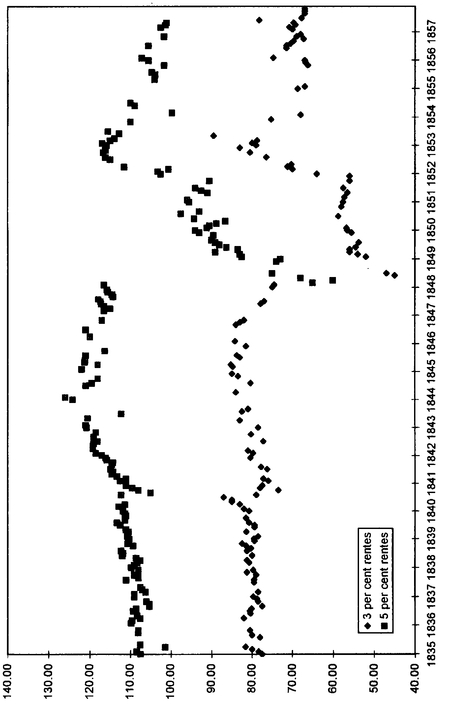
Moreover, it soon became apparent that, in smashing the republican left and signalling his support for an expansionary credit policy, Napoleon was generating a climate of financial optimism. The price of rentes tells its own story. On the eve of the coup, 3 per cent rentes were quoted at 56 and 5 per cents at 90.5. Immediately after, prices leapt to 64 and 102.5 respectively; and by the end of 1852—when Napoleon proclaimed himself Emperor on the first anniversary of the coup—3 per cents stood at 83—a capital gain of nearly 50 per cent from Republic to Empire (see illustration 2.i). Figures for gross investment in railways tell the same story: after a perod of stagnation between 1848 and 1851, investment increased by a factor of five in the period to 1856. James had for some time been conscious that economic and political events were out of synchrony: even the war scares and domestic alarms of the pre-coup period had not been as destabilising as he himself had anticipated. “To listen to the politicians,” he remarked in 1850, “you would think all was lost; to listen to the financiers is to be told quite the opposite.” But from December 2 onwards, politics and economics were brought back into harmony by a government that consciously identified its own health with that of the bourse.
The Napoleonic regime was thus far from an ideal outcome for James, who would probably have preferred Changarnier to pave the way for an Orléanist restoration. But once it was apparent that Napoleon had no intention of penalising him personally, he could live with it. He had already summarised his position—pre sciently—in October 1850: “In the end we shall have an Emperor, which will end with war, for if I wasn’t so afraid of war, then I would be an imperialist myself.” After the coup, he was quick to recognise that his rivals would steal a march on him if he was identified too closely with the defunct republic. While Betty could express her “demoralisation” with Napoleon by retreating into internal exile at Ferrières, her husband had (once again) to move with the times: “I think Napoleon is gaining strength,” he reported to London, just three weeks after the coup, “despite the fact that the great and the good will not accept his invitations. Do you think that we too should stay away completely?” It was a rhetorical question. Even the Rothschild women could not sustain their social boycott indefinitely. Indeed, their mood began to soften even before the end of December. “At the Rothschilds,” observed Apponyi waspishly after an encounter with Nat’s wife Charlotte and Betty, “the mood of calm stems from the enormous amounts of money they are making at the moment as a result of the boom in all the bonds and shares they have in their portfolio.”
It was at least the fifth change of regime since James had settled in Paris, and it was evidently becoming hard for him to take such events seriously. “My good nephews, how would you like a French constitution for two sous? They’re being sold in the streets for that here.” An absolute government was “not very good; but here you can do what you like and it’s all forgotten.” As early as October 1852, James could breezily report that he was “on the best footing with the Emperor and everyone”; this was fully two months before Napoleon actually proclaimed himself Emperor. It was also just days before Napoleon’s famous Bordeaux speech in which he declared: “The Empire means peace” (“L‘Empire, c’est la paix”). This seemed to rule out the rash infringements of Belgian neutrality or challenges to Prussian rule in the Rhineland which had caused most concern in the previous two years, and explains why the other powers recognised Napoleon as Emperor with only token quibbles.
Of course, it was not that easy: in January 1853 James was still having difficulty getting to see the new Emperor. But he had two routes into the new court. Firstly, he remained Austrian consul-general, and made a point of wearing his scarlet uniform to remind anyone who had forgotten his diplomatic status. In August 1852 he had been able to relay an anodyne message to Napoleon from the new Austrian Emperor Franz Joseph; and, although Hübner did his best to undermine James’s claim to represent Vienna in Paris, he had no chance of dislodging him as long as the Rothschilds remained Austria’s bankers. The second way James sought to ingratiate himself with Napoleon was by championing the cause of the half-Spanish, half-Scottish adventuress Eugénie de Montijo, who more snobbish Parisians assumed would merely be Napoleon’s next mistress. Napoleon had been introduced to her in 1850 and by the end of 1852 was infatuated; when his plans foundered for a diplomatic marriage to Princess Adelaide of Hohenlohe (one of Queen Victoria’s nieces) he impulsively resolved to marry her—to the dismay of his ministers.
This decision was still a secret, however, on January 12, when Eugénie arrived at a ball at the Tuileries on the arm of none other than James—who, noted Hübner, had long been “under the spell of the young Andalusian, but now more than ever, for he was one of those who believed in a marriage.” One of his sons—presumably Alphonse—escorted her mother. When the party entered the Salle des Maréchaux, intending to find seats for the ladies, the wife of the Foreign Minister Drouyn de Lhuys haughtily informed Eugénie that the seats in question were reserved for the wives of ministers. Napoleon overheard this, came across to the two women and offered them seats on the imperial dais. After two hours, the Emperor and Eugénie disappeared into the cabinet impérial, to return later arm in arm. Three days later he proposed; on the 22nd the engagement was made public; a week later the wedding took place. “I prefer a young woman whom I love and esteem,” declared Napoleon. “One can love a woman without esteeming her,” commented Anselm’s wife Charlotte shortly after this, “but one only marries a women one honours and respects.” This compliment—a rather strained one given the Rothschild family’s habitual distinction between romantic love and marriage—was duly relayed to the imperial couple.
2.i:The weekly closing price of French 3 per cent and 5 per cent rentes, 1835-1857.
The significance of this should not be exaggerated, of course; on the other hand, it is easy for the modern reader to forget how seriously contemporaries took the complex rituals of nineteenth-century court life--especially, it might be said, at the court of an unpredictable parvenu who owed his throne to a coup d’ état and his legitimacy to carefully managed plebiscites.
The Crédit Mobilier
Of course, it was not at the Tuileries or at Compiègne (where Napoleon did his hunting), but at the bourse and in the railway boardrooms that James’s fate in the Second Empire was really decided. Here, the Second Empire witnessed what is usually portrayed as one of the great corporate battles of the nineteenth century: the fight to the finish between the Rothschilds and the Credit Mobilier.
Partly because of the coincidence of the foundation of the Credit Mobilier (November 20, 1852) and the formal proclamation of the Second Empire (December 2), the significance of the new bank has often been misunderstood. For example, it is portrayed by many writers as a primarily political challenge to the dominance of the Rothschilds over French public finance—Napoleon III’s response to Fould’s challenge to “free himself” from Rothschild tutelage. A second misconception is that the Credit Mobilier represented a revolutionary new kind of bank, in contradistinction to the “old” private bank personified by the Rothschilds.
In fact, there was nothing fundamentally new about the idea of creating a bank on the basis of publicly raised share capital. Since 1826, joint-stock banks had been legal in Britain, and banks like the National Provincial and the London & Westminster Bank—both established in 1833—had revealed the possibilities of the new form long before the Pereires turned to banking; by the time the Credit Mobilier was founded there were around a hundred joint-stock banks in England and Wales, twice the number of London-based private banks. Nor is it true to say that British joint-stock banks eschewed lending to industry (though they tended not to go in for long-term investment, they often extended overdrafts and discounted bills in ways which were long-term in effect). Long-term industrial investment was not really what the Credit Mobilier did anyway, pace the claims of economic historians like Alexander Gerschenkron and Rondo Cameron that it promoted industrialisation not only in France but throughout the continent. There were precedents for what the Pereires attempted in France too, the earliest (if one ignores John Law’s Banque Générale) being Laffitte’s Caisse Générale du Commerce et de l‘Industrie. Nor, as Landes has argued, were the Rothschilds and other established Paris banks especially old-fashioned in their response to the Credit Mobilier’s challenge: they too saw the rationale of the joint-stock form for longer-term investments. Although their capital differed from the Pereires’ in being entirely their own, the French and Austrian Rothschilds used it in much the same way as the Credit Mobilier used its bondholders’ and depositors’ money—and in the long run more successfully. To make a simple but usually overlooked point: the Credit Mobilier was not even bigger than the Rothschilds. Its initial capital was 20 (later 60) million francs; that of de Rothschild Frères in 1852 was in excess of 88 million francs; and that of the combined Rothschild houses no less than 230 million francs. Of the Credit Mobilier’s initial capital, the Pereires themselves accounted for only around 29 per cent.
In reality, it was not so much what they did as they way they did it which convinced contemporaries, and in turn historians, that there was a profound difference between the Rothschilds and the Credit Mobilier. (Only someone unfamiliar with Paris could lump “Rothschild, Fould and Pereyre [sic]” together as Bismarck did.) The Pereires continued to use their old Saint-Simonian rhetoric about the collective benefits of industrial investment, even as they speculated in rentes and railway shares and pocketed the profits for themselves. The Rothschilds, by contrast, made no secret of the fact that they were speculating and profiting, and regarded their contributions to the wider communities to which they belonged as a charitable activity, distinct from their business. When Castellane met Anthony for the first time in 1850 he was rather shocked by the latter’s complaint that “in London you can make [money] on everything, on cotton as well as rentes, as much as you like, but here [in Paris] you can hardly speculate on anything but rentes.” That was not the way the Saint-Simonians talked: for them it was a matter of mobilising the savings of all France in the pursuit of a steam-driven utopia. It was a difference in style vividly captured by the stockbroker Feydeau in his memoirs. Unlike the Pereires, he argued, James was “simply a solid, intelligent and astute ‘capital merchant’ ”:
The sole task of maximising the return on his colossal fortune constituted for him a round-the-clock occupation. Each liquidation at the end of the month was a combat which he fought for the security of his house, the eminence of his name, the affirmation of his power. He kept abreast of the slightest pieces of news—political, financial, commercial and industrial—from all quarters of the globe; he did his best to profit from these, quite instinctively, missing no opportunity for gain, no matter how small.
As we have seen, doing business with a man like James was a thankless task for small fry like Feydeau. But one needed only to go the offices of the Credit Mobilier to encounter
the most striking contrast possible with the house of Rothschild. At the Pereires’ there were no hard words to be feared and no outbursts to dread. Acidulously polite men, ulcerated by hatred, always concentrating, hard and tense like bars of iron, inflexible in their ideas, filled with admiration for themselves, they were always to be found surrounded by friends, all cupping their ears in order to find out the line their patrons were taking, which shares they were working on, if they were buying or selling. The employees of the Credit Mobilier lay in wait for you on the stairs to interrogate you to see if you had an order. Everyone wanted to get rich, and at any price; each, necessarily, was trying to work in the same direction as his masters.
James evidently relished this contrast, and on one occasion, with that sardonic humour which was to become his trademark under the Second Empire, commissioned Feydeau to undertake a speculation on his behalf—in the form of a purchase of a thousand Crédit Mobilier shares. He did this no fewer than five times, astonishing his broker by actually paying for them in full at the liquidation. When Feydeau expressed his incredulity, James feigned surprise:
Vat do you mean, my young friend? ... I do not mock you at all. Listen: I haf the greatest possible confitence in the chenius of Messrs Pereire. They are the greatest financiers on this earth. I am a family man, and I am happy to infest a part of my little fortune in their affairs. I only regret one thing, and that is that I cannot entrust all off my capital to such clefer men.
Contemporaries—notably the financier Jules Isaac Mires after his fall from grace—sometimes attributed this difference in style to the different cultural backgrounds of the two families. The “Jews of the North,” he suggested, having originated in the harsh, restrictive atmosphere of Germany, were “cold” and “methodical” in their selfish pursuit of wealth, and indifferent to the interests of the state; whereas the “Jews from the Midi” not only had “more noble” “Latin” instincts, but had also benefited from France’s more tolerant treatment of the Jews, and so did business in a more altruistic, public spirited way. Others conceived of the difference in more political terms: Rothschild represented “the aristocracy of money” and “financial feudalism,” while his rivals stood for “financial democracy and an economic ‘1789.’”
In reality, the competition between the two had its origins in the prosaic realm of railway concessions. To say the least, the republic had been an unhappy interlude for the railway enthusiasts. Investment and construction had stagnated as the politicians argued interminably about which concession should be granted to whom; interest rates were high, the bourse depressed, employers wary of labour unrest. Only one major line got under way (the Ouest from Versailles to Rennes). One of the most immediate consequences of Napoleon’s coup was that it ended all this. The very day after the seizure of power, the concession for the Lyon-Mediterranean line was granted, followed two days later by the Paris-Lyon to a consortium of which both the Paris and London Rothschilds were members. The Nord company’s concession was also renegotiated on terms which were singularly favourable to the company. The Empire was a bonanza for rail entrepreneurs: altogether no fewer than twenty-five concessions were awarded between 1852 and 1857, and a further thirty followed in the years to 1870.
In all this, an influential role was played by Napoleon’s illegitimate half-brother the duc de Morny, who saw the new regime principally as an opportunity to enrich himself and argued strongly in favour of merging the many small railway companies into a few big lines. James was in touch with Morny in early 1852, and liked what he heard. Interestingly, the French house’s balance sheet drawn up at this time shows that James held shares in various railway companies worth more than 20 million francs (around 15 per cent of the Paris house’s total assets). The value of these shares was now rocketing as investors reacted to the new regime’s encouragement: Apponyi estimated that James made 1.5 million francs in a single week in April 1852 “without having to pay out a penny.” Given the enormous increases in capital achieved by the Paris house in the 1850s, the figure does not seem improbable. It is worth noting that of all the big six French lines the Rothschild-controlled Nord was the most intensively utilised and most profitable: although it accounted for only 9 per cent of total French network in terms of length, it carried 14 per cent of freight and more than 12 per cent of all passenger traffic. The ratio of fares and freight rates to costs was 2.7: in the 1850s and the volume of traffic more than doubled between the 1850s and the 1860s.
Increasingly, however, James and the Pereires were at odds. The first signs of dissension had manifested themselves in 1849, when the latter had sought to raise money for their proposed Paris-Lyon-Avignon project without reference to the Rothschilds. The process continued apace in 1852, though it is far from easy to say exactly when the decisive breach occurred. An important step towards divorce was taken when James decided to participate in the Paris-Lyon line syndicate, taking around 12 per cent of its stock (other shareholders included Bartholony, Hottinguer and Baring and, although not named as a concessionary, Talabot seems to have played a leading role). This signified an unambiguous rejection of the Pereires’ rival scheme. In an illuminating series of letters, James explained his reasons for doing so to his nephews:
Regarding Lyon, it would be very damaging for the Nord if it were to be left out and if two other companies were to make it, so I said to Hottinguer, we will take as big a share as any other house and if Baring is going to arrange a subscription in London, it should be done jointly with you. In short, I do not want a major operation to take place under a new government without our name being on it. If such an operation were to succeed without us, then people would say “We don’t need Rothschild any more.” As we can take as much as we like, it is better that we remain part of this camaraderie ... The gentlemen concerned are very popular with the ministers.
A passing reference to one of the brothers as “an ass” suggests that relations with James were now rapidly deteriorating.
But the partnership was not yet over. Indeed, Isaac Pereire was deputed to act as James’s representative on the new Paris-Lyon company’s board. Moreover, his brother Emile continued to play a leading role as chairman of the Nord board, and was involved in the renegotiation of the Nord’s concession—the other major railway deal clinched in January 1852. The company raised 40 million francs by issuing bearer bonds and used the money to take over the Boulogne-Amiens line and to build new branch lines (for example, to Maubeuge); in return, its concession was extended for ninety-nine years, with an option to the state to buy the company out in 1876. It was not until later in the year that the split came, when James offered his support to Talabot once again.
Talabot’s aim was now to merge the new Paris-Lyon company with his lines to the south—Avignon—Marseille, Marseille-Toulon and smaller lines in Gard and Herault—creating a grand Compagnie de la Méditerranée along lines very similar to those originally envisaged by the Pereires. James’s decision to take 2,000 shares in this ambitious but financially stretched entity left the Pereires out in the cold. (The fact that Morny was another shareholder must cast doubt on the simplistic notion that the Pereires had the new regime’s backing against the Rothschilds.) The final blow came when James refused to provide similar financial support for the Pereires’ Midi company: although his subscription of 3.3 million francs was far from negligible, Alphonse’s resignation from the board was a vote of no confidence. The Credit Mobilier was therefore founded by the Pereires in response to their exclusion from what looked like a new Talabot-Rothschild axis backed by the regime in the person of Morny.
The Pereires did not have to look far for models on which to base their alternative source of railway finance: two successful semi-public banks had already been launched before the Credit Mobilier was conceived. The first was the Foulds’ Credit Foncier, a mortgage bank established with governmental backing in March 1852 to provide long-term loans to landowners by selling mortgage bonds—an extremely popular nineteenth-century form of investment—to savers. By the end of 1853 it had increased its capital to 60 million francs and had issued loans totalling 27 million. It is worth pointing out that James was as hostile to the Crédit Foncier as he was to the Credit Mobilier, arguing in October 1853 that the interest at which it lent its money was too high and the obligations it issued were viewed with too much suspicion in rural areas for it to perform its intended purpose. Far from supporting agricultural proprietors, it was being used to finance urban property development, much of it of a speculative nature:
From the outset we have seen these problems clearly and it is for that reason that we have refused to become involved in the affair, although overtures have repeatedly been made to us ... The Credit Foncier ... involves itself in risky operations and it is these which up until now have made its profits ... It is not a soundly established enterprise.
The other new bank was the Caisse des Actions Réunies, an investment trust established with 5 million francs’ capital by Mires, then the editor of the Journal des Chemins de Fer, in 1850. Although Mirès did not transform the Caisse into the more ambitious Caisse Générale des Chemins de Fers until 1853, he subsequently claimed that it had given Benoît Fould the idea for a much bigger venture:
I said to myself, if M. Mires, on his own, could create such a society, a society made up of more considerable people would represent a powerful financial organisation, destined to conduct simultaneously major financial operations and industrial enterprises. On my return [from Baden] I looked for suitable men to involve in this project and I found no one more suitable ... than MM. E. and I. Pereire ... And that was how the Credit Mobilier was born.
Another version has the Interior Minister Persigny more or less forcing the idea of the Credit Mobilier through against the unbending opposition of Achille Fould—though this was probably an attempt by the Foulds to disclaim responsibility after the Credit Mobilier had failed. In fact the Foulds and Pereires were equal partners, with a majority shareholding between them.
What was new about the Credit Mobilier? It was not, despite the original intentions of the Pereires, permitted by the Banque de France to call itself a bank. Essentially, it was an investment trust, set up by a Pereire-led group with a capital of 20 (later 60) million francs, the prime function of which was to attract the savings of smaller investors into railways. Many investors had burnt their fingers in the 1840s when numerous railway companies had issued a multitude of highly volatile shares. The Crédit Mobilier simplified matters: it offered its investors standardised bonds of varying duration and used their money to invest in stocks and shares as its directors saw fit. In short, it was an intermediary between the bond market and the share market, a deposit bank which issued bonds rather than non-transferable certificates of deposit. The final statutes of the bank published on November 20 were the result of a compromise between the more cautious government ministers and the Pereires: current accounts and money raised from the sale of short-term bonds were not to exceed double the firm’s paid-up capital, twice the level demanded by the Finance Ministry; money from long-term bonds was not to exceed 600 million francs, ten times its capital.
The Credit Mobilier is usually seen as a direct challenge to the power of de Rothschild Frères. It is true that there soon developed a fierce commercial rivalry between the two firms. James was also irked by the social pretensions of his erstwhile subordinates—especially when they bought the 8,200 acre estate of d‘Armainvilliers next to Ferrières, the Palmer vineyards next to Château Mouton and even the house next door to Nat’s in the rue du Faubourg-Saint-Honoré! Nor had he made any secret of his reservations about the new bank. As he wrote—in a personal letter to Napoleon on November 15—it would at once be excessively powerful and excessively vulnerable to crises, a line of argument which was less contradictory than Persigny later made it sound.
The first objection James raised was the classic conservative objection to joint-stock companies, that the directors would be “anonymous” and “irresponsible,” and might abuse their power over other people’s money. But James went further in predicting that the new bank would be in a position to establish “a redoubtable domination of commerce and industry.” “By the sheer volume of their investments,” he warned, the directors of this company would “make the law in the market, and a law which will be beyond control and beyond competition ... and concentrate in their hands the greater part of the national wealth ... That would be a calamiry . . . The bank when it is fully active will be stronger than the government itself.” At the same time, its very strength would rest on foundations of sand; and this was precisely what made the prospect of a calamity so real. For whereas the bank would offer investors bonds paying fixed interest, its own investments in shares would be “variable, doubtful, uncertain.” In a moment of crisis, the bank would lead the economy “to the edge of an abyss.” Taking it for granted that the new bank would maintain an inadequate reserve, James predicted that if it got into difficulties the government would have to choose between “a general bankruptcy” or the suspension of gold and silver convertibility. These were exaggerated fears designed to intimidate Louis Napoleon; but they were not entirely without foundation, as we shall see.
Yet the fact that James was opposed to the Credit Mobilier should not be taken to mean that it was directed against him. It may be that the Pereires were sincere in offering James shares in their new venture; his refusal is not proof of their antagonism towards him. Nor should too much be read into the fact that the bank’s charter was published in the Moniteur Universel while James was away from Paris. The fact that some of the Rothschilds’ closest associates in Italy and Germany— Torlonia, Oppenheim and Heine—were among the shareholders also weakens the anti-Rothschild, thesis: these people had too much to lose from incurring James’s wrath.
In truth, the Credit Mobilier, with its overt claims to be a financial “centre” acting in the public interest, was more of a challenge to the Banque de France. The new institution had been created, declared Pereire in 1854, “out of the necessity to introduce into circulation a new agent, a new fiduciary money, bearing its own daily interest”—an indication that he saw its bonds as performing a quasi-monetary function. Above all, as the more astute contemporary commentators discerned, it was a response to the Banque de France’s tight lending policy in the wake of the 1848 revolution: prior to 1852, the Banque refused to lend money against railway shares and lent against rentes at the relatively steep rate of 6 per cent. As the yield on rentes had fallen to 3.6 per cent by November 1852, the advent of the Credit Mobilier becomes more intelligible. So does James’s opposition: in 1852 de Rothschild Frères held Banque de France shares valued at 1,131,078 francs, which were depressed by the launch of the Crédit Mobilier. We see here the beginning of an alliance between Rothschilds and the Banque which would be consummated when Alphonse became a regent of the Banque in 1855.
The Credit Mobilier began with a bang. Its 500 franc shares opened at 1,100 and touched 1,600 four days later. At their peak in March 1856 they were trading at 1,982 francs. Those were massive capital gains for the original shareholders which it is hard to believe James did not envy. The dividends too looked healthy, rising from 13 per cent in 1853 to 40 two years later (implying earnings of 4 and 10 per cent). Such results seemed to discredit James’s prophecies of disaster. Nor were they the products of creative accounting. For these were the glory years of French railway building: between 1851 and 1856 gross investment increased by a factor of five; more than twice as much track was opened in the 1850s as in the 1840s. Moreover, the ratio of fares and freight charges to operating costs was at its all-time peak. The Credit Mobilier’s raison d‘être was to enable the Pereires to take a share of this buoyant market; and in this it succeeded.
Yet the extent of its success should not be exaggerated. It is true that, with the funds they were able to raise through the Credit Mobilier, the Pereires were able to build up shareholdings in a substantial network of railway companies, exerting a dominant influence over the Midi (Bordeaux-Cette), the Paris-Lyon via Bourbon nais line and the Ouest (which merged the Paris-Rouen, Rouen-Havre, Dieppe-Fécamp and Versailles-Rennes lines). But the Rothschilds continued to control the Nord and had the biggest single shareholding in the Paris-Lyon, which later fused with the Grand Central to form the Paris-Lyon-Mediterranean in 1857, not to mention their smaller stakes in the Midi and the Ardennes-et-Oise. Between them the Pereires had eight seats on the boards of various French railway companies; the Rothschilds had fourteen. Besides, there were numerous other new players, notably Morny himself (who launched the Grand Central Company in 1853), not all of whom can be considered Pereire allies. The lines of battle were far less distinct than has often been claimed: Charles Laffitte was the Pereires’ partner in the Ouest, but was also a substantial shareholder in the Nord. The duc de Galliera was a founder of the Crédit Mobilier but also a member of the board of the Nord. The Pereires may have been predominant in the lines which fused to become the Est, but it was N. M. Rothschild & Sons in London which placed bonds worth £2.5 million in London for the company in 1854.
One thing is sure: Mires’ later claim that by 1855 James had “abdicated” in the face of competition from the “new” bank“ is untenable. In fact, it was the Credit Mobilier which risked overstretching itself. It was an exaggeration to say, as James did, that its capital was ”insignificant,“ but there is a case for saying that the Crédit Mobilier was undercapitalised in relation to the Pereires’ aspirations. As early as 1853, the company sought to issue bonds worth 120 million francs in an attempt to increase the funds at its disposal, but the government exercised its power of veto. When the Pereires tried again in 1855, they were again thwarted by the government. As a result, the Crédit Mobilier increasingly found itself relying on some 60-100 million francs of more conventional deposits, mainly from associated businesses like railway companies. These constraints may explain the marked discrepancy between its founders’ stated intentions and the reality of its investment strategy. In fact, its portfolio was characterised by a relatively high turnover, with its total assets fluctuating between as little as 50 million francs in 1854 and as much as 266 million francs a year later.
If the Pereires had confined their activities to France then it is doubtful whether the celebrated “war” between them and the Rothschilds would ever have amounted to much more than a skirmish. But they did not. What made the Crédit Mobilier seem genuinely threatening to James was its potential to expand outside France and to become a pan-European phenomenon. On April 2, 1853, the Cologne bankers Abraham Oppenheim and Gustave Mevissen of the Schaffhausenscher Bankverein were granted a licence by the Grand Duke of Hesse-Darmstadt to open a discounting and issuing bank. They called the new bank the Darmstädter Bank fur Handel und Industrie and, with its projected capital set at 25 million gulden (around 54 million francs) and its Pereire-style charter, it obviously aimed to be the German Credit Mobilier. This was effectively a challenge to the Rothschilds in their ancestral home: Darmstadt is less than twenty miles to the south of Frankfurt, and the only reason Oppenheim and Mevissen chose to establish their new bank there was that the authorities in both Frankfurt and Cologne had refused to grant them a licence. Among the nine directors, four were from Frankfurt, including the Rothschilds’ old rival Moritz Bethmann.
But what was more worrying was the direct involvement of the Pereires and Foulds in the new venture. As we have seen, Abraham Oppenheim himself had been one of the original shareholders in the Credit Mobilier (he had 500 shares), and he sent his brother Simon to Paris to drum up French interest. The agreement he made was generous: of the initial 40,000 shares, the founder-directors retained 4,000; a further 4,000 were issued by Bethmann in Frankfurt, 10,000 were sold at par to Crédit Mobilier shareholders and the remainder were held jointly by Oppenheim, Mevissen, Fould and the Credit Mobilier. But it proved the only way of ensuring the success of the new venture. Had it not been for French purchases of the shares when they were offered to the public in May, the price might very well have fallen below par (a weakness which was inevitably blamed on Rothschild machinations). The effect of these purchases was to give the Crédit Mobilier a majority shareholding. It was not long before there was talk of establishing similar satellites in other countries. As early as July 1853, James felt obliged to warn the Piedmontese banker Bolmida against establishing a Credit Mobilier in Turin, warning him that the “disagreeable possibilities” of such a bank would outweigh the “positive advantages.” The Pereires’ first attempt to establish a Spanish Crédito Mobiliaro was also in 1853, while the idea of a Belgian Credit Mobilier was floated not much later. By 1854 even Austria did not seem immune to Pereire penetration. These moves raised the alarming possibility that the Credit Mobilier might take on the character of a multi national, challenging the hitherto unique position of the Rothschilds in European finance.
Again, however, the story should not be oversimplified. It was not only the Pereires who realised the possibilities of joint-stock banking in the 1850s. There were a number of imitations in London (for example, the Credit Foncier and Mobilier of England, the International Land Company and the International Financial Society), though they made little headway. In 1855 and 1856 alone, thirteen such banks were established in German states, including David Hansemann’s Disconto-Gesellschaft, the Berliner Handelsgesellschaft, the Vereinsbank and the Norddeutsche Bank (the last two both in Hamburg). Nor should we ignore the equally important newcomers who adopted the more traditional private and merchant banking structure, for in many ways these posed a more enduring threat to the Rothschilds’ pre-eminence. In London, the dominant position of Baring Brothers and N. M. Rothschild (especially in the acceptance market) was being challenged by the growth of existing merchant banks like Schröders and Frühling & Goschen, and the advent of newer firms, notably C. J. Hambro & Son (1839), Overend Gurney and Kleinwort & Cohen (1855). In Frankfurt too, M. A. Rothschild & Söhne was encountering new competition from Erlanger & Söhne, founded by the converted Jew Löb Moses Erlanger, as well as from Jacob S. H. Stern, Lazard Speyer-Ellissen, Moritz B. Goldschmidt (1851) and Gebrüder Sulzbach (1856). In Paris, a new force was the firm of Lazard Frères, founded in 1854.
Apart from the boom conditions of the early 1850s, one reason for the proliferation of new banks was the revolution in communications brought about by the advent of the telegraph. Though the original discovery can be traced back to the eighteenth century, and successful demonstrations of its application happened in the 1830s, it was not until after 1848 that the telegraph had a real impact on international finance. By 1850 lines were in commercial operation in the United States, England and Prussia, France and Belgium; but it was the Dover-Calais submarine link in 1851 which was the real watershed. Even before the cable had been laid, Julius Reuter1 wrote to New Court: “Should you favour our service for the transmission of the Berlin and Viennese exchange rates we would pledge ourselves not to give the service to any other London house and moreover we would refund you for any cable not arriving at the fixed time.” However, any such monopolistic arrangement had long since vanished on the Continent and did not last long in London.
This explains the somewhat unexpected hostility of James to an innovation he might have been expected to embrace. Throughout the 1850s, he repeatedly complained that “the telegraph is ruining our business.” The fact was that the telegraph made it much easier to do what the Rothschilds had managed so ingeniously before, namely to conduct financial business between affiliated houses over long distances. Many of their rivals now sought to imitate their example with the assistance of “the wires”: by the 1860s, Frankfurt families like the Speyers, Sterns and Erlangers had all established branches in London and Paris and, in the case of the Speyers, in New York as well. “It appears,” James complained in April 1851, “that yesterday a great many German scoundrels sold [French] railway shares in London with the telegraph ... Since the telegraph became available, people work much more. Every day at 12 they send a despatch, even for trivial deals, and realise [their profit] before the bourse closes the same day.” Once, the Rothschilds had been able to steal a march on their rivals with their unrivalled system of couriers and carrier pigeons; but now “anyone can get the news.” James could see that there was no alternative but “to do the same,” but it still struck him as a “crying shame that the telegraph has been established.” It meant that even when he went to take the waters for his summer holiday, there was no respite from business: “One has too much to think about when bathing, which is not good.” Such complaints were still being echoed by James’s son as late as the 1870s: although the Rothschilds had no option but to make use of the new technology, they always regretted the way it tended to broadcast financial news, and continued to write letters to one another in their accustomed fashion right up until the First World War.
The Gold Rush
The significance of such grumblings should not be exaggerated, however. The reality was that, although they were facing increased competition in Europe, the Rothschilds remained in a league of their own as an authentically global operation. Indeed, it was in the continents beyond the reach of the telegraph that they made some of their biggest advances in the 1850s. There was no telegraph link from Europe to North America or India until 1866; no link to Latin America until 1869; and no link to Australia until 1873. In these regions, the Rothschilds’ traditional system of semi-autonomous agents, corresponding regularly but not in daily contact, remained unsurpassed. The European agents continued to do their work, of course: Weisweiller and Bauer in Madrid; Samuel Lambert, having succeeded his father-in-law Richtenberger in Brussels; and newer recruits like Horaz Landau who served in Constantinople and then Italy. But their role as intelligence-gatherers was now less important than it had been, though of course confidential political information remained at a premium and could be obtained if an agent was well enough connected. It was the more remote agents, however, whose role was of greater strategic significance in this period.
The 1848 crisis had exposed the difficulty of conducting business across the Atlantic, particularly when a single agent occupied such a position of independent power in New York. It had partly been with the idea of replacing Belmont with a full Rothschild partner that James had sent Alphonse there in October that year. Betty’s letters to her son demonstrate how serious this intention was. He should, she advised, be patient until he had acquired enough experience of American affairs but then
you can speak the language of the big boys; respectfully first of all, and, if politeness does not work, then with energy and the dignity which befits your status and rights, and which will put the man in his place. If after that Mr B. still wants to play the lord and let you take it or leave it, well then you’ll be in a position to take up your glove and show this gentleman the door ...
Matters evidently came to a head in the spring of 1849. “The situation with Belmont is no longer tenable,” she wrote on March 24. He had
too little merited one’s trust for one to leave him even a pretence of it without failing one’s own interest and one’s dignity ... The question is then: wouldn’t it be a great help to the future of our family to set up a House in New York, a House which would bear our name ... America’s future appears so grandiose to those who choose to reflect on it that I hold fast to the thought with pride, I confess, that you, my son, will be the one to lay the foundations of a House that will bring honour to our name ... [Y]our career would take off .. “ and you will leap to the head of a great House with one step.
Her plan, she told him in May, was “to see you established in America for anything ... and deliver this great future from the stupidity and greed of an agent ... So I repeat: stay in the New World; if the worst comes to the worst, if the old world should fall, which God will not permit, it would become a new fatherland for us.”
The idea continued to be discussed after her son’s (supposedly temporary) return to Europe in 1849. “Alphonse ... has made up his mind to return,” reported Lionel having seen his cousin at Wildbad; “we have spoken in general terms about the American business, but that is all. Uncle James and Alphonse both think a great deal of money is to be made in America and wish to continue that business, so that in any case he will go back.” Alphonse himself spoke of “putting affairs over there on a more convenient footing” when he returned to America, and Castellane was in no doubt that he would soon leave Paris again “to found a house in New York.” Even in New York, it was “everywhere known that Baron Alphonse is coming to the States.”
Yet it never happened; an omission which was arguably the Rothschilds’ single greatest strategic mistake. It is not easy to say why this was. One possibility, strongly suggested by Betty’s letters, is that Alphonse could not bring himself to relinquish the comforts of Parisian life for the less sophisticated ways of New York. It was the mother who had to persuade the son, and she sought to make the idea more appealing to him by suggesting that, after an initial period of two years, the day-to-day running of the projected new house would be entrusted to “a temporary agent up to the time when someone from the family, or later, your brothers, wanted to devote a stay of a few months to it from time to time ... Once the House was founded you could quickly come back to us, dear son, while at the same time overseeing the man who would come to replace you from afar.” Nor were the London partners much enthused, though they continued to suspect Belmont of “speculating with our. money.” According to Betty, Lionel and his brothers took “a dim view of this project.” They were “worried that Paris is getting too much out of it, and would rather see an agent there. But this agent could only be Davidson who works very much in their interest.”
Perhaps the most convincing explanation, however, is that Belmont at last succeeded in persuading James that he could not be replaced. By now he was a well-established figure in the US, whose social standing and political influence were growing almost as rapidly as his personal fortune. In 1849 he was able to announce his engagement to Caroline Perry, daughter of Commodore Matthew Galbraith Perry of the United States Navy and, as Belmont emphasised, a member of “one of our best families.” Four years later, in an unexpected role-reversal, it was Belmont who came to Europe—as the American ambassador to the Hague. These signs of worldly success (which a young, French-educated Rothschild would have taken time to equal) may finally have convinced James to let Belmont be. Even Betty acknowledged that Belmont had “created for himself a strong and independent position; he knows inside-out all the country’s resources; he holds the key to all the wheeling and dealing in the commercial world.” “I would incline to the view,” her husband reluctantly concluded in 1858,
that we should leave the management of American business entirely in Belmont’s hands, as we can have complete confidence in him and he understands business there so completely, and if we do so we shall no longer have to put up with endless complaints and questions as to whether or not we will accept bills from this or that banker.
Only seven years before he had been complaining bitterly that Belmont did not let him “see the books” of the New York agency.
Of course, Belmont was only in charge of the East Coast business; that principally meant bond issues by established north-eastern states like New York, Pennsylvania and Ohio and major railways like the Illinois Central. Of increasing allure in the 1850s, however, was the West Coast, where Benjamin Davidson had been sent from Mexico, armed with a blanket credit of £40,000, on the news that gold had been struck in California. Once again, the Rothschilds had misgivings about entrusting their interests to a single individual in so remote a market—“where civil isation is at a very low ebb [and] where affairs are attended with personal risk”; so it was decided to send a clerk named May from the Frankfurt house to join Davidson in San Francisco. James approved of May: he was “a good little chap ... clever and a Frankfurt Jew. I always have a great deal of confidence in such people.” But he was soon disillusioned. Just over a year later, a row blew up when May and Davidson decided to spend between $26,000 and $50,000 on a new house. Davidson’s brother leapt to his defence, pointing out that the Californian agency had made profits of £37,762 in just two years; that its running costs were justifiable given the high cost of living in San Francisco; and that prior to acquiring the new house he had been living in a “shanty built over his vault, like a pig in a sty—which he left to go out & get his meals in fear and trembling lest a cry of fire should call him back & that he should find himself burnt out.”
As in the case of similar disputes with agents, this seems to have blown over, leaving both Davidson and May in situ. Ten years later, they were both still there; indeed, it was now May who requested to be allowed to return home—in a letter which sheds light on the Rothschilds’ relations with their American agents:
I am growing every day older, I am now in my 36th year, and it is time for me to make up my mind whether I should continue to lead this solitary life and spend the remainder of my days far away from my family, or whether I should return and settle at home. This is no Country where a man and particularly a European, even if he should have the least pretensions to civilization and sociability, can remain for many years, it is all very well as long as one is young but the riper age brings on other ideas. You must not suppose ... that I have accumulated so much wealth in this country, which determined me to withdraw from the business ... it is true that the position which you had been kind enough to give me and which kindness I shall never forget and makes me all my life grateful to you, has been to me a great advantage, but ... your interests have never in the least suffered by it and ... your business had always to be considered first and cared for above all.
Later in the 1850s, it was decided to send another Davidson—Nathaniel—to take Benjamin’s place in Mexico, which, for all its political instability, still promised important business opportunities: not only loans to the chronically insolvent state, but also investments in mercury and coal mines and an iron foundry. The importance of this continuing Mexican presence increased in 1860-61, when Mexico became the object of French imperial ambitions. Scharfenberg meanwhile remained in Cuba, which momentarily acquired a political importance when the American government sought to buy it from Spain—a scheme in which Belmont had a hand, but which foundered in the face of political opposition in the US.
Finally, mention should also be made of another traditional Rothschild sphere of interest in the Americas: Brazil. This had been a hobby-horse of Nathan’s in the 1820s, but for two decades business between London and Rio had been limited, partly because successive governments had not had recourse to the London capital market. That changed with the outbreak of war with Argentina and Uruguay in 1851, the costs of which forced Brazil to issue a £1.04 million loan through N. M. Rothschild the following year. The rapid growth of the country’s railway network also created new financial needs. The 1851 loan was quickly followed by a £1.8 million issue for the Bahia and San Francisco Railway Company; another loan of £1.5 million to the government which was also to finance railways (both 1858); a £2 million issue for the São Paulo Railway Company (1859) and another government loan of just under £1.4 million. A currency crisis in 1860 and a slide in the price of Brazilian bonds necessitated a period of consolidation; a new loan of £3.8 million in 1863 therefore mainly served to convert earlier debts dating from the 1820s and 1840s. However, the outbreak of war with Paraguay in 1865 put Brazilian finances under renewed pressure and it was only after protracted negotiations with the Brazilian minister Moriera that Lionel agreed to a new loan of just under £7 million. As the war drew to a close in 1869-70, there was talk of yet another loan. It was just the beginning of an exceptionally monogamous financial relationship between the Brazilian government and the London house which, between 1852 and 1914, generated bond issues worth no less than £142 million.
Brazil and the United States had been areas of Rothschild activity for decades; Asia was more or less terra incognita by comparison. But here too the 1850s were a time of expansion. In the wake of the “Opium Wars” of 1839-42 (so called because the pretext for fighting them was a Chinese bar on opium imports from British-controlled India), Hong Kong had been annexed by Britain and five other Chinese “treaty ports” opened to European traders. This accelerated the process whereby Chinese teas and silks were exchanged for Western silver and Indian opium, and created attractive new opportunities for British business (simultaneously eroding the power of Chinese merchants like Wu Ping-chien, whom one historian has called the Rothschild of the Orient). By 1853 the London house was in regular correspondence with a Shanghai-based merchant firm, Cramptons, Hanbury & Co., to whom it made regular shipments of silver from Mexico and Europe. Silver was evidently the prime concern, though the bank was also interested in Indian opium, some of which found its way westward to Constantinople, and by the later 1850s it was in regular correspondence with a Calcutta firm, Schoene, Kilburn & Co. Peripheral crises like the Chinese rebellions of the 1850s and the Indian Mutiny of 1857 thus had a resonance in New Court which previous Asian upheavals had lacked. For the first time, the bank was becoming involved in the commerce of the British Empire, a field it had previously left to others. It was thus a pardonable exaggeration to say that “the entire universe paid tribute [to Rothschild]; he had his offices in China, in India, in even the least civilised countries.” This was the great difference between the Rothschilds and the Eurocentric Pereires.
The great flow of silver to the East which was such a feature of the mid-nineteenth-century world economy helps explain why discoveries of gold in California and Australia in the 1840s aroused such excitement. The impact of these discoveries can hardly be overstated. In 1846 world gold production was around 1.4 million troy ounces fine, of which more than half came from Russia. By 1855 total production had risen to 6.4 million ounces, with around half the increase from North America and half from Australia. We have already seen how the Rothschilds sought to involve themselves in the Californian gold rush by sending Benjamin Davidson north from Mexico. They were also interested in the Australian fields. No sooner had gold been discovered in New South Wales and Victoria in 1851 than the Rothschilds were being urged “that a branch of your House accredited here with an ample supply of coin at the commencement would form the basis of one of the most extensive and moneyed establishments in either hemisphere.” This advice was not followed to the letter: as in the case of Shanghai and Calcutta it was at first thought sufficient to rely on a separate firm as Melbourne correspondent, though in this case the firm was run by Jacob Montefiore and his son Leslie. However, family ties proved no guarantee of competence. As if to confirm Mayer Amschel’s hallowed disdain for in-laws, Montefiore & Co. went bankrupt in 1855 owing a substantial sum to the London house, and a proper Rothschild agent, Jeffrey Cullen, had to be sent out to act as fireman.
The Cullens had worked for N. M. Rothschild since the time of Waterloo, so Cullen had a good idea of what his employers wanted: even before he had wound up the Montefiores’ tangled affairs, he was eagerly asking for consignments of mercury and other goods in demand in the colony (above all alcohol, whether beer, whisky or port). “If you should make me a consignment of this,” he wrote, unconsciously echoing the tone of Nathan’s letters as a young textile dealer, “you may rest assured of my using all my endeavors to do the business in such a way as to give you satisfaction.” By September he was asking for “a credit of £5,000 or £10,000 by every mail ship” and, in order to enable him to visit the gold diggings in person, the assistance of “a good Financier, as there is not such a thing in the whole Colony, even the heads of the Government are grossly ignorant of their business and upon more than one occasion I have been sent [for by] the Treasury, to explain some trifling matter of monetary affairs.”
If Cullen was at the periphery of the Rothschilds’ nascent gold and silver empire, at its centre lay the various refineries and mints which the family acquired in this period. James had operated his own refinery in Paris since as early as 1827, moving it to a new building in Quai de Valmy and establishing a société en commandite under the direction of Michel Benoît Poisat in 1838. At the same time, he went into partnership with Dierickx, the Master of Paris Mint in 1843, a relationship which lasted until 1860. The new gold discoveries led to an immense increase in the activity of both refinery and mint. It was, in James’s words, “a revolution in the money market.” Thus, when Lionel resolved in 1849 to involve the London house directly in the gold-refining business, he was following his uncle’s lead.
In Nathan’s day, there had been four private refiners in London—Browne & Wingrove, Johnson & Stokes, Percival Norton Johnson and Cox & Merle—in addition to the Royal Mint’s own refinery. Of these, Browne & Wingrove had done the lion’s share of the Bank of England’s refining. However, the discoveries in California and Australia greatly increased the volume of gold coming to the Bank: in 1852 gold purchases reached a peak of £15.3 million, over two-thirds of which was in bar form—far more than Browne & Wingrove could handle. It was to fill this gap that Lionel proposed to lease the Royal Mint’s refinery, which since 1829 had been using the sulphuric acid system of parting under its Master, Mathison. From September 1849 he began telling his political allies J. Abel Smith and Lord John Russell “repeatedly” that “a change in the system of the Mint” was necessary, a recommendation duly adopted by a Royal Commission set up to examine its activities. “I hope,” he told his brothers, “the ministers will have courage enough to make the alterations and that we shall be able to get it—it would be a capital business.” As Nat said, “with such large arrivals of specie from California & Mexico it is more necessary than ever.”
Mathison predictably sought to resist this “privatisation,” but in vain; and fortunately for the Rothschilds Percival Norton Johnson did not listen to his new partner George Matthey, who urged him to enter a bid. In January 1852, therefore, Anthony acquired the lease for the refinery, and by December Lionel was in a position formally to ask the Governor of the Bank, Thomas Hankey (another political ally), “to be permitted to present directly to the Bank of England my gold and silver bars, refined and melted under my responsibility.” In its first year of activity, the refinery processed over 300,000 ounces of Australian gold and 450,000 ounces of Californian. It was a sign of its importance that Gladstone—that most ardent of bullionists—paid a visit there in 1862, directly after an “expedition” to the Bank of England. As Flandreau has shown, their control of refining and minting capacity on both sides of the Channel enabled the Rothschilds to operate a unique “system” of arbitrage, with the London house buying American or Australian gold on the French house’s account, relaying these via the London bullion brokers to Paris. The Paris house meanwhile bought silver for New Court, which relayed it via London or Southampton to the East. Not only was this profitable; by the late 1850s it was becoming an integral part of a bimetallic international monetary system.
Public Finance and the Crimean War
For decades, the Rothschilds had regarded a major European war as the greatest of all dangers to their own financial position—worse even than a revolution. In March 1854 war came. Implausibly, the Crimean War had its origins in a dispute between Catholic and Orthodox monks about the so-called Holy Places in Jerusalem. In reality, it was a revival of the old question about how much power Russia should exercise over the waning Ottoman Empire—in particular, the Danubian principalities of Moldavia and Wallachia—and the Black Sea. This time, in contrast to 1840, France and Britain united: the former in order to break up the Holy Alliance, the latter for no reason other than to give the Tsar a beating, which a liberal public felt he deserved for his conduct in suppressing the Hungarian revolution in 1849. The Tsar, who five years before had been the arbiter of Central Europe, found himself deserted by the other members of the Holy Alliance: Austria flirted with the Western powers and all but joined in the war, Prussia continued her policy of impotence and irrelevance. Piedmont jumped on the anti-Russian bandwagon in the belief that any war would weaken the Austrian position in Italy.
Considering how quickly the Russians gave into the demands of this coalition, it was a strangely prolonged war. The first serious military action came in the summer of 1853 when the Tsar ordered troops into the Danubian principalities and the British and French navies approached the Dardanelles. By the time fighting broke out between Russia and Turkey in October, the Russians had effectively dropped their overblown claim to be sole protectors of Christians in the Ottoman Empire; so France and Britain had to go to war over the principalities and the Black Sea. But in June 1854, the Tsar promised the Austrians that he would evacuate the principalities ; the war could then only be about the Black Sea. It was therefore to revise the 1841 Straits convention “in the interests of the Balance of Power of Europe” that French and British troops landed at the Crimea, with the practical objective of capturing Sevastopol. As early as November 1854, the Russian government agreed to this point (again for fear of Austria joining in) but because France and Britain had still to decide what it actually meant, the war dragged inconclusively on. Attempts to find a negotiated agreement following Nicholas I’s death in March 1855 foundered. Instead, the Russians rashly decided to resist any restrictions on their naval power in the Black Sea, goading the Western powers to finish the war off. Sevastopol fell on September 8; the French suggested some new war aims; and finally at the Congress of Paris (February-April 1856) the crisis was concluded. The Black Sea was neutralised; Russia lost a chunk of Bessarabia (modern Moldova); and France and Britain agreed to guarantee the future independence of Turkey. In practice, these terms would last as long as Russia took to recover from her defeat—about twenty years, as it turned out, for it had been a traumatic and costly exposure of the Tsarist system’s administrative deficiencies. The most enduring achievement of the victors was the creation of Rumania by the fusion of the Danubian principalities, which was achieved in 1859—something they had not set out to achieve.
The precise causes and significance of the Crimean War did not concern the Rothschilds much. Why should they? A dispute between Roman and Greek monks over Christian relics held no interest for the builders of the Jerusalem Jewish hospital. Nor did they have any railway interests in the Danubian principalities. As for the international status of the Black Sea, the London house had already taken a conscious decision not to involve itself in grain exports from Odessa for purely economic reasons. What mattered was that a war—any war—between the great powers was bound to have a disruptive effect on the international financial markets. And so it did, as table 2a shows.
Table 2a: The financial impact of the Crimean War.
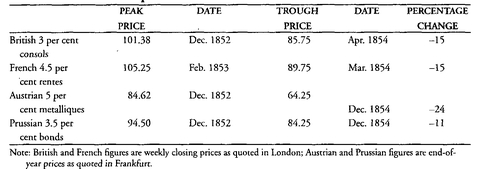
Sources: Spectator, Heyn, “Private banking and industrialisation,” pp. 358-72.
To diplomatic observers, the Rothschilds looked worried, and understandably so. Their correspondent in St Petersburg had reassured them in June 1853 there would be no war, and had been believed. When the British Foreign Minister Clarendon saw Lionel on September 27—shortly after the government’s instructions to Admiral Dundas to pass the Straits had been leaked—he told him “he never remember[ed] such a day” in the City. In January 1854, with the Western navies finally entering the Black Sea, Hübner found James “completely demoralised.” Amschel gave the same impression. When Bismarck heard the news of the Russian ambassador’s recall from Paris in February 1854, he “considered whom I could best frighten thereby. My eye fell on [Amschel] Rothschild. He turned as white as chalk when I gave him the news to read. His first remark was, ‘If only I had known it this morning’; his second, ‘Will you do a little business with me tomorrow?’ I declined the offer in a friendly way, thanking him and left him to his agitated reflections.” John Bright, one of the most vociferous opponents of the war in London, heard Lionel remark gravely on March 31 that “a country with £800,000,000 of debt should have considered much and seriously before it involved itself in another war.”
Yet far from weakening the Rothschilds’ position, the Crimean War had precisely the opposite effect in that it emphatically reasserted the Rothschild houses’ primacy in the field of public finance. Indeed, it demonstrated that the Rothschilds had for years been exaggerating the financial dangers of war. In reality, wars—and especially short wars of the sort which characterised the period from 1854 to 1871—created financial opportunities which they, with their distinctive multinational structure, were especially well placed to exploit. Even for those powers which did not directly fight in it, the Crimean War increased military expenditure above the level of revenues available from taxation (see table 2b), and therefore forced all concerned—even parsimonious Britain—to go to the bond market. Although their rivals, including the Credit Mobilier, tried, none could challenge the Rothschilds’ traditional pre-eminence in that market.
It made life easier, of course, that an old rival—Barings—had the misfortune to be banker to the losing side. In 1850, it had seemed a setback when the Russian government entrusted a new £5.5 million loan to Baring. Heavily oversubscribed, it had opened at a 2 per cent premium and left Joshua Bates and Thomas Baring with a commission of £105,000.2 But two years later, as diplomatic relations deteriorated, Barings found itself in an exposed position, denounced by Palmerston in the Commons as the Tsar’s “agent” and widely (though erroneously) believed to have participated in the 1854 Russian war loan.3
Table 2b: Increases in public spending, 1852-1855 (millions of national currencies).
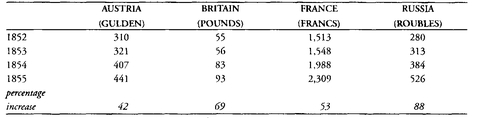
Source: Mitchell, European historical statistics, pp. 734f.
This helps to explain the near monopoly enjoyed by Rothschilds over British war finance. As Chancellor when the war began, Gladstone had pledged himself with characteristic rigour against “the system of raising funds necessary for war by loans,” on the grounds that it “practise[d] wholesale systematic deception upon the people.” Britain was still burdened by a substantial debt left over from the Napoleonic Wars: as Lionel had said, the national debt on the eve of war stood at around £782 million, and although in relation to gross national product the debt burden was steadily falling (from 250 per cent in 1820 to around 115 per cent in 1854), contemporary politicians were unaware of this. Gladstone therefore proposed to finance the war by increasing income tax—first from 7d in the pound to 10/2d, finally to 14d—and some consumption taxes. It was not enough, however, and by the time he resigned from office (to be replaced by Sir George Lewis), the government had run up a £6.2 million deficit for the year 1854 (financed by the sale of treasury bills) and faced a shortfall nearly four times as large in the following year. Lewis imposed a further £5.5 million of new taxation, but the 1855 deficit remained £22.7 million. The government had no alternative but to turn to the City; with Barings under a cloud, that could only mean New Court.
In 1855 the London house took the whole of a loan worth £16 million. In February the following year—by which time the war was, of course, over—it submitted the only tender for another loan of £5 million; and in May it secured a final tranche of £5 million. In both the 1855 loans, Lionel at first offered fractionally less than the minimum set by the Chancellor, but had no hesitation in accepting the government’s terms. It is hard to say how meaningful this bargaining was: the terms agreed were only slightly higher than the current market yield on consols, so there was no question of unjustifiable profits being made by the bank. Lionel was probably seeking as much to strike a patriotic posture as to make a profit, with a view to strengthening the case for his own admission to Parliament. On the other hand, the 1856 loans were heavily oversubscribed (by a factor of nearly six in February and eight in May). Palmerston saw this as a sign of City confidence in the government; it might equally well have been proof that the Chancellor was being over-generous in the aftermath of victory.
In France the revival of Rothschild influence over public finance actually predated the war. On March 14, 1852, Napoleon announced a large conversion operation, intended to cut the cost of debt service by reducing the interest due on the greater part of the national debt from 5 to 4.5 per cent.4Investors had twenty days to choose between accepting the new 4.5 per cents or redeeming the 5 per cents for cash. The move was justified by the government in macroeconomic terms as part of a strategy to lower interest rates and boost business activity. However, faced with a sudden slump in the price of 5 per cents (from 103 to 99 in just ten days) and fearing that an unexpectedly high number of bondholders would demand the redemption of their rentes rather than conversion, the new Finance Minister Jean Bineau was forced to turn to the bankers. It was Hottinguer and de Rothschild Frères rather than the Pereires who took the largest share in the subsequent support operation, whereby the banks bought up 5 per cents to push the price back above par; and the Banque de France which facilitated their purchases by extending its discounting facilities against rentes. The manoeuvre achieved its object, and the great majority of rentiers accepted the new bonds.
Two years later, when France and Britain issued their ultimatum to Russia to withdraw from the Danubian principalities, James naturally expected to be called on once again by the French Treasury. On March 4, 1854, he told Prince Albert’s brother Ernest II, Duke of Saxe-Coburg-Gotha, “that for a war with Russia any sum was at command; he would furnish at once ‘as many millions as were desired’.” By now, however, the Credit Mobilier had entered the lists, and when the government three days later announced its intention to borrow 250 million francs, a contest between the two seemed inevitable. Mires later claimed the credit for persuading Bineau and Napoleon to sell the bonds directly by public subscription; perhaps he did. Yet he exaggerated when he claimed that this and the subsequent 500 million franc war loan of 1855 had “liberated the French government from a tyranny incompatible with the dignity of a dynasty born of universal suffrage.” For by April 1855, with another 750 million francs needed, the new Finance Minister Pierre Magne had to inform Napoleon that the domestic market was reaching saturation point. As a result, a substantial share of the 1855 loan was issued in London, and Napoleon elected to revert to the French government’s traditional banker there. Although the Credit Mobilier took a substantial share of this issue, the Rothschilds were once again in charge: while the Paris house handled some 60 million francs, the London house received subscriptions totalling 208.5 million.
The Rothschilds’ role in assisting the Banque de France in the post-war monetary crisis—in part a consequence of the government’s short-term borrowing from the Banque during the war—merely underlined James’s ascendancy. Writing in April 1856, James could not conceal his glee at the regime’s difficulties: “The Emperor is excessively displeased to see that the birth of a prince and the conclusion of peace are not having a better effect on public credit, and that it might be said that he has been forced to make peace for want of money.” Indeed, the money market was so tight that, if James were to make a business trip to Brussels, people might say that he was taking all his capital there. Not for the last time, James was subtly mocking the regime’s financial dependence on him.
. The other combatant power to whom the Rothschilds lent money was Turkey. Here too there was competition, though this is understandable as the Rothschilds had not hitherto established a serious financial relationship with the Porte (with the exception of the Greek indemnity payment). The first Turkish war loan of 1854 was taken by Goldschmidt, Bischoffsheim (a minor City house, Palmer, MacKillop & Dent, also seems to have been involved, though James somewhat paranoiacally suspected the long arm of the Credit Mobilier). It was a failure. Attracted by descriptions of Turkey’s copper mines and perhaps thinking of Turkey as Nathan had previously thought of Spain, James therefore resolved to take over. In Horaz Landau, who had been sent as the Rothschild agent to Constantinople shortly before the Crimean War, he chose an able negotiator; when the Turks found themselves in need of more funds in 1855 the Rothschilds were ready and waiting.
In February 1855, during a temporary lull in the fighting, Landau began skilfully to weave his way between the Sultan’s minister Fuad Pasha and the Western diplomats, proposing a new loan, this time guaranteed by France and Britain, while at the same time drip-feeding short-term advances to the government—a classic Rothschild tactic. In August the London house was able to inform Landau that a £5 million loan to Turkey had been secured with an Anglo-French guarantee, thus allowing much more generous terms to be offered than would otherwise have been possible. No sooner was the war over than Alphonse was despatched to Constantinople to discuss the possibility of establishing a new bank there, once again encountering competition from a minor English house (this time Layards). However, the onset of the 1857 economic crisis—combined with a realisation that the risks involved in Turkish finance were greater than had initially been anticipated—led to something of a retreat from Constantinople in the succeeding years.5 Although Landau continued to agree to small advances, the idea that “the national bank of Turkey [might] become a branch of the House of Rothschild” (as The Times put it in 1857) was shelved.
Austria did not fire a shot in the Crimean War. She had to make substantial military preparations, however, if only to back up her tougher diplomatic communications to Russia regarding the Danubian principalities; and because of the fragility of her financial and monetary system in the wake of 1848-9, the effect was roughly equivalent to that of outright war on the French economy (if not greater). As tables 2a and 2b show, Austrian bonds were actually worse affected by the war than French; and Austrian expenditure rose by only slightly less, despite the policy of non-intervention. This was the first act in a “tragedy” of financial weakness which in many ways provides the key to the disasters which befell Austria in the decade after 1857. Past and present military expenditure weighed heavily on the Austrian budget, so that defence spending and debt service accounted for 60-80 per cent of the total. Although attempts were made to economise, fresh military crises invariably nullified these. Taxes were raised and state assets were sold; still the government had to borrow to meet its outgoings. When it borrowed short from the National Bank, the exchange rate—decoupled from silver in 1848—depreciated: between mid-1853 and mid-1854 the gulden fell from 9 per cent below par to 36 per cent below. When the government borrowed long from a frail bond market, the effect was to crowd out private investment. Between 1848 and 1865 the total funded public debt rose from 1.1 billion gulden to 2.5 billion, an average annual increase of around 80 million, but with disruptive peaks as in the mid-1850s. Constantly haemorrhaging fiscal and monetary policy thus combined to constrain economic growth, so that the tax base stagnated and the downward spiral continued.
Could anything have been done to remedy this? In November 1851 the Austrian Finance Minister Krauss wrote a letter to James “in which he lamented a good deal and demanded his counsel, requesting him to shed some light on the situation.” On being shown this letter, Apponyi urged James “not just to shed some light, but to take a torch, as only you can, and try to rid us of all our monetary wastepaper.” James and his partners tried. Though the Rothschilds might justifiably have closed down the Vienna house after 1848, instead Anselm set about rebuilding what his father had built only to destroy. It was a thankless task, the more so as Anselm’s wife refused to settle in a city she disliked intensely. A rather lonely figure, he at first went through the motions of following in his father’s footsteps: going to see the returned Metternich, making public donations to causes favoured by the Emperor—even siding with Austrian foreign policy in a half-hearted sort of way. But Anselm was haunted by the memory of his father’s downfall, and all his efforts to shore up Austrian finances were, one senses, premised on a sense of inevitable failure. When he called on Metternich in December 1853, Anselm’s mood was bleak:
Austria’s financial condition, he stated ... was inevitably approaching a crisis, unless we hit upon the right method of avoiding it ... Rothschild declared that he had expected better things of Herr Baumgartner [Krauss’s successor as Finance Minister], but that Baumgartner had no sense of reality and was not equal to his task ... The conversation at this stage was interrupted by a visit from the Nuncio. Rothschild took his leave and as I went with him to the door he said to me, “You mark my words, we are on the eve of a crisis; if something is not done to avert it, it will be upon us before the new year!”
Still, there were successes which kept alive the tradition of Rothschild influence at Vienna, albeit in shadowy form. In 1852 the London and Frankfurt house jointly issued Austrian 5 per cents worth £3.5 million for Baumgartner. In April 1854, faced with a run on the currency, the government turned once again to Anselm, who managed to persuade the other houses to participate in a further credit of 34 million gulden, though nearly half of this was provided by Fould.
In short, the bond issues generated directly or indirectly by the Crimean War were largely handled by the Rothschilds. Table 2c (which only gives the figures for the London house) provides an overview.
2c: Principal bond issues by N. M. Rothschild & Sons, 1850-1859.
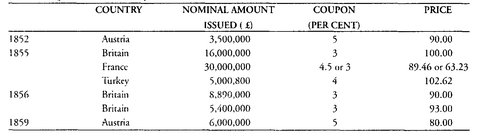
Source: Ayer, Century of finance, pp. 42-9
Of all the great powers, Prussia played the smallest part in the Crimean crisis—to the point that the British delegation at the Paris Congress demanded her exclusion from the peace negotiations. However, Prussian expenditure was in fact rising rather rapidly in this period: in total it was around 45 per cent higher in 1857 than it had been ten years before. Though the Prussian state had more robust sources of revenue than the Austrian, it too still needed to borrow. Here too the Rothschilds were able to rebuild their financial influence. As early as 1851, James went in person to Berlin for talks with the Prussian Finance Minister Bodelschwingh about a new issue of 4 per cent bonds.
Relations with Berlin in the early 1850s were to some extent disrupted by a silly quarrel precipitated by Bismarck over the German Confederation’s long-standing deposit (the “fortress money”) with the Frankfurt house. As the Prussian delegate to the Confederation, Bismarck saw it as his role to make life as difficult as possible for his Austrian opposite number Count Thun. A proposal by Thun that the Confederation should borrow 260,000 gulden from Amschel on the security of the fortress money, to pay for the now obsolescent German navy, gave him the perfect opportunity. The sum of money involved was insignificant: the real question was whether or not the restored Confederation could be made to work in the old, Austrian-led way. No sooner had Thun, as presiding delegate, secured approval for an initial advance (in January 1851), than Bismarck announced that Prussia regarded this as an illegitimate use of federal funds (despite the fact that the money was not actually being drawn from the fortress account). To his horror, Amschel found himself caught in a crossfire of peremptory instructions from Austrian and Prussian representatives.
Thun threatened to take the Confederation’s business to another banker; Bismarck said he would transfer the Prussian delegation’s account to Bethmann. Despite all his attempts to ingratiate himself with Bismarck, and despite an explicit instruction from Bismarck’s deputy Wetzel not to pay the money, Amschel felt he had little alternative but to accede to Thun’s instructions, which were formally in order. A sense of the intemperate tone used by both sides in the ensuing row can be gained from Thun’s letter to Schwarzenberg of January 12, in which he denounced Prussia for having
recourse to such a disgustingly contemptible means as to appeal to a Jew against the Diet. I feel that their action has made the position so acute that an understanding and reconciliation will no longer be possible. The Diet naturally could not accept the position, and if Rothschild had not agreed to pay the money, I could not have left the matter in suspense for another twenty-four hours, even if war would have been the inevitable result.
“I confess,” he wrote to Bismarck himself, “that so long as I live I shall blush to think of it. The evening when Councillor Wetzel showed me the protest [to Rothschild], I could have cried like a child at the disgrace to our common fatherland.” Bismarck gave as good as he got, however:
It is not our fault if, as you say, the Diet has been dragged in the mud though arguments with a Jew; it is the fault of those who have exploited the Diet’s business connection with a Jew in order, in an unconstitutional manner, to divert moneys that were in the Jew’s keeping from the object to which they had been assigned.
As for Amschel, Bismarck portrayed him in his report to the Prussian Minister President Count von Manteuffel as so “anxious to please the Austrian Government in every possible way ... that he immediately informs the Austrian Delegate of every remittance that he receives for the Prussian Delegation to the Diet”:
On one occasion Count Thun actually informed me that the House of Rothschild had been instructed to make such a payment before I had received any official intimation to that effect. The conduct of the House of Rothschild in connection with this protest has caused me to ignore all invitations from the Herr von Rothschild resident here, and in general to give him to understand that his action has been highly displeasing to the Prussian Government ... I cannot but regard it as highly desirable that the business relationship in which the Prussian Delegation to the Diet has hitherto stood with the House of Rothschild should be broken off, and that the business should be transferred to another firm here.
Both Thun and Bismarck had in fact overplayed their hands. Thun was reprimanded by Schwarzenberg for summarily sacking a Prussian official at the Federal Treasury who had also protested at the proposed Rothschild loan; while in Berlin both Bodelschwingh and the President of the Seehandlung made it clear that Bethmann was no substitute for the Rothschilds, who not only held large deposits for the Seehandlung but had also taken a substantial share of the 1850 Prussian loan.
These were arguments which Bismarck could understand: much as he enjoyed goading Thun, he always grasped the importance of economic self-interest in politics. Within months of the resolution of the naval dispute (it was agreed to sell the ships off), he had changed his tone completely, and was now speaking up on behalf of the Rothschilds against an Austrian-backed protest by Frankfurt Catholics against the laws of 1848 and 1849 which had conferred full citizenship rights on the town’s Jews.6 Now, when the Frankfurt house requested the title of “court banker” to the Prussian court—a request which Manteuffel was inclined to grant because “Rothschild will thus be to a certain extent diverted from his fervent efforts to improve the Vienna currency, and will be favourably inclined towards a railway loan we are thinking of raising”—Bismarck was in favour, playing down the row over the naval loan with characteristic cynicism:
The Rothschilds have never been really guilty of anti-Prussian sympathies ; all that happened was that on the occasion of a dispute that occurred between ourselves and Austria ... they were more afraid of Austria than of us. Now, since the Rothschilds cannot properly be expected to show such courage as would lead the iustum ac tenacem propositi virum [man of firm and righteous will] to resist such ardorem civium prave iubentium [popular clamour for wrong] as Count Thun developed on that occasion, and as the other members of the family have since apologised for the attitude of Baron Amschel, whom they described as senile, I feel that, in view of the services which this financial power is able to render, their mistake on this occasion may be consigned to oblivion.
Indeed, he went so far as to propose that Mayer Carl be granted a Prussian honour—the Red Eagle of the Third Class—on the ground that this would woo the Rothschilds away from Austria. This generated one of those Ruritanian debates so typical of Central European bureaucracies: would Rothschild goodwill be more forthcoming if the honour were withheld a little longer? Should the honour be redesigned so that the traditional crucifix motif was replaced by some other symbol more suitable for a Jew? But the bottom line was that the Prussians needed the Rothschilds: Manteuffel overruled Bodelschwingh and the title of court banker was granted, to the chagrin of Bethmann, who remained merely Prussian consul.
This had the intended effect. Mayer Carl shortly afterwards hinted to Bismarck that “he would be exceedingly grateful if he could be shown a possibility of placing his money at 3 1/2 per cent.” When it seemed possible that Prussia too would be drawn into the war in the spring of 1854, Manteuffel sent his adviser Niebuhr to negotiate a 15 million thaler loan with the Rothschilds. It is true that this project fell through, despite prolonged negotiations at Heidelberg, where James and Nat travelled to join Mayer Carl and Niebuhr, and again at Hanover in June. Bodelschwingh was also able to block the proposal that the interest of all extant Prussian loans be paid through the Frankfurt house. However, Mayer Carl returned to the field in 1856, placing 7 million thalers of a new Prussian loan. Moreover, Bismarck now endorsed the idea of entrusting Prussian interest payments in typically realist style: “We may, of course, assume that the bank has its own reasons for making such a proposal, for it is not going to undertake all the work involved out of devotion to Prussia. The fact, however, that its advantage is identical with ours does not seem to me to furnish any reason why we should ignore ours.” The request was finally granted in 1860, when Bodelschwingh left office. Bismarck defended Rothschild interests in other ways too. When Mayer Carl took exception to being awarded the Order of the Red Eagle—in its third- and then second-class versions, but with an oval design in place of the usual cross—Bismarck was quick to deny allegations that he had nevertheless presumed to wear the Christian version. In 1861 James too received a Prussian order.7
By the end of the 1850s, then, the Rothschilds had reaffirmed their position as Europe’s pre-eminent lender to governments. Britain, France, Turkey, Austria and Prussia had all issued bonds through one or more of the Rothschild houses. Nor does the list end there. Other important clients of the period included Belgium (though here business had to be shared more than in the past with the new Banque Nationale),8 Hesse-Nassau, whose finances the Frankfurt house more or less monopolised,9 and the Papacy. Here the Rothschilds had made an early move, in the hope of securing concessions to the Roman Jews in return for financing the Pope’s restoration to the city. The negotiations proved much more difficult than had been anticipated, however, for the Vatican strenuously refused to allow the loan to be made formally conditional on even limited measures of Jewish emancipation, though the Pope did give James a separate guarantee that the ghetto would be abolished. 10 The financial terms proved difficult to agree too. While Carl was prepared to advance the Pope only 10 million francs before his return to Rome, the Pope demanded much more. Even Carl’s demand that the loan be secured by a mortgage on ecclesiastical lands was rejected.
The final terms—which James himself had to hammer out—were exceptionally generous, given the Papal record of insolvency and instability. Altogether, 5 per cent bonds with a nominal value of 50 million francs were purchased in advance of the Pope’s return (April 1850), followed by two more instalments of 28 million francs. Further loans followed in 1853 (26 million francs of 8 per cent bonds at 95) and in August 1857, when an ambitious attempt was made to consolidate the Papal debt and to stabilise the Roman currency. New 5 per cent bonds were floated on the Paris market with a total value of 142.4 million francs—equivalent to around 40 per cent of the total Papal debt (around 350 million francs). The paradox of Rothschild relations with the Papacy was that substantial profits could be made as long as the Holy See did not reform its finances; but if it could not reform its finances, it was unlikely to reform its treatment of the Jews. Given the choice between boycotting the Vatican—thus losing their monopoly over the Pope’s external borrowing—and accepting defeat over the Jewish question, the Rothschilds opted for the latter.
Besides Russia, which was avoided for obvious reasons, there were two exceptions to this rule of financial dominance. One was Spain, which issued a loan through Mires in 1856, though it is doubtful whether the Rothschilds had any desire to reenter the market for Spanish bonds which they had quit so long ago in preference for the system of advances against mercury. The more important exception—though it was only a partial exception—was the Kingdom of Piedmont-Sardinia.
In 1849 James had managed to secure control of a substantial loan to Piedmont, using methods which dismayed the ambitious young financier and aspirant politician Cavour. Having trebled its national debt by its two abortive attempts to drive Austria out of Italy, Piedmont was a natural target for Rothschild financial penetration. Cavour could only watch in disgust as James returned in 1850 to negotiate another loan with the Piedmontese Finance Minister Constantino Nigra. Cavour’s critique of Nigra’s “deplorable” dependence on James should be read with some caution: the reality was that Piedmontese credit at this juncture was weak, not that James was deliberately driving down the price of its bonds. On the other hand, there is no doubt that James saw Piedmont rather as a farmer might regard an undernourished cow to be fattened and then milked. The 1850 loan, he gleefully reported to his nephews, was “the most beautiful deal I’ve ever made.” Apart from his 2.5 per cent commission, it was essentially an investment in the future: of the new issue of 5 per cent rentes totalling 120 million lire, James took 20 million à forfait (that is, bought them outright) at a price of 85, agreeing to sell a further 60 million in Paris on the government’s behalf and leaving the rest in Nigra’s hands. In fact, he quickly passed on more than half of the first 20 million to the local bankers in Turin, intending to sit on the rest and await the recovery in Piedmontese credit, which he confidently expected.
Cavour’s chance soon came. In October 1850 he became Minister for Agriculture, Trade and Shipping, and made his first tentative attempt to challenge the nascent Rothschild monopoly two months later, when he got wind of a further issue of rentes (to reimburse the Turin central bank for its reparations payments to Austria). Eagerly, Cavour sought to find buyers for the new issue in Frankfurt and Vienna, urging his friend De La Rue to approach Goldschmidt and Sina. “It would delight me,” he declared, “to play a trick on that Jew who has us by the jugular.” With Cavour’s appointment as Finance Minister in April 1851 came the opportunity to attempt a complete break. The financial position was daunting: in addition to the 25 million lire owing to James for the various short-term advances with which he had been “drip-feeding” Nigra, he faced a budget deficit of some 20 million lire and other debts totalling 68 million. Cavour therefore had to move swiftly to break the Rothschild grip. Having raised 18 million lire on the Turin money market to tide him over, he ordered his ambassador in London to look for a new banker willing to fund a substantial new Piedmontese loan. “We must at all costs extricate ourselves from the painful position in which we are placed with regard to the House of Rothschild,” he insisted. “A loan concluded in England is the only means whereby we can regain our independence ... If we do not speedily succeed in concluding a loan with London, we shall find ourselves compelled again to pass through the Cau dine forks of the Rothschilds.” To assist the ambassador, Cavour despatched his old rival Count Revel. Revel found Baring reluctant, but the newer house of Hambro was willing to do the business, issuing £3.6 million of Piedmontese bonds at 85.
There is no question that, as soon as James realised what was afoot, he did everything in his power to stymie the new loan. Cavour firmly believed that James was behind a negative report on Piedmontese finances in The Times; he was undoubtedly selling Piedmontese bonds with all his energy. Indeed, this was the occasion of one of the rather crude (but to contemporaries somehow devastating) word plays which were to become his trademark under the Second Empire: “L‘emprunt est ouvert, mais non couvert” (literally “The loan has opened, but it is not subscribed”). James came close to winning: the bonds went to a discount in Paris and Cavour had some anxious hours. Yet in the end it was beyond him to buck the market indefinitely, especially as he himself had been responsible for making the market for Piedmontese bonds in the first place. “We can do what we like,” he told his nephews, “but we cannot stop the Piedmontese from rising, as it was we who issued them at 85.” Nor was James so economically irrational as to carry on selling when “the world” was set on a rise. By the end of 1851, his own holding of Piedmontese bonds was not much changed at around a million francs: Cavour was wrong when he claimed that James had “sold the lot.”
Yet it had never been Cavour’s intention “immediately to break with Rothschild, but merely to show him that we can do without him.” For his part, James could not help but admire Cavour; the man, as he put it in one of his very rare compliments to a politician, had “character.” Cavour underlined his point in 1852, when Alphonse was sent to Turin offering to take the remainder of Nigra’s 1850 rentes (some 40 million lire) at 92. As soon as the Piedmontese parliament took his hint that he had no need of the money and rejected the offer, he was able politely to turn Alphonse away. But he fully expected to have to turn to the Rothschilds again in the near future; all he had really been trying to achieve was an improvement in his bargaining position. Thus, when James returned in January 1853 to repeat his offer of the previous year, Cavour—now Prime Minister—was able to bid him up from an initial offer of 88 for the 40 million to 94.5. When Cavour then raised the subject of yet another loan, he made simultaneous approaches to Hambro, to Fould in Paris and to James, who despatched Alphonse once again to Turin. For Cavour, this competition was invaluable: the escalating Crimean crisis was driving the price of all bonds down, Piedmontese included: Hambros could offer no more than 65 for the new 3 per cent bonds, Fould would go little higher—but Alphonse, determined to win back his father’s pet client, offered 70 and a commission of 2 per cent. As Cavour said, “the rivalry of Fould was worth several millions,” and James subsequently grumbled about the “considerable loss” he had incurred. At the same time, Cavour needed James to help pay the interest on the Hambro loan during the early phase of the Crimean crisis, until he was bailed out by the British government subsidy paid when Piedmont joined in the war against Russia.
“To do Rothschild justice,” Cavour remarked with wonderful understatement in January 1855, “it must be said that he never asks for money. That is his better side.” What Cavour had demonstrated was that the state which shopped around in the more competitive financial markets of the 1850s was more likely to see that better side. That James was once again in favour at Turin was revealed when, to the dismay of the Pereires, he emerged as the main foreign shareholder in the new Piedmontese investment bank. “Pereire is simply furious,” wrote Cavour in February 1856, whereas “Rothschild seemed delighted. He says that he wants to make an Italian credit, ‘Because, do you see, you must have Italy. Hurry up, for if peace is concluded [between Russia and the Western powers], it is necessary to be in a position to act immediately.’ ” The new bank, he and Cavour agreed, should be “an Italian affair instead of a Piedmontese affair.” With astonishing prescience, James was already preparing to finance the next European war—the war he foresaw between Austria and Piedmont. It was the second time he had hinted to Cavour that he would back him in such a conflict.
The Counter-Attack
The Rothschilds had faced competition during economic upswings before; it was when the downturns came that they tended to see off their rivals. The 1850s were no exception. At a certain point, the demands on the international capital markets from new banks and railway companies, combined with the borrowings of states involved in the Crimean War, could no longer be sustained; and definitely could no longer be reconciled with monetary stability. A slowing-down was detectable even before the war ended; the crash came in August 1857 when the Ohio Life and Trust Co. stopped payments, triggering a domino-like succession of American bank failures. The crisis spread swiftly across the Atlantic to Glasgow and Liverpool, where at least four banks failed, as well as to Hamburg, and might have claimed the Anglo-American house of Peabody & Co. in London had it not been for an £800,000 loan from the Bank of England. As far as can be established, none of the Rothschild houses was badly affected by this crisis. The profits of the London house for 1857 were well down (to a negligible £8,000), but they were still profits; the Naples house did rather better, though it had a bad year in 1858.
French monetary policy in this difficult period was in many ways the key to the Rothschild counter-attack against the pretensions of the Pereires; this has seldom been understood. A vital turning point in their rivalry was the election of Alphonse de Rothschild as a regent of the Banque de France in 1855. Viewed strictly in terms of the Rothschilds’ importance as shareholders in the Banque, it was natural for a member of the family to become, in effect, one of its directors. The Paris house held over.1,000 Banque shares in 1852; Plessis has shown that this number tended to rise, reaching peaks of 1,499 in 1857 and 1,616 in 1864. Moreover, individual family members held up to 200 shares in their own private portfolios. Even allowing for the high level of concentration of share ownership, this made the Rothschilds probably the Banque’s biggest shareholders.
Nevertheless, Alphonse’s election was controversial for a number of reasons. First, despite their large stake, the Rothschilds had not been admitted to the Banque’s Assemblée Générale prior to 1855 (presumably because James remained technically a foreigner). Second, although the convert d‘Eichthal had been a regent before him, Alphonse was the first Jew to become a regent. Third, and most important, his appointment coincided with a potentially crucial debate about the future of the Banque itself. This explains why the meeting of January 22, 1855, at which Alphonse’s name was put forward as a prospective regent, was the best attended in the period: Mires and the Pereires were among the 138 members who voted and—quite exceptionally—the election had to go to a second round before Alphonse obtained an undisputed majority over the other two candidates. Although the regents were not quite the haute banque caste of French political legend, Alphonse’s election was an important watershed, finally putting the Rothschilds on a par with the Mallets, Davilliers and Hottinguers. More to the point, it gave the Rothschilds a representative in the Banque at a critical juncture. Alphonse may have made more formal contributions to the Banque’s deliberations in the 1860s. But a Rothschild influence over French monetary policy in the 1850s is unmistakable, and proved crucial in the Rothschild-Pereire conflict.
The question, in essence, was how far the Banque should become more like the Bank of England in the way that it influenced the French money market. It had done much to strengthen its own position during the 1848 crisis, killing off the regional banks of issue; but it remained a relatively small entity—its capital of around 70 million francs in 1852 was rather less than that of de Rothschild Frères—and the Credit Mobilier’s pretensions posed a serious threat. The climax of the banking and railway boom in 1855, combined with the fiscal demands of the Crimean War and a bad harvest, placed the Banque under a severe strain. In August 1855, to replenish its depleted reserves, the Governor was forced secretly to buy 30 million francs of gold and 25 million francs of silver from de Rothschild Frères. A year later, the situation deteriorated so much that the Governor had to request permission to suspend the convertibility of the currency. A substantial number of the regents favoured this move, but Alphonse was not one of them. Supported by the Finance Minister Magne, he and his father successfully argued for an increase in the discount rate and larger purchases of gold and silver—including a further 83 million francs from the Rothschilds themselves—in order to maintain cash payments. Between 1855 and 1857 the Paris house provided the Banque with gold worth 751 million francs, purchased through New Court at a premium of around 11 per cent.
The debate on the renewal of the Banque’s charter thus took place at a time when the Governor was increasingly dependent on the Rothschilds to replenish his reserves. Though Alphonse was absent from the Banque during the first half of the year, it seems likely that his father played some part in these debates, arguing against the Pereires’ schemes for a radical restructuring of the Banque designed to make it more accommodating to the new investment banks with their large portfolios of shares. The final outcome of the debate was essentially a victory for the conservatives: in return for accepting 100 million francs of rentes from the government, the Banque was allowed to double its capital and was freed to raise its discount rate above 6 per cent when monetary tightening seemed necessary. Priority, in other words, was given to maintaining exchange rate stability rather than the liquidity of the domestic financial markets; and this was to prove a real constraint on the Credit Mobilier.
It was while this institutional battle was being fought (in 1856) that James launched the Réunion Financière—essentially a loose confederation of private banks and allied railway financiers like Bartholony, Pillet-Will, Blount and Talabot—with the intention of challenging the Pereires at their own game. In fact, his plan of using the Réunion as the basis for a new joint-stock bank similar to the Credit Mobilier11 was thwarted by Magne, who imposed a temporary ban on new company formations in early 1856 as part of his effort to cool down the economy and free capital for the government’s own pressing financial needs. This seemed to Mires (whose plans were also affected by the ban) like a victory for the Pereires, and there is no denying that the Réunion group controlled a smaller amount of railway capital than the Pereires and their allies (49 million francs to 94). But the signal had been given: from now on, the French Rothschilds at least were prepared to contemplate the adoption of Pereire-style investment banking.
In fact, it soon became apparent that the restrictions imposed on the domestic capital market, combined with the more restrictive discount policy of the Banque de France, imposed a bigger constraint on the Pereires than on the Rothschilds. Nothing illustrated this more starkly than the Pereires’ failure to prevent the fusion of the Grand Central line with the Rothschild-controlled Paris-Orléans line in June 1857, a setback which prompted anguished allegations from the Pereires about a conspiracy against them and their undertakings. “To reduce us to impotence,” they complained to Napoleon, “they say we are all-powerful.” The reality was that, as the financial crisis of 1857 intensified, it was the Pereires who suffered more. Of all the railway lines, it was the Nord which proved most resilient in the crisis; the Banque de France’s advances to the other railway companies and the Franqueville conventions (whereby the government guaranteed dividends and subsidised the building of unprofitable branch lines) were responses to the weakness of the “new” bank, not the “old.”
This explains why the Pereires tended to come off second best in the great pan-European race for railway concessions after 1856-7. That the railway business became genuinely international in this period is often underestimated as a factor in international relations. It is a myth that railways favoured nationalism by creating integrated national markets: the railway map of Europe very quickly spilled over state borders to become a transnational network, and much of the capital invested in railways in Spain, northern Italy, the Habsburg Empire and Russia was either English or French. This internationalisation of the railways coincided with a dawning awareness among military planners that they could play a vital strategic role in transporting armies as well as goods and travellers. The control of the railways thus became a political as well as a financial question, and one of considerable significance in the events leading up to the “unifications” of Italy and Germany.
The pattern repeated itself with variations in Belgium, Spain, Piedmont, Naples, Austria, the Danubian principalities, Russia and even Turkey. First there were competing attempts to establish Credit Mobilier-style banks in these economies; then, or simultaneously, there was scramble involving much the same people to grab railway concessions. In Belgium the Rothschilds’ old friend King Leopold positively encouraged James to establish a Credit Mobilier-style bank, but James dropped the idea as soon as he was sure that the Pereires had no intention of doing so themselves; he acted only when it was necessary to thwart his rivals. In truth, existing Belgian finan cial institutions like the Société Générale rendered the Pereires more or less superfluous. James was therefore free to extend the influence of the Nord company over important sections of the Belgian rail network, acquiring control of the Namur-Liège line and forming a consortium with the Société Générale for the Mons-Hautmont line. He was also indirectly involved as a director of the Est line in its acquisition of the Luxembourg railways—a vital link between the Belgian ports of Ostend and Antwerp and the Rhineland. In Switzerland there was more of a contest: the Pereires built up a large shareholding in the Western line along Lake Geneva, but the more important Central and North-East lines remained in Swiss hands until the Réunion Financière bought a stake in the latter and merged it with other lines to the south to create the United Swiss Railway Company. In Naples there was a momentary alarm when it seemed that the King might be about to grant the Pereires a bank charter, but this soon passed; the Bourbon regime had an intense suspicion of economic innovation and made even the construction of railways in Sicily well-nigh impossible.
Elsewhere the Pereire threat was more serious, and elicited a succession of decisive Rothschild responses. In Spain, they succeeded in establishing the Crédito Mobiliaro Español following the legalisation of joint-stock banking in December 1855. They were not the only French bankers to do so: Adolphe Prost (of the Compagnie Générale des Caisses d‘Escompte) set up a Compañia General de Crédito and the Rothschilds responded by setting up the Sociedad Española Mercantil e Industrial. The banks were broadly similar in their size and objectives. The Pereires dreamt of financing a railway connection from their own Midi line’s Bayonne terminus, across the Pyrenees and through Madrid to Cadiz in the south-west. The Rothschild response was swift: in partnership with the ubiquitous Morny, James secured the Madrid-Almansa concession from the marqués de Salamanca in 1855 and two years later created the Madrid, Zaragoza and Alicante Railway Company, the first stretch of which (Madrid-Alicante) was opened in May 1858. Morny simultaneously snapped up the concessions to link Madrid to Portugal via Ciudad Real and Badajoz, as well as the routes to Málaga and Granada via Córdoba. This left the Pereires with only the head and the tail of their original design: the Bayonne-Madrid link, which was constituted as the Norte de España in December 1858; and the Córdoba—Seville link, which they built in partnership with Charles Laffitte. Although this meant that the Rothschild group failed to secure the connection between Spain and France, the point here is the slowness with which the Pereires moved; plainly their difficulties in 1857 put a brake on their schemes outside France. It is also striking that James was now collaborating with Morny and even Mires (who secured the Pamplona-Zaragoza line), and perhaps equally striking that they were collaborating with him.12
The Rothschild victory in Piedmont was even more clearcut, though in some ways it was a Pyrrhic victory. There was a moment in December 1855 when it seemed that Cavour and the Pereires (whom he thought “astonishingly able”) were going to strike up an alliance, which would have been a serious blow for James. But the Pereires evidently wanted too much—“a monopoly,” as Cavour complained. James was more subtle, and it was he who gained the main foreign shareholding (33 per cent) in the new Cassa del Commercio e delle Industrie in Turin, established in February 1856 as the sole chartered joint-stock bank in Piedmont. In fact, James’s plans for “an Italian bank” in Turin proved to be premature; the coincidence of the 1857 financial crisis and the death of the bank’s director Luigi Bolmida plunged it into difficulties and by 1858 it was all but defunct. Nevertheless, we can infer what Bolmida and James had been trying to achieve from an Italian account of a visit by James to Turin in April 1857, shortly after Bolmida’s death. “He wanted,” according to this, “to resume Bolmida’s projects which consisted essentially of obtaining from M. de Cavour the granting to the Piedmontese Credit Mobilier [that is, the Cassa del Commercio] of all the state railways in order to create in turn a Grand Central [line] and to secure for himself the concession for the grand railway of the two Riv ieras.” As in Spain, in other words, a new bank was a means to the end of expanding the Rothschild railway empire: James was evidently hoping not only to gain control of the Victor Emmanuel Railway Company, formed by Charles Laffitte and Alexandre Bixio in 1853 to link Turin to France and Switzerland, but also to secure the concession to link Marseille to Nice and Genoa. Though he managed only the latter (in partnership with the French financier Gustave Delahante), the extent of James’s victory in Piedmont should not be understated. Moreover, we can see that, as in northern France and Belgium, James was building up a railway network which crossed borders in what were soon to become strategically vital areas: Savoy and Nice, which Napoleon III coveted, and the Piedmont-Lombardy border. Significantly, the natural railway routes from northern Italy across the Alps ran not from Turin but from Austrian-controlled Milan or Venice.
This explains a good deal of the Rothschild strategy in Austrian territory. The Pereires had stolen a march on the Rothschilds in January 1855, when they persuaded the financially pressed Austrian government to sell them a section of the state railway network (the Prague-Brünn line in Bohemia and the line running east from Marchfeld into Hungary), another early privatisation.13 Though the Rothschilds still controlled Salomon’s Nordbahn, they had shown little interest in Austrian railways since 1848, which had increasingly been built and controlled by the state; but the Pereires’ coup galvanised Anselm. The Pereires had managed to create a formidable consortium: the board of their new Imperial and Royal Chartered Austrian State Railway Company (Staatsbahn for short) included Morny, Fould, Ludwig Pereira and the Vienna bankers Sina and Eskeles (who already controlled the Vienna-Raab line).14 Moreover, they appeared to have secured a bargain: the lines which they acquired for just 77 million gulden had cost 94 million gulden to build. They had also done Napoleon III’s foreign policy a favour: the purchase was widely seen as cementing the Austro-French alliance of December 1854, and was actively encouraged by Hübner in Paris. It was, complained Anselm, a “disgraceful business”—so disgraceful, indeed, that he immediately set about trying to imitate it. When the Pereires proposed to the government the creation of a Credit Mobilier in Vienna—with the obvious intention of buying up the remaining state lines—he and James agreed to organise a rival bid. Given that the lines in question were those which would link Vienna to Trieste (the Südbahn) and Milan to Venice (the Lombard), it is easy to see their concern.
The Rothschilds had four decisive advantages. Firstly, the entente between Austria and France proved to be short-lived. Secondly, as the financial position in France deteriorated, the government ruled that foreign securities could not be issued on the bourse; for the Pereires this was a lethal blow—James, by contrast, could still count on New Court and the London market. Thirdly, the Rothschilds were able to assemble a group of grand names (notably Count Chotek and the princes Schwarzenberg, Fürstenberg and Auersperg) to act as their partners, as well as the banker Leopold Lämel, an influential figure in Prague. Finally, they very probably had sight of the Pereires’ bid thanks to the Minister of Commerce Baron Bruck, which enabled them to draw up a similar but more attractive alternative, with nearly double the capital (100 million gulden to the Pereires’ 56.6 million) and a more overtly Austrian orientation. By the end of October 1855, the issue was settled. On November 6 the Imperial and Royal Austrian Credit Institute for Commerce and Industry (Creditanstalt) was formally chartered; a month later the first shares were issued, of which the Rothschilds and their partners retained at least 40 per cent.
With its branches in Prague, Budapest, Brünn, Kronstadt and later Trieste and Lemberg, the Creditanstalt swiftly established itself as the dominant financial institution of the Habsburg Empire, a position of unrivalled pre-eminence it retained until the eve of the First World War. Nothing did more to re-establish the Rothschilds’ economic influence in Central Europe. Yet the extent to which the Creditanstalt represented a moral victory for the Pereires’ methods can hardly be overstated. In order to beat them, James—after all his earlier criticisms of the investment bank as a concept—had been obliged to join them, as he admitted to Count Orlov, the new President of the Russian Council of State:
Every time we have been consulted by government, we have indicated with the utmost force the dangers posed by these credit institutions, but when our views have not prevailed... we have had no option but to participate in these enterprises, which after all are excellent for those who undertake them ... It was impossible for us to abstain completely...
In almost all respects, the Creditanstalt was modelled on the Credit Mobilier; if anything, its charter gave it even more latitude to invest in or lend money against every conceivable kind of asset—industrial shares, state bonds, land and even commodities—and to raise money in every conceivable way—issuing shares and bonds, accepting deposits. The key to the Rothschild revival in Vienna was thus the unabashed adoption of the methods of their arch-rivals.
In the short run, the Creditanstalt secured the Rothschilds the dominant position they had sought in the developing Central European railway network. In 1856 the Pereires were once again defeated in the contest for the crucial Lombard and Central Italian lines, the defection to the Rothschild side of their former ally Galliera proving fatal to their efforts. It was now that the Rothschilds’ access to the London capital market also began to tell: when the new Imperial Lombardo Venetian and Central Italian Railway Company was launched, £1.2 million of its total £6 million shares were taken by an English group led by the London house, which also issued bonds for the company worth £3.1 million. The Paris house provided just under half the total funds required, the Creditanstalt the rest. This gave the Rothschilds and their associates control of more than 600 miles of Italian railways, of which 260 miles were already in operation.
Of equal interest were the lines running westwards from Austria into Bavaria. The Frankfurt house had been involved in one of the earliest South German railways, the so-called Taunusbahn connecting Frankfurt to Wiesbaden, which in 1853 had been extended to Nassau. In 1855 it added to its railway interests by joining a consortium with Hirsch, d‘Eichthal, Bischoffsheim and others to finance the Bavarian Ostbahn, linking Nuremberg to Regensburg, Munich and Passau on the Austrian border. There were also moves to extend this line northwards through Schweinfurth to Bebra. It was therefore logical for the Rothschild group to secure the concession to link Vienna, Linz and Salzburg (the Kaiserin Elizabeth-West bahn): this time the Paris and Vienna houses provided 30 million of the 60 million gulden capital. The lines to the Habsburg east were more problematic. Here too the Pereires established an early lead, securing the eastward extension of the Vienna-Budapest line to Szeged and Timisoara (the Franz Joseph Orientbahn), which connected with the state-owned Südbahn. But once again lack of funds proved their undoing. In addition to acquiring the Hungarian Danube Steamship Company (Danagözhajózái Társaság), the Rothschild group struck south into present-day Slovenia and Croatia, acquiring (through Talabot) the line to Agram (Zagreb) and Sisak. There also appears to have been some co-operation with the Oppenheims, who acquired the concession to link Villach and Klagenfurt in Austria to Maribor in Slovenia.
By August 1858 the thought of “une affaire gigantesque” linking these various strands to Vienna and Trieste by swallowing up both the Franz Joseph Orientbahn and the Südbahn was making James “tremble.” He did it nonetheless: a month later, for 100 million gulden, he and Talabot bought the Südbahn from the Austrian government, then merged it with the Lombard and the Franz Joseph lines to form a single railway giant: the South Austrian Lombardo Venetian and Central Italian railway company. There was also talk of building a rail link from Habsburg Transylva nia to Bucharest in the now autonomous principalities of Wallachia and Moldavia.15 It seemed only a matter of time before the network of lines in which the Rothschilds had an interest would stretch to Constantinople and the Black Sea coast.
At this point a note of qualification needs to be sounded: from the moment the Creditanstalt was created and the process of railway mergers began, there was an inevitable dilution of Rothschild control. It cannot be assumed that all the steps described above were initiated or even wholly endorsed by James or Anselm. James patently had reservations about the project for a line to Bucharest, the purpose of which (to judge by the proposed route along the Habsburg frontier) was manifestly more military than commercial. In the summer of 1858, Anselm actually threatened to resign from the board of the Creditanstalt “because he [did] not approve [of] the way in which business is being conducted”—a threat he carried out the following year. This did not signify a lasting break between the bank and its founder, for his son Nathaniel took his place in 1861; but it suggests that we should beware of equating Rothschild and Creditanstalt, just as we need to be cautious in using phrases like “the Rothschild group” to describe the loose coalition of investors who took over the Austrian rail system—or, for that matter, the Rothschilds and their business associates in France.
There was only one major European region which the Rothschilds relinquished to their rivals: Russia. In the wake of the Crimean War, tentative advances were made to the new Tsar’s government regarding the possibility of developing the embryonic rail network. However, James seems to have been content to let the Pereires take the initiative here, having received pessimistic reports of the likely profitability of new lines. This pessimism was vindicated when Barings sought to raise some £2.8 million in London for a new Grande Société des Chemins de Fers Russes to link Warsaw and St Petersburg. The issue was a flop and earned the firm yet more opprobrium from the Russophobe press. Curiously, James seems briefly to have revived the idea of establishing a Rothschild house in St Petersburg in 1858; but when he casually suggested that Alphonse or Gustave might spend “a few years” setting up “an establishment in Petersburg,” it was only because he felt that “it might contribute to the emancipation of the Jews”—not because he was attracted by business possibilities there.
By the end of 1858, then, the challenge posed to the Rothschilds’ position not only within France, but right across the European continent, had been quashed. This had largely been possible because, while the Pereires’ resources remained fundamentally Parisian, the Rothschilds were an authentic multinational, with a business empire which expanded during the 1850s as far afield as the new goldfields of California and Australia. The Rothschilds’ superior resources made it possible for them to reimpose their dominance over European public finance in the period of the Crimean War. At the same time, their alliance with the Banque de France ensured that when the downturn came in 1856-7, the convertibility of the currency was maintained and reforms which might have eased the Pereires’ overstretched position were rejected. The contest for control of the Central and Southern European railway networks which followed was therefore an unequal one. Yet in order to secure the crucial railway lines linking Austria to Germany, Italy, Hungary and the Balkans, the Rothschilds had to imitate the Pereires by establishing their own versions of the Credit Mobilier in Turin and, more important, in Vienna. The increasing complexity of the Rothschild business empire makes it harder to consider it as a single, integrated entity after this period, though there is no question that James himself considered it still to be one. Before 1859 the Rothschilds had been fortunate in one signal respect: they had lent to the winning side in the Crimean War, not to the loser. The real test would come in the period 1859-70, when they would find themselves repeatedly on both sides of decisive conflicts which were to recast the map of Europe.