
FIVE
[W]e will be forced to go to war, not because of the external danger but rather because of excessive liberties granted too soon and too quickly.
JAMES DE ROTHSCHILD, FEBRUARY 1, 1867
On November 15, 1868, at the age of seventy-six, James de Rothschild, the last of Mayer Amschel’s five sons, died. Despite occasional bouts of illness—he complained most frequently of “sore eyes”—he had continued to exhibit a quite phenomenal vitality until the last year of his life. In February the previous year, he had spoken of “wanting to retire,” and assured his sons (in terms which recalled his Napoleonic youth) that “having retired from the field of battle, it is necessary to leave all imaginable powers in the hands of the generals.” But it never happened. It was only in April 1868 that his strength began to fail. “Uncle James has been very ailing,” reported Ferdinand, “he hardly goes to the bureau and sits half the day in his armchair.” Even in these last days James continued to intimidate his younger relatives. “He rather upbraided me for not writing to him,” added Ferdinand nervously, “but until now, I am happy to say, has not yet blown me up.” When the crisis came, it was characteristic that James himself kept his relatives informed of his condition. “The most terrible pains are making me faint-hearted,” he grumbled in early October. “My eyes are poorly and I am suffering very much.” Yet as late as October 31, although bed-ridden, he still had the energy to dictate a letter to his son Edmond on the subject of a loan to Spain. On November 3, despite having passed a “really extraordinary” number of large gall-stones and despite Alphonse’s assurances that it was “becoming difficult to talk seriously with him about business,” James gave his last recorded instruction: to sell rentes. Like his brother Nathan, whom he so closely resembled as a businessman, James died a bear.
For his sons, the world had abruptly lost its axis; for his nephews, the cessation of James’s letters marked the end of the long era in which, for all their hard-won autonomy, “the Baron” had been primus inter pares. “At least we have the consolation of seeing this grief shared by all, the big and the small, the old and the young,” wrote Alphonse:
No one was more popular than our excellent father, and no one more deserved to be so. To the most rare and precious qualities of spirit he added a gaiety, an affability in every communication, which won over people’s hearts and attached them to him for ever. He left us still full of ... youthful spirit, in the full enjoyment of his faculties, surrounded by respect, affection and, I believe I can say, general admiration.
James’s funeral on November 18 was indeed an event in French public life as well as a watershed in the family’s history. The contingents from Frankfurt (Wilhelm Carl and his sister-in-law Louise) and London (Anthony, Leo, Natty and Alfred) could not fail to be impressed by the crowds who turned out on the day of their uncle’s interment. “All Paris came to pay their respects,” reported Leo, “and the whole courtyard was full as all these strangers & friends alike passed before the house. The funeral cortege started & the boulevards were lined with spectators ... it was a public funeral which our Uncle’s greatness & popularity had earned for him & this spontaneous outburst of sympathy gratified all our relatives.” “I never saw such an assembly of people as came to the rue Laffitte this morning,” reported his eldest brother Natty; “4,000 people passed through the Drawing room, they say there were 6,000 people in the court yard and from the Rue Laffitte to Pere la Chaise [the cemetery] the wheels are lined 5 deep on both sides . . .”
This was no mere family hyperbole. Even The Times‘s Paris correspondent Prévost-Paradol was impressed: “Before 10, the Rue Laffitte was full of people from all parts of Paris [come] to offer their condolence to his family. I do not remember to have ever seen, no matter on what occasion, the Boulevards from the corner of that street along to the Porte St. Denis more crowded and it required the exertions of several sergents de ville to keep a passage open.” There were diplomats (including the Austrian ambassador Metternich), leaders of the Jewish community, including the three Chief Rabbis, as well as representatives of the Banque de France, the bourse and the Compagnie du Nord. Above all, there were throngs of lesser bankers—men like Gerson Bleichröder and Siegmund Warburg, who journeyed to Paris to pay their last respects to the chief of the “power of powers.” Though the family had declined the military honours due to a recipient of the Great Cross of the Legion of Honour, and though his gravestone bore an austere inscription—simply the letter “R”—James’s funeral still struck Alfred as “more like that of an Emperor than of a private individual.”
In fact, the Emperor of the French himself was not present, merely sending his master of ceremonies, the obscure duc de Cambacérès. Otherwise, there were no senior political figures in evidence. Moreover, among the telegrams of sympathy sent by heads of state from the Austrian Emperor Franz Joseph to the American President Ulysses S. Grant, there was also one from the exiled Orléans royal family whose throne Napoleon III had to all intents and purposes usurped. The significance of this was not lost on contemporaries. As Prévost-Paradol put it in a subtly worded obituary in the Journal des Débats, James had represented “financial royalty”: towards political royalty, by contrast, he had been “compelled to observe in the midst of ever-recurring political dissensions, a prudent neutrality.” Although “nobody could ever reproach him with not having at all times very punctually paid to Caesar what was due to Caesar,” he had been “a citizen of the world rather than belonging to any nationality in particular.”
With all this, he had his preferences ... Certainly for him the most pleasing period was the Restoration ... and the Orléans Government was also dear to him ... [But] with his strong good sense he knew that real security exists only under a free Government. He took a serious view of business; he placed no trust in vain theories, and he disliked risky ventures. It was just that which set him apart from the present time and gave him an old-fashioned air in the midst of a generation less risk-averse in business as well as in politics.
This was, of course, a thinly veiled dig at the Bonapartist regime—the kind of press criticism which the more liberal press law introduced in 1867 had made possible. It was also close to the mark: James had indeed remained ambivalent, if not hostile, to the Second Empire to the last, and this explains the conspicuous absence of political figures at his funeral.
James’s death marked the end of an era in more ways than one. He was the last of the generation which had been born in the Frankfurt Judengasse. Having inherited the mantle of his brother Nathan in 1836, he had helped steer the family firm through the worst storm in its history in 1848. While conceding greater autonomy to the London house, he had largely checked the centrifugal forces generated by conflicts of temperament and interest within the family. He had transformed the Paris house, adding to its original accepting and issuing functions a new role as an industrial Investment bank with its own railway “empire.” In 1815 the capital of the Paris house he founded had been £55,000; by 1852 the figure was £3,541,700 and just ten years after his death £16,914,000.1 What made this achievement so remarkable was the fact that James had managed to withstand not only periodic financial crises, but also a succession of severe political crises: 1830, 1848 and 1852. And he had exerted for nearly four decades a unique influence over French foreign policy and European international relations in general. Nothing quite like this was possible again after 1868. Ferrières and the Gare du Nord—the two most grandiose monuments he left to posterity—are not out of scale.
As an individual, he was without question one of the richest men in history. According to The Times, his personal fortune as disbursed to his heirs by his will amounted to 1,100 million francs (£44 million). The Kölnische Zeitung came up with the even higher figure of 2,000 million. These figures—which do not even include his extensive rural and urban real estate in the rue Laffitte, Ferrières, Boulogne and château Lafite—are so enormous as to be scarcely credible. (Expressed as a percentage of French gross national product, 1,100 million francs is equivalent to a staggering 4.2 per cent.) However, surviving, documents enable us to calculate a more realistic figure. James’s will specified cash payments or annuities to his relatives and a handful of minor legatees (including his manservant) totalling approximately 20 million francs, of which the greater part (16 million) went to his wife Betty. In addition, an unspecified residue, including James’s share of the combined capital of the Rothschild houses was divided between his three sons, his daughter Charlotte and his granddaughter Hélène.2 Unfortunately, no figures for the firm’s capital have survived for the years between 1863 and 1879, and the 1863 figure is an estimate by Gille. However, bearing in mind that James’s personal share had been put at 25.67 per cent in 1855, we can estimate the value of his share eight years later at £5,728,000, or around 143,200,000 francs. It is impossible to put an exact price on James’s real estate, but the fact that the contents of Ferrières were valued at 20 million francs while the Lafite estate had cost 4.1 million francs would suggest a rough figure of around 30 million francs. Adding all these figures together, a total of around 193 million francs (£7.7 million) would seem reasonable, though this must be an underestimate (we do not know how big a securities portfolio James had amassed apart from his share in the family partnership; nor is it possible to attach a cash value to his huge art collection). “It seems to me,” joked Mérimée irreverently, “that it must be more disagreeable to die when one has so many millions.”
There was one other thing which James sought to bequeath his heirs: the culture he himself had inherited from Mayer Amschel. In many ways, his will is the last authentic expression of that distinctive ethos which had been the foundation of the Rothschilds’ success. Here was the old appeal to fraternal unity, urged on his sons “as a duty, the fulfilment of which will bear the happiest of fruits.” He explicitly urged them:
never to forget the mutual confidence and fraternal accord which reigned between my beloved brothers and me and which became the source of fruitful happiness in happy days, just as it was a refuge in times of trial. That fraternal union alone, [which was] the dying wish of my worthy and revered father, has been our strength and has been our protective shield, [and along with] our love of work and practice of probity, has been the source of our prosperity and public reputation. May the wish which I in my turn express here therefore be religiously taken to heart by each of my children, as the most precious legacy of my fatherly love ...
Here too was the old principle (enshrined since in the earliest partnership contracts) that his sons should “not do business outside the [family] house, whether in public funds, commodities or other securities”; though James elaborated on this point in more detail than had perhaps seemed necessary in previous decades:
A house cannot be well managed, its unity cannot be preserved, unless all the associates work in the same interests and in the same way. I have left, I hope, each of my children a sufficiently independent fortune for them not to need to run after dangerous enterprises. I urge them not to give their names to all the affairs which are offered to them so that the name they bear will always be as respected as it is at present. I urge them not to put all their fortune in paper and as far as possible to hold current securities which can be realised at short notice.
That last injunction takes us close to the heart of Rothschild business philosophy: invest some of your property in real estate and favour high liquidity in your securities portfolio. Yet, echoing once again his father’s words more than a half a century before, James ended with a ringing reminder to his children of the connection between their business and their religion, urging them: “never to discard the holy traditions of our forefathers. It is a precious heritage which I leave to you and which you will pass on to your children. The will of God has given man his religion at the same time as his life; to obey this decree of providence is our first duty; to desert one’s faith is a crime. Love the God of your ancestors and serve him with good deeds: may I be accepted into his bosom and watch over you from the heaven above as I have watched over you on earth.”
Guided by—one might even say thanks to—these hallowed principles, James had outlived most if not all of his rivals. Most piquant of all was his final triumph over those sorcerer’s apprentices, the Pereires. The Credit Mobilier had been in difficulties for some time, partly because of the activities of its property offshoot the Credit Immobilièr, partly because of its own unsuccessful attempts to involve itself in Austrian and Spanish government finance. The first sign of trouble came in early 1866, when it doubled its nominal capital with a major rights issue and sought to raise a further 80 million francs for the Immobilièr. The financial crisis of that year, exacerbated as it was by pre-war tensions in Central Europe, proved fatal. Despite the Pereires’ efforts to push up the price of Mobilier shares from the low of 420 francs in June 1866, by the end of the year they were barely able to pay a dividend. As usual, Emile Pereire blamed the “hostility” of “the Rothschild group,” and pleaded with his friends in the government for assistance. But a loan of 29 million francs from the Credit Foncier did not suffice and in April 1867, as the full extent of the Immobilière’s losses became apparent, the Pereires had no alternative but to throw themselves on the mercy of the Banque de France—the institution which they had once dreamt of supplanting—with a request for a 75 million franc loan. Predictably, they were given short shrift, not least by Alphonse in his increasingly influential capacity as a regent. At a special meeting on September 14, he argued strongly that only 32 million francs should be made available, and that this should be “to facilitate the liquidation of the Credit Mobilier.” When the bank’s shares touched a nadir of 140, the Saint-Simonians’ flagship was sunk.
The Pereires’ decline and fall evoked no sympathy whatever from the Rothschilds. To the bitter end, James remained implacably hostile to the very principle of the Crédit Mobilier. “On a given day,” he told Landau in March 1867, “all these financial societies will agree among themselves, absorb all business activities and will leave us nothing, as they say colloquially, but the bones to gnaw on.” He categorically opposed all efforts to rescue the Crédit Mobilier. To others, however, it seemed that it was the Pereires themselves who were being left with only the bones. Ten days after the decisive meeting at the Banque, Napoleon III’s de facto deputy Rouher observed: “The Pereires are really to be pitied; they did not deserve the ferocious hatred with which they are being pursued.” It was true. Once the Credit Mobilier was effectively defunct, the Rothschilds proceeded to buy up the Pereires’ private assets with an unforgiving ruthlessness. As we have seen, the Pereires’ purchases of town and country houses near to Rothschild properties had always rankled with James. It is easy to imagine the Rothschild Schadenfreude in 1868, when Adolph bought the hotel at 47 rue de Monceau from Isaac Pereire’s son Eugène for just £42,000—£17,200 less than the Pereires had paid for it; and in 1880, when Edmond bought the Pereire château d‘Armainvilliers. As if to twist the knife still further, Alphonse declined to buy any Pereire paintings when their collection went on sale in 1872: “No very celebrated works,” he remarked dismissively, “simply a few honourable mediocrities.“ It is tempting to read this as an oblique epitaph for the Pereires themselves.
5.i: Baron Lionel de Rothschild (The Modern Croesus), The Period (July 5, 1870).
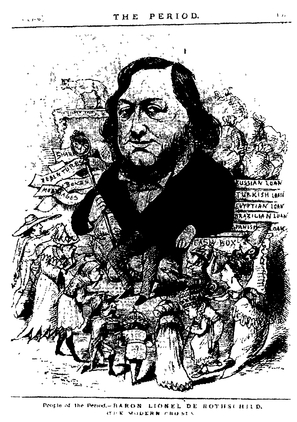
By contrast, James’s death seemed to leave the Rothschilds in a position of unrivalled supremacy. “There is after all only one less Rothschild,” declared the author of one panegyric in 1868: “The Rothschilds carry on.” In 1870 the British magazine The Periodused a now familiar image when it portrayed Lionel as the new Rothschild “king” upon his throne of cash and bonds, accepting the obeisances of the rulers of the world—among them, the Emperor of China, the Sultan, Napoleon III, the Pope William I and Queen Victoria (see illustration 5.i).
Yet the Credit Mobilier’s failure did not represent a generic failure of joint-stock banking: on the contrary, the years after James’s death saw no slackening in the proliferation of such banks. And as international financial markets grew larger, more competitive and better integrated, the relative importance of the Rothschilds’ concentration of private capital was already declining, immense though it was. Two years before James’s death, the French journalist Emile de Girardin commented:
The great [private] banking houses have lost their influence. They can still, when the political and monetary circumstances do not go against them (which is becoming rare) determine the great [financial] movements, but ... from now on the universal suffrage of speculation will prevail over the influence of this or that [private] banker.
The reign of the “banquiers,” he suggested, was coming to an end; “the reign of the institutions, of the great financial companies” was beginning.
If 1868 marked a turning point in French financial history, did it also mark a political turning point? It is tempting to argue that it did—that James’s death, following hard on the heels of the Credit Mobilier’s collapse, sounded a kind of financial death-knell for the regime. “L‘Empire, c’est la baisse,” James had said in 1866; was not its political demise also legibly imminent after the Prussian victory over Austria? It would be convenient for the historian’s narrative if this were true—if “the orthodox bankers” really had “delivered a deadly blow to the already tottering credit of the Second Empire.” In reality, the most pronounced feature of the period between 1866 and 1870 was the optimism of the French financial markets. There undoubtedly had been a baisse tendency between 1863 and 1866. From a peak of 71.75 in late October 1862, the rente had fallen to a low of 64.85 in November 1864. But thereafter its trend was upwards: the crisis precipitated by the Austro-Prussian conflict, which James had cited as an argument for a change in French policy, was in many ways just a temporary check. Prices touched their lowest point (60.80) on April 28, 1866, almost two months before war broke out; they actually rose from 63.03 to 68.45 in the week which saw the battle of Königgrätz. There were ups and downs thereafter—often linked to fears about Napoleon’s health—but the general trend is unmistakable. The closing price on the week ending May 21, 1870, was 75.05, a level not seen since the Empire’s halcyon days in the 1850s. Seldom has a débâcle been so blithely unanticipated by the bond market as that of 1870.
How are we to explain this? The plain answer is that the Second Empire after Königgrätz was a foolish rentier’s paradise. This was because monetary conditions, for primarily international reasons, eased. An improvement in the French balance of payments, combined with the creation of the Latin Monetary Union, led to an influx of gold and silver into the Banque de France’s reserve, allowing the discount rate to be lowered to 3 per cent in August 1866 and 2.5 per cent in May 1867. At the time there was much gloomy comment about the contemporaneous decline in industrial activity—investment in railways tailed off sharply after 1862—but the so-called “strike of the billion” (a reference to the Banque’s unprecedented reserves) had its positive aspect in rising bond prices. A new issue of rentes worth 340 million francs in the summer of 1868 was heavily oversubscribed. The harvests of 1868 and 1869 were good too. All this is important because it helps to explain why France, though she lost the war in 1870, was able to win the peace in 1871-3.
The financial markets’ buoyant mood in the late 1860s was further encouraged by the liberal reforms introduced by Napoleon. The first tentative steps away from dictatorship had been taken in 1860 and 1861, which saw modest increases in the power of the hitherto rubber-stamping Legislative Assembly; but it was not until 1867 that Napeolon III began to move rapidly towards a “Liberal Empire.” Deputies in the Legislative Body were given the right to question ministers; and in 1868 restrictions on the press were lifted. In the short run, this merely opened the lid of a Pandora’s box of criticism, at its most vitriolic in the pages of Henri Rochefort’s Lanterne. Perhaps the unfettered opposition’s greatest success was in exposing the extraordinary financial irregularities perpetrated by Georges Haussmann, the prefect of the Seine, to pay for his grandiose reconstruction of Paris, that most tangible achievement of the imperial regime. In the elections of May 1869, despite the best efforts of Rouher, only 57 per cent of votes were cast for the government compared with figures in excess of 80 per cent in the 1850s.
In all this, the Rothschilds played an important though somewhat ambivalent part. As early as December 12, 1866, Disraeli told Stanley he “had received from one of the Rothschild family alarming news as to the state of France. It was thought that people were getting tired of the empire.” James viewed the liberalisation of the Empire with scepticism from the outset: “I find it very difficult to believe,” he told his children in January 1867, “that these liberal alterations can do much good for credit or for the country; indeed, it is a sign of great weakness.” In a remarkable letter to his sons, James set out what was in effect his political testament:
You are going to say that your father is changing his way of thinking, and that he is on one side very liberal, in the way I have written to you on the question of Spain, and on the other anti-liberal vis-à-vis France. Let me begin by telling you that, strictly speaking, you are right, but there is within me on one side a man who is political and a liberal and on the other side a financial man, and unfortunately [a country‘s] finances cannot progress without liberties, but [they progress] even less with too many. I turn my thoughts to the past, and to all that we saw during fifteen years of Louis Philippe’s reign, when the government allowed [deputies] to address the house as freely as possible, and granted complete freedom of the press. Where did that lead us? To the overthrow of the government and all the changes and revolutions which have happened since. For unfortunately France is a country of vanity, where an orator can address the house to show off his talent in pretty speeches without thinking about the real interest of the nation. Now I believe that liberties are necessary in this sense, that people should have the right to publish simple articles and that they should be allowed to speak frankly about things which everyone talks about, but it is a long way from that to all the liberties which the Emperor is willing to grant. I tell you candidly that it is a very serious and hazardous thing and that willy-nilly we will be forced to go to war, not because of the external danger but rather because of excessive liberties granted too soon and too quickly. A man who has been in prison a long time cannot easily breathe the air he is eager to enjoy, and when he comes out he takes in too much at once and it takes his breath away and I fear that that is what will happen with the freedom of the press ... I only hope that the law will include in its terms the restrictions which will be necessary to halt the evil that that otherwise might well lead us to war.
Alphonse shared some of his father’s pessimism, though his point of view was not so strictly economic. As he saw it, “one of these days the liberal movement [would] simply become irresistible”; but he predicted “conflicts” and further political upheavals to come. At the end of 1866, he told his mother-in-law Charlotte that he was (as she recorded):
convinced that the Empire cannot last, but will be succeeded ere very long by a republic—a republic gratefully accepted by the whole of France as a state of transition, which will allow the most urgent reforms to be introduced, and allow time for the selection of a ruler, King or Emperor from the ranks of the numerous living representatives of the Bourbon and Orléans families.
When his in-laws expressed the hope that Napoleon would continue his liberal policy, he responded bleakly: “What is necessary above all is that one have a policy, for in truth they do not know where they are going, or with whom they are going.” But that did not restrain him from active opposition to the Bonapartist regime now that the opportunity presented itself. In the summer of 1867 he stood for election to the local council of Seine-et-Marne on an anti-government platform. Interestingly, James expressed “a little vexation that his son is counted among the members of the opposition,” and was inclined to deprecate the path of “open opposition.” Indeed, he explicitly assured Napoleon that “he was not of the side of the opposition.” But at the same time he did not restrain his son. “No minister,” he told his son, “will take it upon himself to put us into the Opposition.” In other words, he regarded Alphonse’s activity as a way of putting pressure on the government, in the belief that no French government could afford to risk alienating the Rothschilds.
Nor did James object to the activities of Gustave’s friend Léon Say, whose articles in the journal de Débats in 1865 in many ways initiated the campaign against Haussmann’s Parisian regime and provided the basis for Jules Ferry’s famous pamphlet, Les Comptes fantastiques d‘Haussman. As a member of the boards of both the Zaragoza and the Nord railways, Say was widely regarded as a Rothschild man, if not a Rothschild “servant.” Although he evidently had political ambitions of his own, there is no doubt that in attacking Haussmann he was grinding a Rothschild axe. Since 1860, when the Rothschilds had carried out a minor funding operation for the city of Paris, Haussmann had relied partly on the Credit Foncier to finance his building operations as well as on contractors who were willing to accept IOUs in the form of deferred payments and “delegation bonds.” In exposing the irregularities in the prefect’s accounts—which added up to some 400 million francs of unauthorised debt—Say was therefore dealing an indirect blow to the Crédit Foncier—much to Alphonse’s satisfaction. The Rothschilds had no hesitation in taking a share of the new loan floated to liquidate Haussmann’s less orthodox liabilities. Not surprisingly, then, Alphonse was (tentatively) pleased by the Liberal opposition’s apparent success in the May 1869 elections, even if the “Reds” did rather too well for Gustave’s taste and Nat was mildly alarmed by outbreaks of working class “hub bub.” “It seems to me,” Alphonse wrote to London in July 1869, “that if France wants liberty, she is a lot less revolutionary than before, the conservative sentiment is a lot more developed than it was a few years ago, and I have confidence that we will come though this crisis without tumultuous events and without deep troubles.” Admittedly, there were signs of working class discontent, but he was confident that a broadly based parliamentary regime would be able to cope with these.
This sense of liberal victory undermines the widely held assumption that the Second Empire was sliding politically towards revolution even before the outbreak of war in 1870. On the contrary, by embracing the opposition, Napoleon seemed to turn the collapse of the “Rouhernement” to his own advantage. On January 2, 1870, it was announced that the erstwhile Republican orator Emile Ollivier was to form a new liberal government—a move anticipated by Nat as early as the previous July. Alphonse was not much enamoured of Ollivier, but he remained fundamentally bullish. “Paris is full of the joys of its new ministry,” he reported in early January 1870. “All one sees are contented people and the bourse manifests its liberal sympathies by a resounding rally. All the men in the ministry are wise and sensible, if not of a very exceptional talent. They can count for the moment on a large majority in the Chamber, and there is therefore good reason to believe that confidence in the future will be maintained.” According to Disraeli, who was in touch with Anthony that same month, “the Rothschilds ... were now very confident that things would go smoothly; they thought the Emperor had outmanoeuvred the Orleanists by adopting a constitutional system, and might look forward with confidence to the future of his son.” Even the unruly scenes caused by Rochefort at Victor Hugo’s funeral did not perturb Alphonse unduly: “When a government has public opinion with it, it is very strong.” “The impotence of the democratic party,” he assured his cousins, was “beyond doubt.”
In the course of the next three months the constitution was remodelled along parliamentary lines, and on May 8 the new regime was endorsed by 68 per cent of voters. The decision to resort to yet another plebiscite initially annoyed Alphonse—it struck him as “a true puerility” and fresh proof of the ineptitude and mediocrity of the new ministers, awakening as it did fears of a second coup by the Emperor or a socialist insurrection in the big cities. But he welcomed the result “as a great victory for the party of order and the liberal party over the party of disorder”—a verdict apparently endorsed by a new upward surge at the bourse.
The problem was that the price of liberalisation was military weakness. Napoleon himself grasped the implications of Königgrätz when he called for reform of the lax system of military service in order to double the size of the army. Charlotte reported as early as August 1866 that the Emperor was “revolving in his head endless plans and projects for new breechloaders and needle guns, and murderous cannon.” Four months later, James heard of the Emperor’s plans to increase the army. But by giving the opposition its head in the Legislative Body he ensured that his Army Bill would be emasculated. As events in Prussia a decade before had demonstrated, liberals tended not to relish the prospect of increased military service, much less the taxes needed to pay for it. The arguments against higher spending seemed all the more plausible in view of the large sums which had already been squandered in Mexico, and which continued to be absorbed by the colonisation of Algeria.
All the government’s efforts in this direction therefore encountered stiff political opposition. The Rothschilds themselves were against French rearmament: as James saw it, it would “make a very bad impression and people will believe in war.” He and his sons therefore shed no tears when the Army Bill was whittled down. Like most contemporaries, they seem to have believed that France was already strong enough to take on Prussia if, as Alphonse put it, Bismarck made “the biggest mistake of all, to give France a pretext to pick a quarrel with him, when the occasion for it seems favourable.” When the organisers of the Paris Exhibition (among them Alphonse) found it hard to borrow works of art from the provinces, a joke did the rounds “that the Prussians might come, and carry them away.” The significance of this is precisely that it was regarded as a joke. As James said, there were “inexplicable contradictions” in the French situation: “[W]e have just put on an Exhibition, we ought to direct all our capital to industrial projects to improve the country; instead we’re forced to borrow to pay for [defence] expenditures.” When the Finance Minister Magne announced a loan in January 1868, its object was as much to stimulate the economy as to finance rearmament.3 Alphonse repeatedly cast doubt on the wisdom of French rearmament in his letters to his cousins: indeed, he seems to have been an early subscriber to the (erroneous) theory that arms races cause wars. Mayer Carl took a similar view in Berlin; he too saw French rather than Prussian policy as to blame. Alphonse reported enthusiastically from Paris in December 1869 that the Minister of Finances had reported “a very prosperous situation with a surplus of 60 millions of which the greater part will have to be used for public works and the rest for reductions in taxes and the improvement of the position of the minor functionaries.” A month later, the talk was of new government subsidies for railway construction.
This fundamental military weakness would not perhaps have mattered if the regime had been capable of pursuing a wholly passive foreign policy. But it was not. And it was as Napoleon cast around for some way of matching Bismarck’s triumph in Germany that the full extent of French weakness became apparent—or should have done.
Latin Illusions
Throughout the nineteenth century, there was a tendency—there are too many exceptions to speak of a rule—for diplomatic ties to be cemented if not actually built on movements of capital. Britain, the first economy capable of generating large enough balance of payments surpluses to allow sustained capital export, had secured most of its allies against Napoleon this way; and after 1815 the formal and informal British Empire was erected on an increasing stream of overseas lending. France was the other nineteenth-century power to export capital on a large scale; indeed, the value of foreign government loans issued in Paris in the years 1861-5 came close to equalling that issued in London. As we have seen, many of the new banks and railways established in countries like Spain, Italy and Austria after 1850 were based on French capital. This process reached its peak in the 1860s. But whatever its economic rationale (and there were many who questioned even that) its diplomatic or strategic benefits proved to be limited. If the Prussian challenge to French power on the continent was to be met, France needed reliable allies. Increasingly, Britain invested outside Europe: between 1854 and 1870 the proportion of British foreign investment which went to the continent fell from 54 to 25 per cent; by 1900 the figure was just 5 per cent. This helps explain Britain’s increasing diplomatic “isolation.” Anthony spoke for both Cobdenite Liberals and isolationist Tories when he declared in the immediate aftermath of the Austro-Prussian war:
We want peace at any price. It is the desire of all our statesmen. Take, for instance, Lord Derby. He owes his income of £120,000 to the fact that his estates in Ireland and Lancashire are being covered with factories and factory towns. Is he likely to support a militarist policy? They are all in the same boat. What do we care about Germany or Austria or Belgium? That sort of thing is out of date.
On the continent, meanwhile, French capital tended to flow to states which were either unable or unwilling to reciprocate with anything more than interest (and in some cases not even that).
The striking feature of European economic development after 1866 was the increasing regional segmentation of the capital market. France continued to invest heavily in and to trade with Belgium, Spain and Italy: this helps to explain the viability of the Latin Monetary Union established by France, Belgium, Italy and Switzerland in 1865. Austria, after the calamity of 1866, reorientated herself politically and economically towards Hungary and the Balkans. The proliferating banks of Prussian North Germany, meanwhile, began to invest substantial sums in other German states, Scandinavia and Russia. The implications for French foreign policy were as profound as they were unnoticed. For French capital was flowing to two states which were negligible quantities in the balance of power—Belgium and Spain—and to Italy which, because of the Roman conundrum, could never commit herself unequivocally to Bonapartist France. To be sure of checking Prussia, France needed Russia; or, failing that, an Austria willing to reopen the question answered so decisively at Königgrätz. Diplomacy may partly explain why neither of these alliances was achieved: as long as Bismarck could keep Russia and Austria-Hungary vaguely interested in the idea of a reconstituted Holy Alliance, France was forced to bid high for the support of either; and both Austria and Russia demanded a price Napoleon hesitated to pay—support against the other in the Near East. Yet the French bargaining position would have been much stronger if either Austria or Russia had been recipients of substantial amounts of French capital. Without that, France had only her military power to offer; and that, as we have seen, was doubtful.
The Rothschilds’ role in this process was vital, if to a large extent unconscious. The English Rothschilds shared the prevailing Palmerstonian view that France, not Prussia, was the power which threatened European equilibrium. In August 1866, a week before the Peace of Prague was signed, Charlotte expressed a widespread view when she told her son: “[W]e have known long and well that the Emperor Napoleon was the instigator of the war, and hoped to profit by it.” Lionel did not hesitate to pass on the criticisms of French policy he received from his uncle and cousins to Disraeli.
Nothing did more to reinforce British Francophobia than Napoleon’s inept efforts to revive the idea of some sort of territorial “compensation” for France, supposedly as a reward for her neutrality in 1866. Twice in that year, Napoleon had raised this issue only to back down. In March 1867 he tried again. Egged on by Bismarck to present Europe with a fait accompli, he struck a deal with the King of Holland to buy the Duchy of Luxembourg from him: yet another of those abortive real estate transactions which were such a feature of the 1860s. Luxembourg was an anomaly—the personal possession of the Dutch King, it had been a part of the post- 1815 German Confederation and its fortress had been garrisoned by Prussian troops. It was also a member of the Prussian Customs Union. The prospect of its annexation by France therefore aroused the ire of the German National Liberals (whom Bismarck tipped off) and seemed to raise once again the spectre of a Franco-Prussian war. James and Alphonse had not been involved in the negotiations between Paris and the Hague, but when they got wind of them they were predictably appalled, and bombarded London with frantic requests for English mediation. Less than two months after he had made it, James’s prediction that political liberalisation would lead France into a war seemed alarmingly close to being realised. Even when Napoleon once again backed down, the possibility that Prussia would opt for war could not easily be dismissed: Mayer Carl’s assurances of Bismarck’s pacific intentions were flatly contradicted by Bleichröder from Berlin. The war scare ended only when both sides agreed to submit the matter to an international conference in London; there it was decided to neutralise Luxembourg on the model of Belgium since 1839. Even then, the compromise merely seemed a postponement: Anthony was alarmed by the evidence of military preparations on both sides of the Rhine when he visited the continent later that summer. Mayer had formed the impression as early as September that the other German states would side with Prussia “in the event of a French action.”
The more encouraging aspect of the 1867 crisis was the apparent revival of the old Rothschild system of informal diplomacy. James and Alphonse saw the Emperor and Rouher repeatedly during April; Bleichröder and Mayer Carl relayed (admittedly contradictory) information from Bismarck; and Lionel passed it on to Disraeli, who sent it to Lord Stanley, who in turn passed it on to the Queen. Any British response was then transmitted back through the Rothschilds to Bleichröder’s “friend.” It was still apparently the case, as Stanley informed the Queen, that New Court’s “information as to what is passing on the Continent is generally quite as early and quite as accurate as that which can be obtained through diplomatic channels.” The decision to refer the matter to a conference in London was partly mapped out through these unofficial channels, with crudely coded telegrams between Berlin and London establishing the basic framework for negotiation. In many ways, Alphonse’s wish for effective English mediation had therefore been granted. Yet subsequent events prevented this process being repeated in 1870. Firstly, the Conservative government fell in London. Although Leo was friendly with the Foreign Secretary Clarendon’s son, and although Lionel and Charlotte saw Gladstone occasionally, relations were far less intimate than when Disraeli was in office. Secondly, James’s death and Alphonse’s increasing identification with the opposition meant, as Alfred observed in April 1868, that “the rue Laffitte [seldom] hears any news from the French Ministers.” Thirdly, the French government further antagonised British opinion in 1869 by embroiling itself in a scheme to acquire control of some crucial Belgian railways.
Once, this would have been a deal which would have greatly interested the Rothschilds. But their influence in Brussels had been waning for some years. This was partly because of the death in 1865 of their old friend and client Leopold I; relations were never so close with his son. More important, the Belgian banks (especially the Banque Nationale and the Société Générale) were now sufficiently strong to dispense with the Rothschild assistance they had relied on since the 1820s. When the Belgian government raised a 60 million franc loan in 1865, the Paris house was offered only 4 million francs. Two years later, when a further 60 million was issued, the Rothschilds’ share was only slightly more (6 million)—a figure Alphonse regarded as “almost derisory.” There was no Rothschild involvement in the French government’s abortive railway purchase, which was widely interpreted as having a strategic objective: to allow the swift movement of French troops into Belgium in the event of a war with Prussia. In London this was regarded as the diplomatic equivalent of sacrilege: preserving the neutrality of Belgium was becoming the holy of holies of British continental policy.
Nowhere was the incompatibility of French finance and diplomacy more obvious than in Spain. It was over the political future of Spain that France ultimately went to war with Prussia in 1870; historians rarely trouble to explain why this was. The answer lies in the sustained penetration of the Spanish economy by French capital in the 1860s, and the growing assumption of Bonapartist politicians that this entitled France to an informal imperial influence over the country. Far from disrupting the plans of the various French banks interested in Spanish finances, mines and railways, the revolution of September 1868 seemed to invite increased French involvement. Indeed, it was only after the revolution that it proved possible to reach an agreement on a loan to Madrid along the lines envisaged by James since 1866: not for the first time, the shift to a parliamentary regime seemed to encourage the Rothschilds, even if it was forcibly achieved. Though he died just days before it was concluded, the Spanish loan of 1868 was James’s last great coup, as Say wrote at the time in the Journal des Economistes. The Paris house took 3 per cent bonds worth 100 million francs (nominal) at a price of 33, reopening the Paris market to Spanish paper; in return, the Spanish government paid subsidies worth 30 million francs to the Zaragoza company. This was the first Rothschild bond issue for Spain in decades, and was intended to be the beginning of a sustained effort to put the country “back on its feet.”
Enthusiasm for the new parliamentary regime was short-lived, however, in Paris as in Spain. Apart from the usual post-revolutionary centrifugal tendencies, the new regime had to fight a long and costly war to retain control of Cuba: this precluded financial stabilisation. The classic Rothschild solution—the sale of the island to the United States—proved politically impossible, though Alphonse found the Prime Minister Prim personally sympathetic to the idea. This meant a return to the old pattern of declining bond prices, ad hoc advances on mercury or tobacco, continuing losses on “that devil of a railway”: in short, business as usual. Yet, as in the 1860s, other banks were eager to challenge the Rothschilds’ traditional dominance in Madrid. In particular, there was a vigorous campaign by the Banque de Paris, whose director Delahante envisaged “capitalising the revenue of the mines of Almadén, of [the copper mines of] Rio Tinto and a lot of other state properties and, in a word, more or less substituting himself for the state administration.” Although he presented this as a venture which he and the Rothschilds might undertake together, Alphonse had little doubt that Delahante dreamt of substituting himself for the Rothschilds too; in any case, a fresh outbreak of political instability and a further deterioration of the monetary situation put paid to the scheme. The culmination of this struggle came in 1870, when the Rothschilds narrowly managed to defeat an attempt by Delahante to gain control of the Almadén mines. Symbolically and financially, that would have been a heavy blow.4
Even after this victory, rival French banks continued to vie with the Rothschilds for influence in Madrid. But they had only partial sucess. In 1871 a consortium led once again by the Banque de Paris successfully issued a new Spanish loan, allowing the Rothschilds only “a very small slice.”5Something similar happened the following year, prompting over-confident talk at the Credit Lyonnais of “Rothschild” having “lost Spain.” On the other hand, long-term lending to Spanish governments remained as risky a business as ever. The years 1866 to 1882 saw a Spanish debt explosion: the public debt rose from 4.6 billion pesetas to 12.9 billion pesetas. The bulk of the new debt was taken by foreign lenders: the percentage of total debt held abroad rose from just 18 per cent in 1867 to 44 per cent in 1873. This was an unsustainable increase: as a percentage of GNP, total debt rose from around 70 per cent to a peak of 180 per cent in 1879. The collapse of the constitutional monarchy in 1873 knocked down Spanish bonds to below 18, compared with prices of above 30 in 1868, and the position deteriorated still further in the succeeding years. While their rivals retreated to lick burnt fingers, the Rothschilds were more than content to continue the traditional system of advances against the output of the Almadén mines, the value of which was as dependable as the value of Spanish paper was not. This continued to be a reliable source of income until the 1920s. The early 1870s—when political uncertainty was at its height and bond prices were slumping—saw a dramatic leap in the price of mercury from a norm of £6-8 per bottle to a peak of £22 in 1873. Fearing that such prices would encourage other producers to open uneconomic mines, the Rothschilds hastily stepped up the output of the mines: between 1873 and 1887 production very nearly doubled.
So well did the Almadén system seem to be working—Alphonse described it as a “milch cow”—that the possibility was raised in 1872 of extending it to the Spanish government’s copper mines at Rio Tinto. The republican interlude of 1873 put this plan on hold; but the Bourbon restoration at the end of the following year led to the sale of the mines to a British company for £3.7 million (rather more than the Rothschilds thought they were worth). It was only later that the Rothschilds became interested in Rio Tinto as major shareholders—an involvement which proved exceedingly profitable as world demand for copper soared. The same, however, cannot be said of the French house’s continued involvement with the Zaragoza railway. Despite steadily swallowing up smaller lines like the Córdoba—Seville, the “MZA” (Madrid-Zaragoza-Alicante) never paid a dividend to its shareholders. The prolonged rivalry between it and the Pereires’ Norte network, which lasted into the 1920s, must rank as one of the least profitable of Rothschild campaigns—despite state subsidies totalling £24 million, compared with a total French investment of £70 million.
More than anything else, this sustained economic interest in Spain explains the French government’s political interest in the country in the wake of the 1868 revolution. No sooner had Queen Isabella been ousted than speculation began about a possible successor from one of the other European royal houses. Shrewdly, the Rothschilds took care not to drop the Bourbons: indeed, the Paris house’s direct involvement in the finances of the royal family seems to date from the weeks immediately before the revolution which overthrew them. But a Bourbon candidate was out of the question in the short term, despite Napoleon III’s preference for Isabella’s son, Alfonso, the Prince of Asturia. As usual on such occasions, there was a Saxe-Coburg candidate, Ferdinand. But several other names were discussed in the long interregnum between the revolution and the final acceptance of the throne by Amadeo of Savoy (the son of the Italian King Victor Emmanuel) in October 1870.6 One of them was Leopold of Hohenzollern-Sigmaringen, a relative of the Prussian King. It was, of course, the French effort to prohibit his candidature, implying as it seemed a new Prussian threat from the south, which precipitated the fateful war of 1870.
If Belgium and Spain were non-powers, Italy was at least a contender. James had sought with little success to exert financial pressure on the Italian government during the 1866 crisis: in the end his plan that Italy should buy Venetia from Austria was realised, but only after the war he had hoped to avert. In the period after the Peace of Prague, the possibility of an anti-Prussian alliance between France and Italy was raised more than once, with Austria as a possible third. Bismarck called such a combination “conjectural rubbish”; nevertheless, it should not be dismissed out of hand. In February 1869 Nat heard it alleged that “his Majesty will determine upon war, in order to divert public attention from internal affairs” and that the Italian ambassador in Paris was returning to Italy “with a political motive, viz that of inducing his Government to make an offensive [and] defensive treaty with this country.” Two months before, the Italians had in fact secretly offered their neutrality in the event of a war, proposing the Tyrol as the price. And when war broke out in 1870, Victor Emmanuel seriously considered joining France against Prussia; it was unusual for him to be overruled, as he was on this occasion, by his ministers.
From a financial point of view, Italy was biddable. The costs of war—both external and internal—had pushed up spending from 916 million lire in 1862 to 1,371 million in 1866; but revenue lagged drastically behind, rising from just 480 million to 600 million, so that by 1866 more than half of all expenditure was being financed by borrowing. In the four years after 1861, the national debt more than doubled to around 5,000 million lire (approximately 55 per cent of GNP). Not only did the price of Italian rentes slump from around 66 to just above 50 in 1867; in 1866 the convertibility of the lira had to be suspended, leading to a marked currency depreciation. Against sterling, for example, the Italian currency fell some 12 per cent between 1862 and 1867. Italian politics continued to perplex foreign observers (Cavour’s “disciple” Quintino Sella was about the only post-risorgimento figure the Rothschilds had a good word for; the arch-intriguer Urbano Rattazzi was their bête noire). As in Spain, there was nevertheless considerable competition between French bankers for a share of whatever financial operation the Italians chose to make to extricate themselves from their financial difficulties. The beginning of 1867 saw the latest steps in this direction by the maverick prophet of Catholic finance, Langrand-Dumonceau, with the Rothschilds hard on his heels.
Yet bedevilling any possible alliance between Italy and France was the question of the relationship between the Italian Kingdom and the Roman Catholic Church. The diplomatic key to this was the status of the city of Rome itself which, despite the agreement struck with France in 1864, Italian politicians continued to covet. But the ramifications of the enmity between the Italian state and the Pope also extended to the realm of finance. When the Italian government proposed to raise money through the sale of ecclesiastical properties, there was considerable interest from foreign banks. In the course of several months of negotiations, a syndicate emerged—made up of the Rothschilds, the Société Générale and the Credit Foncier, with Langrand tagging along—to advance the government money ahead of the sale: the talk was of a loan of 600 million lire in return for a 10 per cent commission and Church lands supposedly worth over 1,000 million. But as it emerged that the sale of Church lands was vehemently opposed by the Pope and, more important, that the Italian government wished to transfer at least some of the repon sibility for the act of expropriation to the bankers, the Rothschilds began to draw back.
This withdrawal was partly for business reasons, it is true: there were various aspects of the proposed deal which James disliked, not least the need to share it with “swindlers” like Langrand. But the principal reason, as the private letters to London show, was that James was loath to incur the wrath of the increasingly influential Ultramontane party in France. This sensitivity to Catholic opinion was an intriguing feature of James’s later years. He had already shown signs of it in 1865, when he argued against selling Spanish bonds on the ground that “to act against the government and minister [of] a Catholic country like Spain, where Jews are not even allowed to have synagogues, could do no good in the long run.” Now he used the same argument again:
As a Jew, I don’t like to go against the clergy as that could hurt Jews everywhere ... It [was] not just because of the small share [we had], but because the deal was impossible, impossible to do. I, a Jew, should force the clergy to sell their property? ... I remain a financier and [do] not [want to get involved with] politics which will turn the clergy against us.
Even the pragmatic Alphonse agreed that “to associate oneself with a political act, which might well be convenient, but which is neither just nor equitable, would, I believe, be to sacrifice one’s good reputation to the love of gain, and to stir up against the Jews of Italy all the passions of the Middle Ages.”
The Roman obstacle proved insuperable. Renewed negotiations with the Credit Foncier and the Rattazzi government about a more straightforward advance of 100-120 million lire in July 1867 were blown off course by the renewed crisis over Rome that autumn. In a piece of sheer opéra buffe,Rattazzi encouraged Garibaldi to make a second attack on Rome, then had him arrested, and then resigned when the French despatched new troops to Rome. Garibaldi then escaped from his island retreat at Caprera, only to find the population of Rome apathetic and the Italian regular army siding with the French: his volunteers were duly defeated at Mentana, just as they had been at Aspromonte five years before.
In the wake of this fiasco, which momentarily raised the spectre of a war between France and Italy, the Church lands issue resurfaced, but once again James and Alphonse declined to become involved, despite the obvious frustration of the London partners. As usual, there were business reasons for this reserve: talk of a tax on Italian rentes annoyed James, as did the Credit Foncier’s increasingly independent style of negotiation. But fundamentally it was the religious problem which was decisive. “We are in a Catholic country,” declared Alphonse regretfully, “and one cannot go against the religious prejudices of the country where one lives, especially when one belongs to another faith oneself.” Nat agreed: it would be “a very difficult matter for our Paris house to go into the Ecclesiastical business.” “The Church people,” he argued, “would tear us to pieces if they could and nothing in the world would make us so unpopular. For my part let the profit be what it may I most sincerely hope we may have nothing to do with it.”7 Pointedly, Alphonse reminded his London cousins that “in almost analogous circumstances” they had “refused to make the Russian loan, because of liberal sentiment in England, which in those days sincerely pronounced itself in favour of Poland and against Russia.” Moreover, there was also now the added political complication of the French presence in Rome. In February and March 1868 Alphonse and James were in close consultation with Napoleon and Rouher, who saw an understanding over Rome as the precondition for a loan of any sort to Italy. Such an understanding was never achieved.
Even more than the closure of the Naples house in 1863, the abortive negotiations of 1867-9 were the turning point in the history of the Rothschilds in Italy. Mayer Carl was right when he complained that it was “a great pity that all our enemies & those who constantly oppose us everywhere should get hold of such a prof itable business.” True, the sales of Church land raised less money than had been intended; their main effect was to depress Italian land prices. And the Rothschilds continued to be the dominant force in the management of the Italian external debt until the 1880s: between 1861 and 1882 over 70 per cent of interest payments on foreign held rentes went through the Rothschild houses. It was also to the London house that the Italian government turned for a 644 million lire stabilisation loan when it was decided to resume specie payments in 1880-81. Yet Alphonse would never wield the influence over Italian governments which James had enjoyed in the 1850s and 1860s.
From the point of view of French diplomacy, the difficulties raised by the sale of the Italian Church lands were more ominous. For the Roman imbroglio not only precluded Rothschild involvement in the sale of Church lands; it also effectively ruled out the possibility of an anti-Prussian partnership between France and Italy. Each time the French Rothschilds retreated from the Church lands business, it was German bankers like Erlanger, Oppenheim, Hansemann and Bleichröder who stepped into the breach.
Another sign of the declining influence of French capital in Italy was the gradual disintegration of what had been one of James’s proudest creations: the South Austrian Lombardo Venetian and Central Railway Company. Compared with the Zaragoza line, the Lombard was a success story: it actually paid dividends to its shareholders. Its future prospects also seemed rosy: the Austrian Brenner pass was opened for rail traffic in 1867, and in 1871 the Fréjus tunnel was opened, sharply reducing journey times from Italy to France. When members of the English family travelled on the Lombard network they were suitably impressed by these developments. Moreover, there seemed no reason why the Lombard should not continue to extend its geographical reach. In 1867 it secured control of a number of Roman lines for a modest advance to the Italian government of 11 million lire. Two years later, the company’s bonds were boosted by talk of extending its network into the Balkans and towards Constantinople.
Yet there were undeniable problems. Natty and his uncle Anthony both complained about overmanning on the Italian part of the network. More seriously, the company’s financial needs seemed insatiable. The amounts of money absorbed by the Lombard company, even after government subsidies, were staggering. According to Gille, the French house poured over £5 million into the company between 1864 and 1870, with more being needed each year. Ayer’s figures indicate that the London house issued Lombard bonds with a nominal value of £24.6 million between 1866 and 1871. The issue price of these bonds tells its own story: in the first issue of 1866 the price was 93 per cent of par; further issues later the same year were for an average price of 79; in 1871 the price was down to 43. In 1874 alone, payments made by the London house on the company’s account totalled £893,000. In the 1860s cash-flow crises were more or less an annual event. Inevitably, the financial weakness of the company gave its major shareholders less political leverage than they had enjoyed in the past. Straddling the Austrian-Italian border as it did, paying substantial sums on a regular basis to the governments on each side, the line had once given James real political influence. By the late 1860s that had ceased to be the case. The old game of advancing moneys due to the government could still be played; but increasingly the various states dictated to the company.
In 1868, for example, the Italian government threatened to cut off the railways’ subsidies as part of its programme of retrenchment, and two years later it proposed a tax which Alphonse feared would consume all the profits generated by the Italian side of the network.8 The Austrian government meanwhile sought to force the company to construct an uneconomic branch line in the politically sensitive Tyrol. The Prussian government’s efforts to promote an alternative link from Germany to Italy via the St Gotthard pass sowed confusion in Rothschild ranks: Mayer Carl voted against the proposed subsidy only to be berated by his relations who had hoped the new pass would boost Lombard bond prices. There was similar disarray when the Austrian government announced its determination to enforce the financial separation of the Austrian Südbahn from the less profitable Italian network, which had been repeatedly postponed since 1866. It was the end of an era. In 1875 the Rothschilds sold the Italian network to the government for 750 million francs (£30 million); henceforth Italian railways would be the preserve of the Italian political elite.
These financial and political pressures gave rise to new kinds of friction between the various Rothschild houses, precipitating periodic “wars of words” between London, Frankfurt, Vienna and Paris. The Paris house was regarded by the others as excessively sanguine about the Lombard company’s finances and susceptible to pressure from other major shareholders like Talabot. Alphonse retorted by accusing Anselm of putting the interests of the Creditanstalt before the collective Rothschild interest. This, however, was just part of a more profound process of divergence which by the 1870s seemed to call into question the fundamental rationale of the Rothschilds’ traditional multinational partnershiip, so eloquently reiterated by James in his will. Though not unrelated to personal differences, as we shall see, this divergence of interests was primarily due to the changing patterns of capital formation, which were gradually allowing Central Europe to emancipate itself from Western European influence. Gradually, the interests of the various houses were becoming more and more geographically distinct. The ultimate failure of France to find any way of effectively counterbalancing Prussian power also had its roots in this process.
The Isolution of Austria—Hungary
An alliance between France and Italy, even if it had been secured, would have been of little strategic value if Austria had not been a party to it. Superficially, a Franco-Austrian alliance was the most likely combination to emerge after 1866; indeed, as we have seen, it had already emerged during 1866, and may even be regarded as one of the reasons Austria risked war against Prussia. After the Austrian defeat, there were repeated French attempts to resuscitate the idea: in April and August 1867, in the summer of 1868, in December the same year, in March and September 1869. To the duc de Gramont—the French ambassador in Vienna who became Foreign Minister in April 1870—such an alliance seemed not only attainable; he believed it had been attained. Gramont treated the abortive agreement of 1869 as if it had been genuinely as well as “morally signed” (Napoleon’s wishful phrase). A French general was even sent to Vienna to discuss joint military operations. But the fundamental stumbling block all along was that the new Austro-Hungarian Dual Monarchy had different priorities from the old Austrian Empire. As Lionel informed Disraeli in 1867, the idea of revanche in either Germany or Italy was not seriously entertained in Vienna, much less in Budapest: the future now seemed to lie in the Balkans. The problem for France was that the Austrian Prime Minister Beust’s interest in Bosnia—Hercegovina implied conflict with Russia, not Prussia. Unless France were willing to favour Austria against Russia over the Eastern Question—for example, over the Cretan revolt against Turkish rule—there was no reality to the Austro-French alliance. And so it proved. There was only really one occasion—at the end of 1868—when the Vienna Rothschilds reported a serious intention on the part of Beust to fight another war against Prussia, and that plainly had more to do with events in Rumania and Crete than with France.
So much for the diplomatic foreground; but these events make little sense in the absence of an economic background. The key, once again, lies in the regionalisation of the European capital market. In the 1850s and 1860s, as we have seen, Austria’s recurrent fiscal deficits had been partly financed by English and French capital. After the débâcle of 1866, James sought to resume business as before. Although he declared that he “really no longer had any great confidence in the ailing credit of Austria,” in practice he began to offer cash advances almost at once. Indeed, he made a personal visit to Vienna in the summer of 1867 to try to negotiate a new issue of “Anglo-Austrians”—sterling bonds of the sort which had been issued in 1859. Yet to other members of the family this seemed premature at a time when the Ausgleich between Austria and Hungary had yet to be finalised. Mayer Carl was especially sceptical about the financial viability of the new system of Austro-Hungarian “dualism,” which gave Hungary almost complete financial autonomy save for a relatively low contribution to a “common” Austro-Hungarian defence budget; he was prepared to contemplate issuing new Austrian bonds only if the price were extremely low. This wariness was shared by Natty in England.
Their reservations were only confirmed by the efforts of the Austrian government to secure rival offers from the Credit Foncier and other Paris houses in November 1867. As Alphonse complained, “In truth, it is pretty difficult to deal with the Austrian government, which is always so pressed for money that it approaches everyone simultaneously,” making it “almost impossible to bring any association to a happy conclusion.” To cap it all, even as these talks were going on, the government announced a new tax on all securities and a compulsory conversion of the interest on existing government bonds from 5 to 4.5 per cent—a measure denounced somewhat intemperately by Alphonse as “impractical financial Jacobinism” and de facto “bankruptcy,” which could only undermine Austrian credit.9 There were similar difficulties with the Hungarian government’s fledgling attempts at borrowing in its own right.
These problems need to be seen in the context of a breakdown of communication—and confidence—between the Vienna house and the other Rothschilds branches. In 1867, to his uncle’s great indignation, Anselm negotiated an Austrian crown estates loan with a Vienna syndicate and even allowed the Société Générale to issue the new bonds in Paris. This was the first sign of a new policy of semi-autonomy on his part, which ran parallel to the divergence of railway interests described above. The Hungarian General Credit Bank (Magyar Altalanos Hitelbank) set up by the Vienna house and the Creditanstalt in 1867 was part of the same trend: Anselm pursued new business opportunities in Hungary with only the most perfunctory nods towards Paris and London. When Austrian bonds were suspended in London following the forced conversion of 1868, Anselm was indignant, siding with the government against what he regarded as an awkward minority of English bondholders, and reproaching Lionel for not taking the same line. Fresh proof of his Austro-Hungarian orientation came in February 1870, when he announced the conclusion of a new 30 million gulden Hungarian lottery loan. His partners were exclusively Austrian and Hungarian banks, and he offered Lionel a risible participation of just 250,000 gulden. It was not until 1871 that another Rothschild house (Frankfurt) secured a worthwhile share in a Hungarian loan, a mortgage on the state railways; and not until 1873 that the London house participated in a Hungarian bond issue. Symptomatic of the widening gap between the houses was the diminishing frequency of communications from Vienna to London: Anselm’s son Albert sought to revive the traditional practice of regular correspondence in 1871, supplying detailed reports of Austrian economics and politics—which reveal, among other things, his father’s closeness to Beust—but these soon tailed off.
Predictably, Anselm’s independent course angered the other houses. James complained that he “informed [them] of all transactions not before but after they were agreed,” despite the fact that “many of them were better suited in their own interests to the foreign, and preferably the Parisian, rather than the Austrian market.” Mayer Carl accused him of “always advocat[ing] the interest of the government & never our own,” an echo of earlier complaints about Anselm’s father Salomon. Alphonse, on the other hand, grumbled that “despite his good relations with the government” Anselm was “often ill-informed about what goes on in Vienna.” Above all, Anselm seemed to be “allow[ing] all the business to go into other hands” (Mayer Carl). “In giving his support to all these new banks,” argued Alphonse, “our good uncle is encouraging competition against our houses in every market in Europe.” To such complaints Anselm responded in terms which say much about the growing dissension within the family. He had established the Hungarian Credit Bank without reference to Paris, he wrote, because he did not wish merely to be regarded as “an agent or a reporter for the [Rothschild] house.” On numerous occasions in the past, Anselm complained, he had been “wholly left out” of transactions undertaken by the other Rothschild houses. In the case of a recent Lombard bond issue, he had been:
fobbed off with empty, vacuous private letters, with letters which say nothing more than the better or worse state of the [Paris] bourse and withhold [details of ] the ... often interesting negotiations and advance transactions with Italy, Spain and so on. If I can be accused of acting with a certain sensitivity, I admit it, but one must give vent to one’s natural feelings if they are not sufficiently taken into account ... The fact that I do a lot of business hand in hand with the Creditanstalt is quite true and perfectly understandable. It was I more than anyone else who brought it into being ... and I therefore have a certain affection for the bank, which in any case, thanks to its capital of 50 million gulden ... has now become a financial power here which commands respect and which has to be reckoned with.
In April 1869 Ferdinand relayed to Lionel a similar message from his father:
He is very pleased with the business he has been transacting. The Vienna house holds about 14,000 Credit[anstalt] shares on which there is a profit of £100,000. He is now transacting the sale of a bridge at Pesth with the Hungarian Govt [on] which he hopes to make £20,000.—He says there is an immense deal of business transacted at the bourse at Vienna, that the public follow him blindly, and that he is very satisfied with his position among his brother financiers.
This did not convince Anthony: when he visited Vienna in September 1869 his impression was of a speculative bubble fuelled by the National Bank’s lax monetary policy. Anselm further antagonised the French and English houses when the Creditanstalt became involved in a projected Banque de Paris loan to, of all places, Spain; his argument that he could not determine the lending policy of a joint-stock bank in which he was a large but not the controlling shareholder did not wash in Paris.
Nothing revealed more starkly the way Rothschild interests were diverging than the plan to extend the Austrian railway network through the Balkans to Turkey, which Anselm took up enthusiastically in early 1869. To his chagrin, the other Rothschild houses were deeply sceptical—partly on the ground of Turkish financial unreliability, partly because they considered their existing railway interests quite burdensome enough—and in the end Anselm had to withdraw from involvement, leaving the field to the Belgian banker, Baron Maurice de Hirsch. “The Turkish railways have no interest for us,” agreed Alphonse and Lionel emphatically. Anselm had been forced to listen to harsh words from his relatives in the years since 1866; but here he could with justice rebuke them. The plan for a rail link to Constantinople had been “a grand European enterprise in which the financial forces of France and England” could have combined with those of Austria. When Alphonse later objected to his becoming involved in the new Banque Austro-Ottomane, Anselm pulled no punches:
I simply do not understand the feeling of aversion felt [by the Paris house] towards this enterprise which in no way prejudices the interests of our houses, and least of all those of the Paris house, which as you very well know maintains no agent at Constantinople and, so far as I am aware, scarcely has any business dealings with the Ottoman government. If it were otherwise, I would undoubtedly have abstained out of consideration for the other houses from even an indirect interest in the company which—it should be said in passing—is going very well and has already concluded several considerable advances to the government. The proof is that its shares stand at 40 to 45 per cent above par.
The Vienna house, he continued angrily,
finds itself in a quite distinctive and abnormal situation; all the major transactions in London, Paris and Frankfurt are handled jointly by the houses there. As for Vienna, now and then we are allowed some scraps and it is certainly not with those that I am in a position to meet my constantly increasing costs and the pretensions which people expect on account of my surname. I have a certain ambition, which is certainly not reprehensible, to march if not side by side with the other houses then at least not too far behind them—and up until the present, with the help of God, this plan of campaign has not gone badly.
If the London and Paris house shirked the challenge of the Balkans and Turkey, could they reproach him for acting alone elsewhere? It was essentially the same question Beust had asked Napoleon III; and there was no real answer.
The Economic Origins of the German Reich
Whatever their views on Balkan railways, there was one East European question which did interest the other Rothschild houses in the 1860s and 1870s: the condition of the Rumanian Jews. The Jewish population of the country had been rising for some time as a result of immigration from the Russian Empire. In 1866 there was a pogrom in Bucharest prompted by debates in the legislature on Jewish emancipation, and similar outbreaks of violence recurred in subsequent years. In Iasi (usually called Jassy at the time) the Jews were the objects of especially severe and sustained persecution. The Rumanian government seemed indifferent. Not for the first time, the Rothschilds therefore sought to use their international political influence on behalf of their “poor co-religionists.” In Paris James urged the French government to protest formally to the regime in Bucharest. In London too the Rothschilds mobilised official criticism of “the terrible jew-hunt at Jassy,” though Lionel doubted the wisdom of sending Moses Montefiore on yet another foreign mission, as proposed by the Board of Deputies. But it was above all in Berlin that the Rothschilds concentrated their efforts. This might at first seem strange; but it must be remembered that in April 1866 a Prussian prince (the second son of Charles Anthony of Hohenzollern-Sigmaringen) had become King Carol I of Rumania, and it was naturally assumed, as Goldschmidt put it to Bleichröder, that “Prussia has primacy and greatest influence with the governing Prince in Bucharest.” Ferdinand too hoped that Mayer Carl would use his influence in Berlin “in favour of the unfortunate Jews.” According to the Prussian ambassador in London, no fewer than “twelve Rothschilds [had] requested most urgently” Prussian intervention. Mayer Carl also seems to have written directly to the Rumanian Prince’s father.
In fact, Bismarck did instruct his consul general in Bucharest to investigate the situation and “if appropriate to make forbearing remonstrances to the authorities.” But he was reluctant to do more without the support of Russia, which continued to regard the erstwhile Danubian principalities as within its sphere of influence. Given that many of the Rumanian Jews had fled even worse conditions to the east, it was no surprise that the Russian Foreign Minister Gorchakov flatly declined “to consider as a crime the measures that the Rumanian government has taken against the national plague of the Jews there,” adding: “If all Jews were Rothchilds and Crémieuxs, then the situation would be different, but under prevailing conditions one could not blame the government if it sought to protect its people against such bloodsuckers.” Mayer Carl himself reported that the elder Hohenzollern “complains bitterly about the Austrian Newspapers which are continually attacking his son and I am particularly sorry ... most of these papers are in the hands of Jews.” In October 1869 Alphonse had a personal audience on the subject with the Rumanian Prince, who struck him as a “very nice boy, who appears to have intelligence and energy,” and who promised “to take the poor Jews under his protection”:
But it’s always the same story: the Jews regard themselves as foreigners, they are full of ignorance and prejudice and they refuse to give them the rights which alone can assimilate them to the other citizens and allow them to apply their intelligence to something other than a more or less illicit form of commerce.
It is doubtful whether these efforts (which were repeated in 1872, 1877 and 1881) achieved much: as late as 1900, the Rothschild houses and the Hungarian Credit Bank had to refuse participation in a Rumanian petroleum deal proposed by the Disconto-Gesellschaft because of the Bucharest government’s continuing ill-treatment of Jews. Their principal significance is as evidence of the readiness of the Rothschilds to repair their relations with Bismarck, so badly damaged by the events of 1866.
The speed with which these relations were restored is a testament to Mayer Carl’s acumen, as well as to Bismarck’s appreciation that the Rothschilds, for all their efforts to thwart his German policy, could still be useful to him. Their political rapprochement may be said to have begun in February 1867, when Mayer Carl was persuaded—apparently by Bismarck, among others—to stand for election to the parliament of the new North German Confederation, which was to meet in Berlin. It must be said that he had his reservations about following his English cousins into parliamentary politics. “He will not consent,” reported Natty; “he says one party here wish to get him out of the way so as to be able to transact all the business and that the others will not be thankful to him if he went to Berlin where he would have to give his advice about the German Currency and ever so many things in all of which the Prussian interest is opposed to that of Frankfurt.” But, as Charlotte wrote:
[T]he town of Frankfurt will not hear of another representative, he will be elected in spite of all his protestations and he may see himself obliged to yield in the end especially as it is not likely that the German parliament will remain assembled during many months of the year ... Mr. de Bismarck and Mr. de Savigny [Karl Friedrich, who had been involved in drafting the Confederation’s constitution] have written to him to implore him to accept the proffered honor, saying that his ability, knowledge, and experience will be much appreciated at Berlin. It is impossible to receive more flattering proofs of regard and admiration.
To the English Rothschilds, Mayer Carl’s near-unanimous election was a family triumph in the tradition established by Lionel. In itself, it was “a post of honour”; the significance lay in the fact that he had “obtained five thousand three hundred votes, out of five thousand six hundred ... in a town where fifty years ago, at the entrance of the public gardens there stood in huge characters a very ugly prohibition to the effect that: ‘Jews are forbidden to enter.’ ” What more symbolic triumph could be imagined than that a Rothschild should be “unanimously chosen by the jew-hating city of Frankfort to represent its interests in the bosom of the German parliament”?10 For Mayer Carl, on the other hand, there were practical considerations. Now he had a good reason to make the regular visits to Berlin which would keep him in “contact with all the great men and master minds of Germany.” A Rothschild presence in Berlin was also welcome to Bismarck. Not only did he encourage Mayer Carl’s candidature; when he visited Paris in the summer of 1867 he also held out a well-chosen olive branch to James in the form of the grand ribbon of the red eagle—“a great honour,” as Alphonse noted, “and the highest distinction which a Jew has ever received in Prussia.” Bismarck went still further that November when he elevated Mayer Carl to the Prussian Upper House—in effect, a life peerage, nearly twenty years before the English Rothschilds finally secured their hereditary peerage. On at least one occasion he even urged Mayer Carl to buy a house in Berlin so that he could spend more time there—advice which Mayer Carl contemplated taking in 1871. The two were soon on very familiar terms: at a concert at the royal palace in Berlin in 1867 Bismarck jokingly told Mayer Carl “that if England wants a King for Abyssinia he could recommend the ex-monarch of Hannover.” As the venue of this encounter indicates, Mayer Carl was also considered haffähig (presentable at court): in March 1869 he had “a long chat with the crown Prince who takes great interest in everything and is very well informed,” followed by an audience with the Queen. A year later, he was invited to a small party by “their majesties” to meet the Tsar’s brother, Grand Duke Michael; and he attended a theatrical performance at the palace that April.
To Mayer Carl, this transformation of Bismarck from the ogre of Königgrätz into his friend “old B” was not merely flattering but useful: from April 1868 onwards he began to have access to the kind of first-hand political news from Berlin which had previously been Bleichröder’s sole preserve. For Bismarck, that was the whole point: through Mayer Carl he could be assured of a direct line of communication not only to Paris but also to London. A classic illustration of their new relationship in action came in April 1868, when Mayer Carl was in Berlin for the opening of the “Customs parliament” which brought together democratically elected candidates from the entire Zollverein in 1868. Intended to pave the way for South German accession to the North German Confederation, the parliament turned out to be an embarrassment for Bismarck because of the anti-Prussian mood of the majority of South German members; this may explain his decision to float a proposal for Franco-Prussian bilateral disarmament through the Rothschilds.
On the morning of April 23, Mayer Carl sent a telegram to the London house: “Tell your friend [Disraeli] that from the 1st of May army reduction here has been decided upon, and will continue on a larger scale if same system is adopted elsewhere.” He elaborated on this message in a letter sent the same day:
I think that the step taken by old B will have a good effect and that the French Emperor will be invited to discontinue his armaments which would be a capital thing ... Everything depends now on France & if your friends use their influence it will lead to a new aspect of things. The army reduction is to take place on the 1st of May & I don’t think [but] that it must have a great effect ... as nothing is more wanted than a simple proof of Prussian peace.
Disraeli seized on this, passing the telegram on to Stanley with a characteristically over-excited covering note:
This appears to me important: Charles [Mayer Carl] is virtually Bismarck. A few days ago, B. was all fury against France, and declared that France was resolved on war etc.: but on Monday the Rs. wrote to Berlin that they understood England was so satisfied with Prussia, so convinced, that she really wished peace etc., that England would take no step, at the instance of France, which would imply doubt of Prussia etc. This is the answer. I can’t help thinking, that you have another grand opportunity of securing the peace of Europe and establishing your fame.
Sight of Mayer Carl’s letter two days later merely encouraged the Chancellor:
I feel persuaded it’s all true. They [Rothschilds] have a letter this morning in detail, explaining the telegram, and enforcing it. The writer, fresh from Bismarck himself, does not speak as if doubt were possible: gives all the details of the military reductions to commence on 1st May, and the larger ones which will immediately be set afoot, if France responds.
Disraeli’s encouraging response had promptly been relayed back to Berlin. True to form, however, Stanley was lukewarm. He understood Disraeli to intend “that we might represent this to the French, as our doing, and possibly induce them to give some promise of disarmament in their turn: when the result being made public, England in general would reap much credit, and the ministry in particular be strengthened”; but he “doubted the feasibility of this combination, ingenious as it is.” Still, he did not question the quality of Mayer Carl’s intelligence, noting in the margin of Disraeli’s first letter on the subject: “They [Mayer Carl and Bismarck] see one another daily.” There were similar communications between Berlin and London in March 1869. “Old B,” reported Mayer Carl on March 15, “is not without certain apprehension about the Belgian Question, but still he thinks that nothing is likely to take place which might endanger the preservation of peace: he says that all depends upon the French Empereur and that nobody can foresee what alternative plans he may have.” Four days later, “B.... sat next to me to-day in the house [and] gave me the same information but he would like to know what old Nap’s plans are & if there is any truth in the alliance with Austria & Italy.”
These exchanges raise an obvious question: was the Machiavellian Bismarck using Mayer Carl to feed misinformation about Prussian intentions to London and Paris? There is no question that Mayer Carl began to identify himself with Prussian interests as early as April 1867—witness his new use of “we” and “us” as shorthand for the Prussian government. When challenged over his vote against the St Gotthard tunnel subsidy in 1870, he replied that he had withheld his support “as I find myself in the Reichstag not as a representative of the House of Rothschilds but as a representative of the people, and from this point of view I am against any subsidy for foreign railway purposes so long as the state is still struggling with a deficit of its own.” “[T]here is a famous difference between Prussia and all these other rubbishing [sic] countries,” he exclaimed on the eve of the Franco-Prussian War, one of many indications that he too was succumbing to that gruff chauvinism which 1866 had done so much to foster in Prussia. But this should not be understood as the familiar old story of German-Jewish bourgeois “capitulation” before the Junker Machtmensch; nor can it be assumed that Bismarck was seeking to hoodwink the Rothschilds. Bismarck may have expected that the question of South German accession to his new Confederation would one day lead to conflict with France; but he cannot be accused of forcing the pace towards war at any time before March 1870. As he put it in February 1868: “That German unity could be furthered by violent events I too regard as probable, but ... to induce a violent catastrophe is quite another matter ... German unity is not at this moment a ripe fruit.” The signals Bismarck sent to Paris through Bleichröder were also peaceful; and when, in the autumn of 1868, Alphonse heard from Berlin that “war was inevitable in the spring,” Mayer Carl was dismissive: “I would not attach much importance to what Bleichröder says as he mainly repeats what he hears from people who are often à la baisse and he himself is always black when he thinks it suits our purpose.”
Mayer Carl had good reason to believe that Bismarck’s intentions were peaceful at least in the short term, for all his intelligence about Prussia’s financial position pointed in that direction. That impression was reinforced by the spate of new private sector financial opportunities in Prussia which followed the 1866 war.
Rothschild involvement in Prussian finance resumed as early as January 1867, when Mayer Carl managed to secure the participation of the Frankfurt and Paris houses in a 14 million thaler issue of 4.5 per cent state railway bonds. This was to be the first of many transactions done jointly with the Disconto-Gesellschaft, whose director Adolph Hansemann was rightly identified by Mayer Carl as the coming man in the new and rapidly changing world of Prussian-German finance. Despite all the ill-feeling of 1866, Mayer Carl almost at once secured readmission to the Prussian loan consortium: it was as if all the harsh words of 1866 had never been uttered. There followed participation in two further loans intended to meet Prussia’s post-war military expenses, one for 30 million thalers in March 1867 and another for 24 million in August. May 1868 saw yet another loan of 10 million thalers. In November of the same year there was the offer of a 20 million thaler railway loan; in May 1869 a further 5 million. In each case, the Frankfurt house shared its allocation equally with the London and Paris houses. “You can be quite sure,” Mayer Carl assured Natty on Christmas Day 1869, “that no Prussian loan or loan for the North German Confederation will or can be made without my knowing it or having a share in the business ... You know that I am on the very best terms with Camphausen & that Hansemann is my great friend; I am therefore not afraid that anything will take place without our knowing it.” When Camphausen attempted to consolidate the Prussian debt in 1870, Mayer Carl was able to boast that “our house at Frankfurt will be the only firm entrusted with the new arrangement.”
These borrowing operations, as Mayer Carl knew full well, were to some extent a consequence of the government’s continuing budgetary difficulties. It is not easy to unravel Prussian financial policy in these years because of the disruptive effects of war and politics on the official statistics. But the available figures are unambiguous. According to published budgets, total public expenditure in Prussia had increased from 130.1 million thalers in 1860 to 168.9 million in 1867: the growth of the army and navy budgets accounts for about 40 per cent of the difference. However, these figures tell only part of the story, for actual expenditures were much higher. Between 1863 and 1868, budget targets were consistently overshot: altogether around 246 million thalers more was spent than intended. Here again military spending (including ordinary, extraordinary and off-budget figures) was the key: as a percentage of total spending it rose from 23 per cent in 1861 to 48 per cent in 1866. These expenditures were met by short-term borrowing (selling treasury bills to the Berlin banks), which was funded after 1866 by the bond issues described above. The increase in public debt was steep: from 870 million thalers in 1866 to 1,302 million just three years later. As we have seen, the fiscal strain of war on Prussia was much less than it had been for Austria for two main reasons. Firstly, Prussia began the wars of unification with a relatively low debt burden; secondly, economic growth meant that in macroeconomic terms the increase in debt was modest—less than 2 per cent of national income according to one estimate. Nevertheless, the contemporary bond markets (which lacked such modern data) were perturbed: the years 1864 to 1870 saw a sharp fall in the price of Prussian bonds, from 91.25 to 78.25.
Mayer Carl had no doubt that Bismarck remained strapped for cash. “Here there is such a want of money in the treasury,” he reported in May 1868, “that the government would be quite miserable if they thought that a war was likely to take place.” The government’s attempt to issue bonds secured on the tobacco monopoly in the autumn of 1868 was a failure. “Money here is tight,” he reported in April 1869, “[and] the last Prussian loan is flat.” Nowhere are the connections between public finance, private interest and foreign policy more visible than in Mayer Carl’s letters of May the same year:
May 10: Here the Government is very hard up and old B particularly cross as nearly all the new taxes will be rejected [by the Confederation parliament] ...
May 23: Old B makes long speeches & coaxes all the members of the opposition but ... will not succeed to make the liberals vote for the new taxes. Meanwhile the Government is very much embarrassed and I should not be astonished if we come to have a new Finance Minister which would be a capital thing as the present man [von der Heydt] is a great Bosche and not a friend of the House ...
May 25: [T]he feeling in the house is a very disagreeable one ... but Heaven knows how the Government is to get out of the financial mess. As far as peace is concerned it is a capital thing and our friends on the border of the Seine will not be displeased to hear of our difficulties ...
May 31: The King I am happy to say is thank heaven much better but old B has had a violent bilious attack & is very cross ... All my friends urge me to speak and to attack the Government about the new financial measures but I need not tell you how unpleasant it is for me, particularly as what one says is to be published all over the world and is generally misinterpreted ...
June 3: Old B says that he is ill, but I think that he is merely very much put out as all his new schemes have turned out to failure and the liberal parry is determined to oppose every measure which is not likely to bring a change in the system ...
June 5: Old B is quite well again & fancies that his scheme will be accepted in the Zoll Parliament, but I am quite certain that the duty on Petroleum will be rejected as all the liberals are determined to vote against it & the only consequence will be that hemust resort to liberal measures.
June 10: Old B is so much disgusted with the opposition he met with, that he talks of resigning but it is an old trick & nobody believes in it ...
The most convincing proof of the government’s financial difficulties was the rejection that autumn of its proposal for a 100 million thaler lottery loan secured on the Prussian railways.11 Only after Camphausen had replaced von der Heydt at the Finance Ministry did Mayer Carl become more optimistic about the financial future.
Yet even as Bismarck tried and failed to secure adequate—and more important, politically uncontrolled—tax revenues for Prussia and the new Confederation, private finance in Germany was booming. This was the first phase of what became known as theGründerzeit—the founders’ era, after the large number of new joint stock companies established between 1866 and 1873. “You have no idea what a competition there is now in business,” reported Mayer Carl in March 1870; “it is more than a mania and a regular disease like Cholera.” In this hectic period, Mayer Carl’s association with Hansemann brought him shares in numerous transactions: loans to the cities of Danzig and Königsberg and to the Silesian, Magdeburg and Cologne-Minden railways. Here too there was cause for optimism about the international situation; for one of the most ambitious new banks established in this period was the Preussische Central-Boden-Credit Aktiengesellschaft, a Prussian mortgage bank modelled on the French Credit Foncier. Originally Abraham Oppenheim’s scheme (though not according to Mayer Carl), the project was taken up by Hansemann in earnest in 1870 and brought to a successful conclusion. The domestic political appeal of the project from Bismarck’s point of view was obvious: here was a way to reconcile the East Elbian landowners to the new liberal era—through cheap credit. As Mayer Carl commented, “The King’s great wish is to have a Prussian Credit Foncier to please the new nobles who are in great awe of it.” For our purposes, however, it is the international significance of the scheme which is noteworthy: for it was from the outset intended to be a Franco-Prussian undertaking, the Paris Credit Foncier taking a leading share, along with the Banque de Paris and the French Rothschilds.12 Once again, it is probably unnecessary to infer a Machiavellian motive on Bismarck’s part. Although he was well aware of the imminent Spanish crisis when Bleichröder informed him of the Credit Foncier’s new issue on June 26, his silence on the subject was not designed to syphon off French capital on the eve of war; Bismarck simply wished the French Rothschilds to continue playing their now well-established role in Prussian finance. The real significance of the issue is the immense success it enjoyed in Paris: surely the ultimate folly of the Bonapartist bourse.
An unexpected revelation in this context is the extent of hostility between Mayer Carl and Bleichröder at this time. Contrary to Fritz Stern’s impression, the Rothschilds were increasingly impatient with Bleichröder and regarded Hansemann as their principal business partner in Berlin. Beginning in the autumn of 1868, Mayer Carl complained repeatedly about Bleichröder, whose pretension to be the Rothschilds’ “agent” in Berlin he dismissed contemptuously. “I think it quite ridiculous of Bleichröder to write to you & to Paris wishing you to entrust your interests to him,” he told New Court during the negotiations for a new Prussian loan in 1868: “[H]e has nothing to do with it.” A year later he denounced Bleichröder as “an old fool who wants everybody to think & believe that he is our agent whilst he does business with any one who gives him 1/8 commission.” “I do not see much of him,” he remarked in March 1870,
He is very jealous of Mr. Hansemann and as he does business with every body whilst he wants to make the rest believe that he is our agent I do not care much about him. He also makes a great fool of himself and runs after fine people, titles and orders, things which have also become a regular mania amongst the members of the Jewish tribe ... Bleichröder is a fool who cares merely for personal distinctions and has not the least influence in these quarters.
It was same story a few weeks later:
Mr Bleichröder takes good care to make every body believe that he is the agent of our house and many persons fancy that whatever he does is for our a/c [account] & with our consent. If you have any business with Berlin I should strongly advise to apply to Mr Hansemann who is first-rate and particularly honest. We do all our business with him & I need not tell you that we have every reason to be particularly satisfied with his services.
And again in October:
You know that we chiefly employ Mr Hansemann for all we have to do at Berlin and never apply to Bleichröder who is a regular busybody & wants the whole world to believe that he is our agent & that nothing can be done without him. Mr Hansemann is very honest & would never think of doing anything without us whilst I am not quite sure that Mr Bleichröder deserves to be viewed in the same light.
The final reason for Mayer Carl’s confidence in Bismarck’s pacific intentions was a sense that there was no need for war to bring about the accession of the South German states: economic forces seemed to be completing the process of unification unprompted. The period 1867-70 saw Mayer Carl busy not only with Prussian finance, but also with the finances of other German states, including the South German states still outside the Bismarckian Confederation. He participated in a succession of loans to the Kingdom of Württemberg, for example (9 million gulden out of a total of 15 million in 1867, 25 million in 1868); as well as in bond issues for Baden, Bavaria and Saxony. In addition, he was able to arrange loans for a number of smaller German states, notably Brunswick, Saxe-Meiningen, Saxe-Coburg-Gotha and the city state of Hamburg. Often the sums and profits involved in these loans were trifling; but Mayer Carl was a firm believer that “every little helps” and “1/2 an egg is better than an empty shell.” In any case, the real significance of this activity lay in its geographical range: to all intents and purposes an integrated German capital market now existed, with its principal centres in Frankfurt, Berlin and Hamburg, serving an emerging North and South German confederation—the nascent Reich. It is telling that most of these loans were for railway construction, not military purposes: the South Germans might bark at Prussia, but they evidently had no intention of biting. To Mayer Carl, shuttling back and forth between Frankfurt and Berlin, the evidence of German economic unification was unmistakable. Why go to war for it?
The Russian Option
With hindsight, only an alliance between France and Russia could really have prevented the unification of Germany on Bismarck’s terms. The obvious diplomatic opportunity for such a combination came in June 1867 when Gorchakov and the Tsar visited Paris “to do business”; but subsequent differences of opinion over the Cretan revolt proved an insuperable obstacle to an understanding. Another obstacle—and here there is a marked contrast with the period after 1887—was the failure of the Paris capital market to establish a dominant position in Russian finances. As we have seen, James had tried and failed to “establish a new Rothschild foothold” in St Petersburg on a number of occasions. Semi-official advances were made to the Paris house in the autumn of 1867; but when James met the Financial Minister Reutern in August 1868, he drew a blank. In the course of a long discussion, James proposed to undertake “a large financial operation,” meaning a large issue of government bonds to finance new railways. But Reutern was uninterested. The government had “no financial operation in view” and certainly had no desire to borrow money in order to leave it on deposit—at a lower rate of interest—with James. Reutern wished to minimise state intervention in Russian railways, not to have the state finance the railways itself. All he could offer James was involvement in the privatisation of the line from Moscow to Odessa. Although there were desultory negotiations on this subject it was not what the Rothschilds wanted. In James’s eyes, direct involvement in private undertakings “in regions so remote from our sphere of action” was too risky.
This general feeling of wariness only intensified after James’s death. As the Frankfurt house put it in late 1868, “Up until now we have not had much luck with Russia and with all these things we seem to arrive like the mustard after dinner is over, which is neither agreeable nor honourable.” Even when the Russian government seemed to change its mind in early 1869, Mayer Carl felt nervous at the thought of a large loan: “[I]t is impossible to pay close attention to a business of such magnitude by the ordinary way of correspondence ... [but] we have nobody to send to Petersburg and till now we have had so little luck with the Northern Barbarians that we ought to be careful & not let the cat out of the bag for others to reap the harvest [sic].” He declined to go to St Petersburg; as did Alphonse, who suspected that a highly publicised Rothschild visit was merely designed to pressurise Russia’s traditional bankers, Baring and Hope. The project was still in a state of limbo as 1869 drew to a close. Rather as in the United States, the Rothschilds refused repeatedly to establish a familial representation in St Petersburg. In August 1871, Gorchakov urged Mayer Carl that “we ought to have a house at Petersburg,” telling him “that one has no idea how much business there is to be made in Russia. ‘C’est unemine d‘or’ were his words.” This advice was never heeded. Alphonse even opposed the indirect involvement of Anselm or Mayer Carl in an Austro-German joint-stock bank to be established in St Petersburg by the Creditanstalt.
Such caution, however, was not shared by other bankers in Berlin. “The Berlin Bourse is a capital market for Russian securities,” reported Mayer Carl in May 1868 with detectable incredulity, “and the public buy almost nothing else.” Bleichröder was assiduous in promoting the idea of a Russian Credit Foncier, which was to be the counterpart of the Hansemann-Rothschild—Oppenheim Prussian mortgage bank. Bleichröder and Hansemann were also much more enthusiastic about Russian railways than the Rothschilds. This needs to be seen as part of an early movement of German capital eastwards: the 1860s also saw a variety of proposals emanating from Berlin and Hamburg for loans to Sweden and Finland (which, though ruled by the Tsar, had its own parliament and enjoyed considerable autonomy). The continental Rothschilds were never more than half-hearted participants in these ventures—for example, taking a 5 per cent stake in the 50 million rouble Russian mortgage loan of 1867, but refusing an option when more such bonds were issued two years later and blowing hot and cold thereafter.
Rather curiously, given their reservations about lending to Russia in 1863, it was the London Rothschilds who proved most convinced of the value of Russian business. Natty was critical of Mayer Carl for failing to go to Moscow at the time of the abortive 1869 negotiations, and it seems to have been at his instigation that the London house pressed the matter to a conclusion that December. The issue of £12 million of Russian 5 per cents at a price of 80 was one of the most ambitious Rothschild undertakings of this period, and a resounding success in all the markets where subscriptions were opened: it was heavily oversubscribed in Paris and Berlin. As Mayer Carl declared, it was “decidedly the greatest success of the day and the Russian Government ought to be particularly grateful to you and will never think of applying to any body else, which I hope will send a large number of other transactions.” It was indeed the first of a succession of five major Russian bond issues in the years up to 1875 (totalling £62 million nominal), though the connection to St Petersburg remained a somewhat fragile one.
The Rothschilds wanted the Russian government to confine itself to such bond issues and to end the practice of guaranteeing private railway company bonds, but this proved difficult to achieve as long as Bleichröder and others were willing to invest directly in Russian railways. “[I]t is a great pity,” complained Mayer Carl on more than one occasion, “that the Russian Government should allow all these Railways to issue their bonds which are all taken up by the public and spoil our market.” Moreover, as early as October 1870, with the Russian denunciation of the 1856 neutralisation of the Black Sea, Anglo-Russian relations began to deteriorate over the Eastern Question. The Balkan revolts of 1875 led to yet another breakdown in Rothschild—Russian relations, despite the hopes which Alphonse had expressed when he and Edmond visited St. Petersburg the year before. The crucial financial realignments which brought France and Russia and ultimately England together to check the new Germany lay more than a decade in the future.