
FOUR
We aren’t working for the King of Prussia.
JAMES DE ROTHSCHILD, 1865.1
When Otto von Bismarck accepted Amschel’s invitation to lunch with him in Frankfurt in June 1851, he can hardly have been aware whose example he was following. Thirty years before, Metternich too had “taken soup” with Amschel; it had been the beginning of a long and mutually beneficial friendship between the Austrian Chancellor and the house of Rothschild. They attended to his private finances (often on preferential terms) and acted as a swift and secret channel of diplomatic communication; he in turn provided them with sensitive political news and gave them a privileged position not only in Habsburg finances but in Austrian society. It was evidently Amschel’s hope that Rothschild relations with Bismarck would follow the same pattern; and for a time that seemed a not unrealistic expectation.
Although Bismarck’s anti-Austrian policy had briefly brought him into conflict with the Rothschilds during his time as Prussian envoy in Frankfurt, neither side had taken this personally, and Bismarck had subsequently entrusted his private financial affairs to the Frankfurt house, which also acted as the Prussian delegation’s official banker. M. A. Rothschild & Söhne remained his bankers until 1867. Like Metternich, Bismarck was not a rich man before 1866; unlike him, however, he never sought to borrow on a large scale from the Rothschilds, though he ran up a modest overdraft in 1866, when his expenditures (27,000 thalers) exceeded his salary as Minister President (15,000 thalers) and the income from his estates (around 4,000 thalers)—a debt easily cleared when he was awarded a gift of 400,000 thalers by the Prussian Landtag as a reward for his victory over Austria. Before that time, Bismarck relied on the Rothschilds primarily to provide him with current account facilities, using the Paris house to pay his substantial expenses (10,550 francs) when he visited Biarritz in 1865, for example. Bismarck expected an annual statement of his account at the beginning of each year “so that I can make my calculations as [I set my clock] by the sundial.” In addition, because his account was often in surplus—as in June 1863, when he was in credit to 82,247 gulden—the Rothschilds paid him interest (at 4 per cent) and occasionally made investments on his behalf At some point before 1861 they bought shares for him in the Berlin Tivoli brewery, a firm in which the Frankfurt house had a major stake (other major shareholders were the Oppenheims of Cologne).
As Fritz Stern has shown, after 1859 Bismarck delegated an increasing amount of his private financial affairs to Gerson Bleichröder, who had taken over his father Samuel’s Berlin banking business on his death four years before. But this did not necessarily signify a breaking of the Rothschild connection. Bleichröder had for some time been one of the principal bankers in Berlin with whom the Rothschilds did business, and it was apparently Mayer Carl who first recommended him to Bismarck. Moreover, Bleichröder was at pains to make available to the Rothschilds whatever scraps of political information he could pick up in Berlin. In March 1861, for example, he more or less accurately forecast that further Liberal election successes would lead to a complete breakdown in relations between crown and Landtag “on the army question” followed “in three months” by “another dissolution and at the end a change in the electoral law, with a reactionary minister or the entire abolition of the chamber.” His information steadily improved after Bismarck returned from St Petersburg to Berlin, after which the phrase “according to personal information from Herr von Bismarck” began to feature in his correspondence. At first, Bleichröder assumed that the “reactionary” and “unpopular” Bismarck would not last long. Gradually, however, he established a closer relationship with the beleaguered premier, not least because Bismarck wished to use him as a channel of communication to James in Paris. As Bismarck’s aide Robert von Keudell put it, James “always had free access to the Emperor Napoleon, who allowed him to speak openly not only on financial but on political questions as well. This made it possible to send information to the Emperor through Bleichröder and Rothschilds for which the official route seemed inappropriate.” Meetings with Keudell and Bismarck himself became increasingly regular; soon Bleichröder’s letters were full of allusions to his “good source.”
Nor did Mayer Carl in Frankfurt neglect his increasingly influential client. We have already seen how by 1860 he had secured, partly thanks to Bismarck, the title of Prussian court banker and a minor decoration. In the hope of obtaining a rather better mark of honour, Mayer Carl wrote to Bismarck in 1863 in the kind of elaborately sycophantic language which his English and French cousins had long since been able to disdain:
Your Excellency knows my old, proven and unbounded devotion to your person and knows how attached I have always been to Prussian interests, even though my great and protracted services have not... been noticed in any prominent fashion... I now turn to you, full of confidence in Your Excellency as a noble, magnanimous and all-powerful representative and do not doubt that Your Excellency in just appreciation of the facts known to Yourself will kindly think of me and grant me a dignified token of the all-highest recognition... May heavenly Providence always watch over Your Excellency and may you experience only days of brightest joy and of boundless good fortune in the circle of your family, may it be my lot always to enjoy Your Excellency’s high favour and gracious protection and to be able to count myself among your most faithful admirers and servants.2
Yet it was not to be. Where the financial relationship between the Rothschilds and Metternich had flourished, their links to Bismarck withered. Despite his position of semi-dependence on the Rothschilds, whose disfavour would have been injurious to what was still a small firm, it seems that Bleichröder was able to poach Bismarck’s account from the Frankfurt house. To begin with; he did no more than collect Bismarck’s official salary in Berlin and disburse some of his domestic expenditures. Even before Bismarck returned to Berlin in 1862, however, Bleichröder began to offer his services as an investment adviser, complaining on his putative client’s behalf when the Tivoli company failed to pay a dividend. Soon he was offering Bismarck a succession of Prussian railway and bank share options, as well as providing him with regular reports from the Berlin bourse. By the end of 1866, he had achieved his objective: it was Bleichröder not Rothschild who handled the investment of Bismarck’s 400,000 thaler gift, and at some point after July 1867 Bismarck closed his account in Frankfurt and remitted the balance (57,000 thalers) to Bleichröder. “It is not necessary to let the Jews get the upper hand,” Bismarck later declared, “or to come to depend on them financially to such an extent as is regrettably the case in several countries. My relations as a minister with Jewish high finance have always been such that the obligation has been on their side and not on mine.” This was true: Bleichröder was always deferential to Bismarck in a way that (for all Mayer Carl’s florid avowals) the Rothschilds would never have been if Bismarck had continued to bank with them. The path Bismarck led Prussia down after 1862 was simply too uncongenial to Rothschild interests in Austria, in Italy and in France.
For their part, as we shall see, the Rothschilds soon came to regard Bismarck with a mixture of antipathy and admiration. He was a “madcap,” declared James in March 1866. At around the same time, Anselm memorably likened him to “a wild boar foaming with rage.” Bismarck, wrote James a month later, was “a fellow who just wants war.” “The terrible Bismarck,” exclaimed Charlotte, “is inexorable; he is the great highway robber of the second half of the nineteenth century.” Yet perhaps even more telling than these denunciations are the expressions of admiration which the Rothschilds also evidently felt for “the white revolutionary.” As early as 1868, Charlotte could regard “a Bismarck intelligence” as a desideratum in a son-in-law. Alphonse, who of all the Rothschilds had most reason to hate Bismarck, could refer to him with only a hint of bitterness as “the great master of the world” and “the man behind the curtain... wire-pulling the puppets of the whole European political show.” When Bismarck finally fell from power in 1890, Alphonse’s comment was a singular tribute to an old adversary: with Bismarck gone, he wrote, “the European countries certainly cannot be said to dwell on solid fundamental principles.” Bismarck never really felt the same respect for the Rothschilds, alluding to them on a number of occasions in more or less anti-Semitic terms. But nor did he underestimate their financial acumen. Perhaps he also recognised in them something of his own hard-nosed “realism.” In later life he defined his own view of political principles as similar to Amschel’s who, he recalled jokingly, had been in the habit of asking his chief clerk: “Mr Meier [sic], if you please, what are my principles today with regard to American hides?”
German Unification: The Financial Background
In one sense, it is easy to see why Bismarck was able to avoid “depending” on the Rothschilds or any other bankers in a way that no Austrian politician of the period could. Financially, Prussia was in a different league. Table 4a gives some bald figures for the nominal increases in expenditure for three of the principal combatants in the period. The figures for France and Prussia are in fact quite similar; but the Austrian figures—which show expenditure nearly trebling between 1857 and 1867—testify unambiguously to the Habsburg monarchy’s unsustainable military commitments. It was the army and the defence budget which caused this growth, not (as might be imagined) inflation, which was comparatively restrained (prices rose by just 5 per cent, surprisingly little in view of the substantial monetary expansion of those years).
Table 4a: Public expenditure in the era of unifications, 1857-1870.

Sources: Mitchell, European historical statistics, pp. 370-85; Schremmer, “Public finance,” pp. 458f
The attitudes of bankers, however, were more directly determined by the way military spending was financed. Here Prussia’s advantage over both her principal rivals was more pronounced. Between 1847 and 1859 the total Austrian debt increased by a factor of 2.8; for Prussia the equivalent figure was just 1.8. More important, Prussia started the period with an exceptionally low debt burden: in the 1850s public debt as a proportion of national income was around 15 per cent and as late as 1869 was still less than 17 per cent; the equivalent figure for France rose from 29 per cent in 1851 to 42 per cent in 1869. Figures for the cost of debt service make the difference equally apparent: in 1857 the Austrian state was spending 26 per cent of its ordinary revenue on debt service, compared with a figure of just 11 per cent for Prussia. For the Bonapartist era as a whole, the equivalent figure for France averaged 30 per cent; even at its peak in 1867 the Prussian debt service burden was less (27 per cent). This meant that, from the point of view of a prospective lender, Prussia was a good credit risk; France slightly less so; Austria a downright bad one. Again, these differentials can be illustrated with reference to bond prices. The price of Austrian 5 per cent metalliques touched twin troughs of around 42 (a price not seen since the Napoleonic period) in 1859 and 1866. Prussian 3.5 per cents, by contrast, never fell below 78 (see table 4b).
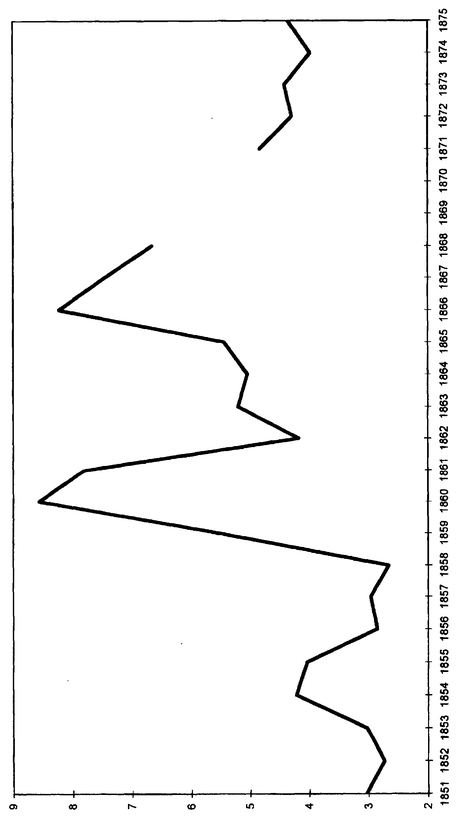
To make the difference clear, throughout the period between 1851 and 1868 the yield spread between Prussian and Austrian bonds ranged between 2.7 and 8.6 percentage points, averaging almost exactly 5 per cent (see illustration 4.i). The gap is less pronounced for Prussia and France, but it is still there: on average between 1860 and 1871, it was just over one percentage point. As Talleyrand observed (with par-donable exaggeration) in January 1865, “Prussia stood above par in politics as on the bourse.” Thus while it is still possible to explain the outcomes of the various conflicts of the period 1858-71 in terms of the shrewd diplomacy of statesmen or the bold strategy of generals, a financial explanation is necessary too, if not sufficient. Another way of putting this is that Austrian policy failed precisely because it was financially unsustainable: unable to afford the military effort necessary to achieve victory in both Italy and Germany, the Austrians should have accepted the option of selling their territory in one, to enable them to afford to defend the other. This was essentially the strategy advocated by James and his nephews. By seeking to defy financial reality, Austria ended up losing on both fronts.
Table 4b: The financial impact of German unification.
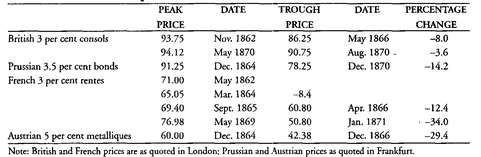
Sources: House of Commons, Accounts and papers, vol. XXVII and XXXI; Economist·, Heyn, “Private Banking and Industrialisation,” pp. 358-72.
Nevertheless, it would be wrong to suggest that Bismarck’s victory was financially predetermined. Bismarck’s access to state revenues in the crucial years 1862-6 was technically illegal in the absence of parliamentary approval, and even his own “gap theory”(Lückentheorie) could not easily justify increases in expenditure much above the last approved budget. On average, expenditure in the years 1863-6 exceeded the sanctioned ordinary expenditure of 1861 by some 38 million thalers per annum. Bismarck risked being held personally liable for raising funds without parliamentary sanction, and in January 1864 the Liberal-dominated Landtag rejected his request for a loan of just 12 million thalers. From this point, he had no option but (as he put it) to “take [funds] wherever he could find them.” But that, as we shall see, was easier said than done, and Bismarck was bluffing when he assured the Austrian charge d‘af faires in the summer of 1864 that he had reserves of 75 million thalers. Indeed, it is arguable that the market’s confidence in Prussian finance in this period was to some extent overdone. In the immediate aftermath of the war against Denmark, Bismarck advocated cuts in defence spending as a way of raising money; if this could be achieved, he reasoned, “Nobody would be able to form an opinion about the financial strength of Prussia.” That puts the high quotation of Prussian bonds in a rather different light.
In any case, the struggle for mastery in Germany was as much diplomatic as military: money furnished the sinews of war, but the role of money in the diplomacy of the 1860s proved relatively limited, as James found out to his chagrin. Regardless of Austrian weakness, there were a number of occasions when Bismarck’s ambitions could have been thwarted if not wrecked altogether: the element of contingency in the diplomacy of the 1860s should never be forgotten. Had Russian policy been less hostile to Austria, for example, Bismarck would have been vulnerable to the pressure from the East which had forced Prussia to accept the restoration of German dominance in Germany at Olmütz in 1849. Had British policy not been so passive, the crises over Poland and Denmark might have turned out less advantageously to Prussia. Had Napoleon III not replaced Thouvenel with Drouyn de Lhuys, French policy might have been more consequential: instead of acting primarily in the interests of Italy (over Venetia if not over Rome), Napoleon might have anticipated the threat posed to France by an expansionist Prussia. Nor should the Austrian attempts to reform the German Confederation be dismissed as mere pipe-dreams. Each time Austria raised the subject—in February 1862, in January 1863 and, most dangerously for Bismarck, in August of the same year—Prussia’s position looked precarious. Austria had more support among the other German states. And Franz Joseph might conceivably have made up his mind to exchange Venetia or Holstein for cash and a “fig-leaf” of territory rather than face another war and another defeat.
4.i: The Prussian-Austrian yield gap (Austrian minus Prussian bond yields), 1851-1875.
Ultimately, it was the mistakes of others which gave Bismarck his opportunities: the Danish decision to annex Schleswig and Holstein in November 1863, the Austrian appeal to the Confederation over the duchies in June 1866 and, later, the superfluous French demand for a permanent renunciation of the Hohenzollern claim to the Spanish throne in 1870. Even the military outcomes were more balanced than is often assumed: when war broke out in 1866, Austria seemed to have secured the support of mighty France as well as the other major German states, while Prussia’s sole allies were, as one Prussian official observed with only slight exaggeration, “the duke of Mecklenburg and Garibaldi.” Well drilled and well armed though the Prussian infantry were, their breech-loading “needle-guns” did not guarantee victory at Königgrätz.
Dress Rehearsal: Poland
The crisis precipitated by the Polish revolt against Russian rule in January 1863 provided a sort of dress rehearsal for the wars of 1864 and 1866: in so far as Russia waged war against Poland, she was able to do so swiftly and, despite much fuss abroad, without foreign intervention. The financial implications were less straightforward. From the Rothschild point of view, the rising was singularly unwelcome. For the first time in forty years, the Rothschilds had managed to secure a major Russian loan in April 1862. It seemed a tremendous coup: an issue of 5 per cent bonds worth £15 million, of which £5 million were taken directly by the Paris and London houses at 94 and the rest sold to the public on commission. But the bonds did not do as well as James had hoped and the London, Paris and Naples houses were left holding Russian paper worth at least £2 million on the eve of the Polish rising. James’s hope had been that prices would rise provided Russia did not become embroiled in war; but the crisis in Poland confounded this expectation. What made the crisis so alarming was not so much Bismarck’s somewhat heavy-handed offer of support to the Tsar (which won him no friends anywhere)3 as Napoleon III’s attempts to stick up for Poland, which threatened—as in 1830—to precipitate a Franco-Russian war. Bismarck was lucky: if Britain had supported France more warmly, or if Alexander II had been persuaded to back down, his position would have been exposed. As it was, Drouyn’s attempt to resurrect the Crimean coalition was a disastrous failure, simultaneously alienating both Russia and Britain.
At the time, Disraeli offered a characteristically imaginative interpretation of events which has often been repeated since as evidence of Rothschild power. On July 21 he warned Mrs Brydges Williams—one of his many middle-aged female admirers—that “a war in the centre of Europe, on the pretext of restoring Poland, is a general war, and a long one,” adding: “The Rothschilds, who have contracted two loans this year, one to Russia and the other to Italy ... are naturally very nervous.” Three months later he was still pessimistic:
The Polish question is a diplomatic Frankenstein, created, out of cadaverous remnants, by the mystic blundering of Lord Russell. At present, the peace of the world has been preserved, not by the statesmen, but by the capitalists. For the last three months, it has been a struggle between the secret societies and the European millionaires. Rothschild hitherto has won; but the death of Billault [the President of the French Senate, and one of the Emperor’s close advisers during the crisis] may be as fatal for him as the poignard of a Polish patriot; for, I believe, in that part of the world they are called patriots, though in Naples only brigands.
This was pure fantasy. In reality, the crisis had been beyond any Rothschild control; all James and Lionel could do was fume as inept French diplomacy drove down the price of Russian and Italian bonds. As James put it after hearing a torrid account from the Russian ambassador of Napoleon’s desire to “turn the whole map of Europe around,” it was “devilishly disagreeable to be issuing a loan right now”; but he did not believe for a moment that there would be a war—only “bad bourses” and “hot water.” This relative optimism reflected the fact that James was better informed than Disraeli: he knew that both the French and the Austrian governments were divided on the issue (in the French case, Walewski for war, Persigny and Fould against), and for this reason calculated that the crisis would blow over. His only real flicker of doubt came on June 17, when a second Anglo-French note to Russia and an interview with Drouyn persuaded him to sell £25,000 of Russian bonds. By the end of July, after long discussions with Prince Altenburg at Wildbad, the “old bourse man” (as James called himself) was sure peace would be preserved. In London, too, Lionel was confident on the basis of “West End” (that is, political) intelligence of “better times.” “Nothing in Poland,” he told his son Leo. “We shall not interfere for the Poles who are not a bit better than the Russians.”4
The most serious consequence of the Polish crisis was to set back Rothschild plans of establishing a long-term relationship with Russia. The financial costs of suppressing the Polish rising were sufficiently heavy to jeopardise the payment of the interest on the newly issued bonds, forcing James and Lionel to put up around a million pounds on the security of yet more Russian bonds, while at the same time disinclining them to offer any more bonds to the market. This seems to have confirmed Nat’s habitual pessimism about Russian finances, and for the rest of the 1860s he opposed involvement in any other Russian bond issues. There were other reasons for keeping at a safe distance from St Petersburg too: pro-Polish sentiment was strong in Paris and in London, and both Charlotte and Alphonse cited this as an argument for leaving Russian business to others. “I am so glad that the Barings, and not the Rothschilds have taken the Russian loan,” wrote Charlotte in April 1864, following the announcement of a new bond issue by the Rothschilds’ old rivals. “If our house had negotiated it, most assuredly there would have been a great outcry against those horrid jews for helping the cruel Russians to crush the poor Poles.”
For the rest of the 1860s, Russia reverted to her traditional bankers, Hope and Baring, who also issued a major £6 million loan in 1866. James, however, still itched to be involved. He was “heartily sorry to have lost the country” when there was “pure wine” to be made there. As early as February 1867, he began to contemplate the possibility, which he had previously rejected, of involving himself directly in Russian railways, a subject he discussed at some length when the Tsar and his Prime Minister Gorchakov visited Paris in 1867. However, he remained convinced that the Russian government should act as the borrower by issuing conventional rentes in Paris and London, rather than trying to issue railway bonds, and the discussions came to nothing, as did another project for a Russian mortgage bank. It was not until after his death that the Rothschilds finally agreed to issue a Russian railway loan.
Schleswig-Holstein
As far as James was concerned, Austria’s defeat in Italy in 1859 was a decisive turning point: he would never again regard Austria as a great power in financial terms. In his eyes, the main question thereafter was how to wind up Austria’s presence in Italy rather as a bankrupt enterprise might be wound up: an insolvent empire, he reasoned, needed to liquidate its unsustainable commitments—to rationalise itself. It was mysterious to James that this diagnosis was rejected not only by the Austrian government but also to some extent by his own nephew Anselm, who (like his father before him) increasingly identified himself with the Habsburg regime, especially after his appointment to the Reichsrat Imperial Council Finance Committee in 1861. In many ways, James was right about the extent of Austrian weakness; but because the Austrians themselves resolutely denied the fact, he was inclined to overplay his hand.
No sooner had hostilities broken out in 1859, as we have seen, than the Austrian government issued a frantic plea for a loan of 200 million gulden; James responded as if Austria were at his mercy, insisting that no other foreign banks be involved. Yet there were too many rival banks eager to lend to Vienna for such a monopoly to be easily achieved. Bischoffsheim and Goldschmidt were able to secure the first tranche of the new loan, which was issued as a lottery loan. James retaliated by selling Austrian securities and refusing to co-operate when Anselm advanced the government 11 million gulden due to it from the loan of 1859. “We have got nothing from the Austrian sterling bonds,” he wrote angrily, “including a price at which we can sell them.” James felt “ill” at the thought of advancing money to Vienna when the government had provided no real security and even spoke darkly of instigating legal proceedings against the Austrian government to protect “our money.” Relations reached a nadir in 1862, with protracted wrangles about the commission still due for the 1859 bonds, and talk of suspending the interest payments due on them. When the possibility of a new Austrian loan of 50 million gulden was raised in 1862, James was indifferent:
I don’t think much will come to us, so we should tell Anselm to let us know by telegraph 24 hours in advance how much we are going to take, because in Vienna nothing ever runs entirely according to plan. I must say it’s all one to me, but I am keen that Anselm should not be able to say that we are leaving him in the lurch and not supporting his house.
Only when Anselm threatened to form a consortium including Erlanger and others did the other Rothschild houses hastily agree to participate in what was effectively a second issue of 1860 premium bonds. This threat was a sign of the growing distance between the Vienna branch and the other Rothschild houses, and irritated Mayer Carl and James. The pattern repeated itself a year later when the Austrian Finance Minister Brentano sought to raise another loan. Again Anselm infuriated James by agreeing to act in partnership with the two rival syndicates formed to bid for the loan, which included the Crédit Mobilier, its London imitator the International Financial Society and the new Anglo-Austrian Bank established earlier in the same year by George Grenfell Glyn. In fact, this loose consortium ended up merely advancing £4 million to Brentano. When the government sought to fund this advance by issuing 70 million gulden of bonds the following year, the Creditanstalt was one of only two bidders, and offered to subscribe just 19 million.
Primarily, then, Rothschild financial support for the Austrian government was renewed in an effort to preserve family unity contra mundum; James remained pessimistic throughout about Austrian bonds, selling heavily in the summer of 1862 and again the following year. The unexpected resurfacing of the Schleswig-Holstein question in November 1863 merely reinforced his pessimism: he could see no advantage for Austria in siding with Prussia against the Danish annexation of Schleswig and Holstein, especially as their joint invasion was not sanctioned by the German Confederation’s Diet in Frankfurt. True, Denmark was technically in breach of the Treaty of London; but the war which broke out in February 1864 seemed to most members of the family an absurdity: Charlotte called it “a mere freak on the part of Kings and Emperors and royal Dukes!” If anything, she was inclined to sympathise with the Danes, a widespread sentiment in both London and Paris. For his part, James saw only increased expenditures which Austria could ill afford and which therefore made the latest tranche of her bonds even harder to sell—though needless to say he was quick to see the possibility of a loan to Denmark, assuming an indemnity would be imposed on her.5
What especially alarmed James was the fact that no sooner had the Danes been defeated than the alliance between Austria and Prussia evaporated: united against Denmark (and against foreign arbitration of the sort attempted ineffectually by France and Britain), they still could not agree between themselves what should become of the duchies. Various combinations were discussed when the two monarchs met at Schönbrunn, but William would not agree to give up Prussian land in return for both Schleswig and Holstein, while Franz Joseph still rejected the old Prussian demand for military hegemony in North Germany. Increasingly, the Austrians inclined towards the German liberals’ favourite solution: that the duchies should pass to the Duke of Augustenburg. However, in February 1865 Bismarck intimated that he would agree to this only if the duchies were made wholly dependent on Prussia, a demarche which (coming just months after he had vetoed the Austrian application to join the Zollverein) raised the prospect of another, more serious war—between Austria and Prussia. This anxiety merely made the Austrian position worse. The curious thing is that the Rothschilds chose this moment to take up the £3 million balance of the 1859 sterling loan, including £500,000 à forfait; once again, the only rationale for this foolhardy commitment was the need to thwart the ambitions of another rival, Langrand-Dumonceau, who was touting a scheme for an Austrian Mortgage Bank and a loan secured on crown lands. To all intents and purposes Austria was broke when Belcredi took over from Schmerling as Chancellor in July 1865, with a deficit of 80 million gulden and no apparent means to cover it other than yet more advances from the banks.
Austria fell into further disrepute in James’s eyes with the decline into insolvency of the Esterházy family, on whose behalf the Frankfurt and Vienna houses had been raising loans since the 1820s. Between 1861 and 1864, no less than 6.3 million gulden had been raised through the issue of bonds secured on Esterházy lands. Then, in June 1865, Paul Esterházy was forced to suspend payments on premium bonds bearing his name, prompting a storm of public criticism directed at the banks which had issued the bonds. At a time when Móric Esterházy increasingly directed Austrian foreign policy as Minister without Portfolio, the collapse of his own family’s finances neatly paralleled the collapse of those of the Empire itself. The embarrassment this fiasco caused the Rothschilds might have served as a warning.
Privatisation and Diplomacy
Why then go on doing business with Vienna? The answer to this question is that James believed he had a solution to the Austrian problem. From as early as December 1861 he had begun to contemplate a transaction which, as he saw it, offered not only financial advantages but also diplomatic advantages to the Austrian government, as well as a substantial commission for himself: the sale of Venetia to Italy. The Gastein compromise of August 1865, which temporarily gave Austria Holstein and Prussia Schleswig, did not preclude an analogous deal whereby Austria could sell Holstein to Prussia. Indeed, Bismarck had suggested this at Schönbrunn the year before, and the Gastein agreement seemed to set a precedent by transferring Lauen burg from Austria to Prussia in return for a payment of 2.5 million Danish thalers. The question seemed to be simply whether a price could be found acceptable to all parties. If this could be achieved, the territories disputed between Austria and her enemies to the north and south would be transformed into mere real estate, as marketable as the over-encumbered private estates of the Esterházys.
To understand what the Rothschilds were attempting to do in the tortuous but decisive negotiations of 1865, it is important to realise that there was in fact a degree of symmetry about the Prussian, Italian and Austrian positions. Each state was strapped for cash. The prospective buyers of disputed territory would therefore be able to raise it only by borrowing. But neither was in a position to do so easily, Prussia because of the constitutional conflict, Italy because of her increasingly low credit-rating. To the Rothschilds, the answer seemed to be obvious: both should privatise state assets—preferably railways—using the receipts to buy Holstein and Venetia respectively. At the same time, Austria’s financial position was so precarious that even selling one or both of these territories was unlikely to balance the budget. Austria had already sold off most of her state railways, so privatisation was not the answer here; instead, James reasoned, the already private railway lines should seek tax breaks from the government as part of the price of financial assistance. This was the essence of James’s vision in 1865: a complex of interdependent transactions designed to liquidate Austria’s unsustainable empire without the need for an economically disruptive war.
The Prussian case is the best known. Prussia was financially stronger than Austria; but in the short term the constitutional crisis and the Danish war created a cash-flow crisis. Once it was apparent that the Landtag would not sanction any kind of loan to the government, Bismarck had to fulfil his threat to resort to other sources. One option which had immediately presented itself in early 1864 was a loan of 15 million thalers from a consortium of bankers led by Raphael Erlanger. To Bleichröder this was alarming: he knew the hostility James felt towards upstarts like Erlanger, and hastened to reassure him that this offer had been “totally rejected,” though in fact the Seehandlung did some sort of deal with Erlanger shortly after this. The trouble was that the Rothschilds wanted Bleichröder to stop Erlanger without being willing to lend to Berlin themselves. When Bleichröder suggested that the government raise money by mortgaging some 20 million thalers of 4.5 per cent bonds already authorised by the Diet to pay for Silesian railways (but as yet unsold), James referred him to Mayer Carl; but the latter passed the buck back, replying that the Paris house would “remain completely aloof” from such a deal—a refusal which Bleichröder felt it wise to conceal from Bismarck: “On the contrary, I tried to make him believe that your esteemed Houses would cheerfully lend their support to Prussian finance operations.” The government was by now deeply divided on the finance question, the Finance Minister Bodelschwingh opposing the diversion of the railway bonds to military ends, and pressing Bismarck to recall the Diet in the hope of securing an authorised loan. But any hope that the victory over Denmark would relax the mood of the Liberals in the Landtag was dashed in 1865, when the government’s conduct was denounced as illegal and all its requests for funds firmly rejected.
This raises an important question: how, if Austria had accepted the idea of selling Holstein to Prussia, would Prussia have paid for it? As early as November 1864, Bismarck was promising “magnificent money equivalents”; if the equivalents “were high,” Esterházy told the Prussian ambassador Werther, “he would not reject the offer.” It was here that the Rothschilds sought for the first time to act as brokers, with Bleichröder and Moritz Goldschmidt of the Vienna house corresponding back and forth in search of a price which both sides would accept. As Goldschmidt said, the sum in question “would have to be fat to overcome the immense reluctance against a cash settlement, which would not be very honourable,” a view echoed by the Austrian Finance Minister Plener. It soon emerged that the figure the Prussians had in mind was 40 million gulden (around 23 million thalers). But where was this to come from? Bleichröder might claim that Prussia’s “coffers were full,” but Bodelschwingh had told the Diet that the war against Denmark had already cost 25 million thalers, half of which had been met from the state “treasure” (meaning reserve funds); according to Bleichröder, that left around 37 million thalers in the reserve. Not much would have remained of that if Prussia had bought Holstein.
The other possibility was that Prussia might sell state property of her own to raise the requisite funds. There were in fact two options, both of which Bleichröder had already suggested before 1864. The first related to the railway between Cologne and Minden (near Hanover), “the backbone of rail transport in north-western Germany”; the second, more ambitious scheme related to the crown lands in the middle Saar, and in particular to the coal mines there. The Prussian state had originally put up around a seventh of the Cologne-Minden line’s 13 million thalers capital, but under a deal struck with the Prussian Commerce Minister Baron August von der Heydt it had guaranteed the interest on the entirety and, in return, had the right to buy out all the other stockholders in 1870. In December 1862 Bleichröder proposed to von der Heydt’s successor von Itzenplitz that the government sell what amounted to its “share options” back to the company for 14 million thalers. The other possibility, raised by Bleichröder in November 1863, was that the government should sell the crown lands in the Saar to a specially created joint-stock company, retaining a majority shareholding, but receiving cash for the company for the rest. Such a sale had in fact been rumoured as early as 1861, though reports that the French Rothschilds had offered 20 million thalers for the mines were unfounded. Apart from the obvious advantages of giving the government the cash it required, privatisation had the additional rationale that if, as Bismarck thought probable, France demanded the Saarland as “compensation” for Prussian territorial expansion elsewhere, the mines would remain in Prussian hands. From the point of view of Bleichröder, privatisation would extend the already substantial industrial empire in the Rhineland of the Oppenheims, with whom he also had close business links.
It would indeed have been a coup if, by these means, the Rothschilds and their associates in Prussia had been able to resolve the quarrel between Austria and Prussia. But there was a catch. If money were made available to Prussia, Bismarck might well be tempted to use it not to pay for Holstein but to wage war on Austria. In fact, the Prussian government was thinking along precisely these lines even before the Gastein treaty. When an agreement was reached on the Cologne—Minden deal on July 18, 1865, whereby the government relinquished its share options for 13 million thaler, Bismarck at once informed the Crown Prince: “The financial means for complete mobilisation and for a one-year military campaign are available; the amount is circa 60 million thalers.” “We have money,” crowed the War Minister Roon, “enough to give us a free hand in foreign policy, enough, if need be, to mobilise the whole army and to pay for an entire campaign ... Whence the money? Without violating a law, primarily through an arrangement with the Cologne-Minden Railroad, which I and even Bodelschwingh consider very advantageous.” It did not take long for the Austrian charge Chotek to report that Prussia had “such an important supply of money as one usually keeps in readiness in anticipation of war.”6On the other hand, the Cologne-Minden sale was still not enough to guarantee victory; Roon was still thinking in terms of the diplomatic leverage Prussia would gain from her apparent readiness for war, rather than of actually fighting. In August, Bismarck too advised Bleichröder against selling securities on his account “because of some premature fear of war.” “The conditions of our financial and military preparations,” he commented after Gastein, “made it desirable not to force the break prematurely.” In particular, Bismarck had cause to fear that if Austria also succeeded in raising money any conflict would be, at least in financial terms, too evenly matched for comfort. His objective in the summer of 1865 was therefore plain: to prevent by any means at his disposal the Austrian government from successfully floating a loan.
Austria manifestly did need a loan in 1865; and it was probably to encourage the government to come to him that James bought £300,000 of Anglo-Austrian bonds at the relatively generous price of 78.9 in mid-August. At first, it is true, he was reluctant to make a major new loan. On September 9 he actually told the Finance Ministry official Baron Becke, sent to negotiate with him in Paris, that it was “impossible for us to make a loan.” But Becke’s reaction impressed him: “The man was completely thrown and said, ‘That means the government must go bankrupt.’” This was a shocking threat, recalling the collapse of Austrian finances in the Napoleonic Wars, and it did not fail to move one who remembered those days. James hastily proposed a compromise: a year’s advance of 1 or 2 million pounds, to be made by the London and Paris houses in partnership with Barings (whom he knew the Austrians had also approached), with a possible loan to follow.
This uncharacteristic willingness to work in tandem with Barings—as well as with the Société Générale and the Credit Foncier, who were also approached—shows that James did not underestimate the risks involved in lending to Vienna. Nevertheless, he wished to show Becke “that we are not against Austria” by “doing something.” The reasons are not hard to divine. Apart from anything else, the Rothschilds continued to hold substantial amounts of Austrian bonds: as James put it, “we have too much money [invested] in this government.” If Austria really did declare bankruptcy, those bonds would depreciate drastically: “The good man just wants money to pay the interest payments and I can see the necessity of doing this. Baring is also very committed to Austria, so that he has an interest in it too.” Moreover, the terms of such an advance in extremis could only be profitable: “Clearly the man will allow one to make as much money from him as one could wish, and Austria is after all always a great state.”
Initially, James toyed with the earlier Langrand-Dumonceau idea of a loan secured on crown lands. But the financial difficulties of the Lombard line—which had just necessitated a cash injection of 63 million francs from the Paris house and the Société Générale—suggested another possibility to his fertile business imagination. According to the terms of the company’s charter, it would have to begin paying a levy to the Austrian state in 1868. Now James saw a way of boosting the company’s ailing stock market quotation: an exemption from the levy which, as Alphonse put it, “weighs so heavily on the future of our Lombards.” Finally, the loan negotiations offered a way to exert pressure on Austria to come to the kind of accommodation with Prussia and Italy which would avert war. Alphonse discussed with the Italian ambassador the possibility of an exchange of Venetia—for cash or for the Danubian principalities (Rumania)—on September 16; three days later, James expressed the hope that the “Italian question” could be “decided,” and suggested inserting the familiar Rothschild clause that the loan should be conditional on peace being maintained. By September 23 he was thinking even more radically:
One could tack on a trade treaty with England and perhaps France ... Really, one could do a golden deal. The[se] people want us to make money out of them. Conditions we prescribe: a Chamber which approves [the loan] and reduction of the army. I think that with a constitution the people have to enjoy better credit than hitherto.
Just three days later, he and Alphonse seemed to have secured “all that we want” after “a long conversation” with Becke:
As for the trade treaty, there will be no difficulty about linking it to the loan ... An understanding seems equally likely on the question of the tax on the Lombard line. In the end one would obtain the most favourable conditions [if we agreed to a loan] today, as the government has elbow-room. It needs money to consolidate its political position and wants to succeed at all costs.
We know from the reports of the Austrian diplomat Mühlinen how desperate Becke was to secure James’s co-operation at this stage. In Becke’s view, Austria’s “financial fate” was “in his [James‘s] hands,” and he did not hesitate to offer inducements of a more personal nature:
[I]f we don’t succeed with him, we won’t accomplish anything of consequence with the others. We must then, make the sparks fly, and especially flatter old man James. Anything pleasing to his conceit is worth 1 or 2 per cent . . . How would it be if we gave him a “grand cordon?” It was the cross of Stanislaus that made the Russian loan. Has he the iron crown of the first class? If not can we let him hope for it?
By October 3, the deal seemed only to lack signatures.
A Meeting at Biarritz
Then, suddenly, there were delays. Of course, there had always been arguments against the deal. In part these were financial: the tightening of the Paris money market in the summer of 1865 had at first inclined Alphonse to think that the issue of a new Austrian loan was “an impossible thing at the present time.” When Anselm had unexpectedly revised Austria’s needs upwards to 150 million gulden, his French cousin had been irate. He found it
difficult to understand how a man who has as much experience of business ... versed as he is in Austrian finance [as] a member of the Reichsrat finance commission, could fail to warn us that Austria is on the edge of the abyss; that he should permit us to keep all our [Austrian] securities, that he should even constantly encourage us to buy more, and then all of a sudden he comes along and tells us calmly that if Austria is unable to make a loan of 150 million gulden, she will have no option but to declare bankruptcy.
According to Alphonse’s calculations, the government in fact needed 49 million gulden (£6.9 million) just to meet its impending debt repayments. Nat had no doubts: any new Austrian bonds would be nothing more than “rubbish.” At the crucial moment in early October, Mayer Carl added his doubts:.
I only regret that as far as the continent is concerned & particularly Germany the prospect for such [is] all but very encouraging—Money is very dear and likely to become more still & our public has lost so much by the Anglo Austrian that you cannot rely upon a market ... I must confess that I have not the least confidence in the Austrian government which has always taken us in & ... [is] not to be relied upon ... I have written so often & so fully to Paris on the subject that I really do not know what to do but I am afraid that this time if you come to an arrangement you will be just as much taken in as our friend & cousins. Our public sells daily large quantities of Austrian stock.
There was also, as Mayer Carl pointed out, a political counter-argument. The constitutional wrangling between Austria and Hungary, which resulted in the prorogation of the Reichsrat in September 1865, seemed to raise exactly the same problem in Austria as already existed in Prussia: was the government legally entitled to raise a new loan? This was an argument which worried the London banks more than the French.
The question which historians have hitherto been unable to answer is whether or not the ultimate failure of the Austrian loan talks was—as the Austrians themselves claimed—the result of a secret agreement between Bismarck and James intended to deny the Austrians Rothschild support. Bismarck undoubtedly set out to stop the loan. As early as June 19—referring to “the opportunities which a complication of the foreign situation could yield”—Bismarck had “noted that it might be advisable by proper financial operations to weaken the present inclination of the money market towards an Austrian loan.” Indeed, he underlined the passage in a diplomatic report which quoted an Austrian official saying that “because of its lack of credit the Austrian government would temporarily have to give up its great power position.” “Through our money operations,” he told Roon, Prussia needed “to paralyse those intended by Austria.” It may have been partly with this object in mind that he suggested to Bleichröder an operation whereby the Rothschilds might buy Prussian bonds from the Seehandlung which could then advance the proceeds to the government, thus notionally circumventing the parliamentary prohibition on unauthorised loans.
Does this ulterior motive explain why the deal fell through? Perhaps: it seems unlikely that Mayer Carl’s refusal to take 9 million thalers of 1859 Prussian bonds, offered him in July by the Seehandlung at par, was uninfluenced by political considerations, given that he was prepared to go as high as 99.5, and that within a week they were being sold at par to Berlin bankers and were trading at 101. James and Alphonse were undoubtedly becoming suspicious of Prussian intentions. On August 4, before the Gastein compromise, James echoed his son’s “dissatisfaction with German politics.” He refused to believe that war would break out “as Austria is weak enough to give in,” but accused Bismarck of contemplating “a wild coup” and expressed growing “distrust” of Bleichröder. Accordingly, he gave instructions to sell 400,000 thalers of Prussian securities. This worried Bleichröder so much that, at the suggestion of a friend, he rushed to see James at Ostend “to tell me,” as James put it drily, “how well everything was going.” James’s assessment of the Prussian situation reveals how little he thought of both Bismarck and Bleichröder at this juncture: “Bismarck is absolutely not to be trusted, as his domestic position is very bad. Bleichröder thinks it could come to a revolution. That is sheer nonsense. I don’t believe a word of it, as a man does not risk his own country for the sake of holding onto office.” And when Bismarck tried again, James understood perfectly what he was aiming to do. Even before the two met in Baden-Baden on September 2, James had already concluded that the decision to increase the Seehandlung’s discount rate was “a political move, designed to prevent Austria from getting a loan and to force her to sell the duchies [Schleswig and Holstein].”
Yet this meeting saw a change in James’s tone. “Bismarck told me yesterday,” he informed his nephews after their meeting, “that the Austrians are at present not all willing to sell them. But in the end they will give in.” For the first time, Bismarck advanced the argument that, if James did lend money to Austria, it would reduce rather than increase the pressure on the Emperor to accept the sale of Holstein. This did not stop the negotiations between the Rothschilds and Becke from nearing a successful conclusion; but when Bismarck visited Napoleon III at Biarritz a month later, he redoubled his efforts to sabotage the loan—and this time he seemed to succeed. On October 6 James reported to his nephews that he had put off further discussions with Becke “as it is not possible at the present moment to think of a major transaction. It is said here that Bismarck spoke in a very bellicose and proud way to Drouyn de Lhuys.” The next day, after hunting at Ferrières, James spent two hours closeted with Bismarck (who complimented him on the quality of his wine). An uneasy Mühlinen reported back to Vienna:
I do not know what passed between them, but I do know that the evening before at Ferrières, the old baron was very well disposed and drank to the success of all our wishes ... while after the visit in question the negotiations took a turn for the worse. The rumour spread that Monsieur de Bismarck has offered 80 million thalers for Holstein. One of Rothschild’s sons, Alphonse, went so far as to tell one of my colleagues that we ought to accept the proposition and then we wouldn’t need the loan.
Once again, it soon emerged, Bismarck was telling James that to lend to Austria would undermine the chances of a peaceful sale of contested territory; Mühlinen was wrong only about the price Bismarck had in mind for Holstein (Bleichröder had proposed a mere 21 million thalers, two-thirds of the proceeds of the Cologne-Minden deal). A few days later (on or before October 15), as Mühlinen reported to the Austrian Foreign Minister Mensdorff, James repeated the Bismarckian message, though he was careful to deny its source. He also threw in for good measure the Italian proposal, secretly advanced at around the same time, that Venetia also be sold:
Towards the close of our conversation James Rothschild said to me suddenly: “Why do you not accept the offer that is said to have been made to you? Let them buy Holstein.” ... I replied to the baron in the presence of his two sons that I could not countenance his insinuation. Although I had no instructions on the subject, I believed that I must state to him my personal opinion that the Imperial Government was not contemplating that contingency. The baron interrupted me to state that it was just a stock exchange rumour like that about the sale of Venetia and that it had not come from any minister or diplomat. I replied that I had but too much reason to infer the source of these fine projects [namely, Bismarck] which had been reaching me for some time on all sides. Since he had just mentioned Venetia, I felt an additional obligation to act with vigour against those who were attempting to mislead the public as to the intentions of my government. Never could it attempt even a discussion on the basis that people were trying to establish, by bringing forward Holstein, in order to arrive at the famous scheme for the purchase of Venetia ... I was convinced that rather than permit the integrity of the empire to be meddled with, Austria would stake her last man and her last florin ... [I]f foreign capital was going to put itself at the service of our enemies, it would be the first to suffer; it would not prevent us from finding at home the means to ward off the blows that they wanted to deal us.
For days James prevaricated, racked with doubts and gout. In Vienna the delay even became a matter for ribald public comment. Evelina reported that when her father-in-law Anselm went to the theatre “to see a new piece, in which the principal actor is made to say: ‘Wir brauchen Geld, Geld, Geld’ ... the whole audience turned round to look at Uncle A. who felt uncomfortable in consequence of being stared at by the modern argus, the public.”
Yet Bismarck had not achieved his object; for on October 18 James and his London nephews resolved to go ahead. Two days later, terms seemed to have been agreed for an advance of 49 million gulden or a loan of 90 to 150 million at a price of 68, with a subsidiary deal freeing the Lombard line of the projected tax for twenty years, in return for which James renounced the government guarantee on the bonds of the Trieste and Venice rail networks. The Rothschilds’ private correspondence shows that the railway tax-break—the value of which Alphonse put at 1.4 million gulden a year and Mühlinen at a total of 28 million—was in fact the crucial issue, so much so that James now made it the sine qua non not just of a loan but also of an advance. The Lombard concession had become, as Alphonse said, “the capital point”—“le tout qui nous intéresse sérieusement.” What he and his father did not realise was that by raising the question of Holstein and Venetia they had unwittingly overstepped the mark in the eyes of the Austrian government. By the time Alphonse woke up to the fact that Vienna was becoming, as he put it, “fidgety,” it was too late. At the suggestion of the Vienna banker Samuel Haber, Mühlinen and Becke had established contact with a group of Paris banks including Hottinguer, Mallet and Fould, led by the Credit Foncier. Where James had been making (as Mühlinen put it) “unacceptable propositions” and demanding “real concessions—tax exemption for the Lombard,” the rival banks offered “much more than Rothschild and without asking anything in return.” “It may be objected,” wrote Mühlinen frankly, “that this latter consortium does not have the prestige of Rothschild-Baring. I admit it, and it is for that reason that for seven weeks we have done the impossible at the price of listening to some pretty hard things from the lips of Baron James in order to go along with him.” On November 14 he and Becke concluded with the Credit Foncier consortium. Thus, far from acting in concert with Bismarck to sabotage the Austrian loan, James had merely overplayed his hand. When he and Alphonse realised that the Credit Foncier had outbid them, they were astounded: it struck Alphonse as “so fantastic that I can’t believe it; those gentlemen must have famous chutzpah to risk such a difficult affair.” James was furious with the “Austrian scoundrels,” and accused Becke of having been bribed; Anselm and Ferdinand were “very much disgusted with Mr de Becke’s behaviour,” which they considered “both ungentlemanly and unbusinesslike.” Indeed, Anselm went so far as to threaten to resign from the Reichsrat, though James advised against this (“as the Austrians won’t reappoint a Jew in a hurry”).
The question remains whether it was his insistence on tax-breaks for the Lombard line, as the Austrians claimed, which had proved the fatal stumbling block. On reflection, James concluded that the Austrians were merely using his Lombard demands as a pretext for what was essentially a political decision in favour of a purely French loan. There are reasons to think he was right about this. For the terms of the Credit Foncier loan were in fact markedly worse than the package James had envisaged: the rival consortium bought bonds with a face value of around 150 million gulden at an effective price of 61.25 so that, after commissions, the Austrian government received just 90 million gulden. As James said, this was usurious when the market quotation for Austrian bonds was 70. By comparison, the Rothschild price for the loan had been a modest 68 or, if one factors in the cost of the Lombard concession, 67.1. It seems more plausible that it was James’s allusion to the possible sale of Holstein and Venetia which persuaded the Austrian negotiators to look elsewhere. When Franz Joseph was informed by his officials in Paris that James regarded the proposed loan as conditional on the recognition of Italy as a kingdom, he scrawled in the margin: “There can be no talk of that.” The fact that Lord John Russell also endorsed the idea of selling Venetia may have added as much to their suspicions as James’s meeting with Bismarck. A loan issued by a purely French consortium with the approval of Napoleon and Drouyn seemed to have fewer strings attached; indeed, it seemed to raise the possibility of luring France into a defensive alliance against Prussia and Italy. When Goldschmidt heard that Becke had accepted the Credit Foncier’s offer, he concluded that “in the Holstein purchase business there is absolutely nothing to be done.”
In the final analysis, therefore, it was the fundamental Austrian refusal to sell either Holstein or Venetia which was the key—not Bismarck’s intrigues, nor James’s private railway demands. This intransigence is usually blamed on Franz Joseph’s antiquated sense of Habsburg honour (even he himself later called Austrian policy “very honourable, but very stupid”). Yet it is worth asking how stupid it was to reject the various offers made for Holstein and Venice. If 49 million gulden was needed just to satisfy Austria’s creditors in the period to February 1866, the 40 million gulden being offered by Prussia for Holstein perhaps was “too little.” It was not unreasonable for Goldschmidt to suggest that Prussia sugar the pill with either a piece of Silesia (Bismarck himself contemplated the county of Glatz) or the little enclave of Hohenzollern in Württemberg, the ancestral home of the Prussian royal family. (Had not Victor Emmanuel sacrificed his ancestral home of Savoy to France?) Perhaps too Mensdorff was right when he argued that to sell parts of a multinational empire might set a worse precedent than to risk losing them by force of arms. At least in a war there was a chance of victory, however slender.
The Road to Königgrätz
We are never more angry with others than when we know we are at fault ourselves. James knew that in raising on Bismarck’s behalf the questions of Holstein and Venetia he had unwittingly scuppered what would have been a useful deal for the Lombard line. Yet, as he and his relatives went back to the drawing board to devise what was to prove a costly and difficult new rights issue for their railway, they did not blame themselves. Nor did they blame Austria, as they might well have. Indeed, negotiations for new advances to Vienna began as early as February 1, 1866. Instead, and with unusual vehemence, they blamed Prussia. For the sake of form, James had sent Bismarck a case of burgundy in November as a memento of his visit to Ferrières; but the Rothschilds’ private view of the Prussian Minister President would take years to recover from the failure of the Austrian loan. On January 16, 1866, Mayer Carl wrote an angry letter from Frankfurt which was little short of a call to arms:
The state of things in this part of the world becomes daily more complicated and the behaviour of Prussia assumes a character unheard of in the annals of history and everybody is of [the] opinion that the Prussians deserve a good lesson for the scandalous manner in which she [sic] trifles with the whole of Germany: her way of acting is quite unprecedented & it is useless to form an opinion of what may or will happen but the fact is that Germany at large is opposed to the policy of a Government whose ambitious views must be put an end to.
It was a sentiment echoed by Lionel’s youngest son Leo in Cambridge: “It seems so brutal of the Prussians that they cannot be satisfied and that they are still anxious to ruin all the minor powers.” In Vienna Goldschmidt too was becoming impatient with Bismarck’s belligerence. James’s mood was not improved when the Prussian ambassador Goltz candidly—and surely without his government’s authorisation —warned him that war with Austria was likely because “Austria has given Prussia a negative answer about Holstein, that she absolutely refuses to sell her rights [there].” For Alphonse, Prussia was the “spectre at the feast”: he saw no hope of the financial markets stabilising so long as Bismarck, with his “policy of annexation,” remained in power. All this helps explain why James was so hostile to the proposition—rejected on March 14 after an approach from Bleichröder’s associate Lehmann and a two hour interview with Goltz—that the Rothschilds form a syndicate to buy the government’s remaining 80,000 Cologne-Minden shares for 20 million thalers.
This refusal is often cited as evidence of a general Rothschild policy “not to lend money for war”; in this case, myth and reality more or less correspond. That famous phrase is in fact taken from a letter of 1862; but James said more or less the same on this occasion. As he told his nephews in London: “I refused Bleichröder’s associate, on the grounds that we cannot give money to make war. Only when we know for sure that the two governments have come to an agreement will we see what is to be done.” James believed with good reason that Bismarck’s position had been seriously weakened by the Landtag commission’s ruling that the earlier Cologne-Minden deal was illegal. Now, he reasoned, Prussia was in real financial difficulties. Had Bismarck wanted the 20 million thalers to make a new offer for Holstein, then James might possibly have been interested; but Goltz had tipped him off that Bismarck now intended a violent solution to the German question. Even Bleichröder admitted this: the most he could say was that “if it had to happen, a rupture [between Austria and Prussia] would not break out before the month of April or May.” Under the circumstances, to have bought the Cologne-Minden shares would not only have defied the explicit will of the Landtag—and we should not underestimate the Rothschilds’ regard for parliamentary sanctions—but would also have amounted to funding Prussian war preparations. Small wonder Bismarck scolded Goltz in a letter of March 13 for showing his hand at such a delicate moment:
We wish to postpone making full preparations for war in order first to carry though the financial operations which would necessarily become more difficult when the situation becomes more tense owing to an increase of armaments. In this connection, I would mention in confidence that we had entered preliminary negotiations with the House of Rothschild ... It is in the nature of things that the House should not welcome the possibility of war, and should do everything possible to prevent war from breaking out; I am able more particularly to assure Your Excellency that Baron Rothschild informed our agent [Bleichröder] that a few weeks ago he would not have been averse from carrying through a transaction with Prussia, and that he would perhaps have done so with real pleasure, but that the altered circumstances, and especially a conversation which he had had with Your Excellency, now prevented him from doing so. I feel I ought to mention this fact, since it shows how careful one must be in dealing with Rothschild.
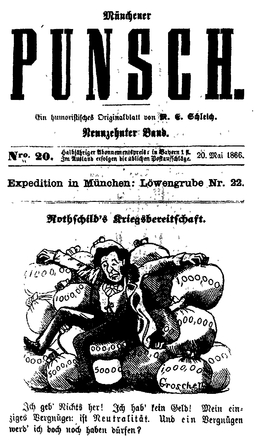
Anthony, who happened to be in Paris, was dismissive of the Prussian proposal: Prussia might be “very anxious” for war, but “their money is as bad as ever ... the whole country is against it and the Prussian Minister ... has been for the last 2 hours asking the Baron . . . to advance to the gov. for 20 Million of Thalers upon a lot of Railroad Rubbish.” On March 17 Goltz informed the King bluntly “that the House of Rothschild is determined to bring its whole influence to bear to prevent Prussia from going to war.” As the Crown Prince put it, “Rothschild is moving heaven and earth [against] Bismarck.” On this occasion, the cartoonists were right: on May 20 the Munich Punsch ran a cartoon on its cover entitled “Rothschild’s Readiness for War” which portrayed James clinging on to his money-bags and declaring: “I’m not giving anything! I don’t have any money! The only pleasure I get is neutrality. And you surely won’t deny me one pleasure?” (see illustration 4.ii).
We know that in the end James failed to stop the war; but that should not blind us to the vulnerability of Bismarck’s position at this juncture. When the Prussian ministers met in Berlin on the same day Goltz wrote his letter, their options were alarmingly narrow, as the terse minutes of the meeting indicate: “The procurement of money creates difficulties. The placing of the Cologne-Minden shares can be done only at a loss. Sale of Saarbrücken suggested. Third possibility is to call the Diet and get a loan, but then great German programme and a great German parliament.” The last option seemed to imply capitulation to the Liberals. This was the time of the so-called “Coburg cabal”—a conspiracy to secure Bismarck’s dismissal which supposedly involved Queen Victoria, Russell, Disraeli and the Rothschilds. On March 20 James eagerly relayed rumours from Berlin “that Bismarck is leaving the ministry and peace will be preserved.” Two days later Disraeli told Mayer that Bismarck “ought to be hung!” When Gustave heard that “Bismarck, to extricate himself ... considers convoking an all-German Parliament” it struck him as “the limit” and “unbelievable”—further proof of his desperation. The Prussian premier, wrote Mayer Carl, had “got himself into a terrible mess and thinks that the sword is likely to bring everything round.” As this suggests, the Rothschilds continued to worry that internal pressure might merely increase Bismarck’s desire for war—this was the period when they abused him most vitriolically as a “madcap” and “foaming like a wild boar.“ In James’s words, ”one never knows what he is about to do and if he can only get the King’s support he will declare war as if it were nothing.“
4.ii: M. E. Schleich, Rothschild’s Kriegsbereitschaft, Ein humoristisches Originalblatt, Münchener Punsch, 19, Nr. 20 (May 20, 1866).
Even if Bismarck did win the King’s backing, however, the question remained how was he to pay for such a war. Bodelschwingh was down to his last 40 million thalers; and on May 2 the Cabinet ruled out the sale of the Saar mines. Under the circumstances, it did not seem unreasonable to hope for Bismarck’s fall. The disarmament proposals put forward by Austria on April 7 merely added to his difficulties: two weeks later, he had to accept them. As for his decision to don the mantle of revolutionary nationalism by proposing a parliament for the Confederation elected by universal suffrage, this seemed to run counter to everything Bismarck had stood for since 1848. As late as April 27, Bleichröder still did not rule out the possibility that Prussia would give in and Bismarck would resign. The second and third weeks of May saw the Prussian government in disarray: an assassination attempt against Bismarck, the dissolution of the Landtag, crisis on the Berlin bourse, and Roon’s calculation that the cost of mobilising nine army corps would be 24 million thalers with a further 6 million per month as long as it remained on a war footing. On May 18 emergency credit institutes had to be set up and currency convertibility suspended; three days later, when the Seehandlung attempted to sell treasury bills in Paris, James once again intimated his opposition to Goltz. As late as June 9—fully a week after Bodelschwingh’s successor had failed to sell the Cologne-Minden shares to a consortium led by Bleichröder and Oppenheim—Lehmann was sent back to Paris “to ask us if we want to make an advance of gold bars or silver to the Bank, either on Cologne-Minden shares or on drafts on the Seehandlung.” Once again he was turned away. As Alphonse put it, the deal would have yielded “a pretty profit”; but James was “little disposed at this moment” to oblige a government which Lehmann himself portrayed as tottering.
Not content with denying Bismarck money, James also sought to deny him something he believed Prussia needed just as much: an alliance with Italy. The Italian position was in many ways similar to both the Prussian and Austrian. Rothschild confidence in Italy’s financial stability had declined sharply since the 1850s and James was still selling Italian bonds in August 1865. He and his sons were genuinely shocked when the Italian government announced a deficit of 280 million lire in September 1865. Yet there were good reasons for continuing to do business with Italy. Firstly, if the transfer of Venetia from Austria to Italy was to be achieved peacefully, Italy would require financial assistance to make the purchase. Secondly, and perhaps more important, Italy now controlled a large area of territory covered by the Lombard company’s rail network. The year 1866 therefore saw a second opportunity to secure concessions for the company in return for a loan to the government. The danger was that Italy, like Prussia, might use any money made available to her for war rather than a peaceful purchase of Venetia. When the Italian government approached James for short-term advances totalling 35 million lire in September 1865, he was therefore not averse to obliging; but he continued to watch carefully for evidence of Italian disarmament before going any further.
News of a 150 million lire bond issue in early 1866 at first seemed of minimal significance, as the government initially asked Landau to take just 14 million. In March, however, the government made a new approach, offering the Lombard company a new and more generous contract in return for an advance of 125 million lire. This seemed to give the Rothschilds the leverage they needed, though the announcement shortly afterwards of a tax on government bonds suggests that the Italians intended to use sticks as well as carrots to secure Rothschild co-operation. If the Italians could only be persuaded to adopt a peaceful policy—and ideally to use the proceeds of a loan to purchase Venetia from Austria—then Bismarck would be diplomatically isolated.7 Nigra, the Italian ambassador, alarmed James by telling him that Italy would join Prussia in the event of a war with Austria. However, on March 22 the Italian government unexpectedly invited Landau, the Rothschild agent, to act as an intermediary “to relay propositions for [the purchase of] Venetia and thus to avoid war.” Alphonse’s assessment of this proposition is revealing:
It is to be feared that such an initiative on our part might be very ill received and might make our position in Vienna very delicate. We have already made insinuations in this regard on several occasions and we have been given to understand that we should never broach the subject, which awakens all H.M.’s sense of amour propre. Perhaps in the critical circumstances in which Austria finds itself, however, the G[overnmen]t [may?] modify its ideas ... The one thing which can be inferred from the Italian G[overnmen]t’s démarche is that it has decided to take part in the war if it happens but has not yet signed a treaty with Prussia.
The Landau initiative was part of a British-backed bid to pressurise Austria and Italy into a peaceful agreement over Venetia. Other possibilities floated at the same time included the exchange of Venetia for Rumania, where a revolt had overthrown the elected Prince Nicholas Cuza, and the exchange of Holstein for Glatz (again).
In the first instance, these efforts failed because, once again, the Austrians would not hear of selling out. Even before he relayed the Landau proposal to Esterházy, Anselm urged that Landau should not accept the Italian mission, in the belief that the proposed sale of Venetia would be rejected out of hand. If Landau came to Vienna bearing such dishonourable proposals, he would bring the Rothschilds further into disrepute as “partisans of Italy”:
The Cabinet here is afraid of nothing. If the need arises, it will take the bull by the horns[?]; without the assistance of France, and I hope it will lack this support, the Italian army will exhaust itself in vain effort against the forts of the quadrilateral. The question of the duchies [of Schleswig and Holstein] is generally considered a question of honour, that of Venetia a question of material existence. [The government] turns a deaf ear to an offer of money on the part of Prussia; it would be more deaf than ever to such an offer from Italy, whose pockets in any case are empty.
Esterházy’s rejection of the Landau offer and Prussian allegations of Austrian troop movements only served to confirm this gloomy assessment. By the time the British government formally proposed the sale of Venetia for £40 million, it was too late. The Italian announcement of a domestic bond issue worth 250 million lire could now only be construed as a measure to finance military preparations. On April 8 the Italians secretly signed an agreement with Prussia, binding for just three months, to go to war against Austria if Prussia did, in return for which they would get Venetia. This gave the Italians the confidence to withstand a barrage of Rothschild criticism—criticism which was only intensified by the Italian government’s decision to impose a levy on all bondholders. Accusing the Italians of having “dealt a death blow to the credit” by their foreign and financial policy, James issued an unveiled threat: if the Italian government attempted to raise another foreign loan, “I declare to you in the most formal manner that I, who have been the patron of Italian funds in Paris, would repudiate completely all new dealings with Italy and that I would refuse henceforth to charge myself with the payment of the interest on the Italian debt . . .” He was equally furious with Bismarck: the Italian alliance convinced James that he was “a fellow who just wants war. I do declare the fellow is too bad and I will stand by Austria with the greatest pleasure in order to topple that wretched Bismarck.”
Yet it was neither Prussian aggression, Austrian intransigence nor Italian insou ciance which finally defeated the efforts to avert war. In fact, for all their talk of honour, once the politicians in Vienna grasped the imminence of war they bent over backwards to find a compromise. On April 9 the Austrian ambassador in Paris, Metternich, intimated to James that Austria would “give in” if France sided with Prussia. It was a message he repeated the next day, as James recorded:
It looks as if Austria is, like all the powers, in need of money, which makes me continue to believe in peace ... Metternich says that Austria will offer anything to keep the peace, and in the end will probably give in ... Austria needs 8-10 million gulden. Will do everything we want and accept all conditions. It will sicken me if they are forced to give in to Prussia.
As that final comment suggests, James was increasingly sympathetic to the Austrian position. But the crucial point is that he expected an Austrian capitulation. And indeed that seemed to be on the cards, even after Bismarck had made his obviously unacceptable Gablenz proposals to give Schleswig and Holstein to a Prussian prince. It was not until May 28 that Austria finally rejected this “compromise”; and only on June 1 that she asked the Confederation Diet in Frankfurt to settle the question—the breach of the earlier Austro-Prussian accord on the duchies which gave Bismarck his casus belli. Even then, Austrian troops withdrew from Holstein without a fight.
In the end, it was French policy which prevented a peaceful outcome. From an early stage, the Rothschilds had realised that the role of France would be decisive: if she acted as honest broker between Austria and Italy, James reasoned, then an agreement might be reached; but if she encouraged the Italians to throw in their lot with Bismarck, war seemed almost inevitable. It was perhaps the most important decision of Napoleon III’s career; and, characteristically, he tried to have it both ways. In Vienna Anselm was given to understand that France would side against Prussia in the event of war; James and Alphonse too began to think in these terms, though they suspected Napoleon of merely wanting “to fish in troubled waters” rather than to deter Prussia. They were right: far from urging restraint, Napoleon was in fact secretly advising the Italians to accept Bismarck’s offer. Indeed, it was the realisation that Napoleon was fomenting war rather than discouraging it which prompted James to make his final, vain bid to preserve peace. The irony is that his success in reversing French policy may well have had precisely the opposite effect.
James did not need to invent a financial crisis to bolster his arguments against war: the European stock exchanges were already sliding into full-scale panic. This was only partly because of the fear of war: as it happened, the diplomatic crisis also coincided with a banking crisis in both England and France, which had its roots in the return of the international cotton market to normality following the end of the American Civil War. The Rothschilds were themselves affected by this crisis, but much less severely than the joint-stock and investment banks: indeed, the principal victims of the crisis were to be the London bank of Overend, Gurney and the Credit Mobilier. For Lionel and his sons, the crisis was bad enough to keep them at New Court during the Sabbath and the “immense city failures” dominated conversation from the House of Commons to Lady Downshire’s ball. To James, however, the fall in share and bond prices was almost welcome; unlike his rivals, he was “praise God in debt to no one”—indeed, he sent the London house £150,000 to ease its difficulties—and the crisis provided him with an ideal diplomatic lever. His aim was to persuade Napoleon III that the negative economic consequences of war would outweigh any international (and hence domestic political) gains it might bring.
He began his campaign on April 8, the very day of the secret Prussian-Italian alliance. As Natty reported, “he had a long conversation with the Emperor at the Tuileries last night and tried to impress on His Majesty the necessity of remaining at Peace.” It was an argument James repeated when he saw the Emperor again three days later, in an effort “to persuade him that war would be the greatest misfortune for the economy”—a view seconded by Pereire. As Alphonse reported, Napoleon sought to reassure him:
Prussia thinks she can count on the support of France. But there is nothing in that, and even as she secretly encourages Bismarck in his adventures, France will preserve her freedom of action, and reserves the right to act according to the circumstances. The Emperor would like to see the question of Venetia resolved. If Austria agrees, he would march firmly with her, and Prussia would pay the price of her follies.
Two weeks later, having been assured by Walewski that war was unavoidable, James went to see Napoleon yet again “to preach peace.” He now found the Emperor “very preoccupied,” as Alphonse recorded:
He said that he considered the question closed and that he did not think that Bismarck could remain in office, and that as for himself, he had not wanted to get mixed up in the quarrel because all he would have done would have been to exacerbate it by his intervention ... But he received that instant ... the news that Austria was putting its army on a war footing in Italy ... My father asked him why he did not intervene to bring about an understanding between Austria and Italy. The Emperor replied that this could take place only through war, as Austria did not wish to listen to any proposals, and that he had proposed the [Danubian] principalities, but they had wanted Silesia.
As this indicated, Napoleon was still inclined to side with the Italians, insisting that they had yet to begin military preparations. It was his old game of backing the revolution wherever it might break out, and when he said as much, denouncing the treaties of 1815 in a speech at Auxerre on May 6, the Rothschilds were appalled. The effect of the speech on the Paris bourse was devastating. It marked, wrote Alphonse the next day, “a new era and one can no longer even conjecture what will happen now in the world, and what revolutions Europe will have to endure before returning to equilibrium.” At a ball given by the Empress at the Tuileries that night, Mérimée noticed that “the faces of the ambassadors were so long, that one would have taken them for people condemned to death. But the longest of all was that of Rothschild. They say that he lost ten millions the evening before.” It was in fact after the Auxerre speech—which caused renewed panic on the Paris bourse—that James coined his famous epigram: “L‘Empire, c’est la baisse.”
It is conceivable that, had Napoleon been consistent in backing Italy and (by implication) Prussia against Austria, the Austrians might still have backed down. Yet at the eleventh hour—perhaps partly because of James’s badgering—Napoleon seemed to come to Austria’s rescue. The diplomatic compromise was foreshadowed economically. First the Credit Foncier offered another cash advance, as requested by Metternich. Then the Lombard company’s annual general meeting in Paris on April 15 was a “brilliant success”—which also seemed to reaffirm the economic links between France and Austria. The crucial development came in the course of May, when Austria unexpectedly offered to cede Venetia to France (which might then hand it over to Italy) in return for support against Prussia. Although Napoleon dithered, reverting to his hobby-horse of a Congress, this remarkable and often misunderstood initiative bore fruit on June 12, when Austria and France signed a treaty guaranteeing French neutrality. Throughout the negotiations, James played an active role in promoting French “goodwill towards Austria,” regularly seeing Rouher, the British ambassador Cowley and Napoleon himself Typically, he had his own private anti-Italian agenda, enlisting the French government’s support in his private quarrel with Italy over the tax on rentes. He also held out as an incentive to the Austrians the prospect of renewing the existing Rothschild short-term credits in Vienna, though the Austrians retorted with quibbles about their contract with the Lombard line.
Bismarck had told Bleichröder on May 23: “The Emperor [Napoleon] can still make peace if he wants.” This was not quite true; for in bolstering the Austrian position Napoleon was in fact contributing decisively to the outbreak of war. The treaty of June 12 was predicated on the assumption that, with France neutral, Austria could not only defeat but dismantle Prussia and Italy: in return for relinquishing Venetia, Austria intended nothing less than the restoration of the Bourbons in the Two Sicilies, the Pope in central Italy and even the old duchies of Tuscany, Parma and Modena. Prussia would be reduced to the frontiers of 1807, losing Silesia to Austria, Lusatia to Saxony, and her Rhine provinces to Hanover, Hesse-Darmstadt, Bavaria and Württemberg. Although Bleichröder had been talking as if the war had already begun since May 4, it was only really after June 12 that Austria decided to fight rather than capitulate. Indeed, James himself regarded the war as not having begun until June 13. Thus it was French policy—at once encouraging Italy and Austria to fight—which turned what might have been a phoney war over Schleswig-Holstein into a full-scale war over the future of Germany and Italy. Without his intending it, James’s efforts to secure peace by shifting Napoleon from a pro-Italian to a pro-Austrian position had tempted the Habsburg regime to stand and fight on both fronts.
Silver Linings
The Rothschilds had tried to stop the war of 1866; they had failed. The costs of this failure for Austria were high: contrary to the expectations of most contemporaries—the Rothschilds included—she and her German allies were decisively defeated by Prussia in the field, a defeat which counted for infinitely more than the Austrian victories over Italy. This time, the Rothschilds had backed the losing side. Moreover, the ramifications of the battle of Königgrätz seemed and were immense. “Casca il mondo,” said the Papal nuncio, and with reason. Bismarck’s alliance of Prussian conservatism with democracy, kleindeutsch Liberalism, Italian nationalism and even the Hungarian revolution truly turned the world upside down.
The dismay of the Austrian Rothschilds was understandable: “In consequence of the terrible news from the battlefield,” Anselm’s son Nathaniel wrote after Königgrätz, “I feel so deeply upset and depressed that I am hardly able to write.” Nor was this just pained patriotism—though Anselm affirmed the existence of this with his donation of 100,000 gulden for the care of the wounded. (He also firmly resisted efforts to distinguish between Jews and non-Jews in the Austrian army).8 Until the preliminary peace had been signed at Nikolsburg on July 26, there seemed every chance that the Prussian army would continue southwards to Vienna itself. As it was, Rothschild properties in the vicinity of the battlefields came directly under Prussian control. Communications to the Rothschild-owned ironworks at Witkowitz were cut off, so that the workforce could not be paid. It was reported that Schillersdorf had been occupied—allegedly by members of the Prussian-backed Hungarian legion—and “a great part of the game” plundered. In fact, when Ferdinand arrived there in September, he found a handful of Prussian cavalry officers; on the day they left, he reported crossly, “they cantered their horses all over the gravel paths in the park. One of them had a hedge put up under my window, and kept jumping over it backwards and forwards. All the English servants were looking on and laughing at his want of skill.”
In Frankfurt too there was horror; and again this reflected the direct threat posed to the town itself by Prussian arms. From an early stage, Mayer Carl had recognised the vulnerability of Frankfurt “in the centre of it all” and his hopes of remaining on “good terms with both parties” were soon shattered. He himself could not help siding with the majority of German states and the Confederation itself against Prussia. “Now that hostilities have begun,” he wrote on June 11, “we must hope that Prussia will get a famous licking and be well punished for her unaccountable conduct which is considered by everyone as quite unheard of in the annals of ancient & modern history.” By June 20 preparations were under way “to keep the Prussians at a distance” from Frankfurt; but it was obvious when they prepared to attack the city on July 8 that resistance would be futile, and Mayer Carl hurriedly sent his daughters off to France. On July 17, after another decisive Prussian victory over troops of the Confederation, the town was occupied. “In a great state of perturbation and anxiety,” Mayer Carl’s wife Louise described to her sister-in-law Charlotte:
the insolence of the Prussians, of their actual robberies, for it seems they go into all the shops, select the most beautiful and most costly articles and never think of paying for anything. In Willy’s house on the Zeil the soldiers occupied every room, with the exception of Matty’s [Hannah Mathilde‘s] dormitory, and would drink nothing but Champagne at their meals!
If it were true that by now the Rothschilds were beginning to be assimilated into their respective national milieus, such feelings would presumably have been much less pronounced in neutral London and Paris. But they were not: the entire family seems to have identified itself with the Austrian-German side. When the Italians received what James called “a real hiding” from the Austrian army at Custozza, he was delighted: “It will do them good,” was his verdict, “and will make it easier to arrive at peace.” As for Prussia, Mayer Carl’s fears that the French house might belatedly succumb to Bleichröder’s appeals for assistance were surely unfounded: James exclaimed that he “heartily wished Austria to give the damned Prussians a good licking, as they have messed everything up.” The news of Austrian losses on the eve of Königgrätz therefore made him “half crazy.” “I declare,” he told his nephews, “I am wholly [pro-]Austrian this time, as the war is just too unjust.” Even his eight-year-old granddaughter Bettina was “very angry with Mr Bismarck for having taken Venice [sic].” “Will it depend upon Mr Bismarck,” she asked her English grandparents, “whether you go to Gunnersbury or some other place?”
But what could be done? Whereas a number of those close to the Emperor continued to urge an anri-Austrian policy on him, Alphonse had discerned as early as April the dangerous implications of a German war for France. Napoleon’s indecision—his encouragement of both Italy and Austria to fight—had left him not the arbitrator he had hoped to be, but a mere spectator. On July 1 Alphonse astutely summed up the contradictory nature of French policy:
If the Austrians win, our government will align itself with them, if they lose we will fall on them ... It is probable that two observation corps will be formed before long, one on the Rhine and the other on the Alps. As a precautionary measure rather than with a predetermined objective, because the Emperor is said to be very uncertain, and adopts a cold and reserved tone in his relations with Prussia. France is playing for big stakes, in effect. The preponderance of the Prussians in Germany would be an immense danger which would not even be compensated for by the acquisition of the Rhineland provinces ... So all public sympathies are for the Austrians, though because no one knows what the Emperor thinks, people dread their success as much as they wish for it, for L. Napoleon’s friends are agitating a great deal in favour of Prussia.
Alphonse rightly discerned that if Napoleon could not make up his mind to join the war on the Austrian side—or lacked the military readiness to do so—he was in no position to demand “compensation” from a victorious Prussia. In the Rothschilds’ eyes, the various French bids for territory in Germany, Belgium or Luxembourg were bound to come to nothing; the most that France could do was to persuade the defeated Italians to accept Venetia without demanding anything else. Itching as he was for “Prussia the aggressive to receive a hard lesson at the hands of imperial France,” James’s verdict was damning: “If I were Emperor, I would be ashamed of myself.” For him and his sons, a French war against Prussia had merely been postponed: in the end, Napoleon would be “forced to go to war with Prussia, as these people think Europe belongs to them.” Any peace between France and Prussia would only be “bastard peace.”
The English Rothschilds too were dismayed by the Prussian victory. To Charlotte, the war of 1866 was not about the unification of Germany, but its division—indeed its defeat—by Prussia. On July 10 she even predicted that Prussian ambition would ultimately necessitate British intervention:
The Prussians ... are not at all likely to be moderate in the hour of their triumph. In that event, namely if they wish to swallow up all Protestant Germany, France, perhaps without drawing her mighty sword, will ask for the Rhenish and catholic provinces of the new northern Empire, and without wishing to interfere, and quite in spite of Lord Derby’s unstatesmanlike speech to the effect that the great continental events cannot possibly interest us, we may be drawn into an armed intervention, to prevent the civilized world from being absolutely divided between France and Prussia.
Of course, as Alphonse said, Napoleon might have acted more decisively if there had been such English support for a French intervention to check Prussia. But it was not to be. Bismarck’s terms—which gave Prussia military control of Germany north of the Main but guaranteed an “international independent existence” for the South German states—were seen as moderate enough in London to preclude a concerted intervention. As Charlotte remarked, in response to a plea from Louise “to ask Mr. Delane for a powerful article in the Times”: “[W]hat does Count Bismarck care for an article in our English papers[?]—He has vanquished the world, even now he would not have consented to peace, had he not obtained for himself an empire quite as large as he can possibly wish for and rule over without fear of revolution and aggression.” The most that Charlotte could do was to join “a committee of ladies, who are willing to collect subscriptions for the poor Austrian soldiers.”
Yet, for all this, the political significance of Königgrätz outweighed its financial significance; if anything, the swift end to the conflict permitted a general financial recovery, abruptly ending the tight monetary conditions of the preceding months. With this in mind, we should not exaggerate the financial costs of war to the Rothschilds. As we have seen, a sense of the impending storm had prompted James to cut his losses and minimise his exposure weeks before the fighting began. As early as April 9, he gave his London nephews some advice which deserves to be as famous as his more pacific axioms. He told them to sell whatever securities they could, even at a loss. “I am very much afraid of war,” he wrote, “and would rather make a sacrifice in order to keep and maintain my holdings of cash because in a war there is money to be made from having money.” A week before, James had already instructed Bleichröder to start selling Rothschild securities in Berlin as soon as he believed war was certain (though he was angry when Bleichröder started to do so prematurely). On April 10 he was able to report to London that he had “paid off all his Lombard bonds” and would “watch any war with equanimity.” “Now my good nephews,” he wrote, contemplating the “full-scale panic” on the Paris bourse, “the world will not come to an end, and if war does come one will find other ways of making money.” In the final analysis, that was James’s first principle: not peace at any price, but profits under any circumstances, peace or no peace.
James’s assessment as the war began was the product of a lifetime’s experience of financing war and peace: “In the long run, all securities must fall since everyone will need loans. Italy wants one and no power can sustain war for two months. Perhaps it will therefore be quite short.” His son Alphonse could also see the strictly economic benefits of war, even as he deplored its political implications. As he reminded his cousins in London, receipts on the Lombard line had never been better than during the war of 1859-60 and were likely to soar again as the Austrian government paid the company to transport its troops to Italy. This ability to distinguish between politics and private interest was a family characteristic. Chided before the war began for being “too devoted an Austrian,” Anselm retorted that he was “far more a devoted pro-Rothschild.”
Moreover, whatever their emotional engagement, the extent of the Rothschilds’ financial commitments to the defeated states was in reality limited. Throughout June they assisted the government in Vienna with small advances and sales of “Anglo-Austrian” bonds in Frankfurt; but that was all. Mayer Carl systematically spurned requests for loans from the other German states which sided with Austria. He refused a 3 million gulden loan requested by Baden in April; a 12 million gulden loan requested by Bavaria in May; and a plea for funds of any sort from Württemberg on June 17—despite the fact that only four months before he had been vying with Erlanger to secure a loan to Stuttgart. Only after much deliberation did the Paris and Frankfurt houses agree to advance the Kingdom a paltry 4 million gulden—and that for just six months.
To be sure, James continued to ignore all Bleichröder’s arguments in favour of lending to the victor, Prussia: in August he “turned down flat” a request from the Prussian ambassador for 20 million francs. But in the case of Italy James hedged. Under the terms of long-standing agreements, the Rothschilds were supposed to pay the interest on Italian rentes in Paris as well as to pay the government sums relating to the Lombard line; because of the war they seem to have delayed doing either, despite increasingly urgent requests from Florence. On the other hand, James refused to sell his substantial holdings of Italian rentes until late in the day, rightly assuming that Italy would be on the winning side, but failing to see that she might nevertheless be defeated herself. Ironically, then, probably the biggest losses suffered by the French house as a result of the war were on Italian rentes. It was scant consolation to able to exert a measure of financial leverage over Italy during the armistice and peace negotiations, though Alphonse’s terse formulation on July 8 was a classic of its kind: “Certainly as long as peace is not concluded, Italy cannot count on us for money; once peace is signed, then we shall see.” Once again, the Rothschild position was: “One cannot give money to continue the war.” The trouble was, as Alphonse and his father knew only too well, that the most profitable business would be the one concluded before peace was agreed, as after that Italian rentes would rally James was “tempted” when the Italian government offered to accept advance payment of 100 million lire of future payments from the Lombard line at a discount of as much as 40 per cent. But (unusually) he elected not to act without Napoleon’s express approval, and deferred to his wish that nothing be done before an armistice had been agreed, cancelling Landau’s premature offer to advance 25 million lire against rentes. The Italian government responded by repeating its demands not only for Venetia but also for an indemnity and the Tyrol, and turning successfully to other banks (the Credit Foncier and the Sterns). It was therefore diplomatic rather than financial pressure which induced them to rest content with Venetia—and indeed to pay Austria 86 million francs for it.
Partly thanks to James, Bismarck had fought the war without the means to pay for it. As he later said, he felt on the eve of Königgrätz “that he was playing a game of cards with a million dollar stake that he did not really possess.” This was only too true, and had he lost he really would have seemed “the greatest scoundrel in the world.” Victory, however, promised to solve the fundamental financial crisis of the Prussian state which had brought Bismarck to power in the first place and which had bedevilled the preceding four years. For convention had it that the victor in war could levy indemnities on the vanquished.
The vanquished included, of course, the Liberal enemy within the Prussian Landtag. Bismarck’s espousal of the kleindeutsch programme split the Liberals; victory over Austria isolated those “Progressives”—who appeared to care more about parliamentary sovereignty than national unity. Their defeat in the elections held on the same day as Königgrätz was almost as important to Bismarck as his triumph over Austria on the battlefield. Yet in one fundamental respect—which is sometimes overlooked—Bismarck too had to compromise. When von der Heydt replaced Bodelschwingh as Finance Minister on the eve of war, he insisted that Bismarck acknowledge that the preceding years’ financial policy had been “without legal basis” by seeking an indemnity act from the Landtag after the war. (An erstwhile Liberal and businessman, von der Heydt himself had resigned as Finance Minister in 1862 rather than breach the constitution.) In agreeing to this, Bismarck effectively abandoned his original commitment to William I that he would assert the monarch’s unqualified control over the military budget; for, although the military budget of the North German Confederation and later the Reich was never voted on annually, it was still voted on periodically. It was this “resolution of the internal question” (heralded by Bleichröder in his letters to Paris and voted through by an overwhelming majority in September) which allowed Prussia to return to financial normality.
However, Bismarck never intended that Prussian taxpayers alone should pay the costs of victory. From the outset, he fought the war against the other German states in an almost piratical spirit. James heard as early as June 28 that Bismarck had “sent all his generals after [the King of Hanover] in order nicely to take his money, his person and his soldiers.” Perhaps the most revolutionary act of Bismarck’s entire career was the annexation of Hanover and the deposition of its ancient ruling house; his motivation was at least in part financial. The Kingdom of Saxony was left intact, but Bismarck still imposed an occupation levy of 10,000 thalers per day (using the money to fund a hastily formed Hungarian legion) and then a final indemnity of 10 million. So long as Bismarck was only expropriating princes, of course, the Rothschilds could afford to look on with equanimity. Indeed, they found themselves reminded of the distant days when the Elector of Hesse-Kassel had been forced to hide his considerable private fortune from the armies of Napoleon I. When the Saxon minister Vizthum was despatched to Munich to arrange the transfer to neutral territory of his government’s gold and silver reserve (which had hastily been moved there from Dresden), he decided to send the silver—around a million thalers of silver coins which had been packed into bottles—to the Paris Rothschilds. James wanted to convert the money into francs when it arrived in Paris—in return for a commission. But Vizthum was able to remind him of the legend of the Elector’s treasure, which the Rothschilds themselves had done so much to propagate: “The King of Saxony is showing similar confidence in you and I am sure that you will not disappoint him.” Not that James was outwitted: when Prussia fixed the Saxon indemnity at 10 million thalers, he urged Bleichröder to secure a share of the loan required by the Dresden government to pay the money.
In the same way, the 30 million gulden “war contribution” levied on Austria was advanced by a consortium of thirty banks, including the Vienna house and the Creditanstalt; and there was soon talk of further loans and advances—though, as Alphonse observed, it remained unclear for some time whether Austria would “recover or die.” Württemberg too had to issue a 14 million gulden loan to pay her indemnity; this time the Frankfurt, London and Paris houses took the lion’s share (10 million), though they had to squeeze their own profit margins to outbid the ubiquitous Erlanger. As in the past, post-war indemnity transfers were a lucrative source of business, even if the profits had to be shared with others. Typically, when the Duke of Hesse-Nassau received 8.8 million thalers in compensation from Prussia, Mayer Carl was on hand to advise him how best to invest it. And of course the upheaval, like that over Schleswig-Holstein, had the effect of enlivening the art market: it was at this time that Adolph was able to buy the Grand Duke of Baden’s collection of crystal. The Esterházys were not the only eminent Central European dynasty reduced to selling off the family jewels in 1866.
This was routine. However, when it became obvious that Frankfurt too would be obliged to pay an indemnity, there was more cause for concern. After all, Frankfurt did not have a princely house: it had the Rothschilds. Any reparations demand imposed by the Prussians would inevitably require personal sacrifices by the town’s richest citizens. Even before the Prussians had made their demands known, Adolph was fretting about the implications. “The Prussians’ behaviour at Frankfurt does upset me,” he wrote to London from the safety of Geneva,
also I shall probably lose the income from the lease of my house there; who else would take such a big place as my late father’s in Frankfurt when there will be no more diplomatic corps in that town? and I cannot give it to somebody who might convert it so as to use it as an inn or an Hotel. In addition we shall have to pay taxes. All this is depressing for me and makes me grumpy.
When the Prussians presented their bill—in the first instance 6 million thalers demanded by Manteuffel, the commander of the Prussian forces, and then a further and apparently additional demand from Bismarck himself for 25 million thalers—the family was appalled. On behalf of the Frankfurt Chamber of Commerce, Mayer Carl immediately protested at the size of this sum and telegraphed in the same sense to Bismarck. To Alphonse, the indemnity on Frankfurt was “barbaric”—“like something out of the thirty years war”—and he fully believed reports that the Prussians intended to starve the town into submission. Charlotte even heard rumours—spread by “that horrid fellow Mr. Erlanger‘—”that Uncle Charles [Mayer Carl] had been put into prison. This I hope and believe is not the case, but the Prussians are perfect monsters.“ When James heard the same rumour, he leapt to his feet and exclaimed: ”A Rothschild? It’s impossible!“ Anselm also signed a petition against ”the colossal war tax“ on Frankfurt, though he doubted whether it would achieve anything as ”Prussian rule by club now prevails.“
In fact, Mayer Carl’s efforts to achieve “some arrangement ... to ... prevent this dreadful calamity” were partially successful. On July 25 he travelled to Berlin where he appealed to “the King of Prussia to be rather less severe upon the poor Franc forters”; just over a week later he was invited back and had two meetings with Bismarck on August 6 and 7. The terms of the compromise he struck showed once again that, to the Rothschilds, questions of money were more important than questions of borders: in return for accepting annexation by Prussia, it was agreed that Frankfurt would pay only the initial 6 million thalers for the costs of occupation. What Charlotte called “the transformation of the good, old prosperous town of our ancestors into an insignificant addition to Prussian greatness” was patently less of a sacrifice than 25 million thalers. According to one account, “Uncle Charles ... won the 76,000 hearts of the town during the height of the Prussian exactions”; and as a candidate for election to the parliament of Bismarck’s new North German Confederation he took care to remind voters that he had “manfully stood up” to Manteuffel in 1866 when his political opponent, the Liberal journalist Leopold Sonnemann, had fled the town. He won by a landslide, defeating the Democrat candidate, by 6,853 to 311, and duly fulfilled his electors hopes by recouping a further 4 million thalers.
Yet there was still a price which the Rothschilds were made to pay for their refusal to assist Bismarck financially. On August 14, just over a week before the final Peace of Prague, James finally followed Bleichröder’s advice and made an offer to issue a Prussian loan. The response from Berlin was brusque. Without ceremony, the Seehandlung informed Mayer Carl that the Frankfurt house would henceforth no longer be entrusted with issuing Prussian bonds in South Germany. In September 1865 James had proudly declared that the Rothschilds “did not work for the King of Prussia”; now, it seemed, the King of Prussia did not need the Rothschilds.