Morecambe on Fishing
People always ask me if Ernie really does wear a wig. I’m sworn to secrecy, but let’s just say that he keeps Axminster Carpets in business. Without him, they’d be on the floor.
Much of my father’s childhood, as we have seen, was coloured by days spent fishing, mostly with his dad.
In the room which was once his office and was also the subject of an unusual documentary for Channel 4 a few years ago, I found, among his myriad possessions, a handful of pages on his great passion for fishing. These were destined for a book he wrote about fishing in 1983 and which was published posthumously the following year.
What grabbed me about the first section, entitled ‘The Anti-Fishermen’, was the frankness with which he wrote. His views are balanced, yet I still came away from reading it feeling a little uncomfortable that a gentle and loving comedian, who worked quite hard at avoiding controversial topics, could suddenly let himself go. A part of me is also very proud that he did: it would be so easy for him to have ignored the issue in such a book and just gone for easy laughs. Mind you, I think the line about the African elephant is more controversial now than it was back then.
Eric typed the following material on his own office typewriter some six months before his sudden death in May 1984.
The Anti-Fishermen
In recent months there have been fresh eruptions from the hunt saboteurs, who threaten to move in on our sport and disrupt it. The saboteurs would have you believe that fishing is cruel and should be completely banned. By fishing they mean freshwater fishing in rivers, lakes and reservoirs. Sea fishing, for some odd reason, is always left out of their arguments.
Strangely enough I have some sympathy for some of the ideas put forward by the anti-hunting lobby. At the same time, I have a strong feeling that if any hunt saboteurs came barging in on the stretch where I fish, then the shotguns would be out and the saboteurs could well be threatened with a dose of pellets in the pants. And I wouldn’t mind that at all.
If I seem to be facing both ways at once in this controversy, let me quickly say that I am fundamentally on the side of the people who enjoy their country sports and wish to continue doing so. Where I have reservations, increasingly as I grow older, is in the quantity of animals killed and in some of the methods applied.
In fishing, I wish there could be almost no killing, but until someone invents a rubber hook I can’t see that happening. I don’t personally like live-baiting, the process whereby a live fish—a Dace, say, or a Roach or Rudd—is impaled on a hook, or Jardine snaptackle, and set as bait to lure a bigger fish such as a Pike. Fewer people go in for live-baiting nowadays than used to in Victorian times, but it is still an accepted method in the fishing community. Deadbaiting I do not mind so much. If the fish is already dead, then the question of its feeling pain does not arise. But, as I said in a previous
chapter, it is the quality of the individual catch that really matters, not how many fish end up in your keep-net or freezer-bags. Some fishermen are a little bit inclined to see their sport too much in terms of match-angling, of collecting fish by the bagful, and not enough in terms of hunting for the best single adversary to be found in a particular stretch of water.
What the anti-fishing lobby does not seem to understand, often because its members have no day-to-day contact with the countryside, is that it is necessary to cull certain species of wildlife if we are to preserve the present balance in nature. No one could manage a dairy farm that has more foxes than cows, and no one wants a river that is so full of fish you could walk across it on their backs; it’s no good for the fish, quite apart from anything else.
In Africa, too, it may seem sad that men have to go out and shoot
such magnificent creatures as the elephants, and yet it has been proved time and time again that the well-run game reserve, with its organised programme of culling, is by far the best means of preserving a good balance in nature. Take away the game reserve, and what you get is the terrible greed and savagery of poachers, and the region loses many more elephants than it would have done, or needs to do, given a properly organised system.
Fishing in Britain is well organised. It has to be. About three million people go fishing each year and it is essential that the places they go to are properly controlled. The National Federation of Anglers plays a big part in this, seeing that competitions are run according to a fixed set of rules and that people enjoy their sport in a sensible, restrained way. On privately owned waters, the bailiffs keep out the poachers—or try to—and the number of fishermen per stretch of
water is carefully limited. On that basis, no saboteur or anyone else could really claim that fishing is the unthinking slaughter it is sometimes made out to be.
His next chapter is more reflective than combative, yet no less fascinating. I’d never taken time out to read his thoughts on fishing before, and the man writing about his favourite pastime is a long way from the comic father I remember so vividly.
Wherever Next?
Although we have our seasons for coarse and game fishing, no one has told the fish. As a result, they will accept our baits, lures and flies just about all the year round. The seasons are part of a system of man-made rules, and we stick to them because it makes sense to respect the breeding patterns of the fish and not to overwork the waters they live in. Nevertheless, you can find variations.
Trout fishing on the Test is from May to September, but on the local reservoirs near me they start around the beginning of March. Finding a place to fish is really a bit like getting a drink in a pub or hotel. If you try hard enough, and are prepared to travel around a bit—like to the old Covent Garden market in the early hours of the morning—you can always get one. With trout, too, there’s always somewhere open. You may have to go abroad, but that is usually no hardship. Not to me, it isn’t, although I must say I haven’t yet been abroad on an out-and-out fishing holiday. Blame it on the wife, if you like, but on a family holiday we always prefer to go around together and do the same things. Joan isn’t interested in fishing, and my son (Steven) prefers coarse fishing, so we aren’t exactly three minds with but a single thought. Blame it on work as well. I have had one or two nice offers of trips abroad but couldn’t go because I had to work for some or all of the period of the holiday.
Before the 1982 World Cup, I was invited to go to Spain and do a commentary for New Zealand Radio on the New Zealand team. That would give me two weeks in Spain—they didn’t expect to last more than three games—and then we hit the real perk. This was to fly, with my wife, to New Zealand for six weeks of trout fishing in the big lakes they have there. I couldn’t do it for the simple reason that I was working. It’s funny that, but it always seems to happen. On the other hand, I’ve had plenty of times when I’ve wanted to work and couldn’t get a job. There’s no justice…
The really big trips for the holiday fisherman take him nowadays to places like Iceland and Alaska. Just the sort of country you’ve always wanted to visit? Probably not, if you aren’t a fisherman. If you are, and money is little or no object, then a magnificent holiday awaits.
I have several friends whose addiction for hanging about near the Arctic Circle for a few weeks each year is getting serious. They fish for salmon, which are not in short supply over there. The only trouble with that is what do you do at the end of your holiday with twenty-five salmon? In fact you could even make friends with people you didn’t want to be friends with. There is just one snag. What about the transport; the excess baggage? Work out, if you can, how much excess you would have to pay on twenty-five salmon weighing twenty pounds (9kg) each, given a free allowance, assuming you travel First Class (which you would) of sixty-six pounds (30kg) with unlimited excess (which you wouldn’t get) charged at a rate to be agreed with the airline. Not easy. The upshot is, my friends come home with about four fish each, which they have had smoked to get their weight down as far as possible.
Now, they will forgive me, I hope, but I don’t altogether see the point of that. It may sound a bit eccentric but if I had caught twenty-five salmon in Alaska, I’d want to bring the whole lot home. It may not be easy, but that is what I would want to do. When I got them back here, I wouldn’t necessarily give them away—not all of them. I expect I would invest in an enormous freezer and stick them in there while I thought about it for a few weeks. After all, if I could afford a mediumsized fortune to go and catch them in Alaska, I could certainly afford an enormous freezer to house them in back home. Any offers?
Two Old Men in Deckchairs
I was at Luton Football Club last Saturday. We were playing Arsenal. It was nice to meet the directors of their board. Nice club, Arsenal. Well, the first four letters are right.
I started following Chelsea FC when I was twelve. My parents bought me their team strip—that wonderful all-blue shirt and shorts that somehow even managed to look blue on black and white TV—and I was hooked. Then Eric became involved with Luton Town FC and for the next fourteen years Chelsea came a poor second in my football affiliations. But in 1985, when Chelsea were struggling more than Luton Town, I ended up moving to that part of west London. Those days were the dizzy heights when fixtures with Watford or Grimsby on a wet Wednesday evening meant acquiring a ticket wasn’t exactly a challenge or a great expense. Not like it is now, as Chelsea have become Chelski under owner Roman Abramovich.
I’ve always kept an eye out for Luton, and was sorry to see them freefall and eventually leave the Football League for the first time in their history. I recall the days when they were sixth from top in the Premier League (then Division One) and beating sides like Manchester United and Arsenal. As Luton slip, Morecambe FC rise and for the first time in their history they have entered the Football League. What a thrill it would have given my father, who used to watch ‘half the game’, as he put it, from his bedroom window as one of the stands at the ground shielded his view and meant he could only see half the pitch.
I returned to the town last year after being invited to see a match between Luton and Coventry. People at the club are always so kind, and everyone seems to have a memory of Eric from the days when he was a director there.
The man in charge of car parking was quick to tell me of the time someone threw a coin on the pitch and hit the referee. ‘It cut him quite badly, and he had to go off for a minute. After the match, Eric came straight down from the directors’ box to see him. “Are you all right?” he asked. “Yes, fine, Eric,” he replied. “Are you sure you don’t want to go for further medical checks?” said Eric.“No, really, I’m OK,” said the ref. “Oh, good,” said Eric. “Then can I have my coin back?”’
There’s an often repeated piece of radio commentary where Eric is being interviewed during the middle of a Luton match. Everything is how one would expect when someone is being interviewed on radio, then Luton score and suddenly one gets a genuine insight into Eric’s boy-like love of ‘the beautiful game’ and the club he supports. Whenever it crops up it makes me smile, because this is my father as I knew him, not Eric Morecambe the comedian, being interviewed. It’s the closest you will ever get to touching the real human being.
Eric was also a big cricket fan. In his final years he claimed he took more pleasure from an afternoon at Lord’s watching England bat—or, to put it Rory Bremner’s way, ‘Listening to the sound of leather on stump!’—than sitting in the directors’ box at Luton watching another struggle on the artificial turf they were then playing on.
My father’s involvement with the charitable organization the Lord’s Taverners was based on his love of cricket. The following piece of writing is something I found in his desk a while back. Whether it was ever published in the Taverners’ magazine or not, I cannot say, but it makes interesting reading and shows as much of Eric the man as it does of Eric the comedian.
But first a little background to the content of the piece: in the early sixties, when Morecambe and Wise were suddenly making it big for Lew Grade’s ATV, it became a running gag for a while to end each show with Eric telling a supposedly risky joke but unable to complete it because Ernie interrupts to say that they’ve run out of time. The joke always began, ‘There were two old men sat in deckchairs, and one old man says to the other, “It’s nice out,” and the other old man says…‘At this point Ernie would interrupt, explaining either that time had run out or it was too rude to say on television. As far as I know, they never did complete the joke, though in the seventies, when doing their UK ‘Live’ tour, they would often get asked what the whole gag was during a Q&A at the end of each performance. And they would tell it in full. It was short and simple. ‘There were two old men sat in deckchairs, and one old man says to the other,“It’s nice out,” and the other old man says, “Yes, it is; I think I’ll take mine out!”’
Was this on his mind, I wonder, when he wrote the article I would find in his desk entitled Two Old Men in Deckchairs? Beneath the title it says ‘By an Ex President’, confirmation that this was written for the Lord’s Taverners charity, of which Eric was President for three consecutive years. It is a charity that mostly works for young deprived people through sport, fundamentally cricket. Also the material itself bears out that this is the charity in question, especially as Eric himself makes an appearance in the little tale. The story also refers to a
certain well-known radio and television presenter who was a friend of Eric and a fellow Taverner.
Two Old Men in Deckchairs
There were two old men sat in deckchairs. One old man was the son—he was sixty—the other old man was the father—he was eighty-six.
‘Are you comfortable, father?’ the son asked.
‘What? Eh?’ the father asked.’
Are you comfortable?’ the son repeated.
‘I can’t hear you: speak up!’ the father shouted.
The son knew why the father couldn’t hear him, so he leaned over and turned up his deaf aid a shade (a portable one, about the size of Wisden’s 120th edition). The father looked down on what the son was doing and hit him.
‘Don’t you dare turn that thing off so you can’t hear me!’ The son smiled at one or two people around him, as if to say ‘Don’t worry, this always happens’ then put a cushion at the back of his father.
‘Should be a nice day for the game,’ remarked the son. The father looked about wondering who it was who’d spoken. It was half a minute before he realized it was the son.
‘Put my cushion at the back of this deckchair, there’s a good boy,’ said the father. The younger of the two old men knew that his father was playing silly sods with him for the benefit of the people around. But the son was up to his father’s tricks.
‘Pardon?’ he said to his father.
‘What?’ the father said to his son.
‘Alright, what?’ said the son to his father. The father then realized that the son had realized that he was playing silly sods, so he went quiet.
‘Would you like to see the programme, father?’ The father ignored the last comment completely. The people around them giggled behind backs of hands. The father looked at the people and giggled too.
‘He’s my son, you know!’ He said this to all and sundry putting his hand up to his head and, pointing one finger to his temple, made a whirring motion which suggested his son had lost his marbles. Then, with his watery grey eyes dripping acid, looked up at his son and laughed. The son didn’t look back because he already knew what was going on. The father was in the mood for entertaining the crowd at his son’s expense. ‘I come here every year,’ he said to a young, bigbreasted woman of about fifty-five. (Well, she was young to him.) ‘Have you been here before?’ the old man asked. The young bigbreasted woman of about fifty-five smiled a smile reserved for old men, and in a very loud voice (as all old men are deaf) shouted, ‘No!’ straight into his deaf aid. The old man’s eyes spun around while he shakily turned down the volume control.
The son noticed what the old man had done and while the older man’s eyes were still swivelling in their sockets quickly turned the aid up again. The people around giggled, so the unknowing old man giggled, too.
‘It’s a nice day for cricket,’ said the son.
‘Where’s the Gents?’ asked the father loud enough for all to hear. The crowd dutifully giggled again.
‘You’re wearing it!’ the son said. His father went quiet for the next few minutes.
In the distance you could see the back of Blenheim Palace. It’s an enormous building; almost as big as Northampton. The deckchairs, ringed around the cricket pitch, were filling up nicely. To the left of where the two old men in deckchairs were sat two men dressed in their cricket whites emerged from a wooden dressing room. They walked slowly towards the crease to toss a coin.
‘Which is Oxford University?’ asked the old man.
‘The one in white!’ teased the son.
‘They’re both in white!’
‘No, father,’ said the son. ‘The one from Oxford is in white.’ He pointed to the two captains. ‘The other one used to be white.’
The old man turned to the big-breasted woman of about fifty-five and said, ‘I used to know Pelham Warner as a boy.’ He blinked his damp eyes at her.
‘That’s nice,’ she replied loudly. ‘Was he a nice boy?’ Everybody laughed, and the old man looked uncertain as to what they were laughing at, so joined in with them.
‘Who won the toss?’ the son asked his father.
‘The banking people are going to field,’ came his reply.
‘What banking people?’
‘The Lloyds Taverners!’ said the father.
Everyone giggled even more, except the young big-breasted woman of about fifty-five. She was talking to her husband, asking if he’d heard of Pelham Warner. Her husband said he was sure it was somewhere near the end of the Northern line.
A ragged line of Lord’s Taverners walked to the middle of the playing area, and stood motionless a moment like scattered washing hung out to dry. Four ex-England players threw the ball at each other while the stars chatted to each other. The ex-England players threw the ball about like it was a magnet and their hands made of metal; under arm, over arm, a flick with the wrist, out of the back of the hand. It was great to watch. One of them threw the ball to a star who caught it very well, but had to go off for attention to a badly bruised hand. Two ambulance men, both dressed like Benny Hill, dashed around the enclosure where the star was enclosed watching his guitar fingering hand throbbing and turning from a bright red to a pale blue.
‘That’ll be stiff in the mornin’,’ said the older Benny Hill.
‘It’s bloody stiff now,’ said the guitar playing star.’ Will I be able to play?’
‘Should be all right, but don’t field too close to the bat.’
‘I mean, will I be able to play the guitar?’
‘Oh!’ said the older Benny Hill.
‘I’ve got a gig tonight.’
‘Oh! Well,’ said the older Benny Hill scratching his head, ‘you’ll never be able to drive one of them things tonight.’
‘Ice!’ exclaimed the, until now, silent younger Benny Hill. ‘Ice’s what that wants!’
‘OK, well can you find me some ice?’ said the guitar playing star trying to stifle his anxiety.
The younger Benny Hill turned to the older Benny Hill. ‘Got any ice, George?’
‘No,’ replied the older Benny Hill.
The younger Benny Hill turned to the injured guitar playing star.
‘No we ain’t. Sorry ‘bout that.’
‘You see, sir,’ said the older Benny Hill through an expression that suggested latent wisdom, ‘we don’t carry ice packs with us as they would melt!’
‘Yes, that’s what ice does,’ agreed the younger Benny Hill with a brief nod.
‘There’s a bar over there,’ pointed the injured guitar playing star with his good hand. ‘Can you ask them for some, please? Tell them it’s an emergency.’
The Taverners’ team were now standing in a group waiting to have their photo taken for the local paper. In their midst stood an ageing ex-President with pads on the wrong way up and pretending to hit a ball with the handle of the bat. He wore an old England cap with the peak facing the wrong way, and his glasses askew so they pointed to one side. The photographer called out, ‘Look this way!’ and everybody looked his way. ‘Now, can you think of something else funny to do?’ he asked, and the ex-President picked up one of the stumps and placed it in his mouth like a cigar. One of the other stars picked up another stump and made to stab it in to the heart of the ex-President, which if done for real would have made him a very ex ex-President!
‘Great!’ said the photographer, and he and the ex-President waddled off the pitch together. As they walked, the photographer asked the ex-President if he wouldn’t mind dressing in women’s clothes and doing something funny with two cricket balls and a stump. Meanwhile, the players moved into their allotted positions in the outfield. One or two are doing stretches as way of warm up exercises. The stars stand and rub their hands together as if they’ve heard they’re going to be paid. The umpire walks out with a shooting stick and plants it in the ground and sits on it. As the game progresses it seems possible the shooting stick is sinking further and further into the ground.
‘The game’s started,’ said the old man’s old son.
‘I can’t see what’s going on for that fella there!’ grumbled the father. He pointed to a cricketer parked in front of the old man’s deckchair. The star cricketer turned around and smiled and said, through a soft Irish brogue and immaculately polished teeth, ‘You ought to be thankful: I have to watch it!’ And with this, he moves like a panther—albeit a very old and rather tired panther—out of the old man’s view.
‘Cheeky sod!’ said the old man to his son.
‘Shh! Father. That’s Terry Wogan.’
‘Who?’
‘Terry Wogan, father.’
‘Oh, I remember him. Saw him just before the war at the pier theatre, Yarmouth. Yes, Wogan and MacShane. He used to dress up as an old woman. That’s it—he was Old Mother Riley.’
Mr Wogan heard nothing of this as he fell down to a ball at the same time turning a similar colour in his attempt to prevent a boundary. By the time he’d managed to throw the ball back to the approximately correct vicinity, the two Oxford batsmen had run Five!
The tannoy boomed out the score and followed through with a ‘Thaaaank yoooouu, Mister Wooooogannnn.’
Terry, as everyone called him, waved a jovial arm.
‘Good shot!’ called the old man’s son as the Oxford batsman facing hit a mighty drive. Wogan turned and gave him a quizzical stare.
‘Yarmouth, 1938!’ said the old man catching Mister Wogan’s eye.
Mister Wogan smiled the smile that has captivated at least a dozen TV viewers down the years, cupped his hands around his mouth and shouted, ‘Yes, and I waited for you, but you didn’t show up!’
The old man, who hadn’t heard a word, turned to his old son and said,’ You see, I was right.’
The over ended and Mister Wogan waved to the crowd who cheered everything he did, as he moved off to another field placement.
The tannoy blared out the fact that the Polaroid Enclosure was now ready, and some of the stars of the greatest magnitude were waiting to have their pictures taken with the public for only one pound.
‘What’s the score?’ the old man asked his son.
‘Oxford are one hundred and ten for three.’
‘They’ll walk it. That Lloyds Taverners lot won’t get anywhere near that score.’
‘LORD’S Taverners,’ corrected his son. ‘And they’ve got some pretty good players, Dad.’
‘Then where are they hiding ‘em? Good God, that Old Mother Riley fella’s over ninety.’
‘Terry Wogan, father.’
‘Yes—saw him back in 1938…’
‘Terry Wogan’s with Jimmy Young.’
‘In those days he was Kitty MacShane.’
The tannoy told everyone that actor Patrick Mower was in the Polaroid Enclosure and waiting for photos to be taken with the public.
‘Who did he say was there?’ asked the old man.
‘Patrick Mower.’
‘Oh yes, I like him. The Sky at Night. Good TV, that.’
‘I wouldn’t mind having a picture taken with him,’ said the bigbreasted woman of about fifty-five. Her husband looked at her for about the first time in two weeks.
The game ambled on.
The Duke and Duchess wandered around and waved to everyone. The guitar playing star left the ground because he couldn’t get any ice for his swollen hand. He went home in his chauffeur driven Bugatti to his mum in North Acton.
The younger old man looked to his left and saw something that made him turn to his father and whisper into his deaf aid. The old man looked up as quickly as any old man could, and they both closed their eyes as two ex-England players and two stars (one female) walked by them carrying a large sheet full of notes to go to the charity.
The game was going well. Tea was taken. The other side were put in. The game ended with the Taverners winning by one run. It rained. The sun came out. The wind blew. It froze hard. It thundered. Fog came down. The sun came out again. It was a perfect English summer’s day. Nearly everyone had drifted away except for the two old men sat in deckchairs.
‘Well, father. Did you enjoy that?’ asked the son.
‘Bloody awful!’
‘Yes, I’m looking forward to next year, too.’
‘And me, but I won’t be coming here if Old Mother Riley’s playing!’
My Lords and Gentlemen
I try not to think what I’d do if he [Ernie] wasn’t around. I expect I’d take six months off, then try another show with another partner, another straight man. No, not exactly a straight man, because Ernie’s not a straight man: like Tony Hancock had Sid James, someone like that…it wouldn’t be another double act: it wouldn’t be The Eric Morecambe-Charlie Smith Show. But I need a partner; on my own I just prattle on. Ernie senses this; he knows when I’m going off and he brings me down to earth with exactly the right line, and that’s marvellous.
The Lord’s Taverners took up much of my father’s time, particularly during his three-year reign as President during the late seventies.
When I found a segment of one of the many speeches he made during his life, I assumed—erroneously as it transpires—that it was one of his addresses to his fellow Taverners at a charity dinner held at the Café Royal in London. But the
content suggested otherwise, and it quickly became apparent that it was made to a male gathering of governors and staff of my own former school, Aldenham. I never knew a thing about this event until I discovered the following:
MY LORDS AND GENTLEMEN. I think that takes in most of you. Now I suppose you are all sat there wondering why I’ve sent for you. The answer is simple: It’s to say thank-you on behalf of the guests—whoever he is—for a most delightful evening—so it says here!
You are all probably saying to yourselves, ‘I thought he was taller than that?’ Well, I’m not. ‘If he’s only that tall his partner must be small.’ As a matter of fact, he is small. So small, he is here tonight and we haven’t found him yet.
When I was first invited to reply on behalf of the guests, I said, ‘What shall I talk about?’ They said, ‘About three minutes!’
Now it’s very difficult for me to stand here and talk about a subject I know very little about—Education. Because the school I went to was different: you had to be sent there by a Judge!
Of course, the secret of a good speech is to be sincere—you must be sincere, whether you mean it or not.
I’m told that if I make a good speech I can return next year. I’m also told that if I make a VERY good speech I can return next year and won’t have to eat the meal.
Not that there is anything wrong with the food or the service at the Café Royal. As always, it’s first class. You might have happened to notice there are three waiters for each person. Simple, really. One gives you the bill, the other two are there to revive you!
There was a little trouble here a few weeks back. The waiters went on strike for three days. But they had to give it up as nobody noticed the difference.
And please, I beg you, don’t be disparaging about the coffee. You may be old and weak yourself some day.
The committee, who had the problem of organising this evening for you, wanted to do something a little different. At a given point, a great big six foot cake was to be wheeled into the room, and a naked girl was going to pop out. But when we took the cake out the oven this afternoon she didn’t look too good, so we scrubbed around the idea.
I have two children. One goes to Aldenham, but the other one has fortunately kept on the straight and narrow. My son tells me that the school was founded in the year 1597, in the reign of Glenda Jackson. And according to him they still have the same cooks!
It’s a pity, of course, that none of the original buildings exist anymore. The earliest building there dates from 1825—which as you all
know is 25 past 6. The New Chapel was 1937, which is almost 20 to
8. If you work that out, it took them 2 hours and fifteen minutes to build the chapel.
The beauty of a school like Aldenham, apart from Mrs Wallace-Hadrill [a housemaster’s wife] is that nowadays, with education being the way it is, your son has the opportunity of growing up and becoming Prime Minister—which is one of the chances he has to take.
Everyone has the same opportunity as the next person. All men are created equal. The man who said that was a fool. The man who said all men are created equal has never been in a footballers’ dressing-room.
I asked my son if he’d like to go into politics. I wouldn’t object—he has a great sense of humour! I myself don’t belong to any organised party—I vote Liberal! But you take the state of the country today. People are complaining there aren’t enough houses. I say Rubbish! That’s just a vicious rumour started by people with nowhere to live.
My brother-in-law built his own five bedroomed bungalow last year, very close to London, for £1,800. He found the plot himself, drew up the plans himself and economised by stealing the bricks!
The Common Market is proving a problem. We have our own customs in England—we drink our wine out of glasses. In France they drink their wine out of doors. It’s not nice, that. And what about their driving? Over there they all drive on the right hand side of the road. Over here only the women do that.
Does the government know that there are more TV sets in this country than bathrooms? Which proves there are a lot of dirty people watching the Morecambe and Wise Show.
However, I digress. Let’s get back to Aldenham and education. A recent survey shows that out of 974 school teachers in this country, 201 proved conclusively that they were!
I remember my wife saying—we were talking that day—she said what a marvellous job teachers do—and I agree, because the human
brain is a most wonderful piece of mechanism. It starts functioning the moment you wake up in the morning, and doesn’t stop until you get to the office. I feel that teachers, and in particular headmasters, have a tremendous responsibility. My old headmaster, when I left school, said to me—‘Bartholomew, I’m sorry to see you go. You’ve been like a son to me: Insolent, surly and unappreciative.’
But when I was at school we didn’t have the facilities of today. Just take the Aldenham school library alone. My son brings home some fantastic books. I’ve read some and they’ve taught me a thing or to.
There was this one book—I forget the title but it was a sad story. It was about this young girl of twenty-five who was going to do away with herself as she was working in this brothel for ten years before she found out all the other girls were getting paid.
Oh yes, I’ve learned a lot from Aldenham library.
Of course, we try to keep up the good work when my son comes home at weekends. He sometimes brings home a couple of friends for Sunday lunch. Well, it’s not really a meal, it’s more a commando raid with knives and forks. They clear all the food off the table then they start looking at each other hungrily…
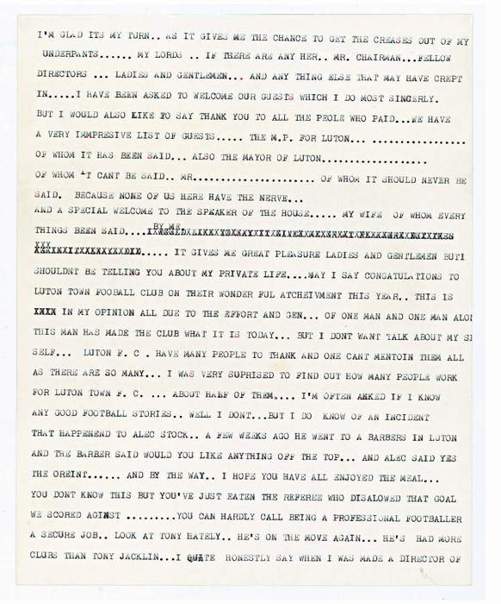
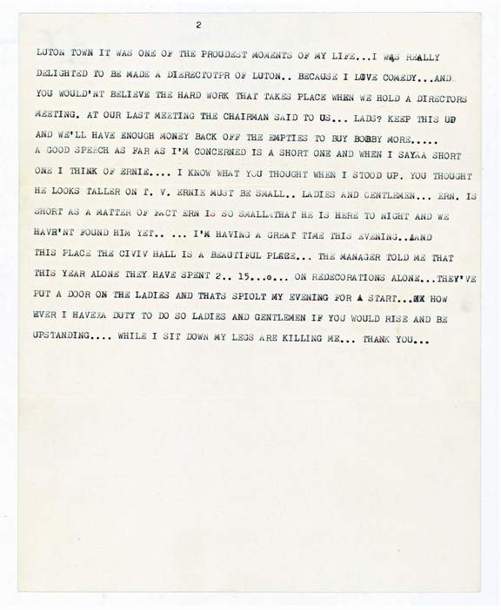
Eric’s Rough Notes for Luton Town FC Civic Hall Reception