
ONE
On the Worldwide Repute of Early Chinese Bridges
Foreign admirers of Chinese bridges could be adduced from nearly every century of the Empire. Between AD 838 and 847 Ennin never found a bridge out of commission, and marvelled at the effective crossing of one of the branches of the Yellow River by a floating bridge 330 yards long, followed by a bridge of many arches, when on his way from Shandong to Chang’an. In the last decades of the 13th century Marco Polo reacted in a similar way, and speaks at length of the bridges in China, though he never mentions one in any other part of the world…. It is interesting that one of the things which the early Portuguese visitors to China in the 16th century found most extraordinary about the bridges was the fact that they existed along the roads often far from any human habitation. “What is to be wondered at in China,” wrote Gaspar da Cruz, the Dominican who was there is 1556, “is that there are many bridges in uninhabited places throughout the country, and these are not less well built nor less costly than those which are nigh the cities, but rather they are all costly and all well wrought.”
—JOSEPH NEEDHAM, 1971
From Science and Civilisation in China, Volume IV, Part 3
Joseph Needham, a man highly regarded for his ability as a builder of bridges—between science and faith, privilege and poverty, the Old World and the New, and, most famously of all, between China and the West—was obliged to make an early start in the craft, as the only child of a mother and father who were ineluctably shackled in a spectacularly disastrous Edwardian marriage.
Joseph Needham, the father, was a London doctor, a steady, unexciting, reliable sobersides. It was as a lonely widower, in 1892, that he met the young flame-haired Irishwoman who was to become his second, and singularly ill-chosen, wife. It took him only six weeks to decide to marry Alicia Adelaide Montgomery, the daughter of the union between the town clerk of Bangor, County Down, and a French gentlewoman. It took him the better part of thirty turbulent years in the genteel London suburb of Clapham to repent.
Alicia Needham was generously described as having “an artistic temperament,” which in her case meant a combination of wild, childlike exuberance and the staging of almighty tantrums, which were colored by her liking for throwing things (plates, mainly) at her husband. She was profoundly erratic, moods blowing up like storms, her torrents of tears being followed by gales of cackling laughter. She was fascinated by psychic phenomena, knew all of south London’s local mediums, read tarot cards, held séances, was interested in ectoplasm, and took photographs of spirits. She spent money like a drunken sailor, her spending binges frequently bringing the family close to ruin.
It was eight years before she became pregnant. The son who in the closing days of 1900 entered this most fractious of households was to be their only child. Trouble began at the font: such was his parents’ animosity toward each other that each chose to use a different Christian name for the boy: from the four he was given at birth his mother selected Terence; his father, perhaps mindful of the time of year the child was born, instead chose to use Noël. The boy would sign letters to each with the name each preferred; but when finally left alone to choose, for both convenience and filial compromise generally used, and eventually settled on, Joseph.
His was a solitary, contemplative childhood, lived out in his fourth-floor room, where he played alone with his Meccano erector set and his building blocks and a large model railway layout, and was bathed, shampooed, and dressed by a humorless French governess shipped in direct from Paris. But it was also an intellectually stimulating upbringing. His severe and learned father, to whom he was by far the closer, saw to it that he had a solid grounding in worlds both bookish and practical. He taught the boy how to write when Joseph was little more than an infant (his mother banging hysterically on the locked door protesting that the child was far too young), leaving a lifetime legacy of the neatest handwriting, perfectly legible and elegant. He taught him woodwork, bird-watching, the geography of Europe, the taxonomy of the back garden, and an antimaterialist philosophy that would remain with him all his life: the need to “give things only a passing glance.”
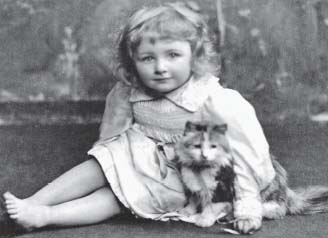
Noël Joseph Terence Montgomery Needham and his leashed cat at home in Clapham, southwest London, 1902. Dresses for boy toddlers—a convenience for mothers and maids alike—were much in style in Edwardian England.
There was spiritual instruction, albeit of an unusually rigorous kind. The family took the clanking steam train up to the medieval Templars’ church in the center of London each Sabbath day to hear the controversial mathematician and priest E. W. Barnes preach one of his so-called “gorilla sermons.” Barnes, who would later become bishop of Birmingham, was at the forefront of a movement to remodel Christian doctrine in the light of scientific discovery—most notably Darwinian evolution, from which the “gorilla sermons” took their name.
He was an uncritical supporter of Darwin, denied the existence of miracles, opposed the fundamental beliefs about the sacraments, and outraged the orthodox members of the Church of England, who accused him of heresy and demanded his condemnation by Canterbury. And the schoolboy Needham listened to him enraptured. In an interview much later in life Needham explained the legacy that Barnes had left, summing it up by saying he had basically liberated religion from the “creepiness” that put off so many other people. Barnes and his modernizing zeal transformed faith, thought Needham, into the best of good sense.
Not content with keeping up the academic pressure on his son even on Sundays, the elder Joseph Needham also took the boy to France on study holidays. The parents, ever fighting, invariably (and prudently) took separate holidays, and young Joseph, fearful of being embarassed by his high-strung mother, rarely went with her, except for a couple of times when he traveled to see a rather pretty niece who lived in Ireland. So much did he like France that he eventually spent a term at school there, at Saint-Valérysur-Somme, and was able to speak passable French by the time he was twelve, with some help from his gloomy governess.
It was also in France that, when he was twelve, he had his first social encounter with the working class from whom his parents had tried so sedulously to shield him. He and his father were stranded on a remote railway station platform in Picardy, in the village of Eu. The hotels were full, but a track worker cheerfully took in the pair. “I remember how he invited us in to his humble home and made us most welcome there.” That men from classes shabbier than his own could be so decent came as something of an epiphany for the boy: he would reflect many years later that this small event in France played no small part in the construction of his later political sympathies.
A respect for tidiness, order, punctuality, and routine was also instilled in the boy by the fussy, kindly old doctor—but in the Needham family, unlike so many Victorian and Edwardian households, it was done affectionately, not harshly. Maxims helped: “Never go upstairs empty-handed,” his father used to say. “Never have three helpings of anything. Never put off until tomorrow what you can do today. More flies are caught by honey than by vinegar.”
The library his father had built up at home was prodigious, and books spilled off the shelves in almost every room. Young Joseph was captivated by the collection, and consequently his reading habits were precocious in the extreme—he remarked that he was only ten when he swallowed up Friedrich Schlegel’s The Philosophy of History in one go (learning to speak German en route).
There was one figure, a family friend, who helped nudge the youngster toward his lifelong fascination with science. He was a diminutive, Napoléon-like Cockney anatomist who had originally been named John Sutton and was the son of an impoverished Middlesex “farmer, stock slaughterer and amateur taxidermist.” He later adopted the surname Bland-Sutton, won a knighthood, and when he became a constant teatime visitor to Clapham Park owned the kind of name and profession that the socially ambitious Needhams very much liked: he was now Sir John Bland-Sutton, baronet, surgeon.
The schoolboy Joseph found Bland-Sutton’s tales endlessly fascinating—how he had dissected no fewer than 12,000 animals, from fish to humans, and had investigated the anatomy of more than 800 stillborn babies. How he had developed a diet for pregnant zoo animals, had found a cure for rickets in lion cubs, and had discovered that lemurs were unusually liable to cataracts. And how his peculiar early love for teeth, jaws, and tusks was in time supplanted by a growing surgical fascination with the genitalia of women.
Bland-Sutton essentially invented the hysterectomy, though was widely criticized at the time for being a “criminal mutilator of women.” He wrote two definitive books: one on ligaments, the other on tumors. He entertained on a Lucullan scale, and built a house in Mayfair that had thirty-two columns topped with bulls’ heads and was modeled after the temple of Darius at Susa, in Persia. He had few close friendships other than a robust closeness with Rudyard Kipling—the pair, both top-hatted, were regulars on the London social scene.
When the boy was considered old enough—nine—Bland-Sutton let him attend a simple operation, an appendectomy, at Middlesex Hospital, and paid him a sovereign for assisting. And though Needham soon decided he would never himself make a surgeon, he worked in the operating theater as an assistant to his father during his teenage years, handing instruments and catgut to the nurses while his father attended to the flows of ether and nitrous oxide that kept the patients asleep. Needham came to have a thorough knowledge of human anatomy as a result.
And then, in August 1914, with the German attack on Belgium came the outbreak of the Great War. Joseph Needham was swiftly sent off to Northamptonshire, 100 miles to the north, to study at one of England’s oldest, costliest (he won no scholarship), and most distinguished public schools, Oundle. The education he received there was, for the time, unusual and excellent, and was due mainly to the school’s still fondly remembered headmaster, F. W. Sanderson.
“Think,” Sanderson would proclaim to his boys in every welcoming speech and in every valedictory address: “Think in a spacious way. Think on a grand scale.” H. G. Wells was one of those in Edwardian England who heard the message and decided to send his sons to Oundle; eventually he wrote an admiring biography of Sanderson. It was an echo of the message that was then being conveyed by another Edwardian hero, Admiral Jackie Fisher of the Royal Navy, who often exhorted his audience to “think in oceans.” Put aside the mean and the pettifogging, the details and the trivia, Sanderson would say: just stand back and think big.
While he was at Oundle, this child of two determinedly bourgeois parents first began to declare a real sympathy for the ordinary working-class man, and first began to display hints of the firmly socialist views that would eventually define his political life. His brief contact in Picardy four years before had suggested some early stirrings. Then one day in 1917 when he left school to visit a dentist in Peterborough, about thirty miles away, he opted to go by train, and delays forced him to wait for several hours. A kindly railwayman, who Needham recalled in old age was named Alfred Blincoe, took the bored youth up into his locomotive, stood him on the footplate in front of the controls, and taught him how to drive. After a few minutes of instruction, Needham remembered, “I could…take over the regulator and the Westinghouse brake and crack a walnut (as they say) gently between the buffers.”
A passion for steam trains was born that moment—a passion for railway locomotion that would underline another of his father’s axioms: “No knowledge is ever wasted or to be despised.” But the hours he spent that day talking to Alfred Blincoe also spawned in Needham an enduring belief that politics based on enlightened ideology could perhaps alleviate the very obvious trials of the laboring classes. It convinced him that he had a moral duty to become party to such ideologies as could help improve the lives of his country’s workingmen.
Besides, this was 1917—a year that was most decisively marked by the events of the Russian Revolution. The teenage Needham immediately supported the Bolsheviks, and later horrified his father by marching into the family home one winter evening with a friend from Oundle, Frank Chambers, declaring that the Russian communists were “a jolly good thing,” and that the dictatorship of the proletariat was the way of the future. How he came to this view intellectually puzzled him: he had never read any of the Marxists’ classics, and in later years he suggested that his voracious appetite for the works of George Bernard Shaw and H. G. Wells, whom he came to know well, led him to believe in the possibility of a political utopia. Perhaps, he remarked later, his socialism was born more from an emotional response to his encounters with laboring men like Blincoe than from listening to theory or studying radical polemics.
It was also in 1917 that Needham formally acknowledged his talent and interest in science, and applied to a university with a view to studying medicine and, like his father, becoming a physician. He was accepted quite readily in 1918, and despite being inducted into the Royal Navy Volunteer Reserve as an acting sublieutenant—the armed forces were by now critically short of medical personnel and tried to press into service anyone who knew how to tell a tibia from a fibula—he was able, by the great good fortune of the war’s coming to its end in August of that year, to make it into the university in October. He chose Cambridge: it was here that his entire life would undergo a profound and utterly unimaginable change.
Cambridge University was a quiet, intense place, solemn and depleted at the end of the Great War, but brimming with brains and ambition. And perhaps in no other college was this more true than the one that had readily accepted Needham—the fourteenth-century gem known formally as Gonville and Caius, more generally referred to by its second name only, and that pronounced like the original surname of its second founder, John Keys.
Needham knew little enough of Caius when he applied. A friend at Oundle, Charles Brook, had opted for the college, and one summer afternoon, while he and Needham were idling in the long grass in the school fields, he had suggested that Needham might profit from going there too—not least because the Master was then a doctor, Hugh Anderson, a specialist in the muscles of the eye, and Needham had thoughts of becoming a doctor himself.
His first days there were far from inspiring. Most of the rooms were still occupied by staff officers who had been billeted there during the war, their quartermasters apparently having forgotten about them. So Needham was given the only place available—a miserable ground-floor room, C-1, in what was then a most unfashionable college court, Saint Michael’s, in a gloomy new annex across Trinity Street from the principal building.
As if being consigned to the college’s social Siberia wasn’t bad enough, in November 1918 Needham promptly came down with the flu—becoming one of perhaps 50 million victims of the infamous Spanish influenza epidemic. His college tutors took his infection with the greatest seriousness. One, W. T. Lendrum-Vesey, a somewhat mad minor Irish aristocrat who was a sportsman and classicist, very generously fed the patient grapes—but he tied them to the end of a borrowed walking stick and proffered them through the door in order to avoid approaching Needham’s bed and catching his germs.
Initially Needham remained the shy and introspective young man he had been at school, given to taking himself for long walks into the wintry countryside, pondering the great questions of science and medicine—and also, more important, the great questions relating to God. His Anglo-Catholic upbringing, half forgotten while he was at Oundle, reasserted itself in Cambridge, and he found it a comforting balm, a means of helping assuage his loneliness.
He joined a variety of societies that brought him into contact with churchly matters: he belonged to the Sanctae Trinitatis Confraternitas, for example, which organized plainsong recitals in various college chantries; and he became secretary of the Guild of Saint Luke, a body that helped to bring notable scholars to Cambridge to talk to medical students and doctors about the attractions and contradictions of humanistic scholarship. These talks impressed Needham, but not so much by their philosophical scope: he was most impressed, he recalled later, with the vast history of science they covered—with how the astonishing activity of the human mind in ages past had led to so vast an array of scientific experiment, thought, and theory.
Almost immediately on his arrival, he abandoned his schoolboy ambition of becoming a surgeon. The craft of a “sawbones,” as he called it, was simply too mechanical, too nonintellectual. His first tutor, the great food biologist Sir William Bate Hardy, insisted that he instead learn chemistry. “The future, my boy, lies in atoms and molecules,” Hardy was fond of saying, and he cautioned Needham not to rein himself in by studying merely anatomy and dissection. Since Hardy was so romantic a figure—he was a deep-sea yachtsman of legendary skill and courage, a black-bearded figure with the cut of the jib of an Elizabethan admiral, and almost certainly the model for the heroic Arthur Davies in Erskine Childers’s great spy novel The Riddle of the Sands—and since Needham found chemistry infinitely more absorbing than slicing up frogs and dissecting the knee joints of cadavers, he switched courses.
Three years later, by dint of a great deal of both work and, he insisted, prayer, he won his degree. He celebrated his success with a poem—one of a number of unfortunate pieces of doggerel he would write on the all too frequent occasions when he felt moved to do so. Some of his limericks and clerihews were mercifully brief; but his celebratory Ode to the Chemical Laboratories of Cambridge, perhaps not the most promising of titles, is longer. It is inconvenient to quote in full, but one stanza will suggest Needham’s style, which some might describe as by Wordsworth out of McGonagall, with nods to Betjeman and Rupert Brooke, had either been writing at the time:
And so to work: distilling oils by steam
Titration, or whatever it might be
Until the hour of four o’clock shall seem
Convenient for making ourselves free
Then back in high gear straight down K Parade
In overcoat and scarf arrayed
At home, with Robinson of Christ’s, to tea.
Despite now being armed with a degree, Needham was still somewhat rudderless; and since his father had just died—unexpectedly, at sixty—Needham felt he badly needed a father figure to help him decide on a career. So he turned for advice to a man whom he had met once before, at Oundle, and who was by now the unchallenged reigning monarch of the new science of biochemistry at Cambridge, Frederick Gowland Hopkins—known to all, even when in due course he was given a knighthood (for his part in the discovery of vitamins), as Hoppy.
Hopkins, who promptly asked the very willing and enthusiastic Needham to come and work with him, would provide him with both intellectual guidance and the benign paternal invigilation he needed. In addition, however, and purely fortuitously, Frederick Hopkins and his remarkable new laboratory in central Cambridge would offer Needham limitless access to one unexpected source of good cheer that would continue to amuse him for the rest of his days—an abundance of clever young women.
“His place bristles with clever young Jews and talkative women,” remarked one of Hopkins’s colleagues. In those early days the department counted among its most distinguished members Muriel Wheldale and Rose Scott-Moncrieff, who both worked on plant pigments; Marjory Stephenson, who specialized in the chemistry of microbes; Barbara Hopkins (the professor’s daughter), who worked on the metabolism of the brain; Antoinette Patey, whose field was the biochemistry of the eye; and three Dorothies—Dorothy Foster, whose interests lay in the inner workings of frogs; Dorothy Jordan-Lloyd, a protein chemist; and, most important, considering that she would one day become Joseph Needham’s wife, Dorothy Moyle, who would become a world-famous authority on the chemistry of muscles.1 To all of them, Joseph Needham, the clever, tall, rumpled, amusingly eccentric doctoral student from a smart college and with a reasonably exotic family background, a man who was known for being a chain-smoker, a singer, and no mean dancer, became an object of immediate and studied fascination.
And as he did, the formerly shy, reserved young man began to blossom. Armed with a qualification and now occupied with a settled calling in the Biochemical Institute, Needham started to make the most of his stature and his studious good looks. As soon as he returned from a stint researching in Freiburg—during which he added a fair fluency in German to the seven other languages (including Polish) that he now spoke with comfort—he seemed to burst with a new enthusiasm and confidence. Moreover, since his father’s death he now had a small annuity, with a sum of £6,500 invested in stocks. His uncle Arthur Needham was helping him look after it and draw its modest dividend income.
His academic standing began to rise. He was much liked by Hopkins, and was favored from the moment when he joined the team, in short order winning a coveted (and paid) research studentship. His position at the institute then evolved with some speed as he advanced from student to researcher to demonstrator to reader, the last post giving him a respectable salary. Before long he was able to show in both his work and his personal life the truth of an adage that was popular at Cambridge among those who admired and rather envied Hopkins’s close-knit team: “All of Hoppy’s geese,” they said, “turn into swans.”
Needham eventually acquired a little sports car—the first of a series of vehicles that prompted a keen tinkerer’s interest and led to a lifelong fascination with speed and dash. In due course he bought a most remarkable vehicle, an Armstrong-Siddeley Special tourer, a bright blue six-cylinder monster machine that could thunder through the Cambridgeshire lanes at almost ninety miles per hour. This car, moreover, had quite a pedigree: it had once been owned by Malcolm Campbell, who during the 1920s and 1930s achieved worldwide fame by capturing, repeatedly, the world land speed record—and indeed managing, in a variety of cars all called Blue-Bird, to double it, from 150 to 300 miles per hour, in the ten years between 1925 and 1935.2
It was also during this time that Needham became an avid follower of what in the 1920s was called, with a somewhat necessary degree of tact, gymnosophy. He became an avid nudist.
He first embraced nudism when the newly formed and very daring English Gymnosophist Society, its membership hitherto confined to a small claque of metropolitan sophisticates, spread its influence close to Cambridge, to the little Essex town of Wickford, where a highly secretive gathering of East Anglian naturists named themselves the Moonella Group. The members gave each other nicknames, swore not to divulge to outsiders the address of the house and garden where they took their naked ease, and encouraged one another to wear nothing except colorful headbands and sandals, so long as they looked Greek.
Nudism soon became tolerated to a limited degree in the ancient universities, where most eccentric behavior was excused, just as long as it didn’t frighten the horses. So like his counterparts at Oxford who flung their pink (and all too frequently flabby) bodies into the Cherwell at the site known as Parsons Pleasure, Needham knew he could not only cavort bare in the Moonellas’ garden at Wickford but also swim naked in an informally reserved stretch of the river Cam, conveniently close to the college, more or less whenever he pleased. Charles Darwin’s granddaughter, Gwen Raverat, remembered from her childhood that any gentlewoman passing through this reach in a punt on a hot summer day “unfurled a parasol and, like an ostrich, buried her head in it, and gazed earnestly into the silky depths, until the crisis was past, and the river was decent again.”
But Needham liked a little more privacy than this. So he would either take the branch-line steam train or cycle to the small village of Stow-cum-Quy, five miles east of the city. Here he could disrobe, and here was the nearest of the cool, limpid, almost motionless watercourses of The Fens, described by Needham quite memorably as a place that brought him bliss. The pool, he would write some twenty years later, was
surrounded with reeds whose stems are almost white, but bear at the top their long green blades which stream unanimously out in one direction if there is a little wind. If you lie flat on the bank of the diving place and look along the pool you see a picture of the reeds in the best Chinese manner.
Though now certain of his academic heading, Needham had yet to direct the spiritual side of his life. For two years during this time of apparent flamboyance he seriously considered becoming immersed in a fully organized religion. He went so far as to enroll as a practicing lay brother in an Anglo-Catholic monastic organization, the Oratory of the Good Shepherd; and for a while he tried to follow the strictly disciplined routines of the Oratory House.
But there was a problem: among the many strictures Needham was obliged to obey was celibacy—a vow that proved far too much for him. And so in 1923, after two full years, he left and returned to worship the deity on his own terms. In doing so—and because his bindings had now been loosed—he found himself allowed, among other things, to develop a keen personal interest in one of his young female fellow researchers in Hoppy’s biochemistry lab—Dorothy Mary Moyle, five years his senior.
“Dophi” Moyle, as she was generally known—though Needham in his diaries referred to her rather more economically, using just the Greek letter delta—was born into a London family of Quakers. Her father was a senior official in the patent office. After attending a private school in Cheshire run by her aunt, she went to Girton, then still a women’s college at Cambridge, and was soon summoned by Hopkins to work in his biochemical seraglio.
Her work on the chemistry of muscles—she specialized in the little-understood processes inside the cells of an animal’s muscle whenever it is made to contract3—was very different from Joseph Needham’s research, which involved the processes inside eggs, mostly those of chickens, as they progress toward the moment of hatching. So when the pair met they did not do so for the purposes of comparing notes: their mid-morning coffee-room sessions rarely went beyond the purely social. But she overheard him often enough, and what she heard turned out to be much more intriguing.
For Needham had suddenly become exceptionally and unexpectedly boisterous. He was now recognized within the department for talking loudly and with wild enthusiasm to all who would listen about the secret mechanics of his calling—especially about the process of cell division, which he saw as a fascinating amalgam of pure science and deep philosophy. He was especially proud of one celebrated experiment that he conducted, in which he placed a morsel of boiled mouse heart into a living human embryo, and watched as it formed what he believed were the beginnings of a second human brain inside the unborn mass. This, he told his fascinated listeners, was science that delved into matters connected with the very origins of life.
Dorothy Moyle found herself quite swept away by the man. Late in the spring of 1923, he asked her out. They first took coffee and tea together in the cafés on King’s Parade. Then they went bicycling, and as the friendship strengthened and the summer came and the days stretched out and warmed, they went to swim at Quy (though Dorothy shyly kept her clothes on while Joseph plunged in naked). They visited churches and railway stations. (Joseph was still fascinated with railways, and although not a train spotter, collected photographs of engine types and of stations he thought architecturally remarkable.) And during the university vacations they went away together, on trips—they were, after all, graduate students, and not subject to most college rules of decorum and celibacy.
They first went to Great Cumbrae Island in the Clyde estuary, outside Glasgow. Soon after that came more ambitious journeys, paid for by grants for the pursuit of biochemical knowledge: the following years they went together to Monterey in California, to the Woods Hole Institute on the south coast of Massachusetts, and to a French marine laboratory in Brittany. Ostensibly they went away to work on matters embryological, and specifically to check on the varying pH of the nurtured fish eggs they found in each of these places. But in fact they spent much of their time talking about their shared interests in Christianity and socialism—and to judge from their rather saucy holiday snapshots, they had adequate time for erotic amusements, too.
In early 1924 Needham introduced Dorothy to his mother in London, and they then visited her parents in the Devon village of Babbacombe. He proposed to her in midsummer, and they married in the autumn, just before the start of the academic year, choosing Friday, September 13, as the date for the small ceremony, in a deliberate snub to convention and superstition.
Before the rites they had made it clear to each other and to their friends—though not to their parents—that theirs would be a thoroughly “modern” marriage. Whenever the need seized them they would pursue encounters with others. They would not be hobbled by the tedious, irksome, and thoroughly bourgeois demands of sexual fidelity.
If they had had a child, all this might have changed. But they were not able to conceive: Joseph’s diary records encounters with Harley Street specialists concerned by his low sperm count, which may have been the reason. Still, they were philosophical about their situation. Having a child, they concluded much later, would have cramped their style—or at least his: from almost the very moment they exchanged vows Joseph began to pursue his erotic enthusiasms with great and unstinting gusto.
Few Cambridge women of the time were left free from his attentions. Women who are now well on in years recall these attentions. They remember his wicked grin, his piercing gaze, his courtesy, his Old World charm, his offers of help and advice, and “his way of making you feel you are the most important person in the world to him—which of course at the time, you were.” One now elderly woman, Blanche Chidzey, vividly remembers meeting him on a train, talking briefly to him, and then falling asleep, only to awaken when she heard him chatting quietly to a distinguished physicist who was also in the compartment. “Naturally I thought some lofty scientific topic must have gripped them—but then I listened, and it was all about me, in terms of chatting me up.” But he was very polite, she added.
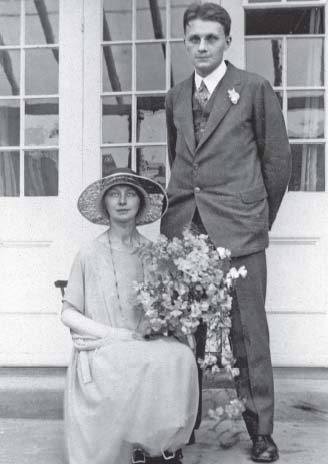
Dorothy Moyle and Joseph Needham on their wedding day, Friday, September 13, 1924. Theirs was to be an “open marriage,” which lasted for more than six decades.
Of Dorothy, who was a more discreet person—a perfect saint, said one admirer, who perhaps heaped praise on her for putting up so stoically with her extraordinary husband—we are not so sure. Joseph was to hint in later years that perhaps his wife was somewhat more sedate than he. She was, he said, “not a flamboyant character, but a reasonable person, never outrée or unusual.” Pictures from the time tend to confirm this: she is small and sober, bespectacled, with her hair tight around her head, her coat plain black, her shoes sensible, her smile a little forced; he is tall and slightly comic-looking in a baggy double-breasted suit and scuffed Oxfords, with a small badge in his lapel and a cigarette between his lips, his smile puckish and distant, his mind evidently on other things, far away.
The fellows of Caius College did not give the young couple a wedding present. But in October of that year, they offered something of far greater value. Once he had presented and defended his thesis and been awarded his doctorate they elected Joseph Needham a full-fledged fellow. He now had a boundless access to the myriad of unique marvels an ancient university can provide. He had a cozy, firelit room of his own—with a nice symmetry it was K-1, the room once occupied by Sir William Hardy, who had been such an encouragement to him—as well as a library of fine books and a handsome chapel. He could come whenever he wished to the fellows’ oak-paneled combination room to take a usually indifferent sherry or a rather better claret beneath paintings of forgotten divines of noble antiquity. He could bring guests whom he wished to impress or delight to the splendidly proportioned dining hall, where servants set down excellent food at vast tables laden with old silver and porcelain.
His own combination of intellect and charm had been recognized very swiftly—he was still only twenty-four. People were beginning to say that he was on his way to becoming the Erasmus of the twentieth century, so sharp was his mind, so broad his intellectual reach. But however he compared with the great scholars of the past, one thing was certain: he was now settled, and for life. Academically at least, he was made.
His achievements as a scientist, and as a figure with extraordinarily well-rounded interests, were now being noticed well beyond Cambridge. By 1925 he had already edited his first book, a collection of essays by some of the great scholars he had encountered while organizing lectures for the Guild of Saint Luke. All of them Joseph Needham knew personally while he was still a young man: he was a consummate networker, and his social abilities were a further key to his later success.
Six years later he produced another book, Chemical Embryology, this time not an edited collection of other men’s works, but a history of embryology entirely written by himself. He was just thirty-one when its three volumes were published by Cambridge University Press; and though the subject was esoteric and the sales were accordingly minuscule, the sheer scale of the work—and his obvious ability to think big thoughts—hinted at what was to come in Needham’s later life.
Needham suffered something of a breakdown after completing the work, and for two weeks after handing in the typescript found it impossible to sleep because of hearing what he called “incessant music” in his head. Soon, though, he turned his insomnia to his advantage: Dorothy, who liked to recount stories of her husband’s formidable mental powers and his near-photographic memory, said she recalled watching him lying awake in bed, mentally visualizing the books’ page proofs, and then correcting in a notebook any errors or infelicities. Once this activity became too humdrum for him, she said, he further occupied himself by translating the selfsame pages from English into French, also in his head, and then correcting any errors that he fancied he could also see in this new translated text.
And there was more than merely the pride of achievement. The publication of the three volumes made virtually certain the honor that would be bestowed on Needham a decade later: in 1941 he was elected a fellow of the Royal Society, arguably the greatest scientific distinction short of a Nobel prize.4 His writing of a scientific classic while he was still so young a man and so untutored a researcher was something that the graybeards of the Royal Society found wholly commendable, and impossible to overlook—but that some also envied, mightily.
Now that Joseph and Dorothy were married and settled and had established their sexually liberal style of living, it was time for this deeply religious pair to find a church to accommodate them. That might not be easy: not only had its prelates to be supremely tolerant regarding marriage vows, but it had to be a church entirely comfortable with the couple’s socialist leanings.
The Needhams were not easily discouraged, and in 1925 they found just what they were looking for in the Essex village of Thaxted, twenty miles from Cambridge. Here they uncovered as left-wing an Anglican prelate as it was possible to imagine: Conrad Le Despenser Roden Noel, the infamous “red vicar” of the Home Counties, the man the popular newspapers dubbed England’s most turbulent priest.
Noel had been vicar of Thaxted since 1910, notorious as a firebrand, and having been forced from several livings by congregations who objected to his socialism. But among the parishioners of Thaxted he was to find a wellspring of liberal sympathy, and he flung himself into his role with ferocious enthusiasm. He asked the composer Gustav Holst, who lived nearby, to play his newly composed suite The Planets on the church organ; he threw out all the old fusty paintings and hangings in the nave and installed new, colorful linens and cottons; he found a tame pigeon and preached with it sitting happily on his shoulder; he staged a three-part Mass each Sunday, and greatly enlarged the choir to sing in it; and to display his support for revolutionary Christianity, the majesty of England, and the rights of the Irish to be free of colonial enslavement, he ran up the Red flag, the George Cross, and the banner of Sinn Fein all at once on his church’s newly refettled spire. On hearing this, High Church louts from Cambridge swarmed into the village and climbed up the stonework to try to haul down the contentious flags; but Reverend Dr. Noel imported teams of striking policemen to guard them, and there was a standoff lasting some months before a consistory court finally ordered the vicar to remove them once and for all.
Thaxted Church thus became, almost overnight, a place of great stimulation and fun. Before long Sunday Mass at Thaxted was one of the best attended in the county. Joseph and Dorothy Needham became committed members of the congregation, remaining supporters and friends long after Noel had died in 1942, and well on into their old age.
At Thaxted, Needham also became an eager practitioner of the peculiarly English country ritual of morris dancing. Conrad Noel had first brought the old dance back to Thaxted at the urging of his wife, who felt it important to preserve rural traditions, even though this one was of pagan origin and was held to encourage fertility and the growth of crops. And Needham loved it—he loved the flamboyance and the merriment; the feeling of liberation and joy; the men dressed in loose white fustian with colored baldrics crossing over their chests and backs, bells on their ankles, and flower-ornamented hats; the handkerchiefs waved and sticks whacked against one another; the pipe and tabor played tunelessly, but hauntingly, in the background.
Morris dancing was first brought back to England from the Muslim world during the Crusades—hence morris, from Moorish—and is the oldest unchanged dance in England. To Needham it was one of the “pure creations of the working class,” part of a series of dances which “will unite by their remarkable continuity the developed communism of the future with the antique primitive communism of the past.” Not for nothing did morris dancers come out and perform their ungainly and unusual dances on May Day, as they still do today: their rituals celebrate the rural workingman, and as such they were, for Needham, a demonstration that true socialism—a caring solidarity among workers—was woven deep into the warp and woof of English society.
His claims may have been extravagant, or wishful thinking. But he danced for most of his adult life, learned the accordion so he could accompany his fellow academic dancers, and played a significant role in creating a renewed enthusiasm for morris dancing which still exists in southern England today. It seems noteworthy that amid all his other work he found time to address the International Folk Dance Congress in 1935: his topic was “The Geographical Distribution of English Morris and Sword Dancing.” Like so many of the fascinations in Joseph Needham’s life, what had started as an innocent weekend hobby ended up as a subject for academic discussion and high seriousness. “No knowledge,” his father had said, “is ever to be wasted, or ever to be despised.”
Britain’s nine-day general strike of 1926 finally confirmed Needham as a man of the far, far left—mainly because it did not lead to any obvious victory for the workers. In fact it allowed the Conservative government of the day to pass laws banning such sympathetic strikes, consolidating in Needham’s disappointed mind a notion that had been forming since he was a schoolboy: that his sympathies lay with the workers, totally.
He was by no means a Bolshevik, as he had thought himself as a schoolboy; nor would he ever become a full-fledged member of the Communist Party. But around this time he would devour both Das Kapital and the German edition of Engel’s Dialectics of Nature, and he would throw his hat in with the far left wing of the British Labour Party now and for the rest of his life. But he was a stalwart who would also be firmly wedded to his creature comforts—such as his magnificent Armstrong-Siddeley car (though he did write to the company’s founder, Sir John Siddeley, asking that none of the firm’s money be used to finance military research, as it was once rumored to do).
He became very much an activist—a militant, almost. He was forever writing letters to newspapers, pamphleteering, designing placards, campaigning, marching, taking up causes. He demanded, for instance, that Britain boycott the Olympic Games of 1936 in Berlin. He complained on behalf of the National Council for Civil Liberties about heavy-handed police actions at an airfield at Duxford, where pacifists had tried to hand out leaflets during an air show, and found themselves arrested. (They “should be shot,” Needham records one local as muttering to him when he went to the show to see for himself.)
His colleagues on the National Council for Civil Liberties represent a roll call of the intellectual left of the day: E. M. Forster, Clement Attlee, Nye Bevan, Havelock Ellis, Dingle Foot, Victor Gollancz, A. P. Herbert, Julian Huxley, George Lansbury, Harold Laski, David Low, Kingsley Martin, A. A. Milne, J. B. Priestley, Hannen Swaffer (a former neighbor in south London), R. H. Tawney, H. G. Wells, Rebecca West, and Amabel Williams-Ellis.5 All of them became firm friends. He addressed the University Socialist Society, finding himself lecturing to a comrade named Kim Philby, Trinity College representative, who would later become notorious as one of Britain’s most celebrated spies. Needham joined forces with the extraordinary social anthropologist Tom Harrisson, a founder of Mass Observation.6 He was enormously influenced by the communist crystallographer J. D. Bernal, and joined Sir Solly Zuckerman’s famous scientific dining club, the Tots and Quots. He was, in other words and in all ways, a figure of the left-wing establishment, his credentials never in doubt, his subscriptions and his fealties always paid in full.
All this frantic activity led to some predictable muttering in the college. A number of the older fellows of Caius said that Needham’s socialist leanings suggested a growing eccentricity, and the possibility that he was becoming unsound. Eccentricity was generally a backhanded compliment; but unsound was as pejorative as any word in the establishment’s lexicon. Needham was notably thin-skinned in his youth, highly sensitive to criticism of any kind: “I shall have nothing further to do with your journal,” he wrote to the editor of the Cambridge Review, after the publication ran an essay lambasting him for his idealism and his left-wing views, “until your influence is decisively removed from it.” But later, when he was more seasoned, Needham took attacks in his stride. He would quote an old Arab aphorism: “The dogs may bark—but the caravan moves on.”
Not surprisingly Needham was an instantly recruited and enthusiastic supporter of the Republican cause in the Spanish civil war, to which every left-winger in Europe became magnetically affixed from the moment it began in the summer of 1936. He never went off to fight, arguing that he had a full-time teaching job. But he campaigned, spoke out, attended rallies, organized. He lobbied hard, for instance, for the welfare of a group of Basque refugee children who were marooned in the village of Pampisford, just south of Cambridge. He helped design and test for the Republicans a plywood-and-deal field ambulance, powered by an American Harley-Davidson motorcycle engine—but it ran amok and smashed down a garden fence, for which Needham paid personally, and promptly, saying it would do the cause much harm if the bill went unsettled. And, most crucially, he also became a significant contributor to the Cornford-McLaurin fund, set up by the British Communist Party to help the families of two Cambridge members of the International Brigade—John Cornford, a twenty-one-year-old poet; and the New Zealander Campbell McLaurin, a mathematician—both of whom had been killed in the fight for Madrid in 1936.
The year was a grisly one, in Spain and elsewhere. Although in America the Great Depression was starting to lift and a cautiously optimistic country would reelect Franklin Roosevelt to a second term in the White House, it was the wretchedness of Europe that preoccupied the world: the Spanish war, the Berlin Olympics (which Needham wanted Britain to boycott), the Nazis’ occupation of the Rhineland, the world’s growing awareness of Adolf Hitler, and even the sad farce of King Edward’s abdication most properly defined the year. And for the world the following twelve months would scarcely be better—Europe would suffer the first real fear that it was soon to be plunged into one almighty war; and with an outbreak of shooting on a bridge outside Beijing in 1937, China and Japan were promptly plunged into another.
Yet for Joseph Needham 1937 happened to be a very good year, and one which marked a turning point for him. The crucial moment came late one sunny summer day when he was contentedly sequestered in his laboratory. There came a soft knock at his door. He had a visitor.
In June, in the hot, teeming city of Shanghai 8,000 miles to the east of Cambridge, a young and highly capable woman was preparing to board an ocean liner, bound for England, and for a new life immersed in a brand new science.
Lu Gwei-djen, the daughter of an esteemed apothecary in Nanjing and now a budding biochemistry researcher, was clever, glamorous, and thirty-three years old when she joined the Blue Star liner headed for its long sea voyage to the port of Tilbury, outside London. She was traveling to England, and specifically to Cambridge, for one reason only: to meet and work with the biochemical couple she admired above all others—Joseph and Dorothy Needham.
From what she had read in the technical journals—not least the reviews of his stunning three-volume study of embryology—she knew well to admire Joseph Needham’s scientific work. She also knew that Dorothy Needham was in her own right an expert in the same field of muscle biochemistry as Gwei-djen. So for purely scientific reasons, Cambridge was the obvious place for her to go.
But there was more to it than the quality of the science. Politics and political sympathy also played a part in her decision. From what she had read in those imported British newspapers and political weeklies that made their way to Shanghai, Lu Gwei-djen also knew that Joseph Needham was a prominent and eager member of the political left and so was very much in step with her own political ideals. Moreover, the vast range of his interests suggested that he was something of a Renaissance man, and she knew that the press had suggested he might be regarded as a latter-day Erasmus.
She had read of his interest in the Spanish civil war, an event that had especially captured the imagination of many of the young and more radical Chinese. She herself had wanted to contribute her mite to the Cornford-McLaurin Fund. The thought that these two promising young men had braved so much, and then had lost their lives to a cause that was so clearly good, was to her intensely romantic; and those who supported the fund—as she knew Joseph Needham had—must, she felt, be thoroughly admirable.
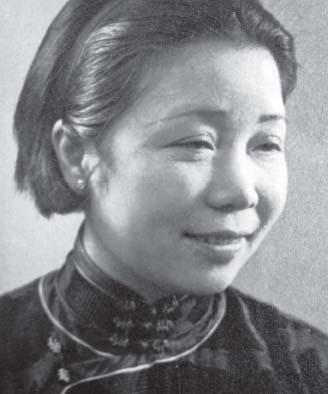
Lu Gwei-djen, the brilliant young biochemist from Nanjing, in a formal portrait taken in 1937 shortly before she left China for Cambridge, and a life as Needham’s mistress and muse.
Her plan was to pursue a field of biochemical research that was then virtually unknown in China, so impoverished and troubled were the country’s universities. Though a number of other universities around the world, particularly those in America, offered her places and opportunities, she wanted most of all to come to England. Her keenest ambition was to work at Sir Frederick Hopkins’s now world-renowned Biochemistry Institute, and perhaps while there to make contact with these two scientists who had become her faraway heroes.
The merit of her own work was all too evident, and on seeing her résumé Hopkins accepted her application in a flash. Dorothy Needham, to whom the professor had then passed her letter, agreed readily to help her as an adviser, and perhaps even to become her academic supervisor.
Lu Gwei-djen had been born on July 22, 1904, into a highly regarded Christian family. The first character of her given name,  , was chosen to signify the sweet-smelling osmanthus tree that blooms in eastern China in July, the month of her birth; and the second,
  , signifies treasure, a thing of great value. As an infant she was plump, active, and widely adored—but her life got off to a shaky start, thanks to the civil wars raging across eastern China, and her family was forced to evacuate to Shanghai to get away from the battles being fought around Nanjing. She did not begin her formal education until she was nine, when the situation calmed down enough for her to come home.
She had started out as a rebellious and archly nationalistic child—as a teenager she had insisted to her friends that she would never learn English, and that those Chinese who did so were no better than “traitors and fools.” But then in 1922 she won a coveted place at a newly built American-run college that would soon be famous—Nanjing’s Ginling College for Girls, the “little sister in the Orient” of Smith College in Massachusetts.
Under the soothing ministrations of this liberal American education, Lu Gwei-djen began to mellow. Within no more than a few months her early anger had all dissipated. She swiftly became fascinated by English, and within a year was fluent in it. She took up the piano with gusto. She studied—“with an intense desire,” she recounted later—though her early choices of mathematics, religion, English, and hygiene slowly gave way to an all-science curriculum. She began this with the study of zoology and botany, before finally developing a keen interest in biochemistry and in particular the study of the mechanics of animal muscles.
She boarded a steamer at Shanghai in the early summer of 1937. Two other young scientists accompanied her—Shen Shizhang, who after studying with Needham went on to become a professor of zoology at Yale; and Wang Yinglai, who won fame by being the first to create synthetic insulin. The crossing from the Yangzi to the Thames took two months; their ship docked in London in late August.
After a first night in a cheap hotel in London the three took the train to Cambridge and found their digs, a small flat conveniently close to the railway station. From here it was just a short walk to Tennis Court Road and the renowned Biochemistry Institute. Sir Frederick Hopkins, his seventy-six years now very much showing in his evident frailty and his snow-white mustache, was on hand to greet them; and Dorothy Needham took them to their rooms.
Lu Gwei-djen remembered very well her first meeting, later that same day, with Joseph Needham. She recalled walking down the hall to his room, then knocking gently on the wooden door. She was excited, after months of anticipation. She imagined, she later wrote, that she would now meet “an old man with a bushy white beard.”
She could not have been more wrong: instead of the hare-eyed boffin she expected, there stood before her “a young dark-haired biochemist, breathless from running from place to place and clad in a plain white overall with many holes caused by the acid of bench experiments.” He was handsome, in a studious way. He was very tall, muscular, rangy. He wore tortoiseshell-framed glasses, and a shock of hair kept falling over his forehead, which he brushed back with his hand from time to time. His voice was strong, but it had a silkiness, almost a lisp, that she found instantly captivating.
“I had absolutely no idea,” she wrote later, “that the presence of my colleagues and myself would have earthshaking effects on Joseph Needham, for whom I supposed we would be no more interesting than any other research students working for their doctorates, and no more. But between us and Joseph Needham a strange magnetic force developed.
“As he afterwards wrote, the more he got to know us, the more exactly like himself in scientific grasp and intellectual penetration he found us to be; and this led his inquisitive mind to wonder why therefore had modern science originated only in the western world? Much later on, after he and I had started investigating Chinese history, a second question presented itself—namely why, during the previous fourteen centuries, had China been so much more successful than Europe in acquiring knowledge of natural phenomena, and using it for human benefit? Such were the mainsprings of the Science and Civilisation in China project.”
The “magnetic force” was directed much more particularly at Lu Gweidjen than at the other pair, and she was being tactfully disingenuous in saying otherwise. For there was little doubt: she arrived in late August; she took a room across the corridor from Needham; and, during the autumn and winter of 1937 and 1938 the two of them fell headlong and hopelessly in love.
Needham’s diaries record it all: the suppers in town, maybe at their favorite Indian restaurant, or maybe a blowout at the Venetian, which was then the best Italian place in Cambridge; the evenings at the pictures (The Good Earth had just arrived, and Sidney Franklin’s rendering of Pearl Buck’s epic novel offered Gwei-djen a chance to wallow in homesickness and nostalgia, and to weep); the arm-in-arm walks along the snowbound Backs, or down to Grantchester along the frozen riverbank; the brief holiday in France, in Avallon.
Dorothy Needham knew full well what was happening, not least because neither Joseph nor Gwei-djen made any secret of their affection for each other. She was entirely complaisant, uncomplaining both in public and in her diaries, to herself. During that winter the three often went out together as friends and colleagues—they had much science in common to discuss, after all, and Joseph and Dorothy both enjoyed introducing their visitor from China to the engaging minutiae of Cambridge life. As winter took hold in Cambridge, the three spent much time huddled in front of the glowing coke fire in their local pub. And by all accounts, and to judge from Dorothy’s private letters, she very much liked Gwei-djen, and admired her intelligence, her determination, and her spirit.
And the liking did not appear in any way diminished when Gwei-djen finally became her husband’s mistress.
It was a good six months after Joseph Needham and Lu Gwei-djen first met that matters took this more decisive turn. Most probably, this happened late one damp evening in February 1938, in K-1, his cozy little room in Caius College in the gaslit center of Cambridge. The epiphany that is most relevant to this story is more linguistic than erotic, however. It occurred as the couple lay together in his cramped single bed in that sixteenth-century room, smoking companionably.
As they lay there, quite content, all was just as normal as such circumstances permit. Perhaps there might in due course be some kind of scandale, but this was the 1930s, and the event had occurred in Cambridge, and the parties involved—not least Dorothy Needham, who had gone away briefly to visit her family in Devon—and the university circles in which they all moved were socially progressive and sexually tolerant.
Needham’s university diary of the time makes it possible to imagine the scene in some detail: the couple’s energies being spent, it appears that Needham first lit two cigarettes, as was his habit—probably of his usual brand, Player’s—and he handed one to Gwei-djen. He then turned on his pillow to face his mistress beside him. We can imagine that he smiled at her, tapped on the cigarette, and asked simply: “Would you show me just how you write the name of this—in Chinese?”
And as the diary illustrates, she did indeed show him. Under her invigilation he then wrote on his diary page (and only a little haltingly, for his always had been and always would be a most precise hand) the Chinese character for cigarette—two separate components, nineteen strokes of the pen, and all signifying something that he realized was infinitely more lovely in its construction than its banal equivalent Anglicism: fragrant smoke.
He lay back, admiring his work. It was the first time he had ever written anything in the language of these people, alien and very far away—and when he did so, a distant door suddenly started to open for him, onto an utterly unfamiliar world.
“It was very sudden,” Gwei-djen remembered. “He said to me: I must learn this language—or bust!” She was to be his first teacher, he demanded, urgently. And she agreed, readily: “How could I refrain from helping him to learn it, even though it was a little like going back to the nursery to receive, and reply to, his artless Chinese letters? But little by little he gained the knowledge he sought, and was launched on the way to understanding Chinese texts of all ages.”
Years later Gwei-djen reflected on Needham’s sudden but very real enthusiasm for Chinese, coming when he was at the top of his game as one of the world’s leading biochemists. “He was not a professional sinologist who had gone through the mill of formal academic teaching in Chinese,” she wrote. “Nor was he a conventional historian, nor had he any formal training in the history of science; he had just picked it up in the way that broadly enquiring Cambridge undergraduates were always encouraged to do, while in the course of doing something else—in his case anatomy, physiology, and chemistry.”
Gwei-djen had never taught before, but she knew from friends the first essential step. In order to commingle her pupil’s identity with his linguistic passion, and thus more effectively bind him to the wheel, she gave him a carefully chosen Chinese name.


cigarette
Usually Chinese names have three components or three syllables, signified invariably by three characters,7 with the single-character family name first, followed by the two given names—for example, Mao Zedong, Zhou Enlai, Chiang Kai-shek. Gwei-djen saw no reason not to follow convention. She gave him the family name Li, and the given names Yue-se. The Chinese character li,  can mean plum but is usually a surname. Gwei-djen chose it because she felt it was similar in sound to the first syllable of his English surname, Needham. She also chose his given names for the way they sounded—Yue-se sounded, she thought, like Jo-seph. In any case, Yue-se had been the standard transliteration of Joseph since the time of the Jesuit missionaries in the 1600s.
The character yue,  indicates appointment or arrangement; the character se,
  signifies a musical instrument resembling a zither. Arrangement-zither Plum would be a strange name in English; but to a Chinese, Li Yue-se is both sonorous and dignified, a name that could belong only to a scholar. Learning to write, read, and say it on command turned out to be Joseph Needham’s Lesson One and would often be repeated in his early study of the Nanjing-inflected dialect of pure Mandarin Chinese.
He was a good student, and he set about his studies in a methodical but unique way. He created, entirely from scratch, a series of homemade notebooks to be his vade mecums. There were eventually dozens of them, but initially he made just three: the first was an English-Chinese dictionary, the second a Chinese grammar, the third a Chinese phrase book. Slogging along day after day, with an obsession that, as he became ever more deeply immersed in it, made him by his own account “almost delirious with happiness,” he filled in these notebooks, word after word, sound after sound, character after character. The total entries became scores, then hundreds, and finally the 5,000 or 6,000 that are considered necessary for full literacy in the language.

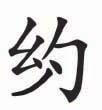

Li Yue-se
He organized some of the books in a fairly conventional way. His dictionary, for instance, has an index that he made himself, with hundreds of English words cross-referenced either by the way they are pronounced in Chinese or by the radical with which the written Chinese symbol begins. (Some might think that the first words for which he chose to learn the Chinese are subtly illustrative: his first index for words starting with the letter v, for example, contains only vagina, value, vanish, vegetable, venture, very, village, virtue, virgin, victory, viscera, voice, and vulgar. An early page devoted to a has just the words ability, affair, add up, age, apologies, and allow.
He also drew up a series of complex, beautifully logical tables to display the various Chinese suffixes—one page of his dictionary is devoted to those that are basically pronounced like -ien; another page is devoted to those ending in -iao; and so on. To accompany these he drew four columns alongside each entry, one for each of the four basic tones of central Chinese speech. Once this was done, all he had to do was add a first letter—m to produce mien, say; or t for tien; m for miao or t for tiao—and then write in each of the columns what each tonal variant signified in English.
His matrix would then show that mien, when pronounced with the first flat tone, means abolish; that mien pronounced with the second rising tone means cotton; and that mien with the falling fourth tone means face or bread. Tien pronounced with the first tone means heaven (as in Tienanmen Square—the Square of the Gate of Heavenly Peace); tien with the second tone means field, or sweet; and tien in the fourth tone means electricity.8 So impeccable and comprehensive is the organization of this particular series of books that they could be used today as teaching aids.
The organization of some of his other books, however, shows Needham at his eccentric best. He constructed a second small Chinese dictionary that dealt neatly, if very unusually, with the 214 very basic Chinese characters called radicals. These fairly simple characters—most are made up of fewer than six strokes; those in the largest group are composed of only four—are designed to show the roots of various Chinese concepts, and they are placed usually to the left of (or less frequently above, below, or to the right of) other characters, so that the combined package makes up the intended, totally new word.
Usually a Chinese dictionary arranges these radicals in order of their complexity—listing those made with one stroke first; followed by those with two strokes; then by those with three, four, five, and so on. Needham realized that with his nearly infallible photographic memory he would be better served by a dictionary that arranged the radicals by the direction and shape of the strokes—putting all radicals that had vertical strokes on one page, all those with strokes that veer to the left on another, and so on. This was a highly eccentric way to do it—and no Chinese lexicographer or textbook author has seen fit to copy Needham’s model—but it evidently worked for him.
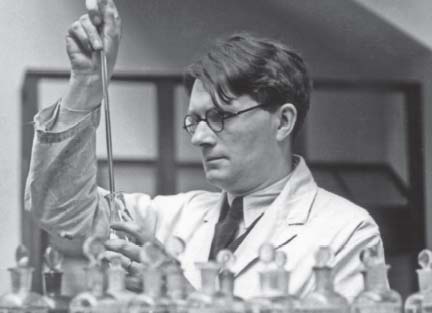
This was the Joseph Needham—bespectacled, tousle-haired, scientifically obsessed—who so enchanted Lu Gwei-djen when they met in Cambridge in the late summer of 1937.
He plowed on like this throughout the spring and summer of 1938—laboring during the daytime at his biochemistry, teaching with his usual eager flamboyance, continuing to present well-received papers to the technical journals, and then, once all his official university duties were discharged, reverting to his newfound intellectual passion. Late into each night he could be seen poring over his dictionary, a pool of light the only illumination in his room, a furiously scratching pencil the only sound, strands of blue cigarette smoke coiling up into the darkness.
By the time autumn had settled on the city, Lu Gwei-djen realized that her lover was well on the way to being fluent and usefully literate. It was a formidable achievement, and the two of them were vastly proud of it. Even Dorothy Needham was sufficiently impressed to offer congratulations, though she spent most of that year and the next sunk deep in her own studies, tactfully keeping out of the way, and pretending not to mind.
But when one is thirty-eight years old, the linguistic corners of the brain are notoriously difficult to penetrate—and at a certain level, in trying to make the leap from simple competence in Chinese to the excellence he demanded, Needham ran into difficulties. He could absorb only so much. Confusion started to trouble him.
Lu Gwei-djen was there in the front line, of course, as helpful as she could be. Soon, however, he decided to bring over to his side some heavy artillery: Gustav Haloun, a young Czech who had been recently appointed professor of Chinese at Cambridge, agreed to give him more formal help, and through 1938 and 1939 the two devised an elaborate dual system for helping Needham learn the deep complexities of the language.
Haloun, who readily recognized his student’s seriousness, decided first to get Needham to help translate an entire Chinese text. It was an obscure fifth-century treatise on philosophy, the Guan Zi; and the task, which took Haloun and Needham four or five hours each week, and which from Haloun’s point of view represented a triumph of enlightened self-interest, utterly absorbed Needham: he later said he found the hours poring over the Chinese text and turning its hundreds of ideographs into elegant English prose a time of serene intellectual bliss. Studying Chinese, he once wrote, was “a liberation, like going for a swim on a hot day, for it got you entirely out of the prison of alphabetical words, and into the glittering crystalline world of ideographic characters.”
He positively adored learning to write the language; and though he tried hard to speak it as well, the written language most engaged him. He understood its particular value in China, and he amply appreciated the notion that a sophisticated and elegant style of writing is seen by all Chinese as a firm indication of intellectual achievement and moral cultivation. And so, by 1939, when war was breaking out in Europe, he began to advance his linguistic competence—and decided to try his hand at the peaceful and contemplative art of calligraphy. Cambridge might have been solace enough, and the ancient courts of Caius College even more so; but to immerse himself in making the sinuous swirls of brushstrokes was to become lost in timeless serenity.
From small Chinese shops huddled in alleys north of Leicester Square in London he bought brushes and scores of long sheets of training paper, traditionally marked with grids in which a student would write the characters. He bought an ink block and a grinding stone, and someone sent him a pad of scarlet seal ink for stamping his name on completed documents—“Under good care it should last you for twenty years,” the donor wrote. And then, in the quiet of K-1, he began to write, with Gwei-djen initially encouraging him to be confident and graceful in his strokes, to find subtlety, to develop a personal style, to keep it legible though artistic.
Even the writing of a single horizontal line—the Chinese character for the number one,  yi, for example—will for a good calligrapher require five or six separate movements of the brush. This was the technique which Needham had to learn, and which occupied his hours during the prewar summer of 1939.
As time went by he did become quite good—passing fair is perhaps the best judgment. He developed a calligraphic style that is quite recognizable and is marked by almost schoolboyish energy and enthusiasm. He never became a master calligrapher, true; but friendly Chinese masters of the craft would tell him that his work showed a passion that made the art its own reward.
And through all this process, and in retrospect perhaps inevitably, he fell in love not simply with the language, but with China itself. He described his feeling as an intense connection, one that arose from his stupefied admiration for the people who, for the last 3,000 years, had made this ancient language the basis of their cultural continuum. The language was China: to love the language was to love China.
So, late in the unexpectedly warm autumn of that year, 1939, when the first German planes were appearing in the English skies and war was beginning to engulf Europe, Joseph Needham decided that he had to get across the world, and see for himself what he now firmly believed was the manifold amazement of this country.
Eventually a war would take him there—not, however, the European war, but the war in the East that had already been raging between China and Japan for the previous two years.
Technically this was an undeclared conflict, widely seen by Europeans and Americans as something of a sideshow. Since it was not a formally declared conflict both Britain and America were officially able to remain aloof, at least to a degree. But it was a war of extraordinary viciousness, one which the writer Lin Yutang would later describe as “the most terrible, the most inhuman, the most brutal, the most devastating war in all of Asia’s history.”
The fighting had broken out in July 1937,9 while Lu Gwei-djen was aboard her liner, edging toward London. She first learned of it on the day she arrived, when she read the evening newspapers. Every subsequent day in Cambridge she scoured the press avidly for news from home; and as China’s tragedies unfolded and expanded, she and Needham followed as best they could the twists and turns of the conflict.
For Lu Gwei-djen it was particularly heartbreaking. Through the summer and autumn of 1937 the Japanese had mercilessly advanced against China’s eastern cities. Pounding attacks on Shanghai alone during the late summer, just weeks after Gwei-djen had left, resulted in the killing of more than 250,000 Chinese soldiers. One of the most famous war photographs of all time—that of a burned, crying baby sitting on railway tracks in the midst of a bombed, ruined city—brought the war into households around the world. There was a tidal wave of sympathy from a public who saw a vulnerable but determined China being pulverized and humiliated by the forces of evil from Japan.
But no foreign government took action; no one helped. The Chinese, isolated and alone, fell back, and back, and back—“the tragedy of the retreat,” in the words of a Chinese officer, “being beyond description.” Japanese amphibious forces landed in November and, supported by bombers from the island then called Formosa and by heavy battleships moored in the Huangpu River, they poured inland along both banks of the Yangzi, their advance not even briefly halted by the carefully built copy of the Hindenburg Line behind which the Chinese had naively thought they might defend themselves.
City by city, eastern China collapsed entirely. The Japanese forces left behind scenes of total ruin: all the buildings smashed, thousands dead, wandering dogs feeding on piles of corpses, and the few survivors staggering through the wreckage like ghosts. Within a month, by the middle of December, Japanese troops were at the old walls of Nanjing, China’s capital, which was Gwei-djen’s home.
The story of the next seven weeks of savagery, of the unutterably terrible “rape of Nanking,” is now as well known as any of the atrocities of the European war. For Gwei-djen, unable to communicate with her family during that winter, the situation was almost unbearable. As it happens, her family survived; but tens of thousands of others died, and often in unimaginably awful ways—gang-raped, bayoneted, set ablaze, beheaded, eviscerated—and the terrified Chinese government was compelled to leave for a new fortress stronghold in the western mountains, Chongqing.
The West still did precious little to help. In America there was great public sympathy for the plight of the Chinese, and its leaders were seen as symbolic heroes. Chiang Kai-shek’s face stared down from the cover of Time magazine, not least because the publisher, Henry Luce, who had been born in China of missionary parents, knew and liked him and his American-educated wife. President Roosevelt offered soothing words—his family, too, had long and intimate links with China, the Delanos having been partners in one of the greatest Chinese tea-shipping firms, and his mother having spent much of her childhood in the family mansion in Hong Kong, Rose Hill.
But the president’s words were hardly matched by any actions of consequence, at least in the first four years of the war. Neutrality was the policy to which the American government was committed, and neutrality was what (certainly in September 1937, two months into the conflict) more than ninety percent of the American public demanded, no matter how sorry they felt for China. Not even the lethal Japanese bombing attack in December 1937 on the American gunboat the USS Panay, moored off Shanghai, caused Washington to change its mind. The Japanese said it had all been a dreadful mistake, apologized, made offers of compensation, and organized a campaign of letter-writing from Japan in which schoolgirls sent handwritten (and identically phrased) condolences to the American embassy in Tokyo. At this stage in its plans Japan wanted no military entanglement with the Americans. Washington continued to say it was appalled by what was happening in China but could and would do nothing. It could not, and would not, become involved. The Neutrality Act did not allow it.
In Cambridge Joseph Needham was apoplectic. He was even more furious when the British government made it perfectly clear there would be absolutely no policy of sanctions against the Japanese. No matter what was happening in China in the late 1930s, Britain would stay out of the conflict.
Not even the fact that the British ambassador to China, the remarkable Sir Hughe Montgomery Knatchbull-Hugessen,10 had been strafed in his automobile in Shanghai by a Japanese fighter plane in August 1937, was severely wounded, and was sent to a hospital for a year in any way diminished the official esteem in which Tokyo was held by Whitehall. Indeed, there was a quiet hope expressed in official circles in London that Japan might be so worn down by a prolonged conflict in the vastness of China that it would be too exhausted to pursue any further imperial ambitions. Cynics and proponents of realpolitik held the view that a conflict between China and Japan was, so far as Britain’s wider interests were concerned, very nearly a good thing.
So British banks were fully allowed to continue doing business with Japan, British ports officially welcomed Japanese ships, Japanese exports were on sale in British shops, and British oil helped fuel Japanese tanks and warships. In other words, business as usual.
Needham’s opposition to his country’s stance on the war was born of his deep commitment to socialism on the one hand (which had been powerfully reinforced by a journey he had made to Moscow two years earlier), and a lover’s solidarity with his mistress on the other. At every opportunity he went to London to march, and to hand out pins with red-and-blue lapel flags printed with his own version of the seasonal message: “Help China. Don’t buy Japanese toys at Christmas.” He wrote letters to the newspapers, always on the Caius College letterhead, which tended to guarantee their publication. He was also a prominent backer of the famous Left Book Club, which was a powerful champion of China’s cause and which (by way of its publisher and founder Victor Gollancz) put out many of the pamphlets that explained—from a leftist point of view, of course—the situation in China to its 60,000 members across the country.11
His older and more staid colleagues in the Senior Combination Room at Caius made it clear that they were uncomfortable with his behavior, that they feared the erratic behavior of this proto-Bolshevik in their midst. But Needham remained adamantly defiant: the situation in China was dire, and he was not about to change his mind or remain quietly at home, simply because of the dignity conferred on him by his position as a Cambridge don.
Any of the old guard at Caius who suspected he might have been slacking had only to look at evidence showing that he was still working diligently at his biochemistry. Following his three-volume book on embryology in 1930, when he was just over thirty, he now completed a second massive book on morphogenesis—the process whereby a living creature becomes endowed with its particular shape and form—in 1939, before he had reached forty. “Dorothy and I used to walk from the laboratory to join him for tea in his rooms in College,” wrote Gwei-djen. “Welcoming a break, he would jump up from his desk, stoke the fire of coal and wood logs, and make tea for us, humming and singing folk songs all the while. Then he would show us the pile of pages he had written on the typewriter that day.”
Acclaim for the new book was well-nigh universal—especially in America, where he toured in 1940 to give lectures at the great universities of the East Coast. A reviewer at Harvard—who of course had no way to know what was coming two decades later—declared that Biochemistry and Morphogenesis, as the book was called, “will go down in the annals of science as Joseph Needham’s magnum opus, destined to take its place as one of the most truly epoch-making books in biology since Charles Darwin.”
Moreover, he completed this book while he was still campaigning in England and lecturing in America for recognition of the plight of the Chinese, and at the same time was busy teaching his students, writing his half-crown monograph (as Henry Holorenshaw) on the history of a particular branch of English socialism, regularly giving morris dance performances, swimming naked, attending meetings of the Cambridge Communist Party, offering sermons from the pulpit at Thaxted Church, and living through the manifold complications of his peculiarly organized love life.
It was perhaps merciful that late in the summer of 1939 Lu Gwei-djen left Cambridge for California, initially to attend the Sixth Pacific Science Congress. She then decided to stay on: she had an offer from Berkeley that she felt bound to accept—and Needham, in Cambridge, agreed, because he was eager to further his mistress’s career and because he came to America often enough. So the affair continued, at long distance, its ardor undiminished, with just the logistics making matters a little more trying.
Through this whirlwind of activity Joseph Needham started to become famous—and famous, above all, in England during the early days of the war, for being one of China’s most vigorous champions. This fame was to become central to his future, largely because of a secret meeting in a house in North Oxford one foggy November evening in 1939, when a group of wise men decided that, if it was at all possible, Needham should go to China on a mission.
The key figure in this endeavor was a young Chinese professor of philosophy, Luo Zhongshu, who was about to leave for China after a stint teaching at Oxford. He had held a professorship at a university in the city of Chengdu, and while he was at Oxford he received regular letters and telegrams from his former colleagues there, telling him in unsparing detail just how bad the situation was for them at home.
Japan, it turned out, was engaged in a full frontal assault on China’s entire education system. The Japanese military apparently had a deep-seated loathing for China’s intellectual community, and this disdain was now manifesting itself in acts of brutality aimed specifically at China’s universities. Colleges in the cities of Shanghai, Wuhan, Nanjing, and Guangzhou had been selected as early targets for bombings. Nankai University in Tianjin had been repeatedly bombed, and its ruins were set ablaze with kerosene. The main university in Beijing had been initially stripped by looters, and its academic buildings were converted into brothels, bars, and stables for the use of troops, while its deanery and sanitarium were made into hospitals and barracks for the Japanese defense forces based nearby.
To people in England already steeled to the plight of China’s civilians—information about the “rape of Nanking” had leaked slowly and steadily out to the West, shocking all who heard it—the news of savagery being directed at China’s intellectuals was stunning. And when Luo began to make speeches to university audiences across England claiming that of the 100 colleges then operating in China, no fewer than fifty-two had been destroyed or badly damaged in the fighting, his listeners were shocked. Any tragedy that extended its reach into a country’s education system was seen as particularly dire. If China’s intellectual community was not to go into a terminal decline, then the West—and Britain in particular—had to help quickly.
Professor Luo eventually took this message to a gathering where he thought that shock might be more readily converted into action. It was a meeting of senior wise men from Oxford and Cambridge who assembled on November 15, 1939, in Norham Gardens at the house of the famous religious scholar H. N. Spalding, who was then Oxford’s professor of eastern religion and ethics. Luo stood before the group and launched into what his listeners remembered as a vivid description of a new and tragic development: because of the Japanese attacks, entire Chinese universities were now having to take the hitherto unimagined step of fleeing, pell-mell, into the supposed safety of the Chinese hinterland.
The audience members expressed their dismay—and then a determination that the British government should be persuaded of its moral duty to intervene in some way, to help the cause of China’s intellectual survival. It was swiftly agreed that a team of sympathetic Britons should be sent to China immediately, and that they should be charged with assessing the situation further, with finding out exactly what was needed, and how, precisely, any official help from the British government might best be directed.
It took little time to decide on the ideal candidates for such an expedition. Two names presented themselves. The first was that of a man on their very doorstep: the Oxford University reader in Chinese philosophy, E. R. Hughes, who had formidable connections to the Chinese government, had a background of a quarter century working as a missionary deep in the Chinese countryside, and since his return to England had developed many connections to the inner sanctums of Whitehall.
Joseph Needham was the second man to be put forward. He was something of a wild card, since all at the meeting knew he had never once been to China. But his intelligence, his exceptional linguistic abilities, and his very vocal passion for the rights of the Chinese people counted for much. Once his name was put forward that evening, it was unanimously accepted. And so Professor Luo wrote to him that very night, asking formally if he might be interested in taking part in a mission to China that would be of vital importance for the country’s future.
Naturally, when Needham received the letter a few days later both he and Lu Gwei-djen (to whom he wrote in America) were excited beyond belief. All his months of marching, carrying placards, and writing letters—and perhaps even his halting attempts at calligraphy—seemed at last to have paid off, to be on the verge of bringing results. Someone was listening. The Chinese might get the help they wanted. And he might now actually be sent off to work in the country that so captivated him.
But there was nothing definite, and much work still to do. There were many meetings and exchanges of letters that winter—sessions in Cambridge, sessions in London, the formation of committees, exchanges of telegrams (“At this time of great danger your efforts have brought us some comfort,” read one, from university professors stranded in Kunming), and finally the issuing of a number of formal “statements of intent” indicating that Britain’s finest universities were now bent on full cooperation with their opposite numbers in China.
Needham wrote to the Chinese ambassador. “My wife and I are desirous of going to China to help the rebuilding of scientific life…. I had no interest in Chinese affairs until three years ago, but now I can speak and write Nanjing Mandarin.” The ambassador was warmly enthusiastic, but he warned Needham of the conditions: “Those who have gone to China,” he said, “have a pretty hard time.”
It took eighteen months of diplomatic dithering and negotiation before Britain finally made the decision to send him. The British Council—the culturally evangelizing arm of the British Foreign Office—was the first organ of Churchill’s government to become formally involved. It did so first by way of a bland statement in the summer of 1941, to the effect that “it was extending its work into the field of Chinese intellectual cooperation.” Six months later, in the spring of 1942, the head of the council’s science department, J. G. Crowther—a former contemporary of Needham’s at Cambridge and the science columnist for the Manchester Guardian who had famously first reported James Chadwick’s discovery of the neutron—wrote privately to Needham. He had a vital and top-secret message:
An urgent request from high quarters has arisen for an Englishman to go to China. There are great physical difficulties in transporting anyone to Chongqing at present, [but] it should be possible to secure the necessary places in planes.
He who goes would have to be ready for anything.
It was the moment Needham had been waiting for.
And it was a moment that had come simply because a diplomatic logjam had finally been cleared. Japan had attacked Pearl Harbor early in December 1941, and America and Britain had at last declared war. There was now no longer a need for any diplomatic niceties so far as Tokyo was concerned. Help could now be offered to the Chinese formally and publicly, and without even the slightest care as to what Japan might think.
Whatever Needham might have thought privately about these months of diplomatic realities, when he read Crowther’s letter—as he did a dozen times over—there was no doubt. His heart leaped. He was now going to China, for sure. He had no idea just who “in high quarters” had come up with the idea, but it now appears that the request had an unlikely origin: the great scholar Sir George Sansom, an expert on Japan. At the time, Sansom was the senior civilian representative on a little-known body, the Far East War Council, which was based in Singapore and essentially decided how Britain should best prosecute its side of the conflict in the world east of Suez. It was probably Sansom’s suggestion that Needham, a Chinese-speaking fellow of the Royal Society, and a senior figure who was intimately connected with British scientific research, should be the one to go; further, it was likely that this decision would have been approved at a higher level still—quite possibly in Downing Street, by Winston Churchill.
It had been agreed, said Crowther over a lunch in London a few days later, that by living in and visiting learned institutions all across “free China,” Needham could find out exactly what was wanted by the Chinese—textbooks, laboratory equipment, reagents, visiting experts—find out where it was wanted, and have whatever could be sent, sent. “I was to do everything in my power to renew and extend the cultural bonds between the British and Chinese peoples,” Needham told a London newspaper. And that, he suspected, was only half of it. For he was to go out only partly as the Royal Society’s representative; more prominently, he was to go as a diplomat—the head of a new body to be called the Sino-British Scientific Cooperation Office, which Whitehall had decided was to be officially attached to the British embassy in Chongqing.
During the summer the mechanics of his journey were worked out. His rank at the embassy would be satisfyingly senior—that of counsellor—so his Chinese counterparts would take him seriously and accord him respect as a high panjandrum, a full representative of the British crown. His salary, while not likely to make him rich, would be such that “when you return to this country after your visit your bank balance would be the same as if you had not gone out to China.” Anyone wishing to make contact with him by letter should write by way of the British Council at either Hanover Street, W1; the Dupont Circle Building in Washington, D.C.; or the Reserve Bank Building, Calcutta.
He first told Dorothy, who was naturally happy, but concerned about the very apparent dangers of the trip. First, he would have to get to India by sea, either in a naval vessel on convoy duty, or more likely in a cargo ship—a risky business in itself, since the European and Mediterranean waters were crawling with Axis raiders. He had done some research that suggested it might also be possible to get to India by way of New York and either Lagos or Durban, doubtful though this sounds. But the British Council dismissed this somewhat eccentric idea, arguing that delays in all three cities could amount to months.
He would be given only forty-eight hours’ notice of his journey, so he would need to have his bags packed at all times. He also had to obtain an exit permit allowing him to leave Britain. It would probably be uncomfortable onboard ship, and he would be obliged to share a cabin with as many as half a dozen others. They would probably be cooped up for as long as ten weeks: because of the zigzagging routes needed during the war, this was the routine time for a voyage between the Thames and the Hooghly in 1942.
Calcutta was the preferred jumping-off point for free China—the place where Needham would get his papers and his marching orders. He would then fly into China over the infamous “Hump,” a rickety and spectacularly unsafe air bridge that was then being organized by American freelance pilots, who flew Dakotas and kindred planes over the eastern Himalayan ranges between British Indian air bases in Bengal and the encircled free Chinese cities in Yunnan.
Once the arrangements were made he decided to go to America and tell Gwei-djen. Her initial appointment in Berkeley had been cut short, because it turned out she had a nearly fatal allergy to the Bay Area’s omnipresent acacia flowers. After a stint at a hospital laboratory in Birmingham, Alabama, she took a research position at Columbia University in New York—which is where Joseph Needham, who had been writing to her weekly during her absence, decided to meet her in the late autumn of 1942.
The exigencies of war made his date with her decidedly nontrivial. To reach her he had to take Pan American Clipper’s circuitous flying-boat route—first from Poole in Dorset to Foynes in southwest Ireland; then to Lisbon in neutral Portugal; then, since the early autumn weather was poor and the Atlantic headwinds were too strong, across to the coastal town of Natal in Brazil; and only after this giant leap by way of a further long flight up to the Hudson River landing site off Manhattan.
The Clipper’s manifest, which listed him by his long-unused first name, Noël, stated his affiliation as “British Foreign Office.” The American ambassador in London had used this ruse in a letter he had sent to the State Department a few days before, asking that the War Department grant Needham—“a friendly enlightened liberal”—priority on a plane to China, “via Brazil, Africa and the Middle East, or by way of Australia and India.” But despite Needham’s apparent willingness to get to China by way of almost anywhere on the planet, the department was unsympathetic: even if he could get permission, he would have to spend weeks cooling his heels at various American military airfields. It would be far less time-consuming for him to go by ship. So his journey to America on the Pan American flying boat may have been officially sanctioned—by the British war minister, Anthony Eden—but it turned out to have little official purpose. It was an officially sponsored journey that enabled him, first and foremost, to visit his mistress.
The pair met at the Manhattan dockside, and immediately checked into a hotel. Her apartment on Haven Avenue was too small and, after all, it had been some months since they had seen each other properly. He had already written about the government’s decision in principle to send him to China: now, after his dozens of meetings in London, he could flesh out the details for her, and he could ask for advice on places to visit and people to see. It was an exceptionally happy few days for both of them. His love affair with China, and his deep affection for her, had at long last borne fruit. He was off to China, and the very distinctive and very different second half of his life was about to begin.
During those few days in New York Needham also told Lu Gwei-djen of a kernel of an idea that had suddenly come to his mind.
It was an idea that had originated some weeks earlier. Among the letters that he had exchanged with Crowther during the summer of 1942 there is a reference to an essay that Needham was then considering writing: it would be on the history of science and scientific thought in China. A few days later he received invitations—probably initiated by Crowther—from both Nature and the BBC, asking him to write impressions of his forthcoming trip. On the letter from the BBC he scribbled a brief note to himself. It said simply: “Sci. in general in China—why not develop?”
“Science in general in China,” he seems to be writing—”Why did it never develop?” In New York, he discussed the idea with Gwei-djen, and wondered out loud if he might one day turn this thought into a book that would explain to the western world just how profound and enormous was China’s scientific contribution.
He could hardly have wished for a better audience than his diminutive, intense, pretty, and very intelligent young Chinese paramour. For many years she had been hammering into his head a notion first planted in her mind by her father in Nanjing—that China had made an immensely greater contribution to world science and technology than anyone in the West had ever acknowledged. According to the generally received wisdom, only a handful of the more enduring inventions had actually originated in China—and yet this belief, she and her father had said repeatedly and insistently, was nothing more than an arrogant conceit of the West. The two of them were perfectly convinced that China had invented scores upon scores of other things of which the West was conveniently ignorant. Perhaps, she asked, Needham could just try to find out what these things were.
By the time he got home to England, the press was in a frenzy. The communist Daily Worker had reported exclusively that one of its own—never a paid-up party member, to be sure, but a man quite content to be known as a fellow traveler—was off to China, to give the help for which socialists had long been campaigning. Perhaps, the Worker said, Dr. Needham would find time to meet and befriend Mr. Mao Zedong, whose revolutionary exploits the newspaper reported as often as it could, and whose ultimate political victory in China was a consummation, in the view of the paper’s editorial writers, devoutly to be wished.
The mainstream press also reported on Needham’s forthcoming trip. The Evening Standard, in particular, which wrote more than once of how this “big and exuberant man,” who, “at 42, is one of the most brilliant biochemists in the world,” was off to show that “he was perhaps the only English scientist who can discuss Chinese philosophy in fluent Mandarin.”
There were a few weeks of limbo, when Needham went back and forth between Cambridge and London, working out further details. He found it all rather irksome. “9 a.m. War Office,” reads his diary for a typical day in London. “11–1 British Council. Lunch Dorchester. 3–4 House of Commons. Cavendish Café w/Ken Turner, U.S. Embassy; 5:49 home.”
He also spent time lunching or having tea with people associated in some way with China. He met, for instance, the Foreign Office librarian, Sir Stephen Gaselee, whose formidable intellect (his obituary remarks that he was renowned as “a Latinist, Coptologist, medievalist, palaeographer, liturgiologist, and hagiographer”) more than matched Needham’s own. The American ambassador, John Winant, had him over; David Crook, the Stalinist spy and lifelong British communist, wrote a letter of introduction to an American journalist in Chongqing, Jack Belden, who he thought could introduce Needham to the Communist leader Zhou Enlai, and through him maybe to Mao Zedong; Julian Huxley, the biologist, called to wish him luck; Arthur Waley asked to meet Needham, in London; and the Chinese ambassador, Dr. Wellington Koo, took him to lunch. Needham remarked that he could well have spent the rest of the year dining with all those in London who had any interest in the situation in China, so eager were they to spend time with him.
But then, on November 19, there came a telegram from a junior official at the Foreign Office. The ship was ready, it said, and would begin boarding in a few hours. The sea journey east should take ten weeks at the outside: Christmas would be spent somewhere in the Red Sea; the New Year would be celebrated at Bombay. In the confidence that the vessel would tie up at the Hooghly docks in early February, seats had been secured on an American military plane which was due to fly over the Hump from Calcutta, and which was due to depart in the fourth week of the month. If all went according to schedule Joseph Needham should arrive in the Yunnan capital city of Kunming on Wednesday, February 24, sometime in the afternoon. He should get his bags and leave immediately.
The next entry in his diary shows that he did as he was told—for on February 3, 1943, he was indeed in Calcutta, performing a curiously unexpected task before finally leaving for China. He was, the officials explained in justification, a British diplomat who was about to travel in a country embroiled in a war with Japan. It was imperative, they told him, that he carried a sidearm, just in case. He had therefore been officially instructed that he was obliged to get himself a gun.
And so on that hot February day this tall, bespectacled, and in appearance classically absentminded professor left his billet overlooking the Calcutta maidan and walked to the Fort William army depot. From the armorer there he procured a pistol, a Webley No. 1 Mark VI—the classic British service revolver of World War I, deemed still suitable for a diplomat even though the soldiers were being issued a smaller and lighter replacement. He was given eighteen rounds of .455 ammunition, and warned that, should he ever have occasion to fire the weapon, it would deliver “quite a kick.” He signed it out, agreeing that it was being issued on loan, and that it must be “returned when no longer required in connection with your present work.”
Now, duly armed, and in all other senses bucklered and spurred, he was fully prepared for his expedition. He waited for three pleasing weeks—for Calcutta, in late winter during the war, was a city filled with amusement and delight. Finally came the appointed day: February 24, a Wednesday. He rose at dawn, as ordered, and was driven in a British army jeep to Dum Dum airport outside the city. Here he boarded a C-47 of the Army Air Corps Ferrying Command, bound for Dinjan in Assam.
The plane rose through a morning fog, headed northeast, and after two hours of juddering, noisy flying touched down on a soggy plateau in the valley of the Brahmaputra. A quick refueling, a change of crew, and the plane was airborne again, heading now over the great rock pile of the Himalayas, and across to the international frontier.
Needham gazed out of the aircraft windows, far too excited to sleep. Range after range of gigantic mountains, glaciers uncoiling between them, rose up before and beneath him, their sharp peaks reaching closer and closer to the plane’s underbelly as the pilot tried frantically, by making enormous spirals, to reach a safe altitude. The altimeter read 17,000 feet by the time they reached the top of the ranges, and everyone aboard was cold and gasping for breath.
He tried to write a poem to celebrate, but (perhaps rather happily for his readers) there was too little oxygen in the cabin, and his mind wandered. Instead he read some Lucretius, complaining in the margins about the translation. And then the frontier was crossed, and the plane began its slow descent over the deeply incised valleys of the Salween and Mekong rivers, for Yunnan.
This was the moment he had so long anticipated. It was Wednesday afternoon, teatime, on February 24, 1943; and just now, less than a score of miles ahead of the plane, all China waited for him.