
FIVE
On the Fundamental Ideas of Chinese Science
Heaven has five elements, first Wood, second Fire, third Earth, fourth Metal, and fifth Water. Wood comes first in the cycle of the five elements and water comes last, earth being in the middle. This is the order which heaven has made. Wood produces fire, fire produces earth (i.e. as ashes), earth produces metal (i.e. as ores), metal produces water (either because molten metal was considered aqueous, or more probably because of the ritual practice of collecting dew on metal mirrors exposed at night-time), and water produces wood (for woody plants require water). This is their “father-and-son” relation. Wood dwells on the left, metal on the right, fire in front and water behind, with earth in the centre. This, too, is the father-and-son order, each receiving the other in its turn. Thus it is that wood receives from water, fire from wood and so on. As transmitters they are fathers, as receivers they are sons. There is an unvarying dependence of the sons on the fathers, and a direction from the fathers to the sons. Such is the Dao of heaven.
—FROM CHUN QIU FAN LU, BY DONG ZHONGSHU, 135 BC; EXPLANATIONS BY JOSEPH NEEDHAM, 1956
From Science and Civilisation in China, Volume II
Senior members of Cambridge University usually are granted, as one of the perquisites of their standing, permanent rights to a college room or suite of rooms fashioned for two functions: scholarship and sanctuary. Some rooms in the relatively modern colleges are rather ordinary, more monastic than majestic. Some, such as those looking out over the river and the lawns at King’s, are enormous and sought-after: ancient grandeur personified. A room in a court at the heart of Gonville and Caius College, one of the senior collegial institutions of the university, is—because of its vast history—likely to be a particularly agreeable place, a perfect little gem, a home to be cherished by anyone fortunate enough to be granted the right to live there.
The entrance to such a room will probably be a pair of ancient oak doors folded one against the other, the outer one to be occasionally closed, or “sported,” to indicate “Do not disturb.” There will be small mullioned windows, edged with weathered limestone, that look out onto a panorama of lawns and shrubberies. There may be a window box, with gillyflowers or honeysuckle, their fragrance wafting in during the long summer evenings. There will be a small sitting room, with a stone fireplace that is slightly larger than necessary, ensuring a fug on even the rawest of winter days. Often there will be a two-bar electric heater, to take the chill off the room first thing. The bedroom will be tiny, spartan, and seldom with enough cupboards. The plumbing will be elderly, and British.
Of course it is quite possible for the occupant to make himself toast or crumpets on a fork in front of the electric fire, and perhaps even to brew tea in a pot suspended over the coals. But other than that there is no need to cook, since both the combination room and Hall are just a stroll away. Tradition requires that the college provide the service of a congenial woman of uncertain age known as a bedder, to look after your laundry, wash your dishes, and empty your wastepaper baskets.
A good college room at Cambridge, where generally the only disturbance comes from fellows crossing the lawn (students are forbidden to cross it), or from the old clocks around town chiming the hours, is very much a place to keep. It is a place that, once granted, is to be held on to with tenacity and pleasure, to be abandoned only for the grave.
Joseph Needham had secured his tiny suite of ground-floor rooms, identified (since they were on staircase K) by the initials K-1, in 1930. He had been given them on the retirement of their previous occupant, his old tutor, the biologist Sir William Bate Hardy. They were ancient—they had been designed in the 1560s to house an entire group of students—and despite having been paneled in the early eighteenth century and redesigned for the use of one student alone, they were still very cramped. Needham further compressed the available space by cramming it with floor-to-ceiling bookshelves so that only the tiniest of assistants could creep between them. He liked their snugness, however, convinced that it helped keep them warm and cozy through the bleakest Cambridge winters.
Much happened during the six and a half decades of his tenancy. Dozens of wars would be started, fought, and finished. Communism came and, at least from Europe, mostly went. Four monarchs presided over Britain’s affairs during his stay, and thirteen prime ministers—Ramsay MacDonald being the first. Herbert Hoover was in the White House when Needham first occupied his room. And whereas other dons tended to work in libraries or laboratories, Needham made most use of this tiny bastion of scholarship deep in the old center of his college: for all the many years he occupied them, the rooms were witness to a ceaseless whirlwind of thought, activity, and creation.
The work began almost immediately, and Needham let it be known throughout the college that his firm intention was to hit the ground running. He arrived from Paris in March. He spent most of April unpacking, brushing the combined dust of China and France from his well-worn boots, and reestablishing himself among the other dons of the Caius combination room. By the end of the month he rolled up his sleeves, opened a fresh packet of the tiny black Burmese cheroots he now liked to smoke, and set about typing out the formal beginnings of his project. Two weeks later, on May 15, 1948, he sent off by college messenger a short document: it was addressed to Cambridge University Press and it was red-stamped with the single word “Confidential.”
The document was twelve pages long, and it was headed “Science and Civilisation in China”—the first time these five words had been assembled into the title that they would eventually form. Needham immediately got to the point. This, he wrote, was a “Preliminary plan of a book by Joseph Needham, FRS. It will be addressed, not to sinologists, nor to the general public, but to all educated people, whether themselves scientists or not, who are interested in the history of science, scientific thought, and technology, in relation to the general history of civilisation, and especially the comparative development of Asia and Europe.”
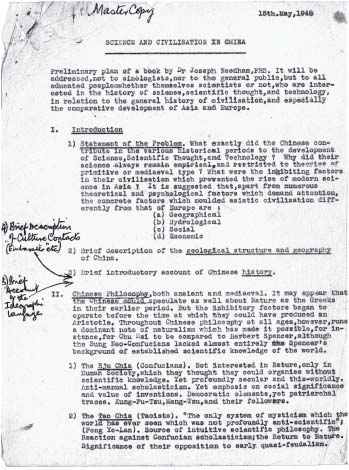
Needham’s original proposal for the Science and Civilisation in China project. He envisaged it would make one large volume: so far it is twenty-four volumes, with still more in preparation.
As a statement of intent this single sentence would remain unchanged through the entire making of the book. It was a statement that indicated, if subtly, that the book was going to be two things.
Needham intended the book to address, on one level, the entire history of science in China. But on another it was also—and perhaps rather more importantly—to be a history of how the science and civilization of all humankind had developed, and the story of how over thousands of years China, in relation to the general history of civilization, had contributed to this development. It was Needham’s considered view that China had contributed to a far greater degree, and far more actively, than all other nations, and moreover had done so far more than was either known or recognized.
He underlined this point in a speech to the China Society in London: “What is really very badly needed is a proper book on the history of science and technology in China…. It would have a wide bearing on the general history of thought and ideas.”
The notion that China had for centuries been unconnected to these thoughts and ideas, and had stubbornly remained on the sidelines of the world’s development, was now to be swept away, once and for all. With this set of books, Joseph Needham—a man who was neither a specialist on China nor a historian but a biochemist with no reputation for scholarship involving the story of human civilization—intended now to bring out the evidence, thrust the Chinese into the spotlight, and tell the world in detail of the debt it owed to these remarkable, ancient, highly cultured people.
Cambridge University Press accepted Needham’s proposal readily, with little debate or demur. Not that anyone at the press had any illusions: the undertaking would surely be formidable and very costly, and as a commercial venture was unlikely to make a profit for decades. But university presses are not generally established to make a great deal of money, and Needham’s early plan did not make the project seem unmanageable: the initial proposal suggested he could accomplish all in a single volume, and the letter of reply from the press dated May 22, 1948, formally accepted this as a target. Within weeks, however, reality apparently struck home, and Needham revised his estimate upward, dramatically. He could now do it in seven volumes—no more! he felt obliged to promise—and moreover he could finish them all with what in the academic publishing world might be regarded as dispatch. With the same self-confidence—or hubris—that had characterized the founding editors of the Oxford English Dictionary a century before, he airily told the Syndics, the wise men who form the editorial board of the press, that his project could and would be finished in what for an academic work would be fairly short order. Ten years, he thought, at most.
Not everyone accepted the plan with the same equanimity. It was swiftly pointed out by a small group of naysayers that as a reader appointed by the university, Needham was still officially supposed to be teaching—that, after all, was why he was paid. Some graybeards in some combination rooms felt that instead of writing a book about China he should simply stick to teaching undergraduate embryology and carry on with his research into the mysteries of such biochemically fascinating substances as inositol, which had occupied him six years earlier, before he had taken off for Chongqing in 1942. It might be better for all concerned if he simply stopped meddling in matters for which he was not officially qualified, and which thus should not concern him.
But luckily only a very few took so stringent a view, and within weeks Needham’s interest in China was formally recognized by the university, and he was granted official leave to teach just biochemistry. He no longer had to be cumbered with the irksome responsibility of supervising graduate students. That was one small victory. A few weeks later came a second: he was told he need no longer teach at all; nor did he even have to turn up again at the department of biochemistry. He could instead remain in his college and draw up his plans for the books there, full-time.
This eventual consensus from his academic colleagues was a credit to his very apparent doggedness. Everyone suddenly came to realize that this extraordinary man would go on to create his magnum opus one way or another. Moreover, if it was ever completed it might well bring luster to the university’s reputation—and so it would be foolish to let such details as teaching the complexities of the Krebs cycle to nineteen-year-old undergraduates stand in the way of the project. From the summer of 1948 on, he was essentially set free. “It was a schizophrenic period,” he was later to write, “but in the end I was able to follow my star without distraction.”
So pleased were the fellows of Caius College to have the undivided attention of their most eccentric member that they then allowed him to act as temporary librarian, a task which suited him perfectly. Still, when he first visited the Caius library, ancient, revered, and rich with the smell of old leather and beeswax, he was vividly reminded of the insularity of those among whom he worked: vast oak bookcases were devoted to subjects such as constitutional history, ecclesiastical history, local history, and European history; but there was just a single tiny shelf labeled “Outside World.” It was an imbalance he set himself promptly to correct.
Despite Needham’s manic energy and infinite resourcefulness he quickly realized—especially when looking over his own ever-expanding library—that he was going to need an assistant. The man he chose, who would loyally remain with him for the following nine years, and help oversee the publication of the first three volumes, was the Chinese historian Wang Ling. The two men had met in China in June 1943, when Needham stepped off a downstream ferryboat and found the almost evacuated headquarters of the Academia Sinica, in the city of Lizhuang on the banks of the Yangzi.
Wang had been so stimulated by a lecture Needham had given to the academy members that he decided, there and then, to research all he could possibly discover on the history of gunpowder. So impressed was Needham by his eventual efforts that he asked Wang to come to Cambridge once the war was over, and lend him a hand with the project, if it ever took off. Five years later, almost on the anniversary of their first meeting, Wang Ling arrived in Cambridge from Shanghai to take up a position at Trinity College, and to assume a formal post as assistant editor of Science and Civilisation in China. The pair collaborated, became fast friends, and remained inseparable for the rest of their lives. In the early days Needham even shared half of his university salary with Wang, until the Cambridge University Press saw fit to pay Wang a decent wage.
Before work could begin, Needham realized he would have to assemble in one place his ever-enlarging research collection of books and papers on China. There were thousands of them—some valuable, some worthless. All of them had been sent from China piecemeal as the war dragged on, or had been flown back by the Royal Air Force at the end of Needham’s tour, as part of the nearly limitless allowance that was then offered to repatriated diplomats. The boxes and crates that the Chinese freight loaders had jammed into the holds of westbound cargo planes held pile upon pile of books, papers, and manuscript texts that Needham had begged, bought, or borrowed during his years in China. Among them were some very rare items: he had bought ancient wood-block books, for instance, whose export would be strictly banned once Mao came to power in 1949. But Needham had good friends at both the Ministry of Culture and the Academia Sinica, and he continued to be sent banned materials until at least 1958, whatever the regulations.
All through that early summer Needham arranged these books, shelved them, classified them, and filed the papers. The task seemed to require an almost superhuman fortitude. And it was to become, very suddenly, a great deal worse.
Without any warning a large number of wooden tea chests and still more crates and cartons began to arrive at the Caius porters’ lodge—and each one held a vast quantity of even rarer and more obscure papers and books, not one of them collected by Needham or by anyone especially familiar to him. They were, it turned out, a gift.
The boxes had all come from a man Needham had met in China but had almost discounted at the time and had quite forgotten since his return. He was a paleometeorologist, Dr. Zhu Kezhen, who in 1944 was president of Zhejiang University, called the “Cambridge of the East.” As with so many Chinese universities, the war had obliged Zhejiang to move from its site near Shanghai to a temporary home in the grimy, impoverished town of Zunyi, in China’s farther west.
Dr. Zhu, who had a particular interest in the climatic history of China, had been doing his level best to maintain Zhejiang’s national reputation—and part of his plan was to ask for a visit from Joseph Needham of the British embassy, who might supply British and American textbooks and equipment. Yet he evidently had made little impression on Needham, who mentions him only briefly in his contemporaneous notes, marking him down simply as “China’s leading meteorologist” and reporting no special conversations or memories.
Needham did tell Dr. Zhu that he planned to write a history of Chinese contributions to world civilization, but that was all. Needham’s diaries note that he was actually much more captivated by researchers at Zhejiang who were doing work on the mechanics of silk, color-pattern inheritance in ladybirds, the presence of flavonoids in jujubes, and the high levels of ascorbic acid in the local Chinese rose hip.
He had no inkling of the enormous impression he made on Dr. Zhu—who seemed, as he later recalled, a rather taciturn and distant man. Zhu, however, had thought deeply about Needham’s plan to write a book and realized that he could be in a unique position to help.
So as soon as Needham had returned to England, and by the time the Japanese had scurried home and the political and military situation in China became somewhat more stable,35 Dr. Zhu started collecting books and papers for him, packing them securely, and sending them to Cambridge by ship.
One particular item Zhu sent turned out to be of extraordinary value, in terms of both money and of usefulness. It was a complete copy of an edition of 1888 of what was then and remains today perhaps the largest book in the world: the imperial Chinese encyclopedia, Kuchin Tu-shu Chi-cheng (Gujin tushu jicheng, in pinyin) or The Complete Collection of Illustrations and Writings of Ancient and Modern Times. This was a distillation—or rather a conflation, since nothing seems to have been left out—of everything that was known to the greatest minds of the capital city of the Celestial Empire. It was the sum, in other words, of all Chinese knowledge.
The book36 had been commissioned in 1700 by the Kangxi emperor—one of the earliest of the Qing emperors, and, with his reign of sixty-one years, the longest-serving in all Chinese history. It took its authors twenty-six years to complete, and when first published, having been printed with movable bronze type at the Peking Imperial Printing House, it reputedly contained 10,000 volumes and 170 million characters.
The definition of volume was then somewhat different from our own—the word section or fascicle might be more appropriate. The edition Needham received, which was created a century and a half after the first (and which, because of its fragility, is now packed away in boxes in Needham’s archive), comprised very nearly 2,000 books: the edition currently at the Library of Congress in Washington sports almost 6,000. Also, the word anthology might describe the work most accurately—it is not alphabetical but topical, and it is essentially a collection of everything important that had ever been written down in Chinese. Its usefulness to Needham was paramount. His debt to Dr. Zhu turned out, as he later readily admitted, to be incalculable.
Once the books were in place and the rooms more or less in shape, a routine was soon established, as well as a commute. Joseph and Dorothy owned a house a little more than a mile away from the college, at 1 Owlstone Road. When Lu Gwei-djen returned from Paris in 1957 she would live a few yards away from them on the same street, at number 28, conveniently for all purposes. The walk between home and college—or the drive; Needham loved driving, and at irrationally high speeds—was fantastically pretty: in springtime and in summer the half hour it took to cross the lawns of King’s College, to stroll under the chestnuts beside the Backs, to pass down along the Cam by way of Newnham Road, and, finally, to cut through the rabbit warren of Edwardian houses to Owlstone Road, presented as perfect a cross section of Cambridge’s loveliness as any tourist might desire.
Although Needham kept a vast amount of Chinese paraphernalia at home, most of the work on the great project was accomplished in his rooms at Caius. Day after day he and Dorothy left early each morning—if the weather was dry, going by one of several footpaths across Coe Fen; if it was drizzling, keeping to the streets and crossing the Cam by the Silver Street Bridge—then walking together first to Dorothy’s biochemistry department on Tennis Court Road. Then Joseph would finally press on alone along King’s Parade and to the porter’s lodge of Caius. If he was for some reason on his own, and the weather was fine, he rode his bicycle.
He cut an impressive figure, at least in part because he was so tall and broad, built like a bear. He invariably wore a dark suit, pin-striped, double-breasted, rumpled. The collar of his shirt, freshly laundered, was nevertheless always disarranged; his tie was askew; and his shoes, though clean, were scuffed, the laces frequently broken and retied. He kept his brown tortoiseshell glasses well polished, however. He parted his thick hair on the right, and was careful always to have it well brushed, though it was usually just a little too long.
There was a dusting of ash on his lap, but during the composing of the book he set a firm rule: he would take no cheroot or cigarette before noon. He was fiercely disciplined in this: as the morning wore on he would peer anxiously at the college clock—with one cylinder of tobacco already out on the desk, and his box of Swan Vestas at the ready—and the moment it struck twelve he would light up, and then smoke like industrial Pittsburgh for the rest of the day. He kept the cigarette in his mouth all the while, his head wreathed in ribbons of curling blue.
Once in K-1 he sank into a brown study, and remained there, stolid and undisturbable, for hour upon Chinese hour. Only Wang Ling could interrupt his reverie, to pass him a paper, look up a reference, or translate one of the finer points that no dictionary or encyclopedia could settle. Once started each morning, Needham worked nonstop, often until long after dark.
He employed neither a typist nor a secretary. He typed everything himself on one of his Royal typewriters—either a black portable, which he carried in its venerable case, covered with airline stickers; or a large Royal desk machine37 with an extra-wide carriage. He used only two fingers, and yet managed to type at a fantastic speed (as many two-finger typists mysteriously do). His typing was always very accurate; his first script was always his final draft, and it was from these drafts that the Cambridge University Press prepared its galleys (these, by contrast, usually required many changes—edits which he often performed in his head, while lying awake in bed).
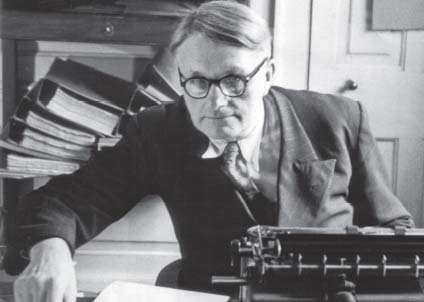
Needham working in K-1, the room in Caius College, Cambridge, that he occupied for almost seventy years. Later he also took the room next door, now occupied by the cosmologist Stephen Hawking.
He did not take kindly to interruption, and though generally a polite and thoughtful man, could be crashingly rude if disturbed. Once when his old friend Julian Huxley, who had been the first director general of UNESCO, telephoned from the porter’s lodge to announce that he had arrived for a visit, Needham said, with glacial courtesy, “I am frightfully busy. You come without an appointment, so I am afraid I cannot see you.” Huxley promptly returned to London, his day entirely wasted.
On another occasion Sir Ronald Fisher, an eminent geneticist, knocked on the door of K-1, opened it without waiting for a response, and was halfway in when Needham barked out “I’m frightfully busy” and went on hammering away at the machine. Fisher tried to explain that he had come simply to say that yes, as Needham had asked at breakfast that morning, a pair of visitors from China could indeed make use of Fisher’s college rooms for the coming weekend. He raised his voice. No response. Then he shouted to Needham over the clattering din of the typewriter, “You asked me, and I say ‘Yes.’” And then he left abruptly. Needham, despite having been granted a favor, never even bothered to look up.
On one occasion he relented, and happily so, since the interruption proved of great benefit. A stranger telephoned, explaining that he had just arrived from France, and badly needed a reprint of a paper he had seen mentioned in Needham’s trilogy Chemical Embryology. Needham barked at him politely, telling him he had no such reprint and would he kindly not disturb him any further?
But the man persisted, inviting Needham to lunch, pleading once again that he had come all the way from France. And so Needham, who was something of a trencherman, agreed. The man then described how making use of an obscure embryological point mentioned in the trilogy had completely transformed his egg-producing business in France. And then he did what he had really come to Cambridge for—he handed Needham a check for an enormous sum of money.
Needham seldom dined in the college, preferring to work through the dinner hour and then go home late. Christopher Brooke, a prominent medievalist who was a junior don when Needham was beginning his work on China, recalls that on those few occasions when Needham did turn up in Hall he would forcefully quiz his dinnertime colleagues on matters that seemed relevant to his book, and would carefully jot the answers down on the backs of menu cards and on paper napkins. The younger men liked talking to him: they found him rum, not dangerous. And they knew how he worked, really worked, and that he was often exhausted as a result. Once he flopped down into one of the chairs at the high table right beside the young, nervous Brooke, declaring simply: “Make amusing conversation to me: I’m really very tired.”
Wang Ling recounted a story about how preoccupied his boss became when he was in the middle of working nonstop:
The Chinese have a proverb to describe a hard-working scholar reading books all the time, even reading while travelling on horseback. Needham travels by train, always buying a first-class ticket, not because of any snob value but because only the first class has empty compartments where he can spread his books and manuscripts around, jotting down notes…. Even while travelling by car, while driving he always discussed some topic of his book. However, there was one occasion when he did not discuss the book. He was driving at top speed on our return journey from a meeting in Oxford. He was engrossed…[when] suddenly he noticed the passenger seat beside him was empty. As one would expect, a Chinese was too polite to ask him to stop the car in order to secure the latch on the door, which was not properly closed, so I had fallen out of the fast-moving car. Fortunately I landed on a pile of snow or else I would not live to tell the story. Joseph turned back to look for me and I got back in. He was upset beyond description—but I have survived to tell the tale. And the offending car-door was thereafter secured with a dog-chain.
Despite Needham’s occasional air of autocratic disdain, people were eternally eager to help him, support him, and surround him with care. He employed a woman whom he called Auntie Violet to make him breakfast and tea: she worked for him, buttering the crumpets he liked to toast on his electric fire, until she was well over ninety. And once it was realized that even a Stakhanovite like Needham could be tempted to join others for afternoon tea, a variety of distinguished men and women, crumpet lovers and tea drinkers all, would stop by to dine informally with him, often memorably.
One professor stopped in to talk about rain gauges—whereupon Needham discovered for him, quite accidentally, a reference to what turned out to be the first rain gauge ever made, in a book on mathematics in the Yuan dynasty. During a teatime conversation about sternpost rudders with a team of acknowledged experts on shipbuilding from London, Needham turned out to know far more about the subject than any of the specialists. They returned to the Maritime Museum in Greenwich chastened, rubbing their eyes in astonishment both at the marvels of ancient China and, in comparison with Needham, their own newly revealed ignorance. And a Russian scientist arrived for tea, and asked, just in passing, if Needham knew who had translated one of the Russian’s own books, published in Moscow, into English—whereupon Needham reached around and fished the very book out of his shelves. He looked at it and nodded, remarking that, yes, the title did sound familiar. Yes, he said again, after thinking for a few more moments—he himself had actually been the translator, when he was an undergraduate. But he doubted that he could repeat the feat: his Russian was not so good today—though his German, Greek, French, and Italian, and of course his Chinese, were still well-nigh impeccable.
But aside from such meetings as these, what exactly was Joseph Needham doing in his rooms? Just what was he trying to sift out from all the material he had gathered, and from all his memories? And, once he had it all, how exactly would he go about assembling all the building blocks into this massive, multivolume work?
He decided initially to make a great historical list, a list of every mechanical invention and abstract idea—the building blocks of modern world civilization—that had been first conceived and made in China. If he could manage to establish a flawless catalog of just what the Chinese had created first, of exactly which of the world’s ideas and concepts had actually originated in the Middle Kingdom, he would be on to something. If he could delve behind the unforgettable remark that Emperor Qianlong had made to the visiting Lord Macartney in 1792—“We possess all things…. I have no use for your country’s manufactures”—if he could determine what exactly prompted Qianlong to make such a claim, then he would perhaps have the basis of a truly original and world-changing work of scholarship. But he needed evidence, and a great deal of it.
Accordingly, he and Wang Ling spent the remaining months of 1946, and most of the next five years, searching for every invention and original idea that was mentioned in the ancient Chinese literature.
Needham proceeded in a patient, methodical, ruthlessly efficient way. He was an extraordinarily well-organized man. He was, for a start, a copious and fanatically driven note taker and file maker. In the piles of boxes that remain today in his archives in Cambridge are dozens of green steel card indexes, most of them filled nearly to bursting, not with index cards bought by the quire from stationers, but with menu cards from teahouses that he was forever cutting up in a process he called “knitting”—snipping, slicing, and folding—which would drive mad those uninitiated few who might accompany him to the café for a cup of Typhoo and a toasted tea cake. He would sit there cutting, cutting, smoking, and cutting—and a day later the cards would all be stacked in their boxes, each one covered with details, in his almost perfect copperplate, about arcane creations from China’s distant past. On the reverse side would be a half-legible copy of Today’s Special Lunch or Today’s Fare for Afternoon Tea.
And one by one, he and Wang began to find things. True, he had made discoveries while he was in China—the antiquity of the abacus, for example, and techniques of grafting plums. But buried among the papers and the documents he had assembled in Cambridge there was much more. He was able to note excitedly:
What a cave of glittering treasures was opened up! My friends among the older generations of sinologists had thought that we should find nothing—but how wrong they were. One after another, extraordinary inventions and discoveries clearly appeared in Chinese literature, archaeological evidence or pictorial witness, often, indeed generally, long preceding the parallel, or adopted inventions and discoveries of Europe. Whether it was the array of binomial coefficients, or the standard method of interconversion of rotary and longitudinal motion, or the first of all clockwork escapements, or the ploughshare of malleable cast iron, or the beginning of geo-botany and soil science, or cutaneous-visceral reflexes, or the finding of smallpox inoculation—wherever one looked, there was “first” after “first.”
Needham first found a geographer of the Song dynasty named Shen Gua, for instance, who, in a document firmly dated at AD 1088, described the technique of using a magnetized needle suspended from a length of a silk to determine the direction of south—a full century before the first reference (in AD 1188) to the use of a magnetic compass anywhere else in the world. “I shall never forget the excitement which I experienced when I first read these words,” Needham wrote later. “If any one text stimulated the writing of this book more than any other, this was it.”
He then found that Chinese ironworkers experimenting in the sixth century BC had managed to make iron that was malleable and not brittle, and that farmers had fashioned a plow from this metal, and added a moldboard to it, thus making a plow that was a vast advance on the primitive scratching device known as an ard, which was used in Europe at the time.
He uncovered old writings and drawings showing that the Chinese had invented breast-strap harnesses for horses in the third century BC, when Europeans still had their horses and oxen drag plows by the cruel and inefficient means of a rope looped around their necks. The Europeans would continue to use neck ropes for at least 1,000 years more.
He found that Chinese emperors, goading their subjects with the familiar valediction—“Do this, tremble, and obey!”—had built immense dams, irrigation projects, and canals (like the Grand Canal, which was started in the fifth century BC) hundreds of years before people in the waterlogged rest of the world (Mesopotamia excepted) thought they might be able to control their own rivers. Needham found documents showing that the Chinese created a tradition of subduing nature’s excesses while people in the West were simply lying back and cursing the inevitability of fate.
The Chinese learned how to cast iron, for example, and to smelt it with coal. From the fourth century BC on, they were able to make long-lasting pots and pans, axes, chisels, saws, and awls—and a number of tall pagodas, some still standing today. In the seventh century after Christ an ironworker made a palace tower 300 feet high and weighing 1,300 tons, topped with a massive iron phoenix and covered with gold leaf. In the tenth century, when Chinese ironmaking was unequaled, foundrymen working for the emperor in Hubei province in central China made him an enormous commemorative cast-iron lion, twenty feet high and weighing forty tons, which still stands as a memorial to a defeat of Tartar invaders.
But the founding of cast iron marked only the start of China’s remarkable metallurgical progress. By the second century BC foundry workers were managing to produce a much more malleable and less brittle version of the metal, which today is called wrought iron, doing so by way of a process to which they gave the culinary term chao, since it involved “stir-frying” the molten mass very slowly for hours at a time, to remove the excess carbon. Contemporary ironworkers would call the technique puddling. To further strengthen the puddled iron—which could be used by a blacksmith to make such things as stirrups and swords—some Chinese engineers of 2,000 years ago reintroduced a very carefully calibrated amount of carbon by hammering particles of it into the metal surface, producing a kind of crude steel.
The puddling method, which the classic encyclopedia of the second century, the Huainanzi, called “the hundred refining method,” was often fancifully reckoned to be the fons et origo of the Bessemer process. The myth seemingly started because in 1855 the American steelmaker William Kelly hired a number of Chinese “experts” to work alongside his ironmasters in his mills in Kentucky, to give advice. In fact these “experts” were no more than manual laborers hired from a teahouse in New York City, men who had no special knowledge of steelmaking of any kind. They were simply cheaper to hire than the local Kentuckians. China had indeed an advanced and very ancient ability to make useful iron and some primitive kinds of steel—but Henry Bessemer’s process, like William Kelly’s, was entirely homegrown.
Countless other clever devices followed. Chains were invented—permitting, among other conveniences, the making of the chain drive, which Needham discovered appearing in Chinese life in the tenth century, seven centuries before it was first seen in Europe. Long before that, in the first century, illustrations started to appear of the mysterious-sounding square-pallet chain pump—an enormously practical device that allowed farmworkers to raise water from rivers and streams by as much as fifteen feet, and so allow the irrigation of waterless fields. To operate it men drove their feet against large wooden paddles attached by sprockets to a chain of small wooden buckets: the device is in universal use in China today, so perfect a creation that it remains essentially unchanged after 2,000 years. Chains also meant chain suspension bridges, aeons before western suspension bridges were first made. Many of these Chinese bridges also remain today—the most famous being the nearly legendary Luding Bridge, which was built in 1701 across the Dadu River in Sichuan.
In those corners of the empire where iron was less easy to obtain, engineers contrived to use stone for bridges crossing rivers, creating what is now known as the segmental arch bridge, a type of construction that remains perhaps the greatest feat of China’s early civil engineering.
Three hundred years before the Italians copied it, entirely thanks to the close observations of Marco Polo, this one type of Chinese bridge was to have an influence on communication and architecture like few others. The principle behind the bridge was first established in the seventh century by a northern Chinese engineer, Li Jun. Li had built many ordinary arch bridges—like those built by the Romans as early as the first century after Christ—but he realized that a bridge incorporating only the very top of a circle into the arch could be stronger, lighter, and more enduring than a tall, stone-hungry semicircle-arch bridge. He began experimental constructions at the end of the sixth century, and his first completed and truly segmented arch bridge, more than 120 feet long, was thrown across a river in Hebei province outside Beijing. It is still standing today—1,400 years after its construction in AD 605, and after centuries of floods, battles, and earthquakes.
Less obvious and less dramatic improvements in human life were being made in China all the while, and Joseph Needham worked patiently during 1946 and 1947, through the most terrible British winter of all time, when most of the world outside Cambridge was flooded and miserable, assiduously chronicling each of the discoveries.
Some were purely practical: the wheelbarrow, for instance, or the fishing reel. The sternpost rudder came about in the first century after Christ; and once the compass had been perfected it was possible for Chinese sailors to venture, as they did, to Australia, to Mogadishu, around the Cape of Good Hope, and on rather less daunting adventures to the Philippines and Indonesia. Then again, the rolling of the ships at sea caused a problem that another Chinese domestic invention neatly solved: it was a device of interlaced metal rings which keeps a light permanently upright and which is generally known as a set of gimbals, later used to hold a compass, a chronograph, and the ship’s gyroscope. And there was much, much more: the umbrella, the spinning wheel, the kite—and the sliding measuring instrument that engineers in the west copied and called a pair of calipers.
Needham then discovered a genius of the Han dynasty, Ma Jun, who lived around AD 206 and specialized in making automated figurines, “automata of dancing girls who played music, men who beat drums and played flutes, wooden images dancing on balls, throwing swords about, hanging upside-down on rope ladders, showing government officials in their offices, cocks fighting…and all continuously changing with a hundred variations.” Ma was a polymath: he also improved the silk loom, explained the operation of the south-pointing chariot (a nonmagnetic steering device that was already ancient in his time), irrigated gardens with man-powered square pallet chain pumps, and invented the rotary ballista, a flywheel with stones attached that was a kind of rock-hurling machine gun.
And there was a profoundly simple but world-changing Chinese invention known in the West as the stirrup—a contraption just six inches high that weighed no more than a pound or two, but conveniently allowed a man to remain firmly and comfortably on a horse even though it might be going at full tilt and jumping every obstacle in its path. This was an invention that had an effect on mankind out of all proportion to its size and to its apparent early significance.
Many early Chinese inventions were devised for idling and pleasure, or for elegance—for example, playing cards, tuned drums, fine porcelain, perfumed toilet paper,38 the game of chess. The origins of chess are still hotly contested: many people like to think that the game began in India or Persia, though Needham’s discoveries demonstrated that it began with the game of xiangqi, invented by the Chinese in the second century BC and exported westward to the Indian subcontinent. But the stirrup offers a reminder that China, despite its attention to the peaceable aspects of civilized life, was also involved in warfare, defensive and offensive, conducted internally and across its frontiers, from very early times.
And then, at the beginning of 1950, Needham decided that he had found enough, or at least enough to get started. His first discovery period was officially declared to be over—though looking for and finding Chinese firsts would be a continuo throughout the making of the series.
Needham was ready to acknowledge that, however long and impressive this list of firsts might be, the items and ideas on it did not necessarily constitute either science or civilization, but merely hinted at creative ferment within Chinese society. But what a ferment! Depending on the way the arithmetic is done—and considering only the most intellectually fertile phase of China’s history, between the Han and the Ming dynasties—Needham pointed out that in every century the Chinese dreamed up nearly fifteen new scientific ideas—a pace of inventiveness unmatched by the world’s other great ancient civilizations, including the Greeks. The nature of the inventions was remarkable enough, Needham wrote; but the rate at which they came was like nowhere else on earth, and like no other time in history.
The role these firsts played in the actual construction of his book was crucial, because they were to serve rather like surveyors’ marks, flags that would show how the complex work would be encouraged to grow—which Chinese invention would be placed in what part of the new structure, which creation should by rights be close to which other, which fields of thought should be examined and in what order. And as in the building of any immense structure, the placing of these precise markers took time—in fact, most of the cruel English winter of 1947 was devoted to working out this structure, long before any real building could actually begin.
By the early 1950s such markers as were definitely known were all firmly set down and the foundation trenches between them were dug—so that now the books themselves were ready to be organized, and the first of them could be written.
Needham initially decided to arrange the work in seven sections. He would later call these the “heavenly” volumes of the series, the major topics of Chinese learning and invention, at least as he saw them. It was a neat blueprint, except that both he and Wang Ling seriously underestimated how out of control everything would rapidly become. Nearly every one of their seven major headings of knowledge would produce innumerable divisions and subdivisions of subsidiary knowledge, almost every one of which, on Needham’s close inspection, he thought deserved a full volume of its own. It was the making of these subsidiary books—which Needham came to call the “earthly” volumes—that caused the project to have such an elephantine gestation period.
In the very early days, the initial magnificent seven volumes were somewhat shakily organized.
Needham first suggested that Volume I, the Introduction, should address an overarching question: what science had emerged from China over the centuries? It should also address the context—the geography of China, the history of China—in which this question should be considered.
Volume II would look at Chinese philosophy: how the Confucian and the Daoist traditions regarded science, and how the tradition of experimentation and observation—of deductive reasoning as compared with inductive reasoning—originated and then developed (to the degree that it did develop at all) in the Celestial Empire.
Needham would devote much of Volume III to what he called the Chinese “pre-sciences,” or what today would be called the pure sciences—mathematics, astronomy, meteorology, geology, geography, physics, alchemy, botany, zoology, and anatomy. This one book would thus have an enormous span—though precisely how enormous Needham had, at this stage, precious little idea.
Volume IV—a similar monster that in its early form would also hint at unimagined vastness to come—would examine Chinese technology, the impure or applied sciences, which included such topics as engineering, papermaking, ceramics, navigation, chemical technology (including the making of explosives and the details of the long argument over who made gunpowder first, and for precisely what purpose), biochemistry (including fermentations and the science of nutrition), mining, metallurgy, architecture and painting, agriculture, medicine, pharmacology, and martial technology, including the science of making war.
Volume V would investigate the “Needham question.” It would try to fathom what changes suddenly occurred in the China of five centuries ago that made it necessary for modern science to develop not in China but elsewhere, principally around the shores of the Mediterranean. The reality was obvious: in the middle of the fifteenth century virtually all scientific advance in China came to a shuddering halt, and Europe then took the leading role in advancing the world’s civilization. Why might this be? The various factors—geographical, hydrological, social, economic, bureaucratic, linguistic—that might have played a part in China’s sudden change would each be considered in turn. Did China’s reliance on an ideographic writing system, for example, inhibit the development of Chinese science? Did the immense bureaucracy play a part? Could the huge imperial investment in controlling the annual flooding of the Yangzi and the Yellow rivers have any bearing? Joseph Needham planned that this volume would offer all the answers.
According to the original plan, Volume VI—given the overall scheme for looking at China’s development in relation to the general history of civilization—would examine other societies that had developed in parallel to the Chinese: the Egyptians, the Greeks, the Babylonians, the Indians, the Aztecs, the Maya, the Japanese. It would note, in detail, similarities and major differences.
And then, as the grand finale, Volume VII would ask quite simply and robustly: what next? What would be China’s future, its wealth, its political systems, its systems of beliefs, its place in the modern world? Could the nation possibly recover from the setbacks of five centuries before? Could China ever climb back to its once preeminent position in the world? Had the nation abrogated its position forever? Or could China once again set the direction for human civilization, as it had done so ably and for so long, thousands of years ago?
Like all plans, this one mutated and evolved. By 1950, when Needham and Wang were finally assembling Volume I and the book was well on its way to completion, the six succeeding volumes had already substantially altered their focus. All had expanded hugely. Many of them had spawned offspring.
For example, in 1954 the table of contents for Volume II, which was as yet unfinished, illustrates how enormously complex the study had become, and how just one volume had to be extended out of all proportion to its original dimensions.
The initial plan for Volume II might have seemed relatively simple: to describe Chinese philosophical approaches to science, and how the Daoist and Confucian attitudes toward experiment, observation, and theory varied over the centuries. By 1954, however, matters had become infinitely more complicated.
Confucianism, according to the plan, was to be first delineated and described in eight sections—“Theories of the ‘Ladder of Souls’”; “The Ambivalent Attitude toward Science”; “The Humanism of Hsün Ch’ing”; and so on. Daoism was then to receive the same treatment—“Daoism and Magic”; “Ataraxy”; “The Return to Cooperative Primitivity”; “Gymnastic Techniques”; “Sexual Techniques.” Scores of pages were then allotted for a thorough examination of “The Fundamental Ideas of Chinese Science” with essays on such topics as omen books, trigrams, hexagrams, the Book of Changes, and the Chinese knowledge of “Pythagorean” numerology and symbolic correlations.
And this was not even a quarter of the way into just one planned volume. Before Needham and Wang were done, there would be essays on such unrecognizable arcana as “Scapulamancy and Milfoil Lots,” “Oneiromancy,” “Glyphomancy,” “Wang Chun’s Struggle with the Phenomenal-ists,” “The Judicial Trial of Animals,” “The Neo-Confucianists and the Supreme Ultimate,” and “The Buddhist Evangelisation of China.”
When the volume finally appeared, in 1956, it was almost 700 pages long. The essay on “Tantric Sexual Techniques” alone took up seven full pages, and it included authoritative paragraphs showing how tenth-century Daoist manuscripts with titles like The Book of the Mystery-Penetrating Master and Important Matters of the Jade Chamber could offer reassurance to anxious Chinese men. The manuscripts calmed them by offering messages such as “Sexual continence is as impossible as it is improper” and “Celibacy is a practice that leads to neuroses.” For titillation—probably unintended, despite Needham’s personal leanings—the same chapter in Volume II also offered a catalog of exotic Daoist bedroom behavior from 1,000 years ago that beggars belief today.39
Needham had decreed early on in the process, as he watched each volume begin to swell and threaten to burst out of its covers, that no one volume should be “too big for a man to read comfortably in his bath.” But it was happening nonetheless. Whereas Volume I had been 248 pages long, with thirty-six illustrations, fifty pages of bibliography, and twenty pages of index, Volume II ran to 698 pages and Volume III to 680, with 127 illustrations, a bibliography that was 115 pages long, and an index that was itself as long as a novella, at fifty pages. The books were developing an alarming case of middle-age spread, and something had to be done.
The consequence of all this was a rapid onset of cell division40 (somewhat dismayingly for the beleaguered Cambridge University Press, which was obliged to tolerate the constant expansion of the project). One book became two, three, or four. Volume V, a special case, became not five, but thirteen formal subsidiary parts, each one of them big and complicated enough to be made into a separate, self-standing, and equally enormous new volume of its own.
The books are all about detail. They were assembled with a painstaking concern for even the smallest facts of Chinese life, and each volume was an exploration, as Needham put it, “of the limitless caverns of Chinese scientific history.” He thought the individual volumes should demonstrate that they had been assembled using an approach “which tried always to avoid generalizations, and instead lingers lovingly on the fineries.” The archives Needham left behind in Cambridge offer some clues about how each of the books was so scrupulously assembled. The volume that most admirers consider the shining example of Needham’s craft was published to nearly universal acclaim in 1971: Volume IV, Part 3, Civil Engineering and Nautics.
The book’s organization is elegance itself, with its two basic themes segueing into each other quite seamlessly. The formula is deceptively simple: first there is stone, then there is water. Civil Engineering, which opens the volume, covers the making of Chinese roads, walls, and bridges—creations that are largely fashioned from stone. Next comes a graceful transition provided by the history of the Chinese canals over which these bridges pass—water and stone, combined. And finally comes the beginning of Nautics—water itself, alone—which tells first the story of the Chinese ships, rowing boats, and junks that use these canals, and then discusses the evolution of Chinese navigation, propulsion, steering, and the “techniques of peace and war”—under which heading are included such topics as anchors, moorings, dock and lights, towing and tracking, caulking, hull-sheathing and pumps, diving and pearling, the ram, armor plating, grappling irons, and the tactics of firing naval projectiles.
Most amazing is the detail, and the sheer variety of topics undertaken by the authors—who were listed on the title page as Joseph Needham, Wang Ling, and (after her return from her UNESCO duties in Paris in 1957) Lu Gwei-djen, the project’s holy trinity. Some of the chapter headings hint at the scale and scope of the volume: “Constructional Features of Junks and Sampans.” “Star, Compass, and Rutter in the Eastern Seas.” “The Mat-and-Batten Sail: Its Aerodynamic Qualities.” “Sculling and the Self-Feathering ‘Propeller.’” “China and the Axial Rudder.” “Armour-Plating and Grappling Irons.” “Sluice-Gates, Locks, and Double Slipways.” “Water-Tight Compartments, Hull-Shape and Its Significance.”
Inside are diagrams and woodcuts, ancient scroll paintings and explications. For example, one page begins: “Then, before 1450, as we shall see, came a fundamental change in policy. The anti-maritime party at court, for reasons still somewhat obscure, got the upper hand, and the long-distance navigations were at an end.” This was Needham’s briefly discursive history of the fifteenth-century decline in Chinese exploration, brought about after Zheng He’s famous expedition, which got as far as Mogadishu (some say a great deal farther), bringing home booty that included a hapless African giraffe which Zheng thought might amuse the emperor, but which in fact frightened him unconscionably.
The manner in which the trio worked on the volume—the years of research, the months of writing, the ceaseless flow of arcana—is just hinted at by the contents of the boxes of papers now sedulously cataloged at the Needham Research Institute in Cambridge, in which are held all the letters and documents that Needham was able to use in deciding what to write.
One of the countless boxes, selected at random, contains the following:
1. A collection, held together with a rusting paper clip, of articles about coracles, including a long description of such a vessel from Cochin-China, which was caulked with a mixture of cow dung and coconut oil.
2. A picture of Lord Montgomery of Alamein inspecting a Chinese catamaran.
3. A letter from a correspondent in France (telephone BAlzac 3839) about Indo-Chinese sailing rafts.
4. A book entitled Floating Objects.
5. A collection of ten monographs, Le Jonque Chinoise by L. Audemard.
6. An advertisement clipped from the communist newspaper The Daily Worker for books on Chinese sailing vessels by G. R. G. Worcester.
7. An essay, “The Exploits of Sir Francis Drake.”
8. Notes written on a table napkin, calling for definitions for the terms lee-shore, double-canoe, Lepanto, tonnage, slavery, bamboozle.
9. On a sheet of writing paper, a rhetorical question in Needham’s hand: “How much did Ancient Egypt influence the design of the Chinese junk? Perhaps F. H. Wells in China Journal of 1933, he adds, has the answer?
10. Tsao-Fang’s paper On Canal-Boats and Canals Generally.
11. Dictionary of Sea Terms (1933).
12. A painting from 1672 of a European cargo barque, said to be the first Chinese representation of a foreign vessel.
13. Notes on Viking vessel design.
14. A book, The Sung Navy, 960–1279 AD, by Lo Jung-pang.
15. A paper “On the Techniques of Straddling Shots.”
16. A letter from a Mr. John Saar, of 30 West 75 Street, New York 23, offering information on junks and remarking that on a recent visit to Caius College he had been “so well treated that he had lost all his left-wing and anti-elitist prejudices.”
Day by day Needham, Wang, and in due course Lu Gwei-djen collected such material, sifted it, filed it away, then inserted it into the proper places as the chapters were planned, organized, and written. The material in this particular Nautics box might have been placed, perhaps, somewhere in the four pages devoted to “The Aerodynamic Qualities of the Mat-and-Batten Sail” or the eight allotted to “Textual Evidence for Early Chinese Use of the Axial Rudder” or the seven diagrams and drawings and essays on the subject of “Oars.” Or maybe it was not used at all: maybe it was discarded, replaced by even richer sources, by even better evidence that has been consigned to others of the scores of boxes lying in the institute’s archives, cataloged in detail awaiting their examination by some thesis writer of the distant future.
“I sometimes despair,” Needham wrote once, “that we will ever find our way successfully through the inchoate mass of ideas and facts that are so hard to establish.”
But he did find his way. He typed out the pages for the Nautics chapters, all of them with two fingers, all of them at a furious rate, day after day through the late 1950s while at the same time he was working on other volumes and parts that dealt with wholly unrelated topics such as gold, tilt hammers, parachutes, segmental arch bridges, and reservoirs.
He finished the pages and sent them off to specialists—among the forty-odd who dealt with the Nautics volumes, all giants in the field, were James Fitch of New York, Klaus Fessel of Tübingen, Alfred Lieber of Jerusalem, Clough Williams-Ellis of Penrhyndeudraeth,41 and G. R. G. Worcester (then the greatest living expert on Chinese junks) of Windle-sham. He then recast his chapters on the basis of their advice; sent completed texts to his long-suffering collaborator at Cambridge University Press, an apparently saintly editor named Peter Burbidge; and awaited publication.
This one volume eventually emerged in 1971. Needham dedicated it to the memory of the following:
CHI CHHOA-TING
Historian of China’s water ways and works
a friend beside the Chialing River
Economic and financial leader in a resurgent land
and of
HERBERT CHATLEY
Once Professor of Engineering at Thang-shan College
and
Chief Engineer of the Huang-po Conservancy
an “Old China Hand” who loved the Chinese people
Historian of the engineers of Cathay and Manzi
It had taken fifteen years to make. No doubt someone will one day measure the tonnage of supporting paperwork or the footage of shelf space that the paperwork occupies, and come up with a statistical analysis that will rank this book alongside the compilation of enormous dictionaries or encyclopedias elsewhere. And this was just one volume—just one of many volumes that were compiled for Science and Civilisation in China as a whole. And all made, in essence, by this one fascinating man.
As word of the project spread, the honors began to trickle in. One that caused a peculiarly British kerfuffle came from the Republic of China, and was called with appropriate grandiloquence the Order of the Brilliant Star with Cravat. Needham was told about it by the Chinese embassy in October 1947, was naturally thrilled, and casually asked his former bosses at the Foreign Office if accepting the honor would cause any diplomatic problems or offense. To his considerable astonishment he was told that yes, it would, and under no circumstances was he going to be allowed to wear a foreign honor unless given personal permission by His Majesty the King.
It took nearly two years for this permission to be secured. Letters from lofty figures in the various dusty British government departments that dealt either with protocol or treaties or had access to the corridors of Buckingham Palace tut-tutted their way around Whitehall. Eyebrows were raised at the notion that any foreigner could legitimately honor a man so exalted as a British diplomat (which is what Needham had been during the period for which the Chinese wanted to honor him). Discreet working lunches were held in offices at Westminster, and even more hushed dinners were held in clubs on Pall Mall, all to discuss this unprecedented (and to some, rather impertinently sycophantic) gesture.
Finally, in June 1949, Sir Alan Lascelles, a courtier of huge distinction at the monarch’s side, agreed that Joseph Needham’s work had done much to better relations between London and the Nationalist government, now back in Nanjing. He thus wrote to Needham at Caius College saying formally, “His Majesty King George VI has been Pleased to Give Restricted Permission for N. J. T. M. Needham, Esq. To Wear the Order of the Brilliant Star with Cravat Essentially while in China and in the Presence of High Officials in China.”
The irony of fate intervened. It all turned out to be much too late. In China the Communists were fast assuming power; the People’s Republic was declared the following October; and four months after the king had given his permission, Chiang Kai-shek, who had signed the warrant for Needham’s award, fled for Taipei. Joseph Needham’s much-vaunted honor, the source of so much fuss in London, had become overnight no more than a bauble, recognized only in Taiwan, and except as a collector’s curio, barely worth the paper it was written on.
Moreover, at about the same time, suddenly, and without any warning, Joseph Needham made the most terrible blunder.
He made a decision, based on his lifelong romantic flirtation with international communism, that very nearly killed the entire project, almost before the first volume ever appeared. It was a fall from grace, and one for which Joseph Needham had no one to blame but himself, and it haunts the project even to this day.
It all came about by way of a mysterious telephoned invitation from a conference room in the capital of Norway. The caller was Chinese, and once the static on the line had cleared, he turned out to be one of Needham’s oldest wartime friends. Would Joseph care to leave Cambridge for a while, the caller asked, and come back for a spell to China?