
FOUR
On the Invention of Words to Describe Indescribable Chinese Traits
Nosphimeric was a word which I invented during the war years. While on my perpetual travels I often encountered Bishop Ronald Hall of Hong Kong, visiting one of his outlying Chinese congregations, and one day we had a chance meeting at Annan in Kweichow. Talking about various things at dinner I happened to mention to him that I needed a non-pejorative word for that squeeze, graft and corruption which has always been so characteristic of the bureaucracy in China, and which had loomed so large in the eyes of the modern western businessmen who tried to buy and sell there. Both our trucks were being repaired that night, and his was finished earlier, so he set off first—but not before giving me a piece of paper on which was written: “see Acts 5:1–11.” When I got to the Bible I found it was the story of Ananias and Sapphira, who had promised a sum of money to the church, but then held back a portion of it, and accordingly died, blasted by St. Peter. Now the word used in the Greek New Testament for “to sequestrate” is nosphizein, and since meros means a part, we can form the adjective required.
—JOSEPH NEEDHAM, 1994
From Science and Civilisation in China, Volume VII, Part 2
By now Joseph Needham was about as far from the comforts of the West as it was possible to be, more deeply marooned in the outer fastnesses of China than it was possible to imagine. But though he was stranded, he took a calmly philosophical view: the weeks that he would be obliged to spend in the Turkestan desert—he had no idea just how long—would allow him the luxury of reflection, would give him time to take stock, to consider what he had achieved so far, and to plan for what remained to be accomplished.
His most immediate task was clear: the Mogao caves were just a few steps beyond his tent, and it would serve him well to get to know as much as he could of their story, since it was unlikely, he supposed, that he would ever have the time or the funds to visit them again.
He had studied a great deal about Marc Aurel Stein, and regarded him as a hero, and by the time he reached Turkestan was full of admiration for a man so clever, cultured, intrepid, and inquiring, in many ways much like himself. Needham had no way of knowing that at the very moment he was beginning his own unexpectedly lengthy sojourn in Dunhuang, his hero was actually very close by.
Sir Aurel Stein (he had been given a knighthood for his services to archaeology in 1912) was eighty-one, but he was unstoppably curious, and in 1943 had come to the East again. He was just a few hundred miles away from Needham, across the Hindu Kush mountains, staying with the American legation in Kabul. He was there to realize, or so he thought, a lifelong dream: to mount an expedition to look for the fabled city of Balkh, which followers of Alexander the Great had supposedly founded 2,000 years before in deepest Afghanistan.
Needham also did not know—and would not know until he returned to Chongqing in midwinter—that Stein had fallen gravely ill in Kabul. On October 27, a day that for Needham happened to be quite diabolical—“packed up first thing, hoping to start…became a nightmare day…couldn’t start the engine…fifteen soldiers pushed…eventually got it going…bearing had been too tight”—Stein’s illness worsened dramatically, and he died. It adds a certain irony to the story: the single greatest discovery Stein made at Dunhuang in 1907 was, in all probability, the single object that most inspired Needham to write his great work in China—and yet Needham’s realization of this came, almost to the day, when Stein’s own life came to a close.
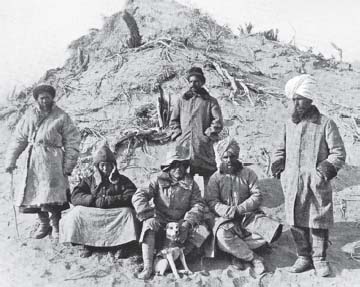
Sir Aurel Stein in 1906, sitting in front of a tamarisk cone on his second expedition to the Taklamakan Desert in western China. He is pictured with his Chinese secretary, his Muslim assistant, three Sikh helpers, and his beloved Dash the Great.
The story of the discovery made at Dunhuang is that of legend.
Stein had left his exploration base in Kashmir the previous year. He had prepared well for a journey to this corner of Turkestan, from which he had heard rumors of fantastic finds—fabulous treasures that he believed the world at large should see. He made certain he was as well-equipped as he could be: his maps and books in tin-lined cases to protect them from ants, surveying instruments, ropes, leather repair kits, bamboo poles for the tents, plenty of guns and ammunition, telescopes, bandages, needles, safety pins, and a morning coat and pin-striped pants so that he might impress any mandarins he encountered. He left behind presents for all the friends whose birthdays he would miss while he was away. And he took plenty of food for his dog, which—like all its predecessors and successors, seven in all—he called Dash. He was a scrupulous man—small, tough, and very attentive to detail.
It took him half a year to reach the western interior of China, and for most of the winter of 1906–1907 he was navigating the harsh sand deserts of Turkestan. During February and March he had been pushing eastward across the immensity of the Lop desert (where in more recent times China used to test atom bombs), with his men on donkeys and camels and with blocks of ice carried in straw baskets in lieu of water. The donkeys had died; the water was almost gone—and one day in late March an icy storm known locally as a buran was blowing a full gale, chilling everyone blue.
And then, suddenly he reached this oasis. A few miles later on—for he wanted to waste no time—he came to Mogao, and the caves.
They were quite fantastic. There were enormous sculptures, intricate rock carvings, icons. Most of the cave walls were covered with painted images. Some caves contained hundreds, perhaps thousands, of painted, brilliantly colored images of the Buddha, all identical, each hand-painted or block-printed onto the wall no less than 1,300 years ago, and so fresh they looked as though they had been completed yesterday. And then there was the roof—every square inch of some of the caverns was similarly covered. These illustrations were all scenes—eighty-six of them, and each different—showing the various stages in the Buddha’s life. They were from the Northern Zhou dynasty, which flourished from AD 557 until 588.
There were enormous white-limed and colored statues of women, horses, and Buddhas—Buddhas galore—and in other caves there were images of men and women who looked distinctly Indian. They had been created long ago by artists who saw Buddhism as a theology coming from below the Himalayas and having little about it that was Chinese. And two of the more enormous caves held stupendous Buddhas 100 feet high, huge and splendid and precious, thought Stein, for all mankind.
The best was yet to come. Just inside the main doorway of one cave there was an opening in the wall, on the right-hand side. This is the tiny cavern that has since come to be known as Cave 17. The fact that Aurel Stein saw it, and saw into it, has to do with a local Daoist monk whose name—Wang Yuanlu—is both revered and reviled today, for what he subsequently did.
Needham knew the story well. It started when Wang, who lived in Dunhuang at the end of the nineteenth century, decided to appoint himself guardian of the caves. No one else was looking after them; no one ever visited them; and he feared that they were crumbling away and would soon be inundated by the ever-shifting sands. He thought he would try to do a little restoration of the crumbling statues and the peeling paint, and he started to do so with all the gusto of an enthusiastic amateur. While he was working in what is now known as Cave 16, repairing the statue of a horse, he noticed what appeared to be a hidden doorway to the right of the entrance, covered with stucco and painted over.
He ordered it broken open—and inside he found an immense trove of scroll documents, tens of thousands of ancient paper volumes, hundreds of silk banners, and yard upon yard of textiles.
Word of the find quickly leaked out. Officials in the Chinese capital ordered the treasures to be sent to a nearby city for safekeeping, but no transportation could be found; and so Wang was ordered to reseal the little cave and await orders. This he did—for a while. But he made his great mistake in May 1907, thirty-six years before Needham’s visit, when he opened up the cave once again. This time it was to satisfy the wickedly persuasive Stein, who was on his collecting expedition for the British Museum. Stein had heard about the collection of documents, and realized that the answer to the question which had nagged at him for so long—how Buddhism had come to China—probably lay within their texts. The contents of Cave 17 were Stein’s Holy Grail, and he just had to have them.
“Heaped up in layers,” Stein wrote of the contents that would in time come to be world-famous, “but without any order, there appeared in the dim light of the little priest’s lamp a solid mass of manuscript bundles rising to a height of nearly ten feet, and filling, as subsequent measurement showed, close on 500 cubic feet. Not in the driest soil could relics of a ruined site have so completely escaped injury as they had here in a carefully selected rock chamber where, hidden behind a brick wall…these masses of manuscripts had lain undisturbed for centuries.”
He wanted them. He wanted them badly—more than anything else he had ever seen. Scholarship needed them, he argued, so that once and for all the world could know how the Buddha came to China.
And so, by way of a bargaining minuet of elegance and subtlety, and by eventually shelling out just 220 of the English taxpayers’ pounds—a paltry sum that all Chinese schoolchildren know well to this day, a grisly example of western perfidy—the visitor managed to persuade the poor, grinning, stupid monk Wang Yuanlu to hand them over. To sell to a foreigner, in other words, virtually the entire contents of the cave.
Stein then began taking the papers away. He took, and he took, and he took. And by the time the orgy of taking was over the monk had handed over to the visiting Briton what would be twenty-four wagonloads of papers: thousands and thousands of ancient objects, comprising, everyone now agrees, one of the richest finds in all of archaeological history.
Most important of all were the scrolls that had been carried by wandering monks hundreds of years before, written in languages as different as Sanskrit, Manichean Turkish, Runic Turkic, Uighur, Tibetan, Sogdian, Central Asian Brahmi, and classical Chinese. There were also star charts—the oldest in the world, fashioned in the Tang dynasty between the seventh and tenth centuries, and showing the sky in the northern hemisphere, with the Big Dipper and Polaris as easily recognizable as they are in this morning’s newspaper.
And there, too, was the primus inter pares, a fifteen-foot grayish-yellow scroll, which had a colophon suggesting, incredibly, that it be given away free to anyone who wanted a copy—and which is now known as the Diamond Sutra.
This was the object that answered the most urgent of Stein’s obsessions, the object that so impressed learned Britons in London when they first saw it, the object that so impressed Joseph Needham when first he heard of it in Cambridge in the early 1940s. This one document, covered with Chinese writings and with pictures of the Buddha and other sacred scenes, was not, as everyone had first supposed, a manuscript. Rather, the Diamond Sutra had been printed. It was the result of wooden-block printing, and in all likelihood hundreds, perhaps thousands, of copies had been made, and this was the only one to survive.
Until the discovery of this sutra in Cave 17 it was assumed—one might say it was arrogantly assumed—that a westerner had printed the first book. But here was firm evidence to the contrary: here was proof that a dated document—the Chinese translation of a Sanskrit Buddhist text—had been printed from blocks of wood 600 years earlier. Here was immutable proof that a technique long assumed to have been a monopoly of European inventors in fact owed much to far more ancient creators, in China. Here was a clear indication that China was no backward nation but for much of its great age a highly sophisticated civilization, the certain fount of at least this one human invention, and quite possibly the fount of just about everything else important that was known to the outside world.
Stein was (and still is) widely vilified in China for his trickery and plunder—as were a succession of greedy treasure hunters who came after him.28 Dunhuang was eventually closed, so terrified were later Chinese governments that more foreign pillagers would take away the treasures. But when Joseph Needham arrived in September 1943 he went as a diplomat, and so was able to enjoy nearly unrestricted access to the grottoes, with no hindrance by fussy officials or soldiers. His access became even more complete once the mandarins in the local magistracy realized how sick his old truck was, and that he would have to spend many weeks on-site.
He made full use of this access, and of his time. Day after day he sketched and photographed the caves in great detail, to the point where he believed he might have enough material to publish a monograph—Dunhuang in those days being generally unknown and highly exotic. He was charmed by the sound of wind chimes at a temple, which he heard while sitting silently in the desert on a brilliant moonlit night. He cursed when robbers stole the razor blades he had bought in New York the year before, when he was with Lu Gwei-djen, to whom he now wrote a letter almost every day. He found and “poked about” in a Han Chinese fort and in any number of previously unvisited stupas. He celebrated the “double tenth”—the anniversary of the Chinese revolution, observed on October 10 every year, as it still is to this day—by eating a collation of chocolate cake while standing up outside the cave entrances with a pair of friendly lamas dressed in russet robes and wearing “beads and strange hats.” He was chased by a pair of wolves and from then on had to keep fires going at night to scare others away.
He found shortly thereafter the jawbone of what he believed to be a monastery abbot, a discovery that triggered more disturbing dreams and robbed him of some nighttime peace; he swapped a carton of sulfa drugs for a box of locally grown quinces; he went donkey-racing on the dunes. He copied maps from various books about the Silk Road by the great American scholar Owen Lattimore. He attended an immense parade for a local city god and ate a very non-Chinese meat pie there. He bought and smoked Russian cigars and had a Gobi craftsman cut him a new set of stone seals. And once, when he spent a night at an inn, he was lying in bed when, thanks to an overheated kang below, there was a sudden explosion that burned all of his roommate’s clothes. Everyone else in the party had to give the victim spare clothing, whether it fit or not. Needham himself was not much given to wearing proper clothes out here in the desert: as the autumn temperature started to drop he wrapped himself simply in sheepskins or in locally woven rugs.
Before they became marooned for the winter—when the Turkestan deserts become fearfully frigid—Needham decided to send for help. He dispatched his faithful assistant, H. T., into the desert with a pair of donkeys. He told H. T. not to fret about not making it: the animals’ own survival instincts, Needham tried to reassure him, would guarantee the survival of any man riding them.
H. T.’s ultimate mission—once he made sure his boss would be rescued—was to get home to Chongqing. He was supposed to ride the animals across the desert to a road where he might catch a bus, find his way by road to Lanzhou, then somehow find an airplane bound for the capital, and once there go to Needham’s office and restart the work that the boss was having to ignore—supplying universities with their various needs and ordering these goods from India.
But his trip home became just as frustrating as the expedition itself. H. T.’s bus slid into a ditch; a car he rented blew a gasket and had spark plug trouble; and when he finally reached the Lanzhou airfield he was ejected from every plane he tried to board, because all the aircraft had been commandeered to carry immense quantities of Hami melons to Chiang Kai-shek and his melon-loving wife.
He waited at the aerodrome for the better part of a month before deciding to return to Lanzhou. When he got there, he found that Needham’s party had also made it that far. A crew of mechanics from a desert oil field had done some limited repairs on the engine, the truck had managed to limp to Lanzhou, and a more competent local technician there would make it ready for its 1,000-mile journey home.
There remained one small problem. Although Needham and H. T. were both in Lanzhou, Needham was south of the Yellow River and H. T. was north of it, and the bridge was down.
“So we both spent a great deal of time crossing the river each day,” wrote H. T. some years later. “I particularly enjoyed…the sheepskin raft, which gave me the sensation of sitting right on top of the churning current. As the weather got colder, chunks of ice began to appear on the water and by early December the whole river was solidly frozen. It was an awesome sight to see the mighty river turned into a solid sheet of ice, all within the space of two weeks.”
By early December, with Needham having done all he could in the Chinese northwest, he joined a long list of people trying to get on the China National Aviation Corporation (CNAC) flight. He had connections aplenty, thanks to his journeying; and after a mere two weeks of waiting, one of them finally worked the necessary wonders. Room was found on a beat-up old American warplane, and crammed in with baggage, melons, and a few other hastily boarded emergency travelers, Needham took off. At five p.m. on December 14 the plane touched down at Chongqing’s sandspit of an airfield, where there was an embassy official on hand to greet him. He had expected to be away for a month: he had been gone for four.
Meanwhile, H. T. Huang had still to get home in the wounded old Chevrolet truck. It took him a further month of misery—at one stage he ran out of lubricant and resorted to filling the engine with rapeseed oil. But in late January 1944, five and a half months after leaving, he and Needham were reunited, and the two men were able to breathe a sigh of relief, turn the truck over to the embassy garage, and never set eyes on it again.
There was one other pleasing coda to the journey—a romance which blossomed right under everybody’s nose, and yet passed unnoticed by all, thanks to the journey’s abundance of difficulties. Liao Hongying, the pretty young woman whom Needham had dropped off in Lanzhou, met there a visiting British diplomat, Derek Bryan. The pair had come back to Chongqing in H. T.’s truck. During the journey Bryan remarked on the discipline and efficiency of Mao Zedong’s Communist soldiers—and Liao realized that he was clearly not a stuffed-shirt supporter of Chiang Kai-shek, as in her view most foreign diplomats were, but rather was “one of us, one of the people.”
They fell in love, were engaged within the month, were married soon after—and became subsequently an abiding fixture, first in Beijing and then later in England among the small corps d’élite who, during the 1950s and 1960s, campaigned in earnest and unwavering support for the ideals of the People’s Republic of China.
Bryan and Hongying were not communists but, like Needham, committed socialists. Either way, though, they incurred the disfavor of the British Foreign Office, which eased Bryan from the diplomatic service in 1951 after he told an American diplomat that he rather approved of Mao Zedong’s social reforms.29 They were ardent Quakers, and with Needham they later helped found the Society for Anglo-Chinese Understanding, membership in which was one of the only ways for Britons to be permitted to enter China during its most exclusionary years. They taught Chinese, did research, then spent their retirement in Norwich. When they died—Hongying in 1998, the ninety-two-year-old Derek Bryan in 2003—they left a considerable sum in a trust to help support Chinese students who wished to come to Britain.
However arduous Needham’s trip to the northwest had been, its route, as far as any risk from the war was concerned, was reasonably safe. There were essentially no Japanese soldiers to the west of Chongqing, and the Japanese air raids had more or less ended by 1941.
The same could not be said of the Chinese east. By 1943 Japan was in firm control of much of eastern China from Manchuria down to a point on the coast well to the south of Shanghai; and Tokyo also held tightly on to territory that ran from the old treaty port of Xiamen southwest to the borders of Indochina—Vietnam in particular. All of southern Guangdong province—including, since the surrender on Christmas day 1941, the British crown colony of Hong Kong—was ruled strictly by the mandate of the Japanese emperor. Where the two armies met—the more or less united Nationalist and Communist armies on the Chinese side, the Japanese imperial army on the other—was the ever mobile front. Cities in this swath of contested countryside changed hands with baffling frequency and experienced fighting, bombing, and all the manifold horrors of total war.
Nearly incredibly, however, the Japanese forces let one rockbound stretch of the eastern Chinese coast, 300 miles that very roughly ran along the seashore of Fujian province, remain free of their control. There are many theories as to why, but most probably the planners had decided it was more important to go for the major manufacturing centers and transportation links and leave the more isolated and unpopulated countryside to its own devices. So although much of Fujian had been occupied briefly in the late 1930s, by 1944 it was back in Chinese hands. And halfway along the coast was the province’s principal city, the former treaty port of Fuzhou; it, too, was now stubbornly under Chinese control, and continued to run as it had before the Japanese arrived.
Needham was fascinated. For one thing, it astonished him to discover a British consulate operating in Fuzhou, in territory that was almost surrounded by the enemy—the possibilities for espionage, or for other kinds of mischief, were surely legion. Immediately, he became curious about how the academic communities were faring in this part of China, hemmed in tightly either by the Japanese invaders to their north, west, and south, or by the sea to the east. And so, with his interest piqued by the extraordinary situation in Fuzhou, he set out once again.
He began his great “South-Eastern Journey,” as it was later to be called, in April. A few weeks earlier, his wife, Dophi, had arrived from Cambridge, to take up the post of his chemical adviser. But he chose not to take her along. His companion was once again to be H. T. Huang, and their vehicle would be a converted Chevrolet ambulance, very similar to the ill-starred wreck they had taken before, though slightly smaller and less powerful. It was similar but, crucially, it was not the same.
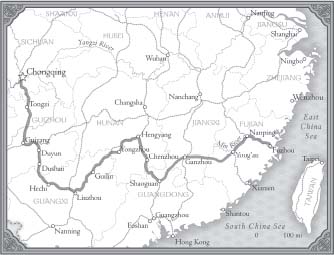
Map of Needham’s Eastern Expedition, Chonqing–Fuzhou
In any case, because of the geography of the Japanese occupation Needham and H. T. had to drive the truck due south30 and then get aboard a steam train. They rented a flatcar to carry the truck and hooked it onto the back of the train, and for the next five days the railway-obsessed Needham was in an adolescent rapture—“saw first train, with British-looking 2-8-0 with two day-cars and two bogie wagons.”
His enthusiasm for trains was much like his ardent devotion to young women, and in his diary he expressed the keenest interest in both almost every day. “Saw many pretty Miao girls in bright kilts”; “face of woman cooking…perfect curve under black hair”; “lovely boat-woman, strong and handsome”; “found very nice Jap-trained girl at observatory”; “shared compartment with nice girl of purest Red Indian appearance.” His excitement sometimes carried him away: the “Red Indian” girl turned out to be Chinese, from the same school Lu Gwei-djen had attended in Nanjing; and the giant 2-8-0 railway train he discovered was not British at all, but made in Czechoslovakia.
Needham and H. T. soon settled into the routine of train travel, and Needham would get off at every stop to talk to the engineer or to make notes about the various steam locomotives he spotted shunting in the yards. American and British soldiers were everywhere, helping the Chinese hold the front line against the Japanese—and in traveling to their various billets these foreigners took up most of the first-class seats and sleeping compartments.
But one advantage offset the crowding: Americans often traveled with interpreters, and if these interpreters were young women and pretty, the genial old dog from Cambridge had an opportunity to befriend them. On the first day he found Miss Zhao Baoling, a fine soprano whose seemingly inexhaustible repertoire of Chinese folk songs entertained Needham for hours. H. T. felt obliged to write the lyrics down for posterity, for the archives. “It is all research,” Needham would say. “Sure it is,” said H. T.
There was plenty of military activity to keep the soldiers busy: few days passed without Needham’s noting an air raid or some other scare suggesting that the Japanese were up to something.
Train should have left at 1:50, but then came air raid alarm, two balls raised [on the signal-box flagpole], train shunted back into the country and everyone dispersed into the wooded hills. The two balls came down, but nothing happened so people drifted back to the train. Then sound of planes: everyone ran into the woods. Seven U.S. fighters, probably P40s, circled four times and went away. Everyone drifted back to the train again. Sound of planes; everyone ran to the woods; two unidentifiable planes flying rather low, circled once and withdrew. At last all-clear gongs went and the train left at 4 p.m.
Unknown to Needham and his superiors at the embassy in Chongqing, the Japanese were indeed planning something.
Tokyo had at long last wearied of the inconvenient existence of the Allied-held salient in their eastern Chinese holdings, and had ordered its local commanders to either annihilate or throttle it. And so, at almost the same moment that Needham and H. T. began their train journey toward Fuzhou, the Japanese air force and army were moved to seal off the area completely, to close the gaps that allowed the Chinese to bring men and matériel—and visiting scholars like Needham—into the region.
So just as they were venturing farther and farther into this seemingly carefree part of eastern China, the Japanese were slamming closed all the entrances and exits. If Needham didn’t move swiftly, or have enormous luck, he would find himself trapped—and as a very high-value prisoner of war.
But he knew nothing of this, and as April ended and May began (“bush tunic and shorts this morning—first time this year”; “morning nice and hot…violent storm with rain, lightning and thunder in the afternoon”) he continued merrily on his way. Just as he had on the northwestern journey, he devoted as much time as possible to visiting universities, factories, and schools; giving lectures; collecting shopping lists for the flights over the Hump; flying the flag; and generally keeping up morale.
But all this was much more difficult as the days wore on. The Japanese skirmishing attacks were becoming more numerous, and though no one knew why, their increased frequency was making many Chinese fretful or physically ill. A college librarian Needham met in the town of Pingshi, whom he described as “nuts, but rather nice,” was newly suffering, as was his wife, from a chronic form of malaria. “Compared photos of them in Canton before the war when she looked very spry, and they had a car as well as a house, while now they both look yellow and haggard. But he has carpentry as a hobby, and is making dolls’ houses.”
Needham seemed to find amusing people everywhere he went. In one small town he reported meeting a parasitologist squirreled away in a back street, doing very little science but happy with the arrival of a dozen microscopes which had just been smuggled in from Hong Kong. At a small observatory he discovered a Princeton-educated phoneticist who had recently been captured by bandits and held for four months in a cave. In Ganxian—which is where Rewi Alley was once stationed, which Needham declared was the cleanest and most prosperous-looking city he had seen in China thus far, and which had colonnaded buildings like the center of New Delhi—he found a young Chinese man who spoke good Greek. The two had tea, and, with Needham applying his formidable linguistic abilities, “an enjoyable chat.”
Needham might have been justified in describing the malarial librarian as “nuts,” but his own oddities frequently surfaced, as H. T. discovered time and again. In Ganxian, for example, Needham’s unusual breakfasts caused comment and some consternation. He always liked his morning toast burned black. The charcoal, he said, brought inestimable benefits to his stomach. The cook at the China Travel Service inn, where they were staying, had his own ideas on what constituted properly made toast and he served it to Needham brown. Three times an increasingly impatient Needham sent the toast back to the kitchen, and the matter was not resolved until H. T. applied the invaluable combination of diplomacy and chemistry that described his job. “We have here a famous and very eccentric Professor from England,” he explained. “Please tell the chef not to worry about getting the toasts burnt. That is the way he really likes them—and the carbon is good for his digestion.”
In mid-May the car needed repairs—they had retrieved it from the train and were now driving over the Fujianese hills, which Needham said reminded him of the Jura—and so they took the opportunity to have it looked at while they waited for local flooding to subside. For three days they had nothing to do and no visits to make, so Needham, ever a man for improving each shining hour, decided to translate some Chinese folk songs into English while keeping the original meter (the exercise proved woefully unsuccessful), and to teach some passing Chinese lovelies how to sing the three songs he knew best: “Gaudeamus igitur,” the communist “Internationale,” and the “Horst Wessel Song,” a tune then beloved of all good Nazis.
He also wondered briefly—while being interrogated by a Chinese chemist he met—about a supposedly distinguished British scientist whom the Chinese gentleman was certain was named Queenie Woggin. After some head-scratching Needham realized he was being asked about Dame Helen Gwynne-Vaughan, an expert on fungi who went on to be head of the women’s branch of the British army. She most certainly had a queenly manner, which he supposed might have accounted for the error. Walking swiftly away from his interrogator, he fell into a hole in the road, up to his neck, a feat which he later said greatly amused everyone, particularly the women. He took himself off to a neighbor’s verandah to restore his bruised dignity, lit his evening cigar, and spent an hour gazing in rapture over the blue hills of Fujian, the masses of rhododendrons trembling in the cooling breeze, the scent of gardenia in the air.
He wrote down, quite simply, that China, at moments like this, was surely the loveliest place on earth.
Finally, after they had spent a month on the road, their destination was in sight. Wearying of driving over mountain ranges, they decided to travel to Fuzhou—an island of westernized civility set down in a sea of Japanese malevolence—on a steam-powered riverboat. The Min courses placidly down to the sea from its source in the Jura-like mountains to the west, and Fuzhou sits foursquare at its mouth—so a boat was a far more reliable means of getting to the town, and Needham loved boats almost as much as he loved trains.
While he was waiting for the steamboat in the riverside town of Nan-ping he happened—again, typically—on an American whom he thought of principally as an ornithologist, John Caldwell. Needham, an amateur bird-watcher, had long owned a copy of Caldwell’s definitive work The Birds of South China. More officially, however, John Caldwell, China-born and a native speaker of Chinese, was something else altogether.
Ostensibly he was employed as a journalist for the U.S. Office of War Information. But in fact, like many of the racy, mysterious foreigners who then operated in this part of China, he was a spy. And he was quite a talkative, matter-of-fact spy. He seemed to know what was going on locally, and felt that all of a sudden the situation seemed ominous. There were, he warned Needham, faint—but to him unmistakable—indications of a gathering storm. He told Needham that he was “getting jumpy” and was preparing to evacuate his father and mother, who lived nearby. It was a subtly coded message that Needham well understood: from now on, be very, very careful; the Japanese were planning something.
Yet whatever it was, Needham still had a mission to accomplish for the Crown. The boat to Fuzhou left in the dark on the appointed day, Needham sitting happily in the bow as it lurched down the infamous rapids of the Min. The voyage took a little over twelve hours, and the first man he met when the boat tied up at the Fuzhou docks that afternoon turned out to be a spy also. This time, though, his new acquaintance was a British spy: Murray MacLehose, who at the time of their meeting was on a top-secret mission. Eventually, MacLehose would manage to escape from the murky business of espionage and embark on a glorious and very public diplomatic career.
Murray, later Lord, MacLehose was a giant of a Scotsman who spent almost all of his life—aside from a brief spell in the late 1960s when he was unaccountably made British ambassador to Denmark—working in the East, and who ended his career as probably the most fondly remembered of all the colonial governors of Hong Kong. At the start of his working life, when he joined the Malayan civil service, he was sent to the Chinese treaty port of Xiamen, then known as Amoy, a couple of hundred miles down the coast from Fuzhou, where he was now posted, and where he could learn the local coastal dialect of Hokkienese. But in December 1941 the Japanese captured Amoy and hauled off whatever British diplomats they could find, including MacLehose. At first they interned the British; then, accepting the terms of the Geneva Convention, they called in the Red Cross as an intermediary and sent them all home to Britain.
MacLehose might have remained at home, except that the wily old men of the British intelligence services had other plans. They decided to send this ambitious, impressive-looking, linguistically competent young Scot right back to China—to the port of Fuzhou, which was still free. He would work there under cover of being the British vice-consul and would train Chinese guerrillas to operate behind Japanese lines and carry out sabotage. This was what he was doing, officially but covertly, when he and Needham first met, beside the old Fuzhou river bridge in May 1944.
Because of the secret nature of this work, Needham chose to remove all material relating to MacLehose—who was arguably one of the most interesting and celebrated Britons Needham ever encountered in China—from all his subsequent published works on China. “The following morning we took the river-steamer down to Fuzhou,” he writes in his book Science Outpost, “where we spent an enjoyable five days. The narrative resumes after our return.” And that was that.
Even the few references to MacLehose and to the British consul, Keith Tribe, that appear in Needham’s private and unpublished diaries are fairly circumspect, and anodyne. He says that MacLehose took him to stay in the consulate in the old Foreign Concession—which reminded him of Clapham, where he grew up. He writes that it was a lovely old property full of objets d’art, and that H. T., being Chinese, was asked to stay in a hotel across the street. He says his bedroom was enormous, with a very large bathroom. They had tea—rolls, honey, jam—and he could close his eyes and imagine himself back home.
The men then evidently went on to have a grand old time. They had elaborate massages; took a junk out to the Pagoda Anchorage, where the China tea clippers used to take on cargo; spent time at the still elegant Fuzhou Club, whose bar was frequented by prosperous western swells; visited a number of the lacquer and ceramics factories for which the city is famous; and dined on fish with the equally well known Fuzhou sauce of fermented red rice and wine, the making of which—the mash contained Monascusyeasts—excited Needham greatly (he noted down the details for his book). They also visited two great antiquarian bookshops for which Fuzhou was well-known.
Needham had to purchase two enormous rattan trunks in which to ship all the volumes (including fifty-six that were presented to him by members of the Fuzhou Club) back to Chongqing. Most were devoted to the history of Chinese science, and all are still housed in Cambridge today, in the great East Asian science library he accumulated over the years.
All told, the five days passed in a whirlwind of activity, much of it undertaken with Murray MacLehose—and yet Needham did not leave behind one remark, either in his published book or his private diaries, relating either to their conversations or to the vice-consul’s duties. Once in a while the man’s initials appear, as in “lunched with MM” or “MM at dinner”—but that was all. Others get much fuller treatment: a Mr. Pearson is described as “pompous and talkative,” Keith Tribe as “interesting and nice.” But there is nothing of Murray MacLehose.
And then Needham and H. T. set out for home—this time, because of the reports from the consulate (and presumably from the two spies) that the Japanese were now bent on quickly closing the net.
It was a race. Almost every town they passed through had already been visited by Japanese bombers whose crews were softening up targets ahead of an infantry push. They often had to take long diversions to get around ruined buildings and broken roads. On May 29, the Chinese state radio broadcast the news that a Japanese offensive had started—and within hours the highways began to choke with panicked refugees, and the air came alive with waves of aircraft, mostly American and Chinese, heading west and north to head off the enemy incursions.
Needham still insisted on visiting places of interest—a tungsten mine here, a gasworks there, an epidemiology laboratory in this town, an experimental farm there—but H. T. was pressing him ever onward. H. T. understood Hokkienese, as Needham did not, and was fully aware of the growing danger. The crucial point on the journey came with their attempted crossing of the great Xiang River bridge at the city of Hengyang—a crossing they had accomplished without a moment’s thought three weeks before.
Now the Japanese were licking at their heels, and for the first time Joseph Needham’s legendary calm showed signs of crumbling. If they didn’t cross this bridge ahead of the Japanese, they would be trapped, imprisoned, interned—or very much worse. Usually he was indifferent to the vicissitudes of war, preferring to read his Chinese-English Dictionary as the attacks went on. But now, on June 2, he called a council of war with H. T. He had wanted to visit a number of factories in the provincial government center of Taiho, but he was worried. He wrote in his journal: “Even if Changsha holds out, there may be severe dislocation of traffic at Hengyang, preventing us getting to the west with our truck and the valuable records so far. So decided—not to go.” They now had to make for the bridge, or bust.
They heard alarming reports—that Hengyang had been bombed continuously for three days; that the Americans had bombed and destroyed twenty-two Japanese steam locomotives at Hankou; and, most ominously, that Japanese troops were racing north from Guangzhou to meet those streaming south from north of the Yangzi, and the two armies would soon meet in a giant all-crushing pincer movement. Needham started taking all this very seriously, at times even listening to the radio—“I can hear the American plane pilots and the ground staff talking!” he exclaimed excitedly.
They decided to race for the bridge. They stopped briefly at a second tungsten mine and watched men washing the wolframite from the crushed quartz—H. T. grinding his teeth in frustration—but then pressed on, the urgency growing by the hour, the situation becoming ever more perilous.
Saturday 3rd June. After lunch passed an unusual number of trucks…mostly full of gasoline for the American airfields…some evacuating office or factory personnel. Passed several miles through an inferno of activity—thousands of men and women carrying loads of stone, no doubt for a new airfield. Not a day to be lost now.
Sunday 4th…progress interminably slow…air raid alarm, so we pulled out of the station and waited in a thick drizzle. Regrettably the decapitated corpse of a coolie between the railway tracks…after such an accident the railway people leave the results lying around for hours with a crowd of people looking on and saying “ai-ya”—perhaps pour encourager les autres. Afterwards, as dusk fell and moonlight came on, smoked a cigar with H. T…. beautiful mountainous countryside in the night all around.
The steam engine strained slowly up the final range of hills before beginning its slow coast down into the Xiang River valley. From time to time it would stop unexpectedly, sometimes because of air raids, sometimes to allow passengers in their long gowns to clamber unsteadily down to the tracks and scuttle off into villages hidden in the woods. Each time they stopped, though, many more would-be passengers were clamoring to be let on the train, to escape the steady progress of the Japanese infantry. Needham and H. T. made way for newcomers until their compartment was crammed with sweating, frightened humanity; with baggage; and with a variety of farm animals. From time to time Needham tried to lead the refugees in song to keep their spirits up—but they were too nervous, and most of them kept staring anxiously out of the dirt-encrusted windows. Above all else they loathed the Japanese, and were gripped by fear at just what the troops might do.
Tuesday 6th. Hengyang at last. Saw stationmaster who says he will put us across the river by the great railway bridge in 3 hours or so…situation very calm and normal except for soldiers making machine-gun posts and putting the station in a posture of defence. The railway is putting on three expresses daily in the Guilin direction, which is clearing the evacuees pretty well.
Throughout the day great air activity, squadron after squadron of P-40s, and other fighters with the Chinese star on them, coming up from the airfield just east of the station and heading north—other squadrons returning—a marvellous sight—the planes often flying very low, with the tiger-faces prominent. Two trainloads of evacuees from Changsha, several trainloads of rails, signals and miscellaneous railway equipment, going across the river, to comparative safety from the Japs.
On the platforms some very good Chinese soldiers, tough-looking, with swords, fans and umbrellas, as well as rifles, listening to a talk by a captain with a revolver and a walking stick.
Examined two large (4-8-4 and 2-8-2) engines, English and German respectively, too badly damaged to be repaired; and then finally, about 5, when all hope seemed to be gone of crossing this day, engines came and remarshalled us and set up a train to go across.
Not off till 7 though, and then stood on the bridge approach for a long time—a lovely target. Sat on our own flatcar in the brilliant moonlight and smoked cigars. Bathed in a pool, then fell asleep.
It must have been the deepest of sleeps—because Needham’s next notation reports the outcome:
Woke at 11:30 to find we were already across, and in the West Station.
So we got some tea.
They had escaped just in time. Two days later the Hengyang bridge was blown up, and the east bank of the Xiangjiang was irretrievably lost. Within a matter of days, just as had been feared, the entire Chinese salient in eastern China was forcibly folded into the Japanese empire. Chongqing, the country’s capital, would now be totally cut off from the east for the remainder of the war.
Needham decided to take the long way home. He spent time with his old friend Alwyn Ogden (H. G. Wells’s look-alike), the consul in Kunming, which was still untouched and just as peaceful as before. He reconnected with a woman friend there, who had a week’s vacation owing. The couple went deep into the Yunnan countryside, walking in bamboo forests, gathering wild strawberries, and bathing nude in the natural hot springs—all in the name of recovering from having been so close to a Japanese army that so unexpectedly had gone on the offensive.
And then, on July 1, with the Ogdens’ help, he managed to find a seat on a flight to the capital. He ended his account of his great Southeastern Journey simply, and laconically: “There was no-one to meet me, but got a lift in Brigadier Wilson-Brand’s car. Found Dophi at dinner.”
Needham would make many further journeys around the country, though none so ambitious as these. The most dangerous was the one he undertook in 1944, when he tried to get to the Burmese frontier. Fighting was continuing there, between the Japanese on one side and the British and Americans on the other. The Japanese were now in deep trouble,31 and were fighting with the tenacity of the cornered and the desperate. Yet it was not war but the region’s geological instability, and the resulting landslides, that presented Needham’s expedition with its greatest nuisance. It did not help matters that his truck crashed and overturned while he was zooming down one side of the Mekong River valley. The party lost much of its equipment, but no one was hurt.
During this tropical adventure he visited botanists, plant physiologists, and nutritionists—finding out, among other things, that they had just discovered the world’s richest source of vitamin C, the plant Emblica officinalis, which was known locally as the Chinese olive, “but which in fact belongs to the Euphorbiaceae.”32 Others were working on ways to improve the resin production of the lac insects, from which shellac is made. Someone was producing a “Guide to the Caterpillars of Yunnan,” “with special reference to the pests”; and someone else was about to finish a comprehensive guide to Yunnan’s flora.
And that was in only one building. In another he came across scientists who were looking at the electric responses of plants, at the underground fruiting of the peanut, at the metabolism of silkworms, at creating a taxonomy of mushrooms, at how wheat blight is spread, and at making a vast catalog of the pharmaceutically useful plants found in China—this last project being conducted in an old village temple with a gigantic image of Guanyin, the Buddhist goddess of compassion, gazing down with impassive approval.
Many of the scientists were French speakers, a fact that reflected France’s colonial influence in this corner of China, and the closeness of the Cochin-Chinese territories of l’Indochine. The European tradition was strong: all the courses in the medical school were being taught in French, and one of the researchers in the biology department had been raised in Germany, and talked to Needham in her adopted tongue about her studies into the anatomy of frogs’ noses.
Outside the city, in a town called Lufeng, Needham spent time with the geologists who had just astonished the world by finding a nearly complete fossil of the small plant-eating dinosaur that is now called Lufengosaurus. He also bought a number of pairs of scissors, since before Lufeng became associated with the beasts of the Jurassic, it was famous for its cutlery, and its sharp edges were treasured throughout the old empire.
In a Confucian temple nearby he then found dozens of statisticians working under a stern image of the sage inscribed on a golden tablet. Needham, delighted beyond words with his visit, remarked in his diary that Confucius would have been pleased to see his temple so used, in the service of a people of whom he had once, in Analects 13, so famously written, “Enrich them first, then educate them”; and in Analects 12, “What is needed in governing is sufficient food and sufficient weapons; as for the people, make them sincere.”
Yet Needham did find moments to stop, and wonder. The most important came just as he was leaving the city for his failed attempt (thanks to the later truck accident) to reach the frontier. In his diary he considers that although Kunming showed how the learned Chinese have a fathomless capacity for inquiry, there remained one mystery: why, if the Chinese were so clever and so endlessly inquisitive, inventive, and creative, had they for so long been so poor and scientifically backward?
Why had the kind of inquiry into the natural world, which Needham’s research suggested they had been pursuing for a thousand years and more, evidently become moribund for so very long? The question bothered him, nagged at him, vexed him—and always stayed in his mind, no matter how impressive the efforts of places like Kunming might be today. It was an expansion of the note he had scribbled on the BBC letter two years before: “Chinese sci. Why not develop?” Something had happened, perhaps hundreds of years ago, that somehow blighted the promise of those earlier times. Needham vowed that one day he would determine just what that something might be.
This would later become famous as the “Needham question.” It is a puzzle that manages to define China and Chinese history. And as far as the world’s academic community is concerned, it is a puzzle that also helps define Joseph Needham.
Joseph Needham would remain in China for eighteen months more. By the time he left he had visited 296 Chinese institutes, universities, and research establishments; he had arranged for the delivery of thousands of tons of equipment and chemical and scientific journals; he would read, endlessly and voraciously, the various thousands of documents which he had collected and which he felt certain would enhance his knowledge of China; and he spent much of his final months laying the foundations for a diplomatically privileged organization to support Chinese science—an organization that would continue to function without him long after he had left.
Despite now having Dophi with him he was rather lonely. He missed Gwei-djen sorely: he wrote loving notes to her in his diary, and there are moments of great poignancy that seem almost to have brought him to tears. He recorded a moment in western China when he came across an American forces’ post exchange, where he could buy shoes to replace his own—if he could pay in American cash. In his wallet he found one five-dollar bill, left over from his trip to New York to see Gwei-djen two years before. He was overwhelmed, he wrote, by a sudden, terrible wave of nostalgia. Needham wrote her a long letter, one she later said she treasured above all others. It remains as much as anything his testimonial to China:
Nothing could exceed the impact which your country and your people has had on me since I first came here. It has been a time of much confusion, but for that very reason I have been able to penetrate everywhere into the life of villages and towns (roughing it of course a great deal in the process); and bend my solitary steps into Confucian, Buddhist and Daoist temples, often deserted, able therefore to savour to the full the great beauty of the traditional architecture in its setting of age-old trees and forgotten gardens. And I have been free to experience the life in Chinese homes and market-places, and see at first hand the miseries of a society in collapse, awaiting the dawn which must come soon. And when I say “roughing it” this is no exaggeration. Sometimes I set up my camp bed in an empty temple, sometimes at the back of a cooperative workshop. Besides all the usual insect pests there are rats in plenty—they used to bump up and down all night on the canvas ceiling when I was lying in bed at Jialing House with a temperature of 104° from the Haffkine plague vaccine. But on the other hand, what gastronomic delights I have found, and often from stalls in village streets; things to eat that most conventional Westerners (and indeed some of my Embassy colleagues) would fear to enjoy. Nothing could ever make me forget doujiang with bing tung and you tiao taken in the open air on a spring morning at Ganxian in Jiangxi, or the you zha bing of Guangdong straight out of its boiling oil, or in a Lanzhou winter, the huo guo and the bai gan’er to warm even the soul, while the icy wind blows through the torn paper on the windows.
But then there came an unexpected opportunity to see her. By chance in early 1945—when it was clear the war was winding down—Needham was asked to fly to Washington for a regional diplomatic meeting and to discuss a postwar plan for the United Nations which would later involve him. A succession of military aircraft brought him to the American capital. Once his meetings were done he took the Pennsylvania Railroad express to see Gwei-djen in Manhattan, and told her immediately how intolerable it was for him to be apart from her. She, to his great delight, then asked if perhaps she could come out to China. Her work at Columbia was done, after all, and she would very much like to come to her home country, to be with him and perhaps, once the Japanese were defeated, to see what had happened to her family.
And so, late in 1945, Needham cunningly contrived to have Gwei-djen sent to China from New York, to be brought onto his staff as a salaried employee, classified as an expert on nutrition.
The war was over by then—Germany and then Japan had surrendered—and as a newly impressed diplomat Gwei-djen was able to come to China by air, quickly and fairly easily. Needham was impatient for her to arrive, and he wrote “Groan!” in large letters on the closing page of the diary he kept on his last major trip, to the Chinese north, when he got back to the embassy and found that she had not yet arrived. But a few days later she did make it; and Dophi records the two of them taking afternoon tea together with the ambassador’s wife33 in early December. Dophi goes on to note that her husband’s mistress spoke eloquently that afternoon on the need for China to be allowed to import “the right kind of soybean,” not a low-fat variety that some foreign firms were then trying to sell. Joseph Needham’s love life was evidently back to normal.
But the arrangement did not go down at all well with his colleagues. Gwei-djen’s appointment caused a fluttering in the diplomatic dovecotes because it seemed so blatantly nepotistic. There was no pressing academic need for Gwei-djen to come to China, and she remained there only long enough to take one trip across the south.
No complaint was as vitriolic in tone as one formal memorandum that found its way back to the head office in London, having been written by one of the more remarkable—and angriest—members of Needham’s team, the biologist Laurence Picken.
Picken, who died in early 2007, was a polymath like few others. He started his career in biology as a specialist—rather like Dorothy Needham—in the elastic properties of muscle. He joined Needham’s team in China in late 1943 as a biophysicist and an agricultural adviser. But then, fatally for his biological career, he learned to play the qin, a seven-string Chinese zither. From that moment, muscles had to move over. Picken became hooked on music—especially its ethnology, ranging from the social aspects of birdsong to the modern adaptability of Tang dynasty court music.
A colleague of Picken’s at Cambridge recently described him as “a bachelor don of the old school, an established scholar in the fields of biochemistry, cytology, musicology, Chinese, Slavonic studies and ethnomusicology, world expert on Turkish musical instruments, Bach cantatas, ancient Chinese science and reproduction of cells. You could pick up from him an amount of knowledge on any number of subjects—from Baroque keyboard ornamentation to the vinification of Burgundy, from the wave structures of the benzene ring to the translation of the Confucian Odes, from Frazer’s theory of magic to the chronology of Cavalcanti—and the very irrelevance to the surrounding world of everything he knew made the learning of it all the more rewarding.”
But in the autumn of 1945 it was evident that Picken was a man with a mean streak. His memorandum, sent to London and addressed to a mandarin on the British Council, Sydney Smith, was a rant of some style:
[Needham] has talked the Science Department into appointing a Chinese nutrition expert to the staff. God knows what she will do (she will be drawing a salary bigger than I or Sanders). But the real reason for the arrangement seems to be that she is one of his mistresses. You would scarcely credit it, but her personal file (on which are all papers relevant to her appointment) contains letters otherwise official from Needham to her with marginalia in JN’s dog Chinese such as Little Joseph Longs for Younger Sister’s Fragrant Body. Dophi reads these letters but does not understand Chinese! Usually Joseph keeps these locked up, but it had to be consulted the other day in his absence. Incidentally, when he does get back from Xi’an (where he has been for two months) he has got to face the query: was his journey really necessary? The Council has at last sent out a Finance Officer and Administrator, and JN will have some pretty difficult explaining to do. His little jaunt to the only region where he has not been in Free China, where there are none but third-rate institutions, and very few of these, will have cost the Council £3,000. The attraction [is that] of the ancient capital of Chang’an, second in beauty and historic interest to Beijing. If he had a cast-iron excuse for going there he could fly in three hours. But his God-complex is titillated by going by truck, and so he goes that way, spending several weeks on the journey and spending I don’t know how much money. Dophi has gone along too, and one of the staff as companion for Dophi, and an interpreter. For the female companion it is a holiday at the Council’s expense, and with her salary paid too. She is another affinity.
But I think he’s had his last fling. With the exception of old Percy Roxby [a geography professor sent temporarily to China from the University of Liverpool], who is a noble soul and sees no wickedness in anyone, all the British staff and some of the Chinese are aware of this situation. As JN said himself on one occasion—I am not serving the Council; the Council is serving me.
Needham was stunned when he got home from his trip and saw the memorandum. To be sure, he was fond of repeating the calming Arab maxim “The dogs may bark, but the caravan moves on,” but at the same time this irritated him, and he was determined that Picken would not get the better of him. So he promptly wrote to Smith in London, assuming the air of authority that he felt was proper for him as head of SBSCO: “You’ll have seen Picken’s letter—the man’s going mad…he has been going queer for many months past…possibly some disappointment in the affairs of the heart.”
With that, he imagined, heading off any possible inquiry from London, he then proceeded to get his own back. He wrote a formal assessment of Picken, which was to lie like a deadweight in Picken’s personnel file for the remainder of his career: “A more unfriendly and disagreeable colleague I never hope to meet…unpleasant and indeed inexplicable.” The venom was diluted, the vitriol repelled.
It would be idle to imagine that l’affaire Picken had any significant effect, so towering and unblemished was Needham’s standing in China, in London, and in Cambridge. Yet less than six months after the memo was written, though probably the two events were quite unconnected, Joseph Needham’s first great adventure in China was at an end.
He decided to leave, and this decision came with bewildering suddenness. One morning in early March, out of the blue, he received an urgent telegram from the biologist Julian Huxley, his old left-wing friend at Cambridge.
For the last three years Needham had been involved in discussions about the possibility of establishing, once the war was over, a worldwide scientific organization to encourage cooperation in research. Others had had similar ideas, and by 1946 the plans for creating a much wider organization—one that would embrace culture and education more generally—had found favor. So, Huxley asked—would Needham care to come to England, on the double, to help form this new organization, which would be created under the auspices of the successor to the League of Nations, the United Nations. The body was to be called the United Nations Educational, Scientific, and Cultural Organization (UNESCO), and it was designed to promote world peace by encouraging cultural exchange and cooperation. Everyone, including Huxley, thought that because of his experiences in China, as well as all his correspondence about such a body (and his one trip to Washington, in February 1945), Needham would be the ideal man to set up its Division of Natural Science.
He would do a great deal more than that. That March morning he acted speedily. He replied to Huxley, accepting the offer. He told his ambassador, Sir Horace Seymour, that he was leaving—but it turned out that Seymour had already been told, and moreover had been asked by the Foreign Office to give his official blessing for the departure of his senior diplomatic colleague. Needham sent a telegram to Dophi, who had already gone back to London to recover from tuberculosis, which she had contracted in China earlier that winter. And finally, he told a delighted Gweidjen. She was to pack, he said. The two of them were leaving forthwith. They would travel in three days’ time to Nanjing, Shanghai, and Beijing, and then to Hong Kong, from where the Royal Air Force would fly them home. There was no time to be lost.
There followed two days of frantic housekeeping, with books to be packed, files to be organized, keys to be handed over, bills paid, and expenses settled—and for the gun and ammunition he had drawn in Calcutta to be handed in to the British military attaché for return to Fort William. A number of lunches and dinners were hastily arranged to allow the Chinese community to say farewell. Needham was not a sentimental man: once he received his new orders, he wanted simply to turn on his heel and go. But the Chinese had to observe the protocol, and he knew it. Hence at each banquet he smiled his way through an interminable list of dishes and an insufferable parade of speech makers.
“He is leaving us in two days,” said the secretary-general of the Chinese Academy, his voice cracking. “We are sad…. He is family to us, and we do not want him to go. Friends in time of need are the friends who are missed most.”
Needham promised in reply that he would be back in five years. One imagines he already communicated this notion to Zhou Enlai’s headquarters: as a good socialist Needham naturally hoped that the Chinese Communists would wrest power from the Nationalists now that the war was over, and all the evidence indicated to him that they would indeed triumph, and before too much longer. And if so, then he wanted to be on good terms with the new government, which presumably would be led by the Communist Party chairman, Mao Zedong. He knew Mao only slightly; Zhou, however, he considered a friend who he hoped would put in a good word for him, when the time came. For one thing, he would need a visa next time he came to China, and he suspected that it might be difficult to acquire.
Needham was capable of tact and discretion, and that spring evening he kept his expectations of a communist victory from his audience. The thought that he might soon return seemed to cheer everyone up, however, although one man told the diners that his own melancholy could hardly be dispelled by the hope that Needham would come back. “Returning from seeing a friend off at the shore,” he said, quoting the Daoist philosopher Zhuangzi, “one feels as far away as the horizon.”
They gave Needham a commemorative scroll as a leaving present, and filed silently from the room. China would be an altogether changed place, outwardly barely recognizable, the next time he visited.
On a blustery April English morning three weeks later the aircraft carrying Joseph Needham and Lu Gwei-djen bumped down onto the tarmac of Northolt aerodrome, west of London. Shivering in the cold, the couple made their way to the terminal building. It was exceptionally crowded today because Northolt, usually a military field, had been opened to civilian aircraft that were unable to use the grass strips at nearby Heathrow, which were being paved for its enormous postwar expansion.
Waiting for them was the man who had first secretly invited Needham to China four years before: J. G. Crowther, the British Council’s science officer and former correspondent for the Manchester Guardian. He had just resigned from both positions, since his outspoken criticism of the atomic bombs dropped on Japan the year before had distanced him from the scientific establishment. Huxley had hired him, however, and now he was campaigning for science to be included in this new organization’s mandate—science, he and Needham had long argued, was the property of all mankind, and its corruption by capitalism should be resisted. He took the couple in to central London, talking excitedly about Huxley’s plans for the new body—almost to the exclusion of asking Needham about his time in China.
Within days Needham had a new London office, in Belgravia, and he became a commuter. The Needham family house at No. 1 Owlstone Road in Cambridge was still intact, as was his old room at Caius College. He began a new routine: with permission from the biochemistry department, which had become accustomed to Needham’s long absences, he began his two years of work for the United Nations. In time the UNESCO office was moved to Paris; but in 1946 the new body was in a terrace house near Victoria Station, so small and cramped that Needham’s first interviews, for a team of secretaries, had to be conducted in the bathroom.
It was not long before the press discovered him. “Doctor Needham is home!” wrote one of the London newspaper columnists shortly after he arrived, travel-stained and weary. “A very tough egg is Dr. Needham—large, muscular, a chain-smoker, 46, with a scalding brilliant tongue and no time for fools. I do not know whether he inherits his tongue from his father, the anaesthetist, or his Irish mother Alicia, the pianist. On his way to Chongqing he had a brush with bandits—any tackling him now would be lucky to get away with a black eye and an earful of deranged epithets. Dr. Needham can learn anything—he has been answering all sorts of riddles, about sugar beet and foxglove seeds, yeast cultures and wooden shoes for Chinese airmen.”
Needham missed China dreadfully. He also worried about neglecting his biochemical research. But in the end he agreed that, for the time being, and out of a sense of polite public obligation, he would indeed do as Huxley had asked. He had, after all, been intimately involved in the long-distance planning of the new body, knew how best to cut his way through the bureaucratic thickets that are inevitable in such a project, and so would do all he could to help UNESCO’s founders realize their dreams. He could and would, as his admirers later said, “put the ‘S’ into UNESCO.”34 After all, the work gave him ever more standing and status, he was pleased that it took him to Paris frequently, and he generally approved of UNESCO’s stated aims—though he found the preamble to its constitution, “Since wars begin in the minds of men, it is in the minds of men that the defences of peace must be constructed,” a little rich for his taste.
He stayed in the traces for two years. In Paris he watched with grim fascination, from his temporary offices in the Hotel Majestic, as the victors of World War II—Britain, the Soviet Union, France, and the United States—squabbled over the precise role of the new body. Some people assumed it was really a cover for espionage. Needham’s idea of placing scientific field offices around the world, modeled on his own SBSCO in China, was to the more paranoid minds no more than a thinly veiled means of putting spies in place, under deep cover.
The Americans were the most suspicious. The Central Intelligence Agency’s station in Paris placed the Majestic Hotel under immediate surveillance, and by February 1947 was alarmed enough to warn President Truman specifically that UNESCO was being infiltrated by communists. General Hoyt Vandenberg, director of the CIA, wrote a top-secret memo to the president, dated February 15, 1947, in which he pointed to Needham as the principal problem:
Embassy Paris reports that Professor Joseph Needham, a temporary British UNESCO official, who is apparently a protégé of Julian Huxley (Director-General of UNESCO), is a member of the Cambridge University Communist Group. Huxley dismisses the matter with the observation that Needham is a “good” Communist. Pursuant to authorization from the UNESCO general conference Needham proposes to negotiate an agreement between UNESCO and the [Soviet-backed] World Federation of Scientific Workers…. The announced plans for UNESCO, together with the recent conviction of another British scientist, Dr. Allen Nunn May, of giving uranium samples to the USSR, point to the grave dangers implicit should Communists occupy strategic posts in the scientific projects of UN.
Alarm bells started to ring. Within a month President Truman’s administration had placed numerous bureaucratic hurdles in Needham’s way, and had flatly refused to allow UNESCO to hand out grant moneys to any scientific unions that Washington deemed left-wing. To the surprise of very few, Needham promptly resigned, relieved to be getting back to his studies and away from the fratricidal feuding that characterized this period of the cold war.
By March 1948 he was in Cambridge, and the only souvenir of his time in Paris was an immense oak directors’ desk, ornamented with gold anchors at the corners. It had belonged to a German admiral, who had been based at the Majestic and had been in charge of Axis naval operations during the war. Needham had done his UNESCO paperwork at this magnificently Teutonic piece of furniture, and Julian Huxley agreed it should be sent back to Cambridge with him, in gratitude, and as a memento.
Now he was back in his university, with his wife and his mistress on hand, and his mass of books beginning to trickle in from China. His love for his Chinese muse was now fully settled, his obsession with China was firmly held, and he would now start to implement the task that would define the remainder of his life.
Spring was just beginning, a time when Cambridge is at its prettiest, a time of freshness and new beginnings. He thought it perfectly appropriate that he was back, away from the grim infighting of Paris. Now he could immerse himself in the joys of scholarship. His traveling—the first phase of his research—was over. Now it was time to begin his mission—to create the volumes that he felt sure would put China’s reputation in its properly deserved place in the pantheon of the world’s leading nations. It was time for his book to be born.