
CHAPTER 6
On May 1, 1778, George Washington wrote “with infinite pleasure” to congratulate Congress on a set of long-awaited “good tidings.” He was referring to news that the Franco-American Treaty of Alliance and Treaty of Amity and Commerce had both been signed on February 6 in Paris. Now that the charade of neutrality was over, French ships would soon be sailing to America’s aid. As Washington reported, “I have mentioned the matter to such Officers as I have seen, and I believe no event was ever received with a more heart felt joy.”
Lafayette’s response was particularly demonstrative. According to the early chronicler David Ramsay, whose History of the American Revolution was published in 1789, Lafayette broke with both military protocol and American convention when, swept up “in a transport of joy, mingled with an effusion of tears, he embraced General Washington, exclaiming ‘The king my master has acknowledged your independence.’ ” With the enthusiasm of a twenty-year-old whose dream has come true, Lafayette sent his own letter to Congress, declaring, “I am myself fit to receive as well as to offer congratulations in this happy circumstance,” and predicting that “immortality” would reward America’s leaders. As he explained to Adrienne in June, he had always believed “that in serving the cause of humanity and that of America, I was fighting for the interests of France.” Now that the three causes were formally united, his belief had been vindicated.
Congress’s ratification of the treaties meant a day of celebration for the troops at Valley Forge. Cannon and musket fire filled the air on May 6, as did “huzzas” for the French king, the “friendly European powers,” and “the American States.” Under the watchful eye of Baron Friedrich Wilhelm von Steuben—the Prussian-born adviser whose relentless drilling had transformed the Continental Army into a disciplined fighting force of the highest caliber—ten thousand men took to the parade ground for a display of military exercises carried out with unprecedented precision. Lafayette donned the colors of the Bourbon monarchy for the occasion, wrapping a white kerchief around his neck before leading the French troops through the assembly. When the official events ended, less formal festivities began. Washington was willing to relax the usual rules of behavior for the evening, declaring that the men “must have more than the common quantity of liquor and perhaps there will be some little drunkenness among them.”
It was clear that the French-American treaties heralded a new role for Lafayette, but it was less clear what that role would be. For a time, rumor circulated that Lafayette had been appointed France’s minister to the United States. So seemingly credible was this report that, on May 23, the executive council of Pennsylvania asked Washington to clarify when, precisely, Lafayette could be expected to pass through the state. They hoped to receive advance notice “in order that due honour might be done to so respectable a personage” as the new ambassador. Henry Laurens, for one, was relieved when the rumor proved to be false. Much as Laurens liked and admired Lafayette, he found the young Frenchman’s boyish enthusiasm and utter refusal to participate in what we might today call Realpolitik distinctly enervating.
Conrad Alexandre Gérard, the man actually named to the post, was considerably more pragmatic. A career diplomat who had played a crucial role in negotiating the treaties of alliance with Deane, Franklin, and Lee, he was uniquely well versed in the intricacies of these important documents. At his first meeting with Laurens, in July 1778, Gérard assured the American that he had “refused to listen” to the droves of Frenchmen wanting places in the Continental Army who had called on him since he arrived. They all hoped that he might recommend them, but Gérard was adamant that “Congress would never be troubled with Petitions under his auspices.” Laurens praised this “sensible declaration” in a letter to Washington, adding, “I most earnestly wish our noble friend the Marquis could be persuaded to adopt the [same] determinations.”
Having no interest in Gérard’s position, Lafayette had no need for the diplomat’s circumspection. His hope was that the Franco-American alliance would provide the opportunity he had craved all his life— a chance to serve in the French army. Writing on May 14 to Lazare-Jean Théveneau de Francy, a French agent in America, Lafayette proclaimed that “if my compatriots make war in any corner of the world, I will fly to their colors.” In fact, he insisted that he would not wait for orders from the king but would “leave on the spot” with the first French ship headed for the Caribbean. If no action could be found against British forces in the islands, he would return to Europe and fight there. Regardless of the arena, Lafayette felt confident that he would be in the French fight, and equally confident that France would emerge triumphant. As he explained to Théveneau de Francy, France’s finances were strong and its army “invincible.” Moreover, he added, “we are Frenchmen, a matter of no small weight in the balance of advantages.”
With the French on the way, Washington began preparing Lafayette for a turn in the spotlight. On May 18, he sent Lafayette on his most important mission to date. The British seemed to be readying for an evacuation of Philadelphia, but Washington wanted to be sure that the redcoats’ apparent departure was not a ruse intended to disguise an attack on his men. He assigned Lafayette to find out.
From Washington’s standpoint, the mission gave Lafayette a chance to hone his craft as a budding general without sending him too far afield. But it was nonetheless a genuinely sensitive task that required careful coordination across languages, cultures, and chains of command, as Lafayette would lead not only the soldiers he had come to know during his time at Valley Forge but also hundreds of Pennsylvania militiamen and forty-seven Oneida warriors who had recently arrived from Fort Stanwix, near Albany, where Lafayette had recruited them in March. With more than two thousand men involved, success would require clear and effective communications on all sides, and failure could have lasting repercussions.
Everyone understood that this was a delicate coalition, and sound advice was freely distributed on all sides. Before leaving Fort Stanwix on April 24, the Oneida men had received instruction from a sachem known, according to the New Haven–basedConnecticut Journal, as “Ojistalale, alias Grasshopper.” Samuel Kirkland, a Presbyterian missionary who lived among the Oneidas, translated the sachem’s speech for the Anglophone press. “Young warriors often need advice,” began Grasshopper. “You are undertaking a long march, you will be exposed to fatigue and many temptations, and many will be your observers.” The men were told to “beware of strong liquors” and to abjure both “private revenge” and the “abuse and plunder” of innocent families. “Nephews,” the sachem implored, “keep in mind you are bound to the grand army of America, and will be introduced to General Washington, the chief warrior; to a great officer of our Father the French King, the Marquis de la Fayette, at whose particular application you go.” Finally, the warriors were to “be all of one mind, have one object in view,” and “yield implicit obedience to Major de Tousard,” one of Lafayette’s aides-de-camp, “who will conduct you in the march and fight with you.”
Lafayette was likewise prepared by his mentor. Notably, the instructions Washington issued on May 18 featured little of the clipped language or matter-of-fact tone typical of his orders. Instead, he took the time to spell out his reasoning and elucidate his goals. “The detachment under your command,” Washington explained to Lafayette, should endeavor to provide “security to this camp,” to disrupt British communications with Philadelphia, to “obstruct the incursions of the enemies parties, and obtain intelligence of their motions and designs.” “This last,” Washington emphasized, “is a matter of very interesting moment, and ought to claim your particular attention.” To achieve this goal, Lafayette was “to procure trusty and intelligent spies, who will advise you faithfully of whatever may be passing in the city,” and to “communicate to me every piece of material information you obtain.”
Well aware that Lafayette’s zeal sometimes outpaced his wisdom, Washington hoped to temper the young man’s enthusiasm with a measure of circumspection. Acknowledging that it would be “very desirable” to attack the last British troops as they withdrew from Philadelphia, Washington warned that “this will be a matter of no small difficulty and will require the greatest caution and prudence in the execution.” Washington reminded Lafayette “that your detachment is a very valuable one, and that any accident happening to it would be a severe blow to this army” and admonished him to “use every possible precaution for its security and to guard against surprise. No attempt should be made nor any thing risked without the greatest prospect of success, and with every reasonable advantage on your side.” Like any good teacher, Washington described the parameters of the assignment but ultimately expected Lafayette to make his own decisions. He refrained from directing Lafayette to any “precise position,” choosing instead to “leave it to your discretion to take such posts occasionally as shall appear to you best adapted to the purposes of your detachment.” To this, Washington added simply that “in general … a stationary post is unadvisable, as it gives the enemy an opportunity of knowing your situation and concerting [plans] successfully against you.”
Unfortunately, Lafayette failed to heed this last point as fully as Washington might have hoped. Lafayette marched to within eleven miles of Philadelphia, where he set up camp on an elevation in an area known as Barren Hill and remained there for two nights. As Lafayette described it, his position was “of good height,” affording a clear view of its surroundings, and securely situated, having “at right rocks and the [Schuylkill] River, at left excellent stone houses and a stand of woods, its front supported by five pieces of well-placed cannon, and some roads at the rear” protected by six hundred militiamen. The detachment stayed in place long enough for General Howe to learn their location. Howe was having a busy week, filled with farewell parties, but he was willing to delay his departure for a few days if it would mean leaving with Lafayette in tow. He immediately began planning an attack on Barren Hill.
On the morning of May 20, Lafayette was recruiting a young woman to serve as a spy when he was told that a British column was approaching from the left. Next, he heard that troops were advancing from the rear. The Pennsylvania militiamen, he learned, had abandoned their posts. Someone cried that Lafayette’s detachment was surrounded—and it was. With 5,000 British soldiers advancing toward him from three directions, and seeing no way through enemy lines, Lafayette maintained his composure. Thanks to a cool head and some clever feints, he managed to elude the enemy while directing an orderly retreat along a low road that led through the woods, across the Schuylkill, and back to camp. That Lafayette’s detachment escaped with only nine dead was all but miraculous.
News of Lafayette’s retreat at Barren Hill spread throughout America and around the world as it made its way from personal letters and official documents to newspapers and magazines. Interpretations of the story varied according to each author’s politics, some presenting Lafayette as a hero and others painting him as the hapless beneficiary of a lucky break. Washington, who understood how deeply Lafayette cherished his honor, was careful to cast the event as “a timely and handsome retreat” in a letter to Congress that was published in the Pennsylvania Packet on June 3. Another writer, whose letter appeared on the same page, attributed Lafayette’s success either to cowardice or to confusion on the part of the British. “The commander of the enemy’s party,” the author opined, “must have been deceived by the regularity and good order of the retreat, and apprehensive of being drawn into an ambuscade, otherwise nothing but want of courage can excuse him from letting the Marquis get off with so trifling a loss.” The London papers, which habitually derided the “French mercenaries” serving America’s cause, carried a letter from a British soldier who blamed Lafayette’s escape on nothing more than good timing. The “rebels,” wrote the man, who claimed to have been at the scene, had received intelligence of the British march and escaped across the Schuylkill “with the utmost precipitation.” “Had we been half an hour sooner,” he averred, “we should have given a good account of them, for the army was never in higher spirits.”

Lafayette’s Retreat at Barren Hill. (illustration credit 6.1)
The most colorful accounts of the day are those that describe the actions—some real, others likely fabricated—of the forty-seven Oneidas who served as Lafayette’s advance scouts. The Pennsylvania Packet reported that the Oneidas’ harassment of the British facilitated Lafayette’s retreat: after firing at the British light cavalry, the story relates, the Indians “set up the war whoop, and scampered about according to their custom.” The British were said to have been so “terrified at the unusual sound” that they “scampered off too as fast as their horses would carry them,” dropping their cloaks behind them. This account paints the Native Americans as scavengers who collected the discarded clothing “and soon converted them into leggings.” Another version of the story appears in thediary of Joseph Plumb Martin, a soldier in the 8th Connecticut Regiment. Overestimating the number of Oneidas present, Martin remembered that “a company of about a hundred Indians, from some northern tribe”—men he described as “stout looking fellows and remarkably neat for that race of mortals”—had joined the detachment at Barren Hill. Martin came away unimpressed by the Oneida scouts, who, “with all their alertness,” had failed to notice that the British were coming until it was very nearly too late, and then proceeded to spend the afternoon “whooping and hallooing like wild beasts.”
There are no accurate records of the numbers of Native Americans who died at Barren Hill, but evidence suggests that the Oneida warriors were among the last to leave the site, and a plaque installed many decades later in a nearby cemetery commemorates “six Indian scouts who died in battle May 1778.” Before the summer was out, the Native Americans were headed back to upstate New York, but Lafayette’s association with the Oneidas was just beginning.
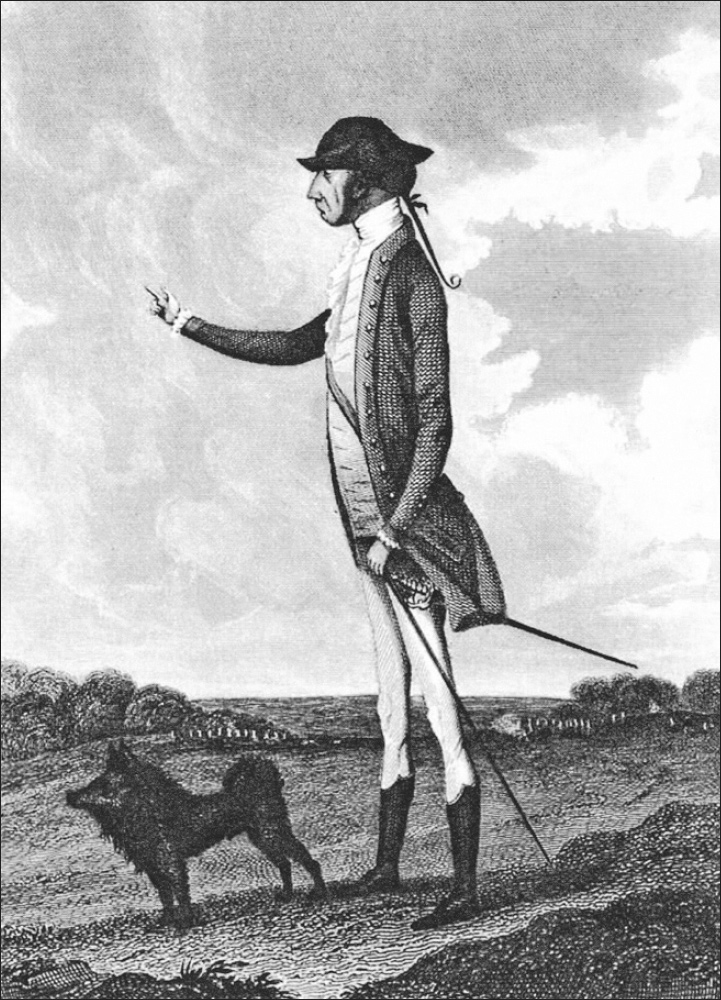
Major General Charles Lee with one of the dogs whose company he preferred to humans’. (illustration credit 6.2)
Of all the alliances Lafayette forged in 1778, the most valuable was surely his friendship with Washington. The bond between the men was cemented in late June, when the chaotic Battle of Monmouth pitted them not only against the British Army but also against the volatile temper of their comrade-in-arms Major General Charles Lee—a scrawny man with an outsized ego whose service as second-in-command of the Continental Army was about to come to a spectacularly bad end.
Lee and Washington had a long and contentious history. The men were the same age (both were born in February 1732—Washington in Virginia, Lee in Cheshire, England), and both had served in the wars against France. But Lee, who had fought in Europe and was still a British soldier when he took up the American cause, deemed himself the wiser and more accomplished officer. Lee’s disdain for Washington was not personal; he regarded nearly everyone in the same imperious manner. An eccentric character, Lee took pride in his misanthropy and openly admitted preferring the company of dogs and horses to that of humans; in a letter to a friend, Lee promised that he would turn philanthropic “when my honest quadruped friends are equaled by the bipeds in fidelity, gratitude, or good sense.” Exhibiting a fine disregard for military protocol, he treated orders like unwelcome suggestions—which is to say, he generally ignored them.
In the early days of the Revolutionary War, relations between Lee and Washington had been cordial. But they took a turn for the worse in November and December 1776, when Lee repeatedly disregarded Washington’s directive to hasten his troops from their camp near White Plains, some fifteen miles north of British-held New York, in order to reinforce Washington and his men in New Jersey. Rather than simply cross the Hudson as instructed, Lee wrote letter after letter—to Washington, to other officers, to state officials—justifying his inaction on the grounds that he had insufficient troops to make the journey safely. As the days wore on, elaborate complaints began to creep into his letters. Writing to the president of the Massachusetts Council on November 22, Lee railed against the “indecision” he observed in the nation’s military and political leadership and insisted that a draft be raised—a suggestion that ran counter to the wishes of Congress. “There are times,” Lee argued, “when we must commit treason against the law of the State for the salvation of the State.” Still in New York on November 30, he further argued that a conscripted army would make for a superior fighting force, since volunteers tend to come from “the most idle, vicious, and dissolute part of every society.” Such men might easily “become the tools of some General, more artful than the rest,” he warned, and be compelled to turn their arms “against their country’s bosom.” Meanwhile, Washington—who, we might presume, was the “artful” general to whom Lee alluded—was growing impatient. Writing from Newark on November 27, Washington had expressed astonishment that Lee had not yet budged, given that “my former letters were so full and explicit, as to the necessity of your marching as early as possible.” Lee and his men finally crossed the river in early December, but they would not be on the move long. On the morning of December 13, Lee was captured by British dragoons while staying at a suspiciously unguarded farmhouse in northern New Jersey. He remained in custody until May 1778.
Released as part of a prisoner exchange, Lee reached Valley Forge the day after Lafayette returned from Barren Hill. He was just in time to join in the councils of war that Washington convened in June to debate whether—and, if so, how—to engage the British troops that were evacuating Philadelphia and marching north toward New York. Opinions were divided. Lee joined with Benedict Arnold and others in insisting that the Continental Army would be no match for the British in an open engagement, while Lafayette was among those who encouraged bold action. Washington chose a middle course: the Americans would harass the withdrawing troops as they headed north but would be prepared for a general engagement should success seem likely. On June 18, Washington drew up orders that placed Lee in command of the first division, assigned “to move the morning after Intelligence is received of the Enemy’s Evacuation of the City.” But Lee declined the offer, and Washington selected Lafayette to lead the advance force.
On June 25, Washington placed Lafayette in command of 4,400 troops with orders to use “the most effectual means for gaining the enemys left flanck and rear, and giving them every degree of annoyance.” On June 26, at least seven letters flew back and forth between Lafayette and Washington between five in the morning and ten-thirty at night. In them, Lafayette stressed his desire to move as quickly as possible while Washington stressed the need for circumspection. “I must repeat again my wish that you do not push on with too much rapidity,” Washington wrote from Cranbury, New Jersey, at nine forty-five in the morning. “You may be, in case of Action, at too great a distance to receive succor and exposed from thence to great Hazard,” he explained.
Before the night was over, Washington had replaced Lafayette with Lee. Lee had not changed his mind about the feasibility of the mission but felt that he had been too hasty in declining the opportunity to lead it. As Lee had explained to Washington on June 25, it “is undoubtedly the most honorable command next to the Commander in Chief” and “my ceding it would of course have an odd appearance.” Lee made a similar appeal to Lafayette, who yielded to the senior officer’s request. If Lee’s objective in declining had been to scuttle the mission and make himself seem indispensable, Washington’s appointment of Lafayette had elegantly demonstrated that neither was the case.
After accepting a command that he did not want, the disgruntled Lee proceeded to complain mightily about it. Writing from a post in the woods near Englishtown, New Jersey, some forty-five miles south of Manhattan, at seven in the morning on June 27, Lee grumbled that he had been unable to ascertain whether or not the British were still encamped at Monmouth; by way of explanation, he added that “the People here are inconceivably stupid.” The British had not moved, and they were still there on the morning of June 28, when the Americans engaged the rear of the British Army near Monmouth Court House. Lee was in command when the first shots were fired, but his leadership quickly dissolved when he ordered a retreat in the face of a charge by enemy cavalry. As Lafayette recalled the events, the Americans were soon “exchanging roles with the British.” No longer on the offensive, Lee had allowed himself to be pushed back by Cornwallis. Alarmed, Lafayette dashed off a note to Washington, who arrived “at a gallop” only to find “the troops in confusion and still retreating” while Lee complained that the entire mission had been “against my advice.” An outraged Washington castigated Lee, sent him to the rear, and seized control. “Cannon fire was exchanged all day,” wrote Lafayette, and although both sides suffered hundreds of casualties in one-hundred-degree heat and stifling humidity, the Americans “continued to gain ground until nightfall.” At the end of the day, the British withdrew and the Americans claimed the battlefield.
As measured by the number of fallen soldiers, the battle was very nearly a hard-fought draw, but the Americans saw the outcome as a victory. It was the first time Washington’s army had advanced against the British, and the first time the ragged men of Valley Forge had looked and acted like the disciplined fighting force they had become. The day also yielded the revolution’s first female hero: it was at Monmouth Court House that Molly Pitcher, who had been supplying water to the troops throughout the day, reportedly took her husband’s place at the cannon when he was carried off the field.
For Lee, the Battle of Monmouth was disastrous. With his pride deeply wounded by Washington’s actions, Lee flew into a fit of rage and began a letter-writing campaign that might charitably be described as unwise. Writing to the Virginia congressman Richard Henry Lee (no relation) on June 29, Lee railed against Washington’s decision to engage the enemy at Monmouth, writing “what the devil brought us into this level country (the very element of the enemy) or what interest we can have (in our present circumstances) to hazard an action, somebody else must tell you, for I cannot.” His June 30 letter to Washington went further. Lee insisted “that nothing but the misinformation of some very stupid, or misrepresentation of some very wicked person, could have occasioned your making use of such very singular expressions as you did, on my coming up to the ground where you had taken post.” The retreat, Lee claimed, had been necessary. In fact, he added, “I can assert that to these maneuvers the success of the day was entirely owing.” Accusing Washington of having committed “an act of cruel injustice,” he asked whether the commander in chief believed him to be guilty “of disobedience of orders, of want of conduct, or want of courage.” Whatever the charge, Lee demanded an opportunity to refute it before a court-martial. Lee was arrested that day, and his court-martial began before the week was out. He was found guilty on three separate charges, and never served under America’s colors again.
Lafayette emerged from the Battle of Monmouth a closer comrade to Washington. In his memoirs, Lafayette wrote that they “passed the night on the same cloak” and discussed Lee’s perfidious behavior. Lafayette’s star was rising, and it was about to soar far higher.
Lafayette saw his next step clearly. Having found battlefield distinction in America, he hoped that he might be welcomed back into the French fold. When Lafayette learned that the French fleet had been spotted off the coast of Maryland, it seemed that his opportunity had arrived. At last, he thought, he might don his country’s uniform.
The twelve French ships of the line and four frigates that appeared in American waters on July 5, 1778, had sailed from Toulon three months earlier under the command of Admiral Charles Hector d’Estaing— a man who was much accomplished but little loved. In three decades of military service, the forty-eight-year-old d’Estaing had been stationed around the globe, risen to the ranks of both general and admiral, and received nearly every decoration available to him. Yet he had also acquired a reputation for being a meddler whose poor judgment hobbled his leadership. In 1778, d’Estaing’s habit of inserting himself into matters better left to others prompted the gossipy publication known as L’espion anglois to predict that he would sow “ill will and insubordination” among the men who sailed for America. “I fear for this campaign,” opined the author. Bearing out this forecast, an anonymous pamphlet written by a disgruntled officer four years later decried the admiral’s “haughty and presumptuous” character and blamed d’Estaing’s distasteful personality and routine abuses of power for generating widespread enmity that ultimately damaged the mission.
Arrogant though d’Estaing may have been, he appeared to hold Lafayette’s future in his hands, and Lafayette greeted him accordingly. In a long and effusive letter of welcome, Lafayette established common cause with the admiral, emphasizing their shared Auvergnat ancestry and promising to collect and pass along intelligence concerning British maneuvers. At length, Lafayette broached the matter that was dearest to his heart: his desire to fight in the French service. “However pleasantly situated I am in America,” he wrote, “I have always thought … that I would prefer to be a soldier under the French flag than a general officer anywhere else.” Echoing the sentiments he had already expressed to Théveneau de Francy, Lafayette assured d’Estaing that, if France should decide to wage war against British interests in any part of the world—the East Indies, the Antilles, Europe—he would “leave at once” to join the cause. Writing again ten days later, Lafayette clarified that he had “no other ambition” than “to seem worthy to you of being a French soldier and of serving in this capacity under your orders.”
In the weeks after the fleet’s arrival, Lafayette threw himself into a whirl of activity that earned him d’Estaing’s gratitude and admiration. In an autumn report to the French Ministry of the Marine, d’Estaing praised the young marquis, noting that “no one was better situated to serve as a link” between France and America. And although d’Estaing sometimes bristled at what he termed Lafayette’s “extreme impatience,” he understood that Lafayette’s “zeal,” coupled with “his valor, and his wisdom” helped to counteract the “incalculable slowness” that he encountered in his dealings with the Americans. Indeed, no one could have been more enthusiastic than Lafayette about the task at hand. Between July 14 and July 30, Lafayette sent at least six separate letters to d’Estaing. He provided introductions to Washington’s aides-de-camp Alexander Hamilton and John Laurens (Henry’s son) and supplied context for missives from Washington. He reported on British activities in New York, sent encrypted messages concerning American plans, and engaged skilled pilots in an effort to salvage d’Estaing’s doomed attempts to navigate the shoals off New Jersey and enter New York Harbor. On July 30, en route to Rhode Island after giving up plans to attack New York, d’Estaing expressed his thanks to Lafayette, who, he predicted, would inevitably succeed in winning “the opinion and the aid” that would be “the first necessity” of a new campaign planned against the British at Newport. “You know how to get everything going,” d’Estaing wrote to Lafayette, who was then marching northward, leading two American brigades overland from White Plains to Rhode Island. There, they would serve under Major General John Sullivan, who was to lead American ground troops in a joint land and sea offensive against the British and Hessian forces occupying Newport and its surrounding islands. “You will have acquired an even greater share of glory before I have the honor of embracing you,” d’Estaing forecast.
Washington, too, had high hopes for Lafayette. Lafayette’s good nature had already helped dissipate the army’s resentment of French officers. Now Washington relied on Lafayette to smooth whatever wrinkles might mar the new alliance. Writing to Sullivan on July 27, Washington stressed the importance of maintaining “Harmony and the best understanding” between the two forces. This was no simple task. In fact, Washington himself remained wary of working with non-Americans. In a letter to the New York congressman Gouverneur Morris (who, having witnessed the privations of Valley Forge, became an ardent champion of the army), Washington exclaimed, “I do most devoutly wish that we had not a single Foreigner among us, except the Marquis de la Fayette, who acts upon very different principles than those which govern the rest.”
Perhaps it was inevitable that relations between the new allies would be strained from the start. Shortly after the armies assembled at Newport, their leaders began wrangling over whose troops would land first on the British-occupied islands. Sullivan expected that American troops would be the first to disembark, with d’Estaing’s French forces following them. But d’Estaing insisted that the French deserved the honor of landing before the Americans. Indeed, d’Estaing argued that for the French to land after the Americans would be not merely “militarily inadmissible” but, in fact, “impossible.” Lafayette made valiant efforts to bring the two sides closer together, but with national pride at stake, there was little to be done. To d’Estaing, he emphasized that this was, after all, America’s war, and that it might be “vexing for certain people to watch the beautiful monologues of a play performed by foreign actors.” To Washington, Lafayette urged that the French be allowed to act quickly and decisively, lest d’Estaing’s men feel unappreciated. Having boarded the French ships, Lafayette wrote, he “saw among the Fleet an ardor, and a desire of doing some thing which would soon turn into impatience if we don’t give them a speedy occasion of fighting.”
It did not go well. A joint attack, with both armies landing simultaneously, was planned for August 10, but Sullivan seized an opportunity to advance one day earlier. Having received word that the British were evacuating, he sent his men forward on August 9 without notifying d’Estaing. As John Laurens related the story to his father, “This measure gave much umbrage to the French officers. They conceived their troops injured by our landing first, and talked like women disputing precedence in a country dance, instead of men engaged in pursuing the common interest of two great nations.” Feeling angry and betrayed, d’Estaing struck out on his own. Without consulting the Americans, he dispatched most of his fleet from Newport Harbor in pursuit of British ships, leaving Sullivan to discover that his naval protection had been reduced to a mere three ships.
Horrified, Sullivan charged Lafayette with the unenviable task of coaxing d’Estaing back to Newport. But the French had come under fire as they sailed out of Narragansett Bay and were wary of facing the same battery on their return. In a pleading letter, Lafayette promised d’Estaing that his ships would be safe and added, with underlines for emphasis, “that the Americans do not find your situation dangerous.” Still d’Estaing refused to place his fleet in the hands of an ally he deemed untrustworthy. He remained at sea until the elements accomplished what Lafayette could not: on August 12, strong winds scattered the French vessels and inflicted heavy damage that forced d’Estaing to turn back for Newport. Relieved as they were by the return of the fleet, the Americans were all the more livid when d’Estaing declared his intention to remain only long enough to assess the condition of his tattered ships. On August 22, the French sailed for Boston in search of needed repairs, leaving Sullivan to accuse them of desertion, cowardice, or worse. Furious at the French, he committed these and other unflattering opinions to paper and dispatched a small craft to overtake d’Estaing and deliver the missive.
For a brief moment, Lafayette snapped. He did not condone d’Estaing’s departure, but neither would he abide insults to French honor. With tempers flaring on all sides, Lafayette was so irate that he dared not share his emotions with his mentor, Washington; he later confessed that he feared he might “risk our friendship by expressing the sentiments of an afflicted heart.” Still, he kept striving to make peace. “Would you believe,” he asked d’Estaing in a letter of August 24, “that, forgetting the general obligations owed to France and the services specifically rendered by the fleet, the greater part of these people here allow faded prejudices to revive and speak as though they had been abandoned, almost betrayed.” Nonetheless, Lafayette pointed out that their mutual disgust with Sullivan’s cohort “need not mean falling out with General Washington and Congress,” whom he termed “the two great driving forces of all our work.” The next day, he shared his horror with Washington, asking him to “Reccommend to the several chief persons of Boston to do any thing they can to put the French fleet in situation of Sailing soon.”
Ultimately, it fell to Washington to calm the anger on both sides. In judiciously phrased letters to Lafayette, Washington tended to the young man’s wounded honor by extolling the virtues of Lafayette, d’Estaing, and all their countrymen. In other letters written at the same time, Washington issued pleas for transatlantic understanding to Sullivan, Major General William Heath, and other American leaders, explaining his wish to “palliate and soften matters.” Wisely, Washington asked his countrymen to remember that the French were “people old in war, very strict in military etiquette, and apt to take fire where others scarcely seem warmed.” There was little to be done about national temperament, but military success required a degree of mutual understanding. Differences would have to be put aside.
On August 26, Lafayette rode through the night to Boston, making the sixty-mile journey in just seven hours—a remarkably rapid pace. There, he conferred with all parties and helped broker a détente. The success of the alliance depended on Lafayette, and Lafayette’s future depended on that alliance.