
CHAPTER 7
In the fall of 1778, Lafayette was growing restless. Having suffered through a summer of delays and disappointments, he spent the month of September encamped near Bristol, Rhode Island, awaiting an attack that never came, prodding Washington and d’Estaing into actions they would not pursue, and lobbying for permission to return to Washington’s headquarters. On September 1, Lafayette pleaded with Washington, “I long my dear general, to be again with you.” Writing again on September 21, Lafayette added “our Separation has been long enough, and I am here as inactive as anywhere else.”
With no new orders forthcoming, Lafayette cast about for other ways to contribute to the cause. On September 8 he wrote to Silas Talbot, an American army officer with extensive naval experience, to propose a nocturnal attack on an English frigate moored off the coast of Rhode Island. By the following week Lafayette had developed a new plan: he would challenge Lord Carlisle, the head of the British peace commission, to a duel. As Lafayette explained in a letter to d’Estaing, the commissioners had impugned the French character, alleging that France viewed the American colonies as little more than “the instrument of her ambition.” Not only did Lafayette burn to right the wrong but, he informed d’Estaing, “I have nothing very interesting to do here, and even while killing Lord Carlisle, I can make some more important arrangements at White Plains.” (Lafayette did extend the challenge, but Carlisle declined.) Finally, Lafayette’s last hopes for imminent activity were dashed by a letter of September 25 in which Washington made it clear that a second attempt to invade Canada was not in the offing. Adopting a firm but gracious tone, Washington wrote to his ever-eager comrade,
If you have entertained thoughts my dear Marquis of paying a visit to your Court—To your Lady—and to your friends this Winter, but waver on acct. of an expedition into Canada, friendship induces me to tell you, that I do not conceive that the prospect of such an operation is so favourable at this time as to cause you to change your views.
Shortly after the message was written, Lafayette began planning a trip to France.
As Washington knew, a series of personal misfortunes had been weighing on Lafayette in recent months, but a steadfast commitment to the American Revolution had prevented him from returning home. Henriette, Lafayette’s first daughter, had died on October 3, 1777, at the age of twenty-two months. But news traveled slowly and unreliably, especially in times of war, and Lafayette did not learn of the death until late spring. When he did, he was crushed. “How dreadful my isolation is,” he wrote to Adrienne on June 16. “My heart is afflicted by my own sadness and by yours, which I was not able to share. The immense time that it took for me to learn of that event makes it that much worse.” Lafayette was also facing financial troubles. Since arriving in America, he had been drawing on credit to pay for expenses that were rapidly multiplying. Making matters worse, the Victoire had foundered off the eastern seaboard in the summer of 1777, scuttling Lafayette’s plans to recoup his investment in the ship by sending it back to France loaded with cargo.
The most pressing reason for Lafayette’s return to France might well have been the one highlighted in his October 13 letter to the president of Congress requesting leave of absence from the Continental Army. “Now … that France is involv’d in a war,” Lafayette wrote, “I am urg’d by my duty as well as by patriotic love, to present myself before the king, and know in what manner he judges proper to employ my services.” Perhaps Lafayette had come to understand that he would not be permitted to fight under the French flag until he begged the king’s forgiveness for sailing to America against explicit royal orders. At first, Lafayette seems not to have comprehended the difficulties of his situation, or the awkward position in which he placed d’Estaing, Bouillé, and the other French officers whom he petitioned for an appointment in the summer of 1778. But his interlocutors were more keenly attuned to questions of decorum and dared not welcome a fugitive—even a fugitive in name only—into the fold.
As Lafayette planned his return voyage, France’s representatives in America began preparing carefully crafted letters to the king and his ministers in support of the wayward youth. The French ambassador, Conrad Alexandre Gérard, reported to the Comte de Vergennes on the “wisdom and dexterity” with which Lafayette had comported himself in America but deemed it prudent to distance himself from any laudatory views. In his letter of October 20, Gérard professed, “You know, Monseigneur, how far I am from adulation, but I would be unfair if I did not convey to you the testimonials that are on the lips of everyone here without any exception.” Gérard noted that Lafayette had “offered very salutary advice informed by friendship and experience” and that his “prudent, courageous, and likable” conduct had made him “the idol of Congress, of the army, and of the American people.” Moreover, he added, Lafayette’s “military talents are held in high esteem.” D’Estaing, too, wrote on Lafayette’s behalf while couching his commendations in apologetic terms. In a November report to the Ministry of the Marine, d’Estaing singled out the tremendous enthusiasm exhibited by Lafayette, which, he wrote, had obliged him to receive the young man with “personal satisfaction mingled with political unease.” Americans, in contrast, were unstinting in their praise of Lafayette. Knowing that the war could not be won without French support, and fully aware that Lafayette was America’s strongest advocate in France, Congress did all it could to shore up Lafayette’s standing in his native land. When Congress approved Lafayette’s leave of absence on October 21, it also resolved to furnish him with a letter extolling his virtues to Louis XVI. The official dispatch recommended “this young Nobleman to your Majesty’s notice,” lauding Lafayette as “one whom we know to be Wise in Council, gallant in the Fields, and Patient under the hardships of War.” Citing not only Lafayette’s “Zeal, Courage and attachment” but also his “Devotion to his Sovereign,” Congress attested that Lafayette had earned “the confidence of these United States … and the Affection of their Citizens.”
William Carmichael, who had served as Silas Deane’s secretary in Paris, added a personal appeal to Benjamin Franklin, asking him to manage the delicate politics of Lafayette’s return. Lafayette’s diplomatic skills had impressed Carmichael, who reported to Franklin that “no one but [Lafayette] has known how to reconcile the clashing parties of this Continent to his own views.” He did not want to lose Lafayette’s valuable voice but, having witnessed the uproar that surrounded Lafayette’s departure from France, he believed that Franklin—the most beloved American in Paris—would be the best man to usher Lafayette back into the good graces of the king. Consider, Carmichael wrote to Franklin, “what a satisfaction it will be” to the Noailleses “that the Ministry should be acquainted by you rather than any one Else of the opinion entertained of [Lafayette] here.” “May it not be proper,” Carmichael suggested, “to put the resolves letters &c. &c. into the hands of the ministry instantly on the receipt of them & before the Marquis makes his appearance at Versailles?”
Before he left, Lafayette was promised one more token of Congress’s gratitude: a ceremonial sword to be cast in silver by Lafayette’s Parisian cutler through the intercession of Benjamin Franklin. The sword, its hilt decorated with vignettes commemorating four of Lafayette’s battlefield accomplishments, became one of his most prized possessions. In Paris, John Adams remarked that Lafayette wore it proudly whenever he went out in company—it was tangible proof that Lafayette had found the glory he sought in America.
When Lafayette had left France in 1777, the smarter sets of Paris and Versailles had deemed him a social liability, but on February 12, 1779, he returned home a hero. His carefully scripted reentry into Paris was an unmitigated success. As he described it, “Upon my arrival, I had the honor of being consulted by all the ministers and, what was even better, embraced by all the ladies.” Satisfying protocol, Lafayette immediately paid a visit to Versailles, where he was “interrogated, complimented, and exiled” to the luxurious confines of the Hôtel de Noailles for a few days of supremely comfortable house arrest—a nominal punishment for having disobeyed royal orders. But even this penalty was not paid in full: on his second day in Paris, Lafayette personally delivered a package of letters to John Adams. All doors were open to him, and even Marie Antoinette, who had so heartily disapproved of his dancing, now intervened with the king on his behalf. Thanks to the queen, Lafayette was granted the rather costly honor of paying80,000 livres to purchase the command of the regiment of the King’s Dragoons— a position that a man out of royal favor could not have acquired for any amount of money.
Like so many others before and since, Lafayette had reinvented himself in America. As the Comte de Ségur told it, Lafayette’s faraway exploits had captured the imagination of his homeland. Ever since Paris learned of “the first battles in which Lafayette and his comrades in arms burnished the name of France, the approbation was universal; even people who had most opposed his foolhardy enterprise applauded him; the court nearly burst with pride, and all the young people envied him.” In fact, Ségur believed that Lafayette’s éclat had propelled France into open support for the Americans. “Thus,” Ségur wrote, “public opinion, declaring itself more and more for war, made it inevitable, and dragged along a government too weak to resist such an impulse.”
Another man might have been content to rest on his laurels, but Lafayette put his popularity to use in the service of the American cause. Throughout the spring of 1779, he corresponded and met with the highest-placed representatives on both sides of the French-American alliance, and thereby sealed his reputation as America’s foremost advocate in France. Speaking with Vergennes, Maurepas, and others at court, Lafayette proposed loan agreements, lobbied for increased naval and ground support, and floated ideas for military offensives against British territories. Of these, the most daring was a bold plan to strike the coastline of England, pillaging the commercial towns of Liverpool and Bristol to raise funds for the Americans. The assault was envisioned as a joint land-and-sea venture led by Lafayette and the naval commander John Paul Jones. In honor of Benjamin Franklin, who had been deeply involved in the planning, Jones would be aboard the Bonhomme Richard—a reference to Franklin’s Poor Richard’s Almanac. Fully anticipating that the offensive might begin at any moment, Lafayette spent much of the summer and autumn of 1779 at the ready at the Channel port of Le Havre, but he never received the go-ahead to sail.
The attack on England was just one of many projects Lafayette and Franklin hatched together. The men made for an unlikely pair: one young, plainspoken, and painfully earnest, the other an aging wordsmith renowned for his urbanity. But both were good-natured, and although Lafayette tried not to take sides in the increasingly public feud that set Franklin against his fellow American ministers, Lafayette was drawn more to the Francophile Philadelphian than he was to John Adams, a stolid New Englander, or to the Eton-educated Virginian Arthur Lee. Franklin listened patiently to even the smallest of Lafayette’s concerns; when Congress asked Franklin to procure uniforms with decorative layers of white fabric, or “facing,” sewn onto the cuffs, lapels, and other parts of the coat, Lafayette objected that yellow facing would be more suitable. Lafayette, in turn, appreciated the humor when Franklin poked fun at his outsized devotion to all things American. On September 17, 1782, when Franklin learned that Lafayette intended to name his newborn daughter Virginie, “as an offering to My Western Country,” Franklin jested that Lafayette did “well to begin with the most ancient State” and wished that the Lafayettes would “go thro’ the Thirteen.” Enjoying the conceit, Franklin added that“Miss Virginia, Miss Carolina, & Miss Georgiana will sound prettily enough for the Girls; but Massachusetts & Connecticut are too harsh even for the Boys.”
All kidding aside, Franklin fully understood Lafayette’s motivation for naming a daughter Virginie and a son George Washington. Franklin knew well, and Lafayette was coming to learn, that words and images could shape public opinion. In the spring of 1779, they collaborated on a telling project: an illustrated children’s book to be used in schools—or so they wrote—depicting selected horrors inflicted by the British upon the Americans during the Revolutionary War. As Franklin quipped to a pro-American correspondent in England, the goal of the book’s thirty-five prints was “to impress the minds of Children and Posterity with a deep sense of your bloody and insatiable Malice and Wickedness.” Lafayette’s tone was a bit less jocular when he wrote to Franklin, “I great deal love our project, and want to be Concern’d in it as much as possible.” Although Lafayette expressed some reluctance about portraying the English as less human than other nationalities, he concluded that such a book was necessary because British atrocities “must be known By the future American posterity.” Together, Franklin and Lafayette compiled a list of twenty-six possible images before abandoning the project. Those in Lafayette’s handwriting include the very questionable No. 18, “Prisoners killed and roasted for a great festival where the Lenape Indians are eating American flesh; Colonel Butler, and English officers, sitting at table,” and the more historically accurate No. 21, “A dusty prison ship where American officers are confined without being at liberty to take the air and so crowded that they can live but a few days—British officers come to laugh at ’em and to insult at their miseries.”
Lafayette had only recently begun thinking about the power of images. In August, he had seen John Hancock give a copy of a 1776 portrait of Washington by the prominent Philadelphia artist Charles Willson Peale to the Comte d’Estaing. Writing to Washington about the scene, Lafayette testified, “I never saw a man so glad of possessing his sweet heart’s picture, as the admiral was to Receive yours.” Lafayette was so struck by the event that he acquired a small copy from Peale for himself and arranged for the army engineer Pierre Charles L’Enfant (who would later become known as the city planner of Washington, D.C.), to sketch Washington from life. Lafayette’s sudden interest in pictures took Washington by surprise; in a letter of September 25, Washington, who found portrait sittings rather disagreeable, explained to Lafayette that “when you requested me to set for Msr. Lanfang [sic] I thought it was only to obtain the outlines and a few shades of my features, to have some Prints struck from.” Washington noted, “Could I have conceived that my Picture had been an object of your Wishes, or in the smallest degree worthy of your attention, I should, while Mr. Peale was in the Camp at Valley Forge, have got him to have taken the best Portrait of me he could, and presented it to you.”
There was nothing out of the ordinary about Lafayette’s request for a picture of Washington. In the eighteenth century, many prominent men decorated their homes with portraits of historical figures they hoped to emulate, absent friends they wished to remember, and influential contemporaries deserving of respect. Thomas Jefferson, for instance, filled Monticello with sculptures, paintings, drawings, and engravings of dignitaries. Marble busts of Voltaire, Alexander Hamilton, and others greeted guests in Jefferson’s entry hall; paintings of John Locke and Isaac Newton and engravings of Louis XVI and Napoleon Bonaparte mingled with biblical scenes on the walls of the parlor; and, thanks to plaster casts of busts by Jean-Antoine Houdon, George Washington, Benjamin Franklin,John Paul Jones, and Lafayette were always among the company in the tearoom.
Lafayette would later amass his own, more focused collection of prints, paintings, and sculptures commemorating important friends and significant events, but his portraits of Washington played a unique role in 1779 and 1780. In those months, Lafayette was lobbying to be placed at the helm of a French detachment headed for America, and his close friendship with Washington was the most powerful argument at his disposal. Shortly after returning to Paris in 1779, Lafayette arranged for a French artist to paint a more didactic version of Peale’s portrait of Washington. While the version that Hancock owned offers a three-quarter-length view of the standing Washington towering over a distant landscape, the new image created for Lafayette emphasizes the demise of Great Britain and highlights the role of France as America’s closest ally. As Lafayette described it, his painting shows Washington “with the French treaty and the Declaration of Independence in his hand and the edicts and proclamations of His Britannic Majesty under his feet.” “Beneath,” wrote Lafayette, “one reads the famous lines ‘Manus haec inimica tyrannis, etc.’—‘This hand is hostile only to tyrants and draws the sword only to obtain tranquil peace under liberty.’ ”
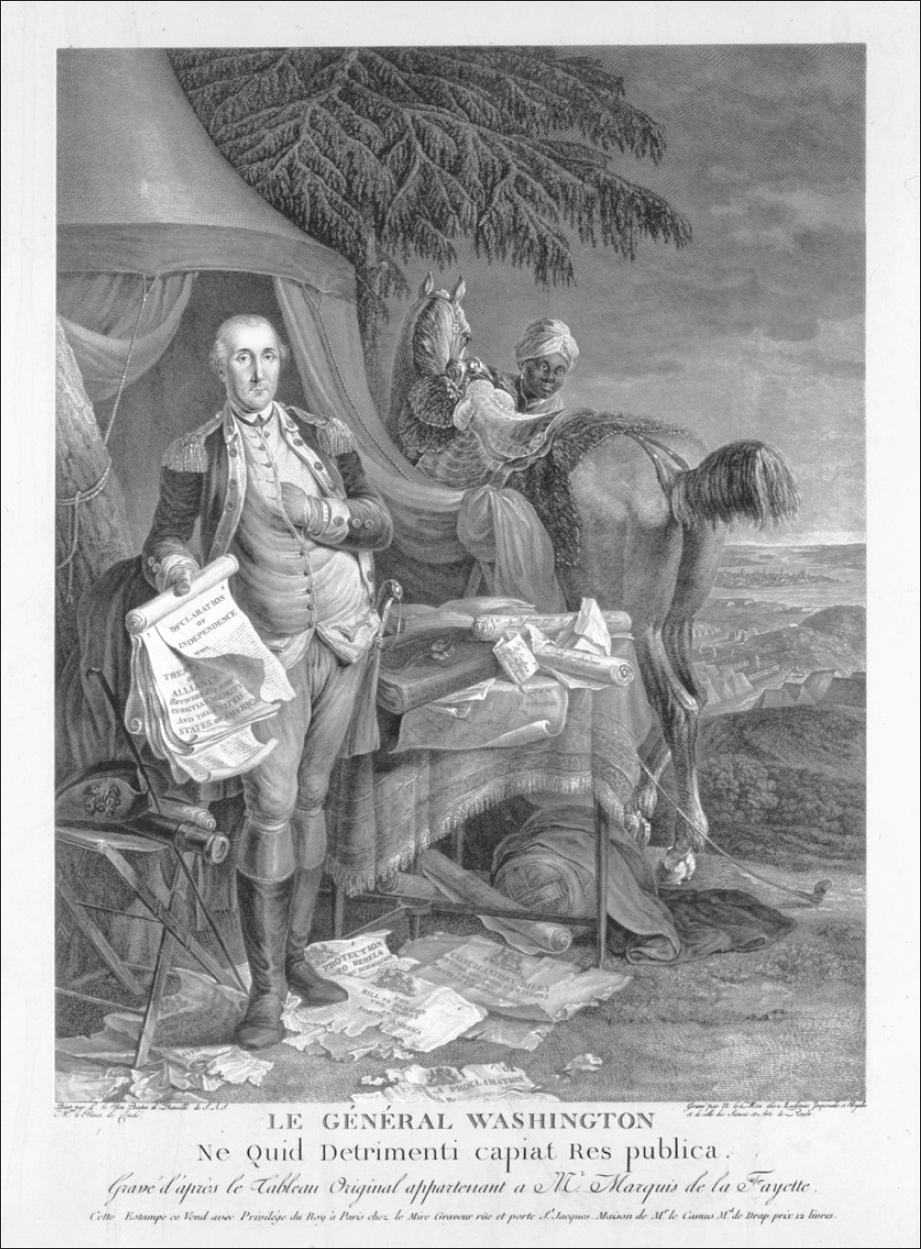
Portrait of Washington. Print commissioned by Lafayette, linking his name to Washington’s in 1780. (illustration credit 7.1)
Lafayette took every opportunity to call attention to his intimate knowledge of Washington and of all things American. In a letter to Vergennes on July 1, 1779, Lafayette wrote, “If you are curious … to see a portrait resembling my friend, I beg you to send to my home for it.” Lafayette added that he planned to bring the portrait with him to Benjamin Franklin’s house in Passy, where it would be displayed for Franklin’s Fourth of July celebration. “Things like that go over very well with our new allies,” Lafayette explained toFrance’s most senior diplomat. Soon, Lafayette commissioned yet another version—an engraving published in 1780 by Noël Le Mire after a composition by the battle painter Jean-Baptiste Le Paon. This more decorative scene places Washington at a camp in the woods and adds a decidedly exotic flavor by introducing a turbaned African servant and a Persian rug, edged with fringe, draped across the tabletop. The most significant addition to the work, though, might be its pairing of the names of Lafayette and Washington—the text beneath announces that it was “engraved after the original painting in the collection of Monsieur the Marquis de la Fayette.”
As plans for a new French expedition to America got under way, Lafayette was as direct as could be about his desire to command the French detachment. In a letter to Vergennes dated February 2, 1780, he laid out his argument: in light of his friendship with Washington and so many Americans, he believed that naming him commander would be “much more advantageous to the public good and to the interests of France vis-à-vis her allies” than any other option. “If I am in command,” he wrote, “you can proceed in complete confidence because the Americans know me too well for me to ignite any false rumors.” So strong were his feelings on the matter that he was willing to accept a purely temporary appointment and to relinquish all claims to rank or seniority. But if he were not chosen, he warned, immediate actions would have to be taken “to prevent the ill effects that the arrival of another commander would have in America.” He insisted that “the notion that I would be unable to lead this detachment is the last that would present itself over there.” A cover story would have to be agreed upon; for instance, Lafayette might simply say that he “preferred an American division,” implying that he had declined a French post. Whatever decision was made, Lafayette believed that he had to be kept fully apprised because “a secret that I would not know about would be regarded with great suspicion in Philadelphia.”
We have no record of how Lafayette responded when he was told that the command would be given to the Comte de Rochambeau, but he must have been devastated. Rochambeau had certainly earned the position: he had been an officer since before Lafayette was born and had suffered multiple wounds in the Seven Years’ War. Still, Lafayette demanded at least a face-saving role. “If [the command] is not given to me,” he wrote, “I must leave immediately with the resources I request.” Moreover, he would have to be the one to “instruct General Washington.” The ministry was happy to grant him this much. According to Vergennes’s orders of March 5, 1780, Lafayette would sail to America in advance of the French expeditionary force. Once arrived, he would “hasten to join General Washington” and “inform him confidentially that the king … has resolved to send to their aid six ships of the line and 6,000 regular infantry troops at the onset of spring.” On March 11, Lafayette set sail from Rochefort on the Hermione, bearing the good news and ample provisions for the army.
Before departing, Lafayette quietly signaled his displeasure at having been passed over. As John Adams reported it, Lafayette bid adieu to his monarch “in the Uniform of an American Major General.” Adams averred that when Lafayette appeared before Louis XVI in American attire, the costume “attracted the Eyes of the whole Court.” And Adams had no doubt that the sword Lafayette carried that day was the one commissioned by Congress. It “is indeed a Beauty,” Adams conceded, “which [Lafayette] shews with great Pleasure.” Without saying a word, Lafayette let it be known that he was returning to the only nation that appreciated his merit.
Americans, in fact, did more than simply appreciate Lafayette—they celebrated him at every turn. In a letter of May 1, 1780, Abigail Adams notified her husband that “last week arrived at Boston the Marquis de la Fayette to the universal joy of all who know the Merit and Worth of that Nobleman. He was received with the ringing of Bells, fireing [sic] of cannon, bon fires, etc.” Similar festivities erupted in every town he passed through on the 250-mile journey from Boston Harbor to Washington’s headquarters at Morristown, New Jersey. “It’s to the roar of cannon that I arrive or depart; the principal residents mount their horses to accompany me,” Lafayette told Adrienne. “In short, my love, my reception here is greater than anything that I could describe to you.”
Lafayette’s return was a bright spot in a season that had been unrelentingly bleak for the American army. Privations that had plagued the war effort from the start were worsening as officers and soldiers alike faced lethal shortages of food, clothing, and blankets. With military salaries going unpaid and inflation rendering American currency next to worthless, desertion rates skyrocketed and recruitment plunged. Although Lafayette did not come with any quick fixes—even the four thousand uniforms that he had hoped to bring with him did not reach Rochefort before he sailed—his news of imminent French aid injected a note of hope into the atmosphere of despair, and the mere fact of his return had a cheering effect.
Lafayette wasted no time in proving that he merited the accolades he received. As soon as he understood the gravity of the situation, he began peppering state leaders from Massachusetts to Pennsylvania with urgent pleas for assistance. Lacing his military arguments with personal requests, Lafayette wrote to Samuel Adams in Massachusetts, George Clinton in New York, and others up and down the eastern seaboard, asking them to consider the awkward position in which he now stood. Having taken “particular delight in praising the Patriotic spirit of the United States” to his countrymen, Lafayette confessed to Adams, “I would feel most unhappy and distress’d was I to tell the people that are Coming over full of ardour and Sanguine hopes, that we have no army to Cooperate with them, No provisions to feed the few soldiers who are left.” Lafayette sent similar requests to members of Congress, who, in the end, wrested control of recruitment and supply from the states’ disorganized authorities.
Alarmed though Lafayette was by the depleted state of the army, nearly two years had passed since he had last seen action, and his most urgent wish was to return to the field of battle. Washington, Lafayette, and the other generals had long agreed that taking New York should be their primary objective, and shortly after he rejoined Washington’s “family” (as Washington’s closest circle was known) Lafayette began agitating for an immediate attack. With England’s attention temporarily diverted to the war’s southern front, Lafayette believed that the time to act was now. General Clinton’s forces had been mercilessly bombarding Charleston, South Carolina, since mid-April, and after the devastating Siege of Charleston ended with the Americans’ capitulation on May 12, the British began pouring resources into raids in North Carolina and Virginia. Lafayette understood that any action against New York would have to wait the arrival of Rochambeau’s French forces, but he did not want to delay a moment longer than necessary. As he promised Vergennes in a letter of May 20, “If the French troops arrive in time, chances are good that New York is ours.” But he warned that “if the English have time to regroup,” the project might have to be abandoned.
So eager was Lafayette to move forward with the attack on New York that he laid out the plans in a detailed letter to Rochambeau dated July 9—one day before the French squadron had even landed at Newport, Rhode Island. But Rochambeau had more immediate concerns. He had arrived with only 5,100 men, rather than the anticipated 7,500, and he believed that many of them would require a month or so to recover from illnesses contracted during the crossing. Arms and matériel badly needed by the depleted American military were also lacking; John Paul Jones’s frigate bearing 15,000 muskets and 100,000 pounds of gunpowder had been delayed. Meanwhile, with the English reinforcing their position in New York and Rochambeau expecting an assault on Newport any day, all able-bodied French troops were fully occupied in strengthening their fortifications in Rhode Island. Perhaps, Rochambeau suggested, an assault on New York could be planned for some time after August 15, with the details to be worked out in a face-to-face meeting with Washington, who served as the supreme commander of all French and American forces.
Understanding that New York would have to wait, Washington did his best to temper Lafayette’s impatience. On July 22, Washington wrote, “I am persuaded, my D[ea]r Marquis that however ardent your wishes to undertake the reduction of a certain place, you will not fail to give a candid and full overview of the difficulties” to Rochambeau. “We owe it to our allies,” he added. “We owe it to ourselves.” As Washington feared, Lafayette would not be dissuaded. At a July 30 meeting with Rochambeau and the Chevalier de Ternay, the commander of France’s naval forces in America, Lafayette listened to their concerns and dutifully reported Washington’s opinion that they could not strike New York until they had naval superiority. But he chose not to mention that the Americans had almost no arms, and as he later informed Washington, he “added in my own name that however we must … act Before the winter, and get Rid of a shamefull defensive.”
On August 9, Lafayette committed these and other thoughts to paper in a twelve-page letter, which he sent to Rochambeau and Ternay with a copy to the Chevalier de la Luzerne, who had replaced Gérard as the French ambassador to the United States. While purporting to offer a factual account of the July 30 conversation, Lafayette’s letter made bold claims that neither Rochambeau nor Ternay could support. Although the group had reached no such decision, Lafayette asserted that “it is very clearly settled that as soon as the French attain naval superiority, they must not lose a single day in beginning the joint effort.” And the chastising tone with which Lafayette concluded his missive did nothing to render his opinions more palatable. “Based on an intimate understanding of our situation,” he wrote, “I assure you … that it is important to act during this campaign.” Nothing that might happen in the future, Lafayette warned, would be sufficient to “make up for the fatal harm of our inaction.” Finally, alluding to his greater knowledge of all things American—knowledge that he’d once hoped would win him the command that Rochambeau now occupied—Lafayette added, “I believe it is very important to take advantage of the moments when you find an opportunity for cooperation … without which you can do nothing in America for the common cause.”
Rochambeau was livid. Writing his own letter to Luzerne, Rochambeau lambasted Lafayette. “He proposes Extravagant things to us,” fumed Rochambeau, “like taking Long Island and New York without a navy.” And although Lafayette assures us, Rochambeau added, that he can protect our right flank, “he forgets that there is still a left flank in a landing, which the whole English navy will exterminate, if it doesn’t prefer to go at the same time and do the same thing to the Chevalier de Ternay, who will be left to his own devices here” in Newport. Lafayette’s letter, Rochambeau complained, included “not a word, nor an order, nor even an opinion from Mr. Washington,” with whose dispatches Rochambeau was “infinitely satisfied.” Unfamiliar as he was with Lafayette, Rochambeau could only assume that the letter had been written “at the instigation of some hotheads,” but Luzerne disabused him of the notion that any conspiracy might be afoot. In a letter of August 24, Luzerne indicated that he was “inclined to believe that what M. de Lafayette has written to you is purely a result of his zeal and of a courage that experience will moderate.” Luzerne concurred that, henceforth, Rochambeau should correspond with Washington directly; such a move, Luzerne wrote, “will prevent all the inconveniences of this premature ardor.”
Lafayette was slow to see how he had erred, but Rochambeau hammered away until he got the point across, leading Lafayette to write a series of apologetic letters, each more elaborate than the last. Even at the end of the exchange Rochambeau had severe words for the presumptuous young man. “You know me well enough to believe that I do not need to be roused to action,” Rochambeau wrote to Lafayette on August 27. “At my age, when one has made a decision based on military and political reasoning necessitated by circumstances, all the instigations in the world could not make me change without a direct order from my general.” Lacing into Lafayette for his naïveté, Rochambeau allowed that “it is always good, my dear marquis, to believe the French invincible, but I am going to confide in you a great secret based on forty years’ experience. There are none easier to defeat when they have lost confidence in their commander.” And, he noted, they are inclined to “lose that confidence immediately when they have been put in danger because of private and personal ambition.” In the end, however, Rochambeau eased up on Lafayette, assuring him of his “most tender friendship” and concluding his letter by observing “that the warmth of your soul and your heart rather overheated the composure and wisdom of your judgment.” But that was not the end of the world. “Keep this last quality in the council,” Rochambeau recommended, “and reserve all of the first for the moment of action.”
For Lafayette, the fateful moment finally arrived in February 1781, when Washington placed him in command of 1,200 men, mostly composed of light infantry, with orders “to act against the corps of the enemy now in Virginia.” Lafayette’s primary target was to be Benedict Arnold, the traitorous American general who had crossed over to the redcoats, plotting a British takeover of West Point in September 1780. Since then, Arnold had taken a page from Cornwallis’s playbook and was conducting costly raids throughout Virginia. Lafayette was meant to stop him. If Arnold were to fall into Lafayette’s hands, the marquis had explicit instructions to “execute in the most summary way” the “punishment due to his treason and desertion.” Lafayette set out from New Windsor, Connecticut, on February 21, and joined up with Baron von Steuben in Yorktown, Virginia, on March 14.
Although Lafayette faced a force far greater than his own and a steady stream of setbacks—pouring rain, scarce provisions, rampant desertions—the return to action restored his spirits. Lafayette estimated that he was outnumbered “four or five to one in our regular infantry and ten to one in cavalry,” yet his letters were nearly as jovial as those he’d sent when he’d first arrived in Charleston. Writing on May 22 to the Vicomte de Noailles, one of several French friends who had sailed with Rochambeau and were now fighting in the north, Lafayette said expected reinforcements were slow in coming. When they arrive, he mused wryly, “we’ll be in a condition to be beaten more decently; but at the moment we can only run.” Finally, he asked Noailles to mention him were he to write to Paris: “Tell them that your poor brother is devilishly busy getting himself thrashed.”
In reality, Lafayette was far from getting thrashed. Rising to the challenge, he kept his men on the move as he and Cornwallis played a game of cat and mouse throughout the state of Virginia. In August, as Cornwallis began maneuvering toward a secure position on the Chesapeake at the trading port of Yorktown, Lafayette learned that help was on the way. Washington and Rochambeau would soon be joining their forces and heading south together, while a French fleet under the Comte de Grasse sailed for the Chesapeake Bay. Lafayette was given a crucial task: his job was to keep Cornwallis occupied in Virginia while the allies closed in from land and sea. Cornwallis was essentially trapped. While Washington and Rochambeau were descending from the northwest, three American divisions, commanded by Lafayette, Steuben, and Benjamin Lincoln, were taking up positions to the south and west. With the Chesapeake to the east, Cornwallis had nowhere to go.
By September 28, the allied forces were in place with Washington at the helm, and in early October, Washington tightened the noose around the enemy, digging trenches closer and closer to the British defenses. More than one hundred French and American cannons opened fire on Cornwallis’s fortifications on October 9, began targeting British ships the next day, and continued the bombardment for a week, inflicting heavy damage. On the night of October 14, Lafayette’s detachment struck a decisive blow. Led by Colonel Alexander Hamilton, who was then serving under Lafayette’s command, some 400 light infantrymen armed with axes and bayonets stormed and took one of the last remaining British redoubts. Cornwallis fought for two more days before waving the white flag on October 17. The official ceremony of surrender took place two days later, but the humiliated Cornwallis refused to attend. When the British general Charles O’Hara relinquished Cornwallis’s sword to General Benjamin Lincoln of Massachusetts, the last major battle of the American Revolution officially drew to an end.
More than four years had passed since the Victoire had deposited Lafayette and his lost band of French officers on the shores of South Carolina. In those four years Lafayette had lived a lifetime’s worth of new experiences. Yet he was still only twenty-four years old, and his remarkable life as a man living between two worlds was just getting under way.