
PART ONE
ONE

The earliest literary portrait of Leonardo da Vinci, and to me still the most moving, is that by the Tuscan painter and architect Giorgio Vasari in his classic book Lives of the Artists, published in 1550.1 Vasari was only eight years old when Leonardo died, but he gathered information about the master from many artists who had known him and remembered him well, most notably Leonardo’s close friend and disciple Francesco Melzi. An acquaintance of Leonardo, the surgeon and art collector Paolo Giovio, wrote a short eulogy, but it is unfinished and merely a page long.2 Vasari’s chapter, “Life of Leonardo da Vinci,” there fore, is as close as we can come to a contemporary account.
Besides being an accomplished painter and architect, Vasari was a keen collector of drawings by famous masters and of stories about them. The idea of writing a book on the history of Italian art from the thirteenth to the sixteenth centuries was suggested to him by Giovio during a dinner party in Rome.3 The book became a bestseller when it was first published, and its wide popular appeal has endured over the centuries due to the author’s lively and colorful portraits, replete with charming anecdotes. Through a series of engaging stories about the lives of its greatest artists, Vasari’sLives conveyed the revolutionary nature of the Italian Renaissance. In spite of many inaccuracies and a tendency toward referring to legends and idolizing, Vasari’s work remains the principal source for anyone interested in that period of European art and culture.
QUALITIES AND APPEARANCE
The opening paragraphs of Vasari’s chapter on Leonardo are an emphatic declaration of the master’s exceptional qualities and appearance:
In the normal course of events many men and women are born with various remarkable qualities and talents; but occasionally, in a way that transcends nature, a single person is marvelously endowed by heaven with beauty, grace, and talent in such abundance that he leaves other men far behind, all his actions seem inspired, and indeed everything he does clearly comes from God rather than from human art.
Everyone acknowledged that this was true of Leonardo da Vinci, an artist of outstanding physical beauty who displayed infinite grace in everything he did and who cultivated his genius so brilliantly that all problems he studied he solved with ease. He possessed great strength and dexterity; he was a man of regal spirit and tremendous breadth of mind; and his name became so famous that not only was he esteemed during his lifetime but his reputation endured and became even greater after his death.
Vasari’s effusive portrait of Leonardo may seem exaggerated, but his description is echoed in many contemporary accounts and references, in which Leonardo was often compared to the classical geniuses and sages of antiquity—Archimedes, Pythagoras, and most frequently Plato.4 Indeed, when Raphael, another great master of the Italian Renaissance, painted his fresco The School of Athens in the Vatican, he gave Plato the features of Leonardo, dressing him in a rose-colored toga (a color favored by Leonardo), with his index finger raised in a characteristic gesture well known from Leonardo’s paintings.

Figure 1-1: Andrea del Verrocchio, David, Museo Nazionale, Florence
Leonardo’s physical beauty in his youth and middle-aged years must have been exceptional, as it is mentioned by all his contemporary commentators, even though this was not customary at the time. An anonymous writer called the Anonimo Gaddiano exclaimed, “He was so unusual and many-sided that nature seemed to have produced a miracle in him, not only in the beauty of his person, but in the many gifts with which she endowed him and which he fully mastered.”5 Others marveled at the unique combination of physical strength and grace he seemed to embody. Many authors, including Vasari, referred to him with the ultimate epithet—il divino.
As a youth, Leonardo liked to dress flamboyantly. “He wore a rose-colored cloak,” the Anonimo Gaddiano tells us, “which came only to his knees, although at the time long vestments were the custom. His beard came to the middle of his breast and was well-combed and curled.”
As he grew older, Leonardo apparently dressed more conventionally, but his appearance was always elegant and refined. Paolo Giovio described him as “the arbiter of all questions relating to beauty and elegance, especially pageantry.” Leonardo’s own description of the painter’s inherent refinement is revealing as well:
The painter sits in front of his work at great ease, well-dressed, and wielding a very light brush with delicate colors. He adorns himself with the clothes he fancies; his home is clean and filled with delightful pictures, and he is often accompanied by music or readers of various beautiful works.6
There exists no confirmed portrait of Leonardo as a young man, but legend has it that he was the model for several angels and other youthful figures portrayed by Renaissance artists. The most credible of them is the lovely adolescent David sculpted by Andrea del Verrocchio during the time Leonardo was his student (see Fig. 1-1). The slender figure, wavy hair, and strikingly handsome face certainly match the contemporary descriptions of the young Leonardo, and art historians have pointed out that several of the statue’s facial characteristics seem to foreshadow those in the well-known portraits of the old master.7
There are quite a few portraits of Leonardo as an older man, most of them idealizing him as a venerable sage.8 The most authentic is that which is considered the artist’s only existing self-portrait, a captivating, highly detailed drawing in red chalk that he made when he was about sixty, although he appears older than his age (see Fig. P-1 on p. xxii). The drawing is housed in the Biblioteca Reale in Turin and is known as the Turin self-portrait. Unfortunately, it has been severely affected by centuries of exposure to air and light. The paper is now covered with “fox marks” (rusty-brown spots caused by excessive moisture and subsequent accumulation of iron salts), and the drawing is rarely exhibited in public.
In spite of its poor condition, the Turin self-portrait, which has been reproduced in countless posters and books, exerts a powerful effect on the viewer. This is even more true if one is fortunate enough to spend some time with the original, viewing it from different angles and distances, revealing the portrait’s complex and subtle expressions. Leonardo drew this portrait at a time of personal uncertainty and discontent. He was well aware that the greater part of his life was behind him; his eyes had weakened and his health was failing. He was living in Rome at the time, where he was revered. But already he was beginning to become out of fashion as an artist, eclipsed by younger rivals like Raphael and Michelangelo, who were in their prime and were the favorites of the papal court.
In Leonardo’s self-portrait, this unhappy time is reflected in a line of disillusionment, or perhaps contempt, around the mouth. Yet, under the bushy brows and majestic forehead, his eyes—the “windows of the soul”—have preserved the quiet intensity of his gaze as well as a deep serenity. The resulting expression, to me, is that of a powerful, critical intellect, tempered by wisdom and compassion.
Over the years, the Turin self-portrait has become not only the iconic image of Leonardo, but the model for the archetypal portrait of the old sage in the centuries after him. “This great furrowed mountain of a face,” wrote art historian Kenneth Clark, “with its noble brow, cavernous eyes, and undulating foothills of beard is like the faces of all the great men of the nineteenth century as the camera has preserved them for us—Darwin, Tolstoy, Walt Whitman.”9
A quality that is not visible in Leonardo’s self-portrait but was always mentioned by his contemporaries was his kind and gentle nature, in the words of the duchess Isabella d’Este, “this air of sweetness and gentleness that is so characteristic of him.” “Leonardo’s disposition was so lovable that he commanded everyone’s affection,” Vasari writes. “He was so generous that he sheltered and fed all his friends, rich or poor.” He was also eloquent and charming in conversation. In fact, Vasari claimed he was so persuasive that he could “bend other people to his own will.”
Leonardo combined this gentle and charming disposition with great physical strength. In his younger years he was apparently quite an athlete, “most skillful in lifting weights,” as the Anonimo Gaddiano tells us, and an excellent horseman. According to Vasari, “he was physically so strong that he could withstand any violence; with his right hand he would bend the iron ring of a doorbell or a horseshoe as if they were lead.” Vasari may have exaggerated Leonardo’s strength (and we know that Leonardo was left-handed), but his athletic prowess seems to have been well known.
During his years in Milan, he entertained the court with fables, songs, and charming conversation. “He sang beautifully to his own accompaniment on the lira to the delight of the entire court,” we are told by Paolo Giovio. But Leonardo also pursued his scientific research with intense concentration and needed to escape frequently to spend long periods of time alone. “The painter or draftsman must be solitary,” he wrote in the Treatise on Painting, “and most of all when he is intent on those speculations and considerations which, continually appearing before the eyes, give material to the memory to be well stored.”10 These frequent withdrawals into periods of solitude, spent in contemplation and sustained observations of nature, likely contributed to the air of mystery that surrounded him.
CHARACTER TRAITS
Throughout his life, Leonardo displayed an air of serene self-confidence, which helped him overcome professional setbacks and disappointments with equanimity and allowed him to calmly pursue his research even during times of great political turbulence. He was well aware of his unique genius and skill, yet he never boasted about them. Nowhere in his Notebooks does he vaunt the originality of his inventions or discoveries, nor does he flaunt the superiority of his ideas, even as he explains how they differ from traditional beliefs. This lack of arrogance and ego was remarkable indeed.
Another quality that distinguished him was his passion for life and for all living things. He immersed himself in the study of living forms not only intellectually, but emotionally as well. He held a great awe and reverence for nature’s creativity, and felt particular compassion for animals. His love of horses was well known to his contemporaries, and can be seen in his drawings, in which he used his acute powers of observation to render the animals’ movements and “noble proportions” in exquisite detail. Vasari claimed that Leonardo always kept horses. Equally touching is Vasari’s famous story of Leonardo buying birds in the marketplace, so that he might set them free:
Often when he was walking past the places where birds were sold he would pay the price asked, take them from their cages, and let them fly off into the air, giving them back their lost freedom.
His love of animals was also the reason Leonardo became a vegetarian—something unheard-of in Italy during the Renaissance, and therefore widely noticed. Leonardo’s justification for his vegetarianism combines his firm moral stance with keen scientific observation. He argued that, unlike plants, animals are sensitive to pain because they are capable of movement, and he did not want to cause them pain and suffering by killing them for food:
Nature has ordained that living organisms with the power of movement should experience pain in order to preserve those parts which might diminish or be destroyed by movement. Living organisms without the power of movement do not have to strike against any opposing objects, so that pain is not necessary in plants, and hence when they are broken they do not feel pain as do animals.11
In other words, in Leonardo’s mind, animals develop sensitivity to pain because it gives them a selective advantage in avoiding injury when they move about.
By all accounts, Leonardo was a man of unusual tenderness. He had tremendous compassion for the suffering of people and animals. He was vehemently opposed to war, which he called pazzia bestialissima (“most bestial madness”). In view of this, it seems contradictory that he should have offered his services as military engineer to various rulers of his time.
Part of the answer to this contradiction had to do with his pragmatic attitude when it came to securing a stable income that would allow him to pursue his scientific research. With his extraordinary talent for designing machines of all kinds, and in view of the endless political rivalries and conflicts on the Italian peninsula, Leonardo shrewdly recognized that employment as a consulting military engineer and architect was one of the best ways to secure his financial independence.
However, it is also clear from his Notebooks that he was fascinated by the destructive engines of war, perhaps in the same way that natural cataclysms and disasters fascinated him. He spent considerable time designing and drawing machines of destruction—bombards, explosive cannonballs, catapults, giant crossbows, and the like, even as he remained adamantly opposed to war and violence.
As biographer Serge Bramly points out, despite his many years of service as military engineer, Leonardo never participated in any offensive action. Most of his advice consisted of designing structures to defend and preserve a town or city.12 During a conflict between Florence and Pisa, he proposed to divert the river Arno as a means to avoid a bloody battle. He went on to add that this should be followed up with the construction of a navigable waterway that would reconcile the combatants and bring prosperity to both cities.
Leonardo’s most explicit condemnation of war consists of a long and detailed description of how to paint a battle, written when he was in his late thirties. Even a few excerpts from this text, which runs over several pages, reveal how vividly the artist intended to picture the horrors of war:
You will first paint the smoke of the artillery, mingled in the air with the dust raised by the commotion of horses and combatants…. Let the air be full of arrows of all kinds, some shooting upwards, some falling, some flying level. The bullets from the firearms will leave a trail of smoke behind them…. If you show a man who has fallen to the ground, reproduce his skid marks in the dust, which has been turned into blood-stained mire…. Paint a horse dragging the dead body of its master, and leaving behind him in the dust and mud the track where the body was dragged along. Make the vanquished and beaten pale, with brows raised and knit, and the skin above their brows furrowed with pain…. Represent others crying out with their mouths wide open and running away… others in the agonies of death grinding their teeth, rolling their eyes, with their fists clenched against their bodies, and their legs contorted.13
A decade after he wrote this, Leonardo, who was then over fifty and at the height of his fame, received a commission for a huge mural, which gave him the opportunity to turn his words into action. The Signoria, the Florentine city government, had decided to celebrate the military glory of Florence by decorating its new council chamber with two large frescoes depicting its victories in two historic battles—against Milan at Anghiari and against Pisa at Cascina. The Signoria commissioned the former fresco from Leonardo and the latter from his young rival Michelangelo.
The Battle of Anghiari was the most important public commission Leonardo had ever received. He completed the huge cartoon (or sketch) within a year, as stipulated in his contract, and then spent over half a year painting the fresco’s central scene, a group of horsemen fighting for a standard. Because of technical problems that resulted in the rapid deterioration of the mural, he never completed the huge painting. (Michelangelo left Florence for Rome to paint the frescoes on the ceiling of the Sistine Chapel, without starting his Battle of Cascina.) The central part of Leonardo’s composition, known as The Struggle for the Standard, remained on the wall of the council chamber in the Palazzo Vecchio for almost sixty years before the Signoria finally had its last traces removed. During those decades it dazzled spectators and was copied by several other Renaissance masters.
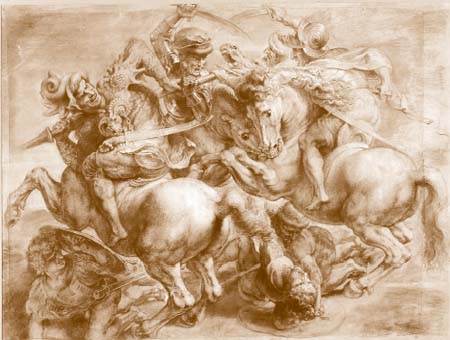
Figure 1-2: Peter Paul Rubens after Leonardo, The Struggle for the Standard, c. 1600–1608, Musée du Louvre, Paris
Leonardo left many preparatory drawings for The Battle of Anghiari, from which art historians have reconstructed the painting’s general composition.14 While he intended to present the unfolding of the battle with great clarity and historical accuracy, Leonardo used the central episode as a symbolic statement exposing the fury and “bestial madness” of war.
The superb copy of The Struggle for the Standard by Peter Paul Rubens (Fig. 1-2), now at the Louvre, shows Leonardo’s incredibly tight composition of a confused melee in which, in Vasari’s words, “fury, hate, and rage are as visible in the men as in the horses.” Moreover, by dressing the combatants in unrealistic theatrical costumes rather than in battlefield armor, Leonardo enhanced the symbolic character of the scene, underscoring the artistic declaration of his abhorrence of violence. Had he completed the fresco, and had it survived, it might well stand alongside Picasso’sGuernica as one of the art world’s most forceful condemnations of the folly of war.
SECRECY AND CONTRADICTIONS
Biographers have often been exasperated by the illusive task of presenting a clear picture of Leonardo, the man. He was worldly, eloquent, and charming, but also solitary, accustomed to spending long periods in intense concentration. He had an eminently practical mind, yet delighted in fables, allegories, and fantasies.15 He displayed physical strength and virile energy as well as refined elegance and feminine grace. As Serge Bramly comments wryly, “With Leonardo, everything seems to have two sides.”16
Leonardo not only embodied a dynamic tension between contradictory paradoxes in his personality, but he himself was also fascinated by opposites throughout his life. While he searched for a canon of ideal human proportions, he was strangely attracted by grotesque appearances. “He so loved bizarre physiognomies, with beards and hair like savages,” Vasari recounts, “that he would follow someone who had caught his attention for a whole day. He would memorize his appearance so well that on his return home he would be able to draw him as if he had him before his very eyes.”17
Leonardo made many drawings of these “grotesques,” which enjoyed great popularity in his time and were the forerunners of the famous caricatures of the eighteenth and nineteenth centuries. Perhaps the most typical of Leonardo’s caricatures is a bald, resolute elderly man with a terrific frown and “nutcracker” nose, who is often juxtaposed on the same sheet of paper with a beautiful youth of soft, feminine features. Old age and youth, virility and grace, are examples of the interplay of opposites—of the yang and the yin as they are called in Chinese philosophy—that are so striking in Leonardo’s personality and art.
The artist’s fascination with grotesque forms also led him to devise the most extravagant, and often quite macabre, practical jokes, which delighted the courtiers in Milan and Rome. At the papal court in Rome, Vasari tells us that Leonardo obtained a large lizard to which he attached “with a mixture of quicksilver some wings, made from the scales stripped from other lizards, which quivered as it walked along. Then, after he had given it eyes, horns, and a beard he tamed the creature, and keeping it in a box he used to show it to his friends and frightened the life out of them.” On another occasion, according to Vasari, Leonardo cleaned and scraped the intestines of a bullock and “made them so fine that they could be compressed into the palm of one hand. Then he would fix one end of them to a pair of bellows lying in another room, and when they were inflated they filled the room in which they were and forced anyone standing there into a corner.” Reportedly, he perpetrated hundreds of follies of this kind.
The challenge of presenting a consistent portrait of Leonardo da Vinci is further complicated by the fact that he was very secretive about his personal thoughts and feelings. In the thousands of pages of manuscripts that have come down to us, there is barely a trace of Leonardo’s emotional life. There are very few affectionate references to anyone, family or friends, and hardly any clues to his feelings about the people and events of his time. While he was a master at expressing subtle emotions in his paintings, it seems that Leonardo kept his own innermost feelings to himself.
This secrecy also extends to his sexuality. It is widely assumed that Leonardo was gay, but there is no definite proof of his homosexuality. Art historians have pointed to various features of his drawings and writings that might indicate that he was attracted to men, and it has often been noted that there is no record of any woman in Leonardo’s life, while it was well known that he always seemed to be surrounded by strikingly beautiful young men.18 But even though there were many openly homosexual and successful Florentine artists in the Renaissance, Leonardo was as secretive about his sexuality as he was about other aspects of his personal life.
Leonardo was equally secretive about his scientific work. Although he intended to eventually publish the results of his investigations, he kept them hidden away during his entire life, apparently out of fear that his ideas might be stolen.19 In Milan, he designed his studio so that the platform holding his work could be lowered through the floor to the story below, using a system of pulleys and counterweights, to hide it from inquisitive eyes whenever he was not working.20
Much has been made in this context of the fact that Leonardo, who was left-handed, wrote all his notes in mirror writing, from right to left. In fact, he could write with both hands and in either direction. But, like many left-handed people, he probably found it more convenient and faster to write from right to left when he jotted down his personal notes. On the other hand, as Bramly points out, this extraordinary handwriting also suited very well his taste for secrecy.21
The main reason Leonardo did not share his scientific knowledge with others, although he shared his knowledge of painting with fellow artists and disciples, was that he regarded it as his intellectual capital—the basis of his skills in engineering and stagecraft, which were the main sources of his regular income. He must have feared that sharing this body of knowledge would have diminished his chances of steady employment.
Moreover, Leonardo did not see science as a collective enterprise the way we see it now. In the words of art historian and classicist Charles Hope, “He had…no real understanding of the way in which the growth of knowledge was a cumulative and collaborative process, as was so evidently the case with the major intellectual enterprise of his time, the recovery of the heritage of classical antiquity.”22 Leonardo had no formal education and was not able to read the scholarly books of the time in Latin, but he studied Italian translations whenever he could obtain them. He sought out scholars in various fields to borrow books and elicit information, but he did not share his own discoveries with them—neither in conversations, as far as we know, nor in correspondence or publications.
This secrecy about his scientific work is the one significant respect in which Leonardo was not a scientist in the modern sense. If he had shared his discoveries and discussed them with the intellectuals of his time, his influence on the subsequent development of Western science might well have been as profound as his impact on the history of art. As it was, he had little influence on the scientists who came after him, because his scientific work was hidden during his lifetime and remained locked in his Notebooks long after his death. As the eminent Leonardo scholar Kenneth Keele reflected, “The intellectual loneliness of the artist-scientist Leonardo was not merely contemporary; it has lasted for centuries.”23
SIGNS OF GENIUS
Since Leonardo da Vinci is widely viewed as the archetype of a genius, it is interesting to ask ourselves what we mean by that term. On what grounds are we justified in calling Leonardo a genius, and how does he compare with other artists and scientists known as geniuses?
During Leonardo’s time, the term “genius” did not have our modern meaning of a person endowed with extraordinary intellectual and creative powers.24 The Latin word genius originated in Roman religion, where it denoted the spirit of the gens, the family. It was understood as a guardian spirit, first associated with individuals and then also with peoples and places. The extraordinary achievements of artists or scientists were attributed to their genius, or attendant spirit. This meaning of genius was prevalent throughout the Middle Ages and the Renaissance. In the eighteenth century, the meaning of the word changed to its familiar modern meaning to denote these individuals themselves, as in the phrase “Newton was a genius.”
Regardless of the term used, the fact that certain individuals possess exceptional and inexplicable creative powers beyond the reach of ordinary mortals was recognized throughout the ages. It was often associated with divine inspiration, especially in connection with poets. For example, in the twelfth century, the German abbess and mystic Hildegard von Bingen was famous throughout Europe as a naturalist, composer, visual artist, poet, and playwright. She herself, however, took no credit for the amazing range and depth of her talents but commented simply that she was “a feather on the breath of God.”25
In the Italian Renaissance, the association of exceptional creative powers with divine inspiration was expressed in a very direct way by bestowing on those individuals the epithet divino. Among the Renaissance masters, Leonardo as well as his younger contemporaries Raphael and Michelangelo were acclaimed as divine.
Since the development of modern psychology, neuroscience, and genetic research, there has been a lively discussion about the origins, mental characteristics, and genetic makeup of geniuses. However, numerous studies of well-known historical figures have shown a bewildering diversity of hereditary, psychological, and cultural factors, defying all attempts to establish some common pattern.26 While Mozart was a famous child prodigy, Einstein was a late bloomer. Newton attended a prestigious university, whereas Leonardo was essentially self-taught. Goethe’s parents were well educated and of high social standing, but Shakespeare’s seem to have been relatively undistinguished; and the list goes on.
In spite of this wide range of backgrounds, psychologists have been able to identify a set of mental attributes that seem to be distinctive signs of genius, in addition to exceptional talent in a particular field.27 All these were characteristic of Leonardo to a very high degree.
The first is an intense curiosity and great enthusiasm for discovery and understanding. This was indeed an outstanding quality of Leonardo, whom Kenneth Clark called “the most relentlessly curious man in history.”28 Another striking sign of genius is an extraordinary capacity for intense concentration over long periods of time. Isaac Newton apparently was able to hold a mathematical problem in his mind for weeks until it surrendered to his mental powers. When asked how he made his remarkable discoveries, Newton is reported to have replied, “I keep the subject constantly before me and wait until the first dawnings open little by little into the full light.”29 Leonardo seems to have worked in a very similar way, and most of the time not only on one but on several problems simultaneously.
We have a vivid testimony of Leonardo’s exceptional powers of concentration from his contemporary Matteo Bandello, who described how as a boy he watched the artist paint The Last Supper. He would see the master arrive early in the morning, Bandello tells us, climb up onto the scaffolding, and immediately start to work:
He sometimes stayed there from dawn to sundown, never putting down his brush, forgetting to eat and drink, painting without pause. He would also sometimes remain two, three, or four days without touching his brush, although he spent several hours a day standing in front of the work, arms folded, examining and criticizing the figures to himself. I also saw him, driven by some sudden urge, at midday, when the sun was at its height, leaving the Corte Vecchia, where he was working on his marvelous clay horse, to come straight to Santa Maria delle Grazie, without seeking shade, and clamber up onto the scaffolding, pick up a brush, put in one or two strokes, and then go away again.30
Closely associated with the powers of intense concentration that are characteristic of geniuses seems to be their ability to memorize large amounts of information in the form of a coherent whole, a single gestalt. Newton kept mathematical proofs he had derived for months in his mind before eventually writing them down and publishing them. Goethe is said to have entertained his fellow passengers on long coach journeys by reciting his novels to them, word for word, before committing them to paper. And then there is the famous story of Mozart, who as a child wrote out a note-perfect score of Gregorio Allegri’s Miserere, a complex chant for a five-part choir, after hearing it only once.
Leonardo would follow people with striking facial features for hours, memorize their appearance, and then draw them when he was back in his studio, reportedly with complete accuracy. The Milanese painter and writer Giovanni Paolo Lomazzo tells the story of how Leonardo once wished to paint some peasants laughing:
He chose certain men whom he thought appropriate for his purpose, and, after getting acquainted with them, arranged a feast for them with some of his friends. Sitting close to them he then proceeded to tell the maddest and most ridiculous tales imaginable, making them, who were unaware of his intentions, laugh uproariously. Whereupon he observed all their gestures very attentively and those ridiculous things they were doing, and impressed them on his mind; and after they had left, he retired to his room and there made a perfect drawing which moved those who looked at it to laughter, as if they had been moved by Leonardo’s stories at the feast.31
In subsequent chapters I shall recount the chronology of Leonardo’s life, following its trajectory from Vinci, the little hamlet, to Florence, the thriving center of Renaissance art, to the Sforza court in Milan, to the papal court in Rome, and to his final home in the Loire valley in the palace of the king of France. However, the documentations of this rich and fascinating life contain hardly any clues to the sources of Leonardo’s genius. Indeed, as classicist Penelope Murray observes in the introduction to her anthology Genius: The History of an Idea:
There remains something fundamentally inexplicable about the nature of such prodigious powers. We attribute the extraordinary quality of, for example, Shakespeare’s poetry, Mozart’s music and Leonardo’s paintings to the genius of their creators because we recognize that such works are not simply the product of learning, technique, or sheer hard work. Of course we can trace sources and influences…but no amount of analysis has yet been able to explain the capacities of those rare and gifted individuals who can produce creative work of lasting quality and value.32
In view of the persistent failure of scientists to shed light on the origins of genius, it would seem that, after all, Vasari’s explanation may still be the best: “Occasionally, in a way that transcends nature, a single person is marvelously endowed by heaven with beauty, grace, and talent in such abundance that he leaves other men far behind, all his actions seem inspired, and indeed everything he does clearly comes from God rather than from human art.”