
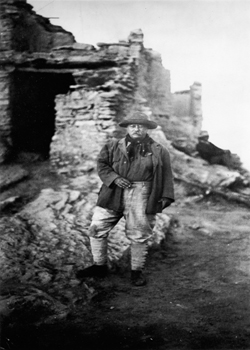
Former president Theodore Roosevelt visiting Arizona in 1913. From his White House bully pulpit, Roosevelt had saved such magnificent Arizona landscapes as the Grand Canyon and the Petrified Forest. His conservation policies, in general, became the template future presidents followed.
T.R. visiting the Arizona Territory in 1913. (Courtesy of Theodore Roosevelt Collection, Harvard College Library)
PROLOGUE
(FEBRUARY—MARCH 1903)
I
On a wintry morning in 1903 President Theodore Roosevelt arrived at a White House cabinet meeting unexpectedly and with great exuberance. Something of genuine importance had obviously just happened. All eyes were fixated on Roosevelt, who was quaking like a dervish with either excitement or agitation—it was unclear which. Having endured the assassinations of three Republican presidents—Abraham Lincoln, James Garfield, and William McKinley—Roosevelt’s so-called kitchen cabinet at least had the consolation of knowing that their boss, at the moment, was out of harm’s way. Still, they leaned forward, bracing for the worst. “Gentlemen, do you know what has happened this morning?” Roosevelt breathlessly asked, as everybody leaned forward with bated breath for the bad news. “Just now I saw a chestnut-sided warbler—and this is only February!”1
The collective sigh of relief was palpable. His cabinet probably should have known that T.R.—an ardent Audubonist—had a bird epiphany. With a greenish-yellow cap, a white breast, and maroon streaks down their sides, these warblers usually wintered in Central America; his spotting one in Washington, D.C., truly was an aberration. By February 1903, after his seventeen months as president of the United States following the murder of McKinley in Buffalo by a crazed anarchist, it was common talk that Theodore Roosevelt was a strenuous preservationist when it came to saving American wilderness and wildlife. His track record was in this regard peerless among the nation’s political class. “I need hardly say how heartily I sympathize with the purposes of the Audubon Society,” Roosevelt had written to Frank M. Chapman, curator of ornithology and mammalogy at the American Museum of Natural History in New York, just two years before becoming president. “I would like to see all harmless wild things, but especially all birds, protected in every way. I do not understand how any man or woman who really loves nature can fail to try to exert influence in support of such objects as those of the Audubon Society. Spring would not be spring without bird songs, any more than it would be spring without buds and flowers, and I only wish that besides protecting the songsters, the birds of the grove, the orchard, the garden and the meadow, we could also protect the birds of the sea-shore and of the wilderness.”2
By the time Roosevelt wrote that letter, Chapman—a droll, hardworking, unshowy activist spearheading the Audubon movement—was a legend in ornithological circles, considered by many the father of modern bird-watching. Back in February 1886 Chapman had stirred up a serious commotion in a letter to the editor of Forest and Stream titled “Birds and Bonnets” in which he lamented the fact that in New York City alone three-quarters of all women’s hats sold were capped by an exotic feather from a gun-shot bird. A devotee of comprehensive assessments and long-range planning for protecting aviaries, Chapman deemed the mutilation of birds for fashion “vulgar” and “unconscionable.” 3
Raised on an estate in New Jersey just across the Hudson River from New York City, Chapman had a love of birds from an early age. Although his rich parents had pushed him into the financial world, his passion was ornithology. Still, he went to work on Wall Street, without going to college first—a university degree wasn’t required for a nineteenth-century gentleman banker. But the financial rewards of his brokerage work didn’t satisfy him, so the dapper Chapman walked away from wealth to pursue a career in ornithology. He began volunteering at the American Museum of Natural History and worked his way up to become the preeminent expert in the Department of Birds. Even without an academic degree, Chapman, with his cleft chin, pursed mouth, and perfectly groomed mustache, became something of a dandyish town crier for his adopted profession, as well as a pioneer in using a camera to study the nesting habits and egg hatching of birds. He believed the modern ornithologist needed to take behavior, psychology, breeding, biology, migration, locomotion, and ecology into consideration during fieldwork.4
Theodore Roosevelt, whose father was a founder of the American Museum of National History, not only followed Chapman’s rising career but cheered on his pro-bird activities every step of the way. Thrilled by Chapman’s autonomy from academia, Roosevelt embraced his “public service” work aimed at helping everyday citizens to better understand the wild creatures flittering about in their own backyards. Before Chapman, for example, ornithologists practiced taxidermy on birds, stuffing them with cotton and lining them up on museum shelves. For every specimen on display, there were many others in storage. Bored by this strictly “study skins” approach, Chapman developed innovative dioramas in which habitat was also included as part of the educational experience.5 A profound, inexplicable infatuation with birds was simply part of Chapman’s curious chemistry, and he shared his zeal with Roosevelt and other outdoor enthusiasts. As a protector of “Citizen Bird,” Chapman insisted that ornithologists needed to teach fellow hunters that often “a bird in the bush is worth two in the hand.”6
As the editor of Bird-Lore magazine (precursor to Audubon)—and author of numerous popular bird guides, including Bird-Life: A Guide to the Study of Our Most Common Birds in 1897—Chapman was the bird authority of his generation. Roosevelt enjoyed being his enthusiastic sponsor. Chapman insisted in saving not just birds but their habitat—particularly breeding and nesting grounds in Florida. It was the essential condition, he insisted, for dozens of migratory species’ survival. To Chapman—and Roosevelt—creating “federal reserves” for wildlife and forests wasn’t debatable; it was an urgent imperative.
Roosevelt and Chapman weren’t unique in their promotion of vast reserves. They were, in fact, reviving conservationist convictions that had been stalled by shortsighted politicians. Since the American Revolution the idea of game bird laws and habitat conservation had struck a responsive chord. In 1828 President John Quincy Adams set aside more than 1,378 acres of live oaks on Santa Rosa Island in Pensacola Bay.7 Although Adams’s personal journals did, at times, show an abiding interest in birds, his motivation for saving Santa Rosa Island was ultimately utilitarian: its durable wood could be used to construct future U.S. naval vessels. But even such a low-grade conservationist effort as Adams’s tree preserve drew a fierce backlash. Running for president in 1832, Andrew Jackson denounced Adams’s tree farm as an un-American federal land grab, an unlawful attempt to deny Floridians timber to use as they saw fit. “Old Hickory,” as Jackson was nicknamed, believed God made hardwood hammock to cut and birds to eat. He ridiculed New England swells like Adams as effete, anachronistic sportsmen overflowing with ridiculous notions of “fair chase” rules and regulations for simply killing critters.8
While Jackson clearly lacked the conservationists’ foresight, he was correct in labeling Adams and others who applied etiquette to hunting as aristocrats. Because New England had such strong cultural ties to Great Britain—where the idea of wildlife preserves (hunting) for aristocrats was an accepted part of the society since the reign of King William IV (1830–1837)—it’s little surprise that America’s first true conservationists came from the northeast. Starting in 1783 there were dozens of “sportsman” companion books, which promoted strict guidelines for upper-class gentleman hunters in places like New York, Boston, and Philadelphia. Furthermore, in 1832 the painter and sportsman George Catlin, returning from a sketching trip in the Dakotas, lobbied the U.S. government to establish “a magnificent park” in that region, to be populated by buffalo, elk, and Indians and marketed as a world-class tourist attraction. Filling his western reports with exclamatory prose, Catlin envisioned a “nation’s park” that would contain “man and beast, in all the wildness and freshness of their nature’s beauty!”9
That same year John James Audubon hinted at the need for aviaries when he intrepidly journeyed around Florida, paint box and gun in hand, traveling from Saint Augustine to Ponce de Leon Springs and the Saint Johns River to Indian Key to Cape Sable to Sardes Key and finally to Key West and the Dry Tortugas.10 Yet he still wrote enthusiastically about massacring brown pelicans and legions of other shorebirds in the Florida Keys. “Over those enormous mud-flats, a foot or two of water is quite sufficient to drive all the birds ashore, even the tallest Heron or Flamingo, and the tide seems to flow at once over the whole expanse,” he wrote. “Each of us, provided with a gun, posted himself behind a bush, and no sooner had the water forced the winged creatures to approach the shore than the work of destruction commenced. When it at length ceased, the collected mass of birds of different kinds looked not unlike a small haycock.”11
Even though the vast majority of nineteenth-century U.S. conservationists enthralled by the “great Audubon” were elite hunters and anglers, there was also a slow-burning idiosyncratic group of naturalists, epitomized by Henry David Thoreau. Thoreau was a careful student of the New England ecosystem and was deeply influenced by William Bartram’s Travels through North and South Carolina, Georgia, East and West Florida, the Cherokee Country, the Extensive Territories of the Muscogulges or Creek Confederacy, and the Country of Chactaws (1794). His own long, sulking sojourns at Walden Pond and lonely hikes in the dank woodlands of Maine had transformed this onetime Harvard man of letters into a semi-hermetic Concord naturalist. It was Thoreau, in a seminal article in the Atlantic Monthly in 1858, who most passionately articulated a need to save wilderness for wilderness’s sake. “Why should not we,” Thoreau asked with mounting enthusiasm, “have our national preserves…in which the bear and panther, and some even of the hunter race [Indians], may still exist, and not be ‘civilized off the face of the earth’—[and] our forests [saved]…not for idle sport or food, but for inspiration and our own true recreation?”12
Although this prescient article was added as a last chapter to Thoreau’s classic The Maine Woods after his death, our great national hermit, in truth, was an anomaly in pre–Civil War America. His condemnation of the “war on wilderness” was, as the conservation scholar Doug Stewart put it, “a mere whisper in the popular conscience.”13 Instead, the pilot-light credit for galvanizing what the conservationist Aldo Leopold, in A Sand County Almanac (1949), called “the land ethic” belonged to well-to-do Eastern Seaboard hunters who loomed over the early campaigns to create wilderness preserves. In other words, Thoreau the poet contemplated nature preserves in the Atlantic Monthly while hunting clubs like the Adirondack Club and the Bisby Club circa 1870 started actuallycreating preserves in the Adirondacks.14
Long before Theodore Roosevelt, John Muir, and Gifford Pinchot were born, in fact, New York’s aristocratic hunters, using sportsmen’s newspapers and circulars to deliver their message, challenged loggers and sawmill operators and every other kind of forest exploiter to abandon their reckless clear-cutting. They wanted places like the Adirondacks saved for aesthetic and recreational pleasures. The precedent these pioneering gentlemen hunters started needed an indefatigable champion like Theodore Roosevelt to put the U.S. government fully on the side of the bird and game and forest preserves. “When the story of the national government’s part in wild-life protection is finally written, it will be found that while he was president, Theodore Roosevelt made a record in that field that is indeed enough to make a reign illustrious,” William T. Hornaday, the legendary director of the New York Zoological Park, wrote in Our Vanishing Wild Life (1913). “He aided every wild-life cause that lay within the bounds of possibility, and he gave the vanishing birds and mammals the benefit of every doubt.”15
Even though Roosevelt’s alliance with Chapman (and other visionary naturalists like Hornaday) launched the modern conservation movement between 1901 and 1909, Roosevelt’s preservationist vein, first developed in 1887, has been unfairly minimized by scholars. Partly that’s due to a left-leaning bias against aristocratic hunters. In addition, historians studying the progressive era have been confused by, or failed even to recognize, the distinction between hunting game birds and helping save song birds that are unfit to eat. Crowds of scholars have unfairly rounded on Roosevelt for having a bloodlust. Nevertheless, to Roosevelt, gentleman hunters were the true front line in the nature preservation movement. Over the years, however, historians have usually deemed Roosevelt first and foremost a “conservationist”—a term first seriously coined in 1865 by George Perkins Marsh in Man and Nature but not popularized until the publication, in 1910, of Gifford Pinchot’s manifesto The Fight for Conservation (to which ex-President Roosevelt provided an introduction). “Conservation,” Pinchot famously wrote, “means the greatest good to the greatest number for the longest time.”16
A wildlife enthusiast since childhood, Roosevelt in 1887 cofounded the Boone and Crockett Club with George Bird Grinnell in order to create bison, elk, and antelope preserves for future generations of Americans to enjoy. Smitten with “the chase,” he had also written a fine trilogy of books largely about his hunting experiences in the Dakota Territory: Hunting Trips of a Ranchman (1885), Ranch Life and the Hunting-Trail (1888), and The Wilderness Hunter (1893). While living at the Elkhorn Ranch thirty-five miles north of Medora, North Dakota, for extended periods between 1883 and 1892 (and shorter ones thereafter), Roosevelt developed a highly original theory about land management and wildlife protection. As president he promoted the pro-wildlife approach with revolutionary zeal. The immortal beauty of America’s rivers and its vast prairies, rugged mountains, and lonely deserts stirred him to nearly religious fervor. Yet he remained a proud hunter to his dying day. In fact, Sagamore Hill, Roosevelt’s home in Oyster Bay, New York, had walls lined with trophy heads and skins of birds and mammals. Boom (an elk), Pow-Pow (a buffalo head stuffed for library display), and Pop-Pop-Pop (a massive 28-point blacktail buck head spanning more than fifty inches) were his to showcase.17They represented Roosevelt’s enthusiasm for big game hunting.
On the other hand, President Roosevelt, with scholar’s fortitude, kept detailed lists of birds he saw grace the White House lawn. An avid birder, he spied on Baltimore orioles as they flicked their orange-edged tails and on crimson cardinals building sturdy nests. Dutifully he would record their numbers and habits in notebooks. Paradoxically, even though Roosevelt hunted game birds, when songbirds were the issue he agreed with the naturalist John Burroughs, who wrote in Signs and Seasons (1886) that the “true ornithologist leaves his gun at home.”18 He understood the clear distinction between game birds (like ducks and ruffled grouse), which were hard to drop, and songbirds (like robins and mockingbirds), which were easy to shoot on the wing but not dinner table fare.
Certain bird species—herons, terns, and ibises, for example—mesmerized Roosevelt. As president, he insisted that killing one of these Florida exotics was a federal crime. And although he wasn’t an expert on brown pelicans, he had carefully studied the freshwater white pelicans of North Dakota and Minnesota, who left their lakes near the Canadian border and migrated to the Indian River region in Florida like clockwork every autumn. Although T.R. had never been to Pelican Island, a teeming bird rookery, he had read a great deal about the place, thanks to Chapman. Situated in a narrow lagoon located near Vero Beach on the Atlantic coast of Florida, Pelican Island, a five-and-a-half-acre dollop of shells and mangrove hammocks, was abundant with flocks of wading birds, something akin to the Galápagos Islands (in miniature) when Charles Darwin began his evolutionary studies in 1835. If Roosevelt paddled around the island he would have heard the loud murmur of bird chatter, a dozen species all singing in different keys, yet all somehow in unison, giving the Indian River rookery the distinct feel of a God-ordained sanctuary. Exuberant streams of birds actually congregated on Pelican Island like figures in a timeless dream. Great blue herons, for example, lingered for long and often hot hours, statue-still while somehow still managing to groom their breeding plumage, including ornate onyx head feathers that seductively lured a mate. Reading about the calls, stillnesses, and hesitations of these long-legged birds fascinated Roosevelt no end.
The most prominent resident of Pelican Island, however, was its namesake—the brown pelican (Pelecanus occidentalis.) Chapman had taken dozens of photographs of brown pelicans congregating there, often carrying silver-colored fish in their elongated beaks as they flew contentedly over the tumbling waters of the Indian River. Studying Chapman’s photographs in his 1900 book Bird Studies with a Camera, Roosevelt knew these funny-looking birds were of incalculably greater value alive than dead; if the brown pelican passed into extinction, Florida, he believed, would lose one of its most enchanting charms.
Clearly, Roosevelt understood that wildlife had a sacred order and pelicans were part of this grand design or teleology. For more than 2 million years, by adapting to changed circumstances, prowling for fish by turning downwind, half-folding their wings and then almost belly-flopping into brackish or saline water, they had avoided extinction. With their huge heads submerged, the brown pelicans’ narrow beaks—the attached pouches serving as a dip net—scooped fish amid swarms of mosquitoes and midges in Florida’s glassy lagoons.19 For all their innate awkwardness, these playful birds were actually very efficient hunters. By dive-bombing for mullets from as high as fifty or sixty feet in the air, a healthy brown pelican could consume up to seven pounds of fish per day. Their daily hunting range was a radius of about fifty to sixty miles. And it wasn’t just the frenetic avian activity of pelicans, egrets, ibises, and roseate spoonbills on Pelican Island that Roosevelt embraced as a biological hymnal. He studied the state’s weather and its terrain, and kept records of its climate. He loved every little thing that grew in wild Florida, studying the beach mice, the green anoles, the gopher tortoises, the ants, the sea turtles, and the osprey, all with biological sympathy.
Ornithologists like Chapman who journeyed to wild Florida in the 1880s learned to love the shimmering wild egrets and elegant spoonbills that populated the rookeries, but only the brown pelicans made them laugh out loud. These were the clowns of the bird world. Their combination of short legs, long necks, and four webbed toes (which enhanced their swimming ability) made them seem clumsy. Because their bodies were so heavy, takeoff was something of a burlesque act. More than a few bird students (like Roosevelt) noted that when a pelican flew solo—which was often—it left an indelible impression. At times the pelicans resembled helium balloons with bricks attached to their feet, frantically flapping to get airborne, seemingly feverish with fatigue, desperate to defy the law of gravity. Nevertheless, they always managed to lift off.
Underlying President Roosevelt’s love of pelicans and other birds was a staunch belief in the healing powers of nature. That he had a mighty strong Thoreaurian “back to nature” aesthetic strain coursing through his veins becomes evident when we read his voluminous correspondence with Chapman, Hornaday, and other leading naturalists of his day, including John Burroughs, William Dutcher, George Bird Grinnell, John Muir, and Fairfield Osborn. Through a combination of book learning and field observations, Roosevelt had a keen sense of the importance of what would come to be known as biological diversity and deep ecology. His appreciation of the beauty of nongame birds like pelicans imbued him with a stout resoluteness to protect these endangered avians. To him the destruction of pelicans—and other nongame birds—was emblematic of industrialization run amok. In fact, with the exception of his family, birds probably touched him more deeply than anything else in his life.
Starting after the Civil War, Americans were faced with the revolutionary impact of Darwinism: everybody, it seemed, weighed in for or against evolutionary theory. To Roosevelt, who read the revolutionary On the Origin of Species as a young teenager, Charles Darwin was practically a god, the Isaac Newton of biology. Besides being an excellent scientist, Darwin was a fantastic imaginative writer who had wandered the world far and wide. Because of his intense interest in Darwin, naturalist studies became Roosevelt’s guiding principle. Only the Hebrew scriptures had a more profound impact on human societies than On the Origin of Species.20 Although there was a Creator, Roosevelt believed, the natural world was a series of accidents. Yet he also held a romantic view of the planet, a belief that Homo sapiens had a sacred obligation to protect its natural wonders and diverse species. He believed every American needed to get acquainted with mountains, deserts, rivers, and seas. One ethereal experience with nature, he believed, made the world whole and God’s omnipotence indisputable. “Roosevelt,” the historian John Morton Blum concluded, accepted the Darwinian belief in “evolution through struggle as an axiom in all his thinking. Life, for him, was strife.”21
II
After the Civil War, a new “gold rush” throughout America fomented the massacring of wildlife for profit and sport. Game laws were practically nonexistent in much of the interior west and south of the Mason-Dixon line up until the 1890s. Roosevelt was repulsed by firsthand dispatches he received about the abominable eradication of species throughout America. The glorious bison (once somewhere around thirty million to forty million strong) were nearly exterminated from the Great Plains, and jaguars along the Rio Grande simply disappeared into the Sierra Madre of Mexico. Pronghorn antelope could no longer outrun the market hunters and ranchers. The colorful Carolina parakeet (Conuropsis carolinensis) and the ubiquitous passenger pigeon (Ectopistes migratorius) were about to vanish forever. So was the ivory-billed woodpecker (Campephilus principalis). It was already too late for the great auk (Pinguinus impennis) and the Labrador duck (Camptorhynchus labradorius)—both species had been permanently eliminated from the planet.22 Using satire to open resistant minds to the conservation crusade, William T. Hornaday’s prophetic Our Vanishing Wild Life featured an illustration of a tombstone with “Sacred” carved on top and “Exterminated by Civilized Man 1840–1910” on the bottom. Scrolling downward on the tombstone, Hornaday listed birds made extinct by the epic brutality of humans—the Eskimo curlew, Gosse’s macaw, and purple Guadalupe parakeet among them.23
By the turn of the twentieth century the situation in Florida was particularly acute. Once deemed a vast swamp of little value, the state was experiencing a boom due to the fashion trendiness of its birds—especially their feathers. Ironically, the Florida birds’ splendid display of colorful plumes—nature’s design to draw female birds into a mating ritual—had done its job too well: upper-class women of the “gilded age” were drawn to the male bird’s fanciful plumage and it became the rage to adorn their hats with the beguiling feathers. As a result plume hunters poured into the state, guns in hand, determined to bag wading birds for the exotic feathers then in high demand. A pound of roseate spoonbill or great white heron wings, for example, was worth more than a pound of gold. For unrepentant old Confederates and lowlifes on the lam, wild Florida’s vast thickets and tangled vegetation offered not only a haven but also a source of easy income. Along the banks of Florida’s coastal rivers, the pallid shine of oil-wick lamps was a common sight. It emanated from plumer camps, where hunters were poised to gun down nongame birds for the New York millinery industry, which paid handsome sums for pallets of feathers.24
Most Florida plume-hunters were uneducated country bumpkins hired as day laborers. A lone plumer working the shallow pools along the Atlantic Ocean could collect 10,000 skins in a single season. A full-sized egret could yield fifty suitable ornamental feathers. Besides skinning the curlews, plovers, and turnstones, the hunters would put the carcasses on ice and ship them to New York by the barrel, where they were considered delicious “bird dishes” in some fine Manhattan restaurants.25 Still, the real dollars came from the fashion industry. White feathers, particularly those of the American egret (known today as the great egret) and the snowy egret, were the most coveted plumage of all. Although the pink feathers of flamingos (stragglers from the Bahamas) and roseate spoonbills were in high demand as trimming, their plumage started to fade away to an anemic pink after a year or two. The egrets’ white feathers epitomized decorative elegance and high status. The demand for beautifully adorned hats fueled an entire industry. By 1900 millinery companies employed around 83,000 Americans, mainly women, to trim bonnets and make sprays of feathers known as aigrettes.26
Although feathers had been used to adorn men and women for centuries, both in the courts of Europe and among indigenous peoples around the world, the garish gilded age took them to a new level of popularity.27 The demand was advanced, in large part, by the proliferation of women’s fashion magazines, where exotic feathers were shown adorning gowns, capes, and parasols. “The desire to be fashionable led scores of thousands of women to milliners for something eye-catching and elegant,” the historian Robin Doughty wrote in Feathers and Bird Protection. “If plumes were costly looking, then ladies demanded them by the crateload, and the elegant trimmings pictured regularly in journals meant that bird populations all over the world fell under the gun.”28 Low-gauge shotguns were the weapon of choice. But starting around 1880, the introduction of semiautomatic rifles—although these were only sporadically used—made wholesale slaughter of wading birds much easier.29
By 1886, when George Bird Grinnell founded the Audubon Society, more than 5 million birds were being massacred yearly to satisfy the booming North American millinery trade. Along Manhattan’s Ladies’ Mile—the principal shopping district, centered on Broadway and Twenty-Third Street—retail stores sold the feathers of snowy egrets, white ibises, and great blue herons. Dense bird colonies were being wiped out in Florida so that women of the “private carriage crowd” could make a fashion statement by shopping for aigrettes. Some women even wanted a stuffed owl head on their bonnets and a full hummingbird wrapped in bejeweled vegetation as a brooch. However, others were aghast at ostentatious displays of feathered hats and jewelry. Led by many of the same women who were agitating for the right to vote, a backlash movement to banish ornamental feathers was under way. The fashion pendulum was slowly swinging away from using birds for exhibitionism. Extravagant birds’ rights tenets and oaths were being advocated by many leading U.S. women suffragists, who took their lead from Queen Victoria, who had issued a public proclamation denouncing ornamental feathers in Great Britain.30
Terrified by the genocide of birds, Frank Chapman, the leading popular ornithologist in America, began delivering a lecture titled “Woman as a Bird Enemy” around New York. He hoped to shame women into abandoning their cruel fashion statements.31Convinced that an inventory of Florida’s birds was of paramount importance, he also organized the first Christmas bird count; it quickly grew into the largest volunteer wildlife census in the world. Before long more than 2,000 Floridians began participating in bird counts during an annual three-week period around Christmas.32
Early in 1903, the tireless Chapman knew that Theodore Roosevelt, now the president of the United States, remained a “born bird-lover.”33 As governor of New York, T.R. delivered a bold speech on avian rights and cheered on the Lacey Act (landmark legislation passed by Congress on May 25, 1900, to protect birds from illegal interstate commerce). As President William McKinley’s vice president, Roosevelt issued an unequivocal statement endorsing the eighteen state Audubon societies in the United States: “The Audubon Society, which has done far more than any other single agency in creating and fostering an enlightened public sentiment for the preservation of our useful and attractive birds, is [an organization] consisting of men and women who in these matters look further ahead than their fellows, and who have the precious gift of sympathetic imagination, so that they are able to see, and wish to preserve for their children’s children, the beauty and wonder of nature.”34
Once Roosevelt became president, under his initiative, the U.S. Department of Agriculture had already publicly supported the various Audubon societies, and in its Yearbook 1902 it pleaded with farmers and hunters to leave nongame birds alone.35With the future of Pelican Island in the balance, the bird population about to be wiped out, Chapman understood that the time to seek President Roosevelt’s support on banning the bird slaughter there was now. If the dollop of land was not declared a USDA reservation, it would soon be a dead zone like the ground-down New Jersey Flats.
III
In early March 1903 President Roosevelt was mired at Capitol Hill in Washington D.C. trying to push forward an anti-anarchy bill and was meeting with newly elected U.S. senators (from Idaho, Kentucky, Washington, and Utah) at the White House. Nevertheless, he still made time for his ornithologist friends. William Dutcher updated T.R. on the status of lighthouse keepers employed by the American Ornithologists Union (AOU) in Key West and the Dry Tortugas (seven islands located seventy miles off the mainland in the Straits of Florida) to protect nesting roosts. The bird-lovers also swapped stories about the health and well-being of their various friends in the Florida Audubon Society, an organization of which Roosevelt happened to be an honorary founder.36 (Dutcher himself would soon become the first president of the new National Association of Audubon Societies.*)
The gregarious president liked showing off his extensive knowledge about the state’s ecosystem, which included varied habitats like sea grass beds, salt marshes, and tree hammocks. Roosevelt’s library had a half-shelf of books about Florida’s wildlife. During the Spanish-American War he had been stationed at Tampa Bay waiting to be dispatched to Cuba. His Uncle Robert Barnwell Roosevelt, his father’s brother, a famous mid-nineteenth-century naturalist, had written a landmark ornithological book in 1884,Florida and the Game Water-Birds of the Atlantic Coast and the Lakes of the United States. (It was Uncle Rob who taught Theodore about the importance of what is now called ecology.) At the time T.R. was forty-four years old. He was stocky, with piercing blue eyes. His rimless spectacles and robust mustache dominated a remarkably unlined face. He spoke in clipped sentences, often making hand gestures and grimaces to underscore a point. This was followed by a hearty chuckle that bellowed up from his very depths. Emphatic and worldly in manner, a tireless optimist with thousands of enthusiasms to juggle, in Rudyard Kipling’s terminology Roosevelt—who liked to be called the Colonel, in recognition of his service in the Spanish-American War—was quite simply a “first-class fighting man.” The journalist William Allen White perhaps summed up Roosevelt’s gregarious personality best: “There was no twilight and evening star for him,” White wrote. “He plunged headlong snorting into the breakers of the tide that swept him to another bourne, full armed breasting the waves, a strong swimmer undaunted.”37
As expected, Roosevelt assured both visitors that of course he cared a great deal about the fate of Florida’s brown pelican, egrets, ibises, and roseate spoonbills. He always had, since childhood. He had, in fact, recently read Chapman’s Bird Studies with a Camera and loved the vivid chapter on Pelican Island. Chapman and Dutcher couldn’t have had a more receptive audience that March afternoon in Washington.
The American Ornithologists Union had been trying to purchase Pelican Island outright from the federal government for three years, to no avail. That winter, members of the AOU finally had a constructive meeting with William A. Richards, the Department of the Interior’s new General Land Office (GLO) commissioner.38 Dutcher, acting as chair of the AOU’s committee on bird protection, along with Frank Bond, explained their quandary to Richards (a nononsense former governor of Wyoming). For years AOU had demanded that Pelican Island be surveyed—a prerequisite for placing a purchase bid on it. Now, with the official 1902 survey about to be filed, AOU felt boxed in. Legally, homesteaders’ applications had to be given preference when GLO land was sold. With homestead filings imminent, the AOU’s application would be shunned or given a low priority. And that meant the brown pelicans might not survive as a species on the Atlantic coast.
A hunter and conservationist himself, Richards wanted to help AOU, and he summoned Charles L. DuBois, his chief of the Public Surveys Division, into the meeting. Was there an ingenious way to circumvent the homesteaders-first provision? DuBois, a jurist who always dotted the i’s and crossed the t’s, at first said no. But he offered Dutcher and Bond one long-shot alternative. President Roosevelt could make Pelican Island a bird refuge by issuing an Executive Order. Worried that a firestorm would ensue if the U.S. Department of the Interior seemed to be in collusion with AOU, DuBois instead suggested pushing the Executive Order through the USDA, where it would go virtually unnoticed in the Biological Survey Division headed by Dr. C. Hart Merriam.
Now that the AOU had a credible, legal way to protect Pelican Island, Dutcher wrote to Secretary of Agriculture James Wilson asking that a federal bird reservation be created. A stamp on the top corner shows that the secretary received it on February 27. Immediately using Frank M. Chapman as his conduit, Dutcher pushed for a meeting with the president about Pelican Island. Time was of the essence. With minimal difficulty Chapman procured a White House meeting that March.39
After listening attentively to their description of Pelican Island’s quandary, and sickened by the update on the plumers’ slaughter for millinery ornaments, Roosevelt asked, “Is there any law that will prevent me from declaring Pelican Island a Federal Bird Reservation?” The answer was a decided “No” the island, after all, was federal property. “Very well then,” Roosevelt said with marvelous quickness. “I So Declare It.”40
For the first time in history the U.S. government had set aside hallowed, timeless land for what became the first unit of the present U.S. Fish and Wildlife Service’s National Refuge System. History teaches that a zeitgeist sometimes develops around a fountainhead figure, that sometimes a transforming agent—in this case President Theodore Roosevelt—serves as an uplifting impetus for a new wave of collective thinking. Building on a growing ardor for federal intervention into the regulation of the private sector, Roosevelt’s “I So Declare It” was in line with the legacies of all the Republican presidents since Lincoln. The Union victory in the Civil War, in fact, meant that the U.S. federal government had emerged as the principal proponent of national reform movements like conservation.
Recognizing the need for scientific wildlife and land management, every U.S. president in the gilded age considered himself conservationist-minded to some limited degree: certainly Benjamin Harrison, Grover Cleveland, and William McKinley did. Each, in fact, had landmark “forest reserves” accomplishments in his portfolio to showcase for history. Yet they all lacked long-term vision, concerned instead with only the forestry issues and water-shortage emergencies of the moment. But Roosevelt was vastly different; nature was his rock and salvation. Refusing to be hemmed in by the orthodoxies of his time, he burst onto the national stage—first as civil service commissioner and governor and vice president and then as president—promoting the Gospel of Wilderness. Bridging the gap as a naturalist-hunter, he deemed songbirds liberators of the soul and bison herds incalculably valuable to the collective psyche of the nation. Even though local communities across the American West complained about federal land grabs, Roosevelt insisted he was preserving wilderness for their own good, for the sake of the American heritage.
With nationalistic optimism, Roosevelt’s patriotic summons essentially called for deranking the Louvre, Westminster Abbey, and the Taj Mahal as world heritage sites. The United States had far more spectacular natural wonders than these worn and tired man-made spectacles: it had the Grand Canyon, Crater Lake, the Petrified Forest, Key West, the Farralon Islands, the Tongass, Devils Tower, and the Bighorns. American bird flocks, he insisted, were far more glorious than those found in the steppes and forests of staid Old Europe. The implicit assumption was that Roosevelt’s utter love of “American Wilderness” always had a heavy component of raw nationalism. When asked as ex-president in 1918 why he loved wildlife so much, Roosevelt had a characteristically direct yet unreflective answer: “I can no more explain why I like natural history,” he said, “than why I like California canned peaches.”41
Now, with this imperious decree of March 1903, the irrepressible naturalist was saying that a part of wild Florida should be saved for the sake of imperiled birds and endangered animals. President Roosevelt’s guiding eco-philosophy was that habitat preservation for animals mattered, completely. Any reasonable person, he believed, should understand this. In the new century, market hunters had an obligation to stop their rampage and bow to the forces of biological conservationism and utilitarian progressivism as far as land and wildlife management were concerned. Forests needed to be treasured as if life-giving shrines. Citizens had to rally to save remnant populations of wildlife everywhere before species extinction became epidemic. Biodiversity was apparent and essential in nature, Roosevelt believed, wherever open minds looked. A huge cornucopia of wild creatures and plants, diverse in purpose and structure, with beauty and utilitarianism beyond the most fertile imagination, was an omnipotent God’s blessed gift to America.
A relieved Chapman rejoiced when he heard Roosevelt’s verdict—“I So Declare It”—realizing this was a new precedent for wildlife protection. He vowed to convey to future generations that March 1903, was the turning point in the birds’ rights movement. True to his word, Chapman would laud Roosevelt in Camps and Cruises of an Ornithologist (1908) and Autobiography of a Bird-Lover (1933). Filed away in Chapman’s personal papers on the fifth floor of the American Museum of Natural History, in fact, is the letter he wrote to Roosevelt in 1908, claiming that “The Naturalist President” had, “more than any other person,” inspired him to write Camps and Cruises of an Ornithologist.42 In that long memoir, Chapman credited the “characteristic directness” of President Roosevelt with guaranteeing the “future safety of pelicans” for perpetuity.43 “Not only shall I enjoy the book, but what is more important, I feel the keenest pride in your having written it,” Roosevelt wrote to Chapman in gratitude. “I like to have an American do a piece of work really worth doing.”44
With that one sweeping “I So Declare It,” President Roosevelt, the big game hunter, had entered John Muir’s aesthetic preservation domain. And Pelican Island wasn’t a passing whim of a president showing off to ornithologist colleagues. It was an opening salvo on behalf of the natural environment. No longer would slackness prevail with regard to conservationism, for Roosevelt—the wilderness warrior—would coordinate the disparate elements in the U.S. government around a common “great wildlife crusade.” Perhaps the historian Kathleen Dalton in The Strenuous Life summed up Roosevelt’s evolved attitude toward biota circa 1903 best: “Despite his official commitment to the policy of conservation of natural resources for use by humans he held preservationist and romantic attachments to nature and animals far stronger than the average conservationist.” 45
On March 14, 1903 President Roosevelt officially signed the Executive Order saving Pelican Island. By slipping the federal bird reservation into the domain of the U.S. Department of Agriculture, as Charles DuBois of the Interior Department had suggested, T.R. was hoping to avert the notice or controversy that keeping it in the Interior Department would have generated. Whenever he was faced with an obstacle, Roosevelt liked figuring out a way to circumvent it. Remarkably, T.R.’s Executive Order sailed through the bureaucracy in just two weeks. Legally it had to be approved by both Agriculture and Interior before the president could sign it.46 Without any note of toughness—and only fifty words long—the order was a seminal moment in U.S. Wildlife History: “It is hereby ordered that Pelican Island in Indian River in section nine, township thirty-one south, range thirty-nine east, State of Florida, be, and it is hereby, reserved and set apart for the use of the Department of Agriculture as a preserve and breeding ground for native birds.”47
The first unit of the U.S. National Wildlife Refuge System was now a reality. And Sebastian, Florida—the hamlet closest to Pelican Island—was its birthplace. Eighteen months later, Roosevelt created the second federal bird reservation, at Breton Island, Louisiana. By 2003, when Pelican Island celebrated its centennial, the U.S. National Wildlife Refuge System comprised more than 540 wildlife refuges on more than 95 million acres. Taken together, this woodlands, bayous, desert scapes, bird rocks, tundra, prairie, and marshland make up 4 percent of all United States territory.48 At the time, however, the Pelican Island declaration garnered very little national attention—the New York Times never mentioned it, nor did the Jacksonville Florida Times-Union.49 But future generations took serious notice; the impetus for a National Wildlife System had sprung to life. Saving Pelican Island initiated Theodore Roosevelt’s evolving idea of creating greenbelts of federal wildlife refuges everywhere the American flag flew. Very quickly these refugees grew exponentially in numbers under Roosevelt’s influence until the map of the lower forty-eight states was vastly altered. From this single small island in Florida’s Indian River Lagoon grew the world’s greatest system of land for wildlife. In the remaining six years he was in office, Roosevelt created fifty more wildlife refuges. Writing in his well-received An Autobiography (1913), Roosevelt explained how his ambition hardened to create these refuges without his ever making an on-site inspection trip:
The establishment by Executive Order between March 14, 1903, and March 4, 1909, of fifty-one National Bird Reservations distributed in seventeen States and Territories from Puerto Rico to Hawaii and Alaska. The creation of these reservations at once placed the United States in the front rank in the world work of bird protection. Among these reservations are the celebrated Pelican Island rookery in Indian River, Florida; The Mosquito Inlet Reservation, Florida, the northernmost home of the manatee; the extensive marshes bordering Klamath and Malheur Lakes in Oregon, formerly the scene of slaughter of ducks for market and ruthless destruction of plume birds for the millinery trade; the Tortugas Key, Florida, where, in connection with the Carnegie Institute, experiments have been made on the homing instinct of birds; and the great bird colonies on Laysan and sister islets in Hawaii, some of the greatest colonies of sea birds in the world.50
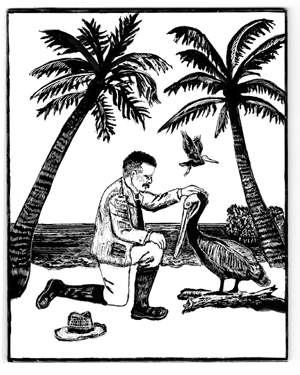
Michael McCurdy, well-known illustrator of John Muir reprint books, pays homage to President Roosevelt’s saving of Florida’s brown and white pelican rookeries.
Illustration of T.R. petting a brown pelican. (Courtesy of Michael McCurdy)
What Roosevelt doesn’t mention in An Autobiography was the backlash against his creation of bird refuges. The plumers and the millinery industry fought back, appealing to public opinion, lobbying Congress, and, in the most extreme cases, shooting at bird wardens. A battle royal ensued between powerful exploiters of nature versus beleaguered preservationists. Determined to win the so-called Feather Wars against plumers and market hunters—not to give an inch and to use the full force of the U.S. federal government as his arsenal—Roosevelt declared Passage Key, another brown pelican nesting area in Florida, the third federal refuge in October 1905.* This sixty-three-acre island was located offshore from Saint Petersburg, Florida, at the entrance to Tampa Bay. Roosevelt had studied it in 1898, when his legendary Rough Riders were waiting to transfer to Cuba to fight in the Spanish-American War, so he knew firsthand the high quantity of both migratory and year-round birds using it.51
Now as president, with another “I So Declare It” decree on Florida’s behalf along the Gulf Coast, Roosevelt had helped every bird at Passage Key to continue to survive and thrive in its marine habitat. Slowly but steadily, the federal bird reservations grew. Many of his first reserves were in Florida—Indian Key, Mosquito Inlet, Tortugas Keys, Key West, Pine Island, Matlacha Pass, Palma Sole, and Island Bay. Roosevelt’s “Great Wildlife Crusade” also protected colonies of white-rumped sandpipers, black-bellied plovers, and piping plovers on the East Timbalier Island preserve in Louisiana; provided safe nesting grounds for herring gulls on the Huron Islands Reservation in Lake Superior three miles off the shore of Michigan; and offered sanctuary to the sooty and noddy terms on the Dry Tortugas Reservation in the Gulf of Mexico. At the Pathfinder Federal Bird Reservation in Wyoming—created on February 25, 1909, just before T.R. left office—the president not only saved an essential waterfowl migration stopover place on the western edge of the Central Flyway but also preserved herds of pronghorns, the fastest mammal in North America.
IV
When writing or lecturing about American birds Roosevelt often became lyrical, sometimes even songlike. His sparkling writings are often good enough to put him in the company of such first-rate naturalist writers as John Muir, Rachel Carson, Annie Dillard, Edward Abbey, Louise Erdrich, Peter Matthiessen, and John Burroughs. In 2008 the nature writer Bill McKibben included Roosevelt’s 1904 speech at the Grand Canyon in Library of America’s American Earth: Environmental Writing Since Thoreau.52 “To lose the chance to see frigate-birds soaring in circles above the storm,” Roosevelt wrote in A Book Lover’s Holidays in the Open (1916), “or a file of pelicans winging their way homeward across the crimson afterglow of the sunset, or myriad terns flashing in the bright light of midday as they hover in the shifting maze above the beach—why, the loss is like the loss of a gallery of the masterpieces of the artists of old time.”53
During his presidency, Roosevelt also instituted the first federal irrigation projects, national monuments, and conservation commissions. He quadrupled America’s forest reserves and, recognizing the need to save the buffalo from extinction, he made Oklahoma’s Wichita Forest and Montana’s National Bison Range big game preserves. Others were created to protect moose and elk. To cap it off he established five national parks, protecting such “heirlooms” as Oregon’s iridescent blue Crater Lake, South Dakota’s subterranean wonder Wind Cave, and the Anasazi cliff dwellings at Mesa Verde in Colorado. Courtesy of an executive decree, Roosevelt saved the Grand Canyon—a 1,900-square-mile hallowed site in Arizona—from destructive zinc and copper mining interests. The doughty scrawl of his signature, a conservationist weapon, set aside for posterity (or for “the people unborn”* as he put it) over 234 million acres, almost the size of the Atlantic coast states from Maine to Florida (or equal to one out of every ten acres in the United States, including Alaska.) 54 All told, Roosevelt’s acreage was almost half the landmass Thomas Jefferson had acquired from France in the Louisiana Purchase of 1803.55
Full of environmental rectitude, Roosevelt turned saving certain species into a crusade. Unafraid of opposition, always watchful of political timing, and constantly ready with a riposte, Roosevelt acted with the prowling boldness of a mountain lion on the hunt. Suddenly, before people knew what hit them, strange-sounding place-names like Snoqualmie, Nebo, and Kootenai were national forest reserves. Because Florida was known as a bird haven, perhaps turning Pelican Island and Passage Key into Federal Bird Reserves wasn’t too shocking. But imagine how perplexed people were when Roosevelt ventured into the supposedly arid desert territories of Arizona and New Mexico, establishing federal bird reservations at Salt River and Carlsbad. Roosevelt believed there was no type of American topography that posterity wouldn’t enjoy for recreational purposes and spiritual uplift: extinct volcanoes, limestone caverns, oyster bars, tropical rain forests, artic tundra, pine woods—the list goes on and on. As Roosevelt noted when dedicating a Yellowstone Park gateway in 1903, the “essential feature” of federal parks was their “essential democracy,” to be shared for “people as a whole.” 56
With the power of the bully pulpit, Roosevelt—repeatedly befuddling both market hunters and insatiable developers—issued “I So Declare It” orders over and over again. Refusing to poke at the edges of the conservation movement like his Republican presidential successors, Roosevelt entered the fray double-barreled, determined to save the American wilderness from deforestation and unnecessary duress. The limited (though significant) forest reserve acts of the Harrison, Cleveland, and McKinley administrations were magnified 100 times over once Roosevelt entered the White House. From the beginning to the end of his presidency, Roosevelt, in fact, did far more for the long-term protection of wilderness than all of his White House predecessors combined. In a fundamental way, Roosevelt was a conservation visionary, aware of the pitfalls of hyper-industrialization, fearful that speed-logging, blast-rock mining, overgrazing, reckless hunting, oil drilling, population growth, and all types of pollution would leave the planet in biological peril. “The natural resources of our country,” President Roosevelt warned Congress, the Supreme Court, and the state governors at a conservation conference he had called to session, “are in danger of exhaustion if we permit the old wasteful methods of exploiting them longer to continue.”57
Wildlife protection and forest conservation, Roosevelt insisted, were a moral imperative and represented the high-water mark of his entire tenure at the White House. In an age when industrialism and corporatism were running largely unregulated, and dollar determinism was holding favor, Roosevelt, the famous Wall Street trustbuster, went after the “unintelligent butchers” of his day with a ferocity unheard of in a U.S. president. As if recruiting soldiers for battle, Roosevelt embraced rangers and wardens far and wide—even in Hawaii, Alaska, and Puerto Rico—insisting that the time was ripe to protect American wildlife from destructive insouciance. By reorienting and redirecting Washington, D.C. bureaucracy toward conservation, Roosevelt’s crusade to save the American wilderness can now be viewed as one of the greatest presidential initiatives between Abraham Lincoln’s Emancipation Proclamation and Woodrow Wilson’s decision to enter World War I. It was Roosevelt—not Muir or Pinchot—who set the nation’s environmental mechanisms in place and turned conservationism into a universalist endeavor.
“Surely our people do not understand even yet the rich heritage that is theirs,” Roosevelt said in his book Outdoor Pastimes of an American Hunter, in 1905. “There can be nothing in the world more beautiful than the Yosemite, the groves of giant sequoias and redwoods, the Canyon of the Colorado, the Canyon in the Yellowstone, the Three Tetons; and our people should see to it that they are preserved for their children and their children’s children forever with their majestic beauty unmarred.”58