

Theodore Roosevelt spent his adult life crusading on behalf of the national parks and monuments. Here he is at Yosemite in April 1903.
T.R. at Yosemite National Park. (Courtesy of the National Park Service)
CHAPTER ONE
I
At a very early age, Theodore Roosevelt started studying the anatomy of more than 600 species of birds in North America. You might say that his natural affinity for ornithology was part of his metabolism. As a child Roosevelt became a skilled field birder, acquiring a fine taxidermy collection while recording firsthand observations in note-books now housed at Harvard University.1 And it wasn’t just birds. When Roosevelt was four or five years old he saw a fox in a book and declared it “the face of God.”2 This wasn’t merely a flight of fancy. The mere sight of a jackrabbit, flying squirrel, or box turtle caused Roosevelt to light up with glee. The multilayered puzzle that was Roosevelt, in fact, was titillated by the very sound of species names in both English and Latin—wolverines (Gulo gulo), red-bellied salamanders (Taricha rivularis), snapping mackerel (Pomatomus saltatrix), and so on. At times revealing a Saint Francis complex regarding animals, Roosevelt wanted to understand all living matter. “Roosevelt began his life as a naturalist, and he ended his life as a naturalist,” wrote the historian Paul Russell Cutright. “Throughout a half century of strenuous activity his interest in wildlife, though subject to ebb and flow, was never abandoned at any time.”3
Roosevelt was born on October 27, 1858, in the noisy hubbub of gaslit New York City. He struggled with ill health well into adulthood. “I was,” Roosevelt later wrote, “a wretched mite suffering acutely with asthma.”4 Often wheezing, the young Roosevelt found physical relief by simply observing creatures’ habits and breathing fresh air. Nature served as a curative agent for Roosevelt, as it’s been known to do for millions afflicted with respiratory illness. “There are no words that can tell the hidden spirit of the wilderness,” he wrote, “that can reveal its mystery, its melancholy and its charm.”5 Literally from childhood until his death in January 1919—following his arduous journey down the River of Doubt through Brazil’s uncharted Amazon jungle—he epitomized Ralph Waldo Emerson’s criterion for being an incurable naturalist. “The lover of nature is he whose inward and outward senses are still truly adjusted to each other,” Emerson explained, “who has retained the spirit of infancy even into the era of manhood.”6
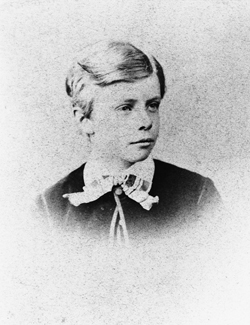
As a precocious child Theodore Roosevelt became an amateur ornithologist. Trained by one of John James Audubon’s student taxidermists, Roosevelt started his own natural history museum in New York City to show off his specimens. Later in life Roosevelt argued that parents had a moral obligation to make sure their children didn’t suffer from nature deficiency.
A precocious young T.R. (Courtesy of Theodore Roosevelt Collection, Harvard College Library)
Just over a year after Roosevelt’s birth, the British naturalist Charles Darwin published his great scientific treatise On the Origin of Species by Means of Natural Selection or the Preservation of Favoured Races in the Struggle for Life. Deeply personal in tone, without esoteric graphs or undecipherable tables, On the Origin of Species set off heated global debate over religious beliefs that underlay the then current theories of biology. Darwin’s great idea was evolution by natural selection, a death knell to the ancien régime of rudimentary biology. Although the Darwinian catchphrase “survival of the fittest”—which was first coined by the economist Herbert Spencer and which Roosevelt adopted practically as a creed—didn’t appear until a revised 1869 edition, by the time Theodore was ten or eleven the biologist was his touchstone, a Noah-like hero. He was enthralled by the idea of collecting species in faraway places, and in his youthful imagination the Garden of Eden was replaced by Darwin’s Galápagos Islands. (Almost twenty years before On the Origin of Species raised tantalizing questions about the Creation, Darwin had written about circumnavigating the world collecting specimens of animals and plants—both alive and dead—in The Voyage of the Beagle). Once Roosevelt grasped the concept of natural selection his bird-watching instincts went into overdrive. Suddenly he understood that the biological world wasn’t static. Observed similarities between living creatures were often a product of shared evolutionary history. With Darwinian eyes he now studied every bird beak and eye stripe, hoping to reconcile anomalies in the natural world.7 As an adult he would often carry On the Origin of Species with him in his saddlebag or cartridge case while on hunts.8
There was nothing unusual about a nineteenth-century child being enamored of animals and wildlife. Whether it’s Aesop’s Fables or Mother Goose, the most enduring children’s literature often features lovable, talking animals. But the young Roosevelt was different from most other children: from an early age he liked to learn about wildlife scientifically, by firsthand observation. The cuteness of anthropomorphized animals in the popular press annoyed Theodore; Darwinian wildlife biology, on the other hand, captured his imagination and had the effect of smelling salts. Roosevelt loved the way the British naturalist had gone beyond physical similarities of anatomy and physiology to include behavioral similarities in his extended analysis The Expression of the Emotions in Man and Animals (1872). This devotion to Darwin, a real sense of awe, continued long after Roosevelt was an adult. Even when he was president, grappling with showcasing the Great White Fleet and building the Panama Canal, stories abounded about Roosevelt hurrying across the White House lawn exclaiming “Very early for a fox sparrow!” and then suddenly stopping to pick up a feather for closer coloration inspection.9 Believing that evolution was factual, President Roosevelt nevertheless conceded that the concept of natural selection needed to undergo constant scientific experimentation, and the more data the better.10
But before Roosevelt discovered Darwin there were the picture books and outdoors narratives aimed at the boys’ market. Every parent recognizes the moment when a child displays a special aptitude or precocity for learning, when hopes arise that it’s a harbinger of great educational accomplishment to come. Such sudden bursts of enthusiasm from a toddler indicate both personality and preference. When Theodore Roosevelt obsessed over the lavish illustrations in David Livingstone’s Missionary Travels and Researches in South Africa and asked questions about Darwin’s theory of evolution, his parents, Theodore Roosevelt, Sr., and Martha Bulloch Roosevelt, realized their son was an aspiring naturalist.11
A Scottish physician and African missionary, Livingstone always had a high-minded scientific purpose for his jungle explorations—for instance, to discover the headwaters of a river. Even though the elegantly bound Missionary Travels was almost too heavy for young Theodore to carry, he would stare at the photographs of zebras, lions, and hippopotamuses for hours on end, thirsting for Africa. His early fancy for animals was the most appealing and tenderest part of his adolescence. “When I cast around for a starting-point,” his friend Jacob A. Riis wrote in Theodore Roosevelt: The Citizen (1904), “there rises up before me the picture of a little lad, in stiff white petticoats, with a curl right on top of his head, toiling laboriously along with a big fat volume under his arm, ‘David Livingstone’s Travels and Researches in South Africa.’”12
Nearly coinciding with the publication of On the Origin of Species, a Neanderthal skullcap was found three years earlier in Neander Valley, Germany. For anybody even remotely interested in the relationship between animals and man the discovery of the first pre-sapiens fossil was stunning news. Suddenly Thomas Huxley, a discerning British biologist with long, wild sideburns, began saying in his lectures that the skull was proof that man was a primate, a direct descendant of apes. Just as exciting was Huxley’s work on fossil fish, which he collected and classified with gusto. Although Huxley had been skeptical of Darwin’s evolutionary theory, the publication of On the Origin of Species changed that. As the introverted Darwin retreated to a more private life, spending time with family and friends, Huxley became the leading interpreter of Darwin, explaining the master’s theories and articles to rapt audiences all over the world. Determined to defend evolution to the hilt, Huxley declared himself “Darwin’s bulldog,” ably drawing gorillas on blackboards to explain to the old-school scientists how man evolved from them. Whereas Darwin was a field naturalist, his advocate Huxley practiced anatomy; together they constituted a nearly lethal one-two punch on behalf of modern biology.
Although Theodore couldn’t possibly have understood the intricacies of evolutionary theory as a young boy, the explicit fact that man had evolved from apes appealed mightily to him. As a naturalist Darwin was unafraid to cut into the tissue of a cadaver looking for clues to creation. Merely having the temerity to write that man, for all his nobility, still bore “in his bodily frame the indelible stamp of his lowly origin” made Darwin heroic to Roosevelt.13 “Thank Heaven,” Roosevelt wrote about his childhood a year before his death, “I sat at the feet of Darwin and Huxley.”14
Besides reading heavily illustrated wildlife picture books and hearing about the evolutionary theories of Darwin and Huxley from his family, Theodore gravitated to the Irish adventure writer Captain Mayne Reid. Generally speaking Captain Reid—a school tutor turned frontiersman on the Missouri and Platte rivers—wrote about the “Wilderness Out There” in a highly romantic way, as in a cowboy western.15 His seventy-five adventure novels and oodles of short stories are full of backwoods contrivance. In The Scalp Hunters (1851), for example, Captain Reid, with an air of superior wisdom, went so far as to declare that the Rocky Mountains region was a sacred place where “every object wears the impress of God’s image.”16 But Reid also appreciated evolution, filling his writings with sophomoric Darwinian analysis. He never missed a chance to describe birds, animals, and plants in vivid and apposite detail.17 Although Captain Reid never made much money with his hair-raising tales, he consistently milked his Mexican-American War military service for a string of successful plays. Strange wild locales were among Captain Reid’s specialties; for example, in The Boy Hunters (1853) he made the Texas plains, Louisiana canebrakes, and Mississippi River flyover seem like teeming paradises for any youngster interested in birds. There was, in fact, an able naturalist lurking underneath his often racist (even by mid-nineteenth-century standards) dime-novel prose.
Anybody wanting to understand Roosevelt as an outdoors writer must turn to The Boy Hunters. The plot is fairly straightforward—a former colonel in Napoléon’s army moves to Louisiana with his three sons and a servant, determined to be at one with nature—but by Chapter 2 the narrative takes a strange twist. One afternoon a letter arrives from Napoléon’s hunter-naturalist brother asking the old colonel to procure a white buffalo skin for France. Feeling too arthritic to tramp the Louisiana Territory in search of the rare buffalo, the colonel sends his sons—the “boy hunters”—in pursuit of the rare beast. Accompanied by the faithful servant, the adventurous boys head into the dangerous wilderness, determined to find a white buffalo, thought to be a sacred symbol in many Native American religions.* (Starting in 1917 the white buffalo also became a featured image in the state flag of Wyoming.)
Swooning over such chapter titles as “A Fox Squirrel in a Fix,” “The Prong-Horns,” and “Besieged by Grizzly Bears,” Roosevelt loved every page of The Boy Hunters. Much of the novel’s action took place in the Big Thicket of Texas, where wild pigs and horses roamed freely. After exposure to the American West the boys were no longer content shooting at birds: they coveted big game. Their ambition, Reid wrote, was not “satisfied with anything less exciting than a panther, bear, or buffalo hunt.”18 Like a trio of well-armed Eagle Scouts, the boy hunters grew to be completely self-reliant, able to ride horseback, dive into rivers, lasso cattle, and climb huge trees like black bears. They scaled a steep cliff and shot birds on the wing with bow and arrow. They were taught to “sleep in the open air—in the dark forest—on the unsheltered prairie—along the white snow-wreath—anywhere—with but a blanket or a buffalo-robe for their beds.” Drawing on the legends of the mountain men like Jim Bridger, Reid, preaching the strenuous life for boys, created little Natty Bumppos who could “kindle a fire without either flint, steel, or detonating powder.”19 These boys didn’t need a compass for direction. They could read all the rocks and trees of that “vast wilderness that stretched from their own home to the far shores of the Pacific Ocean.”20
The Boy Hunters included marvelous Hogarth-like woodcut illustrations of ferocious cougars and a bear wrestling an alligator, which spiced up the narrative. Lovingly Captain Reid described in credible naturalistic detail tulip trees and the fanlike leaves of palmettos, weird yuccas, and lofty sugar maples. Most ambitiously, however, he anticipated Darwinian theory in anecdotes about the food chain.21 Academics have (accurately) criticized Captain Reid for harboring racist views of Indians and black slaves, but they’ve traditionally overlooked his essentially Marxist analogies about how the rich preyed on the poor in the mid-nineteenth century. He was a radical Republican, and to him the mega-capitalists were “king vultures” who didn’t have a single positive trait and who abused the common vultures (aura and atratus) without mercy. Later in life, when Roosevelt fought in the Spanish-American War, he borrowed much of Captain Reid’s observations of vultures for color in his own memoir The Rough Riders.22
Unlike James Fenimore Cooper or the Crockett Almanacs, Reid’s half-fictions awkwardly offered up the proper Latin names for wildlife and plants he encountered. “About noon, as they were riding through a thicket of the wild sage (artemisia tridentata),” he wrote in The Boy Hunters, “a brace of those singular birds, sage cocks or prairie grouse (tetrao uro-phasianus), the largest of all the grouse family, whirred up before the heads of their horses.”23 Passages like this occur in dozens of Reid’s books, often with the Latin binomials slowing down the otherwise fast-paced prose. Clearly, Reid wasn’t a local-color writer like Bret Harte or Alfred Henry Lewis recounting desperado hijinks and cowboy yarns from the Wild West. Roosevelt, like many American and English boys, made no bones about their idolatry of Captain Reid and his risky romps throughout the West.
Later in life, when Roosevelt moved to the Dakota Territory for intermittent spells to ranch and research a trilogy of books on the outdoors and hunting, Reid remained his literary model. Reid’s prose exploits of an American “cibolero” (buffalo hunter) in The White Chief: A Legend of North Mexico (1855), for example, motivated Roosevelt to lustily track down a nonwhite bison himself. In following its protagonist on a wild, woolly hunt for trophies in the Rockies, the book celebrated manifest destiny while offering Roosevelt a “manly” lesson in natural history. “To [the cibolero] the open plain or the mountain was alike a home,” Captain Reid wrote. “He needed no roof. The starry canopy was as welcome as the gilded ceiling of a palace.”24
Whenever Roosevelt wrote about the wilderness or birds, even as a boy, traces of Reid’s hyper-romantic style are easily detectable.25 Although other naturalist writers also captivated young Theodore’s imagination—for example, John James Audubon and Spencer Fullerton Baird, the foremost naturalist of the era *—Captain Reid, whom Edgar Allan Poe witheringly described as “a colossal but most picturesque liar,” remained his role model.26 (Captain Reid seldom purposely lied about nature, but he always embellished his own supposed rough-and-ready heroics.) An impressive five times in his An Autobiography of 1913, Roosevelt wrote about how “dearly loved” Reid was.27 By contrast, other outdoors books for boys didn’t much appeal to Roosevelt. For example, he dismissed Johann D. Wyss’s The Swiss Family Robinson for its clumsy zoology and was bored by its tropical escapism and dragfoot juvenility. According to young T.R., Wyss had assembled a “wholly impossible collection of animals” to pad his plot about survival after a shipwreck.28
One naturalist Roosevelt did enjoy was the British scholar Reverend J. G. Wood, whose Illustrated Natural History was published to wide acclaim in 1851. Wood made studying wildlife fun for nonscientific minds as well as specialists, without dumbing it down. Ignoring the complications of Darwinism, he simply took the view that natural history was “far better than a play” and “one gets the fresh air besides.”29 In particular, Roosevelt loved Wood’s Homes without Hands: Being a Description of the Habitations of Animals, Classed According to Their Principle of Construction (1866). Roosevelt marveled at passages in this weighty 632-page tome about ant nests and tunnels, deciding on the spot to emulate the author.30 The eight-year-old Roosevelt sat down and wrote a short essay, his first known written work, titled “The Foraging Ant.” There were more than 10,000 ant species in the world and Roosevelt wanted to understand their differences.* Proud of “The Foraging Ant,” which was about the workaholism of ants, Roosevelt read the essay out loud to his parents, who were complimentary about the pseudoscientific earnestness of his naturalist prose.31
More impressive than the essay itself, however, was the mere fact that young T.R. had read Homes without Hands. Although the book was replete with engravings of numerous species ranging from ospreys to wasps, the prose was fairly dense. Ostensibly, Wood was describing the varied hearths wild creatures built to live in—moles’ burrows, prairie dogs’ tunnels, rabbits’ warrens, beavers’ dams, spiders’ nests, and so on. But Homes without Hands was not aimed at the children’s book marketplace; it was serious adult fare, the kind of comprehensive text required in mid-nineteenth-century university biology or zoology introductory courses. Full of Latin identifications, choking with minutiae about the abdomen colors of bees and conchologistical (conchology is the study of mollusks) insights into Saxicava, this book was a far cry from the elegant musings of Thoreau about the shifting light at Walden Pond or a National Geographic article on white-water runs down the Shenandoah River. That Roosevelt gravitated to its heft pointed to his future avocation as one of the most astute wildlife observers our country has ever produced. One object from his Twentieth Street home impressed him more than any other: a Swiss wood-carving that showed a hunter stalking up a mountain after a herd of chamois, including a kid. As Roosevelt recalled in An Autobiography, he fretted regularly for the tiny chamois, fearful that “the hunter might come on it and kill it.”32
Stifled by city life, Roosevelt educated himself as best he could about zoology on the streets of Manhattan. As if cramming for a final exam, he grew determined to learn the song of every fast-fluttering bird in New York and the nesting habits of every small mammal in Central Park. Studying marine species in the nearby Atlantic Ocean was another interest; he actually enjoyed analyzing the radula (mouthparts) of mollusks. One afternoon he spied a dead seal at a fish stand among the piles of maritime products available for sale on the wharf—scallops, tuna, and other food fish; dried sea horses and pipefishes hawked for their “medicinal” qualities; and much more. Roosevelt fixated on the dead seal’s bulk and whiskers.33 The fact that the species had been netted in New York Harbor, where it is a rare visitor, flabbergasted him. Day after day, as if drawn to a talisman, he kept begging to be brought to the pier to study the seal’s anatomy more closely.34 As a budding naturalist, acquainted with The Voyage of the Beagle, the seven- or eight-year-old noted that seals had no external ears and that their back flippers didn’t bend forward to help their bodies when they were on dry land. Zoology books taught him that there were nineteen seal species in the world, most living around Antarctica and the Arctic Circle.
“That seal filled me with every possible feeling of romance and adventure,” he later recalled in his autobiography. “I had already begun to read some of Mayne Reid’s books and other boys’ books of adventure, and I felt that this seal brought all these adventures in realistic fashion before me. As long as that seal remained there I haunted the neighborhood of the market day after day. I measured it, and I recall that, not having a tape measure, I had to do my best to get its girth with a folding pocket foot-rule, a difficult undertaking. I carefully made a record of the utterly useless measurements, and at once began to write a natural history of my own, on the strength of that seal.” 35
Eventually, once the seal’s body was sold for blubber, Roosevelt was given the head as a souvenir. With this in hand, the ten-year-old created his “Roosevelt Museum of Natural History.” Its purpose was to help train him to become a natural history professional like Darwin. Bookshelf space was made in the upstairs hall at 28 East Twentieth Street for “Tag #1,” and before long he had rows of bird nests, dead insects, and mouse skeletons. He considered himself a “general collector,” with a particular interest in salamanders and squirrels. After a few months, however, he turned his focus primarily to birds. Before long, he had numerous specimens to call his own. There is, in fact, a precious historical document housed at Harvard University, handwritten and five pages long, that illuminates the sheer earnestness with which young Theodore maintained his natural history collection. Titled “Record of the Roosevelt Museum,” it begins with a proclamation of professional accomplishment. “At the commencement of the year 1867 Mr. T. Roosevelt, Jr. started the Museum with 12 specimins [sic]: at the close of the same year Mr. J. W. Roosevelt [West Roosevelt, his cousin] joined him but each kept his own specimens, these amounting to hardly 100. During 1868 they accumulated 150 specimens, making a total of 250 specimens.”36
Roosevelt scrambled for new specimens of mammals, birds, reptiles, amphibians, and insects wherever he could. Conch shells, larvae, hollowed eggs, and even a common cockroach were worth inclusion into his growing windowsill and bookshelf collection. In an article titled “My Life as a Naturalist,” written in 1918 when he was an ex-president, Roosevelt recalled that he collected specimens the way other boys collected stamps.37 Jars of tadpoles and minnows were particular favorites in his museum. Heading up Third Avenue toward the Harlem River, Roosevelt would wander the fields looking for rabbit holes and woodcock feathers. Leaves found in Gramercy Park were pressed into books and preserved. Young Theodore prided himself on being able to distinguish a hardwood from a conifer. Sometimes he would study the differences between leaves from the same tree, like a perplexed botanist.
As a boy, Roosevelt developed a keen sense of hearing, perhaps as compensation for his extreme nearsightedness. When he was twelve, his parents finally bought him spectacles, and a whole new world of avian color blossomed in front of him: for example, the bright plumage of indigo buntings and red cardinals shone for the first time as though dipped in Day-Glo. Roosevelt was interrogative about birds, believing they were messengers from prehistoric times. “It was the world of birds—birds, above all—that burst upon him now, upstaging all else in his eyes,” the historian David McCullough explained of the adolescent Roosevelt, “now that he could actually see them in colors and in numbers beyond anything he had ever imagined.”38
As a budding ornithologist Roosevelt also mastered the identification of a bird by the way it flew. If he saw a moderate rise and fall, the bird could be a woodpecker or northern flicker. Other birds, however—like hawks, egrets, herons, and crows—flew in a straight line, flapping their wings in constant rhythm. He learned that studying a bird’s feather shape, color, and pattern was another way to properly identify it. And then, of course, there were the differences in bird’s beaks, which from a utilitarian standpoint were better than Swiss army knives: they caught and held food, preened feathers, and built nests. There were thousands of different types of birds in the world and Roosevelt wanted to identify them all: a lofty goal that became a lifelong pursuit, which he never abandoned. “Roosevelt was part of a generation of men,” the naturalist Jonathan Rosen has explained in The Life of the Skies, “who helped mark the transition from the nature-collecting frenzy that followed the Civil War to what we today recognize as birdwatching.”39
II
Roosevelt’s mother greatly encouraged her son’s fascination with birds. Martha Bulloch Roosevelt (or Mittie, as she was usually called) was born on July 8, 1835, in Connecticut but grew up in Savannah and then Roswell, Georgia, north of Atlanta. She was something of a southern belle, with a gentle air about her; her two brothers had fought for the Confederate army in the Civil War. Even though Mittie married a Yankee—Theodore Roosevelt, Sr., of New York—and moved to Manhattan, she never abandoned her Johnny Rebel sympathies. After the surrender at Appomattox she tended to romanticize the “lost cause,” always championing the Gray over the Blue, furious over the way captured Georgian soldiers had been mistreated in prison camps in Illinois and Maryland. Most of Mittie’s reflections on the South, however, were idyllic. Her yarns about Georgia red clay, black bears, and beige panthers always kept her children wide-eyed. Because of Mittie, in fact, the piney woods of Georgia—the shortleaf, longleaf, loblolly, and slash pine—had an enduring fascination for Theodore. Encouraged by Mittie, Theodore became a die-hard enthusiast of natural history, a collector enraptured by birds. She even allowed into the Roosevelt household exotic live creatures like flying squirrels and newts. “My triumphs,” Roosevelt recalled of his childhood, “consisted in such things as bringing home and raising—by the aid of milk and a syringe—a family of very young gray squirrels, in fruitlessly endeavoring to tame an excessively unamiable woodchuck, and in making friends with a gentle, pretty, trustful white-footed mouse which reared her family in an empty flower pot.” 40
In the spring of 1868, Theodore’s parents traveled to Roswell to visit Martha’s relatives. A fascinating correspondence between mother and son has survived, illuminating young Theodore’s love of collecting all things wild. “I have just received your letter,” he wrote to his mother on April 28. “My mouth opened wide in astonishment when I heard how many flowers were sent to you. I could revel in the buggie ones. I jumped with delight when I found you had heard a mockingbird. Get some of the feathers if you can…. I am sorry the trees have been cut down…. In the letters you write do tell me how many curiosities and living things you have got for me…. I wish I were with you…for I could hunt for myself.”41
Two days later the precocious nine-year-old responded to a letter from his father, angling for hard-to-find plants. “I have a request to make of you, will you do it?” Roosevelt asked his father drily. “I hope you will. If you will it will figure greatly in my museum. You know what supple jacks are, do you not? Please get two for Ellie [Elliott, his younger brother] and one for me. Ask your friend to let you cut off the tiger-cat’s tail, and get some long moos and have it mated together. One of the supple jacks (I am talking of mine now) must be about as thick as your finger and thumb must be four feet long and the other must be three feet long. One of my mice got crushed. It was the mouse I liked best though it was a common mouse. Its name was Brownie.”42
As a young boy Roosevelt not only collected live mice and a woodchuck but also sketched them in notepads, a few which have survived undamaged. Eastern moles were another favorite of the young Roosevelt, and in a series of drawings housed at Harvard he captured all the salient details of these blind underground tunnelers: flat fur; eyes covered with skin; the absence of ears; and side-facing feet ideal for digging. Then there are his fine sketches of robins and wrens. Clearly, Roosevelt was blessed with a mind that could absorb physical detail. His bird and animal drawings were quite accomplished for a boy of his age. To most children one field mouse was indistinguishable from another, but Roosevelt knew that a canyon mouse (Peromyscus crinitus) or a pinyon mouse (P. truei) was different from a cotton mouse (P. gossypinus). And he didn’t recoil from drawing them.43
III
An astonishing fact about young Roosevelt’s prodigious interest in nature was that he kept semi-regular diaries. Studying his unaffected scrawl and chronic misspellings brings crucial understanding and clarity to his later achievements as a conservationist and wildlife protectionist. Being a naturalist in the 1850s and 1860s was fashionable, and the young Roosevelt had caught the bug. Darwin had sounded a clarion call for a new generation of biological collectors, and Roosevelt had heard it loud and clear. Roosevelt called his first diary My Life and kept it between August 10 and September 5, 1868. That summer the Roosevelt family spent their holiday in Barrytown, a busy railroad depot and steamboat landing across the Hudson River. Leasing the country home of John Aspinwall, the Roosevelts immediately began exploring the Hudson River valley, which had recently been celebrated on canvas by such remarkable landscape painters as Thomas Cole, Jasper Cropsey, and Albert Bierstadt. Sitting on the riverbank, they could watch steamers, canal boats towed by tugs, and tall sails drifting by in silence.44
Barrytown provided Roosevelt his first opportunity to hear the earth inhale and exhale without interference from the noise and stench of the industrial revolution. In virtually every diary entry throughout the late summer of 1868, Roosevelt wrote enthusiastically about animals he had either encountered or heard of in the dales of Barrytown. There were deer, big and small, to be studied; he learned how to analyze their tracks, like an Iroquois or Algonquin scout in training. There were encounters with packs of wild dogs; mid-afternoon pony rides; times for feeding horses sweet grass, green meat, and bran mash; lazy hours reeling in bluegills at fishing ponds; walks along fast-running brooks teeming with crayfish, eels, salamanders, and water bugs (all easily trapped from the low bank); and strange spiderweb filigrees to analyze. Then there were the nests of wasps to fear and weasel holes to avoid when riding a pony. And, of course, bears (or at least rumors of bears)—young Theodore was ready to discuss bears at any time, night or day.45
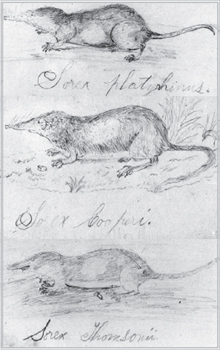
Influenced by Audubon and Darwin, Roosevelt started sketching birds and mammals in his notebooks. In these pencil drawings, he marks the sub-species variations of shrews.
T.R. sketches of mammals. (Courtesy of Theodore Roosevelt Collection, Harvard College Library)
Throughout his life, bears mesmerized Roosevelt. In An Autobiography, in fact, he wrote wide-eyed of Bear Bob—a former slave once owned by his mother’s family in Georgia—who had been scalped by an angry black bear’s claw.46 (That violent, degrading spectacle haunted Roosevelt’s imagination.) Even at nine, Roosevelt saw bears—lumbering giants that can run as fast as a racehorse for short distances—as a symbol of wilderness. Enamored of their cunning, curiosity, and ferocity (when provoked), Roosevelt marveled that their acute sense of smell enabled them to detect game from nearly one mile away. He also noted that bears belong to a mammal group referred to as plantigrade (i.e., flat-footed, in contrast to digitigrade animals, which walk on their toes, like cats and dogs). Young Roosevelt rejected the human-like Thomas Nast cartoons of these omnivores in Harper’s Weekly (popular in the 1860s) in favor of cutting-edge zoology books with exact details on nonretractile claws agility (among black bears only) in climbing trees. With scientific detachment, young Theodore would correct people who casually claimed that all bears hibernate in winter; they don’t, and such sloppy misconceptions annoyed him greatly.47
For example, he believed bears were “wicked smart,” able to backtrack in their own footprints to shake hunting dogs off their easily detectable scent. Yet popular culture usually portrayed bears as slothful, honey-loving buffoons hiding in a den. Often black bears were written about as small cousins of grizzlies. To a degree, that assessment was fair. But it bothered Roosevelt, who knew that there was nothing small about black bears. Hunters had recently killed adult black bear males weighing well over 300 pounds, with short, stubby claws used to scale trees quickly. In Native American lore, so-called spirit bears—black, brown, grizzly, and polar—were all endowed with sacred characteristics; but in European culture they often had a menacing reputation, as inGoldilocks and the Three Bears. As a boy Roosevelt was largely unimpressed with both caricatures of bears. He wanted hard, factual, empirical data about their instinctive habits. “My own experience with bears,” he later wrote, “tends to make me lay special emphasis upon their variation of temper.” 48
The Hudson River valley was the first American wilderness area Roosevelt fell in love with. He tossed fist-sized rocks into boggy creeks and used miniature nets to scoop up minnows from local muddy bottoms. Such was his enthusiasm for the region that Roosevelt pouted the following spring when his family left for a year in Europe (from May 12, 1869, to May 25, 1870). He preferred studying North American wildlife in the woods of New York to what his parents thought would be a sweeping “continental” educational experience for their four children. Capitulating to his father’s will, Theodore put on a cheery face and grew excited about the prospect of inspecting the zoos and natural sites of old Europe. While their steamship, the Scotia, headed across the Atlantic, Roosevelt’s journal commented briefly on staterooms and seasickness, then focused on wild-life. Numerous entries in his log for 1869–1870—the spelling atrocious—mention some encounter or another with wildlife or domestic animals.
May 19th, 1869 [at sea]
Warmer. Read and played. We saw two ships one shark some fish severel gulls and the boatswain (sea bird) so named because its tail feathers are supposed to resemble the warlike spike with which a boatswain (man) is usually represented.
June 23rd, 1869 (London)
We went agoin to the zoological gardens. We saw some more kinds of animals not common to most menageries. We saw some ixhrinumens, little earthdog queer wolves and foxes, badgers, and racoons and rattels with queer antics. We saw two she boars and a wildcat and a caracal fight.49
Everywhere the Roosevelts traveled in Europe, young Theodore cast a friendly eye toward living creatures. Whether it was hauling in English lake fishes with his sister Corinne or listening to the roar of a waterfall in Hastings where herons congregated, Roosevelt observed nature like a budding biologist. Even when he was touring museums or cathedrals, his eyes immediately darted toward heraldic shields with bears and bulls, statues of wooden dogs, art showing centaurs, and any scrawny stray cats that prowled territorially around the grounds as if they owned the property. Vivid descriptions of ornery mules and trotting horses populated the diaries. In “My Journal in Switzerland,” for example, Roosevelt wrote of climbing the Alps around Mont Blanc and trying to trap animals to learn “natural history from nature.”50 Although he was bored by the manicured European botanical gardens, Roosevelt marveled on seeing his first glacier, which he anointed “Mother of Ice.”51 While in Lugano, he was given two chameleons by the family’s carriage driver to keep as pets; he was intrigued by their uncanny ability to change colors with such ease.52
By September 1869 the Roosevelts had made their way to southern Italy. Unfortunately, his asthmatic condition was making Theodore miserable, discoloring his face, forcing him to wheeze for air, his chest heaving and filled with mucus. Clearing his throat was necessary so often that it became a tic. Often he had to sleep sitting up in order to breathe. In his diary he cast horrific spells as awful attacks of “the asmer.” There was no effective treatment available in the mid-nineteenth century, so he suffered, gasping for air whenever flare-ups occurred. After one sick, asthmatic afternoon, bored and bedridden, Theodore suddenly perked up at the sight of a performing canine. “In the evening a Lady came with a little dog who is the cuningest litleest fellow in the world,” he said; “he had a great many tricke letting you kiss its hand whipping you standing on its hind legs and having a dress on.”53
Although the Roosevelts traveled through Europe in high style, young Theodore missed his tiny museum back on Twentieth Street in New York City. Discovering English birds’ nests and French snakeskins on walks, he pocketed them to haul back home for his expansive collection. Not wanting to let his natural history training lapse, he read Wood and Reid and Baird every chance he got. In Dresden, Germany, he ventured by himself to the Royal Zoological Museum, a venerable institution founded in 1728. Housing more than 100 animals, the museum had a particularly fine collection of reptiles and fishes. The main draw at the museum, however, was the intricate glass models of sea anemones precisely blown by the artist Leopold Blaschka.54
But it was the aquarium in Berlin that really got Roosevelt’s blood running, bringing him up close to live perched ravens, rare ducks, and feisty cormorants. “We saw birds in there nests on trees and anemonese and snakes and lizards,” he recorded on October 27. “We had a walk and played chamois and after goats which I a grizzely bear tried to eat.”55 Tellingly, even the Berlin aquarium left him missing the United States. “Perhaps when I’mm 14 I’ll go to Minnesota,” he wrote, dreaming of bird-watching in the Red River valley; “hip, hip, hurrah’hhh!” 56 In these diaries are the beginnings of Roosevelt’s imagining America as a wilderness, a mosaic of longleaf pine woods and forested wetlands, of large floodplains and swamps and lakes. Europe may have had prairies, but America had dry and wet prairies. To Roosevelt America had now risen in stature as a true wilderness laboratory—Europe, he sensed, was spent.
Whenever young Theodore saw animals neglected or abused, his diaries reflect his outrage. The sight of a puppy run over in a Parisian gutter sent him into a deep funk. He lamented how cows and goats were mistreated by peasants, and was upset at seeing horses suffer from whips, bits, epilepsy, frostbite, and heat exhaustion. On December 7, in Nice, he recorded how atrociously a French peasant treated his livestock. “We saw a brutal conveyance of lambs,” he wrote. “They were tied by their legs and swung across a donkeys back. We saw also a young vilain who swung a poor animal around.”57
Three weeks later, young Theodore was horrified by the way Italians treated their animals. “It seemed as if we would never get out of Naples which I was very anxius to do,” he wrote, “to avoid seeing the cruelty to the poor donkeys in making them draw heavey loads and nearly starving them.”58 In Rome he bragged that “we saw a beautiful big huge dog and I was the only one he shook hands with and I am proud.”59 Paradoxically, other entries from the same European trip extol the thrill of what hunters call the chase. Sometimes Roosevelt would patrol the streets of Rome pursuing wild dogs, cornering them so he could watch them snap and snarl up close, taunting them with his gun muzzle to provoke them to show their wolflike teeth. In prose he used dramatic imagery (indeed, clichés) about “trapping wild dogs” that were “growling furiously,” stray mongrels that “thrust into his face.”60
At other times during his European tour, Roosevelt sketched animals in the zoos he visited. This practice may have been inspired by his meeting Professor Daniel G. Elliot, one of the world’s foremost naturalists, in Florence on March 1. Well-to-do, Elliot came from New York but had been embraced in European scientific circles as an ornithologist and mammalogist of rare talent. Some claimed, in fact, that Elliot had been put on earth to study a wide range of species including Californian salmon and American bison. Writing and often illustrating numerous books, Elliot was considered the leading expert on cats, both wild and domestic. But what most captivated Roosevelt was that Professor Elliot had undertaken to produce two volumes on North American birds in 1869, covering the numerous species that the great Audubon had missed.61 An easy touch, the critic Roosevelt deemed Elliot’s The New and Heretofore Unfigured Species of the Birds of North America a “beautiful” accomplishment of lasting integrity.” 62
Warmed by the glow of spending time with Elliot, T.R. sought out more books by naturalists. He started carrying around illustrated volumes by Alexander Wilson and Thomas Nuttall. At the zoological garden in Florence, he got to feed the bears and sketch them in a notebook. Even when Roosevelt toured the drafty stone museums of Europe, he would try to find a link to animals, noting, for example, that an ornate sleigh resembled a “crouching leopard.” The last entry in young Theodore’s European diary was made on their westbound ship before the family disembarked in New York. After complaining that he hadn’t seen any birds or fish, his luck turned. “In the afternoon we saw some young whales,” he wrote, “one of whom came so near the boat that when it spouted some of its water came on me.”63
IV
Upon returning from Europe, fatigued from touring Catholic cathedrals and German dance halls, Roosevelt was flushed with the ambition of seeing the American West with his own eyes. Smitten with the whole idea of “Go West, young man!” once promulgated by Horace Greeley, he wanted to straddle the Continental Divide clad in buckskin, riding off into the wild Rockies. Roosevelt’s parents, however, preferred the thick woodlands of northernmost New York and Vermont instead of places with names like Dead Man Gulch or Hellville. Proximity, one supposes, played a large role in his parents’ decision about the itinerary. All T.R. could do was nod in acquiescence; at least the Hudson River valley was better than being seasick on another voyage to Europe. During the summers of 1870, 1871, and 1872 the Roosevelt family rented country houses along the Hudson River valley—in Dobbs Ferry (George Washington’s headquarters before the march to Yorktown in 1781) and Spuyten Duyvil (near Riverdale).64 The Hudson enchanted Roosevelt, even though the constant houseboat traffic and train whistles in these commuter towns not far from the city meant he wasn’t having the kind of wilderness experience his imagination craved.
Conscious that he hadn’t toured his homeland west of the Atlantic coast, Roosevelt titled his post-Europe diary “Now My Journal in the United States” (May 25 to September 10, 1870). Spending much of that summer in Spuyten Duyvil, Roosevelt quaintly dated his diary with “country” at the top of each entry. Sounding like a modern-day summer camper, he wrote of swimming, hiking, and shooting a bow and arrow. “We began to build a hut,” he wrote on June 6, “and had a nice time and found a bird’s nest with 3 eggs (but we did not take them).”65
When that particular diary ends abruptly, in September, there is a gap for the next eleven months. In August 1871, when the next journal begins, the awesome natural sites in the Adirondack Park—Mount Marcy, Blake Peak, and Lake Tear-of-the-Clouds (the source of the Hudson River)—animate his writing. Bursting with excitement about the Adirondacks (and the White Mountains), he tramped around, imagining himself in the footsteps of frontiersmen like Ethan Allen and George Rogers Clark. The Adirondacks at this time were very much in vogue. Two years prior to the Roosevelt family’s visit, the Congregationalist minister W. H. H. Murray had published the best-selling Adventures in the Wilderness; Or Camp-Life in the Adirondacks, in which he claimed that the upstate New York “wilderness” helped cure consumption and other lung ailments.66 Owing to the unexpected success of Murray’s book, tourists and health seekers alike came pouring into the Adirondacks, fishing in Lake Placid, hiking up Whiteface Mountain, and simply inhaling the air along the Ma-cIntyre Range.67
Young Theodore counted himself in the front line of the new enthusiasts for the Adirondacks. Like Thomas Jefferson—who in 1791 deemed the thirty-two-mile-long Lake George “without comparison, the most beautiful water I ever saw”68—Roosevelt wanted to explore the shoreline and islands of this natural wonder. In fact, the “Queen of American Lakes” always held a special place in Roosevelt’s heart. “We started on the Minnehaha up Lake George,” he wrote. “We passed innumerable islands on the way up it. At the head or rather tail of this lake, where it is connected with Lake Champlain the mountains were very abrupt and the lake very narrow. The scenery at this point is so wild that you would think that no man had ever set foot there.” 69
In these diary entries from the Adirondacks Roosevelt uses a vivid exactness in describing the the piney woods and incomparable lakes he played in. Satisfied and comfortable, he watched a blue-gray bird with a shaggy crest dive into the lake and quickly identified it as a kingfisher. Careful distinctions were made between coveys of quail and runs of common loons. Strange as it seems, Roosevelt spent an hour just observing a little blue heron with a daggerlike bill that sat on the lake edge sunning itself; the sight was worth 100 Lord’s Prayers. Sometimes it almost seemed that when Roosevelt saw a bird he became the bird for a short spell.
In the Adirondack Park and the White Mountains, Roosevelt also discovered the fiction of James Fenimore Cooper. His father felt that reading a novel like The Last of the Mohicans (1826) while staying in the area where the French and Indian War took place would enrich the literary experience. Cooper’s hero Natty Bumppo (also called Leatherstocking or Hawkeye) was a bold white scout, paddling across Lake Champlain, climbing lofty summits, and wearing a bearskin to gain entrance to a Huron village. Later in life Roosevelt remembered that he read all five of The Leatherstocking Tales in the order in which Cooper had written them. This means that in addition to absorbing The Last of the Mohicans, he read what in retrospect are the two most important American conservationist novels of the nineteenth century, narratives that dealt, in part, with imperative calls to create forest reserves through visionary natural resource management: The Pioneers (1823) and The Prairie (1827). “I put Cooper higher than you do,” Roosevelt would write to the novelist Josephine Dodge Daskam when he was vice president of the United States. “I do not care very much for his Indians, but Leatherstocking and Long Tom Coffin are, as Thackery somewhere said, among the great men in fiction.”70
Before Cooper, forests were viewed as dark, satanic thickets, a regrettable natural obstacle to homesteaders and frontiersmen, something to be clear-cut; streams, were similarly considered dangerous, unpredictable torrents. Cooper overturned this concept of the “haunted” wilderness. To him trees were “jewels” and fishes “treasures.” In The Pioneers, for example, he railed against despoilers of nature for their “wasteful extravagance.” Cooper’s alter ego, Natty Bumppo, firmly believed that the unnecessary slaughter of wildlife was a crime against God. Cooper even anticipated the extermination of the ubiquitous passenger pigeon. “It’s wicked to be shooting into flocks in this wastey manner,” Cooper wrote in The Pioneers. “If a body has a craving for pigeon’s flesh, why, it’s made the same as all other creaturs, for man’s eating; but not to kill twenty and eat one. When I want such a thing, I go into the woods till I find one to my liking, and then I shoot him off the branches without touching the feather of another, though there might be a hundred on the same tree.”71
On that summer’s holiday, stimulated by his evening campfire readings in The Last of the Mohicans, young Theodore did. He had turned explorer, stalking chipmunks burrowed in fallen trees, and spying on woodpeckers making a racket with their beaks like plier claws. Pretending to be Natty Bumppo, he carefully studied salamander markings, finding them hidden under water-soaked logs. To the bafflement of his parents he gathered more than 100 different species of lichens and fungi under rocks and in dense undergrowth. He brought out from caves unusual samplings of moss to scrutinize back home under a magnifying glass. And, of course, there was daily talk of bears. “There is a tame bear here who eats cake like a Christian,” he recorded at White River Junction, “and appears very anxious to come to close quarters with us.”72
V
As these diaries attest, the future president’s father encouraged T.R.’s love of nature. Straitlaced, slightly pious, and a dutiful husband, Theodore Roosevelt, Sr., preferred philanthropy over business and was always ready to aid the poor and needy. An abolitionist before the Civil War, he now—during the Reconstruction era—had an “emancipationist memory” (as the historian David W. Blight called the belief that the federal government should intervene to help the poor and disenfranchised), and a determination to be part of the progressive movements of his day.73 Theodore Roosevelt, Sr., worried that in the thirst for post–Civil War reconciliation, African-Americans were going to be discriminated against. But the main thrust of his philanthropy was to extol natural history and animal protection. Promoting the humane treatment of horses, making sure they weren’t abused, became one of his civic concerns. In An Autobiography, T.R., in fact, goes on for a couple of pages about his father’s prowess with horse reins, bragging that he was a fine four-in-hand carriage driver. A man of medium height, Theodore Sr. was so well proportioned and carried himself with such perfect posture that he seemed much larger. “He was a big, powerful man, with a leonine face, and his heart filled with gentleness for those who needed help or protection,” Roosevelt recalled, “and with the possibility of much wrath against a bully or an oppressor.” 74
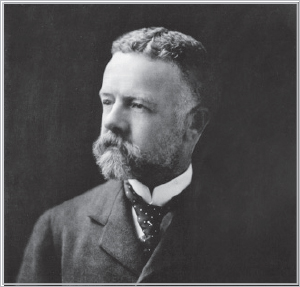
Theodore Roosevelt, Sr., was a founder of the American Museum of Natural History in New York.
Theodore Roosevelt, Sr. (Courtesy of American Museum of Natural History)
Driven to succeed, Theodore Sr. usually dressed in a white neckcloth and a dark suit, forgoing the broad-brimmed high hats favored by his fellow aristocrats. He gave the impression of a groomed man on top of his life’s game. His nephew Emlen Roosevelt, in fact, claimed that he personified “abundant strength and power” in every pursuit he decided to tackle.75 The wellspring of Theodore Sr.’s enthusiasm for living creatures—both wild and domestic—came from his father, Cornelius Van Schaack Roosevelt (T.R.’s grandfather), who was born in 1794. Cornelius dropped out of Columbia College and devoted his full attention to Roosevelt and Son hardware. Before long he had a near-monopoly on American plate glass imports. With money to invest, Cornelius founded Chemical Bank of New York. Basically, the Roosevelt family business, as befitting the urban gentry, was now financial investment.
The son of the exceedingly rich Cornelius Roosevelt, Theodore Sr., a leisured gentleman, born into the Dutch aristocracy of New York, never experienced poverty. Still, he had compassion for the underprivileged. (So did his son Theodore Jr., the future president.) Theodore Sr. mixed easily with both rich and poor. Among his many civic-minded good deeds was his cofounding of the Newsboys’ Lodging Home and New York’s Children’s Aid Society. Calm, cheerful, deeply thoughtful, and a devoted Dutch Reform Protestant, Roosevelt was determined that his children—Anna (nicknamed Bamie), Theodore Jr. (Teedie), Elliott (Nell or Ellie), and Corinne (Conie)—would have an ideal childhood. Studying the natural world, he insisted, would be a big part of their education. Summers spent in the fresh air of upstate New York and New England helped fulfill this desire. Trips abroad were always structured for maximum educational uplift. Although not a naturalist, the elder Theodore Roosevelt was known throughout Manhattan as a devotee of the Hudson River valley. It’s little wonder that he became a founder and trustee of the American Museum of Natural History. To be a civilized person, Theodore Sr. believed, meant honoring the biological history of On the Origin of Species, the most revolutionary book of the nineteenth century.
Now a New York landmark and a national treasure, the museum began when Dr. Albert S. Bickmore, who had been a student of the zoologist Louis Agassiz at Harvard, arrived in Manhattan. Fresh from collecting species throughout the East Indian archipelago, Bickmore began telling colleagues of a dream he had of founding a museum of natural history. They all agreed it would take a lot of money. So Bickmore was directed to 28 East Twentieth Street, where Theodore Roosevelt, Sr., resided. The elder Roosevelt had an abiding philanthropic interest in promoting nature education and was friendly with the leading Darwinian scientists in America. Although his reputation for good works was renowned, he wasn’t a pushover. If Theodore Sr. didn’t like a sales pitch, he’d give a firm, definitive no, even if his directness bruised sensibilities. Theodore Jr. wrote in An Autobiography that his father was the “best man” he ever knew but “the only man of whom I was ever really afraid.”76
The courteous and knowledgeable Bickmore, however, received a warm welcome. Hours of fine conversation ensued, with Bickmore’s dream coming into realistic focus by the time the teapot was emptied. “Professor,” the elder Roosevelt told his guest, “New York wants a museum of natural history and it shall have one, and if you will stay here and cooperate with us, you shall be its first head.”77
This was not idle encouragement. Applying his Dutch fortitude and beneficence, the elder Roosevelt helped spearhead the nascent effort to build a world-class nature museum in Manhattan. Vouching for Bickmore with his rich friends, he envisioned the museum as an educational place to offer schoolchildren and working people a chance to study stuffed elephants, desert dioramas, birds’ nests, and porcupine quills. A few months later, on April 8, 1869, the charter for the American Museum of Natural History was approved in the front parlor of the Roosevelt brownstone. Two days later, Governor John Thompson Hoffman of New York signed a bill establishing the museum. The elder Roosevelt’s partners in this grand philanthropic endeavor included the future U.S. ambassador to the United Kingdom Joseph Choate, the finance magnate J. Pierpont Morgan, and the U.S. congressman William E. Dodge, Jr.78
Theodore Roosevelt, Sr., was one of eighteen Manhattanites who signed a letter to the commissioner of Central Park requesting a building site on the Upper West Side for the new museum. The spot chosen was Manhattan Square, which ran along Central Park West from Seventy-Seventh to Eighty-First Street. The New York Times singled out the elder Roosevelt as being “deeply interested in the enterprise” from the moment Bickmore had knocked on his door.79 President Ulysses S. Grant laid the museum’s cornerstone in 1874. As was to be expected, ideas regarding the mandate and magnitude of the new museum collided. Early bickering, for example, centered on whether dinosaur fossils should be displayed. The elder Roosevelt—a trustee—was for displaying them; paleontology, after all, as the French scientist Georges Cuvier had dramatically proved, was an exhilarating part of natural history. (Critics of fossils, however, believed they were a Darwinist ploy to somehow discredit what would become Creationism.) At Theodore Sr.’s request a delegation was sent to France to study Cuvier’s dinosaur bones and acquire outstanding taxidermy by Jules Verreaux.80
From the time it opened its doors in 1877, the American Museum of Natural History was a marvelous ticket-taking success. Visitors streamed en masse to see the new architectural wonder looming over a largely underdeveloped neighborhood. The original neo-Gothic building anchored the area, then home to squatters and goats. Huge turrets, conical roofs with heraldic eagles, and granite walls all added to its baronial elegance. At nighttime the illuminated museum could be seen from New Jersey, across the Hudson River.81 The interior decor was heavy with black walnut and ash. The museum attracted nearly as much press attention as the opening of the Empire State Building eventually would; even President Rutherford B. Hayes was on hand for the formal opening late in 1877.82 The inaugural displays focused on the glory of Darwinism (even though On the Origin of Species had been published eighteen years earlier, its impact in America was just being felt), scientific achievement, geographical discovery, and the natural sciences. An extraordinary collection of fossil invertebrates—purchased for $65,000 from the official New York state geologist—attracted the longest lines.83
Young Theodore came home from Harvard University to attend the museum’s opening and marveled at the seashells, beetles, and bird skins. He had donated twelve mice, a turtle, four bird eggs, and a red squirrel skull to the collection.84 Respectfully, he listened to President C. W. Eliot of Harvard, a dull blade on the podium, extol the “divinity” of the natural sciences. He was particularly drawn to the second floor of the main hall, which showcased Professor Daniel Elliot’s collection of North American birds. A stuffed dodo, a mummified crocodile, and a huge badger all apparently fascinated him no end.85
Nobody could have guessed that Theodore Jr., running around the museum excited about a mammoth tooth and a badger claw, would decades later have a wing of the museum dedicated in his honor for his efforts on behalf of U.S. conservation. Other great presidents—like Washington, Lincoln, and Jefferson—have beautiful memorials in Washington, D.C., along the Potomac River tidal basin, to celebrate their statesmanship. The New York museum, by contrast, fittingly became the New York state shrine to Roosevelt (along with a nature preserve called Roosevelt Island in the Potomac River in Washington, D.C., and Theodore Roosevelt National Park in the badlands of North Dakota). The Upper West Side museum was rededicated after Roosevelt’s death to honor the “scientific, educational, outdoor and exploration aspects” of his life—not the political aspects. And while it’s true that sagacious conservationist sayings of his were carved on the marble walls—“The nation behaves well if it treats the natural resources as assets which it must turn over to the next generation increased; and not impaired in value” might be the best—they were undercut by some of his most strident imperialist maxims.86
But the museum was a repository for dead wildlife only, whereas the elder Roosevelt—like young Theodore—also cared deeply about live animals. Wandering down the corridors of the museum lacked the domestic intimacy of mousing with a cat, let alone the thrill of hearing a cougar snort. So Theodore Sr., teaching his four children another lesson, brought the family into the animal protection movement.