
CHAPTER NINE
I
It is strange now to picture them meeting for the first time in March 1889 at the Fellowcraft Club at 32 West Twenty-Eighth Street in New York. With a membership of around 200 sophisticated newspapermen, writers, and artists, the Fellowcraft had the kind of leather-chair ambience preferred by the literary-minded aristocrats of the gilded age. The thirty-year-old Theodore Roosevelt was one of the club’s younger members. Although he was preparing to move to Washington, D.C., for his new post as U.S. civil service commissioner, he nevertheless continued fulminating against the deplorable conditions in New York City’s notorious cordon of louse-infected tenement slums. No job could ever rein in his multifarious reformist interests and instincts. But Roosevelt dropped his anti-poverty crusade and his history writing on March 7 for a long-coveted opportunity to meet the naturalist John Burroughs. The date, in fact, should be noted in the annals of U.S. conservation history as the cementing of an extremely significant alliance that would last for nearly three decades. “I thought him very vigorous, alive all over, with a great variety of interests; and it was surprising how well he knew the birds and animals,” Burroughs recalled. “He’s a rare combination of the sportsman and the naturalist.”1
Roosevelt and Burroughs’s lunch reportedly came about through an intermediary. As an assemblyman, Roosevelt had gotten to know Jacob A. Riis, a Danish-born newspaperman whose How the Other Half Lives would soon awake the nation to the suffering of New York City’s immigrants. Roosevelt regularly visited a boys’ club run by the reformer and polemicist John Jay Chapman in Hell’s Kitchen with Riis, and would often give away copies of Burroughs’s compilations of essays, such as Wake-Robin andWinter Sunshine. Chapman, who was a neighbor of Burroughs, arranged to have the two birders meet for lunch at the Fellowcraft Club.2 Joining them was Elizabeth Custer, the widow of Lieutenant Colonel George Armstrong Custer. Since her husband died at the battle of Little Bighorn in 1876, she’d published two western memoirs: “Boots and Saddles” or Life in Dakota with General Custer (1885) and Tenting on the Plains or General Custer in Kansas and Texas (1887). She, too, would have plenty to converse about with Roosevelt.3
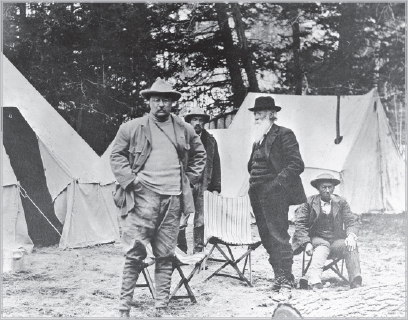
Theodore Roosevelt with John Burroughs in Yellowstone National Park in 1903. The photograph was taken by Illustrated Sporting News.
T.R. and John Burroughs at Yellowstone camp. (Courtesy of Theodore Roosevelt Collection, Harvard College Library)
T.R. was always trying to engulf people up in the tidal wave of his erudition, which some interpreted as monomaniacal self-regard. As one close friend kindly put it, “He was the prism through which the light of day took on more colors than could be seen in anybody else’s company.” 4 But Burroughs was a household name—his books were mandatory reading in schoolhouses all over America—and he made Roosevelt feel inferior.5 Burroughs didn’t just tramp around the wooded countryside keeping field notes or hunting game—he was the wooded countryside personified. Unlike Roosevelt, who was constantly showing off his credentials as a naturalist, Burroughs, as if half divine, believed there was sanctity in every fallen leaf or grain of sand. (Or, as Charles Dickens wrote of a favorite character in his 1854 novel Hard Times, he was a “man who was the Bully of humility.” 6
Concerned over the post–Civil War abandonment of agrarian communities in favor of overcrowded cities, the usually benevolent Burroughs wrote stingingly against “scientific barbarism,” even calling humming factories “the devil’s laboratory.”7Raised in the Catskill mountains, Burroughs would rub his eyes in disbelief as he surveyed the environmental degradation of New York City’s waterways. Although Burroughs never postulated a social philosophy per se, there was a sympathy for the Transcendentalists in everything he did or said. But he nevertheless admired captains of industry like Henry Ford and Thomas Edison who rose from the tinker’s bench to change the world. Roosevelt, by contrast, never fully condemned industrialization—he wanted only to break up trusts and to create great American parks, forest reserves, and bird rookeries to help invigorate city dwellers and uplift their urban spirits from chronic factory smoke and industrial disease.
There were other differences between the two naturalists. Burroughs was contemplative whereas Roosevelt preferred direct action, always ready to rumble. Although both men hunted, Burroughs’s pockets didn’t always bulge with bullets. While inWake-RobinBurroughs wrote about a deer hunt in the Adirondacks and about shooting rabbits for sport, his literary talent was better suited to promoting the joy of watching wildlife. The older Burroughs got, in fact, the more hunting bored him. To Burroughs, for example, the American Museum of Natural History was a morgue, an abominable mockery of the great web of vibrant life in the animal kingdom. “A bird shot and stuffed and botanized is no bird at all,” he later told a group of children who came to visit the museum. “And a bird described by another in cold paint is something less than you deserve. Do not go to museums but find Nature. Do not rely on schoolbooks. Have your mothers and fathers take you to the park or the seashore. Watch the sparrows circle over you, hear the gulls screech, follow the squirrel to his nest in the hollow of an old oak. Nature is nothing at all when it is twice removed. It is only real when you reach out and touch it with your hands.”8
One can be reasonably sure Roosevelt knew Burroughs’s biography from Catskills childhood to Signs and Seasons publication practically by heart at the time of their first meeting. Born in Roxbury, New York, on April 3, 1837, Burroughs was six years younger than Theodore Roosevelt, Sr. In his memoir My Boyhood, Burroughs wrote of growing up poor on his family’s farm yet being enchanted by juniper trees, gurgling streams, apple orchards, and picturesque dairy farms. “I deem it good luck, too, that my birth fell in April, a month in which so many other things find it good to begin life,” Burroughs wrote in My Boyhood. “Father probably tapped the sugar bush about this time or a little earlier; the blue-bird and the robin and song sparrow may have arrived that very day.”9
While he was growing up, Burroughs’s life revolved around the Roxbury harvest cycle. Enthralled by the cool sweep of the Catskills, he adopted the upstate woodlands as his own “open-air panorama.”10
By the time he was nine or ten years old, birds—of all kinds—became Burroughs’s fixation. One spring day, he later recalled, a cloud of passenger pigeons descended on a grove of beeches. The birds’ collective noise in his pasture sounded like a gust at sea or a tornado.11 Not long afterward—while visiting the U.S. Military Academy at West Point—Burroughs, who had started to style himself as a backwoods ornithologist, dipped into a copy of Audubon’s Birds of America in the library and couldn’t put it down.12 The beauty of Audubon’s flamingos and wild ganders was beyond stimulating. (Years later, in 1902, while Theodore Roosevelt was president, Burroughs wrote a biography of Audubon. Its purpose was to restore Audubon’s place as the premier American literary naturalist by virtue of his voluminous journals.13) Yet Burroughs noticed that Audubon had also written a ghastly essay on how farmers were slaughtering passenger pigeons by setting tree traps and filling water pots with sulfur. How much more beautiful was the cooing of live passenger pigeons than the heaps of dead birds local farmers used to feed hogs!
To earn a living, Burroughs decided to be a rural schoolmaster. He worked first in New Jersey, not far from the Atlantic coast. When he was twenty years old he traveled to Chicago and had his daguerreotype taken; it shows a rare handsomeness. His longish hair was slicked back, and his straightforward gaze suggested deep wisdom. But Burroughs was always most comfortable in rural settings. Whenever he found himself in New York or Chicago, he would clutch his wallet, worried that pickpockets might spot him as an easy mark. Struggling to find steady work, Burroughs moved to Washington, D.C., in 1862, during the height of the Civil War, and clerked in the Currency Bureau of the Treasury Department. Before long he was befriended by the poet Walt Whitman, who was also living in Washington.
It’s unclear whether Whitman fell in love with Burroughs’s physical beauty or with his rural innocence (or both) in the fall of 1863, but he did fall in love. (There is, however, no evidence of a sexual encounter between them.) To Whitman, his twenty-six-year-old protégé was like an only son; also, Burroughs was an open-hearted romantic with an unjaded face like “a field of wheat.” Mentoring young men like Burroughs came easily to Whitman. He had come to Washington to help nurse the 70,000 Union and Confederate soldiers wounded in action and recuperating in poorly run, unsanitary hospitals. Under Whitman’s tutelage, Burroughs started writing about nature in a more intimate way, perfecting his literary craft as a prose stylist when he was not working at his desk in the Treasury Department. There was a refreshing hominess to Burroughs’s essays about bullfrogs, maple syrup, and trout spawning. As Burroughs explained, his privileged education under Whitman—who was meticulously working on his cycle of war poemsDrum Taps when they met—led him to try to “liberate the birds from the scientists.” Unlike Roosevelt, Burroughs wasn’t overly interested in John James Audubon, the hunter and taxidermist extraordinaire, carting around arsenic paste and a shotgun. But Burroughsdid want to become a writer about green spaces who would be celebrated as the “Audubon of prose.”14
For the most part Burroughs spent 1863 to 1873 in Washington, D.C., writing outdoors prose. His friendship with Whitman grew and grew; the gray-bearded poet calling the Catskills writer his own personal “naturalist-in-residence” who felt empathy even for quick-breeding insects. To Burroughs, Whitman’s controversial Leaves of Grass was “an utterance from Nature, and opposite to modern literature, which is an utterance from Art.”15 When Abraham Lincoln was shot, Whitman—who used to cher confrèrewith Lincoln whenever they passed on the street—mourned like a grieving widow. The great Lincoln, Whitman moaned, had been stolen away in his prime.16
Just before the assassination, Burroughs had hiked up Batavia Mountain in the Catskills seeking an afternoon of solitude. Pausing for a moment to catch his breath, he was suddenly mesmerized by the long, ethereal, flutelike song of a hermit thrush. The sounds of this bird held Burroughs transfixed, as if in a dream, for ten or fifteen minutes. Craning his neck high and low, looking up in tree branches and along the ground where the songster might have been foraging, Burroughs struck out. There would be no sighting of a hermit thrush that afternoon. All he took away was a comforting memory of the delicate ringing melody. Upon hearing Burroughs talk effusively about the hermit thrush, Whitman wrote his celebrated eulogy to Lincoln, “When Lilacs Last in the Dooryard Bloom’d.” One verse went as follows:
Solitary the thrush,
The hermit withdrawn to himself, avoiding the settlements,
Sings by himself a song.
Song of the bleeding throat.17
While Whitman worked on Leaves of Grass, Burroughs became his cheerleader, comparing him to Thoreau and Emerson. Encouraged by Whitman, confident that Leaves of Grass was the great American masterpiece, the very embodiment of democracy in verse, Burroughs wrote his own first book, Notes on Walt Whitman as Poet and Person.18 Whitman himself helped edit the manuscript, rearranging quotations and sentences. Walks through Washington’s parks now became commonplace for the two nature lovers, who often strolled through the White House gardens or Rock Creek Park in search of a veery thrush or ruby-crowned kinglet.19 And Whitman was the one who chose Wake-Robin—the trillium found in American woods—as a title for Burroughs’s second book. “He thinks natural history, to be true to life, must be inspired, as well as poetry,” Burroughs wrote of Whitman, following one of their hikes. “The true poet and true scientist are close akin. They go forth into nature like friends…. The interests of the two in nature are widely different, yet in no true sense are they hostile.”20 Whitman’s belief in the special connection between science and poetry was shared by Roosevelt.
As an ice-breaker at the Fellowcraft lunch, Roosevelt had told Burroughs about his European honeymoon with Edith and how Burroughs’s nature books—especially Birds and Poets and Locusts and Wild Honey—made him long terribly for the United States. Roosevelt added that Burroughs’s prose was “thoroughly American.” Their talk shifted to the reform work Roosevelt was doing to help impoverished New York City boys; Roosevelt told Burroughs that, like Santa Claus, he regularly handed out mint copies ofWake-Robin as gifts, instructing the recipients to read every page carefully, for it embodied “all that was good and important in life.”21
Perhaps somewhat embarrassed, Burroughs feigned mild disbelief at the anecdote, certain that his musings about plovers and blackbirds couldn’t uplift ghetto boys who panhandled for stale bread and rotten fruit in the Bowery. But he was pleased that the nephew of Robert B. Roosevelt thought so highly of his work. Totally uncynical, seldom if ever putting anybody down with a jolt of criticism, Burroughs decided that he liked the cut of Roosevelt’s jib. (Essentially, Burroughs felt about Roosevelt as he did about a Catskills neighbor: “That man hasn’t a lazy bone in his body. But I have lots of ’em”—lots of ’em”22). After lunch, on the train ride back to the Hudson River valley, as Burroughs passed stops in Tarrytown, Cold Spring, Beacon, Poughkeepsie, and Hyde Park,* hewrote about his luncheon with Roosevelt, musing on how much luckier rural children like his own son, Julian, were than the urban poor. “How different is the life of Julian,” he wrote, “in the country with fresh air, good books, and parents with a measure of leisure—from that of the boys that Chapman and Roosevelt want so much to help.”23
While Burroughs simply thought of the lunch as enjoyable, Roosevelt had been deeply impressed. Burroughs, he was now certain, was the Thoreau of his time, perhaps the finest literary naturalist America had ever produced. Frequently when fans meet a writer or artist they admire, encountering the celebrity in person is a terrible disappointment. The exact opposite occurred at the Fellowcraft Club; the upshot of the lunch was that Roosevelt was now indissolubly linked to Burroughs. Not since his father died, in fact, had Roosevelt seen such Homeric dimensions in anyone as in John Burroughs. When Roosevelt started writing the last book of his North Dakota trilogy, The Wilderness Hunter, his style became infused with Burroughs’s naturalist writing. Unlike his previous two Dakota volumes, The Wilderness Hunter would emphasize the wildlife-sportsman ethos over even the best-honed hunting yarns.
II
Another factor that contributed to this change of emphasis in Roosevelt’s writings was his move to Washington, D.C., to assume his new duties as a member of the Civil Service Commission. Theodore and Edith had decided that she and the children (a second son, Kermit, was born in October 1889) would at first remain at Sagamore Hill while he lived rent-free at Cabot and Nannie Lodge’s residence in Washington.24 An insomniac Roosevelt usually slept only four or five hours a night, so he figured that, after his desk job, there would be plenty of spare time to continue writing The Wilderness Hunter and start in earnest to write The Winning of the West (his history as mural). Everything was either handwritten or dictated to a stenographer—typing never appealed to him. Every waking hour was a whirlwind of activity. “He was a live wire,” Burroughs noted about T.R. in his journal, “if there ever was one in human form.”25 (On another occasion Burroughs said Roosevelt was “a many-sided man and every side was like an electric battery.”26) Roosevelt himself wrote in Ranch Life, “Black care rarely sits behind a rider whose pace is fast enough”—a fitting observation that David McCullough used as the epigraph of Mornings on Horseback.27
Certainly overworking was preferable to behaving like his brother Elliott. Following a riding accident, the restless, ill-adjusted, but charming Nell turned to alcohol and opiates to deal with a broken leg and with inner anguish that modern psychiatrists would have probably diagnosed as a form of dehabilitating depression. A chronic misery had fallen over him. He drifted across the Atlantic, fumbled about London and Rome, occasionally sneaked in some serious hunting, but mostly just squandered opportunities to succeed at anything. For a while he sought rehabilitation in Illinois and worked in Virginia. But spiritual destitution followed him every step of the way. Despite being married to a wonderful wife, Anna Hall, Elliott was nevertheless a serial adulterer, like Uncle Rob. By including Elliott as a founder of the Boone and Crockett Club, Theodore hoped to get his brother refocused on the outdoors life—hunting being the one activity that stabilized Elliott’s tormented spirit.28 However, once Elliott became embroiled in a paternity suit, Theodore lost all patience with his brother.29 Bringing shame upon the family name, he believed, was never acceptable. “He is evidently a maniac,” an agitated Theodore wrote Bamie about Elliott, “morally no less than mentally.”30
In early 1889, besides worrying about Elliott, Roosevelt wondered whether the Boone and Crockett Club had a staunch ally in Benjamin Harrison. Because Harrison was a Republican—as were most early conservationists—Roosevelt was hopeful. Would the new president fight for forest reserves, fish hatcheries, and big game preservation? The stoop-shouldered Harrison, in fact, was an “aesthetic conservationist” who loved the outdoors almost as much as Roosevelt did.31 Growing up on a farm along the banks of the Ohio River (near Cincinnati), Harrison hunted duck, fished for smallmouth bass, and hiked around the North Bend woods looking for arrowheads. He had a sharp eye for birds. Harrison appreciated the redemptive quality of wild places and their contribution to building character. Twice before being elected president, he visited Yellowstone National Park. While serving as a U.S. senator from Indiana, Harrison had been instrumental in halting commercial development in Yellowstone, pushing for prohibitive legislation that allowed only ten park acres to be leased for hotel use. Harrison had also introduced a bill in early 1882 that would have set aside land along the Colorado River of Arizona for government preservation. (The legislation failed, but T.R. eventually saved the Grand Canyon under an executive order known as the Antiquities Act of 1906.)
Despite these legislative setbacks, Harrison’s conservationist convictions grew. His new secretary of the interior, John W. Noble, was a college friend of his at Yale who’d risen through the Third Iowa Cavalry to become a brigadier general during the Civil War. Following Lee’s surrender, Noble moved to Saint Louis, practiced law, and was eventually made a U.S. district attorney.32 Perhaps because he had seen so much killing in the Civil War, Noble didn’t cotton to the slaughtering of bison by market hunters, which had become widespread owing to the demand for the hides. And he worried about a timber famine in the Missouri Ozarks and elsewhere, seeing it as an impending national danger. In 1910 George Bird Grinnell, reflecting on the early history of the conservation movement in his partially unpublished “Brief History of the Boone and Crockett Club,” praised Noble in no uncertain terms, writing that he was “a man of the loftiest and broadest views and heartily in sympathy with the efforts to protect the forests.”33
As an intellectual, Roosevelt spent much of the 1890s competing with Edward Coues for preeminence as the top frontier historian. Each man, in particular, was vying to be considered most knowledgeable about the American West. While Roosevelt was writingThe Winning of the West, Coues was editing an impressive string of journals and frontier reports about western exploration. The years Coues spent as an army surgeon in forlorn outposts along the Mexican border had allowed him to gather valuable insights for his books. Coues’s firsthand knowledge of the West clearly informed his reliable annotations of the classic accounts of exploration he edited in the 1890s: History of the Expedition of Lewis and Clark (1893), Expeditions of Zebulon Montgomery Pike(1895),Journals of Alexander Henry and David Thompson (1897), Journal of Major Jacob Fowler (1898), Forty Years a Fur Trader on the Upper Missouri by Charles Larpenteur (1898), and Diary of Francisco Garces (1900).
Coues’s major books were edited, but even so, only Roosevelt himself (and perhaps a few others) could publish at that book-a-year pace. Roosevelt felt Coues, along with Burroughs, was doing the most important work of any U.S. writer or intellectual in the 1890s by editing these six treasured classics of western expansion for future generations to appreciate. When Coues died in 1899 at age fifty-seven, Roosevelt considered it a terrible loss to ornithology, zoology, and frontier history. Coues, he believed, had awakened the popular consciousness to the epic of American exploration.34 (And then there were Coues’s ornithological works.) For the remainder of his life Roosevelt used Coues’s Key to North American Birds (which went through six editions) as his central reference work regarding classification.
At the Civil Service Commission, Roosevelt continued his war against the entrenched spoils system, a war he’d been waging since he joined the New York state assembly in 1883. Now he had a national platform from which to preach against the epidemic of corruption. Almost as much as “Bad Lands Cowboy,” the label “Civil Service Reformer” soon became attached to Roosevelt in the minds of the American people. Over the next six years, serving both presidents Harrison and Cleveland (the latter won the 1892 presidential election, returning to the White House for a second nonconsecutive term), Roosevelt prosecuted dishonest government officials from coast to coast. Fraud at the U.S. Post Office was his particular focus. He also tried to help the nongovernmental Indian Rights Association (IRA) improve living conditions on territorial reservations in the Dakotas, Nebraska, and Oklahoma.35 “The spoils system was more fruitful of degradation in our political life than any other that could have possibly been invented,” he would write late in his tenure. “The spoil monger, the man who peddled patronage, inevitably breeds the vote-buyer, the vote-seller, and the man guilty of malfeasance in office.”36
No nook or cranny was off-limits when it came to Roosevelt’s determination to eradicate illegal profiteering from the federal government. Fellow Republicans were aghast that Roosevelt doggedly investigated his own party’s members, but he believed both parties were unacceptably full of money skimmers. His targets included not only customs officials in New York City but even William Henry Harrison Miller (President Harrison’s former law partner in Indianapolis). From that moment, the taciturn president disliked the flamboyant Roosevelt, barely listening when his commissioner pontificated about crooked Wyoming developers determined to carve up poor Yellowstone National Park, or about a new investigation of the U.S. Post Office, or about graft in the Indian Agency. The old general—the grandson of America’s ninth president, William Henry Harrison—would tap his finger, bite his lip, and stare straight ahead with a marble face. Roosevelt wasn’t oblivious of the icy treatment, writing to his daughter Alice that the five-foot-six-inch Harrison was a “little runt of a President.”37 Often, Roosevelt called the president “Little Ben” behind his back.
Although Roosevelt used Sagamore Hill as his home base that summer of 1889, he often traveled to historic U.S. sites of western expansionism. Greatly encouraged by G.P. Putnam’s positive reaction to the first two volumes of The Winning of the West, Roosevelt pressed on, doing research in archives in Canada (Ontario), Tennessee, Virginia, and Kentucky. To Roosevelt entering each archive was like entering a mine—he never knew what gem or nugget it might contain.38 “If nothing else, The Winning of the Weststands as another monument to Roosevelt’s preternatural energy and powers of concentration,” the historian John Milton Cooper, Jr., observed. “No other active statesman in the English-speaking world, not even Winston Churchill, produced such a solidly scholarly work of history while he was, as the Romans said, in medias res.”39
III
Whether Roosevelt was hunting bears or attacking spoilsmen, his level of activity wasn’t without critics. Ironically, he now got along splendidly with toothless trappers and cattle ropers, but was no longer as comfortable with the refined intelligentsia of the East Coast. Critics like John Hay and Henry Adams, to name the most prominent, belittled his talk of the “strenuous life” as counterfeit and self-aggrandizing (though they both liked his wife, Edith, tremendously). Whenever Roosevelt spoke about humans needing to have “healthy animalism” instilled into their lives, patricians rolled their eyes. Hadn’t he learned anything in Porcellian? Whenever he claimed that great knowledge could be gleaned from backwoods types like Hell Roaring Bill Jones or Yellowstone Kelly, they rebuked him for being a literary nationalist at best and folk-obsessed and jingoistic at worse. Hadn’t he traveled extensively through Europe and understood the great art of Leonardo and Michelangelo? Equating the beauty of Pike’s Peak with The Last Supper, they believed, was Wild Wolf macho nonsense.
With his trademark teeth and eyeglasses moving in unison as he spoke, Roosevelt countered that his critics were part of a stifled class, deaf to the clarion call of nation-building, unable to see that the United States’ frontier values made the nation vastly superior to Europe’s effete culture. His opponents could die in their Washington parlors, but he preferred to go out like a wild animal shot at dusk in an untrampled forest. The whole Hay-Adams circle viewed Roosevelt, in the words of Kathleen Dalton, as “an entertaining but dangerous man to have in a drawing room: he had spilled coffee all over the dress of one governor’s wife and bumptiously ripped another woman’s hem with a clumsy step.”40
The poet James Russell Lowell notably bucked this patrician crowd assessment, praising T.R. in the 1890s for being “so energetic, so full of zeal, and, still more, so full of fight.”41 (It didn’t hurt that Roosevelt had quoted from Lowell’s poem “A Fable for Critics” to open the first volume of The Winning of the West.) As a conversationalist, Lowell would say, Roosevelt was in a league of his own. Clearly Roosevelt was a force of nature, a rare phenomenon, a well-rounded intellectual unafraid to enter the fray of national politics, conservation, military affairs, and academic scholarship. With the exception of Henry Cabot Lodge, however, Roosevelt was no longer fully comfortable with the Brahmins of mannered society. He consciously cultivated the manners of a background different from his own, eating with his fingers, reading books at the dinner table, waving off blessings, and carrying a loaded pistol for its shock value. Essentially five generations of etiquette had been abandoned in favor of the half-primitive insolence.
Although Roosevelt was impressed with the Hay-Adams crowd, wanted their airy approval, and admired them as perspicacious people who had personally known Lincoln, his respect went more to scientists. In the presence of biologists, naturalists, and surveyors like Grinnell, Baird, Coues, or Merriam, for example, Roosevelt was much more modest, soft-spoken, and open to criticism. He listened as much as he spoke. It was as if he had determined that politicians were corrupt and intellectuals fey, whereas U.S. government scientists (that is, those who knew how to write well) and members of the army or navy were the true pillars of American integrity. As for the pioneers themselves, Roosevelt proudly characterized them as “grim, stern people, strong and simple, powerful for good and evil, swayed by gusts of stormy passion.”42
In July 1889 the first two volumes of The Winning of the West were published to another round of critical acclaim. Best read as a bildungsroman about how “Young America,” as the country was called by Great Britain, had succeeded in its westward expansion,The Winning of the West was Roosevelt at his nationalistic apogee. “His Americanism,” Burroughs wrote, “charged the very marrow of his bone.”43 Frederick Jackson Turner, still a relatively obscure historian at the University of Wisconsin–Madison, praised the volumes in The Dial, saying that Roosevelt had dealt “impartially and sensibly with the relations of the pioneers and Indians whom they disposed.” 44 The Atlantic Monthly commended Roosevelt for his “natural, simple, picturesque” style.45 According to theNew York Times, the volumes were admirable in their “thoroughness” and written by a “man who knew the subject.”46 Great Britain’s finest review publications—including the Saturday Review and the Spectator—all gave thumbs up.47 What none of these glowing reviews pointed out was that Roosevelt had pioneered in writing a new kind of popular scientific history, melding Parkmanism with Darwinian thinking and a full jigger of Mayne Reid to boot. Some passages directly echoed The Oregon Trail and On the Origin of Species, and even The Scalp-Hunter.48 The consensus was clear: the historian Roosevelt had a knack for not putting the reader to sleep.
For his own part, Roosevelt was proud that The Winning of the West was more in the tradition of Francis Parkman than Henry Adams’s History of the United States in America during the Administrations of Thomas Jefferson and James Madison, whose first volume also appeared that year. Besides writing about westward expansion as Parkman had done, Roosevelt had infused his narrative history with scientific explanations. “Now I am willing that history shall be treated as a branch of science, but only on condition that it also remains a branch of literature,” Roosevelt wrote; “and, furthermore, I believe that as the field of science encroaches on the field of literature there should be a corresponding encroachment of literature upon science; and I hold that one of the great needs, which can only be met by very able men whose culture is broad enough to include literature as well as science, is the need of books for scientific laymen. We need a literature of science which shall be readable.”49
Yet, as Roosevelt was apt to do, he felt the sting of criticism more than the high-minded accolades. Accusations abounded that the The Winning of the West had been a rush job. Typos and minor mistakes could be found. The Atlantic Monthly, for example, pointed out that Roosevelt had misidentified John Randolph of Roanoke, and the New York Sun charged him with unethically paraphrasing a book by the scholar James R. Gilmore.50 An exclamation of anger broke from Roosevelt’s pen, for he knew his public reputation was under assault. Roosevelt dealt with each charge differently: he befriended the Atlantic Monthly’s editor but put the kibosh on the envious Gilmore in a very public rebuttal to the charge of quasi-plagiarism. By confronting his tormentors, Roosevelt escaped the turbulent waters of bad publicity unscathed. By emulating Parkman, Roosevelt prided himself in having written the “history of the American forest.”51
Basking in the sunshine of literary fame, Roosevelt wrote to Francis Parkman himself—who the previous year had written an important conservation-oriented article, “The Forests of the White Mountains,” for Garden and Forest52—and told Parkman about his future plans as an author. Although not an environmentalist in the modern sense of the term, Parkman was a premier naturalist and horticulturist of his day, running a nursery in Massachusetts to supplement his career as a historian. Clearly Roosevelt wanted to show Parkman that, he too, used wilderness and fauna as his background for historical events.53 “I am pleased that you like the book,” he wrote on July 13, 1889. “I have always had a special admiration for you as the only one—and I may very sincerely say, the greatest—of our two or three first class historians who devoted himself to American history; and made a classic work…. I have always intended to devote myself to essential American work; and literature must be my mistress perforce, for though I really enjoy politics I appreciate the exceedingly short nature of my tenure.”54
IV
In the fall of 1889, Edith moved the three Roosevelt children—Alice, Ted, and Kermit—from Sagamore Hill to a rented house at 1820 Jefferson Street in Washington. (The house, just off Connecticut Avenue, was one-tenth the size of Sagamore Hill.) Theodore, who called his children “bunnies,” hoped his family would grow even more.55 (He would soon get his wish: Edith gave birth to Ethel in 1891 and to Archibald in 1894.) Considering the constraints on his time, Roosevelt was a good, loving father to all five children. Enjoying the hurly-burly of the household, he instructed his brood at a young age how to identify songbirds and insects. In the nation’s capital, Theodore was usually more mannered, acting like his own father, determined to teach his children the Ten Commandments, Wordsworth, Keats, and Shakespeare. At Sagamore Hill, however, he encouraged mayhem, coaxing them to swim in the bay and play in the Long Island woods. Dull moments were frowned upon.56 “Every evening I have a wild romp with them,” Roosevelt wrote to his mother-in-law, Gertrude Elizabeth Carow, “usually assuming the role of ‘a very big bear’ while they are either little bears or a ‘racoon and a badger, papa.’”57
Over Thanksgiving 1889 Roosevelt began planning a “grand holiday” during which he would bring Edith, Bamie, Robert Munro Ferguson, Corinne (and her husband, Douglas Robinson), and Henry Cabot Lodge’s sixteen-year-old son George (nicknamed Bay) to the Badlands and Yellowstone. They would travel by pack train to pristine parts of the upper Rocky Mountains. Because Theodore talked incessantly about the Elkhorn Ranch, it made sense for his wife to see the Medora magic firsthand and then head to Yellowstone. Over the next nine months, as he prepared for this expedition, he devoured every aged calf-bound book ever written about exploration in Yellowstone. Theodore was thrilled to learn that all the Rocky Mountain big game he loved, except the mountain goat and caribou, were to be found in Yellowstone National Park. According to Arnold Hague, a member of the Boone and Crockett Club, deer—both mule and white-tailed—populated the Gallatin Range valleys in high numbers, dashing up hillsides and grazing in meadows. An impatient Roosevelt could barely wait to see the enchanted herds for himself.58
And he was likewise eager to show off his scientific knowledge to his family—to explain why some owls nested in prairie dog holes and to describe the mating rituals of elk. Playing geologist, he could explain to Edith the significance of the 2-million-year-old lava on Huckleberry Ridge tuff and how Specimen Ridge had one of the world’s largest petrified forests. More and more, he saw himself as an interpreter of both American triumphalism and Darwinian species variation as they related to western U.S. history. In fact, after delivering an address on westward expansion at the American Historical Association’s year-end meeting, Roosevelt was acclaimed by his colleagues as the leading proponent of the “new school” of western historians.59 “I know of no one in the East, besides yourself, who has any conception of Western history,” William Frederick Poole, the association’s president, wrote to Roosevelt. “You have entered a fresh and most interesting field of research, and I predict you great success.”60
In January 1890, encouraged by the positive response from the American Historical Association, Roosevelt once again fantasized about quitting the U.S. government so he could be a full-time western historian. He wondered how best to blend his historical research with his conservationist beliefs. Realizing that the myth of American abundance was a national curse, Roosevelt set about to change attitudes about saving wildlife and preserving habitat. There was in America what his friend William T. Hornaday, chief taxidermist of the National Museum (the Smithsonian), called an “army of destruction” that had to be stopped.61 Roosevelt intended the family trip to Yellowstone, now slated for September, to be a fact-finding mission as well; it would help him better understand the poaching and plundering before he started testifying, as he hoped, before congressional committees on the sanctity of the park.
Perhaps there was another motivation for visiting Yellowstone in 1890. Roosevelt might have felt embarrassed that both President Harrison and George Bird Grinnell—his superiors in national politics and North American big game conservation, respectively—had already toured the national park whereas he had seen Old Faithful and the Tetons only in picture books. He would now be able to even the score. Polishing up his Civil Service badge, Roosevelt would probe into why Wyoming poachers and Montana lumbermen and railway-tie cutters were being permitted in what the law of 1872 deemed a “public park of pleasure-ground for the benefit and enjoyment of the people.”62 Why weren’t these intrusive criminals being collared by local law enforcement or the U.S. Army? How could the U.S. government make sure Yellowstone wasn’t “shot out” by horn and hide hunters? His “grand holiday,” doubling as a fact-finding mission on behalf of the Boone and Crockett Club, he believed, was an integral part of this journey to the park that the novelist Thomas Wolfe later called “the one place where miracles not only happen, but where they happen all the time.”63
Even before leaving for the West in late summer, Roosevelt chafed at the loopholes in the original Yellowstone Act, which didn’t properly preserve big game. He wanted protective amendments, and fast. In 1872 there had been only a single transcontinental railroad spanning the Rocky Mountains—the Union and Central Pacific, which rumbled across Wyoming far to the south of Yellowstone. Roosevelt was fine with that. But in 1890, influenced by Grinnell, Roosevelt, after deep consideration of the issue, opposed a proposed new Montana Mineral Railroad line aimed at “segregating” the park. Under the sway of the Forest and Stream crowd, Roosevelt now fancied himself as the conservationist point man in upbraiding Montana Mineral on the Yellowstone issue. “I am glad to hear that Roosevelt is going to stand back on the question of railways in the Park,” Grinnell wrote to a fellow member of Boone and Crockett, “and not to work against us.”64
The “grand holiday” started out splendidly—a first-class train ride from New York through Chicago and Saint Paul, until the steaming locomotive eventually rolled into the western edge of the Dakotas on September 2. For seven or eight days they mixed it up with the sharp-faced Ferris brothers and T.R.’s hardy Elkhorn ranchhands, such as Bill Merrifield, who lived among the abrupt escarpments like nonconformist characters in a Bret Harte story. Roosevelt’s elation with Medora was evident as he pointed out Custer’s 1876 campsite, the Marquis de Mores’s defunct meatpacking plant, and the innumerable rock formations that gave the Badlands its peculiar charm. One afternoon, coping with washouts and quicksand, they forded the Little Missouri River twenty-three times. Absent-eyed antelope could be seen grazing along a ridge, with muscles suddenly tensed upon the realization of human encroachment. At dusk they watched timid white-tails in bushy gullies and big-eared mules on sage-spangled buttes. “Nothing could be more lonely and nothing more beautiful than the view at nightfall across the prairies to these huge hill masses, when the lengthening shadows had at last merged into one and the faint glow of the red sun filled the west,” Roosevelt wrote about these rock landmarks in a publication of the Boone and Crockett Club. “The rolling prairie, sweeping in endless waves to the feet of the great hills, grew purple as the evening darkened, and the buttes looned into vague, mysterious beauty as their sharp outlines softened in the twilight.”65
Corinne marveled at how Theodore spoke of Dakota cowboys as if they were heroic knights on horseback and their low-lying cabins splendid castles. Despite the fact that she looked like a Dresden china figurine, Corinne proved to be the real trouper of the holiday, not complaining while trudging across mud holes and half-high streams, smeared with pine pitch and achy from saddle sores. Just watching Theodore use an iron brand and rope steer yearlings like the other cowboys, in fact, made her proud. “We lunched at midday with round-up wagon,” she recalled in her memoir My Brother Theodore Roosevelt, “rough life, indeed, but wonderfully invigorating, and as we returned in the evening, galloping over the grassy plateaus of the high buttes, I realized fully that the bridle-path would never again have for me the charm it once had had.”66
Meanwhile, having heard so many stories from Theodore about Medora, Edith was now pleased to put a face on things. The Badlands stillness seemed unbreakable, eternal, and primeval. Nature, she understood anew, was tonic for her husband; serene solitude of the sagebrush calmed this act down. He simply was more relaxed without gaslights. And she undoubtedly discerned from reading the preface to volume one of The Winning of the West that her husband, in an imaginative leap of romantic fancy, equated his Dakota ranching days with those of the late-eighteenth-century pioneers clearing brush through the Allegheny upcountry and Great Smokies valleys. “The men who have shared in the fast-vanishing frontier life of the present,” he had written, “feel a peculiar sympathy with the already long-vanished frontier of the past.”67
On September 9, the Roosevelt party started making its way to Yellowstone National Park. For the next week, everybody’s eyes were fixed on wildlife around Inspiration Point and on the condensed force of Yellowstone’s Lower Falls as it roared downward 308 feet. Everything about Yellowstone was exhilarating to Roosevelt—although he was disappointed that game wasn’t found around the hundreds of geyser basins where the tourists congregated. One afternoon he and Ferguson fished in the Yellowstone River within close view of Tower Falls, bringing strings of brook trout back to camp for supper. According to Corinne’s diary, throughout their stay in Yellowstone National Park, Theodore kept copious notes about the wildlife they spotted. She marveled at her brother’s ability to distinguish birds at a glance or from merely hearing their thin cries. During just the first four days in Yellowstone they encountered the peregrine falcon, red-tailed hawk, Canada jay, raven, mallard duck, teal duck, nuthatch, dwarf-thrush, robin, water ouzel, sunbird, long-spur, grass finch, bittern, yellow-crowned warbler, Rocky Mountain white-throated sparrow, song sparrow, wren, and pigeon hawk. As a bird-watcher, Roosevelt was most stirred by the golden eagle, which put on an aerial show: these dark-brown raptors glided at fifty miles an hour and then swooped downward for direct strikes on chipmunks and ground squirrels. “Each one of the above I saw with the eyes of Theodore Roosevelt,” Corrine recalled, “and can still hear the tones of his voice as he described to me their habits of life and the differences between them and others of their kind.”68
Although Theodore occasionally sulked about not being able to “rough it”—the cost of having his family in tow—being in the fresh air brought ample reward. “He loved wild places and wild companions, hard tramps and thrilling adventure,” Corinne wrote, “and to be a part of the type of trip which women who were not accustomed to actual hunting could take, was really an act of unselfishness on his part.” On most days the Yellowstone sky was cloudless; the nights were cold, with frost chilling the eyeballs and causing sinuses to ache. Instead of eating elk venison, as T.R. would have liked, the party’s diet usually consisted of cutthroat trout plus canned ham and tomatoes. At night a theatrical Theodore tried to scare everybody, pretending to be a bear on the prowl outside their tents, swollen with laughter until thoroughly spent. As Corinne put it, they were all enjoying the “pretense of roughing it.”69
As Edith and Corinne soon learned, however, for all his scientific knowledge, Theodore was a reckless escort in the wilderness. For starters, the professional guide he had hired, Ira Dodge, got them terribly lost. Acting as if it were still midsummer, one evening the Roosevelt party camped at an altitude of 7,500 feet, shivering all night under flimsy blankets; even the camp’s drinking water, in a pail, froze.70 Disregarding safety, Theodore thrust people ill equipped for outdoors rigors to push themselves to the point of breakdown or exhaustion. Worse yet, Roosevelt had leased a string of horses unaccustomed to being ridden sidesaddle. On a pack trail ride along stretches of the Continental Divide, which separates waters flowing west from those flowing east, Edith was thrown off her horse, which had reared suddenly, spooked by an erupting geyser. The pain in her back was excruciating, but no doctor was brought in. Her recovery was slow. Soon thereafter, Theodore himself was injured when hunting with Ferguson outside the park. He had “rather strained” his groin and was uncomfortable on horseback for a few days. After visiting the Mammoth Hot Springs in the northwest corner of Yellowstone, where the hot water rose through limestone instead of lava, the Roosevelt party was back at the Elkhorn Ranch on September 23, bruised but all smiles.71
The whole Medora-Yellowstone trip was hailed by T.R. as an unsurpassed bonding experience for his family. Only going to a great European spa like Baden-Baden, he believed, had the same rejuvenating effect on citified people as a week in America’s great park. (It didn’t hurt that he had an office of civil service clerks to mind the store back in Washington, D.C., during his six-week grand holiday.) “I have rarely seen Edith enjoy anything more than she did the six [weeks] at my ranch, and the trip through the Yellowstone Park,” he wrote to his mother-in-law. “And she looks just as well and young and pretty and happy as she did four years ago when I married her—indeed I sometimes think she looks if possible even sweeter and prettier…. Edith particularly enjoyed the riding at the ranch, where she had an excellent little horse, named Wire Fence, and the strange, wild beautiful scenery, and the loneliness and freedom of the life fascinated and appealed to her as it did to me.” 72
After the vacation at Yellowstone, Theodore threw himself into his conservation work for the Boone and Crockett Club harder than ever. Arming himself with scientific data, he was determined that his children could someday bring their children to experience Wyoming’s Garden of Wonders. Using the newest wildlife science available, Roosevelt wanted the old-time wildlife abundance back. Yellowstone needed to be expanded as a zoological reservation (George Catlin had once called for this), where big game like elk and buffalo could thunder around unmolested by the intrusions of civilization. After all, Roosevelt argued, the West couldn’t have been won without buffalo and elk to provide the pathfinders with meat. The time had come to create reserves so that the populations of both species could increase again and be safe. If Robert B. Roosevelt and his amiable helper Seth Green could repopulate Hudson River spawning shad through artificial propagation, then surely a similar repopulation project could be undertaken on behalf of buffalo. Essentially, the visionary Roosevelt was calling for what in the 1980s became the American Prairie Foundation, a nonprofit organization that wanted to create a 3.5-million-acre reserve in central Montana for studying, North American game, bird-watching, hunting, and hiking.73
By 1890 the conservationist movement was no longer embryonic. A new leader had appeared on the West Coast, a man who spoke on behalf of pristine nature with the grace of a literary angel. The California naturalist John Muir’s two articles inCenturymagazine (both illustrated by Thomas Moran), “The Treasures of the Yosemite” and “Features of the Proposed Yosemite National Park,” 74 had created a literary sensation. Worried that overgrazing by sheep was denuding the Sierra high country and threatening the groves of old-growth sequoias, Muir wanted to preserve the complete watersheds of the Merced and Tuolumne rivers inside a new national park. Immediately, Roosevelt recognized that California had found its John Burroughs. It was helpful that Robert Underwood Johnson, an editor of Century, was himself a strong proponent of national parks in California. Congress created three of them that fall: Sequoia, Yosemite, and General Grant, which is now part of Kings Canyon National Park.
Bolstered by Muir, Roosevelt now argued that wildlife preserves like Yellowstone, Yosemite, Sequoia, and General Grant were among the best ideas of the Gilded Age. Using the Boone and Crockett Club as his pulpit, he argued for tougher antidevelopment and antipoaching laws at Yellowstone. “Through his effort with Grinnell, Roosevelt began to envision the park as a sanctuary and breeding ground for wildlife,” the historian Jeremy Johnston explained in Yellowstone Science. “Roosevelt hoped that if the park’s wildlife were protected, their populations would dramatically increase and spread to the surrounding regions. This would ensure the continuation of hunting, his favorite pastime, outside the park’s boundaries. It would also alleviate his fear that as settlement increased, the West would become a series of private game reserves creating a situation where only the rich could hunt.”75
As Roosevelt touted Boone and Crockett’s conservation agenda throughout official Washington, there was talk about conflict of interest. But a sharp (and convenient) distinction had been drawn in Roosevelt’s own mind: his club was a watchdog agency guarding against incursions in Yellowstone National Park (federal property). Still, the noisiest of Montana Mineral Railroad’s lawyers and Wyoming’s developers weren’t afraid to publicly smear T.R. as a hypocrite attacking the spoils system from the Civil Service Commission while exploiting his government connections to lobby for conservation. Still, Roosevelt had rightness on his side. There was a palpable urgency to what the Boone and Crockett Club was trying to accomplish in terms of saving big game. A new public consciousness was needed to save the untamed beasts of the west. Roosevelt thought that promoting species survival via educational outreach in zoos and museums was an important way to wake up America’s youngsters to the plight of animals. He also championed the sculptures of Edward Kerneys (considered America’s first animalier) whom made anatomically correct bronzes. He collected them like mad.76 The indifference of big business toward habitat saving annoyed Roosevelt mightily. Instead of thinking of forests as a finite resource and offering to replant as they logged, the railroads preferred the slash-and-burn approach. And the problem of deforestation wasn’t only in the West. The soil runoff from speed-logging in the Adirondacks was being blamed by scientists for ruining navigation (by creating sandbars) on the Hudson River. Following John Muir’s preservationist tactics as delineated in Century with regard to California’s world-class forests, Roosevelt started floating the idea of creating an Adirondack National Park in New York.
Roosevelt remained determined, and in January 1891 he ran a very important board meeting of the Boone and Crockett Club in Washington. Roosevelt and Grinnell appealed to the room of dark-suited worthies—most notably Secretary of the Interior John W. Noble—about the importance of protecting wildlife and creating forest reserves.77 The latter issue was taking on particular urgency, since deforestation was an ever-increasing problem. Western wildfires were epidemic. Railroads had an insatiable appetite for timber, needing wood for railway carriages, stations, platforms, fences, and, of course, the ties for their expanding network of tracks. (In 1887, Scientific Monthly estimated that the railroads needed 73 million new ties each year.78) Loggers thought of forests as an infinite resource, so no replanting was done. The denuded land was vulnerable to erosion and so, for instance, the soils of Roosevelt’s beloved Adirondacks were already clogging the navigable water of the nearby Hudson River. “Roosevelt…asked me to say something of the way in which game had disappeared in my time,” Grinnell joked to a fellow member of Boone and Crockett, Archibald Rogers, “and I told them a few ‘lies’ about buffalo, elk, and other large game in the old days.”79
The board meeting led to White House action to protect the nation’s forests. A few days later two members of the Boone and Crockett Club—William Hallett Phillips (a lawyer and diehard angler who accidentally drowned in the Potomac River in 1897, moving Rudyard Kipling to dedicate a poem in Scribner’s to his memory) and Arnold Hague (a geologist-conservationist with the U.S. Geological Survey who had written an influential report on Yellowstone)—briefed Secretary Noble on how the new science of forestry could prevent deforestation. The Harrison administration quickly pushed legislation through Congress to protect forests on public lands. The Forest Reserve Act of 1891, which the president signed that March, put an end to the virtual giveaway of public land to the railroads and enshrined the government’s role in protecting the wild-life in American forests. Most important, its final provision, Section 24, gave the president the right to convert public land into forest reserves. It stated: “That the President of the United States may, from time to time, set apart and reserve, in any state or territory having public land, bearing forests, in any part of the public lands wholly or in part covered with timber or undergrowth, whether of commercial value or not, as public reservations, and the President shall, by public proclamation, declare the establishment of such reservations and the limits thereof.”80 The language of Section 24 would prove crucial to Roosevelt’s future conservationist efforts as president.
As soon as the first forest reserve—Yellowstone National Park Timberland Reserve—was established, it was clear that YIC and other would-be developers had suffered a huge, irreversible defeat. The Boone and Crockett Club issued a resolution praising Noble, and Grinnell published a glowing tribute to his efforts in Forest and Stream.81 President Harrison quickly bestowed protection on 13 million acres of American woods, creating eleven forest reserves,* where absolutely no tree cutting was allowed; and six timberland areas, where limited logging was permitted under close supervision. As the conservationist Gifford Pinchot later noted in his memoir Breaking New Ground, this was “the most important legislation in the history of Forestry in America,” and it “slipped through Congress without question, without debate.” 82
Before this act, land in the American West was being sold by the U.S. federal government to private enterprises. Nearly a quarter of the Montana Territory, for example, had been deeded or sold to the railroads. But President Harrison’s act put a wrinkle in that habitual practice. Recognizing that Europe’s natural resources were being depleted and its lands deforested and eroded, President Harrison had behaved like a champion for George Perkins Marsh and the Boone and Crockett Club. Working in the administration’s favor was the fact that starting in 1876 the Department of Agriculture had created an activist U.S. Division of Forestry. Meanwhile, at the Department of Interior, the U.S. Geological Survey had formed the Irrigation Survey, in which scientists worked to find solutions to America’s resource management problems. Like Roosevelt, both government divisions considered themselves enemies of the railroad and mining industries.
Despite the enormous victory, Roosevelt wasn’t satisfied. There were still no laws to properly police these public lands; and he was worried that market hunters, loggers, and miners would not be deterred by “No Trespassing” signs if ignoring them had no consequences—no jail time and no heavy fines. In fact, implementing the Forest Reserve Act wasn’t easy. Congress grappled over the legal specifics until in 1897 it passed the National Forest Management Act (Organic Act), which clarified “the purposes for which the national forests could be created to preserve and protect the trees in a reservation; secure good water conditions; and furnish timber for the use of the American people.” 83 Or, put more simply, to make sure every generation of Americans had healthy forests. As the historian Harold K. Steen explained regarding the 1897 provisions, “Not until the 1960s and 1970s would Congress, and the courts, take another look at those purposes.”84
The 1897 provision authorized U.S. presidents to set apart and reserve, whenever they chose, government land wholly or in part covered with timber or underwood growth. This executive branch prerogative, in fact, was used by T.R., who founded the Forest Service in 1905, saving 151 million forested acres between 1901 to 1909 as president, mostly in the West (an increase of forest reserves by 300 percent.) As Stewart Udall, secretary of the interior under both John F. Kennedy and Lyndon Johnson, perceptively noted, “The Boone and Crockett wildlife creed…became national policy when Theodore Roosevelt became president.”85
Of course, Roosevelt was thrilled that cedars along the Pecos River in New Mexico were now protected and that the ponderosa pine around Los Angeles’s San Bernardino Mountains would tower unmarred for decades to come. However, he was most gratified that President Harrison had placed 1.2 million acres of Wyoming forest (an estimated area of 1,936 square miles) adjacent to Yellowstone National Park under federal protection as part of the new Yellowstone National Park Timberland Reserve. This was a crucial component for his idea of a big game preserve to grow properly. Not only did Yellowstone deserve recognition as the first national park, but courtesy of the Harrison administration the Yellowstone National Park Timber Reserve was now also where the national forest system was born. This wasn’t quite the same as the enlargement of the park that Roosevelt had lobbied for, but it nevertheless was a huge victory for the Boone and Crockett Club.
Once Noble had understood how forests protected watersheds, he never hesitated in his advocacy of the reserve system. “Your associates, Mr. Phillips and Mr. Hague, brought the business to my attention,” Noble wrote to Roosevelt on April 16, 1891, describing how the Forest Reserve Act was consummated. “Having been familiar with the subject, I had no hesitation in immediately advising the President favorably as to the proclamation, and I am glad to see that he has promptly appreciated the situation and acted as he did.” 86
V
The early 1890s were the halcyon days of the American conservationist movement. Groups like the American Forestry Association and the American Association for the Advancement of Science were starting to be heard on Capitol Hill. In 1891, when the first Irrigation Congress met in Salt Lake City, a future senator—Francis G. Newlands of Nevada—stated matter-of-factly that “unless the mountains and the hillsides are kept covered with timber the snows which now practically impound the water and hold it until needed will melt the quicker in summer and thus make artificial storage more expensive.”87 The lobbying efforts of leaders like John Muir, George Grinnell, and Theodore Roosevelt were paying off. Few congressmen—except some in the West—wanted be remembered for contributing to the deforestation of America. Senators George Vest of Missouri (D) and Charles Manderson of Nebraska (R) bravely fought for forest reserves every year and eventually influenced the Senate with their pro-conservationist views. If the National Wildlife Federation Conservation Hall of Fame were on the job, both men would have been inducted long ago,* as should Noble and Harrison. “The Executive and its representative, the Department of the Interior,” Roosevelt and Grinnell wrote following the act of 1891, “have at all times been most sympathetic and helpful in the movement for forest and game preservation.” 88
But the stunning success of the Forest Reserve Act of 1891 raises a question: why then? Was it a coincidence that these events followed on the heels of the supposed close of the western frontier? In a historic paper delivered at the Chicago World’s Fair on July 12, 1893—“The Significance of the Frontier in American History”—Frederick Jackson Turner argued that the frontier closed in 1890. Influenced by Roosevelt’s The Winning of the West, Turner, a professor at the University of Wisconsin–Madison, claimed that the United States’ westward expansion had created a new sort of citizen: the frontier-spirited outdoorsman (e.g., Carson, Bridger, and Pike). On top of that, pointing to census figures on population destiny in the West, he stated that western expansion was now afait accompli.
Many historians consider Roosevelt the “progenitor” of the frontier thesis because on January 24, 1893, more than six months before Turner delivered his paper at the Chicago World’s Fair, Roosevelt had delivered the biennial address before the State Historical Society of Wisconsin in Madison declaring the Old Northwest the “heart of the country.”89 Turner was sitting in the audience dutifully taking notes. The historian Michael L. Collins noted that at the very least Turner owed a huge debt to Roosevelt.90Graciously, Roosevelt claimed that Turner had “put into definite shape a good deal of thought which…[had] been floating around rather loosely.” Essentially, an alliance was formed in promoting the frontier hypothesis, with T.R. as the popular oracle and Professor Turner influencing fellow academics. Even though they developed only what the historian Ray Billington deemed a “corresponding” relationship, Turner, in what is widely interpreted as honoring a debt, quoted T.R.’s Wisconsin address in his own 1920 book The Frontier in American History.91
Roosevelt and Turner’s frontier thesis was clever. In 1890 settlers were no longer riding Conestoga wagons up the Oregon Trail and trailblazers like Kit Carson were no longer tangling with the Navajo at Canyon de Chelly. Thirty years earlier Abraham Lincoln had called for a transcontinental railroad. By 1890, with Chicago as the main terminus, a web of tracks now ran out of Illinois in every direction from coast to coast. Cities all through the American West, such as Albuquerque, Omaha, Sacramento, Seattle, Tucson, Denver, and Portland, were rapidly growing in population. Although Geronimo was making a little noise in the Arizona Territory, the Native American population had by and large been pacified, and reservations were being set up in dozens of states and territories. Indians had now been relocated to Oklahoma reservations (and other locales), the buffalo were nearly gone, and the Great Plains–Rocky Mountains landscape was being developed and mined. Even the stubborn Mormons of Utah had renounced polygamy in the Woodnuff Manifesto.92 “Literally innumerable short stories and sketches of cowboys, Indians, and soldiers had been, and will be written,” Roosevelt wrote Frederic Remington. “Even if very good they will die like mushrooms, unless they are the very best; but the very best will live and will make the cantos in the last Epic of the Western Wilderness, before it ceased being a wilderness.” 93
Now that the “West was won” and the Rocky Mountain wilderness “ceased to be wild,” Roosevelt and his fellow members of the Boone and Crockett Club saw the Forest Reserve Act of 1891 as the responsible national starting point for creating a sustainable trans–Mississippi River environment from which all Americans could benefit. The Winning of the West—plus, equally important, his naturalist writings—made clear Roosevelt’s advanced belief in the benefits of timber resource management and regulated hunting and fishing. Shortly after the passage of the act of 1891 Roosevelt and Grinnell cowrote an essay, “Our Forest Reservations,” lambasting “corporate greed” and fretting over the lack of game wardens in the American West. “We now have these forest reservations, refuges where the timber and its wilds denizens should be safe from destruction,” they wrote. “What are we going to do with them? The mere formal declaration that they have been set aside will contribute but little toward this safety. It will prevent the settlement of the regions, but will not of itself preserve either the timber or the game on them…. The forest reservations are absolutely unprotected. Although set aside by presidential proclamation, they are without government and without guards. Timber-thieves may still strip the mountain-sides of the growing trees, and poachers may still kill the game without fear of punishment.”94
What Roosevelt and Grinnell (and John Muir, for that matter) were arguing for was, in fact, closing much of the western frontier to settlement and development. What good, they asserted, were forest reservations and national parks if these were left unprotected and not administered properly? With his characteristic law-and-order attitude, Roosevelt believed all poachers and despoilers should be imprisoned. Their actions, he felt, were unpardonable. All the wildlife he loved that flourished on federal property in 1891—including walruses on Alaska’s Amak Island, sea lions in California’s Farallones, and bald eagles in Colorado’s White River plateau—needed police protection. The national park and forest movement, both Roosevelt and Grinnell understood, was going to hinge on the federal government’s protecting its assets. “The game and timber on a reservation should be regarded as government property, just as are the mules and the cordwood at an army post,” they wrote. “If it is a crime to take the latter, it should be a crime to plunder a forest reserve.” With strict law enforcement, they believed, no big game species would “become absolutely extinct.”95
In recent decades the “new western history”—presented by Patricia Nelson Limerick and Richard White—postulated that declaring the “frontier closed,” as Turner (and Roosevelt, in a sense) did in 1890 had (in postmodern terms) deeply racist connotations.*They chastised Roosevelt and Turner for believing, as Limerick put it, that the frontier was “where white people got scarce, or alternatively, where white people got scared.” 96 The White-Limerick’s new western history arguments, in hindsight and from the vantage point of multiculturalism, were fundamentally sound. As the premier champion of Anglo-American settlement of North America, Roosevelt treated Native tribes, Spanish settlers, and even French Canadians as riffraff who needed to be cleared away like so many weeds. Caucasian outdoorsmen on the western frontier were, to Roosevelt, almost infallible. For example, Daniel Boone and his cohorts in the Cumberland valley, Roosevelt believed, had been “ordained of God to settle the wilderness.”97 Every chance Roosevelt got, he championed George Rogers Clark and Zebulon Pike. No matter how cruel white backwoodsmen were to “red Indians,” the savagery was blamed on the Indians. Although Roosevelt sometimes wrote glowingly of the Indians’ wilderness prowess—as he did in The Winning of the West—he still seemed to be using them as foils in order to elevate the frontiersmen into first-class guerrilla fighters. At its best, The Winning of the West treated Native Americans as Rousseauesque noble savages—a popular concept of the time.
Yet, it’s important to remember that although Roosevelt’s ethnocentrism and his notion of the white man’s burden are repugnant today, they were the accepted tenets of his own time. Nationalistic boasting was in fashion. Ever since Polk won his war in 1848 and the United States acquired parts of California, Nevada, Arizona, and New Mexico, western expansion had been touted as an accomplishment to be celebrated, along with the Declaration of Independence and the Gettysburg Address. So, with half-shut eyes, Roosevelt wrote only the winner’s history of the West. Western triumphalism—called “new history” because it dealt with a part of the continent about which very little had been written—became the scholarly norm in the 1890s, with Roosevelt leading the way. Despite all its shortcomings, Roosevelt and Turner deserve kudos for helping create this genre of U.S. western history, on which both Limerick and White would build their careers 100 years later. Limerick, in particular, challenged the 1890 frontier-is-closed thesis time and again. “In the American West, too many ‘frontier-like’ events happened after 1890—homesteading continued, short-term extraction even accelerated as the western oil, timber, and uranium booms took off, and contrary to myths of a vanished West, neither Indians nor cowboys disappeared,” Limerick noted in 1991, in a speech celebrating the National Forest Service’s centennial. “In extractive industries, the familiar boom/bust cycle continued, while Indian, Hispanic, Anglo, and Asian people continued to search for ways to live together. The westward movement didn’t stop at 1890; millions more people moved into the West in the twentieth century. If one went by numbers, one would have to call the nineteenth century westward movement the frail prelude to the much more significant twentieth century westward movement. It would be easier to sell me a used car, or a vacuum cleaner, or an encyclopedia set, than it would be to sell me on the idea that the creation of forest reserves was another sign and symbol of the end of the frontier.”98
While Limerick rightfully threw cold water on Roosevelt and Turner’s thesis, a caveat must be added. Three new national parks were created in late 1890 out of huge parcels of pristine California wilderness. Approximately 13 million acres of the Westhad been set aside in 1891 by the Forest Reserve Act. (That acreage is more than twice the size of Massachusetts.) Limerick was correct in saying that millions of settlers kept coming west, but they weren’t allowed into the sequestered government-owned prime forestlands. The Interior Department was, by 1890, closing off large swaths of the West to future development. By 1898, 40 million acres had been saved as reserves. Therefore, perhaps the appropriate resolution to the dispute between Roosevelt-Turner and Limerick-White can be found by considering the role of forestry science during the gilded age. Roosevelt, as the New York Times would note, was a leader in a new post–Civil War generation trying to redefine Americanism in the 1890s. Roosevelt may have named his pony Grant, admired John Hay’s ring made of hair from Lincoln’s beard, and applauded Sherman and Sheridan for protecting Yellowstone, but he had never personally experienced war—and neither had his wealthy father. As for the western American “frontier,” Roosevelt wasn’t part of its settlement. Hopping off the Northern Pacific Railroad with thousands of dollars to lavish on wilderness guides and equipment in Medora was hardly Jim Bridger stuff. But the obverse of that reality was also true: Roosevelt never killed a Confederate, an Indian, a Mexican, or any other human on American soil.
What Roosevelt did in the Dakotas (and Grinnell did in Nebraska, Baird in Arizona, and Merriam in California) was collect samples of western wildlife, as ambulating Ivy League scientists were apt to do. For all their Wild West notions, these men—and a dozen like them who graduated from Harvard and Yale between 1870 and 1890—were the children of Charles Darwin. After the surrender at Appomattox in 1865, an entire generation of Ivy League graduates, for the first time, had all studied Darwin. Science was the rage. And to those who—like Roosevelt, Baird, Merriam, and Grinnell—were predisposed to biology, the father of evolutionary theory continued to be a secular saint as they entered their thirties. Once On the Origin of Species had been published in 1859, it was virtually impossible for educated Americans like Roosevelt to look at flora or fauna in the same way. In other words, the Forest Reserve Act of 1891 came about not because the frontier closed but because during the 1870s Harvard and Yale had started taking biology, naturalist studies, and forestry seriously in the aftermath of Darwin (and George Perkins Marsh). For the purposes of inventory and study, America’s outdoor laboratories (wildlife included) needed to be preserved. That was a scientific imperative. Just as Copernicus realized that the earth wasn’t the center of the solar system and Newton discovered laws for the movement of the stars, Darwin made it clear that man must be considered as merely a part of the natural world.
What made Roosevelt different from Grinnell, Baird, or Merriam was that while he fully embraced Darwinism and Marshism, he wouldn’t throw away Mayne Reid’s potboilers or the notion of the Alamo as a heroic line in the Texas sand. Roosevelt stubbornly refused (or was intellectually unable) to become part of the “dry as dust” world of science. “I know these scientists pretty well, and their limitations are extraordinary, especially when they get to talking of science with a capital S,” Roosevelt wrote to Grinnell. “They do good work; but, after all, it is only the very best of them who are more than bricklayers, who laboriously get together bricks out of which other men must build houses. When they think they are architects they are simply a nuisance.”99
Although when it came to studying bears, elks, deer, and antelope Roosevelt too was something of a bricklayer, he had appointed himself as the architect of the burgeoning scientific conservation movement. It was Roosevelt, for example, who dramatically testified before the Public Lands Committee of the House of Representatives against railroad expansion and the YIC’s development schemes. During a question-and-answer session Roosevelt acted like a conservationist hit man, ready to take out any un-American corporations or individuals undermining the new wild-life protection ethos and forestry. Unlike Baird, for example, Roosevelt never demanded data. For both better and worse, Roosevelt believed in the cumulative power of firsthand observations over empirical laboratory results. All the biological conservation theory and forestry science in the world, he insisted, wouldn’t add up to much if the American people didn’t believe the findings.
Although Roosevelt worried that Merriam, at the U.S. Biological Survey, was overdoing classification, he insisted that big game, songbirds, and even reptiles should be saved like rare, precious gems. To protect animals as endangered species, moreover, Roosevelt believed you had to make people care about their survival. Roosevelt, susceptible to the ideas of naturalist-inclined poets like Whitman and Burroughs, was the kind of polymath not usually admired by serious scientists. To make nature dull like the “little half-baked scientists,” Roosevelt believed, was fraught with peril. Darwinism needed to be communicated directly to people in simple ways that they could understand and that wouldn’t dethrone God as the creator. Like Darwin himself, Roosevelt was a “nature theologist,” holding that nature was proof positive of the genius of God, who had masterminded everything from sparrows’ eyes to Pike’s Peak.100
Thus, by 1891, serving as civil service commissioner and as president of the Boone and Crockett Club, Roosevelt was already the heart and soul of the burgeoning conservation movement. One reason for this was that he was the only Darwinian-trained biologist who wore a shapeless broad-rimmed rancher’s hat, carried guns, and knew how to attract a large audience both inside and outside official Washington. When Roosevelt offered homilies about grizzly bears and elk herds, the general public listened. As a Washington-based politician, he had clout: for example, he dined regularly with Secretary of the Interior Noble at the Metropolitan Club. He could also glad-hand with backwoods types in the West on his hunting trips. It’s one thing to set aside timber tracts with Section 24 as President Harrison did; it’s quite another to change an American mind-set about wildlife and timber management—a mind-set committed to plowed land and sawmills—as Roosevelt was attempting to do, seemingly overnight.
In the early 1890s people needed familiar points of reference to make the leap from Creationism (God put mammals, fish, minerals, and trees on earth to be used) to Darwinism-Marshism (varied species need lots of protective habitat and enforceable laws to survive). Roosevelt was there as America’s conservationist trail guide. Because most subscribers to Forest and Stream imagined “Dakota Teedie” as a wilderness hunter in buckskins, he had the credibility to explain to them why game laws and forest reserves were necessary. No other easterner was perceived by so many Americans as embodying the western spirit. Only by living in the log cabin at Elkhorn and writing about it in Hunting Trips and Ranch Life did Roosevelt earn the right to explain why California’s old-growth timber needed saving and why for every tree felled in Wyoming another should be planted.
By mixing Darwinian-Marshian analysis with cowboy campfire yarns, and by applying his inbred prosecutorial disposition, inherited from Uncle Rob, Roosevelt was able to help sell the U.S. Congress, the departments of Agriculture and Interior, and eventually western Americans on the notion that saving natural wonders, wildlife species, timberlands, and diverse habitats was a patriotic endeavor. From his boyhood (when he drew Egyptian storks to demonstrate evolution) until his death in 1919 at age sixty (after an arduous river trek to the Amazon of Brazil), Roosevelt served as the American spokesperson for mainstreaming evolutionary theories. This was something neither Francis Parkman, Henry Adams, nor John Hay had an inclination to do—nor, for that matter, did John Burroughs, Elliott Coues, or John Muir. “He who would fully treat of man must know at least something of biology,” Roosevelt would write later in life, “and especially of that science of evolution that is inseparably connected with the great name of Darwin.”101
VI
Especially after the Forest Reserve Act and the three new national parks in California, it was natural for Roosevelt to support President Harrison for reelection in 1892. Despite their personal differences, the two men were philosophically similar. Roosevelt cheered his fellow Republican’s achievements, such as the bold appointment of Frederick Douglass as ambassador to Haiti. When Harrison resolutely confronted Britain and Canada about their overharvesting of fur seals in the Bering Sea, Roosevelt was honored to be part of his administration. When Harrison’s wife, Caroline, died of tuberculosis a few weeks before the 1892 presidential election, Roosevelt sympathized with his boss’s deep grief and distracted mind. So when Grover Cleveland routed Harrison in the election, Roosevelt, too, had a sense of loss.
As president of the Boone and Crockett Club, Roosevelt hoped that President Cleveland would build on the Forest Reserve Act of 1891. Although the overweight Cleveland—who was a cartoonist’s delight because of his girth and his walrus mustache—couldn’t be accused of being a typical outdoorsman, he was known to care deeply about the fate of big game. Therefore, Roosevelt planned to engage Cleveland, a fellow New Yorker, in saving Great Plains buffalo from extinction. Recognizing that preserving the territorial integrity of Yellowstone was the initial step if the national park movement was to succeed, Roosevelt refused to reduce the political heat just because Harrison had been rejected by the electorate. He believed that the unflinching Grover Cleveland, who had gone after Tammany Hall’s notorious Roscoe Conkling, 102 could be won over by the Boone and Crockett Club through a combination of diplomacy and arm-twisting. After all, most of Roosevelt’s fellow club members were extremely rich and were, like Cleveland, from New York state.
On December 5, 1892, as Harrison’s term was winding down, Roosevelt wrote a letter to the editor, attacking the villains—mining interests and real estate grabbers—of Cooke City, Montana, located northeast of Yellowstone National Park. To Roosevelt, this mining-camp town seemed to be frying in greed. Through unethical quid pro quos and bribes, local developers in Cooke City had, Roosevelt feared, chipped away at the territorial integrity of President Grant’s idea for a park (dating from 1872); President Harrison’s wise amendments regarding forestry and timberlands (1891) were simply being ignored. Grinnell had published a series of articles in Forest and Stream criticizing the contraband mentality of Cooke City and even disseminated a pamphlet all over Montana aimed at stopping the pilferers by threatening to have the U.S. Army arrest them. The Boone and Crockett Club’s hard-line approach was “If you poach in Yellowstone, you will go to jail for two years.”
Roosevelt’s letter, written on U.S. Civil Service commissioner stationery (and thus implying that the federal government was on his side), didn’t mince words. “It is of the utmost importance that the Park shall be kept in its present form as a great forestry preserve and a National pleasure ground, the like of which is not to be found on any other continent than ours; and all public-spirited Americans should join with Forest and Stream in the effort to prevent the greed of a little group of speculators, careless of everything save their own selfish interests, from doing the damage they threaten to the whole people of the United States, by wrecking the Yellowstone National Park,” he wrote. “So far from having this Park cut down it should be extended, and legislation adopted which would enable the military authorities who now have charge of it to administer it solely in the interests of the whole public, and to punish in the most rigorous way people who trespass upon it. The Yellowstone Park is a park for the people and the representatives of the people should see that it is molested in no way.”103
In The Winning of the West, Roosevelt had promoted manifest destiny and the westward march of U.S. capitalism with the zeal of Horace Greeley, so his new position baffled the developers in Montana. Roosevelt, in fact, had once speculated that Duluth would soon rival Chicago as the citadel of the West and that the Red River valley of the Dakotas would harvest grain for the world. As if he were a bond salesman for Jay Cooke, he had written that Montana would supply the most beef and that the Cascade Mountains of Washington Territory had enough potential timber to construct endless homes for America’s growing population.104 Now, suddenly, Roosevelt was smashing the utilitarian paradigm on behalf of preserving lodgepole pines, petrified logs, and elk herds. To the Cooke City folks, Roosevelt’s new demands were nothing more than atheistic excuses for a federal land grab.
Such were the deeply anti-Roosevelt protestations of Montanans (and the organized syndicate YIC) in the early 1890s. How were they to know that Roosevelt had developed his preservationist insights by reading sportsman literature and studying Darwinian biology at Harvard? Who knew he had memorized every detail of Audubon’s Birds of America as if it were a sacred text? How could railroad titans have understood that he took pride in his association with John Burroughs and George Bird Grinnell, who had lured him into the preservationist camp? How were western cattlemen to fathom Roosevelt’s preference for open-range grazing because his humane, Berghian side didn’t like seeing wild game get tangled up in barbed wire? Could anybody really imagine that his Uncle Rob used to have monkeys leaping around in a New York brownstone and a German shepherd sitting at the dinner table? To T.R.’s thinking, his letter in Forest and Stream was just straight talk. Like Muir, he thought the idea of national parks should be adopted, honored, and celebrated by mainstream Americans. Some areas of the American landscape and some types of wild-life, he believed, were simply too magnificent for mankind to destroy for the quick financial profits of scoundrels like the Cooke City crowd.
So when Roosevelt went elk hunting in western Wyoming in September 1891, for the first time since the Forest Reserve Act of the past spring, he was considered by many locals as a bizarre, land-grabbing preservationist zealot. (And that was even before his blistering open letter in Forest and Stream.) Accompanied by his friend Robert B. Ferguson, the frustrated forty-niner Tazewell Woody, and the campfire cook Elwood Hofer, Roosevelt wanted to see the elk herds of the Tetons, which the Shoshone spoke about with such reverence with his own eyes.105
Two Ocean Pass was a scenic wonder that left Roosevelt breathless. It was located on the Continental Divide (in what became Bridger-Teton National Forest in 1908). All around him were evergreen forests and eternal rock peaks with “grand domes and lofty spires.” Craggy ramparts pierced the sky in this vast mountainous region. Here was a sacred spot for sure. Some streams flowed westward into the Snake River and then the Columbia River, eventually emptying into the Pacific Ocean. Others descended eastward toward the Yellowstone River, which drained into the Missouri River before merging with the Mississippi River at the confluence north of Saint Louis; from there the Mississippi went straight to the Gulf of Mexico.106
To an American outdoors romantic like Roosevelt, the forlorn, wild valley of Two Ocean Pass epitomized the miraculous West. He was walled in by the raw, rugged Teton mountain chains, their flanks blasted and slashed by precipice and chasm. Carefully Roosevelt studied the fork of a stream where one branch headed toward the Oregon coast while the other flowed in the direction of Louisiana’s bayous. Clad in a buckskin tunic with leggings, Roosevelt was living out his fantasy of a voyage of discovery. Everything around him—mountain valleys; fields of goldenrod, purple aster, bluebells, and white immortelles—was unmarred by mankind. There were no surveyors’ stakes, mining shacks, or cattle trails to break the spell. Two Ocean Pass and the Tetons—the Grand Tetons—were becoming known as national treasures as surely as Yellowstone and Yosemite. A poet like Whitman could have written a hymn just by breathing in the crisp Wyoming air. “In the park-country, on the edges of the evergreen forest, were groves of delicate quaking-aspen, the trees often growing to quite a height; their tremulous leaves were already changing to bright green and yellow, occasionally with a reddish blush,” Roosevelt wrote in the essay “An Elk-Hunt at Two-Ocean Pass,” which appeared in The Wilderness Hunter. “In the Rocky Mountains the aspens are almost the only deciduous trees, their foliage offering a pleasant relief to the eye after the monotony of the unending pine and spruce woods, which afford so striking a contrast to the hardwood forest east of the Mississippi.”107