
CHAPTER EIGHT
I
To offset his losses from the “blue snow,” Roosevelt wrote yet another book about his Badlands experiences, to be called Ranch Life and the Hunting-Trail, illustrated by Frederic Remington. (This book often gets mixed up with Hunting Trips of a Ranchmanbecause, even though they were published three years apart, their titles are very similar.) Ranch Life would consist largely of articles Roosevelt had been commissioned to write for Century starting in late 1887, along with additional previously unpublished essays. An overarching conservationist message now emerged from Roosevelt’s hunting experiences: tragically, American big game was verging on extinction throughout the entire West. Consider how difficult it had been for Roosevelt to shoot a lone buffalo, or to find a grizzly bear. Poacher syndicates were even slaughtering elk within the confines of Yellowstone National Park. If law enforcement didn’t round up the illegal shooters and trappers, then doomsday, Roosevelt believed, lurked just around the corner for western wildlife.
The overwhelming question weighing on Roosevelt’s conscience as he worked on Ranch Life was simple: how could he be proactive to save big game animals? Although Roosevelt’s exact moment of reckoning remains unclear, in early December 1887 he found a conservationist solution to his quandary. Borrowing from the way his elders tackled societal ills, he would create a hunting club devoted to saving big game and its habitats. High-powered sportsmen like himself, he believed, banding together, had to lead a new wildlife protection movement. Posterity had a claim that couldn’t be ignored: saving American mammals was an imperative. A “fair chase” doctrine—hunting rules and regulations—had been created. And as far as Roosevelt was concerned, the time for watered-down measures had passed; his club would fight for true solutions, its goal being the creation of wilderness preserves all over the American West for buffalo, antelope, mountain goats, elk, and deer.
By the time Roosevelt left the Badlands for New York, his conservationist resolve had grown firm. What his Uncle Rob had done for fish, he would do for American big game. A day after arriving back in New York, in early December 1887, Roosevelt convened some of the best and brightest wildlife lovers and naturalists in the New York area to dine at his sister’s Madison Avenue home. He was ready to make a hard sell. If his father could found the American Museum of Natural History from a parlor in Manhattan, Theodore saw no reason why this group, meeting in the cramped uptown quarters he shared with Edith, Bamie, and little Alice when not at Sagamore Hill, couldn’t save buffalo and elk in the American West.1 After all, Hunting Trips of a Ranchman had established him as the authority on big game. Roosevelt now had a sacred responsibility, he believed, to save herds of North American ungulates from extinction.
As his first step, Roosevelt asked George Bird Grinnell to be a co-founder of the Boone and Crockett Club (named after his two favorite, iconic trailblazers). Grinnell had already successfully created the Audubon Society and was editor of the respected periodical Forest and Stream, so he knew how to rally public opinion. Roosevelt always valued experienced help. Although Grinnell disdained lobbying, he was good at it. Grinnell fully approved of the project, and his willingness to join forces with Roosevelt to promote the conservation of big game animals and their habitat boded well for the eventual success of the Boone and Crockett Club. Roosevelt and Grinnell then lured a who’s who of other conservation-minded “American hunting riflemen” to serve as founders. All of the original twelve members, they insisted, had to espouse the “fair chase” philosophy and believe in the sanctity of national parks.2
Roosevelt tapped his brother, Elliott, and his cousin J. West Roosevelt (both childhood veterans of board meetings for Theodore’s Roosevelt Museum during the 1870s) to join the Boone and Crockett Club. It was now the turn of their generation, emerging into maturity, to continue the kind of conservation work Robert B. Roosevelt had long championed. Most of the other founders were New York capitalists with deep pockets, like T.R. himself: E. P. Rogers, a yachtsman and financial investor; Archibald Rogers, the rear commodore of the New York Yacht Club; J. Coleman Drayton, who was John Jacob Astor’s son-in-law; Thomas Paton, the husband of the heiress Marion Rowle; and Rutherford Stuyvesant, a wealthy real estate investor. From the outset Roosevelt knew that large sums of money would be necessary to lobby effectively in Washington, D.C.3 Basically, the founders were from the establishment, easily distinguishable from the plain citizenry of New York even though none was afraid to get mud on his boots.
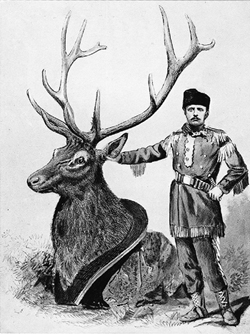
A drawing of Roosevelt standing next to a trophy worthy of the Boone and Crockett Club.
T.R. with Boone and Crockett Club antlers. (Courtesy of the Boone and Crockett Club)
In early January 1888, the twelve founders of the Boone and Crockett Club had approved a prescient conservationist constitution at Pinnards Restaurant in Manhattan. Ideas had been allowed to percolate freely. The thought of buffalo once again thundering on the plains aroused the founders’ enthusiasm during their inaugural deliberations. A decision was made from the outset that the club would have a permanent membership of exactly 100 hunters. The bylaws also stipulated that a limited number of associate members (no more than fifty) would also be allowed. Roosevelt—who would remain the club president until 1894—filled the associate memberships with a galaxy of truly talented writers, including Owen Wister and Henry Cabot Lodge (two outdoorsmen he admired unconditionally). Scientists, military officers, political leaders, explorers, and industrialists were also recruited as members, in hopes that they’d forge innovative solutions to stop the exploitation of America’s natural resources. Roosevelt himself brought in the army generals William T. Sherman and Philip H. Sheridan, the artist Albert Bierstadt, the former secretary of the interior (from 1877 to 1881) Carl Schurz, and the geologists Clarence King and Raphael Pulmelly.4 “The members of the club, so far as it is developed, are all persons of high social standing,” an editorial writer in Grinnell’s Forest and Stream said of the club’s founding, “and it would seem that an organization of this description, composed of men of intelligence and education might wield a great influence for good in matters relating to game protections.”5
Among the Boone and Crockett Club’s original objectives, as stipulated in article 3 of its bylaws, were (1) to promote “manly sport with the rifle” (2) to promote “travel and exploration in the wild and unknown, or but partially known portions of the country” (3) to “work for the preservation of the large game of this country, and so far as possible to further legislation for that purpose, and to assist in enforcing the existing laws” (4) to “promote inquiry into and to record observations on the habits and natural history of various wild animals” and (5) to “bring about among the members interchange of opinion and ideas on hunting, travel and exploration.”6 Bylaw 3 is the area where the club eventually succeeded beyond even Roosevelt’s wildest hopes.
The club’s members were indeed an aristocratic clique, pampered but not easily fatigued. Their first meetings were relaxed, as if the members were sitting around the lounge-library of the country manor hotel. Roosevelt served as a moderator, keeping the conversation on track, reminding the wildlife preservation gospelers to be pragmatic. In short order they came up with a set of reasonable rules, none more important than their own membership requirements. To be eligible, a hunter had to have successfully shot at least three varieties of North American big game with a rifle. Once inducted, members were sworn to maintain a strict code of honor—in particular, never lying about a kill and always behaving as serious naturalists. Frontier values, the founders agreed, built character and were to be encouraged. On a hunt, nobody was allowed to pull rank or claim privileges because of his social station—members were absolute equals when tramping. As a covenant all members had to be determined to save big game for future generations of Americans to enjoy. Although it wasn’t their main priority, club members all seemed to mourn the yearly loss of the “heritage” of American hunting.
Like membership in Skull and Bones or Porcellian, the very act of going on a hunting trip with a fellow club member created a lifelong bond of fellowship; after all, even Natty Bumppo seldom hiked in the Adirondacks or Green Mountains without Uncas or Chingachgook guides.7 A general feeling among the members was that research on wildlife—habits, traits, coloration—could never be overdone. To all of the men, America without big game would be like an oak or sycamore tree that never had leaves:totally unacceptable. By saving wild creatures, the Boone and Crockett Club was saving America’s outdoors heritage. Some members were given distinguished Native American names such as Pappago, Little Brave, and Running Waters.8
On February 29, 1888, the founders drafted a constitution. The club has been described as the “first-ever organization to be formed with the explicit purpose of affecting national legislation on the environment.”9 Its initial goal for wildlife conservation was to add enforcement provisions to the laws governing Yellowstone National Park. When Congress had established America’s first national park in 1872, it neglected to enact regulations punishing poachers, sawyers, vandals, or miners. As a result, many westerners treated the park as if it were ripe for plucking. Particularly, local wildlife was under siege from the Northern Pacific lobby (the so-called Railroad Gang) and its associated real estate speculators. If the park police happened on someone poaching or trying to haul out minerals, all they could do was escort the offenders to the boundary and expel them.10
Therefore, the Boone and Crockett Club appointed a committee to “promote useful and proper legislation toward the enlargement of the Yellowstone National Park.”11 As the railroad fought for a right-of-way through the park, and its allies pushed legislation reducing Yellowstone’s acreage, the Boone and Crockett committee lobbied for regulations with teeth in them.12 There are about 130 boxes of largely uncataloged material at the club’s archives in Missoula that bear witness to how crucial Yellowstone preservation was to the founding members.
The club had real reasons to worry about wildlife depletion in the West. Audubon’s bighorn sheep, the eastern and Merriam’s elk, the heath hen, the Carolina parakeet, and the great auk had all gone extinct since the 1870s, to name just six examples. The once plentiful beaver was no longer found east of the Mississippi River. (Even encountering a beaver in the Great Plains and Rocky Mountains was a rare event by 1887.) The buffalo population had dwindled dramatically since the start of the century, from 40 million in 1800 to at most a couple of thousand in 1887. White-tailed deer were faring only slightly better: when Europeans first came to America, there had been approximately 24 million white-tailed deer, compared with just 500,000 at the time of the first Boone and Crockett dinner. Even wild turkeys—once nearly ubiquitous and numbering 15 million—were struggling, with current estimates of only 30,000. (Today the number is around 7 million.) “As sportsmen, the club founders were very aware of what the plight of wildlife meant in terms of future hunting prospects,” George B. Ward and Richard E. McCabe explained in Records of North American Big Game. “As Americans, they saw clearly what it represented in broader resource terms to the national health. As businessmen, industrialists, journalists, and politicians, they recognized that it lay with them, and others of like vision, to attempt ‘so far as possible’ to relieve and correct the situation.”13 The survival of two game animals Roosevelt had written about so authoritatively inHunting Trips and in his outstanding articles for Outing—the pronghorn and elk—was a high priority of the Boone and Crockett club. Only 150,000 elk and 25,000 pronghorn remained in the West; each species was down 98 percent from counts early in the nineteenth century.14 Yellowstone became the club’s special cause.
“So far from having this Park cut down it should be extended,” Roosevelt declared, “and legislation adopted which would enable the military authorities…to punish in the most rigorous way people who trespass against it.”15
Many historians now believe that the Boone and Crockett Club—Roosevelt’s brainchild—was the first wildlife conservation group to lobby effectively on behalf of big game. The club sprinkled the issue of wildlife protection with kerosene, struck a match, and watched it take off. While antihunters sat on the sidelines gabbing about the extermination of the buffalo, Roosevelt and Grinnell popularized the sportsman’s code and called for protection of the buffalo in Yellowstone. In essence, the club became the most important lobbying group to promote all national parks in the late 1880s. Audubon’s six words—“surely this should not be permitted”—which Grinnell promulgated had now become the club’s rallying cry. And with the help of General Sheridan and Senator Vest, in particular, Roosevelt and his friends achieved very good press during their club’s first two years of existence.
The club had awakened a national conscience pertaining to the wanton destruction of America’s limited natural resources. Like cavalry officers on a mad charge, Roosevelt and Grinnell often went to Washington, D.C., to demand congressional action on behalf of wildlife. Their message was as clear as a bell. Shame fell upon senators who tried to cross words with Roosevelt and company. “Those who used to boast of their slaughter are now ashamed of it,” a triumphant Grinnell declared in 1889, referring to the club’s success, during its first year, in convincing Americans about the need for regulated hunting and for federal parks; “and it is becoming recognized fact that a man who wastefully destroys big game, whether for the market, or only for heads, has nothing of the true sportsman about him.”16
II
While Grinnell used Forest and Stream to promote the Boone and Crockett Club during 1888, Roosevelt subtly did the same in Century magazine.17 The six long articles T.R. wrote for Century about conservation, ranching, and hunting were expertly illustrated by Frederic Remington, who recalled the landscape of the Badlands from a trip there in 1881. If Custer could take his own photographer along with him to the Black Hills in 1874, Roosevelt saw no reason not to have Remington illustrate his Dakota exploits for posterity. Roosevelt wanted his likeness to exude dignity, stoicism, and righteousness. Despite all his frenetic activity and the difficulty he faced daily, pouring out words as quickly as ideas came to him, Roosevelt preferred being portrayed by Remington (and later by others) as coolheaded and manly—a modern fictional counterpart would be Rooster Cogburn in True Grit. Reporters enjoyed covering Roosevelt’s bombastic side, but he himself felt that his most impressive quality was fundamental decency.
Remington would soon become nearly as famous Roosevelt. By the time Roosevelt had recruited him, Remington, a native of Canton, New York, had sketched cavalrymen, bronco busters, mountain trappers, desert rats, cowboys, and Indians. (In fact, he had just finished illustrating Elizabeth Custer’s Tenting of the Plains, to modest acclaim.18) Like Roosevelt—and Buffalo Bill, who in 1887 was performing in Great Britain to capacity crowds—Remington knew how to strike a mythic note when portraying the settlement of the American West.19 Yet, to his credit, Remington, not a particularly talkative man, wasn’t interested in the bogus myths of the West such as El Dorado or the Northwest Passage. Like Roosevelt, he wanted to present the Rockies, the Great Plains, and Southwest in a factually accurate way, sketching with enterprise and precision whatever he saw. Belief in Darwin and the science surrounding that belief—humans evolving from apes, natural selection, and survival of the fittest—were also an important component of Remington’s artistry.
Although they collaborated brilliantly on the articles for Century, Remington didn’t personally care for Roosevelt, who was known to mock sheep farmers (Remington had once herded sheep in Kansas). “No man,” Roosevelt claimed, “can associate with sheep and maintain his self-respect.”*20 This rift over sheep was rather silly, for on the face of it, the two men had much in common: an Ivy League education (Remington had gone to Yale); a belief in the strenuous life and Darwin’s and Huxley’s biology; and, of course, a shared interest in wildlife, ranching, cowboys, and the American West in general. Neither of them enjoyed fake western stories about jackelopes, bigfoots, or ring-tailed roarers. But Roosevelt’s blue blood rankled the scrappy, middle-class Remington, who was often stone broke and begging for freelance assignments.21
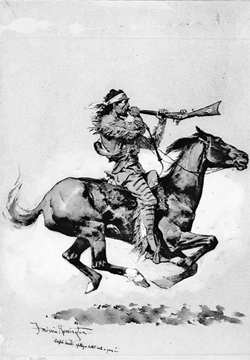
Frederic Remington’s Buffalo Hunter Spitting a Bullet into a Gun (ink wash and watercolor on paper, 1892) was a Roosevelt favorite. This illustration was created for an edition of Francis Parkman’s The Oregon Trail.
Frederic Remington’s Buffalo Hunter Spitting a Bullet into a Gun. (Courtesy of the Frederic Remington Art Museum, Ogdensburg, New York)
Inherited privilege, in fact, annoyed Remington no end. And to Roosevelt, Remington was just a gun for hire, a talented illustrator from whom he had commissioned sixty-four illustrations (plus another nineteen for Ranch Life and the Hunting-Trail). Not for a second, however, did either man regret their collaboration. Sheep or no sheep, Remington’s illustrations couldn’t have been finer. But Roosevelt blanched at the idea of Remington as an equal and never once considered him worthy of membership in the Boone and Crockett Club. To Roosevelt, at least before the Spanish-American War, Remington was a plebian, not fit to share a private club’s dais with high-caliber naturalists like Grinnell and Parkman.
III
In the late summer of 1888, having finished Ranch Life and the Hunting-Trail, Roosevelt once again went on a big game hunt. His destination was the dense coniferous forests of the Pacific Northwest and his prey was the woodland caribou (Rangifer tarandus caribou). As a Harvard student, Roosevelt had tried to hunt caribou in the North Woods of Maine and failed miserably. Now, with his library walls at Sagamore Hill filled with North American big game trophies, the lack of a caribou head was palpable. According to Grinnell, Roosevelt’s best chance of finding a herd was in the Idaho Territory, high in the Selkirk Mountains along the border of the Washington Territory. So off Roosevelt went on the Northern Pacific Railroad for a stopover in Medora and then on to the Idaho village of Kootenai on the north side of Lake Pend Oreille. Along the way, whenever possible, Roosevelt worked on the first volumes of The Winning of the West. No time was ever wasted when Roosevelt was in a railway car, for he always turned his compartment into a rolling library.
Never before, not even in the Bighorns, had Roosevelt encountered mountains such as the Selkirks. At one point he could see the Columbia River bending and twisting through gorges lined with towering pines. Much of the brush-choked forest had never been explored.* It was delightful to feel like a naturalist explorer again. “The frowning and rugged Selkirks came down sheer to the water’s edge,” Roosevelt recalled. “So straight were the rock walls that it was difficult for us to land with our batteau, save at the places where the rapid mountain torrents entered the lake. As these streams of swift water broke from their narrow gorges they made little deltas of level ground, with beaches of fine white sand; and the streambanks were edged with cottonwood and poplar, their shimmering foliage relieving the sombre coloring of the evergreen forest.”22
The village of Kootenai was the head of the famous Wild Horse Trail, a pack path that led to mineral-rich mines near Fort Steele, British Columbia. Roosevelt—with old John Willis (who wasn’t attentive to hygiene) and a Kootenai Indian named Ammál (who was built like a heavyweight boxer) as guides—traveled up the swift Pack River on the Wild Horse Trail and over the Continental Divide to the Kootenai River. From there they floated down the bone-chilling river in a pirogue, eventually making camp alongside Kootenai Lake. This sheet of crystal-clear water was considered the heart of caribou country. Situated in a long valley between the Selkirk and Purcell mountains, the glassy lake was approximately seventy miles in length.23 Naturally, they set up camp at a level-place. Roosevelt was so anxious for caribou that he bathed his first morning in Idaho before the sun broke.
Idaho was God’s country to Roosevelt, even though the hunting started out slowly. One afternoon, while eating frying-pan bread by a brook, Roosevelt spied an ouzel feeding. Suddenly a water shrew swam into a shallow eddy nearby. Roosevelt had read about this rare little mammal—Sorex palustris—in zoology books over the years, but this was his first real-life encounter with it. The water shrew’s habitat was northern forest streams surrounded by fallen logs and lichen-covered rocks. Roosevelt’s first thoughts were of Spencer Fullerton Baird at the Smithsonian Institution and Dr. C. Hart Merriam at the Department of Agriculture. He knew that they would have “coveted it greatly” for their collections.24 Forgetting about caribou for the moment, Roosevelt captured the feisty little shrew and studied it carefully. The Kootenai guide, Ammál, who had taken to calling Roosevelt “Boston Man,” shook his head in disbelief at the glee his client felt about a rodent.25 “It was a soft, pretty creature,” Roosevelt wrote, “dark above, snow-white below, with a very long tail.” After inspecting it alive, Roosevelt killed the shrew, turning the skin inside and letting it dry. Throughout his days in Idaho, he treated the specimen as a prized possession. Too much handling of the skin, Roosevelt believed, owing to chemicals on one’s hands, would lead to discoloration. When Roosevelt returned to New York he sent the shrew to Baird in Washington, D.C., where it became part of the Smithsonian’s natural history collection.26
But Roosevelt hadn’t traveled all the way to Idaho so that a solitary water shrew could be put on display at the Smithsonian. Eventually he killed a black bear, one with “two curious brown streaks down its back,” and fried its meat for dinner. The caribou, however, remained elusive. Hiking up steep mountain crests and the faces of cliffs, a frustrated Roosevelt couldn’t even find a caribou trail. Willis often ran ahead to reconnoiter, but without luck. At dusk Roosevelt’s party felt removed from even the back of civilization. “Indeed the night sounds of these great stretches of mountain woodlands were very weird and strange,” Roosevelt wrote. “Though I have often and for long periods dwelt and hunted in the wilderness, yet I never before so well understood why the people who live in lonely forest regions are prone to believe in elves, wood spirits, and other beings of an unseen world.”27
Back in New York, Roosevelt raved about the unsurpassed beauty of Idaho—and it was also pretty good for the hunter’s pot. While Grinnell promoted Montana’s Flathead Range as the most gorgeous part of the Rocky Mountains, Roosevelt championed the stupendous ranges of Idaho. Perhaps because he had so fully documented wildlife in the Dakota Territory, he was proud to add the topmost peaks of the Idaho Territory to his area of expertise. Before long he was writing about Idaho’s “hoary woodchucks [marmots],” “timid conies [pikas],” and “troops of noisy, parti-colored Clark’s crows.”28
When Roosevelt became president thirteen years after the caribou hunt, saving wild Idaho—which had become a state in 1889—ranked high on his agenda. On January 15, 1907, he created Caribou National Forest, about 200 miles east of Boise. The following year, on July 1, he virtually turned the state into one vast wildlife preserve, setting aside millions of acres in seventeen new national forests with his presidential pen: Pocatello, Cache, Challis, Salmon, Clearwater, Coeur d’Alene, Pend Orielle, Kaniksu, Weiser, Nez Perce, Idaho, Payette, Boise, Sawtooth, Lemhi, Targhee, and Bitterroot.29 Seldom, if ever, had a hunt resulted in such a momentous conservationist gesture on behalf of wild creatures.
IV
That fall, Roosevelt agreed to campaign for the Republican presidential nominee, Benjamin Harrison. Huge crowds came out to hear Theodore as he and Edith traversed Illinois, Michigan, Wisconsin, and Minnesota. Perhaps because of the fame he’d achieved through his connections with the West, the farmers and ranchers of the upper Midwest and Great Plains loved him. And he was just as popular all the way south to the Rio Grande and Rio Colorado. To Roosevelt the “hurly-burly of a political campaign,”30 as he once put it, was an enthralling blood sport, the supreme test of personal combat for a genuine warrior.31 While Harrison ran a “front porch” campaign, delivering speeches from his home in Indianapolis and avoiding perspiration, Roosevelt hit the trail with a vengeance, orating at every crossroads town and village junction. The whole experience, he wrote in a letter to Lodge, was “immense fun.”32
As Election Day neared, Roosevelt celebrated his thirtieth birthday. It was a rare time for self-reflection. Despite all his exciting work with the Boone and Crockett Club and as a writer, his political career had stagnated. After all, it was hard to build momentum after losing the mayoralty. He hoped that stumping for Harrison, giving the Republican Party his everything as a surrogate, would earn him a major (or even minor) government post in the administration. Tactically, Roosevelt was on track. On November 6, Harrison defeated the incumbent president, Grover Cleveland, by 233 electoral votes to 168. “I am as happy as a king,” Roosevelt wrote to his British diplomat friend Cecil Spring-Rice, “—to use a Republican simile.”33 And sure enough, Roosevelt was rewarded with an appointment as U.S. civil service commissioner starting on May 7, 1889. It was a post he would hold for almost six years.34 His primary task would be to clean up corruption in the federal government.
That Christmas season was a joyous one for Roosevelt. When Ranch Life and the Hunting-Trail* was published in December, most reviewers applauded his well-crafted prose and Frederic Remington’s fine engravings and pen-and-ink line drawings. Whether T.R. was writing about cattle branding at Elkhorn, cowboys’ rope tricks, or goat hunting in the canyon of the Coeur d’Alene, Remington delivered spot-on illustrations that electrified the narrative. Although Hunting Trips of a Ranchman had been a better book than Ranch Life and the Hunting-Trail, Remington’s sketches upgraded the latter into an enduring western classic. Nobody alive could draw mountain men, French-Canadian trappers, or timber wolves with the realistic precision of Remington. (For some reason, however, Remington could never properly depict mountain lions, a deficit that annoyed Roosevelt.)
Like Remington, Roosevelt had romantic sentiments about the American West, finding it an almost inexhaustible source of material for books and articles. “Civilization seems as remote as if we were living in an age long past,” Roosevelt wrote approvingly about being a westerner in Ranch Life. “Ranching is an occupation like those of vigorous, primitive pastoral peoples, having little in common with the humdrum, workaday business world of the nineteenth century; and the free ranchman in his manner of life shows more kinship to an Arab sheik than to a sleek city merchant or tradesman.”35
Remington wanted merely to draw the reality in Ranch Life. “I don’t consider that there is any place in the world that offers the subjects that the West offers,” he once observed. “Everything in the West is life, and you want life in art…. The field to me is almost inexhaustible.”36 By contrast, Roosevelt was on an accelerated mission to save its wilderness areas and big game. Underneath his name on the title page of Ranch Life, Roosevelt identified himself as president of the Boone and Crockett Club of New York: the club had become a “bully pulpit” for his ideas about wildlife management and forestry reserves. In the text, he mourned for the “fast vanishing” elk and told readers that when hunting deer they should shoot “only the bucks.”37 The descriptions in Ranch Life of shifting weather and natural wonders were both precise and poetic. Roosevelt’s zoological descriptions rose to the high standard Grinnell had inspired at Forest and Stream. Of antelope, for instance, he wrote: “Antelope see much better than deer, their great bulging eyes, placed at the roots of the horns, being as strong as twin telescopes. Extreme care must be taken not to let them catch a glimpse of the intruder, for it is then hopeless to attempt approaching them. On the other hand, there is never the least difficulty about seeing them.”38
Predictably, Roosevelt ended Ranch Life with a boast about the natural grandeur of the American West. With jingoistic but good-natured pride he tried to one-up both Asia and his brother, Elliott. (The fact that he had turned thirty didn’t mean the sibling rivalry had dissipated.) Elliott, at this juncture, however, was on an alcoholic downslope, desperately struggling with depression and contemplating suicide. “My brother has done a good deal of ibex, mountain sheep, and markhoor shooting in Cashmere and Thibet [Tibet], and I suppose the sport to be had among the tremendous mountain masses of the Himalayas must stand above all other kinds of hill shooting,” Theodore wrote. “Yet, after all, it is hard to believe that it can yield much more pleasure than that felt by the American hunter when he follows the lordly elk and the grizzly among the timbered slopes of the Rockies, or the big-horn and the white-fleeced, jet-horned antelope-goat over their towering and barren peaks.”39
Unfortunately, T.R. didn’t get to bask in the acclaim that Ranch Life received. That winter, to meet his publisher’s deadline, he was working overtime on The Winning of the West. Puffy-eyed, he burned the midnight oil nightly until three or four in the morning. Somewhat naively, he had promised G.P. Putnam’s Sons the first two volumes by the spring of 1889. Always tottering toward a physical breakdown, pushing himself beyond the usual human limits, whenever possible Roosevelt locked himself up at Sagamore Hill and wrote. His entire nervous system was strained. Desperately he tried blocking out both good and bad news. With two children to raise, Edith constantly worried that bills had to be paid. (She made sure all financial obligations were met.) Whenever the issue of financial insolvency was raised, however, Roosevelt’s blue eyes would darken in disapproval. His exuberance would be temporarily extinguished. Life for Theodore had become a pressure cooker of deadlines, commitments, responsibilities, and financial insecurity. Only the finances, however, made him irritable. His great consolation was that at least he hadn’t become a leech, or one of those fellows who always looked for other people to carry the load.
V
Although Roosevelt doesn’t mention it in An Autobiography, there may have been another impetus for creating the Boone and Crockett Club in 1887. The previous year, anxious to professionalize mammalogy, Dr. C. Hart Merriam of the Department of Agriculture elevated the Economic Ornithology section at the Department of Agriculture into the Division of Economic Ornithology and Mammalogy.40 In principle, the new division was intended to help farmers cope with pests. But in practice, Dr. Merriam was interested in the distribution of mammals across the United States. Owing to the creation of the Audubon Society and the American Ornithologists Union, birds were starting to be properly studied. Two exhaustive “bulletins,” in fact, were published in the late 1880s: W. W. Cooke’s “Bird Migration in the Mississippi Valley” and Walter B. Barrows’s “The English Sparrow in America.”41 But nobody was publishing similar high-quality bulletins about chipmunks, skunks, squirrels, gophers, ferrets, groundhogs, or dozens of other American mammals.
Merriam—short in stature, with a mustache that made him look like an otter—soon changed that. Merriam’s agriculture division began conducting general surveys of mammals (as well as birds), with a keen eye toward biotic community distributions. Using field reports and scientific results, he constructed life-zone maps. For the first time in American history a biological understanding of cougars’, wolves’, or bears’ ranges became available to the general public. Nobody had ever inventoried American wildlife quite like Merriam. A crucial component of his success was his uncanny ability to reach out to untrained, backyard naturalists and mammal collectors throughout America. In any given state or territory there was bound to be a local hunter who had preserved the skins of such diurnal species as rabbits and squirrels. “It was from such sources that many of his specimens came and he carried on a large correspondence,” the naturalist historian Wilfred H. Osgood recalled of Merriam in the Journal of Mammalogy, “promoting interest in mammals by purchasing specimens and, in some cases, by employing collectors or at least by placing standing orders.”42
A truly practical biologist, Merriam also pioneered in using a new trap for small mammals: called the Cyclone, it was made of tin and wire springs, had an area of only about two square inches when collapsed, and was easily portable in quantity. Merriam sent Cyclones to Roosevelt with the idea that when he was in the Rockies he could set up such traps around cabins and creeks, then carefully perform taxidermy on the little mammals and ship the specimens back to Washington, D.C. (Although this is speculative, Merriam may have sent these traps because he was jealous—since Roosevelt had sent the Idaho water shrew to Baird, Merriam’s friendly competitor in collecting.)
Although Merriam’s shop was officially the Division of Economic Ornithology and Mammalogy, Roosevelt called it the Bureau of Biological Survey (which is what it officially became on March 3, 1905, the day Roosevelt was inaugurated as president in his own right). The Geological Survey mapped the topography of America after the Civil War, and Roosevelt envisioned the Biological Survey doing the same for the classifications of plants, birds, and animals. The Biological Survey, with Merriam at the helm, proved that temperature extremes were partially responsible for how wildlife was distributed. Although only about five or six crackerjack naturalists were ever on his official payroll, Merriam established a grassroots network of specimen collectors from all over America, a particularly notable achievement in an era when there were no telephones, let alone the Internet. He published a pathbreaking study of the San Francisco Mountain Region and Desert of the Little Colorado, Arizona establishing from summit to base six life zones in the flora of the mountains: Lower Sonoran (Sonoran Desert plants); Upper Sonoran (Colorado pinyon and juniper woods); Transition (Ponderosa pine forest); Canadian (Rocky Mountain Douglas fir and white fir forest); Hudsonian (tree line forests of Rocky Mountain bristlecone pine and Engelmann spruce); and Arctic-Alpine (alpine tundra).*
A founder of the National Geographic Society, Merriam joined the American-British fur seal commission determined to save the great herds of Alaska from extinction, in the same way that Roosevelt and Grinnell were protecting the buffalo. By the time Merriam became president of the Biological Society of the Cosmos Club in Washington, D.C. in 1891, he was considered the greatest authority on applying Darwinian theory to American species and topography.43
Writing reports from Arizona and saving seals constituted the fun part of Merriam’s job at the Biological Survey. As an administrator he had to find ways for wildlife and humans to coexist in America. Everything from poisoning ground squirrels with barley and strychnine to promoting lime and sulfur wash to prevent rabbits from attacking orchards fell under his job description. Anxious to save the beaver from being over-hunted, Merriam became a supersalesman on behalf of muskrat fur as an alternative. Starting in 1886 he also oversaw publication of the Annual Reports of the Biological Survey. He also made sure U.S. Department of Agriculture “bulletins” were printed and disseminated all over the country.44 If you were a farmer in Mississippi or Arkansas, for example, constantly shooting raccoons as varmints, Merriam was the national voice that would say, “Not a good idea.” Raccoons fed on crayfish, which infested leveled embankments; so the raccoons were actually providing a pest-control service by destroying the potentially destructive crustaceans. Such pragmatic solutions to wildlife control are why Roosevelt respected Merriam so much. When it came to wildlife protection, Merriam was a living instruction manual.