
CHAPTER ELEVEN
I
In the autumn of 1894, Roosevelt began collaborating with Madison Grant, a lawyer and explorer, on the creation of the New York Zoological Society. With his waxed handlebar mustache, Yale pride, penchant for bow-ties, and habit of always talking with his hands clasped as if in prayer, Grant was a preeminent figure in the world of zoology, credited with discovering several North American subspecies of mammals (a species of Alaska caribou was named Bangifer granti in his honor).1 That very year he had written forCentury an article entitled “The Vanishing Moose,” which Roosevelt loved.2 Now both wildlife protectionists would turn their attention to the vanishing buffalo as part of their ambitious scheme for a new American zoo.3
This zoo would be situated in the Bronx, then a rural section of New York City. Roosevelt and Grant had been disappointed by the European zoos they visited. Little educational information was disseminated to visitors about species variation or habitat, and most zoological parks emphasized the freakishness and oddity of their collections. Such come-ons as a six-legged deer in Berlin and a two-headed turtle in London sickened Roosevelt. Worse yet, the animals in European zoos paced back and forth in tiny cages, like prisoners waiting for the end of a lifetime sentence. This kind of backward zookeeping had to end. As Roosevelt envisioned it, their modern New York zoo would be built “on lines entirely divergent from the Old World zoological gardens.”4 The animals would have more room, in open-air exhibits where possible, and broadsheets would be created specifically for schoolchildren explaining the principles behind wildlife preservation and Darwinian evolution. And while the Bronx Zoo wasn’t as showy as a production by P. T. Barnum or Buffalo Bill, the Chicago Exposition had taught Roosevelt to think outside the box when it came to devising a tourist attraction that would bring throngs to see wildlife up close. A subway stop, in fact, was slated to open at the southeastern entrance to the zoological park.
In planning this zoo, Roosevelt and Grant included a singularly ambitious goal: they would breed buffalo in captivity there and eventually would turn them loose throughout the Great Plains and upper Rocky Mountain region. This so-called New York repopulation plan would reintroduce buffalo in their traditional grounds, such as the Black Hills, Pine Ridge Reservation, Flint Hills, Osage Hills, and Wichita Mountains; even the remaining herd in Yellowstone Park would be augmented with Bronx-bred buffalo. As Roosevelt saw it, buffalo would once again be trampling the luxuriant tall grasses into muddy thoroughfares, as in the days before Christopher Columbus. Unlike the 45 million cattle in the Great Plains, reinroduced buffalo wouldn’t overgraze the prairie into a dust bowl. He hoped to create a buffalo common. While there were few dramas as frightening as a bison bull at bay, zoologically schooled members of the Boone and Crockett Club like Roosevelt and Grant nevertheless knew that buffaloes were essentially timid creatures, as easy to corral as cattle. Only when a mother buffalo felt that her young were in jeopardy did they turn frothingly hostile, staving off predators such as wolves and cougars with the threat of a horrific stampede. Then look out! Buffalo might appear slow and lumbering, but they could outrun a racehorse. As domesticated creatures, however, they were fairly benign.5
While George Bird Grinnell was supportive of a Buffalo common in the West, he thought bison needed lots of roving space to survive and that the New York grasses were completely different from those on the plains. Therefore, he wasn’t keen on the Boone and Crockett Club’s throwing its weight behind acquiring wildlife for display in New York City; he preferred having the members concentrate on enacting tougher hunting laws. Running a zoo was a headache he simply didn’t want. To Grinnell it made more practical sense to have the Department of Agriculture help C. J. Jones of Garden City, Kansas—who had captured fifty buffalo on his own and purchased an additional eighty in Manitoba—lead a serious repopulation program right in the heartland of “Buffalo Country.”6
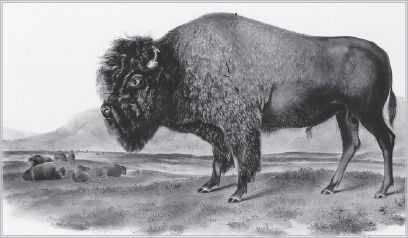
The Great American Buffalo was drawn by Audubo
The Great American Buffalo. (Courtesy of the Boone and Crockett Club)
But, as was often the case, Roosevelt got his way. He insisted that the zoo would teach New Yorkers about the perils western big-game species faced. Also, the zoo allowed Roosevelt, as a New York politician, to found something great for the Empire State, an added political bonus. One of the zoo’s most tireless advocates, in fact, was Andrew H. Green, then known as the “father” of greater New York City. When Green concurred that a natural-setting zoo was a fine idea, long overdue, Roosevelt knew his brainchild would take off. A truly creative philanthropist, Green had been a close friend of Roosevelt’s father, envisioned Central Park as a recreational center, bankrolled the American Museum of Natural History, investigated the Tweed Ring, and created the Niagara Falls Commission to save the falls from destruction in a bilateral agreement with the Canadian government. Grinnell warned his friends against forming a zoo committee in late 1894 before club members could, at the very least, vote on the idea. They should settle their differences, Grinnell believed, through at least a tip of the hat toward the democratic process.
But Roosevelt, spurred by his idea about buffalo, had another important ally besides Green and Grant. Professor Fairfield Osborn of Columbia University, curator of the American Museum of Natural History, sided with Roosevelt (as he always did), even offering his fund-raising contact list. Starting in the 1890s Osborn had become quite a fixture in zoological circles. The refined, fashionable Osborn would tuck a paisley scarf into his collar instead of a tie, sported corduroy pants, and was constantly jotting notes on legal pads while chain-smoking cigarettes. Green was the first president of the New York Zoological Society, but when he became suddenly ill Osborn took over the obligations. Deep down, Roosevelt probably knew that Grinnell was correct in his skepticism. Roosevelt nevertheless wrote to Madison Grant—whose hand-tailored suits and donnish manners made him a kind of WASP caricature, like a cucumber sandwich at afternoon tea—that regardless of Forest and Stream’s view-point, “I’ll go ahead and do it.”7 Being the impresario of a zoo was simply too irresistible to turn down.
In the spring of 1895, a group from the Boone and Crockett Club officially formed the New York Zoological Society. The leaders included Roosevelt, Grant, Green, and Osborn. Behaving like fraternity brothers, they created a crest for the society, with a ram’s head in its center and “Founded 1895” underneath, long before the development plan was officially approved in late 1897.8 The 261-acre forested zoo, with a topographical range from granite ridges to natural meadows and glades to forest, was ideal for a wide variety of animals to thrive in the open air. The Bronx River wound through the site, and the woods were already home to many birds. It would be relatively easy to create marvelous replicas of diverse habitats here, allowing the wildlife to feel at home.
The zoo officially opened in November 1898, after the blitzkrieg of the Spanish-American War. Grinnell essentially fell into line, now and again flashing an over-the-shoulder look that said “I told you so” when any animal emergency transpired; Darwianism, he believed, was veterinarianism. Roosevelt was especially proud of the imposing Antelope House. But the Lion House soon became the premier tourist attraction. These “houses” were established to tell the biological history of species in a truly detailed, exciting, educational way. A special wooded range had been developed for moose, and a wonderful stream surrounded by plants was devised so children could watch industrious beavers construct dams and lodges. At the time, the new zoological park was the largest in the world, and its open-air displays became the model for its successors, such as the zoo in San Diego, which opened in 1922.
As it entertained tourists and educated schoolchildren, the zoo simultaneously served as a scientific laboratory. For example, the twenty acres reserved for buffalo allowed ample space for mammalogists to study these North American quadrupeds through the rutting cycle.9 Likewise, elk got fifteen acres in which to thrive and be observed. Moose were brought in from Maine and cougar from somewhere west of Kansas City. Aesthetically, what Roosevelt and Grant were trying to avoid was the zoo seeming like an oversized breeding pen. Bear dens were soon erected with awesome caves and rock precipices, and there were plans to build the world’s greatest House of Reptiles, which the foremost herpetologist in America, Raymond L. Ditmars, would curate. “It is extremely desirable that all animals living in the open air should be so installed that their surroundings will suggest,” the New York Times explained about the new zoo, “as a well-kept and accessible natural wilderness rather than as a conventional city park.”10
Besides breeding buffalo in captivity, the New York Zoological Society funded an extensive scientific report on the concept of creating wildlife sanctuaries or refuges across the country. Could buffalo reclaim the Black Hills, Red River Valley, or Drift Prairie of South Dakota? Would elk be able to roam freely again along the Yellowstone and Missouri rivers? Someday, would moose be protected in Maine and Minnesota? As Lincoln Lang recalled in Ranching with Roosevelt, T.R. “had discussed the possibilities of game protection,” in the 1880s and even spoke of someday establishing the North Dakota Badlands as a “national preserve.”11 With the zoological society launched, Roosevelt’s vision was no longer an impossible goal. A subtle brotherhood of men—hunters and naturalists—were now in the business of species education.
Already at Black Mesa Forest Reserve in the Arizona Territory two members of the Boone and Crockett Club—Dr. Ed W. Nelson and Alden Sampon—were studying the feasibility of a wildlife reserve in the Navajo lands, a reserve that would be completely off-limits to hunters along the upper border of the Little Colorado River basin.12 The deep box canyons, yellow pine forests, piñons, cedars, and junipers of the Black Mesa needed protection, as did the three intact cliff dwellings of the Pueblos. Although Roosevelt hadn’t been to Black Mesa, he knew from Nelson that creating a big-game reserve there would be ideal for black-tailed deer and silver-tipped bears. And it would mean a great deal to the Native American peoples. But Roosevelt also understood that without irrigation the Arizona rock oasis would become uninhabitable; the scattered pines would wither. The residents of the adjoining sheep and cattle settlements were opposed to a Black Mesa wildlife playground.13
Roosevelt—unusually for him—made snide, belittling remarks about the Arizona business types who were unable to comprehend the concept of antiquities. Arizona needed to be maintained, not mined. Stopping growth in Black Mesa, Roosevelt worried, was going to be difficult, but he believed the “fantastic barrenness,” “incredible wildness,” and “desolate majesty” of the Navajo lands needed to be protected forever. With quiet cheerfulness he began looking for ways to get the job done. “No one could paint or describe it,” he later wrote after camping out in the Black Mesa valley, “save one of the great masters of imaginative art or literature—a Turner or Browning or Poe.”14
II
The recruitment of William Temple Hornaday as the first director and general curator of the New York Zoological Society was a brilliant coup by Roosevelt. (Like George Bird Grinnell, Hornaday regularly used all three of his names.) Born in Plainfield, Indiana, in 1854, four years before Roosevelt, and raised in Iowa starting in 1856, Hornaday grew up earthy and dirt-poor.15 “I shall always believe,” he wrote in his memoir Two Years in the Jungle, “I was born under a lucky star as a compensation for not having been born rich.”16 He managed to attend Oskaloosa College and then Iowa State College, where his intuitive genius for handling both domestic and wild animals, added to his excellence in taxidermy, opened the doors to a zoological career upon graduation. While Roosevelt was preparing for Harvard with a private tutor, the irascible Hornaday was traveling the world as a young man searching for exotic species to shoot and stuff in the name of science. His primary employer, the Wards National Science Foundation (of Rochester, New York), sent him to the Bahamas, Cuba, Florida, Brazil, Ceylon, Malaysia, and Borneo.
Obsessive, unbuckling, and stubborn beyond words, Hornaday was a highly sophisticated version of Bill Sewall or Moses Sawyer. Unlike Baird or Merriam, Hornaday had calloused hands. There was always a mischievous twinkle in his eyes, like a child who had suddenly aged overnight. He was the kind of immature prankster who yodeled in church just to hear the echo. There was a cultivated crudeness to his manners, and his certainty about zoology bordered on arrogance. His daily conversation was filled with such bio-trivia as the flesh preferences of wolverines and why hawks were copper-clawed. Hornaday also bristled with statistics on the possible extinction of Delaware swans, Louisiana woodpeckers, and Ohio turtledoves. Vermont was the only state, he believed, which managed its wildlife properly. For all his eccentricities, you had to give Hornaday credit: he walked the walk. Unlike most Harvard-trained scientists, Hornaday had actually wallowed in the mud with alligators, tying their mouths with rope like Jim Bowie working the tip jar in a French Quarter sideshow. And when it came to buffalo, nobody—not even Grinnell—understood their psychology as keenly as Hornaday. The West was full of horse whisperers, but Hornaday—with the notable exception of C. J. Jones—was the only buffalo whisperer around. (Unlike Jones, Hornaday at least didn’t try to crossbreed wild buffalo with Hereford cattle.)
By 1879 Hornaday was chief taxidermist and director of the now defunct United States National Museum. When Hornaday created the National Society of American Taxidermists the following year, Roosevelt sat up and paid attention. Stitch for stitch, Hornaday was probably the best American mammal taxidermist of his era. When working on a buffalo, for example, he took the extra step of ridding his specimen of screwworm flies (Cochliomyia macellaria), which frequently laid eggs in an open wound or sore. He was an artist skilled enough to prepare an exhibit of a buffalo grazing, stampeding, or simply looking forlorn, bringing out the personality of the animal vividly in any mood or situation. Most famously, Hornaday himself shot a huge 1,800-pound buffalo in Montana; it became the centerpiece of a popular diorama at the National Museum of Natural History. Upon skinning this buffalo, however, Hornaday made a startling discovery, later claiming that it triggered an effusion of sorrow. “Nearly every adult bull we took carried old bullets in his body, and from this one we took four of various sizes that had been fired into him on various occasions,” he recalled. “One was sticking fast in one of the lumbar-vertebrae.” 17
When Roosevelt moved to Washington, D.C., in 1889 for his civil service job, he befriended the bawdy Hornaday, then chief taxidermist at the Smithsonian. Despite his skill at mounting, Hornaday was pushing for the Smithsonian to open a “live animal” department. Hornaday insisted that people preferred to see a real wobbly little buffalo rather than a stiff, old, stuffed one. The global killing of wildlife for science was the hackneyed way, Hornaday came to believe, for truly enlightened men and women to study animals. Newly developed netting techniques made it possible to capture everything from a hippopotamus to a cougar alive. He even wanted to start tagging animals in the wild. Once Hornaday was given permission to show live specimens at the Smithsonian turnstile increased three-fold. The public roared its approval and Hornaday pratted on about the advanced wildlife protective ethos.
Hornaday’s new vision led to his founding of the National Zoological Park in 1889, in Washington, D.C.18 But such brilliant, original thinking (like that of Robert B. Roosevelt) can often go hand in hand with a difficult personality. Since Hornaday loved being out in the field, chief among the targets of his lacerating criticism were those zoologists and ornithologists who didn’t get grimy tracking down wildlife for science. You might say he had an outbank Audubon complex, like Theodore Roosevelt. Often smelling of buffalo or bears, Hornaday was far more comfortable in alpine hiking clothes than in a suit. Sometimes his hair was matted with dry grass and mud. There was, as noted above, a farmyard crudeness to his manners, and his rumored atheism did nothing to endear him to the pious Methodists and Episcopalians he worked with at the Smithsonian. In fact, when the people who were financing the National Zoological Garden started telling Hornaday how to run his shop, and radically changing his Darwinian plans for animal displays, he resigned and moved to Buffalo, New York. Once he was settled there, he tried to change the city’s name to Bison, New York, to be more zoologically accurate.
Although Roosevelt never approved of Hornaday’s vulgarness or imperiousness, he knew that Hornaday was the most knowledgeable expert in the world regarding buffalo. It was said that Hornaday, in a quick glance, could identify the precise home range of a buffalo—for example, Nebraska or Manitoba or Oklahoma—by the constitution of its dung. Furious that these wild creatures were treated so shabbily, he nevertheless remained hopeful that repopulation programs and new game laws might be able to reverse the trend toward extinction. When Hornaday told Congress in April 1896 that national bison ranges should be created to save the vanishing herds, Roosevelt fully agreed. Even though Hornaday wasn’t considered refined enough for the Boone and Crockett Club, Roosevelt had no hesitation in asking him to head the Bronx Zoo. To Roosevelt’s thinking Hornaday was wasting his talent working in the Erie County real estate business and merely serving as a trustee for the Buffalo Museum of Science.
Roosevelt promised to let Hornaday develop exhibits at the Bronx Zoo any way he wanted. He had faith that Hornaday was the man best able to breed buffalo in captivity as the first step in repopulating the Great Plains. Always speeding up the timetables, Roosevelt was impatient and held the view that if it took six years to destroy all the bison in Kansas, Nebraska, Indian Territory, Oklahoma Territory, and the Texas panhandle, then the Bronx Zoo should be able to repopulate those same expansive grasslands with buffalo in an equivalent time. Only a maladjusted obsessive like Hornaday, with fever in the veins, could possibly pull off a breeding program in such unrealistically short order. Promised a handsome salary, Hornaday agreed, with a little pressure from the Boone and Crockett Club, to accept the zoo directorship—a position he held for the next thirty years. During these decades Hornaday wrote a series of books, articles, and lectures that are the core documents of the wildlife conservation movement in America. His Our Vanishing Wild Life is perhaps the single most important (if deeply flawed) book ever published on protecting endangered species. “Give the game the benefit of every doubt!,” he would lecture. “If it becomes too thick, your gun can quickly thin it out; but if it is once exterminated, it will be impossible to bring it back. Be wise; and take thought for the morrow. Remember the heath hen.”19
As Hornaday saw it, the Bronx Zoo would celebrate the whole post–Civil War generation of Darwinian naturalists, including the affluent Roosevelt. The center of Hornaday’s zoo was Baird Court—the administrative and library offices—named after the head of the Smithsonian Institution. Then there was Lake Agassiz, named after the great Harvard zoologist. The Boone and Crockett Club contributed hundreds of horns and antlers to put on display. Meanwhile, plans to raise buffalo got off to a rocky start. The native Bronx grass on which the bison grazed was not the same as prairie grass; in fact, it was so different that the first domestically raised herd of American bison died. Grinnell, it seemed, had been right. Bitterly disappointed, Hornaday had to remove all the native grasses and then pay zookeepers to feed the buffalo the proper prairie grasses by hand and keep the water hole always full.20
That was quite an embarrassing failure for Roosevelt; he felt a real, if momentary, sense of loss when the buffalo died. But Roosevelt wasn’t a quitter. He stuck by his determined zoo director. Since buffalo weren’t going to be the zoo’s only mission, Hornaday, at Roosevelt’s request, hired the field researcher Andrew J. Stone to survey the status of Alaska’s caribou herds, polar bears, and seal rookeries.21 For even if the Bronx buffalo range went away, Roosevelt and Hornaday’s plan of breeding buffalo in the Indian Territories (and two or three prairie states) was on track. And Grant, lobbying for financing from the New York state legislature, got the Boone and Crockett Club all the appropriation provisions it had requested. Roosevelt essentially left all the fund-raising and architectural details of the Bronx Zoo up to Madison Grant, whose actorish ways could move mountains. When the Bronx Zoo was officially sanctioned by the Park Board around Thanksgiving of 1897,22 Roosevelt offered Grant thanks. “I congratulate you with all my heart upon your success with the Zoo bill,” he wrote. “Really, you have done more than I hoped. I always count myself lucky if I get one out of three or four measures through.”23
III
The creation of the Bronx Zoo, with the help of regiments of planners, was the capstone to Roosevelt’s tenure as president of the Boone and Crockett Club. Over the years 1888 to 1894, he had achieved a scorecard of extraordinary accomplishments. From the Timberland Act of 1891 to the Yellowstone Protection Act of 1894 to the creation of the New York Zoological Society, the Boone and Crockett Club had become the most effective big-game conservation group in America. Even though Roosevelt was sometimes tasked with club work that he despised—such as preparing accounts for audit 24—he relished promoting outdoor writers in his edited books. Encouraged by the fine reviews of American Big-Game Hunting, Roosevelt and Grinnell began working throughout 1894 on a successor volume, one having a more global perspective than the first. How did North American white-horn deer compare with the fallow deer of the Mediterranean region of Europe and Asia Minor? Why did the Nubian ibex of the Palestine countryside have larger scimitar-shaped horns than the mountain goats Roosevelt had hunted in the Rockies? What caused the nyala of southeastern Africa to be slightly faster than the Badlands antelope? These were the types of questions Roosevelt and his coeditor George Bird Grinnell wanted answered in the new book, called Hunting in Many Lands.
When commissioning Madison Grant to write on moose in Hunting in Many Lands, for example, Roosevelt preferred that his hunt story take place in Canada. Roosevelt wanted to know everything about moose found farther north than Maine and Minnesota, around the headwaters of the Ottawa River along the Ontario-Quebec border. This, Roosevelt wrote to Grant, would run against the current zoological thinking that the differences between species in tropical and temperate zones were the most scientifically important. By focusing on moose in a specific Canadian habitat, Grant could show (so his editor hoped) the variation among moose populations in North America. “The best zoologists nowadays put North America in with North Asia and Europe as one archetypal province, separate from the South American, Indian, Australasian, and South African provinces, which have equal rank,” Roosevelt complained to Grant. “Our moose, wapiti, bear, beaver, wolf, etc., differ more or less from those of the Old World but the difference sinks into insignificance when compared with differences between all these forms, Old World and New, from the tropical forms south of them. The wapiti is undoubtedly entirely distinct from the European red deer; but I don’t think the difference is as great as between the black-tail [mule] and white-tail deer.”25
In 1895 Hunting in Many Lands was published, with a sterling article by Madison Grant, “A Canadian Moose Hunt,” about the upper Ottawa River, essentially companion piece to his article in Century. Grant also eventually became instrumental in two other conservationist causes besides the Boone and Crockett Club and its offshoot, the Bronx Zoo: these were the American Bison Society (founded by Roosevelt and Hornaday in 1905) and Save the Redwoods League.* Unlike American Big Game, this second volume, comprising sixteen essays (plus appendixes, which included the Yellowstone Protection Act), was, as Roosevelt and Grinnell planned, international in approach. Fine photographs were interspersed throughout the text. The final product included essays on hunting Russian wolves, Sierra Mountain bears, Mexican rams, East African zebras, Korean leopards, and American antelope-deer (by Roosevelt).
And another contributor, the future U.S. secretary of state Henry L. Stimson, wrote of the wildlife he encountered when he was climbing the turret-shaped mountains of northwestern Montana. W. W. Rockhill, a friend of the Dalai Lama, focused on the big game found in Mongolia and Tibet. There was even an essay on dogsledding in Manitoba by D. M. Barringer, a nineteen-year-old graduate of Princeton University who dedicated his life to the “impact theory” (he became the first geologist to discover that Coon Butte, Arizona, was in fact a meteor crater). In the impressive essay “The Cougar,” by Casper W. Whitney (the editor of Outlook) Roosevelt himself was praised as being the world’s expert on the mountain lion’s “moods.”26 The global approach to wildlife conservation of Hunting in Many Lands was smart and innovative. In the preface Roosevelt and Grinnell called for accelerated mammological research. Color variation, hoof sizes, whisker lengths, mating habits—the more scientific data compiled, the easier it would become for “wild creatures” to be taught “to look upon human beings as friends.”27
In a piece that Roosevelt and Grinnell wrote together, the Yellowstone Protection Act of 1894 was held up as a model for policing wild refuges around the world. All the contributors to Hunting in Many Lands (except Elliott Roosevelt, whose posthumous contribution, “A Hunting Trip in India,” was embarrassingly antediluvian in attitude), promoted spirited ideas for global forestry and wildlife protection. Charles E. Whitehead of New York, for example, wrote that the “true hunter” took “more pleasure in watching the natural life around him than in killing the game that he meets.” His essay “Game Laws” recommended that the U.S. Army be authorized to try and punish poachers under martial law. “When we reflect how many and valuable races of animals in North America have become extinct or nearly so, as the buffalo and the manatee,” Whitehead fumed, “how many varieties of birds that afforded us food, or brightened the autumn sky with their migrations, have been annihilated, as have been the prairie fowl in the Eastern States and the passenger pigeon in all our States, the necessity of these laws appears urgent.”28
Most of the essays in Hunting in Many Lands made at least a passing reference to proper land and wildlife management. An argument was also made that all the other existing national parks besides Yellowstone—Yosemite, Sequoia, and General Grant—should likewise have game protection laws.* As for the coeditors themselves, Roosevelt argued that the reports of various hunters would help naturalists and zoologists better understand species. Grinnell endorsed Roosevelt’s participation in the Committee on Measurements exhibition, held at Madison Square Garden in New York City in May 1895, which rated the symmetry and coloration detail of big-game trophies.29 In the registration book Roosevelt, wanting to be associated with the American West, untruthfully gave his residence as “Medora N.D.” Along with other furrists and taxidermists, Roosevelt had submitted to the show numerous specimens, none of which drew more attention than his Texas tusked peccary head.
IV
That month also saw a career development: Roosevelt left the U.S. civil service to become a member of the Board of Police Commissioners of New York City.† He had lived as a bureaucrat in the District of Columbia and was ready to return home. At the time, New York’s police department was perceived as untrustworthy and corrupt; the new commissioner would have to make public integrity his first priority. From day one, Roosevelt had a two-pronged approach to running the force: do away with bribery and force officers to abide by the law. Making the city’s police department more honest, however, proved difficult. The Bowery, in particular, a mile-long row of brothels, bars, and burlesque clubs, was the most notorious tenderloin district in America; the police patrolling the beat were mostly on the take. Always “prudish as a dowager,” as one biographer put it, Roosevelt thought prostitution caused moral debasement and was a menace to health.30 Roosevelt began making surprise visits to Bowery saloons, firing officers if they were found partaking in the draft beer and revelry.31 Nothing at the police department pre-Roosevelt, it seemed, had been done on the up-and-up. Roosevelt found that even instituting a standard for the promotion of police officers was fraught with controversy. “The public may rest assured that so far as I am concerned,” Roosevelt stated on accepting the appointment, “there will be no politics in the department and I know that I voice the sentiment of my colleagues in that respect. We are all activated by the desire to so regulate this department that it will earn the respect and confidence of the community.”32
Commissioner Roosevelt wasn’t just handcuff-happy in the Bowery or on the Lower East Side. Bitten by the temperance bug, he tried to enforce the moribund blue law against allowing saloons to be open on Sunday and went after nefarious dealers of exotic pets like a tyrant. Following the old Henry Bergh–ASPCA line, Roosevelt believed in ethical treatment of captured wildlife for both humane and sanitary reasons. Although many Americans liked to have some of the world’s 350 parrot species as pets, a majority of these parrots died in transit from South America or Africa. Roosevelt wanted to have such importation regulated to ensure the birds’ safe passage. But exotic birds hardly consumed much of his time. To instill discipline on the force, Roosevelt took to taking “midnight prowls” to investigate the cops’ beats. Determined to run a squeaky-clean department, he insisted that public integrity was an essential component of proper law enforcement, that a single bad apple poisoned the nobility of the entire force. “Two years and eight months left to me on this Board,” he boasted after just a few weeks in office, referring to his appointed term “and that is time enough to make matters very unpleasant for policemen who shirk their duty.”33
But even as Roosevelt succeeded at modernizing the police headquarters on Mulberry Street, introducing bicycle squads and implementing pistol shooting practice, he continued his work for the Boone and Crockett Club. In late 1895, for example, the National Academy of Sciences asked him for his opinions on the condition of America’s national forests. Gleaning information from the U.S. Geological Survey and the Department of Agriculture’s Division of Economic Ornithology and Mammalogy (Biological Survey), Roosevelt didn’t like what he found. In his report, he worried that the 13 million acres of national forests set aside by the Forest Reserve Act of 1891 were being plundered for timber, and that the sheep pasturing in forest reservations would destroy all the herbage. In addition, Roosevelt once again called for the U.S. Army to do more policing of western reserves; urged the hiring of dozens of wardens; and, last, recommended to Secretary of the Interior Hoke Smith that still more forest acreage be set aside by the Cleveland administration.
As New York’s police commissioner, Roosevelt appeared in the newspapers daily throughout the spring of 1896. In particular, the press reported his searching the streets and saloons for “slacking cops.”34 Not that Roosevelt, in his zeal to end corruption on the force, ignored the need to fight crime. For instance, when Owen Wister spent some time with Roosevelt on Mulberry Street, he was impressed by how committed his old friend was to stopping gambling and prostitution in the city. After one lunch Wister dutifully noted that Roosevelt’s jaw was “acquiring a grimness which his experience of life made inevitable; and beneath the laughter and the courage of the blue eyes, a wistfulness had begun to lurk which I had never seen in college; but the warmth, the eagerness, the boisterous boyish recounting of some anecdote, the explosive expression of some opinion about a person, or a thing, or a state of things—these were unchanged, and even to the end still bubbled up unchanged.”35
Truth be told, Roosevelt wasn’t happy as police commissioner, finding the work “grimy” and “inconceivably arduous, disheartening, and irritating.”36 Firing underlings for gross incompetence was demoralizing, and the job left him hardly any time for the outdoors life. Roosevelt found consolation in the fact that at least he wasn’t forgotten as a historian. The final volume of The Winning of the West was published in June 1896, to a fourth round of positive reviews. However, this time Roosevelt received no psychic uplift from the publication, and perhaps he was relieved that the long work, based on antiquated ideas he had first paraded before the public seven years ago, was at last over. Instead of reviewing Volume 4, the New York Times presented a feature article about how Roosevelt couldn’t wait to tramp around the West (where he hadn’t been in two years) with a new small-caliber Winchester. Roosevelt commuted back and forth on the Long Island Railroad from Sagamore Hill to his Mulberry Street office, preferring the pastoral Oyster Bay to the hurly-burly of the carriage-choked city. Roosevelt would have preferred to make his way to Yosemite or Alaska to write a book, just as John Burroughs had done—his friend had just published Birds and Bees and Other Studies of Nature. Roosevelt would title his book, the article intimated, something like Bears and Deer of the American West and Beyond.37
That August Roosevelt managed to spend a couple of weeks in the Dakotas and Montana. He was preparing to close the Elkhorn ranch while in the west he campaigned tirelessly on behalf of Republican William McKinley of Ohio. Once Roosevelt returned to New York, in fact, he accused the Democratic candidate, William Jennings Bryan, of being a wild-eyed anarchist willing to usher in dissolution and disunion. Roosevelt never before had so much fun belittling an opponent. He told everybody in the Boone and Crockett Club that Bryan, a Nebraskan who served two terms in Congress, besides being an agrarian radical (and admittedly a first-class orator) was against forestry science, wildlife protection, and national parks. Roosevelt warned that as Election Day neared Bryan would become downright demagogic, turning the worst class of voters into a rabble armed with pitchforks, demanding that the dollar be leveraged on the silver standard instead of gold. If Bryan was elected, Roosevelt worried, the Forest Reserve Act of 1891 (and any other wise federal government initiatives) would be overturned, for his supporters had the kind of peasant mentality that would end up even denuding Pikes Peak and Mount Olympus in what Roosevelt saw as a “Witches Sabbath.”38
In any event, Roosevelt needn’t have worried. On Election Day, McKinley bested Bryan and the existing U.S. government’s timberlands—at least on paper—were safe.39 That holiday season Roosevelt was in high spirits, lunching with Burroughs and plotting with Grinnell.
A great moment in U.S. conservation history occurred a few weeks before William McKinley’s inauguration on March 4, 1897. On Washington’s birthday, February 22, 1897, ten days before the end of his term, the outgoing president, Grover Cleveland, created thirteen new or expanded forest reserves totaling 21 million acres; much of this land was in the verdant Pacific Northwest. Naturally howls of protest came roaring into Washington, D.C., from lumberers, grazers, and miners.40 “The rage of the lumber and railroad men,” the reporter George B. Leighton later noted in Five Cities, “knew no bounds.”41
Timber barons, in particular, felt that they had been blindsided by the fat, hatless departing president. From their entrepreneurial perspective Cleveland had just served them strychnine in their coffee. Western businessmen couldn’t believe the sheer treachery of Cleveland’s parting shot. They were on the verge of mutiny. Suddenly all the milling of lumber and hauling of river stone had to cease at Cleveland’s designated forest areas unless the U.S. government said otherwise. Always predisposed to underrate Cleveland, Roosevelt was surprised and grateful that the outgoing president had unsheathed a sword. “This action,” he and Grinnell later bragged, “was directly in the line of recommendations urged in the Boone and Crockett Club books.” 42
Of course, Roosevelt wished that millions more acres had been put aside, particularly in the Arizona and New Mexico territories, where the Painted Desert, Black Mesa Valley, Canyon de Chelly, and Grand Canyon lay vulnerable. Although he had seen the Grand Canyon only in photographs from the rim, he knew—ever since reading John Wesley Powell’s The Exploration of the Colorado River and Its Canyons as a teenager—that it needed to become a national treasure. Nevertheless, he heartily approved of the forests and natural wonders the Cleveland administration had the fortitude to save: the San Jacinto and Stanislaus (California); Uinta (Utah); Washington, Mount Rainier,* and Olympic (Washington); Bitterroot, Lewis and Clark, and Flathead (Montana); Black Hills (South Dakota); Priest River (Idaho and Washington); and Teton and Big Horn (Wyoming).43 “It was a serious matter taking this great mass of forest reservations away from the settlers,” wrote Roosevelt. “That it needed to be done admits of no question, but the great bulk of the people themselves strongly objected to its being done; and a great deal of nerve and a good deal of tact were needed in accomplishing it.”44
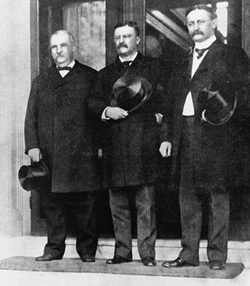
A rare photograph of Theodore Roosevelt with Grover Cleveland (on left).
T.R. with Grover Cleveland. (Courtesy of the Library of Congress)
President Cleveland met with immediate blowback from many western senators. Words like traitor, fink, thimblerigger, Judas, blackleg, bamboozler, mountebank, stool pigeon, and patsy were hurled his way. “So hostile and powerful were these forces,” the historian Char Miller remarked in Gifford Pinchot and the Making of Modern Environmentalism, “that through their representatives in Congress they had managed to suspend Cleveland’s action pending congressional hearings.”45 Senator John Lockwood Wilson of North Dakota, for example, excoriated Cleveland for a “dastardly blunder” carried out to please East Coast elitists like the Boone and Crockett Club. Wilson predicted that westerners would ignore the edict and continue to log timber as they saw fit. Senator Richard Franklin Pettigrew of South Dakota called Cleveland “a disgrace to civilization and a disgrace to the Republic.” Nearly every western senator, in fact, believed that Cleveland had betrayed America. Cleveland’s action in kicking over the hornet’s nest, they argued, was in part pathological, a punishment because the Democratic Party had lost the 1896 election. (This didn’t make any sense, however, because Bryan was no friend of the forest reserves.)
Meanwhile, the Seattle chamber of commerce was in high dudgeon over President Cleveland’s last-minute “sneaky” forest grab. The mere pun on his last name—Cleave-land—got its members hopping mad. “The reservations, of no benefit to any legitimate object or policy, are of incalculable damage to the present inhabitants of this state,” these northwestern businessmen argued. “If they were allowed to stand, not only will the mining industry be destroyed, but the great railroad trunk lines of the Central West which are now heading for Puget Sound will be prevented from coming here. All the passes in the Cascade mountains by which the railroads can reach the Sound are embraced in these reservations.” 46
But the New York Times, in a spate of editorials, applauded President Cleveland’s parting proclamation as a historic accomplishment on behalf of the general public and posterity. “To leave [pristine forests] to private enterprise is to make sure within a generation or two of reducing the Western land now wooded to the condition in which countries once well watered and fertile, like Greece and Spain, have been reduced by like improvidence,” the Times argued. “It is to dry up the streams now stored by the forest and to expose the country the water supply which they protect to an alternation of drought and flood.”47 That August John Muir also vigorously defended Cleveland’s public lands act in an article in Atlantic Monthly titled “The American Forests”—though he also noted that sometimes “wild trees” had to make way for “orchards and cornfields.”48 To Roosevelt’s mind the sworn enemies of the Cleveland reserves were (politically speaking) at the polar opposite ends of the political spectrum: Bryan Populist-Democrats from the Midwest and Rocky Mountain regions and Republican Wall Street types and monopoly-minded captains of industry on both coasts.
Unlike Roosevelt, President Cleveland had too much dignity to call his opponents horrific names in 1897. Nevertheless he ably defended himself nine years later in a book titled Fishing and Shooting Sketches. Cleveland wrote that the “criticisms” and “persecutions” from “mendacious” newspapers and “shameless” Western politicians were “nothing more serious than gnat stings suffered on the bank of a stream—vexations to be borne with patience and afterward easily submerged in the memory of abundant delightful accompaniments.” For the rest of his life Cleveland gloated that the granite-ribbed San Jacinto Mountains around Palm Springs, California and the Uinta Mountains of Utah one-hundred miles east of Salt Lake City, and eleven other wilderness areas had been saved due to his boldness.49
That May the U.S. Senate tried to make an immediate amendment to President Cleveland’s forest lands act. A Lieu Selection Act (passed on June 4, 1897) was created to offer money to homesteaders booted out of the new forest reserves. Emotions ran high. Northern Pacific Railroad agents throughout Washington state, for example, encouraged residents to simply disobey the federal government. It was up to the new president—William McKinley—to grapple with the fracas the anticonservation politicians and extractioners were making. What added to these senators’ fury was that President Cleveland had issued his order without consulting them in any way. If Grover Cleveland had stayed in power, the Sundry Civil bill—called the “Washington’s Birthday Reserves” Act (by conservationists) or the “Midnight Reserve” Act (by pro-development westerners)—would probably have been nullified. The continuation of the forest reserves rested squarely on President McKinley’s broad shoulders. As Muir noted in Our National Parks, promoting his aesthetic view of nature, forest reservations were useful not as “fountains of timber” but as “fountains of life” capable of rejuvenating the human spirit and rescuing it from the “vice of over-industry” and the “deadly apathy of luxury.”50Avoiding political quicksand, and following the old legal adage about cooling out the client, McKinley adroitly held the “Washington’s Birthday Reserves” in abeyance for a year; the act didn’t become officially operative until March 1, 1898.51
The fact that President McKinley didn’t recoil from or play the ostrich on Cleveland’s 21-million-acre coup impressed Roosevelt tremendously. McKinley, in fact, got lucky, for the discovery of gold in Yukon-Alaska in 1896 eventually caused many people in the Pacific Northwest to give up on lumber and instead start developing Seattle and Portland as major ports and outfitting centers. “I am exceedingly glad that President Cleveland issued the order,” Roosevelt wrote to Grinnell that summer, “but none of the trouble came on him at all. He issued the order at the very end of his administration, practically to take effect in the next administration. In other words he issued an order which it was easy to issue, but difficult to execute and which had to be executed by his successor…. I think that credit should be given the man who issues the order, but I think it should be just as strongly given to the man who enforces it…. President McKinley and Secretary [Cornelius] Bliss took the matter up, and by great resolution finally prevented its complete overthrow.” The estimable point Roosevelt was trying to drive home to Grinnell was that McKinley and Cornelius Bliss, his secretary of the interior, deserved credit equal to Cleveland’s for the creation of these thirteen reserves.52
Bliss was a New Yorker, a successful businessman, a member of all the right clubs, and a bit of a dandy. When McKinley nominated him to be secretary of the interior, conservationists like Roosevelt knew that their movement would have an ally in the executive branch. Bliss was easily confirmed by the Senate, over the objections of Senator Henry Teller of Colorado, who claimed that such an “Eastern man” knew “nothing of the great Western matters constantly arising in the Department of the Interior.”53 The real reason for Teller’s objections was perhaps that he wouldn’t be able to make sweetheart deals with a man of Bliss’s moral fiber. Within two months of being confirmed, Bliss got a sort of revenge on Teller by appointing a forester, Gifford Pinchot, as his “confidential special agent” to look into how to both protect and create new western reserves.54
There was another reason Senator Teller made a terrible mistake in going after Bliss. As the old Arab proverb goes, “The enemy of my enemy is my friend.” Given that there were few easterners whom Senator Teller disliked more than Theodore Roosevelt, once Bliss was confirmed, he joined Henry Cabot Lodge in suggesting that Roosevelt become assistant secretary of the navy. Ostensibly, Roosevelt would be in the Navy Department, but Bliss knew he would interfere in western land issues left and right. The secretary of the interior—a prominent contributor to the American Museum of Natural History—welcomed his fellow New Yorker’s interference. Nobody was a better backstop than Roosevelt. As secretary of the interior, Bliss, backed by the Boone and Crockett Club, championed forest reservations in Alaska, the surveying of Yosemite National Park, the saving of prehistoric sites in the Arizona Territory, and the commissioning of the special forest agent, Pinchot, to assess how best to preserve and use vast tracts of public land in the Pacific Northwest.55 As Roosevelt boasted, Bliss was 100 percent in line with the Boone and Crockett Club’s agenda. (In 1900 Roosevelt even promoted the idea of Bliss as the Republican vice presidential nominee, instead of himself.)
A graduate of Yale, Pinchot was tasked with making recommendations about forest management and building public support for the “Washington’s Birthday Reserves.” Known for giving himself airs, he traveled up and down the West Coast, meeting with newspaper editors, politicians, Rotary clubs, and citizen groups. The assignment required a delicate balancing act. Constantly Pinchot had to pluck up enough nerve to tell lumberjack types about the virtues of forestry and preservationists about the need for paper products. In Seattle, for example, Pinchot got into an ugly dispute with John Muir over sheep grazing in national parks and forest reserves. Even though Pinchot had personally reassured Muir, while they were hiking together in the Cascades, that he was against the “hoofed locusts,” in an interview with the Seattle Post-Intelligencer he switched stories. An infuriated Muir shouted hypocrite, accusing Pinchot of currying favor with the Wool Growers Association. Spitting mad, his “eyes flashing blue flares,” Muir told Pinchot, “I don’t want anything more to do with you.”56
Throughout 1897, as groups like the wool growers fought tooth and nail to overturn the federal “lockup” of forest lands, with their congressmen promoting a spate of amendments and nullification bills, Roosevelt vehemently defended Cleveland and McKinley’s policy. At least on paper and in principle, many of his most cherished wilderness places (including Wyoming’s Bighorns and Tetons and Montana and Idaho’s Bitterroots) had been saved in part for his grandchildren and great-grandchildren to enjoy. But westerners didn’t like the government’s incursion into their lives. The arrival of a federal land officer, a scientist from the Biological Survey, or an inspector from the Interior Department caused many westerners to reach for their guns. A forest ranger coming to an outbank town like Bend, Oregon, or Spokane, Washington, for example, was greeted with all the hospitality that would have been extended to a plague of locusts. In Montana alone, suddenly the Flathead reserve was assigned nine rangers, Lewis and Clark seven, and the Bitterroots nine (though part of this reserve is in Idaho). These mounted rangers formed a “chain of patrol” around each forest preserve, looking for fires, poachers, and outlaws.57
Meanwhile, a consensus had started to form in America that big business was insensitive to the environment. The educated class was coming to believe that the federal government needed to intervene before the rivers ran dry and the forests disappeared like the buffalo herds. While working for the Federal Writers’ Project during the Great Depression, the poet Kenneth Rexroth reflected on the character of a typical 1890s Californian businessman, for example, willing to destroy natural wonders like Mount Shasta for the sake of mineral exploration. “He is most often a stranger to the country in which he operates, with no interest in its well being and no care for the conservation of its resources,” Rexroth wrote in the WPA Guide to California. “He is interested in the immediate exploitation of the irreplaceable commodity. The effects of that exploitation on the surrounding country and its population, or on the workers…[are] the least of his cares. Former mining areas are littered with abandoned machinery, the streams are polluted, the forests are destroyed, and the aboriginal population murdered or enslaved.”58
The challenge Roosevelt, more than any other high-profile American, addressed in the 1890s was how to get farmers and backwoods families to hop on the new conservation bandwagon. Thousands of settlers in the Rocky Mountains, California, and Pacific Northwest accepted the arguments of the mining and timber industries and disobeyed federal law—for instance, cutting timber down in the reserves in broad daylight. Federal geological reports collected in 1897 made the feelings of local citizens vividly clear. “Nearly all illicit lumbering and other timber depredations are looked upon by settlers as blameless ventures,” the investigator George B. Sudworth wrote after on-site investigations of Colorado’s White River Reserve. “Such operations furnish a limited amount of employment to the poorer classes…. They are considered to be taking only what rightfully belongs alike to them and all other settlers. The depredator’s good name is not thought to be sullied by the veritable theft of timber from the national domain. The spirit of some landless settlers…is well illustrated by the following remark made to this writer by a party suspected of selling dead building logs: ‘This timber belongs to us settlers and we’re going to get it! The Government officials can’t prevent us either, with an army! If they attempt to stop us, we’ll burn the whole region up.’”59
Roosevelt remained convinced that increased law enforcement, in the newer “Washington’s Birthday Reserves” as well as Yellowstone, was the answer. He wanted to lock up any and all scoundrels trying to despoil the federal forestlands. This was a continuation of his brag that he would have shot the slimy hide hunter Edgar Howell in the face for killing the Yellowstone buffalo. If anarchic, anti–federal government followers of senators Teller and Pettigrew wanted to challenge the authority of the executive branch over the forest reserves by acts of civil disobedience, Roosevelt’s view was “Bring them on.” Their conniptions were music to his ears; after all, the federal government was now on his side. If these debasers defied federal authority, then off they’d go to Fort Leavenworth Prison or Ship Island in the Gulf of Mexico, where they would rot behind bars whittling driftwood as the sun rose and set. Because Roosevelt had studied the life of Zebulon Pike for Volume 4 of The Winning of the West, he became especially incensed that shepherds in Colorado were destroying the grasses in the forest reserve named after the bravest scout of the Jeffersonian era. As Muir squared off against the “hoofed locusts” of Yosemite Valley and the High Sierra, Roosevelt likewise fought to save the Colorado Rockies.
V
Drawing rooms and gentlemen’s clubs in New York had been abuzz in early 1897 over what job Theodore Roosevelt would get in the new McKinley administration. He was known to want a post that would be intellectually stimulating, and there were some early murmurs that he might be given Interior. The anti-forestry legislators deserved nothing less. But only a fool took them seriously. The effect of Bliss’s expedient confirmation put an immediate wet blanket on that low-burning fire. Roosevelt was much too volatile a pro-conservation figure to deal with the western politicians, so McKinley could not make that appointment. However, watching the Republican boss Mark Hanna hold court at a party in New York made Roosevelt grow ashamed and leery of any kind of connection with the McKinley administration. Hanna was a political operative—a breed of man he disliked. Not wanting to be associated with such immoral types, he developed a mild case of self-revulsion.60 “I felt,” Roosevelt wrote, “as if I was personally realizing all of Brooks Adams’s gloomiest anticipations of our gold-ridden, capitalist-bestridden, usurer-mastered future.”61 For his part, the new President McKinley was reluctant to appoint Roosevelt to any meaningful post; he wrote Roosevelt off as “too pugnacious.”62
Things may have remained at a stalemate had Henry Cabot Lodge not orchestrated a lobbying appeal to have his friend appointed as assistant secretary of the navy. As America’s foremost expert on the naval battles of the War of 1812, and having been a great success as police commissioner in New York City (where he increased the force by 1,600 men), Roosevelt seemed an ideal number two administrator for the Navy.63 McKinley had qualms but soon, as a favor to Henry Cabot Lodge and Secretary of the Interior Bliss, he agreed to appoint Roosevelt to the post. Roosevelt assumed his duties on April 19, 1897.
Although the post of assistant secretary hadn’t been created until 1861, Roosevelt now felt that he was part of a club that stretched all the way back to John Paul Jones, the naval hero of the Revolutionary War. Roosevelt remained forever grateful to Bliss for vouching for his character and helping to secure the appointment. But if McKinley and Bliss knew what Roosevelt was revealing in his private correspondence that spring, they would probably have fired him. For example, he told the British scholar Alfred Thayer Mahan that the McKinley administration planned to annex the Hawaiian Islands, cut a canal through Nicaragua, construct a modern naval fleet, and kick Spain out of the Caribbean. (Those were all programs he wanted implemented.*) In a second letter he suggested that Mahan lobby T.R.’s boss, Secretary of the Navy John D. Long, for the United States to build more battleships.
But even as Roosevelt immersed himself in military affairs, he found time to duel intellectually with Dr. C. Hart Merriam over the nature of species and subspecies. Merriam, the reviewer whose praise for The Summer Birds of the Adirondacks, back in 1877, had helped establish Roosevelt’s bona fides as a naturalist, was now chief of the U.S. Department of Agriculture’s Bureau of Ornithology and Mammalogy (Biological Survey). Nobody admired Merriam more than Roosevelt, who regularly sent notes of appreciation for his steady work on behalf of biological inquiry, mammalogy, and biogeography. Roosevelt always enjoyed seeing Merriam’s name in print. There was always an air of collaboration about the two men. Sometimes, for example, Roosevelt sent Merriam sketches and drafts that he was working on. Who else but the overly conscientious Merriam would take the time to examine 27,000 specimens of white-footed mice before issuing a report on their habits?64 Every time Merriam spoke publicly in science forums, even the people in the back rows whispered in awe at his illustrious erudition. There was something about this government scientist’s deportment that demanded respect. He had a knack for making even trifles interesting.
Starting in the mid-1890s Merriam plunged headfirst into the debate over the classification of bears. Boldly he declared there were ten bears to be saved, as well as a new subspecies. Back in 1890, when Merriam, following a trip to the San Francisco Mountains of Arizona, announced his “life zone” theory (i.e., that temperature and humidity were the leading factors in species development), Roosevelt applauded the findings. But now these sudden pronouncement about bears left him baffled. Perhaps, he thought, Merriam was just overworked. So in an unusual gesture of solidarity Roosevelt tried to disagree only quietly, letting the biologist create new textbook designations.
Although Darwinism had been fully embraced in the Ivy League schools, save for a few recalcitrant professors, its crossover into the mainstream culture was fraught with dissent. Being a pioneering biologist like Merriam, one who insisted that germs were living organisms (like people), was mistakenly interpreted as tantamount to declaring Adam and Eve a farce. For hard-core creationists—who were a large majority of Americans—Merriam was pushing scientific inquiry too far for comfort. When Henry Cabot Lodge, serving as a U.S. senator from Massachusetts, wrote a letter to Roosevelt, intimating that Merriam was getting a little too loopy with his Darwinian claims in the U.S. Biological Survey, Roosevelt objected. “Now, I was a little disturbed at what you said to me about Hart Merriam,” Roosevelt wrote. “On most matters I accept your judgment as much better than mine. On this you for the time being accept mine. The only two men in the country who rank with Merriam are [Alexander] Agassiz and [David] Jordan.”*65
Out of all Roosevelt’s naturalist friends, only Merriam (and the botanist Asa Gray) took Darwinian pursuits such as cross-pollinating flowers—anthers and pistils—seriously. Merriam was like Roosevelt in that loafing wasn’t part of either man’s personality. For Merriam, every waking minute was sacred time for further scientific inquiry into the mysteries of life. He had become the workhorse of the U.S. Biological Survey. Besides publishing the definitive two-volume work The Mammals of the Adirondack Region, Northeastern New York, he had visited seal rookeries in Newfoundland, helped found the National Geographic Society, conducted collecting trips in the Mojave and Sonoran desserts, served on the American-British Seal Commission, and written a groundbreaking Darwinian interpretive text, “The Geographic Distribution of Life In North America, with Special Reference to the Mammalia” in Proceedings of the Biological Society of Washington.66
At the time of his disagreement with Roosevelt about overspecialization or organisms, Merriam was organizing an expedition to 14,179-foot Mount Shasta, a dormant volcano in Siskiyou County, California, the second-highest peak in the Cascade Range. Groves of conifers on its slopes had already been recklessly denuded by a lumber company.* Raised in New York, Merriam was admired as a highly effective administrator by the East Coast aristocracy who frequented the gentlemen’s clubs—Metropolitan, University, Cosmos, and Century. The railroad tycoon E. H. Harriman, for example, hired Merriam in 1899 to head a famous eight-week expedition to Alaska. Harriman’s primary personal goal was to hunt a brown bear. Paid a retainer, Merriam organized the travel arrangements, booked the best polar scientists for the voyage, and, most famously, hired John Burroughs and George Bird Grinnell to come along. Once in Alaska, Merriam, for the sake of American natural science, hiked across Howling Valley in Glacier Bay, wrote on the volcanic island of Bogoslof, and pondered the fate of seals. Eventually he compiled “The Merriam Report,” a multivolume account everything learned on the expedition, for E. H. Harriman himself. A deskbound Roosevelt was envious because he hadn’t been able to go along on the historic expedition.
Considering the high level of mutual admiration, one suspects that what actually started the feud with Merriam was his encroachment into the study of bears, considered Roosevelt’s bread-and-butter area of expertise. Merriam stoked up a controversy regarding bears in 1896 by publishing (for the Biological Society of Washington) the paper “A Preliminary Synopsis of the American Bears.” Claiming that for fifteen years the classification of North American bears had been done with imperfections and unscientific contractions, Merriam wanted to challenge orthodoxy. Taxonomic revisions of various genera of bears, he said, owing to field research, were now needed. Having collected 200 to 300 bear skulls and skins as samples, he insisted that the results were crystal clear. There were many more bear species than previously known. That possibility seemed so fantastic, so incomprehensible to Roosevelt that he could barely absorb the assertion calmly. Merriam might as well have claimed to have discovered Sasquatch.
Calling for a comprehensive treatise on bears, Merriam admitted that “much additional material is coveted from North British Columbia, and the coast regions of Alaska south of the Alaskan peninsula.” Nevertheless, from studying so many skulls Merriam confidently declared in his synopsis that there were ten full bear species (and one subspecies in Canada), not the smaller number that Roosevelt had supposed. To give just two examples, there were now a small black (Ursus floridanus) whose range was the Everglades and a huge brown bear (Ursus dalli) found in Yakutat Bay and the St. Elias Alps which needed to be added to zoology books.67 In other words, some of the information in Roosevelt’s published essays on bears, while entertaining, was, in Merriam’s view, technically wrong.
Roosevelt could hold his tongue no longer. Feeling bruised by an article of 1897 in the New York Times proffering Merriam’s views about bear species, Roosevelt suddenly saw things Henry Cabot Lodge’s way. Merriam, it seemed, had indeed gone Darwin-mad, playing the clairvoyant, turning Linnaeus on his head, and wanting to rewrite zoology books to support his field research, which called for new ways to classify species. As if the bears weren’t enough, Merriam was about to publish an article in Scienceclaiming that more species breakdowns of many other mammals were needed to cover such factors as color variation, differences in horn size and shape, whiskers, and hoofprints. Regarding coyotes in America, for example, Merriam believed there were actually eleven distinct species. Roosevelt, urging modification of Merriam’s theory, balked at the species approach to classification. Merriam’s heavy emphasis on species classification, he argued, would merely confuse the general public. “I have been greatly interested in Dr. Merriam’s article as to discriminating between species and subspecies,” Roosevelt wrote to Henry Fairfield Osborn. “With his main thesis I entirely agree. I think that the word ‘species’ should express degree of differentiation rather than intergradation. I am not quite at one with Dr. Merriam, however, on the question as to how great the degree of differentiation should be in order to establish specific rank.”68
Osborn, who would go on to become the preeminent advocate of Darwinism in the early twentieth century, was Roosevelt’s ally in the well-mannered dispute of 1897. In a letter to Osborn, Roosevelt admitted his own “conservative instincts,” but added that when it came to creating entire new species of bears, wolves, elks, and coyotes, he was sanely skeptical.69 If Merriam’s theory were true, that meant his trophy collection at Sagamore Hill of North American big game would never be complete, and every year he’d have to try to bag newly designated species. Roosevelt saw Merriam’s idea as akin to having an “old familiar friend” suddenly “cut up into eleven brand new acquaintances.” Although Roosevelt loved Merriam dearly, he thought Merriam’s new zoology was off-kilter and not worth expounding in serious periodicals like the New York Times and Science. Turning a blind eye toward Merriam’s research, Roosevelt insisted that varied species—like mule and white-tailed deer—were smart “arbitrary divisions” devised for “convenience’s sake.” But he didn’t find value in suddenly catapulting black-tailed deer, for instance—comfortable as a subspecies—into the species category on a biological whim. At the end of the day they were deer. He believed their “essential likenesses” far more important than their “minor differences.” While Roosevelt fully supported having Merriam’s Biological Survey field collectors record variations in species discovered in different regions of America—and in fact coveted such information himself—he didn’t want to “lumber up our zoological works” by adding unnecessary new terminology, thereby overloading the binomial system.
One wonders what Secretary of the Navy Long thought of his underling, whom he didn’t know well, being involved in naturalist squabbles throughout the spring and summer of 1897 (Long’s diary suggests he had strong reservations about Roosevelt’s sanity). Roosevelt’s Darwinian-influenced views spread into his public policy pronouncements, including his pro-expansionist sentiments, when he flat-out stated that “the rivalry of natural selection” was “one of the features of progress.”70 On April 30, Roosevelt published a rebuttal to Merriam in Science. In “A Layman’s View on Specific Nomenclature,” Roosevelt started out by praising Merriam as “one of the leading mammalogists and he has laid all men interested in biology under a heavy debt”—but then he attacked. Using examples like coyotes of the Rio Grande Valley, bears of the Bighorns, and cougars everywhere, Roosevelt challenged Merriam’s thesis as clumsy. “The excessive multiplication of the species in the books cannot, as it seems to me, serve any useful purpose,” Roosevelt wrote, “and may eventually destroy all the good of the Latin binomial nomenclature.”71
The next month, a taxonomic debate between Merriam and Roosevelt was held at the Cosmos Club in Washington, D.C.—a little mansion on Madison Place that had served as something of a living room for John Wesley Powell, Clarence King, and the Geological Survey community in general—in front of an audience of America’s leading naturalists. It had been arranged by L. O. Howard of the Bureau of Entomology.72 Merriam, who lived nearby on Sixteenth Street, often used the Cosmos library as his own salon, occasionally reading Huxley and Thoreau in an easy chair as a break from arsenic and formaldehyde. There were few other places in Washington, D.C., where you could you simply pluck from the bookshelves classics of exploration without so much as consulting a reference librarian.
Just as Marbury v. Madison was carefully studied in law schools for decades after the decision, the rancorous disagreement between Roosevelt and Merriam had a long shelf-life in graduate biology programs. At its core was the question: What constituted a species? On Roosevelt’s side were “lumpers,” old-fashioned taxonomists uncomfortable with “undue cleavage of the genus.” The “splitters” were Merriam’s followers, who insisted that wildlife that integrated “must be treated as subspecies and bear trinomial names; forms not known to integrate, no matter how closely related, must be treated as full species and bear binomial names.” To Roosevelt these “splitters” were essentially perpetuating a gimcrack theory, smothering in its implications (although he didn’t phrase his view in quite such a degrading way). Merriam made plenty of valuable points defending his research. Nevertheless he was not, as a rule, a good speaker. For visual effect he brought with him wolf and coyote skulls, with mixed results.73
Roosevelt, by contrast, made the room shake when he spoke. Thrusting his hands out of his shirt sleeves, he lectured on the need for biology not to overcomplicate everything. One point, which Roosevelt essentially conceded, was that ornithology was a relatively “finished science” whereas mammalogy, particularly throughout the American West, was “yet in its infancy.” Merriam saw this concession as an opening. Daily the Biological Survey was getting mammals with skull variations and tails different from others in the same genus. Was it really so irresponsible to believe, Merriam wanted to know, that new species were being discovered? 74 Essentially, Roosevelt won the debate on extempore elocution while Merriam did better on specifics; in other words, it was a draw.
Besides his sharp argument with Merriam, Roosevelt’s obsession with species bled into his job at the Navy Department in other, unexpected ways. On behalf of entomology, for example, Roosevelt wanted the new class of U.S. torpedo boats to carry names likeWasp, Hornet, and Yellow-Jacket.75 Under the aegis of a decorator, Roosevelt filled his office with a wide assortment of antlers; it looked like a Wyoming hunting lodge. And even though war with Spain was looming and naval procurement was one of his responsibilities, Roosevelt continued to mercilessly prune and edit articles that hunters were submitting to the Boone and Crockett Club. “Wherever the young idiot speaks of papa, father should of course be substituted, and, if possible, the allusion should be left out all together,” Roosevelt wrote to Grinnell after reading an article on deer hunting submitted in August 1897. “It is not advisable to put in nursery prattle. In the next place all of the would-be-funny parts must be cut out ruthlessly. If there exists any particularly vulgar horror on the face of the globe is it the ‘funny’ hunting story. This of course means that we shall have to cut down the piece to about half its present length; but if that is done I think it will be good.”76
VI
As Roosevelt put together the Boone and Crockett Club’s third volume, Trail and Camp-Fire, he retained a bias toward preservation and the kind of songbirds that the Audubon societies had lobbied to protect, as opposed to the plight of milkweed bugs or the angular-winged katydid.* “The geology and the beetles will remain unchanged for ages,” he wrote George Bird Grinnell, his co-editor once more, when going over a manuscript about Africa, “but the big game will vanish, and only the pioneer hunters can tell about it. Hunting books of the best type are often of more permanent value than scientific pamphlets; & I think the B&C should differentiate sharply between worthless hunting stories, & those that are of value.” Perhaps not wanting to war with his co-editor as well as Dr. Merriam, Roosevelt ended his letter praising Grinnell’s recent article on buffalo as “worth more than any but the very best scientific monographs about the beast.”77
In Roosevelt’s correspondence of 1897, four interrelated conservation issues—increased national park protection, more forest reserves, western water reservoirs, and the diminution of buffalo—concern him above all others. He truly believed that the Boone and Crockett Club had made great inroads in raising public consciousness of buffalo’s plight. Hoofed game were on the rebound in North America, and the Bronx Zoo would soon get the word out even more throughout the East Coast. Citizens had started warming up to the idea of game and forest wardens being trained in biology. As Roosevelt told Grinnell, Trail and Camp-Fire must hit the same urgent notes: “We have made such a point of Yellowstone Park in our two previous volumes,” he noted, “that I think we ought to dwell on it in this one.”78
By September, with Trail and Camp-Fire delivered to its publisher, Roosevelt took a rare three deep breaths, sheepishly worried that he had been too roughshod in his exchanges with Merriam both in Science and at the Cosmos Club. His defiant mood had tapered off. “I almost broke the heart of my beloved friend Merriam,” Roosevelt confided to Henry Fairfield Osborn. “He felt as though he had been betrayed in the house of his friends; but he really goes too far. He just sent me a pamphlet announcing the discovery of two species of mountain lion from Nevada. If he is right I will guarantee to produce fifty-seven new species of red fox from Long Island.”79
Apparently Merriam harbored his own regrets about the dustup, declaring that Roosevelt was “a writer of the best accounts we have ever had of the habits of our larger mammals.”80 Furthermore, while he was in the Olympic Mountains of far western Washington, a stunning Pacific slope cluster of low-lying peaks surrounded by rain forests and considered the wettest spot in the continental United States, Merriam discovered that the elks there had coloration and antler size different from those found in Yellowstone. Appealing to Roosevelt’s ego (and perhaps his own wicked sense of humor), Merriam named this new subspecies Cervus roosevelti.81 These huge elk were magnificent creatures. “It is fitting that the noblest deer of America should perpetuate the name of one who, in the midst of a busy public career,” Merriam wrote in the December 17, 1897, issue of the Proceedings of the Biological Society of Washington “has found time to study our larger mammals in their native haunts and has written the best accounts we have ever had of their habits and chase.”82
What could Roosevelt do? There was hardly an honor in the world he would have preferred more than having a species of elk found in the dusky coastal and Cascade ranges of the Pacific Northwest named after him. However, if he embraced Cervus roosevelti, other naturalists would dismiss him as a hypocrite bought off by flattery. Nevertheless, here was a heaven-sent opportunity for Roosevelt to make everything right again with Merriam, and he seized it. There is no record of Roosevelt’s thought process, but in any event he accepted the new honor, informing Merriam, “No compliment could be paid me that I would appreciate as much as this—in the first place, because of the fact itself, and in the next place because it comes from you. To have the noblest game animal in America named after me by the foremost of living mammalogists is something that really makes me prouder than I can well say. I deeply appreciate the compliment and I am only sorry that I will never be in my power to do anything except to just merely appreciate it.”83
The deeply touched Roosevelt now felt he had a debt to repay. He began reading everything he could on the Olympic Mountains and sought photographs of Cervus roosevelti. The 800-pound “Roosevelt elk” was brown or dark beige with very dark underparts and a yellowish-brown tail. Much like their namesake, these elk were crepuscular, extremely active at dawn and dusk. Focusing on Washington state wildlife for the first time, he learned that the Olympics contained five distinct landscapes: temperate rain forest, rugged mountain terrain, large lowland lakes, cascading rivers, and saltwater beaches. As an ornithologist, Roosevelt hoped to soon see the black oystercatchers, with their long reddish beaks, crack open mollusks along the rugged Pacific shore. The mere thought of aromatic Sitka spruce and western hemlock appealed to Roosevelt just as much as seeing his namesake elk in their natural habitat.
Starting in 1897, Mount Olympus became Roosevelt’s new Matterhorn, another peak he wanted to conquer. The highest point in the Olympics chain, not even until 1907, it had eight tumbling glaciers and some of the finest strands of Pacific silver fir in North America. Mount Olympus—the very name enthralled Roosevelt—wasn’t going to elude him. The Pacific Ocean here was a sea of boulders, many larger than houses. For a marine biologist there were new universes to explore. While Muir championed the Yosemite Valley, Merriam studied northern Arizona, and Grinnell focused on northwestern Montana, Roosevelt developed an abiding fascination for the Olympics of Washington state and the forest reserves of Colorado; they were two unexplored western places (not counting Alaska) on his future itinerary. Fascinated to learn about Washington state’s big-leaf maples in rain forests adorned with epiphytic mosses and ferns, he became determined to save them—a feat he accomplished six years later as president. The only other rain forests as temperate as those stretching from Alaska to Oregon along the Pacific Coast were in Chile, New Zealand, and South Australia. Europe had nothing like them, so Roosevelt, as he educated himself about the Olympics, swelled like a toad with pride.
When Encyclopaedia of Sport, a British reference guide, asked Roosevelt to contribute an article on elk that year, he turned his focus to the herds he’d been studying with unremitting interest. “There are several aberrant forms of wapiti, including one that dwells in the great Tule swamps of California,” Roosevelt wrote. “There is also an entirely distinct species with its centre of abundance in the Olympic mountains of Washington and in Vancouver Island. This species, which Dr. Hart Merriam has recently done the present writer the honour of naming after him (Cervus roosevelti).” 84
Ironically, in the long run, Roosevelt’s position, that Merriam was creating too many species of mammals, triumphed. Cervus roosevelti would lose its species status in 1899, becoming a subspecies called Cervus canadensis roosevelti.85 Hearing the news of his demotion, Roosevelt asked Merriam, “By the way, is ‘Roosevelti’ merely a synonym of ‘occidentalis,’ for the Olympic Wapiti? My only glory gone!”86 Regardless of its designation, however, “Roosevelt elk” remains the common name for these gorgeous creatures that ranged throughout the dense redwood and rainforest country of the Pacific Northwest. The combination of his elk wandering among 2,000-year-old sequoias became—in his dotage—one of Roosevelt’s Edenic fantasies.
Roosevelt also worked side by side with Merriam on abolishing the unsportsmanlike practice of chasing deer to the water’s edge with packs of hounds in the Adirondack Park. This was a conservationist project in which they could be brothers in arms. The two men also wanted to ban the new practice of jacklighting (shining a spotlight into flocks of ducks which stunned so they could not fly off, and then firing away). As noted, in 1884 Merriam had written The Mammals of the Adirondacks Region of Northeastern New York, a careful examination of that area’s fauna. The Boone and Crockett Club recommended the book for sportsmen; and Roosevelt praised it in Trail and Camp-Fire. Offering an olive branch to Merriam in the public sphere, throwing out grand praise, Roosevelt called the federal biologist a “field naturalist in the highest sense of the term; the model of what we ought to have for the entire American continent.” 87
But Roosevelt’s interest in Adirondack deer wasn’t simply a matter of rebonding with Merriam. The declining deer population in those home-state woodlands troubled him. Like Uncle Rob, Theodore wanted to protect the Hudson River watershed by not cutting down too many trees—at times it seemed that most of the topsoil of upstate New York was ending up in Manhattan’s harbor. In 1897, after a concerted lobbying effort, the New York legislature enacted a law to protect deer. Proper wildlife management, Roosevelt boasted, truly got extraordinary results. “We set to work ridding the Adirondacks of the [hunting] dogs,” the New York conservationist John Burnham recalled of Roosevelt and Merriam’s push, “and it was a thrilling, dangerous job.”88
A year after the bans on dogs and jacklighting went into affect, the Adirondack deer and ducks started to rebound. In an early experiment in wildlife relocation, trapped deer from Maine were taken to upstate New York and let loose. The repopulation commenced as hoped for. (A similar reintroduction with buffalo, moose, and elks, however, failed). Still, Roosevelt was thrilled that his Adirondacks deer were being revived through a combination of wildlife and forestry law. Former president Benjamin Harrison, in fact, had just built a sporting home in the Adirondacks called Berkeley Lodge. Along with Roosevelt and Merriam, Harrison was a high-level proponent of the “Forever Wild” movement to save the Adirondacks from destruction. And he spoke up on behalf of deer, too. Starting in 1897 Roosevelt once again began exploring the region for bird sightings in hopes of updating his nearly twenty-year-old Summer Birds of the Adirondacks; he never, however, found the time.
Extraordinarily fine essays on hunting in Africa and Newfoundland were included in Trail and Camp-Fire when it was published in late 1897. On the book’s cover was a moose head with record-size antlers; the title page had an amateurish illustration of a mountain goat standing on a rock ledge. The volume’s scope was ambitious. On the conservationist front, the editors—Roosevelt and Grinnell—took up the cudgels for saving Adirondack deer by championing many new laws. There was also a self-congratulatory essay on the founding of the Bronx Zoo. Finally, Roosevelt once again provided a list of the essential natural history books all true-blue hunters and serious explorers needed to read. Four essays in this fat book—including Roosevelt’s “The Bear’s Disposition”—dealt with bear hunting and protection issues.
Grinnell’s own contribution, the long essay “Wolves and Wolf Nature,” was simply brilliant. It could have been published as a monograph instead of in an anthology. “In discussing wild animals, we are all very disposed to consider the species as a whole, and to deal in general terms, jumping to the conclusion that all the individuals of a kind are exactly alike, and not taking into account the marked variation between different individuals, for we consider only their physical aspect,” Grinnell wrote. “We forget that to each individual of the species there is a psychological side; that these animals have intelligence, reason, mind, and that at different times they are governed by varying motives and emotions, which differ in degree only from those which influence us.”89
Later, when Roosevelt became president, he lashed out at the novelist Jack London for not writing accurately about wolves in Call of the Wild. Roosevelt’s expertise on this matter stemmed largely from firsthand observation and from reading “Wolves and Wolf Nature.” Somewhat incongruously, Grinnell’s essay also served as an impetus for Roosevelt to go wolf coursing in Oklahoma a few years later with Captain Jack “Catch ’Em Alive” Abernathy. However, Roosevelt took issue with Grinnell’s depiction of how gray wolves brought down prey, insisting in his essay “On the Little Missouri” that they attack prey at the hindquarters, feasting first on the flanks. “It will be noticed that in some points my observations about wolves are in seeming conflict with those of Mr. Grinnell,” Roosevelt wrote, “but I think the conflict is more seeming than real; and in any event I have concluded to let the article stand just as it is. The great book of Nature contains many passages which are hard to read, and at times conscientious students may well draw up different interpretations of the obscurer and least known texts. It may not be that either observer is at fault; but what is true of an animal in one locality may not be true of the same animal in another, and even in the same locality two individuals of a species may widely differ in their habits.”90
Roosevelt was now embracing the very criticism Grinnell made of T.R.’s first book, Hunting Trips of a Ranchman, as his own clear-headed scientific statement of purpose. Just why Roosevelt felt compelled to have these frays with Merriam and Grinnell is open to speculation; but one can probably attribute it to a mixture of egotism and his belief that he was correct. As a target of Roosevelt’s attacks, Grinnell, unlike Merriam, never let the jabs bother him. Supremely self-confident, Grinnell had, in fact, learned how touse Roosevelt for his own conservation cause in Forest and Stream, unleashing the feisty reformer’s combative personality at his own will.91
Grinnell and Roosevelt agreed on the precepts of conservation for the West: repopulating it with the buffalo and the elk, saving its natural wonders, and helping Native Americans there reconstitute their heritage. Two days before Christmas 1897, Roosevelt wrote to John A. Merritt, the third assistant postmaster general in the McKinley administration. All those holiday stamps he had licked for Christmas cards had given him an idea. Why not promote the West by issuing new stamps? When Merritt replied asking for specific recommendations, Roosevelt suggested a Cheyenne warrior with a bonnet of eagle feathers, a prairie schooner, a Remington cowboy illustration, and (if a real person could be used) an image of Kit Carson—Roosevelt always promoted Carson at every chance possible. Those were fairly safe choices. But, Roosevelt wrote, if the U.S. Post Office was truly interested in presenting the American West in a stamp series, it should focus on the region’s wildlife and wondrous natural sites. “By all means have one of those postage stamps with a buffalo on it,” Roosevelt instructed. “The vanished buffalo is typical of almost all the old-time life on the plains, the life of the wild chase, wild warfare, and wild pioneering. If any bit of scenery were taken I should suggest your going up to the Cosmos Club or to the Geological Survey and examine three or four of their photographs of the boldest [Arizona] canyon walls, or of Pike’s Peak.”92