
CHAPTER TWELVE
I
Starting in January 1897 William Randolph Hearst’s New York Journal and Joseph Pulitzer’s New York World began reporting zealously on the Cuban insurrection against Spain. Up until then the U.S. Senate was for Cuban independence, but back burnered the issue. There was little clamor to send the American navy into a firefight. Still, through these jingoistic newspapers, the public was made aware of such heinous acts as a Spanish firing squad executing the Cuban revolutionary Adolfo Rodriguez and the horrific conditions of prisons in Havana. Public sympathy in America was turning against the ogre, Spain. Besides the Cuban insurrection, the Spanish authorities were also trying to squelch the Philippine liberation movement (the Philippine Islands were then a Spanish colony). Hatred for all things Spanish became widespread in the United States, fueled by—in large part—the Hearst and Pulitzer papers.
Influenced by this so-called yellow journalism, Roosevelt had no trouble actively disdaining Spaniards in 1897. To Roosevelt the Spanish government exuded a conceited authoritarianism that he despised. He believed that the United States had an obligation to challenge any brutal European monarchy that was thumbing its nose at the Monroe Doctrine. Disregarding the fact that American sugar tariffs enacted in 1894 had disrupted the Cuban economy, Roosevelt blamed Spain for Cuba’s impoverished living conditions. He was glad, if anything, that the tariff had helped set the Cubans against Spanish rule.
Roosevelt, as a Mahanian naval strategist, had serious concerns about Spain. In particular, he had carefully read “War with Spain—1896,” a national security document written by an astute naval intelligence officer, Lieutenant William Wirt Kimball for the Naval War College. Roosevelt thought Kimball’s analysis was spot-on. He had even written to Mahan that the “Kimball Plan” avoided the politics of imperialism versus anti-imperialism altogether. It was a blueprint for war preparedness. Kimball insisted that if war with Spain occurred, a naval engagement would be preferable to a land war in Cuba and the Philippines. This made great sense to Roosevelt. Boiled down, the Kimball Plan called for an offensive strike against Madrid in three war zones: the Philippines, Cuba, and on the high seas against Spanish shipping. The crucial strategic point was for the United States to cleverly draw the Spanish navy into protecting the far-flung Philippines, leaving Cuba wide open to a U.S. invasion. What Roosevelt as a naval historian most deeply admired about the Kimball Plan was its specificity: every Spanish ship was described and analyzed in minute detail. In many ways the document stylistically resembled his own Naval War of 1812. If war came T.R. wanted the U.S. Navy prepared for all the challenges the Kimball Plan presented. He wrote to Kimball, “The war will have to, or at least ought to, come sooner than later.”1
Around Christmas 1897 Assistant Secretary of the Navy Roosevelt became obsessed by the idea of war with Spain. He worried that if the United States didn’t confront Spain in the Western Hemisphere than there would be “disastrous long term consequences for future American security.” 2Overflowing with patriotic spirit, Roosevelt believed that fighting for the independence of Cuba and the Philippines was both a noble cause and a strategic imperative. Spain’s ambitions had to be thwarted. There were echoes in Roosevelt’s thinking of 1886, when he had promoted armed conflict with Mexico, and of 1891, when he had fantasized about shooting “dagos” in Chile.3 Although he found time to scold Frederic Remington for having drawn badgers improperly in an illustration in Harper’s Weekly and continued reading up on the Olympic Mountains, for the most part Roosevelt was consumed that holiday season with promoting an imperialistic pamphlet of quotations he’d assembled under the title Naval Policy of the Presidents.4 He also corresponded with Commodore George Dewey (whose fleet was maneuvering in the Pacific) and impetuously directed the North Atlantic Squadron to join the U.S.S. Maine at Key West, Florida, to immediately begin winter exercises.5
On January 25, 1898, the Maine dropped anchor in Havana harbor in what was essentially an exercise in showing the flag.6 America was inching closer to war with Spain. When on February 15 the Maine exploded in a fireball, killing 262 U.S. sailors, Roosevelt’s war fervor increased. He blamed Spain for the explosion. While President McKinley ordered a report to find out whether the Maine had been sabotaged by Spain or whether a short-circuit fire had blown up the gunpowder kegs, Roosevelt grew impatient. Believing that the U.S. Navy was in a perfect state of readiness, the best it had been since the Civil War, he wanted the Spanish forts in Cuba reduced to burned wood and rubble. All-out war against Spain, he believed, should be declared at once. “Cuban independence,” no longer a remote concept, had become Roosevelt’s new rallying cry and his response to those who advocated peace at any price. “Personally I cannot understand how the bulk of our people can tolerate the hideous infamy that has attended the last two years of Spanish rule in Cuba,” Roosevelt wrote to William Sheffield Cowles, “and still more how they can tolerate the treacherous destruction of the Maine and the murder of our men!”7
Pledging to go and fight in Cuba himself—even though he was nearing forty and had six children to help raise—Roosevelt famously declared that the cautious President McKinley had “no more backbone than a chocolate éclair.”8 Warring with his own administration, Roosevelt said that come hell or high water he was going to fight on the front lines in Cuba or Puerto Rico (or even the Philippines if need be). He wrote to Dr. William Sturgis Bigelow, a Bostonian physician with a world-class collection of Japanese art, on March 29, 1898, “A man’s usefulness demands on living up to his ideals in so far as he can. Now, I have consistently preached what our opponents are pleased to call ‘jingo doctrines’ for a good many years. One of the commonest taunts directed at men like myself is that we are armchair and parlor jingoes who wish to see others do what we only advocate doing. I care very little for such a taunt, except as it affects my usefulness, but I cannot afford to disregard the fact that my power for good, whatever it may be, would be gone if I didn’t try to live up to the doctrines I have tried to preach.”9
Less than two weeks later, President McKinley reluctantly asked Congress for a declaration to interfere in Cuban affairs. Roosevelt was all for the declaration but emphatically against the annexation of Cuba, unless Havana wanted it.10 Congress became engulfed in a heated debate. Was war the right choice? Should America defend its honor in Cuba? These questions became academic when, on April 23, Spain declared war on the United States. President McKinley called for three regiments of volunteers to supplement the depleted army. Then on May Day, out of the clear blue sky, astounding news arrived. The previous day Commander Dewey—known for his fearless firefights along the Mississippi River as a Union naval lieutenant during the Civil War under Admiral David Farragut’s command—had crushed the Spanish fleet in Manila Bay, without losing a single U.S. sailor in battle. A few days later, on May 6, Roosevelt simply resigned as assistant secretary so he could implement the Kimball Plan, defend the Monroe Doctrine, and revenge the Maine. In quick order he received an army commission, purchased an appropriate outfit at Brooks Brothers, and departed for drill training in San Antonio, Texas. Nobody in official Washington could believe how childishly he was acting.Bigelow, who shared with Roosevelt a love of jujitsu,*11 wrote to Henry Cabot Lodge, “If T.R. goes, the country will not trust him again.”12 Seconding that opinion was Henry Adams, who asked mutual friends, “Is he quite mad?”13
Roosevelt became so distracted by the prospect of war that for the first time since the founding of the Boone and Crockett Club, he missed its annual dinner that January. The concept of American imperial ambitions consumed Roosevelt to the point of monomania. Pestering everybody he knew who was in a position to help, Roosevelt kept pleading, “Send me.” Picking up the old slogan “Remember the Alamo” from the Mexican War, Roosevelt was one of the progenitors of “Remember the Maine.” Obviously, hunting and bird-watching took a back seat to war that spring. Between trying to take care of Edith, who had undergone surgery to remove abscesses from her hips, and trying to persuade President McKinley to declare war on Spain, he had lost all sense of proportion. “I really think he is going mad,” Winthrop Chanler of the Boone and Crockett Club noted on April 29. “The President has asked him twice as a personal favor to stay in the Navy Department, but Theodore is wild to fight and hack and hew. It really is sad. Of course this ends his political career for good.”14
When Secretary of War Russell Alger called for volunteer regiments “to be composed exclusively of frontiersmen possessing special qualifications as horsemen and marksmen,”15 Roosevelt leaped at the opportunity. At the very least, his years as deputy sheriff of Billings County, North Dakota, and his stint in the National Guard of New York provided him with legitimate “frontier” credentials. Eventually, Roosevelt was made second in command of the First U.S. Volunteer Cavalry, behind his friend Colonel Leonard Wood, a former Indian fighter who had won the Medal of Honor for pursuing Geronimo and became McKinley’s chief army medical adviser. Because of Roosevelt’s highly publicized enlistment, more than 23,000 applicants flooded into the War Department offices. Everybody, it seemed, wanted to serve with Roosevelt at his side, including some of his Harvard classmates.16
With the newspapers cheering Lieutenant Colonel Roosevelt on, more than 1,250 men were eventually selected to form a top-notch regiment. They were first called “Teddy’s Texas Tarantulas” and went through three or four other names until “Roosevelt’s Rough Riders” stuck. The Rough Riders were assigned to San Antonio for their mobilization. The regiment’s encampment was erected on the dusty International Fair Grounds (later renamed Roosevelt Park). The diverse Rough Riders comprised twelve troops—five from New Mexico Territory, three from Arizona Territory, one from Indian Territory (the southeastern part of present-day Oklahoma), one from Oklahoma Territory, and a smattering of upper-crust men from the East Coast, particularly men who had played Ivy League football and soccer. A recruiting table was set up on the outdoor patio of the Menger Hotel where men could register; some gave pseudonyms so not to be held accountable for past crimes. Horses and equipment were supplied from Fort Sam Houston’s quartermaster depot. Livestock men in Stetsons milled about El Mercado Square gossiping with Mexicans about the glorious war. Slouch hats, blue flannel shirts, and bandannas were handed out to Rough Riders as uniforms, giving the regiment a distinctive cowboy look.17 Eventually they were all also issued brown canvas stable fatigues for field service and given machetes to help them whack through the tropical foliage of Cuba.
Among Roosevelt’s favorite haunts in San Antonio was the Buckhorn Saloon. Opened for business in 1881 by Albert Friedrich—whose father made high-quality horn furniture—from day one the bar had a standing offer: “Bring in your deer antlers and you can trade them for a shot of whiskey or a beer.” Before long the Buckhorn had the finest collection of horns and trophy mounts in the world. Men would actually collect antlers shed in the Texas Hill Country and then ride into San Antonio for their free drinks. In 1882, in fact, for $100 Friedrich acquired a record-making “78 Point Buck” it was placed behind the bar, where it still remains. Business was so good that Friedrich moved his operation to larger quarters at Houston and Soledad streets, a few blocks from the Alamo. Expanding on the tradition of free alcohol for deer racks, the Buckhorn, by the time Colonel Roosevelt discovered it, was also giving away shots for rattlesnake rattles. (Later, mounted fish from the Seven Seas were included in the freebie deal.) Even though Roosevelt wasn’t much of a drinker, he would wander in with fellow Rough Riders, order a beer, nurse it, and listen to an old guitar-picker sing about being a cowhand along the Brazos River.18
San Antonio was a fillip to Roosevelt. He liked being dependent on his own horse and seeing sagebrush. No doctor or pharmacist could have uplifted him better than the opportunity to lead lineal descendents of Andrew Jackson’s fighting force in the Battle of New Orleans. Whether a volunteer was a Fort Worth bronco buster, a Newport polo swell, or a Tucson shopkeeper, each of the Rough Riders shared traits with the others: they all shot straight, were in good physical condition, hated Spain, and were willing to mobilize quickly. “I suppose about 95 per cent of the men are of native birth,” Roosevelt wrote. “But we have a few from everywhere including a score of Indians, and about as many of Mexican origin from New Mexico.”19
Many fine firsthand accounts have been written of Roosevelt’s arrival in San Antonio, colorful portrayals of him pacing around like a bantam rooster in a new fawn uniform with canary-yellow trim, sweat constantly beading on his forehead from the Texas heat. The regiment’s chant soon became, “Rough, tough, we’re the stuff. We want to fight and we can’t get enough.”20 Throughout San Antonio signs were hung welcoming each state and territory and offering hospitality.21 The Menger Hotel—built twenty-three years after the fall of the Alamo—housed a replica of the pub inside Great Britain’s House of Lords; bartenders used to give out free shots of whiskey, in solidarity with the men. (The hotel later renamed the room the Roosevelt Bar.) However, Colonel Wood upbraided the much younger Roosevelt for purchasing beer kegs for volunteers. “Sir,” Roosevelt apologized when reprimanded, “I consider myself the damndest ass within ten miles of this camp.”22
Before Roosevelt headed down to San Antonio for the training, he gave away his Elkhorn Ranch to Sylvane Ferris and sold his last head of cattle. (He had visited the ranch only infrequently in 1893, 1894, and 1896.23) Roosevelt nevertheless differentiated himself in San Antonio from the other Ivy Leaguers in the Rough Riders. Without falsity, he presented himself as both a Knickerbocker and a wilderness hunter to the rank and file training along the San Antonio River. As Owen Wister put it, Roosevelt embodied both the East (as a socialite) and the West (as a cowboy). Regularly, Roosevelt jogged and rode horseback for miles in the lean May sunshine with his regiment, not far from the Alamo. Many of the Rough Riders had fought against the Comanche and Apache, and had won. Roosevelt knew that in cow country, along the wild borderlands with Mexico, men gave each other nicknames like Red Jim, Bear Jones, or Dutchey; he was honored to be called “the Colonel” by everybody.24
II
The Rough Riders eventually boarded a slow-moving train to Tampa Bay on May 30, with Arizona providing the regimental colors. Before the departure from San Antonio Roosevelt worried that the warhorses, ears pricked, snorting, and rattling the boards in the railcar stalls, were being bullied and whipped as they were loaded onto the railcars by supposed horse masters. The harassing shouts of “Yahah!” bothered him. Taking charge of the situation, Roosevelt waved the others away and loaded the ponies properly into their compartments for the journey to Florida.25 Back in 1894 Owen Wister had written a short story, “Balaam and Pedro,” in Harper’s Monthly about the abuse of a horse he encountered on a western trek; the Wyoming character who stopped the inhumane treatment became the hero of The Virginian. (Wister, in fact, praised Henry Bergh’s movement to prevent cruelty to animals in his 1905 novel.26) Now Roosevelt, like the protagonist of Wister’s tale, was protecting horses under his command.
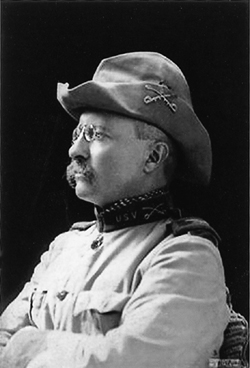
Colonel Theodore Roosevelt in his Rough Riders uniform.
T.R. in Rough Riders uniform. (Courtesy of Theodore Roosevelt Collection, Harvard College Library)
Once the train reached Galveston the dry heat was replaced by muggy humidity. Nobody, however, really seemed to mind. The railway cars were roofless, giving the procession the aura of a parade, with Rough Riders waving at villagers as the train passed slowly by. At every stop in Louisiana and Mississippi folks poured out of the countryside to have a quick look at Colonel Roosevelt and his cowboy-garbed regiment. Moms with baked goods and girls with pitchers of fresh milk greeted them at depots. Watermelon wagons appeared regularly, providing snacks for the soldiers. Roosevelt basked in the limelight at each depot, offering a running commentary on American exceptionalism. Before the fighting in Cuba even began, there was going to be a showbiz side to the Rough Riders, but they would soon also touch the heartstrings of America. And, from the start, Colonel Roosevelt was the willing leader.
These Rough Riders were the pride of Roosevelt’s heart, and his inextinguishable enthusiasm kept their morale high. Good-heartedly Roosevelt gave up his private berth to a trooper with measles, taking a coach seat with his men. He was determined not to treat his privates like indentured household servants. To kill time, some of the men, while waving away hatching flies, wrote a jingle about going down the “dusty pike” with Colonel Roosevelt, ready to “throttle the sons of Spain.”27 Roosevelt was reading Edmond Demoulins’s Supériorité des Anglo-Saxons (1897), a foray into social Darwinism. Demoulins wrote that France, his native country, lacked the “independence and ability to fight life’s battles fearlessly,” qualities that the Anglo-Saxons possessed in spades.28He also believed that education—at which the British excelled—was the key to developing a great country. All this was music to Roosevelt’s ears. As the train rumbled eastward Roosevelt consoled himself with Demoulins’s notions of natural selection in the human arena.
Once he finished the book, Roosevelt, flaunting his authority, called his men together at a depot stop near the Sabine River. He lectured them on Darwinism, describing how natural selection explained everything, from the size of their noses to the wings on the mosquitoes they were swatting. Many of the Rough Riders had taken to calling the Spaniards “greasers” or “dagoes,” and Roosevelt promised to explain shortly why the epithet wasn’t entirely unfair.29 Seizing Darwin’s image of a “tangled bank,” which endedOn the Origin of Species, Roosevelt now made it his own. “Through all nature,” Roosevelt intoned, “it is a case of the survival of the fittest. Look at the magnificent trees along the river. The ones that started crooked were crowded out and died. The strong and the straight saplings appropriated all the food.”30
That wasn’t the extent of Roosevelt’s lecture on Darwinism. Inspired by Demoulins, he took a leap forward, bringing humans and mammals into the mix. “It is the same with wild animals,” he continued. “The cripples and the inefficients that cannot support themselves are killed off.” Humans, Roosevelt maintained, were just highly developed animals. So just as the Chinese purged themselves of the criminal class and the wicked, the United States, if it wanted to achieve greatness, needed to sanitize its society by getting rid of criminals. (To be fair, he did, however, add the important point that the blind or crippled or chronically infirm of sound mind needed to be cared for by society at large.)
Roosevelt then segued into the unfitness of Spaniards, the weak link in European affairs. Most, he said, were shiftless and of weak moral fiber. As Americans, his men had a newfound responsibility to liberate Cuba, Puerto Rico, and the Philippines, because the Spanish had proved themselves tyrannical. Obviously Roosevelt was trying to arouse his fighting forces. Verbally attacking the enemy in training was a practice older than Rome. Taking the jingoist notion one step farther, Roosevelt, as if reeling off a paragraph of Kipling, boasted that the Rough Riders had a sacred obligation to revenge the Maine. “The old vigilantes in Montana did not have a single law,” he reminded them, “but they did have a simple, wholesome code which everyone knew. Life and property are secure as a consequence.” 31
Notions of natural selection had long ago been stamped into Roosevelt. On the Origin of Species had taught him that evolution had some important implications for human societies. Still, the lecture was overblown and felt wrong. While Roosevelt was not a strict evolutionist in human affairs, he nevertheless was in the clutches of the general Spencerian notion “root, hog, or die.” To Roosevelt it was a slogan akin to gospel.32 As he articulated in his 1895 essay “Kidd’s Social Evolution,” published in North American Review (a scholarly analysis of Benjamin Kidd’s just-published reflection on natural selection), Roosevelt believed humans had two sides—one inspired by Darwin (“the rivalry of natural selection”) and the other being moral character (essentially the Ten Commandments). There were laws, he wrote, which governed mankind’s reproduction in every generation “precisely as they govern the reproduction of the lower animals.”33 But Roosevelt also understood that the rivalry of natural selection was just one way—not all-encompassing—in which Homo sapiens judged progress:
Other things being equal, the species where this rivalry is keenest will make most progress; but then “other things” never are equal. In actual life those species make most progress which are farthest removed from the point where the limits of selection are very wide, the selection itself very rigid, and the rivalry very keen. Of course the selection is most rigid where the fecundity of the animal is greatest; but it is precisely the forms which have most fecundity that have made least progress. Some time in the remote past the guinea pig and the dog had a common ancestor. The fecundity of the guinea pig is much greater than that of the dog. Of a given number of guinea pigs born, a much smaller proportion are able to survive in the keen rivalry, so that the limits of selection are wider, and the selection itself more rigid; nevertheless the progress made by the progenitors of the dog since eocene days has been much more marked and rapid than the progress made by the progenitors of the guinea pig in the same time.34
Probably the best way to understand Roosevelt’s thinking on social Darwinism—besides reading “Social Evolution,” which was reprinted as a chapter of his 1897 book American Ideals*—is to study a lecture given by John Burroughs in the 1890s, “The Biological Origin of the Ruling Class.” Fulsomely embracing Darwin as a naturalist, Burroughs believed that the law of the strong overcoming the weak offered a valuable viewing of “the drama of human politics and business.”35 To Burroughs, the fittest usually rose to the top in American life. Undoubtedly evil charlatans sometimes tried to rig the reality. Scum often rose in life’s pond—but on the whole, every generation of Americans produced its heroic natural elite. These winners rode herd on human affairs, directing their course, helping civilizations and societies to survive cataclysms. Whenever truly bad leaders, imposters, reached a pinnacle of power, eventually they would be destroyed by the natural elite. Competition of all kinds, Burroughs went on in his lecture (which was a set piece), should be supported so that the best-and-the-brightest could earn their rightful positions of societal power. As for the poor and disabled, Burroughs believed the natural elite had a moral responsibility to take care of them.36
III
After four days on the train, the Rough Riders arrived in Florida. The unit was assigned to the U.S. transport Yucatan, but the departure date from Tampa Bay kept changing. Roosevelt worried that if the boat didn’t leave soon, his men’s livers weren’t going to withstand all the hiatus booze. The first day was incredibly humid, with a hot, glassy atmosphere and scant wind. Luckily, Edith came down from Oyster Bay for a few days’ reunion at the Hotel Tampa. Anxious for war, Theodore was unperturbed by the omnipresent swarms of chiggers and sand flies. To kill time he studied Florida’s botanical wonderland. At a glance, he could distinguish holy trees from blue beech and ironwood. Yet, Roosevelt found waiting deeply frustrating—ceaseless delays, widespread discomfort, missing cargo, confusion in command. One afternoon a jolt of excitement hit the camp: there was a rumor that Spanish warships were patrolling the Straits of Florida. But, alas, it was just a rumor.37
While waiting to be shipped out, Roosevelt studied the waterfowl along the wharf front and marshy inlets—ibis, herons, and double-crested cormorants, among scores of others. These were the species his Uncle Rob had written about so ably in Florida and Game Water Birds. Beneath Roosevelt’s army boots on the Tampa beaches were sunrise tellin and wide-mouthed purpura and ground coral, bay mud, tiny pebbles mixed with barnacles and periwinkles. Writing to his friend Henry Cabot Lodge, Roosevelt turned quasi-geobiologist, delineating Florida’s semitropical sun, palm trees, sharks swimming in the shallows, and sandy beaches much like those on the French Riviera.38 The Gulf of Mexico, the ninth-largest body of water in the world, interested Roosevelt no end. Its barrier islands from Texas to Florida were home to myriad songbirds and shelled mollusks. Captain Mayne Reid had written about the region as a place of high adventure, where swells were 150 feet long, the throw of the surf was unpredictable, and pirate bands camped on isolated coral islands, eating clams and octopuses, fugitives from all governments.
Spending these days in Tampa Bay, various U.S. Fish and Wildlife historians believe, later influenced Roosevelt’s creation of federal bird sanctuaries along both of Florida’s coasts. What Roosevelt understood from being stationed on the Gulf Coast was that the market hunters were having a bad effect on Florida’s ecosystem, including the Everglades, Indian River, Lake Okeechobee, and the Ten Thousand Islands. The previous year, Roosevelt’s New York–based ornithologist friend Frank M. Chapman had warned him once again that tricolor herons and snowy egrets were being slaughtered for their feathers. Now, huge mounds could be seen around the port of Tampa, bird carcasses piled twenty or thirty yards high and rotting in the sun. If the slaughter wasn’t stopped, the bird roosts of Florida would vanish, species going the extant way of the passenger pigeon, the ivory-billed woodpecker, and the Labrador duck.39*
As President McKinley concentrated on the Spanish-American War, the American conservationist agenda in 1898 was left in the hands of Secretary of the Interior Bliss. Realizing that creating new forest reserves was inevitably controversial, Bliss focused on enlarging existing federal reserves, such as Pecos River in New Mexico and Trabuco Canyon in California. In addition, the lands in the Alaskan Territory were protected under an experimental program for the Department of Agriculture. President McKinley himself bragged about these forest reserves—and other accomplishments—in his third State of the Union address.40 Meanwhile, Roosevelt noticed in Tampa Bay that Florida—one of the richest states in the Union in terms of wildlife—was being treated as a worthless swamp, instead of as the amazing array of ecosystems his Uncle Rob and Charlie Hallock had written about. As Chapman, who was spending much of his year in Florida, told Roosevelt, wildlife protection had to be enforced there, or else dozens of species would soon be destroyed forever.
When the Yucatan finally set sail for Cuba on June 13, Roosevelt was nearly giddy with joy at escaping from Tampa. As the regimental band played “The Star-Spangled Banner” and “The Girl I Left behind Me,” he looked at the other forty-eight vessels in the flotilla, neatly aligned in three columns, steaming to war. As his boat headed southward, he used his descriptive powers in his correspondence, saying that the Florida Keys area was “a sapphire sea, wind-rippled, under an almost cloudless sky.”41 There was no sign of an equinoctial storm that could throw the armada off course; it was, to use the sailors’ cliché, clear sailing. But Roosevelt was hard pressed to turn a naturalist phrase in his diary. There was a certain unrest about these tiny islands themselves—waves breaking heavily on their beaches, tides advancing and retreating—which transcended description. When he first caught sight of the shoreline of Cuba’s Santiago Bay, waves beating in diagonals, Roosevelt finally turned somewhat poetic. “All day we have steamed close to the Cuban Coast,” he told his sister Corinne, “high barren looking mountains rising abruptly from the shore, and at a distance looking much like those of Montana. We are well within the tropics, and at night the Southern Cross shows low above the horizon; it seems strange to see it in the same sky with the Dipper.”42
On June 23 the Rough Riders landed at the fishing village of Siboney about seven miles west of Daiquirí, behind General Henry Ware Lawton’s Second Division and General William Shafter’s Fifth Corps. They were ready for action. Their attitude toward the Spanish occupation of Cuba was best summed up by Wister’s ultimatum in The Virginian: “I’ll give you till sundown to leave town.”43 In New York and Washington, D.C., Roosevelt had romanticized the Cuban insurgents who were fighting the Spanish. However, he soon called them “the grasshopper people,” for the shabby way they had treated the land.44 The woods and fields were so dry that Roosevelt feared they would catch on fire. Only the little grasses tossing purplish shadows in the sand seemed irrigated. Everything man-made looked battered and cheap. Ironically, the Rough Riders were under the command of Brigadier General S. B. M. Young, whom Roosevelt called “as fine a type of the American fighting soldier as a man could hope to see.” By happenstance General Young had once been in command of Yellowstone National Park, and Roosevelt, as president of the Boone and Crockett Club, had worked with him on wildlife protection and forest preservation issues.45
The Rough Riders took ashore blanket rolls, pup tents, mess kits, and weaponry, but no one thought to give them any insect repellent. It was hot. There was no wind, and they felt on fire. The tangled jungles and chaparral of Cuba, particularly in early summer, were breeding grounds for flies that now swarmed over the camps. As it turned out, these insects were as much the enemy in the Cuban heat as the Spaniards. They filled the air with psssing, droning, chirping, and humming; not for a second were they quiet. Sleeping with a mosquito net was a must. There were 100 varieties of ants in Cuba, including strange stinging ants that seemed to come from a different world. (Darwin, in The Descent of Man, claimed that “the brain of an ant is one of the most marvellous atoms of matter in the world, perhaps more so than the brain of a man.”46) The little crouching chameleons with coffin-shaped heads, unafraid of the soldiers, changed color from bright green to dark brown depending on the foliage they rested on. “Here there are lots of funny little lizards that run about in the dusty roads very fast,” Roosevelt wrote to his daughter Ethel, “and then stand still with their heads up.”47
Unfortunately, the military mapmakers had failed to tell Colonel Roosevelt and company that Las Guásimas, the dingiest village imaginable, was, with only modest exaggeration, the world’s biggest scorpions’ nest. Soldiers soon swelled up from scorpion bites, which also caused dizzyness and arthritic-like aches. Stephen Crane, who was then a war correspondent for the New York World (and whom Roosevelt disdained as immoral because of his novella Maggie: A Girl of the Streets), wrote nastily that the former New York police commissioner and bird-watcher recognized “the beautiful coo of the Cuban wood-dove” but inexplicibly seemed deaf to the fatal noise of a “Spanish guerrilla wood dove which had presaged the death of gallant marines.”48 It was a Craneian cheap shot; still, Roosevelt may have been the only soldier in Cuba who recorded ornithological observations of cardinals and tanagers.
Just two days after landing, the Rough Riders got their taste of combat at the battle of Las Guásimas. Although they were just one of many U.S. outfits assaulting the Spanish fortifications around the coastal city of Santiago, the Rough Riders deserved the praise they’ve received for their performance. Just like the army regulars, they truly were a bold, well-disciplined fighting force; and McKinley acknowledged this by the eve of the horrific battle of Santiago, promoting Colonel Wood (to brigadier general) and Roosevelt (to colonel) within the week. Trying to deflect all the press attention being showered on him only, Roosevelt often trumpeted the prowess of his gutsy troops. “They were a splendid set of men, these Southwesterners—tall and sinewy, with resolute, weather-beaten faces,” he wrote, “and eyes that looked a man straight in the face without flinching.”49
One Rough Rider to whom Roosevelt took a real shine was Corporal David E. Warford of Troop B (Arizona Territory), under the leadership of Captain James H. McClintock.50 Warford came from Globe, Arizona, a one-trough mining town in the heart of Apache country. It seemed to Roosevelt that Warford had been born on horseback. Constantly smoking, the most confident equestrian around, and able to call out a bird by its song, Warford never complained and was full of bounce. Colonel Roosevelt grew even closer to Warford after the young volunteer was shot in both thighs in the battle of Las Guásimas and continued fighting, injured, before repairing to a hospital ship.51 Warford was not literate, and he bragged that he had “kilt” Spaniards and that a wounded fellow Arizonian was “crow-bait,” but Roosevelt admired his western spirit. If the forest reserves had brave outdoorsmen like Warford protecting them, Roosevelt later realized, timber thieves and game poachers could finally be stopped.
What Roosevelt called his “crowded hour” occurred on July 1, 1898, when, on horseback, he led the Rough Riders (plus elements of the Ninth and Tenth regiments of regulars, African-American buffalo soldiers, and other units) up Kettle Hill (near San Juan Hill) in what is known in military history as the battle of San Juan Heights. Once the escarpment was captured Roosevelt, now on foot, killed a Spaniard with a pistol which had been raked up from the sunken Maine. Social Darwinism seemed to have played out in Roosevelt’s favor that day—he was the fittest pistolero. Roosevelt later said that the charge up Kettle Hill surpassed all the other highlights of his life. Somewhat creepily, it was reported, Roosevelt had beamed through the battlefield depredations and gory deaths, always flashing a wide smile, but with his pistol pointed. Whether he was ordering artillery reinforcements, helping men cope with the prostrating heat, finding canned tomatoes to feed the troops, encouraging Cuban insurgent, or miraculously procuring a huge bag of beans, Roosevelt was always on top of the situation, doing whatever was humanly possible to help his men avoid both yellow fever and unnecessary enemy fire. There was no arguing about it: Colonel Roosevelt had distinguished himself at Las Guásimas, San Juan, and Santiago (although the journalists did inflate his heroics to make better copy). By the Fourth of July, Roosevelt had become a legend in the United States, the most beloved paragon produced in what Secretary of State John Hay called “a splendid little war.”52
With the capture of San Juan Heights—the villages and vista spots overlooking Santiago—the city itself soon surrendered. The war was practically over. The stirring exploits of Colonel Roosevelt were published all over America, turning him overnight in to the kind of gallant warrior he always dreamed of being. But the hardships Roosevelt had suffered were real. Supplies like eggs, meat, sugar, and jerky were nonexistent. Hardtack biscuits—the soldiers’ staple—had attracted hideous little worms. Just to stay alive the Rough Riders began frying mangoes.53 Worse still, the 100-degree heat caused serious dehydration. Then there was the ghastly toll from tropical diseases. Diarrhea and dysentery struck the outfit like a plague. Fatigue became the norm. So many Rough Riders were dying from yellow fever and malaria that Colonel Roosevelt eventually asked the War Department to bring them home to the Maine coast, hoping to save lives.54 The request showed Roosevelt at his best, putting the welfare of his men first, not worrying that history might misconstrue it as a way to dodge combat. On August 14, the Rough Riders, following a brief stopover in Miami, arrived at Montauk peninsula at the end of Long Island (not Maine) and were placed in quarantine for six weeks.55
IV
An odd feature of Roosevelt’s leadership of the Rough Riders was his continued biophilic obsession with animals, even when preparing for combat. In fact, this distinguishes his war memoir The Rough Riders from all other accounts of the 1898 Cuban campaign. And in his autobiography, Roosevelt presents his theory about the role of pets in sustaining military morale. Compared with military tactics and the toll of yellow fever, such passages can seem frivolous, but they do offer a valuable perspective on Roosevelt as a war leader and as a person. Largely at Roosevelt’s instigation, his First Volunteer Cavalry Regiment had three animal mascots, brought all the way from San Antonio through their stay in Tampa Bay. Most famously, there was a young mountain lion, Josephine, brought in by an Arizona trooper named Charles Green, a gift from a supportive citizen in Prescott.56
Roosevelt adored everything about the cougar cub: her sand-colored coat, dark rounded ears, white muzzle, and piercing blue eyes, which would turn brown as she matured. He knew that as an adult, Josephine would be able to run elusively at thirty-five miles per hour and leap from boulder to boulder with breathtaking grace. Eventually Josephine would weigh at least ninety pounds and be able to pull down a 750-pound elk with her powerful jaw.57 But for now she was domesticated, though at times surly. (Roosevelt wrote in The Rough Riders that she had an “infernal temper.”) As the New York Times wrote of Josephine, she “rejoiced” when her name was uttered. She was, in turn, beloved by all the men.58 Purrs were commonplace, even though Josephine learned to distrust anybody who wasn’t wearing a military uniform. As the reporter Edward Marshall put it, Josephine “hated civilians.”59
Roosevelt spent as much time with the cougar cub as he could. She became something of a shadow cat. One evening when they were in Montauk, Josephine got loose, climbed into bed with a soldier, and began playfully chewing on his toes. Roosevelt later chuckled in The Rough Riders that the volunteer “fled into the darkness with yells, much more unnerved than he would have been by the arrival of any number of Spaniards.” 60 Writing to his children from Tampa Bay, Roosevelt told how their mother, Edith, who had visited him for a few days, was stunned to find him with a cougar at his side. “The mountain lion is not much more than a kitten yet,” he explained, “but it was very cross and treacherous.” 61
Another steadfast companion in the Rough Riders was a golden eagle, one of the largest bird species in North America and the national emblem of Mexico. The volunteers named it Teddy in Roosevelt’s honor. As in N. Scott Momaday’s novel House Made of Dawn, Roosevelt considered himself a charter member of the Eagle Watchers Society.62 Roosevelt loved following these raptors as they swooped down to pluck up snakes and darting prey, and he had even managed to learn a little about the art of falconry. Wearing leather gloves in order not to get clawed, he would hold his arm out for Teddy, calling the New Mexican–born eagle back to camp after it had had its fill of lizards and squirrels. “The eagle was let loose and not only walked at will up and down the company streets, but also at times flew wherever he wished,” Roosevelt recalled. “He was a young bird, having been taken out of his nest when a fledgling. Josephine hated him and was always trying to make a meal of him, especially when we endeavored to take their photographs together. The eagle, though good-natured, was an entirely competent individual and ready at any moment to beat Josephine off.” 63
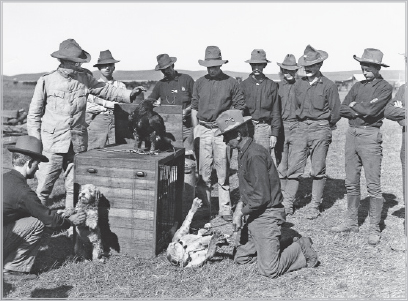
Colonel Roosevelt pets Teddy the golden eagle while members of the Rough Riders play with Cuba the dog and Josephine the cougar.
Both Josephine and Teddy were left behind in Tampa, since it would obviously have been nonsensical to bring a cougar and an eagle into battle.64 The third mascot, however, made it to Cuba. Roosevelt’s regiment had a “jolly dog” named Cuba, owned by Corporal Cade C. Jackson of Troop A from Flagstaff, Arizona. The mutt had dirty gray poodle-like fur and the personality of a Yorkie. Little Cuba could be easily scooped up with one hand. Frisky as a dog could be, Cuba actually accompanied the regiment “through all the vicissitudes of the campaign.” Aboard the Yucatan, Roosevelt had a Pawnee Indian friend draw Cuba—who ran “everywhere round the ship, and now and then howls when the band plays”—for his daughter Ethel.65
Every time the Rough Riders went into battle, Cuba would run off and disappear into the jungle, frightened by the noise of the artillery. Once the smoke cleared, however, when the men were bandaging wounds or frying eggs over a wood fire, Cuba would suddenly slink back into camp looking for handouts and back-scratches.66 Later, after the victory, a reunion photograph of the Rough Riders was taken in Montauk, with all three mascots in the same frame, Cuba begging near Colonel Roosevelt’s leg for either a treat or attention.67 According to Roosevelt, the dog was occasionally “oppressed” by Josephine but was sometimes able to “overawe the mountain lion “by simple decision of character.” Sometimes when Josephine growled, however, Cuba backed off, like a horse hearing the hum of a rattlesnake.68
Perhaps because Roosevelt was so comfortable with the trio of animals, knowing how to feed mice to the eagle and scratch Josephine behind the ears, these mascots added a Dr. Doolittle dimension to his character. In both San Antonio and Tampa Bay his two horses—Rain-in-the-Face and Texas—practically never left his side. When Vitagraph motion picture technicians were filming the Rough Riders wading ashore in Cuba off the Yucatan, a soldier was ordered to bring Roosevelt’s steeds safely onto the beach. Unfortunately, a huge wave broke on Rain-in-the-Face, causing him to drown: he inhaled seawater and could not be released from his harness. For the only time during the war days Roosevelt, his mind unsteadied, went berserk, “snorting like a bull,” as Albert Smith of Vitagraph recalled, “split[ing] the air with one blasphemy after another.” As the other horses were brought onto shore, Roosevelt kept shouting, “Stop that goddamned animal torture!” every time salt water got in a mare’s face.69
Skeptics of Rough Riders lore point out that Roosevelt was only seeking glory, always appearing—abracadabra—when a camera came along. Some critics carped that he used friendly reporters, such as Richard Harding Davis and John Fox, as tools. Roosevelt—so the opprobrium went—was thinking only about himself in Cuba, seeking fame amid the parlous carnage. What makes it clear that these are misrepresentations is the fact that all the surviving Rough Riders, even those who lost their legs or eyes, testified that he was a phenomenal leader. Never once did Roosevelt expect more from any volunteer than he gave of himself. No matter how dangerous the situation, he was in the thick of the action. The Spanish soldiers, for example, used smokeless powder, which made it impossible to tell where bullets were coming from in the jungle. At all hours and in all circumstances, Colonel Roosevelt, placing fate in the hands of God, refused to duck or run for cover as the bullets whizzed by. Calmly, even under enemy fire, Roosevelt helped wounded men make primitive tourniquets out of tree branches and bandannas. “Yesterday we struck the Spaniards and had a brisk fight for 2½ hours before we drove them out of their position,” Roosevelt wrote to Corinne and her husband, Douglas Robinson. “We lost a dozen men killed or mortally wounded, and sixty severely or slightly wounded [out of about 500]. One man was killed as he stood beside a tree with me. Another bullet went through a tree behind which I stood and filled my eyes with bark. The last charge I led on the left using a rifle I took from a wounded man…. The fire was very hot at one or two points where the men around me went down like ninepins.”70
The Spanish snipers in Cuba fired high-speed Mauser bullets and had deadly aim. The U.S. volunteers, including the Rough Riders, in fact, faced some of the worst combat in the history of warfare.71 As Stephen Crane, embedded with the Rough Riders, noted, “The tropical forests were regularly aglow in fighting.”72 Constant barrages of rifleshots resulted in heavy American losses. “In the period of about four and a half months they were together, 37 percent of those who got to Cuba were casualties,” historian Virgil Carrington Jones said of the Rough Riders. “Better than one out of every three were killed, wounded, or stricken by disease. It was the highest casualty rate of any American unit that took part in the Spanish-American campaign.”73
The letters Roosevelt wrote from Cuba crackle with the kind of martial detail also found in Crane’s Civil War novel of 1895, The Red Badge of Courage. Yet they’re also full of natural history, with observations about the “jungle-lined banks,” “great open woods of palms,” and “mango trees,” “vultures wheeling overhead by hundreds,” and even a whole command “so weakened and shattered as to be ripe for dying like rotten sheep.” Constantly, Roosevelt tried to conjure up nature as a way to increase personal power. When the director Terrence Malik made The Thin Red Line in 1998—a film about the Battle of Guadalcanal, based on a World War II novel by James Jones—he constantly cut away to exotic birds. This device helped illustrate that nature always watched the pageant of human combat from the sidelines, waiting for the artillery to cease before coming back to life and inventorying the new morning.
In Roosevelt’s correspondence and war memoir the land crab is omnipresent, almost the central metaphor of his Cuban campaign. Experts noted that the local species, Gecarcinus lateralis, commonly known as the blackback, Bermuda, or red crab, leaves the tropical forests each spring to mate in the sea. This made for an eerie spectacle all along Cuba’s northern coast as these disfigured creatures, many with only one giant claw, crawled out of the forests across roads and beaches to reach the water. Swollen with eggs, the female red crabs made their journey to the Caribbean Sea, which was their incubator, traveling five to six miles a day over every obstacle. Roosevelt noted that they avoided the sun’s glare, often gravitating to shade, just like wounded soldiers. As if in a scene from Borges or García Márquez, these burrowing red crabs—their abalone-like shells marked with gaudy dark rainbow swirls—while living on land, still had gills, so they needed to stay cool and moist. “The woods are full of land crabs, some of which are almost as big as rabbits,” Roosevelt wrote to Corinne; “when things grew quiet they slowly gathered in gruesome rings around the fallen.” 74
For the first time as an adult, Roosevelt was in the tropics. The very density of vegetation was daunting, the white herons often standing out against the greenery like tombstones. These red crabs were to him what tortoises or finches were to Darwin; everything about them spoke of evolution. Unlike the stone crabs of Maine, these red crabs, by contrast, weren’t particularly good-tasting; from a culinary perspective they were off-putting. Still, with food supplies sparse, the soldiers smashed the red crabs with rocks, discarded the shells, and mixed the meat into their hardtack, calling the dish “deviled crab.” Although the crabs were not dangerous, many Rough Riders were jarred awake at night by the formidable pincers. And the crabs were persistent—a soldier would shake them away from his bedroll, but after scurrying away, the crabs would come back a short while later. Sleeping off the ground on a hammock became more coveted than having a can of tobacco or bottle of rum. What disturbed Roosevelt the most about the Cuban crabs, however, was their attraction to carrion, fallen soldiers as well as dead animals. It wasn’t pleasant to think that the price of liberating Cuba was to die on a lonesome beach with red crabs and ants crawling all over your body, entering your mouth and eyes and ears.
In The Rough Riders, Roosevelt ably described the timeworn, brush-covered flat in the island village of Daiquirí where his volunteer regiment camped one evening, on one side of them the tropical jungle and on the other a stagnant, malarial pool fringed with palm trees. After the sacking of Santiago, many of his Rough Riders, a third of whom had served in the Civil War, lay wounded in ditches with flies buzzing around them. Sometimes, after an American died, local Cubans would strip the corpse of all its equipment. Humans could be scavengers, too. Roosevelt turned to images of avians and crustaceans to explain the horror of death. “No man was allowed to drop out to help the wounded,” he lamented. “It was hard to leave them there in the jungle, where they might not be found again until the vultures and the land-crabs came, but war is a grim game and there was no choice.” 75
Roosevelt then went on to tell of U.S. volunteer soldiers, comrades in arms, mortally wounded—perhaps shot through the stomach—dying without uttering a sound or gasping out a last wish. Men lucky enough to crawl propped themselves up against palm trees and expired in the dismal shade, their uniforms drenched in sweat, urine, and blood. A little field hospital was set up, and Roosevelt witnessed the pathos of men heaving for air, their lungs collapsed, broken ribs piercing vital organs. “We found all our dead and all the badly wounded,” he wrote. “Around one of the latter the big, hideous land-crabs had gathered in a grewsome ring, waiting for life to be extinct. One of our own men and most of the Spanish dead had been found by the vultures before we got to them; and their bodies were mangled, the eyes and wounds being torn.”*76
If that ghastly scene wasn’t harrowing enough, Roosevelt proceeded to tell another story. After staring at a corpse that had been mutilated by vultures, the blood having coagulated hours before, Rough Rider Bucky O’Neill, who at home was the mayor of Prescott, Arizona, came up to Roosevelt, shook his head, and said, “Colonel, isn’t it [Walt] Whitman who says of the vultures that ‘they pluck the eyes out of princes and tear the flesh of kings?” Not wanting to discuss poetry, Roosevelt muttered that he wasn’t sure about the proper attribution and walked away. Then, as if to demonstrate how tenuous life really was, Roosevelt matter-of-factly noted in The Rough Riders that O’Neill himself soon perished in the trenches of Cuba: “Just a week afterward we were shielding his own body from the birds of prey.”77
V
In his review essay “Kidd’s Social Evolution” for The North American Review, Roosevelt offered an example of when the dictates of natural selection superseded a love of wildlife. “Even the most enthusiastic naturalist,” he wrote, “if attacked by a man-eating shark, would be much more interested in evading or repelling the attack than in determining the precise specific relations of the shark.” 78 By this criterion, Roosevelt was a success in Cuba in two ways. He not only thwarted the Spanish sharks but managed to make detailed diary notes about vultures and crabs, which he planned to use in his memoir The Rough Riders.
When the victorious Rough Riders returned to the United States, Roosevelt was the most acclaimed man in America. His homeward journey, in fact, had been treated as major news. In hard, good health, taut and fit, his face coppered and his hair cut short, he was living his boyhood fantasy of being a war hero. Roosevelt had endured the vicissitudes of war with commendable grit, and now it was all bouquets. “His personal view of the war was reported to have been extracted from Social Darwinism,” the historians Peggy Samuels and Harold Samuels say in their landmark work Teddy Roosevelt at San Juan. “The superior Anglo-Saxon race necessarily won over the decadent Spaniards.” 79 As Roosevelt wrote in a new foreword to The Winning of the West, the Spanish American War had completed “the work begun over a century before by backwoodsmen” by booting “the Spaniard outright from the western world.”80
Anglo-Saxonism was hardly all there was to the victorious battlefield prowess of the Rough Riders. Something in the American wilderness experience, Roosevelt believed, gave his regiment the upper hand over the Spaniards. Not a single Rough Rider got cold feet or shrank back. Something about the mesas of New Mexico and Arizona had taught them to be tough. In an important essay, “The Darwinist Frontier,” the historian Patrick Sharp has contended that Roosevelt believed the American fighting spirit would continue only as long as outdoorsmen didn’t get lazy and rest on the laurels of modernity.81 Slowly, Roosevelt was developing a theory about this, which he would call the “strenuous life.” The majestic open spaces of America like the Red River Valley, Guadalupe Mountains, Black Mesa, Sangre de Cristo Range, Prescott Valley, and Big Chino Wash had hardened his men, teaching them the kind of self-reliance Emerson promoted. Wouldn’t Rough Riders make terrific forest rangers and wild-life wardens? Didn’t the wildlife protection movement need no-nonsense men in uniform to stop poaching in federal parks? “In all the world there could be no better material for soldiers than that afforded by these grim hunters of the mountains, these wild rough riders of the plains,” Roosevelt said. “They were accustomed to following the chase with the rifle, both for sport and as a means of livelihood.” 82
While the Rough Riders recovered from bodily atrophy at Montauk, where they were watched for signs of yellow fever, New York’s Republican Party was urging Roosevelt to run for governor that fall. Two prominent local politicians—Lemuel Ely Quigg (who had backed him for mayor in 1894) and Ben Odall Jr. (chairman of the Republican state committee), met with him on August 19 to strategize how best to turn a war hero, about whom New Yorkers were currently fanatical, into a sitting governor.
After the hot trenches of Cuba, the cool summer breezes on the Montauk peninsula were a welcome relief to Colonel Roosevelt, even though the makeshift barracks had no charm. There were ocean beaches and dunes, shrublands and tidal flats, brackish wetlands and salt marshes. As Roosevelt contemplated his political future, and as everybody clamored to shake his hand, the raccoons and white-tailed deer of Montauk brought balance to his newfound fame. There was even Nantucket Juneberry along the sand plains to meticulously study. One hundred years later, to honor the fact that the famous Rough Rider had lived at Camp Wikoff in 1898, the community of Montauk named a 1,157-acre wilderness area Roosevelt County Park.83
Much has been written about Roosevelt’s 137 days of service in the army, mostly blandishments in the style of Heroes of American History. The whole island of Cuba had been a theater to Roosevelt, and he was the lead actor. For more than fifteen years, Roosevelt had cultivated good relationships with reporters, and they delivered fresh copy of his dramatic charges with gusto in 1898. He even appeared on the cover of Harper’s Weekly. General Nelson A. Miles—who was famous for his part in the Indian wars of the West and had been in Cuba but never saw much action there—complained that Roosevelt had never actually charged up San Juan Hill. Miles was correct—Roosevelt’s skirmish was on Kettle Hill—but the misnomer was widespread, and it stuck. Why let a geographic mistake beset a powerful war story? The immodest Roosevelt even put in for a Medal of Honor for himself, only to be rebuked by Secretary of War Russell Alger. Although it took until 2001, Roosevelt, through the lobbying of his family, eventually won the Medal of Honor posthumously for his bravery during the battle for San Juan Heights.84
Every day that Colonel Roosevelt was at Montauk, the New York press, seemingly in concert, covered even his humdrum statements as if they were major news. There was no need to light the fuse of his celebrity, for he had already been hurtled onto the front page of every national newspaper. The mascots, in particular, grabbed a lot of notice. The New York Times ran a feature story about Roosevelt’s tame lioness, Josephine, reporting that the colonel might raise the big cat at Oyster Bay.85 Edith staunched that plan, however, and instead, Josephine was carted off to tour the West as an icon of the Spanish-American War and as a big-top attraction. Unfortunately, in Chicago Josephine got loose or was stolen and was never seen again.86
The eventual fate of Teddy the golden eagle was just as disappointing. Quite sensibly Roosevelt had donated the eagle to the Central Park Zoo, where he became a popular tourist attraction. Everything went well for Teddy during his first nine months at the zoo. But in May 1899 two bald eagles from Brooklyn—nicknamed the “heavenly twins”—were brought into Teddy’s cage to keep him company. Holy hell broke out. The feisty Teddy, presumably in an act of territorial protection, attacked one of the bald eagles, molesting the newcomer with his claws and beak. A few days later, the heavenly twins ganged up on Teddy, battering him severely. Within hours Teddy keeled over, dead. The zoo superintendent, John B. Smith, told the press that Teddy had died of a “broken heart,” having lost his “prestige” to the bald eagle. The body of the Rough Riders’ mascot was shipped to Frank M. Chapman at the American Museum of Natural History, where he was stuffed and put on display.* 87
The story of Cuba, at least, had a happy ending. Corporal Jackson, after being quarantined at Montauk, headed back to Flagstaff with Cuba at his side. Because he was a footloose type, unable to take care of a pet, he gave the celebrated dog to a family man, Sam Black, who had been a ranger in Arizona Territory. For sixteen years Cuba lived in the lap of luxury, catered to by the Black family. When Cuba eventually died of natural causes, he was buried along the scenic Verde River fifty miles southwest of Flagstaff, having been given a proper military funeral in recognition of his service to his country.88 Cuba was also given a special pet cemetary memorial at Sagamore Hill.
On August 20, Colonel Roosevelt was allowed to leave quarantine to return to Oyster Bay for five days. By the time he arrived at Sagamore Hill, there was a groundswell of support for his gubernatorial candidacy. From Buffalo to Brooklyn, Roosevelt had become public property, a war hero celebrated as a favorite son. All around Oyster Bay, he was greeted with shouts of “Teddy!” (which he hated) and “Welcome, Colonel!” (which he loved). Not for a minute did he suffer from the aftereffects of war; it was as if he had psychologically inoculated himself against trauma. “I would rather have led this regiment,” Roosevelt wrote to a friend, “than be Governor of New York three times.”89
Cleverly, Roosevelt had kept diaries in Cuba, jotting down exact dialogue and stream-of-consciousness impressions. His editor at Scribner, Robert Bridges, worried that if Roosevelt ran for governor, the war memoir they’d been discussing would have to be postponed. “Not at all,” Roosevelt told him, “you shall have the various chapters at the time promised.”90 And there were always his biophilic notes, sent to his children from Cuba. “There is a funny little lizard that comes into my tent and it’s quite tame now,” read one, “he jumps about like a frog and puffs his throat out. There are ground doves no bigger than big sparrows and cuckoos almost as a large as crows.”91
Once back at Camp Wikoff, Roosevelt wandered around Montauk Point, taking care of his golden eagle and leading little Cuba on long walks. (The dog greeted many of the Rough Riders from dockside as they returned to the United States.) Roosevelt seemed like a changed man, disconcertingly calm, studying the undercarriage of wigeon as they flew overhead. Sometimes, particularly when reporters were around, he rode his horse up and down the beach with the fervor of a plainsman.92 Having “driven the Spaniard from the New World,” Roosevelt could relax—he had been relieved of the burden of of his father’s buying his way out of Civil War service. With nothing more to prove, he could excel as a powerful politician, soapbox expansionist, true-blue reformer, naturalist writer, and conservationist. After his “crowded hours” avoiding whizzing bullets and tropical diseases, he turned to studying the shorebirds of Long Island. As always, Roosevelt wanted to be the master of his own backyard, even as he prepared to run for governor of New York.
Just how much Roosevelt identified himself with the American West was evident at the send-off his regiment gave him on September 13. A bugle called, and all the Rough Riders dutifully assembled into formation. In front of them was a card table with a blanket draped over a bulky object. Roosevelt was inside his tent, writing letters, when the troop requested his presence outside; he immediately concurred. The First Volunteer Cavalry had a parting gift for their humane and courageous colonel. After some moving words, the blanket was lifted to reveal a bronze sculpture of 1895 by Frederic Remington, Bronco-Buster. (“Cowboy” was the western term for a cattle driver. A “bronco-buster” broke wild broncos to the saddle.93) Tears welled up in Roosevelt’s eyes, his voice choked, and he stroked the steed’s mane as if it were real. “I would have been most deeply touched if the officers had given me this testimonial, but coming from you, my men, I appreciate it tenfold,” Roosevelt said. “It comes to me from you who shared the hardships of the campaign with me; who gave me a piece of your hardtack when I had none; and who shared with me your blankets when I had none to lie upon. To have such a gift come from this peculiarly American regiment touches me more than I can say. This is something I shall hand down to my children, and I shall value it more than I do the weapons I carried through the campaign.”94
The Rough Riders had given Colonel Roosevelt the best gift possible. Remington’s bronze was far superior to a gold-plated pistol or signed group photograph. It summed up Theodore Roosevelt well: a fearless western cowboy, stirrups flying free, determined to tame a wild stallion by putting the spurs to it, a quirt in his right hand and a fistful of reins in the other. Like much of Remington’s finest pen-and-ink work, Bronco-Buster, his first venture into sculpture, was charged with kinetic movement and free-floating energy. At fast glance the horse, forelegs held high, practically jumps to life.95 Roosevelt had succeeding in transforming his sickly childhood in New York City into a frontier saga worthy of Captain Mayne Reid. “The men of the West and the men of the Southwest, horsemen, and herders of cattle, have been the backbone of this regiment,” Roosevelt wrote, “as they are the backbone of their sections of the country.”96 A Remington casting of Bronco-Buster is now permanently housed in the White House Oval Office as a table centerpiece. And in the Roosevelt Room hangs an equestrian portrait of T.R. as Rough Rider by the Polish artist Tade Styka.
After the Spanish American War, Roosevelt and his commanding officer, Leonard Wood, became close personal friends. Together the two veterans would hike Rock Creek Park discussing everything from immigrants’ assimilation into America to the intolerable sanitary conditions in Cuba. Sometimes they brought young people with them on these outings. “Colonel Roosevelt especially made these walks of the greatest interest to the children,” Wood recalled. “He transmitted to them something of his own keen interest in nature, his love of birds, his interest in woodcraft, and in a thousand ways attempted to instill in them an interest in and an understanding of God’s world as he saw it, to implement healthy tastes, and to build up a love for a wholesome outdoor life. At the same time he was full of stories of men and animals, stories which tended to build up a love for birds and animals and of wholesome outdoor life for the woods and the fields at a time when it was easy to lay the right foundation and to plant seed which would bear good fruit. He had a wonderful fund of information about birds and animals which he was continually passing on to the youngsters in a way they could understand.”97
Roosevelt’s campaign for the New York governorship in the fall of 1898 did, however, face obstacles. Serious concerns were raised over whether the colonel was a resident of New York (he’d been paying taxes in Washington, D.C.).98 Even within the state Republican Party, there were some who refused to let this new hero of San Juan Heights forget his record as a dyed-in-the-wool reformist. At times, working hard at retail politics made Roosevelt feel like a draft animal. But once he took to the “Roosevelt Special,” a whistle-stop train in which he toured towns and cities, often with Rough Riders standing proudly at his side, the election was essentially secured. In Syracuse, for example, Roosevelt orated on his fortieth birthday from the back of a train with the ferocity of William Jennings Bryan, pounding his fist, spittle flying, speaking of the greatness of the American flag, and pronouncing that better days were just around the bend. It was quite a show. And on November 8, 1898, Election Day, Roosevelt rode triumphantly to victory, defeating fifty-two-year-old Judge Augustus Van Wyck by 17,794 votes (out of over 1.3 million cast).99 His election was a testament to his power as mythmaker of self. Roosevelt was once again prepared to take a city—in this case Albany—by storm just like in Cuba.