
CHAPTER SEVENTEEN
I
Forest reserves weren’t all that President Roosevelt was preserving for prosperity. As a fervent enthusiast of national parks, Roosevelt hoped to establish a few new ones during his tenure as president. Only five national parks existed in the spring of 1902—Yellowstone, Sequoia, General Grant, Yosemite, and Mount Rainier—and he was eager to establish a sixth. The National Park Service would not be created until 1916, when President Woodrow Wilson signed the Organic Act, so all five of these national treasures were managed independently by the Department of the Interior. The Organic Act’s high-minded mandate was to “conserve the scenery and the natural and historic objects and the wild-life therein and to provide for the enjoyment of the same in such manner and by such means as will leave them unimpaired for the enjoyment of future generations.” But in 1902 the national parks were run by the U.S. Army (Mount Rainier being an exception), with the commanding officer of the troops serving as superintendants, reporting directly to the Secretary of the Interior.1
All other things being equal, President Roosevelt’s first choice for a new national park was the Grand Canyon plateau—then a national forest in which extraction was allowed. Roosevelt had first learned of the Grand Canyon when he read Major John Wesley Powell’s harrowing account of journeying down the Colorado River between 1869 to 1872 as a teenager. There was nothing that President Roosevelt didn’t like about the self-taught Powell—a feisty one-armed Civil War veteran and brave explorer who went on to found the U.S. Geological Survey and the U.S. Bureau of American Ethnology. To Roosevelt the Grand Canyon was an immortal landscape. Just as Yellowstone had been ballyhooed in magazines and periodicals during his youth, in 1902–1903 the Grand Canyon was being touted as an unrivaled natural wonder. Gorgeous photographs of the deep gorge with snow around its rim appeared in the popular press, anticipating the heroic work of Ansel Adams (who was born in 1902). One of America’s finest landscape painters—Thomas Moran—celebrated the Grand Canyon in canvas after canvas, to great critical acclaim.
Opposition against declaring the Grand Canyon a national park, however, was fierce. Arizona was a mining territory, where rock blasting was pervasive. Mining claims had already been staked (with encouragement from the U.S. government) for the chance to extract from the Grand Canyon zinc, copper, lead, and asbestos. The Roosevelt’s idea of withdrawing the nearly 300-mile Colorado River gorge from the private sector was anathema to many in Arizona, including the governor of the territory, Nathan Oakes Murphy. Murphy had journeyed to Washington, D.C., in 1902 to lobby against all of Roosevelt’s irrigation and federal forestlands projects. An antigovernment zealot, Murphy wanted to oust Arizona’s Indians from federal reservations so that the land could be sold to Anglo settlers. Popular in the southern counties of Maricopa and Pima, Murphy fancied himself as the voice of small-time miners and land developers. You might say he was allergic to anything stamped “Interior” or “Agriculture.” 2 The Tucson Daily Citizen, in fact, deploring his anti-Roosevelt, anticonservationist bias, fulminated that Murphy “should have retired from the Governorship of Arizona before undertaking to promote the interests of the water stealers and land grabbers. He should have divested himself of his official character before entering the lobby to advocate private monopoly at the expense of public interests.”3
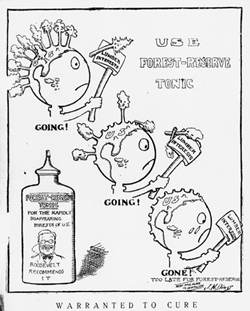
Roosevelt employed cartoonists like Ding Darling to help promote his grand vision for national forests throughout the American West.
“Use Forest Reserve Tonic.” (Courtesy of Ding Darling Estate)
Realizing that turning the Grand Canyon into a national park was an undertaking strewn with hurdles, Roosevelt looked for a softer, less controversial natural legacy to preserve. Turning to Chief Forester Gifford Pinchot for advice, Roosevelt was told that Crater Lake in southern Oregon was perhaps an ideal choice for a relatively conflict-free national park. In hindsight, Pinchot unquestionably gave the president excellent advice. Pinchot’s idea was to save Crater Lake quickly and then have the president journey by train to the Grand Canyon to stir up public sympathy for creating a national park there.
The party of twelve prospectors who discovered Crater Lake in June 1853 saw its loveliness with fresh eyes, and it cast a spell on them.4 In 1865, the Sprague and Stearns expedition reported on the amazing site to the public at large. Nearly five miles in diameter, situated in the Cascade Mountains, about two hours by horse northeast from Medford (a Klamath County depot juncture for the Oregon and California railroad), Crater Lake was the result of a volcanic eruption. No lake anywhere else was as chameleon-like blue in changing color as this natural wonder. The lake’s edges, for example, owing to the westering light, were sharp turquoise while its center appeared to be a bottomless indigo blue.5 Even colorist as fine as Marin or O’Keeffe would have been hard pressed to replicate its myriad hues of blinding blue. Everything about the elliptical site suggested geological aberration. In the pre-Columbian era a horrific eruption had capsized the peak leaving an immense cavity. Over the millennia, melting snow and rain filled the 2,000-foot-deep crater.
With a depth of 1,943 feet, Crater Lake was far deeper than any of the Great Lakes—deeper, for that matter, than any other lake in the United States. To Native American tribes—specifically the Klamath and Modoc—this freshwater lake was a sacred site, the opening to an underworld where a giant supposedly ruled with saber and spear. Myths about Crater Lake abounded. The Klamath and Modoc believed that Wizard Island, in the middle of the lake, was the giant’s decapitated head. According to another myth the ruling deity of Crater Lake was an oatmeal-colored creature like the Loch Ness monster. In still another myth, the supposedly “unreachable bottom” was where evil spirits or sea devils resided in lodges.6
Many a natural site holds a mystery, but Crater Lake was perhaps unique in that people who had looked down at the extinct volcano basin from the twenty-mile circle of cliffs often felt haunted by the visual memory, as if they themselves had witnessed the ancient cataclysm—the lava streams ripping off the mountaintop—which had occurred in the area 7,700 years before. Out of such volcanic disruption in the Cascades was born one of the prettiest lakes in America, the equal of Lake George in New York and Lake Tahoe in California and Nevada. Even though the temperature of Crater Lake was low, it seldom froze in wintertime.7
President Roosevelt himself had never visited Crater Lake—and never would. But he had heard from Gifford Pinchot about the extraordinary efforts of an indefatigable Oregonian conservationist determined to save it. Just as Yellowstone had George Bird Grinnell and Yosemite had John Muir, Crater Lake had William Gladstone Steel. Born in Strafford, Ohio, seven years before the Civil War, Steel had first heard about Crater Lake while living in Kansas as a youth. He said he had read a reverential story about the supposedly bottomless freshwater lake in a Topeka or Wichita newspaper, in which a noontime sandwich was wrapped. The story stuck with him. Steel’s transient parents, stricken by “Oregon fever,” steadily went westward, eventually moving the family to Portland, a regional hub town of about 1,000 people along the alluvial Colombia River. (In the nineteenth century Portland was often called “Stump Town” do to excessive area-wide lumbering.) After growing up in the Midwest region Steel was enthralled by the thought of exploring the green mountain valleys of the Pacific Northwest. Upon graduating from high school, between jobs, Steel took to exploring both the high and the low country of Oregon. No slope or ravine was too mundane for his hiking-boots.8
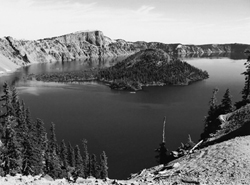
Crater Lake Nation Park in Oregon was saved by the Roosevelt administration. Roosevelt called it “an heirloom.”
Crater Lake National Park. (Courtesy of the National Park Service)
In 1881, at age twenty-seven, Steel started a promotional journal with his brother George. They filled its pages with geographical data and called it The Resources of Oregon and Washington. The Pacific Northwest was a densely forested geological wonderland, and the Steel brothers wanted to inventory the far-flung natural resources. Their articles were aimed not at tourists but at mining companies, timber titans, and fish-canning outfits, which were just starting to cast an eye on the region. The brother’s business partner, Chandler B. Watson, had visited Crater Lake in 1873 and was full of its praise. Remembering the story about Crater Lake in the newspaper that had wrapped his sandwich, and always game for a fun week-long trip, Steel traveled 250 miles to the remote site, arriving on August 15, 1885. He wanted to see its reported splendor with his own eyes; it proved to be the turning point of his life. Captain Clarence E. Dutton of the U.S. Army would likewise become bewitched by the lake.
Journeying back to downtown Portland from Crater Lake, Steel developed plans to create a national park out of the “awe-inspiring temple.” Gripped by the lake’s spellbinding blueness, for the next seventeen years he became a monomaniac on the subject. Intensive cultivation of new conservationist tactics became his focal point. Tall and balding, with the physique of a downhill skier, Steel was extremely well liked in Portland’s social circles. Although he wasn’t a first-generation Oregon Trail pioneer, he was treated like one, receiving invitations to all the important civic functions and town hall meetings in the Willamette valley. Officially, Steel was superintendent of postal carriers in Portland, a job which allowed him to rub elbows with everybody of consequence in town. He was respected for his self-control, and his status was enhanced by his ambitious brother George, who had married money and became postmaster. Marshaling data about how the new Yellowstone National Park was attracting tourists from the east coast to Wyoming and Montana, Steel also consulted with lawyers and judges to learn the ropes of the legislative process.9 “To those living in New York City,” he boasted, “I would say, Crater Lake is large enough to have Manhattan, Randall’s, Ward’s, and Blackwell’s Islands dropped into it, side by side without touching the walls, or, Chicago or Washington City might do the same.”10
After diligently doing his homework, Steel spearheaded an effort to have two bills concerning Crater Lake National Park introduced in Congress. There was a rumor in Portland that homesteaders and developers wanted to acquire Crater Lake so as to log the surrounding tracts of mountain hemlocks, white bark, red firs, and lodgepoles, and even sweeping pockets of ponderosa pine. Steel’s first plan of action was to have the U.S. government reserve the townships around the lake to prevent exploitation or settlement. If that could be accomplished, the next step was to have the U.S. Geological Survey map and scientifically analyze the enthralling terrain. Then, very quickly, perhaps within the year, a national park could be established.
Never one to let a lag develop between his musings and action, Steel boned up on the law and traversed the countryside to find support. He was successful in persuading the U.S. Geological Survey, headed by Powell, to make a complete inventory of Crater Lake. For approximately a month Captain Dutton, accompanied by an able party of geologists and soldiers, lived along the shores of Crater Lake, an area, according to the New York Times, rarely seen by white men. The Times recounted in vivid detail the hardships endured by Captain Dutton’s survey team: donkeys pulling canoes for more than 100 miles up snowbound mountain ridges; pulley ropes dropping the boats down sheer cliffs; measurements of depth taken with the most advanced nautical equipment available west of Denver. After surviving the howling winter winds, Dutton sent Powell a detailed letter about their findings. He declared that as a result of more than 150 soundings aimed at surveying the lake’s bottom he believed the depth was 2,005 feet, making Crater Lake, as the Times put it, the “Deepest Body of Fresh Water on the American Continent.”11
Traditionally, Americans like “firsts” and the “biggest,” “widest,” or “tallest” of anything. So the fact that the Times and other newspapers had declared Crater Lake the deepest greatly helped Steel’s preservation efforts. Oregonians, like everybody else, enjoyed bragging. Dutton helped Steel in another fundamental way. In a long letter to Powell, published in part by the Times, Dutton described the geological uniqueness of the lake, mentioning “splendid examples” of glacial striation and rare submerged cinder cones 800 to 1,200 feet high. Many readers probably skipped over Dutton’s engineer-like prose about pumice and tufa, but one effect of his findings was to make the entranced Crater Lake the Yellowstone of the Pacific Northwest.12
Taking a lesson from the John Muir School of Publicity, Steel, with the U.S. Geological Survey report at his side, started introducing Portlanders to the importance of conservation, as simply as possible. Having met with Muir at Mount Rainier, Steel learned how to lobby effectively on behalf of nature. Steel relied on inoffensive efforts (like those of the Sierra Club), aimed at raising consciousness about Crater Lake and other sites in the Cascade Mountains. For starters he organized an Alpine Club (which predated the Sierra Club) and participated in the first nighttime illumination of snowcapped Mount Hood, accomplished with red fire and flares. After having a Portland summit meeting with Muir in August 1888 on strategies of preservation, he released rainbow trout into Crater Lake, hoping to win the support of sportsmen throughout the Pacific Northwest.
Two years later Steel published his first and only book, appropriately titled The Mountains of Oregon. Nobody would ever say that Steel wrote with the eloquence of Burroughs or Chapman, but The Mountains of Oregon dutifully presented the geological wonders of Crater Lake, reading like a fanciful lawyer’s brief for granting it national park status. Yawning chasms, high precipices, weird grandeur, hanging rocks, immense cliffs—the book was filled with enraptured descriptions which leaned toward the style of come-ons for roadside attractions. Mainly, Steel was at pains to explain just how large Crater Lake was; he called it an “immense affair” that would dwarf Chicago and Washington, D.C., combined. Photographs of such Crater Lake sites as Mill Creek Falls and Vidae Cliff were included, complementing the prose. There was even a photograph of himself, sitting with fellow Oregon conservationists, his dark, pointed beard suggesting that he was a Burroughs or Muir in the making. The climax of The Mountains of Oregon came when Steel said that even though the Crater Lake area was teeming with game—deer, bears, and cougars—he refused to hunt because the “grandeur and sublimity of the surroundings” filled him with awe.13
Upon receiving a copy of The Mountains of Oregon Muir wrote to Steel that he was impressed by the “interesting and novel mountain material” four years later Muir—the bard of Yosemite—published his own riveting work The Mountains of California.14 As propaganda, The Mountains of Oregon—a hodgepodge of miscellaneous pieces—worked beautifully. Even timber barons liked seeing the magnificence of their own backyard. In 1893, in large measure as a result of Steel’s six years of lobbying, a 4-million-acre Cascade Range Forest Preserve was established in Oregon. The forest reserve encompassed land more than 300 miles long, from the Columbia River to the California state line; it was the largest protected wilderness area in the country. It was a triumph for the intensely focused conservationist against the timber speculators.15
When Roosevelt was elected vice president in 1900, Steel was a forty-six-year-old Republican diehard with unimpeachable conservationist credentials. No firm information exists about whether he knew anything of Roosevelt’s pro–national park convictions. He was a longtime bachelor known for weekend forays into vagabondage, devoted night and day to the cause of Cascades preservation, and the wheel of fortune was starting to turn his way. That February he had married Lydia Hatch, who was said to be the one and only love of his life. Besides having his wedding reported in the Portland press, Steel started receiving communitywide praise for his program to introduce rainbow trout into Crater Lake. Reports from southern Oregon indicated that his “planting” of rainbow trout had worked; the trout were flourishing, easily surviving the bitter-cold winters (skeptics had feared that this was impossible). Steel, in essence, had provided a welcome twist to wildlife reintroduction efforts, which usually were like those of the Boone and Crockett Club. For in the case of Crater Lake, there was no “re” to be concerned about. Recognizing that the clear waters were ideal for trout, he introduced them to a new habitat in the Cascade Mountains. Congratulatory letters came his way from anglers all over America.
Ironically, Crater Lake’s fortunes took a turn for the better when President McKinley was assassinated. With Theodore Roosevelt as president, the chance that it might become a national park was increased tenfold. Over the years Steel had made many friends in the burgeoning conservation movement from coast to coast, mailing copies of The Mountains of Oregon to judges and legislators in the hope of teaching them about the pristine Cascades.16 Of all the valuable contacts Steel had cultivated, however, none outshone Gifford Pinchot. In 1896 Steel had an opportunity to take Muir and Pinchot on a camping excursion to Crater Lake. Although Muir was only moderately impressed, Pinchot was knocked out by the sparkling blue water glistening in the midday sun. As he wrote in his memoir Breaking New Ground, “Crater Lake seemed to me like a wonder of the world.”17
Further bolstering Steel’s effort to create a national park was the fact that neighboring Washington state had won a campaign to have 14,411-foot Mount Rainier become a national park in 1899; the park was so large that it created its own weather system and sometimes received 1,000 inches of snow annually.18 Playing on the rivalry between the two Pacific Northwest states, Steel reminded Oregonians that Crater Lake was every bit as gorgeous as the peaks of the Tatoosh range. Whenever Steel’s sales pitch for Crater Lake was falling flat or a setback occurred, he knew Pinchot was available for encouragement. No sooner had Roosevelt delivered his First Annual Message to Congress in December 1901 than Steel solicited letters of endorsement from Muir, Pinchot, and others. Muir begged off—he was preoccupied with his own agenda in Yosemite—but Pinchot rallied to Steel’s side like a knight in shining armor. “You ask me why a national park should be established around Crater Lake,” Pinchot wrote to Steel on February 18, 1902, in a letter intended for public dissemination. “There are many reasons. In the first place, Crater Lake is one of the great natural wonders of this continent. Secondly, it is a famous resort for the people of Oregon and of other states, which can best be protected and managed in the form of a national park. Thirdly, since its chief value is for recreation and scenery and not for the production of timber, its use is distinctly that of a national park and not a forest reserve. Finally, in the present situation of affairs it could be more carefully guarded and protected as a park than as a reserve.”19
By procuring this testimonial from Pinchot and using it as exhibit A when presenting the Crater Lake bill to Congress, Steel had the equivalent of a winning lottery ticket. Quite naturally Roosevelt would defer to Pinchot’s wisdom about the Oregon backcountry. Steel met a formidable roadblock—Speaker of the House David Henderson, a heavy-fisted politico from Iowa. Ticked off because Steel and Pinchot were foisting a national park on Congress even though T.R. had been president for only a few months, Henderson, representing the antiunion Midwest and western timber-mining interests, offered an adamant “no.” By dint of his intimidating seniority he blocked the bill from even being debated. As the first U.S. congressman from west of the Mississippi River to serve as House Speaker, Henderson was mistrustful of federal interference with the free enterprise system. Cranky for a midwesterner, Henderson, whose obstinacy could quickly turn to fury, had worried that Roosevelt had gone too far in pushing natural resource preservation in his First Annual Message to Congress. But at heart Henderson—who had been a valorous colonel in the Civil War and had lost a leg in 1863—was supportive of Roosevelt’s militarism.20 With a little arm-twisting by the new president, Henderson, bristling all the way, reluctantly capitulated. After all, in the context of picking and choosing fights Crater Lake hardly seemed worth crossing swords with the Roosevelt administration.
It didn’t hurt that Roosevelt had backup support for the Crater Lake bill from Congressman John Lacey—also from Iowa—who worked mightily on getting Henderson to change his mind. Lacey had visited Oregon in 1887. He was immediately drawn to the Cascades, and he understood that the Pacific Northwest forests were the greatest in the world. Places like Mount Hood and Crater Lake, he knew at once, should be saved for posterity. The slow, sad death of the great trees as a result of wildfires sickened him. “The whole country was covered by a pall of smoke from the burning forests,” Lacey recalled to the Chicago Tribune. “This was more wicked than the destruction of our forests on the Atlantic only because the great woods of the Pacific are finer, and for the further reason that they are our last.”21
Double-teamed by Roosevelt and Lacey, Henderson acquiesced and did an about-face, and the Senate passed HR 4393 on May 9. “You give me more thanks than my small share in getting the Crater Lake bill passed deserves, but I am sincerely glad it has got along so far,” Pinchot wrote to Steel on May 15. “There is no doubt, in my judgment, that the President will sign it.”22
Although Pinchot wouldn’t lead the U.S. Forest Service for three more years, the impressive power he exerted in creating Crater Lake National Park was a prelude of grand conservation achievements to come. Not only did the utilitarian Pinchot enter the preservationist domain with Crater Lake, but he solidified his alliance with Steel. Mountaineers in arms, both men loathed the reckless way the General Land Office (GLO) of the U.S. Department of the Interior was dealing with the unexplored Cascade Mountains. The saving of Crater Lake was a marker in the conservationists’ struggle in the Pacific Northwest, an early indicator that the Roosevelt administration was going to play hardball against the shameful unregulated timbering. Just as important, Pinchot had found a “world wonder” for his boss to establish as America’s sixth national park, one which wasn’t mired in too much controversy. The word “wonder,” in fact, during the first two decades of the twentieth century, was the term conservationists used in public discourse to save wilderness sites. A mere forest or lake might seem commonplace, but a “wonder” might bring much needed tourist dollars into local towns. And it worked! Using the U.S. Geological Survey as their base, the tag team of Pinchot and Steel tried to insert the words “deepest” and “wonder” into any public conversation about Crater Lake.
When President Roosevelt signed the Crater Lake bill on May 22—setting aside 240 square miles—he was proud. America had its sixth national park, and its first in Oregon.* Crater Lake was saved for both “great beauty and scientific value.”23 Earlier that day Roosevelt had participated in a ceremony at Arlington National Cemetery honoring the soldiers killed in Cuba, Puerto Rico, and the Philippines during the Spanish-American War; he was one of 500 veterans present.24 The signing of the bill saving Crater Lake took only five or ten minutes of his busy schedule that afternoon; it was incidental. Still, it was a rewarding few minutes. A sentimentalist at heart, Roosevelt now knew what it must have felt like to be Ulysses S. Grant thirty years ago, creating Yellowstone. As a courtesy, Roosevelt had the signing pen shipped to Steel in Portland as a well-deserved souvenir. Applauding Roosevelt and the U.S. Geological Survey for the first-rate report, the New York Times described Crater Lake as a natural wonder whose “grandeur” rivaled “anything of its kind in the world.”25
II
Inspired by the saving of Crater Lake, President Roosevelt looked for another natural “wonder” to designate as a national park. The whole notion of “scenic nationalism” was in vogue.26 During the 1880s, while living in the Badlands, Roosevelt had perhaps heard about a site in the Black Hills: a “hole that breaths cool air,” considered sacred by the Lakota people.27 It was known as Wind Cave, and the Lakota believed that a beautiful woman—the “buffalo woman”—had once floated out of it to give her people bison. Other tribes believed that a demon or dragon lived in its depths. Some Native Americans believed that the cave had magical powers, that it could predict weather. They weren’t completely delusional: the cave opening did serve as a sort of primitive barometer. When the weather was good, air would blow into the cave. However, when a storm approached the low air pressure caused higher pressure to swell inside the underground cavern, causing air to be forced out in a loud, dramatic fashion.28
Even though Wind Cave is one of the longest underground mazes in the world (encompassing more than 130 miles of passages), when Jesse and Tom Bingham stumbled upon it while deer hunting in 1881 there was only one entrance: a twelve- by ten-inch “blowhole.”29 As legend has it, the air pouring out of the hole blew the Binghams’ cowboy hats off their heads, like a gust off Lake Michigan. Hoping that they had discovered a gold mine, the Binghams returned to Wind Cave the following day with curious friends, only to have their hats now sucked into the maw of the cave; the wind had shifted 180 degrees in less than twenty-four hours. The Binghams were afraid to explore the cave. Perhaps they would be attacked by bats or snakes. But Charlie Crary wasn’t hesitant. Boldly he climbed into the blowhole, as if he were Professor Lidenbrock in Jules Verne’s Journey to the Center of the Earth. He unraveled a reel of twine so that he could find his way out, and he emerged from Wind Cave unscathed and almost stuttering with excitement. His mind was dazzled by the elaborate, delicate, honeycomb-patterned boxwork he had encountered, fragile crystals deposited around like glitter. In his historical study The National Park, Freeman Tilden matter-of-factly describes the cavernous rooms as “lacy compartments.”30
Crary had seen one of the most amazing boxwork formations in the world. More than 300 million years old, Wind Cave is a subterranean wonderland of fractured limestone, crystal fins, and calcium deposits. Words cannot do justice to the diverse geological formations and underground lakes. A whole new geological vocabulary, in fact, was created to describe various types of boxwork: for example, starburst, nail quartz, gypsum flowers, and helictite bushes. With a constant temperature of fifty-three degrees Fahrenheit, the cave network was a perfect retreat from the Black Hills’ cold winters and hot summers. Some of the passageways are wet and slippery. An astounding 95 percent of the world’s mineral boxwork was found in the cave. Yet much of it was fragile, snapping off when a spelunker’s head bumped it or a hand grasped it.
Between 1881 and 1890 South Dakotans hoped that gold could be grubsaked in Wind Cave, as it had been in the Black Hills. Miners tried, but with no luck. Instead, the cave complex started attracting explorers and curiosity seekers. Periodically the local Custer Chronicle called Wind Cave a “wonder,” and the Hot Spring Star added the mystical note that “no bottom” had been found. It was frustrating for locals to sit on a great mineralogical assemblage and not be able to turn a profit. Alvin McDonald of the South Dakota Mining Company considered finding the cave’s bottom a challenge akin to Robert E. Peary’s going to the North Pole. During 1890–1893 McDonald worked underground, keeping a detailed diary about various caverns and rock formations. He also did some drilling. Cave passages were enlarged for tourists and wooden staircases were erected. McDonald emerged with plenty of artifacts and reams of descriptive prose about stalactites worthy of Verne—he named rooms and mapped trails like an explorer in a work of science fiction—but he was forced to give up the “idea of finding the end of Wind Cave.”31
When Roosevelt became president, the effort to learn more about Wind Cave was put on a fast track. Homesteading was banned anywhere surrounding the cave’s entrance. On April 4, 1902, the GLO commissioned a surveyor in Rapid City to map as many rooms and passageways as he could. Many locals, however, considered this a fool’s errand. The U.S. government was also keenly interested in determining the precise amount of minerals available for possible mining. Lawsuits over who owned Wind Cave were put aside as the U.S. government tried to inventory and map the labyrinthine caverns.
As the GLO went about its work, Senator Robert J. Gamble of South Dakota—a Republican—introduced a congressional bill declaring Wind Cave America’s “second wonder” (after Yellowstone National Park).32 Worried that vandals and thieves were stealing crystals and rocks, Gamble claimed that the U.S. Geological Survey and Theodore Roosevelt were on his side in creating the new national park. The New York Times aided the cause by publishing remarks by an unidentified U.S. government employee who said that Wind Cave was a “wonderful evolution of nature” exuding “grandeur, grotesqueness and beauty.” The Times itself said that giving Crater Lake the status of a national park was a wise move and recommended the same for Wind Cave. “There are something like 3,000 chambers and 100 miles of passages,” the Times enthused, “containing many curious features and formations.”33
Once again Congressman Lacey came into the act, like a bird going after split grain or thistle seed, backing Senator Gamble’s action. Lacey’s friends worried that he was fatigued by the legislative struggle; he would arrive at his congressional office at six AM and not leave until nine PM. When he sponsored the bill in Congress in June 1902, fresh from his success with Crater Lake, Lacey argued that Wind Cave had to be a national park in order to stop vandals from destroying it. Reportedly, he said, boxwork thieves were out of control. The same grim fate was befalling the Petrified Forest of Arizona and the Anasazi cliff dwellings at Mesa Verde in Colorado. And there was another component to Gamble and Lacey’s argument. For meteorological reasons alone, they said, Wind Cave needed to be saved and maybe someday bottled up to furnish electrical power. (More than 1 million cubic feet of air was emitted or taken in every hour at the blowhole entrance.)
When both the House and the Senate approved bills to establish America’s seventh national park, Roosevelt was gleeful. On January 9, 1903, without ceremony, he reserved 10,522 acres in western South Dakota to become Wind Cave National Park (eventually it would be enlarged to 28,295 acres). Although it is doubtful that Roosevelt realized this at the time, in addition to the boxwork formations he saved a fine example of mixed-grass prairie, one to which, in coming years, the Bronx Zoo bison would be reintroduced. Wind Cave National Park also became a prime bird-watching location, especially for enthusiasts seeking for the uninhibited song of western tanagers and lazuli buntings. Hunting and fishing were prohibited in the park, and no ponderosa pines could be chopped down for firewood. Rule Number 1 of the General Regulations for Wind Cave was that removal of formations was forbidden and nobody could ever again enter the cave without the approval of the U.S. government. The posted notices read: “All Persons Are Liable to Prosecution.”
Wind Cave has proved to be the “wonder” Senator Gamble called it. The mapping and exploring of its passageways continued unabated. When Wind Cave National Park celebrated its centennial in 2003 only an estimated 5 percent of the cave had been explored. Visitors were routinely dumbstruck by its size and complexity. Like the ocean floor it once was, the cave complex remained an unfathomable mystery for future generations to take up. The Carnegie Institution was founded in 1902, and there was some hope that grants could be given to scientists to solve the cave’s mysteries. With Roosevelt’s new national parks—Wind Cave and Crater Lake—a fait accompli, under the safekeeping of the Interior Department and U.S. Army, two important links in the chain of American “wonders” had been strengthened. And President Roosevelt, as far as western sites were concerned, was just getting started.
III
Contributing to Roosevelt’s promotion of the American West was the publication of his friend Owen Wister’s novel The Virginian: A Horseman of the Plains in 1902. Dedicated to Theodore Roosevelt,* it told the story of a cowboy, a natural aristocrat, who was involved in Wyoming’s Johnson County War in the 1890s. Wister’s sophisticated use of cowboy imagery and the cowboy culture had echoes of Roosevelt’s own days in North Dakota. Wister, a Harvard graduate (summa cum laude) whose short stories inHarper’swere extremely popular, had hit the mother lode with this action-packed novel, where right (even vigilante justice) prevailed over wrong. The Virginian became an overnight sensation; more than 200,000 copies were sold in 1902–1903 alone. While it lacked the humor of Mark Twain and the sophistication of Henry James, The Virginian was nevertheless a novel of considerable distinction. (Unfortunately, it is usually remembered only for the Zane Grey pulp western phenomenon it inspired.)
President Roosevelt had proofread part of The Virginian before publication, wanting Wister to tone down the sadistic violence and gratuitous blood and gore. Roosevelt insisted that the protagonist—the heroic cowboy, who is never given a name—should become the arbiter of western culture and morals, a citadel of manly virtue. Amazingly, Wister agreed to make the changes. Like Roosevelt, Wister had traveled all over the West—in Arizona, California, and Washington, always going back to Wyoming—to study cowboys closely. Often depressed, failing to find a producer for his opera about Montezuma, Wister clung to his notebooks, which were filled with reportorial details of his ranch days north of Laramie. In The Virginian, Wister, with Roosevelt cheering him on, apotheosized the cowboy as the American hero, a Natty Bumppo writ large, redefining western mythology. Wister was in Wyoming during 1885, which the historian Walter Prescott Webb deemed the halcyon year of the “cattle kingdom”—and he masterfully captured the raw essence of that era with a realist’s eye for accuracy.
If President Roosevelt could have written one novel in his lifetime, it would have been The Virginian. Not only did Wister insist that the West was the mainspring of moral and political regeneration, but his narrative was full of observations about wildlife and “vanishing” big game. “For a while now as we rode,” Wister wrote (in the style of the Boone and Crockett Club), “we kept up a cheerful conversation about elk.” His writing about the geography of Wyoming also echoed Roosevelt’s Ranch Life and the Hunting-Trail. For example, Wister wrote, “We had come into a veritable gulf of mountain peaks, sharp at their bare summits like teeth, holding fields of snow lower down, and glittering still in full day up there, while down among our pines and parks the afternoon was growing sombre.”34
Besides naturalist ideas, Wister hammered home the theme of national unity. The Virginian, for example, came from the south but his love interest, Molly Stark Wood, was from an old Yankee family. Their marriage suggested healing after the Civil War, which had claimed more than 600,000 American lives. What replaced the sectional conflict, for Wister, was the West, which had redemptive power. The chief factor was nature. Unlike James Fenimore Cooper, who saw the forest as a place of danger, Wister promoted national parks, such as Yellowstone, for tourism. The Virginian ends with the Virginian and Molly getting married in a beautiful federal forest in Wyoming. No longer were Native Americans a problem in the West—they had been defeated. The new “noble savage” in The Virginian was the Virginian himself, who as a cowboy was liberating himself from industrial disease, urban chaos, and boogie-street immorality. Consequentially, for a man like the Virginian (or Roosevelt) to exist, there had to be a wilderness. Owing to Roosevelt’s embrace of The Virginian, the new American male archetype was off and running, and the concept included the promotion of forestry and humane treatment of horses. “The Virginian is also, despite his skill in violence, a kind man,” the the literary historian John G. Cawelti noted in a Barnes & Noble edition of the book: “Two of the most striking episodes in the novel—one involving a denuded hen named Emily and the other an abused horse—illustrate his general kindness to animals.”35
Wister’s character was a reserved man who obeyed the law, respected nature, never cursed, was courteous to women, and even befriended Indians. Considerateness and gentlemanliness were part of his charm. And he was a walking, talking exemplification of the Boone and Crockett Club’s sportsmen’s code, and also a one-man rodeo. Just as the U.S. Forest Service later used Smokey the Bear to teach people about the dangers of forest fires, The Virginian could be read as constructive propaganda, i.e.real men didn’t disobey federal laws by poaching in places like Yellowstone or Yosemite or the Black Hills; that real cowboys respected the boundaries of national parks and never desecrated these sites. It’s indisputable that The Virginian was worth more, in terms of public relations for President Roosevelt and his conservationist-preservationist agenda, than any five Madison Avenue firms of later years could have been.
Reveling in The Virginian as literature, Roosevelt even approved of the vigilante justice in the novel. Cattle rustlers, plumers, poachers, abusers of wildlife—in Wister’s West they deserved to be hanged. Of course, as president Roosevelt couldn’t sanction Wister’s tracking down and hanging of rustlers, but his sympathies were in that direction. The railroad and barbed wire had ended the open-range era of the West. Gone were the old days of first-generation cowboy lore. President Roosevelt and Wister both scorned the new big business: conglomerates of oil, transportation, and manufacturing which were destroying the wilderness they found so intoxicating. It was up to the new generation of cowboys, Roosevelt believed, to stand against these usurpers. Yesterday’s free-range cattlemen had to become the front line in his conservation movement. To Roosevelt the three great values of America—individualism, nationalism, and democracy—needed wilderness to flourish.
As Wister implies in his dedication, he had let Roosevelt line-edit The Virginian. Why? If Wister’s hero had been prone to wrongheaded violence—eradication of animals, genocide of Indians, brothel morals—as many first-generation western white men actually were, then wouldn’t his book, in effect, be granting mythological status to rogues? To President Roosevelt’s thinking there was already too much melodramatic romanticization going on in the American West. There were too many men like Billy the Kid, Jesse James, and John Wesley Hardin. The black hats were dominating the nickel-novel market. The white-hatted scientists who worked for the U.S. Biological Survey naturally seemed boring and tame compared with the Kid. Wasn’t it far better to give the lawmakers and biologists a boost in the popular imagination? Wasn’t it better to promote Wyatt Earp, Pat Garrett, John Muir, and other men of their type as the heroic face of the American West?* Furthermore, western folklore already had its exploiter gods: Paul Bunyan obliterated forests with his mighty ax and Pecos Bill dug out the Grand Canyon with a huge shovel. All that the Virginian—like a later character, the Lone Ranger—did was try to distinguish right from wrong. Wister’s Virginian ushered in a new, better representative western male. Put a pair of field glasses into the Virginian’s hands, and he would have been the kind of Auduboner the USDA was promoting in its Yearbook.
To Roosevelt, the westerner who most epitomized the Virginian (besides Seth Bullock) was the lawman Pat Garrett, who had shot Billy the Kid at Fort Sumner, New Mexico, on July 14, 1881. Roosevelt had learned from his Rough Riders—half of whom came from New Mexico—that Sheriff Garrett was revered from Las Cruces to the Four Corners. A worshipful Roosevelt loved to meet the renowned sheriffs of the West—they were heroes. Garrett, fairly honest, upright, with a bit of a drinking problem, didn’t disappoint him. No sooner had McKinley been assassinated then Roosevelt, in December 1901, hired Garrett to be collector of Customs based in El Paso (or one of Roosevelt’s “White House gunfighters,” as the newspapers began calling such appointments). When Roosevelt and Garrett finally met, around Christmas 1901 in Washington, they got on like long-lost brothers.36
The western code that Wister promoted and Garrett lived, President Roosevelt believed, should become a moral code. As an addendum, as Roosevelt said in The Deer Family, a backyard naturalist code should be adopted. Wyomingites had to save the Yellowstone forests just as Oregonians had to fight for the environmental integrity of Crater Lake. Concerned about industrialization and urbanization, President Roosevelt proudly idealized the West as America’s last best hope. That was why he pushed for the Newlands Act and for so many irrigation laws. Roosevelt had long understood that Congress could declare places like Wind Cave and Sequoia as parks, but if the locals didn’t accept them as such, if county sheriffs continually let poachers go free and laughed as hooligans carved their initials in rocks and stole native American pottery, then the federal reserves would be destroyed. Only if the fighting men of the American West believed in protecting parklands and forest reserves could the West really be the Garden of Eden of his dreams. Although the “Virginian” wasn’t what we would now call an eco-warrior, he later became the prototype for Edward Abbey’s character Hayduke in The Monkey Wrench Gang, which led to the creation of Earth First! in 1980. It’s safe to argue that tolerating President Roosevelt’s warrior-like romanticization of Wister’s cowboy virtue and his mystical belief (like Muir’s) in the power of primeval nature is a small price to pay for saving over 230 million acres of the American West.
Roosevelt believed that Wister, far from selling out, did America a favor by making his masculine archetype a man of virtue, not vice. (Medicine Bow, Wyoming, continues to boast that it was the model for the setting of The Virginian, and that Wister’s novel put the “Western-man’s ways” on the “straight-and-narrow.”) Like Uncle Tom’s Cabin and The Jungle—two other novels with a cause—The Virginian helped galvanize Americans to celebrate law enforcement instead of propagating the far more destructive trend of outlaw chic. Big game hunting was going to happen in the West. Therefore, wasn’t it far better for settlers to follow the noble sportsman’s code of The Virginian instead of the butchery of Buffalo Bill? Wister, with President Roosevelt as a guiding light, did the West a favor by making the region’s first true literary hero a white hat instead of a black hat. When The Virginian wandered the badlands, he was, like Roosevelt himself, a righteous horseman in the “quiet depths of Cattle Land” where every magnificent vista was considered “pure as water and strong as wine.” According to Wister, being “a man” meant holding congress with nature—again, like Roosevelt, who he said was the “greatest benefactor we people have known since Lincoln.”37
The Virginian continued selling like hotcakes, with a stage production under way. Meanwhile, Roosevelt went on a tear to save western forestlands, catching the pro-development crowd unaware. (It should be noted, though, that Texas had no public lands on which he could declare anything.) If The Virginian ended in a shootout, so too would Roosevelt’s conservationist battle with western developers; and he planned on winning it. Between the creation of Crater Lake National Park (May 22, 1902) and that of Wind Cave National Park (January 9, 1903), just over seven months, Roosevelt built his conservationist tower strong and tall. His administration established thirteen new national forests. (However, he also reduced the 1.1 million acres of the White River in Colorado by 61,000 acres in 1902; today it’s 2.3 million acres.)
Geographically Roosevelt’s forests ranged from the great boundary waters of Minnesota and Canada to the foothills of the lush, waterfall rich Arbuckles in Oklahoma. In New Mexico Roosevelt created Lincoln National Forest in honor of his presidential hero (this 1,103,828-acre reserve straddled four counties and became the birthplace of Smokey the Bear). Heading off the mining industry, Roosevelt declared the Little Belt Mountains of central Montana a national forest, though they were known to contain silver, gold, lead, and zinc. The lush timber forest and grassy meadows of the Little Belts, Roosevelt declared, were far more valuable to America’s long-term heritage than a cabal of speculators amassing personal fortunes from the public domain. The Little Belts had formed 70 million years ago; he wanted to keep them intact.
Perhaps the most extraordinary forest reserves President Roosevelt created in 1902 were the huge “experimental” ones in Nebraska. In April he declared Niobrara and Dismal River national forests. (The reserves became jointly known as Nebraska National Forest in 1907.) Within their perimeters were the longest “hand-planted” forests in the world. Starting in the 1890s Charles Edwin Bessey, a botanist at the University of Nebraska, working in conjunction with the U.S. Department of Agriculture, began an innovative tree-planting project in the Nebraska Sand Hills. Because the Sand Hills were semiarid, receiving only about twenty inches of rain annually, the 20,000-square-mile area was terribly deforested. Brushfires were the most menacing threat. In 1901, Pinchot, wanting to assist Bessey’s vision of a forested Nebraska sand hills, sent a reconnaissance survey team to assess the possibility of planting trees.38
Roosevelt had great confidence in the Nebraska Sand Hills rehabilitation project. By creating the two forest reserves on deforested land—208,902 acres, to be exact—Roosevelt was hoping to launch a prototype pilot project that could soon be replicated in Kansas and Iowa. He saw both Dismal River and Niobrara as nurseries for Nebraska farmers who wanted trees for windbreaks and to protect their homes. No longer would sharp summer winds scorch their crops or brutal winter snowdrifts bury homes, as had happened at his North Dakota ranch. Trees would protect farmers from the elements and improve soil humus so that modern agriculture could thrive. Roosevelt also believed that trees in Dismal River and Niobrara would “ameliorate the dryness of the atmosphere,” thereby increasing rain.39
Roosevelt and Pinchot’s Nebraska project was, as the historian John Clark Hunt called it in the journal American Forests, “The Forest That Men Made.”40 Building the headquarters in Halsey, Nebraska, President Roosevelt had Forest Service employees plant 70,000 jack pine seedlings (from Minnesota) and 30,000 ponderosa pine seedlings (shipped from the Black Hills Forest Reserve by Seth Bullock). Many trial-and-error experiments commenced. Overcoming prairie fires was extremely difficult. Eventually the workers discovered that native red cedar grew more effectively than pine. From a political perspective the Nebraska project was proof positive that federal forestry efforts were aimed at enhancing western living, not destroying states’ rights.41Decades later, when America was in the midst of the Great Depression, President Franklin D. Roosevelt would adopt the Nebraska pilot project nationwide as the Civilian Conservation Corps (CCC).
Still, T.R. received a lot of criticism from Nebraskan farmers and stockmen who thought of his forest reserves as socialism—the U.S. government taking lands away from the public domain. Eventually, Roosevelt was forced to reduce his Sand Hills reserves by 2 percent.42 “Some of the Nebraska Congressmen are uneasy about the growth of the forest reserves in Nebraska,” Roosevelt wrote to Pinchot in 1906. “I call your attention to the enclosed account of an interview with [Sylvester] Rush, who was special district attorney at Omaha, who was so active in securing the prosecution of the cattlemen for illegal farming. The article tends to show that some of the cattlemen who have been most prominent in illegal action are pushing this reserve scheme. Of course this does not alter the fact that these reserves are good things where no harm to the homesteader or agricultural settler results; but it also shows that we should be exceedingly careful about going too far with them. Such a course would tend to promote a revulsion.”43
Besides undertaking the forestry experiment in Nebraska, Roosevelt also preserved millions of acres of Alaskan forestland in 1902. Even though he still hadn’t managed to visit Alaska, he had carefully read Merriam’s “Harriman Alaskan Expedition Report of 1899.” (And he knew that Burroughs and Muir were busying themselves writing memoirs of their Alaskan trip.) Well aware that the Alexander Archipelago—a 300-hundred-mile-long group of pristine islands off the southeastern coast of Alaska, named after a former head of a Russian fur trading company—was an incubator for thousands of seabirds, seals, walruses, and whales, Roosevelt declared all 1,110 islands a national forest on August 20, 1902. When he was asked how seal and bird rookeries could possibly be a forest reserve, Roosevelt pointed out that the islands were located in a temperate rain forest zone. Roosevelt saw this new Alaska reserve as a preemptive strike against Great Britain, whose sea hunters were constantly killing seals in American waters. “We have taken forward steps in learning that wild beasts and birds are by right not the property merely of the people alive to-day,” Roosevelt said, “but the property of the unborn generations, whose belongings we have no right to squander.”44
Originally conceived by George T. Emmons, a former naval lieutenant who hunted and fished in Alaska regularly, the Alexander Archipelago National Forest Reserve was Rooseveltian conservationism writ large—very large. It was slightly over 4.5 million acres. In 1893 Emmons had overseen the U.S. Navy’s Alaska exhibit at the World Columbian Exposition in Chicago.45 At the time Emmons was considered America’s expert on the coastal Alaskan art of the Tlingit and Haida. In 1900, it’s safe to say, nobody else, intellectually, knew the islands, inlets, and waterways of southern Alaska with the nautical precision of George Emmons. Although his primary home was Princeton, New Jersey, Emmons spent his summers in Alaska as an “anthropologist without portfolio.” All of America’s major museums collected Alaskan art from him.46
An amateur cetacean biologist also, Emmons wrote a fact-filled report, “The Woodlands of Alaska” (promoting the Alexander Archipelago), and sent it to Roosevelt. Emmon’s geological knowledge was based on personal exploration—always a plus with Roosevelt. What impressed Roosevelt so much about Emmons was his scholarly, coolheaded analysis of Alaskan wildlife. His report, for example, admitted that much of Alaska wasn’t suited to be a forest reserve. But the forests of southeastern Alaska—the Alexander Archipelago—were a must, if only to protect wildlife. These largely coniferous woodlands were part of a continuous forest which ran through Oregon, Washington, and British Columbia. Because it rained so often, forest fires were rare. These islands were built for the ages. Whetting Roosevelt’s conservationist appetite, Emmons boasted that the coast hemlock (Tsuga heterophylla) and the Sitka spruce (Pices sitchernsis) of Alexander Archipelago were world-class. With scientific prudence Emmons suggested that the islands of the Alexander Archipelago should remain “one immense forest of conifers.”47
Sounding a lot like Pinchot, Emmons told Roosevelt that he wasn’t a an idealist with regard to national forests; limited logging would have to take place on the islands of the Alexander Archipelago. Emmons explained how the Roosevelt administration could work around such inconveniences as fishing camps, sawmills, and canneries. Recognizing that Sitka, for example, was inhabited by territorial citizens (white), Emmons didn’t rock the boat. He did, however, recommend that the very thinly populated islands of Prince of Wales, Kuiu, Kupreanof, and Chichagof (and hundreds of smaller islets) become federal assets. Although Tlingit and Haida lived on these islands, they weren’t considered real citizens in 1902. Unbending about saving the archipelago, Emmons chose forestry over Indian rights as his primary concern.48
Another reason President Roosevelt embraced the plan outlined in Emmons’s “Woodlands of Alaska” was a boundary dispute between the United States and Canada over a strip of southeastern Alaska. The object of controversy was known as a “Panhandle” along the Alaska-Yukon border. Ever since the discovery of gold along Bonanza Creek in 1896 the United States had denied Canada direct access to the Klondike from the Pacific Ocean. By 1902 the dispute between the nations was enflamed. “[The] claim of the Canadians for access to deep water along any part of the Canadian coast,” Roosevelt angrily pronounced, “is just exactly as indefensible as if they should now suddenly claim the island of Nantucket.”49
Roosevelt had long harbored an expansionist desire to incorporate all of Canada into the United States, though of course he never acted on it. Clearly, in 1902, with Canada a great democratic nation, this wasn’t going to happen. Nevertheless, Roosevelt didn’t want to have Canadians timbering or fishing in Alaskan waters. The United States, Roosevelt insisted, had legal authority over an unbroken littoral going from the Alaskan Territory to the southernmost part of the Panhandle. In 1901 Roosevelt had ceded about 600 square miles of land to Canada—but now, in 1903, he wasn’t going to compromise with regard to the Panhandle. Roosevelt, in fact, belying his reputation as an expansionist, is the only U.S. president ever to shrink the size of American territory. Getting Great Britain to side with the United States in a dispute, an international tribunal voted in favor of the Roosevelt administration in 1902. But the U.S. federal government’s seizure of the Alexander Archipelago as a forest reserve was a proactive measure aimed at protecting Alaskan waters from Canadians.
Deeply impressed by Emmons—after all, they shared a love of U.S. naval history and conservation—Roosevelt sent him on an official mission to Alaska in 1902 to iron out a land dispute with Britain over the Alaskan-Canadian border. The sheer professionalism of Emmons on this mission impressed the president mightily. Owing to Emmons’s advocacy and diplomacy, on August 20 Roosevelt created the Alexander Archipelago Forest Reserve by a presidential proclamation. “The areas included in the reserve were exactly as George Emmons had proposed them,” the historian David E. Conrad noted in an important article in Pacific Historical Review, “and his dream of a national forest in Alaska was an accomplished feat.”50
The Alexander Archipelago Forest Reserve was just one of thirteen reserves President Roosevelt created in 1902—all aimed at also protecting big game. These new federal forestlands totaled 14,276,476 acres. In coming years many of these forest reserves would be increased in acreage, often undergoing many boundary changes before being finalized and renamed. By the end of 1902, however, the reserves broke down as follows:
|
Acres |
||
|
San Isabel, Colorado |
77,980 |
|
|
Santa Rita, Arizona |
337,300 |
|
|
Niobrara, Nebraska |
123,779 |
|
|
Dismal River, Nebraska |
85,123 |
|
|
Santa Catalina, Arizona |
155,520 |
|
|
Mount Graham, Arizona |
118,600 |
|
|
Lincoln, New Mexico |
500,000 |
|
|
Chiricahua, Arizona |
169,600 |
|
|
Madison, Montana |
736,000 |
|
|
Little Belt Mountains, Montana |
501,000 |
|
|
Alexander Archipelago, Alaska |
4,506,240 |
|
|
Absaroka, Montana |
1,311,600*51 |
On December 2, 1902, amid this flurry of national forest legislation, Roosevelt, in his Second Annual Message to Congress, defended the legality of his thirteen new reserves with the passion of John Muir. This generation of Americans, he said, had a duty of handing down natural wonders, not squandering them. Whether it was the temperate rain forests of Alaska; the dazzlingly colorful fall broadleafs of the Great Lakes; the pine barrens of New Jersey; the Joshua tree terrains of the Southwest; or the supreme cottonwoods, tupelos, and bald cypress of America’s river bottoms, citizens needed to protect their trees for aesthetic and other reasons. To Roosevelt a single limb of a many-branched oak had more true wisdom than all the congressmen in session combined—except, of course, for Lacey, who was as big as a forest in the president’s mind. Furthermore, wildlife survival was, quite simply, completely dependent on trees. In line with the mission of the Boone and Crockett Club and the Audubon societies, Roosevelt also wanted written assurances from Congress that the fish along the White River, the wild turkeys of Wisconsin, and the walruses of Alaska on federal lands would be unmolested in perpetuity. “Legislation should be provided for the protection of the game, and the wild creatures generally, on the forest reserves,” he said. “The senseless slaughter of game, which can by judicious protection be permanently preserved on our National reserves for the people as a whole, should be stopped at once.”52