
CHAPTER SIXTEEN
I
Deep in the southern Mississippi Delta near what was then the village of Smedes—on land situated between the Mississippi River to the west and the Little Sunflower River to the east—a historical marker in front of the Onward Store on Highway 61 now commemorates the most celebrated hunt in American history. In mid-November 1902 President Roosevelt, exhausted from mediating between mine owners and the striking members of the United Mine Workers (UMW), was in need of a short vacation. A few weeks earlier, public schools and government offices throughout the Northeast and Midwest had to be closed because there wasn’t enough coal to heat them, and the president had threatened to send federal troops to reopen the locked mines of Appalachia. Finally, a settlement was reached with the mine owners through arbitration, and a relieved Roosevelt was ready to go hunting.1 This particular six-day Mississippi expedition, from November 13 to 18, resulted in a stuffed animal different from the kind produced by taxidermy: the most popular toy ever manufactured—the teddy bear (plus several apocryphal hunting yarns that have masqueraded as fact for more than a century).2
After the coal crisis and the carriage crash, President Roosevelt eagerly accepted long-standing invitations from friends to come south for the bear hunting season. No state matters were going to detain him. An open air-vacation was to be the order of the day. The only real outdoors “breaks” he had in 1902 had been the Berkshires and a visit to the Bull Run Historic Battlefield to hunt for Virginia wild turkey on a chilly afternoon. He didn’t get one.3 Naturally, politics also figured into Roosevelt’s decision to go south of the Mason-Dixon Line. Mississippi’s newspapers and politicians had been attacking the president with a vengeance over the Booker T. Washington affair. The white supremacist James K. Vardaman was a divisive and contentious newspaper publisher, who had lost a race for the governorship to Andrew Longino (a moderate on racial issues). Vardaman had daggers out for the president. In addition to being a bigot, Vardaman was a gaffe machine, unable to achieve even a semblance of political correctness.4 When Democrats who favored Vardaman heard that Roosevelt was coming to Mississippi to hunt, they denounced the president as that “coon-flavored miscegenist in the White House” and a “nigger lover” hell-bent on destroying the last remnants of Confederate culture. Vardaman—like many white Southern Democrats—was still furious that this Republican president had invited Washington to dine at the White House the previous year. It was an unforgivable affront, he said, to Anglo-Saxon culture. Vardaman ran derogatory advertisements in newspapers in Jackson, Vicksburg, and Meridian in hopes of derailing the presidential trip. One read: “WANTED: 16 COONS TO SLEEP WITH ROOSEVELT WHEN HE COMES DOWN TO GO BEAR HUNTING WITH MISSISSIPPI GOVERNOR LONGY.” Roosevelt’s claws of detractors were not limited to Southern Democrats. An anti-Roosevelt insurgency was brewing among the so-called “lily-white” Republicans, who wanted Mark Hanna to be the party’s presidential nominee in 1904.5
Roosevelt wasn’t intimidated by the vile accumulation of race baiting, but he was acutely aware that this hunt was going to be carefully followed by the press. The Illinois Central Railroad gladly took care of Roosevelt’s transportation. He, in turn, cut quite a figure on the 1,000-mile journey from Washington to the Mississippi delta. The towns his train thrummed through—Tunica, Dundee, Lula, Clarksdale, Bobo, Alligator, Hushpuck-ena, Mound Bayou, Cleveland, Leland, Estill, Panter Burn, Nitta Yuma, Aguilla, and Rolling Fork—are today on or near the American “blues highway,” considered by many the birthplace of rock and roll. Throughout the delta that November the fields were covered with bright white bolls—a second cotton harvest. Clad in a fringed buckskin jacket he had acquired in the Dakota Territories, topped off with a brown slouch hat, the president looked like Seth Bullock of Deadwood, and the full cartridge belt around his waist added an air of a Rough Rider ready for action. The Mississippi River valley that loomed in front of him seemed stranger, even exotic. The president had already made a request of one of his hosts, Stuyvesant Fish, president of the Illinois Central Railroad: “My experience is that to try to combine a hunt and a picnic, generally means a poor picnic and always means a spoiled hunt,” Roosevelt wrote. “Every additional man on a hunt tends to hurt it. Of course I am only going because I want to hunt—and do see I get the first bear without fail.”6
Reporters covering his train ride to Mississippi noted that Roosevelt was reading his friend the French ambassador Jean-Jules Jusserand’s The Nomadic Life, a history of the Crusades of the Middle Ages, and surmised that the text was meant to inject some intellectual adrenaline and romanticism into the preparations for the “Great Bear Hunt.” (Reporters could never account for Roosevelt’s eclectic reading tastes.) When the train entered the delta the view from the presidential compartment changed from rolling hills to unhindered flat plains. At each railroad platform were bales of cotton ready for shipping to the textile mills of New England and Europe. The always gregarious Roosevelt waved at the Mississippi field hands who lined the tracks for an unprecedented glimpse of a U.S. president. Blacks recognized that, whatever Roosevelt’s shortcomings, cruelty and injustice always moved him to action. Since the Booker T. Washington affair Roosevelt had become a hero to African-Americans and mulattos. Nonsegregationist newspapers in the Mississippi bottom reported the president’s trip positively. One headline read: “President Speeds to Bruin Land.” A few hamlets along the train route hung patriotic crepe paper streamers as a welcoming gesture.
By going to Mississippi, Roosevelt was hoping to accomplish a few things with regard to race. It was the twentieth century, and he felt that the South had to stop seeing the world as a bridge into the burning past. The first step for a new civil rights era, he believed, was to champion antilynching laws throughout the South and Middle West. Anyone lynching a black had to be vigorously prosecuted. Racist vigilantes, the president worried, had gotten out of control. On the economic front what troubled Roosevelt was that African-American cotton pickers were trapped in a dead end: their position as tenant farmers bordered on slavery. The economic situation was unaceptable below the Mason-Dixon Line thirty-seven years after the Civil War. How could he help lift the African-Americans of the Deep South out of their condition of peonage?
But grappling with the “Negro” condition was just part of his agenda in Mississippi. Roosevelt was extremely interested in seeing America’s agricultural sector increase under his leadership. Worried about declining farm ownership in the South, particularly in the delta, Roosevelt wanted to educate himself about how the price of the cotton crop could rise up from seven cents a pound to ten cents a pound. (By 1909 he had achieved this objective.) In fact, farm property values, as a result of Roosevelt’s agricultural policies, doubled throughout the United States between 1900 and 1910. Under the expert management of Secretary of Agriculture Wilson the Roosevelt administration also championed organized food inspection programs and improvements in rural roads. New levees were approved to help control annual overflows. “In many respects,” the historian Lewis L. Gould has pointed out, “his administration was an era of unmatched prosperity on the American farm.”7
In addition to civil rights and his agriculture policy, there was a third factor that influenced Roosevelt to choose the Mississippi Delta for his first high-profile hunt as president: he tacitly acknowledged that he really wanted a black bear. Ever since the 1880s, when he had read two articles in Scribner’s Magazine by James Gordon—“Bear Hunting in the South” and “A Camp Hunt in Mississippi”—he had itched to explore the Coldwater, Tallahatchie, and Sunflower river floodplains. Such a hunt, of course, included braces of dogs, rough-haired little terriers that could dodge into the canebreak when the bear was enraged. They’d bark and snarl only a few inches from a bear’s muzzle. Other ritual activities were likewise followed. Besides Mississippi black bear, Roosevelt hoped to see tall cypresses rising out of the swamps and camp near cottonwoods reported to be ten feet in diameter. His team would cut through bayous with only moss, which grows on the north side of a tree, as a compass. And the southern planters he would be hunting with, he anticipated, were, as the sportsman Frank Forester once wrote, man for man the finest hunters in the western hemisphere.8 Roosevelt was also hoping to mix with some crack-shot swampers and trampers.
Despite the light rain glazing the rails and the storm-threatening clouds darkening the horizon, when Roosevelt arrived in Smedes on the afternoon of Thursday, November 13, he was ready to hunt. The grayness was eerily appropriate. Buoyantly Roosevelt thanked the engineer, shook hands, signed autographs, and showed off his ivory-handled knife and custom-made Model 1894 Winchester rifle with its deluxe walnut stock. He felt good to be in bear country. For the most part his arrival time had been kept secret, so there weren’t many greeters in Smedes other than a large contingent of field workers who had taken the day off to see the president; these were the descendants of slaves.9 Among those who had joined Roosevelt in Memphis were other members of his hunting party, including John M. Parker, president of the New Orleans Cotton Exchange who later became governor of Louisiana; John McIlhenny, who had been a lieutenant in the Rough Riders and had founded the Tabasco Company in New Iberia, Louisiana; and a local plantation owner, Hunger L. Foote, whose grandson Shelby would become one of America’s foremost Civil War historians. “My grandfather died before I was born,” Shelby Foote has recalled. “But I’ve got loads of newspaper clippings and photographs from the big hunt. There was no bigger event in our family history.”10
The main tract of land where Roosevelt would hunt belonged to E. C. Magnum, a shareholder in the Illinois Central and, more important, owner of the sprawling Smedes and Kelso plantations on which the hunt was conducted. Camp was set up on the bank of the Little Sunflower River about twelve miles east of Smedes, reachable after a bushwhacking ride on horseback through a dense tangle of prickly underbrush, stunted pines, sluggish bayous, and canebrake. There were also plenty of fine groves of oak and ash to navigate. Roosevelt had listened to the train chugging for days, and now the delta songbirds immediately provided nourishment to his ears. Supplies were delivered to the camp on mules and by wagon. A-frame sleeping tents had been assembled next to a huge cooking tent that had been erected earlier. That first night, the men swapped bear stories around a roaring bonfire on the bank of the Little Sunflower. Roosevelt’s tales of his cowboy adventures in the Wild West usually stole the show, but in this gathering the star raconteur was a fifty-six-year-old African-American, Holt Collier, chosen to lead this hunt because of his reputation as a bear tracker. There was a “glad to be alive” quality about Collier, to which Roosevelt naturally gravitated. “Though the hunt had been planned at high corporate and governmental levels for months,” the biographer Minor Ferris Buchanan recalled, “its success was wholly dependent upon the skill and performance of Holt Collier.”11
Collier had been born a slave in 1846 to the family of General Thomas Hinds, who won fame with Andrew Jackson at the battle of New Orleans. Collier never received a formal education and couldn’t even sign his own name. When he was a young boy, his job on the Plum Ridge Plantation had been to provide meat for the Hinds family and their field hands. Accordingly, Collier had killed his first bear with a twelve-gauge Scott shotgun in a wilderness swamp when he was only ten years old. Collier became a runaway slave at the age of fourteen but then, oddly (and intriguingly to Roosevelt), joined the Confederate army. (There was a prohibition against African-Americans serving in uniform in the Confederate army, but an exception was made for Collier.12) A brave, gallant soldier with a virile demeanor, he witnessed the death of General Albert Sidney Johnston at Shiloh. He signed up with Company I of the Ninth Texas Cavalry a few weeks later and saw combat in Alabama, Mississippi, and Tennessee.
Like the kind of folk figure Ramblin’ Jack Elliott or Woody Guthrie might sing about, Collier became a Texas cowboy during Reconstruction, driving cattle on the open prairie, spitting tobacco on the run. He had gone to Texas after being acquitted of the murder of a Union captain, James A. King of Newton, Iowa, in 1866. Upon hearing that Howell Hinds, his former master, had been murdered in Greenville, Collier came back to Mississippi to avenge his death. Often involved in chasing fugitives, in gunfights, and in horse racing, and having spent decades as an expert guide, Collier had an unsurpassed reputation for being his own man, able to track bears or humans with unfailing instinct. As a marksman he had few peers in the delta. He lived closer to the ground and understood the local geography better than anybody else. Collier epitomized a forest trickster character that the South Carolina Gullahs called “Bur,” like “Bur Rabbit” or “Burr Bear.”
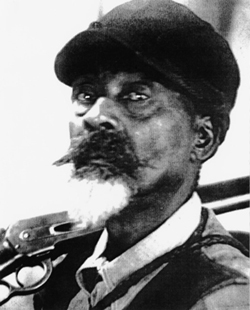
Holt Collier was the best bear hunter in the Mississippi Delta. William Faulkner later based his story “The Bear,” in part, on Collier.
Holt Collier. (Courtesy of Minor Ferris Buchanan)
Mississippi, in the years following the Civil War, was teeming with wildlife; primeval forests and jungle swamps provided ideal habitats for wild game including bear, cougars, and deer. And the state had been a safe haven from slavery and now was a haven from Jim Crow. Many of the slaves who escaped north on the Underground Railroad hid in its forestlands on their journey following the “Drinking Gourd” (the Big Dipper). When they returned home as freedmen after Appomattox they considered the forest their friend. (Unfortunately, the Klu Klux Klan also used the forest for secret lynchings and to burn bodies.13) The woods were Collier’s sanctuary too. Collier could wake up in the woods at dawn and shoot a deer for breakfast within an hour. He often brought forest meat into town for white people. In the late nineteenth century, bears were considered a nuisance in towns such as Greenville and Leland. If you traveled in the delta cane fields a rifle or shotgun was always necessary, because the likelihood of encountering a bear was high. Just as polar bears ruled the Arctic and grizzlies ruled the Rockies, in the Mississippi Delta the black bear was king. Collier, as a boy, had been attacked by a bear, wrestled with it, and eventually stabbed it to death. Whenever he retold this drama, Collier would show off the scar, which had stayed risen on his arm, to admiring sympathizers.
By the time Roosevelt met him at Smedes, Collier had killed more than 3,000 bear; this was considered an American record. Well-dressed—courtesy of a haberdasher in Greenville—and convivial, Collier had piercing brown eyes and very pronounced features. With stolid dignity he wore a Vandyke beard that he had acquired as a Civil War scout, and his cropped salt-and-pepper hair was often covered by a well-worn Confederate cap. His taut muscles seemed to grip his bones. Roosevelt, who was a promoter of Joel Chandler Harris, immediately took to Collier’s briar-patch bear tales as if Collier were Uncle Remus come to life. The stories reminded him of the Bear Bob stories his mother had told him when he was a boy. Just hearing the way Collier said “painter” (for panther) brought a smile to Roosevelt’s face. Nobody Roosevelt had ever met in the Rockies had as many close personal encounters with bears as Collier. Until the 1890s Collier had earned a very good living as a hunter, evolving into a first-rate guide. Collier hunted through the fall and winter months for thirty-plus years. He sold the meat to railroad workers, timber companies, and levee men. When not hunting he would follow the seasonal spring fairs from town to town, offering his services. In the summer he worked in the stable of his brother Marshall. Mainly, Collier was a survivalist, living off the land with his gun to keep him company. “Money don’t buy nothin’ in the cane-break, nohow,” he used to say, “and a man’s dog don’t care whether he’s rich or po’.”14
Roosevelt enjoyed such folk wisdom. When John M. Parker, who was choreographing the hunt, commented that its rigors might be too hazardous for a sitting president, a mildly insulted Roosevelt, looking at Collier with a half-embarrassed smile, exclaimed, “This is exactly what I want!” The other hunters, sensing that the president felt insulted, began shifting uneasily, uncomfortable with the ensuing silence.
“Good,” Parker shot back, “we will have bear meat for Sunday dinner!”—to which Roosevelt condescendingly replied, “Let us get the bear meat before we arrange for the dinner.” Except for this verbal sparring Roosevelt and Parker got on famously, and they formed an important political alliance in coming years.
Roosevelt understood that the secret of Holt Collier’s success, as with all good hunters, was that he revered bears and knew all their habits. Black bears, for example, would never sleep in a wet area: they pulled down cane stalks to make a comfortable nesting place. People who thought bears slept in the swamps were wrong. Although constantly maligned in the delta as meat-eating predators, bears actually preferred a diet of acorns, hickory nuts, black walnuts, persimmons, and melons. Sometimes they would wander onto farms to swipe piglets or to raid a hen house, but not often. Though Collier considered it unsportsmanlike, a fairly common bear trap used by others in the region was a pot of honey mixed with whiskey. Lapping up the honey, the bears eventually toppled over drunk; in such an inebriated condition they were easy to shoot or stab. Roosevelt made it clear upon his arrival in the delta that “pothunting,” as it was called, wouldn’t be tolerated.
Because the press had limited access to the campsite, details of the president’s six days in the Mississippi Delta are sketchy. The New York Times reported that Roosevelt often simply took to the trails to enjoy nature, preferring gentler episodes to the barking terriers, not particularly interested in rousting a bruin or pulling a ligament. An excellent dinner seemed to always be the main event, with bear paws, opossum, gravy, and sweet potatoes served on tin dishes and accompanied by wine. The clatter of fine cutlery was far more commonplace than gunshot fire during those six days. Bored reporters wrote about dreamy aromas rising from plates of onion fritters, hush puppies, and okra. Everything was served on a rough pine-board picnic table in a clearing; the scene looked like an advertisement for the national parks. The president stuck to his earlier decision not to shoot deer; they weren’t predators or nuisances. This was part of Roosevelt’s attempt to promote the sportsman’s ethic in the South. Despite the bad trails and impenetrable canebreak Roosevelt rode hard, enjoying what the newspapers described as “African jungle” terrain.15 “The President is enjoying his outing very much,” the Times reported. “He has not had three days of such complete freedom and rest since he entered the White House.”16
Collier, his baying hounds, and the terriers first picked up the scent of a bear on the morning of Friday, November 14. Roosevelt had been placed in a stand while Collier, following large misshapen paw prints, tracked the animal through mud gullies and unruly thickets for hours. Eventually, convinced that the hounds had lost the scent, Roosevelt and Hunger Foote returned to camp on horseback for a late lunch. Collier continued the pursuit, and around three-thirty PM his dogs caught up with an old 235-pound giant. (Collier said that the bear would have weighed 500 pounds but for a drought that had reduced its food supply.) Immediately Collier bugled for the president to take part in the kill; chasing the exhausted bear into a slough or watering hole, the dogs plunged in after it and refused to let up. Before long the pack had surrounded the doomed bear, lunging at it with their fangs and yelping nonstop in a frenzy. Desperate for its life, with the sweep of a mighty forepaw, the bear seized one of the dogs by the neck and crushed it to death. Collier, irate at the loss—and under strict instructions not to kill the bear but to save the first kill for Roosevelt—leaped from his mount to protect his remaining dogs from the attack. As the bear was at bay with the dogs, Collier lurched close enough to strike the bear’s head with a swing of the barrel, stunning the beast. He struck the bear so hard, in fact, that he bent the barrel of his rifle, rendering it useless. With a dog still gnawing at its hind legs, Collier carefully lassoed the bear around the neck and tied it to an oak tree.
Summoned by others with Collier, President Roosevelt and Foote rushed to the slough. The president was dismayed when he took in the gruesome scene: a dog lying dead in the dirt, two others seriously hurt, and a badly stunned, immobile bear tied to a tree, groaning for air. A light rain had become heavier, bringing a chill of evening. The whole scene had a macabre look, or a look of something gone tragically wrong. Seemingly in unison, the hunters cried, “Let the president shoot the bear.” For a second, or perhaps a second and a half, a blank-faced Roosevelt thought about what to do. It was an I-Ching moment: I cannot go backward…I cannot go forward…Nothing serves to further. Humility fell over Roosevelt. To shoot that bear would be akin to rape, a travesty of the sportsman’s ethos. Eventually he shook his head “no” and refused to draw his Winchester. “Put it out of its misery,” he ordered, tossing his knife—a gift from the emperor of Japan—to Parker. “I declined to use that knife,” Parker recalled in 1924, “but John McIlhenny threw his hunting knife, and I used that, sticking the bear under the ribs while the dogs were in front of him.”17
After walking away from the scene, Roosevelt later called the afternoon “a most unsatisfactory experience.”18 At best Roosevelt went through the superficial motions of a good guest but, in truth, he was insulted at the roping stunt. According to Minor Ferris Buchanan, a hesitant Parker, following instructions from Collier, plunged the knife into the bear’s side; but he failed in his effort to kill it in a single stab, and an obliging Collier had to finish the job, on a very angry animal. The bear’s carcass was slung over a horse and brought back to camp by Collier. The whole episode made Roosevelt feel downcast. The bear hunt in the wilderness had turned into an embarrassment.
Hidden for years in the Roosevelt Collection at Harvard University was a photograph of the dead bear strapped to a horse. It is a black eye to Rooseveltian folklore. The president’s great-grandson, Tweed Roosevelt, unearthed the photo in 1989 when he was researching the November 1902 hunt in preparation for an address to the Teddy Bear Society of America, a toy collectors’ group, in Boston. It’s unclear who took the photo—probably Parker. “I told them the truth,” Tweed Roosevelt recalls. “I didn’t gussy it up. There never was a bear cub, and the bear with T.R. wasn’t shot but was knifed to death. They didn’t like hearing it.”19
Nevertheless, by not shooting the bear, Roosevelt stayed true to the “sportsmen’s code,” the aristocratic European tradition. As the historian Louis S. Warren explained in The Hunter’s Game, the code frowned on killing young deer or young bears. Some people called such an act “slob shooting.” The true conservationists of Roosevelt’s era abided by the general premises of the code, which also included never shooting any captured animal for recreation. “For many men, hunting became a symbol of masculine strength,” Warren writes. “How one hunted and what one killed came to define what kind of man one was.” By refusing to shoot Collier’s helpless, tied-up bear, Roosevelt was merely abiding by the sportsman’s code. But to many average Americans, not killing the bear seemed odd. “Any good hunter realized that to have shot that particular Mississippi bear would have been cowardice,” Tweed Roosevelt noted. “As a true hunter-conservationist, T.R. would have never considered engaging in such a sordid act.” 20
Three bears were killed on the 1902 hunt, though none by Roosevelt. “There were plenty of bears,” Roosevelt later wrote to Philip Stewart, who had hunted cougars with him in Colorado, “and if I had gone alone or with one companion I would have gotten one or two. But my kind hosts, with best of intentions, insisted upon turning the affair into a cross between a hunt and a picnic.” 21
The next morning, Sunday, November 16, the newspapers carried stories about the president’s good sportsmanship, as shown in his steadfast refusal to shoot a captive bear. The Washington Post ran a front-page article, headlined “One Bear Bagged. But It Did Not Fall a Trophy to President’s Winchester.” The Post reported that the president had been summoned “after the beast had been lassoed” and “refused to make an unsportsmanlike shot.” For once compassion overcame single-mindedness in one of Roosevelt’s hunts. Then the story took off. The front page of the next day’s Washington Post featured a cartoon by Clifford Berryman, “The Passing Show,” that depicted Roosevelt in his hunting regalia, with one hand holding his rifle butt on the ground and the other thrust out in a firm “No!” and a perplexed fellow hunter holding a black bear by a rope around its neck. The caption read “Drawing the Line in Mississippi”—a double entendre that many scholars believe referred to Roosevelt’s fierce criticism of the lynchings of African-Americans in the South. The racial inference in Berryman’s cartoon must have chilled Roosevelt.22
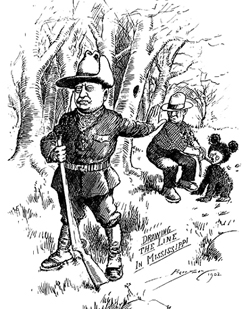
Perhaps the most famous cartoon of the twentieth century was Clifford Berryman’s “The Passing Show,” more commonly referred to as “Drawing the Line in Mississippi.” It appeared in the Washington Post and started the “teddy bear” phenomenon.
Clifford Berryman’s “Drawing the Line in Mississippi.” (Courtesy of the Cartoon Museum)
Berryman’s cartoon was a hit and was reprinted nationwide, eliciting praise for the president but also chuckles at his inability to bag a bear in Mississippi. Having worked with the Post since 1891, Berryman had developed a fine reputation for political satire. He had been raised in the Kentucky bluegrass country and had never heard of a southern bear hunt where the hunter refused to kill the prey—it struck him as funny. There were four or five variants of his cartoon, which is now a classic. One of the disregarded versions portrayed the president as a small boy. Berryman’s editor chose the version in which Roosevelt was an adult and the bear was small. But, as Buchanan pointed out in Holt Collier, Berryman had two major mistakes in his celebrated cartoon: the bear was not a cub and the man holding the rope wasn’t white (it was Holt Collier). “Naturally,” Roosevelt wrote to a friend, “the comic press jumped at the failure and have done a good job of laughing over it.”23
Reporters had swarmed around the president all that first day, hoping to send colorful dispatches. But no bear shot by the president was ever hung in the camp. Meanwhile the reporters were stuck in the middle of nowhere, twelve miles from the Smedes telegraph line, with no lively copy to offer from the delta. Some reporters quipped that the president would have been better off fishing for smallmouth bass or chasing after moccasins to exterminate. Any way you sliced it, the story was a non-story: the president didn’t bag a bear. Roosevelt took his failure stoically, saying that it was the “nature of the chase.” But reporters loath a void. Many of the journalists lampooned Roosevelt for his failed hunt, but several wrote glowingly of Collier, describing his almost superhuman single-handed capture of a large, wild bear at the age of fifty-six. Soon other stories were manufactured. By the time Roosevelt left Mississippi, heading north to Memphis, the buzz was that the president had befriended Holt Collier—a black man. This, combined with the lingering effect of Roosevelt’s dinner with Booker T. Washington, perhaps contributed to a boycott by the Tennessee Governor’s Guard and Confederate veterans’ groups of the president’s scheduled parade in downtown Memphis.24
Yet the long-term effect was good for Roosevelt’s reputation. Berryman’s cartoon of the president refusing to shoot a captured bear had captured the public’s imagination. A middle-aged Brooklynite, Rose Michtom, impressed by Roosevelt’s sportsmanship, made two plush toy bears, stuffed with excelsior and adorned with black shoe-button eyes, as a tribute to the compassionate president who had refused to fire on a captive beast. Her husband, Morris, put the stuffed bears in the window of his stationery and novelty store, and they sold immediately. Then Morris Michtom had a brainstorm: why not seek President Roosevelt’s permission to market the toy as “Teddy’s Bear”? Michtom sent a letter to the president, apparently in February 1903. The president supposedly wrote back a few lines, essentially saying OK. “I don’t think my name will mean much to the bear business,” he reportedly said, “but you’re welcome to use it.”25 The couple’s son, Benjamin Franklin Michtom, remembers that his parents framed Roosevelt’s letter and hung it on a wall of their summer home in Florida; after they died and the house was sold, the letter disappeared. No copy has turned up among Roosevelt’s voluminous personal papers, housed at Harvard University, or among his presidential papers at the Library of Congress.26
Although Roosevelt’s letter has been lost and some scholars question whether it was ever written at all, two things are certain: the teddy bear became a rage in the toy business, and the Michtoms made a fortune. Their bears sold for $1.50 apiece, and they couldn’t fill the orders fast enough. By 1907 the demand for the cuddly stuffed bears—most with jointed heads, arms, and legs—was so great that the Michtoms formed the Ideal Novelty and Toy Company and moved to a more spacious factory-style building. Coincidentally, in the small medieval town of Giengen, Germany, Margarete Steiff, a seamstress who had been a victim of polio, was also making little plush bears. In the previous few years, she had created a line of appealingly detailed stuffed elephants, donkeys, horses, camels, and pigs. When her nephew, the artist Richard Steiff, began sketching brown bears at the zoos in Stuttgart and Munich and urged her to design a mohair bear toy, she agreed. At first nobody bought the Steiff bears. When one was put on display at the 1903 Leipzig Fair, however, a wealthy American buyer fell in love with it and ordered 3,000 to be shipped to New York. Upon being presented with one of the Steiff bears, Roosevelt supposedly roared his approval and ordered several hundred to be used as table decorations for his daughter Alice’s wedding reception. That sealed the deal: the Steiffs, like the Michtoms, officially dubbed their new toy the “Teddy Bear.”27
The teddy bear craze set off by Steiff and Ideal Toy and Novelty reached its zenith while Roosevelt was president. In 1903 the Steiffs manufactured 12,000 bears; in 1907 the number had soared to 974,000. Dozens of other companies produced their own teddy bears, with various stylistic alterations. Claiming that its version was the authentic teddy bear, the Steiff Company began sewing a small metal button into one ear of each of its stuffed toys, to hold the trademark label that still distinguishes the Steiff brand. But Roosevelt always gave credit for the phenomenon to Clifford Berryman, who thereafter included a little bear in all his cartoons of the president. “My dear Mr. Berryman, you have the real artist’s ability to combine great cleverness and keen truthfulness with entire freedom from malice,” Roosevelt wrote on January 4, 1908; “good citizens are your debtors.”28
The fad continued after Roosevelt left the White House in 1909. One toy company, eager to cash in by bestowing on the incoming president, William Howard Taft, his own stuffed animal, designed a plush opossum marketed under the slogan, “Good-Bye Teddy Bear. Hello Billy Possum.” Unfortunately, with its weird pink eyes, frightening grin, and ratlike tail, Billy Possum was one stuffed critter children refused to hug. The toy was a flop. Other presidents might be remembered as anglers—among them Cleveland, Coolidge, Hoover, Truman, Eisenhower, and George H. W. Bush—but only Theodore Roosevelt was firmly established as an outdoorsman. The teddy bear probably had more to do with this image than his setting aside of more than 230 million acres of federal parklands.29
Once he was back in Washington, Roosevelt initiated a correspondence with Collier, sending him letters and promising to stay in touch. Presumably a literate friend read these letters to Collier. With so many parvenus in town Roosevelt enjoyed staying in touch with a outdoorsman like Collier. Although it took a few years, Roosevelt would again go hunting with Collier in 1907. Roosevelt pronounced him a better hunter than even John “Grizzly” Adams, Ben Lilly, or Wade Hampton III. At the turn of the twentieth century men used to vie for being considered the best shot; Roosevelt was giving the gold medal to Collier. “He was a man of sixty and could neither read nor write, but he had all the dignity of an African chief,” Roosevelt wrote, “and for half a century he had been a bear hunter, having killed or assisted in killing over three thousand bears.”30 A young novelist from Oxford, Mississippi, William Faulkner, drawing on Roosevelt’s enthusiasm, later modeled a character in his allegorical short story “The Bear” on Collier, though he made his fictional figure a Chickasaw chief.31 Capturing the mythical tenor of the bear hunt, Faulkner wrote of his character Sam Fathers that he was an “old man of seventy” and that “the woods” were his “mistress and his wife.”32
Although the correlation isn’t provable, Holt Collier’s outdoors acumen may have influenced President Roosevelt in another, unexpected way. Roosevelt had long been an admirer of the buffalo soldiers—the 14,000 African-American men who served in cavalry and infantry units during the Indian Wars on the Great Plains. After his trip to Mississippi Roosevelt suddenly assigned them to patrol the three national parks of California: General Grant, Yosemite, and Sequoia. Additional buffalo soldiers were put in charge of Monterey’s Presidio. Roosevelt had developed the idea that African-Americans made fine wilderness police. Captain Charles Young—the third African-American West Point graduate, and a personal friend of Roosevelt—was named acting superintendent of Sequoia National Park. Young’s outfit would escort Roosevelt to Yosemite in 1903, discussing with the president ways to protect the “big trees.”
From Collier’s perspective Roosevelt’s hunt was all upbeat. Fame came to him like a race horse. For Roosevelt, unlike Collier, the Mississippi bear hunt had an unfortunate outcome, which plagued him to the grave and beyond. More than ever, Americans now called him Teddy—the name he loathed. The first sign that individuals knew absolutely nothing about the real Roosevelt was that they dared to say “Teddy Roosevelt charged up San Juan Hill” or boasted that “Teddy Roosevelt was in town.” Newspaper columnists were famous for this. Why didn’t they call Lincoln “Abie” or Washington “Georgie” while they were at it? Whenever J. P. Morgan, John Hay, and Mark Hanna called Roosevelt “Teddy”—as they often did—he took it as a direct insult. “No man who knows me well calls me by the nickname…,” Roosevelt wrote to a friend on December 9, 1902. “No one of my family, for instance, has ever used it, and if it is used by anyone it is a sure sign he does not know me.”33
Such was the power of a cartoonist and a stuffed toy.
II
For the last two or three months of 1902, President Roosevelt carefully weighed his options for where to create his inaugural forest reserve, taking extra precautions not to set off a firestorm in Colorado and Montana, where timber titans and sheep farmers were already on the verge of hanging him in effigy. Right after Christmas Roosevelt had written to Alexander Agassiz, president of the National Academy of Sciences (and son of the great Harvard zoologist) to help him launch a “comprehensive investigation” of the natural history of the Philippines and Puerto Rico. Shrewdly, Roosevelt struck first on January 17, 1903, just after the Christmas holiday season ended, helped by recommendations from Agassiz and a report written by John Gifford of Florida (who was worried about the illegal felling of trees in Puerto Rico).34 Having risen to fame in the Caribbean as a Rough Rider, and deeply fascinated by the rare tropical wild-life that populated the rain forests, particularly the bright green Puerto Rican parrot (Amazona vitatta), Roosevelt created the 28,000 acre Luquillo Forest Reserve (renamed the Luquillo National Forest in 1907).35
Nobody in official Washington objected to the Luquillo. Roosevelt would visit Puerto Rico himself in 1906 to see the rainforest firsthand; as an Auduboner he knew it was a famous aviary for parrots and banan-aquits. As further evidence of Roosevelt’s interest in tropical forests, as ex-president he went to the Amazon and wrote magnificently about them in “A Naturalist’s Tropical Laboratory,” an article for Scribner’s Magazine. “In the heat and moisture of the tropics the struggle for life among the forest trees and plants is far more intense than in the North,” he wrote. “The trees stand close together, tall and straight, and most of them without branches, until a great height has been reached; for they are striving toward the sun, and to reach it they must devote all their energies to producing a stem which will thrust its crown of leaves out of the gloom below into the riotous sunlight which bathes the billowy green upper plane of the forest. A huge buttressed giant keeps all the neighboring trees dwarfed, until it falls and yields its place in the sunlight to the most instantly vigorous of the trees it formerly suppressed.”36
From a political perspective creating the Puerto Rican rain forest park was a painless endeavor. In 1900 Puerto Rico had surrendered its sovereignty to the U.S. military authority. President McKinley had issued the Organic Act (known as the Foraker Law) establishing civil government and open commerce between Washington, D.C., and San Juan. Puerto Rico was declared America’s first unincorporated territory, and the new Puerto Rican government was assigned a governor appointed by the White House (Charles Herbert Allen), who was helped out by five Puerto Rican cabinet members. Treating Puerto Rico as part of the spoils of the Spanish-American War, the McKinley administration established free trade and a democratic electoral process. During the first full year of Roosevelt’s presidency a second round of elections was held (under the Foraker Act), a telephone company was established, and English was made one of the two official languages, along with Spanish. By the authority of a 1902 act of Congress, President Roosevelt was allowed to do as he saw fit with all “crown lands” ceded to America by Spain.
As with the Badlands and the Rockies, Roosevelt had adopted the Luquillo National Forest—the only tropical rain forest in the U.S. National Forest System—as an object of unending fascination and wonder. The Luquillo had a romantic lure that appealed to Roosevelt’s image of David Livingstone and to his sense of the lost jungle. With quiet reasoning T.R. studied every biotic aspect of the newly acquired sanctuary located on the east side of Puerto Rico, especially its rain forests. Courtesy of the USDA, Roosevelt had learned that in 1824 Spain had established a forest conservation law, eventually administered by a public forestry commission, to protect the dim, mysterious, green-roofed jungles. Never one to turn down a good idea, Roosevelt felt that America’s forestry service could learn a few things about land management from these old, impressive Spanish laws and regulations. In 1876, only a few years after Yellowstone was established, King Alfonso XII of Spain had officially proclaimed the towering Luquillo forests and masses of vines (approximately twenty-five miles from San Juan), a “forest reserve.” Lush beyond words, the Luquillo forests received over 200 inches of rainfall annually. This meant that the dark-green ausubo trees and the wide variety of ferns received 100 billion gallons of freshwater a year. Commonly referred to by Puerto Ricans as “El Yunque”—which roughly translates as “Forest of the Clouds”—Roosevelt’s first national forest was a tropical paradise of the first order. Four distinctive forest types were here: the Tabonuco, Sierra Palm, Palo Colorado, and Cloud Forests. Peaks rose over 3,500 feet with trees blanketed with moss, algae, and bromeliads with bright red flowers. San Juanites would picnic and swim at La Mina Falls. But there was trouble in paradise. Throughout the Sabana River valley, like a ring of rust surrounding a jewel, was chronic deforestation due to reckless coco farmers and rubber merchants.
For a conservationist like President Roosevelt the 5,116-acre Luquillo forest was a biotic plum dropped into his lap. There are approximately 100 million species on earth, and half of them exist in tree foliage and trunks. Who knew what undiscovered species lurked in that largely un-chartered and unmapped jungle? There were, for example, eleven coqui species (i.e. tiny tree frogs as loud as an opera singer after it rained). Roosevelt immediately assigned a USDA team of botanists, ornithologists, and foresters to write and publish a scientific report on the Luquillo forest. Roosevelt wanted to know everything about it. (A forest ecology report was published in 1905, to Roosevelt’s great satisfaction.) Roosevelt marveled at the proliferation of tabonuco trees (which grew at low elevations and could be 100 feet tall), unusual wild palm fruits, and picturesque waterfalls as exotic as something Gauguin might have painted in the South Seas. Sound forest management would be needed to protect this wonderland where more than 240 types of trees coexisted. If the deforestation that had taken place in Haiti was allowed to occur in Puerto Rico, Roosevelt believed, San Juan would lose its fresh water supply. A real disaster. (Likewise, Pinchot was dispatched to the Philippines to write a forest inventory report.)
Roosevelt’s preservationist instinct concerning Puerto Rico didn’t stop with Luquillo. On July 22, 1902, seemingly arbitrarily, he declared Miraflores Island in the harbor of San Juan off-limits to anything but a forest reserve and a future quarantine hospital for U.S. Marines.37 In 1906 Roosevelt wrote to Pinchot, asking him to go to Puerto Rico quickly and “oversee what is being done in forestry.” Pinchot went and recommended that Culebra Island be declared a wilderness preserve.38 Following Pinchot’s recommendation—and that of the Florida Audubon Society—on February 27, 1909, just before leaving the White House, Roosevelt did something dramatic on behalf of Puerto Rican wildlife. By an executive order he declared the entire island of Culebra a national wildlife refuge. This crab-shaped dollop, about seventeen miles east of the mainland, was (and remains) a pristine reef with a staggering array of Technicolor coral and fish. He was impressed by the large colonies of brown boobies, laughing gulls, and sooty and noddy terns that lived on Culebra; and once he learned that more than 50,000 sea birds used it as a sanctuary he forbade the U.S. Navy to conduct further military exercises there. Even as ex-president, Roosevelt didn’t forget Puerto Rico. He worked in tandem with the naturalist Henry Fairfield Osborn to found the New York Zoological Society’s Department of Tropical Research. Besides collecting data on endangered species and rare plant life, the new department established Kartabo Station in British Guinea (now Guyana), considered the first on-the-spot rainforest research facility in the western hemisphere.39
Owing to President Roosevelt’s foresight and action, when the Luquillo National Forest celebrated its centennial in 2003 the Puerto Rican parrot was still surviving—though barely. And the forest had expanded to 28,000 protected acres. In April 2004 Senator Hillary Clinton of New York, urged by environmental groups and Puerto Rican constituents, introduced a bill to add further environmental protection measures to save endangered species in the Luquillo (in 2007 it was renamed El Yunque National Forest). Clinton lamented the decline of the endangered Puerto Rican parrot. “Today,” she said, “there are fewer than thirty-five of these parrots.”40 But she added that with the increased financing of two entities essentially created by Roosevelt—the National Forest Serviceand the U.S. Fish and Wildlife Service—the parrots might once again thrive in the most spectacular rain forest in the Caribbean. At the USDA-run visitor center in the Yunque National Forest a huge blown-up copy of Theodore Roosevelt’s 1903 proclamation declaring Luquillo a national forest has been installed as an exhibit.
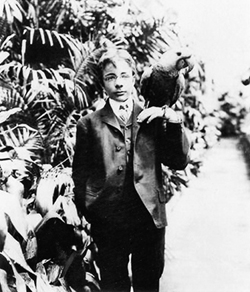
Theodore Roosevelt Jr. with a favorite parrot.
Ted Roosevelt Jr. with parrot. (Courtesy of Theodore Roosevelt Collection, Harvard College Library)
Hearing about the beautiful parrots in both Puerto Rico and the Philippines fascinated Roosevelt to no end. Parrots, he believed, were deeply complex creatures with the intelligence of a human three- to five-year-old. Their startling plumage was far more interesting to him than a luminous splash in a painting by Monet or Renoir. Before long, unable to resist, the president acquired parrots as pets. “Loretta, the parrot, has fairly become one of the household,” Roosevelt wrote to his son Kermit in January 1904. “I had no idea that parrots could become so social and intelligent. The other day Archie was in bed with a headache. I found Mame sitting beside the bed and Loretta in her cage between them on my bed. She was having a most lovely time, with the feathers on her head and neck ruffled up, chuckling and talking away in low tones, and alternately shaking hands with first one and then the other of her companions. She was evidently as pleased as she could be, and upon my word, of the three I felt as if at the moment she was intellectually taking the lead herself.”41
Besides Loretta there was also a blue-yellow macaw known as Eli Yale (kept in the greenhouse), which Roosevelt said “looked as if he came out of Alice in Wonderland.”42 Roosevelt loved teaching Eli Yale—so named because its colors were those of Yale University—words like “dee-lighted” and his children’s names. Sometimes it would scream and make a piercing flock call. Occasionally after White House dinners, Roosevelt would head out to the greenhouse to feed both Eli Yale and Loretta table scraps, particularly dried fruits and vegetables. Both parrots were friends with the well-fed domestic hen Baron Spreckle, who Roosevelt noticed was starting to act like a parrot. Having these birds around the White House and Sagamore Hill helped keep Roosevelt engaged as a Darwinian zoologist—or, as Edith claimed, returning him to his boyhood. “If all the animals and birds which have been sent by admiring friends as gifts to the President and members of his family had been allowed to remain at the White House,” a popular magazine surmised, “that historic old structure might easily be turned into a menagerie and the grounds surrounding it into a zoological park.”43