
CHAPTER TWENTY
I
President Roosevelt started 1904 by writing a spate of letters to family and various friends. The contents were history, and nothing seemed off-limits. Showing a considerable breadth of knowledge, Roosevelt mused about everything from “pagan” Rome to nineteenth-century naval power. Outdoing himself as an intellectual president, perhaps even equaling Jefferson in bookishness, Roosevelt contemplated the lasting achievements of Darwin, Huxley, Spencer, Milton, and a dozen others. It was as if Roosevelt was trying to see where he himself fit into world history. Interestingly, he seemed to feel compelled to insist that Francis Parkman—who had died in 1893—was a more talented historian than the entire American Historical Association membership combined. In Roosevelt’s book Hero Tales from American History, in fact, Parkman was considered on equal terms with the likes of Washington, Lincoln, and Grant. “He went to the Rocky Mountains, and after great hardships, living in the saddle, as he said, with weakness and pain, he joined a band of Ogallalla Indians,” Roosevelt noted after his idol’s death. “With them he remained despite his physical suffering, and from them he learned, as he could not have learned in any other way, what Indian life really was.”1
As president, Roosevelt began using Sir George Otto Trevelyan, author of Life of Macaulay, as his chief historian correspondent. Roosevelt, even though he was grappling with international crises in Japan, Russia, Colombia, and Morocco (and in a presidential election year), found time to reflect with Trevelyan on the need for more “faunal naturalists” in the grand tradition of John James Audubon. Perturbed by the germanization (i.e., overspecialization) of American colleges and universities—which Roosevelt continued to believe were strangling the talent out of the new generation of naturalists—the president lamented the unfortunate triumph of the pedantic, petty twentieth-century men who had contaminated history with dullness: there was a “lamentable dearth in America,” the president wrote, of new naturalist work of “notable and permanent value” in the tradition of Audubon, Thoreau, and Burroughs.2
Forty-five years earlier the world had received Darwin’s On the Origin of Species, followed by The Descent of Man. Roosevelt now wondered what had happened in the naturalist field since then that was truly innovative and exciting. All America had to offer the post-Darwinian world was Dr. C. Hart Merriam of the Biological Survey, who was a “great mammalogist” but apparently had no ability to write triumphant, redefining zoological works. The fact that Merriam wasn’t producing a big book continued to perturb Roosevelt. “[Merriam] himself suffers a little from this wrong training, and I am afraid he will never be able to produce the work he could, because he cannot see the forest for the trees,” Roosevelt confided to Trevelyan. “He cannot make up his mind to write a great lasting book, inasmuch as there continually turns up some species of shrews or meadow mice or gophers concerning which he has not quite got all the facts; and he turns insidiously aside once more to the impossible task of collecting all these relatively unimportant facts. Still, he does understand that we should not leave to storybooks the vital life histories of our birds and mammals.”3
Roosevelt also seemed somewhat estranged from Grinnell because of the flap between them over the article in Forest and Stream that had attacked John Burroughs. By April 1904 Grinnell had finished editing the Boone and Crockett Club’s fourth volume,American Big Game in Its Haunts—for the first time without Theodore Roosevelt as coeditor. Yet the lead article, “Wilderness Reserves”—later collected in Outdoor Pastimes—had been written by Roosevelt; it also appeared in Forest and Stream. “Mr. Roosevelt’s account of what may be seen [in Yellowstone],” Grinnell wrote, “is so convincing that all who read it and appreciate the importance of preserving our large mammals, must become advocates of the forest reserve game refuge system.” As if trying to bridge the gap between Roosevelt and himself, Grinnell went on for several pages about what a “great thing” Roosevelt’s “accession to the Presidential chair” had been for forest reserves, national parks, big game, and birds in general.4 “Aside from his love for nature, and his wish to have certain limited areas remain in their natural condition, absolutely untouched by the ax of the lumberman, and unimproved by the work of the forester,” Grinnell wrote, “is that broader sentiment in behalf of humanity in the United States, which has led him to declare that such refuges should be established for the benefit of the man of moderate means and the poor man, whose opportunities to hunt and to see game are few and far between.”5
Roosevelt’s essay “Wilderness Reserves” began with a photograph of tourists at Yellowstone, all dressed in Sunday clothes, watching black bears eat in an open field, and another of Oom John meditating by a clear stream, with traceried wrinkles around his all-seeing, naturalist’s eyes. Once again railing against “greedy and shortsighted vandalism,” Roosevelt explained why preservation of both forests and wildlife was essential to the long-term health of America:
The wild creatures of the wilderness add to it by their presence a charm which it can acquire in no other way. On every ground it is well for our nation to preserve, not only for the sake of this generation, but above all for the sake of those who come after us, representatives of the stately and beautiful haunters of the wilds which were once found throughout our great forests, over the vast lonely plains, and on the high mountain ranges, but which are now on the point of vanishing save where they are protected in natural breeding grounds and nurseries. The work of preservation must be carried on in such a way as to make it evident that we are working in the interest of the people as a whole, not in the interest of any particular class; and that the people benefited beyond all others are those who dwell nearest to the regions in which the reserves are placed. The movement for the preservation by the nation of sections of the wilderness as national playgrounds is essentially a democratic movement in the interest of all our people.6
“Wilderness Reserves,” in which Roosevelt used his 1903 trip to Yellowstone and Yosemite for color and details, was his greatest call yet for preservation. Because there had been no hunting involved in his “western trek,” Roosevelt was able to focus his writing on seeing such wildlife as golden eagles, magpies, scores of black-tails, and an antelope band numbering about 150. There were many Darwinian food-chain anecdotes, including coyotes feasting on deer carcasses and eagles swooping down for mice. Roosevelt was calling for maintaining the balance of nature without unwarranted human intrusions. But the scenic wonders of the West—the groves of giant sequoias and redwoods, the three Tetons glistening in snow, the gulls circling Three Arch Rocks, the Grand Canyon at dusk, the great Mojave Desert with its lonely barren hills—impelled Roosevelt to declare that they should be “preserved for the people forever, with their majestic beauty all unmarred.”7
Roosevelt was also deeply troubled by the Park Commission’s overreach. He rejected the idea of construction along the National Mall from the U.S. Capitol to the Washington Monument in favor of “greenspace.” In a display of outrage that anticipated a later concept, NIMBY, Roosevelt insisted that the Mall should be used for “monumental purposes” only.8 Too many new buildings, he believed, would ruin the park-like essence of official Washington, turning it into a crass thoroughfare. Critics of Roosevelt’s greenspace accused him of hypocrisy, for building a West Wing on the White House (which he wanted architecturally renovated and enlarged) and also a tennis court. “It is true that I have a tennis court in the White House grounds,” Roosevelt wrote in his own defense. “The cost of it has been trivial—less than 400 dollars. It has been paid for exactly as the adjacent garden, for instance, is paid for. The cost is much less than the cost of the greenhouses under Presidents Grant, Harrison, Cleveland, etc.”9
Because there were eight Roosevelts in the White House—Theodore, Edith, Teddy Jr., Kermit, Alice, Quentin, Ethel, and Archibald—not to mention a flood of guests, expansion and remodeling had begun in 1902. Roosevelt wanted the White House divided into living quarters for the first family (East Wing) and office space for the president (West Wing). The architecture firm of McKim, Mead, and White was brought in to do the job. Overseeing it all was Edith, who was determined to transform the old Executive Mansion into “the recognized leader of Washington official Society,” and to make it a “moral” factor in the “social life of America.” By 1904 Edith had become the most popular first lady since Frances Cleveland. Part of Edith’s appeal was that she good-humoredly allowed the six Roosevelt children to collect animals of all kinds. And, as the historian Lewis L. Gould put it, Edith took tremendous care of the president, “the largest child in Mrs. Roosevelt’s brood.”10
One of Edith’s wildlife management problems at the White House was Josiah the badger, now full-grown. Because the president allowed Josiah to roam freely, it constantly gnawed into any leg within reach of its teeth, occasionally drawing blood. Furthermore, President Roosevelt built a durable house for Josiah so it could dig tunnels in the White House lawn.11 “At present he looks more like a small, flat mattress, with a leg under each corner, than anything else,” the reporter Jacob Riis recalled after an afternoon at Sagamore Hill. “That is the President’s description of him, and it is a very good one. I wish I could have shown you him one morning last summer when, having vainly chased the President and all the children, he laid siege to Archie in his hammock. Archie was barelegged and prudently stayed where he was, but the hammock hung within a few inches of the grass. Josiah promptly made out a strategic advantage there, and went for the lowest point of it with snapping jaws. Archie’s efforts to shift continuously his center of gravity while watching his chance to grab the badger by its defenseless back, was one of the funniest performances I ever saw. Josiah lost in the end.”12
Then there was Jonathan Edwards, an untamable cinnamon bear that had been given to Roosevelt by a group of Republicans from West Virginia and named after the Puritan minister (an ancestor of Edith’s). The bear had what Roosevelt called “a temper in which gloom and strength were combined in what the children regarded as Calvinistic proportions.”13 Roosevelt enjoyed taking Jonathan Edwards for walks, feeding it honey and nuts, and playing hard with it, as with an oversize dog. Eventually, when it got too big, the president had to donate it to a zoo.14 As Riis noted in his Theodore Roosevelt: The Citizen (a well-written campaign biography of 1904), the family had so many pets they were hard to count. White rats, opossums, and raccoons were at one time or another White House residents.15 Peter the rabbit hopped about, sometimes sleeping under sofas or inside closets. In between important meetings, Roosevelt would feed mice to his barn owl, a reddish-chested female. Aquariums were full of horned toads, painted turtles, and salamanders. A medium-size iguana used to wander about the White House corridors as freely as did Maude the pig. Roosevelt’s son Theodore Jr. raised a pet lamb named “Teddy” as if it were a family dog. All that was missing was a pushmipullyu, or the White House could have been renamed Puddleby-on-the-Marsh.16
When President Roosevelt was awake late, he sometimes recorded habits of his domestic cats, usually for his children to enjoy. “Tom Quartz is certainly the cunningest kitten I have ever seen,” he wrote to Kermit from the White House. “He is always playing pranks on Jack and I get very nervous lest Jack should grow too irritated. The other evening they were both in the library—Jack sleeping before the fire—Tom Quartz scampering about, an exceedingly playful wild creature—which is about what he is. He would race across the floor and then jump upon the curtains or play with the tassels. Suddenly he spied Jack and galloped up to him. Jack, looking exceedingly sullen and shamefaced, jumped out of the way and got upon the sofa, where Tom Quartz instantly jumped upon him again. Jack suddenly shifted to the other sofa where Tom Quartz again went after him. Then Jack started for the door, while Tom made a rapid turn under the sofa and around the table and just and away and the two went tandem out of the room—Jack not reappearing at all; and after about five minutes Tom Quartz started solemnly back.”17
Roosevelt had long been a promoter of guinea pigs as first-rate pets for children; and he kept five in the White House: Admiral Dewey, Dr. Johnson, Bishop Doane, Fighting Bob Evans, and Father O’Grady.18 And then one afternoon a sixth materialized out of thin air. A few weeks after New Year’s 1904, the magician Harry Kellar put on a show for the president’s family. “I went along and was as much interested as any of the children, though I had to come back to my work in the office before it was half through,” Roosevelt reported to his son Kermit. “At one period Ethel gave up her ring for one of the tricks. It was mixed up with the rings of five other little girls, and then all six rings were apparently pounded up and put into a pistol and shot into a collection of boxes, where five of them were subsequently found, each tied with a rose. Ethel’s however, had disappeared, and he made believe that it had vanished, but at the end of the next trick a remarkable bottle, out of which many different liquids had been poured, suddenly developed a delightful white guinea pig, squirming and kicking and looking exactly like Admiral Dewey, with around its neck Ethel’s ring, tied by a pink ribbon.”19
Hearing about how President Lincoln had kept a turkey named Jack around the White House after sparing its life one Thanksgiving, the president adopted a one-legged rooster as a favorite pet, prohibiting the cook from even thinking about breaking its neck. Then there was the pet turkey which became friendly with the president’s two parrots. The Washington Evening Star reported: “There is no home in Washington so full of pets high and low degree as the White House, and those pets not only occupy theattention of the children, but the President is himself their good friend, and has a personal interest in every one of them.”20 As the White House usher Ike Hoover put it, “A nervous person had no business around the White House those days.”21
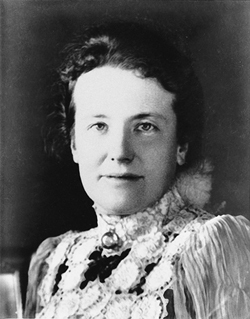
First Lady Edith Roosevelt tolerated her husband’s obsession with having live animals around him at all times.
First Lady Edith Roosevelt. (Courtesy of Theodore Roosevelt Collection, Harvard College Library)
The antics of all these White House pets made colorful newspaper copy. Once Algonquin, a spotted pony, was escorted to the second-floor family quarters to boost the morale of nine-year-old Archie, stuck in bed with measles; the disease had swept through Washington like an epidemic.22 Ecstatic to see Algonquin, whom he loved, Archie let out an Indian “whoop” and dived to hug his pet. Algonquin was so startled by Archie’s abrupt gesture that his legs buckled and all 350 pounds of pony slipped and fell to the floor. The loud thud sounded like a muffled gunshot blast. The whole Roosevelt clan rushed into the bedroom deeply concerned. When the president returned from California he mildly reprimanded Archie, saying that such suddenness was unwise when dealing with ponies; they spooked too easily. The comical episode is now remembered as another Roosevelt first—the first time a horse rode in a White House elevator.23
Then there was the famous Kansas jackrabbit affair, which rocked Washington. A Topekean had donated to Roosevelt’s White House menagerie two young jackrabbits from his home state. One day while being fed pellets, the rabbits escaped their cage. A wild scramble ensued. The president and his sons chased after them. Escaping from the White House lawn, the rabbits made their way to G Street and Twelfth Avenue, where they parted company, one heading east, the other west. “Newsboys and messenger boys joined in the exciting chase after the rabbits, and for a time business in that vicinity was practically at a standstill,” the Washington Post wrote in a long feature story. “Both animals were large specimens, and, as they spread out their long limbs, many thought they were young deer.” After hours of mayhem one rabbit was captured at Turelane and M Street N.W. The other made its way back to the White House as if wanting to be put back into its hutch. Instead, the president decided to let them both live in the White House shrubbery, “wild and free.”24
Roosevelt started tossing carrots to the jackrabbits whenever he wandered the White House grounds to feed nuts to the squirrels. Both T.R. and the grounds policeman, named Mr. Curtis, ensconced in a security booth just east of the White House entrance, used to hand-feed the squirrels. Before long the squirrels were as tame as the Angora house cats. Roosevelt would sit on the grass, and the squirrels would scurry up to him to be fed. The squirrels weren’t even afraid of the Saint Bernard, named Rolla, or the retriever Sailor Boy. Sometimes 100 squirrels would line the walk heading into the White House, waiting for the president to come out and apparently knowing that he had pocketfuls of nuts.25
Perhaps the most exotic pet President Roosevelt had was a spotted hyena (Crocuta crocuta) named Bill, from the plains of Ethiopia. Eventually, Bill weighed about 150 pounds. He had been given to Roosevelt in March 1904 by Menelik II, emperor of Ethiopia, who claimed to be directly descended from King Solomon and the Queen of Sheba. Menelik had brought with him to America such wildlife as elephants, monkeys, tigers, pythons, and rare birds to donate to the Lincoln Park Zoo in Chicago. But he insisted that Roosevelt keep the hyena pup and a lion cub as personal pets.26 Roosevelt donated the lion cub to the Bronx Zoo, but he kept Bill for a while, teaching it tricks, enjoying its high-pitched cackle, and letting it beg for table scraps.27
More than anything else, however, it was dog stories that the press loved. Whether it was Sailor Boy the Chesapeake retriever or Jack the terrier, President Roosevelt always seemed to have a canine friend nearby. He could have made a fortune writing stories about the White House dogs (on the order of later books such as Old Yeller or Marley and Me) for Outing. Even during important cabinet meetings about the Panama Canal or the Ottoman empire, Roosevelt would often pat a dog while he spoke. Sometimes he carried lunch scraps in the pocket of his suit coat to feed them as treats. One of his dogs, Pete, a bull terrier, ended up biting so many White House visitors that the president reluctantly exiled him to Oyster Bay. When Ethel’s bull terrier Ace got lost at Sagamore Hill one fall afternoon, a high-profile search was undertaken, as if for a missing person. Eventually the New York Times was able to run the headline “Roosevelt Dog Is Found.”28
Whenever a family pet died, Roosevelt buried it at Sagamore Hill in a special cemetery located north of the house and surrounded by native plants. An inscription on a memorial boulder there read “Faithful Friends.” Each buried pet had its name carved in the stone monument, and there was a bench nearby for the mourners. Little American flags were stuck in the ground, as if it were Arlington National Cemetery. In remembrance of Cuba, the famous dog of the Spanish-American War, the president had his named carved into the rock. Eventually, Roosevelt created an arboretum, arching over the burial site of his animal friends.29 Roosevelt’s idea of heaven was a place where all these pets would come and greet him in a grand reunion.
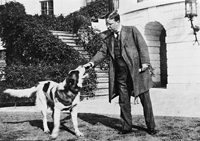
Between meetings, no matter the weather, President Roosevelt would play fetch on the White House lawn with his dogs.
T.R. with pet dog. (Courtesy of Theodore Roosevelt Collection, Harvard College Library)
II
That spring a debate raged in Washington regarding what to do with Alaska. More than 100 bills concerning Alaska were presented to the Fifty-Eighth Congress. President Roosevelt wanted virtually all of them—particularly those protecting wildlife—passed. The discovery of gold had caused a rush to Alaska; but Roosevelt hoped to impede development by creating reserves for the big game mammals at Fire Island (which he would turn into a federal game preserve in 1909). He insisted emphatically that harvesting Alaskan wildlife must be regulated, and that a smart plan for managing natural resources must be implemented for the vast territory. He also promoted a court system and infrastructure improvements for Juneau, Skagway, Sitka, and other cities. A variety of books on Alaska—notably Our New Alaska by Charlie Hallock (printed by Forest and Steam), A Summer in Alaska by Frederick Schwatka, A Trip to Alaska by George Wardman, and “The Merriam Report” of the Harriman Expedition—had spurred entrepreneurs’ interest in the land once derided as “Seward’s folly.” For the first time Americans were starting to see the acquisition of Alaska for $7.2 million (less than two cents an acre) as a steal. History had vindicated Seward’s judgment as, Roosevelt believed, it would someday vindicate his own attempts to save Alaska’s caribou herds.
Throughout 1904 Roosevelt also grew interested in the brown bears of Alaska, which could be found in every district. He regularly asked for reports from the Boone and Crockett Club about Alaska’s black bears, grizzlies, and glacier (or blue) bears. The polar bear, he learned, was found only along the coast, in ranges of eternal ice, and never below sixty-one degrees north latitude (and it was found at that latitude only when swept down on Bering Sea ice floes). Merriam reported to Roosevelt about the various sizes of brown bears he saw on the Kodiak Islands during the Harriman expedition of 1899. Roosevelt hatched a plan to take a steamer to Alaska and then hunt with an Aleut guide along the salmon streams of Kodiak in search of a bull bear. He even ordered rubber boots and rainproof slickers in anticipation of the journey. Roosevelt envisioned himself not only killing a bear but writing an article about Alaska for Scribner’s magazine. Besides the bears, Roosevelt also wanted the newly discovered types of wild sheep and caribou saved. His administration’s primary conservation policy initiative in Alaska from 1901 to 1904 was enforcing both the Lacey Bird Act and a wild fowl law (enacted June 6, 1900) for protecting eggs.30 In 1902 the Boone and Crockett Club, with Roosevelt’s support, helped Congress pass an act (32 Stat. L. 327) imposing seasonal hunting and bag limits in Alaska. As the Roosevelt administration structured game laws for Alaska, if you wanted to hunt, you needed a permit—issued by the Biological Survey. Only the secretary of agriculture could permit hides, trophies, carcasses, etc. to be shipped out of Alaska. The federal government under Roosevelt was seizing firm control of the last frontier.
President Roosevelt, in particular, was anxious to bring the districts of Alaska—not officially even a territory until 1912—into the American family. But he simply had no patience for dealing with bureaucrats on Capitol Hill who didn’t know rain-fresh ferns from black-green moss. There were individual members of Congress, however, whom he greatly respected. Once again Roosevelt—this time as president—partnered with Congressman John Lacey of Iowa to save Alaskan ecosystems such as Saint Lazaria, the Pribilof Islands, the Yukon delta, and parts along the Bering Sea. Both men wanted the territory’s seal and bird rookeries, forests, and fishing streams properly managed. Roosevelt was counting on Lacey (or “the major,” as he started calling Lacey after the visit to Oskaloosa in 1903) to figure out how to build a railroad through Alaska’s mountain passes while simultaneously protecting the priceless forest reserves. What mattered most to both Roosevelt and Lacey (now being called by the Boone and Crockett Club the “father of federal game protection”) was that the incomparable wildlife of Alaska not be molested or its scenic wonders destroyed by reckless industrial capitalism. No American knew more about the dual issues of wildlife protection–forest conservation law and railroad law than Lacey—the author of both Lacey’s Railway Digest and the pro-bird Lacey Act of 1900.31 “Cannot we get the Alaska legislation through?” Roosevelt pleaded with Lacey. “It does seem to me to be very important that this republican Congress show its genuine care for the welfare of Alaska.”32
An uproar ensued throughout Alaska against the president’s tough federal game laws in 1904. A grassroots movement in Juneau sought to repeal 32 Stat. L. 327, and its voice was heard in Congress. Charging that the laws promulgated by the Boone and Crockett Club and the Roosevelt administration favored rich sportsmen from the continental United States who wanted to bag a moose in the Kenai Peninsula, Alaskans flouted the game laws, risking arrest. How dare these elitists flood into Alaska with a perfume-scented permission slip from Secretary Wilson while blue-collar hunters who actually lived in the Brooks Range or the Kenai Peninsula were being rejected by the USDA. The rallying cry of Alaska’s pioneers was “home rule.” To mitigate, if only slightly, the discord between advocates of conservation and development, the Roosevelt administration was forced to concede to the territory’s governor the right to issue permits. But capitulation went only so far. Roosevelt remained vigilant in maintaining federal control of the hunting of fur-bearing animals like seal and fox: USDA managed all fur-bearing land animals while the new Department of Commerce and Labor oversaw seals and walruses.33 And Roosevelt began developing a strategy to save birds in Alaska just as he had done in Florida, North Dakota, Michigan, and Oregon.
By now George T. Emmons was sending Roosevelt regular reports about wild Alaska. They were all well-crafted, rational, and succinct. Roosevelt seemed to relish learning that the lumber companies of the territory were furious over the Alexander Archipelago Forest Reserve decree of 1902. Letters of protest arrived at the White House from a Protestant missionary in Fort Wrangell and a businessman in Ketchikan. A U.S. congressman took up the crusade to save Alaskan commerce from the conservationism of Emmons and Roosevelt. And, of course, the Indians were opposed to the federal government’s engaging in land grabs. Roosevelt’s response to all this blowback was predictable. On September 10, 1907, he created the 17-million-acre Tongass National Forest in Southeastern Alaska, the largest ever formed. On July 1, 1908, he merged the Alexander Archipelago with the Tongass. The new Tongass National Forest—eventually 17 million acres—was a historical feat. The fjords, glaciers, and Coast Range forest were preserved.
On July 23, 1907, Roosevelt put aside another 5.4 million acres of Alaska as the Chugach National Forest. After the Tongass, it was the second-largest national forest in America. Concerned about the wildlife in the eastern Kenai Peninsula, Prince William Sound, and Copper River delta, Roosevelt was starting to envision Alaska as one vast wilderness refuge. It would become a place for urban dwellers to replenish their spirits. Meanwhile, to protect the Chugach and the Tongass from despoilers Roosevelt approved of ranger boats to patrol the 10,000 miles of gorgeous coast, which would soon become popular with cruise lines. As Roosevelt envisioned them, these patrol boats would be something like traveling ranger stations. In Roosevelt’s Alaskan parks the motorboat had replaced the saddle and pack horses. As one early ranger in the Tongass declared, “The Alaskan ranger is just as proud of his boat as the Bedouin horseman is of his steed, and the ranger boats in Alaska are the most distinctive craft sailing the waters.”34 In 1908 the Roosevelt administration had a sixty-four-foot, seventy-five-horsepower yacht designed in Seattle to use for Forest Service duty.
Ever since his 1903 trip to California, where he saw the splendor of fogbound San Francisco Bay with the Farallon Islands rising out of the blue Pacific, the president had grown even more interested in all things Japanese. In California in 1904 there was a lot of xenophobia and anti-Japanese sentiment, and Roosevelt hoped to curb its ugliest manifestations by talking publicly about Japan’s virtues; that is, he hoped to ease the cultural clash. Tension was extremely high between Japan and Russia throughout the election year, over territory in Asia. On February 1 the Russian czar had said, at a dinner in the Winter Palace, “There will be no war” but a week later Japanese troops landed at Chemulpo in Korea. Japan then torpedoed the Russian fleet at Port Arthur, stunning the Russian authorities. Privately, the president liked seeing Tokyo exhibit its naval power, which was a sign of national greatness. Although, wisely, on February 11 he declared U.S. neutrality with regard to the Russo-Japanese War, he immediately started working the back channels of diplomacy, hoping to arrange for a cease-fire between the two warring countries.
An old friend of Roosevelt’s from Harvard, Kentaro Kaneko, was in the United States in early 1904, and the president feted him. To Roosevelt, Kentaro had an irresisible combination of “fine national loyalty” and “Samurai spirit.”35 Roosevelt believed the United States had much to learn from Japan, especially how to properly manage city slums; but that the Japanese, for their part, needed to find “the proper way of treating womanhood.” The Japanese island of Hokkaido had also become a hot topic for naturalist discussions at the White House. Photographs of steaming mountain peaks, active volcanoes, and beech forests that captured the Japanese “garden spirit” enthralled the president. On hikes in Rock Creek Park, often with Pinchot at his side, Roosevelt, while rock climbing, would go on and on about samurai literature he had just read. That spring influenced by Japanese rice-paper drawings on display in Washington, Roosevelt began writing about flowers of the Potomac River basin—the locust trees with white blossoms and honeysuckles moving conspicuously around the south portico. He admired the way the Japanese brought nature into everything they did, filling vases with chrysanthemum flowers and growing miniature bonsai trees in offices. Although he was not a specialist on Asia, he knew something about Japanese folk ways, and he understood that Japanese artists considered humans part of nature; they cultivated the high art of thriving in harmony with animal life. Oddly, Roosevelt encouraged Russian expansion in Asia, hoping that Tokyo wouldn’t “lump” Americans together with Russians as “white devils” and as Japan’s “natural enemies.”36
From the White House, the president kept watch on the Japanese fishermen and plumers who were slaughtering wildlife around the Midway atoll. In 1859, Captain Nick Brooks had claimed the guano island of Midway for the United States. There was a marketplace demand for bird fertilizers in California, and at Midway the excrement was readily available for scooping up by the boat load. All was peaceful at Midway until President Roosevelt learned in 1903 that Japanese seafarers were killing the albatross which bred on the island. Immediately, Roosevelt dispatched twenty-one Marines to Midway to protect the albatross from slaughter.37
III
In March 1904 Pinchot had presented Roosevelt with a report which claimed that the western states and territories with the most public land were “progressing rapidly in population and wealth.” In other words, the larger the forest reserves, the more prosperity for a state or territory. The report recommended that the Timber and Stone Act and the Desert Land Act be repealed, only to prove that land was indeed being irrigated. But as a trade-off the administration called for many new forest reserves. “From 1902 to 1905, over 26 million acres were added to the national forests, and many of the reserves contained good grazing and agricultural land,” the historian Donald J. Pisani wrote in Water, Land, Law in the West: The Limits of Public Policy, 1850–1920. “No westerner could be sure where the process would end. Because they threatened to limit access to the public domain, both repeal of the land laws and reservation were perceived as threats to economic opportunity.”38
On April 30, 1904, President Roosevelt officially opened the Saint Louis World’s Fair that commemorated the centennial of the Louisiana Purchase (the ribbon-cutting had been delayed for a year owing to construction difficulties at the fairground). A decade earlier at Chicago’s World Fair, Roosevelt had been an attraction himself, greeting guests at the Boone and Crockett Club’s log cabin, and extolling the virtues of western expansion. Now, in Saint Louis, pushing a golden button to open the Louisiana Purchase Exhibition, he visited some of the nearly 150 miles of exhibits, including a stuffed Roosevelt elk. This fair popularized the hot dog, ice cream cones, iced tea, and sweet rolls. The world’s largest pipe organ thundered out songs that Roosevelt heard enthusiastically, including the triumphalist “Hymn of the West,” which was sung in his honor.39
Although Roosevelt did not overly admire Thomas Jefferson, considering him vastly overrated, he nevertheless sang Jefferson’s praises at the fair. If Jefferson had done nothing else, Roosevelt believed, acquiring the Louisiana Territory from Napoleon had been enough to ensure his greatness. The whole continent, from coast to coast, was in Jefferson’s debt. This was the same theme he had touched on the previous year when he visited Saint Louis as part of his Great Loop tour. And now, with all eyes on Missouri, that May the Olympic Games opened in Saint Louis. The United States won eighty out of 100 gold medals, though it should be noted the a separate competition was held for “uncivilized tribes” (that is, dark-skinned people).
While all these distractions were going on in Saint Louis, Roosevelt, on June 3, created his third national park: Sully’s Hill, on the south shore of Devils Lake in North Dakota, named after the Indian fighter General Alfred Sully—whose fierce battles with the Sioux peoples Roosevelt knew well. The 780-acre parcel along Devils Lake was a densely forested haven for such migratory waterfowl as wood ducks, Canada geese, American white pelicans, mallards, hooded mergansers, and dozens of other species.40
Because Sully’s Hill National Park was transferred to the National Wildlife Refuge System in 1914 (it is managed today by the U.S. Fish and Wildlife Service), it has been largely ignored by historians of American conservation. Its remote site and the fact that it’s named after a general known for Indian massacres have also given this park, in a sense, an orphaned status. Only the WPA guide for North Dakota has ever really done this hilly, serene woodland justice.41 But Roosevelt felt that by signing a proclamation for Sully’s Hill that June, he was accomplishing many goals. For starters, he was beloved throughout North Dakota, like a favorite son. (He won the state in the 1904 presidential election by a landslide.) Roosevelt’s act on behalf of Sully’s Hill met with virtually no resistance. He was saying that North Dakota had subtle “wonders” equal to those in California, Oregon, and Wyoming. Since first visiting Fargo in 1880, Roosevelt had been enthusiastic about the Red River valley of Minnesota–North Dakota; and the tiny lakes around Sully’s Hill offered a chance for him to save a migratory bird area he treasured. Also, the wooded glacial moraine mounds of Sully’s Hill were in stark contrast to the surrounding prairies. It was an oasis for wildlife.
But mainly President Roosevelt, from reading so much about ornithology, knew that the Devils Lake area (of which Sully’s Hill was a part) provided essential bird breeding grounds in the Central Flyway. Sully’s Hill, in particular, was a favorite inland breeding ground of the American white pelican. If his administration was going to save pelicans in Florida and other Gulf states, he likewise needed to preserve the species’ northern wetlands and prairie habitats.* Although there is no documentary evidence, Roosevelt may have created Sully’s Hill National Park in solidarity with the American Civic Association. That same June, the association, under the conservationist leadership of the newspaperman J. Horace McFarland of Harrisburg, Pennsylvania, initiated a well-publicized effort for America to create more national, state, and municipal parks. A devotee of Roosevelt’s philosophy of the strenuous life, McFarland urged that all politicians should adopt parks in their home districts. The Boone and Crockett Club had inventoried all federal and state parks and, embarrassingly, North Dakota had none; making Sully’s Hill a national park changed that.42 “The steep forested hills within Sully’s Hill are a unique island of trees in North Dakota’s sea of prairies,” a local wrote inOutdoorsmagazine, “and many people enjoy the fall colors during September and October.”43
Even while campaigning Roosevelt found time to stay involved in conservation efforts regarding the Boone and Crockett Club, Sully’s Hill National Park, Alaskan lands, California’s trout, Virginia’s flowers, and the Washington Mall. And his efforts in the movement to protect wild birds increased greatly. Pelican Island had merely whetted his appetite for more federal bird reservations. Edward Howe Forbush, founder of the Massachusetts Audubon Society and author of Birds of Massachusetts and Other New England States, had just released an alarming special report about the diminution of various species along the Atlantic coast. From Oyster Bay that July, the president wrote to Forbush about the wood thrushes, catbirds, meadowlarks, robins, song sparrows, chirping sparrows, and Baltimore orioles he found along the cove near Sagamore Hill. While these species seemed to be thriving on Long Island, Roosevelt worried about New England. “Are the birds,” Roosevelt asked Forbush, apparently with fingers crossed, “recovering their ground?”44
Roosevelt had encouraged states to form their own bird sanctuaries and forest reserves. Worried about the overharvesting of the Great Lakes pine forests, Roosevelt pleaded with the governors of Michigan, Wisconsin, and Minnesota to create state-run reserves. Following his bear hunt in Mississippi, Roosevelt also pleaded with southern states to develop forestry programs. In 1904 Louisiana became the first southern state to do so; the last one was Arkansas in 1931. Under Pinchot’s leadership close cooperation between federal and state forest units was encouraged.45
That summer at Oyster Bay, even under the pressure of the 1904 presidential election, Roosevelt found time to write James Rudolph Garfield. It was Garfield who taught Roosevelt the point-to-point walk—how you never let any obstacle get in the way when on a hike. Besides being a hunter and birdwatcher, Garfield loved the outdoors life almost as much as Roosevelt did. And although Roosevelt was only seven years older, he felt very paternalistic toward Garfield, whose father, President Garfield, had been assassinated. “Our imitation of your point-to-point walk went off splendidly,” Roosevelt wrote to Garfield on July 13. “I had six boys with me, including all of my own excepting Quentin. We swam the millpond (which proved to be very broad and covered with duckweed), in great shape, with our clothes on. Executed an equally long but easier swim in the bay, with our clothes on; and between times had gone in a straight line through the woods, through the marshes, and up and down the bluffs. The whole thing would have been complete if the Garfield family could only have been along. I did not look exactly presidential when I got back from the walk.” 46
In his letters during the summer of 1904, Roosevelt seemed prouder than ever of his work initiating conservation. Having established three new national parks in fairly short order, President Roosevelt, following Sully’s Hill, checked up on Yellowstone regarding wildlife protection management. Buffalo Jones reported back to him that the grizzlies at Yellowstone were thriving, and as a result a new problem had arisen: the bears were rummaging through garbage dumps at an amazing rate and getting tin cans stuck in their teeth and paws. “As many as seventeen bears in an evening appear at my garbage dump,” Jones wrote to Roosevelt. “Tonight eight or ten. Campers and people not of my hotel throw things at them to make them run away. I cannot, unless there personally, control this. Do you think you could detail a trooper to be there every evening from say six o’clock until dark and make people remain behind a danger line laid out by Warden Jones? Otherwise I fear some accident. The arrest of one or two of these campers might help.” 47
This bear “mussing,” as Roosevelt put it, gave him great joy and only a little concern. All of the Boone and Crockett Club’s fights of the 1890s to protect wildlife had paid off at Yellowstone. The bears had rebounded and then some; he looked forward to thinning them out. “Oom John,” Roosevelt wrote to Burroughs, laughingly, on August 12: “I think that nothing is more amusing and interesting than the development of the changes made in wild beast character by the wholly unprecedented course of things in the Yellowstone Park…. Buffalo Jones was sent with another scout to capture, tie up and cure these bears. He roped two and got the can off of one, but the other tore himself loose, can and all, and escaped, owing, as Jones bitterly insists, to the failure of duty on the part of one of his brother scouts, whom he sneers at as a ‘foreigner.’ Think of the grizzly bear of the early Rocky Mountain hunters and explorers, and then think of the fact that part of the recognized duties of the scouts in the Yellowstone Park at this moment is to catch this same grizzly bear and remove tin cans from the bear’s paws in the bear’s interest!”48
In that same letter to Burroughs, Roosevelt wrote about soldierly-looking redheaded woodpeckers, in black-red-and-white uniforms, seen flitting about the White House lawn. Honored to be active in a few state Audubon societies, dutifully keeping a “count” of birds seen at the White House, Roosevelt began lunching with ornithologists regularly. Merriam had informed the president that Breton Island was becoming “doable” as a refuge; the Department of Agriculture was ready to declare it a federal bird reservation. All technicalities were cleared up. Even the holes of fiddler crabs and bare mudflats could be protected. After speaking with Frank M. Chapman about some additional specifics, on October 4, 1904, Roosevelt created the Breton Island Federal Bird Reservation of the south east coast of Louisiana with another “I So Declare It.” The reservation was the second unit of what became the U.S. Fish and Wildlife Refuge System (whose stated mission was to “work with others to conserve, protect, and enhance fish, wildlife, plants, and their habitat for the continuing benefit of the American people”). Because nobody lived on the barrier islands—these islands were isolated sixteen miles from Venice, Louisiana, with treacherous Gulf waters in between—most Americans had never heard of the sandy breeding ground where pelicans and herons in the hundreds populated the beach. But plumers in Mississippi and Louisiana had. Regularly gangs made “hits” on nesting wading birds and seabirds.49
This changed after Roosevelt’s “I So Declare It” of October. Within three or four months “Area Closed” signs were posted all over the new federal refuge. A full-time warden was hired. And in October, the police in Saint Louis had discovered a new investigatory method—fingerprinting. Perhaps, Roosevelt pondered, this new technique could be used against plumer gangs, who were then operating like pirates; three or four months of being locked up and smelling the dungeon stone, the president believed, would quickly turn them into preservationists. “Wreckers are no longer respectable, and plume-hunters and eggers are sinking to the same level,” Roosevelt wrote, with regard to Breton Island. “The illegal business of killing breeding birds, of leaving nestlings to starve wholesale, and of general ruthless extermination, more and more tends to attract men of the same moral category as those who sell whiskey to Indians and combine the running of ‘blind pigs’ with highway robbery and murder for hire.”50
There was nothing lush or exotic about Breton Island, which had been created from remnants of the Mississippi River’s Saint Bernard delta. To some sailors the island was just a long sandbar of broken shells, sargasso weed, and wind-twisted pine boles. Sometimes, though, with the sunset in sharp shades of bright red-orange, the island could look more enticing than a beach at Acapulco. A wide variety of birds crossed and recrossed the island, barely flapping a wing but just gliding in rhythm with the gulf waters. It was a soothing spot. The Tropic of Cancer vegetation included black mangrove and wax myrtle, both propagated by sprouting up tubers. To President Roosevelt’s way of thinking, he had created a bird reservation at the “mouth of the Mississippi” where his beloved pelicans could prosper. It was also a prime place where herons and terns built nests, dived for fish, and hunted for purplish shrimp. All said, thirty-three species of birds—wintering waterfowl, wading birds, secretive marsh birds, and various shorebirds—lived on the island. When the birds were in full plumage Breton Island was quite a sight.
Just as Roosevelt had hired Paul Kroegel to be the warden of Pelican Island, along the Mississippi-Louisiana barrier islands he now employed Captain William Sprinkle, with funds from the USDA and the AOU-Audubon endowment. Born and bred along the Gulf Coast, Sprinkle was a fine fisherman and shrimper and a professional wildlife protector. Later in life Roosevelt met him and declared that he “knows the sea-fowl” and the island where they “breed and dwell.” Sprinkle spent so much time sailing around the Gulf islands that when he returned to the mainland near Biloxi, where he lived, there usually was a quarter inch of dust on the divan. Sprinkle marveled at the iridescence of the Mississippi birds and their musical harmonies. To Roosevelt, “a fearless man” like Sprinkle, who appreciated laughing gulls and skimmers, was worth ten times an Agriculture Department bureaucrat in Washington, D.C., trying to make policy out of paper.
This fisherman-cum-warden with his motorized skiff took to his law enforcement job promptly with a warm feeling for nature in the Gulf. No longer did he eat the green herons’ pale-blue eggs; he was tasked with overseeing their hatching. Plumers, in fact, rued the day that Sprinkle had been given the warden’s badge. “The Biological Survey does its best with its limited means; the Audubon Society adds something extra; but this very efficient and disinterested laborer [Sprinkle] is worth a good deal more than the hire he receives,” Roosevelt wrote. “The government pays many of its servants, usually those with rather easy jobs, too much; but the best men, who do the hardest work, the men in the life-saving and lighthouse service, the forest-rangers, and those who patrol and protect the reserves of wild life, are almost always underpaid.”51
In Louisiana, unlike Florida, Roosevelt received no immediate criticism for his federal reserve. With the presidential election just a month away, the saving of these barrier islands hardly constituted news outside New Orleans and Mobile. (And even in those communities its news value was scant.) Still deeply disliked in the South for having brought Booker T. Washington into the White House, Roosevelt knew that Louisiana’s nine electoral votes would go to the Democrats. Virtually the entire “old Confederacy”—with the exception of West Virginia and Missouri—ended up voting against Roosevelt. Bristling because southern newspapers derided him for not really having fought on San Juan Hill, Roosevelt wrote to a friend that Jefferson Davis was nothing more than an “unhung traitor,” worse than Benedict Arnold. Advocates of states’ rights were the bane of Roosevelt’s political existence. He also got into scrapes with North Carolina’s tobacco lobby and Colorado’s timber industry; they wanted his hide because of his ceaseless attempts as president to interfere with their profits.
Even though Roosevelt was popular nationally, he wasn’t particularly loved by the Republican Party bosses. They’d have preferred Mark Hanna as their nominee. The advantage of Roosevelt as a presidential candidate in 1904 was that he was unhampered by any quid pro quos. Grumbling against Roosevelt usually had to do with his reformist viewpoint. A tough, tireless, bruising campaigner, Roosevelt wrote in early 1904 that to “use the vernacular of our adopted West, you can bet your bedrock dollar that if I go down it will be with colors flying and drums beating and that I would neither truckle nor trade with any of the opposition if to do so guaranteed me the nomination and election.” While stumping, he often resembled a boxer more than a politician, punching one fist into the other to make a salient point. Full of anticipation, Roosevelt rolled into Chicago that June, dressed like a rancher and boasting of his successes in Panama and Cuba; regarding conservation, however, only the Newlands Act was cited as a chief accomplishment. There was no mention of new national parks, forests, or bird reservations. Choosing the conservative Charles W. Fairbanks of Indiana as the vice-presidential nominee, Roosevelt was immediately embraced by the old guard in Chicago. By ensuring support from the Republican conservatives, Roosevelt improved his chances for victory in the fall.
Fairbanks was another Ohio Valley frontier type, who was born in a log cabin and moved west to Indiana for better farming opportunities. At six feet four inches tall, he towered over Roosevelt; and he always looked dignified in his proper Prince Albert coat even while feeding hogs at the Tarrant County Fair. Roosevelt wasn’t enthusiastic about Fairbanks, considering him an old guard type in the viselike grip of big business. Also, Fairbanks tended to mumble and was something of a bore. But in the vetting process, Roosevelt had learned that Fairbanks had few if any negatives. He proved to be an excellent choice. For all of their differences, Fairbanks was an ardent conservationist, the founder of the Indiana Forestry Association, and an angler of sorts. And Fairbanks brought both ideological and geographical balance to the ticket. While Roosevelt campaigned with fist pounding a palm, Fairbanks spoke in a clipped, un-spontaneous, dullish way. As a team Roosevelt-Fairbanks became known as “the Hot Tamale and the Indiana Icicle.”52
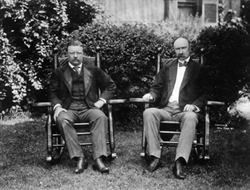
Roosevelt chose Charles W. Fairbanks of Indiana as his running mate in 1904. Although Fairbanks was a conservative, Roosevelt selected him, in part, because he was a fellow conservationist crusader.
T.R. with Charles W. Fairbanks. (Courtesy of Theodore Roosevelt Collection, Harvard College Library)
No matter how cold Fairbanks was, he couldn’t compare to the nearly lifeless Judge Alton B. Parker of New York, the Democratic presidential nominee. With the fiery William Jennings Bryan sitting out the 1904 election, Parker had been nominated over William Randolph Hearst. Parker was a decent, fair-minded appeals court judge, but the only real campaign issue he took up was getting the gold standard endorsed in the party’s platform. Also, Parker had what modern-day media consultants call an “image problem.” He always seemed to be overshadowed by rows of law books—not an uplifting quality in a national politician. And Parker didn’t take criticism well: he was thin-skinned. Worse, Parker’s choice for vice president was an eighty-one-year-old millionaire, Henry G. Davis of West Virginia, who helped finance the lackluster campaign with his own funds. All things considered, the famous Roosevelt luck was in play. There couldn’t have been two less inspiring candidates for Roosevelt and Fairbanks to run against than the humdrum Parker and Davis.
During the campaign, with the media covering little else, Roosevelt appointed his “golden trout watcher,” Stewart Edward White, as a special inspector for the California forest reserves. White’s job was to stop illegal tree destruction and clear-cutting. Roosevelt also asked him to write a hunter-naturalist’s book about big game in California; it would be a sorely needed addition to America’s naturalist library. Meanwhile, Theodore’s fatherly letters to Kermit, who was attending Groton in Massachusetts, were full of anecdotes about hiking from the White House to Chain Bridge along the Potomac, and descriptions of the autumn foliage—the rusty leaves of the Virginia creepers and the brilliant saffron tones of the beeches, birches, and hickories. Only in the last paragraphs of the letter of October 15, as if embarrassed, did Roosevelt mention the fact that the Democratic Party was besmirching his reputation. “In politics things at the moment seem to look quite right,” he told Kermit, “but every form of lie is being circulated by the democrats, and they intend undoubtedly to spring all kinds of sensational untruths at the very end of the campaign.”53
Roosevelt had a lot to boast about on the campaign trail. For starters, nobody doubted that he was the titular head of the Republican Party. If Roosevelt had jotted down on a three- by five-inch card his list of his historic accomplishments since becoming president, he could have listed the Panama Canal, the forming of a Department of Commerce and Labor (in conjunction with the Bureau of Corporations), settling a boundary dispute with Canada over Alaska, avoiding war with Britain over Venezuela (by going through the Hague Commission), siding with mine workers in the anthracite coal strike, launching numerous antitrust suits against monopolies like the Northern Securities Company (these suits were intended to ensure that rich and poor were equal under the law). With regard to racial matters, he had stood up to bigots in the U.S. Senate such as Edward Carmack of Tennessee and Benjamin Tillman of South Carolina. In the area of conservation, Roosevelt had created three national parks, twenty-nine national forests, and two federal bird reservations. His emphasis on irrigating the West was making human settlement in the arid zones of Arizona, Nevada, and California possible. (Although this was not understood at the time, western reclamation led to overconsump-tion of water and fertilizer and in that regard proved extremely harmful to the environment.)
So when President Roosevelt wrote to Kermit, a week before Election Day, about a “big sum of substantive achievement” he wasn’t boasting falsely. Still, his successes were of the executive kind; his record of working with Congress was mediocre at best. Only his close alliance with Lacey had paid dividends. “Now as to the election chances,” Roosevelt wrote to Kermit. “At present it looks as if the odds were in my favor, but I have no idea whether this appearance is deceptive or not. I am a very positive man, and in consequence I both attract supporters and make enemies that he [Parker] does not, in a way that he cannot.” Enemies of Roosevelt included Collier’s Weekly and the Evening Post, racist southerners, railroad companies, western developers, timber and mining concerns, Wall Street financiers, and the great capitalists (with the exception of Andrew Carnegie and a few others). The Standard Oil Company had publicly attacked Roosevelt when his administration established the Bureau of Corporation, seen by the Rockefeller crowd as an insult and as antagonistic to big oil. In the weeks before the election, sensing that Roosevelt was going to win, Standard Oil wrote a $100,000 check for his campaign fund. Boldly, Roosevelt rejected the money, asking that the donation be returned, not wanting to be tainted by oil money. Roosevelt insisted that presidents during the automobile age could not, under any circumstances, afford to take a contribution “from an oil company seeking government influence.”*54
IV
On November 8, 1904, Roosevelt won a decisive victory over Alton Parker, with 336 electoral votes to 140. The socialist Eugene V. Debs had run as a third-party but didn’t earn a single electoral vote. Roosevelt had earned the White House. This was, in fact, the largest plurality for a U.S. president up until that time. As for Congress, the Republicans swept both houses, picking up many new seats. It’s been estimated that about thirty of the freshman Republican legislators elected were ardent Rooseveltian conservationists. Because Roosevelt had publicly pledged that he would not run again in 1908 (a decision he came to regret), he was free to push forward his ideas on national forests, wildlife protection, western irrigation, and federal bird reservations. Ironically, Roosevelt’s premature pledge not to run again had the beneficial effect of letting him be more aggressive about creating forest reserves. He had learned something from the way President Cleveland had protected 21 million acres before leaving the White House in 1897. Responding to a congratulatory note from Owen Wister, Roosevelt bragged about his successes in irrigation and forestry, claiming he had the “college bred” men of the country on his side.55 With executive power and no more elections, Roosevelt was off to the races regarding conservation—he was determined to create a new environmental infrastructure for America, one that would become a triumph of twentieth-century policy and planning.
When word of Roosevelt’s election went out on the AP and UPI wires, telegrams of congratulations poured into the White House from all over the world: the writers included Kaiser Wilhelm of Germany, Emperor Meiji of Japan, and Prime Minister Balfour of Great Britain. Only one world leader, however, was clever enough to have sent congratulatory gifts before election day, anticipating Roosevelt’s victory: Emperor Menelik II of Ethiopia had sent two monkeys, two ostriches, one zebra, and one lioness on the Atlantic Transport liner Minneapolis.56 Menelik wanted Roosevelt to receive the gifts on election night—and he did. Roosevelt was impressed and promptly saw to it that the animals were donated to zoos. A year later three huge elephant tusks arrived from Menelik—one of them was nine feet long. Roosevelt donated two of these to the National Museum and kept one for himself.*57
A few days after his election a confident Roosevelt, usually shy about fund-raising, asked Andrew Carnegie directly to fund a forest museum and library that Pinchot had been promoting; it would be a kind of Bronx Zoo for trees. (In 1901, Carnegie had formed the Carnegie Institution of Washington to “encourage in the broadest and most liberal manner investigation, research, and discovery, and the application of knowledge to the improvement of mankind.”58) As Roosevelt saw it, the “forest life” museum would contain “specimens and models, the material for actual study of the life of the forest firsthand, or as it exists in the woods.” The desired effect was to increase “our knowledge of the forest on a new plane and vastly increase the possibility of using it wisely and well.” Deforestation was a global curse and Roosevelt wanted to confront it on a global level. “In other words,” Roosevelt went on, in a letter to Carnegie, “such a collection, supplemented by a complete library of literature of forestry, and supported by funds for original research, would mark a wholly new step in the progress of forestry. Its creation would be a signal service not only to the United States but to every region of the world where trees grow. I’m strongly of the opinion that the plan is a good one.”59
Never before had Roosevelt written in this way to ask for funds from a rich and powerful man. But Pinchot’s ideas of a revolution in forestry were so vital for America that he was willing to approach Carnegie, who was widely celebrated by 1904 for embracing a wide array of educational advancement schemes. Carnegie libraries were springing up on Main Streets all across America. Unfortunately for Roosevelt, however, Carnegie had little or no interest in a tree museum. To his mind, it smacked of a boondoggle. Courteously, the old man rejected the appeal, but he did help Roosevelt promote bird rehabilitation projects in Florida. (Roosevelt thanked him for this in An Autobiography.) Still, the idea of a tree museum continued to intrigue Roosevelt and Pinchot. Making a return visit to the Saint Louis World’s Fair with Edith, the president studied all the buildings with an eye for fine architectural touches, imagining how best to create a forestry museum that would attract visitors by offering modern exhibits. Predictably though, his favorite state-sponsored attraction at the fair was the North Dakota exhibit, which had his “Maltese cross cabin” on display. Roosevelt had succeeded in being the Pike, Carson, Boone, and Crockett of his time in the popular imagination—quite an accomplishment for a Manhattanite of the Knickerbocker aristocracy who had been sickly as a child.
What a thrill it was for President Roosevelt to see his Maltese cabin at the North Dakota display at the fair! Although it was just an ordinary log cabin, it had been carefully dismantled, shipped to Saint Louis, and then reconstructed to look exactly as it did from 1883 to 1886. Two pairs of Sunday trousers, an old straw hat, and high hunting boots once belonging to Roosevelt were put on display. Tourists came to study the ranch brand burned onto one of the logs. Capitalizing on Roosevelt’s famous Badlands hunts, expertly hammered onto the side of the cabin were perfectly mounted speciments of the deer, elk, eagle, fox, and owl. Besides his own frontier house, a childhood cabin of Lincoln and a dwelling constructed by Grant before the Civil War had also been erected as attractions at the fair; this was exactly the Republican presidential company Roosevelt liked to keep.60
During the four-month wait between his reelection in November 1904 and the inaugural ceremony in March 1905, Roosevelt, who reaffirmed his belief in the Monroe Doctrine in tough words, also stayed busy with conservation. President Charles William Eliot of Harvard University, for example, had published John Gilley, Maine Farmer and Fisherman for the Christmas season, and Roosevelt promoted it enthusiastically. Gilley was in the rough-hewn American tradition, like Seth Green, Paul Kroegel, and William Sprinkle—so Eliot had produced the very type Roosevelt wanted to hire to defend forests, wildlife, natural wonders, scenic vistas, and waterways.61
Roosevelt also meditated, that holiday season, on deer and wolves. Predictably, he had an explicit desire to hunt bear on the outskirts of Yellowstone now that its bear population was increasing. When a discussion turned to national parks Roosevelt, drawing on his 1903 trip with Burroughs, objected fiercely to ever allowing “sheepmen, cattlemen, or any other transgressors” into them.62 Meanwhile, Roosevelt’s old ranchhand Bill Merrifield came to see him at the White House one afternoon, shedding his ranchman garb in favor of “a severely correct frock coat, cravat, and top hat.” The two men swapped stories for hours about 1880s North Dakota; Roosevelt’s chief concern was that this simple, humble plainsmen felt comfortable as if in the “people’s house.”
New animals were continually being added to the Roosevelt family menagerie, and to lull his children to sleep at night the president would read them The Deerslayer out loud. An expansive renovation was also under way at Sagamore Hill: Grant La Farge was helping the president redesign the house to look like a Kenyan hunting lodge.63 And Roosevelt began strategizing about how best to save the Alaskan seal rookeries from British and Japanese fur hunters in the Bering Sea. Every time he read of entire seal colonies being slaughtered, pain struck his heart. The secretary of state, John Hay, was doing his best to get Britain to forgo seal hunting within a sixty-mile radius of the Pribilof Islands and to shorten the hunt seasons. Unfortunately, Hay’s negotiations weren’t going well.64 Roosevelt began haranguing the specially formed Bering Sea Tribunal to ban “seal killing” during the spring breeding season. How could Great Britain consider itself a civilized country, Roosevelt fumed, when Britons slaughtered “nursing mother seals on the high sea?”65
One of President Roosevelt’s first significant postelection acts was to transfer the federal forest reserves from the Interior Department to the Department of Agriculture’s Bureau of Forestry on February 1, 1905. This had been Gifford Pinchot’s dream since 1898. On March 3, with Inauguration Day approaching, the Bureau of Forestry was renamed the Forest Service. Roosevelt had two major reasons for going along with Pinchot’s transfer plan: the GLO was filled with pro-business appointees who knew nothing about scientific forestry, and the centralization of the GLO caused long delays in issuing grazing, mining, and lumbering permits to regional reserve users.66
Unlike his boss, Roosevelt, Pinchot was interested in forest administration rather than wildlife protection per se. Wise use of timber resources was his objective. Pinchot, in fact, was extremely hesitant to regulate game animals on the forest reserves (which were yet again renamed National Forests in 1907) for fear of infringing on states’ rights and giving western critics such as Senator Mitchell of Oregon reasons to disband the reserves by congressional legislation. This utilitarian attitude regarding forests made Pinchot the bane of Roosevelt’s friends who favored wildlife protection, such as Muir, Burroughs, Hornaday, and Finley. According to Pinchot’s “The Use Book”—rules and regulations for rangers to follow—the Forest Service offices would “cooperate with game wardens of the State or Territory in which they serve.” A couple of years later Pinchot made this perfectly clear by means of a provision in the Agricultural Appropriations Act of 1907: “hereafter officials of the Forest Service shall, in all ways that are practicable, aid in the enforcement of the laws of the States or Territories with regard to…the protection of fish and game.”67 Yet Roosevelt didn’t believe only in Pinchot’s notion that national forests were to be mainly conserved, not preserved. For Roosevelt, always interested in animals, the forests were also “cradles of wildlife.”68
V
As Inauguration Day, March 4, neared, Roosevelt received the best gift imaginable from sixty-seven-year-old John Hay (still serving as secretary of state), short of saving Alaska’s seals or naming yet another elk after him. Hay, who was seriously ill, presented Roosevelt with his precious Lincoln hair-ring. The connotations of this gentlemanly gift brought Roosevelt to tears, especially since Hay had sometimes belittled him. Hay, who was a friend of Roosevelt’s father, had also been Lincoln’s loyal personal assistant. When Lincoln was shot at Ford’s Theatre by John Wilkes Booth and was brought across the street to the Petersen House, the attending doctor had clipped locks of hair from the dying president’s head. Hay somehow inherited them and made a special ring with the hairs set like a diamond. “Please wear it to-morrow,” Hay had written Roosevelt in his presentation note; “you are one of the men who most thoroughly understand and appreciate Lincoln.”
Moved by Hay’s gesture, Roosevelt wrote back that he was wearing the ring and would do so when taking the oath of office on March 4. (Later, Roosevelt claimed to have encountered Lincoln’s ghost a few times in the White House corridors.69) The ring was a farewell gesture. On July 1 Hay died at his summer home in Newbury, New Hampshire, from what doctors believed to be a pulmonary embolism. His death was harder for Roosevelt to absorb than the assassination of McKinley. Without delay, however, Roosevelt appointed the intensely loyal Elihu Root to be Hay’s replacement at the State Department. It was an inspired choice, for in the coming years Root would successfully remove the consular service from the “spoils system” by placing it under the direction of the Civil Service, maintain the “open door” policy in the Far East, help create the Central American Court of Justice, and eventually win the Nobel Peace Prize in 1912.
Roosevelt’s inauguration parade of March 4, 1905, was quite a spectacle. In the presidential stand 1,200 dignitaries from all over the world sat arm-to-arm. A light blanket of snow was draped over the White House, creating a fine, calming white hush. The half inch of snow wasn’t enough to create serious problems.70 In fact, a mild front had blown into town, making Washington pleasant though still cold. Once again, Roosevelt was lucky. Acting as the impresario for his own inauguration, he had imported the heroic staff figures from the Saint Louis world’s fair representing colorful pioneers, plainsmen, and scouts.71 At his request, thirty Rough Riders strode next to him as his special guard throughout the day. Representatives from every state and territory participated in Roosevelt’s gala parade. Bands blared and boys’ glee clubs sang. More than 2,000 American flags were handed out by the War Department so they could be waved by onlookers as the parade went by. A cold northwest wind swept through Washington, but throngs of sunburned cowboys from Texas and Oklahoma arrived to cheer Colonel Roosevelt.
At Roosevelt’s request $2,000 from the inaugural planning committee’s kitty had been appropriated to bring six renowned Native Americans to participate in the parade. They were the chiefs Geronimo (Apache), Buckskin Charlie (Ute), Little Plume (Blackfoot), America Horse (Brule Sioux), Hollow Horn Bear (Rosebud Sioux) and Quanah Parker (Comanche).72 Quanah, in a traditional costume, saluted the president flatteringly as the “Great White Chief,” initiating a lifelong friendship. Roosevelt promised Quanah—whom he admired greatly—that they would soon hunt wolves together in Oklahoma’s Big Pasture–Wichita Mountains. But for the time being, Roosevelt hoped the six chiefs would enjoy themselves in their capital city.
Old Seth Bullock—“the Captain”—Roosevelt’s conservationist protector of the Black Hills forest reserve, arrived in Washington, bringing with him the best broncos from Nebraska and cayuse ponies from South Dakota to march in the grand event. From Bullock’s perspective Roosevelt was the only president to understand the American West. For people from the rangelands, riding in Theodore Roosevelt’s inaugural parade had replaced Buffalo Bill’s Wild West Show as the highest honor. Cleverly, Bullock had asked the cowboy star Tom Mix to ride at his side, causing the girls in the audience to scream with delight. Roosevelt was so naturally close to Bullock that they “spoke” in sidelong looks, understanding everything in a mere glance. Following the parade Roosevelt appointed Bullock the U.S. marshal for South Dakota.73 “Seth Bullock is really a big fellow,” Roosevelt wrote to his son Ted. “He belongs to the Viking age just as much as Harold Hardraade, or Olaf the Glorious, or Gisli Soursop. If ever I went to war I should want him as colonel of a rough rider regiment.” 74
Perhaps the most fitting symbol of the inaugural parade wasn’t on the official itinerary. A few Washingtonians, it turned out, had gathered tree limbs and branches from nearby woods in Maryland. Setting up souvenir stands along the Pennsylvania Avenue parade route, these “big sticks” went for ten cents apiece, complete with an inaugural verification card. They sold briskly, revelers waving them in the air to express solidarity with Roosevelt, as they listened to the clip-clopping of the horses’ hooves marching down the grand boulevard.75 Meanwhile, for three and a half hours Roosevelt stood on the reviewing stand, doffing his top hat to the thousands who paraded past him. As the New York Times reported, “Old timers agree that in point of picturesqueness, variety, and general interest no inaugural procession in many years” equaled Roosevelt’s parade of 1905.76
People poured into Washington, D.C., from far and wide to be part of history on that cold March day. More than 35,000 Americans took part in the procession. Most were wearing topcoats and scarves. Not since Andrew Jackson muddied the White House furniture with his “corn liquor” crowd had there been as much fun at an inaugural. People came from the lake regions of the Midwest, and the high plains of Colorado, Wyoming, and Montana. Old-style Rocky Mountain guides from west of Denver suddenly experienced East Coast civilization for the first time. Coal miners from West Virginia arrived by railroad from mountain hollows not even on maps. There were the Scotch-Irish from Kentucky and fishermen from the Georgia Sea Islands. Self-proclaimed cornhuskers ventured into the alien town from the grouse-hunting lands of Illinois and Iowa which the president had first tramped in 1880. Members of the Boone and Crockett Club, proud of their founder, sat together shouting “Roos-e-velt!” “Roos-e-velt!” like children at P. T. Barnum’s circus. As one reporter observed, the entire navy base from Norfolk had come to see the author of Naval War of 1812 in his moment of triumph. A Pennsylvania cavalry regiment played “A Hot Time in the Old Town Tonight,” causing Roosevelt to applaud wildly; it was considered a risqué number. A comical note was struck whenever Roosevelt tried to shout out to a parader and the wind blew his glasses-cord into his mouth.
Cultural diversity was a predominant theme in Roosevelt’s unusual parade. Eager-faced African-American students from Virginia and Pennsylvania were asked to participate in the parade; so too were Puerto Ricans and Filipinos, who wore earmuffs to combat the cold. Socialites, carrying canes, arrived by the trainful from Beacon Hill, the Upper East Side, the “gold coast” of Long Island, and Philadelphia’s East Falls. It almost seemed as if representatives from every bump, knoll, and stretch of America were present to cheer Roosevelt. The entire event was like the kind of murals Thomas Hart Benton would later paint: no region, epoch, or local type was left out. This was Roosevelt’s own Buffalo Bill production, an amazing explosion of Americana choreographed in a way that matched the Saint Louis world’s fair.
This time Roosevelt took his oath of office by pledging on a Bible, the same one he had kissed on January 2, 1899, when he was sworn in as New York’s governor.77 Of all the guests Roosevelt received, it was Robert B. Roosevelt, standing on the same platform, who most strongly plucked the president’s heartstrings.* Surely he remembered coughing his way through his Manhattan childhood, with his father trying to open the Museum of Natural History and Uncle Rob lobbying to create New York’s fish hatcheries. Until 1905 President Roosevelt had always seen his Uncle Rob as a political liability and was disinclined to be photographed with him—stories about his uncle’s flirtations and romances with women served only to hurt his own claim to high personal morality. But Uncle Rob had led the way in the conservation movement—he was, after all, the “Father of Fishes”—and his nephew seemed relieved to welcome the black sheep back into the family. No longer did he have to meet Uncle Rob clandestinely at Lotus Lake to discuss shad or eels. With no future political concerns to worry about, the president now let down his defensive guard. “Dear Uncle Rob,” Roosevelt wrote on March 6: “It was peculiarly pleasant having you here. How I wish Father could have lived to see it too! You stood to me for him and for all that generation, and so you may imagine how proud I was to have you here.” 78
At the time of his inauguration, as if presenting himself with a gift, Roosevelt saved yet another North Dakota birding roost near Devils Lake.79 Stump Lake was ten miles long and two and a half miles wide and teemed with migratory waterfowl. On four islets in the lake, thousands of ducks bred during the nesting season. White pelicans, in particular, bred in the wetlands ecosystem. Unlike brown pelicans, known for diving, the American white pelican, which flocks in a V, feeds by dipping its bill into a lake for fish.80Roosevelt knew that Stump Lake was a popular spot for oologists, a subgroup of ornithologists who focus on collecting and analyzing bird eggs. Anxious to put the oologists (that is, those not affiliated with the Smithsonian Institution or the American Museum or some similar scientific outfit) out of business, Roosevelt had an executive order prepared for signing. Thousands of eggs were being stripped from Stump Lake, and two generations were killed off in a “hit,” as the theft was called in Grand Forks and Fargo. Secretary of Agriculture Wilson had written a letter to Roosevelt suggesting that the North Dakota islets be preserved. “In view of the fact that the season is close at hand when ducks will return to Stump Lake to breed,” Wilson wrote on March 5, “I respectfully recommend that the reserve be created at an early date, in order that ample time may be given to make the preparations necessary to afford the birds full protection during the breeding season of 1905.”81
Four days later, on March 9, Roosevelt declared Stump Lake his third federal bird reservation, placing it on the “same footing” as Pelican Island and Breton Island.82 Part of his rationale for creating Stump Lake—and Sully’s Hill, for that matter—was his sad realization that Canada reared most of North America’s wild fowl while the United States did the slaughtering. His thinking would prove to be prescient. Around this same time, encouraged by Congressman Lacey, Roosevelt began envisioning a coordinated system of bird reservations from Lake of the Woods to the Gulf of Mexico and from the Aleutians of Alaska to Nihoa Island in Hawaii.
The bird protection movement was gaining momentum. Pelican Island, Breton Island, and now Stump Lake had been created. Many others were on the agenda. Birds were also being saved in Roosevelt’s national forests. And Roosevelt was just getting started with his other preservationist ideas for the territories of Oklahoma, New Mexico, and Arizona.