
CHAPTER TWENTY-ONE
I
Following his inauguration in March 1905 Roosevelt became focused on hunting gray wolves (or coyotes) in Texas and Oklahoma. Removed from the rigors of campaigning, he wanted to see the so-called Spirit Trail of the Wichita Mountains and watch the sun drop beyond long reaches of flatlands known as the Big Pasture (a part of the Kiowa-Comanche reservation in southwestern Oklahoma south of the Wichita Mountains and north of the Red River of the South). The time to reinvent himself, during the spring, had again come. As an added incentive, bones of ancient elephants—mammoths—were rumored to have been found around Domebo Canyon in Oklahoma; perhaps he’d be able to inspect a few. Working through Colonel Cecil Andrew Lyon—the chairman of the Texas Republican state executive committee, known for his quick laugh and his lack of artifice—Roosevelt was primarily concerned about not repeating the Mississippi bear hunt. Because in 1905 Texas had no Republican U.S. congressmen or senators—El Paso to Beaumont being hard-core Democratic territory—Lyon was asked by the Roosevelt administration to recruit good Republicans to enter state government posts; the party couldn’t completely fold its tent. A shared love of hunting was the brick of Roosevelt and Lyon’s relationship; their shared party affiliation was the cement.1
“I am delighted with the good news about the wolves, but please do not have any taken alive and turned out,” Roosevelt wrote to Lyon on March 16. “I would not care to hunt any that were loosed for that purpose. It would not do, on more accounts than one. If we can put them up and kill genuine live wolves and have a genuine hunt, I shall be very glad…. If not we shall take jackrabbits or coyotes; but nothing must be turned loose after having been captured.” 2
Roosevelt had an additional reason to be wary. The day he wrote to Lyon, two white police officers in Mississippi were murdered by a black mob at H. L. Foote’s plantation, not far from the birthplace of the “teddy bear.”3 When this news reached the president, he was bound for New York City to attend the private wedding of Franklin D. Roosevelt and Eleanor Roosevelt (both were his cousins). Roosevelt was horrified by the bloodshed: segregationist Mississippi seemed to be a bottomless chasm of violence and injustice. At all costs, Roosevelt instructed his staff, he wanted to avoid galloping into a race war on his trip to Texas and Oklahoma. His advance team was instructed to tread carefully, avoiding political potholes. With regard to other matters, his staffers dutifully found him the right bridles, spurs, and whips, to use in Texas, Oklahoma, and Colorado. A fast, fearless, long-winded hunt horse was also procured. And, of course, what Roosevelt called “outdoors books” were ordered; they dealt with Oklahoma’s wildlife species and included range maps and pertinent life histories.4 What Roosevelt didn’t want was a hotel with concierge, elevators, and white washbowls with copper fixtures, once he was out of Texas. The White House also announced that Roosevelt intended to spend time with his friend Quanah Parker, the last of the Comanche chiefs to surrender to “the white man’s stony road.”5 (A small contingent of Comanche insisted that Parker wasn’t their real chief, but that thieving white politicians had anointed him as such.)
According to the plan that was developed, Roosevelt would spend April around Fort Sill, hunting wolves in the surrounding primeval prairie dotted with solitary towers. Then he would venture to the Rockies in search of grizzly bears. (Only T.R. could get away with vanishing for weeks on end and still have the public cheer.) Once again the president wanted to explore the Colorado high country, which was the birthplace of his favorite rivers: the Rio Grande, San Juan, North and South Platte, Yampa, Gunnison, Arkansas, and Dolores—and, most famously, the Colorado. Meanwhile Edith, and three of the Roosevelts’ children—Ethel, Kermit, and Archie—would spend a holiday on the Atlantic coast of Florida on the yacht Sylph.
Roosevelt, for his part, was advancing the notion of statehood for the Twin Territories (Indian and Oklahoma) as a single entity: Oklahoma. His choosing to hunt wolves in the Wichitas–Great Pasture area rather than in Texas contributed to that message. Until Roosevelt’s presidency, the Twin Territories were considered largely no-man’s-land to everybody but the mounted warrior cultures of the Kiowa, Apache, Comanche, and Wichitas (considered the ablest bison hunters on the Great Plains). The Spanish explorer Coronado had journeyed through the Oklahoma plains in 1541, looking for a “lost city of gold” but decided there wasn’t one. (He carved “Coronado 1541” on Castle Rock where the Santa Fe Trail crossed the Cimarron River.) Thomas Jefferson acquired southwestern Oklahoma in the Louisiana Purchase, but it was considered the least valuable part of the purchase when President Andrew Jackson marched the Five Civilized Tribes from the southeastern United States down the Trail of Tears to the area.
Oklahoma! Everything loose or lost in America seemed to have tumbled into the territories as if through a giant chute. The population included reservation Indians, felons, paupers, drunkards, dirt farmers, fortune seekers, gamblers, and losers of every stripe. The smart pre–Civil War pioneers, those who were not seeking instant wealth, stayed on a network of trails and kept heading west. No pause. No rest in Tulsa, Oklahoma City, or Elk City. Just onward toward Amarillo by twilight and across the great desert lands to the shimmering Pacific Ocean. Others simply followed the Cimarron River, driving longhorns up to Kansas, where Christian settlements had taken hold. But only a rather optionless breed of humanity stayed in Oklahoma for very long.
Because people ventured to the Twin Territories to exploit resources or simply pass through, the basic tenets of conservationism were largely anathema to residents. In 1878, the last buffalo herd was reported to have been obliterated in Oklahoma—all the big game was rapidly disappearing from the Great Plains. Railroad expansion helped end the “golden age” of big game hunting in Oklahoma.6 There were, however, plenty of smaller animals and birds. And Oklahoma still had vast natural beauty. The Cross-Timbers region was a great forestland that stretched from southeast Kansas to northern Texas, dividing the western plains from southeastern forests. In general, the Plains Indians lived to the west and the Five Civilized Tribes to the east. Seldom did the two meet. Wintering waterfowl, nesting wood ducks, and neotropical migratory songbirds all lived in the spurs of the Oklahoma mountains.
There was something still peculiarly western about the Twin Territories, for this hard-living region was unsettled. Oklahoma City, for example, was erected virtually overnight between 1889 and 1895, because of the cheap land. When President McKinley’s “great land lottery” was announced in July 1901—Kiowa, Comanche, and Apache reservation land was being given away—homesteaders came pouring into the region by railroad and on horseback. Luckily for posterity, a conservation easement was attached to the lottery. Coinciding with the homesteading act President McKinley—at Vice President Roosevelt’s urging—saved 59,019 mountainous acres to create the Wichita Forest Reserve (administered by the Department of the Interior’s Forestry Division of the General Land Office). Fortunately, fragments of the Cross Timbers survived at the Wichita Forest Reserve (eighty-nine square miles, considered sacred by Native Americans, just outside Lawton–Fort Sill.) The entire Wichita mountain range covered a 1,500-square-mile region that extended into Caddo, Comanche, Kiowa, Jackson, Greer, and Tillman counties.
So, onward to the pure air of Oklahoma! Roosevelt craved a long stay on the prairie before the Twin Territories became one state. His mere presence in any Indian-Oklahoma territorial hamlet would guarantee it a mention in the history books. Roosevelt wanted to inspect the Wichita mountains landscape, first inhabited by Paleo-Indians more than 10,000 years ago. He would be scouting for an ideal buffalo pasture. The buffalo at the Bronx Zoo, he believed, were ready to return to their home range in Oklahoma, where Coronado first saw these animals in the sixteenth century.7 According to Charles “Buffalo” Jones, whom Roosevelt appointed as game warden of Yellowstone, the bison then living in Mammoth Valley had become such a popular attraction at the national park that railroad companies were promoting them to tourists. One advertisement exclaimed: “BISON once roamed the country now traversed by the Northern Pacific. The remnant of these Noble Beasts is now found in Yellowstone Park reached directly only by this line.”8
During the Christmas season of 1904 Roosevelt spent an evening with the naturalist Ernest H. Baynes of New Hampshire, an animal trainer who went everywhere, befriended everyone, and noticed everything. Concerning buffalo, he liked to express original zoological ideas—often sounding brilliant—and then brag about his originality. In September 1904 Baynes had cooked up for Roosevelt a detailed plan to reintroduce buffalo. The initiative called for Roosevelt to remove from private individuals as many of the remaining American buffalo as possible. The U.S. government would offer large-scale ranchers like Charles Goodnight and Howard Eaton a fair price ($1,000) for each buffalo they owned.9 Baynes even suggested that the government acquire the few remaining Canadian herds. Once all the remaining buffalo were procured, refuges would be established for them throughout the Great Plains. The Wichita National Forest in Oklahoma would be the first. Baynes’s plan also offered a compelling reason why numerous reserves (not just the Wichitas) were needed: “If a contagious disease should strike any one of these herds not too large a proportion of the existing animals would be wiped out at the same time.”10
After the election, Baynes’s plan was put into action. Roosevelt even promoted big game preserves in his Fourth Annual Message on December 6, 1904, in a way that would have pleased George Catlin:
I desire again to urge upon the Congress the importance of authorizing the President to set aside certain portions of the reserves, or other public lands, as game refuges for the preservation of the bison, the wapiti, and other large beasts once so abundant in our woods and mountains, and on our great plains, and now tending toward extinction. We owe it to future generations to keep alive the noble and beautiful creatures which by their presence add such distinctive character to the American Wilderness.11
Just after New Year’s Day, William Temple Hornaday and Madison Grant of the New York Zoological Society went to work getting the buffalo ready for Oklahoma. The zoo herd had been donated to them by William Whitney of Massachusetts, a wealthy wildlife protection activist. At the time, the federal government owned only two herds: at Yellowstone National Park and National Zoological Park in Washington, D.C. Baynes was authorized by Roosevelt to start identifying private buffalo herds to be acquired by the federal government for a third preserve and a fourth preserve. Meanwhile, Congressman Lacey lobbied every U.S. senator about the new game reserve bill. After a few weeks of congressional seesawing, on January 24, 1905, the bill (33 Stat. L., 614) passed easily. The buffalo would soon be back on the Great Plains.
Essentially, the Wichita Forest Reserve became an experimental laboratory for the Roosevelt administration. A stipulation of the new Lacey Act was that 3,500 to 5,000 livestock grazing permits would be issued annually to local ranchers. Although hunting was strictly forbidden in the Wichitas, a special provision was made to allow wolf and coyote drives as part of a predator control program. At the time, big game managers believed that if buffalo were to survive, the wolves, coyotes, and cougars had to go. Oddly, guns were not allowed on these wolf and coyote hunts—only dogs. Secretary of Agriculture Wilson also made it clear that if these drives scared the livestock or deer, they would be abolished.
But the Wichita rangers had a more menacing threat to the ecosystem than predators. Although homesteading had been banned in the Wichitas, mining was allowed. From 1901 to 1905, prospectors poured into southwestern Oklahoma hoping to strike it rich. Shafts were built in the granite. Assay offices were set up, it seemed, in every one-horse town. Mining camps were established, including in Meers, Oreana, and Craterville. For a fleeting moment the Wichitas were like the Yukon or the Black Hills. But in the end, there was no gold, and luckily, the forest rangers were somehow able to protect the integrity of the Wichita Forest Reserve during the mining boom, with only limited damage.
From January to March 1905, on Roosevelt’s instruction, groundwork was done by the New York Zoological Society to establish the Wichita Forest Reserve and National Game Preserve.12 Secretary of Agriculture Wilson asked the Biological Survey to assist in finding the ideal location in southeastern Oklahoma for the game reserve. The Senate approved the plan. The part of the Wichitas that seemed to be the most highly recommended site was Winter Valley. So on the eve of Roosevelt’s inauguration, which was to be followed by his hunting trip to the Wichitas, the buffalo project was on a fast track. Baynes’s articles promoting it, first published in the Boston Evening Transcript, had been widely syndicated. An Adrian, Michigan fence company, had huge spools of product ready to ship off at the president’s beck and call.13 It had been a long, hard fight since the 1880s to establish federal sanctuaries for the vanishing big game of North America. But all the efforts by the Boone and Crockett Club and the New York Zoological Society had finally paid off in the spring of 1905.14
On April 1, the president’s specific travel plans became known to reporters. Things were happening quickly. Instructions had been received at Fort Sill, Oklahoma, from the White House to have a detachment of soldiers ready at the railroad outpost of Frederick (population 200 at best) for April 8. They would serve as the president’s Secret Service detail in the Big Pasture–Wichitas. After touring Texas (Dallas, Austin, San Antonio, etc.), Roosevelt planned to cross the Red River to hunt in the Indian Territory with Chief Quanah. Thoreau had preferred nature in winter, but Roosevelt (like Burroughs) was a springtime man. With “thoroughly congenial company” he would ride on “the flats and great rolling prairies which stretched north from our camp toward the Wichita Mountains and south toward the Red River.”15
Roosevelt was also eager to visit Fort Sill. On January, 8 1869, Major General Phil Sheridan had chosen this strategic site for a cavalry fort; he named it after a friend. It had been his headquarters during his successful effort to quash the Plains Indians’ border raids. Comanche and Apache had been pillaging pioneer communities in Texas and Kansas even after the Chicago world’s fair of 1893 had declared the frontier closed. Fort Sill was a form of revenge. Hiring Buffalo Bill Cody and Wild Bill Hickok as scouts, Sheridan used the fort as U.S. Army headquarters in the Indian wars. Eventually, the army pacified all the Indians on the South Plains. In 1867 the Medicine Lodge Treaty was signed by the chiefs—all under duress—of the Kiowa, Comanche, Apache, Cheyenne, and Arapaho, who thereby agreed to reservations in southwestern Oklahoma. After being recalcitrant for a difficult eight years, in June 1875 Quanah Parker had his Quohada Comanche surrender at Fort Sill. With no buffalo herds present for sustenance, his people couldn’t go on. Quanah considered escaping as Chief Joseph had done with Nez Perce, disappearing into the Guadalupe Mountains between Carlsbad, New Mexico, and El Paso, Texas. But he didn’t. He couldn’t put his people through the necessary deprivations and ordeals. A new, less bloody era had arrived in Comanche country.16
With the Comanches pacified and McKinley’s homesteading lottery operating, approximately 29,000 Americans moved to Oklahoma. No hill or knoll was unclaimed. Suddenly, Lawton, the town attached to Fort Sill, grew into the third-largest city in Oklahoma. Sensing the closing of the frontier, and aware that raids were a thing of the past, Roosevelt soon transformed the mission of Fort Sill from cavalry to field artillery. On many days in Lawton, china cupboards would shake from cannon blasts. Curiously, after four or five years of mortar rounds, the usually skittish songbirds seemed to decide that the army practice wasn’t a menace: they paid little attention to the loud artillery. The birds had adapted; call it Darwin’s natural selection at work. As a western historian, Roosevelt was deeply interested in studying the U.S. Army’s Seventh Cavalry, Nineteenth Kansas Volunteers, and the Tenth Cavalry buffalo soldiers. And, in keeping with his hobby, he wanted to see with his own eyes where Sheridan had once trained troops. Therefore, Fort Sill was a special American place to Roosevelt—like Valley Forge, the Alamo, the Chalmette Battlefield, and Appomattox Court House—simply because Sheridan had been connected to it.
Surrounding Fort Sill were the rugged Wichita Mountains—a jumbled landscape of rocky outcroppings, rock-crowded peaks, towering sentinels, granite ridges, and huge boulders strewn around 60,000 acres of prairielands. The Wichita Uplift—which occurred during the Pennsylvania Period about 300 million years ago—had created a number of peaks over 2,000 feet above sea level; they were older than the Alps or Himalayas. Four types of habitats could be found in the Wichita Mountains: rocklands, aquatic, mixed grass prairie, and cross-timbers.17 In this strange range, bunch grass was interspersed with scrub oak forest, cactus, and aloe plants. The Wichitas were a botanical crossroads (ecocene) with more than 270 bird species taking advantage of the buffet, fattening up for the winter. It was said by western frontiersmen that the ancestral Wichitas—this series of rock prominences—was where the East met the West at the vertex of the Great Plains.18 The Red Beds here—formed by prehistoric ocean currents, huge earthquakes, and glacial shifts—resembled the Garden of the Gods outside Colorado Springs. It was a geologist’s dream, a rock garden in which boulders hung off cliffs, seemingly ready to tumble in a roaring avalanche with a northerly gust.
The president’s lead guide in the Big Pasture and Wichita Mountains was going to be Jack “Catch ’Em Alive” Abernathy, a white, Anglo counterpart of Holt Collier; though his specialty was hunting the prairie wolf (Canis latrans) with catch rope instead of hunting the black bear with a knife. Born in 1876 in Bosque County, Texas, colorful Abernathy cut such a swath across the Red River valley of Texas-Oklahoma that he became a legend to drovers from Amarillo to Tulsa. By the time Abernathy was fifteen years old he had already had successful careers as a cowboy on the A-K-X Ranch and as a bronco buster with the J-A outfit. Nobody, it was said, could saddle a wild horse as skillfully as Abernathy. Some people complained that he overworked and underfed his stallions. But everybody agreed that at dusk, Abernathy was usually the last man to hobble his horse.
Brickish and bullnecked, Abernathy was an excellent pianist and bluegrass fiddler in the fast Smokies style of eastern Tennessee. At his regular gigs in bars in Sweetwater, Texas, “Dixie” was still the most frequently requested song, followed by “Ole Paint” and “The Yellow Rose of Texas.” Gregarious to the point of causing irritation, Abernathy had the smile of a dedicated drinker. In reality, he was nearly a teetotaler, taking only an occasional shot or two of bourbon for a toothache. “My six-shooter was my friend,” Abernathy wrote of his youthful days, “and constant companion.” 19
Refusing to be an antihero Abernathy, a proud and devout Christian, lived on the straight and narrow. A man who could defend himself in a scrape, he was dutifully married and had five children. Abernathy was always looking for freelance law enforcement work; handcuffs often dangled at his side. Fairly regularly, he served as an under-sheriff or posse leader for day wages. Townspeople looked up to him. He also took on short ranch jobs at regular intervals. Around a campfire, Abernathy was always the guy tossing kindling on the flames, hoping to keep the conversation going. With his white horse, Sam Bass, and his brave dog Catch (a Scottish shepherd), he was as close to the character called “the Virginian” as was possible in north Texas and southwestern Oklahoma. Owen Wister could easily have woven Abernathy’s trademark quip—“I am a goner for keeps”—into The Virginian. Adding to his western appeal, a kind of Fort Worth drawl colored Abernathy’s utterances: “cow” was “kyow” and was “womb-man.” But for all of his decency, Abernathy wasn’t a nester. Restlessness was his normal condition.
By 1905, what had really made Abernathy legendary, a one-man show more dazzling than Annie Oakley shooting glass balls out of the sky, was his ability to catch a wolf alive by jumping off a horse, wrestling the wolf bare-fanged to the ground, and jamming his fist into the back recesses of the wolf’s jaw. Hence his sobriquet, “Catch ’Em Alive.” The wolves (or “loafers,” as cowboys called them), unable to bite, would become utterly passive and submissive. With the skill of a wrangler, Abernathy would then wire the captured wolf’s muzzle closed and hog-tie its feet.
“Coyote” was the Spanish name to distinguish these wolves from the larger gray wolves that lived in the same Mexico-Texas-Oklahoma range. (In writing about Oklahoma, Roosevelt often used the terms “coyote,” “prairie wolf,” and “gray wolf” interchangeably. “Thus was born Catch ’Em Alive Jack,” the historian Jon T. Coleman writes in a foreword to Abernathy’s autobiography, “the alter ego that would carry Abernathy from Texas to the White House.” 20
Roosevelt first learned of Abernathy’s bold, enterprising feats from a doctor friend, Sloan Simpson of Fort Worth, in January 1903.21 In his customary way, he grunted in disbelief and raised his eyebrows questioningly. Abernathy was brought to Roosevelt’s attention again by Colonel Lyon, over Christmas 1904. Apparently, Lyon had witnessed Catch ’Em Alive Jack hand-trap a few coyotes and immediately told the president about the crazy stunt. A vague plan was begun—that he’d go wolf coursing with Abernathy in Texas or Oklahoma soon and make the Wichita Forest Reserve the site of the buffalo preserve inspired by Baynes, Hornaday, and Lacey. Before long Roosevelt would give Abernathy the highest praise he could, saying that the plainsman had “a perfect knowledge of the coyote.”22
II
As the “Roosevelt Special” pulled out of New York on April 3, 1905, the president was in a fun-loving mood, even though he was grappling with the Moroccan crisis (involving Germany, Spain, and France, whose military and economic interests in Morocco were threatened when its emperor called for Moroccan independence and anticolonial integrity). About foreign affairs in general, Roosevelt joked to the press that he had left the 300-pound William Howard Taft “sitting on the lid keeping [it] down.” Reporters covering Roosevelt’s trip asked why he had chosen dusty Texas and the Twin Territories, of all places, for a holiday. “I don’t exactly say that I need a rest,” Roosevelt said, “but I am going to take one in the open, under God’s blue heaven.”23
Excitedly, Roosevelt talked of meeting with Rough Riders at a reunion in San Antonio, riding with Quanah in the Big Pasture, and coursing for wolves with Catch ’Em Alive Jack in the Wichitas near Sheridan’s old Fort Sill. The prospect of being caked with cracked mud seemed idyllic to Roosevelt. Other easterners might seek comfort, but he spoke in favor of burrs and smelling the blossom-spray of spring on the prairie. One of his favorite Rough Riders—“Little” (five-foot-two) Billy McGinty of Ripley, Oklahoma—would be around for casual laughs. As a horseman, Roosevelt said, McGinty had no peer. And holidaying in the dry plains had obvious benefits for Roosevelt’s heath. Asthmatic wheezing was unheard along the 1,290-mile Red River of the South: this was open-lung country. Unbeknownst to reporters at the time, Roosevelt, as noted, was also planning to see if the Wichita Forest and Game Preserve would be a suitable place to reintroduce bison. In fact, predator control was a major reason why he wanted to hunt wolves. The zoologist William Temple Hornaday at the Bronx Zoo had informed Roosevelt that he was ready—more than ready—to send his hand-fed bison herd by railroad from the Bronx to Oklahoma. All he needed was Roosevelt’s go-ahead. Roosevelt, in a sense, was serving as Hornaday’s advance scout.
Although this is unprovable, at his inauguration in March 1905 Roosevelt probably told Quanah Parker (the last of the Quahadi Comanche chiefs) about the buffalo repatriation that the New York Zoological Society was overseeing; after all, Congress had (through the Lacey Act) authorized the president to create a big game reserve in the Wichitas, just two months earlier.* There was never a Native American that Roosevelt liked more than Parker. Because he had a white mother—Cynthia Ann Parker, who had been captured by Comanches in a raid near Groesbeck, Texas—Chief Quanah was a so-called half-breed. A tough Plains fighter in his youth, by 1905 he had become an American pragmatist, more of an optimist like William James than a fatalist like Crazy Horse. Yet there was also something mystical about him, an unaccountable reverence in his every utterance. Actually, some of Quanah’s guru wisdom may have been drug-induced. The chief used peyote; eating mescaline made him feel equal to every task, able to glide like a bird or crawl like a snake.
The advisability of taking such drugs is always doubtful, but they seemed to work for Quanah. He was bookish and knew that mescaline in the form of peyote buttons had been used along the Rio Grande Valley by Native Americans since 3,700 BC. In the sixteenth century, Spanish priests in Mexico forbade native people to use it; but as the Comanche lost their foothold in the American Southwest in the late nineteenth century, peyote came into vogue among them, like the Ghost Dance.24 In the face of defeat, why not get high and pray? Around 1890, after a particularly intense vision, Quanah created the Native American church movement. This religious experience led to his denouncing his past raids against white settlers and becoming a committed pacifist. He adopted peyote as a ritual for the Comanche and Kiowa. The bitter sweet taste of mescaline could, he believed, free his people’s minds from the white man’s tyranny, and at the very least it was far better than being locked up at Fort Sill or Fort Leavenworth. The fact that Quanah ate Lophophora williamsii was unimportant to Roosevelt, because the drug had brought Parker into the arms of Christ. “The white man goes into his church and talks about Jesus,” Roosevelt famously said. “But the Indian goes into his tipi and talks toJesus.”25
No one knew for certain where Quanah was born. However, he claimed it was somewhere around the Wichitas; and just as Roosevelt had learned the North Dakota topography inside-out, Quanah understood every nook and cranny of his beloved Wichita range and the Llano Estacado (Stalked Plains). Even though Quanah wore his hair in long braids and had several wives, he nevertheless adopted many of the white man’s ways. An impetuous cordiality informed his dealings with white men. Often, he wore a business suit and derby hat. For example, his home in Cache, Oklahoma—the two-story, twelve-room “Star House,” where Roosevelt dined and slept on the porch one evening—was modeled after the U.S. Army general’s headquarters in Fort Sill. (Fourteen white stars symbolizing generals in the cavalry were painted on its red roof.26) It had been a gift of the Texan rancher Burk Burnett and was equipped with one of the first residential telephones in southwestern Oklahoma.27
What Roosevelt most admired about Quanah was his never-failing reverence for buffalo. Unlike Geronimo, the Chiricahua Apache who appeared in William Cody’s Wild West Show, Quanah never abandoned his vision of a vast “buffalo common” on the Great Plains. The deeds of the U.S. Cavalry never diminished his fervent belief in the prophecy of a rebirth for the buffalo. A hard worker, not given to idle hours, the soldierly Parker had no concept of quitting. In 1903, Roosevelt had been informed that the 101 Ranch in Bliss, Oklahoma, had hired the capricious Geronimo to lead a hunt for captured buffalo. This was a theatrical pageant: Geronimo, in war paint, would lead on horseback, followed by a convoy of automobiles whose drivers would shoot at terrified buffalo acquired from the Goodnight Ranch in Texas. When Roosevelt heard from the National Editorial Association about this inhumane and unsportsmanlike hunt, he was furious. He wired Governor Thompson B. Ferguson of the Oklahoma Territory to stop the brutality at once. Also, according to the New York Times, federal troops from Fort Sill were ordered to arrest the culprits.28
Now, heading toward Fort Sill two year later, huge crowds showed up to hear President Roosevelt’s speeches in Pittsburgh, Louisville, Saint Louis, and a hodgepodge of depots in between en route to Texas. A high-pitched train whistle always announced his arrival. Children—anonymous and interchangeable—stood along the tracks, waving flags and looking for a glimpse of their hero. Refusing to disappoint them, Roosevelt thrust his head out the train window, shouting hellos and farewells. Courthouse bells usually clanged on his arrival in every village. Water tanks were invariably painted red, white, and blue. Vendors set up wiener and lemonade carts, hoping to capitalize on the whir of anticipation that a visit by T.R. brought to town. Usually, Roosevelt’s impromptu stages were fairground bleachers, hotel balconies, or railroad sidings. As on all of Roosevelt’s whirlwind tours, whistles blew and the atmosphere accompanying each speech was festive. Americans had acquired a new respect for Roosevelt following the 1904 election, and this respect burst forth like the plume of a fountain.
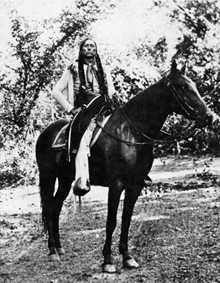
Roosevelt formed an important alliance with the great Comanche leader Quanah Parker. Together they worked to bring buffalo back to the Wichita Mountains.
Quanah Parker. (Courtesy of U.S. Fish and Wildlife Service)
On April 4, in Steubenville, Ohio, however, tragedy struck. The Roosevelt Special accidentally bulldozed into a man who was boarding a freight train and plowed right over him as it went west at thirty-five or forty miles per hour.29 Roosevelt grew despondent over this; he was also embarrassed. Yet he refused to dwell on the death, and his Roosevelt Special went on. He took in the varied American landscapes from the window of his train compartment: the indolent Ohio hamlets fading, the drainage ditches of Missouri receding, the dark and haunted Oklahoma prairie stretching for hundreds of miles south of Tulsa. On a map, it seemed obvious that Oklahoma had a weird language all its own: Okmulgee, Wetumka, Wapanuka. Staring out into the darkness Roosevelt sought the hills, tall pines, and thicket oaks beyond. The prairielands soothed the neurotic and agonized part of his spirit.
By the time the Roosevelt Special reached Dallas, the president, alert and curious, was in a buoyant mood. Cowboys along the tracks pointed at him in admiration. People craned their necks to see the Rough Rider who hadn’t lost his luster. In honor of his visit, Dallas had decorated the large public square near the Oriental Hotel with flags and bunting; an estimated 30,000 people came to hear the president speak about the “American century.” Even oil field scouts and get-rich-quick geologists had come to Dallas in wagons. Appealing to the chauvinism of the Lone Star state, he called Texas a “mighty and beautiful state,” a “veritable garden of the Lord.”30 Roosevelt promoted improvements for the Trinity River and irrigation projects around Dallas in general. Aridity could be conquered by forest conservation and modern engineering. More water and grass, he said, were needed in Texas. And appealing to the old Confederates’ pride, he boasted that he was half southern gray, half northern blue, but all Lone Star. This became a standard applause line in his stump speeches in Texas.
At Fort Sam Houston in San Antonio, Roosevelt inspected national troops and spoke of the Monroe Doctrine as a guiding American principle. He also called for restoring integrity to Wall Street. On every street Roosevelt was greeted as if he were a hometown boy who had made good. A major thoroughfare had been renamed Roosevelt Avenue in his honor (only the christening of the polar explorer ship made him prouder). While on horseback in Texas, Roosevelt always made sure a lasso was coiled around the horn of his saddle, just in case a wild horse or runaway cattle entered his domain. What a showman Roosevelt was! Speaking like a cowboy, Roosevelt acted as if dusty ole San Antone were the greatest place on earth. He had learned Texans’ lingo, mores, and folkways. “In the old days in Texas I understand that there used to be a proverb that while you would not generally want a gun at all; if you did want it you wanted it quick, and you wanted it very bad,” Roosevelt said to a crowd of well-wishers. “That is just the way I feel about the navy. I feel that if we have it the chances are that we will not need it, but that if we do not have it, we might need it very bad.”31
III
From San Antonio it was on to Fort Worth and Wichita Falls, where many of the largest cattle ranches in the world were situated. Two “old style Texas cattlemen,” as T.R. described them—Burk Burnett and Guy Waggoner—were going to lead the presidential wolf hunt to the Big Pasture.32 Between them, these two pro-Roosevelt ranchers practically owned Fort Worth. Burnett, in particular—who had been a trail boss on the 1,200-mile cattle drive along the Chisholm Trail to Kansas in 1867—was a legend along the Red River of the South. He was known for his financial acumen and hard deals, and his “Four Sixes” brand dominated the North Texas range for decades. He was also a meticulous caretaker of his cattle empire; there was no such thing as a collapsed corral fence on his property. Moving his ranch operations to Wichita Falls—as well as his Longhorns, Durhams, and Herefords—he produced the best cattle strains in Texas. A grin-and-bear-it type, a man of deliberate action who never knew regret, Burnett wasn’t enamored of grammar books, dictionaries, or the history of European civilization. Like Roosevelt he was an advocate of direct action.
A close friend of Quanah, Burnett leased 300,000 acres from the Indian Territory to graze cattle. Often, Burnett slept on the wraparound front porch of Quanah’s Star House (which Burnett had purchased for Quanah), preferring Indian company to the drifters working in Fort Worth’s stockyards district. But for all his Texan down-homeness and honesty, Burnett was extremely rich. His feeder steers were selling at a fair market price, and he had a lot of them. At the time Burnett organized the wolf hunt for Roosevelt he had more than 20,000 head of branded cattle on a spread totaling 206,000 acres.33
In anticipation of President Roosevelt’s arrival, Catch ’em Alive Jack Abernathy scouted for the most desirable places to camp in the Big Pasture and found an ideal spot along Deep Red Creek in Oklahoma. Some chauvinistic Texans criticized Abernathy for not holding the hunt on Lone Star soil, but the objections passed. Both Burnett and Waggoner did supply Texan “daredevil” riders—their hired ranchhands with the best equestrian skills—to impress the president. (Guy Waggoner, in fact, was an expert rider himself. He became head of the Texas racing commission and eventually moved to New Mexico, where betting on horse races was legal.) Ranchers from some ten or fifteen counties tried to wangle a slot on the hunt party. Every man under fifty wanted to be an extra in the Roosevelt extravaganza.
Roosevelt’s longtime physician friend Alexander Lambert was designated as the official photographer for the hunt; no reporters would be allowed to witness it, because there was a strong possibility of an embarrassing moment for the president. Lambert was perhaps Roosevelt’s most intimate friend. He specialized in diagostics, internal medicine, and drug addiction and was also the president’s personal physician.34 His loyalty to the president and to the principle of doctor-patient confidentiality was so great that he left no diaries or reflections about their times together. With his thick goatee, large ears, and an ever-present doctor’s bag, he was a fixture on all of Roosevelt’s hunts. A professor of clinical medicine at the Cornell University medical school and director of the fourth division at Bellevue Hospital, he was one of the best doctors of his generation. Besides enjoying his company immensely Roosevelt was beholden to Lambert for his sophisticated knowledge of how mosquitoes carried yellow fever.35
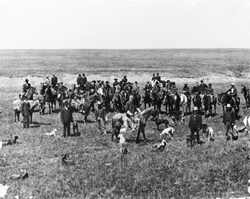
Roosevelt’s hunt in the Great Pasture of the Indian Territories (near Oklahoma) attracted the eager participation of the richest ranchers in Texas.
The great pasture hunt. (Courtesy of Theodore Roosevelt Collection, Harvard College Library)
On April 5, as arranged, Roosevelt’s train arrived in the hamlet of Frederick, Oklahoma. Armed lawmen had the crowd of curiosity seekers under proper control. There was little chance of trouble. A grandstand had been built for the once-in-a-lifetime visit, with patriotic props in place. Wild cheers erupted when the president disembarked from his railroad car, waving his Stetson. About 5,000 to 6,000 people constituted the welcome committee. They came from Fort Sill–Lawton and west from Altus, from north of Hobart and south from Wichita Falls, Texas. Ranchers, farmers, and merchants had dropped whatever they were doing to come hear Roosevelt speak in the middle of nowhere. About twenty deputies patrolled Frederick, making sure that no troublemakers would disrupt the picture-perfect day. In particular, they kept a close eye on Indians. “The next time I come to Oklahoma,” Roosevelt said at the outset, to a roar of approval, “I trust I will come to a State.”36
Abernathy was sitting on his horse, Sam Bass, soaking in Roosevelt’s oratory. Accompanying Roosevelt were Colonel Lyon, Burnett, Waggoner, the former Rough Rider Bill Fortesque, Lieutenant General S. B. M. Young, Quanah (with three wives and a baby), Dr. Lambert, and the Rough Rider physician Sloan Simpson.37 There were also a few Texas Rangers. The hunt was going to be like a caravan in the Sahara. The main worry for local planners was Roosevelt’s notorious reckless riding (in October 1904 he had been thrown from his horse and received a serious injury).38 In the open space of the Twin Territories, T.R. was bound to let loose, galloping his horse’s hooves into prairie dog homes with disastrous results.
According to the Frederick Enterprise, President Roosevelt spoke boldly about building the Panama Canal and pleaded to be left alone by curiosity seekers while he was on his hunt. “Now I want four days’ play,” Roosevelt said. “I hear you have plenty of jack rabbits and coyotes here. I like my citizens, but don’t like them on a coyote hunt. Give me a fair deal to have as much fun as even a President is entitled to.” 39 The Washington Post ran a huge front-page headline: “President in Wild.” The reporter wrote that the elusive jackrabbits and coy wolves had better watch out: “The distinguished party of hunters will have plenty of elbow room. The whole Territory is theirs for the asking, but the programme is to confine the hunt to the tract of land thirty-six miles square leased by Capt. Burnett from the Kiowa and Comanche tribes.”40
The scenes of Roosevelt’s first acquaintance with Abernathy in Frederick became legendary in The Washington Post, the New York Times, and elsewhere—the two men shared a boyish predilection for nineteenth-century romance and adventure, and an abiding love of wild things. When Roosevelt spied Abernathy on horseback in Frederick, a wide smile crossed his face. “You look like a man who could catch a wolf,” Roosevelt said, shaking Abernathy’s hand. “I want to congratulate you, for I know you are going to do what Colonel Lyon says you can do.” Given his interest in coyotes (or gray wolves), Roosevelt was utterly fascinated by Abernathy’s techniques for catching them. Would the wolves do a somersault when tackled? Did every bite hurt and require stitches? But mostly Roosevelt was baffled by why the wolves became so submissive. “I can’t quite understand just all about this yet,” Roosevelt said to Abernathy.
“Well, Mr. President,” Abernathy responded, “you must remember that a wolf never misses its aim when it snaps. When I strike at a wolf with my right hand, I know it is going into the wolf’s mouth. I believe I could shut my eyes and do what you see me do, for I have caught two wolves in my life in inky darkness. However, I prefer not to shut my eyes.”41
What Roosevelt came to understand was that Abernathy simply out dominated the wolves. In all coyote or wolf packs a dominant member was genetically predisposed to force the others to submit; usually the conquered animals would roll on their backs as if to say “No more.” Abernathy had learned to use this law of the Plains. When he wrestled the wolves into submission, they came to see him as the pack leader and thus became rather docile.42 Abernathy had negated Roosevelt’s preconceived ideas about gray wolves; the heads and nose pads were considerably larger than those of coyotes, and the fur was much longer. Zoology wasn’t a fixed science, and Oklahoma had the president rethinking these wolves as a subspecies. Also, because the coyotes around Fort Sill had bred with domestic dogs, the canids in the Big Pasture–Wichitas tended to be larger (with varied coloration differences). There was also a red wolf around southwestern Oklahoma—in between the gray wolf and the coyote in size.43
After Roosevelt’s brief speech about Oklahoma’s statehood, the Monroe Doctrine and Indian rights, his hunt party went to the Big Pasture. Roosevelt was genuinely enamored of the open range of scrub weeds and tall grasses. About fifteen tents were set up as base camp at Deep Red Creek, a little tributary of the Red River of the South, eighteen miles from Frederick. Roosevelt shared his tent with Lambert. Chuck-wagon food was readily available. A calf with the Four Sixes brand had been slaughtered, and a famished Roosevelt ate from a hindquarter. The first night, the coyotes came up closer to camp to do their howling than Roosevelt had expected. This was the land of broken treaties where cowboys slept in their hat crown; Roosevelt felt right at home as the moon set on the prairie. As a gesture to the Comanche who didn’t speak English, the president used pidgin, and a fumbling sign language. That first evening at camp, however, the president was travel-fatigued and went to bed early. Roosevelt matter-of-factly told Abernathy, Burnett and Waggoner and the cowboys that he was spent.
IV
On Sunday morning Roosevelt woke at the crack of dawn. It was going to be a fine day for an outing. There was a breathless hush to Oklahoma’s light winds of April, which was invigorating. Air wafting up from Old Mexico, warm, sea-scented, almost tropical, filled his nostrils, and he felt at one with the land. Most of his early observations were of the prarieland, shaded by the occasional ash, pine, elm, or black walnut. Intrigued by the Big Pasture and Wichita Mountains ecosystems, Roosevelt inventoried his surroundings: rustling cottonwoods, black-tailed jackrabbits, white-tailed deer, wild turkey, stunted mesquite, tiny swifts, pecan groves, and grasshopper swarms. Around Deep Red Creek alone there were more than fifty mammals and 800 plant species.44 It didn’t take him long to notice that Didelphis marsupialis—the ubiquitous Virginia opossums—were everywhere; pretty soon they’d be waddling down Fifth Avenue in New York. Some animals—like opossums—simply knew how to adapt and survive in the face of mankind’s intrusion. And Roosevelt’s note-books were quickly filled up with bird sightings. “Cardinals and mockingbirds—the most individual and delightful of all birds in voice and manner—sang in the woods,” he wrote; “and the beautiful, many-tinted fork-tailed fly-catchers were to be seen now and then, perched in trees or soaring in curious zigzags, chattering loudly.” 45
Mostly, that first sunshiny day was spent shooting rabbits for supper. As they sat around the fire that Sunday night, sharing wild game, Abernathy was amazed to hear the president talk like a zoologist who had paddled the Red River from the Texas Panhandle to the Mississippi River. It was all firewood and snuff stories, told with the sophistication of a Harvard man. Somehow Roosevelt made even the barest incident interesting. “I was amazed at the President’s knowledge of wild animals, snakes, and even the smallest of reptiles and insects,” Abernathy recalled in a memoir. “He told of the vinegaroon, the most deadly of the poisonous creatures in Texas and Old Mexico; many of those old time hunters present had never even heard of such a reptile.”46 Clearly, Roosevelt wasn’t just a stiff-kneed politician. He came as advertised: a Rough Rider.
Unfortunately, Roosevelt never published his campfire stories. With meat in the pot and log flames jumping high and low, on these outdoor outings Roosevelt would recount moments from the strenuous life with cliff-hanging suspense. There were accounts of sumo-wrestling with a 300-pound Japanese man; tramping toward the Missouri River headwaters, boxing with the heavyweight champ John L. Sullivan, and encountering rattlesnakes in North Dakota. Holding his audience’s attention with theatrical gestures, Roosevelt made it seem as if he had strode over the Alleghenies and down the Ohio River valley with Daniel Boone. When Frederick Jackson Turner told stories of western expansion, the farmer was the hero. By contrast, Roosevelt glorified men who had channeled violence into grand deeds such as hunting or boxing. His favorite camp-fire stories dealt with the ritualistic tradition of hunting grizzly bears: man pitted against beast. What made Roosevelt’s stories about grizzlies more interesting than anybody else’s was the way he personalized the bears without sweetness: for example, Big Foot Wallace in Wyoming, Old Mose in Colorado, and Old Ephraim in Idaho. And he always spoke of these bears with reverence.
The Wichitas truly were a biotic crazy quilt, Western trees grew in the range that didn’t exist even a mile east of Fort Sill. Rounded domes and jagged granite peaks seemed to erupt out of the ground. Here the western meadowlark sang with its counterpart, the eastern meadowlark. As the Oklahoman historian Edward Charles Ellenbrook once put it, this was the demarcation line of biological America. Only in the Wichitas could one of John Burroughs’s beloved dark-blue eastern bluebirds be seen hopping around with the azure Rocky Mountains bluebird. And Roosevelt, a dedicated Auduboner, hoped to clap his eyes on one of America’s most unsociable birds: the Mississippi kite. Oh, what a delicious place the Wichitas were for a naturalist! And they didn’t offer just birds and small mammals. Besides collared lizards there was an odd assortment of poisonous snakes, broad-banded copperheads, western diamondback rattlers, prairie rattlers, and western massasaugas among them. The Bronx Zoo’s new herpetologist, Raymond L. Ditmars, needed to do field collecting in the Wichitas.
Although Roosevelt wrote an article about his plains hunt, titled “Wolf-Coursing,” for Scribner’s Magazine that summer, he often used the term “coyotes” while he was in Oklahoma. To Roosevelt the pageantry and novelty of catching a wolf alive were intoxicating. What he admired most about gray wolves and coyotes was their survivalist behavior. Even their cowering had a certain nobility. The reason was fairly simple. During the great slaughter of buffalo by the U.S. Army, wolves and coyotes had prospered. After skinners finished cutting up the buffalo for robes and meat, the canids soon rushed up to the carcass to devour the entrails. With such an abundance of free food, they quickly multiplied throughout the Great Plains. A new breed of hunter—the wolf exterminators—replaced the buffalo hunters in Texas and Oklahoma. These were considered a lowly type in the hunters’ pecking order. “A wolfer could manage with just a pack horse, a gun, a bedroll, and a bottle of strychnine crystals, but more often he had two pack horses, or a team pulling a small cart or wagon,” the historian Francis Haines noted in The Buffalo. “He followed after the buffalo hunters, and at each kill poisoned every carcass within a mile or so of his central point. Then he went away for a few days to let the wolves and coyotes have plenty of time to eat their fill and die.”47 This breed of hunter had two objectives: obtaining wolf furs and being paid by local ranchers.
Roosevelt immediately took a shine to Abernathy (and for that matter to Abernathy’s father, a former Confederate soldier, whom he met). There was a softness in Abernathy’s eyes that belied his hell-on-wheels reputation. He was like a live coal. Initial conversations between Roosevelt and Abernathy centered on the greyhounds brought along for the hunt. Roosevelt had never seen a breed of dogs so sleek and eager. By contrast, the Mississippi hunt hounds seemed lifeless. “By rights there ought to have been carts in which the greyhounds could be drawn until the coyotes were sighted, but there were none, and the greyhounds simply trotted along beside the horses,” Roosevelt wrote. “All of them were fine animals, and almost all of them of recorded pedigree. Coyotes have sharp teeth and bite hard, while greyhounds have thin skins, and many of them were cut in the worries.”48
The wolf hunt, led by Abernathy, began in earnest on Monday, April 10. The sun was now hot—a fireball low to the ground, causing all the men to change shirts three or four times during the course of the afternoon. The wind was seldom stiff. All the soldiers from Fort Sill and the Texas Rangers assigned to protect the president were surprised that Roosevelt could ride at such breakneck speeds up hills and down gullies. They hadn’t expected such equestrian skill from a man in his forties. By high noon the Roosevelt party had caught three wolves. After a lunch of cooked calf, the president finally asked Abernathy to show off his wolf catching. The appointed hour had arrived for Catch ’Em Alive Jack to put up or shut up.
To Roosevelt, watching Abernathy ride a horse was exhilarating: he was an athlete in top form, and there wasn’t the faintest hesitation about him. Roosevelt had never before seen such an able rider, even in the Dakotas. Riding beside Abernathy invariably meant falling behind, pulling up the reins breathless. But Roosevelt did pretty well at keeping up. In the East, everybody was obsessed with money and power. Abernathy, although not opposed to either of these, nevertheless seemed organically a part of nature. He had a homegrown quality that Roosevelt associated with authenticity.
Dispatches from Oklahoma about President Roosevelt’s grand hunting tour with forty dogs were so colorful that readers might be forgiven for questioning their veracity. Readers were exhilarated. Realizing he had a huge audience for his antics, Roosevelt banged the kettledrum so loudly for Oklahoma’s statehood that his congressional enemies said he was pretending to have been born on a carpet of grassland. Roosevelt, it seemed, was acting like an Oklahoman high-plains drifter who understood the bioregional history of the territory from dinosaur fossils to modern dust storms. For its residents—who had an inferiority complex with regard to Kansas and Texas—this presidential gesture was greatly appreciated. When the New York Times ran a front-page headline, “President in Foot Races: Also Chases a Wolf Ten Miles and Is In at the Death,”49 Oklahomans welcomed the national publicity. Roosevelt’s animated hunt was far better than grim stories of blasphemy, land steals, and droughts.
What the Times didn’t tell its readers was that these prairie wolves (unlike the timber wolves of Minnesota) were quite small. Still, they were ferocious when attacking Oklahoman cattle or deer, they had long teeth, their bite was feared (though erroneously) to be poisonous, and a wolf bite did cause throbbing pain, suppuration, and high fever. On the other hand, these wolves were very scared of humans and would slink off and disappear into the brush when humans came into sight. The Kiowa thought these wolves were a trickster spirit because of the way they appeared and then disappeared, like a mirage. Too cunning to be trapped, gray wolves could, however, easily be chased down by fast dogs and fast horses; this is where Abernathy’s skill came in.
Secretly, Roosevelt admired coyotes because they were an enemy of the sheep industry. The cowboy in him just couldn’t stand sheep. George Bird Grinnell used to say that wolf-coyotes were the smartest animals of all, the only ones who could creep up close to men and not be detected.50 Whenever camps were abandoned, prairie wolves would soon scavenge around the dying fires and devour the refuse. They wouldn’t, however, eat meat if it stank (as a human carcass does) for more than twenty-four hours. The Comanche, who also admired coyotes, often called them “barking wolves” because their evening howls resembled those of dogs. But to Oklahoman cowboys, coyotes were four-legged vultures, varmints to be eradicated. No matter what dire measures ranchers took, however, the adaptable coyotes thickly populated the prairie. Often, ranchers in Oklahoma hung dead coyotes on fences, a grotesque warning to the others to leave the livestock alone. “After nightfall they are noisy,” Roosevelt wrote, “and their melancholy wailing and yelling are familiar sounds to all who pass over the plains.”51
Another reason cowboys in Oklahoma loathed wolf-coyotes was that some were infected with rabies and might therefore lunge at humans. The disease around Fort Sill was more feared than dysentery. The phrase “mad coyote,” in fact, was common around Fort Sill. A local told Roosevelt that one night when he slept under the stars a rabid coyote had attacked him. Roosevelt soon learned that this disease was more feared in Oklahoma than in any other place in America. Poisoned bait was set out from Beaver to Greer counties by gentle-faced farmers who felt forced to be exterminators. Strychnine was sprinkled onto rabbit and deer carcasses throughout the prairie; one taste, and the coyotes died instantly.52
The Biological Survey’s Animal Damage Control Unit assisted with the poisoning, handing out burlap bags of strychnine (a skull and bones was printed on each bag). But it still didn’t work on the coyotes, though it did kill border collies and other types of work dogs. So, just as some dirt farmers reject modern chemicals in favor of scarecrows, many Oklahomans continued festooning fences with coyotes.
Roosevelt enjoyed chasing down the wolves with Abernathy and the boys at his side. With the game dogs taking the lead, the Roosevelt party rode behind at breakneck speed over low crested hills and river bottoms, across shallow washouts and the treeless prairie. As a general rule, if the greyhounds didn’t corner or tackle a wolf after two or three miles, it would escape. Abernathy had all this down to a science. He never even seemed to perspire. Prairie dog holes were the primary obstacle to his “catch ’em alive” trade. Fortunately, the best horses in the region had acquired a sense for avoiding them. On a beautiful roan cutting horse, Roosevelt raced hard around the Big Pasture–Wichita Forest Reserve, never more than a quarter of a mile behind the greyhounds and some staghounds. For all of their self-assurance, neither Burnett nor Waggoner could keep up with Abernathy on his fast white horse Sam Bass. As a rider, Abernathy had amazing dexterity. Because Roosevelt was so impressed by Abernathy, the ranchmen’s envy increased by the hour. They began denigrating Abernathy as a professional attention-hog. Burnett, in particular, wanted to bond with the president; instead, Abernathy had stolen the show. In Outdoor Pastimes of an American Hunter, Roosevelt wrote a virtual dissertation on Abernathy’s wolf-coursing techniques but gave barely a word to ranchmen, Lyon, or even General Young. Instead of raising his glass of grape juice (his chosen beverage) to the ranchers, he toasted Jack Abernathy, Sam Bass, and a greyhound “blue bitch” with the speed of a cheetah.53
“[Abernathy] held the reins of the horse with one hand and thrust the other, with a rapidity and precision even greater than the rapidity of the wolf’s snap, into the wolf’s mouth, jamming his hand down crosswise between the jaws, seizing the lower jaw and bending it down so that the wolf could not bite him,” Roosevelt later recounted, rather breathlessly. “He had a stout glove on his hand, but this would have been of no avail whatever had he not seized the animal just as he did; that is, behind the canines, while his hand pressed the lips against the teeth; with his knees he kept the wolf from using its forepaws to break the hold, until it gave up struggling. When he thus leaped on and captured this coyote it was entirely free, the dog having let go of it; and he was obliged to keep hold of the reins of his horse with one hand. I was not twenty yards distant at the time, and as I leaped off the horse he was sitting placidly on the live wolf, his hand between its jaws, the greyhound standing beside him, and his horse standing by as placid as he was…. It was as remarkable a feat of the kind as I have ever seen.”54
Day after day Abernathy caught ’em alive and Roosevelt glowed with approval. Abernathy always paid dividends as promised. Roosevelt, in fact, came to be strangely in awe of him. In his novel The Secret Agent, Joseph Conrad wrote that “shrinking delicacy” exists “side by side with aggressive brutality in masculine nature.” That was the case here; Roosevelt the New York bird-watcher had overnight turned into the admirer of an Oklahoman wolf catcher. The conflict between Roosevelt as a preservationist versus Roosevelt as a conservationist and hunter had taken a bizarre turn. John Muir would have been appalled at the grotesque “catch ’em alive” spectacle.
“The fact that I had won the friendship of the president in such a short time,” Abernathy later recalled, “naturally raised great popular interest.”55 Unfortunately, Burnett and Waggoner grew more and more envious of Abernathy. They kept muttering half-comical innuendoes at his expense. Ignoring these gibes, the president kept showering Abernathy with attention. Although the press was not present for the wolf-coursing, Lambert was on hand to photograph the catches. When other members of the hunt tried to pose with the president for a photo, Roosevelt waved them off. “I want this picture with just Abernathy and myself in it,” Roosevelt said. The loyal Lambert, sensing the value of the publicity, said to Roosevelt excitedly, “You can say that this picture was snapped about a minute from the time Abernathy started the chase and made the catch.”56
The plains and its sentinels had once again captured Roosevelt’s imagination. The more harrowing the encounter, the happier the president was. A six-foot rattlesnake had lunged at Roosevelt four times before he killed it with his eighteen-inch quirt.57Even the god-awful sound of a gray wolf being tackled by Abernathy seemingly calmed his nerves. On day three of the hunt, Quanah brought his three wives along for the fun, accompanied by his son and baby daughter. Self-sufficient and uncomplaining, Quanah and his family had their own wagon. With temperatures in the low seventies and bright sunshine turning the prairie grasses different hues of green and blue, Roosevelt was in his element. For lunch he enjoyed eating beef strips by hand, all reeking from wood smoke. He kept blurting out bully. In this land where sound preceded sight, Roosevelt was happy that there wasn’t a lamppost for miles. “The air was wonderfully clear, and any object on the sky-line, no matter how small, stood out with startling distinctness,” he wrote. “There were few flowers on these dry plains; in sharp contrast to the flower prairies of southern Texas, which we had left the week before, where many acres for a stretch would be covered by masses of red or white or blue or yellow blossoms—the most striking of all, perhaps, being the fields of the handsome buffalo clover.”58
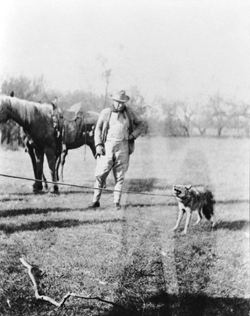
Fascinated by wolves, Roosevelt here ponders one caught by Jack Abernathy.
T.R. with a roped wolf. (Courtesy of Theodore Roosevelt Collection, Harvard College Library)
Just in case the taxpayers thought President Roosevelt was on a naturalist adventure at their expense—which he was—he once again invoked the Biological Survey. Roosevelt sent a minutely detailed scientific report to Dr. C. Hart Merriam about the weight and coloration of more than a dozen coyotes. With a uniform collecting technique that would have made Spencer Fullerton Baird proud, Roosevelt recorded facts about Oklahoma’s coyotes that are still used for reference. Doing some on-the-spot calculations, Roosevelt wrote to Merriam that the average weight of a coyote in the Wichita Mountains region was thirty pounds. Skulls, skins, and paws were likewise shipped from Fort Sill to Washington, D.C., for the Biological Survey to properly analyze. “All but one are the plains coyote, Canis nebracensis,” Merriam informed Roosevelt. “They are not perfectly typical, but are near enough for all practical purposes. The exception is a yearling pup of a much larger species. Whether this is frustor I dare not say in the present state of knowledge of the group.”59
What prevented Roosevelt from considering the whole experience perfect, however, was the absence of buffalo. They were gone—and sadly, even the white-tailed deer were vanishing. A wilderness not abounding in game was a contradiction in terms. All Roosevelt could do was ride the buffalo trails, the great highways of Oklahoma, which were the easiest route to water, and imagine the Old Days. Francis Parkman had caught the tail end of them in the summer of 1846 with the Oglala band of Sioux. If you wanted to see a wild buffalo in North America in 1905, Yellowstone and the northern woods of Alberta were your only bets.60 For now, Roosevelt studied the ancient buffalo herds’ well-worn paths. He wore cowboy leggings and felt superior for having left his silk shirt behind in a closet in the East Wing.
Once again Roosevelt was playing the “great natural man.” While talking with Quanah one evening at Star House, Roosevelt mentioned Baynes and Hornaday’s idea of a bison refuge. “Grandfather wanted to entertain Roosevelt just so-so,” Quanah’s granddaughter Anona Birdsong Dean recalled of the evening. “He had a table that sat thirty people. Each woman had a job. Mother went to see if the table was set properly. She found goblets filled with wine setting next to each plate. Grandfather, who never drank, had gotten wine somewhere and told one of the women to fill big glasses with the wine. Mother said, ‘Why did you do that?’ Grandfather explained that when he went to Washington, Roosevelt served wine in small glasses and he wanted to be more generous than Roosevelt.”61
But now Roosevelt was truly offering buffalo! Quanah realized that Roosevelt was a generous man at heart, and the very notion of the Wichita Forest Reserve repopulated with buffalo brought tears to his eyes. Although Quanah spoke several dialects and was fluent in English and Spanish, he was nevertheless speechless.62 Could his peyote vision be becoming true? Could a boyhood dream he had on the lonely Llano Estacado now be reality? Would Oklahoma—or at least a portion of its most scenic terrain on the western side of the Cross-Timbers in the Indian Territories—become a bison refuge?
A few days after that historic dinner, Quanah hung an autographed photo of Roosevelt on his dining room wall. To him, Roosevelt truly was the “Great White Chief.” More than any other white man, Roosevelt had his heart in the right place, and Quanah knew that few Americans had ever loved the Wichitas–Big Pasture as Roosevelt did. He and Roosevelt smiled when rattling off the colorful names of the Twin Territory’s towns as if they were superior to anyplace Queen Victoria had ever seen: Arapaho, Bowlegs, Etowah, Hydro, Oologah, Talihina. Side by side on horseback, snacking on pecans, the two warriors spoke of black-tailed prairie dogs, armadillos, bald eagles, and the rare black-capped vireo.
Besides bird-watching and wolf hunting Quanah spent time teaching Roosevelt how to properly track horse thieves. Roosevelt, in turn, gave him a thick porcelain cup. Both men enjoyed being conspicuously attired and talking nonstop. In Washington, D.C., the press corps called Roosevelt the “cowboy president.” Quanah knew better: Roosevelt was the “buffalo president.” As if a spell had been cast over him, Quanah told the Comanche that Roosevelt loved the beauty of southwestern Oklahoma like someone born and raised along the Red River. Roosevelt, in turn, wished that the chief had been a Rough Rider. It had been rumored that William “Buffalo Bill” Cody had offered Quanah $5,000 to perform in Europe with the legendary Wild West Show. Quanah said no. “I’m afraid I would be put in a little pen,” Parker informed Roosevelt. “And I no monkey.”63
In 1901, when President McKinley created the Wichita Mountains as a forest reserve, nobody imagined that it would become the focus of a federal buffalo reintroduction program. But Roosevelt was always thinking and listening. Some of Roosevelt’s Rough Riders had come from the Wichitas area and had been full of stories about the landscape’s lyrical, magnetic charm. Now, in 1905, as Roosevelt rode amid the strange rock formations with Quanah, he learned why the area was considered sacred by the Comanche, Kiowa, and other tribes. For example, there was a magnificent rock formation 2,464 feet high, designated by the U.S. Army as Mount Scott. Quanah told Roosevelt that a Kiowa medicine woman had prophesied that all the Great Plains buffalo, after being chased by murderous American hunters, had disappeared down Mount Scott’s summit in single file. They descended farther and farther, into the earth’s core. Inside this safe haven, everything sparkled for the buffalo; the world was “green and fresh” and rivers “ran clear, not red.”64 Someday, the Kiowa medicine woman prophesied, the buffalo would return to the plains from the top of Mount Scott, erupting like a volcano. A gregarious herd would trot out happily, resurrected and with a fierce unity of purpose, for a new day on the Great Plains.65
Roosevelt, of course, didn’t subscribe to this prophecy, but he nevertheless enjoyed hearing the legend. And he had to admit that the elegant pyramidal sentinel that stood watch at the eastern gate—like an island in the sea—was the energy source of the entire Wichita preserve.66 For 70 million years, ever since mammals eclipsed reptiles as the dominant vertebrates in Oklahoma, Mount Scott was the home of buffalo or their ancestors. Roosevelt understood the importance of their return. “The extermination of the buffalo,” he had lamented, “has been a veritable tragedy of the animal world.”67 Now, at Mount Scott, they were going to make a stand with the help of buffalo men. Roosevelt spoke to the Wichita Forest Reserve rangers—who operated out of a little white clapboard hut with cedar posts—about the imminent prospect that the park would become America’s first National Game Preserve for buffalo and deer. A wooden archway was soon built in an attempt to keep poachers out; it gave the reserve a legal feel.
Not since his youth had Quanah Parker been so excited about anything as he was about Roosevelt’s repopulation scheme. Before long Roosevelt received public support for the idea from the Boone and Crockett Club and the League of American Sportsmen (of which Hornaday was vice president). Hornaday also worked hard to find exactly the right spot in Winter Valley, with grasses and with canyons to provide shelter from the winter weather. Daily, a typical bison herd foraged on vegetation over a two-mile radius, so the acreage of the reserve had to be fairly large. If everything worked according to plan fifteen buffalo—a nucleus herd of breeding cows and young bulls—would be shipped by train to the Wichita reserve in 1907. Hornaday, biologically cautious, selected the buffalo from numerous bloodlines to avoid inbreeding. There was only one chance to get it right.68
V
Following the Oklahoma hunt Roosevelt, as a courtesy, asked to meet Mrs. Abernathy and the five children. Approving of their pioneer stock he enjoyed them immensely. The six days at Big Pasture had been bully, a brief return to the heroic days before the Indian Wars. Roosevelt extended an open invitation to the entire Abernathy family to visit him in the White House. Clearly, Roosevelt honored Abernathy even though other Texans might consider him a court jester. “The petty rivalry of which I had been the object during the course of the wolf hunt in the Big Pasture was but a small incident in comparison with the experience that was awaiting me when I was now unexpectedly drawn into public life,” Abernathy wrote, “as a result of my new friendship with President Roosevelt.”69
Now that the hunt was over the Washington Post cast it in glowing terms. Seldom, if ever, had the Post been so enthusiastic about a president. Even Roosevelt’s secretary, Loeb, might have blushed at reading the copy. “Mr. Roosevelt acquired in the Indian country a complexion that would do credit to an Apache warrior,” one article read. “He is now as brown as a berry and in fine spirits, and the warming up of the past few days has put him in a good trim for the more exciting and hazardous sport which he will experience in Colorado, where for the next four or five weeks he will make life miserable for members of the cat and bear family that happen to come his way.”70
When Roosevelt arrived in Colorado Springs following a speech in Clayton, New Mexico, with plans to climb Pikes Peak, reporters were still covering his every move. Love him or hate him, Roosevelt made good copy. Once again he used hunting as his hook, arousing a burst of regional western pride. For three weeks he would dwell with the blood of bears, boots in the stirrup, stubble on his face. For Roosevelt the Rockies were always the Alps without handrails, and he promoted them as such. Not since Andrew Jackson had America had a president who was such a celebrity. Wherever Roosevelt went now, he would wave a bandanna to express solidarity with the crowds. But speaking in front of 10,000 people gathered at the Santa Fe station in Colorado Springs, Roosevelt pleaded with both well-wishers and the press to allow him uninterrupted privacy in the wild. “One thing you cannot do on a hunt, and that is to carry a brass band,” Roosevelt said. “You cannot combine hunting bears with your Fourth of July celebrations. I am going to beg the people of Colorado to treat me on this hunt just as well as the people of Oklahoma treated me on the wolf hunt.”71
Roosevelt shelved world affairs and domestic policy while in the Rockies, preferring a wintry saddle blanket to wire reports, and only one major news item seized his attention. The celebrated U.S. Senator from Connecticut, Orville H. Platt (not to be confused with Thomas Platt of New York), had died at age seventy-seven. The last time Roosevelt had seen his Republican friend—best known in history for the Platt Amendment of 1901, which offered Cuba self-determination after the Spanish-American War—Platt’s face was alarmingly drawn and gaunt, and a rattling cough had somehow caused his complexion to lose its luster: his skin was sepia-tinted. When Platt had tried to laugh, there was only a faint sound, and Roosevelt had known he wasn’t long for this world. “It is difficult to say what I think of Senator Platt without seeming to use extravagant expression,” Roosevelt had said of Platt at a dinner earlier that year. “I do not know a man in public life who is more loved and honored, or who has done more substantial and disinterested service to the country. It makes me feel really proud, as an American, to have such a man occupying such a place in the councils of the Nation.”72
Deeply saddened, Roosevelt wanted to create a living memorial for Platt. In the Wichitas, he had heard about a system of freshwater and mineral springs south of Oklahoma City, less than two hours north of Dallas.73 In 1902 the Chickasaw and Choctaw had ceded the best 640 acres of these freshwater springs to the Roosevelt administration. As at Hot Springs National Park (in Hot Springs, Arkansas), the gateway town of Sulphur, Oklahoma—otherwise a nothingville—had built hotels, hoping to attract tourists to the curative waters. The community, however, had a problem with sinking wells and hoped the federal government would someday come to the rescue.74
Roosevelt now decided that the so-called Seven Springs area would make a terrific national park. He refused to wait until Oklahoma became a state, with large acreage carved out for Indian reservations, and there was little political disadvantage to naming the springs after Platt, even though the senator had never visited south-central Oklahoma (he had been a member of a committee on Indian Affairs, however). On June 29, 1906, Roosevelt (through a special act of Congress) declared the Seven Springs area Platt National Park—his latest park after Crater Lake, Wind Cave, Sully’s Hill, and Mesa Verde.75 At a deliberate pace, the U.S. government added infrastructure to the Seven Springs area, including the Lincoln Bridge (completed in 1909). Besides featuring the springs, the park was surrounded by undisturbed grasslands.76 (In 1976 the National Park Service renamed Platt the Chickasaw National Recreation Area. But as a lasting memorial, a Platt District in Sulphur was designed to recognize Platt National Park’s seventy-year history.77)
On April 24 the New York Times reported “The President’s Return.” Worried about difficulties with the Panama Canal, labor riots in Chicago, anarchy, and high tariffs, Roosevelt had decided to shorten the Colorado leg of his holiday by five or six weeks. TheTimes lamented that Roosevelt, “the hardest working man in the country,” couldn’t enjoy the Rockies longer. Most presidents are criticized for taking vacations because they may be caught off guard by an unexpected international crisis or a domestic crisis such as a strike. But Roosevelt was immune from such criticism. In fact, the Times (and other newspapers) thought he needed more time to enjoy himself, catch coyotes, and hunt grizzlies.78
Of course, Roosevelt didn’t slip out of Colorado in the dead of night. The state threw a huge open-air revivalist meeting in Glenwood Springs to honor him on his departure. With the Old Blue Schoolhouse as a backdrop, ranchers who had ridden in to Glenwood Springs from Newcastle, Rifle, and half a dozen other nearby towns said adios. It was quite a pageant. Instead of sprucing up for the farewell, Roosevelt wore filthy blue jeans, a slouch hat, a soiled bandanna, a sheepskin jacket, and a blue cotton workman’s shirt. Because it was Sunday, Roosevelt asked that services be held under God’s blue sky with the green grass serving as pews. The sunshine in the upper air, the president maintained, was more inspiring than light filtered through stained-glass windows. An organ was rolled out onto the schoolhouse porch, and old-time hymns such as “Rock of Ages” were sung. A Presbyterian minister asked Roosevelt to say a few words to the God-fearing men and women of the Rockies. Thereupon, Roosevelt unleashed a sermon about the strenuous life, peppering his speech with cowboy jargon. At the end of this oration he announced that he would shake every hand offered him in Glenwood Springs. “There are a many of you,” he said, “so don’t stampede or get to milling.”79
A week later, on May 7, Roosevelt hosted a good-bye dinner in Glenwood Springs. This was the final good-bye. All Roosevelt could do, however, was talk on and on about Colorado’s bears. Lambert had captured some of these bears with a Kodak camera, but other bears weren’t so lucky. Roosevelt had been routinely bringing his bear skins to a local taxidermist, Frank Store, who mounted them in record time. Interestingly, Roosevelt requested that his half dozen or so bears be stuffed closed-mouthed. He had these trophies shipped as quickly as possible to Dr. C. Hart Merriam in Washington, D.C., where casts were also made of the bears’ footprints, so that the Biological Survey could glean precise scientific data from the samples. As usual, Roosevelt wrote up his outdoor notes to accompany the trophies.
Although Roosevelt did not bring back a grizzly cub to Alice (as promised), he did adopt a small black-and-tan terrier named Skip, whose new home would be the White House. Skip was a gift from Jake Borah to the president during his last few days in Colorado. Roosevelt and the dog, which never barked, had become inseparable friends. To Roosevet’s delight, Skip actually climbed trees to go after chased game.80 While Roosevelt read books in Colorado for relaxation, sometimes going for three or four hours straight, little Skip would obediently sit in his lap, petted as the pages were turned.
“Archie simply worships Skip, who is developing into a real little boy’s dog and accepts with entire philosophy being carried around by Archie in any position,” Roosevelt wrote after he returned to Washington. “He has won the hearts of all the family except Mother, who I think resents his presence a little as a slight upon Jack. Yesterday she praised him—you know the kind of praise I mean—‘Yes, he is a cunning little fellow and friendly, of course. In fact, he is friendly with everyone.’”81
VI
While Roosevelt was in Colorado, Edith had decided to purchase a little cabin for her husband in Albemarle County, Virginia, fourteen miles south of Charlottesville. She called it Pine Knot; a favorite phrase of her husband. By a happy coincidence the first lady had journeyed to Keene, Virginia, on May 6 to spend time with Joe and Will Wilmer (family friends). Both Ethel and Archie accompanied her. The Blue Ridge Mountains had long attracted Roosevelt, who particularly liked Jefferson’s Notes on Virginia. Edith must have known this. Besides enjoying the countryside, she was looking for a wilderness cabin where Theodore could escape Washington’s hubbub to “rest and repair.” She was tired of seeing him traipse off to Colorado for weeks every time he needed to return to the outdoors. On the Wilmers’ horse farm, tucked away among red and white oak, red cedars, dogwoods, red maples, and black cherry trees, was a rustic worker’s cabin. Almost on the spot she purchased the cottage, plus fifteen acres, for $280, although the deal didn’t go through at the bank until June 15. (She purchased an additional seventy-five acres in 1911.82)
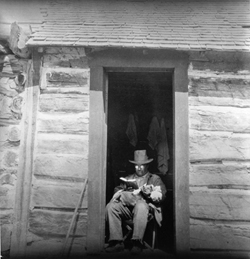
Roosevelt loved reading books on nature, hunting, and literature. Here he is with his little dog Skip on his lap in a Colorado cabin.
T.R. in Colorado cabin with Skip. (Courtesy of Theodore Roosevelt Collection, Harvard College Library)
Returning to the White House with Skip, the president was full of stories about Oklahoma’s wolves and Colorado’s bears. Wildlife photographs taken by the versatile Dr. Lambert were being developed in a darkroom. Anxiously, Roosevelt waited to see the photos with Catch ’Em Alive Jack. The whole experience at Big Pasture–Wichitas was imprinted on his mind like a brand. Quickly, he ordered the paperwork drawn up to create the Wichita Forest and Game Preserve. He signed the executive order on June 2, 1905, and transferred the newly formed Forest Service headed by Gifford Pinchot to the Department of Agriculture. At Merriam’s Biological Survey, last-minute legalities were being completed to create two new federal bird reservations in Michigan: Siskiwit Islands and Huron Islands.83 Lawyers at the Department of the Interior were also looking into preserving some interesting geological formations and archaeological ruins in the Southwest, such as Chaco Canyon and Mesa Verde. “Arizona and New Mexico hold a wealth of attraction for the archaeologist, the anthropologist, and the lover of what is strange and striking and beautiful in nature,” Roosevelt wrote. “More and more they will attract visitors and students and holiday-makers.”84
Edith was likewise bursting with news of the outdoors. All she could talk about was Pine Knot—the two-story cottage in the middle of a bird paradise. A piazza, she said, offered views of open fields and the Blue Ridge foothills. Everything about the place, she believed, was ideal for solitude. Yet it was also a practical acquisition. While it was isolated from Washington, Pine Knot was not really too far from civilization. Only half a mile away was a general store, and Christ Church could be reached simply by walking across a horse pasture. And Pine Knot had historical significance which Edith knew her husband would cherish: it sat along Scottsville Road, where General Sheridan had marched 5,000 troops in 1865 on a maneuver to destroy the James River canal locks.85“Mother,” T.R. wrote to Kermit after returning from Colorado, “is a great deal more pleased with it than any child with any toy I ever saw.”86
It was agreed that after Roosevelt concluded the Russo-Japanese negotiations in early June, he would head south to stay at Pine Knot for a few relaxing days. He could start a Virginia bird count there. Edith went first as an advance scout, setting up furniture and making sure the potbellied stove was in working order. This was not an Adirondacks hunting lodge but a cabin in the rustic tradition of John Burroughs’s Slabsides in New York. On June 9, after extracting a promise from Russia and Japan to negotiate face-to-face, Roosevelt took the Southern Railway (train No. 35) to Red Hill, Virginia. A few locals were at the station when he arrived. All T.R. offered them was a boyish declaration that he was glad to become a Virginian homeowner.
After sleeping one night in the ocher-colored cottage—which had a cedar roof, dark green shutters, and a hardwood tree growing inside—Roosevelt declared Pine Knot “the nicest little place of the kind you could imagine.” Not everybody in Blue Ridge country, however, was happy to have President Roosevelt as a neighbor. Anger over the dinner with Booker T. Washington had made Roosevelt persona non grata in parts of Albemarle County. No reconciliation with these bigots was possible. Also, Roosevelt’s admiration for General Sheridan—who was to Virginians what General Sherman was to Georgians—didn’t endear him to the locals. Furthermore, Roosevelt’s attempts at taking land in the Blue Ridge Mountains for federal forest reserves had angered local timber companies. So, this was hostile country to some degree. Nevertheless, Roosevelt refused Secret Service protection; that was a reluctantly agreed upon precondition with Edith. He instead chose to sleep with a pistol at his bedside, thumbing it open to check the bullet chambers before blowing out the light. A real man, Roosevelt believed, protected his own family in the woods.
What Roosevelt enjoyed most about Pine Knot was the sound of birds, which reminded him of the Elkhorn Ranch in North Dakota. Ahhh—all of his weariness evaporated in the woods. He was like a refugee who had fled the Washington battlefield, escaping the knife blade to the throat by the grace of God. “It was lovely to sit there in the rocking chairs and hear all the birds by daytime,” he wrote to Kermit, “and at night the whippoorwills and little forest folk.”87 Visiting Pine Knot also gave Roosevelt a chance to cook his favorite food, fried chicken, on a kerosene stove. Just as Roosevelt had played at being an Oklahoma wolf hunter with Catch ’Em Alive Abernathy, he now played at being John Burroughs in the grove. And at Pine Knot he ate like a glutton—a dozen eggs for breakfast, washed down with glasses of milk. No longer was he trim and fit. He was taking on a little of the girth of Grover Cleveland. As Edith’s biographer Sylvia Jukes Morris noted, Theodore believed that “a man with a huge brain needed plenty of nourishment.”88
And President Roosevelt’s brain was needed more than ever during the summer of 1905. On the death of Secretary of State Hay, Roosevelt took up the Russo-Japanese peace negotiations himself. The melancholy prospect of endless war had seemed likely, but now diplomats from both sides came to Oyster Bay to search for common ground. Roosevelt then selected the Portsmouth Naval Shipyard in New Hampshire as the site of a further, more intense round of negotiations. What made the Russo-Japanese War so unusual was that the fighting was taking place in neutral nations: China and Korea. Today many military historians call the conflict the first modern war because the telegraph, advanced torpedoes, minefields, and armored battleships were introduced. Roosevelt wanted to prevent a global cataclysm—this was the reason why he threw himself so wholeheartedly into the diplomatic fray. At stake was the balance of power for the entire Pacific.
Using diplomatic muscle, Roosevelt achieved a stalemate. Such large-scale wars, he believed, should be obsolete. His negotiation skills and his aggressive diplomacy, which culminated in the Treaty of Portsmouth (signed on September 5, 1905), won him the 1906 Nobel Peace Prize. Roosevelt had persuaded Russia to stop its expansionism into East Asia, while the Japanese won control of the Korean Peninsula. Neither side was very happy with the negotiated peace. Still, as a warrior-cum-statesman Roosevelt understood the vital importance of stopping a war between such highly armed powers as Japan and Russia; and both parties conceded that he had been fair. Two rare samurai swords were presented to Roosevelt by the Japanese war hero Admiral Togo at Sagamore Hill, as a token of appreciation for his statesmanship.
VII
In September 1905 George Herbert Locke, an editor at Ginn and Company of Boston, sent Roosevelt a complimentary copy of William Joseph Long’s new Northern Trails; Some Studies of Animal Life in the Far North. It was disingenuous of Locke, who knew that Roosevelt considered Long a nature faker and a prig with epicurean tastes. But controversy sells books. Roosevelt read Northern Trails and was infuriated by Long’s inaccurate description of wolves. Feeling empowered by his field observations in the Goat Pasture, Roosevelt sent a private letter to Locke, lambasting Long as a fraud. “There are statements made in the story which from my own knowledge of animals I am confident are utterly inaccurate,” he wrote. “To anyone who knows the relative prowess of a single big wolf and of a lynx, or has seen the ease with which a good fighting dog who knows his business will kill a lynx without himself getting harmed, the whole account of the way two wolves kill a lynx is absurd. Then again, take the account of the killing of the caribou by the white wolf, by a quick snap where the heart lays. The whole account is full of inaccuracies which it is hard to understand in any observer who knows anything about wolves or deer.” 89
Sounding like a fact-checking schoolmaster, Roosevelt listed more than a dozen errors Long had made pertaining to wolves alone. Besides having mastered zoological books on wolves, Roosevelt had listened carefully to Catch ’Em Alive Jack in the Big Pasture. This combination led Roosevelt to believe he was the world’s foremost authority on wolves. At least, he said, London in Call of the Wild and Kipling in the Jungle Books made it clear that they were writing fiction. By contrast, Long, had again written in his preface, audaciously, that “every incident is minutely true to fact.” Balderdash! was Roosevelt’s response. “Wolves normally kill any large animal by biting at the flanks or haunches,” Roosevelt fumed. “Occasionally, but much more rarely, they seize by the throat. I have known them in the hurly-burly of the fight to seize in many different ways, but never under any circumstances have I known them to seize in the way described by Mr. Long.”
Roosevelt sent a copy of this letter to Catch ’Em Alive Abernathy. These two outdoorsman, both astonishingly indifferent to risk, now operated in tandem when it came to wolf studies: the president and the backwoodsman formed a united front. When they were together, they exchanged knowing looks, implying that they shared frontier values which could not be understood by easterners. Roosevelt claimed that Abernathy was an American original. In the fall of 1905 Roosevelt insisted that Catch ’Em Alive, scuffed boots, plain manners, and all, visit the White House as his guest of honor. Roosevelt was eager to show Abernathy off to his Ivy League friends. He treated Abernathy, in fact, like a trophy from the Wild West. Roosevelt held dinners in Abernathy’s honor and invited, among others, Mark Twain, Andrew Carnegie, Thomas Edison, and John Jacob Astor. “Although I made no pretensions as a conversationalist—and do not now for that matter—I did not need much initiative in a talk with the aging author of Innocents Abroad,” Abernathy recalled of meeting Twain. “He had plenty to say and was quite willing to do most of the talking.”90
On arriving at the White House for the first time, Abernathy was escorted into a cabinet meeting. Only one chair was available, so he took it. The president was not yet there, and the clock ticked on. The cabinet members, including Elihu Root, eyed Abernathy with suspicion. He was wearing a six-shooter and seemed ready to fan the hammer. Suddenly Roosevelt burst into the room, eyes flashing at Abernathy in pure delight. “John you’re getting up in the world—occupying the President’s chair at a cabinet meeting,” Roosevelt laughed. An embarrassed Abernathy, all his swagger evaporated, realizing his mistake, started to get up. Roosevelt forced him down again—they were frontier brothers and shared everything.91
What transformed Abernathy into a national celebrity was the publication of Roosevelt’s Outdoor Pastimes of an American Hunter in November 1905. The book was an omnibus of Roosevelt’s best outdoors essays written between 1893 and 1905.92His preference had been to call it Outdoor Pastimes of an American President, but he worried about commercializing the executive branch. The first half of Outdoor Pastimes dealt more with hunting, the second half more with conservation. Chapter 3 was about “Wolf Coursing” with Abernathy and was accompanied by dramatic photographs (taken by Lambert and Simpson). The images included the president and a captured coyote, saddling the Big D cow pony, greyhounds resting in a run, and much more. There were other chapters about hunting in Outdoor Pastimes, taking up Colorado’s bears and Idaho’s mountain sheep, but it was the chapter on wolf-coursing that stole the show.
Five of the chapters in Outdoor Pastimes were new; the other six had originally appeared in The Deer Family. (The first three chapters were reprints of four articles Roosevelt wrote for Scribner’s while he was president.) Preserving nature is an overriding theme in the book. In rapturous prose, Roosevelt wrote about the beauty of Yellowstone and Yosemite in his chapter “Wilderness Reserves.” Many passages in this essay represent his most glorious writing ever about the national park movement. Phrases in the essay were calculated to make the reader want to take a hike or watch birds; basically, the essay was a meditation by America’s top wildlife manager. In Outdoor Pastimes Roosevelt championed the preservation of buffalo, bears, deer, and wapiti in federal reserves as never before. “The most striking and melancholy feature in connection with American big game,” Roosevelt wrote, “is the rapidity with which it has vanished.”93
The average reader could be forgiven for finding Catch ’Em Alive Jack the most colorful character in Outdoor Pastimes, but the book’s intellectual muse was Oom John. In a series of long, radiant vignettes Roosevelt recounted his time with Burroughs in Yellowstone. Burroughs, in fact, looms large throughout the book. Not only did Roosevelt dedicate Out-door Pastimes to Burroughs, but he began the book with an open letter to his dear friend, dated October 2, 1905: “Dear Oom John,” it started. “Every lover of outdoor life must feel a sense of affectionate obligation to you. Your writings appeal to all who care for the life of the woods and the fields, whether their tastes keep them in the homely, pleasant farm country or lead them into the wilderness. It is a good thing for our people that you should have lived; and surely no man can wish to have more said of him….” From there, Roosevelt went on and on in the same salutary vein.94
Burroughs was flattered beyond words, and The New York Times said that those, like Burroughs, who “make the study of wild life” would love the book for its utter “accuracy.”95 Furthermore, Oom John wasn’t the only outdoorsman whose career the president boosted in Outdoor Pastimes. In 1906 Roosevelt, encouraged by the fame Outdoor Pastimes had brought Abernathy, appointed him U.S. federal marshal of Oklahoma. Annoyed because easterners didn’t believe that Abernathy actually caught wolves alive, Roosevelt also sent a movie crew to Oklahoma in 1907 to make a motion picture of Catch ’Em Alive’s feats.96 Even by the standards of modern filmmaking, which uses sophisticated special effects, footage of Abernathy remains riveting. It’s like an early herky-jerky black-and-white western; even Animal Planet hasn’t yet captured such a crazy episode on film. On this hunt Abernathy came just a hair away from being mauled to death by a wolf. Eventually Abernathy was able to wire the muzzle of the 128-pound wolf and get the animal into a cage. All this was captured on film which Abernathy immediately brought to show the president. “That is the best show,” Roosevelt beamed, “that ever has been in the White House.”97
Roosevelt was so impressed by the footage that he asked Hornaday to allow Abernathy to course for wolves in Oradell, New Jersey. The idea was to get first-class motion picture cameras from New York to film the event. Hornaday would let seven wolves loose on an estate in New Jersey, and Abernathy would recapture them. Sam Bass and a couple of other horses were sent by railroad from Oklahoma, as were Abernathy’s best dogs. “The wolves were easily tracked in the new-fallen snow,” Abernathy wrote. “Two of them were found within one hundred yards of the cage from which they had escaped. They did not seem wild or disposed to flee at the sight of men with horses and dogs. On the contrary they seemed half tame and inclined to be playful in the snow.”98
Critics of Roosevelt thought Abernathy was a ridiculous carnival attraction, not worthy of all this attention. Also, members of the U.S. Senate Judiciary Committee, were furious at Roosevelt for trying to get Abernathy a marshalship in Oklahoma; they tried to characterize him as a drifter type. According to one charge against Abernathy, he was nothing more than “a bronco rider, and a wolf catcher; was reared in a cow camp; has been a fiddler at country dances, a cotton picker, a patch digger, and a friend of the outlaws—and is not a politician.” Telegrams poured into Washington, D.C., from Oklahoma City and Tulsa protesting Abernathy’s appointment as marshal. Some senators, adding to these complaints, said that Abernathy played the fiddle at honky-tonks and got into barroom fights. But Senator Freeman Knowles of South Dakota was sympathetic. “Well, Marshal I am going to call you Marshal, since your name already has gone to the Senate,” he said, “tell us some wolf stories.”
Abernathy gladly obliged Senator Knowles and was easily confirmed. One thing that worked in Abernathy’s favor was his knowledge of all the business operations of the Indian Tribes in Oklahoma. And Abernathy knew how to let his horse pick the trails along the Cimarron River—a sure sign of a first-class tracker. Many whites considered the Comanche and Kiowa terrorists; Abernathy didn’t. “Thus I became Marshal of Oklahoma,” he wrote in Catch ’Em Alive Jack. “The position was one of great responsibility and trust. The salary was five thousand dollars a year (a big sum to me) and all expenses incurred while in the discharge of duty.” Law enforcement, however, wasn’t Abernathy’s forte. He didn’t want to turn down cash offers for catching wolves. “My Dear Marshal,” Roosevelt wrote to Abernathy June 4, 1906: “I guess you better not catch live wolves as a part of a public exhibition while you are Marshal. If on a private hunt you catch them, that would be alright; but it would look too much as if you were going to show business if you took part in a public celebration.”99
Roosevelt kept up an intermittent correspondence with Abernathy about all things Oklahoman. He hoped that Abernathy would succeed as a marshal. Before long, however, Abernathy, under a storm of charges of conflict of interest, quit the job. A true Texan-Oklahoman, Abernathy was too lenient toward his outlaw buddies. While this never-turn-on-fourth-cousins attitude was commonplace in Oklahoma City, it didn’t play well in the East. Roosevelt remained loyal and found Abernathy employment with the U.S. Secret Service in New York. “My first assignment was in Chinatown and the subways,” Abernathy recalled. “I was required to visit the underworld resorts, among them being the opium dens often frequented by rich and fashionably attired society folks. In company with a U.S. Marshal, one night I ‘hit the pipe’ just to experience the sensation; also to get information from the addicts in the resort.”100
Catch ’Em Alive wasn’t the only colorful westerner appointed to law enforcement jobs by Roosevelt. Bat Masterson of “Dodge City (when Dodge City was the toughest town on this continent,” as T.R. put it), famously, was appointed a deputy marshal in New York City. With hopes of saving the Grand Canyon and Petrified Forest, Roosevelt also promoted Ben Daniels—a former Rough Rider in the First U.S. Volunteer Cavalry—as U.S. marshal for the territory of Arizona. All three law enforcement officers—Abernathy, Masterson, and Daniels—epitomized the West as presented in The Virginian. Roosevelt saw their core moral values as reflecting his own. What Roosevelt wrote to Senator Clarence Clark of Wyoming about Daniels as being an American “Viking” also applied to Abernathy and Masterson.101
There are no letters like this of Roosevelt trying to insinuate himself into eastern establishment traditions except when he was applying to Harvard. Without question, Roosevelt wanted to be accepted as a westerner of the “West that was.” He wanted to be associated in history with Quanah Parker, Bat Masterson, Pat Garrett, Wyatt Earp, Ben Daniels, Catch ’Em Alive Abernathy, John Muir, and Joaquin Miller. Even the members of the east coast elite with whom he interacted—most noticeably George Bird Grinnell and C. Hart Merriam—had made their careers in the West. As for John Burroughs, he was sui generis, Oom John, an earnest American, the Transcendentalist in the modern conservation movement. And, to Roosevelt’s mind, his new buffalo pasture in Wichita Forest was a first step in preserving the historical memory of Oklahoma’s Wild West spirit. Lawton without buffalo on the plains was just another dull windswept Oklahoma town. Just as buffalo were roaming around Yellowstone National Park (between the Yellowstone and Lamar rivers), Roosevelt envisioned herds grazing along all the tributaries of the Missouri River.
VIII
The return of the buffalo to the Wichita Mountains was officially begun on June 2, 1905, with a “proclamation.” A tract of 60,800 acres had been set aside by the Roosevelt administration approximately where the president had coursed for wolves and had ridden with Quanah. Although Roosevelt didn’t specifically mention buffalo, he said that wildlife in the Wichita Mountains—including birds and fish—were off-limits to hunters.102 The USDA’s Forest Service would police the game reserve. And the fifteen white-tailed deer in the park needed to become at least 500 strong. A deer rehabilitation project was started. Additionally, the creation of the Wichita Game Preserve (inside the federal forest reserve) was a historic event: America’s first national game preserve. The Bronx Zoo was at last fulfilling its mission of saving endangered species from extinction. Baynes’s plan was now official: buffalo would again be the lords of the Great Plains. The first wave of buffalo would go to Winter Valley in the west-central portion of the Wichita preserve. With buffalo grass, bluestem, and rock-capped roundabouts for buffalo to hide among in winter, the Wichitas were the God-ordained place for the Bronx Zoo’s bison.103
Credit for the Wichita Forest and Game Preserve must be given to William Temple Hornaday, who never threw in the towel. Ever since his study of 1889 lamenting that only 1,091 bison (wild and captive) remained in North America, he had worked overtime to save the bison as a species.104 He specialized in understanding herd dynamics and genetic integrity. Besides personally hand-feeding the Bronx Zoo herds, he and John Pitcher had encouraged restoration in Yellowstone National Park with domestic buffalo from the Goodnight Ranch in Texas and the Pablo-Allard Ranch in Montana. President Roosevelt’s positive firsthand report about the Wichita Forest Reserve in Comanche Country was important, but Hornaday wanted more specific information about the grasses on the reserve. Roosevelt agreed that this was advisable. On his return from Oklahoma Roosevelt dispatched J. Alden Loring—an energetic naturalist in his mid-thirties who worked for the New York Zoological Society and Biological Survey—to survey the exact part of the range ideal for buffalo.105 Roosevelt was impressed that Loring held the world record for preparing small mammal specimens in a three-month period: more than 900 collected in Europe for American museums.106
On December 8, 1905, at the Bronx Zoo, Hornaday announced the creation of the American Bison Society (ABS), which was to be based in New York. His cofounders included Roosevelt and Charles J. “Buffalo” Jones. With determined earnestness the ABSdemanded that the American people protect bison herds.107 Their mission was to numerically increase buffalo herds throughout the Great Plains and Rockies. The ABS simply refused to accept the possibility that buffalo were doomed and could survive only in taxidermy, photographs, or pictographs on cave walls. The Wichita Forest and Game Preserve was the opening salvo of the “buffalo common” movement. Hornaday and Roosevelt were now committed to having large swaths of the bison’s historic range restored. Centuries earlier, Father Marquette had drawn a picture of a wild buffalo he saw as far north as Green Bay, Wisconsin; ABS wanted the buffalo to range that far north once again. The ABS would also educate citizens about the bison’s endangered status. And large-scale bison conservation was now deemed a national imperative, arousing serious new scientific interest in grassland ecosystems.
On March 4, 1907, all forest reserves were renamed national forests, so the area became the Wichita National Forest and Game Preserve. On October 11, 1907, the fifteen buffalo from the Bronx Zoo were loaded onto a train at Fordham Station in New York, bound for Oklahoma’s national forest. Accompanying them on their journey were Frank Rush of Ponca City, Oklahoma, to tend the animals; Elwin R. Sanborn, to write about the event; and H. R. Mitchell, the New York Zoological Park’s chief clerk, to manage all the details. A steel woven fence seventy-four inches high was strung up in the Wichita Forest Reserve along oak posts. Sturdy gates were also built, to withstand a charging buffalo that might want to bolt. Congress had appropriated $15,000 to construct the high fence around 8,000 acres of an ideal Oklahoman buffalo habitat. The huge steel fence had been erected in the Winter Valley part of the Oklahoma reserve; what was unclear about this fait accompli was whether it was meant to keep the buffalo in the reserve or the poachers out. The Biological Survey conducted tests to inoculate the buffalo against the dreaded Texas fever. Large areas of the new buffalo reserve were burned to kill off ticks, which carried the fever. Eventually a dipping vat was constructed to eradicate the ticks. Rush also decided that the best way to protect the buffalo from ticks was to spray them with oil. Eventually the herd would become immune to Texas fever.108
Hornaday saw to it that each buffalo had a padded compartment in Arms Palace cars from the Bronx-to-Ft. Sill, the kind used for the most valuable show horses. No crowded or foul, manure-filled quarters were tolerated; after all, these were Mr. Roosevelt’s buffalo. While the train was switching lines in Manhattan, Sanborn wrote excitedly about how revolutionary Roosevelt and Hornaday’s plan was. “It was a bit awe inspiring,” he wrote from Grand Central Terminal, “to realize that in the midst of this vast station with its multitudes of people, its coughing, booming trains, in the center of the greatest city in the new world, were fifteen helpless animals, whose ancestors had been all but exterminated by the very civilization which was now handing back to prairies…a tiny remnant born and raised 2,000 miles from their native land. Surely the course of Empire westward takes its way.”109
Hornaday, who always wrote copiously, left notes about the fifteen bison he selected for Roosevelt’s bold reintroduction plan. Because he had hand-fed the herd, these bison had become like pets to him. They had been pampered. And four were named in honor of the great Indian chiefs Lone Wolf, Geronimo, Blackdog, and Quanah.110
Seven days after leaving the New York Zoological Society the fifteen bison arrived on rolling boxcars in the hamlet of Cache, Oklahoma. Pacing about and waiting anxiously in full war feathers for the buffalo that October 18 was Quanah. The autumn leaves were beginning to drop from the elm trees. The lakes and other waters were filled with migratory birds. Just seeing the buffalo unloaded at the station choked Quanah up. For a moment he stood in silence. Then he quietly helped load the buffalo onto wagons for their thirteen-mile journey to the fresh green of the Wichita Mountains.111 When they were unloaded, a great dust cloud arose in the air. And what a homecoming it was to the Plains Indians! Native Americans boulder-hopped, booted it, rim-walked, and hit the trail, to watch these fifteen Bronx-raised buffalo run. To the Plains Indians, they were symbols of how their ancestors had once lived—free and in harmony with nature. From the Chickasaw Nation and the Cherokee Strip, from the Kansas border to Palo Duro Canyon in Texas, crowds arrived by the tens of thousands to witness the return of the “Great Spirit’s cattle” to the windblown Wichita preserve. Few thought about huge meat piles or dressing the hides. Watching the animals graze in the open air of Winter Valley was their catharsis. It seemed that every Indian lodge within a four-state region was represented—a tribute to the power of word of mouth. Small coals were lit and pipes were smoked. Grass was taken out of saddle packs for feed, but Frank Rush said no—these were buffalo, not pets.
Guardedly, Quanah poked at the buffalo’s rib cages like an agricultural inspector at a state fair, examining the Bronx Zoo herd carefully to make sure the “Great White Chief” wasn’t playing a trick. Quanah was a shrewd dealer, but he had been hoodwinked before by crooked buffalo hunters, cavalrymen, railroad barons, miners, cattle kings, farmers, and politicians. All of them were culpable in the destruction of the native buffalo. But not Roosevelt—not this time. Yes, these bison had black tongues and cloven hooves. Yes, they had unbranched horns. Knowing that buffalo have four stomachs, Quanah pointed the herd toward the rich grasses of the Wichita Forest and Game Preserve as if saying, “Eat away!” The extinction of the bison was starting to be reversed. Quanah now understood that no war club was strong enough to defeat a man of Roosevelt’s honest character. The “buffalo president” hadn’t broken his word.
Few presidential gestures meant more to Native Americans than these seven bulls and eight cows. A great thing had happened. This was a true token of peace, generosity, wisdom, and goodwill. It coincided with the departure of the last cavalry regiment from Fort Sill in 1907. At least for this afternoon the Plains Indians, thanks to Roosevelt, felt that their ancestors’ spirit had rumbled out of Mount Scott. The higher peak in the preserve—the only one higher than Mount Scott—was Mount Pinchot (2,464 feet), named in honor of the chief forester of the USDA’s Wichita Game Preserve. And it wasn’t just those lucky enough to be at the Wichitas who celebrated the buffalo’s reintroduction. Indians celebrated throughout the Great Plains. Old-timers recalled the days of high-protein bison meat at every meal. Then, every part of the buffalo had been used: the bladder (for food pouches), teeth (ornaments), blood (paints), dung (fuel), tendons (arrow strings), scrotum (containers), tail (switches), brains (hide preparation), and so on.112There had been many accomplishments during Quanah’s career: fathering twenty-one children; fighting against the onslaught of white civilization; conducting shuttle diplomacy between the Wichitas and Washington, D.C. None, however, equaled the success of helping to bring the buffalo back to the Great Plains.113 “The buffalo have plenty of good green grass and pure running water,” Rush reported to Hornaday. “They did not have a tick on them last summer.”114
And Hornaday also sought other prairielands for buffalo to return to. In 1906, when Fort Niobrara Military Reservation in Nebraska closed (the U.S. Army was no longer worried about the Indian menace), the ABS stepped into the void. Following Roosevelt’s instructions, a private buffalo herd was eventually rounded up and moved to this new prairie range.115 Meanwhile, Roosevelt issued a second proclamation in 1906, adding 3,680 acres to the Wichita refuge (the Oklahoma City Club hoped that the reserve would therefore soon be elevated to national park status). By 1908, ABS and the Boone and Crockett Club—backed by the Biological Survey—were able to get Congress to appropriate funds for the creation of the National Bison Range on the Flathead Reservation in Montana.116 (This was, in part, America’s answer to Buffalo National Park in Wainwright, Alberta which had opened in 1907).117 Congress eventually authorized 13,000 acres on the Flathead Indian Reservation for a remnant buffalo herd. The National Bison Range constituted the very first federal appropriation to purchase acreage exclusively for wildlife protection. It eventually grew to be 18,763 acres, protecting not just bison but prong-horns, elk, deer, and bighorn sheep.118
By 1911, Hornaday was able to declare that bison were no longer an endangered species. This was a tribute to the Roosevelt administration’s proactive resolve. Not only had the Wichita Forest and Game Preserve idea worked; it led to the creation of other bison refuges. By 1912 ABS had been instrumental in the creation of the Wind Cave National Game Reserve, with fourteen buffalo donated by the New York Zoological Society. As Roosevelt envisioned it, Wind Cave National Park, which he had established in 1902, needed a secondary attraction besides underground caves. With the naturalist J. Alden Loring of ABS doing the advance work, buffalo were imported to Wind Cave; visitors to the site are guaranteed to see herds.119 Run by the Biological Survey, the new Wind Cave National Game Preserve consisted of 4,000 acres from Wind Cave National Park, six acres from Harney National Forest, and eighty acres from private ranch lands.
Before long the Sioux (Pine Ridge) and Crow also established herds—following Hornaday and Roosevelt’s protocol—in South Dakota and Montana. “The American Bison Society is a splendid organization,” Hornaday said when he retired as president in 1911. “It will go from strength to strength, until the time comes that it is no longer necessary to consider movements for saving of the bison. Then I predict your energies will be directed to saving other species of wild life that at present may be as much threatened with extinction as the bison was three or four years ago.”120 He started crusading to save the whooping crane, the trumpeter swan, the great sage grouse, and the prairie sharp-tailed grouse from extinction.121
Because the buffalo flourished in the Wichita Forest and Game Preserve, Fort Niobrara, and Wind Cave, Roosevelt—after his presidency—began promoting the idea that other big game species be reintroduced throughout the West. The initial results were mixed. In 1911 eleven pronghorns were shipped to the national forest from Yellowstone National Park. Unfortunately, they didn’t have the high-quality treatment that the buffalo had been given in transport, and two pronghorns died in their railroad car. The others could not survive the harsh Wichita Mountains winter. Wildlife introduction, then, had its limits. However, Roosevelt also wanted to have Rocky Mountain elk repopulate the Wichita outcrops. A herd from the Teton National Forest was shipped in from Wyoming by the Biological Survey in 1911. A bull was also imported from the Wichita (Kansas) Zoo. The elk thrived, a second herd was acquired from Jackson Hole, Wyoming, and a new era of wildlife management had begun.
The Wichita Mountains Wildlife Refuge today is the premier American place to better understand the science of species reintroduction. An odd assortment of wildlife was brought into the Wichitas to have a second chance. A Missouri trapper donated wild turkeys to the refuge, but only one survived for more than a year. The Biological Survey experimented with reintroducing wild turkeys and Rio Grande Bronze hens—they interbred and now thrive on the reserve. Pick your decade, and some animal species was reintroduced (or introduced for the first time) in the Wichitas. Longhorn cattle that had escaped from corrals in Texas were rounded up and shipped to Frank Rush’s wildlife park by William C. Barnes and John H. Hatton, two cowboys who didn’t want buffalo to be the only symbol of the lost frontier. Rush shared their commitment to longhorns. He personally raised over 300 longhorns year-round on the Wichita Preserve, all safe from slaughter. The 1920s saw bighorn sheep imported from Alberta, but the sheep couldn’t survive the still heat of summer.122
In 1936 Congress changed the name of the Wichita National Forest and Game Preserve. It would now be called the Wichita Mountains National Wildlife Refuge and placed under the Bureau of Biological Survey. In 1939 all federal refuges moved back under the Department of Interior. From 1940 to today the U.S. Fish and Wildlife Service has controlled the Wichita Mountains National Wildlife Refuge.
By 2009 the Wichitas had so many buffalo that every October U.S. Fish and Wildlife began auctioning off surplus animals, many recently born calves. Tourists came to the Wichitas to see the buffalo herds grazing in a wild environment. But even though these bison appeared tame, they weren’t. Their behavior remained unpredictable and was likely to change at any time.123 As with the bears in Yellowstone, people now visited Oklahoma just to see a herd in the wild. The Wichitas, in this regard, were never disappointing. All over Oklahoma, in fact, in curio shops and general stores, buffalo souvenirs were sold. Roosevelt was right in thinking that Oklahomans needed buffalo in their lives. Just look at all the places named after them in the Sooner State: there is a Buffalo Creek as well as a Buffalo Springs, which isn’t far from the hamlet of Buffalo in Garfield County. In Harper County kids fish in another Buffalo Creek. What Lincoln’s legacy had become to the Illinois tourist trade, the buffalo has been to Oklahoma.124
Even the White House was permanently altered by Roosevelt’s embracing of the Oklahoma buffalo. As part of his redesign of the White House in 1902, Roosevelt had the architectural firm of McKim, Mead, and White decorate in a neoclassical style. Construction was also begun on a new executive office building known as the West Wing. He demanded that the East Wing do away with the grand staircase at the west end of the Cross Hall in order to enlarge the state dining room. Roosevelt was quite pleased with the firm’s work, but a flare-up occurred with Edith on an issue of interior design. She insisted that stone lions’ heads be placed on the mantel in the state dining room. Roosevelt thought these would look un-American. Nevertheless, he capitulated to Edith. But with the success of the Wichita Forest and Game Preserve, with his bison surviving their first winter, Roosevelt grew bolder. Off with the African lion heads! In 1908, in a letter to the architectural firm, Roosevelt demanded that the stone lions be recarved as bison heads because bison “made a much more characteristic and American decoration.”125
In the summer of 1962, John F. Kennedy had the “bison mantel” buffed and restored. Seventy-eight-year-old Alice Roosevelt Longworth was invited to the White House for the unveiling of the frontier symbol her father had championed.126 It had become one of the most distinctive features in the White House. And in 2006—to honor Quanah Parker—the recently founded Comanche Buffalo Society, based in Mount Park, Oklahoma, was created to honor the chief Theodore Roosevelt had considered a blood brother for understanding that America without bison wasn’t America.