
CHAPTER TWENTY-SIX
I
To some, President Roosevelt looked tired during his last days in the White House; his exhausted face seemed to consist of only the two eyes, with dark shadows like a raccoon’s mask. Unapologetic for riding roughshod over Congress, Roosevelt seemed to enjoy being an all-around nuisance on the Hill. In fact, he had developed a sense of mischievousness in early January 1909. While reporters were gossiping about William Howard Taft’s cabinet appointments, the fifty-one-year-old Roosevelt started to put into motion his last bold conservationist acts as president. Owing to his intense connection with the outliers of America, he seemed to feel immune from the disapproval of Washington’s opinion-makers. The people were with him. Conjuring up the ghost of Grover Cleveland—who had set aside 7 million acres of forest reserves as a parting gesture in 1897—Roosevelt was ready to trump his predecessor. “Ha ha!” Roosevelt had written to Taft on New Year’s eve: “While you are making up your Cabinet, I, in a lighthearted way, have spent the morning testing the rifles for my African trip.”1
Playing kingmaker, Roosevelt had selected the fifty-one-year-old Taft over the more senior Charles Evan Hughes, Elihu Root, and Joe Cannon to be his successor as the Republican candidate for president. The voters agreed that Taft was the logical choice; his experience as the chief civil administrator of the Philippines and as secretary of war qualified him to be the commander in chief. Keep in mind, though, that whoever was chosen by Roosevelt in 1908 would have been likely to defeat William Jennings Bryan, so Taft clearly owed his good fortune to Roosevelt. One evening during his second term, following his surprise announcement that he wouldn’t be a presidential candidate in 1908, Roosevelt invited Taft (and Taft’s wife, Nellie) to a private dinner at the White House. After dessert Roosevelt and the Tafts repaired to the library for serious conversation. Leaning back in his leather armchair Roosevelt began to pretend that he had prophetic powers. Squeezing his eyes shut, gazing upward, he jokingly chanted: “I am the seventh son of a seventh daughter. I have clairvoyant power. I see a man before me weighing three hundred and fifty pounds. There is something hanging over his head. I cannot make out what it is; it is hanging by a slender thread. At one time it looks like the presidency—then again it looks like the chief justiceship.”
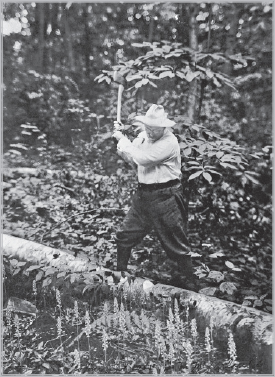
Roosevelt enjoyed chopping his own firewood and clearing his own paths in the wild.
T.R. chopping firewood. (Courtesy of Theodore Roosevelt Collection, Harvard College Library)
“Make it the presidency!” Nellie burst out excitedly.
“Make it the chief justiceship!” Taft quickly interjected, not wanting history to record that he had asked to be president.2
Of course, Taft welcomed Roosevelt’s nod. But already in January 1909, Roosevelt was becoming lukewarm about his handpicked successor. Taft wasn’t offering administrative jobs to young, progressive Republicans as T.R. had hoped. Many holdovers from Roosevelt’s administration, in fact, were being dismissed. And Taft didn’t even seem to know what the Biological Survey and the Forest Service were. On a number of occasions Taft treated Pinchot like someone to be brushed aside. Roosevelt, still only middle-aged, perhaps realized that he was going to miss wielding power. “I should like to have stayed on in the Presidency, and I make no pretense that I am glad to be relieved of my official duties,” he wrote to Cecil Spring-Rice. “The only reason I did not stay on was because I felt that I ought not to.” 3
Adding to Roosevelt’s discomfort with president-elect Taft was that Taft dismissed James R. Garfield as secretary of the interior in January 1909. Roosevelt kept his composure. But in his eyes Taft now had two strikes against him. “No one knows exactly why Taft chose to drop Garfield,” historian M. Nelson McGreary writes in Gifford Pinchot, “but many of the various explanations boil down to a general feeling on the part of Taft that Roosevelt’s Secretary of the Interior was a bit overzealous in his support of conservation and was inclined to stretch the exact letter of the law on occasion in order to protect what Garfield felt was the public interest.” 4 Moreover, Roosevelt worried that Taft would be too frightened to initiate antitrust suits.
Some of Roosevelt’s friends, sensing an impending rift between the outgoing and incoming presidents, scrambled to find a meaningful position for Roosevelt; the possibilities included becoming a U.S. congressman and becoming president of Harvard University. Civic organizations also sought ways to memorialize him in plaques, bas-reliefs, and newsletters. Only half-jokingly, Senator Philander Knox declared that Roosevelt “should be made a Bishop.” And magazines offered Roosevelt substantial sums of money to write for them. He declined the offers from major magazines, on the principle of not selling out the presidency, but he did sign on with Outlook, a minor but important periodical for which he would write approximately a dozen long articles a year (like those that now appear on op-ed pages), for $12,000.5
Roosevelt’s big money came from an arrangement with Scribner’s Magazine to write a series of articles that would eventually become the book African Game Trails. Determined that his specimen collecting not be written up as a “game butchering trip,” and wanting to frame his adventure as Wildlife Conservation, Roosevelt had Andrew Carnegie donate $75,000 for the presumably scientific expedition. With reporters, in fact, Roosevelt incessantly stressed that he was working for the Smithsonian Institution; only a few duplicate trophies would be kept for his wall at Sagamore Hill. And with due diligence Roosevelt started reading everything on such African explorer-hunters as Gordon Cummins and Cornwallis Harris.6 Instead of mocking the thirty-four-year-old Winston Churchill as he had done in the fall, Roosevelt now carefully read Churchill’s My African Journey (1908) and was impressed that the author had bagged a white rhinoceros.7 Roosevelt also wanted to hunt a rhinoceros, because America couldn’t let the indefatigable Britons have the edge in natural history anymore.
To get into physical shape for Africa, Roosevelt would ride horseback every day to the point of exhaustion. “The last fifteen miles were done in pitch darkness and with a blizzard of sleet blowing in our faces,” the president wrote his son Kermit. “But we got thru safely, altho we are a little stiff and tired nobody is laid up.”8 And he raced his favorite horse over fifty miles a day that January, as if preparing to charge up San Juan Hill. He would need to make the American scientific societies and explorers’ clubs proud when he was abroad. Friends from the Cosmos Club were concerned that by trying to get into trim, Roosevelt would suffer a heart attack or stroke. Jokes circulated on Capitol Hill that “crazy Teddy” was going to die from the strenuous life, now that he was a fat ex-president loaded down with guns. Some people scoffed that with his White House tenure winding down, he was little more than a rusted bolt, hard to shake loose.
With no congressional legislation pending, Roosevelt, as interregnum presidents are likely to be, was written off as a lame duck that winter. Big business, in particular, anticipating revenge, couldn’t wait for Roosevelt’s passport to be stamped in some godforsaken African port. “Congress of course feels that I will never again have to be reckoned with,” Roosevelt noted, “and that it’s safe to be ugly with me.”9 In focusing so much on his forthcoming African safari, congressional Democrats, in particular, hoped Roosevelt’s radical conservationist crusade would peter out. However, regardless of what dark thoughts Taft harbored about Gifford Pinchot personally, he nevertheless had to embrace Roosevelt’s conservation on the campaign trail in 1908. To challenge Roosevelt on forestry would have been a death knell to Taft’s candidacy. “If I am elected President,” Taft said in Sandusky, Ohio, “I propose to devote all the ability that is in me to the constructive work of suggesting to Congress the means by which Roosevelt policies shall be clinched.”10
After enduring T.R. in the White House for seven and a half years, the legislators should have known that he would be setting traps in early 1909. “I have a very strong feeling that it is a President’s duty to get on with Congress if he possibly can, and that it is a reflection upon him if he and Congress come to a complete break,” the president wrote to Ted, Jr. “This session, however, they felt it was safe utterly to disregard me because I was going out and my successor had been elected; and I made up my mind that it was just a case, where the exception to the rule applied and that if I did not fight, and fight hard, I should be put in a contemptible position. While inasmuch as I was going out on the 4th of March I did not have to pay heed to our ability to cooperate in the fortune. The result has, I think, justified my wisdom. I have come out ahead so far, and I have been full President right up to the end—which hardly any other President ever has been.”11
So, while wags laughed about Roosevelt’s African trip, the president acted. Congressmen had been asleep in 1903 when Roosevelt had created his first federal bird reservation at Pelican Island, Florida. Now, with Dr. Merriam of the Biological Survey still his steadfast ally, Roosevelt began rapidly declaring federal bird reservations during the last six weeks of his administration. He began with the Hawaiian territory: on February 3, he signed Executive Order 1019, declaring an entire archipelago of the Hawaiian Islands a federal bird reservation.
In 1903 Roosevelt had sent U.S. Marines to safeguard the seabirds of the Midway atoll, securing it as an American possession. Now he was saving the relatively nearby islands around Nihoa Island to Kure atoll from plumers and Japanese poachers. If you looked in an atlas for these flyspeck islands—west of the world’s largest lighthouse, on Kauai—the phrase “far-flung” might come to mind. But although human civilization might not have been thriving in this island group, the birds were there in magnificent numbers.12 “To many these remote, shimmering, uninhabited islands are devoid of interest; to the naturalist, however, every square foot of the surface, and all the life that inhabits them, has an interesting story to tell,” a professor of zoology, William Alanson Bryan of the College of Hawaii, remarked in 1915. “The geologist finds in them subjects of the greatest interest and importance.”13
When Mark Twain wrote Roughing It in 1871, he presented Hawaii to the American reading public as an exotic place. Geologically, Twain had focused on a volcano (a “muffled torch”), claiming that in Hawaii lava flowed like a “pillar of fire.”14 To Roosevelt this was a sure sign of a lazy journalist resorting to clichés: Twain made no mention of humpback whales, spinner dolphins, koa trees, or yellow hibiscuses. And then there was Jack London, who went to Hawaii in the yacht Snark but knew nothing of sea urchins or the numerous types of dolphins and sadly believed that he grew funnier as the bottle emptied. Robert Louis Stevenson had spent time in Hawaii during 1889, but he had chosen to focus on leprosy.
From Roosevelt’s perspective any indigenous Hawaiian chant—for example, the Kauai prayer “Hanohano Pihanakalani”—had more connection to the natural environment of Hawaii than a page by Twain, London, or Stevenson. Natives sang of the exquisite uplands, mountain shells, mokihana trees, and rare terns.15 But the literary “nature fakers” gave false pre-Darwinian descriptions of tropical vegetation that didn’t even exist on the islands. Didn’t Twain have eyes for the Hawaiian stilt, with its long pink legs? Couldn’t London comment on the green sea turtles? Wasn’t Stevenson competent enough to write about one of the forty species of sharks in the waters of Hawaii? The point was obvious: these literary men couldn’t have distinguished a hammerhead from a whitetip reef shark. Why didn’t important American writers study Hawaiian coral reefs, home to more than 7,000 marine species? Roosevelt believed that an accurate inventory of Hawaii’s fauna and flora in the form of a popular book was sadly needed.
Roosevelt’s intense interest in Hawaii went back to his expansionist fever of the 1890s. In 1893, in fact, Roosevelt had cheered as American colonists, mainly sugarcane growers, toppled a kingdom and replaced it with the republic of Hawaii. As assistant secretary of the navy he had lobbied Congress fervently to annex the island for strategic reasons. That effort had become a standard part of his public business in 1898. On April 30, 1900, Hawaii finally became an official U.S. territory; and a jubilant Roosevelt couldn’t wait to loll on the sand beaches, watching the surf roll in, perhaps using the Hawaiian Islands as stepping-stones on his way to Japan or Australia.
Doing his homework, Roosevelt now homed in on saving the far northwestern Hawaiian Island chain in the mid-Pacific, including Nihoa, Necker, French Frigate Shoals, Gardner Pinnacles, Maro Reef, Laysan Island, Lisianski Island, and Pearl and Hermes atolls, before leaving the White House. There were twenty-one islands plus smaller ones contiguous to the big nine. Executive Order 1019 designated the entire chain as a single federal bird reservation.* While Pearl Harbor was the supreme port, the Hawaiian Islands Federal Bird Reservation had such stunningly diverse wildlife—including blue gray noddies, wolf spiders, and monk seals—that as an ecosystem it defied classification.16 Geologists supposed that these islands were the summits of submerged mountains, but that was only a guess. An intruder’s foot would step on a bird burrow with practically every stride.17 Everywhere there are birds,” ornithologist William Palmer wrote on the islands of Executive Order 1019, “thousands upon thousands of albatross, white and brown, in great, distinct colonies; great rookeries of terns and petrels and frigate birds; countless rail run everywhere in the long grass; bright red tropical honey birds, bright yellow finches flutter in the shrubs; curlews scream; ducks quack; crake chirp all the day.”18
Today, 100 years after Roosevelt created the Hawaiian Islands Federal Bird Reservation, many of the small lagoons have still not been mapped. Biologists called the archipelago a wonder of ornithological activity. On French Frigate Shoals alone, in 1909 there were eighteen species of sea-birds including the rare black-footed albatross, Laysan albatross, Bonnien petrel, Bulwer’s petrel, and wedge-tailed shearwater, among other unusual species. On French Frigates Shoals a 120-foot volcanic rock rose over the lagoon, which was alive with growing reefs.19 At Gardner Pinnacles—two barren-looking rock outcroppings—new spider species would soon be discovered. The first aerial photograph of Maro Reef showed a pork-chop-shaped atoll in which the coral reefs shot out like spokes from a huge wheel. Discovered by an American whaling ship in 1920, Maro Reef was a “rough quadrangular wreath of white breakers.”20
A real Robinson Crusoe adventure could be had at Laysan Island, where few if any human footprints could be found. The island was discovered in 1828 by an American captain sailing to the Orient, and the ornithologist Walter K. Fisher had spent a week there during Roosevelt’s presidency, declaring in National Geographic that it was one of the most remarkable places on the planet; bold young albatrosses came up to him to be patted.21 The island—three miles in length and two and a half miles in breadth—was a wondrous kingdom for ornithologists because it had a highly saline lake (one of only a few natural lakes in all of Hawaii around which birds congregated).22 Just as there is now regular or premium gasoline, guano from Laysan Island was once considered the best fertilizer. The specific mix of bird excrement and coral sand formed a rich calcium phosphate coveted for fuel in California.23
What angered Roosevelt in February 1909 was that shiploads of rabbits had been released on Laysan Island by a Honolulu slaughterhouse firm in the hope that these hares would get fat on the thick vegetation—then, when they were at their maximum weight, they would be killed for a shish kebab eaten at Honolulu luaus. The problem was that the rabbits were devastating the tropical ecosystem of the island. Rare plants were being eaten down to nubs.24 By issuing Executive Order 1019, Roosevelt officially banned such releases of rabbits. Preservationist discipline had arrived in the Hawaiian Territory. Because Laysan Island was so remote, however, policing it to enforce the law against plumers and rabbit raisers would be difficult. Since the entire Hawaiian Island Federal Bird Reservation was administered by USDA, which didn’t own boats in Hawaii, Roosevelt employed vessels of the U.S. Revenue Cutter Service to patrol against poachers and rabbit breeders. The U.S. fish commissioner likewise was ordered to protect the new federal bird reservation, including the ocean whales, from commercial fishing and hunting companies.25
There was also an archaeological component to the Hawaii Islands Federal Bird Reservation. On the small basalt island of Necker, only forty-six acres in area, numerous religious relics had been discovered. Fifty-five “cultural places” were unearthed there. Many of the discoveries were stone enclosures designated as wahi pana (religious shrines) and filled with makamae (cultural artifacts). Supposedly, Necker Island had been the last refuge for a Pygmy-like race, the Menchune, who had been chased there by Polynesians. Over the centuries, native Hawaiians made Necker a sacred ceremonial site. In 1988, the George H. W. Bush Administration would list all of Necker Island on the National Register of Historic Places.26 Every square inch of the island—700 miles northwest of Honolulu—was an antiquities site.
Marine biologists today consider Roosevelt’s Executive Order 1019 a stupendous moment in oceanographic history because it preserved the great bird and seal rookeries of Hawaii from human exploitation. Now called the Hawaiian Islands National Wildlife Refuge, the chain continues to serve as nesting areas for more than 14 million breeding seabirds, waterfowl, wintering shorebirds, endangered turtles and seals, and legions of whales. It was Roosevelt’s counterpart of the Galápagos, a gift to marine biology, the world’s largest oceanic conservation area, where evolution was happening incrementally in a discernible way. Here, in the westernmost islands of Hawaii, the food chain remained intact.
Yet if you pick up a Hawaiian guidebook at, say, Barnes & Noble and thumb through the index, you probably won’t find Roosevelt’s name. This omission is based on Roosevelt’s never having visited Hawaii in a fishing craft, yacht, or naval vessel. But you will learn in Hawaiian guidebooks that Twain said that Oahu “beseechingly” haunted him, that Stevenson found the leprosy colony “a land of disfigurement and disease,” and that London had called himself a kama’aina (“child of the island”). Only Roosevelt himself, in his A Book-Lover’s Holidays in the Open (1916), noted the importance of Executive Order 1019 to the marine biology of what he called “the western extension of the Hawaiian archipelagos.”27
Because Hawaii was a territory in 1909—it did not become a state until 1959—there was no dissent from Capitol Hill over Executive Order 1019. Only the Hawaiian rabbit breeders and eggers were up in arms. The territorial governor, Walter Frear of California, likewise had a few grumbles. None of this amounted to more than a few angry letters for public consumption. In 1911 the Field Museum of Chicago sent Charles A. Corwin to the Hawaiian Islands Federal Bird Reservation to inventory species. His report on Laysan Island alone was so impressive that it made national news. “It has been established that the island is inhabited by at least 8,000,000 birds, most of which consist of two species of Albatross,” Corwin wrote in the Christian Science Monitor, a publication that took ornithology seriously. “There were so many birds on the ground, nesting, that we had to crowd our way through to avoid stepping on them…. We can fully verify the stories that these strange birds have a peculiar dance which resembles the cake walk. They clap their bills together and waddle about with high stepping antics, ducking their heads first under one wing, then under the other. All through the dance they whistle and utter weird sounds.”28
With the Hawaii Islands Federal Bird Reserve created, the Biological Survey sent Roosevelt an additional twenty-five bird reservations to sign before March 4. While the reporters were abuzz over Taft’s choices for his cabinet and about the inaugural festivities, the Roosevelt administration would stealthily save birds’ breeding grounds. Unnoticed by the Washington Post and New York Times, the final “I So Declare It” hour had arrived for American ornithologists. Suggestions from Job, Finley, Dutcher, Chapman, Beebe, and other enthusiasts came pouring into the Biological Survey office at the Department of Agriculture. There was a real sense of urgency. On February 25, it virtually rained federal bird reservations in America, and nobody in interregnum Washington had the power to object. For ornithologists of the twenty-first century, these areas are hallowed not only because of their wildlife but also for their green underbrush and marshlands: Salt River (Arizona), Deer Flat and Minidoka (Idaho), Willow Creek (Montana), Carlsbad and Rio Grande (New Mexico), Cold Springs (Oregon), Belle Fourche (South Dakota), Strawberry Valley (Utah), Keechelus, Kachess, Clealum, Bumping Lake and Conconully (Washington), Pathfinder and Shoshone (Wyoming).
What fantastic American names! Stephen Vincent Benét should have written a poem about them. Just reading them aloud is poetry. The two federal bird reservations that the Roosevelt administration likewise created in California were very special, unique in their biodiversity. First, on February 25, came East Park, located in Colusa County an hour north of Sacramento. Here thousands of swans were struggling to coexist with humans around the cool water of a medium-size lake. A very rare tri-color blackbird also used the watering-hole as a home base for much of the year.29 In springtime the rolling hills of East Park bloomed with the rare adobe lily (Fritillaria pluriflora) and residents of Sacramento came to camp along the lake free of charge. In 1921 the Bureau of Reclamation of the U.S. Department of the Interior took over control of East Lake. Nowadays, even with a hydroelectric dam, the thriving birdlife and flower fields remain federally protected.
But the true gemstone of February was the Farallon Islands, a spectacular cluster of rocky islands in the Pacific Ocean twenty-five miles from Golden Gate Bridge. An inventory of wildlife in the Farallons runs for pages. The islands remain the largest nesting colony south of Alaska and the world’s biggest colony of western gulls. Half of the ashy storm petrels continue to reside on these offshore bird rocks. Marine whales congregate around the Farallons, as do southern sea otters, Dall’s porpoises, minke whales, orcas, and northern elephant seals. Every square foot is full of special designs. Although vegetation is limited, there are clusters of pigweed, tree mallow, false clover, plantain, curly dock, and Monterey cypress. Little skiffs from the San Francisco Bay area often circled around the islands (the largest island is seventy acres in area) to see the colorful tufted puffin or watch two-ton elephant seals at Saddle Rock dispute during the breeding season over harems. A biological site of the rarest kind, the Farallons were influenced by the California current, westward winds, upwelling mixing, deep cold water, and finally, in February 1909, by the Roosevelt administration’s “citizen bird” policy.30
From Hawaii to Florida and Michigan to Alaska, birding areas and habitats were put off-limits and set aside for the future. Their status would be enforced by the Biological Survey, National Audubon Society, and AOU. In Hawaii, Oregon, Washington, Louisiana, and Florida the plumers were isolated and suppressed, forced to operate clandestinely, like criminals. And when Roosevelt wrote that birds should be saved for reasons “unconnected with dollars and cents,” he wasn’t speaking just for himself.31Groups like the National Audubon Society and AOU had swept across the land. The unstated presumption was that weird beaks, webbed claws, and wingspreads had aesthetic value for a generation of Americans who championed “citizen bird” and were fed up with market butchers. When Senator George C. Perkins, (among other things) a forestry advocate, questioned T.R. over wildlife protection policy the president snapped. “I would like to break the neck of the feebly malicious angleworm who occupies the other seat as California’s Senator,” Roosevelt wrote to his son Ted; “he is a milk-faced grub named Perkins.”32
With the exception of Henry Ford, Andrew Carnegie, and a few others, industrialists of the time were perplexed by Roosevelt’s passion for protecting loons, cormorants, and herons. What would lead a hero of the Spanish-American War to insist that shooting a dark-eyed junco was akin to grand larceny? Didn’t Roosevelt’s infatuation for birds constitute fanaticism? Roosevelt, for example, had shut down prime Florida real estate to make life comfortable for egrets. “I have no command of the English language that enables me to express my feelings regarding Mr. Roosevelt,” the railroad tycoon Henry Flagler said. “He is shit.”33
Flagler was correct in considering Roosevelt a vicious adversary. As Dwight D. Eisenhower once noted, T.R., despite his disarming toothy smile, “feared nobody” and was a “dangerous antagonist.” And there was a cost to interfering with Roosevelt’s love of pelicans and petrels: T.R. would blast his anticonservationist critics as hopeless “spoilers,” “fools,” “demagogues,” “exploiters,” and “idiots.” The novelist Booth Tarkington, long after Roosevelt died, reflected on how T.R. had subjected people he perceived as anticonservationist to verbal tirades. “The Colonel had his own way of saying ‘swine,’ and it gave that simple Gothic word a peculiarly damning power,” Tarkington wrote. “The swine he had in mind seemed to be incomparably more swinish than the ordinary swine that other people sometimes mention.”34
Likewise John Burroughs explained in his Journals how Roosevelt could be a cutthroat political adversary when it came to the defense of songbirds. “He was a live wire, if there ever was one, in human form,” Burroughs wrote in his journal. “His sense of right and duty was as inflexible as adamant. His reproof and refusal came quick and sharp. His manner was authoritative and stern. He was as bold as a lion and, at times, as playful as a lamb.”35 Every word Roosevelt uttered on behalf of wildlife protection seemed to have an exclamation point. When it came to squaring-off with politicians he was a specialist at haranguing, never crying uncle, giving his opponents the back of his hand. When challenged about the legality of his national monuments, federal bird reservations, or national forests, he took on that lean, ravenous look of a famished wolf. America had a new conservationist code to promote, thanks to Roosevelt: pummel the exploiters until they were licked.36 He believed that his successor, William Howard Taft, would take just such a line.
Taft had even promised to keep Pinchot as the head of the Forest Service—a real concession following the dismissal of Garfield. Roosevelt had created his own circle or set of outdoorsmen in government, including Pinchot and Garfield, who agreed with his every sales pitch, plea from the bully pulpit, executive order, sermon about outdoorsmen, and writ concerning wildlife. And the first eight weeks of 1909 were their golden time. These acolytes weren’t Luddites ready to sabotage the cutting blades in defense of nature. Many were evolutionists—such as David Starr Jordan and Henry Fairfield Osborn—who understood the arcane biology of how conjunction took place in colonial protozoa and cared deeply about species recognition marks. Roosevelt had nevertheless kicked down the door of the wildlife protection movement, knocking it off its hinges, by giving evolutionists places of honor at his table in the White House. As an ex-president, Roosevelt would travel to Florida and Louisiana to inspect his revolutionary rookeries, pleased at his accomplishments on behalf of “citizen bird.” “The number and tameness of the big birds showed what protection has done for the bird life of Florida of recent years,” he wrote after inspecting his federal bird reservations in the Gulf of Mexico. “The plumed lesser blue herons, and more rarely the great blue heron and the lovely plumed white egret, perched in the trees or flapped across ahead of the boat.”37
II
While Merriam remained Roosevelt’s go-to biologist in early 1909, Pinchot was first among equals in T.R.’s conservationist group. Pinchot, one of the most effective administrators to ever operate within the federal bureaucracy, expanded the U.S. forest reserves from approximately 43 million acres to about 174 million acres from 1901 to 1909. Besides serving on such presidential commissions as the Organization of Government Scientific Work and Public Lands (1903), Department Methods (1905), Inland Waterways (1907), and Country Life and the National Conservation Commission (1908), Pinchot had also led the highly successful governors’ conference of 1908. A tireless worker, he crisscrossed America promoting forestry, and he established the first press bureau ever within a federal agency. Much like Roosevelt—his boss and hero—Pinchot manipulated the press like a puppeteer, knowing exactly which strings to pull. Pinchot’s home on Rhode Island Avenue in Washington, D.C., became a veritable salon where smart journalists could have a drink and talk about the western reserves. Roosevelt noted of Pinchot that “among the many, many public officials who under my administration rendered literally invaluable service to the people of the United States, he, on the whole, stood first.” 38
On February 18, 1909, Roosevelt convened the North American Conservation Conference at the White House, following Pinchot’s directive that conservation had to go global.39 “The keynote of the conference was that international streams are affected by cutting forests on either side of the boundary line,” the Washington Post wrote, “and that conservation plans, to be the most practical, must be international.”40 The U.S. delegates at the North American Conservation Congress included Chief Forester Pinchot, Secretary of State Bacon, and Secretary of the Interior Garfield (all members of the “tennis cabinet”—the term that reporters had given to Roosevelt’s inner circle at the White House). Ottawa and Mexico City sent their appropriate counterparts. Meetings were held at the White House, at the State Department, and at Pinchot’s home. After first agreeing to some “conservation measures” of “continental good” the statesmen announced a trilateral “Declaration of Principle” aimed at the creation of a World Conservation Congress to meet at The Hague in September 1909 to push Rooseveltian conservationism forward on a global level. Pinchot’s dream, in fact, was for President Taft to go to The Hague and champion issues like international wildlife reserves, parks, and tree planting; the banning of poaching and overfishing of waterways; and forest managing techniques. As Pinchot envisioned it that February, the global conference, to be held while T.R. was in Africa in the fall, would start a conservation revolution around the world.41
Before Roosevelt left office, fifty-eight nations had, in fact, received invitations from the White House to meet at The Hague. Immediately, Great Britain, France, and Germany accepted. Other nations soon followed suit.42 But after only a few weeks in office, President Taft balked and called off the conference, feeling that Pinchot had overreached himself. The World Conservation Congress never had a chance to succeed. As the historian Paul Russell Cutright put it in Theodore Roosevelt: The Naturalist, “the project died aborning.” 43 The rift between Taft and Pinchot was becoming unbridgeable. “Pinchot, bitterly disappointed, never gave up hope of holding such a conference,” McGeary wrote in Gifford Pinchot, “especially since he later became firmly convinced that conservation of natural resources was a primary means of insuring a permanent peace.”44
That Taft was uninspired by Pinchot’s idea of a World Conservation Congress disappointed Roosevelt greatly. A breach in policy was starting to manifest itself between the incoming (conservative) and outgoing (progressive) GOP administrations. In December, for example, during a meeting on conservation at the Belasco Theatre in Washington, Pinchot had quite innocently introduced Taft as the “president elect.” “I’m not the President-elect,” Taft had snapped when he stood on the podium. “That is merely the imagination of Mr. Pinchot. I’m just a private citizen.”45
Determined to keep Roosevelt’s torch lit in public policy, Pinchot and Garfield co-wrote The Fight for Conservation (1910). When the first draft of the book was finished that February, Garfield asked the departing president to write a “foreword.” Basically they were looking for a letter of recommendation, a strong show of support, an embrace (in writing) from their boss. Somehow Roosevelt found time to compose a fine summation of the sterling qualities of his chief forestry advocates, giving his colleagues his indelible stamp of approval in glowing language. “Both have stood for absolute honesty, for absolute devotion to the needs of the public,” Roosevelt wrote. “Both have stood no less for entire sanity and for farsighted understanding of the many diverse needs of the Nation. They have been fearless in opposing wrong, whether by a great corporation or by a mob; by a wealthy financier, or by a demagogue.”46
January to March was a very busy period for the U.S. Forest Service. An eager Pinchot had decided to challenge the anti-Roosevelt forces one last time with many new forest reserves in the West. Pinchot and Garfield had been gathering data on what forestlands were doable. Roosevelt was well past worrying about the political repercussions of any last-minute reserves. “Keep it legal” was his only direction to Pinchot. Echoing Thoreau, Roosevelt planned on leaving the White House promoting forests and meadows and even corn as a sort of ecumenicism.47 Pinchot and Garfield, working with a few like-minded congressmen, made their mentor proud. Starting on January 20 with Humboldt, Nevada, and not stopping until the last hours of the last days of his administration on March 2 with Sequoia, California, Roosevelt declared thirty-seven new national forests: Humboldt, Moapa, Nevada, and Toiyabe (Nevada); Cleveland, Calaveras Bigtree, Modoc, California, Shasta, Trinity, Lassen, Plumas, Tahoe, and Sequoia (California); Klamath (California and Oregon); Mono (California and Nevada); Pecos, Gila, Datil, Lincoln, Alamo, and Carson (New Mexico); Prescott, Tonto, Sitgreaves, and Apache (Arizona); Zuni (Arizona and New Mexico); Dixie (Arizona and Utah); Marquette and Michigan (Michigan); Superior (Minnesota); Black Hills (South Dakota and Wyoming); Sioux (Montana and South Dakota). And for the first time Arkansas, without a battle, was brought into the fold with two new forest reserves: Ozark and Arkansas.48
III
By far the biggest new national forests that season, in terms of acreage, were in the Alaska Territory. Since his creation, on August 20, 1902, of the Alexander Archipelago Forest Reserve, Roosevelt had steadily added Alaskan land to the federal government’s holdings. On September 10, 1907, he had created the Tongass National Forest, an immense area in southeastern Alaska with huge strands of western red cedar, Sitka spruce, and western hemlock. The reserve also included thousands of islands and salmon-rich streams. On July 1, 1908, Roosevelt merged the Alexander Archipelago with Tongass to create what is today Tongass National Forest, a monstrous eco-zone of snowcapped peaks, blue glaciers, clear streams, muskeg, forests, and fjords. More than 17 million acres of pristine Alaska was preserved between the two forests, making Tongass National Forest the largest reserve in the United States. The diversity of salmon alone made the Tongass the crown jewel of the USDA’s forest reserves. King (chinook); coho (silver); pink (humpback); sockeye (red); and chum (dog) salmon flourished in these icy waters, as nowhere else on earth except Canada. And where there were salmon, grizzly bears and polar bears came in huge numbers.
The creation of Tongass National Forest was a tremendous presidential accomplishment. But as Roosevelt’s days in the White House waned during early 1909, he yearned to do even more to both protect and develop the “last frontier.” To Roosevelt the “spell of Alaska” wasn’t gold mining but the rain forests and wildlife breeding areas saved for posterity. Anybody who shot a northern spotted owl, for example, should be arrested. But Roosevelt always wanted smart community development. After all, it was the Roosevelt administration that in 1905 had pushed an act through Congress calling for a first-class road system to be laid out in Alaska.49 The act was an example of how the U.S. government—not railroad titans or oil companies—could help Alaska develop. The enemy in Alaska, as Roosevelt saw it, was huge companies that bought up land tracts to mine, log, or drill. Roosevelt thought the U.S. government instead of the private sector should build and operate a short-line railway to connect Controller Bay with Alaska’s great coalfields.50 And Roosevelt wanted federal protection of sea otters and stringent government regulations on fur seal hunters and fisheries.
The promotion of the Elkins Act of 1903, the creation of the Bureau of Corporations, and the bills regulating railroad rates all showed Roosevelt’s desire to enhance executive powers. Roosevelt believed that because Seward had purchased Alaska in 1867 with federal funds, the U.S. government should dictate how the territory was developed. “Roosevelt’s belief in the benevolent power of executive action found particularly vivid expressions in his mature conservation program,” Joshua David Hawley wrote inTheodore Roosevelt: Preacher of Righteousness; this statement is especially true regarding U.S. territories like Alaska. “The ruinous overharvesting of the country’s timberlands, severe water shortages in the arid West, the rapid deterioration of the famed open ranges, and the more gradual but steady disappearance of suitable wildlife habitats nationwide—all these developments convinced Roosevelt as president that the United States needed a rational, unified policy to manage the nation’s natural resources. As in the field of economic regulation, Roosevelt concluded here as well that, when it came to conservation policy, Congress was not up to the task.”51
Roosevelt had received an advance copy of Major-General A. W. Greely’s Handbook of Alaska: Its Resources, Products, and Attractions, published later in the spring of 1909. It had a moose as its frontispiece and was filled with photographs shot by members of Roosevelt’s administration in the Coast and Geologic Survey, the Geological Survey, the Bureau of Fisheries, and the Biological Survey. At the end there was a handsome pull-out map of Alaska. With his stumpy forefinger Roosevelt would trace down the Porcupine River’s course from Yukon Province to Tanana, Alaska, proud that the landmass was part of the United States. Had anybody ever hiked the Kokrines Hills? Or floated down the Kuparuk River from the Chukchi Sea? How exciting—America owned fjords to rival Norway’s, and glaciers larger than England. To Roosevelt, Alaska was the hardiest explorers’ paradise. According to measurements by the Boone and Crockett Club, the vast territory was one-third greater than all the Atlantic states from Maine to Florida. Roosevelt had read a great deal about the southern two-fifths of Alaska, which encompassed the densely wooded Tongass National Forest, but he was somewhat ignorant about the watersheds of the Yukon and the lesser Kuskokwin rivers, and the large upper-fifth (essentially treeless) shores of the arctic coast. The Handbook filled in the blanks for the departing president.52
IV
While Roosevelt opened the White House to ornithologists like Job, Chapman, Finley, and Dutcher in February 1909, he also never turned down an opportunity to consult with renowned hunters from around the world. As he prepared for Africa, he found these hunters marvelous company and was almost greedy for their companionship. “He had a great respect for genuine hunters—the kind who endure hardship, exhibit prowess and tell the truth—such men as Selous, Warburton Pike, George Bird Grinnell and Charles Sheldon,” Merriam recalled. “Early in his career in the White House he asked to be notified when out-of-town hunters came to the city. So when the Canadian hunter and sub-arctic explorer Warburton Pike had arrived, Sheldon and I were requested to bring him to dine at the White House. The time happened to be a particularly busy one politically, and we were warned that the President must excuse himself directly after dinner. But instead, he took us upstairs and kept us in his den till midnight. He was several times interrupted by messengers, but declined to see them. Finally his son-in-law (Nicholas Longworth) came with an important telegram. Roosevelt waved him away with the remark that he was not to be interrupted—that for this one night he felt entitled to enjoy himself.”53
During his last weeks at the White House Roosevelt wrote his old editor at the Boone and Crockett Club, Caspar Whitney, a long letter about hunting and the strenuous life. Roosevelt recounted how over the decades he had effectively compensated for being a poor shot by having great will in stalking prey. “In short, I am not an athlete; I am simply a good, ordinary, out-of-doors man,” Roosevelt wrote; his statement was passed around to fellow club members. “The other day I rode one hundred and four miles. Now this was no feat for any young man in condition to regard as worth speaking about; twice out in the cattle country, on the round-up, when I was young I myself spent thirty-six hours in the saddle, merely dismounting to eat, or change horses; the hundred-mile ride represented what any elderly man in fair trim can do if he chooses. In the summer I often take the smaller boys for what they call a night picnic on the Sound; we row off eight or ten miles, camp out, and row back in the morning. Each of us had a light blanket to sleep in, and the boys are sufficiently deluded to believe that the chicken or beefsteak I fry in bacon fat on these expeditions has a flavor impossible elsewhere to be obtained. Now these expeditions represent just about the kind of things I do. Instead of rowing it may be riding, or chopping, or walking, or playing tennis, or shooting at a target. But is always a pastime which any healthy middle-aged man fond of outdoors life, but not in the least an athlete, can indulge in if he chooses.”54
Eighteen months after leaving the White House, Roosevelt wrote “The Pioneer Spirit and American Problems,” a piece for Outlook about the American West, praising Cheyenne, Denver, and Omaha. Sounding rather like Walt Whitman, Roosevelt also celebrated ranchmen, miners, cowpunchers, mule skinners, and bull whackers. He boasted about Indians, pioneers, and buffalo herds. Symbolically, Roosevelt was turning his back on the east coast yet again. He called Abraham Lincoln a westerner because Lincoln had the western trait of “undaunted and unwavering resolution.” And again, Roosevelt claimed that the federal government knew what was best for the West with regard to water power, forest reserves, land leasing, grazing rights, and so on. According to Roosevelt, America always had to have a national system of government, and anybody promoting states’-rights or territories’-rights schemes were charlatans.
“The man of the West throughout the successive stages of Western growth has always been one of the two or three most typical figures,” Roosevelt wrote, “indeed I am tempted to say the most typical figure in American life; and no man can really understand our country, and appreciate what it really is and what it promises, unless he has the fullest and closest sympathy with the ideals and aspirations of the West.”55
How earnestly Roosevelt still believed that the American character was connected to the restorative power of outdoors life was evident in recommendations he gave the U.S. Army War College before stepping down as president. Having learned that the army’s regulations for field service were being modernized, he inserted himself into the internal debate over the revisions. Even though the forerunners of jeeps were being introduced to the army, Roosevelt stood by the symbolic power of horses. Fixing cars was fine, and mechanical skills were always helpful, but all army servicemen, Roosevelt believed, needed to be skilled climbers and equestrians. “We must not allow packing to become a lost art in the army,” Roosevelt wrote in a report. “The old timers in the Rocky Mountains are passing away and we must look to the army to keep up the knowledge of this essential and invaluable service art.”56
One American range that Roosevelt was itching to explore in February 1909 was Washington’s fog-shrouded Olympic Mountains. Before he headed to Africa, Roosevelt saved Mount Olympus (7,980 feet in elevation) as a national monument. Ever since Merriam had named the huge elk in the Olympic range Cervus roosevelti, the president had hungrily read whatever he could about the region. As Time would later note, geologists were unsure exactly how snow-mantled Mount Olympus had been formed. Folklore in Washington state claimed that Paul Bunyan had journeyed to Puget Sound to milk an orca to cure Babe (his devoted blue ox) of a life-threatening illness. When Bunyan thought Babe was going to perish, he dug a huge grave, and the dirt pile became Mount Olympus.57 The very fact that such a folktale survived in the Pacific Northwest was a sure sign that wilderness still existed in the Cascades circa 1909—and the same would be true of the later legend of Bigfoot. Somehow it was fitting that on March 3, Paul Bunyan, Babe, Bigfoot, the giant elk, and Theodore Roosevelt became linked in the Cascades folklore with the creation of Mount Olympus National Monument. Furthermore, Professor Daniel G. Elliot, a co-author of The Deer Family, had been promoting national monument status for Mount Olympus for over two years.
Since the successful reintroduction of bison on the Wichitas and Flathead reserves, Roosevelt had tried to create the National Elk Reserve in the Olympics. However, Congress had prevented him from saving remnant bands as part of Olympic Elk National Park. Roosevelt was furious at being stymied. His Grand Canyon National Game Reserve was a model of proper wildlife reserve management. So, Roosevelt circumvented Congress on March 3, declaring Mount Olympus and 615,000 acres of lush valley, spectacular mountains, fish-filled streams, and old-growth forests off-limits to any kind of hunting, timbering, or extraction.58 Quite literally, Mount Olympus was North America’s most amazing temperate rain forest. In Proclamation No. 869 creating the national monument, Roosevelt described the ecosystem as follows: “the slopes of Mount Olympus and the adjacent summits of the Olympic Mountains…embrace…numerous glaciers, and…the summer range and breeding grounds of the Olympic Elk…a species peculiar to these mountains and rapidly decreasing in numbers.”59
Corporations in Seattle and Tacoma erupted in protest over Mount Olympus National Monument. As with the Grand Canyon, the dissenters said, T.R. was abusing the intent of the Antiquities Act. The onetime mayor of Seattle, Richard A. Ballinger, a reformer and low-key conservationist, thought Mount Olympus should be timbered. Comical remarks circulated in newsrooms that Roosevelt was leaving the White House to dwell on Mount Olympus with his buddies Jupiter and Apollo and his supersize species of Irish elk. The New York Times eventually defended Roosevelt’s new national monument, addressing the humorists by concluding, “Mr. Roosevelt is always right here on earth. If he were on Olympus there would be no room there for Jupiter or Apollo.”60
What a wondrous, moss-draped world the Mount Olympus rain forest was! For a lover of big game, seeing a 700-pound Roosevelt elk browsing in the lush primeval forest constituted an experience unequaled in North America. Mount Olympus, with glaciers descending its rugged slope, was to this national monument what Old Faithful was to Yellowstone. The northern spotted owl, a threatened species, could be found easily on Mount Olympus by just hiking the trails. Three sui generis Olympic species—the Olympic marmot, Olympic snow mole, and Olympic torrent salamander—weren’t found anywhere else in the world. For sheer picturesque beauty, Soleduck Falls, swollen from frequent rains and melting snows, was also in a class of its own. Sometimes naturalists described Olympic as three parks in one—dramatic glacier-capped mountains, miles of wild Pacific coast, and a temperate rain forest. Mount Olympus also had the largest Alaskan cedar and Douglas firs in America.
When Woodrow Wilson became president in 1913, he deemed Roosevelt’s Proclamation No. 869 excessive and downsized Mount Olympus National Monument from 615,000 to 300,000 acres. Roosevelt was furious. When he died in 1919, a movement was under way to return the ecosystem to its original 615,000 acres. But presidents Wilson, Harding, Coolidge, and Hoover were unwilling to do it, wanting to secure the “timber vote” of the Olympic Peninsula. At last, in 1938 Franklin D. Roosevelt, by presidential proclamation, returned his cousin’s acreage to the monument. And he changed Mount Olympus’s designation to Olympic National Park. In 1958 about seventy miles of rugged Washington coastline was added to the park by President Dwight Eisenhower. Joining the Roosevelt elk in federal protection were whales, dolphins, sea lions, and sea otters. The entire Olympic Peninsula, with the surf slapping hard on the offshore rocks, was Bar Harbor and then some. Four valleys facing the ocean—the Queets, the Quinault, the Hoh, and the Bogachiel—produced endless botanical surprises for visitors. Juncos flit about the grasses and woodpeckers excavate old logs. Deer are everywhere. The tide pools full of invertebrates of countless shapes, sizes, colors, and textures at Olympic National Park could have kept Charles Darwin busy for 100 years.61
V
During his last days in the White House, Roosevelt thought a lot about Charles Darwin. His knowledge of the great naturalist had matured since he drew men as storks when he was a teenager in Dresden. In preparation for his African expedition Roosevelt hadOn the Origin of Species wrapped in a waterproof cover to avoid damaging it on safari. It was part of what he called his “pigskin library” of favorite titles. On February 25, just two days before he created his federal bird reservations, Roosevelt had reflected on Darwin. “I think the trouble about Darwinism is that people confound it with evolution,” Roosevelt wrote to James Joseph Walsh, a professor of physiological psychology who had just dedicated his book Catholic Churchmen in Science to President Roosevelt. “I suspect that all scientific students now accept evolution, just as they accept the theory of gravitation, or the general astronomical scheme of solar system and the stellar system as a whole; but natural selection, in the Darwinism sense, as a theory, evidently does not stand on the same basis. It must be tested, as the atomic system is tested, for instance.”62
Other biological books added to the “pigskin library” included Darwin’s Voyage of the Beagle and Huxley’s Essays.63 Roosevelt had also started reading a book on neo-Darwinism by Hans Driesch, The Science and Philosophy of the Organism (lectures delivered in 1907–1908 at the University of Aberdeen). This work, which was both factual and meditative, proved to be a helpful scaffolding for Roosevelt’s Oxford University lectures, “Biological Imperatives in History,” in 1910. A German biologist known as a pioneer in embryology, Driesch spent years operating out of the Marine Biological Station in Naples, Italy, experimenting with the division of embryo cells of sea urchins. These were complicated experiments encompassing biology, physics, mathematics, and philosophy. Roosevelt strove to understand Driesch’s findings in depth. He was enthralled to find that Driesch had included the issue of coloration of bears in Science and the Philosophy of the Organism. “Do we understand in the least why there are white bears in the Polar Regions if we are told that bears of other colours could not survive?” Driesch inquired. “In denying any real explanatory value to the concept of natural selection I am far from denying the action of natural selection. On the contrary, natural selection, to some degree, is self evident.”64
Roosevelt also scrounged around for grant money to help Professor John A. Lomax of the University of Texas continue his fieldwork collecting cowboy ballads. Roosevelt went hat in hand on Lomax’s behalf to potential benefactors. Writing to the president of the Carnegie Institution, Roosevelt asked that Lomax be given $1,000, quickly, for his “very original and instructive study into a phase of native American literary and intellectual growth which of course has been totally neglected.”65 However, his request was rejected.
Frustrated that some intellectuals rolled their eyes at the idea of cowboy culture as serious academic fare, Roosevelt turned to the French ambassador, Jean-Jules Jusserand, to find financial assistance for Lomax. “A Texas professor is doing some really good work in collecting frontier ballads in the cow country of Texas,” he wrote to Jusserand. “They are of course for the most part doggerel (as I believe to be true with the majority of ballads as they were originally written); but these are interesting because they are genuine. The deification of Jesse James is precisely like the deification of Robin Hood and the cowboy is a hero exactly as the hunter of the greenwood was a hero. Also, the view taken of women seems to be much the same as that taken in many of the medieval ballads.”66 This time Roosevelt found Lomax a grant.
Filled with growing enthusiasm for Texan culture, Roosevelt wrote an introduction for Lomax’s Cowboy Songs and Other Frontier Ballads (1910).67 At the same time he drafted speeches that he planned to deliver at Oxford, the Sorbonne, and Berlin University in 1910, once he emerged from the African wilds. Darwinian themes were apparent in all three addresses, accentuated by his own philosophy of the strenuous life. Then, on March 2, with just forty-eight hours left of his presidency, he wrote heartfelt thanks to Merriam, Garfield, and Pinchot. Together, these warriors had challenged the titans of the Gilded Age and beyond—railroads, timber companies, and mine owners.68 Only in writing to Edith or to his children had Roosevelt ever been so sentimental and emotional. “As long as I live I shall feel for you a mixture of respect and admiration and a general affectionate regard,” he wrote to Pinchot, saluting his work as first chief of the Forest Service. “I am a better man for having known you. I feel that to have been with you will make my children better men and women in after life; and I cannot think of a man in the country whose loss would be a more real misfortune to the Nation than yours would be. For seven and a half years we have worked together, and now and then played together—and have been altogether better able to work because we have played; and I owe to you a peculiar debt of obligation for a very large part of the achievement of the administration.”69
Predictably, Roosevelt didn’t forget about his obligations to American ornithology on his way out of power. In 1908, Lucy Maynard, a member of the Audubon Society, had met with him at the White House for a nature lecture. She was updating a new edition of her work on birds in Washington, D.C., and wondered whether the president had any interesting recent sightings to report. “Why, yes,” Roosevelt answered gleefully. “But I’ll do better than that. I’ll make you a list of all the birds I can remember having seen since I have been here.”70
A few days later, Roosevelt sent Maynard a long list, which she published in 1909 as the introduction to her Birds of Washington and Vicinity. In all, ninety-three species were listed, some with brief commentary. For example:
Night Heron. Five spent winter of 1907 in swampy country about one-half mile west of Washington Monument.
Sparrow Hawk. A pair spent the last two winters on and around the White House grounds, feeding on the Sparrows—largely, thank Heaven, on the English Sparrows.
Screech Owl. Steady resident on White House grounds.71
Inauguration Day, March 4, brought a swirl of snow. Ten inches had fallen, and everything was shrouded in white that concealed rock-hard ice. Horse-drawn plows were working overtime to at least keep Pennsylvania Avenue passable for Washingtonians and other guests. Carpenters had worked until the last minute erecting a reviewing stand for the parade outside the North Gate of the White House. But the snow-removal efforts and the carpenters couldn’t keep up with the snowfall. For the first time in U.S. history the inauguration ceremonies were moved indoors, to the Senate chamber.72 The essence of Roosevelt as a phenomenon was evident in the way his departure was receiving more attention in the newspapers than Taft’s arrival. Even with the bad weather, Roosevelt was exuberant: “I knew there’d be a blizzard when I went out,” he had said on inauguration eve. Clapping his hands, he declared the storm the “Roosevelt Blizzard,” and said that’s what history would call it. Trying to hold his own, determined from the outset not to be Roosevelt’s “creature,” Taft remarked that he thought not.73 “You’re wrong,” Taft said. “It’s my storm. I always said it would be a cold day when I got to be President of the United States.”74
At ten o’clock on Inauguration morning, Roosevelt and Taft headed to the Capitol in a twelve-team carriage. Snow was swirling about, and many of the bleachers lining Pennsylvania Avenue were empty owing to the inclement weather. Both men usually had a hearty sense of humor, but it wasn’t on display that day, although T.R. waved to the shivering spectators. Nellie Taft broke all precedent by riding in a carriage with her husband.75 At the Capitol, Roosevelt signed some last-minute bills, hugged some close friends, and prepared to relinquish power. Vice President James S. Sherman of New York had already been sworn in. Just after noon, Roosevelt and Taft walked into the Senate Chamber, receiving enormous foot-stomping cheers. For a few minutes they looked like a united front. Then a century-old Bible was held out and Taft took the oath.76 “Observers were struck by Roosevelt’s immobile concentration as his successor was sworn in,” the historian Edmund Morris wrote in Theodore Rex. “Those who did not know him thought that the stony expression and balled-up fists signaled trouble ahead for Taft.” 77
Not since Lincoln had America had such a folk figure as Roosevelt for its president. He was beloved. Groups from all over America wanted to memorialize Roosevelt, chisel his face in granite, or cast a bronze of his likeness. But such gestures were hardly commensurate with his accomplishments, such as saving the Tongass and Mount Olympus. “For millions of contemporary Americans, he was already memorialized in the eighteen national monuments and five national parks he had created by executive order, or cajoled out of Congress,” Morris maintained. “The ‘inventory,’ as Gifford Pinchot would say, included protected pinnacles, a crater lake, a rain forest and a petrified forest, a wind cave and a jewel cave, cliff dwellings, a cinder cone and skyscraper of hardened magma, sequoia stands, glacier meadows, and the grandest of all canyons.”78 In seven years and sixty-nine days, Roosevelt had saved more than 234 million acres of American wilderness. History still hasn’t caught up with the long-term magnitude of his achievement.
All of Roosevelt’s cabinet dutifully came to see him off at Union Station, but he lingered longest with Pinchot.79 In coming years Pinchot would become governor of Pennsylvania, forestry advisor to F.D.R., and the co-author of Darwinian travel odyssey from New York to Key West and on to the Galapagos. Pinchot would have the huge burden of keeping the conservation movement kinetic while Roosevelt was in British East Africa. Soft-spoken, almost tearful, Roosevelt was attentive and considerate to everybody at Union Station: children carrying teddy bears; army troops; porters; bystanders; and congressmen with whom he no longer had to negotiate. Already, scholars were trying to determine precisely where Roosevelt would fit in the spectrum of American presidential history. Roosevelt himself believed that he was a smart hybrid of both Jeffersonian and Hamiltonian impulses with modern Darwinism added for good measure. “I have no use for the Hamiltonian who is aristocratic or for the Jeffersonian who is a demagogue,” Roosevelt wrote to William Allen White shortly before leaving office. “Let us trust the people as Jefferson did, but not flatter them; and let us try to have our administration as effective as Hamilton taught us to have it. Lincoln, and Washington, struck the right average.”80
At three-twenty that afternoon, Roosevelt left for Oyster Bay as the youngest ex-president in American history. There was about T.R. an air of moral satisfaction. Like Washington and Lincoln, he had accomplished much. He was still walking singular among America’s political class. Regarding conservation alone he had left two watchdogs strategically behind to mind the store. The first was Gifford Pinchot, who would be a gadfly every time Taft failed to protect a Roosevelt natural wonder or forest reserve. And, devilishly, Roosevelt had left a big game trophy at the White House: the head of a huge bull-moose, shot in Maine, still adorned a wall in the executive dining room. For weeks that bull-moose would loom over every presidential meal or conference, until eventually it was taken down. Both the bull moose and Gifford Pinchot were harbingers of difficult days ahead for William Howard Taft. The reign of Theodore Roosevelt hadn’t really ended on that snowy March afternoon. The conservation movement had spread all over America, and his acolytes had just begun to fight for the inheritance of unmarred public lands.
There was no going gently into retirement for Roosevelt. He remained America’s hubristic flywheel and nationalistic sage. British East Africa. Egypt. Rome and Berlin. Paris and London and Oxford. Brazil. Chile. Uruguay. Argentina. The Grand Canyon and the Federal Bird Reservations of the Gulf of Mexico. He visited them all. He dined with European princes and prayed in the Hopi kivas of northern Arizona. And every single day, like an unbroken stream, he crusaded for conservation to prevail over the global disease of hyper-industrialization. “We regard Attic temples and Roman triumphal arches and Gothic cathedrals as of priceless value,” Roosevelt decreed, full of wilderness warrior fury. “But we are, as a whole, still in that low state of civilization where we do not understand that it is also vandalism wantonly to destroy or to permit the destruction of what is beautiful in nature, whether it be a cliff, a forest, or a species of mammal or bird. Here in the United States we turn our rivers and streams into sewers and dumping-grounds, we pollute the air, we destroy forests, and exterminate fishes, birds, and mammals—not to speak of vulgarizing charming landscapes with hideous advertisements.”81
Freed of the restraints of public office, Roosevelt amped up his recriminations against despoilers, finding solace in the world’s deepest dark forests. Swollen with courage, he created the Bull Moose Party in 1912, in part to defend his Alaskan forest reserves from exploitation. Even as his sunlight dimmed, he held firm to his visionary stances on wildlife protection and sustainable land management. He saw the planet as one single biological organism pulsing with life and championed the interconnectedness of nature as his own Sermon on the Mount. As forces of globalization run amok, Roosevelt’s stout resoluteness to protect our environment is a strong reminder of our national wilderness heritage, as well as an increasingly urgent call to arms.
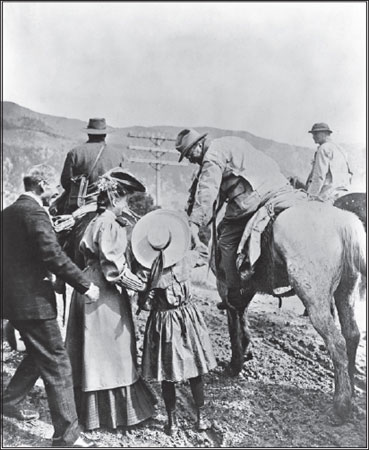
Roosevelt’s greatest White House accomplishment was encouraging young people to join the wildlife and forestry protection movements. Here, the cowboy conservationist reaches out to a Colorado girl.
T.R. inspired children to join the conservation movement. (Courtesy of Theodore Roosevelt Collection, Harvard College Library)