
CHAPTER TWENTY-FIVE
I
Old John Muir could barely believe the stunning news. On January 9, 1908, President Theodore Roosevelt issued an unexpected proclamation designating a wondrous 295-acre strand of coast redwoods (Sequoia sempervirens) as the Muir Woods National Monument in northern California.1 It was a magnificent tribute to the self-described “poetico-trampo-geologist.”2 Situated across the Golden Gate Bridge near Mill Valley in Marin County, Muir Woods was an ideal forest to honor the “sage of the Sierras.” The giant trees along Redwood Creek, each casting a hulking shadow on its way skyward, seemed a trenchant retort to the unchecked capitalism of the gilded age. Sunlight filtered down to create a living silence in the forest. This fine uncut coastal redwood strand had been donated to the federal government by William Kent, a wealthy disciple of Muir’s, originally from Chicago, who had purchased it in 1905 for $45,000.3 A businessman, philanthropist, and amateur naturalist (who would later be a congressman from California), Kent couldn’t stomach lumbermen clear-cutting the shoulder of Mount Tamalpais for a “few dirty dollars” and criminally depriving “millions of their birthright.”4
Muir Woods was really something special. Eternity was somehow present in the delicate greenery of the redwood foliage, and the thick fog of the Pacific dripped into the forest offering moisture year-round. In fall, ladybugs swarmed Redwood Creek, and the big-leaf maples turned yellow. During the winter months, steelhead and silver salmon migrated up the creek to spawn. Sweet berries ripened in the springtime meadows, interspersed with a dazzling display of purple and pink wildflowers. In the Bohemian and Cathedral groves, visitors could see sequoias more than 250 feet high and fourteen feet in diameter.* Many were 2,000 years old or more. Because the rather slender redwoods had little resin, they were insect-resistant. They had survived windthrows, wildfires, and the march of progress. And although the coastal redwood trees were always the main year-round attraction at Muir Woods, the site wouldn’t have been complete without its stands of Douglas fir, tanbark oak, and bay laurel. On the forest floor, mushrooms often emerged after the frequent rain showers and helped regenerate the soil. For bird-watchers, there were squawking Steller’s jays, melodic thrashers, cawing ravens, and the “zree-zee-zee” of the golden-crowned kinglet. Around every bend there were spontaneous bird sounds piercing the divine silence. It was poetically appropriate that this wonder of biological diversity in California bore Muir’s imprint—a perfect confluence of place and name.
Kent had stipulated that the forest be dedicated to Muir. Already in California, individual sequoias were named after great men: for example, General Grant in General Grant National Park and General Sherman in Sequoia National Park.5 Even burned, hollowed “goose pens” where early pioneers used to hide poultry often had individual names. Although Muir himself was deeply averse to the materialism and filthy lucre of his age, he nevertheless recognized that the national monument bearing his name was a gift only wealth could have bestowed. In California the words “John Muir” had become part of the land. Glaciers advanced and retreated, but Muir—and his woods—would last for the ages. “Saving these woods from the axe & saw, from money-changers & water-changers, & giving them to our country & the world is in many ways the most notable service to God & man I’ve heard of since my forest wanderings began,” Muir wrote to Kent with profound gratitude, “a much needed lesson and blessing to saint & sinner alike. That so fine divine a thing should have come out of money-mad Chicago! Wha wad a’thocht it! Immortal sequoia life to you.”6
Except for naming a large swath of the Catskills the John Burroughs National Monument, little could have made Roosevelt happier than the gift of these California redwoods—one of the greatest accumulations of biomass in the world. Of the original 2 million acres of coastal redwoods in America, more than 80 percent had been logged; the sawmills’ blades had to slow down. But Roosevelt’s satisfaction with Muir Woods was also tinged by envy. Thus far in his illustrious career his only namesake in nature was a rare species of Olympic elk. “I have just received from Secretary Garfield your very generous letter enclosing the gift of Redwood Canyon to the National Government to be kept as a perpetual park for the preservation of the giant redwoods therein and to be named the Muir National Monument,” Roosevelt wrote to Kent. “You have doubtless seen my proclamation of January 9th, instantly creating this monument. I thank you most heartily for this singularly generous and public-spirited action on your part. All Americans who prize the undamaged and especially those who realize the literally unique value of the groves of giant trees, must feel that you have conferred a great and lasting benefit upon the whole country. I have a very great admiration for John Muir; but after all, my dear sir, this is your gift. No other land than that which you give is included in this tract of nearly 300 acres and I should greatly like to name the monument the Kent Monument if you will permit it.”7
But Kent modestly declined the honor. He considered himself a mere instrument in the whole affair, and insisted that Muir’s name was a much worthier one for these woods. “I thank you from the bottom of my heart for your message of appreciation, and hope and believe it will strengthen me to go on in an attempt to save more of the precious and vanishing glories of nature for a people too slow of perception,” Kent replied to Roosevelt. “Your kind suggestion of a change of name is not one that I can accept. So many millions of better people have died forgotten, that to stencil one’s own name on a benefaction, seems to carry with it an implication of mandate immortality, as being something purchasable.” As for the Kent family name, he had “five good husky boys” to carry it forward. Should they fail to make something of themselves, Kent concluded, “I am willing it should be forgotten.”8
Attached to Kent’s letter were exquisite photographs of the gargantuan trees at Muir Woods, which led Roosevelt to reflect on his own legacy. His oldest son, Ted, was a few months away from graduating from Harvard University. Like many fathers, the president realized that his brood had suddenly grown up on him. Kermit—little Kermit—was now almost six feet tall. Roosevelt wondered if he’d been as good a father as his own, Theodore Sr., had been. Why hadn’t he taken his boys to see Crater Lake or Key West or Mesa Verde? “Apparently, I have saved up more last year than I ever have before,” Roosevelt wrote to Douglas Robinson the day after establishing Muir Woods, “and I am mighty glad of it, for next year Ted will go out into the big world, and from that time right along the little birds will hop off one after another out of the nest.”9 It saddened him to recall that he had left both Ted and Kermit at home during his sojourn of 1903 to Yellowstone, Yosemite, and the Grand Canyon. Roosevelt now resolved to bring his teenage boys along when he bivouacked in remote parts of Africa, Arizona, or the Amazon.
Except for the pursuit of wealth, one’s legacy is often the strongest motivator for powerful figures. Everybody supposedly had at least one memorable sermon in him, and Roosevelt’s was American conservationism. He had far exceeded any other individual in U.S. history in his efforts to preserve the natural wonders of the West. But he was also uncomfortably aware that his preservationist accomplishments were geographically scattered and isolated, and that his objectives were still hobbled by a slow-moving legislative process. Roosevelt needed a better weapon against congressional lethargy in matters of conservation, and he found it in federal bird reservations, big game commons, and national monuments (as set forth by the Antiquities Act of 1906).
Accustomed to pushing against limits, Roosevelt was determined to put the theoretical power of the “national monument” as a legislative maneuver to an audacious practical test. He wasn’t going to allow the size of a national monument to be a stumbling block with regard to the Grand Canyon. On January 11, 1908, just two days after the Muir Woods initiative, the president snatched the Grand Canyon from the preservation-versus-development debate by declaring it a national monument. His goal was straightforward: to save the Grand Canyon, unmarred. It was, by any measure, a bold step. Until then Roosevelt, with persistence, had put aside only monuments of limited acreage such as Devils Tower, El Morro, Montezuma Castle, the Petrified Forest, Chaco Canyon, Lassen Peak, Cinder Cone, and the Gila Cliff Dwellings. And Muir Woods had been a generous gift by Kent to the federal government; who could argue with such beneficence? But the Grand Canyon wasn’t a small site preserved for scientific interest, as stipulated by the Antiquities Act. This was 808,120 acres of mineral-rich land in Arizona, larger than some New England states. The poet Carl Sandburg wrote that “each man sees himself in the Grand Canyon.”10 This may be true, but only Roosevelt could claim, on a return visit to the canyon in 1913, that he was its presidential protector. “The importance of the canyon will likely outlive the parochial American idea of wilderness designation as world heritage site and mass tourism,” the historian Stephen J. Pyne surmised inHow the Canyon Became Grand. “A place that can hold a score of Yosemite Valleys and in which Niagara Falls would vanish behind a butte, that could absorb the shock of American expansionism and democratic politics, that could transcend a century of intellectual inquiry from Charles Darwin to Jacques Derrida, has not exhausted its capacity to refract whatever light nature or humanity casts toward it provided a suitable overlook exists from which to view it.”11
By 1908, Roosevelt’s characteristic impatience had made it difficult for him to abide by the old rules and wait for legislators to see the light. Most politicians of his day made backroom deals, but the supremely self-confident Roosevelt did most of his political maneuvering in full view of the public. He always welcomed scrutiny. He would just declare something and let the chips fall where they may. And if Congress and Arizonan lawyers were confused about the Grand Canyon’s irreplaceable aesthetic value, he would make them see it. If Congress was drowsy, Roosevelt was going to wake it up; if it was operating in the gutter, he was going to teach it to look at the stars. His job as president was to procure the most happiness for the most people. The Grand Canyon was a truth for all time, not to be denied to future generations—a holy spot.
So Roosevelt abandoned noisy ideas and went for a premeditated fait accompli in northern Arizona. Purposely oblivious of the legal obstacles, Roosevelt aimed to evict the Kaibab Cattle Company, for example, from the scenic and scientifically invaluable area. In the nineteenth century, explorers such as Robert Stanton, John Hance, and William W. Bass had promoted the Grand Canyon as a magnet for tourists. As tourism increased, the calls for its becoming a national park did too. But Congress was too scared to move, worried about the reaction from miners and ranchers who were against any alteration that would limit their access to public land.12 As the historian Hal Rothman noted in Preserving Different Pasts, designating the Grand Canyon as a national monument allowed Roosevelt to “circumvent the fundamentally languid nature of congressional deliberation and instantaneously achieve results he believed were in the public interest.”13 When the dust cleared, the Grand Canyon was a national monument. More important, Roosevelt had conclusively demonstrated the elasticity—and thus the power—of the Antiquities Act, the new favorite instrument of the conservation movement. As Rothman put it, “no piece of legislation” had ever before (or since) “invested more power in the presidency,” than the Antiquities Act. The elastic clause “objects of historic or scientific interest” made it “an unparalleled tool” for Rooseveltian conservationism.14
The Antiquities Act was to Roosevelt a contraption with which he could dictate land policy in the West, circumventing Congress. Nature may not have proceeded by leaps, but Theodore Roosevelt now did. Roosevelt claimed that those 800,000 acres of Arizona contained prehistoric ruins and hence had scientific value. True, there were ruins in the Grand Canyon, but only very meager ones. There was nothing to match Mesa Verde, Chaco Canyon, or Montezuma Castle. As for ethnographical research concerning the residents, the Havasupi were a dwindling tribe content with foraging around the Colorado River, as they had done since the arrival of Spanish Conquistadors. Yet Roosevelt wasn’t wrong when he claimed this vast part of Arizona had ruins and had Indians. If the ruins were “diminutive by regional standards,” they nevertheless provided a political pretext for Roosevelt to invoke the Antiquities Act and remove the area for special protection within the public domain.15 As ex-president, in A Book-Lover’s Holidays in the Open, Roosevelt declared all of Arizona and New Mexico an anthropologist’s dreamland.16
The apparent ease with which Roosevelt designated the Grand Canyon a national monument belied what a long slog it had actually been to save the site. Local opposition to such a huge national park at the Grand Canyon—particularly among corporate cattle, sheep, lumber, and mining outfits—was fierce. Communities surrounding the Grand Canyon, such as Flagstaff, Williams, and Peach Spring, saw the resource-rich proposed parklands as their own. The concept of a “monument,” they believed, was a shenanigan, which the courts would rule unconstitutional. Truth be told, their proprietary claims to parts of the canyon were not groundless. The federal government, after all, had encouraged these Arizona pioneers to displace the Hualapai and Havasupai, and to construct their own wagon roads and stagecoach lines. Over time, they had legally purchased grazing lands, mineral deposits, and spring holes. They had developed an interior network of trails at considerable cost. They had already constructed gateway villages along the approach to the Grand Canyon to welcome tourists. Now Roosevelt, disregarding the wishes of an adjourned Congress, was telling the pioneers to step aside for the Department of the Interior.
For those Arizonans displaced by the Antiquities Act, Roosevelt could muster little sympathy. He saw only their greed or simplicity, and he firmly believed that when archaic land claims from the mid-nineteenth century clashed with the moral imperatives of the progressive era, morality must win out. Beyond that, however, this was a struggle between personal profit and the public good. The country’s future depended on the outcome. So he took a stand. The resources of the Arizona Territory belonged not to local residents only, but to all Americans. Arizonans would have to shake off ignorance and accept that the Grand Canyon was a national treasure. His former Rough Riders who lived in the territory had already done so.
When Benjamin Harrison was a U.S. senator, after Reconstruction, he had introduced legislation in 1882, 1883, and 1886 to preserve the Grand Canyon as a “public park.” The bills had all perished in committee. When he became president, he used his new executive powers to create the Grand Canyon Forest Reserve. But Harrison’s legislation had allowed entrepreneurs to construct commercial monstrosities on the rim, and these had cheapened the canyon’s appeal. With hotels now appearing along the rims, and tourists arriving in unprecedented numbers by both road and rail, Roosevelt maintained no illusions that the Grand Canyon would remain completely “unmarred,” as he had called for in 1903. However, Roosevelt insisted that the north rim stay exactly as it had been when Spanish explorers first encountered it in the early sixteenth century. He believed that by repeatedly refusing to declare the Grand Canyon a national park, Congress had thrust the responsibility for protecting it on his shoulders. This time, he wouldn’t give Congress a chance to stop him. Somebody had to change the old land-use ways for the new progressive ethos. As Mark Twain once quipped, Roosevelt may have been a “spotless” character, but he was always ready to “kick the Constitution into the back yard.”17
Weighing the options presented to him by the Department of the Interior, Roosevelt decided to again implement the Antiquities Act of 1906, using it to confer national monument status on the Grand Canyon on January 11, 1908. In the following decades, Arizonan libertarians would claim (accurately) that the Antiquities Act had been intended only to preserve scientifically valuable sites of 5,000 acres or less, and that Roosevelt’s edict was an abuse of executive power. But regardless of the legality of Roosevelt’s maneuver, the Grand Canyon—the great American temple of nature—would never again return to private hands. From 1908 to 1918, even as the land-use status of the new national monument was hotly debated in both Arizona and Washington, D.C., the increasing tourist appeal of the Grand Canyon made its reprivatization politically unfeasible. The Grand Canyon finally became a national park by an act of Congress on February 26, 1919. The now legendary announcement came just a month after Roosevelt’s death. Furthermore, in 1975 President Gerald Ford passed the Grand Canyon Enlargement Act, placing the entire Colorado River corridor under the management of the National Park Service.18 In 1990, the area between Bright Angel Point and Cape Royal was renamed Roosevelt Point to honor the twenty-sixth president.19 And tourists come by the millions to experience what is now a World Heritage Site, just as Roosevelt predicted during his presidency. “To none of the sons of men,” Roosevelt wrote of his new national monument, “is it given to tell of the wonder and splendor of sunrise and sunset in the Grand Canyon of the Colorado.”20
Not that Roosevelt was anxious about how his preservation of the Grand Canyon would be evaluated in history books. Certitude was his greatest political strength. In fact, on the same afternoon that he declared the Grand Canyon a national monument, he began threatening to do the same with large parts of the Appalachian and White Mountains, an action certain to cause tremendous resistance by congressmen from Maine to Georgia. One notable exception was Governor Robert Glenn of North Carolina, who committed himself politically to Roosevelt’s conservationist crusade, hoping that the Great Smoky Mountains would emerge as a national monument.21 For his part, Roosevelt intended to take the Antiquities Act to its limit not just in the West, but everywhere in America. He envisioned the act as a federal hand with numberless fingers. It was obvious that his last fifteen months in office were going to be filled with conservationist action.
And as of January 11, 1908 (“Grand Canyon Day”), it was also clear that no parcel of wilderness—private, public, or other—was immune from potential seizure by the federal government. Roosevelt’s preservationist initiatives would be as simple as they were decisive. Orthodoxy was being shattered, and many more projects were in the works. With no worries about reelection in 1908, Roosevelt was ready to take on “the American goliath” (which he later defined as a vicious plutocracy, with morals of “glorified pawnbrokers,” that owned both political parties along with “ninety-nine percent at the very least of the corporate wealth of the country, and therefore the great majority of the newspapers”).22
II
Roosevelt, in fact, wasted little time in pressing the Antiquities Act into service yet again in California in early 1908. Stanford University’s president, David Starr Jordan, had previously written to Roosevelt about the Pinnacles, a fantastic landscape of jutting rocks and volcanic formations near Soledad, California. The spires and crags of the Pinnacles were awe-inspiring. Jordan was a leading eugenicist and ichthyologist, whose Guide to the Study of Fishes sat prominently on one of Roosevelt’s bookshelves at Sagamore Hill. The inspiration for this book had been Robert B. Roosevelt. No fewer than 1,000 genera and 2,500 species of American fish were named after Jordan. A founding member of the Sierra Club, he was a devotee of Darwin and Huxley’s biology, and he developed his own laws of biogeography. Fascinated by the adaptability of species, in 1907 Jordan had cowritten Evolution and Animal Life, which President Roosevelt found illuminating.23 If Jordan—an expert on organic Evolution—believed that the Pinnacles were worth saving, then Roosevelt needed no other authority. He could now wave his wand—the Antiquities Act—and immediately guarantee federal protection to whatever Jordan wanted.
On January 16, 1908, Roosevelt turned these 2,500 acres of grandeur into Pinnacles National Monument, on Jordan’s recommendation. (By 2009 the site had been expanded to more than 26,000 acres.) Only superlatives can describe the Pinnacles ecosystem. Oddly, the Pinnacles had more types of bees—400 species—than anywhere else known to entomologists. There were also 149 species of birds, forty-nine of mammals, twenty-two of reptiles, eight of amphibians, sixty-nine of butterflies, and forty of dragonflies and damselflies. And there were also precipitous bluffs, talus caves, crags of volcanic rock, and little canyon hideaways where the lizards seemed almost as ancient as the brontosaurus. The clincher, to Roosevelt, was that The Condor (a periodical) reported California condors using the Pinnacles as a primary roosting site. And the red rock formations, courtesy of an extinct volcano, were more than 23 million years old. If that didn’t constitute antiquities, what did? As Jordan boasted, the Coast Range chaparral (the finest examples in the national park system) and the riparian, xeric, and foothill woodlands were ideal for getting away from the cityscapes of San Diego, Los Angeles, and San Francisco. One of the prettiest sites in the natural world was in the Pinnacles: the acmon blue butterflies, in spring, congregating on coyote brush flowers. And saving all this was as easy as signing a declaration!
Holed up in the White House because of snowstorms and freezing weather, Roosevelt began methodically marking on a map of the United States sites he wanted preserved by the federal government before he left office on March 3, 1909. His desks at the White House and at Sagamore Hill were crossroads for plans to rehabilitate species. From a political standpoint, the Antiquities Act was a revelation, freeing the Department of the Interior from having to squabble with Congress. Much like federal bird reservations for the USDA, national monuments soon became an idée fixe at Interior. Even more significantly, bureaucrats and politicians alike were beginning to see national monuments as a way station to national park status. And even Pinchot, chief of the Forest Service, wanted his reserves studied for Indian artifacts. “The importance of taking steps to preserve such objects has become very apparent,” Pinchot wrote to his on-site employees, “and as soon as possible I wish you to report specifically upon each ruin or natural object of curiosity in your reserve, recommending for permanent reservation all that will continue to contribute to popular, historic, or scientific interest.”24
Roosevelt was temperamentally well suited to conflict and acrimony, and his presidency had already had more than its share of both. By February 1908, he had made an impressive number of political and corporate enemies, including Standard Oil Company, the Louisville and Nashville Railroad, the E. H. Harriman conglomerate, and J. P. Morgan, among many others. But as the biographer Ron Chernow wrote in Titan: The Life of John D. Rockefeller, Sr., Roosevelt had “no more potent ally than the press,” in his corner.25 And the clashes of Roosevelt versus the titans made good copy. The corporations of the gilded age spent millions of dollars on advertising, trying to smear Roosevelt’s reputation, cripple him politically, and exhaust him personally. They had failed on every count. Each swipe had the reverse effect—bolstering Roosevelt’s obstinacy. He licked them at their own game. Although he had never been solicitous of the opinions of his political antagonists, by February 1908 Roosevelt had lost all patience for anti-forestry. He now saw his enemies as Dickensian villains, full of “bosh and twaddle and vulgarity and untruth.”26
America’s corporate leaders (and their army of bosom chums) were not the only unfortunates on the receiving end of Roosevelt’s wrath. When he had established Wind Cave National Park in 1902, a clamor had arisen for him to do the same with Jewel Cave, 143 miles of unmapped underground passageways in the Black Hills just west of Custer. Even though it was the second largest cave in the world, this labyrinth hadn’t been discovered until 1900, when a couple of small-time prospectors, the brothers Frank and Albert Michaud, had felt a blast of chilly air emanating from a rock crevice in Hell Canyon one warm summer afternoon. It was a good place to protect the carcasses of slaughtered cattle from rotting in the heat. But just maybe there was gold beneath where they stood!
Excited by their find, the Michauds purchased dynamite in Rapid City, South Dakota, blasted a big opening, and then crawled into a cavernous room aglow with calcite crystal. Much to their chagrin, there was no gold to be found. But there were numerous caverns filled with stunning, gemlike calcite crystals, which caught the light from their lanterns and returned it in varied patterns and colors. The brothers rushed to procure a mining claim for Jewel Tunnel Lode, as they named the site, and began advertising it as a tourist attraction. They even used the caves to hold a number of dances for local couples—the crystalline walls were a natural forerunner of the disco ball. A few geologists who studied the site determined that the passageways were part of an extinct geyser channel.* 27
The Roosevelt administration soon got involved, using the almost unlimited power of the executive branch to establish national monuments for the permanent preservation of places deemed to have historic and scientific interest. Certainly Jewel Cave met this criterion. In 1907, he authorized Harry Neel and C. W. Fitzgerald to survey Jewel Cave. Roosevelt imagined the underground site to be part of a larger preservation initiative in the Deadwood and Rapid City area, which would include the Badlands, Devils Tower, Wind Cave, and the Black Hills National Forest. Neel and Fitzgerald’s report recommended that Jewel Cave be declared a national monument—despite the mining claim of the Michaud brothers.28 Like Wind Cave, this new find was situated in the Pahasapa limestone rock layer of the Black Hills, and the federal government wanted to study its geological history.29
When Roosevelt established Jewel Cave National Monument on February 7, 1908—his thirteenth designation thus far under the Antiquities Act—he knew there could potentially be decades of legal problems.30 But Roosevelt was apparently untroubled by the possible consequences. There was no restraining him. As far as he was concerned, the 1,280-acre Jewel Cave Monument was a national treasure. If only the Michauds weren’t such self-interested money-grubbers, they would have understood that such a unique natural wonder belonged to all Americans. Furthermore, the Michauds had to stop making additional openings to Jewel Cave, because they were desecrating the site. This was tough medicine for a couple of presumably lucky prospectors, who thought they had stumbled on a fortune. But as Roosevelt saw it, if soldiers gave their lives for the democracy, surely land could be deeded to the federal government for the sake of science. With federal lawyers breathing down their necks, the Michaud brothers sold their claim to the U.S. government for $500.31
To Roosevelt’s way of thinking, the notion that a little knot of men in the Black Hills saw Jewel Cave as a source of profit was depressing to contemplate. The labyrinth of chambers and tunnels belonged to the U.S. government: end of story. Conservation was, above all else, a moral issue to Roosevelt—a cause he believed he shared most intimately with men like John Muir and Seth Bullock, who were uninfected by the greed of New York and Chicago. By contrast, the South Dakota miners seemed to Roosevelt rather like lowly English sparrows—deemed a pestilential invasive species by the Biological Survey and thus deserving neither understanding nor accommodation.32 Well, if sparrows they were, then the president would deal with the Michauds, and all those like them, in his typically expedient fashion. “Is there any kind of air gun which you would recommend which I could use for killing English sparrows around my Long Island place?” Roosevelt wrote to Dr. C. Hart Merriam. “I would like to do as little damage as possible to our [other] birds, and so I suppose the less noise I make the better.” 33
Ridding Sagamore Hill of English sparrows wasn’t the only hunting Roosevelt had in mind that spring. While last-minute legal maneuvering was taking place in the Department of the Interior to establish Natural Bridges in Utah and Wheeler in Colorado as national monuments, Roosevelt began planning a post-presidential safari to British East Africa. His romantic notion was that he would leave civilization in favor of the roar of the lion and the pleasant odor of buffalo. Roosevelt was going to invite two celebrated trophy hunters whom he highly admired—R. J. Cunninghame and Frederick Courtney Selous (both of whom collected big game specimens for the British Museum)—to join him. Selous would later dedicate his African Nature: Notes and Reminiscences(1908) to Roosevelt. Roosevelt also struck up a lively correspondence with the British hunter-explorer Lieutenant Colonel John Henry Patterson, about possibly seeing the great African fauna and flora, rhinoceros, gnu, water buffalo, and giant eland. Roosevelt actually looked forward, he wrote, to being served up as “food for ticks, horseflies, and jiggers.”34
A veteran of the Boer War, the well-bred Patterson had written an adventure saga, The Man-Eaters of Tsavo, in 1907. (Decades later, it was made into two Hollywood movies.) With narrative verve and vividness, Patterson’s book told of his quest to track down and kill two male lions that had eaten approximately 140 railroad workers over the course of nine months in the Tsavo province of Kenya. During the 1890s, rinderpest (a bovine disease) had killed millions of buffalo, zebras, and gazelles, the primary food source for lions. Their food supply thus limited, the starving maneless lions turned to humans as prey. Inspired by Patterson’s action-filled prose, particularly his references to weapons like the Martin-Enfield double-barreled rifle and the .303 Lee Enfield, Roosevelt now wanted a lion head for his library wall at Oyster Bay. (Roosevelt, in fact, worked behind the scenes to eventually help the Field Museum of Chicago acquire the stuffed Tsavo lions and put them on permanent display.35) “A year hence I shall leave the Presidency, and, while I cannot now decide what I shall do, it is possible that I might be able to make a trip to Africa,” Roosevelt wrote to Patterson on March 20. “Would you be willing to give me some advice about it? I shall be fifty years old, and for ten years I have led a busy, sedentary life, and so it is unnecessary to say that I shall be in no trim for the hardest kind of explorer’s work. But I am fairly healthy, and willing to work in order to get into a game country where I could do some shooting. I should suppose I could be absent a year on the trip.”36
While Roosevelt hastened to assure Patterson that he wasn’t a “butcher,” he nevertheless hoped to acquire a multitude of specimens for American museums, entering Africa in the Mozambican port of Mombasa and boating down the Nile with shotgun in hand. Roosevelt arrived in Mombasa in April 1909, and departed for home from Khartoum in March 1910. This was no bear hunt in Mississippi and no holiday in Louisiana’s canebrakes. He would be away from the United States for over a year. That letter of March 20, in fact, started an epistolary exchange between the two men that would continue throughout 1908. The president interrogated Patterson repeatedly about the prospects of bagging specimens of zebras, giraffes, and cheetahs. As the tenor of his letters made clear, he could hardly wait to be armed to the teeth and free from the shackles of the White House. The Smithsonian Institution had been eager to officially sponsor Roosevelt and his party in obtaining all types of specimens, from the diminutive Kenia dormouse to the colossal white rhinoceros, for its collection. With a retinue of hundreds, Roosevelt would fulfill a lifelong dream of visiting Kenya and Uganda in the heart of British East African safari land.*
There was nothing odd about Roosevelt’s desire to hunt big game in Africa. Only the Boone and Crockett club’s taxidermist, Carl Akeley, who had constructed the world’s first habitat diorama in 1890 at the Milwaukee Public Museum, had begun to biologically inventory the wildlife along the Nile River with seriousness of purpose. Working out of the Field Museum in Chicago, Akeley had developed a new technique for taxidermy, which did a better and truer job of preserving texture and musculature. Roosevelt truly admired the way Akeley displayed wild-life in a group setting. The gorilla and the elephant were his specialties. Roosevelt thought Akeley could make a very distinctive contribution to the annals of scientific exploration by collecting with him in Africa. Roosevelt and Akeley would risk their lives for the right gorilla. Poets called nature a mother, but Roosevelt knew it was also a grave. Regardless of his worries about exertion by a middle-aged man in the heat, and about sleeping sickness (the primary concern), with proper funding Roosevelt believed he could revolutionize the African exhibits at all of America’s top museums.
It was strange, though, that he was planning to disappear from the American political scene for virtually a full year. In considering Roosevelt’s maverick conservationist agenda of 1908–1909, it is important to remember that the president didn’t foresee a future political career. Having already won a Nobel Peace Prize for diplomacy, Roosevelt increasingly envisioned his postpresidential role in part as being a global spokesperson for big game animals, wildlife protection, and natural resources conservation. Didn’t South Africa need antelope preserves? Shouldn’t India find ways to protect its tigers? Couldn’t China develop its own fish hatcheries? This had always been Roosevelt’s hope for the Boone and Crockett Club—that it would go global with its preservationist and conservationist message and ideas. Akeley, a new club member, actively promoted this global approach. And Roosevelt was about to write his first non-American centric book, even though the content was about an American naturalist expedition traveling in the so-called dark continent. “I speak of Africa and golden joys,” Roosevelt later wrote in African Game Trails. “The joy of wandering through lonely lands; the joy of hunting the mighty and terrible lords of the wilderness, the cunning, the wary, and the grim.”37
III
The success of Mesa Verde National Park in 1906 had gotten Roosevelt extremely interested in the Four Corners states and territories: Colorado, Utah, Arizona, and New Mexico. Guided by Congressman Lacey, Roosevelt had read about Montezuma Castle, El Morro, and other prehistoric ruins of the Southwest. And at some point Roosevelt also read an article in National Geographic magazine titled “The Colossal Natural Bridges of Utah,” which had piqued his curiosity.38 Pinchot’s U.S. Forest Service—at the time, a branch of the USDA—was in charge of Utah’s two national forests, Sevier and Manti. And Utah also had many more spectacular wonders. Word had reached the White House that southeastern Utah had the largest number of natural bridges in the world. The novelist Edward Abbey later wrote rapturously about the three bridges, which retained their original Hopi names. The first, Kachina, meant “spirits that had lightning snake symbols on their bodies” the second, Uwachomo, signified “flat rock mound” the third, Sipapu, meant “place of emergencies.” The bridges, the largest of which was 222 feet high, had been formed by streambed erosion (unlike many other arch formations in Utah, which were created by wind, rain, and ice). Surrounded by piñon forest, Anasazi ruins, and a gorgeous slickrock canyon, Natural Bridges met every criterion for national monument status.39
Priding himself on knowing everything about the West, Roosevelt started reading every book he could find on Hopi and Navajo culture, and later contributed an essay about the southwestern tribes of the Four Corners region in his A Book-Lover’s Holidays in the Open (1916).40 Ultimately Roosevelt was taking a tricky line: preserving Hopi-Navajo culture in the southwest while also encouraging soldiers, agents, missionaries, and traders to Americanize these peoples. Roosevelt never hesitated to promote the education of Native Americans, and he seemed unaware of the humiliation being inflicted on tribes by the imposition of the Bible and reservation life. “The Indian should be encouraged to build a better house,” Roosevelt wrote of this policy, “but the house must not be too different from his present dwelling, or he will, as a rule, neither build it nor live in it.” 41
On April 16, 1908, Roosevelt signed into existence Natural Bridges National Monument, his first such designation in Utah. These three natural sandstone bridges, spanning a desert canyon and isolated from any town or hamlet, met Roosevelt’s scientific qualifications for monument status because they were “extraordinary examples of stream erosion.” 42 Over the decades, Natural Bridges National Monument became a popular hiking and camping destination, especially for families. Together with National Geographic, Roosevelt helped launch the movement to save Utah’s splendid canyons from private development.
Certainly, Roosevelt’s heavy-handed federalism angered people besides corporate bigwigs and disgruntled ranchers. Many westerners had long felt that businessmen on the east coast had treated the West like a colony, extracting wealth and resources without giving anything back. They were tired of the east coast stuffed shirts telling them what to do. As the episodes involving the Grand Canyon National Monument showed, they could also turn their blistering ire on the federal government. But as the historian G. Michael McCarthy argued in Hour of Trial: The Conservative Conflict in Colorado and the West, 1891–1907 (1977), there were plenty of westerners who approved of federal regulation of resources. At a public lands convention in Denver in 1907, for example, many of the attendees favored the Roosevelt administration’s deployment of rangers to protect national forests from wildfire throughout Colorado. They understood that Colorado was special because of its mountains, forests, and water resources.43
The president of the American Scenic and Historic Preservation Society, Dr. George F. Kunz, also backed Roosevelt’s national monument initiatives every step of the way. Kunz and Roosevelt had been allies since the battle of 1899–1901 to preserve the Palisades cliffs in New York, and Roosevelt thought that Kunz was among the most cogent voices for protection of American scenery. One might almost name an American site at random—from Yellowstone to the Catskills, from Watkins Glen to Bunker Hill—and find that Kunz had fought hard for its scenic integrity. Scholarly, clear-minded, and committed to the cause, Kunz considered all significant ruins as part of the cultural heritage. He had been offended by Oscar Wilde’s offhand comment that the United States “had no ruins.” Whether Wilde had spoken out of ignorance, arrogance, or flippancy, Kunz knew better. The United States had Mesa Verde, Montezuma Castle, Chaco Canyon, the Gila Cliff Dwellings, and numerous other “ruins.” But Wilde was right in one respect: most Americans did not value their ruins as Europeans did. Rome, for example, celebrated its ancient ruins, such as the Colosseum, whereas by contrast, it had taken a small group of Colorado women, fighting tooth and nail, to protect the stunning cliff dwellings of Mesa Verde—and their battle had taken place largely unnoticed by America’s newspapers.
According to Kunz, there were hundreds of antiquities sites, both natural and architectural, that needed preservation—places filled with arrowheads and pottery shards whose designation as monuments wouldn’t disrupt commerce in the slightest. Grateful to Roosevelt for raising the nation’s consciousness on this issue, Kunz became his strongest public defender, countering criticisms of the president’s conservationist and preservationist agenda. “Niagara Falls, Letchworth Park, the Hudson River, the Yellowstone Park, the Grand Canyon and the Colorado, the Agatized Trees, the Giant Redwoods, the Columbia River, and the prehistoric remains of the Southwest, are the poetry of our possessions,” Kunz wrote. “What nation is rich without a poet, and what country has such grand natural objects to inspire the poet as ours?”44
Roosevelt and Kunz were deeply suspicious of anyone foolish enough to register any kind of concern about the creation of national monuments like Pinnacles or Natural Bridges. Legal and constitutional objections, Roosevelt was convinced, gave false legitimacy to a much baser desire: protecting entrenched interests. “The very luxurious, grossly material life of the average multimillionaire whom I know, does not appeal to me in the least, and nothing would hire me to lead it,” Roosevelt wrote to Cecil Arthur Spring-Rice on April 11. “It is an exceedingly nice thing, if you are young, to have one or two good jumping horses and to be able to occasionally hunt—although Heaven forfend that anyone for whom I care should treat riding to hounds as the serious business of life! It is an exceedingly nice thing to have a good house and to be able to purchase good books and good pictures, and especially to have that house isolated from others. But I wholly fail to see where any real enjoyment comes from a dozen automobiles, a couple of hundred horses, and a good many different houses luxuriously upholstered. From the standpoint of real pleasure I should selfishly prefer my old-time ranch on the Little Missouri to anything in Newport.” 45
Medora, North Dakota, wasn’t a village to Roosevelt anymore, but an entire world unto itself, a time and place of magic. Memory is selective, and Roosevelt’s seemed to fasten on the pleasant shade, tranquil skies, and meadowlarks of summer, and to excise the long, cold Dakota winters. In fact, Roosevelt was arguably as proud of his exploits at Elkhorn Ranch as he was of any other chapter in his biography. After killing a buffalo in Montana, he had rushed home to New York City to cofound the Boone and Crockett Club along with his friend George Bird Grinnell. According to Forest and Stream, that was the opening salvo of the conservation movement. Now, in mid-May of 1908, President Roosevelt was scheduled to hold a summit at the White House on conservationism, with most of America’s governors present (a few states, including Texas, sent their lieutenant governors instead). To clear his mind of clutter, and prepare himself for the challenging conference ahead, Roosevelt, together with Edith, escaped to Pine Knot. Usually, at this retreat, Roosevelt liked to live strictly by himself with Edith. But now the Roosevelts’ houseguest—the only nonrelative ever invited to sleep at the cabin in Albemarle County—was Oom John. It had been a last-minute invitation, and Burroughs had accepted.
At Pine Knot both Roosevelt and Burroughs enjoyed the first appearance of new organisms springing up from the old Virginian earth. Soon the cicadas would descend on the trees and the lightning bugs would take to the air. The land was clothed in new plants and wildflowers. Earthworms were plowing the soil, and the naturalists admired these lowly creatures with new eyes. But it was bird-watching that most pleasantly consumed their energy at Pine Knot. Owing to the spring migration, the two companions were able to identify seventy-five species.46 Always wearing a scrunchy suit, Burroughs was quicker to spot the birds; the more casually attired Roosevelt was better at identifying them by their twitters.47 The president was hoping to show Oom John a passenger pigeon, but that sighting never occurred. They did see a swamp sparrow, and rare warblers only four and a half inches long. Some of the warblers had migrated more than 3,000 miles from Canada to wintering spots in South America, and they were resting in Virginia for a few days on their return. Likewise, some of the blackpolls Roosevelt and Burroughs saw had just made a nonstop flight of 2,300 miles over water, perhaps from Venezuela or Cuba. “It was really remarkable,” Burroughs later recalled, “how well [Roosevelt] knows the birds and their notes.”48
What a fine time the two naturalists had, poking around the countryside, marveling at migratory birds whose flight was directed, often, by the magnetic field of the earth. Oom John came to appreciate Roosevelt’s fair-mindedness and skill as a raconteur even more than he did during their Yellowstone trip of 1903 or their wanderings in the Catskills or their jaunts on Long Island. “The President is a born nature-lover, and he has what does not always go with that passion—remarkable powers of observation,” Burroughs wrote in Camping and Tramping with Roosevelt. “He sees quickly and surely, not less so with the corporeal eye than with the mental. His exceptional vitality, his awareness all around, gives the clue to his power of seeing. The chief qualification of a born observer is an alert, sensitive, objective type of mind, and this Roosevelt has to the preeminent degree.”49
But Roosevelt’s penchant for turning everything into a competition grated on Burroughs, who was proud of his humility—proud that he didn’t boast. Roosevelt’s ego, by contrast, would have made Napoleon flinch. As if engaged in a footrace, Roosevelt challenged Oom John over who would see the most species of sparrow or woodpecker, or who would first spot an eastern bluebird. Talking incessantly, Roosevelt would quote poetry by Longfellow and Tennyson, and evince surprise after forcing Burroughs to admit that he hadn’t memorized the precise verses. Too much time spent in the company of Roosevelt, Burroughs decided, could try the patience of the Old Testament’s Job. “I rather shrank from him,” Burroughs admitted later, “…his dominating qualities, his strenuousness—his mood always antipathetic to my own.”50
Shockingly, to Burroughs, Pine Knot was genuinely rustic. It had no amenities aside from an old woodstove. His own Slabsides was regal by comparison. The “barn-like structure” of Pine Knot made it too primitive for a gentleman to sleep in.51 Oom John looked around and let out a great sigh. If Burroughs had had his former energy and confidence, a local inn in Charlottesville would have been hurriedly found. But as it was, bizarrely, Roosevelt had two northern Virginia flying squirrels (Glaucomys sabrinus fuscus) living indoors, and Burroughs remained unable to sleep because of the racket these nocturnal critters made (they were active at night because their large eyes allowed them to see in extremely low light). Roosevelt, however, seemed to genuinely enjoy their midnight madness, tossing them nuts the way he threw nuts to the scampering grays on the White House lawn. Delightedly Roosevelt watched the squirrels glide from the rafters to the bed and from the bed to the floor, like trapeze artists. As an evolutionist, he was intrigued by their membrane, called a patagium, which allowed them to glide as far as 240 feet through the air. Roosevelt erupted in disapproval when Burroughs gingerly moved the flying squirrels’ nest outside the cabin, and a quarrel ensued—those were Roosevelt’s indoor flying squirrels! How dare he! Eventually, Roosevelt compromised by placing the nest in his own bedroom, minimizing Burroughs’s interaction with the squirrels.52 Still, the high-pitched chirps continued to annoy Burroughs; even holding a pillow over his ears didn’t work. At one juncture Roosevelt himself was bitten by one of the squirrels; blood trickled down his hand from a real puncture wound. What shocked Burroughs was that Roosevelt seemed to admire the squirrels even more for this hostile act.53
“Mr. Burroughs, whom I call Oom John, was with us and we greatly enjoyed having him,” Roosevelt wrote to his son Archie. “But one night he fell into great disgrace! The flying squirrels that were there last Christmas had raised a brood, having built a large nest inside of the room in which you used to sleep and in which John Burroughs slept. Of course they held high carnival at night-time. Mother and I do not mind them at all, and indeed rather like to hear them scrambling about, and then as a sequel to a sudden frantic fight between two of them, hearing or seeing one little fellow come plump down to the floor and scuttle off again to the wall. But one night they waked up John Burroughs and he spent a misguided hour hunting for the nest, and when he found it took it down and caught two of the young squirrels and put them in a basket. The next day under Mother’s direction I took them out, getting my fingers somewhat bitten in the process, and loosed them in our room, where he had previously put back the nest. I do not think John Burroughs profited by his misconduct, because the squirrels were more active than ever that night both in his room and ours, the disturbance in their family affairs having evidently made them restless!”54
IV
On May 11, 1908, two days before the participants were to arrive in Washington for the governors’ conference, Roosevelt arrived there from Pine Knot, with Burroughs at his side. Deciding to do something to honor the founders of western naturalist studies in America—Meriwether Lewis and William Clark—Roosevelt signed into being the first national monument in Montana. If John Muir could have a monument named after him in Marin County, then surely one should be dedicated to the great explorers of the Jeffersonian era in Jefferson County, Montana. Roosevelt had a deep-seated memory of reading Lewis and Clark’s diaries as a boy, and he recalled thinking that their 4,134-mile journey up the Missouri River and onward to Oregon was a more stirring epic than Gilgamesh. They had hunted in the prairies, wintered with the Mandan in North Dakota, traversed the Rockies, and navigated the length of the Columbia River to marvel at the Pacific Ocean. To Roosevelt, it was important to memorialize them with a natural site. He settled on a 600-foot-long and 400-foot-deep series of caverns in Montana.
The Lewis and Clark National Monument, which overlooked the Lewis and Clark Trail along the Jefferson River, was Roosevelt’s salute to an earlier age of American exploration. Aside from setting aside a unique cavern, Roosevelt took distinct pleasure in reintroducing the two great American explorers to popular consciousness.
On May 13, Roosevelt brought the Conference of Governors at the White House to order. As he had promised in Memphis during his inspection tour of the Mississippi River, nearly every governor summoned (from both states and territories) attended the conference.55 Roosevelt had asked each governor to bring along with him three competent advisers on natural resource management.56 The nine justices of the U.S. Supreme Court were also in attendance—something unprecedented for a blue-ribbon commission. In addition to the politicians and judges, Roosevelt had invited scores of biologists, geologists, ornithologists, and advocates of forestry science to offer their informed input. “Any right thinking father earnestly desires and strives to leave his son both an untarnished name and a reasonable equipment for the struggle of life,” Roosevelt had said, as a rationale for the conference. “So this Nation as a whole should earnestly desire and strive to leave to the next generation the National honor unstained and the National resources unexhausted.”57
When Roosevelt took to the podium in the East Wing on the morning of May 13 for the opening session of the conference of governors, there was a palpable sense of unity among the attendees. The White House had given a multiple-course dinner party the previous evening, so the governors and the other dignitaries were in a fine mood. According to Plutarch’s Lives, Alexander was once asked if he craved any service and snapped in reply, “Stand a little out of my sun.” That’s how it was for Roosevelt that afternoon. Starting with Genesis, Roosevelt went on to relate how civilization began on the banks of the Nile and Euphrates. Organic evolution was always on the march. Leaping over millennia, be swung his oration quickly to the founders of America at Independence Hall in Philadelphia in 1776. Then, the natural resources of the young country, ranging from anthracite coal to vast timberlands to streams full of fish, had seemed limitless. But owing to unwise land management, America was losing its gifts. Utilization of mineral fuels and metals had transformed America into a steel empire, but overmining was turning the nation’s wilderness into an eyesore. “The mere increase in our consumption of coal during 1907 over 1906,” Roosevelt warned, “exceeded the total consumption in 1876, the Centennial Year.”
Roosevelt’s speech was a kaleidoscope of times and places: here were Kentuckians felling forests and Mississippians watching as their riverine modifications washed the delta away. It was a quasi-public lecture on causes and effects of land misuse. He included many doomsday predictions about the depletion of natural resources (Jimmy Carter’s famous “malaise” speech of 1978 seems cheery by comparison). Here were new and frightening concepts: timber famine, choked rivers, denuded fields, obstructed navigation, exhausted oil fields. But Roosevelt also wanted to introduce phrases like “sustainable growth,” “renewable resources,” and “a future undiminished for our children” into the vocabulary of the twentieth century. “We have become great in a material sense because of the lavish use of our resources, and we have just reason to be proud of our growth,” Roosevelt said. “But the time has come to inquire seriously what will happen when our forests are gone, when the coal, the iron, the oil, and the gas are exhausted, when the soils shall have been still further impoverished and washed into the streams, polluting the rivers.” To Roosevelt, these questions didn’t relate only to the next century or his grandchildren’s generation. “One distinguishing characteristic of really civilized men is foresight,” Roosevelt said. “We have to, as a nation, exercise foresight for this nation in the future; and if we do not exercise that foresight, dark will be the future.”58
Reading the Proceedings of the Conference of Governors is quite telling, in a number of ways. Andrew Carnegie spun out dozens of statistics about iron ore and copper production, and he ended his address with praise for President Roosevelt’s Reclamation Service but not a peep about national monuments or forests. Geologists offered charts of riches still in the ground. The new governor of California, George C. Pardee, spoke about clear-cutting redwood forests so as to export timber, not of saving stands like those preserved in Muir Woods and Mariposa Grove. Governor Charles E. Hughes of New York praised Roosevelt for his work in Albany in 1900 to preserve the Adirondacks, and Governor James O. Davidson of Wisconsin bragged about the pine, hemlock, oak, and maple of the Dells, even though the Dells had been brutalized by overcommercialization. But these were oratorical exceptions to the norm. Most of the presentations at the governors’ conference came from technocrats who were terrified by the prospect of America’s vanishing natural resources.
There were some eruptions of anti-Roosevelt sentiment during the conference. Examples, in fact, were plentiful. Although Governor Edwin C. Norris of Montana effectively used humor to attenuate the sharpness of his speech, he strongly objected to federal land grabs for national monuments and forests. Montana needed Reclamation Service projects, but not the Lewis and Clark National Monument—absolutely not! Grumbling that he was tired of misinformed easterners claiming that Montana was nothing but “chill icebergs, cold weather, and blizzards,” Norris launched into a measured denunciation of the Forest Service. To begin with, he knew that some reserves were necessary for the watershed. But why was Montana, more than any other state, bearing the brunt of federal land seizures? Why were New Yorkers and Yalies so willing to declare acreage in Montana federal property—21 million acres, in fact—while holding back their own tree parks in places like the Berkshires, Adirondacks, and White Mountains? Norris supplied his own answer: President Roosevelt was treating Montana as little more than a protectorate because Montanans had little recourse on the federal level. “I would suggest, Mr. Secretary of the Interior, that there be no more [forest reserves]”, Governor Norris concluded with quiet indignation. “We have sufficient.”59
Everybody who attended the conference, including Norris, ended up with wonderful stories to tell. Although Muir was worried that Pinchot would try to own the resource management movement, he had no quarrel with Roosevelt’s developing a national dialogue on conservation. Roosevelt himself was clearly in his element at the conference, using his characteristic political shrewdness to mentally assess the men surrounding him. The president cut a stylish figure in a tailor-made suit and hat, looking as elegant as the best man at a wedding. In his memoir, Fighting the Insects, the entomologist L. O. Howard, known as Roosevelt’s “exterminator” at the USDA, recalled with a mixture of fondness and amazement the personal welcome he received from the president at the conference. “I found myself in line immediately behind Dr. C. Hart Merriam, the animal and bird man,” Howard recalled. “Immediately in front of him was William J. Bryan. As we reached the President, Mr. Bryan, in a pompous and somewhat condescending way (at least it seemed so to me), said ‘Mr. President, I congratulate you, sir, on having started this conservation movement, which, in my opinion, has tremendous possibilities of good for the future of the country. I assure you, sir, that it meets my entire approval and will receive my hearty support.’”
According to Howard, the president, with a fiercely playful gleam in his eyes, barely acknowledged Bryan’s smug compliment. Instead, he looked over Bryan’s shoulder and waved to Merriam. “I am pleased,” Roosevelt muttered to Bryan perfunctorily, and then quickly pivoted toward Merriam, as if dismissing the Democratic Party’s contender to succeed him in 1908. “How are you, Hart?” Roosevelt greeted Merriam with pointed warmth. “What do you suppose John [Burroughs] and I saw on the twenty-fifth of March at Pine Knot? A yellow warbler, by George!” Roosevelt then turned to Howard. “Hello, Doctor!” the president said, “How are the bugs?”60 As Roosevelt moved off into the crowd, away from Bryan, Howard looked back to see Bryan, still rooted in place, realizing that the president had just gotten the better of him. Howard’s anecdote revealed two things about Roosevelt: his allegiance to the naturalist community and his contempt of Bryan.
To the president, increased interstate cooperation on behalf of conservationism was a stark necessity. If, for example, Missourians dumped sewage in the Mississippi River, then it would travel downstream, adversely affecting citizens in Tennessee, Arkansas, and Louisiana. Garbage didn’t respect state lines. Likewise, it would do no good to save some white pelicans at Stump Lake, North Dakota, only to let them be slaughtered while they were roosting in Charlotte Harbor, Florida. Migration made state game laws pointless. “One of the most useful among the many useful recommendations in the admirable Declaration of the Governors relates to the creation of state commissions on the conservation of resources to cooperate with a federal commission,” Roosevelt wrote to one friend. “This action of the Governors cannot be disregarded. It is obviously the duty of the Federal Government to accept this invitation to cooperate with the states in order to conserve the natural resources of our whole country.”61
A cloth-bound three-volume report of the National Conservation Commission would be made available to the public in January 1909. As an accommodating gesture, Congress would receive an advance copy in December. Roosevelt believed that the publication of the findings would be a historical landmark of his administration, and a turning point in conservation history (though in truth it never acquired any true cogency). He glowed in the aftermath of the conference. “The grounds are too lovely for anything, and spring is here, or rather early summer, in full force,” Roosevelt wrote to his son Archie on May 17. “Mother’s flower-gardens are now as beautiful as possible, and the iron railings of the fences south of them are covered with clematis and roses in bloom. The trees are in full foliage and the grass brilliant green, and my friends, the warblers, are trooping to the north in full force.”62
When Roosevelt was at Pine Knot with Burroughs, he had reported to Chapman that their trip was a feast of bird-watching worthy of Audubon. His cabin sat smack in the middle of a mecca of Virginia bird-watching, where every streak and eye mark could potentially signify a new species. Unbelievably rare birds could be seen—his passenger pigeons were a case in point. Eagerly, Roosevelt listed for Chapman the various gnatcatchers and summer redbirds they’d seen. Burroughs and Roosevelt had used Chapman’s accessible guide, Birds of the Eastern United States, and had spent hours analyzing the noted ornithologist’s various disquisitions. “When I see you again I am going to point out one or two minor matters in connection with the song of the Bewick’s wren and the looks of the blue grosbeak, where we were a little puzzled by your accounts,” Roosevelt wrote to Chapman on May 10. “I suppose that there is a good deal of individual variation among the birds themselves as well as among the observers.”63
Chapman was gratified to receive a letter from the White House detailing Roosevelt and Burroughs’s adventures at Pine Knot. But he couldn’t help feeling that Roosevelt was questioning the veracity of his ornithology with respect to the grosbeaks. He was already unusually defensive, partly because in early 1908 a Biological Survey report on grosbeaks had deviated from some of his published ornithological observations of the species.64 Chapman had taken a series of photographs of blue grosbeaks, showing their resplendent blue plumage and the pale gray bill and black and chestnut wing bars. He had also taken photos of female blue grosbeaks, with their brown body and pale beige breast. He volunteered to come to Oyster Bay and put on a slide show for Roosevelt. Unfortunately, Sagamore Hill still had no electricity and no suitable screening room—Roosevelt wanted it to feel rustic—but he invited Chapman to visit the White House in August. Because Roosevelt was planning an African trip for March 1909, he wanted advice on photography from the author of Birds with a Camera for Kermit. Perhaps sensing Chapman’s distress, Roosevelt took pains in his reply to put the ornithologist at ease.
“As regards the blue grosbeak, your description of the habits was exactly borne out by the conduct of the individuals we saw,” Roosevelt wrote on June 7. “They did not behave at all like indigo buntings or rose-breasted grosbeaks, but stayed by preference along the bushy sides of a ditch in the middle of an open pasture, frequently going out into the open grass. Both males and females would sit solemnly on the tops of some thin stalk or small twig a couple of feet high beside the ditch. The Bewick’s wrens were very tame and confiding. To our ears not only their song but their subdued conversational chirping had a marked ventriloqual effect; seeming to be much further away than it was. It had no resemblance to the song of the house wren, and none whatever to the Carolina wren. I do not understand the principles upon which the sparrows are genetically divided. The swamp sparrow to me in color scheme and even in voice to be more like a spizella than a zonotrichia.”65
V
That Roosevelt continued to make birds his hobby in 1908 is indisputable. They were the reason why he had no patience with symphonies or operas. For Roosevelt, warblers were harmonicas, the doves flutes, the jays clarinets, and certain combinations string quartets. There was a feeling among many of the U.S. governors, in fact, that the president was more enthusiastic about birds than about the Constitution, limited government, private property, or corporations. Many business interests interpreted Roosevelt’s national forests, federal bird reservations, buffalo parks, and national monuments as yet another unneeded expansion of his already huge federal regulatory blanket, smothering land development and entrepreneurship. Roosevelt’s real object with these monuments, these critics claimed, was to broaden executive power by sabotaging checks and balances. In the Arizona Territory, for instance, not only had he turned some 800,000 acres of private land into the Grand Canyon National Monument by presidential fiat, but he had also dispatched armed former Rough Riders to oversee it. Also, Alexander Brodie, Arizona’s governor from 1902 to 1905, was one of Roosevelt’s former lieutenant colonels and had been appointed by Roosevelt. (Three territorial governors appointed by Roosevelt, in fact, had served with him in the Cuban campaign.) After stepping down from the governorship in 1905, Brodie had joined the War Department at Roosevelt’s request.
Over the decades confusion has reigned over a group of nine former Rough Riders who joined the Arizona Rangers. They weren’t employed by either the Department of the Interior or the U.S. Army; they were troubleshooters for Roosevelt in Arizona. These men drifted around like a Secret Service outfit within the Texas Rangers, ferreting out information about illegal mining in the Kaibab National Forest and about vandals at Montezuma Castle near Sedona. The Arizona Rangers were known to have direct access to Roosevelt through Governor Brodie, and they were determined to quash illegal activities in the territory. Operating with little publicity, tough as nails, they brought a conservationist ethos to Arizona because Roosevelt wanted them to. Some of these men were the ones who had given Roosevelt Remington’s Bronco Buster bronze as a departing gift in Montauk, Long Island, in 1898. When T.R. declared the Grand Canyon a national monument, it was great for him to have the Arizona Rangers (not to be confused with park rangers) on his side.66
On June 23, 1908, as if rubbing salt into the wounds of westerners opposed to the Antiquities Act, Roosevelt designated thousands of acres of the Grand Canyon as a game preserve. Not a single oil well, ore mine, or asbestos vein was permitted. The Executive Order was clear. As the critics put it, Roosevelt’s idea of commercial activity in the territories involved tens of thousands of deer and elk frolicking about, so that future members of the Boone and Crockett Club could shoot them. This criticism was patently unfair. Without the Roosevelt Dam along the Salt River, settlements never could have prospered in Arizona’s central valleys. It was an engineering wonder, rising 220 feet out of a canyon gorge. Phoenix grew into a metropolis because of Roosevelt’s large-scale irrigation projects. And Roosevelt had encouraged copper-mining towns like Jerome, Globe, and Bisbee to prosper. As for deer and elk, Arizona needed to think of them as game resources, which enriched human civilization in numerous ways.
The National Governors’ Conference had bolstered Roosevelt’s resolve to create new forest and game reserves and enlarge old ones. Roosevelt had taken the tone of the governors and, in general, liked what he had heard. Taken as a whole they seemed to understand that conservation of natural resources was the issue of the era. For every grumbler like Governor Norris, there were three other governors who supported increased federal forestlands. The philosopher Edmund Burke once wrote about the “wisdom of ancestors.” The activists at the governors’ conference deserved this accolade. They articulated a visionary conservationist agenda for America in the twentieth century. At least the issues of forestry were no longer hidden from public view. At Pine Knot, a worried Burroughs had told Roosevelt that Taft, whom Roosevelt had chosen as his successor, was too “weak” to sustain such Roosevelt innovations as the wildlife refuge system. According to Burroughs, Roosevelt dismissed his warnings at the time. He had made the choice because he believed that Taft, then his secretary of war, would faithfully uphold Rooseveltian values, and he was confident that he had chosen wisely.67
But Roosevelt wasn’t leaving anything to chance. While America was consumed with the election of 1908—Taft versus Bryan—that June the president prepared a massive preservationist initiative, scheduled for announcement on July 1. The forestry movement would be forced down his opponents’ throats. Even more than his own birthday, Roosevelt loved the first of July. On that day in 1898, he had won glory in the Battle of San Juan Hill in Santiago, Cuba, leading the two famous charges against the Spanish army. Roosevelt had led the first charge, up Kettle Hill (on horseback). The second and more famous of the two, up San Juan Hill proper, he had led on foot. It was his “crowded hour,” as he famously phrased it. In addition, other important historical events that resonated with Roosevelt had happened on July 1. In 1858, the year he was born, Charles Darwin and Alfred Russel Wallace had offered joint papers on evolution to the Linnaean Society on July 1; these had been a thunderclap of scientific progress whose reverberations can still be felt. As every American schoolchild of Roosevelt’s generation knew, July 1, 1873, was when the Battle of Gettysburg began, with the Union and Confederate forces colliding as Robert E. Lee desperately consolidated his forces.
So on July 1, 1908, in the last full year of his presidency, Roosevelt began a grand expansion of federal forestlands that was stunning in both its scale and its breadth of vision. It was Roosevelt’s presidential “crowded hour.” Forty-five new national forests—scattered throughout eleven western states—were declared that day. New boundaries were also created for existing forests. All day long, Roosevelt signed documents creating or recognizing national forests. A total of ninety-three federal forest sites were effected within a twenty-four-hour period. Innovative protocols for range management, wildfire control, land planning, recreation, hydrology, and soil science were introduced throughout the American West. Because of Roosevelt’s “crowded hour,” much of the Rocky Mountains region, as well as the Pacific Northwest, would no longer be vulnerable to the lumberman’s ax (although, of course, forest fires would remain a serious threat).
Undoubtedly, the “Crowded Hour Reserves” had been under consideration by the Forest Service since 1905. Pinchot had worked intensely with the GLO, state agencies, business interests, and governors to iron out the legalities. Many of the new national forests bore well-known Indian names: Nez Perce National Forest in Idaho, Cheyenne National Forest in Wyoming, Uncompahgre National Forest in Colorado, and Sioux National Forest in Montana and South Dakota, among others. A few were named to honor great Anglo-Americans who had contributed to the opening of the West, including Lewis and Clark, Madison, Jefferson, and Custer in Montana; Powell in Utah; and Pike in Colorado. Other “Crowded Hour Forests” took the names of nearby cities: for example, Santa Barbara in California and Boise in Idaho. The new Columbia National Forest in Washington state near the Mount Saint Helens volcano—home to bald eagles, bull trout, chinook salmon, grizzly bears, northern spotted owls, gray wolves, and marbled murrelets, among other species—should have been granted national park status; it was certainly spectacular enough. But at least in 1949 it did become the Gifford Pinchot National Forest.
Roosevelt also announced on July 1 the creation of Kaibab National Forest (in what he called the Buckskin Mountains), home to high-altitude flora, mountain lions, and scores of mouse subspecies.68 This was another of Merriam’s special patches of wild Arizona. It was a geographical area beloved by both the Biological Survey and the Boone and Crockett Club. And now, after years of contention, it would be preserved as a national forest. A Texas character, Uncle Jim Owens, who had grown up on the Goodnight Ranch, was tapped to oversee the wildlife protection efforts in the national forestlands around the Grand Canyon. Uncle Jim Owens was a passionate supporter of the American Bison Society, working tirelessly to bring bison back to the West. “He was keenly interested not only in the preservation of the forests,” Roosevelt noted, “but in the preservation of the game.”69
Many of the “crowded hour reserves” were in places Roosevelt knew personally, particularly the Bighorn Forest in Montana, the Bitterroot in Montana-Idaho, and the Teton in Wyoming. In the 1890s, Roosevelt had written a series of essays about all three for his celebrated Dakota trilogy. New Ranger stations were ordered built in 1908, sometimes three or four per forest. Some of the Crowded Hour Reserves forests had begun as suggestions by his friends. For example, the ornithologist William Finley of Oregon successfully sponsored Malheur, Umatilla, Suislaw, Cascade, Umpqua, Siskiyou, Crater, and Wallowa national forests in his state. In the exhilarating rush of creation on July 1, two prime national forest sites in Oregon had been left off the list: Deschutes and Fremont. Pinchot worked quickly to correct the situation, and added them to the list of forest reserves on July 14. Judged purely on the basis of their size and scope, Roosevelt’s Crowded Hour Reserves were among the most important designations in the annals of American forest and wilderness preservation.
The jam of Crowded Hour Reserves animated the U.S. Forest Service as never before. Waves of new applications for positions as rangers and superintendents came pouring onto Pinchot’s desk. Working for Roosevelt to protect national forests was suddenly considered a great honor. Take, for example, Clinton G. Smith of North Cornwall, Connecticut, a first-generation student of Yale Forestry School. On August 1, 1908, he was made supervisor of Pocatello National Forest in Utah (which had been established in March 1907 but was expanded on July 1, 1908, to include Port Neuf National Forest and part of Bear River National Forest). Smith’s prescribed duties were to protect vast acres of the Crowded Hour Reserves, he also started teaching people in Idaho and Utah about silviculture. Over time, Smith became a member of the District Investigative Committee of the Forest Service, prosecuting abusers of the public domain in towns like Malad City, Montpelier, and Soda Springs.70
What should historians make of the Crowded Hour Reserves of July 1, 1908? In March 1903, Roosevelt had lectured before the Society of American Foresters (of which he was an associate member) about his intentions regarding resource management. He had forcefully advanced the argument that forestry was vital to all Americans, particularly those who lived in the arid West. To Roosevelt, the dryness of the West was the worst impediment to the region’s long-term prospects. But by a wise combination of forest reserves and man-made reservoirs, westerners could transform their arid homesteads into lush, Edenic communities. Because Roosevelt was creating national parks, national monuments, and federal bird reservations, all of which were preservationist measures, he didn’t want his Crowded Hour Reserves to be misrepresented as just another sop to wilderness activists. These dozens of new and enlarged national forests would, in the long run, economically sustain a thriving American West. “The object is not to preserve the forests because they are beautiful, though that is good in itself, nor because they are refuges for the wild creatures of the wilderness, though that, too, is good in itself,” Roosevelt explained. “[B]ut the primary object of our forest policy, as of the land policy in the United States, is the making of a prosperous home.”71
VI
His correspondence during the summer of 1908 shows that Roosevelt grew excited by the prospect of once again being a naturalist, after the end of his presidency. From Sagamore Hill, Roosevelt made arrangements with Charles Doolittle Walcott, secretary of the Smithsonian Institution, to sponsor his field collecting in Africa just a few weeks after he stepped down as president. Roosevelt planned to write articles for Outlook and a book for Scribner’s about his experiences in British East Africa, the Congo, and Egypt. He wanted Walcott to suggest professional taxidermists and naturalists to accompany him on his safari. All specimens collected by the Roosevelt expedition would be donated to the Smithsonian Institution and other important American museums. Roosevelt’s mission was simple: for America to have the best natural history collections in the world. Because 1908 was an election year, Roosevelt was looking forward to handing the reins of his party to the presumptive Republican nominee, William Howard Taft. “I would a great deal rather have this a scientific trip, which would give it a purpose of character, than simply a prolonged holiday of mine!” Roosevelt wrote to Henry Cabot Lodge over the summer. “I am no longer fit to do arduous exploring work, and this will probably be about the last time that I shall be fit even for the moderate kind of trip I have planned. But it seems to me that there is something worth doing to be done along the lines I have laid out—something that is still the work of a man of action; and I should like to remain a man of action as long as possible.” 72
Roosevelt felt confident that the American people would elect Taft over William Jennings Bryan, the Democratic nominee. Perhaps with this in mind, the president spent almost as much time, it seemed, hiring his African expedition team as he did stumping for Taft. He gave no outward signs of guilt, hesitation, or concern over misplaced priorities. After reading the zoologist Edgar Alexander Mearns’s Mammals of the Mexican Boundary of the United States (1907), Roosevelt appointed Mearns as chief naturalist and physician for the African expedition. Mearns had acquired his impressive reputation while on duty as a major in the Philippines. Wielding a machete with the same prowess as Bill Sewall using an ax, he was the ideal lead scout for jungle exploration. Roosevelt also extended an invitation to two younger American Darwinian naturalists: J. Alden Loring (an authority on small mammals), and Edmund Heller (the Chicago Field Museum’s specialist on big game). Heller in particular interested Roosevelt, as he had been trained on an extended expedition to the Galápagos.73 Mearns, Loring, and Heller were all fine taxidermists, and taxidermy was a skill crucial to the expedition’s serious work. As this was taking place, Roosevelt wrote more than thirty letters about the African trip to Henry Fairfield Osborn at the American Museum of Natural History, oftentimes asking him for such hard-to-find items as books on Ugandan gorillas and snakes of the Nile River.74 And Roosevelt gladly accepted an invitation, offered annually to naturalists of high esteem, 75 to deliver the prestigious Romanes Lecture at Oxford University for 1910. The world-renowned biologist Thomas Huxley had previously delivered the lectures, so Roosevelt was immensely pleased.
When he returned to the White House from Sagamore Hill in September 1908, Roosevelt met with Congressman John Lacey to discuss possible southwestern Indian ruins in need of rescue by the federal government. Lacey also promoted the admirable idea of preserving the crumbling Spanish colonial missions of Arizona in Tumacacori, along the border with Mexico: Santos Angeles de Guevavi and San Cayetano de Calabazas. To save these adobe-style architectural gems, the federal government would need to seize them. Until this time, no historic Spanish buildings or structures had been declared national monuments, but the Anasazi cliff dwellings of Mesa Verde had been designated part of a national park, and Roosevelt was now smitten with the idea of Tumacacori. The memory of Spanish rule in Arizona shouldn’t be effaced by misplaced national pride or triumphalism. Americans needed to better understand the decades when imperial Spain colonized parts of their Southwest. On September 15, Roosevelt signed the Tumacacori National Monument into law. One signature designated three landmarks.
The first weeks of September were exceptionally busy for Roosevelt. Collier’s was publishing an essay by Jack London, “The Other Animals,” in which London attempted to cut Roosevelt down to size for attacking the realism of his fictional dogs—a point of great pride for him—and for calling him a “nature faker.” London skewered Roosevelt for supposedly stating that animals did not reason, were below mankind in the biological pecking order, and could perform only mechanical and reflexive actions. London believed that accident counted for much in nature and that Roosevelt’s certainty was arrogant.
London insisted that his two novels about dogs—Call of the Wild and White Fang—were consistent with evolution. He had been in Hawaii when he heard that Roosevelt considered him a nature-faker. Embarrassed, London said he had “climbed into my tree and stayed there.” But by the time he sailed to Tahiti on the Snark, London was ready to exchange blows with both Roosevelt and Burroughs. For starters, he insinuated that they had old-school European tendencies: “They believe that man is the only animal capable of reasoning and that ever does reason,” he wrote. “This is a view that makes the twentieth-century scientist smile. It is not modern at all. It is distinctly mediaeval. President Roosevelt and John Burroughs, in advancing such a view, are homocentric…. Had not the world not been discovered to be round until after the births of President Roosevelt and John Burroughs, they would have been geocentric as well in their theories of the Cosmos. They could not have believed otherwise.”76
“When London says this,” a furious Roosevelt wrote to the editor of Collier’s, Mark Sullivan, “he deliberately invents statements which I have never made and in which I do not believe.” 77 Roosevelt considered White Fang a decent work as fiction. But zoologically, its behavioral descriptions of wolves and lynx irked him enough that he publicly called it “mischievous nonsense.” Its purported facts were all wrong. In his letter to Collier’s, Roosevelt inventoried all of London’s offenses against biological accuracy. Sounding less like a president than like a fact-checker, he offered exact page references in White Fang where London’s veracity failed to pass muster.
Had Roosevelt really enough free time to engage in such a hypothetical, picayune debate with a writer of fiction? Nobody came out ahead in these “nature-faker” controversies, but London did get in a few truly memorable lines at Roosevelt’s expense:
Now, President Roosevelt is an amateur. He may know something of statecraft and of big-game shooting; he may be able to kill a deer when he sees it and to measure it and weigh it after he has shot it; he may be able to observe carefully and accurately the actions and antics of tom-tits and snipe, and, after he has observed it, definitely and coherently to convey the information of when the first chipmunk, in a certain year and a certain latitude and longitude, came out in the spring and chattered and gambolled—but that he should be able, as an individual observer, to analyze all animal life and to synthetize and develop all that is known of the method and significance of evolution, would require a vaster credulity for you or me to believe than is required for us to believe the biggest whopper ever told by an unmitigated nature-faker. No, President Roosevelt does not understand evolution, and he does not seem to have made much of an attempt to understand evolution.78
Words are slippery, but London was a master of them. Nothing, short of insulting his family, cut into Roosevelt’s sense of self more than a claim that he didn’t understand Darwinism. But it was 1908, a presidential election year, so Roosevelt let the matter go. When pressed, Roosevelt could often behave like a cuttlefish which, when unable to extricate itself from a dangerous situation, blackens the surrounding waters, eventually becoming invisible in the murk. That’s how he dealt with London in the end, writing him off as a black-hearted fraud.* Now, a century later, the “nature-faker” debate smacks of childish egoism, particularly on the part of a sitting American president. But to dismiss Roosevelt’s obsession with proper descriptions of wildlife as mere conceit is to misread a central facet of his complex personality—his all-encompassing belief that he understood evolution. Roosevelt was a faunal naturalist, steeped in Darwinian biology, and he knew more about wolves than perhaps anyone else in the country. If London was going to count himself as a literary realist, then lynxes twice the size of the Biological Survey’s heaviest specimen had no business in his art. In this instance, as often before, Roosevelt was more than happy to risk being exposed as an intellectual bully if doing so meant that he could set a record straight.
That September, Roosevelt was also championing farmers: he was deeply involved in getting his new Country Life Commission up and running. Although the reference work Roosevelt Cyclopedia doesn’t mention it, the Country Life Commission was a direct outgrowth of his reading of John Burroughs’s and Ralph Waldo Emerson’s works. Roosevelt’s motto came from Jonathan Swift’s Gulliver’s Travels: “Whoever can make two ears of corn, or two blades of grass, to grow upon a spot of ground where only one grew before, would deserve better of mankind, and do more essential service to his country, than the whole race of politicians put together.”79
Over the summer, Roosevelt had persuaded Liberty Hyde Bailey, director of the College of Agriculture at Cornell University, to serve as chairman of the commission tasked with analyzing the status of rural life in America. At first, Bailey turned Roosevelt down—he was too busy—but Roosevelt wouldn’t take no for an answer. “Your letter is not only a great disappointment but a great surprise to me,” Roosevelt wrote to Bailey on August 4, from Sagamore Hill. “I would not have gone into this thing at this time if I had not been assured as a matter of course from our conversation that you would accept. I believe you are entirely right when you say in your letter that this is the greatest opportunity that has yet presented itself for the influencing of country life conditions and the setting in motion of movements that shall organize and vivify the affairs of the open country. Yet my dear Mr. Bailey, by your action you are doing all you can to hurt this great opportunity. You have no right to do it, my dear sir. It is imperative from the standpoint of the work that you and I have so much at heart that you should accept the chairmanship of this Commission, no matter how little work you do with it.”80
The Country Life Commission was Roosevelt’s attempt to broaden the definition of the American town so that it would be more than just blocks with buildings on them. Small towns held the key to the perpetuation of American democracy; lose them and you would have, say, Brussels or Berlin. When Roosevelt was living in North Dakota, he had disapproved of people’s saying that the city boundaries were two miles long and four miles wide. Just as with migratory birds or roaming animals within the United States, boundaries weren’t the be-all and end-all. The American town had to include clean rivers and lakes outside the business district. Wilderness myths were part of a town. What was Helena, Montana, without stories of grizzlies or North Platte, Nebraska, without buffalo tales or Douglas, Arizona, without reports of a jaguar sneaking over the Mexican border? The town had to know the name of the old man dwelling in the shack down by the creek along the verdant meadow. The town didn’t need the city as much as it needed the country.
While not quite a boondoggle, Roosevelt’s Country Life Commission never really got off the ground. Although the commission had outstanding directors, including Henry Wallace (editor of Wallaces’ Farmer in Des Moines, Iowa) and Kenyon L. Butterfield (of Massachusetts Agricultural College in Amherst), Roosevelt’s folksy rural vision seemed antiquated in the brave new world of the Model T. People were thinking in terms of the cylinder, the engine, and the conveyor belt, not of ponies’ oats. Congress, in fact, scoffed at Roosevelt’s commission as romantic nonsense reminiscent of Currier & Ives. Both Democrats and Republicans had grown weary of listening to Roosevelt pontificating about the strenuous life, wilderness parks, national heritage sites, and the eternal virtues of the family farm. City nights were in vogue, as was owning a new car—not five o’clock suppers by candlelight in cabins like Pine Knot. But after his presidency, Roosevelt insisted in Century Magazine that his commission, though dismissed in 1908–1909, would someday be recognized and acknowledged for its agrarian wisdom. “The first step ever taken toward the solution of these problems [of rural life] was taken by the Country Life Commission, appointed by me, opposed with venomous hostility by the foolish reactionaries in Congress, and abandoned by my successor.” Roosevelt wrote. “Congress would not even print the report of this Commission, and it was the public-spirited, far-sighted action of the Spokane Chamber of Commerce which alone secured the publication of the report.” 81
Roosevelt’s own sentiments, like those of the people whom he most admired (John Burroughs chief among them) were decidedly antiurban and anti-industrial. Now, as his tenure at the White House wound down, Roosevelt wanted to do something for the “uplifting of farm life.”82 In essence, the commission was to teach farmers, with their close connection to the soil, to become America’s front line of conservationists—to protect forests from clear-cutting and streams from pollution. No matter how holy so-calledrural simplicity might be, it could go only so far in the twentieth century. Recognizing that farms in America were worth $30 billion (with annual produce worth about $8 billion), Roosevelt boasted that the heartland was the greatest breadbasket the world had ever known.83 “Important tho the city is,” Roosevelt wrote to Herbert Mynick, editor of Good Housekeeping, “and fortunate tho it is that our cities have grown as they have done, it is still more important that the family farm, where the homemaking and the outdoor business are combined into a unit, should continue to grow. In every great crisis of our Government, and in all the slow, steady work between the crises which alone enables us to meet them when they do arise, it is the farming folk, the people of the country districts, who have shown themselves to be the backbone of the nation.”84
What disturbed Roosevelt about American farmers, however, was their lack of science education. Farmers mismanaged forests by overburning and overlumbering. That was an economic waste. The twentieth century was unmistakably going to be a century of science, and for farmers it would entail learning the newest techniques for increasing yields, as well as protecting their crops against disease and pests. A scientific examination of water had to take place in every town. Community water supply systems needed to be developed for the sake of public health. Farmers didn’t have to read Freud’s The Interpretation of Dreams to be modern; but they did have to read the Department of Agriculture’s annual Yearbook. Roosevelt wanted Congress to appropriate funds to open new agricultural colleges, establish conservation training camps, and increase the emphasis on tree planting in public schools.
In essence, Roosevelt was positioning himself as pro-farmers, on behalf of Taft and in opposition to the Democratic presidential nominee, William Jennings Bryan. While Bryan appealed to the populist Deep South by attacking “government by privilege,” Roosevelt wooed Iowa, Kansas, Minnesota, and Wisconsin—farm states that greatly valued education—by promoting agricultural science. Taft’s platform also included reforming the federal bureaucracy, increasing tariffs, and developing a sound currency—all positions that Roosevelt adhered to. But Roosevelt thought that Taft could score points against Bryan (the first three-time presidential candidate for a major party) by promising family farmers federal benefits and better methods of growing, based on the “new conservationism.”
When Bryan dared to publicly chastise Roosevelt as soft on corporations at the expense of everyday folks, the president roared back. In a pamphlet-length letter to Bryan postmarked September 27, 1908, Roosevelt presented evidence of his warring against beef packers, Federal Salt Company, General Paper Company, Otis Elevator Company, American Tobacco Company, Powder Trust, Virginia Carolina Chemical Company’s conglomerates, and Standard Oil Company, among numerous others. Roosevelt boasted that he was the real progressive, whereas Bryan was a poseur. “I believe in radical reform,” Roosevelt said, “and the movement for such reform can be successful only if it frowns on the demagogue as it does on the corrupt; if it shows itself as far removed from government by a mob as from government by a plutocracy. Of all corruption, the most far-reaching for evil is that which hides itself behind the mask of furious demagoguery, seeking to arouse and to pander to the basest passions of mankind.”85
With a gift that fine writers often possess, Roosevelt was sometimes able to size men up—and he didn’t like what he saw in William Jennings Bryan. Ever since William Kent had donated Muir Woods to the federal government, Roosevelt corresponded with him about politics. Now, when many reporters were saying that Roosevelt was being too brutal in his public attacks on Bryan as a left-wing demagogue, claiming that the Democrats were sympathetic to the IWW and Russian radicals, the president explained his sledgehammer tactics to Kent. “I felt it was imperative to put aggressive life into the campaign,” Roosevelt wrote. “It seems to me incredible that people should fail to understand Taft’s inherent worth.” By contrast, Roosevelt said, Bryan was the “cheapest faker we have ever had proposed for President.”86
From Roosevelt’s perspective, the difference boiled down to this: he himself was a champion of Darwinism, agricultural science, conservationism, and irrigation. By contrast, Bryan was promoting silver, the Russian Revolution, and a half-baked Christianity. But not everybody in the Taft campaign was happy with Roosevelt’s presenting himself as a hunter-conservationist. During the fall of 1908, for example, at the Irrigation Congress held in Albuquerque, Roosevelt and Pinchot’s forestry ethos was itself taken as demagoguery. Western Republicans at the Irrigation Congress accused extremist forestry policies of possibly costing them the Rocky Mountain states of Colorado, Montana, and Wyoming in the November presidential election. At issue were the Crowded Hour Reserves. “No policy of recent years has done so much to alienate the friends of Government as the mistaken policy of the forest service, and if any of the mountain states shall go Democratic this fall, it will be chiefly for that reason,” D. C. Beaman of Denver told the gathering in New Mexico. “If a State Government had treated its people in such a manner it would have been ousted at the next election. Shall we stop mining coal, shut down our steel works, gas and electric plants and go back to the blacksmith shop and the tallow candle?”87
Election day was a relief to Roosevelt. He had been occupied by politics throughout the fall, and even as he planned his African safari he had been coaching Taft on how to win Catholic votes, state by state, away from the “small Protestant bigots.” He had also tried promoting conservationism to American farmers. Few major politicians had ever advocated keeping religion out of politics with quite the fervor of Roosevelt. In his role as coach during the campaign, Roosevelt had always wanted Taft to attack Bryan with more fury, to skin him like a skunk. That was eventually Roosevelt’s general attitude toward Bryan. Taft, disregarding Roosevelt, played his cards just right. November 3 was Taft’s day, not Bryan’s. The electoral count was 321 to 162: a landslide. The election couldn’t have turned out better for the Republicans, all around. According to the French ambassador, Jean-Jules Jusserand, Roosevelt’s “joy” over Taft’s victory was “overflowing.” Roosevelt deemed it a vindication of his own policies. “We beat them,” Roosevelt gloated, “to a frazzle.”88
Even though Taft had won, the general public seemed more enamored of Roosevelt—a rare American political leader who willingly turned his back on power. Excerpts of from the Country Life Commission report now ran in rural newspapers all over the country. And (with the exception of Colorado) virtually all the western states where Roosevelt had created national forests, national monuments, and federal bird reservations voted for Taft. Roosevelt’s far-reaching conservation policies were winning over what he called “the base and sordid materialism” of Bryan’s evangelical buffoons.89
VII
Nobody that holiday season in America could really envision T.R. as a private citizen. Life after the White House has always been entirely a matter of personal preference. John Quincy Adams, for example, became a U.S. congressman for eighteen years. Ulysses S. Grant barnstormed around the country for some time. For Roosevelt, stepping down meant returning to his life as a big game hunter, wilderness wanderer, and faunal naturalist. But he hoped that his conservationist acolytes—including his fourth cousin Franklin D. Roosevelt, who was a die-hard advocate of forestry—would continue fighting the crusade in Washington.
“Every now and then solemn jacks…tell me that our country must face the problem of what it will do with its ex-Presidents,” Roosevelt wrote to Ted Jr. after Thanksgiving, “and I always answer them that there will be one ex-President about whom they need not give themselves the slightest concern, for he will do for himself without any outside assistance; and I add that they need waste no sympathy on me—that I have had the best time of any man my age in all the world, that I have enjoyed myself in the White House more than I have ever known any other President to enjoy himself, and that I am going to enjoy myself thoroly [sic] when I leave the White House and what is more, continue just as long as I possibly can to do some kind of work that will count.”90
As 1908 wound down, Roosevelt noted that despite his activist progressive agenda he had left America’s finances in better shape than they were in 1901. He had cut taxes slightly and reduced the interest-bearing debt. He had also reduced the amount of interest paid on America’s debt. His administration had a net surplus of $90 million, and receipts over expenditures for all seven and a half years. “I am especially pleased, because the average reformer is apt to embark on all kinds of expenditures for all kinds of things,” he wrote to the historian George Otto Trevelyan, “good in themselves, but which the nation simply cannot afford to pay for.”91
Thinking about his own presidential legacy had a tendency to set Roosevelt spinning. Insisting that he was sure to be a winner in the contest of history, he churned out letter after letter extolling his successes in Cuba, Panama, Santo Domingo, and Venezuela. Internationally, his primary worry was Kaiser Wilhelm II of Germany, whose militarism bothered Roosevelt’s sense of decency. “The German attitude toward war,” Roosevelt lamented to the British editor John St. Loe Stachey, “is one that in the progress of civilization England and America have outgrown.”92 As for Russia, it was guilty of “appalling…well-nigh incredible mendacity.” 93
Roosevelt, of course, was full of praise for his foreign policy advisers. Besides Root as secretary of state, Roosevelt had relied on Taft as secretary of war; Senator Lodge of Massachusetts; the ambassador to Russia, George Von Lengerke Meyer; the ambassador to Britain, Whitelaw Reid; and the troubleshooting diplomat Henry White. There were three foreigners living in Washington D.C. whom Roosevelt treated like cabinet members: Cecil Arthur Spring-Rice and Arthur Lee of Great Britain, and the French ambassador to the United States Jean-Jules Jusserand. Working with these men, Roosevelt had developed his “big stick” diplomacy, based on what we would now call American realpolitik and a huge modern navy. Other Rooseveltian principles included always acting justly toward other countries; never bluffing; striking only if prepared to strike hard; and, finally, always allowing an adversary to save face in defeat.94
But Roosevelt’s conservation activism didn’t die-out merely because of an election. On December 7, 1908, he created a national monument in Colorado. It was called Wheeler, after Captain George Wheeler, who had explored the area in 1874 for the U.S. Army, and its eroded outcropping of volcanic ash geologically resembled the badlands of North Dakota. Roosevelt was intrigued by the jagged spires, reminiscent of organ pipes, and he also deemed Wheeler a scientific site of great importance. But as it turned out, Coloradans weren’t good custodians of this unique 30-million-year-old area, and in 1950 Wheeler lost its monument status. It was transferred from the National Park Service to the U.S. Forest Service. (Currently it’s called the Wheeler Geologic Area and is part of the La Garita Wilderness Area.95)
Next, inspired by Muir Woods, the Pinnacles, Cinder Cone, Lassen Peak, and other California sites that he had recently saved, Roosevelt began strategizing to make the six Farallon Islands off the coast of California a federal bird reservation, safe from human predation. The Farallons were a favorite roosting area for the common murre, black oystercatcher, and Leach’s storm petrel, but the Farallones Egg Company had plundered these islands by raiding nests and had taken an estimated 14 million eggs. Studying photographs of the islands, and enjoying the charming intimacy of seals and otters at play, Roosevelt decided to have the Biological Survey draw up documents for him to sign in early 1909. Even though San Franciscans were used to ransacking the islands, Roosevelt was going to cut them off as an act of charity and wisdom.
Roosevelt, however, let California’s preservationists down in one profound way. For all of his thoroughness, he didn’t back Muir’s wise opposition to flooding the Hetch Hetchy Valley in Yosemite. Instead, he favored the short-term need for water rather than the long-term aesthetic value of Hetch Hetchy. In contrast to his self-congratulatory boasts during December, Roosevelt’s letter to the Century’s editor, the prominent conservationist Robert Underwood Johnson, exuded self-doubt. Was it smart to have approved a petition by San Francisco to convert Hetch Hetchy into a reservoir, following the earthquake of 1906? Had he let the Sierra Club and John Muir down with regard to this conservation issue? “As for the Hetch Hetchy matter,” Roosevelt explained to Johnson, “it was just one of those cases where I was extremely doubtful; but finally I came to the conclusion that I ought to stand by Garfield and Pinchot’s judgment in the matter.”96 Neither Johnson nor Muir held a noticeable grudge against Roosevelt for his disastrous decision concerning Hetch Hetchy (although they did hold a grudge against both Garfield and Pinchot).
And Roosevelt took his conservationism global that December. At the Joint Conservation Congress he rallied against the disease of global deforestation. Roosevelt invited Canada and Mexico to participate in the North America Conservation Congress on February 18, 1909, in Washington, D.C., for a simple reason: nature didn’t recognize artificial boundaries. If Mexico polluted the Rio Grande River, that would hurt the citizens of Texas. Similarly, if Canada overfished Lake Superior, the effect on Minnesota would be horrific. Roosevelt wanted Arbor Day to be international, because deforestation was a global curse. Also, every country needed tough antipollution laws to regulate the handling of sewage and industrial waste. Migratory birds needed protection like the Lacey Act everywhere from the Arctic to Antarctica, from Lassen Peak to the Himalayas. Roosevelt’s hope was that his conference of February between the United States, Canada, and Mexico might be the precursor to a global conference. “It is evident that natural resources are not limited by the boundary lines which separate nations,” Roosevelt said, “and that the need for conserving them upon this continent is as wide as the area upon which they exist.”97
A final 1908 brouhaha occurred when Roosevelt declared Loch-Katrine in Wyoming a federal bird reservation, to protect a wide range of aquatic fowl as well as nesting bald eagles and peregrine falcons. Congressman Frank W. Mondell protested that Loch-Katrine Federal Bird Reservation was undemocratic. Wyoming had so sparse a population that it had only one congressman—Mondell, who with his long face, pointed eyebrows, and handlebar mustache, served in that capacity for twenty-six years. Mondell was the champion of Wyoming’s oil fields and coal mines. Imposing one of T.R.’s federal bird reservations on his state—not far from Teapot Dome—was, to him, nothing short of an act of war. On February 11, 1909, Mondell, a member of the committee on Public Lands (he would later be its chairman), wrote a scathing letter to Dr. Merriam, which was published in the Congressional Record. “I desire to dissent most emphatically,” he wrote about Loch-Katrine, “and to register my protest against the order in question.”98
By January 1909 Roosevelt felt a great thirst rising in him. The idea of being a lame-duck president, sitting in a chair and letting his paunch expand, when he had nine weeks to achieve American things, was ludicrous. Roosevelt believed that instead of pardoning people, outgoing presidents should compile a list of social ills in need of solving. There would be no idling in the White House corridors. When the editor of Saturday Review asked Roosevelt how to sum up his executive modus operandi, the president’s answer was revealing. “My business was to take hold of the Conservative [Republican] Party and turn it into what it had been under Lincoln,” Roosevelt wrote, “that is, a party of progressive conservatism, or conservative radicalism; for of course wise radicalism and wise conservatism go hand in hand.”99
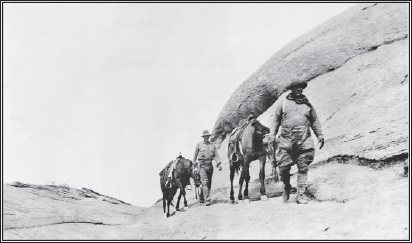
As ex-president, Roosevelt hiked the canyonlands of the American Southwest, many of which he had saved by designating them as national monuments.
T.R. hiking the canyonlands of Utah. (Courtesy of Theodore Roosevelt Collection, Harvard College Library)