
Certainty plays little role in this history of Hatshepsut. The nature of the information passed down to us is uneven, and because so many of her monuments were destroyed, the jumble of perceptions we are left with are from other people, many of whom lived millennia after her death. I have had to break many rules of my Egyptological training in order to resurrect and reanimate Hatshepsut’s intentions, ambitions, and disappointments, by engaging in conjecture and speculation, and creating untestable hypotheses as I attempt to fill out her character and decision-making processes (even though I document my sources and accentuate my uncertainties). Any supposition on my part is warranted, I believe, because Hatshepsut remains an important example of humanity’s ambivalent perception of female authority. Even in the absence of exact historical details and reasons behind Hatshepsut’s actions, I can still track her rise to power by following the clues left behind by herself, other kings, courtiers, officials, and priests, thus filling out the circumstances of her life’s journey as I go.
I have decided to forgo any long-winded analysis of architectural history, reliefs, statuary, text, and genealogy, instead focusing solely on Hatshepsut’s narrative; you will find discussions of topics tangential to the main story in the notes. I have also eschewed reconstructions of Hatshepsut’s ambitious building program, because the extensive evidence of it already fills many volumes. (Indeed, Hatshepsut’s impressive architectural agenda has lured historians into creating a narrative of objects and buildings in lieu of a history of Hatshepsut herself.) This book is about a woman of antiquity and her interactions with Egyptian systems of government and power players, her decisions, her ambitions, her desperation, her triumphs, and her defeats. As I follow Hatshepsut’s story from her ancestral beginnings to her bitter end, I will watch what she did and how she did it, within the context of her times, and present my hypotheses explaining her motivations and thought processes.
Many historians will no doubt accuse me of fantasy: inventing emotions and feelings for which I have no evidence. And they will be right. As I try to get at the human core of Hatshepsut, I will put many ideas and assumptions on the page; this is the best way for me to reconstruct her decision-making process. My conjectures, founded on twenty years of Egyptological research, are bounded and informed. What I say about Hatshepsut’s emotions may not be right, but when I engage in conjecture, I do my best to qualify the statement, or to offer alternatives, or to clarify any uncertainty in my writing. The inexactitude remains, however, as is the case with any historical study of the ancient world.
This book is a kind of pause for me, something completely different from my previous Egyptological research dealing with funerary data sets and coffin studies. I have used all my skills as a researcher, but I have also allowed myself to think out loud, to infer and imagine, in a way I would not do in my other work. This book finds its origins in my intimate (and strange even to myself) connection to the ancient world, and I have to thank the countless scholars who share the same obsession with Egypt’s past—generations of archaeologists who uncovered Hatshepsut’s remnants in the dirt, philologists who translated and analyzed her texts, art historians who pieced together broken statues and found traces of her relief erased by chisels. They have paved the way for this biographical discussion of Hatshepsut’s relevance.
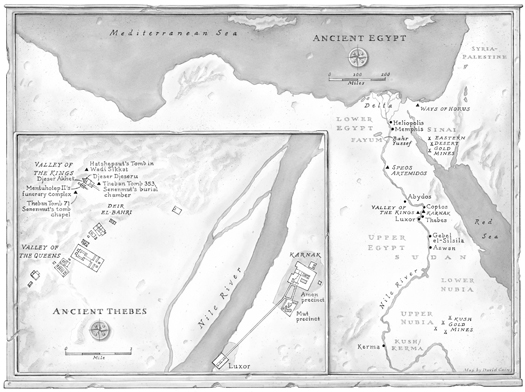

Map of Hatshepsut’s funerary temple, Deir el-Bahri, Thebes, Eighteenth Dynasty. Map by Deborah Shieh.
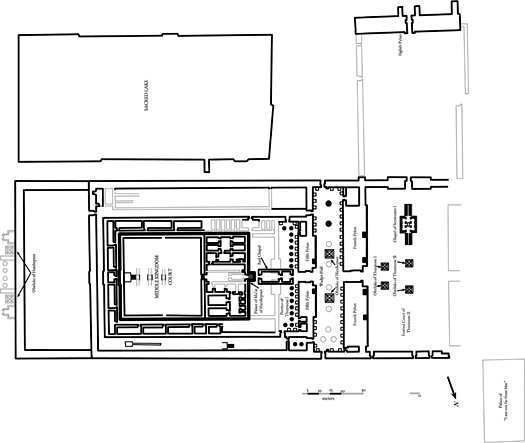
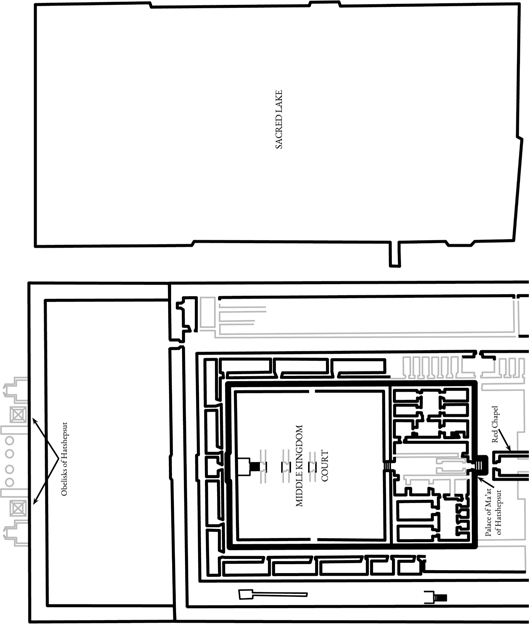
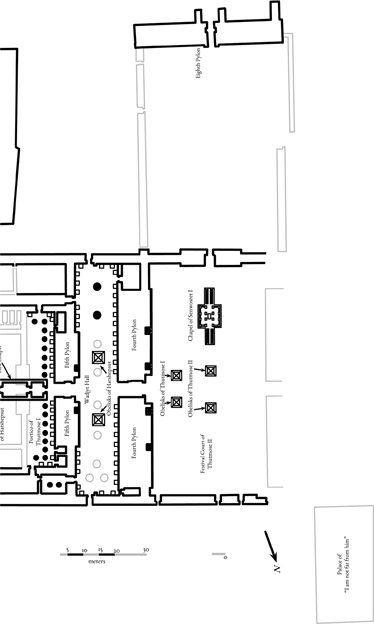
Map of Karnak Temple, Amen precinct, during the time of Hatshepsut. Map by Deborah Shieh.