
Philippa Gregory
CHILDHOOD
Jacquetta of Luxembourg was born, perhaps in one of her family’s chateaux in France, probably in the year 1416. This uncertainty as to her date of birth is not uncommon for women of this period: none of the three women of this book had the date of their birth recorded. Girls were not valued in the fifteenth century, and nobody could have predicted that the oldest daughter of the heir of Luxembourg would be a leading English woman through two reigns and two regencies, a witness to some of the most significant events of two wars, the mother of a queen and the founder of a royal dynasty, and a powerful actor in her own right.
She was the second child born to a noble family, in a world that had been at war for so long that neither her father nor her grandfather had known a reliable peace. She spent her childhood in the beautiful castles and fortified chateaux of northern France, which then belonged to England.
The English had inherited northern France through the marriage of a French princess to England’s King Edward II. But many of the French denied the right of a woman to inherit and argued that the throne should belong instead to the male heir of the junior royal family of France: the Valois. Hostilities started in 1337 and continued, with occasional periods of peace, for more than a century – earning the interminable battles the name ‘the Hundred Years’ War’. Although armies were small and battles had only a local impact, the entire country was disrupted by the shifting borders, the assault on towns, the brigandage of the regular forces, the anarchy of the private armies, and the impoverishment of trade – all this amid the normal day-to-day lethal uncertainty of medieval life. The four-generations’ war blighted the disputed territories and impoverished all of France.
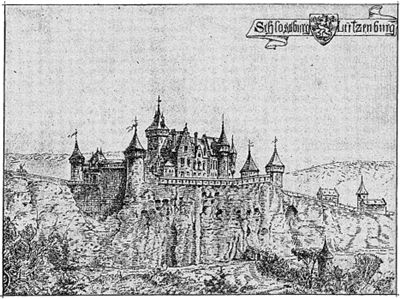
Medieval Luxembourg, as imagined in the nineteenth century
It damaged England too. The overseas wars were an unbearably expensive drain on what was little more than a subsistence economy, distracted everyone from building prosperity and peace, and rewarded those who were opportunistic, militaristic, or even outright lawless. There was a constant sacrifice of life and fortune:
. . . close the wall up with our English dead!
In peace there’s nothing so becomes a man
As modest stillness and humility;
But when the blast of war blows in our ears,
Then imitate the action of the tiger;
Stiffen the sinews, summon up the blood,
Disguise fair nature with hard-favour’d rage;
Then lend the eye a terrible aspect.
The time of Jacquetta’s birth were the glory days for England as the young king, Henry V, invaded France in 1415 and won a tremendous victory at the battle of Agincourt, rolling out English power. The English and their allies occupied most of the northern half of the lands we now call France, including Paris. This was in addition to the traditional English holdings in the west of the country, around Bordeaux. These rich lands were the dowry of Eleanor of Aquitaine when she married Henry II of England, and a celebrated English possession for the previous 300 years.
Jacquetta’s family, as counts of Luxembourg, were neighbours to France and vassals to the Duke of Burgundy. They had to choose sides in this conflict that had already absorbed the energies of England and France for seventy-eight years. Naturally enough, they chose to follow their ducal cousins to side with the English and feud against the Valois. Perhaps the Luxembourg family believed the English were morally right, perhaps they thought they would profit most from English neighbours, or perhaps the English simply looked like the stronger side and the safer bet.
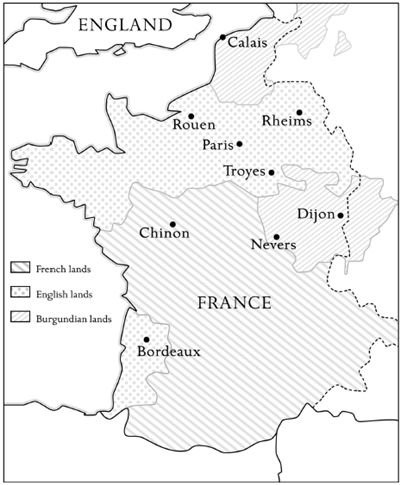
The lands of France in 1429
In 1420 the French King Charles VI signed away the rights of his son Charles, and gave his daughter Catherine of Valois in marriage to the conquering Henry V of England, to seal the Treaty of Troyes. He made Henry V of England his heir, and the young English king, with a new-born son to follow him, must have thought that he had secured his lands in France for ever. But, aged only thirty-four, he died of dysentery after laying siege to Meaux in 1422, and the English lands in France, and the claim to the entire kingdom, were inherited by a nine-month-old baby: Henry VI. The country faced a long regency headed by the baby’s two uncles: Humphrey Duke of Gloucester, who ruled in England; and John Duke of Bedford, who was Regent of France.
When Jacquetta was a little girl of six years old, her uncle Louis of Luxembourg was making his way from France to England to congratulate the baby boy who had so precociously inherited the throne of England and France. Louis de Luxembourg would go on to serve John Duke of Bedford as his chancellor for ten years from 1425–35, and was so reliable and trustworthy that Bedford named him as executor of his will.
While the infant Henry VI was in his nursery, his homeland of England was disrupted by the growing powers of the rival nobles who ruled their own lands, disregarding both the young king and the law. In France, the little king’s inheritance was threatened by the French claimant: the disinherited Valois son Charles. Charles the Dauphin was an unpromising challenger to the regency of John Duke of Bedford. Named by his own mother as a bastard, disowned by his dead father, scarred by a terrible childhood, he was utterly baffled as to how he might win the kingdom that had been so abruptly given away to England.
The arrival of Joan of Arc at the court of Charles the Dauphin was an extraordinary opportunity for the French cause. Her visionary leadership identified him as God’s choice for France, and led the demoralised French army to a string of victories in 1429. Her ambition was to drive the English utterly from the land. She even told them so, in a bold document in which she warned John Duke of Bedford to leave France or face the consequences: ‘Surrender to The Maid sent hither, by God the King of Heaven, the keys of all the good towns you have taken and laid waste in France . . . If you do not, expect to hear tidings from the Maid who will shortly come upon you to your very great hurt.’
Claiming that she was inspired by the guidance of angels, riding under a banner of lilies, bearing a sword but never using it, the charismatic girl marched the French prince out of a sense of personal failure into Rheims Cathedral to be crowned and anointed with the sacred oil of the very first king of the Franks, Clovis. She led the French army up to the city walls of Paris and, if the Valois court had supported their heroine, she might have been completely victorious. The court’s failure to exploit the fantastic power that Joan of Arc brought them may well have been because they feared – as the English were convinced – that Joan was a witch. Joan’s claim to be guided by angels, her healing skills and her good luck were deeply suspicious qualities to her enemies; and even to those who followed her. In the story of Joan of Arc, which was a legend during Jacquetta’s childhood and thereafter, Jacquetta would have seen that an exceptional woman attracts attention which can prove to be fatal.
It was another of Jacquetta’s uncles – John of Luxembourg – who did the English a once-in-a-lifetime service when one of his vassals dragged Joan of Arc from her horse during a skirmish at nearby Compiègne and brought her in to John’s castle at Beaurevoir near Cambrai. Louis, Jacquetta’s brother, was staying at the castle, placed with his uncle to learn the ways of the world. John of Luxembourg’s stepdaughter Jeanne de Bar was another guest. Jacquetta herself might have been there when Joan was brought in.
John held Joan of Arc for four months while his wife Jehanne de Bethune, his stepdaughter Jeanne de Bar and his great-aunt Jeanne the Demoiselle of Luxembourg pleaded with him not to release ‘the Maid’ to the English, foreseeing, quite rightly, that it would be to send her to her death. While the Demoiselle lived with her nephew, Joan of Arc was safe; but when the old lady died in November 1430, John of Luxembourg accepted a fortune of 10,000 livres from the English, and defied the women of his household to send Joan to the Church. As they had feared, the English Regent of France, John Duke of Bedford, insisted on a show trial by the Church, and she was burned at the stake.
THE LUXEMBOURG INHERITANCE
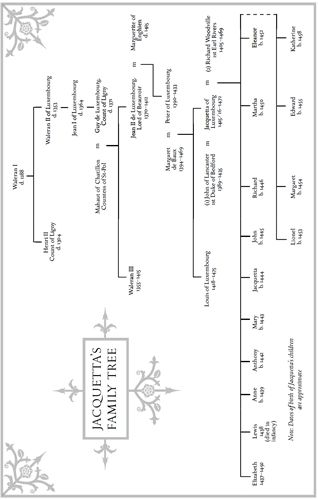
Jacquetta’s father, the Count of Conversano and Brienne, was the oldest of the anglophile brothers and so, on the death of the Demoiselle of Luxembourg, he inherited the title and became Count Peter I of Luxembourg and St Pol. The family was well connected in Europe: the Luxembourgs were of the royal family of Bohemia; Jacquetta’s cousin was Sigismond, the Holy Roman Emperor. On her father’s side she descended from Duke John II of Brittany. On her mother’s side she descended from Simon de Montfort. Jacquetta could trace her ancestry back to English as well as European royalty. Indeed, she could go farther than this: her family could trace their line back through recorded history, into myth.
The family city of Luxembourg was founded around a castle developed from a Roman fort built on a rock called ‘the Bock’ dominating the roads and rivers between France, Germany and the Low Countries. It was famous as one of the most powerful and defensible castles in Europe. The Counts of Luxembourg traced their ancestry back to the first count, Siegfried, who bought the site of the castle in 963 and was said to have married the water goddess Melusina. It was she who made the castle of Bock magically appear, the morning after her wedding. Their happy marriage lasted until Count Siegfried broke his vow of allowing her absolute privacy each month. Spying on her in her bath, he discovered that his wife was a magical being: half-woman, half-fish, something like a mermaid. He cried out in understandable shock, and Melusina and her bath immediately sank through the solid rock beneath the castle, and disappeared.
Jacquetta would have known of this legend, which is stated as an accepted fact in her family tree, occurs in many versions all across Europe, and was recognised by C.G. Jung as an archetypal myth. Melusina appears as a character in alchemy; she represents water and the moon, the female presence. In adult life Jacquetta owned a copy of a rare manuscript of the history of Melusina, her ancestress, and Melusina may have been a theme at her daughter Elizabeth’s wedding, and at royal jousts. Whether Jacquetta regarded Melusina as a real ancestor or not, the metaphor was a deep and powerful one:
GLENDOWER: I can call spirits from the vasty deep.
HOTSPUR: Why, so can I, or so can any man;
But will they come when you do call for them?
‘Will they come when you do call for them?’ is perhaps the very question that Jacquetta would have asked herself, that the English Regent of France, John Duke of Bedford, would have asked of her, and that subsequent generations, frightened and attracted by her reputation, would like to know.
FIRST MARRIAGE: ROYAL DUCHESS
Jacquetta may have spent only a little time in the city of Luxembourg. Her father inherited his title when she was a very young woman, at a time when most girls of her class were sent away to stay with noble relations as a sort of ‘finishing school’. They would learn the skills and arts necessary for being a great lady by serving as companions or maids-in-waiting in other great houses under the discipline of the lady of the house. When she reached marriageable age, from fourteen years onward, Jacquetta’s parents would have arranged a match for their daughter. No young woman of her class would have been allowed to choose her own husband; her preference would probably not even have been consulted. Marriage was designed to confirm an alliance, to consolidate lands, to earn a dowry and to create an heir. The notion of love was a matter for troubadour poetry, or for bawdy jokes; it was not considered a reason for marriage. Jacquetta’s marriage was arranged unusually late, and it may have been one of passionate desire – at least on the side of her husband.
Her marriage was arranged by her uncle, the Chancellor Louis of Luxembourg, at the request of his great friend and patron, John Duke of Bedford. Bedford’s first wife, Anne of Burgundy, had died of fever in November 1432 after a marriage that had lasted ten years. They too had married for dynastic reasons: their marriage confirmed the alliance between Burgundy and England, and throughout her life Anne was effective in maintaining the friendship of her brother the Duke of Burgundy, and the alliance between England and Burgundy which was essential to the balance of power that guaranteed English success against France. She seems to have been a woman of charm and energy, and generosity to the poor. Indeed, she caught the fatal fever after visiting the sick in the Hôtel-Dieu of Paris. Bedford stayed by her bedside during her illness and made a pilgrimage around the churches of Paris for her recovery. He could not save her. John Duke of Bedford, forty-three years old, weary after years of service in France, may perhaps have felt a great sense of loss and loneliness on the death of his wife. He was scandalously quick to seek comfort. Only five months after his loss he married Jacquetta – twenty-six years his junior. The marriage service was performed by her uncle, Bedford’s chancellor and trusted friend Louis of Luxembourg, in his bishop’s palace at Thérouanne.
The hugely powerful, enormously wealthy Duke of Burgundy, Bedford’s former brother-in-law, was outraged that his sister’s widower should re-marry in such a short time. The tradition was that mourning should last a full year – but John Duke of Bedford must have been planning the marriage to his new wife within weeks of burying his first. He had chosen a daughter of the vassal of Burgundy: a snub to the ducal House of Burgundy, and an ill-judged show of favouritism to the House of Luxembourg. It widened the breach between Burgundy and England that undermined the military alliance of the two great landholders in northern France. The alliance between them had held the French at bay: a split would endanger English dominance in France. Perhaps Bedford hoped that the alliance with Luxembourg would replace the alliance with Burgundy; but his hasty second marriage to the seventeen-year-old was regarded as an insult to his first wife and brought him neither territory, nor title, nor dowry. It jeopardised his life’s work: English ownership of France. He must have been truly besotted.
Marriage to John Duke of Bedford made the young Jacquetta the first lady of France, and second only to the king’s mother in England. It also brought her into immediate contact with the knife-edge politics of the long war. On his way to marry her, John Duke of Bedford paused in Calais to put down a mutiny in the garrison. The soldiers were complaining about arrears of pay. Usually such disputes ended peacefully with pardons and payment of back pay, but on this occasion the duke ordered the execution of four ringleaders. On the return journey, Bedford and his new wife called at the garrison to reinforce discipline. Bedford expelled eighty of the mutinous soldiers, who had to go home to England without any pay at all, and only then could the duke and his bride continue on to Paris.
Here, Jacquetta was to be the mistress of the beautiful palace of the Hôtel de Bourbon, near the royal palace of the Louvre. She saw the extreme contrasts of warring medieval France – the terrible poverty in the streets, where beggars died of hunger, and the luxury and wealth behind the palace walls. Within the palace there was perhaps even a laboratory for alchemy, the mystical science of the medieval period.
The study of alchemy had only been allowed in English lands under a royal licence since 1403, such was the fear and suspicion of this medieval ‘science’. But the desperate need for gold had inspired a renewal of interest. One of the promises of alchemy is that the adept might learn how to make the ‘philosopher’s stone’, a substance which refines base metal into gold. Alchemists believed that gold and other minerals were made slowly in the depths of the earth, and that this process could be speeded up, either by the flames of the forge or by the gentle heat of the water bath. John Duke of Bedford licensed alchemists in France to find the formula to make gold to pay his soldiers, and to find the other promised treasure of alchemy: the elixir that would prolong life – perhaps to eternity. Many of the great men of Europe, including Bedford’s brother Humphrey Duke of Gloucester, explored alchemy – a form of study which would in time evolve, on the one hand, into modern sciences, and, on the other, into mysticism. But to the medieval mind there was no separation between art, spirituality, magic and the sciences; and the spirit of the alchemist was as much an ingredient as the liquids he or she learned to distil, the metals they forged and the elements they discovered. It was a spiritual exercise as well as a science, and it still has adepts today.
In her new home in Paris Jacquetta also found her husband’s famous library: religious texts and thirteen precious volumes of stories about Arthur, the mystical King of England. These were hand-copied manuscripts, made before the invention of printing, of great beauty as well as great rarity. They were to be read not only as entertaining stories, but also as prophecies of the future of England, and as a rule book for the imaginary chivalric world which was a guiding light to every man of honour. They may have made troubling reading for the Regent of France, since the stories emphasised the need for a king to be balanced in his health and temperament. His physical well-being determined the health of his lands. In the medieval world view the state of the body reflected the soul of a man: a man who was physically strong and beautiful would have a beautiful soul. The health of the king reflected the health of the nation: a physically strong and beautiful king would rule over a healthy and fertile land.
As John would have known, there were already rumours that his young nephew the King of England was ‘cold’ and ‘moist’ – passive, and too easily influenced, a boy born under the sign of Luna, unlike his father Henry V, who had been ‘hot’ and ‘dry’, born under the sign of Mars: a fighting king.
Just two months after her whirlwind wedding, Jacquetta visited England with her husband and met this new royal kinsman, Henry VI. The country was in crisis: the French wars were ruinously expensive, the nobility of England were running their own lands almost independent of any central control, the young king showed no signs of being able to assume the regal power that was his by right, and the growing rivalry between the lords, exacerbated by his favouritism, was a danger to the stability of the Crown. The king was under the influence of two rival family members: his uncle Humphrey Duke of Gloucester, a most astute and determined politician; and his great-uncle Cardinal Henry Beaufort, the son of John of Gaunt and his mistress (and later wife) Katherine Swynford.
Bedford and his wife were greeted with the ritual and deference due to senior royals, and entered into this jockeying for power and influence at the court of the twelve-year-old boy king. It must have been an extraordinary moment for the young duchess when she made a state entry into London beside her husband, through cheering crowds, with pageants and poems to greet her along the way. At first the parliament was sceptical about the work of the French regency but when they came to understand that John Duke of Bedford had given selfless service in France, they rewarded him for his loyalty and gave him permission to retire.
At first it looked as if he might accept. The couple stayed in England for more than a year, and John Duke of Bedford was granted the wonderful Penshurst Place in Kent. Built in the previous century as an H-shaped medieval manor, Penshurst Place was originally designed as a show house by a wealthy London merchant. It featured a great central hall with a tiled floor and octagonal central hearth, faced by a raised dais for the dining table of the lord and his lady. Behind the dais rose a broad stair to the solar – the private rooms – with windows on three sides over the gardens, which were enclosed by a square of walls with towers at each corner. Bedford built a new wing, now called the Buckingham Building, and put his emblems – the falcon and the ibex – on the gables of the buildings to the west of the hall. He probably added the deep window splays, based on those he had admired at the papal palace at Avignon.
While they were in England – Bedford battling with his rivals on the royal council, and Jacquetta enjoying life at court and overseeing the building of their new English home – she received a message from Luxembourg. Her father had died, probably of the Black Death, a form of bubonic plague. He was only forty-three years old, and had been Count of Luxembourg for only three years.
The Black Death overshadowed Europe in this period, spreading along trade routes, killing more than a third, perhaps more than half, of the population of the continent. Every family lost a cousin, a brother, a daughter, a parent. Everyone paid the price of missing a family member who was earning money, planning the future, or embodying hope. From the poor, who could not get in the harvest or manage the animals, to the rich, who closed their castles in terror of the disease – and still died – the sickness swept through all Europe, destroying the culture with the people.
The death of Jacquetta’s father shows why the disease was so feared: neither rank nor the privileges of wealth could protect someone from a disease that was a mystery to doctors. The disease probably started from the bite of an infected flea that, in turn, infected the lymph glands, which swelled to form hard boils called buboes. A high fever and aches and pains were often followed by death within the week. At a time when no one understood how disease was transmitted, the deaths seemed to occur at random. The name ‘the Black Death’ came not only from the darkened swellings on the patient, but also the intense dark despair throughout Europe in plague years, as the dead could not be buried, the crops could not be got in from the fields, and ordinary life broke down. A city such as Luxembourg, at a centre of trade routes, on pilgrimage paths, and with a number of public hospitals, was particularly vulnerable to the disease.
In July 1434 John Duke of Bedford decided that, despite his weariness and deteriorating health, he had to return to France. The commune of Paris begged for his help as law and order collapsed inside the city, and convoys of food could not get past the marauding soldiers of the French king. Accompanied by Jacquetta, he made the journey back to France, and returned to Paris for the feast of Christmas. Jacquetta’s uncle, Louis of Luxembourg, was relieved to restore the power of acting governor to his master. Paris was practically besieged by lawless gangs of soldiers from both sides, and it was dangerous to go outside the city walls.
The fortunes of war were beginning to turn against the English and their allies, with advancing French troops and constant uprisings from the French peasantry. In spring 1435 Bedford and Jacquetta left for the safer city of English-held Rouen, and the duke struggled to keep the supply routes to Paris open from Normandy, though his health was failing as news arrived of new peace negotiations to be held at Arras.
The young French king, crowned by Joan of Arc, and now widely recognised as Charles VII of France, had consolidated the early gains and was now the rising power in the country. The quarrel between John Duke of Bedford and the Duke of Burgundy over Jacquetta was now proving very costly. The Duke of Burgundy abandoned his traditional alliance with England, probably calculating that he could be more influential with the French king than the English one. The Treaty of Arras would mark his joining with France and the isolation of England. Without their powerful ally, the English were fatally weakened. John Duke of Bedford struggled to maintain English territories from his sickbed in his castle at Rouen.
He tried to fortify the Calais garrison by putting in a new lieutenant. He appointed Sir Richard Woodville, a thirty-year-old soldier who had made his reputation in the English army in Normandy, following his father into royal military service. As the Duke of Bedford’s health failed, and he made his will, the young duchess and the young captain of the Calais garrison, Sir Richard Woodville, grew close. John Duke of Bedford, still working for his country, died on 14 September 1435. He was buried, at his request, in the English-held city of Rouen that he loved so well. There can have been no quarrel between him and his young wife for he made her his sole heir in his generous will which left her all his lands for life (excepting one estate) and also gave her his famous and treasured library including the romances of Camelot.
Jacquetta, now aged about nineteen, suddenly a wealthy widow, was still not free to do as she pleased. As a duchess of England her marriage was in the gift of the King of England, and Henry VI sent for her to return. She was granted her dower – a widow’s pension – in February 1436 on condition that she did not marry without royal permission, so she can have been in no doubt that a marriage would be arranged by the king’s council for her in the future. But Jacquetta was in love, and young, and determined.
Her lover Sir Richard Woodville held the garrison of Calais against an attack by Duke Philip the Good of Burgundy, who was now England’s declared enemy. Woodville led the garrison through the siege and threw back the forces of Burgundy, but must have been deeply shocked, as was Jacquetta, when the English-held capital of Paris fell to the French.
SECOND MARRIAGE: LADY OF THE MANOR
There is no record of their wedding, but Sir Richard and the wealthy young widow travelled to England and confessed to their marriage in 1436 or early 1437. Indeed, they may even have been lovers earlier and only married when Jacquetta found she was pregnant. Jacquetta was ordered to pay a huge fine of £1,000; but she was forgiven by the king, and the young couple were officially pardoned in October 1437 in time for the birth of their first child, a girl. They called her Elizabeth and she was born sometime in the winter of 1437 or in 1438.
Jacquetta and her new husband Sir Richard probably divided their time between court and their country house, at Grafton, Northamptonshire. Richard Woodville’s father already owned houses and land in Grafton and neighbouring parishes, and it is likely that the young couple set up home near him. The Woodville (or Wydeville) family had been living in the area since the early thirteenth century, probably as farming tenants of the wealthy de la Pole family, who owned the manor of Grafton. The Woodvilles would have regarded themselves as tenants and retainers of the de la Pole family: owing their lord their support in any disputes, bound to him by an almost feudal loyalty. Although they were not vassals in any legal sense, there still survived a system of patronage and protection in return for loyalty and support. Sir Richard also owed a sense of chivalric loyalty to Edmund Beaufort, the Duke of Somerset, who had earlier been his commander in Normandy, and appointed him as his deputy to the Calais garrison. William de la Pole Earl of Suffolk would owe the Woodville’s ‘good lordship’: a share in his good fortune, and his protection. In 1440 William de la Pole sold the manor of Grafton to the young Sir Richard – a favour to the young couple – and made it possible for them to set themselves up as lords of their own manor.
With ownership of the manor and land came responsibility. Jacquetta would now find herself as a lady of the manor, partly responsible for farming the lands, supervising the tenants, maintaining law and order, paying taxes and collecting tolls, dispensing charity and supporting the Church. Jacquetta and Sir Richard would also have been responsible for the maintenance of local roads, and the honesty of local markets. When called upon by their lord they would be expected to recruit soldiers and go to war. When Sir Richard was absent, Jacquetta, like other medieval wives, would take on his duties, running the estate, managing the money, and commanding the workers.
As courtiers they played their role in the life of the court, taking part in its leisure, cultural and religious life, and serving as advisers and assistants to the king. In or around 1438 their first son was born. They named him Lewis, perhaps as a tribute to Jacquetta’s illustrious Luxembourg uncle; but the little boy, like many medieval babies, did not survive. The infant mortality rate was more than 30 per cent. The loss of a child, though it may well have been deeply painful, could not have been unexpected. Jacquetta was a fertile woman and raised thirteen children to adulthood, but births were not always noted in this period, and the records are not clear as to the exact date of their births, nor of the siblings who did not survive.
Jacquetta’s husband continued to serve as deputy commander of Calais, recruiting men and leading them in forays against France, which continued despite the treaty and other attempts at peace. He was away from home on military service in 1439 when Jacquetta went into confinement and gave birth to her second daughter, Anne, and then the young couple were reunited on his return.
News came from Europe. Jacquetta’s brother, Louis, the new Count of Luxembourg, had married his uncle’s stepdaughter, Jeanne de Bar, who had tried to defend Joan of Arc. Now Jacquetta’s brother was turning his back on his family’s traditional loyalty to England. Around 1440, perhaps to ensure that he received his inheritance of Luxembourg and Ligny from the French king, he joined Charles VII of France and later fought alongside him, against the English. This might have caused Jacquetta some embarrassment, but the long wars in France were teaching the gentry of England a hard lesson that they would soon learn: loyalty could not be taken for granted.
WITCHCRAFT
In 1441 the country was convulsed by a scandal that had particular resonance for Jacquetta. She still held the title of Dowager Duchess of Bedford, and would have known the only other royal duchess: Eleanor Cobham. Eleanor had met Humphrey Duke of Gloucester when he was a new husband, married recklessly for love to a foreign countess, Jacqueline of Hainault, who was in dispute with her family and her former husband, and locked in a war for her lands. Duke Humphrey was said to be equally in love with the Countess Jacqueline and with her lands in Hainault; but when Jacqueline came under siege from a coalition of her uncle and former husband, Humphrey Duke of Gloucester abandoned his wife, her lands and her cause, and went home to England with her lady-in-waiting, Eleanor.
In a dramatic act of faithlessness he had his marriage to Jacqueline declared invalid, and married Eleanor, leaving English foreign alliances in ruins, and his former wife Jacqueline without help. It was the scandal of Europe. As she had risen from such modest beginnings Eleanor, the new Duchess of Gloucester, attracted much criticism for her pride. When the king’s mother died, and Jacquetta lost status by marrying Sir Richard, a simple knight, Eleanor became the first lady of England, her husband the king’s only surviving uncle, and so first in line for the throne of England.
Duke Humphrey opposed the policy of his uncle Cardinal Henry Beaufort, who advised the king against military advances in France. Duke Humphrey claimed to rule England as regent during the minority of his nephew; but the cardinal was determined to reduce the duke’s influence on his nephew the king, and set about undermining his reputation. The duke was a known scholar and practitioner of alchemy. But it was the easier target – an unpopular woman, his duchess – who came under attack.
Eleanor was accused of commissioning a horoscope that predicted ill health for the king. This alone was an act of treason, punishable by death; and worse was to follow. Her associate Roger Bolingbroke, a well-known astronomer and scholar, was probably tortured and pleaded guilty to the crime of sorcery, which he said he had undertaken at her command. He did penance before the court at matins ‘placed upon a scaffold before the cross of St Paul, in a chair curiously painted, which was supposed to be one of his implements of necromancy and dressed in mystical attire’.
The scholar was exhibited, surrounded by the tools of his trade: equipment for divining, and an effigy. The effigy was said to be a wax model made in the shape of the king that would cause the king to waste away as it was slowly melted.
Another man, Thomas Southwell, Eleanor Cobham’s personal physician, was found guilty of saying mass unlawfully – presumably as a spell rather than a religious service – with the aim of destroying the king. A woman known as ‘The Witch of Eye’, Margery Jourdemayne – a herbalist and wise woman consulted by many of the court – was accused of working with Eleanor and making a wax image of the king which was designed to cause his ill health and perhaps death.
The twenty-year-old king was deeply distressed by this attack on him by his own aunt, and the council was alarmed at evidence of active witchcraft in such high places. Their extreme concern has to be understood in the context of the times. Most people believed that such rituals were effective. What if there were many practising witches at court? What if Eleanor’s spells were making the king ill? Alternative horoscopes were drawn up to show the king was well and strong, and all the conspirators were questioned; the men were probably tortured to confess.
Bolingbroke pleaded guilty and was hanged, drawn and quartered. Thomas Southwell was said to have died of sorrow in the Tower the night before his execution – he probably found some way to commit suicide. Margery Jourdemayne, lacking the friends or the influence to bring poison for a less agonising death, was burned as a witch at Smithfield, the meat market in London.
Eleanor confessed only to commissioning her own horoscope, and claimed that she had met with Margery Jourdemayne for her own fertility treatment. But the king’s council had no need to examine conflicting evidence to find a verdict. Eleanor did not receive a fair trial by her peers – indeed she was not tried at all. She was found guilty of treason by royal decree: a decree issued by the king, her young nephew. It was a verdict without a trial; as a woman accused of witchcraft, Eleanor could not hope for justice.
The problem of how to punish her was a difficult one for the royal council. In the end, they set her a penance of parading around the bounds of the City, wearing only her linen shift and carrying a lighted taper, a punishment more often used against women found guilty of sexual promiscuity. Sending her out before the citizens of London barefoot in her underwear, the council intended to publicly shame her. The council then ordered that she be imprisoned in the charge of Sir Thomas Stanley. Her husband, Humphrey Duke of Gloucester, declared that his marriage to her had been brought about by her seduction and sorcery; and the marriage was rendered null and void.
Stand forth, Dame Eleanor Cobham, Gloucester’s wife:
In sight of God and us, your guilt is great:
Receive the sentence of the law for sins
Such as by God’s book are adjudged to death.
You four, from hence to prison back again;
From thence unto the place of execution:
The witch in Smithfield shall be burn’d to ashes,
And you three shall be strangled on the gallows.
You, madam, for you are more nobly born,
Despoiled of your honour in your life,
Shall, after three days’ open penance done,
Live in your country here in banishment,
With Sir John Stanley, in the Isle of Man.
Eleanor lost her liberty, her husband, and her position at court on the basis of an allegation without evidence, without a trial, and died in prison aged about fifty-two in 1452 after ten long years of imprisonment, constantly watched to prevent her killing herself. Most of her final years were in Peel Castle on the Isle of Man, where even today there is a legend that the unhappy duchess haunts the stairs in the shape of a black dog.
The fate of the Duchess of Gloucester would have served as a stern warning to any woman; but especially to the only other royal duchess, Jacquetta. England, and indeed all of Europe, was a deeply superstitious and religious society, at this time on the brink of one of the panics about witchcraft and sorcery that periodically swept through Europe before the age of enlightenment in the eighteenth century. For people who suffered from natural disasters without understanding the causes, who faced terrible diseases without effective medicine, the only explanation for catastrophic events was the supernatural. People hoping for good and bad outcomes invoked both religion and magic, sometimes interchangeably. A miracle might save a sick child, a saint’s help could be summoned by the right prayers, a young man might fall in love with the right spell, the plague might be called down on an enemy. The supernatural was daily observed in everyday life: when a blaspheming man fell from his horse, or milk refused to churn into butter, or a priest blessed a sickly child who then grew strong. People who had no understanding of science or medicine had to depend on magical explanations, or prayer or casting spells to try to control events. There were no clear distinctions between science, magic and religion. Witchcraft trials would dramatically increase throughout Europe in the next fifty years as the Pope’s instructions in the form of papal bulls were issued against ‘magicians, and diviners practising witchcraft’.
In another ominous change, suspicion was focused on women. In the two decades before Eleanor Cobham’s trial twice as many women had been executed in Europe for witchcraft as men – 110 of them. It is easy now to see why women would come under suspicion. Any woman who was skilled in healing, or who was believed to be able to foretell the future, or ill-wish a victim – thus any woman who served as a midwife, a herbalist, a layer-out of the dead, a fortune teller or an adviser, or any woman who lived on the fringe of society, on the edge of the village, or who seemed to be outside convention or control – would be in danger of an accusation of witchcraft when the levels of public anxiety rose. Women, whose fertility was still a mystery to physicians, whose temperament was said to be changeable under the influence of the moon, easily tempted and easily led astray like Eve, were particularly vulnerable to accusations of meddling with magic, especially in pursuit of power denied to them by the laws of the land and Church. Deep fears about female sexuality and female ambition contributed to the climate of suspicion about women.
Superstition was part of everyday life in the castles as well as in the cottages. Noble women came under suspicion just like the women of the poor. Jacquetta knew that her behaviour would be scrutinised just like the other royal duchess’s, and there were some disturbing similarities in their stories. Jacquetta, just like Eleanor, had been the surprising choice of a royal duke who appeared to have been ‘enchanted’ by her and married her against his best interests. Jacquetta’s ancestor was known to be a water goddess: Melusina, who had also tempted a man into marriage against his mortal interests, and who had continued to commune with water throughout her marriage. Jacquetta’s family’s association with the spirit world was known to everyone: the goddess was named as the founder of her house, appearing on her family tree and in her family crest. In the small world of the royal court, Jacquetta would have known Eleanor Cobham’s associates and might have been seen talking with them: Bolingbroke was a scholar in Eleanor’s household; he may well have known Jacquetta’s first husband, who had been a student of alchemy just like Eleanor’s husband. Southwell was a priest at St Stephen’s Chapel in Westminster, where Jacquetta may have attended the services. Margery Jourdemayne was a wise woman and herbalist who had many patrons at the Westminster court; she might even have advised Jacquetta among her other clients. If a witch-hunt were to start at court, Jacquetta would be one of the first suspects.
Perhaps Jacquetta thought that the charges were part of a plot against Eleanor and her husband: an attempt to destroy their influence on the young king. Jacquetta would have known that once sorcery or witchcraft was invoked, a woman could be slandered and destroyed with the most flimsy evidence. Dealing in magic was a charge almost impossible to disprove, since a denial, even a denial on sacred oath, was typical of a witch and evidence of guilt. On the other hand, no proof was necessary to support the charge: a single accusation by any man of importance – a priest or a lord – served as evidence of guilt. The case against Eleanor Duchess of Gloucester showed that the highest status in England was not enough to save a woman once she was named as a witch.
COUNTRY AND COURT
Jacquetta and her husband may have been glad to spend time in the country in 1441. Away from the dangerous and anxious court the young couple inherited more land at Grafton, including another house called ‘The Bury’, on the death of Richard Woodville’s father. They conceived their first surviving son, Anthony Woodville, who was probably born in 1442, perhaps followed by two sisters, Mary and Jacquetta, in the two following years. Part of Jacquetta’s story is of physical strength: she gave birth to fourteen children, perhaps more. She often had a new baby every year; there was no reliable contraception, which was, in any case, regarded as a sin. She may have completed her family after her last baby, Katherine Woodville in 1458, as a result of menopause, which could well have occurred for her at around forty years old.
Bad news came from Europe. Jacquetta’s family’s patron, Philip III Duke of Burgundy, captured the castle and the duchy of Luxembourg in 1443. The final heir to the imperial line of the Luxembourg family, Elizabeth of Gorlitz Duchess of Luxembourg, had made an agreement with him that he should have the duchy on her death, but the powerful Duke Philip decided not to wait. The members of the wider Luxembourg family were furious at this theft; but there was little they could do to defend their title against such a wealthy and powerful lord.
Jacquetta was pregnant again in 1444 with her son John when the peace treaty between France and England was sealed with the betrothal of a French princess to the young King of England. Charles VII of France did not betroth any of his own daughters to his traditional enemy, but offered the daughter of one of his vassals. The fourteen-year-old Princess Margaret of Anjou was accepted, and a party of English nobility set out from England to escort the young princess to her new country. They were led by the Woodvilles’ landlord and patron William de la Pole, and his wife Alice – granddaughter of the poet Geoffrey Chaucer. With them went the senior courtiers to honour the princess, among them Jacquetta and her husband Sir Richard.
Jacquetta’s younger sister Isabelle de St Pol had recently married Charles du Maine, Margaret of Anjou’s uncle, so Jacquetta was able to greet the new Queen of England as a kinswoman, and the two young women became friends, sharing the experience of being foreign girls married into the English royal family. Margaret of Anjou chose Jacquetta to be one of her chief ladies-in-waiting, and the regular New Year gifts throughout her reign show the warmth and constancy of their relationship. It was Margaret’s habit to pay the servants of her favourites a cash gift of 66/8d. each year, and Jacquetta’s servants regularly received this from the queen. Based on her gift records, her two greatest favourites were the two women who greeted her when she was a young royal bride in France: Alice, wife of William de la Pole; and Jacquetta Woodville, the Dowager Duchess of Bedford.
The fifteen-year-old princess arrived in England to meet her sensitive husband, a young man raised as a scholar, inclined to a life of prayer, dominated by his advisers. The two most prominent of these were now his great-uncle Cardinal Beaufort, and the king’s cousin, the 38-year-old Edmund Beaufort. The king’s uncle Humphrey Duke of Gloucester, still under the shadow of suspicion, was increasingly marginalised. A new man of increasing importance in the king’s council was the Woodvilles’ lord William de la Pole, now Marquis of Suffolk. Margaret came to like and trust William de la Pole during their slow progress through France to England, and became close friends with his wife Alice. It became clear that he and Edmund Beaufort, the handsome but penniless Earl of Somerset, were working together to command the royal councils, excluding the good advice of other noblemen such as Richard Duke of York, a royal cousin whose long service and military success in France should have guaranteed him the respect of the court. However, since Richard Duke of York was the wealthiest nobleman in the country and an heir with royal blood, there were many who feared his power and influence, and were glad when de la Pole and Beaufort conspired to send him overseas to serve in Calais, and later to Ireland.
Margaret was determined to serve her French kinsman and king, Charles VII of France, and to see her father restored to his hereditary lands in Anjou that had been captured by the English. It did not take long before the English court and subjects started to murmur that she and William de la Pole were serving the cause of France and not of England. Jacquetta, as a lady at the queen’s court, would have observed the growing friendship between the queen and William de la Pole, and would also have heard the ugly rumours which suggested a love affair between the fifteen-year-old bride and the 47-year-old courtier. This was the first gossip against Margaret that linked her supposed disloyalty as a queen of England to her alleged infidelity as a wife. Rumours like this were to spoil her relationship with the people of her new country. Jacquetta almost certainly would have warned Margaret that a prominent woman’s reputation must be above slander; but the young queen was passionate in her loyalty to her friends and both she and her husband often chose badly. Jacquetta would have taken leave from court in 1445 for the birth of her son John, and the next year to give birth to Richard.
Meanwhile the rivalry between the king’s advisers came to a head when the young king, warned by the rising man at court William de la Pole, became convinced that his uncle Humphrey Duke of Gloucester was planning to usurp his throne and assassinate him. In 1447 a parliament was summoned at Bury St Edmunds. When Humphrey of Gloucester arrived, he was put under arrest in his lodgings. A few days later he was found dead.
It may well have been a heart attack but there were many who believed that he had been murdered. By the time the gossips got to work on the story, the ‘good duke’ Humphrey had been assassinated by a combination of plotters: William de la Pole, Queen Margaret, and – absurdly – Cardinal Beaufort, who was actually dying of old age, in his own bed, at the time.
The young King Henry VI was deeply in debt and yet still he recklessly distributed honours and favours, carving into Crown lands and giving away important posts with huge fees attached. His projects – King’s College at Cambridge University, and Eton College near Windsor – were more costly than he could afford. William de la Pole was promoted again, from marquis to duke, and the favourite Edmund Beaufort Duke of Somerset was showered with gifts in an attempt to make his fortune rival that of the wealthiest man in England: Richard Duke of York.
The Woodville family benefited too. Sir Richard Woodville was offered promotion to the title of baron in May 1448 and had to choose his new family name. He took the name of ‘Rivers’ perhaps as a reference to the Redvers family whose griffin sergeant he added to his own coat of arms, or perhaps he was laying claim to the disused title of de Ripariis of Aungre. Perhaps it was a tribute to his wife’s watery ancestry of Melusina. Either way, in the next reign it was the source of a great joke against the social climbing of the family, as Edward IV’s official court fool declared that he could not walk dry-shod anywhere in England as the Rivers had ‘been so high that I could hardly scrape through them’.
A mistimed, misguided, misdirected attack on Fougères in Brittany by the court favourite Edmund Beaufort Duke of Somerset in 1449 broke the temporary peace between England and France and led to a counter-attack from the French. The English were miserably defeated and the country was appalled as the soldiers and refugees came streaming home. Hungry, defeated, unpaid and without compensation, bitterly critical of the government which had lost their lands, these refugees disrupted the country and blamed the king’s council for the worst failure in the long years of warfare. Everything that the king’s father, the heroic Henry V, had won, now seemed to be lost, and the young Queen Margaret was regarded as the child of the enemy and widely suspected of secretly working for them.
Her reputation was damaged again when her own father, René of Anjou, a vassal of France, marched against her subjects, laid siege to the great English capital of Rouen, and captured it from the English. For Jacquetta this must have been a particularly painful defeat. Rouen had been the jewel in the crown of the English possessions in France, and her first husband John Duke of Bedford had chosen to be buried in the cathedral there that he had richly endowed. Now his very grave and monument were in the hands of his lifelong enemy, and everything he had fought for was lost to the father of the young Queen of England.
Outraged by English defeats, the parliament charged William de la Pole with treason in 1450, accusing him of planning to marry his young son to his wealthy ward, the Lancastrian heiress Margaret Beaufort, and to seize the throne in their name. William de la Pole was indeed planning for the children’s marriage, and a form of betrothal had already taken place; but he proudly denied the charges of a coup, and King Henry, prompted by Queen Margaret, overruled his own parliament, and allowed the royal favourite to flee the country for what they planned would be only a brief exile. But as the young royals celebrated their triumph over the parliament, the duke’s ship was overtaken at sea by a mystery vessel, the duke kidnapped and cruelly beheaded with a rusty sword on a rocking boat. His body was thrown down on the sands of Dover beach, his head set on a stake. His wife Alice had to tell the queen of his death and young Margaret took to her rooms in the palace of Westminster, crying unstoppably for three days.

The fury and distress of the young royal couple at the murder of their friend and mentor led them to swear vengeance against the whole county of Kent. The sheriff of Kent, William Crowmer, and his father-in-law, the king’s treasurer Lord Say, threatened to empty the county of people and turn it into ‘a deer park’. But the declaration of vengeance only inspired a rebel who rose up in Kent and called for the reformation of the king’s council. He was Jack Cade, also using the names Jack Amend-All and John Mortimer in a compliment to the family name of the absent and disregarded Richard Duke of York. He petitioned that the king should reclaim the royal lands that he had so readily given away; he should punish the kinsmen of William de la Pole for his crimes; he should take new councillors from among the traditional lords, especially the Duke of York; he should bring the alleged murderers of his uncle Humphrey Duke of Gloucester to trial (by which he meant Edmund Beaufort); he should punish those responsible for losing the lands in France (Edmund Beaufort again); he should end unfair taxation and dismiss corrupt officers of his household (probably Edmund Beaufort again) and dismiss those who were unjust or corrupt in the county of Kent. An army gathered around Cade, whose military skill and experience – perhaps learned as an English soldier in France – was powerfully demonstrated as he marched his men, including yeomen and gentry of the county, to face the royal army south of London.
Jacquetta and the queen probably watched King Henry put on his battle armour, and ride out of London at the head of a royal army to command the rebels to go home. The rebels retreated south into Kent pursued by a small detachment of the royal force, including Jacquetta’s husband Lord Rivers and a young man, nineteen-year-old John Grey of Groby Hall. A skilled feint from Cade’s army led the royal army into a trap and Cade won the first battle, killing two royal commanders and putting the troops to flight. Rivers and his young recruit Grey were lucky to get away with their lives. It was a dramatic defeat for royal power. Many soldiers of the king’s army immediately deserted and joined Jack Cade, and more rebel volunteers came in from all the southern counties of England as the news of his victory spread. The men of Kent had started a popular uprising against royal tyranny.
After hesitating for a couple of days, Henry and the queen ignored the pleas of the Mayor of London, and abandoned the city to fend for itself, dashing a hundred miles north, to the fortified castle of Kenilworth, one of the safe royalist Lancaster-owned properties. The lords and nobility in fear of their lives, most probably with Jacquetta and her husband among them, piled into the most defensible place – the Tower of London – and prepared for a siege.
The rebels entered the city in triumph, Cade striking the London stone, a monument traditionally regarded as the heart of the city, and thus claiming ownership of the capital of England. The Mayor of London gave him the keys to the city and hosted a dinner for him. For a heady two days it looked like a victorious popular revolution. Cade, dressed in stolen armour and wearing the dead royal commander’s spurs, demanded that the men who had sworn to destroy Kent be released to him, and the lords in the Tower meekly sent Lord Say and the sheriff of Kent out to certain death. Cade held a mock court and ordered their execution. Their severed heads were paraded on pikes in a triumphant march.
The city had so far supported the rebels; but when Cade’s men started looting houses and businesses, the London merchants and apprentices counter-attacked; the royalist forces in the Tower, Sir Richard Woodville probably among them, came out and together they drove the rebels out of the city, over the bridge to the south of the river. There, they were issued with royal pardons in a transparent attempt to persuade them to go home. These pardons were not all honoured: Cade took his pardon in the name of Mortimer but was hunted down as Jack Cade and killed. The king returned from the country and personally supervised the trials and execution of more than thirty of the rebels: an inglorious end to his inglorious debut in arms.
THE COUSINS IN CONFLICT
Jack Cade was dead – betrayed by a king who did not keep his word – but Jack Cade’s cause was not forgotten. Richard Duke of York used the rebellion as an instance of the failure of the king’s council to keep the peace, adopted Cade’s manifesto as his own programme of reform, and demanded admission to the king’s council, and the arrest of Edmund Beaufort Duke of Somerset. The queen personally defended the royal favourite and blocked his arrest. Now the two royal kinsmen – Edmund Beaufort Duke of Somerset of the House of Lancaster, and Richard Plantagenet Duke of York – were locked in a bitter rivalry to influence the king. The opposing cousins in the war that would be named after them – ‘the cousins’ war’ – were identified. Later historians would give the battles the name of ‘the Wars of the Roses’ as York used a white rose as its emblem and Lancaster sometimes showed a red rose among its badges; but at the time, the people who marched in the ranks, and were summoned by their lords, called this ‘the cousins’ war’: an argument inside a family, with all the bitterness of a family feud.
Matters came to a head when York landed from his post in Ireland, marched on London and walked, unannounced and uninvited, into the king’s own rooms. His first demands were that his service to his country be recognised, and that he be consulted as to the governing of the country. Later he was to demand reforms, justice, and the impeachment of Edmund Beaufort Duke of Somerset for losing the lands in France and for failing in his duty to give good advice. But first York assured the king of his personal loyalty. There was no question yet of him wanting to be named as heir to the still-childless king.
It was a dramatic intervention; but it had almost no effect on the king and queen, so Richard Duke of York took his complaints to the parliament and started slowly to build up support as a reformer, calling for the impeachment of the royal favourite Edmund Beaufort Duke of Somerset, for his loss of English Normandy.
JACQUETTA POSTED TO PLYMOUTH
This victory of the French army against the English in Normandy meant that the French were now free to turn their attention to the rich lands of Gascony around Bordeaux, which the English had held for generations. This was the dowry of Eleanor of Aquitaine, the English heartland in France: everyone was clear that it must be defended. King Henry appointed Jacquetta’s husband, Richard Woodville Lord Rivers, as seneschal of Gascony, and Jacquetta probably went with him to Plymouth as he mustered an army and the ships to transport it to Bordeaux. They would have planned to reinforce the English settlers in Bordeaux; they would have expected to live there as Lord and Lady of Gascony. In a life that had already had many changes, Jacquetta, who gave birth to Martha in 1450, must have prepared herself for new lands and a new position.
A fleet of eighty-six ships was commandeered, and an army of 4,000 men recruited that summer. But there were no funds to pay them. Richard Woodville Lord Rivers struggled to keep his fleet and his force together through the winter, receiving small payments from the king, who was forced to raise money from the clergy of Canterbury and the London customs, seize cargoes from the Genoese merchants and even sell jewels and plate to raise funds.
Lord Rivers struggled to keep his unpaid and unhappy force together and ready to embark. For a whole year, as his men stole and begged in Cornwall and Devon, Jacquetta’s husband negotiated to hold his fleet and army together, and Jacquetta waited for the date of sailing. But in July 1451 the town of Bordeaux surrendered before the expedition to save it had even cast a rope or set a sail. For Richard Woodville and Jacquetta, whose early lives had been devoted to the holding of English lands in France, it must have been a bitter year of failure. They had waited at the dockside with their expeditionary force doing nothing, while the brave English citizens of Bordeaux had gone down fighting.
There was no time for regrets. The court’s attention nervously shifted to the defence of English Calais, the last great English stronghold left in France, and Richard Woodville Lord Rivers was commanded to forget all about Bordeaux and his vigil in Plymouth, and instead go to Calais with a crack division of sixty lances and 530 archers. He was ordered to serve under the favourite Edmund Beaufort Duke of Somerset, trusted with the defence of England’s last key possession in north France. Jacquetta, once again pregnant, must have feared for him as he set sail.
Though Henry VI of Lancaster was clearly unable to either maintain peace in England or guard English lands in France, this does not seem to have shaken the loyalty of Jacquetta and her husband to the Lancaster king and queen. They had seen at first hand his inability to raise funds or get things done, but – whatever criticisms they may have had of the king’s rule in private – Jacquetta and her husband were still unswervingly faithful to him and to his House in public. This was the way of the medieval lords, who were just moving from a feudal society into one where loyalties could be negotiated. Both Jacquetta and Richard had been raised to respect the ruling House of Lancaster. Their landlord, William de la Pole Duke of Suffolk, had died in its service, Jacquetta had been married to one of the great men of the House, and Sir Richard had been born and bred to serve it. The couple were leaders at the court of the Lancaster king and queen, and had been well rewarded. They may have been devoted to the House of Lancaster without a moment of doubt; they may even have been on the defensive, believing, as the royal couple warned, that the Duke of York’s call for reform was nothing more than cover for a treasonous plot against the rightful king.
THE MARRIAGE OF ELIZABETH
Certainly Jacquetta planned to keep her oldest daughter inside the House of Lancaster. In about 1452, the Rivers arranged the marriage of their oldest daughter Elizabeth – and they chose a Lancaster supporter for her husband. The match was made with Sir John Grey, the oldest son of Sir Edward Grey and his wife Lady Elizabeth Ferrers, who lived at Groby Hall, Leicestershire, and owned other houses and lands in the area. The Ferrers were great local landowners and the Greys could trace their line back to the Norman conquest. Their loyalty to the king and the House of Lancaster was proven. It was the young Sir John who had ridden out with Richard Woodville in the unsuccessful pursuit of Jack Cade in Kent. One of the Grey kinsman, Lord Grey of Ruthin, had murdered no less a person than the Speaker of Parliament as he was marching to support Richard Duke of York, the year before. This was an alliance between two staunch Lancastrian families. Elizabeth was aged fifteen, and her new husband was twenty. It was a good marriage for Jacquetta’s daughter, putting her among the established aristocracy of England with a fortune safely based on widespread lands in their neighbouring county. Jacquetta and Richard had eight other children to dispose of, including a new-born girl Eleanor: it must have been a relief to know that the oldest was settled.
A SORT OF PEACE
Perhaps the country might be at peace, too? In February of this year Richard Duke of York had marched an army to the very gates of London and found the city barred to him on the orders of the king. He had hoped to propose himself as the king’s heir, and to block the favourite Edmund Beaufort from the position; but he was unable to recruit support among the nobility. Instead, in a humiliating ceremony at St Paul’s, Richard Duke of York was forced to repeat his oath of loyalty to the king, and promise never to raise an army against him again. In return the forgiving king issued a general pardon for all rebels.
Perhaps Henry’s mildness could command England? Perhaps Henry could even conquer France. In the garrison town of Calais, Jacquetta’s husband Richard Woodville Lord Rivers received orders to requisition all the ships and bring them to Sandwich to ferry an invading force over the sea to France, that was to be led by the king himself. Henry VI had decided that he was going to follow in his father’s footsteps and invade France to reclaim the English lands around Calais. It would be typical of Richard Woodville Lord Rivers to put his fleet together in readiness for the king. At any rate we know that – typically of the king – the planned invasion never happened.
Instead Henry VI undertook another of his journeys around his kingdom, overseeing the trials of rebels against his rule. Kings of England traditionally lived in a travelling court, moving from one house to another to allow for cleaning, and to spread the burden of housing and feeding the court. In summer most kings travelled for the pleasure of hunting new areas, and to visit distant parts of the kingdom, demonstrating the majesty of the Crown. Henry VI used these progresses to enforce the law and to punish rebels. These tours of punishment, organised by the Duke of Somerset, were so successful in executing traitors that they were called the ‘harvest of heads’. This tour, from spring to autumn 1452, took the court westwards, into Richard Duke of York’s heartlands.
Travelling with the queen and the favourite Edmund Beaufort Duke of Somerset, the king personally supervised the trials and sentencing of men who lived in the areas loyal to Richard Duke of York and were accused of treason to the king. It was a strong implied criticism of the Duke of York, whose job it was to maintain the law in his domain. The king and court even stayed at Ludlow – Richard Duke of York’s principal town – but snubbed him and his family by not visiting Ludlow Castle.
That year, 1452, the court celebrated Christmas at Greenwich near London, and Jacquetta and her husband were probably reunited as Sir Richard came home for the festivities in which the king’s half-brothers Edmund and Jasper Tudor were knighted and made Earls of Richmond and Pembroke. These young men had emerged as the sons of a secret marriage made by the king’s mother, Catherine of Valois, in the years of her widowhood after the death of Henry V. Jasper Tudor, the new Earl of Pembroke, received lands that had been confiscated from a York supporter; his brother, the new Earl of Richmond, would later be given the wardship of the fabulously wealthy Margaret Beaufort, with a view to marrying her and gaining her fortune. It must have seemed that the reign was finally becoming established. Treason had been rooted out over the previous summer, the rebels had been defeated, Richard Duke of York had been quiet under the snub to him and his house – and finally there was to be a new expedition against France, to regain the lands around Bordeaux, led by the veteran John Talbot Earl of Shrewsbury.
Better still, the court was delighted and relieved to learn in the spring of 1453 that at last Queen Margaret was pregnant, after seven years of barren marriage. Jacquetta, as one of the queen’s ladies, would have been among the first to know the news; the king, one of the last. Usually a queen would tell her husband the good news in private, and then he would announce it to the wider world. Margaret of Anjou sent a formal message to Henry VI by his chamberlain and he replied with a gift to her and rewarded the messenger as well.
Jacquetta too was expecting another baby; this was probably the year that she gave birth to Lionel, perhaps joining the court on another summer progress to the troubled regions, trying rebels and enforcing the king’s rule. But when they arrived at the royal hunting lodge in Wiltshire, they received terrible news from France. The veteran general John Talbot Earl of Shrewsbury, riding out for England at the age of sixty-five, had been wounded at Castillon outside Bordeaux and then cut to pieces by a battle axe; his son Lord Lisle died at his side. Talbot had fought for Henry VI’s heroic father, he had fought alongside Jacquetta’s husband the Duke of Bedford, he had been captured and released on parole by the French. The terms of his freedom were that he would not bear arms against the French again. Obedient to the rules of chivalry, which held that a knight’s word of honour could not be broken, he had led the English troops into battle without carrying any weapon to defend himself. His death and the final, irretrievable loss of all the English lands around Bordeaux were a dreadful reflection on Henry VI, the defeated heir to the previous, more heroic, generation. The records say that the king took ‘a sudden and thoughtless fright’, complained of feeling sleepy, and went to bed early. In the morning he did not stir; he slipped into a catatonic state, and the court simply could not wake him.
THE FISHER KING
Margaret, seven months pregnant, and still only twenty-three years old, took the extraordinarily bold decision to conceal the fact that the King of England was incapable of speech, thought or even movement. Jacquetta would have been party to the secret as they moved the king from Wiltshire to Westminster and kept him in his rooms. He was passive and silent even when the queen and her advisers shouted at him and then tortured him with medieval cures. Doctors were called in secret and he was leeched, purged, sweated and chilled, but he showed no signs of recovery.
What was wrong with the king? Modern opinion suggests that he may have had some form of stroke from the shock of the news of Talbot’s death and the defeat of England, or he may have inherited madness through his Valois mother, perhaps schizophrenic catatonia. Medieval medicine, based on the theory of ‘humours’, could offer no useful diagnosis or treatment. All they could do was to try to change his ‘cold’ and ‘moist’ temperament by heating him up through purging, bleeding, blistering and medicating. Queen Margaret personally hired alchemists, physicians and herbalists to try to restore him to full health.
Once the news leaked out from the small court circle, there was a storm of gossip and a whirlwind of claims that the king was sick as a result of magic and enchantment. On 12 July 1453, one man accused a group of Bristol merchants of bringing about the king’s collapse by sorcery. Another man confessed to casting a spell over the king’s cloak. Magical, mystical and metaphysical explanations were offered. The metaphor of a sick king became widespread in the culture. People referred to the myth of the Fisher King – a king whose weakness and sickness bled the kingdom of vigour, and who must be replaced by a healthy young champion who alone could heal the malaise of the kingdom. The Fisher King was a king so wounded that he was all-but dead, but he would not die and leave an heir. In the story, all he can do is go fishing, waiting for a saviour to arrive. This story was painfully close to the reality of the sleeping king and his unborn child and when disseminated in ballads, art and story-telling it would do much to encourage the House of York when the healthy and energetic Richard Duke of York was compared with the enfeebled king. Alchemical theories that spoke of the inevitable collapse of the old and the rise of the new were applied to the decline of Henry and the rise of his rival.
Margaret first took her all-but unconscious husband to Westminster Palace but soon realised that he had to be kept away from the noise of the city, and out of sight of gossips, and so moved him to Windsor Castle. She had to leave him there, in the hands of his physicians, to go into her confinement at Westminster. She was supported by her women, including Jacquetta, when she went into the shaded enclosed rooms at Westminster Palace that were traditional for the six-week royal confinement. During this time she could see no men, she had to be attended exclusively by women; even the visiting priest had to celebrate Mass behind a screen. In effect, the country was without any ruler as the king was asleep and the queen in confinement.
It must have been a long anxious wait: childbirth and the related infections and complications were a life-threatening experience, and this was Margaret’s first pregnancy. No male physicians were allowed to examine the queen, whose body was almost sacred; but anyway male physicians had little knowledge. The midwives would have been experienced; but there was no science of gynaecology or paediatrics, and no awareness of hygiene or the transmission of infection. Jacquetta’s own eleven births must have made her a leader among the women as they waited for the baby to come and prayed that the queen would survive and the king recover.
Though formally in seclusion Margaret knew that in the outside world the jockeying for position was still going on. In the absence of the king, Edmund Beaufort Duke of Somerset was dominating the councils of the lords, and excluding his rival Richard Duke of York. Richard in turn was still threatening to accuse Edmund of treason for the loss of the English lands in France. Even worse for the queen was her knowledge that, outside the hushed confinement chamber, her husband was slipping deeper and deeper into a death-like state. On 13 October 1453 she gave birth to the long-awaited son and heir and named him Edward. She must have wondered what his future would be.
To be established as a son and heir to the King of England, the baby had to be recognised by the king before a great council. Somerset called the lords together for the event; excluding the Duke of York. Though the queen was still in confinement, recovering from childbirth, the Duke of York’s wife, the redoubtable Cecily Neville, came into the confinement chamber to appeal to the queen for her husband’s right to attend. The duchess’s intrusion paid off, and her husband Richard Duke of York was present when the baby was taken up the river from Westminster to Windsor Castle to be presented to the king. It was a ceremony that must have given the ambitious duke yet more hope. The council travelled by barges upriver to the king’s apartments at Windsor Castle and watched as the baby was placed in his arms – the king responded not at all.
To some people this suggested that the king was not the true father. They claimed that a true father would have woken at the sight of his new-born child. More seriously, it indicated that the baby could not be christened as Prince of Wales since he had not received the king’s formal recognition as his son and heir. Usually, the king would recognise his son, present him to the nobility, and then the boy baby could go on to his christening and recognition as heir to the throne. In this situation, there was no constitutional precedent; nobody knew quite what should be done.
Despite all this, the queen boldly pressed ahead with the christening of her son, and nobody had the political force or the will to refuse her. Prince Edward was baptised in Westminster Abbey by the king’s own confessor, Bishop William Waynflete. One of his godfathers, defiantly chosen by the queen herself, was Edmund Beaufort Duke of Somerset, fuelling gossip that suggested that the controversial court favourite might even be the baby’s true father. Richard Neville, the Earl of Warwick, ally to Richard Duke of York, said in public that the baby was a bastard, palmed off on a torpid cuckold.
In November, Jacquetta was with the queen as she emerged for the great ceremony of ‘churching’: the new mother’s purification and return to the outside world. Margaret came out of her confinement chamber to find York increasingly powerful in the Privy Council; so much so that he had gained a majority and was at last able formally to accuse Edmund Beaufort Duke of Somerset of treason. The lords who came to arrest Beaufort found him with the queen in her private rooms, seized him despite her protests, and took him to the Tower.
The king’s illness could not be ignored for ever; the lords who were already in dispute about lands and power took the opportunity to pursue their quarrels without fear of royal intervention. The royal council still tried to behave as if it was reporting to the king, but now issued petitions in its own name. Christmas came and went and there was no king leading the festivities at court. In effect, England was without a king, and had been so for the best part of half a year, though nobody dared ask what was to be done.
Margaret, in defence of her little son and his father’s throne, proposed herself as regent, demanding the power, privileges and income of the king. She had been raised by the mighty Yolande of Aragon and had seen the great women of her childhood running their countries when the lords were away. She thought that such an arrangement could be made in England. But, beyond the circle of her friends in the established court party, she gained very little support for the idea. Neither the country nor the parliament could forgive her French background, few people trusted her, and almost nobody wanted a woman running England. They can have been in no doubt that to make Margaret regent would be to release Edmund Beaufort from the Tower and to restore the full power of the Lancastrian party. In an atmosphere of gathering tension, with the lords bringing their private armies into the city and Edmund Beaufort Duke of Somerset ordering his friends and affinity to rent rooms around his prison in the Tower, presumably in preparation for a break-out, the death of the king’s chancellor Cardinal Kemp in March 1454 meant that a new chancellor had to be appointed and new seals made. Only the king could make such an appointment. The king simply had to wake up and name a new chancellor.
Once again a delegation from the council went on the cold journey upriver to Windsor Castle to ask the mute king to nominate a new chancellor. Three times they asked him for a response – but, once again, he heard and said nothing.
YORK TAKES COMMAND
It was enough for everyone but the stubborn queen. Three days later, on 27 March 1454, the council admitted that they had to have a leader. Richard Duke of York was appointed protector and defender of the kingdom until the recovery of the king or the inheritance – fourteen long years ahead – of his baby son. One of York’s first acts was to send the queen to Windsor Castle to join her husband and son, and suggest that they all stay there. The royal family was under house arrest, their favourite Somerset – charged with treason – was still imprisoned in the Tower, their adherents quietly removed from office: the Yorks were in power and they were ruling without a king.
For Jacquetta this was an uncomfortable and dangerous time. She was pregnant again this year with the baby she named Margaret, perhaps as a tribute towards her beleagured queen: the two women were all-but imprisoned together in Windsor Castle with a comatose king, a small prince and a diminished court. Jacquetta was parted from her husband: he was isolated overseas, left in command of Calais, still at his post throughout these changes, defending the greatest, indeed the last, English garrison in France. Richard Woodville Lord Rivers had been appointed by the king and Edmund Beaufort; and now the king was asleep and Edmund Beaufort imprisoned.
His situation grew even more perilous when Richard Duke of York appointed himself as Captain of Calais, in place of the imprisoned Edmund Beaufort Duke of Somerset, bringing the drama of the command of Calais to an absolute crisis point. As if this were not bad enough, parliament had once again failed to grant adequate funds to the garrison. Once again Richard Woodville was in command of unpaid soldiers and once again he had to cope with mutiny and rebellion. This time however, he had no superior officer, he had no king to invoke. The soldiers seized the goods and wool sacks of the English merchants and Richard Duke of York could do nothing from London. Richard Woodville had to allow the mutinous soldiers to sell their stolen goods and keep the profits of mutiny and theft. Indeed he may have done more. He may have encouraged, or even ordered, the mutiny in order to keep the garrison in the hands of the Lancastrian party, and to maintain his own independence from York. If he held the garrison in the name of the king he was obeying his duty to the king, and providing a valuable base for any counter-attack on York.
Viscount Bourchier, a York kinsman, had to resolve the stand-off by bringing the unpaid wages from London, with new orders that Rivers and his fellow-commander Lord Welles should remain in command of Calais, under the suspicious glare of the new Protector of England. The veiled enmity between the garrison and the man who now ruled England came to crisis point when York decided to enter his town of Calais and sailed from England. The garrison, commanded by Jacquetta’s husband, raised the chain across the harbour and prevented York from entering, as if he were an enemy vessel. In effect, they prepared the garrison for siege against its own official commander. It was a tremendous insult, it was open defiance; and it probably signalled the start of a secret campaign in support of the imprisoned Duke of Somerset. Richard Woodville may have been preparing an expedition to free his commander from the Tower of London. Certainly, Richard Duke of York must have feared that the Calais garrison, having resisted his arrival, might mount an invading force against England, release their commander Somerset from the Tower, free the queen and the prince, and make war on him.
But then, in December 1454, after nearly a year and a half of illness, to the ecstatic joy of the court party – the king recovered.
With the recovery of their king, the see-saw of politics threw the Lancastrian party as high as they had ever been. Richard Duke of York resigned his office, and his friends and kinsmen lost their posts as the king and queen returned their friends and favourites to power. Edmund Beaufort Duke of Somerset emerged triumphant from the Tower of London; the king declared him a loyal servant, and presented him with the keys to Calais in March 1455. For Jacquetta and her husband it must have been a great moment. Richard Woodville’s command of his men and the famous Calais garrison’s esprit de corps had held the town against the Yorkists, so that it could be returned in triumph to Edmund Beaufort and the Lancastrian party.
Richard Woodville probably came home from Calais for a visit to the triumphant court and conceived a new baby, born this year: Edward. The king confirmed Richard Woodville’s captaincy of Calais, for later that year he returned to his post, once more holding the garrison town for his lord Somerset. It must have been a great celebration for them all. Within two or three months the king and the queen had restored all their favourites and the old sense of uneasiness that the king was badly advised was justified once again by the new carving-up of the Yorkist lands and posts. Wavering supporters who had admired the good judgement and rule of Richard Duke of York, who had benefited under the protector’s order, justice and peace, were alienated by this wholesale return of the House of Lancaster. These were men who were by nature royalists; but in the face of this wilful provocation they would feel driven to become the reluctant allies of Richard Duke of York.
THE COUSINS AT WAR
The king and queen announced that they were calling a great council to meet in the queen’s favoured town of Leicester, in the heartlands of Lancastrian power – it was significant that they felt safer in the Midlands than in their own capital city of London. Pointedly, the Yorkist house and supporters were excluded from the council, and not invited to the meeting. Richard Duke of York, who had served so well as protector, resigning his power as agreed, was not even to be admitted to offer his advice in the royal council. York and his allies, suspecting that they were to be publicly humiliated again or worse, broke their oaths of loyalty to the king, and mustered their followers. The king’s party demanded they lay down their arms; the Yorkists refused to do so unless they too were invited to the council. Jacquetta and the queen stayed in Westminster as the king moved out of London and went slowly north, recruiting forces on his way to the council meeting at Leicester. York came south faster than anyone had expected and took up battle-ready positions around St Albans, a small town twenty-five miles north of London. Messages went to and fro and King Henry raised his banner, as if to prepare for battle, in the centre of the town.
It was all over within half an hour. Richard Duke of York led his men in a frontal assault against the royal army barriers which tried to hold him out of the town, while the forces of his ally, Richard Neville Earl of Warwick, fought from street to street, coming into the town by little lanes and through the gardens, surprising the royal army, who were not ready for battle, not yet armed as Warwick’s men entered the town. The Earl of Warwick may have deliberately targeted Edmund Beaufort Duke of Somerset. The favoured duke was killed, trying to fight his way out of an inn where he had taken refuge. Shockingly, the king himself was abandoned by his personal guard and wounded by an arrow in his neck. Richard Duke of York found the royal banner propped against a wall and the wounded king in a tanner’s shop having his neck bandaged. The Duke of York knelt, in a show of fealty, before the wounded king.
On hearing the alarming news of the defeat, the queen took her two-year-old son and, probably attended by Jacquetta, fled into the Tower of London and prepared for a siege. She was deeply distressed by the death of her dear friend Edmund Beaufort Duke of Somerset, and appalled at the thought that the Duke of York and his allies would now take control of the kingdom. She was right to fear them. They escorted the king to London, Richard Duke of York on his right hand, Richard Neville Earl of Salisbury on his left, Neville’s son, the 27-year-old Richard Earl of Warwick, proudly leading the way, holding the king’s sword. When they reached London everything was turned upside down again. Richard Duke of York seized the post of Constable of England, and Richard Neville, the Earl of Warwick, named himself as captain of the castle at Calais, where the garrison, still under the command of Richard Woodville Lord Rivers, promptly and courageously refused to admit him.
Jacquetta probably stayed with the queen when she came out of the Tower of London and had to obey the orders of Richard Duke of York. He sent her first to Windsor Castle, and then even further afield: twenty miles north of London, to Hertford Castle, with her son, Prince Edward, and the king. They would have observed that the king was shocked by his first violent taste of warfare and was becoming ill again. Three doctors attended him and he signed over his beloved colleges, Eton and King’s Cambridge, as if he feared he could not continue to oversee them. The king attended the summer parliaments, though York suggested that the queen should stay out of London. She obeyed him and went to Greenwich Palace. Sometime this year Jacquetta probably left the troubled court to stay with her daughter Elizabeth as she gave birth to her first child, a boy: Thomas Grey. Jacquetta herself also had a baby boy this year – Edward Woodville – while her husband, far away over the narrow seas (the English Channel) still held the garrison of Calais for the defeated king, with little prospect of relief and no opportunity to come home. These must have been dark and frightening times for Jacquetta.
By November of 1455 the king was clearly once again too ill to govern and York was invited to be protector by a parliament that preferred a strong regent to a weak king in uncertain health, and was afraid of popular unrest in the country generally, and specifically riots in the West Country. The queen requested that her husband be sent to her at Greenwich, and cared for him there, while creating a court party around herself and her son.
The king now experienced periods of good health interspersed with mental illness. He did not fall asleep again but he was depressed and quiet. He recovered enough in the spring of 1456 to end the protectorate but this time he did not replace the Duke of York’s appointees with those of his own choosing, instead leaving them in place. Jacquetta’s husband, Richard Woodville Lord Rivers, was finally released from his command of Calais when the king commanded that Warwick should be admitted as Captain of Calais, and those mutinous soldiers who had seized the merchants’ stocks of wool and closed the door to the Yorkist lords should be pardoned. Apparently, the king had decided to rule alongside Richard Duke of York, and when a Scottish invasion threatened, it was Richard Duke of York who mustered arms and rode north as Henry’s champion.
In the summer of 1456 the king and queen made a progress around the most staunchly loyal area of the country, the Midlands, and Jacquetta was among the ladies in attendance when they entered Coventry. Her husband, Sir Richard, safely returned from Calais, was probably with her, in attendance on the king. The queen requested that the city show her the honours due to a reigning king, and not those appropriate for a queen and consort. This was an extraordinary demand; and later historians would regard it as Margaret seeking inappropriate power and behaving in an ‘unwomanly’ manner. But at the time her favourite city did not refuse her, acknowledging her power and giving her a state entry suitable for a king. Jacquetta, in the train of her friend and queen, would have witnessed the extra honour that Margaret was now claiming as her due.
Coventry, the third city of England, was to become the new centre of government for a king who now spent much of his time on retreat in religious houses, and a queen who was openly disliked by the increasingly unruly capital city of London. No parliament was called in this period, and so no parliamentary taxes were levied; the royal household fell deeper into debt. Yorkist appointments were quietly replaced with the friends and supporters of the queen, and the king was widely regarded in the country as being ‘simple-minded’: under the control of his wife.
Matters deteriorated further in 1457 with the queen creating a network of adherents across the country, and putting her supporters into local-government posts while London suffered riots, pirates raided shipping in the Channel, and the French forayed into Kent under the leadership of the glamorous Pierre de Brézé, a known friend of the queen’s. To add a sarcastic insult to injury the French force under de Brézé first plundered and burned the town of Sandwich and then played a game of tennis among the smouldering ruins before sailing for home. The king appeared powerless to defend his coast; indeed many people believed that the queen had summoned the raid. Those losing faith in the monarchy looked instead for protection to the Yorkist lord the Earl of Warwick to defend the English coast with his formidable fleet from his base at Calais.
JACQUETTA POSTED TO ROCHESTER
Richard Woodville Lord Rivers was among the noblemen summoned by the queen to defend the vulnerable south coast: he was made constable of Rochester Castle on the River Medway in November 1457, and Jacquetta went with him to live in the great Norman castle. It would have quickly become apparent to the couple that they were not there to defend the coast from attacks by the French, but to prepare to repel an invasion from Calais, from their fellow countrymen led by the Yorkist commander the Earl of Warwick, who dominated the narrow seas, using the powerful base of Richard Woodville’s former command: the fortress of Calais.
The king himself tried to end this stand-off, calling a great council which met in the tense city of London, ringed with 13,000 archers, in January 1458. His intention was to resolve the demands for vengeance by the young heirs of the Lancastrian lords killed at St Albans. They were so insistent that the Yorkist lords be held to account for the deaths of their fathers that there was a real danger that a series of blood feuds might develop. The lords called to account – the Duke of York, the Earl of Salisbury and the Earl of Warwick – came to London heavily armed and deeply suspicious. The Mayor and sheriffs of London armed themselves and patrolled the streets, trying to keep the angry retinues apart. Some believed that matters were so far gone that violence would break out when the two sides met at the council meeting.
Extraordinarily, the king – whose idea this was, whose sweetness of temper it reflected, whose trust in the fundamental goodness of mankind was its inspiration – stayed away from the seething city until March, hoping that the council would meet and determine for itself what should be done. No friendly resolution emerged from this meeting of enemies until finally the king broke his self-imposed silence and proposed a financial settlement for those heirs who had lost their fathers, and a bond for the Yorkist lords to bind them over to keep the peace. York, Warwick and his father the Earl of Salisbury were also to pay for a chantry in memory of the dead of St Albans. The king then declared a ‘Loveday’ when there was to be a solemn procession to the cathedral of St Paul’s with the warring cousins parading, arm in arm.
The young Duke of Somerset, injured at the first battle of St Albans, where his glamorous father Edmund Beaufort had been killed, walked hand in hand with the Earl of Salisbury. Behind them came the notoriously vindictive Duke of Exeter, hand in hand with the Earl of Warwick, the young commander at the battle whose guerrilla tactics had won the day and whose piracy still dominated the seas and Calais. Then came the king alone, crowned and robed, probably the only man with any genuine faith in the ceremony. Behind him came the queen, hand in hand with the man she now regarded as her bitter enemy: Richard Plantagenet Duke of York. Behind them came the courtiers, among them Jacquetta, probably pregnant with her last baby, Katherine. She walked beside her husband Lord Rivers, with as much faith in the parade as they could muster.
The symbolism of the procession is interesting. The king walked alone, above controversy, as he should always be. Next came the queen. Traditionally, she should have appeared walking alone, like the king, superior to faction. Alternatively she could have been shown walking at his side or just behind him, representing mercy: the queen’s traditional role. But in this procession Margaret was not shown as acting like a queen; neither as an intercessor for pardon, nor as the neutral wife of the king, far above petty politics. Instead, she was shown as one of the combatants. She was publicly walking on the Lancastrian side. Though she was ostentatiously hand-fast with the Duke of York, symbolising their new-found friendship, her position publicly identified the two of them as former enemies. The procession was designed to show reconciliation and unity; but in fact it revealed some dangerous truths: that everyone knew exactly which side they were on, that they were prepared to line up to show it, and that the queen was on the side of Lancaster.
Within a few months she would demonstrate this. She accused Warwick of using the base of Calais as a home for piracy, especially against the German merchants of the Hanseatic League, who should have been protected by a treaty with England. She summoned the earl to London to stand trial. Warwick arrived with 600 retainers, all fully armed, and complained after only one day that the inquiry was inspired by the malice of the queen. A riot broke out in the London streets and the queen herself ordered pikemen into the city to restore order, which they did by attacking aldermen and citizens of London. A few months later, in the autumn, Warwick, walking through the royal kitchens, was accidentally stabbed by the end of a spit. A fight broke out in the grounds of the royal palace, between the royal household and Warwick’s men, and the queen demanded that the council try him for treason and strip him of the captaincy of Calais. A kitchen boy was publicly accused of attempted murder, but then privately smuggled away, probably by agents of the queen. Jacquetta witnessed the queen descend from her role, which should have been far above faction, to become a participant in a brawl.
Boldly, Warwick refused to be dismissed from Calais by the royal council and instead demanded a ruling from the parliament that had appointed him to the captaincy. As he left the council chamber he was attacked by men in the liveries of the Duke of Somerset and the Earl of Wiltshire – a genuine assassination attempt this time, almost certainly ordered by the queen. Warwick fought his way out and withdrew to Calais to prepare to defend himself by arms if necessary, and the queen, probably accompanied by Jacquetta, left London to build up her support in the Lancastrian heartlands of the Midlands.
The Loveday would prove to be a tragic landmark. It was the last time the king commanded all his nobles to act in concert. The following year saw him either in retreat at abbeys, or under the influence of the queen, keeping a distance from London. The queen’s enmity to the lords who had affiliated with Richard Duke of York was now explicit.
Margaret created a livery for her son the prince – the swan’s badge, the traditional insignia for the House of Lancaster. It was based on the mythical story of a magical woman who marries a man and gives him beautiful sons who each wear a collar of gold around their throats. Her spiteful mother-in-law replaces the children with dogs and the husband blames his wife for losing the children; but in fact she has changed them for their own safety into swans who can be identified from the wild flock by their gold collars. At the end of the story all their sons return to them but for one prince who stays as a gold-collared swan. The legend was rewritten as the story of the Swan Knight in the Camelot legends. Margaret was invoking ancient myth as part of building loyalty to her son. At a metaphorical level perhaps she was also seeing herself as the mysterious woman (like Melusina) who comes into the world of men, and whose son is in danger and whose place in the world is challenged.
She took this promotion of her son to the extreme when she publicly suggested that he should be made king, and his father, Henry VI, abdicate. Although some lords supported this suggestion the king refused to abdicate his throne; but other than this defence of his position, he took very little part in the deteriorating circumstances, spending much of the autumn on religious retreat. In his absence, the queen maintained her own household, and Jacquetta would have served her through the anxious days of the spring of 1459. Some historians describe a queen intent on seizing power; Jacquetta may have seen a woman quite alone, not yet thirty, struggling to rule over a divided country, with no authority and little support, trying to preserve the safety and inheritance of her son, with a husband increasingly absent in mind and sometimes in body.
BLORE HEATH AND LUDLOW: DEFEAT AND VICTORY
Margaret summoned the gentry of England, in the name of the king, to arm and meet in Coventry in June 1459. The queen brought the five-year-old Prince Edward to the meeting as an emblem of the future, and accused the absent Yorkist lords of treason. The Yorkist allies, hearing this, agreed that they must arm to defend themselves. Richard Neville Earl of Warwick crossed the narrow seas from Calais, his father the Earl of Salisbury marched south with his army from the family castle at Middleham, planning to meet Richard Plantagenet Duke of York at his home at Ludlow Castle in the west of England. The queen, probably with Jacquetta in attendance, was staying at Eccleshall Castle, with her own army. She ordered James Touchet Lord Audley to command the royal army in the name of Prince Edward and to intercept the Earl of Salisbury as he marched south-west towards York’s castle at Ludlow. Lord Thomas Stanley volunteered to lead the Lancastrian army but was ordered to join Lord Audley’s force. Instead he sent promises – this was not the last time that Stanley would prefer being on standby to being in action – but his brother William Stanley actually joined the other side, the Yorkists, serving with the Earl of Salisbury.
Jacquetta and the queen watched the Lancastrian Lord Audley’s force – of about 10,000 men, including powerful cavalry – march out to catch the Earl of Salisbury’s men as they emerged from thick woodland near the village of Blore Heath on 23 September 1459 just after midday. It is likely that Jacquetta’s husband Richard Woodville was among them, drawn up on the heath, waiting for the far smaller force to emerge from the woods. The Yorkist soldiers must have been appalled when they saw the force waiting before them: they were outnumbered by two or three to one. The legend says that they kissed the ground as their deathbed and formed a line on a hill behind a little brook. It was an inadequate defence but they were able to use their archery against the Lancastrian cavalry, who had to cross the water and ride uphill into the withering fire of experienced archers. The fighting lasted for about four hours, until dusk; amazingly it went the way of the Yorkist force. About 3,000 men were killed, perhaps as many as 2,000 Lancastrian soldiers, including their commander Lord Audley. The battle ended as the Lancastrians fled from the field. The queen, perhaps with Jacquetta in attendance, is said to have climbed the spire at Mucklestone church to watch the defeat, and – again according to local legend – was so frightened that she paid the village blacksmith to reverse the shoes on her horse so that the Earl of Salisbury could not order scouts to track and capture her as she fled from the scene.
Lucky once more, Lord Rivers probably with his son-in-law John Grey and his son Anthony survived the battle; but they must have been shaken by the defeat. The victorious Earl of Salisbury marched on to meet with his son Richard Neville Earl of Warwick, and his brother-in-law Richard Duke of York, at Worcester. They were now convinced of the enmity of the queen and the court party, and agreed that they must free the king from his aggressive advisers. In public statements they blamed the Earls of Shrewsbury and Wiltshire, and Viscount Beaumont, avoiding any direct attack on the king or queen. The Yorkist lords met at Worcester and swore loyalty to each other and to their king in a solemn mass in the cathedral; a copy of their written oath of brotherhood to each other and loyalty to the king was taken to Henry VI by the prior of the cathedral. When no reply came from the king, they believed that they had no choice but to defend themselves with arms and they withdrew to the fortified headquarters of the Duke of York, his principal home, Ludlow Castle.
The royal army pursued them, headed by the king and queen, to Ludlow, where battle lines were drawn up on either side of the River Teme, which curls like a protective moat around the town. The king flew his royal standard outside the Duke of York’s town, and offered a pardon to any man deserting the Yorkist lords. It was too tempting an offer for the 600 soldiers from Calais who had served under Richard Woodville and the late Duke of Somerset of the House of Lancaster; they had followed their new garrison commander so far, but had not expected to make war on the king himself. With their commander Sir Andrew Trollope, they deserted to the Lancastrian side and took the Yorkist battle plans with them. Trollope’s former captain Richard Woodville would have welcomed him to the king’s army.
Once again, the Yorkist lords faced a battlefield where they would be heavily outnumbered – historians think the royal army was more than 40,000-strong; the Yorkists had probably no more than 20,000 – but this time they avoided battle. The three lords slipped away overnight: the Earls of Warwick and Salisbury went to their safe haven of Calais, taking the Duke of York’s young son Edward Earl of March with them. They were ferried across the narrow seas by Sir John Dynham, a Devon man who would serve the Yorkist cause again. Richard Duke of York slipped away to his post in Ireland, abandoning his men, his town and even his wife and younger children, who were left to face the royal army as it poured into the town, ready to loot, drink and run riot.
According to the tradition, Cecily Neville Duchess of York had to wait for the enemy at the centre of the town, under the market cross, with her children: thirteen-year-old Margaret, eleven-year-old George, and seven-year-old Richard. It must have been a terrifying experience for the children, as the ill-disciplined royal army burst into the town and set about looting goods and raping women. This was the first sight of war for the seven-year-old Richard, who would go on to command two pitched battles in this war but never again experience defeat until he went down into the mud of Bosworth.
The battle had been won by the king and queen; but in allowing Richard Duke of York to escape to Ireland, and the Earls of Warwick and Salisbury and the young Edward Earl of March to get to Calais, they had left England in danger of attack both from the south across the English Channel and from the west across the Irish Sea. Their next urgent task must be to dislodge Warwick from Calais and defend the south coast.
JACQUETTA KIDNAPPED
The young Duke of Somerset was sent to Calais to expel Warwick, which he failed to do; the garrison was now loyal to its new commander and supporting the cause of the Yorkists. Instead Somerset occupied the nearby castle of Guisnes. Lord Rivers with his wife Jacquetta and their seventeen-year-old son Anthony Woodville were sent to reinforce the port of Sandwich and raise an expedition to support Somerset in the recapture of their old garrison. Rivers set about the task of repairing the defences of Sandwich and raising men. But in a cold January dawn, Warwick’s captain Sir John Dynham, who could handle a ship in winter seas, came out of the darkness with a raiding force of 800 men, landed at Sandwich and marched into the town. The alarm was sounded and Richard and Jacquetta abruptly woken. Richard came dashing out of his house, his breastplate under his arm, and was captured by the Yorkist soldiers. Jacquetta was taken too, and their son Anthony Woodville – riding to his parents’ help from the nearby castle of Richborough – was seized, and the three of them were bundled on board ship and taken back to Calais in triumph. The Yorkists regarded the capture as a good joke: ‘Rivers was commanded to have landed at Calais by the king, but he was brought there sooner than he liked . . .’
They were held outside the town until evening, so that the citizens and soldiers of Calais should not protest against the capture of their former commander, and when night fell they were taken, under cover of darkness, into the great hall of Calais Castle to stand before the Earls of Warwick and Salisbury and the young Edward Earl of March. It seems as if Jacquetta’s husband protested fiercely at their capture, accusing the Yorkist lords of treason, and the Yorkist lords were angry in reply:
My Lord Rivers was brought to Calais, and before the lords with eight score torches, and there my lord of Salisbury rated him, calling him knave’s son that he should be so rude to call him and these other lords traitors, for they shall be found the King’s true liege men when he should be found a traitor, etc. And my lord of Warwick rated him and said that his father was but a squire and brought up with King Henry the Vth and sees himself made by marriage and also made lord, and that it was not his part to have such language of lords being of the King’s blood. And my lord of March rated him in like wise.
What Jacquetta, a dowager duchess of England, must have felt, as she and her seventeen-year-old son listened to her husband being abused for social climbing by marriage to her, can perhaps be imagined. To be insulted by Edward Earl of March, a young man only the same age as their son, must have been particularly galling. However, the Rivers were lucky to escape with nothing worse than insults. A later raid on Sandwich in June saw the Captain of Sandwich kidnapped to the Rysbank Tower in Calais, and beheaded.
Unlike him, the Rivers were spared. Jacquetta was sent home to England within a few weeks, but Lord Rivers and his son Anthony were held as prisoners in the castle he used to command for six long months, until the invasion of England by the Yorkist lords in June 1460, when they were released.
Meanwhile in England, the royal court, fortifying Kenilworth with cannon recklessly stripped from the Tower of London, and calling up reserves, could not inspire a disaffected country to resist the Yorkist invasion. The Kentish towns opened their gates to the Earl of Warwick’s small force of about 2,000 men, and some of the royal party changed their allegiance as the earl started a triumphant recruiting march on London. The city gates were thrown open to him; only the Tower held out under a Lancastrian commander, and there were Londoners who remarked that they would have preferred not to experience this troublesome token of support from the Lancastrians. The Earl of Salisbury stayed in London to lay siege to the Tower while the Earl of Warwick and Edward Earl of March went directly north to meet the king, recruiting as they went, publicly declaring that they only wanted to set their grievances before the king, invoking the help of the Church and Commons, and naming the king’s bad advisers. Probably, they had agreed to capture the king and separate him from his wife and court, thinking that they could rule England through him. Perhaps they even considered putting Richard Duke of York on the throne in his place.
The royal army, of about 10–15,000 men, dug in before the River Nene, outside the Abbey of Delapré, Northampton, just eight miles from the Rivers’ home at Grafton. It was a well-fortified position with a water-filled ditch protected with sharpened staves before them, and field artillery drawn up to protect the men-at-arms. They were commanded by the Duke of Buckingham, the king was nearby, and the queen and the prince were in Eccleshall Castle once more, awaiting results. Jacquetta was probably with them. It would have been an anxious time for her; she probably did not know if her husband and son were alive or dead, or still imprisoned at Calais.
As soon as the Yorkist force, now an impressive 20,000-plus, came up, the Earl of Warwick sent two messages to the king, asking for parley. The Duke of Buckingham blocked these, so that no concessions could be made by the merciful king. Forced into fighting, without a chance to negotiate, the earl ordered his forces into three contingents or ‘battles’, put himself in the centre, and – with eighteen-year-old Edward Earl of March and Lord Fauconberg on either side – prepared to advance and sent the dramatic message: ‘At 2 o’clock I will speak with the King or I will die.’
Steady rain had turned the water-meadows into sodden ground, and soaked the powder of the Lancaster cannon, rendering them useless. The Lancastrian opening volleys of arrows caused no damage, and the Yorkists trudged through the mud to engage in hand-to-hand fighting, which made almost no progress until Lord Grey of Ruthin, the kinsman of Elizabeth Woodville’s husband Sir John Grey, suddenly turned traitor against his king. He heaved the young Earl of March over the barrier, commanded his men that they were now fighting for York, and the two troops, working together, fought their way inside the Lancastrian defences. The battle was over in an hour, with no prisoners taken and no ransoms offered – a new standard of ruthlessness for these battles, which now departed from any pretence to the ideals of chivalry. About 400 men were killed, including four Lancastrian lords who may have died trying to help the king escape. They died in vain: the king was found by a Yorkist archer, praying in his tent, and the three Yorkist lords once again knelt to him in their victory and did him homage; and then took him with them to London.
As soon as the queen had news of the catastrophic defeat she took her son and rode to the protection of Jasper Tudor in Wales. Quite unprotected on her journey, she was robbed by her own attendants on the way; but after days of travel she got behind the grey stone walls of Denbigh Castle, and planned her escape to Scotland, seeking the help of the widow of James II of Scotland, Margaret of Gueldres. Jacquetta almost certainly made her own way to her nearby home and prayed for the safe return of her husband and son. When Sir Richard and Anthony finally arrived, they probably thought it best to stay quietly at their home at Grafton. Their queen and prince were plotting in Scotland, their king was held by the Yorkist lords, and the Duke of York was on the march, coming from Ireland. Even the city of London was a dangerous place: the Lancastrian lords still held out in the Tower, bombarding their fellow citizens, and irritating them so much that most Londoners wished a speedy victory to the Yorkists laying siege to the Tower. Finally, the Lancastrian defence collapsed and they fled, their commander Lord Scales among them, to be killed by Londoners.
A purge of Lancastrian officials followed the victory of the Yorkist commanders. Lancastrian supporters were dismissed from the king’s service and replaced by men loyal to York. The Duke of Somerset surrendered the castle of Guisnes outside Calais. The king himself went on pilgrimage to Canterbury in August, and when in London seems to have lived quietly under the control of the Earl of Warwick; a contemporary observer described him as ‘more timorous than a woman, utterly devoid of wit or spirit’.
There is no record of the Rivers family in October 1460 when Richard Duke of York, arriving from Ireland, astounded everyone by entering London to the sound of his own trumpets, his sword carried before him, claimed the throne of England as his own, by descent from Edward III through his third son Lionel Duke of Clarence, and went to the royal palace of Westminster and occupied the royal apartments. Perhaps we can speculate that the Rivers were at home in Grafton, appalled by events, keeping their heads down and wondering how to serve a king who was in the keeping of his treasonous kinsman, and a queen who was far away.
King Henry nervously stayed in the rooms traditionally allotted to the queen and avoided his self-aggrandising cousin whenever they might have met in the labyrinthine corridors of Westminster. If Jacquetta and her husband were at Grafton they would have heard of the astounding settlement that York reached with the lords and with King Henry in October. After weeks of investigation into his claim to be the true heir to the throne, an agreement was made: York was to serve as protector of the realm as he had done during the king’s illness, and he was to be heir to the throne, succeeding on the death of the king. In the meantime he could collect fees on the assets of the heir to the throne, as if he were Prince of Wales, Duke of Cornwall and Earl of Chester; and all royal officials were to obey him as if he were king. Fundamentally, it was a total coup. Richard Duke of York would be served as the king and would be regarded as prince and heir.
For the Woodville family, as for the rest of the kingdom, this must have been unthinkable. The kingship of England was not elective, it was hereditary – though sometimes won by force of arms. Richard Duke of York’s claim to the throne might be as strong as that of his cousin Henry of Lancaster, but he had never promoted it before, and indeed he had sworn fealty more than once to Henry as King of England. In these new circumstances what was to happen to the queen? Was she to be deposed on the death of her husband? And who could doubt for a moment that she would fight to defend the inheritance of her son?
Jacquetta, who knew Margaret so intimately after fifteen years of friendship and service, would have foreseen that the queen would do anything to defend her own power and her only son’s inheritance. His very title was threatened by the settlement: was young Edward not to be called Prince of Wales any more? Jacquetta, waiting in Grafton, must have predicted with some confidence what would happen next.
Margaret made reckless agreements with the Scots, which included the surrender of Berwick-upon-Tweed, and the betrothal of her son the prince to one of the Scots princesses, in return for military support; then she marched in December at the head of this new army, south to meet the Lancastrian lords of Somerset and Devon and the commander from Calais, Sir Andrew Trollope, at Hull. Sir Richard Woodville Lord Rivers and his son Anthony almost certainly joined their peers at Hull in the queen’s army. Jacquetta probably went too, to serve the queen as she returned to England. At the city of York, Margaret declared her defiance to Richard Duke of York, and challenged him to settle the succession by force of arms. Replying to the challenge, Richard Duke of York and the Earl of Salisbury left Salisbury’s son the Earl of Warwick to guard London, and marched north, as representatives of the new royal power, to confront the queen’s army, as soon as Christmas was over.
The Duke of York had planned to spend the time of Christmas truce in his castle at Sandal, but came out to confront the strong Lancastrian force and joined battle. Some accounts suggest he was lured from his stronghold by a mock attack and retreat, others that his men were ill-disciplined and away from the castle when it was attacked, or a truce may have been in force which the Lancastrians dishonoured. In any case, it was a grave error for the duke and it brought a punishing defeat. York was killed in the battle, as was his second son Edmund of Rutland – his favourite son, whom he had kept at his side through the difficult months. Salisbury’s own fourth son, Sir Thomas Neville, died on the field, and Salisbury himself was killed the next day at Pontefract: ‘The common people of the country, which loved him not, took him out of the castle by violence and smote off his head.’
York’s corpse was beheaded, and the head, crowned with paper, was spiked beside his son Edmund’s severed head, over the Micklegate Bar at York: a traitor’s end and a paper crown for a man who had been a king only on paper. York’s eldest son and heir, Edward Earl of March, learned of the death of his father as he was marching on the town of Shrewsbury, intending to prevent the Lancastrian forces led by the loyal Jasper Tudor from joining the queen. It must have been a very daunting moment for the eighteen-year-old. His father’s death made him Duke of York and the head of the family at war with the rightful king after a major defeat that surely must signal the end of the entire campaign. But Edward pressed on. With an army of about 3,000 he faced the Lancastrian force of about the same size led by the experienced soldiers Tudor father and son: Owen and Jasper. As the young York lord prepared for battle near Mortimer’s Cross on 2 February 1461 he saw something that his troops regarded as a miracle: a parhelion appeared in the sky above his army, a phenomenon caused by ice crystals sparkling in the atmosphere that created the illusion of three suns in the sky over Edward.
A parhelion, the origin of the ‘sun in splendour’
It was a deeply impressive sight to the superstitious armies of both sides. To Edward it was the blessing of God – the Father, Son and Holy Ghost – and he was quick-witted enough to reassure his army that it foretold their victory. Other commentators would see the three suns prefiguring the three sons of York who would fight side by side and found a new royal family: Edward and his brothers George and Richard. The sight of the three suns meant so much to Edward that he incorporated them into a personal badge: ‘the sun in splendour’.
A contemporary stained-glass window showing the sun in splendour
Edward held a strong position on the crossroads at the entrance to Worcester with the River Lugg at his back. The Lancastrian forces had to make a frontal attack and though they broke the Yorkist right they were thrown back from the centre of the line, commanded by Edward. The final charge of the Lancastrian forces broke and fled from the field. Edward captured Owen Tudor and executed him at Hereford, ending the life of a man who had risen very high: from service in the royal household to a secret marriage with the Dowager Queen of England, Catherine of Valois, to found the Tudor line. Jasper Tudor escaped the Yorkist pursuit, abandoned his nephew, the young Henry Tudor, at Pembroke Castle – where he became the ward of the new overlord of Wales, William Herbert – and took a ship from Tenby to exile overseas. He would be gone for nine years.
Meanwhile, with contrasting fortunes, the victorious Lancastrian army, with Queen Margaret at their head, started to move south, pillaging and destroying firstly the lands of the Yorkist lords, and then of everyone else. It is hard for us now to imagine the terror felt by people living in the Midlands and the south as the northern hordes approached. Religious houses buried their treasure, and monks and nuns went into hiding; great landowners fortified their walls and took up their drawbridges; the poorer people braced themselves for rape, theft and destruction. The Scots recruits had been promised plunder instead of pay and they took everything they felt was owed to them. The prospect of the arrival of the queen and the northern men – widely regarded as savages – threw the south and the city of London into a state of utter terror.
Jacquetta’s husband Richard Woodville was trying to lead this undisciplined marauding force; probably their son Anthony was serving, too. Richard Woodville persuaded his friend Sir Henry Lovelace to join the queen’s army and abandon his loyalty to York. Lovelace kept this new allegiance secret and marched with the Yorkist army for the time being. Also serving the queen was the Rivers’ son-in-law Sir John Grey, Elizabeth’s husband, who commanded the queen’s cavalry. Both Lord Rivers and his son-in-law may have found it almost impossible to impose discipline on their troops. Most of the army were northerners, disinclined to march very far south away from home; there was no pay to reward them, and they had been licensed to steal. Rivers, trained in France by the Duke of Bedford, who had urged that enemy lands be treated well – for fear of creating more enemies – must have found himself trying to limit the brutality at every halt.
The Earl of Warwick was the only Yorkist commander available to resist the steady advance of the Lancastrians, and so, taking the king with him as a hostage, he marched out of London by the Great North Road and on 17 February 1461 met the queen’s forces at St Albans.
Warwick must have remembered his previous triumph at St Albans, and positioned his archers – who had been so powerful before – in the town. But the queen’s prize captain Sir Andrew Trollope led an advance guard around the Yorkist barricades in a lightning night march, arrived unexpectedly, and drove the Yorkist archers out of the town. York regrouped and deployed cannon and a new style of handgun. But as snow fell the powder became damp and the weapons exploded in the hands of the gunners. The arrows of the Yorkist archers, fired against the wind, could not reach the advancing Lancastrian army; and when Lovelace, Richard Woodville’s recruit, abandoned his pretended allegiance to York and joined Lancaster, he left a disastrous gap in the line, which broke under a cavalry charge, probably led by Sir John Grey, Elizabeth Woodville’s husband. Grey, just twenty-nine years old, died in this battle, perhaps giving his life at this moment of triumph.
The left wing of the Yorkist army fled from the field, and Warwick was forced to sound the retreat. Holding his surviving army together he marched away into the darkness, abandoning the king, who had been guarded throughout the battle by the Yorkist lords Lord Bonville and Sir Thomas Kyriell. They stayed with him, seated under an oak tree, and handed him over, unhurt, to the victorious Lancastrian lords to be reunited with his wife Queen Margaret and his son Prince Edward.
The king knighted the prince, who then had the power to create other knights as a reward for their courage on the battlefield. Then the Yorkist lords Lord Bonville and Sir Thomas Kyriell, who had guarded the king’s safety, were brought before the royal party. According to some accounts the queen asked her young son what death the two lords should die and the seven-year-old boy chose that they should be beheaded: a shocking exchange even for violent times, a shocking precocity even for an age when men grew up young.
The royal party, Jacquetta among them, stayed at the Abbey of St Albans, and the royal army pillaged for food and goods in the surrounding areas, to the horror of the people. Terror spread to London and the Lord Mayor’s carts, carrying supplies out from the city for the Lancastrian army, were seized by the mob to prevent them supporting the Lancastrians. They saw the royal army as their enemy, and prayed to be rescued by the armies of Edward the new Duke of York and his friend and ally the Earl of Warwick. Edward’s mother Cecily Neville, the widow of Richard Duke of York, living in London, who had surrendered to the royal army at Ludlow, sent her sons George and Richard overseas to the court of the Duke of Burgundy for their safety. She must have feared that the army of northern men, under the command of the queen, would be even worse than the royal army at Ludlow.
The Lord Mayor chose Jacquetta, Anne Neville Duchess of Buckingham, the widowed Lady Scales and some clergymen to represent the city, asking the three noble – and popular – ladies to negotiate with the queen and get an assurance that the marauding northerners would not be allowed to loot the city.
It was not an easy task for Jacquetta. The aldermen and councillors of London were prepared to admit the king and the queen but only on condition that they would guarantee the safety of the city. However, the merchants, tradesmen and citizens of London had heard terrifying stories of the rape and looting by the army of the north, ever since they crossed the Trent. It was generally known that Margaret allowed her soldiers to steal in lieu of their pay, and the people of London did not want an army of thieves and rapists inside the city walls. Worse, they did not trust the word of the queen that they would be safe.
Jacquetta, the Duchess of Buckingham and Lady Scales negotiated with the citizens of London and then reported back to the queen at Barnet. When she heard of the city’s reluctance, she sent the ladies back again to London to demand that the city proclaim Edward of York as a traitor, and open the gates to her. But even as Jacquetta tried to persuade the Londoners, the queen confirmed everyone’s worst fears by secretly dispatching two bands of soldiers, one up the river to Westminster, where they were driven away by the city militia, and the other to Aldgate, where they tried to force open the city gate.
Infuriated by this double-dealing the Londoners barred the gates, and Jacquetta and the two ladies had to leave the city and report to the queen that London would not declare for her – even worse, that now it was raising money to support the Yorkist armies. Since Edward and Warwick were approaching, the queen took her army to Dunstable, nearly forty miles away, as the Yorkist army marched into London to a heroes’ welcome. The people proclaimed Edward as the rightful king, and a council of lords invited him to take the throne, and then presented him with the crown and sceptre in a hasty ceremony at Westminster Abbey. Edward took the crown and promised that he would have a formal coronation when Henry VI and the queen were either dead or in exile. The time for any sort of agreement or compromise was over. There were now two crowned kings in England. It was going to be a fight to the death.
The queen abandoned her hopes of London and led her army back north. They regrouped at York, pursued by Edward and the Earl of Warwick. A detachment of the royal army, commanded by Jacquetta’s husband Richard Woodville with the young Duke of Somerset, held the crossing of the River Aire at Ferrybridge in Yorkshire, and Edward sent a vanguard force ahead to attack them and open his road to the king and queen, who were staying at York. Lord Clifford, for Lancaster, ambushed the Yorkist troops, before they even got to Lord Rivers’s troop, killing most of the Yorkists and wounding the Earl of Warwick. The Yorkists were halted, and then a message arrived from King Henry asking for a truce: it was Palm Sunday, the Sunday before Easter Day, 1461.
Edward resisted the temptation to pause, broke the tradition of peace on a Sunday, and pushed on to Ferrybridge, fighting on foot himself and forcing Lord Rivers’s men back off the bridge. Rather than lose the bridge, Rivers and Somerset destroyed it. The Yorkist forces built a raft to get across, and the two armies fought for control of the raft. The Rivers troop won that skirmish; but then the Yorkists broke off from that battle, went further upstream and crossed the river at Castleford.
Fighting halted for the night, and overnight it started snowing, unseasonal spring snow which made the prospect of a battle in the early-morning light even worse. The Lancastrian army had the advantage of higher ground above the village of Towton as the Yorkists came up from the south; on one side of the battleground was a steeply banked river – the Cock Beck – on the other was the River Wharfe. Both rivers were running fast and in flood with melt-water and spring rains. The Lancastrian archers were blinded by the snow blowing into their faces and the wind was against their volleys. Yorkist archers were far more accurate, even though shooting uphill, since they were shooting with the support of the wind, arrows scything into the Lancastrian ranks from an enemy that they could hardly see. The Lancastrians charged down the hill and the battle swayed one way and then another for three hours. Perhaps as many as 50,000 men were fighting, led by three-quarters of the peerage.
Only the surprise late arrival of the men from the eastern counties, under the command of the Duke of Norfolk, fighting for York, broke the Lancastrian left flank and brought an end to the battle. The Lancastrian army fled as the Yorkist lords mounted up and pursued them down the river bank to the Cock Beck, where the bridge gave way under the weight of men struggling to flee, drowning them in waters which were already flowing red with blood.
It was one of the most lethal battles in British history: almost every great northern family lost a son; the Lancastrian forces lost most of their best captains. It was said that all the fields from Tadcaster to Towton, a distance of more than two miles, were filled with the bodies of dead men. Amazingly, Jacquetta’s husband and her son Anthony survived. Once again they experienced the bitterness of defeat. But this time there was no marching away and regrouping. They had to surrender their swords to the young man that they would have to learn to call King Edward.
The defeated Queen Margaret and the young prince fled from York, getting away just before the enemy arrived at the city gates, and headed north for Scotland and ten long years of exile, the king with them. Edward marched into the city and ordered the heads of his father and brother taken down from the spikes on the city walls. Jacquetta, her husband and her son probably left at once, back the way they had come, riding south, nearly 140 miles to their home at Grafton. They may have stayed there until the new King Edward was formally crowned on Sunday 28 June 1461. He issued full pardons to Lord Rivers and his son Anthony Woodville in July. Edward IV, as he now was known, would prove to be a pragmatic king and his pardon of the Rivers family was part of his policy of trying to befriend and reunite the divided nobility.
Perhaps they all felt that life must go on. Anthony was nineteen and ready to marry. Jacquetta organised the marriage of her oldest son to Elizabeth de Scales, the daughter of the Lancastrian commander who had held the Tower of London during the Jack Cade rebellion, and again when the Yorkists invaded, breaking out only to be killed by Thames watermen. It may have been a marriage of affection as well as arrangement. The Woodvilles knew Lord Scales when he commanded the Tower against Jack Cade, and Anthony would have met his daughter Elizabeth. On the death of her father she inherited the title of Baroness Scales and, as her husband, Anthony took the title, and entered the Yorkist parliament as Lord Scales.
Meanwhile, Jacquetta’s oldest daughter Elizabeth was struggling to stay in her dead husband’s home at Groby Hall. She was entitled to receive an income from three Grey family manors held in trust for her, but her mother-in-law, Lady Ferrers, had no intention of allowing her to live off them indefinitely. Such a drain on the estate could go on till Elizabeth’s death. Lady Ferrers disputed the purpose of the trust, and Elizabeth went home to her parents at Grafton while she applied to senior members of the family to argue the case for her and for her two young sons.
In this new world the Rivers family no longer had the access to court, nor to the power that they used to exert. They could not make Lady Ferrers honour her word. Their king was an exile, sometimes in Scotland, sometimes hiding in the north-east of England, a hunted man; their queen and her son were in France with a few banished English lords, trying to persuade the rulers of Europe to support the defeated House of Lancaster. The Rivers themselves were newcomers to the Yorkist councils, regarded with some suspicion: they had no influence.
But the Rivers had their pardon, and could rise again. In 1463 Sir Richard Lord Rivers and his son Anthony, now Lord Scales, were summoned to the king’s council to advise King Edward, and started the process of climbing into the monarch’s confidence and trust. All three men must have had to make an effort to forget the night in Calais when the young rebel had scolded Lord Rivers for rising through marriage, and the several times when they had been on opposite sides of the battlefield; but all three seem to have managed it.
A year later, in early summer, that most seductive season in England, when the may is as white as snow in the hedges, and every bird is singing, King Edward, on his way north, recruiting men to fight against a Lancastrian army at Hexham, stopped at Grafton and was greeted by the Rivers’ widowed daughter Elizabeth, who appealed to him to support the claim for her dowry lands. The leading Yorkist lord, William Lord Hastings, made an agreement to share her inheritance if his influence won it for her, but – as it turned out – Elizabeth did not need his help. She did not even need her dower. The attraction between the outstandingly beautiful 27-year-old widow and the 22-year-old king must have been mutual and instant: they were married in secret within weeks of first meeting.
Once again, the shadow of witchcraft falls over the reputation of Jacquetta and, from this moment, her daughter too. The marriage was said to have taken place on 1 May, the greatest festival in the witch calendar, known as Beltane. For pagans and witches this date celebrates fertility and love at the start of summer, when the otherworld grows close. The wedding of the young king and Elizabeth Grey took place in secret and exhausted the young king, who was said to have returned to his camp and slept all day. Most ominously of all, later witnesses said that they found two lead images of a man and a woman, bound together with threads of gold, which they said had been used to charm the king and the widow into love with each other.
Jacquetta may perhaps have made lead images. She may have recited spells. She would certainly have used herbs and believed in the power of invocation, blessings, curses and prayer. She had been raised in a world where such things were done, perhaps by many people, with the expectation of success. Certainly, she was the most senior witness at a phenomenally important secret wedding which was to have such explosive political implications for the king, his kingdom and his Council; and she may have kept it a secret from two of his councillors: her husband and her son. Without a doubt, having spent her life so close to the centre of power, she knew exactly what she was doing when she allowed her daughter to wed and bed the young man who had claimed the throne of England. Elizabeth may have been blinded by love; Jacquetta would have been well aware that the marriage would make a Rivers grandson the King of England. She may have tried magic, or she may have used the quiet skills of a covert politician, adept in the art of women’s power and seduction; but she and her daughter changed history that night in May 1464.
For Edward it was a marriage of irresistible desire, and he may have hoped that he would be able to conceal it, or even deny it. Indeed, it may be true that he had previously promised marriage to Lady Eleanor Butler and then denied the promise; an unscrupulous womaniser, he may have thought he might play that trick again. But the wedding that Jacquetta witnessed and perhaps planned had to be revealed in September 1464, when the royal councillors meeting Edward at Reading urged him to confirm his intention of marrying the sister-in-law of the King of France, Princess Bona of Savoy. Edward decided to admit that he was already married, and to a woman formerly of the House of Lancaster, a woman of no fortune, and a woman who was not a virgin; but on the contrary had two strapping sons from a former marriage.
The uproar that ensued was the major step in the gradual alienation of Richard Neville, the Earl of Warwick, from his young cousin and protégé. Edward turned more and more to his new in-laws as his advisers, and Jacquetta’s husband Richard Woodville became Earl Rivers in 1466 and was appointed to the prime post of Constable of England. Jacquetta made sure that all the Woodville children made superb marriages, mopping up all the eligible heirs and heiresses, and leaving Edward’s former great friend and supporter with two daughters on the shelf. Even Elizabeth’s son from her first marriage, Thomas Grey, married an heiress, the little daughter of the Duke of Exeter. All this caused yet more concern to the established aristocracy, especially the Earl of Warwick.
For Jacquetta, the rise of her daughter meant her own restoration to the place of a leading lady in England and Europe. Jacquetta’s younger brother Jacques of Luxembourg came to Elizabeth’s grand coronation on 26 May 1465, representing his lord, the Duke of Burgundy, and demonstrating to the English snobs that the new queen had noble relations on her mother’s side, even if her father had been nothing more than a knight. At the same time, Jacquetta’s oldest brother, and the head of her house, Louis, the Count of Luxembourg, was playing European politics and had turned against Louis XI of France to take the side of his brother Charles Duke of Berry. The gamble paid off for the moment: in the settlement which followed, Jacquetta’s brother Louis was appointed Constable of France and took, as his second wife, Maria of Savoy, the sister of the Queen of France.
Jacquetta was first lady at the English court once again, related to European royalty, her husband a royal kinsman just as when she was a young woman. It must have struck her powerfully that although she was fully restored – and even grander than before – the house that she had served for so long had utterly fallen. In July 1465 her former king, Henry VI, was brought into London with his feet tied to his horse’s stirrups, a prisoner, captured near Brungerley in Lancashire. He was held in the Tower of London; he may have slipped into mental illness once again. Jacquetta’s own grandson, Thomas Grey, was among the five members of the royal household appointed to wait on her former king.
Jacquetta and her family would seem to be established for life, until the man who had been nicknamed ‘the Kingmaker’ – the Earl of Warwick – defied Edward IV and married his daughter Isabel to the king’s younger brother, George Duke of Clarence. Based in the formidable fortress of Calais, Warwick once again stirred up unrest in Yorkshire, complaining about the influence of royal favourites – ‘certain seditious persons’ – this time meaning Jacquetta and her family; and in July 1469, Warwick, his brother-in-law the Earl of Oxford and his son-in-law George Duke of Clarence invaded England, once again from Calais.
Edward was waiting in Nottingham for reinforcements, before making his march on the rebels. Elizabeth his wife was in the city of Norwich, continuing with a planned royal progress. Richard Woodville Earl Rivers and his sons were with the king, and Jacquetta was at the family home at Grafton when the royal reinforcements, marching on their way to join King Edward, crossed the path of the Yorkshire rebels marching south to meet the Earl of Warwick. A muddle or disagreement between the royal commanders, the Earls of Pembroke and Devon, led to the victory of the rebel forces at Edgecote near Banbury and to Edward’s first defeat.
Edward, understanding very well that his wife’s family were in mortal danger from the victorious rebels, whose complaints included the bad influence of the Woodville family, sent his father-in-law Sir Richard Woodville Earl Rivers with his son John Woodville away from the conflict. Father and son went back to their home at Grafton and then started to make their way into the safety of Wales. Jacquetta may have seen them leave the family home that she had shared with her husband for thirty years. It would be the last time she would see the man she had married for love, and the son she had managed to wed to a duchess.
Father and son were captured by the Earl of Warwick’s men and taken to Coventry. Sir Richard Woodville, that faithful knight who had survived so many battles, was beheaded with his 24-year-old son John at his side on the orders of the Earl of Warwick and George Duke of Clarence. There was no charge and there was no trial – indeed there could be none – for the 64-year-old Richard Woodville and his son were fighting for their anointed king against rebels. Their heads were struck from their bodies and put on the walls of Coventry, like traitors. The king himself was captured by Warwick and taken to the Warwicks’ family seat of Middleham Castle in Wensleydale.
Warwick sent an armed guard to the Woodville home at Grafton and had Jacquetta snatched from her home by a squire named Thomas Wake, with the intention of trying her as a witch. The punishment for witchcraft was death – perhaps Warwick’s hope was that if he killed the key Woodville family members, especially the queen’s parents, he would regain his dominance over the young man he had raised to be king.
There was a formal trial for the duchess accused of witchcraft. Jacquetta was arraigned and witnesses were called. A small model was produced: ‘an image of lead made like a man of arms of the length of a man’s finger, broken in the middle, and made fast with a wire’. The court was told that it had been made by Jacquetta to perform witchcraft and sorcery.
Another witness was called: John Daunger, the parish clerk of Stoke Bruerne, Northamptonshire, who lived just two miles from Jacquetta’s home at Grafton. He said that there were two other images made by Jacquetta: one to symbolise the king and one for the queen.
This evidence alone was enough to justify a death sentence for Jacquetta. Warwick had already executed her husband and son without trial; he may have been planning to punish the entire family for their seduction of the king. He may also have genuinely believed that Jacquetta was a practising witch – this was a time of increased fear and suspicion about witchcraft that would culminate in 1484 with a papal bull calling for the pursuit and arrest of witches.
Jacquetta, newly widowed and mourning the loss of her son, must have been very afraid. She would remember the three women that she had known personally who had suffered under the same accusation, and she would have heard of many others. Her own first husband had ordered the death of Joan of Arc, burned for witchcraft, and she had been present at the trial that led to the burning of Margery Jourdemayne and the miserable and long punishment of Eleanor Cobham, another royal duchess.
But amazingly, Warwick failed to conclude the trial with a sentence and an execution. Perhaps, when he actually faced Jacquetta, he did not dare to send such a powerfully well-connected and formidable woman to her death. Although he was clearly preparing the court for a death sentence, something made him change his mind, and he released Jacquetta.
What can have persuaded Warwick against sentence and execution, even though he had such compelling evidence to hand, and witnesses who swore to Jacquetta’s guilt? Although the witnesses later recanted and quarrelled among themselves, there was more than enough evidence to justify a sentence of guilty and an execution as a witch. Perhaps he feared Jacquetta’s powers, perhaps he feared the influence of her family, her long friendship with Margaret of Anjou or the devotion of her daughter the queen, and the other surviving Woodville children, all of them highly placed thanks to their mother’s marriage arrangements. At any rate, he released her and she went to join her daughter Elizabeth, who was holding the Tower of London ready for a siege. A little later, Warwick also failed to hold Edward the king, who defied his imprisonment by behaving like a monarch on an extended house visit, summoning his councillors, and enjoying the amenities. Warwick could not manage the country without a king, especially when there was a new outbreak of unrest. Edward took his freedom and rejoined his wife.
Jacquetta’s grief for the loss of her husband and son must have been intense. But at least her daughter was safe and restored to her position by the return of her husband and a compromise agreement patched up between Warwick and Edward IV. Warwick’s nephew was named as Duke of Bedford – it must have irritated Jacquetta to see her first husband’s title given away – and the young boy was betrothed to the young York princess, Elizabeth. Jacquetta appealed to the great council before the king and the Archbishops of Canterbury and York to clear her name of the slur of witchcraft.
It is this complaint, recorded in the Calendar of Patent Rolls, that describes Jacquetta’s accusation and trial by Warwick. Confronted by Jacquetta’s son-in-law the King of England, and the lords of the land both temporal and spiritual, the witnesses dissolved into mutual recriminations and withdrew their accusations. Warwick himself was present when Jacquetta’s name was officially cleared; but the slur of witchcraft, of course, remained. Indeed, it remains to this day.
The accord between the king, his brother George and his former mentor Warwick was to be short-lived. In a second attempt on England, Warwick, with the king’s brother George Duke of Clarence, now in alliance with the former queen Margaret of Anjou, invaded in September 1470 and caught Edward unawares. Jacquetta had to see her oldest son Anthony and the king flee for their lives into exile as they escaped dramatically, in a small boat across the sea to the Low Countries. In Flanders, they found safety with Jacquetta’s kinsman the Duke of Burgundy. Jacquetta herself, her pregnant daughter Elizabeth the queen, and the three York princesses – Elizabeth (four), Mary (three) and Cecily (just one year old) – fled into the safety of sanctuary in Westminster Abbey, in the crypt of a church in St Margaret’s churchyard. It was there, with Jacquetta assisting, that the new baby was born. In a stroke of fantastic luck, that Edward so often enjoyed, the baby was a boy, an heir for the House of York and a powerful symbol for their future. They called him Edward.
The convention of ‘sanctuary’ – the immunity of criminals from arrest if they stayed on hallowed ground – guaranteed the safety of the little family only while they stayed within the confines of the sanctuary house of the abbey, so Jacquetta, her daughter and grandchildren were in effect under house arrest in a basement, with no prospect of release other than a counter-coup. Henry VI was taken out of his imprisonment in the Tower of London, and paraded through the city for an official crown-wearing ceremony, to symbolically re-establish his rule. True power was in the hands of Warwick and his son-in-law George Duke of Clarence; but it may have been the king who insisted that sanctuary was respected and that Jacquetta and her daughter and grandchildren were not arrested.
However, George Duke of Clarence had been secretly turned against his ally the Earl of Warwick. In a conspiracy of women, George’s mother and sister had sent a lady-in- waiting over to France to persuade him to ally with his brother Edward. When Edward invaded England, George changed sides, deserted Warwick and joined with his brother to enter London in triumph and then defeat the Earl of Warwick, fighting through thick mist at the battle of Barnet on 14 April 1471. The weather was so disadvantageous to Warwick and his army that there were people at the time who thought that, once again, Edward had been assisted by witchcraft.
Jacquetta was liberated with her daughter Elizabeth, the baby prince and the three princesses, and went to the Tower for safety while Edward led his army straight from victory at Barnet to face the invasion of Margaret of Anjou with her seventeen-year-old son Edward. It must have been painful for Jacquetta to know that her son-in-law was facing her friend and former queen at the battle of Tewkesbury, and she must have been grieved when she learned that the young Prince Edward had been killed and his mother Margaret of Anjou captured. She had little time to worry about her former friends for the Tower of London now came under siege from Lancaster supporters and Jacquetta and her daughter Elizabeth the queen had to endure an attack on the Tower; it was defended by Jacquetta’s son, Anthony Woodville, who had returned from the battle of Tewkesbury to protect them. When Anthony Woodville led the counter-attack and the Lancastrian forces were defeated, Jacquetta was there to greet her royal son-in-law’s victorious progress into the city with the defeated queen, Margaret of Anjou, brought in as a captive in a triumphant parade.
That night, the royal House of Lancaster was ended with the murder of Henry VI, either committed by Edward himself, his brothers, or by his friends or servants; certainly on his orders. Margaret of Anjou was held as a prisoner in England, firstly at the Tower and then at the home of her old friend Alice de la Pole, the Dowager Duchess of Suffolk, who had been her lady-in-waiting alongside Jacquetta when Margaret first came to England. Finally, in 1475, Margaret was released to her cousin Louis XI of France and returned to her home in Anjou.
Jacquetta saw her son-in-law proclaimed king once more, and her daughter restored to her throne. She died the following year in 1472, at the age of fifty-six, a good age for a medieval woman, and a remarkable age for a woman who had survived two husbands, fourteen or more childbirths, and two wars. She had lived to see her daughter’s triumphant return to the throne, and she must have been confident that the safety of her daughter and grandchildren was assured, and the House of York firmly established as the royal family of England.
She left an interesting legacy. Her love of books and learning was passed down to her son Anthony and to her daughter Elizabeth and they inherited the impressive library that her first husband, the Duke of Bedford, had willed to her. This was before the age of printing. These books would be hand-copied and, often, illustrated or illuminated manuscripts. Each one was a small work of art, and Jacquetta treasured them and passed them on to her children.
Anthony may have loaned the precious volumes from this library to Sir Thomas Malory, a knight and an adventurer who used them to write his Morte d’Arthur, the first version written in English of the tales of Arthur and the Round Table. Malory was probably imprisoned, both by the Lancastrian court and then by the Yorkists, and his characters, though based on the traditional tale, may have been inspired by Jacquetta’s family and the optimism and glamour of the early years of the York–Woodville court that he briefly served.
Anthony’s education, inspired and perhaps instructed by his mother, made him one of the first Renaissance men in Europe. He met William Caxton, who was pioneering the process of printing in Bruges, and invited him to England.
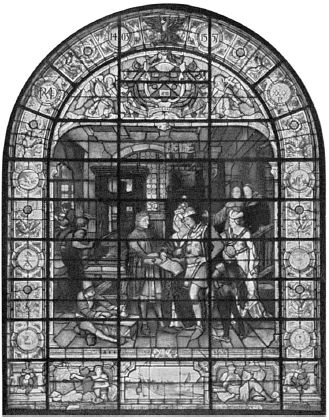
A stained-glass window of c. 1475 of William Caxton presenting his first printed page to King Edward IV and his queen, Elizabeth Woodville
Anthony Woodville sponsored the first ever published book in England, Chaucer’s Canterbury Tales, and in 1477 Caxton published Anthony Woodville’s own translation Dictes or Sayengis of the Philosophres (Sayings of the Philosophers). Caxton is said to have been surprised that Anthony did not include the traditional misogynistic complaints about women in the collection; perhaps we may see the influence of his redoubtable mother here also. Books from the Caxton press, including the Dictes, may have been given to the Prince of Wales, Edward, whose education was supervised by Anthony Woodville. Jacquetta’s daughter Elizabeth read the book in its early stages and suggested some editorial changes, and she may have been a patron of Caxton, commissioning him to translateThe Book of the Knight of the Tower.
This book has come into my hands at the request and desire of a noble lady who has brought forth many noble and fair daughters who have been raised and taught virtuously. Because of the great love she has always had for her fair children and still has, she wants them to know more about moral behaviour so that they may always be virtuous themselves. To this end, she has asked me to translate this book out of French into our common English so it may be better understood by all who shall read it or hear it read. Therefore at the lady’s request and according to the small skill that God has sent me, I have endeavoured to obey her admirable wish.
Perhaps the Woodville love of books and study can be traced down the generations to Henry VIII and his scholarly daughter Elizabeth I.
Jacquetta had another darker legacy: the accusation of witchcraft that was first made explicit when the Earl of Warwick changed sides in 1469 and plotted to execute her. Rumours against the foreign-born descendant of the water goddess almost certainly preceded this accusation; but it was Warwick who openly accused her of witchcraft, and Warwick who ordered the trial at which the prosecution produced the little images of lead and witnesses who swore that she was a witch. Jacquetta escaped the normal punishment of death by strangling or burning, and cleared her name when Edward returned to the throne. But the accusation was repeated after Edward’s death by his youngest brother. Richard III set aside the York children’s claim to the throne which he usurped, on the basis that the marriage of their parents – Edward IV and Elizabeth Woodville – was not legitimate, and that it had been brought about by magic. Though the marriage had been accepted by everyone for nearly twenty years, Richard accused his dead brother Edward of bigamously marrying Elizabeth in a false ceremony while he was already married to Lady Eleanor Butler. Richard’s claim was supported by Robert Stillington Bishop of Bath and Wells, but Lady Eleanor was, by then, dead. Richard also made the potent allegation that the marriage had been brought about by the magical craft of the witch Jacquetta and her daughter Elizabeth.
It was too good a story not to be repeated, and Jacquetta’s and Elizabeth’s reputations as seducers, social climbers and witches endure to this day. Like her mother, Elizabeth Woodville was slandered with accusations of magic, and linked to the legend of Melusina, the founder of the family of St Pol.
In conclusion, I have to wonder why the story of Jacquetta is so little known. I suppose that much of the history of this period is filtered through the pro-Tudor historians and their great playwright William Shakespeare. For them, the founding mother of the family had to be Margaret Beaufort, Henry VII’s mother, and not his mother-in-law Elizabeth Woodville. The histories of Elizabeth Woodville and her mother Jacquetta were neglected in favour of the more conventional founding mother: Margaret Beaufort, whose courage and determination put her son on the throne and whose political astuteness led her to manage the writing of their history, and the exclusion of the rival family.
I think also that the lives of Jacquetta and her daughter make uncomfortable reading for historians who find accounts of female power, female sexuality and female magic disturbing. The bland, censored and very conventional accounts of Lady Margaret Beaufort are a more acceptable view of medieval women than the history of these adventurous, sexually active, ambitious women. And so it gives me pleasure to offer this brief essay as a reference point for readers who have met and loved Jacquetta in my novel The Lady of the Rivers and also as a starting point for the historical studies of Jacquetta Duchess of Bedford that I hope will follow.
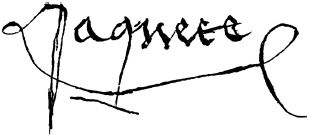
Jacquetta’s signature
NOTES AND SOURCES
The famous call to arms is from Shakespeare, Henry V, Act 3, Scene i. Joan’s threat to Bedford is cited in Warner, M. Joan of Arc: the image of female heroism, London: Weidenfeld & Nicolson, 1981.
The Glendower and Hotspur conversation is in Shakespeare, Henry IV, Part I, Act 3, Scene i. I am indebted to the owner of Penshurst, Viscount de L’Isle, for information about the building.
Jacquetta’s children are difficult to establish. I would suggest that she had fourteen pregnancies, of which thirteen children grew to adulthood. After lengthy discussions with David Baldwin in which we agreed principally that there is no definitive list (!) I would suggest this: Elizabeth, b. 1437, (Lewis, b. 1438, d. in infancy), Anne, b. 1439, Anthony, b. 1442, Mary, b. 1443, Jacquetta, b. 1444, John, b. 1445, Richard, b. 1446, Martha, b. 1450, Eleanor, b. 1452, Lionel, b. 1453, Margaret, b. 1454, Edward. b. 1455, Katherine (or Catherine) b. 1458.
The description of the trial of Eleanor Cobham and her associates is mostly drawn from Godwin, W. Lives of the necromancers: or, An account of the most eminent persons in successive ages, who have claimed for themselves, or to whom has been imputed by others, the exercise of magical power, London: F.J. Mason, 1834, and the very clear account by Jessica Freeman, ‘Sorcery at court and manor: Margery Jourdemayne, the witch of Eye next Westminster’, Journal of Medieval History, 30 (2004), 343–57. Shakespeare has a judgement scene with the king, Henry VI, taking part, though in fact he kept well away from proceedings: Henry VI, Part II, Act 2, Scene iii. Shakespeare thought it was Thomas Stanley, but it was, in fact, John.
The legend of the black dog which haunts Peel Castle and also Leeds Castle, where she was imprisoned, is still told: http://www.mysteriousbritain.co.uk/england/isle-of-man/legends/peel-castle.html. Margaret of Anjou’s gift records are interestingly analysed by Helen E. Maurer: Margaret of Anjou: Queenship and Power in Late Medieval England, Woodbridge: The Boydell Press, 2003.
The celebrated joke against the rising Rivers is cited in The Paston Letters, AD 1422–1509, ed. J. Gairdner, 6 vols, iii (1904), 204, William Paston to his brother John, 28 January 1460; the joke against the Rivers arriving in Calais is in Gregory’s chronicle, cited Griffiths, R.A. The Reign of King Henry VI, Stroud: Sutton, 1998. The account of the abuse of the Rivers family by the Yorkist lords was told in the Paston letters; quoted here is the modernised spelling version from Griffiths, R.A. The Reign of King Henry VI, Stroud: Sutton, 1998.
The description of Henry VI under the control of the Earl of Warwick as more timorous than a woman comes from the contemporary observer Francesco Coppini CMiLP, 1 61 cited in Griffiths as above. The death of the Earl of Salisbury is quoted by Wolffe, B.P.Henry VI, London: Eyre Methuen, 1981.
The details of Jacquetta’s trial for witchcraft are recorded by the court that cleared her, in the Calendar of Patent Rolls 1467–77. A new edition of The Knight of the Tower, the book requested by Elizabeth Woodville, has been published: Barnhouse, R. The Book of the Knight of the Tower: Manners for Young Medieval Women, Palgrave Macmillan, 2006.
BIBLIOGRAPHY
Amt, E. Women’s Lives in Medieval Europe, New York: Routledge, 1993
Baldwin, D. Elizabeth Woodville: Mother of the Princes in the Tower, Stroud: Sutton Publishing, 2002
Barnhouse, R. The Book of the Knight of the Tower: Manners for Young Medieval Women, Palgrave Macmillan, 2006
Bramley, P. The Wars of the Roses: A Field Guide and Companion, Stroud: Sutton Publishing, 2007
Castor, H. Blood & Roses: The Paston Family and the Wars of the Roses, London: Faber, 2004
Cheetham, A. The Life and Times of Richard III, London: Weidenfeld & Nicolson, 1972
Chrimes, S.B. Lancastrians, Yorkists, and Henry VII, London: Macmillan, 1964
Cooper, C.H. Memoir of Margaret: Countess of Richmond and Derby, Cambridge: Cambridge University Press, 1874
Duggan, A.J. Queens and Queenship in Medieval Europe, Woodbridge: The Boydell Press, 1997
Field, P.J.C. The Life and Times of Sir Thomas Malory, Cambridge: D.S. Brewer, 1993
Freeman, J. ‘Sorcery at court and manor: Margery Jourdemayne, the witch of Eye next Westminster’, Journal of Medieval History, 30: 343–57, 2004
Godwin, W. Lives of the necromancers: or, An account of the most eminent persons in successive ages, who have claimed for themselves, or to whom has been imputed by others, the exercise of magical power, London: F.J. Mason, 1834
Goodman, A. The Wars of the Roses: Military Activity and English Society, 1452–97, London: Routledge & Kegan Paul, 1981
Goodman, A. The Wars of the Roses: The Soldiers’ Experience, Stroud: Tempus, 2006
Griffiths, R.A. The Reign of King Henry VI, Stroud: Sutton, 1998
Grummitt, D. The Calais Garrison, War and Military Service in England, 1436–1558, Woodbridge: The Boydell Press, 2008
Haswell, J. The Ardent Queen: Margaret of Anjou and the Lancastrian Heritage, London: Peter Davies, 197
Hicks, M. Warwick the Kingmaker, London: Blackwell Publishing, 1998
Hipshon, D. Richard III and the Death of Chivalry, Stroud: The History Press, 2009
Hughes, J. Arthurian Myths and Alchemy: The Kingship of Edward IV, Stroud: Sutton Publishing, 2002
Jones, M.K., and Underwood, M.G. The King’s Mother: Lady Margaret Beaufort, Countess of Richmond and Derby, Cambridge: Cambridge University Press, 1992
Karras, R.M. Sexuality in Medieval Europe: Doing unto Others, New York: Routledge, 2005
Laynesmith, J.L. The Last Medieval Queens: English Queenship 1445–1503, Oxford: Oxford University Press, 2004
Levine, N. ‘The Case of Eleanor Cobham: Authorizing History in 2 Henry VI’, Shakespeare Studies 22: 104–21, 1994
Lewis, K., Menuge, N.J., and Phillips, K.M. Young Medieval Women, Stroud: Sutton Publishing, 1999
MacGibbon, D. Elizabeth Woodville 1437–1492: Her Life and Times, London: Arthur Baker, 1938
Martin, S. Alchemy and the Alchemists, London: Pocket Essentials, 2006
Maurer, E. Margaret of Anjou: Queenship and Power in Late Medieval England, Woodbridge: The Boydell Press, 2003
Neillands, R. The Wars of the Roses, London: Cassell, 1992
Newcomer, J. The Grand Duchy of Luxembourg: The Evolution of Nationhood, Luxembourg: Editions Emile Borschette, 1995
Péporté, P. Constructing the Middle Ages. Historiography, Collective Memory and Nation Building in Luxembourg, Leiden and Boston: Brill, 2011
Phillips, K.M. Medieval Maidens: Young women and gender in England, 1270–1540, Manchester University Press, 2003
Prestwich, M. Plantagenet England 1225–1360, Oxford: Clarendon Press, 2005
Ross, C.D. Edward IV, London: Eyre Methuen, 1974
Rubin, M. The Hollow Crown: A History of Britain in the Late Middle Ages, London: Allen Lane, 2005
Seward, D. A Brief History of The Hundred Years War, London: Constable, 1973
Simon, L. Of Virtue Rare: Margaret Beaufort, Matriarch of the House of Tudor, Boston: Houghton Mifflin, 1982
Storey, R.L. The End of the House of Lancaster, Stroud: Sutton Publishing, 1999
Thomas, K. Religion and the Decline of Magic, New York: Weidenfeld & Nicolson, 1971
Vergil, Polydore, and Ellis, Henry Three Books of Polydore Vergil’s English History Comprising the Reigns of Henry VI, Edward IV and Richard III, Kessinger Publishing Legacy Reprint, 1971
Ward, J. Women in Medieval Europe 1200–1500, Essex: Pearson Education, 2002
Warner, M. Joan of Arc: the image of female heroism, London: Weidenfeld & Nicolson, 1981
Weinberg, S.C. ‘Caxton, Anthony Woodville and the Prologue to the “MorteDarthur”’, Studies in Philology, Vol. 102, No. 1: 45–65, 2005
Weir, A. Lancaster & York: The Wars of the Roses, London: Cape, 1995
Williams, E.C. My Lord of Bedford, 1389–1435: being a life of John of Lancaster, first Duke of Bedford, brother of Henry V and Regent of France, London: Longmans, 1963
Wilson-Smith, T. Joan of Arc: Maid, Myth and History, Stroud: Sutton Publishing
Wolffe, B.P. Henry VI, London: Eyre Methuen, 1981, 2006