
David Baldwin

ELIZABETH’S EARLY LIFE
Elizabeth Woodville, the future ‘White Queen’, was probably born at Grafton in Northamptonshire in 1437 or early in 1438. We cannot be more precise because her parents’ whereabouts at the time of her birth are uncertain, and estimates of her age are based on a note added to a later portrait indicating that she was twenty-six when the original was painted in 1464. She was therefore almost certainly the eldest of the estimated fourteen children born to Sir Richard Woodville of Grafton and his wife, Jacquetta, Dowager Duchess of Bedford, a couple whose secret marriage in 1436 had surprised contemporaries almost as much as their daughter’s would outrage public opinion years later. Jacquetta, who had been married to John of Bedford, Henry V’s brother, and who ranked as England’s third lady after Henry IV’s second wife and Henry V’s widow, had been expected to give her hand to a great nobleman; and her choice of Sir Richard, a county knight with limited prospects, raised eyebrows in a society which thought that everyone should know his or her place.
Sir Richard was not without merit, however. His reputation as a soldier and jouster grew steadily in the early 1440s, and it would be unfair to assume that Jacquetta’s influence with Henry VI’s wife, Margaret of Anjou, was entirely responsible for his elevation to the peerage as Baron Rivers in 1448. The young couple could now enter fully into English noble society, but Jacquetta’s dower (her life interest in a third of her late first husband’s wealth) was steadily eroded by the loss of English-held lands in France at the end of the Hundred Years’ War and by the inability of the royal treasury to meet all the demands made upon it. Keeping up appearances and providing for a growing family on a reduced income was as problematic then as at any other time, and the young Elizabeth would have learned that money had to be spent carefully. Her surviving accounts indicate that she knew how to manage her finances, and her expenditure did not exceed her income even when queen.
What was life like for a young girl of good family growing up in the Northamptonshire countryside in the middle of the fifteenth century? Like most children, she probably found the regular religious services and polite formality tiresome (particularly when her parents were in attendance), but they were all part of learning how to conduct herself in a ‘proper’ manner. She would have been taught to ride and hunt – hunting was always a favourite pastime of the aristocracy – and her gentler accomplishments would have included needlework, dancing and perhaps singing. Medieval girls were not always well educated – the Paston Letters indicate that some young gentlewomen could barely sign their names – but Jacquetta was noted for her love of literature and her daughters may have fared rather well in this respect.
Long before Elizabeth reached marriageable age her parents would have concerned themselves with the question of whom she would marry. Local alliances were often forged in this manner, and it was agreed that she would wed John, son of Sir Edward Grey and his wife Elizabeth Lady Ferrers, a youth about five years her senior. She would not have been asked if she would like to marry John – her duty to her family came before her own personal feelings – and she was probably sent to live with her future husband and in-laws at Groby in Leicestershire some time before the wedding. The Tudor writer Thomas More thought that she was placed in service to Queen Margaret either now or later, but his ‘Elizabeth Grey’ was probably another lady with the same name. He may have confused Elizabeth with Margaret’s lady Isabella Grey (who was much older), or with an Elizabeth, the widow of Ralph Grey of Heaton, who was serving the queen in 1445.
We do not know when Elizabeth and John Grey were married, and references to the age of their eldest son, Thomas, are not very helpful. He is said to have been thirty-seven in 1492 in one document or thirteen in 1464 in another, and was therefore born either in 1455 or in 1451, when his mother would have been only thirteen or fourteen herself. This may seem unlikely, but Margaret Beaufort was only thirteen when she gave birth to her son, the future King Henry VII, and it may be another case of a marriage being consummated as early as possible. The Church held that a union was invalid unless both partners consented to it, and allowed children to opt out of whatever arrangements their parents had made for them when they reached puberty. Few did so in practice, but consummation effectively closed the window of opportunity and made the contract between the families secure.
The decade that Elizabeth spent as a young wife is all but lost to us, but her everyday life would not have been unlike that of other girls who found themselves in a similar situation. It is probable that she and John made their home on one of the Grey family’s subsidiary manors – perhaps Astley in Warwickshire or Bradgate in Leicestershire – and it was there that a second son, Richard, was born to them a few years later. Elizabeth would soon have become accustomed to giving instructions to servants and farm workers, and to planning ahead to ensure that her family was fed and clothed in all seasons. Most importantly of all, she would have taken John’s place when he was away on business or royal service, and dealt with disputes or anything that affected their joint interests. Such marriages may not have been founded on love – at least not to begin with – but they could be companionate and agreeable all the same.
These were some of the most peaceful – and perhaps also the happiest – years of Elizabeth’s life, but from time to time she would hear that there was trouble in high places and that the great men of the kingdom had come to blows. The first battle of the Wars of the Roses – at St Albans in 1455 – did not involve her husband, father or brothers directly, but they were almost bound to be drawn into the conflict as the situation worsened. We have already seen how, in January 1460, Lord Rivers, Jacquetta and their eldest son Sir Anthony were captured by the Earl of Warwick’s men at Sandwich, taken to Calais, and there given a thorough dressing-down by Warwick, the future Kingmaker, his father the Earl of Salisbury, and the Duke of York’s son, Edward Earl of March. Elizabeth would have been mortified when she learned of what had happened, but she could do nothing except hope that her parents’ and brother’s enemies would not harm them physically, and wonder whom she might ask to intercede for them. Warwick had given her cause to both fear and dislike him, and there would be other occasions as the years passed.
Elizabeth’s father had been a member of the peerage for twelve years by this time, a year longer than Warwick, and Anthony was shortly to marry the heiress to the barony of Scales. But the abuse hurled at them at Calais turned on the notion that they were upstarts who lacked the older, more dignified, nobility of their critics rather than on their ‘misguided’ loyalty to Henry VI. This was, of course, a year before this same Edward Earl of March was proclaimed king as Edward IV and four years before he married Elizabeth Woodville and became Lord Rivers’s son-in-law. It would be interesting to know if they ever reminded one another of the occasion, and smiled grimly at the irony of it.
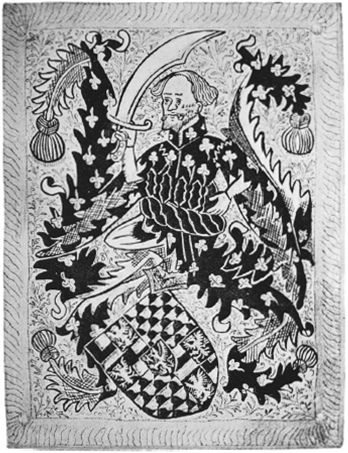
Garter Stall Plate of Richard Woodville, first Earl Rivers, Elizabeth’s father. St George’s Chapel, Windsor
Elizabeth was undoubtedly relieved when her parents and brother were released unhurt a little before or after the Yorkist victory at the battle of Northampton on 10 July, but worse was to follow. Her husband, Sir John Grey, was killed at the second battle of St Albans on 17 February 1461, and she found herself a widow with two young sons. John had led his servants and tenants to join Queen Margaret’s Lancastrian army as it moved southwards after its victory over the Yorkists at Wakefield in Yorkshire on 30 December, and it was almost certainly one of these men, breathless and dust-stained, who brought her the terrible news. The Earl of Warwick had deployed the southern Yorkist forces at St Albans, twenty miles from London, expecting an attack from the north, but Margaret and her commanders had surprised him by advancing from the northwest through Dunstable. Desertions had added to Warwick’s difficulties and he had been driven back and forced to abandon the battlefield, although not without a struggle that cost the lives of many loyal Lancastrians. John’s body would have been brought home and buried in the Grey family mausoleum at Astley, but no monument survives today.
We may suppose that Elizabeth tried to appear outwardly calm as the tired rider blurted out his story, but her thoughts would have been in turmoil. Life was bound to become more difficult, and her troubles multiplied when her mother-in-law, Lady Ferrers, attempted to recover three Grey family manors which her own late husband had settled on John and Elizabeth in 1456. Lady Ferrers feared that the properties would be all but lost to her if her daughter-in-law lived to a ripe old age or remarried; and although Elizabeth was able to establish her right to them it was unlikely to be the end of the matter. Disappointed litigants often resorted to threats and violence when the law ruled against them, and Lady Ferrers had greatly strengthened her hand by marrying Sir John Bourchier, a son of the Earl of Essex and King Edward’s aunt Isabel. There was a very real possibility that she would make the dispute an excuse to settle her family lands on her new husband and any children she might have by him (giving them priority over John and Elizabeth’s offspring), and Elizabeth turned to William Lord Hastings, King Edward’s viceroy in the Midlands, for help. On 13 April 1464 they signed an agreement by which Hastings promised to do what he could to ensure that her son Thomas’s right to inherit the estates was not frustrated, on condition that Elizabeth shared the profits with him and Thomas married his (as yet unborn) daughter. He drove what one historian has described as a ‘very hard bargain’; but his good offices were no longer needed when she married his royal master only eighteen days later on 1 May.
It would be fascinating to know when and where Edward and Elizabeth first met, and how long they had been romantically involved with each other. Stories of a handsome young king’s liaison with a beautiful, older widow were bound to grow with the telling, and we will probably never know if the ‘Queen’s Oak’ ever spread its branches over them, or if they really were married on May Day. What is clear, however, is that the speed of events must have surprised even Elizabeth, since she would not have sought Hastings’s assistance (or anyone else’s for that matter), if she had known she was about to become Queen of England. She may have felt that she could not abruptly terminate her negotiations with him without arousing suspicion: but the indications are that this was the briefest of courtships; in one author’s words, ‘the impulsive love match of an impetuous young man’.
Lord Rivers had been forgiven his allegiance to Lancaster and had become a member of the Yorkist royal council, so it is likely that King Edward would have visited Grafton when, from time to time, he journeyed northwards to mop up pockets of resistance. Elizabeth had returned to her family home after her husband’s death, and would have been able to speak to him on one of these occasions without having to waylay him in a forest. Edward always had a roving eye for a pretty girl, and probably assumed that if he spoke kindly to her she would become his mistress. Any rejection of his advances would have only increased his determination to have her, and Jacquetta, wise woman that she was, would have readily appreciated how the royal passion could be turned to her daughter’s – and indeed, her whole family’s – advantage. The chroniclers record that she was the only family member present when they were secretly married at Grafton, and that she brought Elizabeth to Edward’s bed (without, apparently, even her husband knowing of it), whenever he happened to be in the vicinity. Concealment was dangerous in that the validity of a private, clandestine wedding could always be challenged later, but it was a risk she had to take.
The king’s choice of bride – a widow with two sons whose family had fought against him – would have raised a few eyebrows even in the twenty-first century, but to contemporaries it was both startling and illogical. A ruler could have affairs with attractive ladies who took his fancy, but his marriage was an entirely different matter. A foreign-born queen would bring with her a large dowry and the expectation of an alliance with her native country, advantages that would both be lost if the king defied convention by marrying one of his own subjects. Edward’s councillors reasoned that he would not have put his private feelings before his duty to his country unless his normally good judgement had been affected by witchcraft or another malign influence. It was a slur that would haunt Elizabeth for the rest of her days.
ELIZABETH AND THE KINGMAKER
Edward kept his marriage secret for as long as he could, only revealing it to his startled courtiers after five months of subterfuge. When the council met at Reading Abbey in September 1464, he was asked to confirm that he would marry a high-born French lady, and had to admit that he was married already. No chronicler described the scene – perhaps the anger was too palpable – but however much the assembled nobles and prelates disliked the arrangement they could do nothing about it. The king was not obliged to marry in public or give his advisers prior notice of his intentions; and Warwick’s close associate John Lord Wenlock spoke for many when he remarked ‘we must be patient despite ourselves’.
These men might look down on Elizabeth and bemoan missed opportunities, but Edward’s choice was not entirely without merit. Her ability to fulfil her new role would only become apparent later, but no one could deny that she was beautiful (in an age when beauty was associated with goodness), or that she was likely to give her new husband an heir. Her father’s comparatively humble origins were, arguably, compensated by her mother’s descent from the House of Luxembourg, and her Lancastrian antecedents sent a clear message to Henry VI’s supporters that they too had a place in the new Yorkist England. Edward had broken with convention because he loved Elizabeth, but perhaps he was not as heedless of the consequences as some thought.
A more serious disadvantage was that, by marrying Elizabeth, Edward had effectively made himself responsible for her large family. No self-respecting king could allow his wife’s relatives to live in genteel poverty, and many of her five surviving brothers, seven sisters, and the two sons of her first marriage had to be promoted or found marriage partners of appropriate status. Margaret, who is sometimes described as her eldest sister, was married to Thomas Lord Maltravers, the Earl of Arundel’s heir, in October 1464, and their siblings Anne, Joan, Jacquetta and Mary were all wed or betrothed to the sons of senior noblemen within the next two years. Her father Lord Rivers was appointed to the lucrative office of Treasurer before being created an earl, and in October 1466 Elizabeth bought the marriage of the heiress of the Duke of Exeter for her eldest son Thomas. Anthony, her eldest brother, was given the lordship of the Isle of Wight, while Lionel, one of the younger members of the brood, was fast-tracked to high office in the Church.
The problem, of course, was that lords who had hoped to secure these and other positions and marriages for their own sons and daughters were disappointed, and some were positively outraged when King Edward allowed Elizabeth’s brother John, who was aged about twenty, to marry the sixty-something Dowager Duchess of Norfolk. This was an age in which impoverished young men often made their fortunes by marrying rich widows, but the arrangement so offended contemporary sensibilities that the chronicler was moved to describe it as a maritagium diabolicum (no translation needed!). In the event, John was executed in 1469, and so the already thrice-married duchess outlived him too.
The Dowager Duchess of Norfolk was the Earl of Warwick’s aunt, and Warwick had every reason to feel aggrieved at the way in which Edward and Elizabeth’s schemes had affected his plans for his own family. He had hoped to secure the Exeter heiress for his nephew (he had no son), and was further disappointed when the young Duke of Buckingham, whom he regarded as a potential husband for his elder daughter, Isabel, was married to Elizabeth’s sister Katherine. Matters were not improved when King Edward refused to allow Isabel to marry his own brother and heir apparent George Duke of Clarence and then rubbed salt in the wound by depriving Warwick’s brother George Archbishop of York of the chancellorship. Warwick had always favoured a French alliance, and Edward’s decision to wed his sister Margaret to Charles Duke of Burgundy (the King of France’s enemy and Elizabeth’s continental relatives’ overlord), was, in the opinion of the well-informed Croyland chronicler, the last straw.
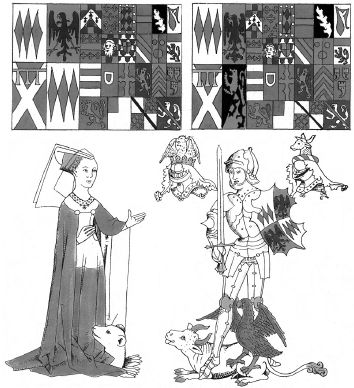
Richard Neville, Earl of Warwick, the ‘Kingmaker’, and his wife Anne Beauchamp, from The Rous Roll
Edward had been a mere nineteen-year-old stripling when Warwick had promoted his successful bid for the throne in 1461, and was bound to become increasingly his own man as he grew in confidence. It was almost inevitable that monarch and minister would sometimes favour different policies, but what irked Warwick was the fact that he had made Edward king while the upstart Woodvilles – who now enjoyed his favour – had been fighting for Lancaster. Elizabeth was only indirectly responsible for her husband’s decisions and could not be blamed for being part of such a large family, but the fact remained that if she had not married Edward few, if any, of these things would have happened. The king’s fool might jest that the Rivers had become so high that he could not ‘scrape’ through them, but Warwick would not have been amused.
Warwick swallowed hard, even helping to escort Edward’s sister Margaret to Margate, from where she was to embark for her marriage to Charles of Burgundy, but he had probably already decided to bring his royal master to heel. The Middle Ages had no concept of what we today call ‘loyal opposition’ – no permitted mechanism by which a subject could seek to frustrate royal or ‘government’ policy – and so he had to tread carefully, working through proxies he could disown in the event of failure. The popular uprising known as Robin of Redesdale’s rebellion, which broke out in Yorkshire in June 1469, was led by men loyal to the Nevilles, and seemed initially to accomplish its purpose. Warwick seized the opportunity to marry his daughter Isabel to George of Clarence, and Edward, who was then at Nottingham, told Elizabeth’s father and brothers to make a run for it shortly before the main royal army was defeated at Edgecote, near Banbury. He knew only too well that the Woodvilles would bear the brunt of the rebels’ anger, and would have been more saddened than surprised when he learned that Earl Rivers and his son John had been hunted down and executed on Warwick’s orders. No legal process is recorded, presumably because capital charges could not be brought against them when they were loyal to a king whom Warwick himself still recognised. It was an act of private vengeance on the earl’s part.
Elizabeth was at Norwich when she heard that King Edward had been taken into ‘protective custody’ by Archbishop George Neville at Olney in Buckinghamshire, and learned of the deaths of her father and brother. The wars had again turned her life upside down, and there can be little doubt that henceforward she regarded Warwick and his new son-in-law George of Clarence (her own brother-in-law) as her mortal enemies. She would have spent many sleepless nights wondering what the future held for her family – what would happen to them if, in the worst-case scenario, her husband was forced to reject her as the price of keeping his throne – but found that she had less to fear than she expected. Warwick soon realised that he could not rule through Edward – few would accept orders that did not come from the king personally – but he was not held to account when he released him and allowed him to return to his capital. On the contrary, Edward was at pains to placate the Nevilles, even betrothing his eldest daughter to Warwick’s nephew, and Elizabeth would have been obliged to receive them at court and smile as though nothing had happened. Her private feelings would have all but overwhelmed her, but public duty came first.
Warwick had eliminated some of his rivals, but found that the episode had not improved his ability to change the king’s policies or influence his choice of ministers. His thoughts began to turn towards replacing Edward with George, and in March 1470 he stirred another uprising, this time in Lincolnshire. Edward did not immediately suspect treason and even asked Warwick and George to raise troops to help deal with the trouble; but they could not deny their involvement after the leaders of the Lincolnshire men were routed at ‘Losecote Field’ – so called because the rebels discarded their heavy padded jackets as they ran for safety – and confessed that the earl and his son in-law were the ‘partners and chief provokers of all their treasons’. The scheming pair accepted that they had lost this round of the contest, but rebuffed King Edward’s offers of pardon. They fled to France, leaving Elizabeth with the satisfaction of knowing that her husband would not readily trust them again.
The king and queen hoped that the troublemakers’ departure signalled an end to their problems, but they were soon to be disillusioned. In France, Warwick and George were reconciled with the exiled Lancastrian queen, Margaret of Anjou, and agreed to help her restore her imprisoned husband, King Henry, to the throne. King Edward was away in the north when the rebel lords returned to England on 13 September, and found that he had no answer to their popularity. Warwick was able to pose as a ‘leader of the opposition’ to a government that had spent nearly a decade disappointing its subjects, and the desertion of his brother John Neville (whom the king had continued to trust) proved devastating. Edward and a few loyal friends made a dash across Lincolnshire, narrowly escaping drowning in the Wash before commandeering several fishing boats they found at Lynn. Their little flotilla was chased by hostile ships but managed to reach the friendly coast of Holland where the king, who had no money with him, rewarded the master of his vessel with a fine furred gown. Warwick took charge of the government, and the hapless Henry VI was brought out of the Tower of London to resume his long-interrupted ‘reign’.
When news of Warwick’s return reached Elizabeth in London, she began to provision the Tower to withstand a siege, but abandoned the stronghold when it became apparent that the situation was hopeless. She was eight months pregnant and afraid that Warwick’s men would force the Westminster sanctuary where she took refuge with her mother and three young daughters; but the Kingmaker ordered that all such places were to be respected and her first son by Edward was safely delivered there on or shortly after 1 November. In normal circumstances, a person claiming sanctuary had forty days to surrender to the authorities or leave England, but no pressure seems to have been brought to bear on Elizabeth. She was allowed to receive gifts of food and other essentials from the abbot and from sympathetic Londoners; the new government paid Elizabeth Lady Scrope £10 to ‘attend’ (presumably to supervise) her; and she could anticipate an occasional, smuggled, letter from her husband. Boredom would have been her worst enemy, but she was with her mother and her young children and was not unused to looking after herself and coping with difficult situations. Perhaps she found the cramped conditions less irksome than if she had been a high-born princess.
Elizabeth could not have anticipated how long she would have to remain in the sanctuary or what might, or might not, become of her. Her rival, Queen Margaret, had spent many years as a fugitive and in exile before the opportunity to reclaim her throne presented itself, and Elizabeth too could do nothing but wait and hope that somehow her husband would be able to regain the initiative. King Edward returned to England with some men and equipment supplied by Duke Charles, his sister Margaret’s husband, on 14 March 1471, and found that luck, and boldness, favoured him. He gained access to York by claiming (implausibly) that he had come only to reclaim his father’s duchy, and found that neither of Warwick’s two northern armies seemed inclined to intercept him. Henry Percy, who commanded one of them and whom Edward had restored to his forfeited earldom of Northumberland less than a year earlier, had already been asked to at least remain neutral, and the uncertainty seems to have affected his supposed ally John Neville, who decided not to intervene until Percy’s attitude became clearer. Unchallenged, Edward marched southwards gathering troops as he went, and on 3 April was formally reconciled with his brother George of Clarence. Warwick’s new-found commitment to the House of Lancaster had effectively destroyed George’s hopes of becoming king himself one day, and the chronicler describes how his mother, sisters, and some leading churchmen joined forces to persuade him that his future lay with his Yorkist brothers. When Edward met him on the Banbury road there was ‘right kind and loving language betwixt them’ and their two armies became one.
The Earl of Warwick shut himself up in Coventry and refused to fight until reinforcements arrived, so Edward struck out for London, partly to reclaim his capital but also to rescue his wife and new-born son. In the words of the chronicler he
then went to the Queen and comforted her that had a long time abiden and sojourned at Westminster, assuring her person only by the great franchise of that holy place, in right great trouble, sorrow and heaviness, which she sustained with all manner patience that belonged to any creature, and as constantly as hath been seen at any time any of so high estate to endure; in the which season nevertheless she had brought into this world, to the King’s greatest joy, a fair son, a prince, where with she presented him at his coming, to his heart’s singular comfort and gladness.
Elizabeth’s relief must have been considerable, but next day, Good Friday, the royal couple were informed that Warwick and the hitherto uncertain John Neville were advancing southwards. Leaving his wife in London, Edward drew up his forces at Barnet on the Saturday evening, and next day – Easter Sunday, 14 April – won a stunning victory over his old mentor. A mist that concealed his own movements caused confusion in the ranks of his enemies, and his smaller army overcame the greater numbers ranged against it. Warwick and John Neville were both killed, the former as he tried to escape, and their lifeless bodies were displayed publicly at St Paul’s.
The rest of the story can be briefly told. Queen Margaret only landed in England on Easter Sunday, and was devastated when news of Warwick’s defeat at Barnet was brought to her. Edward lost no time in setting off in pursuit of the new army her friends were raising in the West Country, and after covering thirty-six miles in one period of twenty-four hours (twice as fast as an army normally marched), cornered her at Tewkesbury on 3 May. Next day he destroyed her forces and killed her son, the Lancastrian Prince Edward, but Elizabeth would have been unaware of this when the ‘Bastard of Fauconberg’, a natural son of Warwick’s late uncle Lord Fauconberg, raised the standard of rebellion in Kent and threatened London. Her brother Anthony (now Earl Rivers) drove Fauconberg’s men back from the Tower, where she was living, and held out until reinforcements from the king’s army reached the capital, but the danger had been all too real while it lasted. If the counter-attack had faltered she was, in the words of a contemporary, ‘likely to stand in the greatest jeopardy that ever she stood’.
Edward’s return to London and Henry VI’s convenient ‘death’ a day or so later brought what was undoubtedly the most dramatic and often fearful period of Elizabeth’s life to a conclusion. She had no genuinely powerful foreign relatives who would shelter her (another disadvantage of her being her husband’s subject), but her apparent stoicism in remaining in England throughout the troubles only added to her growing reputation. The Speaker of Parliament, William Alyngton, ‘declared before the King and his noble and sad [serious] council, the intent and desire of his commons, especially in the commendation of the womanly behaviour and the great constancy of the Queen, he being beyond the sea’. There were many who had thought her unsuited to be Edward’s wife seven years earlier, but no one, it seems, questioned her fitness now.
ELIZABETH THE QUEEN
Alyngton did not say in so many words what he meant by ‘womanly behaviour’, but he was almost certainly referring to the birth of the young prince, christened Edward after his father. Elizabeth may have disappointed her husband by giving him only daughters in the early years of their marriage, but she more than made up for it by producing two more sons (as well as four more daughters) in the course of the 1470s and 1480. Neither Margaret (b. 1472) nor George (b. 1477) was destined to live long, and Mary (b. 1467) died aged fourteen; but the seven children who survived their father seemed more than enough to secure the future of the dynasty. They included Henry VII’s future queen, Elizabeth of York (b. 1466), and Richard (b. 1473), who would become the younger of the ‘Princes in the Tower’.
King Edward had loved Elizabeth as his consort in the early years of their marriage, but after 1471 treated her increasingly as his partner in government. She became the effective head of her son Edward’s council when he was created Prince of Wales in June 1471 (the subcommittee managing his day-to-day affairs was charged to act ‘with the advice and express consent of the Queen’), a task she fulfilled until the child was given his own household at Ludlow in the Welsh Marches twenty months later. Even then she accompanied him to his new home (where he was to be supervised primarily by her brother Anthony), and became one of the three people entrusted with a key to his coffers. It is also significant that when the king embarked on his abortive invasion of France in 1475 he named her the principal executor of his will if he failed to return. She was to take the leading role in arranging their daughters’ marriages, and was given wide-ranging powers to dispose of his goods.
Elizabeth and her brother have been accused of persuading King Edward to allow them to turn Wales into a kind of family fiefdom, but there is no real evidence that this was the case. There were almost bound to be occasions when Anthony issued instructions under his own seal or associated his nephew with them as an afterthought (such actions merely reflected the actuality of the situation), and only a fool would have shunned the opportunity to employ or reward his own followers. The prince’s council was not ‘packed’ with Woodville nominees as some have suggested, and although Elizabeth and Anthony were in a majority among the key-holders there is no indication that they used the boy’s money for their own purposes. On the contrary, there were occasions when Anthony paid bills himself.
We have seen how anything that worked to the Woodvilles’ advantage was almost certain to be at the expense of others, and Thomas Grey, Elizabeth’s eldest son by her first marriage, faced similar criticisms when he was created Marquis of Dorset and given particular responsibilities in the West Country. Thomas seems to have fulfilled his new role adequately – at least there is no hint that the situation there deteriorated during his period of office – but his promotion would have been regarded as yet another example ofWoodville aggrandisement in some quarters. The reality was that Anthony, the future king’s uncle, and Thomas, his half-brother, were almost bound to be given senior positions in the world that was a-making, but – again – none of this would have happened if Elizabeth had not become queen.
Thomas Grey’s claim to the Exeter estates had lapsed when his first wife had died childless within a year of their marriage, but in 1474 Lord Hastings allowed him to marry his stepdaughter Cecily Bonville, heiress to the West Country baronies of Bonville and Harrington. It is likely that Elizabeth had cajoled her husband to persuade Hastings, his great friend, to enter into this agreement with her, and this time there were to be no slip-ups. If Thomas died before the wedding his brother Richard was to marry Cecily to preserve the contract, and Elizabeth was to recoup the £2,500 she undertook to pay Hastings by collecting the revenues of the Bonville and Harrington properties until her daughter-in-law reached the age of sixteen. It is worth noting that ten years had passed since she had last agreed that Thomas should marry into the Hastings family (when, as a frightened widow, she had sought protection shortly before her own wedding to King Edward), and that this time the bride was not to be Hastings’s (landless, and then unborn) daughter but his wealthy stepdaughter. She was negotiating from a position of strength.
Elizabeth and the Woodvilles may well have seized every opportunity to promote their own interests, but their machinations hardly compare with those of the king and his two brothers, George of Clarence and Richard of Gloucester. Richard married Anne Neville, Warwick’s younger daughter, in 1472, and immediately demanded half the inheritance that George had assumed would fall to him as the husband of her elder sister Isabel. Neither was willing to make concessions, and a further complication was that many of the lands the Kingmaker had held would only descend to Isabel and Anne in time, if ever. The Beauchamp-Despenser estates of the widowed Countess of Warwick would not pass to her daughters until she herself died, and Warwick had entailed (‘settled’) his northern Neville lands on George, his brother John’s son, the boy who had been betrothed to the king’s daughter. Edward finally settled the matter by barring George Neville’s claims and by declaring the Countess of Warwick to be legally dead – so that her daughters and their acquisitive husbands could inherit her properties without having to wait for her to die naturally! This was manifestly unjust, but there is every indication that the brothers would have resorted to armed conflict if the king had not found a solution that benefited them both.
Elizabeth’s next major role, after bearing her husband’s children, was to be at his side on great state occasions and participate in the ceremonies in an appropriate manner. Documents describing several of these royal gatherings have survived from the 1470s, and show her fulfilling her duty as impeccably as any woman born into the purple. When Louis de Gruthuyse, who had sheltered King Edward during his exile in Holland, was invited to England and created Earl of Winchester in September 1472, Elizabeth, we are told, ‘ordered a great banquet . . . with abundant welfare . . . in her own chamber’. No expense was spared to make the guest of honour feel welcome and comfortable, and the after-dinner entertainment included dancing by some of the greatest in the land. When all was finished, the king and queen escorted Louis to ‘three chambers of pleasance all hanged with white silk’, and to a bed ‘of as good down as could be thought . . . as for his bed sheet and pillows they were of the Queen’s own ordinance’. Elizabeth had as much reason to be grateful to him as her husband, and her thoughtful touches complemented the greater honour only Edward could bestow.
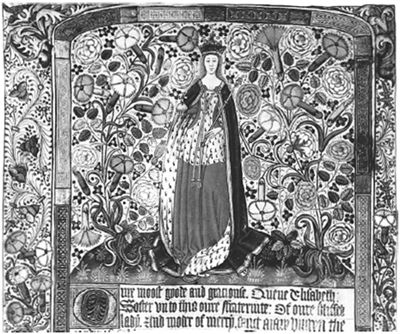
Elizabeth Woodville portrayed in her coronation robes as a member of the London Skinners’ Company’s Fraternity of Our Lady’s Assumption, probably c. 1472. The legend reads: ‘Oure moost goode and graciouse Quene Elizabeth, Soster unto this oure Fraternite of oure blissed Lady and Moder of Mercy Sanct Mary Virgyn the Moder of God’
In 1476 King Edward decided to rebury the remains of his father, Richard Duke of York, and brother Edmund with greater respect than they had received after their deaths at the battle of Wakefield sixteen years earlier. The bodies were exhumed from their original graves in Pontefract in Yorkshire and brought south to the Yorkist mausoleum at Fotheringhay in Northamptonshire, where elaborate tombs had been prepared for them. Richard Duke of Gloucester headed the cortège accompanied by other peers, bishops and heralds, and ensured that his father and brother were appropriately honoured at each stage of the journey. A lifelike effigy of the duke with a white angel holding a crown behind – or over – his head to symbolise that he had been king as of right, was placed over his black-draped coffin, and the hearses were ceremonially guarded at each place they stopped for the night. When they arrived at Fotheringhay on 29 July they were met by Edward, who respectfully kissed his father’s image before it was received into the church by the assembled clergy. The appropriate obsequies were observed, after which Lord Hastings, on behalf of the king, and Lord Dacre of the South, acting for Elizabeth, laid seven and five pieces of cloth of gold over the body in the form of a cross.
Next day the numerous dignitaries attended a mass of requiem at which the duke’s regal status was again emphasised. Walter Lord Ferrers of Chartley rode a black-trapped warhorse displaying the royal arms of England to the choir entrance, after which Edward offered his mass-penny and bowed to the catafalque followed by Elizabeth and their two eldest daughters. The queen was dressed all in blue (the royal colour of mourning) ‘without a high headdress’, and, in the words of a contemporary, ‘made a great obeisance and reverence to the said body’. After the burial the royal party repaired to a ‘village’ of canvas pavilions where they fed a large number of people (our author claims 20,000), and gave alms to all who asked for them. The guests who partook of the royal munificence could not fail to be impressed by the king’s generosity and his ability to command.
The third great ceremonial occasion of the decade took place on 15 January 1478 when the king and queen’s second son Prince Richard was married to the Lady Anne Mowbray, the late Duke of Norfolk’s heir. The bride was conducted from the queen’s chamber at Westminster to St Stephen’s Chapel by the Earl of Lincoln (King Edward’s nephew), Anthony Earl Rivers, ‘and many ladies and gentlewomen’. Edward, Elizabeth, three of their daughters and the king’s mother awaited them, seated beneath a canopy of cloth of gold, and listened patiently while a papal bull was read permitting the young couple to marry even though they were related within the prohibited degrees. Afterwards, Richard of Gloucester ‘cast gold and silver among the common people’, and a great banquet was followed a week later by a tournament in which Anthony, Elizabeth’s two sons from her first marriage, and her youngest brother Sir Edward Woodville all participated. It confirmed the strength of the ruling dynasty, and emphasised the prominence of the Woodvilles in its midst.
Prince Richard was only four when he wed his five-year-old bride, and was left a widower less than four years later at the tender age of eight. The aim, of course, had been to secure the Norfolk estates for the royal family, and King Edward had already ensured that they would not revert to Anne Mowbray’s own relatives in the event of her death. In a move reminiscent of his deprivation of the Countess of Warwick he arranged for parliament to give his son a life interest in the inheritance which would then pass to any children he might have by another wife. The two co-heirs, John Lord Howard and William Viscount Berkeley, were bound to be disappointed, and although Howard did not protest openly (unlike Berkeley), he must have felt that his many years of service to the House of York had been poorly rewarded. It is hardly surprising that he supported Richard of Gloucester’s bid for the throne in 1483.
It would be easy to assume that now Elizabeth was queen she could spend without worrying about where the money came from, but King Edward was determined to restore the Crown’s solvency after the extravagances of Henry VI’s reign. The lands granted her on her accession yielded approximately £4,500 per annum, and she was almost certainly told that her expenses must not exceed this figure. Only one account survives – for 1466–7 – but her surplus of £200 for that year contrasts strikingly with Margaret of Anjou’s ‘loss’ of £24 (after spending over £7,500), in 1452–3. There were some extravagances – £14 10s. spent on sable furs and £54 on goldsmith’s wares, for example – but the overriding impression is that she managed with a smaller staff than her predecessor and reduced fees and household expenses whenever she could.
Some commentators have suggested that Elizabeth was not personally interested in everyday economics, and that her treasurer John Forster was responsible for the careful budgeting that characterised her accounts in 1466–7. Professor Myers thought that ‘there is no reason to suppose that she understood finance beyond the usefulness of money for gratifying her desires’, but it seems unlikely that senior servants like Dr Roger Radcliff, her chancellor, and John Dyve, her attorney-general, could have had their fees reduced unless the queen had been personally involved in the process. Medieval aristocrats were more inclined to exact the last penny than to be careless of their income and expenditure, and it would not be surprising if Elizabeth checked her accounts in the same way that we know her son-in-law Henry VII checked his. Forster may have been charged with balancing the books on a day-to-day basis, but is unlikely to have done as he wished.
Like other aristocratic ladies, Elizabeth had her own household which was quite separate from that of her husband and which was staffed by her own officers. Her chamberlain was himself a peer, her ladies-in-waiting were usually the wives or relatives of knights and noblemen, and her council included not only her senior employees but also greater men whose influence and advice she valued. Her estates, concentrated as they were in particular regions, meant that she was bound to be regarded as the local ‘good lady’ in these areas, and expert guidance in matters such as dispensing patronage (minor offices and cash annuities), maintaining values, and settling disputes would have been essential. She could – and did – delegate much of this work to others, but the ultimate responsibility was hers alone.
Intercession had long been a part of medieval queenship, and Elizabeth would have received a stream of petitions from both corporate bodies and individuals who thought that they would gain more by approaching her than by going directly to the king. Queens were traditionally kind-hearted and sympathetic towards their subjects, and were expected to use their influence with their husbands to win concessions or right wrongs that would not have been addressed in other circumstances. The requests she received from corporate bodies included one from the city of Coventry in 1474 and another from the Merchant Adventurers four years later. She and her son the Prince of Wales had been well received in Coventry in April (even though it was a former stronghold of Warwick the Kingmaker), and the citizens appealed to her when one Reginald Buckley, a servant of her husband, caused trouble there a few months later. She told them to imprison Buckley until Edward could deal with him, and assured them that, in the meantime, she would speak to the king personally. No more is heard of the matter, and she was presumably as good as her word.
The Merchant Adventurers found themselves in difficulty when the tonnage and poundage they owed to the Crown fell into arrears and they were ordered to pay £2,000. Attempts to persuade the Exchequer to rescind or defer part of the debt were unsuccessful, and they asked the Marquis of Dorset, Lord Hastings and Elizabeth, for help. Hastings advised them to direct their main suit to Elizabeth (although he would do what he could to assist also), and at a meeting of the company ‘court’, or assembly, held on 8 January 1479 they were informed that ‘it hath pleased the Queen’s good grace so to labour and pray for us unto the King’s grace that at the instance of her prayer, of the said £2,000 is released 500 marks [£333 6s. 8d.]’. A second 500 marks was cancelled three days later, and they were required to pay only two-thirds of the original sum.
It is not, perhaps, particularly surprising to find powerful interest groups approaching Elizabeth, but ordinary people also sought her assistance when more conventional means of obtaining redress failed. One such petitioner was the Norfolk gentleman Simon Bliaunt who complained to her that Sir John Paston was ignoring his better title to the manor of Hemnals in Cotton and was refusing to surrender it to him. The Earl of Oxford, who was dominant in that part of East Anglia, had promised to appoint arbitrators and to reinstate Bliaunt if they failed to reach a decision by Easter 1467; but Oxford was on good terms with the Pastons and showed no inclination to expel his clients. Elizabeth could have taken the view that Bliaunt was a ‘nobody’ whose difficulties were beneath her attention, but far from ignoring the matter she wrote to the earl in no uncertain terms telling him she ‘marvelled’ that he had not honoured his undertaking. ‘Wherefore we desire and pray you that you will, at the contemplation of these our letters, show unto the said Simon all the favourable lordship that you goodly may, doing him to be restored and put into his lawful and peaceable possession of the same [manor], as far as reason, equity and good conscience shall require, that he may understand himself to fare the better for our sake, as our very trust is in you.’ Again, the end of the story is missing, but Oxford presumably obeyed!
Sir John Paston found himself on the wrong side of the argument on this occasion, but two years later had occasion to seek Elizabeth’s assistance on behalf of his own family. His late father had greatly improved their fortunes by persuading the wealthy but childless knight Sir John Fastolf to make a new deathbed will leaving him all his properties, but his gain had made enemies of a number of powerful figures (not least the Dukes of Norfolk and Suffolk), who had themselves expected to share in the inheritance. John’s only hope was to find someone as powerful as, or preferably more powerful than, his opponents who would intercede for him, and it was for this reason that ‘at the special request of the Queen’, he appointed John Yotton, one of her chaplains, to a sinecure at Caister Castle. Elizabeth was one of the few people in England who could stand up to the dukes, but even she did not presume to order them directly. Instead, she wrote to their wives, asking them to speak to their respective husbands and to let them know her mind in the matter. Such a move was unlikely to change attitudes, but it was a way of warning Norfolk and Suffolk that they could not simply do as they pleased.
Elizabeth’s ability to intervene successfully in these matters owed a great deal to her personal relationship with her husband. She could only seek favours on behalf of others if she was on good terms with him, and this cannot always have been easy. King Edward was notorious for his voracious sexual appetite, and had affairs both before and during his marriage. Thomas More remarked that ‘he was of youth greatly given to fleshly wantonness, from which health of body, in great prosperity and fortune, without a special grace hardly refraineth’, while Dominic Mancini’s comment that ‘he had been most insolent to numerous women after he had seduced them, for, as soon as he grew weary of dalliance, he gave up the ladies much against their will to the other courtiers’, implies that he changed little as he grew older. The King of France, Louis XI, once invited him to Paris, and told him jocularly that ‘if he would come and divert himself with the ladies, he would assign him the Cardinal of Bourbon for his confessor, who he knew would willingly absolve him . . . for he knew the cardinal was a jolly companion’!
Elizabeth must have been aware of these liaisons, but she did not allow them to sour her relationship with her husband. Words there may have been, but she continued to bear him children throughout their life together – Bridget, her last daughter, was born in November 1480 when she was forty-three – and there is no evidence that his trust in her ever diminished. No self-respecting medieval king would admit to changing his attitude or his policies because his wife asked him to, but there are hints that Edward could be far less forgiving on occasions when they were apart and Elizabeth was unable to influence him. He was justifiably angry that a number of nobles and knights – including some he had thought were his friends – fought against him at the battle of Tewkesbury, but to have a dozen of them dragged from the sanctuary of the nearby abbey and beheaded after the merest formality of a trial was as shocking as it was unprecedented. We cannot be sure that he would have behaved differently if Elizabeth had been present and able to calm him; but there is a striking contrast between this and his considered and sometimes markedly affable demeanour on other occasions. It would be fascinating to know how much real power Elizabeth, and other medieval queens, actually wielded behind the scenes.
There is one other aspect of Elizabeth’s queenship we have not so far dealt with, namely her obligation to give small sums of money to deserving subjects who found themselves in financial difficulties. All direct evidence that would have allowed us to see her at work in this capacity has long since perished, but it can be glimpsed in a single surviving privy-purse account recording gifts made by her daughter Queen Elizabeth of York. The younger Elizabeth was approached by various individuals who were in some way acquainted with her or who lived near to Richmond Palace, where she was then residing, and who often brought her small presents in anticipation of her willingness to help them. Two poor women who brought gifts of apples and butter to the queen were given twenty and eight pence respectively, and twenty pence was given to ‘a poor man in [an] almshouse sometime being a servant of King Edward IV’. Both William Pastone, a page of the queen’s beds, and Leonard Twycross, who served the apothecary John Grice, were helped to buy their wedding clothes, while Nicholas Grey, clerk of the works at Richmond Palace, was compensated with sixty shillings when his house caught fire. A friar was given eight shillings ‘for the burying of the men that were hanged at Wapping Milne’, a girl about to enter a convent was provided with a dowry, and Christopher Plummer was reimbursed twenty-three shillings for ‘money by him given in alms for the Queen at divers times in her journeys’. Elizabeth of York would have been regarded as a good and gracious lady by those she assisted, just as her mother would have been blessed by those who approached her and went away happy. In such ways were reputations made.
ELIZABETH THE WOMAN
We have seen something of how Elizabeth responded to the demands and responsibilities of queenship, but can we tell what she was like as a person? Modern historians have alleged that she indulged in feuds, behaved meanly towards those who displeased her, and was careless of others’ welfare, but much of their evidence is open to interpretation. One charge that can be dismissed quite easily is that she plotted the execution of the Irish Earl of Desmond who had dared to suggest to King Edward that it was still not too late for him to reject her and marry a well-connected foreigner. This appears to be no more than a ‘family tradition’ first mentioned by the earl’s grandson in Henry VIII’s reign, and although Desmond was beheaded there were sound political reasons for his downfall. Allegations that Elizabeth persuaded her husband to appoint the Earl of Worcester (who had agreed to avenge her) as his deputy in Ireland and purloined the royal signet ring to validate a ‘feigned’ letter ordering Desmond’s execution are almost certainly tales concocted years later. The Desmonds may have preferred to peddle the story that their ancestor had fallen victim to a spiteful woman rather than admit that he had conspired against the Crown.
Another criticism of Elizabeth is that her new royal status had ‘gone to her head’ and made her insufferably haughty. No one said this in so many words however, and the idea seems to be based mainly on the observations of some visiting Bohemians who were invited to see her ‘churched’ (formally received back into society following her period of ritual impurity) after the birth of her eldest daughter, Elizabeth of York, in 1466. One of them, Gabriel Tetzel, described the banquet that followed the service in great detail, noting that
The Queen sat alone at table on a costly golden chair. The Queen’s mother and the King’s sister had to stand some distance away. When the Queen spoke with her mother or the King’s sister, they knelt down before her until she had drunk water. Not until the first dish was set before the Queen could the Queen’s mother and the King’s sister be seated. The ladies and maidens and all who served the Queen at table were all of noble birth and had to kneel so long as the Queen was eating. The meal lasted for three hours. The food which was served to the Queen, the Queen’s mother and the King’s sister and the others was most costly. Much might be written of it. Everyone was silent and not a word was spoken.
It would be easy to suppose that Elizabeth thoroughly enjoyed making these ladies who had once far outranked her kneel in the rushes, but such a view takes no account of the strict rules governing English court protocol. The great respect shown her was as traditional as the silence that so impressed Tetzel, and would probably not have attracted comment if she had been a high-born princess. Elizabeth did not personally insist on any of these things, nor could she dispense with or modify them. She was an English queen, and did as English queens did.
A more substantial charge is that Elizabeth and other members of her family were at odds with Sir Thomas Cook, a former Mayor of London, supposedly because he had refused to sell her mother Jacquetta a particular tapestry ‘at her pleasure and price’. Cook’s troubles began in 1467 or 1468 when he was approached by a Lancastrian agent named John Hawkins who asked him to lend the exiled Queen Margaret some money. He declined, but at the same time decided not to report the incident to the authorities; and was accused of ‘misprison of treason’ (i.e. being aware that a crime was being committed but failing to reveal it), after Hawkins was arrested and forced to reveal the names of his contacts. The chronicler Robert Fabyan reported that some members of the queen’s family ransacked Cook’s London house in the hope of finding evidence against him, while others took possession of his country estate in Essex. Fabyan, who was apprenticed to Cook, may not have been an entirely disinterested observer, but there is no reason to doubt that the Woodvilles’ men ‘made such havoc of such wine as was left that what they might not drink and give away they let run in the cellar’ in London, or ‘destroyed his deer in his park and spoiled his house without pity’ in Essex.
Fabyan was in no doubt that these attacks had been instigated by Elizabeth’s parents, Earl Rivers and Jacquetta, but the queen herself became implicated when she demanded £800, an extra 10 per cent added to Cook’s huge fine of £8,000, under the ancient right of ‘Queen’s Gold’. This was usually levied only on voluntary fines, those paid for a licence or pardon, for example, so Cook’s representatives approached her solicitor and, as a result, he ‘had his end, how well there was none open speech of it after’. The precise meaning of this is uncertain, but it appears that some – or perhaps all – of the claim was rescinded, and that he was far from ruined. According to Fabyan, he ‘builded and purchased as he did before’.
It seems possible that Elizabeth had been told, perhaps by family members who disliked Cook, that here was an opportunity to obtain a substantial sum to which she was properly entitled, but that her attitude changed when the ‘mistake’ was pointed out to her. Later writers who took the view that no Woodville ever did anything good found it easy to misconstrue the situation however, and the same is true of her decision to place a daughter of Sir William Stonor in the household of her sister-in-law Elizabeth Duchess of Suffolk, at some time between 1470 and 1473. The girl was unhappy there and asked her parents if she could return home; but her mother, who had been reluctant to sanction the arrangement in the first place, told her in no uncertain terms that she could do so only with the queen’s permission. Her best course of action was to ask the duchess to release her ‘so that my husband or I may have writing from the Queen with her own hand, or else he nor I neither dare nor will take upon us to receive you, seeing the Queen’s displeasure afore’.
It would be easy to suppose that Elizabeth was not particularly interested in the girl’s welfare, but her own view would have been that she had given someone from a less exalted background an unrivalled opportunity to mix and mingle with the best in society. Children ‘placed’ in other households were often homesick, but it was all part of the process of gaining self-confidence and learning what others expected of them. We do not know how, or if, this particular difficulty was resolved, but some years later (it could have been as long as a decade), Sir William again found himself in correspondence with Elizabeth and again potentially on the wrong side of the argument. The reason this time was that Elizabeth had heard that he had been hunting deer in her ‘forest and chase’ of Barnwood and Eggshill (Glos.), and was sceptical of his claim that he was acting under a commission ‘to take the view and rule of our game’ granted him by her husband. Her terse, no-nonsense letter required him to ‘show unto us or our council your said commission, if any such ye have, and in the mean season [time] spare of [desist from] hunting within our said forest or chase as ye will answer at your peril’ (my italics). She was not a lady to be trifled with!
Elizabeth would have had little direct contact with men like Cook and Stonor, and their differences were probably isolated incidents; but her sometimes difficult relationship with William Lord Hastings, her husband’s close friend and chamberlain, was an altogether different matter. She may have never quite forgiven Hastings for the hard bargain he struck when she sought his help before her royal marriage, and undoubtedly held him responsible for her husband’s licentious behaviour. No one who was ‘secretly familiar with the King in wanton company’, to quote Thomas More, could seriously expect the queen to look kindly upon him, and the fact that Hastings was twelve years older than her husband made it easier to blame him for leading Edward astray. Hastings himself seems to have been likeable enough – ‘a good knight and a gentle . . . very faithful . . . a loving man and passing well beloved’, according to More – but Elizabeth probably treated him coolly and wished that her husband favoured him less than he did.
The situation was not helped by the friction that also existed between Hastings and Elizabeth’s brother Anthony Earl Rivers, and between Hastings and the elder son of her first marriage, Thomas Grey Marquis of Dorset. Hastings replaced Anthony as Captain of Calais soon after King Edward’s restoration in 1471, and although Anthony was subsequently honoured – by being given prime responsibility for Prince Edward, for example – the loss of Calais still rankled. Rumours began to circulate that the doggedly loyal Hastings was planning to betray the stronghold to the French, and – according to More – ‘was far fallen into the king’s indignation and stood in great fear of himself’. King Edward would never have thought this of his trusted friend in other circumstances, and it is tempting to conclude that Elizabeth was working against him behind the scenes. The storm passed and Hastings kept his position; but his relations with the Woodvilles would not have been improved.
Hastings and Anthony were very different personalities, the former affable and libidinous, the latter serious and noted for his asceticism and literary interests as well as for his ability as a jouster. They had probably never been friends, but neither had Hastings and the Marquis of Dorset, who both found the hedonistic Yorkist court to their liking. Dominic Mancini says they quarrelled over ‘the mistresses whom they had abducted or attempted to entice from one another’, and it is likely that both resented the other’s influence with King Edward. By the 1470s Hastings was in his forties while Dorset was more than twenty years younger; and it would not be surprising if Hastings feared that his more energetic, perhaps more attractive, rival would soon replace him in the royal affections. Elizabeth would have wanted to diminish Hastings’s hold over her husband by any means possible, and may have seen Edward’s fondness for her son as a new opportunity after the allegation that Hastings intended to betray Calais failed.
Historical evidence cannot always be taken at face value, however, and it is possible to argue that Elizabeth and Hastings were really on good terms for much of this period. Hastings not only agreed to allow Dorset to marry his stepdaughter, Cecily Bonville, in 1474, but nominated both the Marquis and his younger brother Richard for membership of the Order of the Garter two years later. Elizabeth, for her part, gave Hastings’s sister, Elizabeth Donne, and his sister-in-law Anne, his brother Ralph’s wife, places among her ladies; but were these merely gestures designed to hide their true feelings and foster the illusion that the Yorkist court was united? It is hard to dismiss the ‘deadly feud’ mentioned by Mancini as being no more than hearsay, and the Croyland writer surely spoke from personal knowledge when he remarked that ‘there had long existed extreme ill-will between the said Lord Hastings and them’.
So what do these relationships and incidents tell us about Elizabeth as a person? She has been much criticised for promoting her family’s interests, and there were undoubtedly some people whom she liked more than others; but how many of us would reject an opportunity that would benefit those closest to us, and how many find some working relationships ‘difficult’? Elizabeth was probably no better – or worse – than most human beings, and her actions must be viewed in the context of her own era. The fifteenth century was a hard and sometimes unprincipled world in which life was cheap and kindness seldom a priority. A man (or woman) who lacked the ability or strength of character to keep what he had would soon lose it, and appeals to law were useless unless he happened to be wealthier or enjoyed greater influence than his opponent. The Woodvilles’ treatment of Sir Thomas Cook – perhaps the most outrageous incident described above – does not seem to have shocked contemporaries, who probably thought he had been adequately compensated when he was allowed to deduct the cost of the damage done to his properties from his fine! Elizabeth herself behaved no less imperiously towards the Stonors, but she was the queen and no one questioned her right to act as she did.
Some insight into a person’s character can also be gained from their interests, and we have a little knowledge of how Elizabeth chose to pass her leisure hours and of her concern for both learning and matters of religion. When Louis de Gruthuyse visited England in 1472, King Edward took him to Elizabeth’s private chamber, ‘where she sat playing with her ladies at the morteaulx [a game resembling bowls]’, while others played ‘closheys [closh, or ninepins] and divers other games’ or danced. She may have shown him her books, a collection which came to include a devotional Hours of the Guardian Angel (most people of wealth possessed and used such volumes), and three others which she either owned or which had been presented to her children and were essentially for entertainment. They included stories of the Trojan War, the legend of Jason’s search for the Golden Fleece, and a collection of Arthurian romances, all of which passed for history at the time. It is unclear if she read them herself, read them to her offspring, or had them read to her, but she had clearly inherited her mother’s love of literature and wanted her own children to do the same.
Elizabeth’s interest in learning first became evident when, at the beginning of her reign, she intervened to save both Queens’ College, Cambridge, and Eton College from dereliction. The Queen’s College of St Margaret and St Bernard that Margaret of Anjou had founded in 1448 had fallen on hard times after the Yorkist triumph, but in 1465 King Edward gave the members a licence to hold property to the value of £200 annually. He informed them that they now had a new patron in Elizabeth, and when statutes regulating the institution were issued ten years later, she was described as vera fundatrix (true foundress), and her arms replaced Margaret’s on the college seal. The president and twelve fellows were enjoined to study theology rather than law, a decision that may not be unconnected with the fact that many worldly popes had been canon lawyers rather than theologians. Elizabeth was said to be ‘specially solicitous concerning those matters whereby the safety of souls and the public good are promoted, and poor scholars, desirous of advancing themselves in the knowledge of letters, are assisted in their need’.
King Edward intended to incorporate Lancastrian Eton, which was still unfinished, into St George’s Chapel, Windsor, and obtained a papal bull authorising him to do so in 1463. All Henry VI’s grants were revoked in Edward’s first parliament, and the building was stripped of its bells, furniture and other valuables. No more might have been heard of it, but in 1467 Edward suddenly relented, restored some income, and petitioned the Pope to cancel the bull. There is no direct evidence that Elizabeth was responsible for his change of heart; but she could not have forgotten that her own family had once been deeply committed to Henry VI and may have wanted to preserve the best of his legacy. Present-day scholars may owe her more than they think.
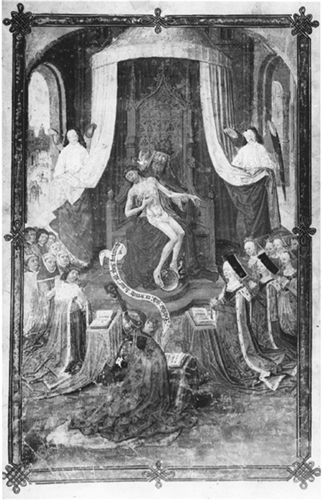
Elizabeth Woodville (lower right foreground), Edward IV, Bishop Thomas Rotherham and Cecily Neville, kneeling with other members of the confraternity before the Trinity. The Luton Guild Book, c. 1475
One way in which the great and the good could express their devotion to their faith was by patronising religious institutions, and Elizabeth was no exception. She obtained a licence to establish a fellowship of the Trinity at Leadenhall in London intended to support sixty priests in March 1466, and later founded a chapel dedicated to St Erasmus (the protector of sailors and women in childbirth) in Westminster Abbey, almost certainly in gratitude for her husband’s preservation during his nail-biting voyage into exile in 1470 and for the successful delivery of the Prince of Wales. Like earlier queens, she became an honorary member of religious guilds (including the London Skinners’ Company’s Fraternity of Our Lady’s Assumption, and the Holy Trinity Guild, Luton), and took a close personal interest in the two great religious houses situated near Sheen Palace, the Carthusian charterhouse and the Bridgettine Abbey of Syon. In 1477 she was granted the privilege of attending services in all the Carthusian order’s houses that had been founded by kings and queens of England, and two years later gave the prior of the Sheen charterhouse, John Ingleby (who was to become one of her executors), forty-three acres of land from her manor there.
Elizabeth also went on pilgrimages, partly to show her contrition for her failings, but perhaps equally to share in the camaraderie and ‘holiday atmosphere’ that characterised jaunts of this nature. Chaucer’s pilgrims were journeying to St Thomas Becket’s tomb for the good of their souls, but no one who reads The Canterbury Tales could doubt that they were determined to enjoy themselves in the process! Elizabeth’s pilgrimages were restricted to holy sites in England – principally Canterbury and the shrine of Our Lady of Walsingham (Norfolk) – but Jerusalem, Rome and Compostela were magnets for her aesthetic brother Anthony. It was after visiting Rome in 1476 that he was robbed of his jewels and plate at Torre di Baccano, about twelve miles north of the city, and was obliged to delay his journey while efforts were made to recover them. Elizabeth sent him letters of exchange worth 400 ducats to help pay his expenses and assist his passage home.
A queen would not usually interfere in wider religious matters, but there was one occasion when Elizabeth was able to use her position and influence to extricate her subjects from a particular spiritual difficulty. The recently proclaimed feast of the Visitation of the Blessed Virgin Mary fell close to two other religious festivals observed in England, and in 1480 Elizabeth petitioned the Pope to allow English men and women to observe it in private without forfeiting any spiritual benefits. The Pope granted special indulgences to those who said the Angelical Salutation (Hail Mary) three times daily ‘because the queen desires the devotion of the faithful of the realm for the said salutation to be increased’.
Medieval people sometimes had a rather mechanical approach to their faith – reflected in their routine offering of the mass-penny, for example – but no one thought that religion was an anachronism or that they would not be held accountable for their sins. It is never easy to decide how much of an individual’s piety was conventional as opposed to profoundly personal, but there seems little doubt that Elizabeth’s convictions were genuine and that she would have thanked God for the many blessings she believed He had bestowed upon her. Her worldly responsibilities and the unkind things said about her have tended to obscure this aspect of her character, and both her mother-in-law, Cecily Neville, and the ‘Red Queen’, Margaret Beaufort, have been more admired for their devotion to their religion. But no one fought harder for her son, the future Henry VII, than Margaret, and few died possessing greater wealth.
But could Elizabeth have been both a committed Christian and a witch who cast spells to achieve her objectives? We need, I think, to distinguish between witchcraft as an alternative religion, and the use of magic to foretell the future or harm an enemy. On one level, it allowed intelligent but unsophisticated minds to explain the otherwise inexplicable, while at the same time enabling them to rid society of those who (it was always assumed) were intrinsically evil. We saw in the first part of this book how, only a few years after Elizabeth was born, Eleanor Cobham, wife of Humphrey Duke of Gloucester, Henry VI’s uncle and heir apparent, was accused of using dubious methods to discover if her husband would succeed to the throne and she would become queen. She failed to appreciate that such enquiries were tantamount to hoping that the king would die, and Duke Humphrey’s enemies made the most of their opportunity. She was punished by being made to carry a lighted taper through London’s streets before being consigned to life imprisonment, and the case shows how readily what may have been no more than idle curiosity could be misconstrued.
Eleanor’s marriage to Duke Humphrey was dissolved on the grounds that she had used her secret powers to persuade him to marry her, and it is no coincidence that Elizabeth’s mother Jacquetta faced similar accusations when Warwick the Kingmaker tried to destroy the Woodvilles in 1469. It was almost impossible to prove that such charges were untrue or unjustified, and they were music to the ears of those who wanted to discredit the victim and those associated with her. Elizabeth was not mentioned in the indictment brought against her mother, and was only implicated fourteen years later when Richard of Gloucester accused her of withering his arm and of using sorcery to bewitch King Edward. Richard, in the words of the Tudor historian Polydore Vergil, claimed that ‘by the space of a few days past, neither night nor day can I rest, drink, nor eat, wherefore my blood by little and little decreaseth, my force faileth, my breath shorteneth, and all the parts of my body do above measure, as you see (and with that he showed them his arm), fall away; which mischief verily proceedeth in me from that sorceress Elizabeth the queen, who with her witchcraft has so enchanted me that by the annoyance thereof I am dissolved’.
No one believed him, of course – Thomas More remarked that his arm was ‘ever such since his birth’ and ‘well they [the assembled lords] wist that the queen was too wise to go about any such folly’ – but he returned to the attack in Titulus Regius, the statute that established his right to the throne. This declared that the ‘ungracious pretensed marriage’ between his brother and Elizabeth ‘was made . . . by sorcery and witchcraft, committed by the said Elizabeth and her mother, Jacquetta, Duchess of Bedford, as the common opinion of the people and the public voice and fame is through all this land’. He offered to prove this ‘in time and place convenient’, if anyone should doubt him – although that seems to have been the end of the matter, at least as far as he was concerned.
So was Elizabeth really a witch, or was this just another, rather crude, attempt to blacken her reputation? Her supposed descent from the water goddess Melusina may have made her more susceptible to such allegations, and her marriage to King Edward defied rational, logical explanation. But suspicion is, in the last resort, all we have to go on, and it would be both irrational and illogical to ‘convict’ her without a shred of real evidence. She had undoubtedly bewitched Edward, but perhaps not in the way that Richard and some of his contemporaries supposed!
ELIZABETH AND HER IN-LAWS
Elizabeth’s relations with some of her in-laws, notably her mother-in-law Cecily Neville, her two brothers-in-law George Duke of Clarence and Richard Duke of Gloucester, and her son-in-law Henry VII, were – in time-honoured fashion – far from easy. This section will try to explain how the dissensions arose and assess the damage they inflicted, but will not seek to apportion blame for them. All four treated her harshly on occasion, and she had to contend with one or more of them for her entire reign and beyond.
Elizabeth’s relations with her mother-in-law were probably always doomed to failure. Cecily and her husband, Richard Duke of York, would almost certainly have been crowned king and queen if the duke had not been slain at Wakefield on 30 December 1460, and her son Edward’s victory could not entirely compensate for the cruel manner in which her own royal title had been snatched from her. The Yorkists might treat her with the respect due to a queen or queen-dowager, but she would have been acutely aware that this was a courtesy rather than a right.
Cecily would have been prepared to bow the knee to a daughter-in-law born into one of the great royal families of Europe, but a Northamptonshire knight’s girl was an entirely different matter. Dominic Mancini says she was so angry when Edward told her he had married Elizabeth that she ‘fell into such a frenzy, that she offered to submit to a public enquiry and asserted that Edward was not the offspring of her husband the Duke of York, but was conceived in adultery, and therefore in no wise worthy of the honour of kingship’. The allegation that Edward was illegitimate (probably because he had been born at Rouen, outside England) was an old chestnut, and Mancini, who was writing in 1483, cannot have known what Cecily was supposed to have said almost twenty years earlier. But there is no reason to doubt his belief that there was animosity between the two women, or that frosty interviews like that described in The White Queen actually took place.
When news of Edward’s victory at Towton on Palm Sunday 1461 was brought to Cecily, one of those present, Nicholas O’Flanagan, Bishop of Elphin, wrote to the papal legate Francesco Coppini urging him not only to send congratulations to the king but also to write to his mother ‘who has a great regard for you, and can rule the king as she pleases’. Their relationship was bound to change, at least formally, after Edward married, but he acknowledged his mother’s special position by building new apartments for Elizabeth at Westminster, presumably so that Cecily did not have to vacate the rooms she had occupied for the previous three years. It has been assumed that Cecily’s absence from both Elizabeth’s coronation in 1465 and her husband the Duke of York’s reburial at Fotheringhay in 1476 was to avoid any dispute with Elizabeth over precedence, but this is by no means certain. Kings and queens did not usually attend their spouses’ coronations or funerals at this period, and she may have deliberately absented herself to emphasise her queenly status in Yorkist eyes.
Cecily’s influence may also have been at work when her younger son Richard of Gloucester and other lords and prelates met at her London town house, Baynard’s Castle, to discuss the terms of Edward IV’s will. They decided to deprive Elizabeth (and presumably her brother Anthony) of any role the late king had desired for them, and to effectively remove the young prince, now Edward V, from the influence of his mother’s family. Baynard’s Castle may have been no more than a convenient venue for these deliberations, but it is difficult to avoid the conclusion that Cecily concurred with this decision and was happy to facilitate it. Elizabeth Woodville would play no part in a minority government if she had any say in the matter, and she may not have been displeased when Richard deposed young Edward and took the throne.
Richard of Gloucester’s relationship with his mother has itself been subject to debate and to differing interpretations. Remarkably, he first sought to justify his assumption of power by reviving the story that his elder brother King Edward had been conceived in adultery, before, apparently, changing his mind and basing his claim on the alleged invalidity of Edward’s marriage to Elizabeth. Cecily would surely have resented having her reputation besmirched in this manner (which may be one reason why the excuse was altered), but she seems to have remained on good terms with Richard. A letter he wrote to her in 1484 asking her to appoint his chamberlain, Francis Lovell, to an office in Wiltshire was couched in the formal language a king would have used on every occasion but contains no hint of animosity:
Madam, I recommend me to you as heartily as is to me possible, beseeching you in my most humble and effectual wise [manner] of your daily blessing to my singular comfort and defence in my need. And madam I heartily beseech you that I may often hear from you to my comfort. And madam, I beseech you to be [a] good and gracious lady to my lord, my chamberlain, to be your officer in Wiltshire . . . I trust he shall therein do you good service and that it please you that by this bearer I may understand your pleasure in this behalf. And I pray God send you the accomplishment of your noble desires. Written at Pontefract the third day of June with the hand of your most humble son, Ricardus Rex.
Both Elizabeth and Cecily lived for another decade, but any contact between them was minimal. After a brief period of rehabilitation at the beginning of Henry VII’s reign (see below) Elizabeth was sent to Bermondsey Abbey, while Cecily seldom left her home at Berkhampstead Castle after Richard was killed at Bosworth. Elizabeth stood godmother to her first grandson, her daughter Elizabeth’s son Prince Arthur, when he was baptised in September 1486, but Cecily, the infant’s great-grandmother, was again absent. Two mistresses in the house was perhaps always one too many!
George Duke of Clarence, Elizabeth’s elder brother-in-law, had been born close to a throne but had no real prospect of inheriting it. He was his brother Edward’s heir for most of the 1460s (it is unlikely that any of the king’s three infant daughters would have been allowed to succeed him), but betrayed his dissatisfaction and impatience when he accepted his father-in-law Warwick’s offer to make him king in 1470. Warwick failed to deliver however – the ‘Lincolnshire Rebellion’ ended in failure – and his subsequent reconciliation with Queen Margaret and the House of Lancaster meant that George would now realise his ambition only if Henry VI and his son Prince Edward both died childless. It was probably this, as much as any other factor, that persuaded him to rejoin King Edward before the battle of Barnet, and allowed him to finish on the winning side.
George resumed his position at court after his brother’s final victory at Tewkesbury, but remained disgruntled and continued to look for ways of improving his prospects. As early as 1472 he was suspected of conspiring with his wife’s surviving uncle, Archbishop George Neville, and the exiled Lancastrian Earl of Oxford, and when, in the next year, Oxford attempted to invade England, he assured Louis XI that he had the support of twenty-four lords, knights and gentlemen and one duke. He may have meant the Duke of Exeter, who had his own, distant Lancastrian claim to the throne and whom Edward IV had never trusted; but George Duke of Clarence cannot be ruled out.
George supposed that because he was married to the Earl of Warwick’s elder daughter Isabel he would succeed to his late father-in-law’s lands (on behalf of his wife), and that the vast Beauchamp-Despenser inheritance of the widowed Countess of Warwick would also pass to him. In normal circumstances, if there was no son to inherit, a deceased’s property would be divided equally among his or her surviving daughters, but Anne, Isabel’s younger sister, had been married to Prince Edward of Lancaster as part of the agreement reached between her father Warwick and the boy’s mother, Queen Margaret, in France. Prince Edward’s death at Tewkesbury had left Anne a young widow with no one to defend her interests; but all this changed when Richard of Gloucester, George’s younger brother, announced that he intended to marry her and claim her half share of the inheritance. The Croyland chronicler says that George disguised Anne as a cookmaid to prevent Richard from finding her; but Richard sought her out, lodged her in sanctuary, and appealed to the king.
It would be tedious to describe the unedifying, often bitter, dispute between the two royal brothers, but the settlement which they and King Edward finally agreed between them was as immoral as it was illegal. We have already seen how young George Neville, Warwick’s nephew, was prevented from succeeding to the lands his uncle had settled on him, and how the Countess of Warwick was declared to be legally dead so that her daughters (and their husbands) could inherit her lands immediately. The countess protested to anyone who would listen, but her husband had died a traitor and she had few friends.
Edward wanted to restore harmony in the royal family so that he could mount a new expedition to recover Henry V’s French empire, and both George and Richard joined him in what proved to be an abortive sortie into France in 1475. They returned wealthier, bought off by Louis XI’s offer of personal pensions coupled with lucrative trade and marriage agreements, but George was left to reflect that all the money in the world could not buy him the crown he so longed for. Matters finally came to a head when their brother-in-law, Charles of Burgundy, was killed in battle at Nancy on 4 January 1477. Duke Charles had fought long and hard to create a new ‘middle kingdom’ of Burgundy, independent of both Germany to the east and France to the west, and his widow Duchess Margaret suggested that Mary, her late husband’s daughter and heiress, could secure her territories against King Louis by marrying George, whose wife, Isabel, had also died a few weeks before.
George was delighted with the prospect of cutting a figure on the European stage, perhaps even becoming King of Burgundy one day, and was mortified when King Edward refused to allow him to marry Mary. Edward knew only too well that if his brother became Duke of Burgundy English troops would be needed to prevent the French from conquering the duchy, and he could hardly expect to receive his generous annual pension from King Louis if their two countries were at war. Elizabeth would have shed no tears over George’s departure in normal circumstances – on the contrary, she would probably have welcomed it – but she would have been alarmed by French-inspired rumours that he meant to use Burgundian arms to make himself king in England. Her sons by the king were aged only five and two, vulnerable to the ambitions of a powerful rival if their father happened to die prematurely, and she would have begged her husband to reject this and any scheme that would make George more formidable than he already was.
George responded by leaving the court in high dudgeon and by behaving lawlessly in his own territories. He had his wife’s former servant Ankarette Twynho executed on the absurd charge that she had poisoned her mistress (everyone knew that Duchess Isabel had died in childbirth), and when one of his own supporters, a Thomas Burdet, was hanged for conspiring against the king and the young Prince Edward, George travelled to London and had Burdet’s claim that he was innocent read before the royal council. No self-respecting king could tolerate such a blatant assertion that his justice was invalid, and George was arrested on, or soon after, 10 June 1477 and confined in the Tower of London. He was tried and condemned in parliament the following January (where, as the Croyland writer observed, ‘not a single person uttered a word against the duke except the king [and] not one individual made answer to the king except the duke’), and executed on 18 February 1478, traditionally by being drowned in a butt of malmsey wine. This may have been a last, melodramatic request or gesture, but it is perhaps more likely that he used an old barrel for washing purposes and was unromantically drowned in his bath!
George had made a thorough nuisance of himself, but none of the charges brought against him automatically warranted the death penalty. He had, allegedly, kept a copy of a document drawn up in 1470 naming him heir to the throne if Henry VI’s line failed, and had spread rumours that Edward was illegitimate; but such misdemeanours could have been punished by imprisonment or the loss of his estates. Contemporaries could not understand why the king found it necessary to inflict the ultimate penalty on his own brother, and his decision has continued to baffle modern writers. It has been suggested that George had threatened to claim that Edward and Elizabeth had never been properly married and that none of their ‘illegitimate’ children had any right to the succession, but whatever the reason, he was clearly regarded as a serious risk.
So did King Edward make the final, fateful decision himself, or was Elizabeth instrumental in persuading him that she and their children would never be safe so long as George lived? Dominic Mancini, who came to England five years later in 1483, says specifically that she had ‘concluded that her offspring would never come to the throne unless the duke of Clarence were removed, and of this she easily persuaded the king’. Mancini was probably handicapped by his unfamiliarity with English; but he had at least one reliable informant in the person of the royal physician John Argentine, and there is no reason to doubt that his statement reflects what people were thinking – and saying – at the time. Elizabeth’s part in the process is, like so much else, ultimately unknowable, but few could blame her if she breathed a sigh of relief when George was finally no more.
Richard of Gloucester is said to have interceded with the king for their brother and to have been angered by his execution, but his feelings did not prevent him from asking Edward to adjust the Warwick inheritance settlement in his favour. Very little is known of Elizabeth’s dealings with Richard in her husband’s lifetime, but there is nothing to suggest that he was on openly bad terms with her or with other members of her family. Richard’s biographer Paul Murray Kendall thought that ‘the queen, beautiful and rapacious, would know how to show her haughtiness to the undersized lad from Yorkshire with the awkward torso and the solemn face’, but this, like so much else in Kendall, is great literature but doubtful history. Richard spent much of the period from 1471 to 1483 serving as his brother’s viceroy in the north of England, and would have encountered Elizabeth only on great ceremonial occasions or when he periodically attended court. Their relationship was perhaps distant rather than friendly, politely formal and tinged with caution. Richard had always been loyal to her husband, but had shown that he could be as ambitious and determined as his brother George.
King Edward’s line looked set to reign long into the future, but everything changed when he died after a short illness on 9 April 1483. Elizabeth wrote to her brother Anthony Earl Rivers, the Prince of Wales’s guardian, urging him to bring her son Edward from Ludlow to London so that he could be crowned as soon as possible, and to come accompanied by as many troops as he could muster. She knew only too well that her family was unpopular in certain quarters and was prepared to err on the side of caution; but some counsellors, notably her old enemy Hastings, feared that she was planning to establish a Woodville-dominated government and objected to the large number of soldiers. Elizabeth quickly realised that she was provoking, rather then deterring, opposition, and went out of her way to reassure everyone. She ‘most beneficiently tried to extinguish every spark of murmuring and disturbance’, in the words of the Croyland writer, and it was agreed that the young king’s escort would be limited to 2,000 men.
When King Edward died Richard of Gloucester was in the north of England and immediately wrote to the queen and the council to express his condolences and declare his loyalty to his brother’s heir. He also dispatched a letter to Anthony Earl Rivers at Ludlow, asking when and by what route he intended to bring Edward V to London, and suggesting that they rendezvous somewhere on the way. Anthony apparently replied amiably, proposing that they meet in the vicinity of Northampton about 29 May, although when Richard arrived there he found that the main royal party had pushed on to Stony Stratford, seventeen miles further south. Anthony and Lord Richard Grey, Elizabeth’s younger son by her first marriage, returned to Northampton, where they were joined by the Duke of Buckingham, and the four noblemen passed a pleasant evening together. But next morning Anthony and Richard Grey were arrested, and Richard and Buckingham rode to Stony Stratford where they informed the young king that they had frustrated a plot to ambush them. Edward protested, but was powerless to prevent his uncle, his half-brother and other members of his entourage being sent to prisons in the distant north.
It is highly improbable that the Woodvilles intended to harm Richard – hard evidence is entirely lacking – but both parties feared the consequences if the other gained a controlling hand in government. Richard claimed that Edward IV’s last will – or a codicil added to it – had named him protector of the realm if Edward died before his son reached maturity, but the will is missing and we can only speculate upon what it might, or might not, have said. Richard was just turned thirty, a man of considerable experience and proven ability, but who surprisingly had not been mentioned in the will Edward had drawn up before leaving for France in 1475. It was Elizabeth who had been given authority to arrange the royal children’s marriages if their father failed to return safely, and whatever role Edward had proposed for Richard it is hard to believe that his wife (and her brother) were to be deprived of all influence. The problem was that the boy had been brought up by members of his mother’s family, and would inevitably prefer them to an uncle he scarcely knew.
When Elizabeth heard what had happened at Stony Stratford she tried, unsuccessfully, to raise forces and then sought sanctuary at Westminster with her five daughters, her younger son by the late king, and her eldest son the Marquis of Dorset. It was here that Thomas Rotherham, Archbishop of York and chancellor, found her surrounded by ‘much heaviness, rumble, haste and business, carriage and conveyance of her stuff, chests, coffers, packs, fardels [bundles], trusses all on men’s backs, no man unoccupied, some lading, some going, some discharging, some coming for more’. Elizabeth ‘sat alone low on the rushes all desolate and dismayed, whom the Archbishop comforted in the best manner he could, showing her that he trusted the matter was nothing so sore as she took it for’. He handed her the Great Seal of England – clear evidence that, as far as he was concerned, she still counted politically – although he then thought better of it and asked her to return it to him the following day.
Richard paid his young nephew every courtesy, and seemed content when the council formally appointed him Protector. He deferred to the assembled notables when they refused to have Anthony Earl Rivers, Richard Grey and the others arrested at Stony Stratford executed immediately, and although young Edward’s coronation was postponed until 22 June there was no suggestion that it would not now happen. It is impossible to know if Richard was pursuing a carefully laid plan to its logical conclusion or whether, alternatively, he was responding to a changing situation; but on 10 June, some five weeks after reaching London, he sent urgently to the north for extra soldiers, seeking assistance ‘against the Queen, her blood adherents and affinity, which have intended and daily doith intend to murder and utterly destroy us and our cousin the Duke of Buckingham and the old royal blood of this realm’.
It would have taken the northern troops between two and three weeks to reach London, and events appear to have moved faster than Richard had anticipated. Only three days later, on Friday 13 June, he had Lord Hastings arrested in the council chamber and instantly beheaded without trial. Word was spread that Hastings had been caught conspiring with Elizabeth against the protector and had paid the penalty – an allegation so improbable that historians have baulked at it ever since. Hastings and Richard had both shared the royal exile in 1470–1, and the former had taken the lead in urging Richard to seize the initiative after King Edward died. His poor relationship with Elizabeth has already been noted, and his decision to change sides – if change sides he did – seems inexplicable. One writer has suggested that Hastings had hoped to be as close to Richard as he had been to Edward and resented Buckingham’s intrusion; but a more likely reason is that he had realised that Richard intended to make himself king. He would never have countenanced the deposition of young Edward, and his ability to summon a powerful retinue from his Midlands heartland meant that he had to be removed before Richard could proceed further. His ‘crime’, his unshakable loyalty to his late friend’s son, was a crime in Richard’s eyes alone.
Hastings’s removal was Richard’s second successful coup against those he knew would oppose him, but he had still another problem to deal with. He could not feel secure while the younger prince remained in sanctuary with Elizabeth, and on 16 June the Archbishop of Canterbury and a group of peers were sent to Westminster to persuade her to surrender him to them. They tried various ploys, arguing that the boy king was missing his brother and that Prince Richard could not claim sanctuary because he had committed no crime and no one was threatening him; but Elizabeth retorted that the first difficulty could be overcome by placing her elder son in her custody, and added that there was no reason why she and her children should not avail themselves of the Church’s protection when the times were so uncertain. Eventually the archbishop, ‘perceiving that the Queen began to kindle and chafe and speak sore biting words against the Protector’, told her bluntly that if she would trust him and these other lords they would ensure that no harm came to Prince Richard, but that if she rejected their offer they would not attempt to influence or assist her on any future occasion. Elizabeth ‘stood a good while in a great study’. She knew that Duke Richard could take her son from the sanctuary by force if he chose to, and was obliged to recognise that she had little alternative but to accept the lords’ proposal. With many tears, she gave him to the archbishop, charging him that ‘as far as ye think that I fear too much, be you well ware that you fear not as far too little’.
Prince Richard was sent to join his brother in the Tower, and six days later, Ralph Shaa, a Franciscan friar, preached a sermon at St Paul’s Cross in which he claimed that all King Edward and Queen Elizabeth’s children were illegitimate and that Richard of Gloucester was the rightful heir to the throne. This was based on a revelation made by Robert Stillington, Bishop of Bath and Wells, that Edward had contracted an informal – but still binding – marriage with Lady Eleanor Butler, a daughter of the late Earl of Shrewsbury, presumably at some time between the death of her first husband in 1461 and his wedding Elizabeth in 1464. The position was, apparently, that if Elizabeth had known of this, then her marriage to the king was, and would have remained, invalid; but if she was unaware of it (and Edward would almost certainly not have told her!), then their union could have been recognised after the Lady Eleanor died in 1468. This was important because the Prince of Wales was not born until 1470, but King Edward never supposed that a casual undertaking he had given years earlier (and had very probably forgotten) would one day return to haunt his son.
The lords who might have resisted Richard’s take-over had been thoroughly cowed by the destruction of Hastings, and he began his reign as king on 26 June. His nephews, Elizabeth’s two young sons, were seen playing in the constable of the Tower’s garden some little time after, but were then ‘withdrawn into the inner apartments of the Tower proper, and day by day began to be seen more rarely behind the bars and windows, till at length they ceased to appear altogether’. No one knows the answer to this, the most famous of all English historical mysteries, but one thing we can be sure of is that Elizabeth would have been desperate to learn what had become of them. She never said, nor so much as hinted, what she was able to discover, but her relationship with, and attitude towards, Richard III was bound to be affected by the extent to which she held him responsible. Did she think her sons were alive or dead, and if dead did she blame Richard or someone else?
The omens were not good. On 25 June, the day before Richard assumed the kingship, Anthony Earl Rivers, Lord Richard Grey and two other Woodville associates who had been arrested at Stony Stratford were executed at Pontefract, and Elizabeth lost both a brother and the younger son of her first marriage. The cheers and shouts of acclamation that greeted Richard’s coronation on 6 July would have rung hollow in the Westminster sanctuary, but she neither gave way to sorrow nor ceased to plan for the future. Richard left London to ‘progress’ around his new kingdom two weeks after the coronation, but had scarcely departed when word reached him of a conspiracy designed to liberate the two princes. The Croyland writer heard that ‘many things were going on in secret . . . for the purpose of promoting this object especially on the part of those who had availed themselves of the privilege of sanctuary’ (my italics), and that Elizabeth was being urged to disguise some of her daughters and smuggle them out of the country in case anything happened to her sons. The plot was nipped in the bud – four men were executed – and Richard ordered John Nesfield, a trusted supporter, to guard the sanctuary to ensure that only those with permission could enter or leave.
Richard’s tour of his kingdom proceeded pleasantly until on reaching Lincoln on 11 October he learned of a new outbreak of trouble headed by his erstwhile ally the Duke of Buckingham. No one knows why Buckingham turned against the man he had helped to the throne a few short months earlier. It is possible that, like other kingmakers, he thought that the great rewards he had received ought to have been still greater, but it has also been argued that he had been alienated by the fate of the princes (whatever that was), and even that he had killed them in the hope of becoming king himself. The Croyland chronicler tells us that the aim of the uprising was again to restore one of the princes to the throne, but that when ‘a rumour was spread that the sons of King Edward had died a violent death’ the conspirators decided to invite Margaret Beaufort’s son, Henry Tudor, the next male heir of the House of Lancaster, to return from exile and claim the kingdom. Richard was dismayed by Buckingham’s defection, but he responded vigorously and luck was with him. The rebellion was poorly co-ordinated, and the foul weather that scattered Henry Tudor’s little flotilla of ships also prevented Buckingham, who was in Wales, from crossing the River Severn into England. The Duke was captured and executed in Salisbury market place on 2 November 1483.
Margaret Beaufort had been one of the main instigators of the Buckingham uprising, and had gone to considerable lengths to persuade Elizabeth to become party to it. Margaret’s doctor and confidant Lewis Caerleon had gained access to the Westminster sanctuary in his professional capacity, and had proposed to Elizabeth that Margaret’s son Henry should marry her eldest daughter, Princess Elizabeth, when he had gained the kingdom. Dr Caerleon had the ticklish task of implying that Elizabeth’s sons were dead without giving the impression that Margaret was glad of it (because it clearly improved her son’s chances of becoming king), but he was as diplomatic as he was discreet. Elizabeth may, possibly, have agreed to the plan on the understanding that her own sons’ claim to the throne would not be jeopardised if it turned out that one of them was still living, but Margaret’s thoughts would have been for Henry alone.
The failure of the rebellion can only have added to Elizabeth’s difficulties. She had now been implicated in three unsuccessful plots against Richard (with Hastings, in the July conspiracy, and most recently with Lady Margaret), and would have feared that his patience with her was all but exhausted. Christmas 1483 must have been a miserable occasion, a world removed from the gaiety of the last Christmas of her husband’s lifetime, when the Croyland writer described the royal court as ‘befitting a most mighty kingdom, filled with riches . . . and (a point in which it excelled all others) boasting of those most sweet and beautiful children, the issue of his [Edward’s] marriage with queen Elizabeth’. Now, the fate of those children, even the very existence of two of them, was uncertain, and their mother was effectively a prisoner of the state.
Richard was undoubtedly angry with Elizabeth, but was obliged to recognise that his embarrassing public stand-off with his sister-in-law was not enhancing his reputation either at home or abroad. He seems to have adopted a carrot-and-stick approach, using ‘frequent entreaties as well as threats’ until, finally, Elizabeth agreed to leave the sanctuary around Easter 1484. The agreement drawn up between them stated that ‘Dame Elizabeth Grey’, as she was now called, would receive 700 marks (£466 13s. 4d.) annually for her maintenance, that Richard would treat her daughters as his own kinswomen, marrying them to ‘gentlemen born’ with appropriate dowries, and that he would not imprison or believe any ill report of them without first hearing their side of the story. It was guaranteed by an oath sworn on holy relics before an assembly of notables, in the words of one historian ‘by the most solemn and public promise that Richard could contrive’.
The document did not mention the two princes, but it is unclear what conclusions should, or should not, be drawn from this. It is possible to argue that Elizabeth would never have negotiated with a man who had the blood of her sons fresh on his hands (what mother could have done so?), but that, alternatively, she had little choice. The sanctuary must have become increasingly cramped and uncomfortable during the nine months the six royal ladies had occupied it, and it is likely that their ‘hosts’, the Church authorities, were anxious to resolve the matter before it soured their own relationship with the new monarch. Elizabeth would also have known that Richard was some fifteen years her junior, and the fact that there would probably not be another king in her lifetime meant that she had no option but to deal with him. His execution of her brother and the younger son of her first marriage had not prevented her from coming to terms with him, and if she could overlook their deaths could she not overlook the princes’ murders too?
But it is not quite that simple. Elizabeth may have ‘done what she had to do’ to improve the lot of her five daughters, but some little time after this she wrote to the elder son of her first marriage, Thomas Grey Marquis of Dorset, urging him to make his peace with Richard also. Dorset had found refuge at Henry Tudor’s little court-in-exile in Brittany after the failure of Buckingham’s rebellion, and it says much for his mother’s persuasiveness that he now tried to abandon Henry only to be pursued and forced to return. It is possible that Richard compelled Elizabeth to write to him, but Dorset, who knew only too well what had happened to his brother Richard and uncle Anthony, would surely have suspected trickery. Whatever Elizabeth told him, it was enough to convince him that there had been a sea-change in her relationship with Richard, and that the Woodvilles were back in business. She never said why she had modified her opinion, but a logical explanation would be that she had discovered that one of her royal sons was still living or that Richard had persuaded her that he was not responsible for their fate.
There is, however, another possible explanation. We do not know precisely when the Marquis of Dorset tried to return to England, but contemporary writers imply that it was not long before rumours began to circulate that Richard intended to marry Elizabeth’s daughter, his niece Elizabeth of York, when his sickly wife Queen Anne died. Richard thought that this would frustrate Henry Tudor’s plan to marry her while compelling disaffected Yorkists to tolerate him for the girl’s sake; but Sir Richard Ratcliffe and William Catesby, two members of his ‘kitchen cabinet’, told him bluntly – ‘to his face’ as Croyland has it – that such a union was incestuous and would never be accepted. They argued that many northerners had supported Richard out of loyalty to Anne, Warwick the Kingmaker’s daughter, and that he would lose their backing if he married a Woodville. This was true to a point, although their real concern was that the younger Elizabeth would seek to punish them for their part in the deaths of her uncle Anthony and half-brother Richard Grey if she became queen.
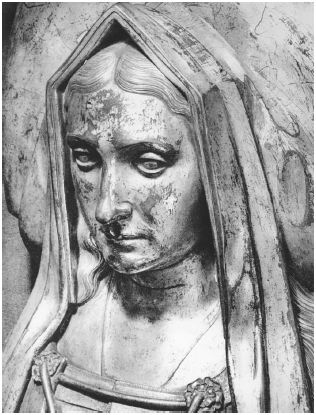
Elizabeth of York. Bronze effigy by Torrigiani, Henry VII Chapel, Westminster Abbey
We might suppose that Princess Elizabeth would have recoiled at the prospect of being forced to marry an uncle who had indisputably ordered the execution of members of her mother’s family, but remarkably, she embraced the plan with enthusiasm. Sir George Buck, Richard’s earliest apologist, saw, ‘in the cabinet of the Earl of Arundel’, a letter she had written to Arundel’s ancestor, the Duke of Norfolk, towards the end of February 1485 asking Norfolk to do all he could to hasten the matter. The letter has disappeared and Buck did not provide a full transcript, but in his words she ‘prayed him [Norfolk] as before to be a mediator for her in the cause of her marriage to the king, who, as she wrote, was her only joy and maker in this world, and that she was his in heart and in thoughts, in body, and in all’. It is unlikely that she would have expressed these sentiments without her mother’s approval and encouragement, but again, we should not assume that Elizabeth Woodville had genuinely forgiven Richard. She could have taken the view that it was the surviving members of her family who mattered, and that here was an opportunity they might never have again.
The moment never arrived, however. Queen Anne duly expired on 16 March, but two weeks later Ratcliffe and Catesby compelled the beleaguered king to stand up in the great hall of the Knights of Rhodes at Clerkenwell and declare publicly that he had no intention of marrying the younger Elizabeth. Richard went so far as to deny that he had even considered the possibility, although the Croyland writer was in no doubt that ‘there were some persons, however, present who very well knew the contrary’. In the event Richard was destined to remain King of England for only five more months, and, long before this, it was known that Henry Tudor was planning an invasion from his new base in France. Henry, prudently, left Elizabeth’s son Dorset behind when he sailed for England in early August, and on the 22nd defeated and killed Richard on Bosworth Field. Elizabeth cannot have mourned Richard any more than she had his brother George, and Henry’s promise to marry her daughter meant that she would become queen mother after all.
So what did happen to the two ‘Princes in the Tower’? It is often alleged that their disappearance was a mystery to everyone, but someone had to remove them from the Tower (dead or alive), and someone had to give the order. It is impossible to believe that Richard III and Henry VII (Henry Tudor) did not know – or care – what had become of them, or that close family members (including Elizabeth Woodville, princess – soon to be queen – Elizabeth and Henry’s mother Margaret Beaufort) remained in complete ignorance. The implication is that they did know but chose to remain silent, something that would not have been necessary if both boys were dead and threatened no one. Edward V was being visited by his doctor in the summer and autumn of 1483 and could have succumbed to his malady; but there is no suggestion that Prince Richard was ill, and no evidence that King Richard or King Henry had him killed. The most likely scenario is that he was sent to a safe and secure place, his whereabouts and true identity known only to a handful of people, in order to ensure that, as far as possible, he posed no threat to the reigning monarch. Such a secret plan would have required Elizabeth Woodville’s agreement, and could explain the apparent thaw in her relationship with King Richard in 1484 and 1485.
The boy had to ‘disappear’ then, but where did he go and was that the last the world heard of him? One possibility is that he was taken to Colchester Abbey after the battle of Bosworth and apprenticed to the abbey’s master bricklayer, eventually re-emerging as ‘Richard Plantagenet of Eastwell’ after the dissolution of the monasteries in 1539. Alternatively, he may have been smuggled or sent abroad, reappearing as the young man known as Perkin Warbeck in Ireland in 1491. Warbeck is a plausible contender in that he actually resembled Edward IV, his ‘father’, and never, so far as is known, made an obvious blunder. But he always declined to explain where he had spent his ‘missing’ years (his claim that he wanted to protect those who had shielded him may have been genuine or may have been designed to avoid the one question everyone was bound to ask him), and he was finally hanged as a common criminal in 1499. Elizabeth Woodville, who died in 1492, would scarcely have heard of him, and there is no evidence that anyone sought the opinion of her daughter Elizabeth, his ‘sister’. The younger Elizabeth would have seen him, if only from a distance, when he was first captured, and could surely have identified him if they had been allowed to converse privately. Henry may have been too afraid that she would recognise him to permit such a meeting, or alternatively, was so convinced that he was an impostor that there was no need.
The new reign began well enough for Elizabeth Woodville. King Henry married her daughter on 18 January 1486, and treated her with all the respect due to the queen’s mother. The act of parliament that had invalidated her marriage to King Edward and bastardised their children was repealed, and on 5 March she was given an income consisting of annuities and a life interest in a raft of properties in southern England. She had lost many members of her family, but could look forward to a comfortable retirement and a peaceful old age.
King Henry had won a decisive victory at Bosworth, but was bound to face challenges from individuals who would have hoped to succeed Richard III if he had remained childless and from others who had been wholly committed to him. An insurrection mounted by Francis Viscount Lovell, the late king’s chamberlain, in April 1486 was suppressed without difficulty, but later in the year Henry learned of a new and altogether more serious plot being hatched in Ireland. Polydore Vergil blamed an Oxford priest, one Richard Simons, who, he said, had trained a personable youth named Lambert Simnel to impersonate the Yorkist claimant Edward Earl of Warwick, the son of the executed George Duke of Clarence, who was then a prisoner in the Tower of London. Simons had taken his protégé to Ireland, where Richard Duke of York, Edward IV’s and Richard III’s father, had been a highly respected royal lieutenant in the 1450s, and where, according to Vergil, he convened an assembly of the Irish nobility and convinced them that Simnel was the real Warwick, who had somehow escaped from custody. The Irish lords responded enthusiastically, and began to plan an invasion of England that would restore the boy to his ‘right’.
None of this is very plausible, however. Simons was an ordinary cleric who had probably never seen the real Earl of Warwick and had no direct knowledge of how he (or any other prince for that matter) conducted himself. He would have been ignorant of the small, personal details of the boy’s life that could have come only from another member of the family, and would have needed help to produce an acceptable substitute. The same would have been true when the unlikely pair reached Ireland and began to publicise their ‘mission’. Few would have taken them seriously, still less danced to their tune in the manner described by Vergil, unless some word of their coming had preceded them, and the vast probability is that they were part of a wider conspiracy organised by senior Yorkists in England. The Irish nobles had been well primed.
Vergil did not identify the leading conspirators, but the royal council, meeting at Sheen Palace in February 1487, took three crucial decisions. First, it was decided to offer pardon to all rebels who would throw themselves on the king’s mercy; secondly, to allow the real Earl of Warwick to attend mass at St Paul’s Cathedral and to speak with those who knew him (so that none could doubt that the boy in Ireland was an impostor); and thirdly, to deprive Elizabeth Woodville of all her properties and send her to Bermondsey Abbey. The first two decisions were direct responses to the Simnel conspiracy (as we may now call it), and it must be supposed that the same is true of the last, the one penalising Elizabeth, but that Henry did not care to acknowledge that his own mother-in-law had been conspiring against him. Vergil admits that Elizabeth was being punished, but says that it was because she had broken faith with Henry when she made her peace with Richard III three years earlier. He sidesteps the fact that Henry had been aware of this for his entire reign but had hitherto treated her kindly, and does not indicate why, if the reason was genuine, he chose this particular moment to accuse her. Lord Bacon’s remark, that Elizabeth was so tainted with treason that ‘it was almost thought dangerous to visit her, or see her’, is almost certainly nearer the truth.
There had been no obvious, open quarrel between Elizabeth and Henry, so why would she have turned against him? Bacon was writing just over a century later, but there is no reason to doubt his assertion that she had been angered by Henry’s treatment of her daughter and increasingly resented the overbearing attitude of his mother, Margaret Beaufort. Henry had been anxious to dispel any suggestion that his claim to the throne had only been accepted because he had married Edward IV’s eldest daughter, and although theyounger Elizabeth had given him a son she had still not been crowned. Henry always turned to his mother when he needed advice, and as Margaret assumed ever greater authority so Elizabeth Woodville thought her daughter ‘not advanced but depressed’.
But would Elizabeth have sought to depose her daughter and her daughter’s husband in order to make Edward of Warwick, the son of her old enemy George of Clarence, king? Some modern writers believe that she had no quarrel with King Henry, and surrendered her properties to her daughter Elizabeth and retired to Bermondsey as part of an amicable ‘family settlement’ that just happened to coincide with the Simnel rebellion. They suggest that she may have been ill or perhaps wished to spend her last years in religious contemplation; and maintain that Henry would not have referred to her in endearing terms in official documents or proposed her as a wife for James III, the King of Scots, if he thought her guilty of treason. What does the evidence really say?
Henry did indeed continue to behave as though everything was ‘normal’, even referring to Elizabeth as ‘our right dear and right well beloved queen Elizabeth, mother unto our most dear wife the queen’ when he gave her fifty marks in 1490. But any hint that he was on bad terms with his mother-in-law would have called the stability of his dynasty into question, and his actions speak louder than his words. Elizabeth Woodville was conspicuous by her absence when her daughter was finally crowned in November 1487 (Henry and his mother watched events from behind a lattice), and although Henry had little choice but to let her kinsman Francois de Luxembourg see her when he visited England in November 1489, they were not allowed to meet privately. Margaret Beaufort was present to hear all that was said.
Admittedly, Henry would not have proposed marrying Elizabeth to James III in November 1487, five months after the Simnel rebellion, if he thought her guilty of treason, but how serious was he? The idea of a union between the Scottish King and the English queen-dowager can be traced to the ‘Three Years’ Truce’ which the two countries signed in July 1486 (long before there was any trouble in Ireland), and it is likely that Henry continued the negotiations even if he had no intention of bringing them to fruition. The Scots would not cause trouble in northern England if they thought their king was about to marry into the English royal family, and Henry, who had troubles aplenty, would have seen it as a good way of keeping the border quiet. King James was murdered in June 1488 after the battle of Sauchieburn, so the subterfuge did not have to be maintained for long.
Elizabeth was no longer young by 1487, but the Scots would not have thought her a suitable bride for their king if she had serious health problems and few if any medieval aristocrats would have surrendered their lands willingly. On the contrary, they seized every opportunity to add to their acres by whatever means were available to them because wealth invariably enhanced status. Henry’s mother, Margaret Beaufort, was pious even by contemporary standards, but her commitment to her religion never prevented her from acquiring money. She used it to found chantry chapels and university colleges, and still left the then vast sum of £14,724 when she died in 1509. Elizabeth, on the other hand, was restricted to an annuity of £400 (less than the settlement she had received from Richard III), and even this was not always paid promptly. King Henry would surely not have given her the properties in the first place if he had always intended them for Elizabeth of York.
Clearly, Elizabeth would not have wanted to depose her daughter (however much she wanted to remove Henry and his overbearing mother), but this is to assume that Elizabeth of York would have ceased to be queen when Henry was killed or at least toppled. She would never have contemplated making George of Clarence king, but Edward, his son, was young, possibly simple-minded, and malleable. There was, as yet, no precedent for a queen-regnant, but a papal dispensation would have allowed the younger Elizabeth to marry Edward, her first cousin, after Henry had been dealt with, and made Elizabeth Woodville the real power behind the throne. The claims of any children the young couple might have would conflict with those of their half-brother, the infant Prince Arthur, but recent events had shown how easily inconvenient royal children could be sidelined. Firm evidence that any of these thoughts actually formed in Elizabeth’s mind is inevitably lacking, but she would, arguably, have been prepared to countenance such a scheme if it allowed her to regain the upper hand.
The other possibility is that Elizabeth knew by early 1487 that one of her sons was alive and in hiding, and that she intended to ‘produce’ him if the Irish rebellion succeeded. The conspirators would have considered the possibility of allowing the real prince to lead it in person, but concluded, regretfully, that his safety outweighed any additional support he might bring to their party. All Yorkists would have regarded a son of Edward IV as the rightful heir to the throne, and Warwick’s claim would have been instantly superseded if one of the two missing ‘princes’ had emerged from the shadows. The Tudor writer Edward Hall says that the conspirators originally considered using Simnel as a stalking-horse for Prince Richard, but then apparently changed their minds.
Everything now turned on the success or failure of the rebellion, and Elizabeth could do nothing but sit quietly in Bermondsey and await the outcome. In April Henry clapped the Marquis of Dorset, the elder son of her first marriage, into the Tower ‘to preserve him from doing hurt either to the King’s service or to himself’, as Bacon has it, and then moved into the Midlands, to Kenilworth Castle in Warwickshire, to await developments. The conspirators, reinforced by nearly 2,000 Continental mercenaries supplied by Margaret of Burgundy, Edward IV’s and Richard III’s sister, ‘crowned’ Simnel ‘Edward VI’ in Dublin on 24 May 1487, and their combined army, led by the Earl of Lincoln, the Yorkist kings’ nephew, sailed for northern England eleven days later. They hoped that former supporters of Warwick the Kingmaker (the young Earl of Warwick’s grandfather) would rally to them, but were doomed to disappointment. Perhaps, as one writer suggests, Englishmen had had enough of ‘adventures in shining armour’, and were apprehensive of a ‘king’ who needed foreigners to restore him to his own.
The Earl of Lincoln decided that his best chance was to march southwards as rapidly as possible in the hope of forcing a battle before all Henry’s forces could reach him, but he was again thwarted. The king had allowed his soldiers to return home over the winter, but he was ever vigilant and, in the words of one commentator ‘in his [Lincoln’s] bosom, and knew every hour what the Earl did’. The rebels spread rumours that Henry had already been defeated in the hope that some of his friends would be dissuaded from joining him, and one contingent led by Lord Welles apparently panicked and fell back on London. Yorkists who were in sanctuary in the city emerged to assault known Tudor sympathisers, and Elizabeth must have heard and drawn comfort from the commotion. Everything might yet be well.
The Earl of Lincoln deployed his 8,000-strong army on some high ground to the south-west of the village of East Stoke in Nottinghamshire on 15 June 1487, and waited for the king’s forces to advance towards him the following day. He tried to maximise his numbers by concentrating them in a single contingent or ‘battle’ which he hurled down the slope at Henry’s vanguard; but probably half his soldiers were Irishmen whose rustic weapons and lack of body armour made them easy targets for the royal spearmen and archers. The Yorkists ‘fought hardily and stuck to it valiantly’, but as the morning lengthened the king was able to reinforce his forward division, and his soldiers’ professionalism and superior equipment eventually told in their favour. Lincoln and most of his fellow commanders perished in the final, furious onslaught, leaving the priest Simons and the boy Simnel to face Henry’s anger. The former disappeared into an ecclesiastical prison, while the latter became a scullion in the royal kitchen.
We will never know the precise role that Elizabeth played in the rebellion, but she may well have provided money, assisted with Simnel’s ‘education’, and perhaps encouraged the Irish lords to use him as a substitute until the real Earl of Warwick – or one of her sons – could be liberated. No one recorded the moment when news of the disaster was brought to her, but it is possible to imagine the abbot, the trace of a smile playing about his lips, informing her of it in the days after the battle. Henry had wanted to capture the Earl of Lincoln alive so that he could ‘learn from him more concerning the conspiracy’ (Vergil), and could, arguably, have obtained at least some of this information from Elizabeth; but there is nothing to suggest that he asked her or that she subsequently co-operated with him. Perhaps, by this time, they knew each other all too well.
THE LAST PHASE
The Simnel conspiracy was Elizabeth’s last throw of the political dice, and the remaining five years of her life were spent in virtual seclusion behind the abbey’s walls. She was permitted to return to public life on rare occasions – the reception of her Luxembourg kinsman, for instance – but her absence from her daughter’s coronation implies that such concessions were kept to a minimum. Her last years were further saddened by the deaths of her remaining two brothers and three of her four remaining sisters. Sir Edward Woodville was killed aiding the Duke of Brittany at the battle of St Aubin du Cormier on 28 July 1488; Richard, the third and last Lord Rivers, died in March 1491; and Anne Countess of Kent, Margaret Countess of Arundel, and Joan Lady Grey of Ruthin all passed away within the same period. She may not have been close to some of them – Sir Edward had fought for King Henry at Stoke, for example – but they were all members of her immediate family. Their funerals would have brought many of the great and the good together, but the probability is that Elizabeth was not allowed to travel around the country or communicate with whom she would.
We have already noted that Elizabeth’s smaller allowance was not always paid on time, and this would also have made her last years more difficult. King Henry was something of a miser, but he would have had reason to ensure that she never had more money than she or those managing her affairs needed. A servant might carry a secret message for old loyalty’s sake, but strangers could not be bribed, or rebellion contemplated, without funds. Elizabeth’s situation is confirmed by her will, which she drew up on 10 April 1492, apparently because she was by then ill and did not expect to live for much longer. It is a pathetic document, quite unlike the will of a queen or a member of the aristocracy:
In God’s name, Amen. The 10th day of April, the year of our Lord God 1492. I Elizabeth, by the grace of God Queen of England, late wife to the most victorious Prince of blessed memory Edward the Fourth, being of whole mind, seeing the world so transitory and no creature certain when they shall depart from hence, having Almighty God fresh in mind, in whom is all mercy and grace, bequeath my soul into his hands, beseeching him, of the same mercy, to accept it graciously, and our blessed Lady Queen of comfort [the Virgin Mary], and all the holy company of heaven, to be good means for me. Item, I bequeath my body to be buried with the body of my Lord [King Edward] at Windsor, according to the will of my said Lord and mine, without pompous ceremony or costly expenses done thereabout. Item, where I have no worldly goods to do the Queen’s Grace, my dearest daughter [Elizabeth], a pleasure with, neither to reward any of my children, according to my heart and mind, I beseech Almighty God to bless her Grace, with all her noble issue, and with as good heart and mind as is to me possible, I give her Grace my blessing, and all the foresaid my children. Item, I will that such small stuff and goods that I have to be disposed truly in the contentation [satisfaction] of my debts, and for the health of my soul, as far as they will extend. Item, if any of my blood [relations] will of my said stuff or goods to me pertaining, I will that they have the preferment before any other. And of this my present testament I make and ordain mine executors, that is to say, John Ingilby, Prior of the Charterhouse of Sheen, William Sutton and Thomas Brente, doctors. And I beseech my said dearest daughter, the Queen’s grace, and my son Thomas, Marquis Dorset, to put their good wills and help for the performance of this my testament. In witness whereof, to this my present testament I have set my seal, these witnesses, John, abbot of the monastery of Saint Saviour of Bermondsey, and Benedictus Cun, Doctor of Physic. Given the day and year abovesaid.
The will confirms both Elizabeth’s deep personal piety – God is mentioned or appealed to on a number of occasions – and the state of abject poverty in which she found herself. Medieval testators routinely paid for the saying of hundreds, sometimes thousands, of the masses they believed would speed their souls to paradise, but Elizabeth could only ask that what little remained after her debts had been settled should be used for this purpose. She had nothing to leave to her daughter the queen, or any of her other children, and this was clearly a source of regret rather than something she had wished or intended. King Henry, her son-in-law, is nowhere mentioned, and it is difficult to avoid the conclusion that their relationship remained poor
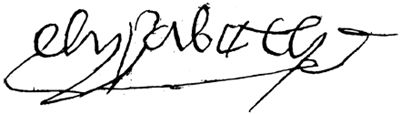
Elizabeth Woodville’s signature, from a receipt for the annuity she received from Henry VII, 1491
It was not unusual for contemporaries to request a ‘simple’ funeral in the sure knowledge that their families would bury them with appropriate ceremony; but Elizabeth would have known that a deceased’s estate bore the cost of this and that queenly obsequies were beyond her means. King Henry could have relented sufficiently to make a dignified ending possible, but the evidence is that everything was done ‘on the cheap’. When Elizabeth died on Friday 8 June 1492 her body was placed in a wooden coffin, and taken by boat from Bermondsey to St George’s Chapel, Windsor, two days later. It was received there by a single priest and a clerk (‘prevely’ – privately or secretly – at eleven at night), and interred almost immediately, without, apparently, the dean and canons being present. Her very existence had been an embarrassment, and there was to be no spectacle now that she was dead.
Her son the Marquis of Dorset, his half-sisters Anne, Katherine and Bridget, and some other family members reached Windsor on the following Tuesday and Wednesday, and that night the Bishop of Rochester conducted the service of Dirige, the Office of the Dead. Elizabeth’s two eldest daughters did not attend – Elizabeth of York was heavily pregnant while Cecily was represented by her husband Lord Welles, the king’s uncle – and the others present were almost all relatives of Edward IV or the Woodvilles. One of the heralds was shocked by the meanness of the arrangements, remarking that ‘there was nothing done solemnly for her saving a low hearse such as they use for the common people with four wooden candlesticks about it’. There was, he adds, ‘never a new torch, but old torches, nor poor man in black gown or hood, but upon [approximately] a dozen divers old men holding old torches and torch ends’. Dorset paid the ‘dole’ (the customary distribution of money to the needy) and gave forty shillings to the heralds, presumably out of his own pocket. It was all a far cry from the funeral of King Henry’s mother seventeen years later, which cost an enormous – but affordable – £1,021!
What, then, can be said of this woman whose modest expectations had been transformed when she married King Edward but who had paid a high price for her new-found status? No other English queen had been deposed, and lost so many of her close family in bloody revolutions, and had her marriage declared invalid and her children bastardised, and, finally, suffered the indignity of being officially forgotten. Her Lancastrian rival Margaret of Anjou had also been deposed, exiled, lost her son and husband, and been compelled to resist those who wanted to supersede them; but throughout her troubles Margaret had a consolation always denied to Elizabeth – she was a French princess who could, in the last resort, expect her powerful kinsman King Louis to intercede for her. It is no coincidence that Henry VIII executed two of his English wives (and considered beheading a third); but that his two foreign-born queens – who had both in their own ways incurred his displeasure – both died in their beds. Elizabeth could flee into sanctuary, but she was still at the mercy of powerful enemies. Warwick the Kingmaker and Richard of Gloucester refrained from using violence against her in 1470 and in 1483, but on both occasions her safety hung in the balance. Ultimately, she had no one to help her but herself.
The real Elizabeth may not be too far removed from the plucky, pitiful queen Shakespeare depicted in Richard III and Henry VI, Part 3, but twentieth-century writers have not treated her kindly. Cora Scofield, whose admired biography of Edward IV was published in 1923, wrote that ‘even wise heads have been known to be turned by a sudden elevation in rank, and Elizabeth Woodville’s head, which was not wise, had evidently been badly turned. Worse still, love seemed to have turned her husband’s head as well. For, not content with the folly of having married this “widow of England”, there was no end to the favours Edward was ready to shower on her undeserving family’. To David MacGibbon, her 1938 biographer, she was ‘a person of a cool calculating decision of character, without any deep affection, but of steady dislikes and revengeful disposition’, while Paul Murray Kendall described her as the ‘impelling spirit’, the ‘greediest and most wilful’ of the Woodvilles, in his 1955 life of Richard III. Charles Ross, writing about the same king a quarter of a century later, remarked that ‘her rather cold beauty was not offset by any warmth or generosity of temperament. She was to prove a woman of designing character, grasping and ambitious for her family’s interests, quick to take offence and reluctant to forgive’.
But was she really like this? People were indeed surprised that Edward IV married for love rather than for money and influence, but his choice was not entirely without merit nor were Elizabeth’s siblings undeserving of the favours they received from him. It is difficult to reconcile Miss Scofield’s allegation that her head had been ‘turned’ with the ‘cold’ and ‘calculating’ traits observed by MacGibbon, nor does the latter’s claim that she lacked ‘deep affection’ sit well with Professor Ross’s ‘grasping and ambitious for her family’s interests’. All these writers, it is fair to say, take the view that Elizabeth and the Woodvilles were a ‘bad lot’ and interpret their actions accordingly, but if we approach the subject without preconceptions it is possible to see most of them in a quite different light.
The two men most responsible for blackening Elizabeth’s character were Warwick the Kingmaker and Richard of Gloucester; but their opinions should not blind us to the fact that other contemporaries took a very different view of her. The Croyland writer noted how she ‘most beneficiently tried to extinguish every spark of murmuring and disturbance’ when trouble flared in the council in the aftermath of Edward IV’s death, and Speaker Alyngton had no reason to commend her ‘great constancy’ during the dramatic events of 1469–71 unless he genuinely admired her for it. A Londoner who wrote a poem celebrating Edward’s recovery of his kingdom expressed similar sentiments:
O Queen Elizabeth, O blessed creature,
O Glorious God, what pain had she?
What languor and anguish did she endure?
When her lord and sovereign was in adversity,
To hear of her weeping it was great pity,
When she remembered the King she was woe
Thus in every thing the will of God is do [done]
It could be argued that men who sought Edward IV’s favour were unlikely to criticise Elizabeth, but they would have been inviting ridicule if they had written and said such things when everyone else thought the opposite. The same is true of the Tudor chronicler Edward Hall, who described her as ‘a woman more of formal countenance than of excellent beauty, but yet of such beauty and favour that with her sober demeanour, lovely looking, and feminine, smiling (neither too wanton nor too humble) besides her tongue so eloquent, and her wit so pregnant’. Hall never knew Elizabeth and would perhaps not have spoken ill of Henry VIII’s grandmother; but he had access to sources of information now lost to us, and there is something about his characterisation that rings true.
Elizabeth Woodville was not perfect – perhaps no one is – but she seems to have fulfilled her difficult and demanding role admirably. Her critics never questioned her competence or alleged that she had failed in her duty (as they surely would if she had presented them with an opportunity), and her devotion to her husband never faltered. Like every mother, she was ambitious for her family, but she cannot be accused of neglecting her brothers’ and sisters’ interests or of not doing her utmost to secure the throne for her son Edward. She never doubted Richard of Gloucester’s true intentions – unlike her brother Anthony and Lord Hastings, who both walked blindly into the traps Richard had prepared for them – and would have been regarded as an astute politician if she had lived in the twentieth or twenty-first centuries. It was her misfortune to be born into a male-dominated society that allowed women no public, political role.
This, then, was Elizabeth Woodville, a woman who experienced greater vicissitudes of fortune than anyone of her generation and who was probably more sinned against than sinning. We can question her motives but not her ability, her judgement but not her loyalty. All in all, there is much to admire in the personality of the ‘White Queen’.
NOTES AND SOURCES
The quotations from contemporary sources have been taken from the following:
Ross, C. Edward IV, 1974; Lander, J.R. Government and Community, 1980; The Great Chronicle of London, ed. A.H. Thomas and I.D. Thornley, 1938, reprinted Gloucester, 1983; The Historie of the Arrivall of Edward IV in England and the Finall Recoverye of his Kingdomes from Henry VI A.D. M.CCCC.LXXI., ed. J. Bruce, Camden Society, 1838; British Library Add. MSS. 6113, f. 100b. Calendar of the Patent Rolls, Edward IV 1467–77, 1900; ‘The Record of Bluemantle Pursuivant’, in C.L. Kingsford, English Historical Literature in the Fifteenth Century, Oxford, 1913; Sutton, A.F., and Visser-Fuchs, L., with Hammond, P.W. The Reburial of Richard, Duke of York 21–30 July 1476, Richard III Society, 1996; Myers, A.R. ‘The Household of Queen Elizabeth Woodville 1466–7’, Bulletin of the John Rylands Library, l (1967–8); Acts of Court of the Mercers Company, ed. L. Lyell and F.D. Watney, 1936; The Paston Letters 1422–1509, ed. J. Gairdner, 6 vols, 1904; More’s ‘History of King Richard III’, ed. J.R. Lumby, Cambridge, 1883; Dominic Mancini, The Usurpation of Richard III, trans. C.A.J. Armstrong, 2nd edition, Gloucester, 1984; The Memoirs of Philip de Commines, ed. A.R. Scoble, 2 vols, 1855–6; The Travels of Leo of Rozmital, ed. & trans. M. Letts, Hakluyt Society, Cambridge, 1957; The Stonor Letters and Papers, ed. C.L. Kingsford, 2 vols, 1919–20; Ingulph’s Chronicle of the Abbey of Croyland, trans. H.T. Riley, 1854; Twigg, J. A History of Queens’ College, Cambridge 1448–1986, Woodbridge, 1987; Sutton, A.F., and Visser-Fuchs, L. ‘A “Most Benevolent Queen”: Queen Elizabeth Woodville’s Reputation, her Piety, and her Books’, The Ricardian, x (1995); Three Books of Polydore Vergil’s English History, ed. H. Ellis, Camden Society, 1844; Hammond, P.W., and Sutton, A.F.Richard III: The Road to Bosworth Field, 1985; Nicolas, N.H. Privy Purse Expenses of Elizabeth of York, Wardrobe Accounts of Edward IV, 1830, reprinted 1972; Laynesmith, J. ‘The Kings’ Mother’, History Today (March, 2006); Calendar of State Papers and Manuscripts Existing in the Archives and Collections of Milan, I, 1385–1618, ed. A.B. Hinds, 1913; Kendall, P.M. Richard III, 1955; Ross, C. Richard III, 1981; Buck, Sir George The History of King Richard the Third, ed. A.N. Kincaid, Gloucester, 1979; British Library Harleian Manuscript 433, ed. R. Horrox and P.W. Hammond, 4 vols, 1979–83; Bacon, Francis The History of the Reign of King Henry VII, ed. R. Lockyer, 1971; Materials for a History of the Reign of Henry VII, ed. W. Campbell, 2 vols, 1873–7; Trevelyan, G.M. A Shortened History of England, Harmondsworth, 1959; Hall(e), Edward The Union of the Two Noble Families of Lancaster and York, 1550, reprinted Menston, 1970; Testamenta Vetusta, ed. N.H. Nicolas, 2 vols, 1826; Sutton, A.F., and Visser-Fuchs, L., with Griffiths, R.A. The Royal Burials of the House of York at Windsor, 2005; Political Poems and Songs Relating to English History, ed. T. Wright, 2 vols, 1859–61.
Readers who would like to have a fuller account of Elizabeth’s life are referred to my Elizabeth Woodville: Mother of the Princes in the Tower, third edition, Stroud, 2010. The standard biography of her husband is Ross, C. Edward IV, 1974, while the most recent is the book of the same title by H. Kleineke, 2009. M. Hicks’s study, False, Fleeting, Perjur’d Clarence, Gloucester, 1980, remains the only life of George, Elizabeth’s elder brother-in-law, but Richard, the younger, has attracted much greater attention. P.M. Kendall’s Richard the Third, 1955, relies heavily on informed guesswork but is a great ‘popular’ biography, M. Hicks’s Richard III, Stroud, 2000, offers a valuable reassessment of its subject’s motives, and the present author’s biography of the King will be published in 2012. Hicks, M. Warwick the Kingmaker, Oxford, 1998, and Pollard, A.J. Warwick the Kingmaker: Politics, Power and Fame, 2007, have re-evaluated the life of Elizabeth’s other great antagonist, while H. Maurer has charted the career of her Lancastrian rival in Margaret of Anjou: Queenship and Power in Late Medieval England, 2003. Henry Tudor’s reign is assessed in S. Cunningham’s Henry VII, 2007, while M.K. Jones and M.G. Underwood tell the story of his mother Margaret Beaufort in The King’s Mother, 1993. The fate of the Princes in the Tower is the most famous of all historical mysteries, and two contrasting theories can be found in A. Wroe’s Perkin: A Story of Deception, 2003, and in my The Lost Prince, Stroud, 2007. For the Lambert Simnel rebellion and the battle of Stoke, see my Stoke Field: The Last Battle of the Wars of the Roses, Barnsley, 2006.
A number of contemporary documents relating to Elizabeth have been printed. G. Smith has transcribed a fifteenth-century account of The Coronation of Elizabeth Wydeville, 1935; a description of her churching banquet held after the birth of Elizabeth of York can be found in The Travels of Leo of Rozmital, ed. & trans. M. Letts, Hakluyt Society, 2nd series, cviii, Cambridge, 1957; and The Record of Bluemantle Pursuivant (in Kingsford, C.L. English Historical Literature in the Fifteenth Century, Oxford, 1913), records the care she lavished on the welcome given to Louis de Gruthuyse when he visited England in 1472. Three of her letters survive, in The Stonor Letters and Papers, ed. C.L. Kingsford, 2 vols, 1919, in The Paston Letters, ed. J. Gairdner, 6 vols, 1904, and in The Coventry Leet Book, ed. M.D. Harris, 4 parts, Early English Text Society, 1907–13; her will is transcribed in Nicolas, N.H. Testamenta Vetusta, 2 vols (1926), and an account of her funeral is included in Sutton, A.F. and Visser-Fuchs, L., with Griffiths, R.A. The Royal Funerals of the House of York at Windsor, Richard III Society, 2005.
Useful articles, some of them based on original documents, are:
Fahy, C. ‘The Marriage of Edward IV and Elizabeth Woodville: a new Italian source’, English Historical Review, lxxvi (1961)
Harrod, H. ‘Queen Elizabeth Woodville’s visit to Norwich in 1469’, Norfolk Archaeology 5 (1859)
Myers, A.R. ‘The Household of Queen Elizabeth Woodville, 1466–7’, Bulletin of the John Rylands Library, I (1967–8)
Scofield, C.L. ‘Elizabeth Wydevile in the Sanctuary at Westminster, 1470’, English Historical Review, xxiv (1909)
Sutton, A.F. and Visser-Fuchs, L. ‘A “Most Benevolent Queen” Queen Elizabeth Woodville’s Reputation, her Piety and her Books’, The Ricardian x, 129 (1995)
Sutton, A.F. and Visser-Fuchs, L. ‘The Cult of Angels in Late Fifteenth-Century England: An Hours of the Guardian Angel Presented to Queen Elizabeth Woodville’ in Women and the Book, ed. L. Smith and J.H.M. Taylor (1996)
Sutton, A.F. and Visser-Fuchs, L. ‘The Device of Queen Elizabeth Woodville: A Gillyflower or Pink’, The Ricardian xi, 136 (1997)
Sutton, A.F. and Visser-Fuchs, L. ‘The Entry of Queen Elizabeth Woodville over London Bridge, 24 May 1465’, The Ricardian xix (2009)