
Michael Jones

THE FAMILY STORY
Lady Margaret Beaufort’s life is a dramatic and moving story of a woman in the late Middle Ages who never saw herself as a victim, someone who suffered greatly and bore terrible dangers yet fought like a tigress to advance the fortunes of her only son, Henry Tudor. When that son became Henry VII of England on 22 August 1485, after vanquishing his rival Richard III in battle at Bosworth, it was as much Margaret’s triumph as the king’s. Margaret was courageous, intelligent and astute, a formidable plotter during the Wars of the Roses, a woman whose deep personal piety never interfered with her political pragmatism. She was strong-willed and ambitious and reached the pinnacle of her power and influence during the reign of her son, when she was known simply as ‘the King’s Mother’.
Lady Margaret Beaufort was born on 31 May 1443, the only child and heiress of John Beaufort Duke of Somerset and his wife Margaret Beauchamp of Bletsoe. Margaret was born into a major aristocratic family, closely related to the ruling Lancastrian dynasty, a guarantee of social pre-eminence and landed wealth. Indeed, her father – one of Henry VI’s military commanders – had been elevated to his dukedom two months before her birth, as he prepared to lead a major expedition to France in the closing stages of the Hundred Years’ War. But Margaret had no memory of him. Somerset’s campaign was a fiasco, and the duke returned home in disgrace, was banished from court and then – rumour had it – committed suicide, unable to brook his calamitous fall from favour. He died a day before Margaret’s first birthday and was buried with little ceremony in Wimborne Minster in Dorset.
The story of Margaret’s father was a tragic one. John Beaufort was captured at the disastrous English defeat at Baugé in 1421, when Henry V’s younger brother Thomas Duke of Clarence impetuously attacked a much larger Franco-Scottish army during a raid into Anjou. Baugé was one of the worst English defeats in the Hundred Years’ War. The English commander’s behaviour was so reckless that a mutiny nearly broke out in his ranks. According to the chronicler John Hardyng, a number of the assembled English aristocrats began a heated discussion of Thomas’s impulsive decision even as his army began to form up, for the order to ride into battle had been issued during an early-evening banquet, when a supposed informer announced the proximity of a French army, reinforced by a large contingent of Scottish soldiers (who were fighting as their allies, against the English). Halfway through a meal, Thomas believed he had a chance to surprise and overwhelm his foes – and, throwing all caution to the wind, commanded his surprised followers to saddle up, and led a mounted charge in the direction of his opponents.
However, the full English army was not ready to go into battle and Thomas rode off at speed without his archers, who formed the majority of his raiding force and whose dreaded longbow had been one of the principal reasons for Henry V’s stupendous victory against the French at Agincourt in 1415, some six years earlier. Thomas had not been present at that great battle: he had contracted dysentery during the siege of Harfleur, and – like many others in the English army – had been forced to return home. This clearly rankled with him, and on the spur of the moment Thomas now decided that he would win a victory even greater than that of Henry V.
In Agincourt’s aftermath, some of the French nobility had taunted the victors that the English aristocracy was no match for them, and had won only because of their reliance on a mass of peasant soldiers and a killing weapon that had no chivalric merit. This was desperate stuff, for the French had been out-generalled and out-fought at Agincourt, and Henry V had cleverly used his archers as part of a highly effective battle plan. But Thomas let this slight by the enemy go to his head, refusing to wait for his archers to form up behind him, and instead charging off into the gathering gloom with only a mounted force of knights accompanying him. Margaret’s father, John Beaufort, was one of his unfortunate companions.
John Beaufort, who at this stage held the title and rank of Earl of Somerset, had a grandstand view of the débâcle that followed, for the English commander was his stepfather. After the death of his own father in 1410, his mother, Margaret Holland, had remarried Duke Thomas and her Beaufort children had been brought up in the duke’s own household. John would have been riding in Thomas’s personal retinue, close to his stepfather, pell-mell towards the village of Baugé, across ground that had not been properly reconnoitred and towards an army of whose size and strength the English were entirely ignorant. What his thoughts were during this twilight charge can only be imagined.
Tragically for the Beaufort family, the course of battle that followed was all too predictable. Thomas Duke of Clarence careered across a shallow river and into the village of Baugé, where fighting with a surprised Scottish advance guard flared up around the church and principal buildings. Part of Thomas’s small force then pushed on to the ridge above the village. By now the alarm had been raised and a much larger army of French and Scots had gathered to meet them. The English had lost any semblance of battle formation and were rapidly overwhelmed. Duke Thomas was killed and most of his aristocratic followers captured, John Beaufort among them. It was an utter disaster.
Our modern understanding of battles is very much an analytical one, based on a study of the strategy and tactics of the rival commanders and their grasp of logistics and planning. A medieval audience would have seen things rather differently, for to them a battle was very much a trial by combat and its result a judgement from God on the merits of each side. A calamitous battle was a source of stigma, just as a resounding victory was a source of pride and affirmation. The battle of Baugé, in 1421, left a troubling legacy for the Beaufort family, just as the battle of Wakefield, in 1460, bequeathed a similarly disturbing one to the House of York, many years later. The image it held – reflected in poetry composed within the family circle – was one of fortune’s wheel, a wheel that could raise those astride it to power, influence, wealth and the zenith of success, then suddenly turn, casting those at its top to the ground in a complete and bewildering fall from grace.
Margaret’s father was now a prisoner of war and would remain one for the next seventeen years. This was an exceptionally long period of imprisonment for a nobleman to endure. Initially, there were hopes for his speedy release, but all negotiations came to nothing. There was a particular reason for this. Beaufort fell into the hands of the French House of Eu, who bought his rights from his original captor, a Scottish captain. Buying and selling of ransom rights was a lucrative source of profit during the Hundred Years’ War, very much in the way that successful commodities trading is now. But the House of Eu wanted John Beaufort in order to arrange a prisoner swap, an exchange between John and the head of their own family, Charles Count of Eu, who had been captured by the English at Agincourt.
In normal circumstances this would have been brought about easily and quickly. But Henry V in his will of 1422 – drawn up shortly before his death at the château of Vincennes – forbade the release of either Eu or another French aristocrat, Charles Duke of Orléans, until they recognised the Treaty of Troyes, the settlement that vested the rights to the kingdoms of England and France on the House of Lancaster. This veto effectively blocked Eu’s release, and doomed Margaret’s father to an equally lengthy period of captivity.
These political factors were important. They overrode chivalric convention, which believed it unreasonable to place additional obstacles in the way of a nobleman’s release. John Beaufort had every reason to feel aggrieved. He grew into manhood and middle age as an exile and captive. Among the many documents concerning his ransom negotiations one stands out. It is dated in the year 1427 and concerns his fresh hopes for a prisoner exchange, one between Beaufort and John Duke of Bourbon, who had also been captured by the English at Agincourt. John Beaufort was dispatching a messenger to the English government, appealing for a speedy release of the Duke of Bourbon. His missive had been drawn up by a clerk, and was clearly and carefully formulated. But as the messenger was about to ride off, Beaufort was overcome with emotion. Hastily he scrawled a postscript in his own hand, pleading, almost begging for his freedom. But once again negotiations broke down and nothing came of his desperate appeal.
John Beaufort endured the longest term of imprisonment of any English aristocrat in the Hundred Years’ War. According to his own statement, his captivity ruined his health and left him burdened with crippling debt. Over the years, as his hopes of release were continually dashed, his outlook became bitter and disillusioned. The impasse over his ransom was eventually broken through the personal intervention of Henry VI, who overturned the restriction of his late father and authorised Eu’s release, an act of clemency that at last ensured Beaufort regained his freedom.
Henry VI disagreed with the war policy Henry V had so dramatically begun at Agincourt and continued with the conquest of Normandy, and was now seeking an end to the Hundred Years’ War through a negotiated peace treaty. His willingness to release the Count of Eu – and the Duke of Orléans two years later – signalled a break with the past. It was an act of kindness remembered with particular gratitude by Margaret Beaufort, who believed that Henry VI had saved her father from almost certain death in captivity and who as a result revered the Lancastrian King throughout her life.
However, by the time of his release in the autumn of 1438, John Beaufort was an angry man, intent on recouping the large ransom that he had been forced to pay. His marriage in 1442 to Margaret Beauchamp of Bletsoe was a relatively humble one for an aristocrat of his standing – a further consequence of his long captivity in France, for when he finally came home there were no suitable candidates for a man of his rank, which infuriated him still further. Margaret Beauchamp was quickly made pregnant, and subsequently saw little of her new husband as he returned to France as a Lancastrian commander with the sole intention of amassing as much profit as possible. Henry VI was generous, granting Beaufort a stream of lands and offices, and in 1443 he was given amajor new command, to lead a substantial army into territory held by the Valois regime of Charles VII and bring the French to battle.
Much was hoped from this new military initiative. Charles VII had roused himself from the lethargy of his early years and was now conducting his affairs with energy and purpose. In 1442 he had led an expedition into English-held Gascony. The new campaign was intended to be a decisive rejoinder to this Valois revival. Henry VI invested more than £26,000 in Beaufort’s expedition, more than half his annual income, at a time when the Lancastrian regime was becoming increasingly short of money. Beaufort negotiated long and hard with the king, demanding a host of lands, titles and offices in England and France. His rewards were lavish, and included promotion to the dukedom of Somerset.
But Beaufort wanted to recoup even more of his ransom. He showed little ability or skill in his command, for – after sailing from Portsmouth to Cherbourg with his army – he quite incredibly made no effort to liaise with the English commander already in Normandy, Richard Duke of York, a course of action that caused Duke Richard considerable offence. The chronicler Thomas Basin was in Rouen at the time Beaufort’s army landed in the duchy, and he reported a joke current among Lancastrian captains: the purpose of the expedition had become so secret, it was said, that its commander was no longer aware of it himself. Richard Duke of York, the king’s lieutenant in France, was reduced to sending out a stream of messengers trying to find out where the new army actually was.
However, the sole purpose of Beaufort’s meandering raid into French territory in 1443 was to fill his own coffers with plunder and loot. He created a diplomatic incident by entering the territory of the neutral duchy of Brittany, besieging its frontier town of La Guerche and then forcing the Breton duke to pay him a substantial sum of money to lift the siege, an abuse of power and office so flagrant that it enraged even the placid Henry VI. Despite being fully paid for his war transport, Beaufort demanded additional payments from all the Norman towns that he passed through, again provoking a storm of protest – his levying of illegal taxes was later the subject of a full government inquiry. No meaningful military success was garnered from his campaign, and – to add insult to injury – Beaufort disbanded his troops early and pocketed the remainder of their wages.
John Beaufort’s conduct provoked outrage, and when he returned home he met with an exceptionally hostile reception. An infuriated Henry VI banished him from court and ordered a full investigation by the English treasury of his financial malpractice. According to the Croyland Chronicle, a well-informed contemporary source whose author knew Beaufort personally, the gravity of his wrongdoing now hit home. Keenly feeling his disgrace, and unable to bear it any longer, John Beaufort committed suicide on 30 May 1444, almost a year after Margaret’s birth.
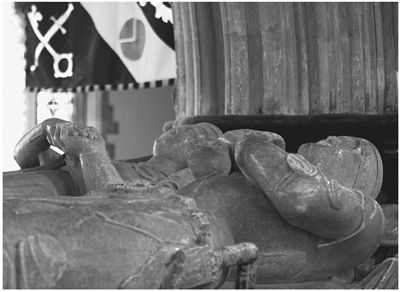
The tomb of Margaret’s father, John Beaufort Duke of Somerset, at Wimborne Minster in Dorset. The legacy of this disgraced war commander and suicide was a deeply troubling one, but it fuelled Margaret’s powerful ambition, and she constructed this memorial during the reign of her son, Henry VII
A disgraced war commander and a suicide was the worst stigma an aristocratic house could possibly bear. Beaufort was quietly buried in Wimborne Minster and his family put out the story that he had succumbed to ill-health. But as Margaret grew up she would have learned the truth about her father’s fate. In this intensely religious age, death at one’s own hand cast the soul of the suicide from the protective mantle of the Church’s intercession. The pious yet pragmatic Margaret found this prospect too painful to bear, and over time constructed a different reality, one that focused on the injustice of her father’s long captivity and heavy ransom, and portrayed him as an innocent victim of vengeful fate.
Some lines of verse on John Beaufort’s death – commissioned by the family – caught the same theme, reciting: ‘When he was wedded, and in estate most high, fortune – to ground him – cast him down most cruelly’. Margaret later confided to her confessor, John Fisher, her fear of the mutability of worldly fortunes, the turn of fortune’s wheel, that when great success had been achieved all might be taken away. Fisher was struck by Margaret’s extreme emotional distress – her convulsive sobbing and weeping – as she shared this recollection. It was made in the privacy of the confessional chamber, when Margaret was an elderly lady and matriarch of the House of Tudor. She had always impressed Fisher with her composure and presence of mind, her calm – almost icy – deliberation when dealing with matters of state or political intrigue. By then Margaret had witnessed many turns of fortune’s wheel herself. But this torrent of emotion had a quite shocking power, as if a deeply buried secret had suddenly been uncovered.
If Margaret perceived her father as a victim, over time, as she grew into adulthood, she cast herself as a survivor, a survivor who would right the wrongs of fortune and master the storms that had wrecked his reputation and standing. She would hazard all to advance the prospects and reputation of her family. This guiding principle held an almost redemptive power for her.
Although John Beaufort had been cast from royal favour, at the time of Margaret’s birth the Beaufort family still dominated the politics of Henry VI’s government. Her great-uncle Cardinal Beaufort was the most important statesman in the land, an experienced diplomatic negotiator and chief moneylender for the war effort in France. Her uncle Edmund Beaufort was another of Henry’s leading war commanders, soon to become his chief lieutenant in France. But Margaret became aware, over time, that this powerful position within the Lancastrian realm could prove transient. The king’s authority was weak and the war in France was going badly.
There were deeper reasons for the Beaufort family’s ambition and vulnerability, and to fully understand Lady Margaret’s own life it is important to explore them. To do so, we have to pull back in time from the tragedy of Margaret’s father and look at the family’s pedigree. For its origins in the late fourteenth century set the Beauforts apart from other aristocratic families. And here lay the source of another stigma. The Beauforts were originally bastards, the illegitimate offspring of John of Gaunt’s adulterous liaison with Katherine Swynford.
This earlier history is important. In the early 1370s, John of Gaunt – the rich and powerful uncle of King Richard II – had turned from his second wife Constance of Castile and begun an affair with Katherine, the governess of his children. Gaunt’s conduct quickly gained notoriety. This ‘scandalous affair’ – as one chronicler bluntly described it – produced four bastard children – three boys and a girl – who were named Beaufort after Gaunt’s French castle and lordship in the Champagne; the oldest of them was Margaret’s paternal grandfather.
The issue of bastardy was complex in the late Middle Ages. It was a time of increasing social mobility, with a land-based economy being replaced by a land-and-cash one, and a rising merchant class buying property and acquiring aristocratic titles. The de la Poles, Earls then Dukes of Suffolk in the fifteenth century, had risen to prominence 100 years earlier as a successful family of Hull merchants. It was possible for those of relatively humble stock to rise more quickly up the social ladder, whether through profits of trade or war. And this fluidity meant that the stigma of bastardy was lessening – within aristocratic and gentry families bastard offspring were more frequently mentioned in wills and granted money and even property.
To a certain extent, this social mobility benefited the Beauforts. John of Gaunt immediately recognised them as members of his broader family, and after the death of his wife Constance of Castile he chose to marry Katherine Swynford, his former mistress, at Lincoln in early 1396. This remarkable decision showed that Gaunt genuinely loved Katherine, and it paved the way for the elevation of the Beaufort family. In September 1396 the Pope ratified the marriage – despite the couple’s earlier adulterous affair – and declared all its offspring, past and future, legitimate. The following year Gaunt had the Beauforts’ legitimacy confirmed by act of parliament, and subsequently the family was granted a stream of lands and titles.
But the stigma of bastardy still remained. Gaunt’s marriage to Katherine elicited much comment, and little of it was approving. One contemporary noted: ‘the wedding caused many a man’s wondering, for, as it was said, he had held her long before.’ And when the Lancastrian King Henry IV took the throne in 1399 he confirmed the legitimacy of his family of the half-blood, but inserted a clause barring the Beauforts from succession to the throne. The three words – inscribed in Latin in the act of patent – excepta dignitate regali planted a lasting slur on the family. While the Beauforts were loyal servants of the new dynasty, and active in their military and civil responsibilities, they were barred from ever bearing the crown of England.
It is worth speculating on the effect this had on the family, for the decision would have powerfully impacted on the Beauforts’ sense of identity. In the medieval age individuals saw themselves within a larger family story, one that for the English nobility was mapped out in lavish pedigrees and genealogies, where rights were borne from generation to generation, and where the ‘livelode’, the family livelihood and its line of inheritance, was defended almost as a sacred trust. The mocking nickname for the Beaufort family, ‘Fairborn’, was still in regular use in the fifteenth century, not only in the gossip of taverns and dining halls, but even inscribed – slightingly – in the pedigrees of rival aristocratic families.
A common perception in the mid-fifteenth century was that the Beauforts were becoming increasingly acquisitive and ambitious, eager to grasp money and property in whatever fashion – however unscrupulous. Such a view would further explain the reckless greed of Margaret’s father on his military campaign in 1443, but it had a wider impact.
Chroniclers were struck above all by the family’s ruthless self-interest. The charge of avarice was first laid against Margaret’s great-uncle, Cardinal Beaufort, and then her own father and her uncle, John and Edmund Beaufort, successively promoted to the dukedom of Somerset. Prejudice against the Beauforts’ bastard origins remained – with hostile observers and rival magnates perceiving them as upstarts, seizing an undue share of royal patronage at the expense of more established aristocratic families. This grievance fuelled Richard Duke of York’s bitter animosity towards his rival Edmund Beaufort Duke of Somerset, for Duke Richard went to great lengths to stress, in his writings and political proclamations, the purity of his own blood line and lineage.
For the Beaufort family, the amassing of lands, wealth and titles may have been a palliative, as it almost certainly regarded the bar on succeeding to the throne as a considerable injustice. If so, this anger would have fuelled an abiding desire to overturn the prohibition and reinstate the Beauforts at the heart of the Lancastrian dynasty.
This powerful family ambition was certainly picked up by contemporaries and it was a formative experience in Lady Margaret’s own political education. It was masked in the reigns of Henry IV and Henry V, for these kings had sons and brothers to succeed them, but was flung dramatically to the fore during the reign of Henry VI, when the king’s marriage to Margaret of Anjou in 1445 failed, for eight years, to produce any children, and it was rumoured that the pious and unworldly monarch – who flew into a paroxysm of terror and moral consternation when confronted with naked female bathers on a visit to Bath, and who banned all low-cut blouses and dresses from the Lancastrian court in case he caught sight of a woman’s cleavage – was incapable of begetting any.
At a time of uncertainty about the succession, what one Lancastrian king could prohibit, another could remit, and Henry VI – whose grasp of royal patronage was as uneasy as his sexual confidence – was at this time dominated by the court favourite William de la Pole Duke of Suffolk, a close ally of the Beauforts who was working to further their cause. Some observers voiced a very real concern that the king, manipulated by Suffolk, might now choose to overturn the clause barring the Beauforts from the throne.
This fear was expressed openly in 1450, when the Duke of Suffolk acquired Margaret’s wardship and hastily arranged her marriage to his son and heir John. The country was in turmoil. The last English possessions in Normandy were being lost to the Valois armies of King Charles VII and parliament sought a scapegoat. The king’s chief minister was an easy target. The House of Commons was virulently hostile to Suffolk and prepared impeachment charges against him. Strikingly it declared that the marriage between his son and Margaret Beaufort was proof of a wish to gain the crown for his own family through Margaret’s rights as a Lancastrian heiress. Since the Beauforts were at this stage still barred from the succession, the accusation made little sense unless the Commons feared that the stipulation was about to be removed by the king, perhaps as a mark of favour to the Duke of Suffolk. This concern was never put to the test, for Suffolk – forced into exile – was captured in the English Channel by a privateering ship and brutally murdered later the same year.
Yet the dynastic issue remained, and with Henry VI suffering increasingly poor health and the government of the country in a state of collapse, the lack of a clearly designated succession posed a very real threat to political stability. There were a number of dynastic contenders – Richard Duke of York, the wealthiest magnate in the realm and the key political figure in the early 1450s, was the most prominent; there were also the senior members of the Holland and Stafford families. Yet after the death of the Duke of Suffolk in 1450, it was not Duke Richard but Margaret’s uncle Edmund Beaufort Duke of Somerset who became Henry VI’s principal counsellor. The signal favour shown to Edmund Beaufort was ill-deserved – he had presided over the last disastrous English defeats in Normandy, a source of fury to Richard Duke of York, who now suspected that the Beauforts might be nominated as heirs to the crown ahead of him and the other candidates, an accusation he made openly in articles drafted against Edmund Beaufort in 1452.
I have taken time to rehearse these broader family issues because I believe they strongly shaped Lady Margaret’s own identity. Embedded within it was an overarching theme – powerful yet thwarted ambition and a deep desire, almost a yearning, for the throne of England itself. By harnessing this ambition Margaret sought an opportunity to right a family wrong and to remove the stain on its reputation caused by her own father’s disgrace and death.
By early 1453 political tension was running high: Richard Duke of York and Edmund Beaufort Duke of Somerset were jostling for influence with the king, and the country was facing armed insurrection and revolt. It was at this dangerous time that the nine-year-old Margaret was summoned to court by Henry VI. The Beaufort family story was now to take a new turn, as Margaret made her first entry on to the political stage.
THE VISION
Margaret Beaufort’s early childhood had been a quiet one, lacking the show and ostentation normally associated with the wealthy heiress to a duke, the highest aristocratic title in the land. After the death of her father John Beaufort Duke of Somerset, on 30 May 1444, she had been brought up by her mother, Margaret Beauchamp, at her house at Bletsoe in Bedfordshire, and at the Beaufort castle of Maxey in the Lincolnshire Fens. These were small residences; indeed Maxey was little more than a fortified manor house, which Margaret shared with the two sons and three daughters of her mother’s first marriage to Sir Oliver St John. Margaret Beaufort always had an enormous affection for the St John family, and from this one imagines that the first part of her life was happy and untroubled. She clearly enjoyed the company of her half-brothers and -sisters and, for a time at least, was sheltered from hearing about her father’s tragic death and the dangerous intrigues of high politics.
In January 1450, with Margaret still only six years old, came the first sign that this idyllic period would not last. Henry VI’s favourite and chief minister William de la Pole Duke of Suffolk was fighting for his very survival. William de la Pole had enjoyed a remarkable pre-eminence in the Lancastrian regime, able to easily manipulate the king and dominate the political stage, but now the House of Commons was determined to make him the scapegoat for the disastrous reopening of the Hundred Years’ War, a resumption of hostilities against the Valois regime of Charles VII that had seen much of English-held Normandy lost to the French, and the duchy’s capital, Rouen, surrender after putting up only token resistance. Failure abroad and government mismanagement at home had created a volatile and angry mood in London, where a turbulent parliament was now in session.
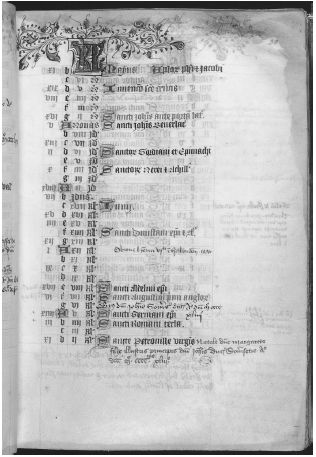
Margaret’s date of birth, on 31 May 1443, from the Beaufort Hours
In the same month the House of Commons brought a stream of accusations against William de la Pole, ranging from corruption to high treason, and despite William answering these allegations he was arrested and imprisoned in the Tower of London on 28 January. New charges were drafted, and it must have become clear to the beleaguered royal favourite that the Commons intended to impeach him and that his position was now desperate. His thoughts turned to his seven-year-old son and heir, John de la Pole. By 7 February he had arranged a marriage for him, to the six-year-old Margaret Beaufort.
This child marriage was a hasty measure, put in place by a desperate man who feared for his own future. As William secured it, he was negotiating with the king for an act of royal clemency in which he would be banished from the kingdom but allowed to keep his life. Yet, amid such terrible concerns, it was significant that he chose Margaret for his son. Appearances can always be deceptive in politics and Margaret – despite her relatively humble lifestyle – was a wealthy heiress, and thus a significant acquisition in the medieval marriage market. And William de la Pole, intensely ambitious for his family, well knew Margaret’s dynastic position and that – most important of all – in the right circumstances she could hold a claim to the throne herself.
There is no evidence that Margaret ever met William de la Pole or his son. But she would certainly have been told about him, and the contract that now existed between her and John de la Pole, although because it was a child marriage it would only be formally ratified when Margaret was twelve. What would she have made of it all?
For this young girl, the idea of marriage did not yet have any meaning or reality. She would have been delighted and flattered that she had been chosen by a duke, a royal minister and the most prominent politician in the country. William de la Pole had been one of the principal English captains in the Hundred Years’ War and was an accomplished and charming courtier. Margaret’s mother would have told her pleasing tales of William’s chivalric gallantry. Less welcome would have been news of the English military defeats in France, which Margaret would have also learned about at this time. These distant yet unsettling reports were not only threatening the life and career of Margaret’s prospective father-in-law but also that of her uncle, Edmund Beaufort Duke of Somerset, for Edmund Beaufort was now the king’s lieutenant in France, and Henry VI’s principal commander in Normandy.
After this brief hiatus, Margaret’s life continued very much as before. However, she had become aware of her own dynastic importance, even though such concepts would have been fleetingly grasped by a young child. But Margaret was no ordinary child. She had a precocious sense of a great destiny being mapped out for her, a sense that was powerfully strengthened by a fresh series of political developments.
Early in 1453 the nine-year-old Lady Margaret was summoned to the Lancastrian court of Henry VI and his queen, Margaret of Anjou. The king instructed Margaret’s mother, Margaret Beauchamp of Bletsoe, to come to London at Shrovetide (14 February) and wait there at his command. Towards the end of February the child marriage between Margaret and John de la Pole was annulled, and King Henry authorised a payment of 100 marks (almost £67) to ‘his right dear and well-beloved cousin Margaret’ for her clothing to attend upon him in state. This was a sumptuous gift, worth over £25,000 in today’s money, so Margaret would have been dressed magnificently, in fine cloth embroidered with jewels. Being fitted for such wonderful garments, and then making her entrance at the royal court, would have been an extraordinary experience for a young girl. She would have known that everyone’s attention was on her as she was thrust into the political limelight. The king was planning to dissolve Margaret’s child marriage to John de la Pole, and arrange another one in its place, to his half-brother Edmund Tudor. Only Edmund Tudor was not a child, but a 22-year-old man.
Margaret had a clear memory of the events that followed, one that she later shared with her confessor and spiritual adviser John Fisher. In her recollection, the events took place with the court in full session at the royal palace of Westminster in mid-May 1453, when she had been forced to choose between two suitors, John de la Pole and Edmund Tudor. The king, Henry VI, had urged her to consider the merits of Edmund, his half-brother. But Margaret had been unable to decide. So she decided to pray to St Nicholas, ‘who was the patron and helper of all true maidens’, appealing to him to show by a sign what was right for her to do. That night she had a vision of St Nicholas, ‘dressed in white, as if he were a bishop’, who advised her to choose Edmund for her husband. Margaret duly did.
This is a remarkable account. Since it was confided to her spiritual adviser, who only made it public in his sermon on the month’s anniversary of her death as a tribute to her piety, there is no reason to doubt its basic authenticity. It shows that Margaret already had a highly developed and unusually powerful sensitivity to religious experience, one that belonged among the mystical tradition of women visionaries of the late Middle Ages. Only Margaret was not a recluse, but a wealthy heiress with a blood-link to the throne, lavishly fêted at the Lancastrian court.
It is worth rehearsing the sequence recalled by her. Margaret asked directly for guidance from a particular saint. She then saw the saint in a vision, and since he instructed her on what to do it seems likely that she also heard his voice. It immediately evokes the life of another astonishing woman who also appealed for help from named saints – Michael, Margaret and Catherine – and then saw them and heard their voices: Joan of Arc, who experienced her first vision at around the age of eleven. Joan was not an aristocrat but from the French peasantry; however, like Margaret she was a woman of action rather than contemplation, ready to fight for her cause.
In more general terms, Margaret’s vision shows that she had a strong sense of personal destiny. The harsh political reality was that this young girl had little say in what was happening around her. It was the king and his advisers who had decided to annul Margaret’s child marriage to John de la Pole, and she would simply have been required to take part in a ceremony in which the match was formally dissolved. But Margaret invested that ceremony with great mystical significance and power. She did not ask advice from a bishop or priest, a representative of the English Church or of the ruling Lancastrian government. By appealing directly to a Christian saint she took command of the situation and reclaimed that decision as her own. It gives us an intimate insight into the way she thought and made sense of the world.
Margaret would now marry Edmund Tudor, and it was decided that the marriage would take place after two years, when she was twelve and her husband twenty-four. Margaret’s childhood was now coming to an end, and although – after her appearance at the royal court – she returned home with her mother, her life was different. She now received a much more intensive education, instruction in etiquette and would have been regularly informed of the news at court and of the kingdom as a whole. She would have learned of the king’s breakdown that summer, how he had fallen into a stupor, unable to recognise anyone or anything, not even his own son, Prince Edward, born to his queen Margaret of Anjou in October 1453. And with the king sick, Margaret would have been told of the two great factions within the realm, the one clustered around the greatest aristocrat in the land, Richard Duke of York, the other around the party of her own uncle, Edmund Beaufort Duke of Somerset.
The House of York was in the ascendant. In 1454 it was Richard Duke of York who governed the realm as Protector and consigned his rival Edmund Beaufort to the Tower of London. When Henry VI recovered his health early in 1455, released Edmund from imprisonment and restored him as chief minister, York went into open revolt. He raised an army and confronted the king and his supporters at St Albans, where a confused skirmish took place amid the city’s streets. When Edmund was cut down and killed, the fighting ceased. Margaret would have received this news with horror. In her eyes her uncle, the family’s most senior representative, was a loyal and devoted servant to the House of Lancaster. His preeminence within the realm showed the power the Beauforts could wield, a power that Margaret would also come to enjoy, but his fate also warned of terrible danger.
On 1 November 1455 the marriage between Margaret and Edmund Tudor took place at Bletsoe, and then the couple left for Tudor’s residence at Lamphey in Pembrokeshire. In the spring of 1456 Margaret became pregnant. She was twelve years old and small in build for her age. Her 24-year-old husband chose not to wait until she was older and physically stronger before consummating the marriage, but put the life of his young wife at risk to ensure that she would become pregnant as quickly as possible. His motives were entirely mercenary, for by right of the ‘courtesy of England’ as long as Margaret produced an heir Edmund would enjoy a life interest in her estates, whatever the subsequent fate of mother and child. It was a rape within marriage, deeply shocking by modern standards and surprising and harshly inconsiderate by medieval ones, for even in this far more ruthless age it was normal practice to wait until a young wife was at least fourteen before having sex with her. The experience caused Margaret lasting physical and emotional damage.
In the Middle Ages, a dutiful Christian wife would not be expected to ever openly criticise her husband. But there is compelling evidence that Margaret knew, or came to know, that what had happened to her was morally wrong. Many years later, when Margaret’s own son – Henry VII – was on the throne, she strongly intervened to delay the marriage of her granddaughter, also named Margaret, to the Scottish King James IV. Her reason was that the Princess Margaret was too young, and that her intended husband could not be trusted to wait before consummating the marriage. It was a striking echo of her own experience, and such was her authority with her son, the king, that her wishes were immediately respected.
Margaret’s pregnancy was deeply frightening for her. This brave young woman had to come to terms with constant physical and emotional pain, and also her fears for the well-being of her husband, Edmund Tudor, the man who had violated her. For Tudor remained her husband and protector in a lawless region of Wales, a country entirely alien to Margaret, and his life and safety were now in jeopardy. Tudor was acting as Henry VI’s lieutenant in the region and as he took up the reins of power he clashed with local supporters of Richard Duke of York. It was the Yorkists who proved the stronger. One of York’s retainers, Sir William Herbert, captured Tudor and imprisoned him in Carmarthen Castle in August 1456. As Margaret’s pregnancy developed, the news about her husband became more and more alarming. She first learned that he had been taken captive, then that he had fallen dangerously ill – a victim of a local outbreak of the plague – and finally there came the hammer blow. Margaret learned that Edmund Tudor had died in Carmarthen on 1 November 1456.
Margaret was more than six months pregnant. She could not risk the dangerous journey back to England, and was now alone, a young widow, vulnerable and terribly afraid. Her confessor John Fisher later spoke of this time, almost certainly drawing on information Margaret had shared with him. Fisher recalled that she had been terrified – in this violent and remote place – fearful for her own safety and that of the child she was carrying. She dreaded the real danger that they both could fall victim to the plague that had killed her husband. In the circumstances, Margaret did the only thing possible – she sought the protection of her brother-in-law, Jasper Tudor, and took up residence in his nearby seat at Pembroke Castle. She gave birth to a son there on 28 January 1457, and named him Henry in honour of the Lancastrian King Henry VI.
The recollections of John Fisher – an invaluable and intimate source about Margaret’s life – make clear that the birth was a very painful one because of her small build and young age. It must have been a terrible experience for her. But soon after her recovery from this ordeal, Margaret made a striking decision, to negotiate another match as quickly as possible. This was a quite remarkable course of action, for Margaret’s experience of sex within marriage at the age of twelve had damaged her and left her physically unable to bear any more children. It was likely to have put her off sex completely – indeed any form of close physical intimacy may have repelled her. One of the religious books owned by Margaret and later bequeathed to Christ’s College, Cambridge, contained a chapter on the spiritual responsibilities of marriage. The section on frigidity had been annotated, probably by Margaret herself or a scribe under her instruction, and a question was posed in the margin. It asked if it was a sin to find sex abhorrent. The thought clearly troubled Margaret, and almost certainly encapsulated her own experience.
And yet, in March 1457, less than two months after the birth of her son, Margaret rode with Jasper Tudor from Pembroke Castle to the Duke of Buckingham’s manor of Greenfield, near Newport in Gwent. Not yet fourteen, Margaret could easily have chosen to stay at Pembroke with her young son and, for a time at least, keep away from high politics. But she decided to embark upon a different path. Humphrey Stafford Duke of Buckingham was the most important member of the Lancastrian court and the only English magnate as powerful as Richard Duke of York. Margaret’s chief aim was to gain the duke’s protection, safeguard her interests and those of her infant son, and avoid another husband being forced upon her. She resolved to do this as quickly as possible.
This was a political transaction, and yet it was also a remarkable personal moment. Margaret, a thirteen-year-old girl, was not intimidated by the prospect of negotiating with a 54-year-old duke, a man who had held most of the important posts of the realm, including the captaincy of Calais and the constableship of England. There was a family entrée, because the duke’s oldest son, also named Humphrey, had married another Margaret Beaufort, Margaret the daughter of Edmund Beaufort Duke of Somerset. But these discussions also required poise and confidence. Margaret was now seeking to arrange a marriage between herself and the duke’s younger son, Henry Stafford. Her efforts were crowned with success. Bishop Reginald Boulers of Coventry and Lichfield granted dispensation for the match on 6 April 1457, necessary because Margaret Beaufort and Henry Stafford were second cousins. The marriage was celebrated at Humphrey Duke of Buckingham’s lavish residence at Maxstoke in Warwickshire soon afterwards.
This was a triumphant outcome, placing Margaret once again at the centre of court and government. For the Lancastrian court had rejected London for Coventry, Kenilworth and the Midlands, and the Duke of Buckingham’s estates lay in the centre of its area of influence. Margaret had already acquired a taste for the machinations of court politics. Lady Margaret Beaufort’s early biographers, obsessed by her piety, downplayed her political skill and powerful ambition. Yet these attributes formed the heart of her identity.
SUN OF YORK
In normal circumstances, Margaret Beaufort could now have looked forward to a period of stability, as her new husband Sir Henry Stafford served the Lancastrian regime and enjoyed the fruits of its patronage. But these were not normal circumstances. The dramatic events that led to Richard Duke of York’s son Edward Earl of March being crowned King Edward IV have already been told elsewhere, and will only be repeated briefly here.
A topsy-turvy period of politics saw first the Yorkists routed at Ludford in October 1459, and then the return of Richard Neville Earl of Warwick and Edward Earl of March from Calais in the summer of the following year. They landed at Sandwich and, gathering a small army, marched to Northampton and demanded an audience with Henry VI. Humphrey Duke of Buckingham, the commander of the Lancastrian forces, refused to grant them one. On 10 July 1460 both sides prepared for battle, and the Duke of Buckingham drew up his will, settling 400 marks of land on Margaret and her husband. In the confused fighting that followed, marred by the treachery of one of Henry VI’s followers, the Yorkists were triumphant and Duke Humphrey was slain trying to protect the king from his assailants.
Margaret would have been shocked by the news of Northampton. She had chosen Humphrey Duke of Buckingham as a powerful protector for herself and her son, and now that protector had died violently in battle. For a while, it seemed possible that the Lancastrians might still triumph, as Margaret of Anjou gathered a fresh army and defeated the Yorkists in clashes at Wakefield and the second battle of St Albans. But Queen Margaret’s failure to occupy the capital lost her the military advantage, and Edward Earl of March now seized his opportunity. Edward had defeated a Lancastrian army raised by Jasper Tudor and his father Owen at Mortimer’s Cross – on the Welsh Marches near Wigmore in Herefordshire – on 2 February 1461. Before the battle Edward had drawn encouragement from an unusual meteorological phenomenon, a parhelion, whereby three suns had appeared in the sky, and later made the sun in splendour his royal badge in celebration of his victory.
Margaret would have drawn little solace from the three suns. At the close of the battle the House of Tudor had been decimated: Owen Tudor was executed and Jasper forced into flight, leaving the fortunes of Margaret’s son Henry Tudor increasingly vulnerable. Edward now entered London, claimed the crown of England and then marched north to do battle with the Lancastrians. The two sides met at Towton in Yorkshire on 29 March 1461. This bloody battle, fought in a blinding snowstorm, ended in a complete rout of the Lancastrian army and established Edward IV on the throne.
The battle was a body-blow for Lady Margaret, for in its aftermath she discovered the remainder of her Lancastrian friends and allies had either been slain or driven into exile. It was a grim roll-call. Her mother’s third husband, Lionel Lord Welles, was killed in the fighting. Her cousin Henry Beaufort Duke of Somerset, and his younger brothers Edmund and John, had been forced to flee the country – first to Scotland, and then to France. It was rumoured that Jasper Tudor had also gone into exile in France.
Margaret quickly realised that the only way to safeguard her fortunes was to seek a rapprochement with the Yorkist king. Accordingly, her husband Sir Henry Stafford, who had fought with the Lancastrians at Towton, quickly made his peace with the new regime, securing a general pardon, first for himself and later his wife. Henry Stafford’s reconciliation protected Margaret’s estates, which were saved from confiscation in the acts of resumption of two successive parliaments. But Margaret was unable to prevent a long-term separation from her son, and this was a terrible blow for her. On 30 September 1461 Edward IV granted the wardship and marriage of Henry Tudor to his loyal supporter William Lord Herbert. The four-year-old Henry would now be transferred to Herbert’s keeping at his Welsh castle of Raglan.
Henry Tudor was brought up with care and consideration by Lord Herbert. Edward IV’s close ally had paid the king no less than £1,000 for the rights of his wardship and intended, when he came of age, to marry him to his eldest daughter Maud. Raglan was a fine residence to grow up in, magnificently rebuilt by Herbert himself and, as described by one Welsh poet, with its ‘hundred rooms filled with festive fare, its towers, parlours and doors, its heaped-up fires of long-dried fuel’.
Herbert’s wife Anne Devereux supervised Henry’s upbringing with real kindness. Lady Margaret could have had few qualms about her son’s treatment, nor about his political future under the Yorkists, for both Herbert and Margaret were united in hoping that Edward IV might eventually restore Henry Tudor to the earldom of Richmond, the title held by his father. But it was an emotional blow none the less, the harsh reality that she would now miss much of his childhood, and only hear about it at second hand. Although rights of wardship were part of the reality of medieval life, this separation would be particularly hard for Margaret to bear.
Lady Margaret adjusted to the new situation as best she could. She sent regular messengers to Raglan to gain the latest news about her son’s upbringing, and negotiated with Herbert so that she could pay him the occasional visit. On one of these she toured her West Country estates with her husband, and then travelled to Bristol, where the small party accompanying her was ferried across the River Severn to Chepstow. Here they were met by a band of Herbert’s followers and escorted to Raglan Castle, where they stayed a week, before returning to England. The details of the itinerary are set out in the household documents belonging to Margaret, but beneath this dry record one can easily imagine her excitement and anticipation as she crossed the Severn and drew closer to her son, and her deep sadness as she parted from him.
In the early years of Edward IV’s reign, Margaret and her husband Sir Henry Stafford chose to set up their home in the castle of Bourne in Lincolnshire. The castle was pleasantly situated, set in parkland bordered by water, its roof-gardens offering striking views across the Fens, and it was in a part of the country Lady Margaret already knew well, and was happy in, conveniently close to her mother’s own residence of Maxey. Bourne belonged to Margaret as part of the Holland inheritance that had descended to her through her paternal grandmother, and was a reminder that in her marriage to Stafford she was a great landed heiress and he, although the son of a duke, was only a younger son – with just a small estate to his name. The couple’s wealth and standing depended on Margaret’s properties, and the security of these was reliant on the goodwill of Edward IV, the new Yorkist king.
Such support was by no means guaranteed in the complex politics of the Wars of the Roses, for Margaret, despite her marriage to Stafford, remained a Beaufort, and the Beauforts had been bitter opponents of Edward’s father, Richard Duke of York. Edward IV, however, was ready to be conciliatory to his father’s former enemies. The king was young, personable and charismatic, and sought to win over the remaining supporters of the exiled Lancastrian King Henry VI to his cause. Foremost among them was Margaret’s own cousin, Henry Beaufort Duke of Somerset.
Henry Beaufort was one of the leading members of the Lancastrian party. After the death of his father, slain at the first battle of St Albans in 1455, he had become one of Henry VI’s most prominent war captains, and had fought against the Yorkists at Wakefield, the second battle of St Albans and Towton. He cut a dashing chivalric figure and was a notable jouster – well known in the courts of Burgundy and France. In the aftermath of the Lancastrian defeat at Towton, Beaufort had been sent to France by Margaret of Anjou to recruit fresh military aid for the embattled queen and her supporters. But his diplomatic mission did not go according to plan. Henry Beaufort arrived in Paris to find the French King Charles VII on his deathbed. Charles had been preparing an invasion army to support the Lancastrians, but he fell ill, and passed away before the force could set sail. Charles’s successor, Louis XI, did not wish to antagonise England’s new Yorkist government, and disbanded the soldiers. He also arrested Beaufort and threw him in jail.
After a spell of captivity in a French prison, Henry Beaufort was eventually freed, and allowed to take refuge in Bruges, under the protection of Charles Count of Charolais, the son and heir of Philip the Good, Duke of Burgundy. But Beaufort seems to have become demoralised by the collapse of French backing for the Lancastrian cause, and, isolated from other Lancastrians, began negotiations with Edward IV and his chief aristocratic supporter the Earl of Warwick. Although at the end of 1462 he joined a Lancastrian invasion of north-eastern England, he showed little stomach for a fight and quickly came to an agreement with the Yorkists – dramatically defecting to Warwick’s army.
Edward IV was initially cautious in his treatment of this prominent former Lancastrian. However, by the summer of 1463 a remarkable rapprochement had taken place. All Henry Beaufort’s lands and annuities (annual cash payments, charged on the royal exchequer) were restored, and the king displayed a considerable show of trust in a man who had once been one of his most bitter opponents, inviting Beaufort to joust in royal tournaments, going hunting with him and even allowing him on a number of occasions to share the royal bed. In medieval society such an act did not have the sexual connotations we would find today, but it was a signal mark of royal favour, and many were taken aback that it was now being bestowed so lavishly – one source, Gregory’s Chronicle, noting of Henry Beaufort in surprised indignation: ‘the king made full much of him’.
But in the aftermath of this extraordinary charm offensive by the Yorkist king a full reconciliation with the Beaufort family occurred. In July 1463 Henry Beaufort’s younger brother Edmund, held in the Tower of London for more than two years, was released from captivity. His widowed mother Eleanor Duchess of Somerset – Lady Margaret’s aunt – was given a royal pardon and her annuities restored to her. Trusted servants were also welcomed back into the fold. John Martyn of Deptford, who had been the estate manager of Margaret’s late father, received a pardon, as did Henry Court, who had served the Beaufort family loyally for two generations. Lady Margaret must have viewed these developments with surprise and delight, for the reappearance of her own family on the political stage was almost miraculous. And if Henry Beaufort had remained loyal to Edward IV she would have benefited not only politically but also financially from the Beauforts’ new position within the Yorkist regime, and gained a powerful protector at court. But her joy was to be short-lived.
At the end of July 1463 Henry Beaufort accompanied the king on a progress into the Midlands. But at Northampton local townspeople, infuriated at seeing him in the royal party, rioted and very nearly killed him. Deeply shaken, Beaufort left Edward IV’s entourage and retired to his castle of Chirk in north-east Wales. Once away from the seductive charm of the new monarch, he began to reconsider his political future, remembering his family’s long tradition of loyalty to the House of Lancaster and regretting his sudden conversion to the Yorkist cause. In the autumn of 1463 Henry Beaufort reopened communications with the exiled Lancastrians, and at the end of the year he fled to Scotland to join them.
Edward IV was incensed by Beaufort’s action, which he regarded as both a political betrayal and a deeply personal one. He had after all showered his former enemy with honours and gone out of his way to welcome him into the Yorkist regime. His generosity now appeared a serious miscalculation, and he had lost face through a very public courting of Beaufort’s allegiance. The king was enraged. When Henry Beaufort returned to northern England with a small Lancastrian army, and was defeated and captured at Hexham in May 1464, the king ordered him to be stripped of all aristocratic insignia and then summarily executed. Edward took a vindictive pleasure in Beaufort’s humiliation and death, and according to one chronicler, his executioner – the Earl of Warwick’s brother, John Lord Montagu – was promoted to the earldom of Northumberland solely because he had captured and then beheaded him.
Edward’s breach with the Beauforts was now permanent. Henry Beaufort’s younger brothers Edmund and John had escaped the rout at Hexham and went into exile abroad, joining the household of Charles Count of Charolais in Flanders. Charolais had earlier sheltered Henry Beaufort and now took his brothers under his protection. Edward – unable to reach them – took out his fury against the family by imprisoning their mother, the elderly Eleanor Duchess of Somerset, and confiscating all her possessions, a spiteful act against a defenceless and vulnerable widow. But the warning for Lady Margaret was clear.
In 1465 Margaret was admitted with her mother to the confraternity of the Abbey of Croyland (or Crowland). Joining a confraternity – a voluntary association of lay people supporting and faithful to a particular religious institution – was not an unusual occurrence in the late Middle Ages, but what was more significant was Margaret’s young age when she chose to do so – she was only twenty-two. The Fenland Abbey of Croyland was reasonably close to her principal residence of Bourne Castle, but more importantly it was the chronicler of the abbey who had recorded details of the fall from royal favour of Margaret’s father, from the pinnacle of regal trust to disgrace, banishment and suicide. Margaret would have known of this already, but her decision to involve herself more closely with the abbey at this time suggests that recent political events may have painfully reminded her of his tragic fate.
For Henry Beaufort’s bloody execution by the Yorkists, less than a year after basking in the sumptuous favour of Edward IV, was once again unsettling proof of the impermanence of worldly power. The Act of Attainder passed against the Beauforts in the parliament of 1465 – which formally confiscated all their landed possessions – showed the depth of the king’s anger against them. Its wording was surprisingly personal: Henry Beaufort had broken his oath to the king, ‘against all nature of gentilesse’ – he had acted dishonourably by breaking his word and abusing royal trust. By doing so he had brought dishonour and shame upon his family name. Against such treachery, the harshest punishment was justified. Fortune’s wheel had turned again – and done so with rapidity and violence.
With Edward IV pursuing a vendetta against the Beaufort family, Margaret must have feared for her own future, and in the face of such danger may have considered retreating from the political arena altogether, as she joined another confraternity at this time, the Order of the Holy Trinity, near Knaresborough in Yorkshire, a religious body concerned with freeing captive Christians imprisoned by the Turks. On this occasion she also obtained admission for her son, Henry Tudor. While England was afflicted by civil war and political unrest, eastern Europe was succumbing to the onslaught of the Ottoman Turks, led by the Emperor Mehmed II – aptly named ‘the Conqueror’ – who had besieged and captured Constantinople in 1453 and in the following decade annexed most of Greece and Serbia.
Margaret’s interest in the Order of the Holy Trinity shows her breadth of thinking, and that she was capable of seeing beyond the misfortunes of her family to a broader vista, the threat to European Christendom from the Islamic Turks. One senses she was deeply fearful for the future, yet determined to face its challenges as best she could. Contributing to the ransoms, and helping to free those Christian knights captured and imprisoned by the Ottomans, held the moral equivalence in the late Middle Ages of participating in a crusade, and receiving an absolution for past sins. It is striking that Margaret’s primary concern was to gain the admission of her eight-year-old son into the order alongside her. By associating herself and Henry Tudor with such a worthy cause she may have hoped to break a chain of punishment for past wrongdoing, and gain spiritual protection from present menace.
By 1465 Queen Margaret of Anjou’s exiled Lancastrian court had departed from Scotland and settled at the castle of Koeur in Alsace. Lady Margaret was well aware that the queen was now living in poverty with her son Prince Edward and a clutch of die-hard Lancastrian noblemen and household officials. The queen’s chancellor Sir John Fortescue described a hand-to-mouth existence, apologising to another exiled Lancastrian – John Butler Earl of Ormonde – that the bearer of a letter sent to him had only been given two French crowns for his costs ‘because we had no more money [to give him]’. Henry VI was not among these penniless refugees; he had been discovered in northern Lancashire in 1465, leading the life of a fugitive in the aftermath of his flight from the battle of Hexham, and was now securely locked up in the Tower of London.
However, Margaret’s remaining male cousins Edmund and John Beaufort were living in better conditions, attached to the household of Charles Count of Charolais in Flanders, and receiving regular financial payments. Other exiled Lancastrians were drawn to Charolais’s service on a more occasional basis, and these included John Courtenay Earl of Devon and Henry Holland Duke of Exeter. But Edmund Beaufort and Charolais had become firm friends, and the two fought side by side at Montlhéry on 16 July 1465, when Charolais defeated the forces of Louis XI of France. The presence of Edmund Beaufort – who now styled himself Duke of Somerset – at this battle attracted considerable interest and was noted by a number of foreign chroniclers. It was Beaufort – in Flanders – who would become a rallying figure for Lancastrian exiles, a fact all the more galling for Edward IV, who had let him out of prison in the first place, and the king’s anger against all members of the Beaufort family ran unassuaged.
Margaret Beaufort was well aware of this, and in the aftermath of Montlhéry may have despaired of her own future. Yet she was pragmatic and astute, and above all a fighter, and with the dispersal of the Lancastrian cause her chief concern remained – as always – to protect the interests of her son, still in the wardship and keeping of William Lord Herbert, one of Edward IV’s closest supporters. The Beauforts were now the king’s irreconcilable enemies, but Margaret sought the support of the Stafford family of her husband. Her ability to cultivate alliances and negotiate with shrewdness and courage first tempered Edward’s suspicion of her, and then gave her an entrée into the Yorkist court.
An opportunity to do this certainly existed. In 1465 Sir Henry’s nephew, Henry Stafford Duke of Buckingham, had married Katherine Woodville, the younger sister of Edward IV’s new queen. And Margaret’s mother-in-law, Anne Neville, had also remarried Edward’s treasurer and close supporter, Walter Lord Mountjoy. It was the Stafford connection that gave Margaret a chance to win back the trust of the Yorkist king. This course of action required patience and prudence, but Margaret was intelligent enough to see where her best chance lay. Walter Lord Mountjoy was a close friend of Edward IV, and Margaret – who had a good relationship with her mother-in-law, Anne Neville, with whom she shared literary and religious interests – enlisted her support. By cultivating this connection Margaret gained Walter Lord Mountjoy’s advocacy and in late 1466 Mountjoy interceded with the king on her behalf. Edward’s hostility began to lessen.
In December 1466 Edward IV granted Margaret and her husband the Beaufort manor of Woking in Surrey, an estate that had been in royal hands since the attainder of Henry Beaufort Duke of Somerset. It was a highly symbolic act of patronage, for the fine manor house and its surrounding lands – in open countryside alongside the River Wey, but conveniently close to the capital – had been a favourite residence of the Beaufort family. But Edward was now treating Margaret as a Stafford rather than a Beaufort, and restoring both her and her husband to political influence. As a result of the king’s change of heart, Woking now became Margaret and Sir Henry Stafford’s principal residence.
Lady Margaret’s surviving household accounts give us a snapshot of the couple’s journey south. A flurry of improvements to Woking’s manor house took place in January 1467 before Margaret and Sir Henry Stafford moved in. The counting-house was re-roofed, stables repaired and a new larder built. Carts and extra staff were hired from the Abbot of Bourne to speed the transfer. The moated manor house lay a mile south of the town of Woking, screened by a copse and surrounded by parkland. Entrance was commanded by a gatehouse and drawbridge, leading to an outer courtyard, with its lodgings and stables. A second gate opened out on to the great hall, with adjoining pantry and buttery, the chapel and the private chambers of lord and lady. Beyond the moat were sheds for horses, sheep and cattle, and gardens, bordered by the fruit trees of the orchard, which ran down to a large fishpond and the winding river.
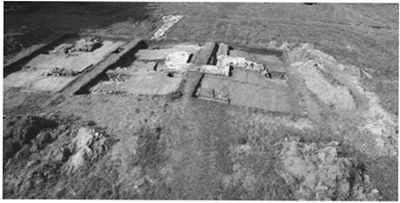
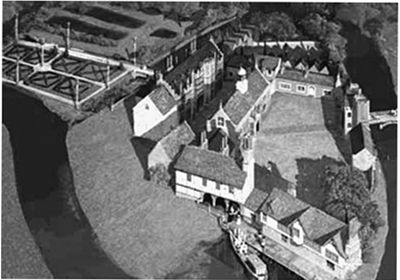
The ruins of the fine manor house at Woking in Surrey that became Margaret’s principal residence, and a reconstruction of its appearance in the fifteenth century
Margaret moved into this new residence with an enlarged household establishment, its strength doubled to between forty and fifty, with an influx of Stafford servants personally recommended by Anne Neville, Margaret’s mother-in-law, who had very much taken the couple under her wing. These included men of particular quality: William Wisetowe, who was appointed their steward, Thomas Rogers, their auditor, and – most important of all – Reginald Bray, who would become their estate manager and Margaret’s most trusted and loyal servant. After all the difficulties of the preceding years, Lady Margaret must have felt an astonishing surge of hope as she set up home at Woking. Fortune at last seemed to be turning her way.
Sir Henry Stafford now enjoyed a far more active political role. In May 1467 he rode to a royal council meeting at Mortlake; on another occasion he was summoned to attend the king at Windsor. In May 1468 both he and Margaret came up to stay in London during the meeting of parliament, arriving in the capital by boat and lodging at the Mitre in Cheapside. Edward IV, whose foreign policy – with Woodville support – had become increasingly hostile to France, was considering sending a military expedition against Louis XI, led by Walter Lord Mountjoy. In retaliation, Louis backed a small invasion force commanded by Jasper Tudor. In July 1468 Tudor landed in the Dyfi Estuary, close to the castle of Harlech, which remarkably had never been reduced by the Yorkists and was still in Lancastrian hands, and then launched a raid across north Wales. Edward responded quickly, ordering William Lord Herbert to raise an army and deal with this threat. Herbert chose to take young Henry Tudor with him, and Margaret – anxious for his safety – sent out a stream of messages enquiring after his well-being. In the event, the eleven-year-old Henry Tudor was safe enough. He witnessed the destruction of his uncle Jasper’s forces at Twt Hill near Caernarfon, and then saw his guardian Herbert finally capture the Lancastrian stronghold of Harlech, which surrendered to his army on 14 August. But Jasper Tudor himself was able to escape Herbert’s soldiers and sail back to France.
Lord Herbert had once again performed stalwart service for his master. However, Edward IV’s rule was becoming increasingly unpopular, and unrest within the realm was growing. Law and order was beginning to break down in the localities, and – faced with a threat to some of their properties in Kendal – Margaret and Sir Henry Stafford now sought a stronger demonstration of Edward’s favour. In December 1468 they took a remarkable step, inviting the king to hunt at Woking park, and afterwards to dine with them at their lodge at Brookwood. Edward accepted their invitation. Lady Margaret – chief heiress of the Beaufort family, enemy of the House of York – was now to entertain a Yorkist king to supper.
The lordship of Kendal had been granted to Margaret’s father on the eve of his great expedition to France in 1443, and she felt honour-bound to protect her lands there. Estate management was a vital skill in the late Middle Ages, particularly as Lady Margaret’s properties were, like many aristocratic holdings, scattered over a wide geographical area. She held a clutch of estates in the West Country, and another in the eastern Midlands. But it was her manors in north-west England, around the Cumbrian town of Kendal, that were now at risk. In the summer of 1468 the Parr family – enjoying the support of the powerful magnate Richard Neville Earl of Warwick – had challenged Margaret’s legal right to hold these properties and also stirred up unrest among her tenants. Storm clouds were gathering over the Yorkist polity: Warwick’s relations with the king were deteriorating, and this ambitious nobleman – known to posterity as ‘the Kingmaker’ – was very much pursuing his own agenda. In November Margaret’s estate manager Reginald Bray had ridden north with a trusted group of servants in an attempt to collect arrears of rent. Conditions were dangerous, and the men received extra financial reward because, as one document noted tellingly, ‘of the trouble now in the world’. But the rents remained unpaid.
Margaret and Sir Henry Stafford sought the backing of the king. But they also judged the opportunity was right to personally meet and entertain Edward IV, and build a deeper relationship with him. While Stafford would receive the king at Guildford, hunt with him and escort him to Brookwood, Margaret took charge of organising the festivities. In 1453 she had been bought fine clothing to meet the Lancastrian Henry VI. Now, in 1468, as she prepared to receive a Yorkist monarch, she chose her own, a dress of fine velvet and high-quality Flemish cloth. A pewter dinner service was bought in from London, servants carefully transporting its five dozen dishes and four dozen saucers to Brookwood. Further provisions were acquired in Guildford: wildfowl and a variety of fish, including pike, lampreys, several hundred oysters and eel, ‘half a great conger for the king’s dinner’, to be washed down by five barrels of ale.
As Margaret prepared to receive Edward IV she was fully aware that she was entertaining a man who had ordered the execution of her cousin and was the implacable enemy of the remainder of her family. Yet she must have felt an extraordinary sense of pride and excitement. On this December night the king, Sir Henry Stafford and Lady Margaret dined together under a magnificent canopy of purple silk, especially made for the occasion, with music provided by the royal minstrels. That such a meal had happened at all was tribute to Margaret’s perseverance, prudence and courage. But it was also proof of a ruthless pragmatism. She would stop at nothing to further the interests of her son. He – and he alone – commanded her abiding loyalty.
A FATEFUL YEAR
The magnificent banquet at Brookwood considerably strengthened Margaret and Sir Henry Stafford’s standing with the king. In settled times, entertaining an English monarch would have reaped a handsome dividend of royal patronage. But the Yorkist regime was close to fracture, with Edward IV’s authority under increasing threat. In the summer of 1469 the realm of England underwent a new period of political upheaval, one that would test the qualities of Lady Margaret to the utmost.
In the early 1460s the new Yorkist dynasty had successfully defeated its Lancastrian rivals. But now it was divided among itself, and by July 1469 the king had lost the allegiance of his chief aristocratic supporter Richard Neville Earl of Warwick, who began plotting with Edward’s younger brother George Duke of Clarence. Warwick’s resentment had been festering for some time, but Edward IV was slow to respond to the danger, and when he did so he completely underestimated the peril he faced. Warwick cleverly orchestrated a major rising in the north of England, led by one of his own retainers, Sir William Conyers – acting under the assumed name of Robin of Redesdale – and the king advanced north with insufficient troops to put it down. The Yorkist king had been outmanoeuvred, and was caught unprepared at Nottingham Castle between the rebels in the north and the forces of Warwick and Clarence moving up from the south. In desperation, Edward appealed to William Lord Herbert – newly promoted to the earldom of Pembroke after his successful reduction of Harlech Castle – to come to his assistance. Once more Herbert left Raglan Castle with a formidable array of Welshmen, and once more young Henry Tudor accompanied him. But Herbert – hitherto always victorious against Edward’s Lancastrian opponents – was now marching towards disaster.
On the evening of 25 July William Lord Herbert’s soldiers made contact with the rebels under Sir William Conyers at Edgecote, six miles north-east of Banbury. But that night Herbert quarrelled with his fellow aristocratic commander Humphrey Stafford Earl of Devon, who withdrew with his force of archers, leaving the royal army split in two. Realising this, Conyers attacked Herbert the following morning. The fighting that followed was confused. Herbert, without his archers, was quickly in difficulties and his battle line was pushed back, but showing considerable bravery he then rallied his men, and was beginning to turn the tables on Conyers when a fresh band of rebels entered the fray, bearing Richard Neville Earl of Warwick’s livery of the bear and ragged staff. Believing that Warwick himself was about to join battle, the royal army broke in panic. Herbert was captured, and led to Northampton, where he was executed the next day.
When the first reports of this disaster reached Margaret and Sir Henry Stafford at Woking, a host of frantic messages was sent out in an attempt to ascertain the whereabouts of Herbert, Henry Tudor and the king himself, now rumoured to be in Neville custody in Warwick Castle. It soon became clear that Herbert had suffered an awful fate. For a brief but heart-rending period Margaret feared that her son had also been killed. But then news reached her that Henry Tudor was safe. He had been led from the battlefield by the Shropshire knight Sir Richard Corbet, and escorted to the residence of Herbert’s brother-in-law Lord Ferrers at Weobley in Herefordshire. But Margaret could never put her initial shock and torment out of her mind, and nearly forty years later, it ran deep enough for her to share it with her confessor John Fisher, who recalled that Henry’s wardship had been granted to those caught up in ‘fierce and terrible warfare’, a clear reference to Edgecote and its aftermath.
The battle was a chaotic affair – but its emotional repercussions were harsh enough, not just for Lady Margaret but also for the twelve-year-old Henry Tudor, who was led away from the field of combat in a state of terror, having seen his guardian – a man of whom he was personally fond – overwhelmed by a band of rebels and hauled off to captivity and certain death. Margaret now rallied, and sent a party of eight trusted servants to Weobley, where they found Henry and Herbert’s widow, Anne Devereux, sheltering under the protection of Lord Ferrers. Handsome rewards were distributed to those caring for Henry Tudor, including one of twenty shillings to his personal attendant, a man named ‘Davy’, and a present was bought for Henry himself, in an effort to cheer him up; but the purchase of bow and arrows – although well intended – was not a happy gift for a young man who had just witnessed his guardian’s army defeated through lack of archers.
The broader political picture was also confused. Warwick and Clarence were unable to rule the kingdom using the captive king as a figurehead, and by the end of September 1469 Edward IV had regained his freedom. Margaret’s concern was to secure the freedom of her son, and although Henry was well cared for by Anne Devereux, in October she began negotiations with Herbert’s widow over the terms of his wardship. On 21 October at the Bell in Fleet Street, bread, mutton, ale and cheese were consumed as the legal councils of Lady Margaret and Anne Devereux met to try and reach an agreement over the matter. Margaret was nothing if not thorough – the records of Chancery and Exchequer were searched, the wording of the original grant was examined in detail and one servant was even dispatched to south Wales in search of further evidence. But the award could not be overturned.
The realm remained troubled, and fresh unrest flared up early in 1470, with a series of uprisings in Lincolnshire. Edward IV marched out of London to deal with the rebels, and Margaret’s husband was summoned to join him, reaching the king at Stamford on the morning of 12 March 1470 with a fighting retinue of thirty men. Not much fighting occurred. Sir Henry Stafford arrived to see one of the plotters, Richard Lord Welles, executed in front of the royal army, after which the rebel force of his son and heir Sir Robert fled in panic, jettisoning their livery tunics, which gave the engagement the derisory nickname of ‘Losecote Field’. Stafford remained with Edward as he marched north into Yorkshire to quell fresh insurrections stirred up by the Nevilles. On this occasion the king was successful, and in April Warwick and Clarence – aware that their support was fragmenting – decided to flee the country, crossing the Channel before Edward could intercept them, and taking shelter in France under the protection of Louis XI.
This period of wildly fluctuating politics continued. The French King Louis brokered a remarkable agreement at Angers between Warwick and Clarence and Margaret of Anjou, in which this prominent Yorkist magnate and Edward IV’s own brother would now support a Lancastrian restoration. In September 1470 Warwick sailed for England with an army and quickly chased a surprised and disorganised Edward out of the country. Edward IV was now forced into political exile in Holland, and a surprised and bewildered Henry VI was freed from the Tower of London and restored to the throne.
Margaret of Anjou and her son Prince Edward were still in France, but Warwick – effectively governing the country in the king’s name – was joined by a number of Lancastrian peers, including Jasper Tudor, and it was Jasper who now secured Henry Tudor’s freedom. It was Sir Richard Corbet who once again escorted Henry Tudor, this time on a journey from Weobley to Hereford, where Jasper met him and brought him to London. And here Margaret and Henry were at last reunited.
Lady Margaret must have been astounded by the sequence of events that brought her son back to her, as if they formed the miraculous workings of providence. One of her first actions on Henry’s return was to arrange for the thirteen-year-old to receive an audience with Henry VI. On 27 October 1470 Henry Tudor was rowed in Stafford’s barge from London to Westminster to meet with the Lancastrian king. Afterwards, young Henry dined with Margaret, Stafford, Jasper Tudor and Henry VI’s chamberlain, Sir Richard Tunstall. This meeting was later invested with much significance, for the Tudor court historian Polydore Vergil – a well-informed source – related how Henry VI made a miraculous prophecy concerning Tudor’s future role in healing the divisions of civil war. John Fisher, in a Cambridge oration delivered before Margaret Beaufort and her son, was even more specific: the Lancastrian king had miraculously foretold Henry VII’s own accession.
Henry VI had of course arranged the marriage between Margaret and Edmund Tudor, and it was natural enough that he should be interested in their sole offspring, the child that had been named after him. In the intervening years the Lancastrian king had suffered two major breakdowns, exile and finally a long period of captivity, and was clearly not in any state to exercise any semblance of power or authority. Yet something evidently happened at this audience, something – a remark or observation made by Henry VI – that led Margaret to believe that her son’s destiny would be entwined with the throne of England, and that she had an important part to play in ensuring this came to pass.
After the audience with the Lancastrian king, Henry Tudor, his mother and her husband Sir Henry Stafford returned to Woking, where they spent several weeks together. The household records only briefly hint at their activities. On 5 November the three paid a visit to Guildford; a few days later they travelled to Maidenhead and Henley. At the end of the month Henry accompanied his uncle Jasper to south Wales. Margaret had every expectation of seeing him again shortly, and after Henry’s departure she began negotiations with George Duke of Clarence, who held the honour of Richmond, to secure a landed settlement for her son. On 27 November a meeting was held with George at Baynard’s Castle in London, and it was agreed that Henry would succeed to the honour on George’s death.
In January 1471 Margaret’s cousins Edmund and John Beaufort returned to England from Burgundy. Their friend and supporter Charles Count of Charolais had succeeded to the dukedom of Burgundy in 1467, and had kept his faith with the Beauforts in the years that followed, even after his marriage to Edward IV’s sister Margaret of York in 1468. Edmund and John were sent away from the Burgundian court at the time of the marriage festivities, but were soon allowed to return, and continued to play an important role in Burgundian political life. In October 1470 Edward IV, his youngest brother Richard Duke of Gloucester, the Lords Hastings, Rivers and Say and some 400 household men had arrived in Holland, and were staying at The Hague, enjoying the hospitality of Louis of Gruthuyse. But Duke Charles was unwilling to support these exiles openly.
On 7 January 1471 Edmund Beaufort had visited the duke at St Pol and urged him to support the restored Lancastrian regime of Henry VI. Edward IV was allowed to put his own case to his brother-in-law and press for Burgundian support to restore him to the throne of England. But in the short term Charles decided in the Lancastrians’ favour, allowing the Beauforts, and other exiled magnates – including Henry Holland Duke of Exeter and John Courtenay Earl of Devon – to return home. Remarkably, the prospects for the Lancastrian regime and its coalition of Yorkist supporters looked bright. Edward IV lacked substantial foreign backing and was not strong enough to mount an invasion without it, and Margaret of Anjou and her son Prince Edward would soon be sailing for England.
In one extraordinary year the political landscape of England had entirely changed. Margaret could now take her place in a Lancastrian court – nominally presided over by Henry VI – among her Beaufort cousins Edmund and John, and her brother-in-law Jasper Tudor, confident of a secure and important future for her son. It was a remarkable turnaround of events, and one that would have been impossible to predict even a few years earlier. Lady Margaret must now have hoped that the wheel of fortune had found its permanent resting place.
REALPOLITIK
The adage a month is a long time in politics holds true for the fifteenth century just as much as the present day. At the end of January 1471 it seemed as if a restored Lancastrian government would once more rule over England. At the end of February the situation was once again completely unclear. It was the meddling of the French King Louis XI that damaged the Lancastrian cause, for the ever-suspicious Louis insisted that Richard Neville Earl of Warwick – who was in effect ruling England in the name of Henry VI – wage war on his arch-rival Charles Duke of Burgundy before he allowed Margaret of Anjou’s fleet to set sail. Warwick’s declaration of war – on 12 February 1471 – forced Charles to provide assistance to Edward IV, at last giving him the ships, men and money to invade England. In March, when Edward’s small army landed in Yorkshire, Margaret’s force still had not embarked.
Warwick was reluctant to confront Edward’s army immediately, and this proved another mistake. The delay allowed the Yorkist king to open negotiations with his brother George Duke of Clarence and win him back to his cause. Edward now seized the military initiative, boldly marching on London, held by Edmund Beaufort Duke of Somerset and John Courtenay Earl of Devon. But these Lancastrian lords were not prepared to remain in the capital, and instead moved towards the West Country, to await the arrival of Margaret of Anjou’s fleet. On 24 March Edmund Beaufort arrived at Woking with a retinue of forty men and stayed with Margaret and Sir Henry Stafford for four days. Edmund Beaufort was heading towards Salisbury, which he intended to use as a recruiting base for a small army. Stafford would not commit himself to joining it. Beaufort was forced to leave Woking on 28 March without any firm assurance of support.
We have reached a pivotal point in our story. As a historian my responsibility is to weave together a narrative based on my knowledge of the source material, the accounts of chroniclers and writers of the time, and the more impersonal documentary records. In the fifteenth century we have relatively few letters, which would reveal what a person wished to communicate to another, and those collections that do exist are mainly for gentry rather than aristocratic families. And we have no diaries, which would show us what a person really thought. So I base my story on the content of the sources, my interpretation of what they may or may not tell us and a broader reading of the personalities and politics of the period.
However, with Margaret Beaufort we also have an unusual and particularly valuable source, the recollections of her confessor and spiritual adviser John Fisher. These allow us a more intimate personal portrait, and also reflect back on key moments in Margaret’s life, which she later shared with Fisher and gave him permission to use after her death. And as I have already mentioned, Fisher saw that Margaret was a deeply emotional person, but that emotion was masked by an icy self-control in matters of state. Here she was skilled, highly effective – with remarkable presence and force of personality – and above all absolutely ruthless.
I believe that Margaret was possessed of remarkable qualities, and learned or drew upon these skills at a relatively young age, then honed them as her political education and experience deepened. In my view of her, which is based on a considerable body of evidence, she never let her emotions cloud her political judgement. She was pragmatic, and concerned more than anything else to protect the interests of her son. The following two paragraphs are on balance what I believe happened. But here – more than anywhere else in the story – an alternative, more speculative reading of evidence and character is possible. So first of all, let me rehearse my preferred reading of events, and then I will once again briefly take the reader behind the scenes.
Margaret and her husband were dismayed by the confident generalship of Edward IV and the defection of George Duke of Clarence. Both knew that if they supported the Lancastrians and Edward emerged victorious the Yorkist king would be an implacable opponent. There would be no more second chances. In the circumstances Margaret temporised. On 2 April a body of Stafford’s household servants travelled from Reading to Newbury for further discussions with Beaufort. Meanwhile Sir Henry Stafford rode off in the opposite direction, towards London. When Edward IV marched south – past Warwick’s force at Coventry – determined to force entry to the capital, Stafford resolved to join his army. Margaret and her husband were now preferring Edward’s chances to those of the Lancastrians, and on 13 April, as Edward prepared to confront Warwick at Barnet, north of London, chain-mail and plated armour was hastily brought to Sir Henry, camping on the field of battle. The following day, in a bloody but confused battle fought in swirling mist, Warwick was defeated and killed. That evening Margaret of Anjou’s forces finally landed in the West Country.
Lady Margaret had preferred cold calculation to heady emotion, and pragmatism over loyalty to the House of Lancaster. It was a ruthless choice, but her instinct for political survival was acute and her decision was soon vindicated. After his triumph at Barnet, Edward moved swiftly against Margaret of Anjou. He was determined to cut off and defeat her force before she could gain further reinforcement – either in Wales or in the north of England. He trapped her army against the River Severn and on 4 May Margaret of Anjou’s supporters were routed at Tewkesbury. John Beaufort was slain in the fighting. In the battle’s aftermath, Edmund Beaufort and a number of other Lancastrians sought sanctuary in Tewkesbury Abbey. Edward IV granted a free pardon to all those within consecrated ground. It was a promise the Yorkist king had no intention of keeping, and two days later his soldiers broke into the abbey. Edmund Beaufort was hauled out and executed on 6 May.
The key source materials I have drawn upon here are Margaret’s household accounts. These documents are very useful, as they show us the comings and goings at Woking, who visited, and how long they stayed. They also allow us to chart the couple’s political strategy, but this can only be done if we assume that Margaret and Sir Henry Stafford were working in unison, with a shared sense of purpose. Most of the time they were – but these were not ordinary times. In the two paragraphs above I have told the story as if they were in complete agreement about what to do.
But suppose they were not. In this case the documents would only show us the man’s side of events. It was Sir Henry Stafford who was master of the household, Stafford who would have to ride into battle, who would have to fight. The documentary material would record his movements, his decisions. If the political situation lay on a knife edge, Stafford’s instinct would always have been to support Edward IV. Margaret’s motivation was more complex. She had learned to work with Edward, but probably also feared him. And now her Beaufort cousins – at last restored to power and influence within the realm – were appealing for her support.
Documentary evidence, however valuable, can take us only so far. From the household records we know what Lady Margaret bought when Edward IV came to supper, but we do not know what her personal impressions were, what she thought about him – as a man and as a king. And when Edmund Beaufort rode into the great courtyard at Woking, with his riding household of forty servants, with the world once again in turmoil, we know that he stayed for four days, from 24–28 March 1471, but nothing about what was said during his visit. So we can imagine one scenario – rehearsed above – with Beaufort urgently and emotionally appealing for support for the Lancastrian cause, and Margaret and Sir Henry Stafford listening courteously and attentively, but in their inner thoughts and private conversations weighing the chances of the rival sides, and deciding the advantage now lay with Edward IV.
However, we could also imagine an alternative sequence, with the couple in disagreement, and arguing passionately and bitterly: with Margaret – more than at any other time in her life – swayed by loyalty to her family; and Stafford calm, rational and immovable, unwilling to support the Lancastrians – believing such a course of action was too risky, and too dangerous. If this was the case, Margaret’s impassioned pleas, her anger, her tears, would find no place in the records.
Then there was the safety of Margaret’s son, Henry Tudor, to consider. He was now in south Wales with his uncle Jasper, and Jasper would almost certainly attempt to join Margaret of Anjou’s army. We can assume that Edmund Beaufort would have argued that the right course of action was to throw every man, every retainer, into battle for the Lancastrian cause, and this was the only way to achieve Henry’s security. Was Margaret swayed by this emotional appeal? Or did she draw back, realising that if the Lancastrians lost the battle Stafford’s support for Edward IV would give the only real guarantee of her son’s political survival?
John Fisher, Margaret’s confessor, came to know an old lady in her sixties, the mother of the Tudor king and matriarch of the House of Tudor. The Margaret that he met would have mastered her emotions in March 1471, and calculated the best course of action from her head rather than her heart. I have shown you that woman here. But people – in the Middle Ages as now – are complex and never entirely consistent. If Margaret had once powerfully surrendered to her feelings, and then realised with hindsight that the actions she had advocated, however understandable, were misjudged and mistaken, she would have redoubled her self-possession and self-control. We will never know.
I will continue my narrative. In the aftermath of Tewkesbury Edward IV was now determined to wipe out his opponents once and for all. The Lancastrian Prince Edward had been slain attempting to flee the battlefield, and on the Yorkists’ return to London the hapless Henry VI was almost certainly murdered in the Tower on Edward IV’s orders. Resistance in other parts of the country quickly collapsed. In south Wales, Jasper and Henry Tudor briefly held Pembroke Castle for the Lancastrians, but in September 1471 they fled abroad. They had hoped to reach the shelter of France, but instead storms blew them to the duchy of Brittany, and here they would remain for the next thirteen years.
On 4 October 1471 Margaret’s husband Sir Henry Stafford died. He had been wounded fighting at the battle of Barnet, and was never able to recover from his injuries. Margaret’s estate manager and loyal servant Reginald Bray took care of the details of Stafford’s burial at Pleshey in Essex. After her husband’s death Margaret left Woking for a while – perhaps finding the memories of her time there too painful – and moved into her mother’s London house ‘Le Ryall’ with a reduced household of sixteen, headed by three of her ladies-in-waiting.
In January 1471 Margaret’s fortunes had been in the ascendant. She had been reunited with her son, a Lancastrian king was on the throne and, in her perception at least, the Beaufort family had been restored to its rightful position within the realm. In October 1471 they had reached a nadir. Her son was now in exile in Brittany, kept in captivity, under guard, and Margaret had no idea whether she would see him again. The Lancastrian King Henry VI, whom she revered as a saint, had almost certainly been murdered in the Tower of London. Her male Beaufort cousins had been wiped out, and Edmund Beaufort – whom she had come to know – had been hauled from the protection of religious sanctuary and executed. And now her husband for the last fourteen years – with whom she had enjoyed a companionable and affectionate relationship – had died. Margaret must have felt utterly bereft.
In May 1472 Margaret drew up her first will, and in it, she tried to make sense of her life so far. She sought reconciliation with her first husband, Edmund Tudor, whose body she wished to be moved from the House of the Grey Friars in Carmarthen and reinterred in Bourne Abbey, so that she could be laid to rest beside him. And she thought deeply about her exiled, captive son. She instructed her trustees to preserve an estate – drawn from her landed wealth – for the use of Henry Tudor, so that he could have an inheritance should he ever return to England and be restored to favour in the Yorkist realm. Sadly, this prospect seemed far distant.
Another aristocratic woman, faced with these traumatic experiences, might well have retired from active life altogether and joined a religious community. Margaret herself probably thought hard about taking such a step, in the autumn of 1465, and again in the autumn of 1471. Her sense of personal destiny, the vision of St Nicholas that she had seen as a child, the miraculous prophecy of Henry VI that she had heard as an adult, must at such times have seemed a mockery to her. Instead she had faced the bewildering turns of fortune’s wheel, and watched as those around her met with violence and death. A genuinely pious woman and intelligent thinker, Margaret must have wondered if she was being punished for some terrible sin, and as she did so, her thoughts would have returned again and again to the suicide of her father.
But Lady Margaret remained a fighter, and the drawing up of her will, far from turning her into a recluse, galvanised her once more into action. She resolved to return to court and find herself a new husband, and her sights were now set on one of the most powerful magnates in the kingdom, Thomas Lord Stanley, the steward of Edward IV’s household. In June 1472 the marriage took place at Stanley’s residence of Knowsley Hall in Lancashire. It was an arrangement of mutual interest. A carefully worked-out marriage contract guaranteed Margaret an annual income of 500 marks from Stanley’s estates in Cheshire and north Wales. For Stanley, the match expanded his territorial influence, giving him a life interest in Margaret’s substantial properties. The contract made no provision for issue, the most likely explanation being that Margaret wished to live a celibate life, rather than the later legend that Edward IV only allowed the union of Lady Margaret and Stanley on the condition that no children were produced.
Margaret now divided her time between Stanley’s Lancashire and Cheshire properties and the demands of court activity in the capital. Thomas Lord Stanley quickly came to respect his wife’s forceful personality and also her understanding of the law. In November 1473 a property dispute in Liverpool was delegated to an arbitration panel headed by Lady Margaret, and in August 1474 a dispute between two of Stanley’s tenants, Thomas Ashton and Richard Dalton, was referred to Margaret’s own legal counsellors. Lady Margaret was a frequent visitor to London, and early in 1475 she witnessed preparations for Edward IV’s expedition to France. Stanley was one of Edward’s principal captains, and in a flurry of activity craftsmen were paid for garnishing his armour and providing crimson and blue silk for his standards. Other servants went further afield, one, Edward Fleetwood, being given £50 to buy horses for Stanley in Flanders. The gathering of this great army, comprising almost half the English aristocracy, must have left a powerful impression on Lady Margaret.
Margaret’s marriage strengthened her connection to the powerful and influential Woodville family. By the mid-1470s the Stanleys and the Woodvilles worked in close co-operation in the administration of Cheshire and north Wales, a partnership cemented by family alliances. Sir James Molyneux, chancellor to Anthony Earl Rivers, was Lord Stanley’s nephew. Stanley’s son and heir George had married Joan, the queen’s sister, daughter of John Lord Strange and his first wife Jacquetta. Lady Margaret now benefited from these contacts, particularly in the arena of court ceremony. In July 1476 Margaret played an important part in the reburial of Richard Duke of York, the king’s father, at Fotheringhay, in attendance upon the queen and her daughters. In November 1480 Margaret was honoured in the celebration of the birth of the seventh royal princess, Bridget, at the newly refurbished palace of Eltham, acting as godmother and carrying the child in the procession.
A measure of mutual respect and affection grew between Margaret and Stanley. In 1478 she commissioned a selection of prayers of the Passion and the Holy Name for her husband, with four charm-like formulae placed in the middle of the book. It was believed that whoever recited these prayers would not perish in battle, was assured immunity from the plague, and – in the case of women – protection during pregnancy. It is highly likely that Margaret had used these charms during her own dangerous pregnancy, and recognising Stanley’s fear of death in battle (his reluctance to commit his forces during the Wars of the Roses gave him a reputation for political guile that would last for centuries) deemed this an appropriate gift.
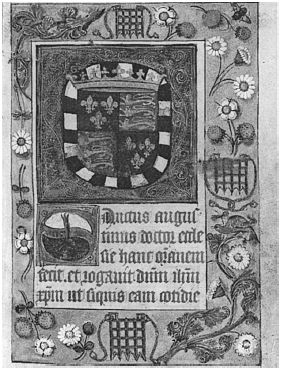
Margaret’s badges and coat of arms and the badge of her husband Thomas Lord Stanley from their book of prayers
By the beginning of June 1482, ten years after her marriage to Lord Stanley, Margaret had established herself at the heart of the Yorkist court, wielding considerable political influence. She now used this power in an effort to secure the return of her son, who was still in exile in Brittany. A remarkable document was drawn up in the presence of Edward IV and Stanley at the Palace of Westminster on 3 June 1482. It laid out arrangements for the disposal of the properties of Margaret’s mother, who had died a month earlier. They were reserved for Henry Tudor’s use, on certain conditions, the principal being that Henry now return from exile ‘to be in the grace and favour of the king’s highness’. Edward added his royal seal in confirmation of the agreement. The pious hope expressed in Margaret’s will of May 1472 had now become a reality. A place had been found for Henry Tudor within the Yorkist realm.
Greater honour was envisaged. Lord Stanley later recalled that towards the end of Edward IV’s reign discussions were held about the possible marriage of Henry Tudor to one of the king’s daughters. If a York–Tudor marriage was to take place, a major restoration to Henry of aristocratic title and lands would have followed, and draft documents preserved in Lady Margaret’s archives suggest that after Edward IV granted Henry Tudor a royal pardon his promotion to the earldom of Richmond (the title held by his father Edmund) was anticipated. These arrangements show Edward now conciliatory towards the exiled Tudor, and were a remarkable triumph for Lady Margaret. Fortune’s wheel had turned once more.
CONSPIRATOR
All rested on how Henry Tudor would react to the new arrangement. Margaret had not seen her son for nearly twelve years – and the thirteen-year-old boy she had last met was now a 25-year-old man. Edward IV was now ready to welcome Tudor back to England, yet it was hard to put aside the legacy of years of suspicion and mistrust. The Tudor court poet Bernard André described an earlier occasion, in 1476, when Henry had been warned by his mother not to come back to England if the king offered him one of his daughters in marriage. Margaret’s doubts were well founded – at this stage Edward IV had other plans for all his daughters – and a year earlier another Lancastrian claimant, Henry Holland Duke of Exeter, had died in the most suspicious of circumstances, being pushed off a boat and drowning on his return from France in the royal expedition of 1475.
In November 1476 Henry Tudor managed to escape the clutches of an English embassy sent to Brittany, slipping away from his escorts and seeking sanctuary in the church of St-Malo. Polydore Vergil gave a vivid description of this incident, almost certainly derived from Henry himself, that he was terrified, fearing for his life, and clearly believing that he would suffer a similar ‘accident’ to Henry Holland once he was shipped to England. Even though Margaret was now vouching for Edward IV’s good faith, the indenture of June 1482 also made provision for the possibility that Henry would choose not to return, despite these reassurances. Henry Tudor would bitterly tell the chronicler Philippe Commynes that most of his life had been spent as a captive or fugitive, and the result of such experiences was an almost pathological suspicion.
The lack of response from Henry Tudor cast a shadow over Margaret’s achievement, although the new arrangement was never fully put to the test, for on 9 April 1483 Edward IV suddenly died – having fallen ill after a boating trip on the Thames, in which he contracted a serious chill. His son and heir was recognised as Edward V and a governing council, dominated by the Woodvilles, was set up to rule the country until the young king could be crowned, then replaced by a protectorate under Edward IV’s younger brother, Richard Duke of Gloucester. The protectorate itself abruptly ended when Richard dramatically announced that his brother’s marriage to Elizabeth Woodville was invalid and that the couple’s two sons – Edward and Richard – were in fact illegitimate. Richard Duke of Gloucester now claimed the throne himself, accepting kingship by proclamation on 26 June and being crowned as Richard III on 6 July.
The circumstances of Richard’s seizure of the throne were bloody and confused. Edward IV’s two sons were confined to the Tower, William Lord Hastings executed for treason and Edward IV’s queen forced to withdraw into sanctuary at Westminster Abbey with her daughters. Yet at this stage Lady Margaret’s intention was to seek an accommodation with Richard III and safeguard the arrangements for Henry Tudor’s return, drawn up a year earlier. She had opened negotiations with Richard in late June, using Henry Stafford Duke of Buckingham as an intermediary, and again the prospects of a marriage alliance for Tudor were discussed. On 5 July, the day before the coronation, Stanley and Margaret secured a private meeting with Richard and his chief justice William Hussey at Westminster. The following day Margaret played a prominent part in the coronation ceremony itself, bearing Queen Anne’s train in the procession to Westminster Abbey, and serving at the banquet afterwards.
Richard III now undertook a royal progress throughout the realm. Thomas Lord Stanley was commanded to join him, and Lady Margaret, who had remained behind in London, began to have second thoughts about the wisdom of supporting Richard. She may have been informed by Jasper and Henry Tudor that they would never be willing to support such a scheme, and begun to despair of ever securing her son’s return. Whatever the reason for it, Margaret now took a calculated but highly dangerous step, abandoning her allegiance to Richard III and beginning to plot against him. At the end of July 1483 she may have even participated in a plot to rescue the princes from the Tower, in which a newly restored Edward V would be supported by an invasion force led by Jasper and Henry Tudor. Information on this early conspiracy is fragmentary, being confined to a brief comment in one contemporary source, the French chronicle of Thomas Basin, and material gathered by the early-seventeenth-century antiquary John Stow. According to Stow, an attempt to storm the Tower failed, and Basin added that about fifty people were arrested and executed in London for their involvement in this rescue attempt.
The evidence for Margaret’s plotting later in the summer is much firmer. The princes had now been withdrawn to the inner recesses of the Tower and their servants dismissed. By September 1483 most people feared that they were dead. Exactly what had happened to them, and – if they were murdered – who was responsible for it, has never been fully established. Chief suspicion rested on Richard himself, though some contemporary chroniclers also pointed an accusatory finger at Henry Stafford Duke of Buckingham, and in the early Stuart period researchers such as William Cornwallis and Sir George Buck even suggested that Margaret Beaufort herself may have decided to kill them, in order to further Henry Tudor’s chances of taking the throne. Such a possibility cannot be entirely ruled out, and if so it would represent the darkest and most terrifying fruit of her remorseless ambition for her son.
However, while a motive for Lady Margaret existed – albeit a profoundly disturbing one – hard evidence for her involvement in such a scheme is scant indeed. Buck claimed to have found proof ‘in an old manuscript book’, but as he never cited its provenance or quoted from it, its existence remains a mystery. And no contemporary chronicler or source blamed Margaret for the princes’ disappearance. Most believed Richard III himself was guilty of the crime. It is Margaret’s motives for joining a rebellion against Richard that smack of opportunism, particularly since she had sought to co-operate with him at the start of his reign.
What is clear is that once the princes were assumed dead, with many contemporaries believing – rightly or wrongly – that Richard had murdered them, a major uprising was planned against the new Yorkist king, and Margaret herself took a leading role in its organisation. As Polydore Vergil said, she was ‘commonly called the head of that conspiracy’. Her ambitions for her son’s future now reached a dramatic and powerful culmination. Henry Tudor, united with the Woodville faction through a proposed marriage to Elizabeth of York, would claim the throne of England itself. Negotiations with Elizabeth Woodville were carried out by Margaret’s physician, Lewis Caerleon, while contact with Henry Tudor in Brittany was undertaken by her servant Hugh Conway. Margaret’s communication with the chief aristocratic supporter of the rebellion, Henry Stafford Duke of Buckingham, remained more ambiguous, and it was uncertain whether the duke fully knew of or supported Henry Tudor’s bid to claim the throne.
In the event, all these plans came to nothing. In October 1483 separate risings against Richard III began in different parts of the country. They were badly co-ordinated, and the Kentish rebellion was promptly crushed by Richard’s staunch supporter, John Howard Duke of Norfolk. Henry Stafford’s tenants in Wales deserted him in large numbers, allowing Richard to move down on the rebellion in south-west England in considerable force. By the time Henry Tudor and his small fleet appeared off the coast of Dorset in early November, the rebel cause was all but lost, and Tudor prudently beat a hasty retreat.
The failure of the rebellion of 1483 placed Lady Margaret in considerable personal danger. Richard III was soon aware of the extent of her plotting, and – in his rage – may initially have considered executing her for treason. The later recollections of Henry Parker Lord Morley, who served as a cupbearer in Margaret’s household, made clear that ‘in Richard’s reign, she was often in jeopardy of her life, yet she bore patiently such trouble in a manner that is extraordinary to think of’. After reflection, the king chose to spare her life because of the loyalty of her husband, Thomas Lord Stanley, who had maintained his allegiance to Richard throughout the uprising. In the parliament of 1484 she was remitted the full rigour of attainder, ‘remembering the good and faithful service that Thomas Lord Stanley has done us, and for his sake’. Yet she was to forfeit all right to aristocratic titles and estates, the annual income that she enjoyed from her husband was declared void and the lands that she had conserved for the use of her son were now confiscated and dispersed among others. Stanley was instructed to keep her confined without household servants. In a life rich in triumph and adversity, it was the lowest point of her fortunes.
And yet – even in failure – the conspiracy initiated by Margaret began to develop a momentum of its own. Exiled Woodvilles, fleeing from England in the aftermath of the revolt, now clustered around Tudor in Brittany, and on Christmas Day 1483 in Vannes Cathedral Henry solemnly promised to return to England as king, vanquish Richard III and marry Elizabeth of York. By 1484 he was using the regal style of a king of England in messages and proclamations to his supporters and in 1485 his claim to the throne was recognised by the French, who provided the ships and soldiers for a small invasion fleet. At the beginning of August 1485 he landed in Wales with a small army, marched into England and confronted Richard III in battle. And at Bosworth on 22 August the numerically smaller army of Tudor triumphed over the larger one of Richard, with the Yorkist king slain in combat as he tried to cut down his challenger. Against all expectations, and against all odds, Margaret Beaufort’s son Henry Tudor had won the throne of England.
THE KING’S MOTHER
The month of September 1485 saw a highly emotional reunion of mother and son. The victorious army of the new Tudor monarch reached London on 7 September, and two weeks later Henry VII left the capital and travelled to Margaret’s manor house of Woking, which he had last visited nearly fifteen years before. It was a deliberate recreation of their previous meeting together in November 1470, before political fortune drove them apart. It was a long visit – the king staying for nearly three weeks – but they had much to talk about.
Henry’s incredible victory at Bosworth would have been top of the list. The new Tudor king would have shared details of the campaign and battle, the difficult negotiations with the Stanleys, the sudden and decisive intervention of Thomas Lord Stanley’s younger brother Sir William on the field of combat, Richard’s dangerous last charge, in which the Yorkist monarch slew Henry’s standard bearer William Brandon and was only a few feet from Tudor himself. Henry VII would have praised the performance of his French mercenaries, and their captain Philibert de Chandée, whom he elevated to the earldom of Bath in gratitude for his stalwart service. And more than anything, he and Margaret would have marvelled that, faced with Richard’s much larger army, his small force had triumphed at all.
Henry had a present for his mother, taken from the spoils of Richard’s war tent – the late Yorkist king’s book of hours, his personal prayer book. It was a telling gift, and a well-chosen one. In public, the Tudor view of Richard was that he was an embodiment of evil, a man who had put himself beyond the pale through a series of horrifying killings. But many of these killings – the executions of Earl Rivers, Lord Hastings, Sir Richard Grey and Sir Thomas Vaughan in June 1483 – had taken place before Lady Margaret met with the king in the Palace of Westminster on 5 July, and discussed her son’s future with him. Now that son had unseated him on the field of battle.
When Margaret very publicly assisted in Richard III’s coronation on 6 July 1483, the day after this conversation, an Italian visitor to London, Dominic Mancini, related that people in the street already openly feared for the safety of the young princes in the Tower, adding that some believed they were already dead, and others thought they would soon die. Yet this fact did not stop Margaret lending her support to Richard’s cause. It is probable that she chose to rebel against him later that summer not out of a sense of moral outrage over the way he had seized the throne but because it seemed a more powerful and effective way of advancing the interests of her son.
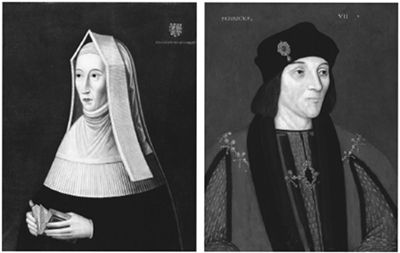
Later Tudor portraits of Margaret and her son, Henry VII
In private, it is more likely the king and his mother were struck by the late king’s piety, and that a genuinely religious person could be politically ruthless none the less, and on occasions take that ruthlessness to terrible extremes. As Henry and Margaret talked about past events and shared their hopes for the future, the king had already granted her a fine new London house at Coldharbour. Locked securely in one of its rooms was Edward Plantagenet, the son of Edward IV’s brother George Duke of Clarence. One of Henry’s first actions after winning Bosworth was to send an armed retinue to seize Plantagenet and bring him to the capital. Both Henry VII and his mother knew that his own claim to the throne was weak, and that Clarence’s son was a dangerous dynastic rival. He was a ten-year-old child, innocent of wrongdoing, but a dangerous child, and Margaret was now in effect his jailer. He was soon transferred to the greater security of the Tower of London, from where – like the princes – he would never reappear. The Tudor monarch lambasted Richard ‘for the shedding of innocent blood’ (a veiled reference to the murder of the princes) then cynically waited until the equally innocent Edward Plantagenet came of age before executing him on trumped-up charges.
Henry’s Beaufort lineage gave him a royal pedigree, but one not strong enough in itself to justify a claim to the throne. To effect this, Henry duly married Elizabeth of York, the match that his mother had laboured hard to bring about. But the king’s mother remained a dominating presence. At the Tudor court, Margaret’s standing was as great as the queen’s. In 1488 both she and Elizabeth were issued with liveries of the Order of the Garter, a sign of special standing, and a song was composed to celebrate their wearing of robes together. At the ceremony Margaret wore identical robes to the queen, cloth furred with miniver and woven with garter letters of gold, and in her heraldic insignia she used the royal coronet with its fleurs-de-lys. Royal household ordinances made provision for Lady Margaret’s accommodation at all the palaces and residences used by the Crown. And contemporaries noted the frequency with which Margaret accompanied the king and queen on royal visits or progresses.
Their close relationship was reflected in the architecture of royal palaces. At Woodstock Margaret’s lodgings were placed close to her son’s, linked by a ‘withdrawing chamber’, a room that was built between the king’s rooms and his mother’s, one that allowed them to be together in utmost privacy, whether to discuss affairs of state or relax at cards or chess. And in the Tower of London Margaret’s rooms were to be found next to the king’s own bedchamber. And their remarkable intimacy and sense of common cause were reflected in their personal correspondence.
In a letter to his mother Henry VII wrote: ‘I shall be glad to please you as your heart desirest, and I know well that I am as much boundeth to do so as any creature living for the great and singular motherly love and affection that it have pleased you at all times to bear me.’ Margaret responded in equally fulsome fashion, addressing Henry as ‘my own sweet and most dear king and all my worldly joy, my good and precious prince, king and only beloved son’.
Lady Margaret maintained an active political role. A postscript to a letter of hers, written in 1488 to Richard Fox, keeper of the privy seal, requested the latest news from Flanders, well aware that Margaret of York, the Dowager Duchess of Burgundy, was sheltering opponents of the new Tudor dynasty. At the times of Henry VII’s expedition to France in 1492 it was the king’s mother who made the greatest financial contribution and also donated large supplies of grain. In April 1497 the return of an embassy from the Burgundian court occasioned a typically sardonic gift. She was unable to resist a weighted jibe against the pretensions of Margaret of York, whose glittering court continued to support a host of plotters against her son’s regime.
‘I thank you heartily for the gift of gloves that you have brought from her,’ she began, ‘which are finely chosen, except that they are far too large for my hand. I think the women of this court are great ladies, one and all, and as befits their great estate, they are great in size also.’ Beneath the mockery one senses the bitterness she felt towards the duchess, who had sheltered the pretenders Lambert Simnel and Perkin Warbeck, and encouraged their plots against the Tudor dynasty.

A letter written by Margaret in her own hand, to the Earl of Ormonde in 1497
Margaret now became a great landowner, renegotiating her marriage contract with Thomas Lord Stanley so that she could hold her properties in her own right and acquiring plentiful estates from the king, whose income funded a substantial household, building projects, and her acts of religious and educational patronage. She built a fine palace at Collyweston in Northamptonshire where she entertained the king and great aristocrats of the realm but also held a court of equity, and a governing council of the Midlands, where she arbitrated in disputes on Henry’s behalf. Here, in the summer of 1503, Henry’s court stayed for three weeks, as Margaret’s granddaughter, the Princess Margaret, made her way north to marry James IV, King of Scotland. Lady Margaret’s choristers sang, acted and performed for her many guests.
Margaret’s wealth allowed her to sponsor works of devotional literature, such as the printing of Walter Hilton’s Scala Perfectionis or Sebastian Brandt’s Ship of Fools, and she also tried her hand at translating, most notably the fourth book of the Imitation of Christ by Thomas à Kempis. Her educational patronage culminated in her Cambridge foundations of Christ’s and St John’s colleges. But these good works, which attracted the interest of her early biographers, were not undertaken in religious seclusion but from an active and highly pragmatic involvement in worldly affairs. Lady Margaret’s household contained a full range of personalities: the scholarly, cultural presence of her confessor John Fisher or the dean of her chapel, Henry Hornby, contrasting with servants such as Reginald Bray – described as ‘plain and rough in speech’ – and John Hussey, an estate official notorious for his strong-arm rent-collection tactics. Lady Margaret respected Bray and Hussey because they were tough, practical and got things done – and she did not ask too many questions about how they did it. And among all these men Margaret exerted a commanding influence. Fisher said simply that, if division or strife arose among any of her household, ‘she with great policy [forcefulness] did bolt [sort] it out.’
And such forcefulness was more than necessary. The turns of fortune’s wheel did not end with Henry VII’s accession. The court poet Bernard André likened the first twelve years of the Tudor dynasty to the labours of Hercules as a series of dangerous threats were beaten off, at home and abroad. Lady Margaret’s book of hours, her own prayer book, was not divorced from this world, and in it she recorded her son’s victories against his assailants, in 1485 at Bosworth, where he won the throne, Stoke in 1487, when he defeated his first major rebellion, and in 1497 Blackheath, where he vanquished the last.
On 14 November 1501, when the marriage of Henry VII’s oldest son Arthur to Katherine of Aragon in St Paul’s Cathedral was lavishly celebrated by the king and his mother, it appeared that the Tudor dynasty had fought its way through such trials and won diplomatic and political acceptance on the European stage. But then fresh calamity struck. Only six months later the fifteen-year-old Arthur fell suddenly ill, and died at Ludlow on 2 April 1502. As the king’s youngest son Edmund had succumbed to an outbreak of the plague two years earlier, and Prince Henry’s health was at this stage not robust, the dynasty’s hold on power began to appear fragile, and a new round of conspiracies started, initiated by the de la Pole family. A final blow fell on 11 February 1503 when the 37-year-old Queen Elizabeth of York died, shortly after giving birth to another daughter, Katherine. The king was stricken with grief, his mother drew up ordinances for the court to dress in black, the colour of mourning, and the unfortunate court astrologer William Parron, who a few months earlier had unwisely predicted that the queen would live to at least eighty, hurriedly left the country.
In the event, the fresh crisis was mastered, and Lady Margaret had the pleasure of watching her grandson Henry grow into a strong and athletic young prince. Henry’s youthful athleticism was particularly encouraging as her son, the king, was succumbing to increasing ill-health, finally passing away on 21 April 1509. Margaret outlived him, participating in the festivities that marked the marriage of Henry VIII to Katherine of Aragon on 23 June. It was her last appearance at court, but a highly symbolic one – the Tudor dynasty was now fully established. She fell ill shortly afterwards, and died on 29 June 1509.
‘All England on her death had cause of weeping,’ said John Fisher in his funeral sermon, and it was indeed an extraordinary life. Margaret had fought long and hard to further the interests of her son, and the creation of the Tudor dynasty was in large part her achievement. And it is her fight that I have sought to recreate here. Margaret’s early biographers paid little attention to her early career, instead becoming fascinated by her religious and educational patronage. For those interested in learning more about this, I have added their works in my bibliography, and the subject is also covered in the study of Margaret’s life that I jointly undertook in 1992 with the archivist at St John’s College, Cambridge, Malcolm Underwood. But it is the political arena – particularly in the period up to 1485 – that particularly fascinates me, and it is this I have focused on, in order to mirror Philippa Gregory’s powerful historical novel The Red Queen.
Readers wishing to gain a full sense of Lady Margaret as a person are often confronted by a series of rather bland late-Tudor copied portraits. Here Margaret is presented in the wimple or headdress of widowhood, in the black cloth of mourning, plain, as if she were a nun. In some of these images she reads from a devotional book, in others she kneels at prayer. She appears to have retired from the world, to live the life of a spiritual recluse. The face is soft and featureless. The power and purpose of her life, and the dark, driving passion of her ambition, are nowhere to be seen.
To reconnect with that ambition, I recommend a visit to Margaret Beaufort’s tomb in Westminster Abbey. Here, in the effigy strikingly fashioned by the Florentine sculptor Pietro Torrigiano from an exact likeness, one sees the strength of character in her face. The sharply etched lines, the pronounced cheekbones and slightly hooded eyes convey considerable force of personality. Her features are intelligent, but worldly and astute, an impression reinforced by the coats-of-arms and badges that surround them. It is the face of a political survivor.
The sense of destiny that Margaret experienced as a child took her on a long and perilous journey. It was a journey of darkness more than light, yet as her life drew to its close, she saw that destiny reach its fruition. In 1499, as Margaret began to build her impressive palace at Collyweston, and govern the east Midlands on behalf of her son, she changed her signature from ‘M Richmond’ to the regal ‘Margaret R’. Contemporaries – with a mixture of awe and respect – referred to her simply as ‘the King’s Mother’.
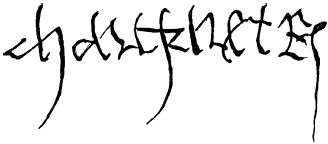
Margaret Beaufort’s signature (from 1499)
NOTES AND SOURCES
Readers wishing to find out more about Margaret’s remarkable life are recommended, as a first port of call, the author’s own biography, co-written with Malcolm Underwood, the archivist at St John’s College, Cambridge: Jones, Michael, and Underwood, MalcolmThe King’s Mother: Lady Margaret Beaufort, Countess of Richmond and Derby, Cambridge, 1992. But I would also like to discuss its major predecessors. The first major study was Halsted, Caroline Life of Margaret Beaufort, Countess of Richmond and Derby, London, 1839. Halsted, who also undertook a biography of Richard III, was perceptive in some of her judgements, but while she praised Margaret’s moral qualities and patronage of learning, she neglected her political ambition and ruthlessness, and quite wrongly believed that she retired from the political scene once her son took the throne. The Cambridge antiquary Charles Cooper, in his The Lady Margaret: A Memoir of Margaret, Countess of Richmond and Derby, Cambridge, 1874, also focused primarily on Margaret’s educational achievements and religious patronage, and largely neglected her early life. Routh, Enid A Memoir of Lady Margaret Beaufort, Countess of Richmond and Derby, Mother of Henry VII, Oxford, 1924, was the first biography to draw on Lady Margaret’s household accounts – held in the archives of Westminster Abbey – but while she drew a fuller picture of Margaret’s domestic routine and position at court, she again underplayed her political acumen. Simon, Linda Of Virtue Rare: Margaret Beaufort, Matriarch of the House of Tudor, Boston, Mass., 1982, while adding little new information to Margaret’s life, was the first biography to emphasise the difficulties she faced as a woman in the world of fifteenth-century politics. For a good, readable recent study that pays proper tribute to her political role, readers are recommended Norton, Elizabeth Margaret Beaufort: Mother of the Tudor Dynasty, Stroud, 2010.
For a fuller picture of the life and reign of Margaret’s son Henry VII, there is the standard biography by Stanley Chrimes, Henry VII, London, 1977, but far more accessible – and particularly good on Henry Tudor’s early life – is Griffiths, Ralph, and Thomas, Roger The Making of the Tudor Dynasty, Gloucester, 1985. And for a valuable recent survey of the king’s rule I highly recommend Cunningham, Sean Henry VII, London, 2007. The best introduction to the wider Beaufort family is the excellent biography of Margaret’s great-uncle: Harriss, Gerald Cardinal Beaufort, Oxford, 1988; and see also my entries on Margaret’s cousins, Henry and Edmund Beaufort, in the New Oxford Dictionary of National Biography.
On the politics of the fifteenth century that Margaret charted her course through there is a mass of material. For the troubled reign of Henry VI there are two major biographies: Wolffe, Bertram Henry VI, London, 1981; which is an easier read than the nevertheless valuable Griffiths, Ralph The Reign of Henry VI, London, 1981. Since much of the material that follows has already been discussed I will simply list the main secondary sources I have used.
BIBLIOGRAPHY
Baldwin, David Elizabeth Woodville: Mother of the Princes in the Tower, Stroud, 2002
Bennett, Michael The Battle of Bosworth, Gloucester, 1985
Coward, Barry The Stanleys, Lords Stanley and Earls of Derby, 1385–1672: the Origins, Wealth and Power of a Landowning Family, Manchester, 1983
Crawford, Anne (ed.) Letters of the Queens of England, 1100–1547, Stroud, 2002
Goodman, Anthony The Wars of the Roses, London, 1981
Hicks, Michael False, Fleeting, Perjur’d Clarence, Gloucester, 1980
Hicks, Michael Richard III, Stroud, 2000
Horrox, Rosemary Richard III: A Study in Service, Cambridge, 1989
Jones, Michael Bosworth 1485: Psychology of a Battle, Stroud, 2002
Kleineke, Hannes Edward IV, London, 2008
Lander, Jack Crown and Nobility, 1450–1509, London, 1976
Maurer, Helen Margaret of Anjou: Queenship and Power in Late Medieval England, Woodbridge, 2005
Pollard, Anthony Richard III and the Princes in the Tower, Stroud, 1991
Rawcliffe, Carole The Staffords, Earls of Stafford and Dukes of Buckingham, Cambridge, 1978
Rosenthal, Joel Nobles and the Noble Life, London, 1976
Ross, Charles Edward IV, London, 1975
Ross, Charles Richard III, London, 1981
Santiuste, David Edward IV and the Wars of the Roses, Barnsley, 2010
Storey, Robin The End of the House of Lancaster, London, 1966
Tyerman, Christopher England and the Crusades, 1095–1588, Chicago, 1988
Finally, quotes from primary sources and references to source material have been drawn from the following:
André, Bernard ‘Vita Henrici Septimi’ in Memorials of King Henry VII, ed. J. Gairdner, Rolls Series, London, 1858
Basin, Thomas Histoire des règnes de Charles VII et Louis XII, ed. J. Quicherat, 4 vols, Paris, 1933–44
Buck, Sir George The History of King Richard III, ed. A.N. Kincaid, Gloucester, 1979
Chronicles of London, ed. C. Kingsford, Oxford, 1905
An English Chronicle of the Reigns of Richard II, Henry IV, Henry V and Henry VI, ed. J.S. Davies, Camden Society, o/s, 64, 1856
English Historical Literature in the Fifteenth Century, ed. C.L. Kingsford, Oxford, 1913
Excerpta Historica, ed. S. Bentley, London, 1831
Historical Collections of a Citizen of London, ed. J. Gairdner, Camden Society, n.s., 17, 1876
Ingulph’s Chronicle of the History of Croyland, ed. H.T. Riley, London, 1854
Letters and Papers Illustrative of the Reigns of Richard III and Henry VII, ed. J. Gairdner, 2 vols, Rolls Series, London, 1861–3
Materials for a History of the Reign of Henry VII, ed. W. Campbell, 2 vols, Rolls Series, London, 1873–7
‘Mornynge Remembraunce had at the moneth mynde of the Noble Prynces Margarete Countesse of Rychemonde and Darbye’ in The English Works of John Fisher, Part One, ed. J.E.B. Mayor, EETS, 27, 1876
Original Letters Illustrative of English History, ed. H. Ellis, 11 vols, London, 1824–46
The Paston Letters, 1422–1509, ed. J. Gairdner, 6 vols, London, 1904
Rotuli Parliamentorum, ed. J. Strachey, 6 vols, London, 1767–77
Stow, John The Annals or General Chronicle of England, London, 1615
Vergil, Polydore Three Books of English History, ed. H. Ellis, Camden Society, o/s, 39, 1844
Warkworth, J. A Chronicle of the First Thirteen Years of the Reign of Edward IV, ed. J.O. Halliwell, Camden Society, o/s, 83, 1863