
Starting Over in France, 1610–11
I was deeply afflicted to hear such evil news…. All this, I say, put new life into me.
—Samuel de Champlain, 16101
IT WAS THE SUMMER OF 1610 in the St. Lawrence Valley. Champlain was hard at work in Quebec, and things were going well for him. As always, his top priority was to build relations with the Indian nations, especially the Montagnais, Algonquin, and Huron. It was an unceasing effort. Even as he extended the hand of fellowship, and they did the same to him, he and the Indian leaders were always aware that things could go wrong in a moment. A single troublemaker, French or Indian, could destroy years of patient labor. But in 1610 the alliances were strong, the Mohawk were quiet after two defeats, and peace prevailed through much of the valley.
At the same time Champlain was working at another task—the improvement of fortifications in Quebec, against the danger of attack by European enemies. The English had recently planted settlements in Virginia and Maine. Champlain kept a close eye on their activities. Illegal traders were also multiplying on the St. Lawrence River. Some of their vessels were more heavily armed than the ships that flew the king’s standard. With all these groups in mind, Champlain put his men to work in Quebec, building a sturdy palisade, digging a deeper ditch, constructing a new drawbridge, reinforcing the batteries, and repairing the magazine. The colony was slowly gaining strength—its best protection against predators.
Important as these projects may have been, Champlain’s most pressing task was to prepare the settlement for the winter. In the spring he had ordered his small band of colonists to plant large gardens, and by the summer they were “well provided with kitchen vegetables of all sorts.” He also asked them to work on grain fields, and noted the progress of “very fine Indian corn, with wheat, rye and barley, which had been sown with vines” planted during his winter’s stay. Champlain was hopeful that the settlement could become self-sufficient in the near future, and it was moving in that direction. Altogether the future looked bright for New France during the summer of 1610, brighter than ever before.2
Then, in an instant, everything changed. A ship arrived from France and it brought shattering news. The king was dead! Henri IV had been murdered, cut down at the peak of his power by a religious fanatic who hated his policy of toleration. Champlain’s first response was disbelief. He absolutely refused to believe that such a thing could happen. More accounts arrived, with many rumors and alarms. Still he was in denial. “For me,” he wrote, “it was very difficult to believe them on account of the different versions that were told, and they did not have much appearance of truth.”3
But slowly the truth came clear, and it was a heavy blow. With the thrust of an insane assassin’s knife, France had lost one of her greatest kings. Champlain had also lost his patron, protector, mentor, and friend. The king had been his strongest supporter and suddenly he was gone. “I was deeply afflicted to hear such evil news,” Champlain wrote. Many people shared his grief in France and in Quebec. He sadly recalled that “all these reports brought great sorrow to true Frenchmen who were then in those parts.”4
Even more troubling than the event itself was uncertainty about what might follow. After so many civil wars in France, nobody knew what would come next, and many feared the worst. A letter arrived from the sieur de Mons, urging Champlain to return immediately to France and help with problems at home.5
Champlain quickly settled his business in Quebec and once again appointed a very able successor to run the colony. Jean de Godet du Parc was the amiable young nobleman who had been tested as commander during the winter of 1609–10. His kinsmen had long been active in America, and he supported the grand design. With du Parc, sixteen habitants promised to stay the winter of 1609–10. Champlain swore them to their duty in a solemn ritual of honor that was important to these men. On August 8, 1610, he left Quebec and hurried down the river to Tadoussac. Five days later he was aboard a ship and homeward-bound for France.6
It was a slow passage of seven weeks, with contrary winds. In midocean the ship collided with a sleeping whale. The hull suffered no serious damage, but the whale was terribly wounded. Great gouts of bright red blood stained the sea around the ship. It seemed a dark omen to these deeply troubled men. They sailed on, in a mood of grim foreboding.7 At last, on September 27, 1610, Champlain’s ship reached the coast of France, and he came ashore at Honfleur. The half year that followed was one of the darkest periods in his life. He wrote very little about it in any of his books. That long silence cloaked a time of struggle and uncertainty, with many setbacks in France and America.8
In Paris, Henri IV had indeed been assassinated. Many attempts had been made on the king’s life and on May 4, 1610, one of them at last succeeded. The killer was a schoolmaster named Ravaillac, a religious fanatic and an academic lunatic who had been crazed with rage against the king’s edicts of toleration, and was consumed with fury in the frustration of a failed career.
When news of the murder reached the court, Queen Marie de Medici collapsed in tears and cried out, “The king is dead!” At her side the Lord Chancellor, Nicolas Brûlart, the marquis de Sillery, gently corrected her. “Forgive me, Majesty,” he said. “The king is alive.” He gestured toward her small son, the dauphin, who in that dark moment became Louis XIII of France.9
The heir apparent was still a child, nine years old. His foreign-born mother was proclaimed queen regent, and she became the ruler of France until her son came of age. Marie de Medici was thirty-seven years old in 1610, and a woman of surpassing beauty. In appearance she was more like her Austrian mother than her Italian father. She was very fair, with bright blond hair and perfect skin. Her refined features and Rubenesque form were much to the taste of her time. A French admirer wrote that her breasts were exceptionally “beautiful and well shaped,” and she displayed them at every opportunity, even in a set of twenty-four huge canvases that Rubens himself was ordered to paint of her life. Her face was described as bewitching, and it was said that her mouth “supplemented the devastation that was caused by her eyes.” Many observers wrote of Marie de Medici as one of the most exquisite women of her era. She used her beauty as an instrument of power and moved quickly to consolidate her position as ruler of France.10
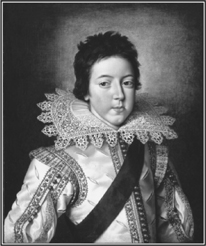
In 1610, Louis XIII became child-king of France at the age of nine, with his mother as Queen-Regent. In this portrait by Frans Pourbus, his eyes are watchful, distant, and deeply suspicious, as well he might have been, in a Franco-Italian court that was more dangerous than the American forest.
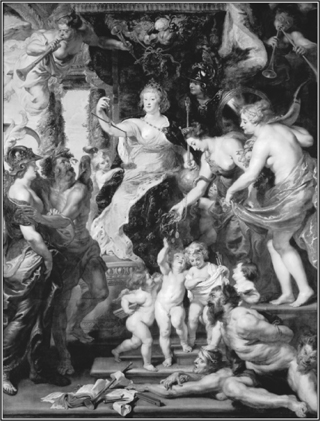
Rubens, The Felicity of the Regency of Marie de Medici (1625), one of twenty-four adulatory paintings ordered by the Queen. It symbolized her regency in a scale of justice and a shower of gold, which was far from the fact. Her corrupt Italian friends provoked a revolution. Th ey were killed, and she was banished by her own son. Champlain lost his job but was quick to get it back.
The queen regent continued many of Henri IV’s ministers in power—Brûlart and Sully in particular—and she supported most of his domestic policies. One of her first acts was to reconfirm her husband’s Edict of Nantes, with its two principles of supremacy for the Roman Catholic Church and tolerance for Protestants throughout the realm.11
On foreign relations she went a different way. Marie de Medici moved closer to the papacy and strengthened ties with Spain. She surrounded herself with a circle of Italian friends and gave great weight to their counsel, especially the advice of her foster sister Leonora Galigaï Concini and her husband, Concino Concini. The Concinis were deeply resented at the French court, and the queen herself was perceived as a foreigner, in part because she never mastered French. Her letters were written in a unique language, part French and part Italian, with a bizarre orthography of her own invention.12
Marie de Medici showed no sympathy for Henri IV’s grand dessein in Europe, and she had little interest in America. In 1610, she informed the Protestant sieur de Mons that he could no longer be “a member of our chamber” at Fontainebleau. His dismissal was a heavy blow, not so much for de Mons himself as for the cause of New France.13
Champlain went to court, but had no access to the queen. Some people there also attempted to end Champlain’s pension of 600 livres a year, which had been granted originally by Henri IV. Later Champlain wrote that he met “all kinds of jealousies and attempts at alteration from certain ill-disposed persons.” He never named them, but we know that some were merchants in the American trade who wanted free access to Canadian furs or a monopoly for themselves. Others opposed American ventures in general, as Sully had done in the court of Henri IV. More than a few were personal enemies of the prince de Condé. Sully was still in this group, and would be so even after his fall from power in 1611. The queen’s Italian advisors had no liking for an expansive New France in North America. English and Spanish agents were everywhere. The clergy was an unstable cluster of contending groups. The court itself was a cockpit of rivalry among honor-obsessed nobles, who were rivals for the ear of the queen and for the favor of her son, the young king.14
The problems that Champlain faced in the court of the queen regent were similar in one way to those he had met in the councils of American Indians. To form an alliance with one group was to make an enemy of another. In both worlds, people cultivated elaborate rituals of politesse, but behind a screen of courtesy they fought constantly with one another in combats of unimaginable cruelty. In Champlain’s two worlds, some of the most dangerous people wore diamonds and brocade.
It was a time of crisis for Champlain’s cause, and the future of New France was very much in doubt. Many such moments came to Champlain in the course of his long and troubled career. Any one of them could have been fatal for his purposes. His responses were always the same. Opposition spurred Champlain to press onward. Danger awakened him to greater efforts. Defeat increased his determination to try again. He wrote later, “All this, I say, put new life into me, as it were, and redoubled my courage for the continuance of my labors in the exploration of New France.”15
At court, Champlain appears to have made no immediate effort to approach the queen directly. Instead he worked at cultivating relationships with three of the most powerful “Lords of the Court,” as he called them. One of these men was his former commanding officer Charles de Cossé, maréchal de Brissac, whom Henri IV had raised to high rank in 1594. Champlain consulted him on American affairs, and gained his help and advice at court.16
Once again, Champlain also sought out Pierre Jeannin, the respected president of the parlement in Burgundy. He had held high office under Henri IV as councillor and comptroller general of the king’s finances. Champlain called him “monsieur le président Jeannin,” and wrote that he was “a man who wished to see good enterprises flourish.” He was a man of learning and a humanist with a thirst for knowledge. In 1609, Lescarbot dedicated his history of New France to Jeannin, and celebrated him as a man who “loves great undertakings by sea and ocean.” In the words of historian W. L. Grant, Jeannin became a “special patron of geographers and explorers”—and of Champlain in particular.17
Champlain’s most powerful friend and advisor was Lord Chancellor Nicolas Brûlart, the marquis de Sillery, a man who tried to keep the peace at court and was held in high esteem for his wisdom and judgment. Champlain often consulted him on American afairs. He frequently appeared in the writings of Lescarbot and Champlain as a faithful friend of New France.18
In Paris from 1610 to 1611, Champlain also made an effort to build a strong base at court by another method. At the same time that he cultivated relations with members of the high nobility, he formed alliances with officials and administrators who ran the daily business of the state. Historian Victor Tapié writes that in the regency of Marie de Medici, “governmental methods and procedures remained as they were under the late king. With few exceptions, the personnel and the entire administration were the same, and a corps of royal officials continued to manage the business of government, but without the close direction that they had received from Henri IV.” This in some ways increased their power, and Champlain was keenly aware that they could make all the difference between success and failure for his plans.
In 1610, Champlain suddenly decided to take a wife, and his choice tells us something about his purposes. She was Hélène Boullé, the daughter of Nicolas Boullé. Her father was a Protestant who appears to have converted to Catholicism, a man of the high bourgeoisie in Paris, with a job at the very heart of the royal regime. He was referred to as monsieur le Contrôleur Boullé. His offices were variously called huissier des finances du roi, or huissier collecteur des finances, or secrétaire de la Chambre du Roi. At court, a huissier was an officer of rank, charged with carrying out executive decisions of the monarch. He was a man at the center of power in France. That position brought him wealth and influence, which was cemented by the marriages of his children. One of his daughters, Margaret Boullé, married Charles Deslandes, secretary to the prince de Condé, and linked the family to one of the most powerful men in France.19
Champlain was already a friend of the family. He had known Nicolas Boullé since the days of his military service in Brittany. Hélène Boullé’s brother Eustache had been his companion in Acadia, and served with him in the St. Lawrence Valley.20 Together these men arranged a marriage, with an elaborate contract and a generous dowry. Nicolas Boullé offered 6,000 livres, of which 4,500 was to be paid at the start. Champlain agreed in return to pay 1,800 livres a year for his wife’s support when he was out of the country.
Champlain was about forty years old in 1610; Hélène Boullé was barely twelve. She was so young that all of the contracting parties agreed that the marriage could not be consummated for two years. Hélène would continue to live in her parents’ home through that period and move to her husband’s home when she was fourteen.21
It was done in haste. The marriage contract was arranged on December 27, 1610, and required that the bride and groom were to “take each other in lawful wedlock within the briefest space of time possible.” The wedding followed three days later on December 30, 1610, in the church of Saint-Germain l’Auxerrois, which still stands in Paris facing the east end of the Louvre. It had been the parish church of Henri IV. The documents were signed by the king’s notaries and record keepers. We know from the list of witnesses that the ceremony was attended by many of the dead king’s personal attendants. His physician, apothecaries, and councillors were on the list. The sieur de Mons and leading Paris merchants were also present.22
This union cemented an alliance between Champlain and administrative figures at court. It also connected him with investors and financiers in the city of Paris. They could be a counterweight to merchants in the western seaports of Normandy and Brittany who might be unhappy with a commercial venture that was controlled by a colonizer. The marriage promised to help Champlain’s grand design in many ways.
Everyone appears to have been delighted, with one exception. The bride was bitterly unhappy. Even at the age of twelve, this spirited and headstrong young person was in a fury about her fate. Champlain showed no apparent concern for the feelings of the child who was forced to marry him against her will.
In Paris, while Champlain was working to strengthen his connections with court officials such as Nicolas Boullé, he also turned in another direction. During the regency of Marie de Medici, leaders of the Catholic Church were gaining power and influence in France. It was clear that Champlain had to win their approval for his project in America. He launched another campaign to rally support within the Church and its religious orders. This was uphill work. In Paris, clergy of all denominations looked unfavorably on a colony that had operated without a spiritual leader for several years. An expanding circle of Catholic leaders also wanted to banish all Protestants from New France, a move that would have excluded many seamen and settlers.
Champlain went to work and tried to build support among the lords spiritual of France: the cardinals and bishops, as well as the clergy, the heads of religious orders, and Catholic laymen. That effort began in 1610–11, and it was not an easy task. The complex structure of the Catholic Church in France presented a challenge. A great danger was fragmentation of effort and scattering of scarce resources.23
A case in point was an affair that started in 1610. It involved a small group of Jesuits and one of the most beautiful women in France. Henri IV had expelled the Jesuits in 1594, but they had survived in some provinces, and in 1603 the king relented. He formed a friendship with Pierre Coton, a very able Jesuit priest who became his confessor. Henri allowed the Jesuits to return, on condition that they must be native-born Frenchmen and swear an oath of loyalty to the Crown. It was part of a larger campaign by the king and later the queen regent to make peace with the major Catholic orders, and to encourage them to function in France, in the hope that “all nature’s difference, might keep nature’s peace.” Among the beneficiaries were Augustinians, Jesuits, Capuchins, and Franciscans such as the Récollet fathers. Most of these groups would play important roles in New France.24
In France the Jesuits made connections with the high aristocracy. Prominent among their supporters was an extraordinary figure who never came to America but played a role in its history. She was Antoinette de Pons, the marquise de Guercheville, a young widow who was renowned for her formidable intellect, great wealth, deep piety, and a sensual beauty that drove some men mad with desire. Some of the stories about her might have been written by Rabelais.25
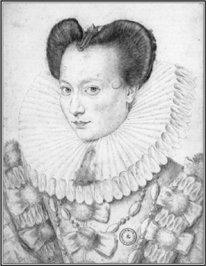
Antoinette de Pons, marquise de Guercheville (1570–1632) was a woman of piety, wealth, and beauty—hotly pursued by Henri IV, but never caught. She devoted herself to Jesuit missions and became proprietress of Acadia. Champlain begged her to support a common effort in New France—another of his many failures.
One of these tales had involved King Henri IV himself, who was fascinated by Madame de Guercheville. She spurned his advances and retreated from the court to her château at La Roche-Guyon on the river Seine, thirty miles west of Paris. The king organized a hunting party near her château and sent a gentleman of the court to ask the marquise if he could spend the night. She replied that the king did her great honor and she would do her best to receive him. For the occasion she ordered a magnificent supper, illuminated her château with torches in every window, put on a beautiful gown covered with diamonds, and prepared to receive the king.26
Henri rode in from his hunt in high anticipation, and Madame de Guercheville came out to greet him, preceded by pages with torches, and surrounded by ladies and gentlemen of the neighborhood. The king found her “more beautiful than ever, in the shadows of the night, and the dancing light of flambeaux and her diamonds.” He said to her, “Is this really you, and am I the king you so dislike?” To his delight, she led him directly to her bedroom, opened the door, and then withdrew. The king thought she was going to arrange an intimate feast for them both. Then he heard her in the courtyard below, calling for her carriage. The king went running down the stairs after her and cried, “Quoi, madame? Am I driving you out of your own house?” She answered with great firmness, “Sire, a king should be master wherever he is. But as for me, I like to keep some little power in whatever poor places I find my self.” Without waiting for his reply, she climbed into her carriage and rode off to spend the night with a lady in the neighborhood. It was said that the king formed a high respect for her in the years that followed.27
The passion that Madame de Guercheville denied to the king was lavished upon the Church, and still more on the Society of Jesus and its many missions. Her religious advisor was a young Jesuit priest, Father Énemond Massé, a friend of Pierre Coton. After the death of Henri IV, she became the patroness and sponsor of Jesuit missions. Her particular interest turned to the conversion of the American Indians. A Jesuit scholar wrote that “the only difficulty … was to restrain her zeal within reasonable bounds.” She enlisted the queen regent and the marquise de Verneuil to her cause. The queen authorized 2,000 crowns, much of it raised by subscription from royal princesses and the ladies of Paris and Rouen.28
With Madame de Guercheville’s sponsorship and the support of the queen regent, in 1610, two Jesuit priests, Massé and Pierre Biard, were recruited to found a mission in America. Two Huguenot merchants of Dieppe, Du Jardin and Du Quesne, were hired to fit out a ship, but when they discovered that they were to carry two Jesuits, they refused to participate. The Jesuit leaders went to Madame de Guercheville. She bought the ship and supported the mission at a cost of 5,700 livres.29
The venture combined two purposes: piety and profit. The Jesuit contract authorized the priests to operate a fur trade from their missions, and Madame de Guercheville insisted that all profits should revert to the mission. The idea was to create what has been called an “Acadian Paraguay” in the Gulf of Maine, comparable to the South American country that was run by the Jesuits for many generations. The two Jesuit fathers, Massé and Biard, sailed for America on January 26, 1611, and suffered terribly on a long winter voyage. These were the first Black Robes in New France. The colony was called Saint-Sauveur, and it was planted on Mount Desert Island, perhaps at a beautiful and sheltered place on the western side of Somes Sound which is still called Jesuit Point.30
Madame de Guercheville also worked with the sieur de Poutrincourt and his son Biencourt de Poutrincourt for a time, but fell out with them over a question of land titles in America. She received an enormous grant of land in Acadia, as far south as Florida. Alarmed English leaders ordered its removal. Two years later, this French Jesuit colony was attacked and destroyed by an English force from Jamestown in Virginia. The English commander, Samuel Argall, had orders to evict the French, burn their settlements, and enforce England’s claim to what is now the coast of Maine.31
Champlain regarded these events with dismay. A very large sum had been lavished on the Jesuit colony at Saint-Sauveur, and it was a total loss. Champlain went to Father Coton two or three times, and urged him to join a common effort for a colony centered on the St. Lawrence River rather than in southern Acadia. The two men were unable to agree on terms. They differed over money, but even more over control. Champlain wrote that Coton wanted terms which “could not have been to the advantage of the sieur de Mons, and this was the reason why nothing was done, in spite of all I could urge upon this father.” He wrote that this enterprise was thwarted by many misfortunes which could well have been avoided at the start if Madame de Guercheville had given 3,600 livres to the sieur de Mons, who wished to have the settlement at Quebec. The lost colony of Saint-Sauveur on Mount Desert Island never revived. Its history revealed the troubles that afflicted New France and Champlain in the regency of Marie de Medici after the death of Henri IV.32
In all these ways, Champlain struggled through the dark years from 1610 to 1612. Lacking direct access to the queen regent, he had succeeded in organizing several centers of support: from his old American circle, from friends in the city, and from an expanding network of royal officials at court. But he had failed with the religious orders and their patroness, Madame de Guercheville.
Still, he kept at it. His elaborate efforts to broaden the base of his American project were shaped by the structure of power in France. By comparison with the empire of New Spain, French colonies in America began as experiments in mixed enterprise. Champlain needed the support of the Crown, the Catholic Church, its monastic orders, great nobles, ministers, court officials, provincial parlements, towns, courts of law, merchants, commercial companies, lawyers, and others. A major difficulty from the start was the division of power in France, fragmentation of control, and tangled lines of authority. Even in small matters he had to win the backing of many people at home. And at the same time, he kept an eye on events in North America. In the early months of 1611 Champlain turned again in that direction.