
Champlain’s Shuttle Diplomacy, 1611–15
He left to me the task of finding the ways and means of keeping New France and laid upon me the entire responsibility for it.
—Samuel de Champlain on de Mons, 16111
WHILE CHAMPLAIN STRUGGLED in France, the infant settlement at Quebec was surrounded by danger. Every Canadian winter was a mortal challenge to its habitants. Every spring brought more traders and fishermen who saw the habitants as rivals and their leaders as regulators. Merchant-capitalists regarded a permanent settlement as a folly. English neighbors perceived it as a threat.
Even to its friends, the future of Quebec seemed very doubtful in 1611. Little was known about the interior of New France. It was laced with great waterways, but where did they lead? It was blessed with resources, but how could they be exploited? It was inhabited by many Indian nations who outnumbered the small European settlements, but to become a friend of one was to make an enemy of another.
It was typical of Champlain to seek a solution in growth. His primary purpose was to broaden the base of support for New France on both sides of the Atlantic. In America he planned to enlarge the base for New France by building more alliances with Indian nations to the west. He was thinking in particular of the Huron nation, whom he called the Good Iroquois, and also of the many Algonquin nations northwest of Montreal. Everything hinged on communication. To help with that task Champlain recruited more young men for his “corps of interpreters,” both Indians and Europeans. One of them was a Huron named Savignon, who had spent a year in France. Another was a Frenchman named Nicolas de Vignau, who had been sent to live among the northern Indians.2
• • •
To succeed with these plans, Champlain was compelled to shuttle back and forth across the ocean, moving rapidly from one opportunity to the next. It was a hard trial for transatlantic leadership. The growing number of his Atlantic crossings was a measure of the magnitude of his leadership. Their timing was another sign of stress. Increasingly he had to make his voyages in difficult seasons of the year, even in midwinter.
In February, 1611, Champlain organized a voyage with the help of Thomas and Lucas Le Gendre, merchants of Rouen with long experience in overseas trade and a strong relationship with the sieur de Mons. They were silent supporters of New France. Without them, Champlain could not have functioned in these lean years. Thomas Le Gendre capitalized the voyage as a trading venture, and “came himself to Honfleur, to oversee the outfitting of the voyage.” Somehow Champlain also recruited “several artisans” for Quebec, and purchased supplies for another precarious year.3
He sailed from Honfleur on March 1, 1611. It was one of his earliest crossings—a winter passage on the stormy North Atlantic, and it nearly killed him. At sea his little ship met heavy winter gales that forced him north of his usual track. Champlain wrote that “contrary winds from the south-southwest and west-northwest … drove us as far as latitude 42 degrees, without being able to make a southing.” One can only imagine what life was like on his small vessel, rising and plunging in dark gray seas with white water streaming from her deck. Champlain wrote that they were able to advance only with “much pain and labor, by going from one tack and another in order to take our direct line.”4
When they were within eighty leagues of the Grand Bank, they met thick fog and mountains of floating ice. Several times they came close to collision with icebergs. Champlain reckoned their height at 180 to 240 feet, three times higher than the mastheads of his ship, and these mountains of ice were moving at high speed before the wind. As they dodged among the biggest bergs, small fields of floe-ice crunched dangerously beneath the ship. They crossed the Grand Bank, but Champlain found that winds and currents had set them still farther north. They could not get below 44 degrees, 30 minutes.5
So cold was the North Atlantic, that even in the latitude of today’s Halifax, Champlain found himself on the edge of a “great bank of ice that extended as far as the eye could see.”6 Soon they were surrounded by it. Night came with rain, snow, and wind so strong that the ship “could hardly carry our mainsail.” With great effort, they worked their way south and got clear of the pack ice, only to enter another ice field surrounded by “thousands of ice floes on all sides.” Champlain wrote, “More than a score of times we thought we should not escape with our lives.”7
“The cold was so great,” he recalled, “that all of the ship’s running rigging was frozen and covered with big icicles, so that we could not manoeuvre or even stand on the ship’s deck.”8 At one point they struck their sails and drifted with the ice. In the night they hoisted sail again but could find no passage, and the ice was closing in. They tried to force their way. Seamen in the forward part of the ship worked with iron bars and long poles to ward off the most dangerous floes. Time and again, new ice appeared in their path. It was now the last week of April, and they had been nearly two months on the North Atlantic. In thick fog, Champlain wrote, “We tacked a hundred times from side to side, and many times thought we were lost.”9
Then suddenly the fog lifted. “When we looked about us,” Champlain remembered, “we saw that we were enclosed within a small pond, less than a league and a half in circumference.” In the distance they sighted land, which Champlain recognized as Cape Breton. At last they left the ice behind, and reached Tadoussac on May 13, 1611, after eleven weeks at sea. It was one of Champlain’s hardest crossings.10
As Champlain sailed up the St. Lawrence River, he was surprised to find “the whole country almost covered with snow” even in mid-May. It had been one of the coldest winters on record. He found the Indians in a desperate state, particularly the Montagnais, who came to meet Champlain’s ship, with “only a few articles which they wished to barter merely in order to get food.”11
Champlain gave them food and hurried on. His purpose was to sail up the St. Lawrence River to the great rapids beyond Montreal, where he hoped to “meet the Algonquins and other nations who had promised … to be there with the young lad” he had given them. The lad was Étienne Brûlé, who had been sent to live among the Indians and to discover what lay to the west and north. They had agreed to meet on May 20. Champlain was consumed with curiosity “to learn from him what he had seen while wintering in the interior.”12
So eager was Champlain that he left his ship at Tadoussac to buy furs from the Indians, and sailed upriver in a battered barque that was barely seaworthy. Halfway to Quebec, the leaky boat took on much water and was in danger of foundering. He reached Quebec just in time. Champlain was happy to find that the settlement had survived the winter with no losses. Commandant Jean Godet du Parc and his sixteen companions were “all very well, without any sickness,” a credit to du Parc’s leadership. Once again this able and self-effacing young nobleman had held the colony together. The habitants told Champlain that they had enjoyed good hunting through the winter. He took their experience as further proof that fresh meat prevented scurvy.13
Champlain pushed forward with the repair of his boat. When the work was done he was off again, driving his men up the river. They reached the Great Rapids beyond what is now Montreal by May 28, eight days late for a prearranged meeting with the Indians, and found nobody there.14 In their absence, Champlain came upon a battered canoe. With two men he used it to explore the riverbanks below the rapids. He was searching for a “site of settlement” near the head of navigation on the St. Lawrence River. Champlain examined the banks for eight leagues and studied the high hill that Cartier had named Le Mont Réal. Finally he found a stretch of level land a league downstream near a small tributary called the Rivière Saint-Pierre. It included more than sixty arpents that had been cleared long ago for cornfields and were now open meadow, mixed with young trees. Champlain was told that “formerly the Indians had cultivated these lands, but they abandoned them on account of the frequent wars which they carried on there.”15 He studied the land with a soldier’s eye and thought that a large area could be moated and fortified. Champlain named it la Place Royale and set his men to leveling the ground. He built a small house and a masonry wall ten yards long, “to see how it would last during the winter when the waters came down.” Then he planted his usual test gardens, “one in the meadows and the other in the woods,” and sowed an abundance of seeds. He was happy to observe that they “came up quickly and in perfect condition.”16
Champlain mapped the area with much attention to the river, its islands, and the terrain. On the north bank of the river he literally put Cartier’s name “Montréal” on the map—its first published appearance.17 An attractive island in the river was three-quarters of a league in circumference, with “space to build a good strong town.” He named it Isle Sainte-Hélène, probably in honor of his reluctant bride.18 Champlain and his men were surprised by the fertility of the land. Everywhere they found wildlife in unimaginable numbers. They came upon an island covered with “so many herons that the air was completely filled with them.”19
Above Montreal were the rapids, a roaring cataract of white water. He described one stretch of “seven or eight waterfalls” that “descend from ledge to ledge, and the smallest of them is three feet high…. Part of it is completely white with foam that marked the most fearful place. The roar is so loud that one would have said it was thunder, as the air rang with the sound of these cataracts.”20 It was a place of beauty and danger. While Champlain was there, an impetuous young Frenchman named Louis and two Indians tried to run the rapids in a canoe. They capsized, and two of the three were drowned. Champlain and the sole survivor went searching for their bodies: “When he showed me the spot,” Champlain wrote, “my hair stood on end to see so terrifying a place.” He described the rapids as fort dangereux, effroyable, espouvantable— very dangerous, frightful, terrifying. It was a language of fear that rarely appeared in his writings. So violent were the rapids that the Frenchman’s body was never found. Champlain named this place the Grand Sault Saint-Louis, perhaps to commemorate the Frenchman who died there. Today they are called the Lachine Rapids, an ironic echo of Champlain’s search for a passage to China.21
On June 1, 1611, while Champlain was busily exploring the river above Montreal, Pont-Gravé arrived from Tadoussac in search of trade. He had crossed the Atlantic after Champlain, and was followed by fur traders in unexpected numbers. By June 12, thirteen barques and pataches were moored below the rapids. The next day, the Huron began to arrive, two hundred warriors led by three chiefs who were friends of Champlain. He went to greet them in a canoe, and they responded with loud shouts of celebration. The French replied by firing their weapons in a feu de joie that alarmed the Huron, some of whom had never seen a gun.
Champlain brought forward Savignon, who spoke well of his reception in France. The Huron produced Étienne Brûlé, who was dressed as an Indian, and had learned to speak the Huron and Algonquian languages.22 The following day, the Indians invited Champlain and Brûlé to meet with them. The Huron insisted that they come alone—another sign of the special relationship that Champlain had formed with them. The Indians said that they wished to make a “close alliance” with Champlain, but they were not happy to find so many traders on the river, and “saw clearly that it was only a love of gain and avarice that brought these people together.” The Huron feared that these mercenary Frenchmen “would do them harm.”23 Champlain defended the traders, and assured the Indians, “we all served the same king.” After much discussion, the Huron made Champlain a princely gift of a hundred fine beaver pelts, and Champlain responded with presents of his own. He talked with them about the river’s source, and they told him of “many things, both of the rivers, falls, lakes and lands, and of the nations living there.” Four Hurons said that they had seen a sea far from their own country, but there were many enemies in between, and the country was difficult. Champlain wrote: “They spoke to me of these things in great detail, showing me by drawings all the places they had visited, taking pleasure in telling me about them. And as for myself, I was not weary of listening to them.”24
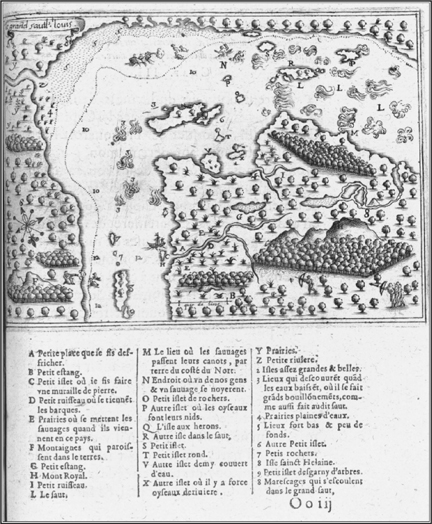
The head of navigation on the St. Lawrence River were these roaring rapids, which Champlain called le grand sault St. Louis. Stripped to his shirt, he ran them in a birch canoe with skilled Huron paddlers and barely survived. Near the falls he met many Indian nations in tabagies, and framed a web of western alliances.
The next night the Huron summoned Champlain again and he found them all in council. They explained their custom of nocturnal councils, “for at night we thought only of listening,” and they told Champlain that they wanted to “tell me their desire in secret.” Once again they said that they were “afraid of the other vessels on the river” and “displeased at seeing so many Frenchmen who were not very friendly towards one another.” They added that they “much mistrusted” the many traders. The Huron gave Champlain more gifts and asked him to come to their country. They talked together through the night.25
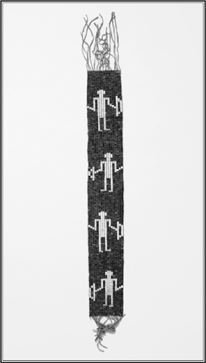
This finely woven wampum belt represented four Huron chiefs or clans, who presented it to Champlain in 1611 as an emblem of their esteem and a token of alliance. He in turn gave it to the King, and it survives today in the royal collections of France.
In the morning, the Huron withdrew another eight leagues, increasing their distance from the French traders, and once more they invited Champlain to visit them alone. This time they discussed the possibility of an alliance against the Iroquois. Champlain observed the complexity of their feelings and the autonomy of individual warriors. One of the Huron had been tortured by the Iroquois and wanted revenge. The chiefs did not support him, but could not restrain him. Champlain promised help if they were attacked but he also expressed a strong wish for peace, which they also shared.26
After the meeting Champlain asked the Huron to take him back to his vessel below the rapids. They agreed and brought eight canoes to run the rapids, much to Champlain’s alarm. He did not want to do it but felt he could not back away without forfeiting the respect of the Indians. He wrote, “They stripped naked, but left me in my shirt, for it often happens that some are lost running the rapids.” The Huron advised everyone to “keep close to one another in order to give prompt help.” They told Champlain: “If unfortunately my canoe should upset, since I did not know how to swim, I ought under no circumstances to let go, but to keep hold of the small pieces of wood (thwarts) in the center of the canoe; for they would easily rescue me.”
Champlain was a man of courage, but he confessed that he was terrified by that roaring cataract. He told his readers, “I assure you that even the bravest people in the world who have not seen nor passed this place in small boats such as theirs, could not do so without apprehension.”27 With a show of outward calm and inner terror he hitched up his shirt and climbed into his canoe. It was one of the great rides of his life. The rushing water seized the boat and swept it forward through massive boulders that could have crushed it in an instant. The fragile craft bucked and twisted in the roaring river, and many times Champlain thought they were lost. But the Indian paddlers brought him through and he was astonished at their skill. “These nations are so clever at shooting rapids, that this is easy for them,” he wrote. “I ran this one with them, a thing I had never done before, nor had any other Christian, except my young man [Brûlé].”28
The Huron went on their way and Champlain remained at the rapids to meet the Algonquin who arrived on July 12. Another large celebration followed, with yet more tabagies. Champlain worked to build an alliance with them. Once again he was planning for the long run. More young lads were exchanged by the French and the Algonquin, so as to learn each other’s customs. After much discussion, the meetings came to an end.29
Champlain headed quickly down the river for Quebec. He made thirty leagues to Trois-Rivières on the first day, and reached Quebec on July 19. Champlain remained only one day at Quebec but made the most of it. He inspected the settlement, “ordered repairs made,” and planned other improvements. Thinking always of the world as a garden, he found a moment to plant roses in Quebec. He was also planning new possibilities for commerce, and carried home some split oak to be tested in France for wainscoting and window frames. Champlain hoped that the American forest might yield an export commodity.30 All this activity was the work of a single crowded day. Champlain wrote that he “gave directions about the things at our settlement, according to the charge given me by the Sieur de Monts.” He departed as suddenly as he arrived, and sailed away for France in a Rochelais vessel. They reached La Rochelle on September 10, 1611.31
• • •
From La Rochelle, Champlain went to visit the sieur de Mons at his château near Pons in Saintonge. De Mons had very bad news. His investors had informed him that they were “unwilling to continue the partnership,” because the lost monopoly of the fur trade appeared to be irrecoverable. He had bought them out with his own money. There was also some other “unexpected and important business,” probably a reversal in his private affairs.
On top of that, de Mons had lost his access to the throne. Marie de Medici continued to make clear that he was not wanted in her presence. This Protestant friend and companion of Henri IV was no longer welcome in the Catholic court of the queen regent. De Mons said sadly that where New France was concerned, he was no longer permitted “to prosecute the matter at Court.” Champlain’s old patron promised that he would continue to help behind the scenes as a silent partner, friend, and adviser, and this Protestant angel for New France did just that. But he told Champlain that he must relinquish the role of leadership for the enterprise of New France.
Both men agreed that the project should be managed by someone else, preferably a Catholic, who would be more acceptable to the queen regent. The sieur de Mons turned to his younger friend, and in Champlain’s words, “he left to me the task of finding the ways and means of keeping New France,” and “laid upon me the entire responsibility for it.” De Mons advised Champlain to go back to court and “put this business in order.”32
With a heavy heart, Champlain left his friend and headed for court. He set off on the long journey, traveling by horseback on the rough country roads of France. Fate seemed to be conspiring against him. Along the way, he wrote, “my wretched horse fell on me, and nearly killed me; this fall delayed me for a long time.”33
As soon as he was able to travel, Champlain was on the road again, thinking about the task ahead. Marie de Medici’s court was dominated by great noblemen and he was a commoner. Champlain decided to begin by approaching the three members of his American circle once more. They had been helping him for several years. He tells us that he went to M. le President Jeannin, and gave him a “mémoire,” summarizing recent events in New France, stressing his expanding alliances with the Huron and the western Algonquin nations. Once again Champlain argued for the importance of American enterprise. Jeannin responded positively. Champlain wrote, “he approved my project and encouraged me in its pursuit.” Jeannin was a man who could make a difference at court. Even the queen deferred to him, and the merchants treated him with respect.34
Champlain tells us that he also went to see other powerful “Lords of the Court” whom he did not name. One of the most helpful people was the sieur de Beaulieu, a royal councillor, almoner, and chaplain in ordinary to young King Louis XIII. With Beaulieu’s help, Champlain moved closer to the boy-king himself and made an effort to befriend the young lad by friendly attention, small acts of kindness, and gifts from New France.35
He also talked with his advisers about the most pressing problem, which was to secure an income for New France, to overcome rivalries of merchant-investors and attract them to the support of the colony. Champlain and his friends at court worked out an ingenious solution to this problem. As historian Gustave Lanctot writes, it was Champlain himself who “conceived the notion of putting the scheme into the hands of some illustrious person, whose influence would greatly outweigh that of the selfish ‘merchandisers.’” He and his advisers decided to recruit a prince of the blood, a great nobleman related to the ruling Bourbon dynasty, and in the line of succession to the throne. He would be invited to rule over New France and regulate its trade with an authority that merchants would not be able to challenge.36
An eligible candidate was Charles de Bourbon, comte de Soissons, governor of Normandy and Dauphiné. He was deeply interested in America. Champlain approached him through the sieur de Beaulieu, and asked if he would be willing to serve the cause of New France by becoming its titular head. Soissons was indeed willing. One by one, Champlain and his friends enlisted the support of the most powerful noblemen at court. Then he submitted a proposal to “the King in Council,” and on October 8, 1612, young Louis XIII granted a royal commission to the comte de Soissons as governor of New France. Soissons instantly appointed Champlain as his lieutenant. Everything was arranged—and disaster struck yet again. The comte de Soissons fell ill and died suddenly, perhaps of smallpox, on November 12, 1612, after little more than a month in office.37
Champlain turned quickly to another prince of the blood, Henri de Bourbon, prince de Condé and duc d’Enghien, a nephew of Soissons and cousin to the young King Louis XIII. Condé was twenty-four years old in 1612 and very popular among a large circle of friends, but he was a difficult character and something of a rebel against members of his own royal family. Champlain and his advisers agreed that Condé could replace Soissons, and approaches were made to him. The prince de Condé had extravagant tastes, and a very expensive hobby of collecting highbred horses. He hoped that New France would be a source of income. Others at court may have wished that an involvement in America might keep him out of trouble in France.38
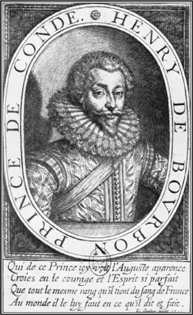
At Champlain’s urging, and with much help from his American circle at Court, this “prince of the blood” became viceroy of New France, and its lord protector. He never came to America, and quickly appointed Champlain his chief lieutenant, as did every viceroy who preceded or followed him, to the year 1635.
Condé drove a hard bargain. He demanded and received the title of Viceroy of New France—literally vice-king for North America. Champlain had another object in mind. He sought to obtain authority for a prince of the blood to act as ruler of New France with full powers to license all trade in that dominion, in hope of securing an income for the colony. He tells us that he “presented to His Majesty and to the Lords of his Council, a petition with articles praying that it would please him to issue articles and regulations for the control of this matter.” The young king agreed, and the queen regent did not object. Letters patent were issued on November 22, 1612, appointing Condé as viceroy with authority to license trade in the St. Lawrence Valley for a period of twelve years.39
Soissons and Condé were the first of many viceroys of New France who followed one another in swift succession. Most were kinsmen of the king; all bought and sold their offices in France. None went to Canada in the early seventeenth century. They had little knowledge of the huge area that they claimed to rule. The prince de Condé had no intention of living in America. On the same day that his letters of appointment came through, he appointed Cham plain as his “lieutenant pour la Nouvelle-France,” with very broad powers to run New France. Champlain accepted quickly, and extended thanks to Condé for “having supported us against all kinds of jealousies and challenges from ill-disposed people.”
Champlain immediately asked leaders in the seaports of western France to recognize Condé’s viceregal authority over New France. Angry protests came from the parlement in Rouen and from the merchants of Saint-Malo, who brought suit for free trade. The king compelled the parlement to drop its opposition, and ordered the Malouins to withdraw their suit. Unable to attack a prince of the blood, their wrath fell on Champlain. They presented memorials against him, urging Condé that Champlain was a “mere painter who went to Canada out of curiosity and discovered nothing; to send him out again would only contribute to his own glory and drain the royal treasury.”40
Condé stood by his lieutenant, and even expanded his powers. Lanctot writes that Condé gave Champlain “quasi-absolute authority throughout the whole country with power to establish settlements, promote land explorations and finally, to set up a financial and commercial association.”41 In turn, Champlain worked closely with the viceroy and defended him against many attacks. Champlain wrote, “These things hindered me greatly, and forced me to make three journeys to Rouen with orders from His Majesty.” He published the king’s commission in all the ports of Normandy. But it was one thing to gain a judgment in France, and another to enforce it in America.42
Champlain wrote that during these disputes it was not possible for him to do anything for the habitation at Quebec. The little settlement suffered, but it survived, and Champlain tried to stay in touch with events there.43 He also continued to work at exploration, even from a distance. In Paris, Champlain had conversations with Nicolas de Vignau, his young interpreter who had lived among the Algonquin. Vignau had returned to France, and he told Champlain that “the mer du nord” or northern sea could be reached in seventeen days from Sault-Saint-Louis by ascending the Ottawa River to a great lake which emptied into it. Champlain was dubious. He had formed a rough idea of the distances from his conversations with the Montagnais. As he thought about it, he began to distrust Vignau.44 He discussed Vignau’s report with his friends at court, Marshall Brissac, Chancellor Sillery, and President Jeannin. They advised Champlain that he “must go and see the thing himself.”45
With that mission in mind, Champlain decided to return to America in the late winter of 1613. On March 6, Champlain and Pont-Gravé sailed from Honfleur for New France. They reached the coast of Cape Breton by April 21, and made good time up the St. Lawrence River. As they approached Tadoussac, the Montagnais Indians “ran to their canoes and came to meet us.” Champlain contrived an experiment to study their reactions. “As soon as they came on board our ship they peered into each one’s face, and as I was not in sight, they asked, where was Monsieur de Champlain?” He kept his distance and was disguised. Then “one old Indian came to the corner where I was walking up and down,” and “taking me by the ear (for they suspected who I was) … saw the scar of the arrow wound which I had received at the defeat of the Iroquois. Then he cried out, and all the rest after him, with great demonstrations of joy, saying ‘your men are waiting for you.’”46
It had been another hard winter for the Montagnais. Champlain found them “so thin and ghastly that I did not recognize them.” He continued sadly, “As they approached they began to cry out for bread, saying they were famished.” Some of the French were dressing three geese and two rabbits and threw the entrails on deck. The Indians “like hungry beasts devoured them, contents and all.” Then they squatted down, “scraping off with their fingernails the tallow with which our ship had been greased and devoured it greedily.” Once again he helped them through a hard season.47
Champlain sailed on to Tadoussac harbor, where they dropped anchor on April 29, 1613. There he ran into another kind of trouble from unlicensed traders. Soon after he arrived, other trading ships began to appear. A vessel from Rouen came up on the same tide, and the next day, April 30, two more ships arrived from Saint-Malo. They had sailed before the King’s Commission had been published in France and were not aware of its terms. Champlain went aboard the ships and explained the situation. He wrote, “I read the King’s Commission and the injunction against violating it with the penalties therein set forth.” The Malouins replied that “being subjects and loyal servants of His Majesty they would obey his commands.” Champlain appears to have worked out an accommodation with the two Malouin captains, the sieur de la Mainerie and the sieur de La Tremblaye, and they found a peaceful solution. “After that,” he wrote, “I had His Majesty’s Arms and Commissions publicly posted up in the harbor, so that no one might pretend cause of ignorance.”
Champlain had a different sort of problem with some of the French captains. Complaints were brought to him about traders “who abused the Indians and treated them badly.” Here again Champlain worked not only to promote trade, but also to protect the Indians from unscrupulous traders. He was particularly anxious to stop any commerce in alcohol or firearms.48
While Champlain was sorting out these questions, the carpenters were out fitting two shallops for travel on the river. On May 2, the boats were ready and Champlain took one of them heading upstream toward Quebec. He started in bad weather and ran into a severe storm on the river. The wind was so violent that the shallop was dismasted—another desperate moment that brought him near death. “Had not God saved us,” he wrote, “we should all have been lost, as happened before our eyes to a shallop of Saint-Malo on its way to the island of Orléans.” They replaced the mast with a jury-rig, and reached Quebec on May 7.49
Champlain found the settlers “in good health, having been in no wise indisposed.” They reported that the winter had been mild and the river had not frozen. Spring was well advanced, “the trees were beginning to put forth their leaves, and the fields were turning bright with flowers.50 He remained at Quebec for a week. Then on the thirteenth he was off to the rapids at Montreal, where he arrived on the twenty-first. A trading barque was already there, bartering with small parties of Algonquin who were carrying their weapons and shields of wood and moose-hide. The Indians were cordial to Champlain, but reported trouble with the western Iroquois and also complained that many traders were not treating them well.51
He promised to assist them against the Iroquois, but told them that first he wanted to pass through their country on a voyage of exploration to the northwest. He asked them to help with three canoes and three guides. The Algonquin were not forthcoming. After much effort and many presents, Champlain was able to get two canoes and a single guide.52
It meant a dangerously small expedition, but Champlain was determined to push forward into the interior of the country. He planned to go up the St. Lawrence River to the “River of the Algonquins,” today’s Ottawa River, and to follow it to the northwest. Again he met the young interpreter Vignau, who repeated his story that he had been to Hudson Bay and back in seventeen days, and had seen the remains of a British ship there. Champlain had read an account of Henry Hudson’s voyage of 1612, published that year in Amsterdam. He knew that Hudson’s men had sailed into the great bay that bore his name, had wintered as far south as 53 degrees of north latitude, and had lost some ships there. But it was a very long way from Montreal. Champlain was suspicious of young Vignau’s account, and told him bluntly that “if he was telling a lie he was putting a rope around his neck.” The young Frenchman swore it was true.53
On May 27, 1613, Champlain and Vignau set off from Montreal with another interpreter named Thomas, an Algonquin guide, and two more French men. Their canoes rode low in the water, heavily laden with provisions, weapons, trade goods, and the tools of exploration. It was slow going, and the weather turned against them. They were a full day traveling from Île Sainte-Hélène to the great rapids, and then portaged around the rapids—which was “no small labor,” Champlain wrote. Above the rapids they entered the great Lake of the Two Mountains, where the Ottawa River flowed in from the north. The countryside was beautiful and fertile, but there was a sense of danger in it. Onondaga and Oneida war parties were active in this region. Every night Champlain and his companions made camp on a defensible island, built a barricade, and kept a strong watch until morning. Those precautions added greatly to the time and labor of their journey.
From the lake they turned north into the Ottawa River. Champlain took a sun line and estimated their latitude at 45 degrees 18 minutes, which was remarkably accurate. It told Champlain that the “North Sea” or Hudson Bay was at least five hundred miles away in a direct line, and farther by river. Clearly Vignau’s estimate of time and distance was wrong.54
As they moved northwest on the Ottawa River they met many more rapids and passed some of them by “hard paddling,” others by portage. In a few places the banks of the river were so rugged that they could advance only by “tracking” or dragging their canoes by “cords” through the turbulent water. This was dangerous work. Champlain was tracking his canoe with a cord wrapped tightly round his hand. Suddenly the current caught his boat and spun it into deep water. Champlain fell between two rocks. The canoe pulled at the cord with a force so strong that, in his words, it nearly cut off his hand. “I cried aloud to God and began to pull my canoe toward me, when it was sent back to me by an eddy such as occurs in these rapids…. I nearly lost my life,” he wrote, “and having escaped, I gave praise to God, beseeching him to preserve us.”55
The other Frenchmen suffered terribly and “several times were nearly lost” as they slowly learned the art of white-water canoeing with the “dexterity … needed to pass these rapids, in order to avoid the eddies and shoals that occur in them.” Champlain observed, “his the Indians do with the very greatest skill, seeking byways and safe passages which they recognize at a glance.”56
The next day they passed through a lake and met fifteen canoes of an Algonquin nation that Champlain called the Quenongebin. He wrote that they were “astonished to see me in that country with so few Frenchmen and only one Indian.” hey saluted each other “after the manner of the country,” and Champlain invited them to stop and talk. He told them that he wished to push on through their country to meet other Indian nations. They strongly discouraged him, saying that the country became even more difficult. He asked for a guide and offered to give them a Frenchman as a hostage in return. They agreed. Many things were being settled at the same time in this brief exchange.57
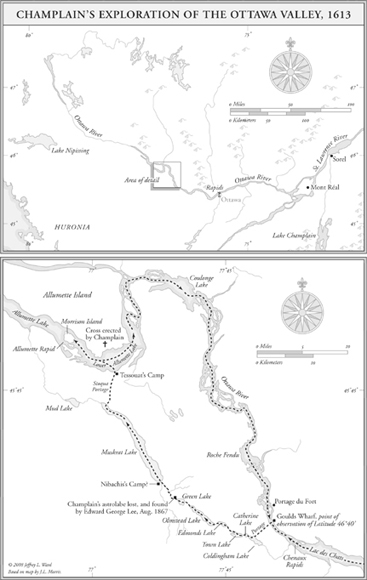
Champlain’s party pressed on and came to another river, “very beautiful and wide,” with banks covered with “fine open woods.” Upstream were an Algonquin people known as the Ouescharini. He called them the Petite nation. The French continued on, through many rapids and falls, and found themselves in a very beautiful lake many miles long, the lac des Chats. Here he met a nation he called “Matou-Ouescarini,” today’s Madawaska nation. He was amazed by huge stands of cedar, but noted that the lake was surrounded by pines that had been “all burned down by the Indians.”58
On the advice of their guides, Champlain and his men left the Ottawa River and followed another line of advance through a chain of lakes with very hard portages. On one of these portages, while they were struggling through a tangle of fallen timber and “suffering more from the mosquitoes than their loads,” Champlain lost his small traveling astrolabe. It would be found in 1867 near Green Lake in Ontario. Today it is preserved as a national treasure in the Canadian Museum of Civilization on the banks of the river that Champlain explored on this journey in 1613.59
They paddled on to Muskrat Lake, where they met yet another Algonquin nation, with a chief named Nibachis, who was “astonished that we had been able to pass the rapids and bad trails.” He said to his companions, “They must have fallen from the clouds,” for “he did not know how we had been able to get through, when those who live in the country had great difficulty in coming along such difficult trails.” Nibachis had heard of Champlain, and he said that the journey convinced him “I was everything the other Indians had told him.” Here was more evidence that Champlain’s reputation was spreading rapidly from one Indian nation to another. His reputation traveled even more widely in North America than did the man himself.60
Champlain told Nibachis through an interpreter that he was “in the country to assist them in their wars,” and that he “wished to push on to see other chiefs for the same purpose.” They agreed to help, and gave Champlain and his men some food. They smoked tobacco and made an alliance. After this tabagie, Nibachis led Champlain across Muskrat Lake, and then by easy beaten trails to a much larger body of water that today is called Allumette Lake.61
Here lived a great Algonquin war chief named Tessoüat, whose fame rivaled that of Champlain in the St. Lawrence Valley. They had first met in the tabagie at Tadoussac in 1603, and Champlain wrote that Tessoüat was “astonished to see me, telling us that he thought I was a ghost and that he could not believe his eyes.” The old chief took him to today’s Morrison Island in the middle of Allumette Lake. Lacking his astrolabe, Champlain reckoned its latitude at 47 degrees with less than his usual accuracy. It is in fact 45:48 degrees north. One wonders how he could have reckoned it at all, perhaps by an improvised instrument of wood and string.62
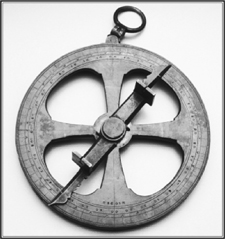
Champlain used this small brass traveling astrolabe (dated 1603) to calculate his latitude by a noon sun-sight. It was suspended from a plumb line to measure the angle of elevation. In 1613, he lost it in the Ottawa Valley. It was found by a farmboy in 1867, with a rusty chain, bowls in copper cases, and two silver goblets with coats of arms that were melted and sold.
Champlain asked Tessoüat why they lived on such poor soil when fertile ground lay to the south. He said they were safe here. Champlain told them that he planned to build a fort and plough the land near Montreal, below the great rapids on the St. Lawrence. “When they heard this,” he wrote, “they gave a great shout of approval” and said they would come and live nearby, thinking “their enemies would do them no harm whilst we were with them.” Tessoüat welcomed Champlain with still another tabagie on Morrison Island. They had a great feast, and then the young warriors withdrew and the older men smoked tobacco for a long time. Champlain told them he wanted to visit another nation called the Nebicerini (or Nipissing) who lived on today’s Lake Nipissing, and asked for the use of four canoes. The island Indians said the Nebicerini were a nation of wizards who killed people with magic, and Champlain would not be safe among them. Champlain persisted, pointing to his interpreter and saying that Nicolas de Vignau had been there.
To his amazement the Indians responded with an explosion of anger. Tessoüat called Vignau a liar to his face and said, “If you visited those tribes it was in your sleep, and every night you slept beside me and my children.” They refused to allow Champlain to go farther, allegedly for his own protection, and offered to deal with Vignau themselves. “Give him to us,” Tessoüat said, “and we promise he will tell no more lies.” Champlain protected Vignau, gave up his plan to go farther, and prepared to return south. Before he left, Champlain erected a cross of white cedar with the arms of France and asked the Algonquin to protect it. On June 10, he started home again with an escort of Tessoüat and his sons and warriors, who were suddenly friendly again. One suspects that the Indians were protecting the sources of their fur trade, much as other nations had done. Champlain was careful not to challenge them.63
On June 17, he and his party were back at the falls near Montreal. Champlain confronted Vignau and demanded an explanation. The young Frenchman confessed that he had never been to the northern sea, and had lied about it so that he would be taken back. He asked Champlain “to leave him in the country among the Indians.” Champlain asked some of the Indians to take him in, but wrote that “none of the Indians would have him, in spite of my request, and we left him in God’s keeping.” Vignau walked off into the forest, and Champlain never saw him again. Perhaps he formed a union with an Indian woman, or possibly he became a solitary trader. He may have been killed by the Indians, who hated a liar more than a murderer. His fate is unknown.64
Champlain never reached Hudson Bay, but on his long journey he succeeded in exploring the Ottawa Valley and made alliances with many Algonquin nations. He returned to Quebec, but could stay only briefly. It was time to go home and deal with problems and intrigues on the other side of the Atlantic. He sailed from Tadoussac on August 8, 1613, and reached France on September 26, in time to resume his labors there.
Within a few weeks of his return, Champlain had formed a new investment group called La Compagnie du Canada. He worked hard to bring together merchants of La Rochelle, Rouen, and Saint-Malo as investors in a single company, each town holding one-third of the shares. The object was to unite three leading centers in a single venture, all licensed by the viceroy. Champlain organized a meeting on November 13, 1613, and men from Rouen and Saint-Malo were present. Among the drivers were merchants of three families: Le Gendre, Porée, and Boyer. They agreed to the proposal, and saved a third of the shares for the men of La Rochelle.65
The company was formally founded on November 20, 1613, with Condé’s active sponsorship. The investors were granted a monopoly of the fur trade in the St. Lawrence Valley to Quebec and beyond, for a period of eleven years. In return, the company agreed to contribute 1,000 crowns each year, and transport at least six families of settlers every season, which pleased Champlain. It also promised to make an annual gift to the viceroy of a highbred horse worth a thousand écus, an arrangement that greatly gratified the prince.66
The company appeared to work for a time, but at the last minute the merchants of La Rochelle withdrew, and somehow they persuaded the prince to give them a special “passport” to send their own trading vessel to the St. Lawrence. One wonders how many blooded horses that arrangement may have cost. In that act, Condé broke the monopoly of Champlain’s company, fueled intense animosities between the trading towns, and gave rise to twenty years of litigation. Undeterred, Champlain went to Rouen to meet his business partners, and left them “well pleased with the mission.” he merchants of Rouen pledged to support settlers and to keep them in provisions.67
The prime mover was Champlain himself. The leading historian of trading companies in New France calls this new group “Champlain’s Company.” Champlain himself was careful to call it the Compagnie de Condé. It represented a change of leadership. The sieur de Mons continued as an investor, but not as an officer of the company. After ten years of faithful leadership he moved to the periphery and Champlain replaced him at the center. Under the auspices of the new viceroy, Champlain became the leader of the colonizing effort in New France, and would continue in that role for twenty-two years, from 1613 until his death in 1635.68
While working with his investors, Champlain somehow found the time to finish another book called Les voyages du Sieur de Champlain, Xaintongeois, capitaine ordinaire pour le Roy, en la marine. It bore the date of 1613 and was published by Jean Berjon, at the sign of the Flying Horse on the rue St. Jean de Beauvais in Paris. It was a work of extraordinary quality and detail, both in its text and in its maps. Champlain included thirteen very accurate charts of harbors and coasts in North America, based on his meticulous surveys and drawn with his own hand.69
He also published three larger maps of New France. One of them was called a “Carte Géographique de la Nouvelle France (1612),” a long narrow map that centered on the St. Lawrence Valley. The cartography was not his best, but the plate was a superb work of art—the most beautiful and visually appealing of all his maps. Its object was to attract interest in the colony and its native inhabitants, with very handsome engravings of the Indians, the flora and fauna. Most of all, it was meant to draw and hold the attention of the queen regent, young Louis XIII, and their ministers. The royal arms were added, not on the land but on the sea. The map appears on the front endpaper of this book.70
Two other Champlain maps of this period (1611–13) were interesting in other ways. They are less striking as works of art, but more developed as works of cartographic science. They are two different states of the same base-map, and to study them together is to see how Champlain’s cartographic knowledge was growing. The first state of this map was begun in 1611 with the collaboration of David Pelletier, a highly skilled engraver, and finished in 1612. It has a rectolinear projection centered on the 45th parallel of latitude. After it was done, Champlain returned to America and explored the Ottawa River. He also saw a newly published work called Tabula Nautica by Hessel Gerritsz, which showed the explorations of Henry Hudson in northern waters and Hudson Bay. On the basis of this new information, Champlain revised his earlier map. The result added more information about North America and made an important point about the possibility of a northwest passage.71 In all these works, writes a student of Champlain’s cartography, “the input of effort and outpouring of information is astonishing in itself, but the real miracle of Champlain’s work is its quality and originality.” He dedicated his books and maps to the young King Louis XIII and the Queen Regent. He desperately needed their help.72
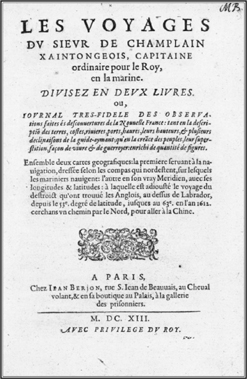
Champlain’s Voyages (1613) were issued in two books bound as one. This was his handsomest work, with fourteen maps and much of his best surviving art. The work described his travels (and travails) in America and France from 1604 to 1611. It was dedicated to the young King and the difficult Queen Regent.
• • •
In 1614, thinking partly of their concerns, Champlain returned to the old problem of religion in New France, and searched for a new solution. He decided to recruit some “good friars” to “plant the faith” in Canada, or at least to do what was possible in the way of their vocation. The way he went about it is very revealing—both of the man himself and of the enormous problems that he faced.73
He consulted with his friend Louis Hoüel, the king’s secretary and controller general of the salt works at Brouage. Hoüel was “a man of pious habits, and inspired with a great zeal and love for the Honour of God.” He had a particular fondness for the “good fathers of the Récollets,” a Franciscan order that had been founded in Spain as early as 1484, and been admitted to France in 1592. Hoüel urged Champlain to take a few Récollets to New France, offered to support them from his own pocket, and promised to find other donors.74
This proposed solution created problems within the Roman Catholic hierarchy. The Récollet fathers were reluctant to act without a commission of the Pope, and the Papal Nuncio Roberto Ubaldini refused to help. In another amazing scene, Champlain went to an assembly of all the French cardinals and bishops, who had gathered in Paris for the meeting of the Estates General in 1614. His talks with them were a great success. The French prelates gave Champlain their full support, and even contributed 1,500 livres to support the mission.75
Champlain at last was having some success in building a broad base at home for his purposes in North America. During the difficult period from 1610 to 1614, he had gathered a powerful group of supporters at court, and worked closely with them. At the same time, he also founded a new investment company to replace that of the sieur de Mons. And he established close relations with Catholic leaders and the Récollets, while keeping on good terms with Jesuits and other groups.
Although things were going better for Champlain in his public affairs, he suffered a calamity in his private life. His marriage came apart. Hélène Boullé Champlain was by all accounts a beautiful, intelligent, and high-spirited young girl. When they married in 1610, Champlain was more than three times her age, and they had little in common. She was a young, city-bred Parisienne of affluent family; he was a middle-aged, battle-scarred soldier and seaman of modest provincial origins. She longed to be among family and friends; he enjoyed the company of Indians, soldiers, and seamen. She lived among the ceremonies of the court; he was away for long periods, often living among the Indians.
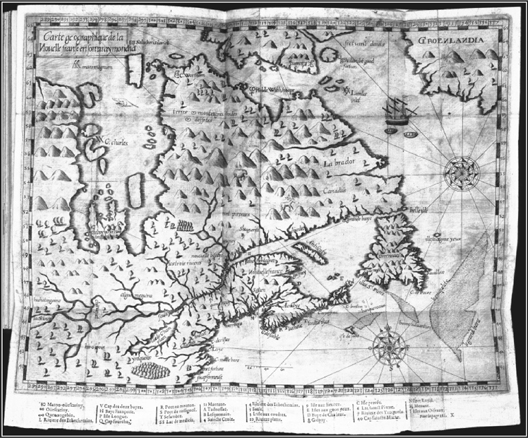
Champlain’s Geographic Map of New France in Its True Meridian survives in two printers’ states. This, the first of them, shows the results of his explorations through 1611.
Another divisive issue may have been the religion that they had in common. Both appear to have been catechized as Protestants and become devout Catholics. Each of them embraced their Catholic faith with a fervor that may have kept them from embracing each other. They drew a veil of silence over their marriage, and we shall never know the secrets of their life together. But two facts were clear enough. Champlain was devoted to his young wife but from a distance. And Hélène Boullé was deeply unhappy.
In August of 1613, when Champlain returned to France, Hélène’s parents ordered her to move in with her husband as the prenuptial contract had required. During the weeks that followed Hélène rebelled. According to the testimony of Hélène’s parents, things began to go wrong in the fall. The breaking point came on January 4, 1614, when Hélène suddenly fled from her husband’s house. Nobody could find her. Her parents were frantic with anger, worry, and embarrassment. They raged against Hélène for the “atrocious and scandalous injury” that she had done to the “honor and good name” of her family. On January 10, 1614, her parents called in two notaries and disinherited her.76
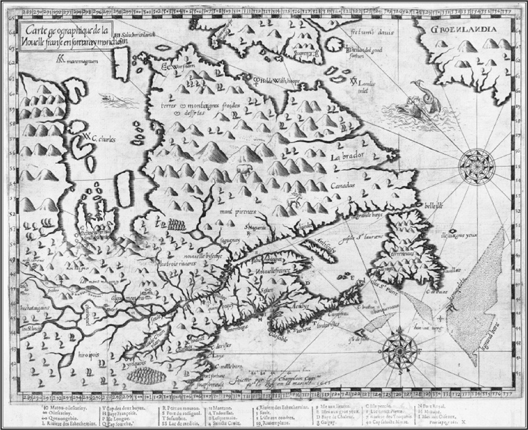
The second state of the same map is similar in most ways, but it includes new information from Champlain’s travels in 1612, and also from a new Dutch account of Henry Hudson’s voyage to the north. In this revision one sees Champlain’s passion for truth and his hunger for new knowledge.
Somehow her husband and parents tracked her down. Hélène was convinced or compelled to return to her husband, and a reconciliation of sorts followed. They lived in the same house, but there were no children, and one wonders if they were living as man and wife. Champlain, for his part, declared on his deathbed that Hélène was the only woman he ever loved.77 She became a dutiful consort to her husband and made a determined effort to support him. She would go to Canada with him of her own free will, and stayed with him there for five years. She helped promote his cause in France. Little evidence survives about the interior of this marriage. Scraps of material suggest that it grew very cold around the year 1614, warmed about five years later, and grew colder again in the late 1620s. But even when they lived together, it was one of the most difficult of all triangles: a younger woman, an older man, and a grand design.