
Champlain as Acting Governor, 1632–35
When the French were absent, the earth was no longer the earth, the river was no longer the river, the sky was no longer the sky. But on the return of the sieur de Champlain everything was as before; the earth was again the earth; the river was again the river, and the sky was again the sky.
—A Huron captain on Champlain’s leadership, 16331
The wise conduct and prudence of Monsieur de Champlain, Governor of Quebec and the St. Lawrence River, honors us with his good will, holding everyone to the path of duty.
—A Jesuit missionary on Champlain’s leadership, 16342
IN THE OLD PORT OF DIEPPE, on March 23, 1633, three small French ships prepared to sail on a very large mission. Their orders were to recover the lost colony of New France and rebuild its ruined capital at Quebec. Nobody knew what to expect. Were the English conquerors still there? Would they fight? The French ships were armed with thirty-two guns and a small force of the king’s musketeers and pikemen, but their instructions were to avoid battle if possible. This was not a military expedition. It was a colonizing voyage, and the ships were crowded with passengers.3
In the flagship Saint-Pierre, 150 tons, Captain Pierre Grégoire took aboard 82 souls. Among them were four Jesuit priests, at least one married woman, and two girls aged six and thirteen.4 Captain Pierre de Nesle’s Saint-Jean (160 tons) carried 75 men. Many were artisans and workmen. Captain Michel Morieu’s Don-de-Dieu, 90 tons, had 40 souls aboard. Altogether the three ships carried 197 people. About 150 were hivernants who had promised to stay through the next Canadian winter.5
The mission commander was Samuel de Champlain, now with an extraordinary array of titles and powers. He carried the King’s Commission as Captain in the Royal Navy, and another as Lieutenant General in New France. Cardinal Richelieu had appointed him “Lieutenant” for “the St. Lawrence Valley .”Directors of the Company of the Hundred Associates had made him their chief representative in North America. He was also général de la flotte, or commodore of their ships for the crossing, commander of the troops who sailed with him, chief judge and lawgiver for Quebec, and administrator of the colony. All these powers were gathered in a single hand. In 1633 Champlain was the absolute ruler of his domain, subject only to the will of Louis XIII and Cardinal Richelieu.
But there were limits to his authority, especially where Richelieu was concerned. He had not wanted to appoint Champlain, and he gave clear signals of distrust. One factor may have been the memory of Champlain’s association with Henri IV. Another might have been a lingering suspicion of Protestant origins. A third was the matter of rank. Champlain had no quarterings of nobility on his escutcheon—at least none without the bar sinister of illegitimate birth. He was not a Knight of Malta. But perhaps what rankled Richelieu most were the qualities of Champlain’s character. He was always obedient to his superiors, but his deepest loyalty was to his design for New France. Whatever the reason, Richelieu limited Champlain’s authority to the rank of lieutenant for the St. Lawrence Valley, and denied him the official title of governor. The cardinal was careful to proclaim his own authority and to restrain his subordinates, especially when the leash was 3,000 miles long.
Those who knew Champlain and sailed with him to America had a different understanding of the man and his role. Even when the title of governor was officially denied by Richelieu, the people of Quebec gave it to him anyway. They called him their governor, often “our governor,” even “my governor.” The Indians of the St. Lawrence Valley went further. In 1633, they called him “the Captain of the French,” all the French. Europeans of other nations treated Champlain with deference and respect when they met him in America. So did the people of New France. Clerics and laymen, habitants and seamen, Québécois and Acadians, fishermen and interpreters recognized this man as their leader.6
By mid-March preparations for the voyage were complete. Prominent French leaders descended on Dieppe to see the ships off. Major investors and directors of the Company of the Hundred Associates arrived for a last round of meetings with Champlain. Father Barthélemy Jacquinot, head of the Jesuit Order in France, came to the harbor himself and led the blessing of the ships. The departure was something new in Champlain’s experience—a national event. In France this display of interest in North America was unprecedented. More than a few French leaders did not discover the importance of their American colony until the English tried to take it away from them.
Another factor was the recent publication of Champlain’s Voyages, his largest and most important work. It made a splash when it came off the press in 1632. So also did his magnificent maps. Champlain was a tireless promoter of New France, and he was quick to discover the expanding power of the periodical press. The sailing of the ships was covered by the Paris gazettes in 1633, especially by the Mercure François. Champlain later published a long account of the voyage anonymously in the Mercure, a major piece of writing that was missed by the editors of his works.7
At last, on the morning of March 23, the ships were ready. On board the flagship Saint-Pierre, Champlain nodded to the master and pilot. On command, master-gunners fired a salute that echoed across the anchorage. Seamen in gaudy dress hauled in the slippery anchor-cable, dripping with green weed. Topmen ran aloft and released the great sails from their gaskets. The canvas caught the wind, and filled with the happy thump that warms a sailor’s heart. On steering decks, burly helmsmen threw their weight against the long tillers, and guided the ships through the harbor.
It must have been a happy moment for Champlain. He was going to sea again, doing what he loved to do more than anything in the world. As the three ships cleared the harbor and turned together into the English Channel, he would have felt the wind on his cheek and smelled the salt in his nostrils. Flocks of white gulls soared free around him, and black cormorants raced straight and low across the water. In that moment he must have shared the feeling of release that any blue-water sailor will recognize.
The wind was fair for America, and westward they went with white bow waves streaming beneath sharp-pointed prows. They sailed along the emerald coast of England, passed Torbay in a fresh breeze, left the Isles of Scilly behind, and settled on a course for the new world. Overhead the flags of France snapped and fluttered on their halyards—the beautiful marine ensign with its white cross on a blue field, and the Bourbon banner with its gilded lilies on a white cloth. Perhaps the mastheads of the Saint-Pierre also flew Cardinal Richelieu’s standard, and the house flag of the Hundred Associates, as well as Champlain’s broad pennant as général de la flotte.
This was his twenty-seventh Atlantic crossing, and Champlain was the most experienced navigator in the fleet. His expertise gave him yet another responsibility for guiding the ships across the ocean. All his skill would be needed on this voyage. Trouble began as they left the English Channel in what the sailor-poet John Masefield called “the mad March days.” On the morning of March 30, lookouts reported that little Don-de-Dieu had vanished in the night. Champlain shortened sail and found her again. He ordered all his ships to hoist lanterns in the night and instructed them to keep beacon-fires burning in iron cressets above their high stern rails.8
The three ships pressed on together with all sail set, and made very good time. By April 12, they were a thousand miles at sea. Then, inevitably, the Atlantic weather changed. The sky turned dark, and seamen were ordered aloft to take in topsails, just in the nick of time. On a pitch-black night the little ships ran into a mid-ocean storm of terrific violence, with strong head winds, high seas, a clatter of hail, sheets of driving rain, and the crash of thunder. All around them, the horizon was filled with great flashes of lightning that reflected on the wet sails and rigging. Champlain wrote that “in the darkness of the night, everything appeared to be on fire.” It was a stunning sight, and even he was shaken by it after all his many years at sea.9
The storm passed quickly, and the next day they found themselves in fair weather. All hands thanked God for their delivery. The ships set their topsails and ran before a favorable wind. Champlain reckoned his latitude by noon sunlines and the elevation of Polaris in the evening. He also studied his seamarks, and by April 24 he knew they were in American waters very near the Grand Bank. Here they met another hazard. The three small ships sailed into huge banks of rolling fog so thick that Champlain wrote that they “could see nearly nothing.” He ordered out the deep-sea lead, and on April 26, 1633, the leadsmen found bottom at 45 fathoms, or 270 feet. The lead brought up a few bits of sand and shell embedded in a pocket of tallow on its hollow bottom. A skilled Atlantic seaman could learn much from these telltale signs by sight and smell, and even taste. Champlain studied the evidence and reckoned from long experience that they were twelve leagues on the Grand Bank in the latitude of 45 degrees 30 minutes. Even in the fog he was able to identify his position with uncanny accuracy. They were exactly on course after five weeks at sea.
In the fog the flagship lost touch with the Saint-Jean. Champlain was confident that she would find her way toward the funnel-shaped estuary of the St. Lawrence River, as indeed she did, and the ships found each other the next day. Champlain led his ships safely through Cabot Strait to the protected waters of Cape Breton, where a sub-company of the Hundred Associates had built Fort St. Anne. Champlain had probably been there the year before and was well acquainted with its commander, the sieur de Mercier. As the ships approached, they hoisted a secret signal and the French fort replied with a sign of its own. Champlain’s little squadron entered the harbor to a tumultuous welcome. He had completed another Atlantic voyage and preserved his perfect record. In twenty-seven ocean crossings he had never lost a major ship under his command.10
• • •
From Fort Sainte-Anne the French ships sailed up the St. Lawrence River to Tadoussac, and found two English ships anchored there. Each carried thirty-eight guns, enough to over-match Champlain’s entire fleet in weight of metal. But the English were not there to fight. They were traders and had nearly filled their holds with cargoes of fish and fur. Champlain engaged them in an amicable discussion, and they departed in peace.11
Champlain hurried up the river to Quebec in high uncertainty, and arrived on May 22. He was delighted to discover that the English were gone, and that the French habitants had recovered control of the settlement. They were few in number, but full of enthusiasm, and they turned out to welcome him in high style. Prominent among them were a party of Jesuit fathers who had come in 1632. Father Le Jeune wrote, “We were in doubt if Monsieur de Champlain would come, or someone else on the part of the gentlemen of the Company of New France, or sieur Guillaume de Caën.” He tells us that they prayed to God for Champlain. Then the ships arrived and Champlain it was. The habitants were overjoyed. One of them wrote, “all at once Champlain had come.” Le Jeune remembered that “it was for us one of the good days of the year; we were full of strong hopes after so many storms.”12
The vessels were welcomed with a salute of three guns, and Champlain answered with three more, in billowing clouds of white smoke that rolled across the river. A boat splashed into the water, and Champlain was rowed ashore with “a squad of French soldiers, armed with pikes and muskets.” They paraded through the settlement, entered the fort, and the soldiers summoned the habitants with a roll of drums. Champlain assembled all the people, and read his dual commission as Lord Lieutenant to Richelieu and representative of the Company of the Hundred Associates. The habitants listened attentively. After much strife surrounding the old companies, they were greatly relieved by the terms of Champlain’s commission, and his “orders from Monsieur le Cardinal,” which “ended the dispute in favor of the Company of New France.”13
The commercial affairs of the settlement were still in the hands of Émery de Caën, an old rival and distant friend. He stepped forward and with a gesture of deference handed the keys of the settlement to an intermediary, the sieur Du Plessis-Bochart, who in turn presented them to Champlain. It was a symbol of the transfer of power from the old Company de Caën to the new Company of the Hundred Associates. Everything was done with ritual acts of fealty and obeisance.14
• • •
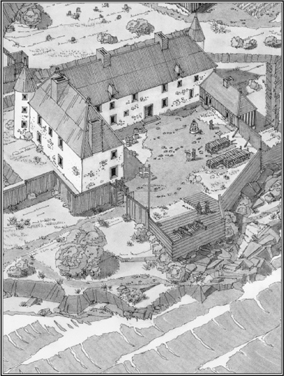
Champlain’s second habitation, as reconstructed by him in 1633–35. This drawing, based on archaeological research, shows its defenses, the battery that controlled the narrows of the river and five outbuildings and small farms. An even stronger fortress was built on the heights above.
Then the hard work began. Champlain looked about and found once again that much of the town was a ruin. The old habitation where Champlain and Hélène had lived together in their happiest years was a tangle of broken stone and charred timber. The English had burned it, and the fort was also a wreck. Nothing had been built since Champlain had left four years before. In the absence of authority, Quebec had become a wide-open frontier town. In the filthy streets Champlain found a scattering of fur traders who were a law unto themselves—English, French, and Indian alike. Only one French family was living there—the long-suffering Héberts, still working the farm that Champlain had given them. They loved the land but lived in daily fear of violence by Indians and Europeans alike. The Héberts were delighted to see Champlain, and hopeful that he would restore order.
Champlain had only a handful of pikemen and musketeers, but disciplined troops with a determined leader swiftly worked their will upon the settlement. He did it with a grace that made it look easy, which it was not, as the tragic history of many a colony made clear. In 1633 Champlain’s energy seemed undiminished, even after thirty years of labor in New France. He mustered the men of the colony and set them to work rebuilding the settlement. The most urgent task was to make the colony defensible. The fort was a ruin—looted, burned, and struck by lightning. Champlain repaired its broken palisade, rebuilt its eroded ramparts, reinforced gates, and added platforms for great guns that commanded the river. In the town below, no weather-tight building remained to shelter the company’s supplies. Champlain repaired a structure to serve as a storehouse, restored shops for artisans, and renovated living quarters for servants and soldiers. Within the fort he constructed a seat of royal government. The king’s arms went up on the building, and once again the flag of Bourbon France was hoisted above the rooftops of the little town. His habitation became a North American echo of the French court, perhaps more in the spirit of Henri IV than Louis XIII.
Champlain also built a new chapel for Quebec and named it Notre-Dame-de-la-Recouvrance, Our Lady of the Recovery, to honor the restoration of New France. Champlain ordered the Angelus to be sounded three times a day, morning, noon, and night. He actively encouraged worship, and the chapel became an important center for the life of the settlement; Quebec’s Notre-Dame Cathedral stands today near the same site.15
The result was a full-scale revival of religion at Quebec during the winter and spring of 1633–34. This was a common occurrence in European colonies during the seventeenth century. Something similar happened in English settlements at Jamestown and Boston, but it took different forms in Catholic and Protestant colonies. Among Protestant populations, revivals centered on conversion experiences. The Catholic revival in Quebec appeared in exercises of piety. Father Le Jeune reported many acts of “extraordinary devotion in soldiers and artisans, such as are the greater part of our Frenchmen here.”
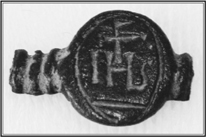
Jesuit rings were given to Indian converts by Father Paul Le Jeune, head of the order in New France. The emblem of the order was a crucifix with the initials IHS, which stood for Jesu Hominum Salvator, Jesus the Savior, and also for Constantine’s In Hoc Signo.They also became an article of trade.
Some made barefoot pilgrimages in deep snow. Le Jeune wrote of one penitent who “came on last Shrove Tuesday [1634], with bare head and feet over the snow and ice from Quebec all the way to our Chapel, that is a good half league, fasting the same day, to fulfill a vow made to Our Lord; and all this was done without any other witnesses than God and our fathers.” Other habitants practiced “abstinence and fasting.” One “took the discipline more than thirty times.” A third devoted a tithe of his profits to “works of piety.” Le Jeune observed the revival with gratification, and attributed much of it to Champlain’s example. The Jesuit father concluded that “the winter in New France is not so severe that some flowers of Paradise may not be gathered here.”16
While Champlain’s habitation was under construction, he moved in with the Jesuit fathers. The mission of these Black Robes in New France had not been Champlain’s idea. He favored the Franciscan piety of the brown-robed Récollets, much as Cardinal Richelieu had preferred the gray-gowned Capuchins. The Jesuits in New France had been sponsored by the relentless Madame de Guercheville, who applied her wealth and beauty to their cause. In Quebec, their presence was resented by some habitants and would continue to be controversial among Catholics even to our own time. But Champlain got on well with them, and especially with Father Paul Le Jeune, a former Protestant who had converted to Catholicism.
Le Jeune told a happy story that is a clue to their relationship. On May 29, Champlain attended Mass in the chapel of the Jesuit fathers, and afterward was invited to dine with them. Le Jeune remembered that “as luck would have it, an Indian friend of the mission” had given them “a choice piece of bear meat, which we served to Champlain. Having tasted it he began to laugh and said to me, ‘If they knew in France that we were eating bear, they would turn their faces away from our breath, and yet you see how good and delicate the meat is.’”17
In that snatch of conversation we hear Champlain’s laughter, feel his easy way with others, and see his pleasure in bountiful food, abundant drink, good company, and cheerful conversation. Here again, we observe his happy gift for working with people whose purposes were different from his own. In his advice to leaders, Champlain recommended an “affable manner” as an act of policy. But for him it was not a mask. Champlain genuinely delighted in the company of others, and they delighted in him.18
Le Jeune and Champlain became fast friends. Both men were probably catechized as Protestants, converted to Catholicism, and embraced that faith with a whole heart. Although their goals for New France were not the same, they worked together to strengthen the colony and to improve relations between church and state in Quebec. Champlain also encouraged the Jesuits to found a seminary for the training of priests. It opened in 1635, a year before the first college in New England. Within two years it was called the Collège de Québec.19

A major source for Champlain and New France are the Jesuit Relations, especially those that Father Paul Le Jeune sent home every year. They tell us how Champlain succeeded in realizing his dream of New France during his last years there.
With Champlain’s support, the Jesuits became an active presence in the colony. They met the immigrant ships that began to arrive from France. The Jesuit fathers rowed out to vessels in the river, climbed the high companion ladders in their billowing black robes, and performed mass on the weather deck, with their communion silver sparkling in the bright Canadian light. Once they brought a choir of seven Indian boys who sang the Paternoster in their own language, to Champlain’s delight and everyone’s pleasure.20
After the fort was repaired, Champlain invited the Jesuits to dine in his quarters, which they did frequently. Le Jeune recalled that “the fort … seemed like a well-ordered Academy. Monsieur Champlain has someone read at his table in the morning from some good historians, and in the evening from the lives of the saints.”21 The tone of the settlement was transformed by Champlain’s spirit. Le Jeune wrote, “We have passed this year in great peace and on very good terms with our French [habitants].” He attributed that success to “the wise conduct and prudence of Monsieur de Champlain, governor of Quebec of the Saint Lawrence River, who honors us with his good will, holding everyone to the path of duty. In a word we have reason to console ourselves when we see a chief so zealous for the glory of our Lord, and for the welfare of these gentlemen.”22
Another of Champlain’s many responsibilities was to control the river. Illegal traders continued to appear in the St. Lawrence. Champlain complained again and again that they used any means to make a profit, and gave no thought to the future. These interlopers offered firearms and alcohol to the Indians, and threatened to burn Indian settlements that traded with the French. As the flow of French shipping increased in the St. Lawrence Valley, the company ordered its captains to attack unlicensed traders when they had the power to do so. In 1634, an English ship was captured after a battle in the river.
Champlain lacked the strength to remove interlopers from the lower reaches of the river. He decided to deal with the problem in another way, by building a new fort and trading post on the small, rocky island of Sainte-Croix, in the St. Lawrence River near the present village of Deschambault, fifteen leagues upstream from Quebec. The channel was narrow there, and, in Champlain’s words, the fort “held the entire river in check.” Its guns kept the English from coming upstream, and Champlain erected a trading post there to provide opportunities for commerce with the licensed traders. Later he changed its name from Sainte-Croix to Richelieu Island, in hope of improving relations with the cardinal. In 1633 Champlain was often on the water, visiting the island, supervising construction, talking with the garrison, and meeting with the Indians. This policy of controlling choke points on the river met with mixed results, but it helped Champlain to keep the peace along the river.23
Champlain’s next task was, yet again, to repair relations with the Indians. When he arrived in Quebec, scattered acts of violence were increasing dangerously between Indians and French. The English conquest had done real damage that way. The Indians could not understand why a kingdom as great as France could be defeated by a small force of freebooters. Some Indians felt abandoned by the French. Others thought that the French could not be trusted as allies or even as trading partners. A few saw them as ripe for the plucking.
On May 30, 1633, an Algonquin warrior killed a Frenchman. The murderer was caught and confined in chains at the French fort in Quebec. Then on July 2, another Frenchman was murdered by an Indian of the Petite-Nation as he was washing his clothes in a stream near the settlement. The killer tried to disguise his crime as the work of the Iroquois. When Champlain and Indian leaders discovered the truth, the murderer was captured and taken to the fort. French leaders asked what should be done with him. Champlain posed the question in another way. What sort of justice would satisfy both the Indians and the French? It was a problem that Champlain had dealt with several times before, always in the same spirit, but each time with more refinement.
Long discussions followed between Champlain and large assemblies of Indians, mostly about standards of justice. The Indians made several proposals. Some suggested that they should kill an Indian who was related to the murderer. Champlain refused, and said to them, “Your law is much more brutal than ours. It would kill another innocent person and allow the criminal to go free.”24 Montagnais leaders proposed that their nation should give Champlain several children as hostages. They took two small children by the hand, laid them at his feet, and said to him: “We give them to you. Do whatever you wish.” Champlain had done something like this before, but this time he said no. “Innocent children cannot carry the guilt of the murderer,” he explained. “I desire no further hostage than the guilty one to be in my hands—a perfidious traitor, with no more courage or friendship than a tiger.”25 Champlain proposed that only the perpetrator should be punished, and in a way that all nations could recognize as just. The killer remained in a condition of “open confinement,” so that his wife and others of his nation could visit him. How it ended is not known. The murderer was still in that condition when the only account was written. But Champlain succeeded in finding a path of coexistence among the French, the Algonquin, and Montagnais, both in what was done and in how they did it. As always, he kept working to restore the rule of law in the St. Lawrence Valley on that basis.26
Another incident happened on May 23, 1633, when the French at Quebec were visited by twelve or fourteen canoes of the Nipissing nation, whom the French called the nation des Sorciers. The Indians were fascinated by the exercises of a young French drummer boy. One pressed too close, and the drummer accidentally hit him in the head with a drumstick. The wound bled abundantly, and the Indians asked for justice, which in their nation called for the payment of presents. Champlain answered that justice would be done in a different way and he ordered the French drummer boy to be whipped. As the “switches were being made ready,” the Indians rushed forward to protect the French lad. One Nipissing stripped himself naked, and threw his blanket over the French boy and said, “If you wish to beat someone, beat me, but do not beat him.” The drummer was spared a beating, and Champlain himself got a lesson in humanity.27
Champlain’s task of restoring relations was compounded by the cultural complexity of the St. Lawrence Valley. Each Indian nation presented a different challenge. Champlain had to find solutions that worked for the Montagnais, for the many Algonquin groups, the Huron, and especially the Iroquois. His first step was to expand communications. Champlain’s main recourse was, as always, to listen and talk. He had a smattering of Indian languages, not enough to speak directly on sensitive questions. Most of his communications had to happen through interpreters.
Some of Champlain’s old corps of French interpreters were still living in the St. Lawrence Valley. When the English had arrived, several interpreters had gone to live among the Indians. Others chose to work for the conquerors. Champlain had made these men what they were and he was appalled by what some of them became. He had come to detest Étienne Brûlé, and disliked Marsolet for having lent aid and comfort to British mercenaries. After 1633, he worked more closely with other interpreters who were held in high respect. Everyone thought well of Olivier le Tardif, who became fluent in Montagnais, Algonquian, and Huron, and was also perceived as an honneste homme. The Indians held him in high esteem. He often appeared at Champlain’s side and became a major figure in New France.28
Within the settlement of Quebec, Champlain worked at changing attitudes of the new habitants toward the Indians. With his example, relations between the French settlers and American Indians began to improve. Le Jeune supported Champlain, shared the same humanism, and greatly admired the style and character of the Indians. He remarked on the grace and dignity of “un sauvage de bonne façon.” Once, upon observing an Indian family passing his residence he wrote: “This family has something inexpressibly noble about it. If they were dressed à la française, they would yield nothing to our gentilhommes.” Le Jeune added: “They will feed you without asking anything of you if they think you have nothing. But if they see that you have something, and they want it, they will not stop asking you for it until you have given it.”29 The Indians were permitted to move freely in and out of buildings, “according to their custom,” Le Jeune wrote. “They enter everywhere without saying a word, or without any greeting. Their houses are not closed; all can enter who will.” Here again, Champlain had set an example. Others followed his lead, and relations improved in a reciprocal way.30
On May 24, 1633, two days after Champlain had returned to Quebec, eighteen large canoes filled with Indians led by the Montagnais leader Capitanal came to visit him. Champlain met with them and made a speech through his interpreter, Olivier le Tardif. He reminded them of the alliance that he had made with their forbears in the first tabagie on St. Matthew’s Point exactly thirty years before. He recalled how he and Capitanal’s father had fought side by side against the Iroquois in battles where Capitanal’s father had been killed and Champlain wounded.
Champlain told the Montagnais of his dream that their children might intermarry and live together as one people. Gesturing to the fort and settlement, he said, “When that great house is built, our young men will marry your daughters, and henceforth we shall be one people.”31 These words flowed from his heart, and the Indians were moved by his spirit.32 Father Le Jeune was present at this meeting and wrote an account of it. He observed that the Indians “listened very attentively” to Champlain and “appeared to be in deep thought,” as did one of their leaders, “drawing from his stomach this aspiration from time to time: Ham! Ham! Ham!, as if approving.”33
Champlain spoke of the trade that had grown between the Montagnais and the British, and warned them that freebooters were “thieves who had come to pillage the French.” He told the Indians about the treaty between the monarchs of England and France, and urged the Montagnais to “consider well what they were doing; these robbers were only birds of passage, while the French would remain in the country as it belonged to them.”
After Champlain finished, the Montagnais leader Capitanal rose. Father Le Jeune was amazed to hear him speak “with a keenness and delicacy of rhetoric that might have come from the schools of Aristotle or Cicero.” Capitanal said that Champlain spoke the truth, and for thirty years had lived the ideas that he espoused. The Indian leader said he had heard his father speak highly of Champlain, and they had learned that the French were different from the English. Capitanal promised that he would “not go to the English; I will tell my men they should not go there.” He explained that his powers were limited. “I promise you that neither I myself nor they who have any sense will do that; but if there is some young man who jumps over there without being seen, I shall not know what to do; you know well that youth can not be restrained.”34
A particular problem was trade in alcohol. “Since the English have introduced them to this drink,” Champlain wrote, “it has caused many quarrels, fighting, smashing their cabins … and trouble throughout the country.” He prohibited traders from giving wine and spirits to the Indians, on pain of severe corporal punishment and flogging. Together Champlain and Capitanal endeavored to stop trade with English interlopers, and to shut down the trade in alcohol. They both knew the limits of their power, but these men did what they could, and they did it together.35
As relations with the Montagnais began to improve, the Algonquins presented another challenge. Also in Champlain’s first busy week at Quebec, a very large delegation of Algonquin Indians came down the river in a great fleet of canoes. Champlain suspected that they might go on to the English, who had three vessels at Tadoussac and “a barque far up the river.” He went to their camp, and met with the Indian leaders, and more important, he listened as few Europeans did. Then he spoke of his vision for the Indians and New France. Unlike the conquistadors of New Spain, Champlain did not wish to make them into a force of servile workers. Unlike the founders of New England, he did not want to keep the Indians at a distance or drive them from their own lands. He urged the Indians to move closer to Quebec, and shared with them his vision of Europeans and North Americans, living side by side in peace.
After his conversations with the Montagnais and the Algonquin, Champlain also met with the Huron, and worked to restore relations with them. This was a very difficult task. Twenty years earlier, Champlain had been close to the Huron, and lived in their villages through a North American winter. But they had grown apart. Some of the Huron felt that Champlain had abandoned them. Still, in 1633 they remembered him with affection and respect. When they heard that Champlain had returned, a large party of Huron came down the river to see this man who had become a legend in their own culture. On July 28, between 500 and 600 Huron visited Quebec in hundreds of large canoes. They came ashore and built a camp on the edge of the river.36
It was an amazing sight. Le Jeune was an eyewitness, and he reported: “I could scarcely tell you how the people of this nation wear their hair. Each follows his own fancy. Some wear it long and hanging over to one side like women, and short and tied up on the other, so skillfully that one ear is concealed and the other uncovered. Some of them are shaven just where others wear a long moustache. I have seen some who have a large strip, closely shaved, extended across the head, passing from the crown to the middle of the forehead. Others wear in the same place a sort of queue which stands out because they have shaved all around it.”37
The next day the Huron held a council of sixty leaders, sitting on the ground, with each village and clan grouped together. Father Le Jeune was struck by their dignity. He wrote: “I have been told that Louis XI once held his council of war in the country, having for his throne or chair only a piece of wood, or fallen tree…. This is the picture of the Council of the Hurons.”38 Champlain was invited to join them, and the Jesuits were allowed to sit in. A Huron leader rose and said that they had come “to see their friends and brothers the French,” and offered presents to “the captain of the French, the sieur de Champlain.” They gave him three large bundles of beaver robes. Other Indians joined in expressing their support. One of their captains rose and said, “All the people rejoiced in the return of the sieur de Champlain and they all have come to warm themselves by his fire.” Then the Huron gave him more bundles of beaver robes.39
Champlain rose and said that he “wished very much to have them as his brothers, that he recognized old men with whom he had gone to war against the Iroquois.” The Huron warmed to his remarks. Then two Huron captains rose, and Father Le Jeune listened in astonishment as “they vied with each other trying to honor sieur de Champlain.” One said: “When the French were absent, the earth was no longer the earth, the river was no longer the river, the sky was no longer the sky. But on the return of the sieur de Champlain everything was as before; the earth was again the earth; the river was again the river, and the sky was again the sky.”40 The other celebrated Champlain as a warrior, and said that the sieur de Champlain was frightful (effroyable) in his looks; that when he went into battle, “a glance from his eye struck terror into the hearts of the enemies.”41
The discussion turned to the Jesuit fathers. Champlain urged the Huron to accept them in their villages, and he dictated the arrangements both to the Huron and the Jesuits. Both accepted his judgment, even though it was in some ways against their own. In 1633, Champlain was truly ruling over the St. Lawrence Valley.
After the Huron council, the Jesuits invited Champlain and the captains of French ships on the river to visit their chapel and receive indulgences, and another side of Champlain’s character appeared. The Huron followed him to the chapel, so many that there was no room for them in the small building. One Huron put his head through a window to see what was happening. Father Le Jeune wrote that Champlain, “enjoying their wonder, gave one of them a piece of lemon peel.” The Indian tasted it and cried, “How good it is!” He asked what it was. Champlain said with a laugh, “it is the rind of a French pumpkin.” Others came for a taste “saying they would like to taste them, so they could tell about them in their country. Soon all joined Champlain in his laughter.” Le Jeune wrote, “You can judge for yourself how the room began to laugh!”42
Relationships with the Iroquois remained a problem. All the major Indian nations of the St. Lawrence Valley asked the French for help against them. On November 13, 1632, Father Le Jeune had been startled by a visit of a Montagnais leader in a state of extreme agitation. Le Jeune wrote: “Manitougache, our guest and neighbor, came to tell us that a great many Hiroquois [sic] had been seen near Kebec. All the Montagnais trembled with fear. He asked if his wife and children could not come and lodge with us. We answered him that he and his sons would be very welcome, but that girls and women were not permitted to sleep in our houses, indeed, they never entered them in France.” He “sent his whole party, all the young people, to cabins in the neighborhood of Quebec, where they were told that some arquebusiers would be sent to protect them.” The Algonquin and Huron made similar requests of Champlain. Twenty years after his campaigns against the Mohawk and the Onondaga, warfare was increasing once again between the Iroquois and the Indian nations who lived and traded on the river.43
On June 2, 1633, Mohawk warriors ambushed a party of Frenchmen near the site of Trois-Rivières. It was a brutal affair. The French were going up the river in a barque and a small shallop. The current was strong and several men went ashore to tow the shallop along the bank. As they reached a point of land, a war party of thirty or forty Iroquois sprang an ambush and attacked with great fury. Other Iroquois tried to board the shallop from their war canoes. The larger barque came to the rescue, and French arquebusiers presented their weapons. The Iroquois were driven off, but not before they had killed two or three Frenchmen, wounded three or four more, scalped their victims and retreated with cries of triumph.44
Here was Champlain’s most intractable problem: the reviving hostility of these formidable warriors. Champlain had tried many times to make peace with the Iroquois. For many years from 1609 to 1628 he had succeeded, when the Iroquois were engaged in wars to the south. An informal peace was agreed, but the English conquest had disrupted this understanding. The Mohawk turned north again, and rivalries for the fur trade were intense. Peace initiatives had failed, and Champlain lacked the military strength to deal with them. What to do?
In 1633 and again in 1634, Champlain laid out his thoughts in letters to Cardinal Richelieu. On August 15, 1633, he explained that the Iroquois had gained control of a large part of the countryside south of the St. Lawrence River, and held “more than 400 leagues in subjection.” In that area, he reported, the rivers and trails were not open to the French and their Indian allies. “It will be necessary sooner or later to prevent them from making trouble for people who wish to come and go freely on the lakes and rivers, and trade peacefully with the French.”45
Champlain told Richelieu that this goal could be achieved only by force of arms, but not by a conventional European army. He proposed to form a special sort of military unit, adapted to conditions in the new world. First it would be very small, carefully selected, trained for operations among the Indians, and highly mobile in the American forest. “To make ourselves masters of these people [the Iroquois],” he wrote, “it is necessary to have one hundred picked men of courage, well mannered, quiet, disciplined, accustomed to fatigue, and able to accommodate themselves to the customs of the Indians in the matter of food and drink.”46
Champlain designed this new force in great detail. He requested permission to recruit “eighty men armed with carbines of three or four feet [in length], and the caliber of a musket, highly skilled in their use.” Another ten men would be “trained in the use of two-handed swords and armed with pistolets;” four artificers skilled in the use of mines and petards for breaking down palisades; ten halberdiers and ten “strong and robust” pikemen trained in the use of that weapon; four carpenters and four locksmiths (skilled in the repair of gun locks); and two surgeons each armed with pistols. He proposed that all of these men would also be armed with cutlasses (“short but very sharp”). The entire force was to wear uniforms of chamois or well-cured leather of a faded color. They were to be protected by helmets and half armor of light steel that would offer protection from arrows.47
It is interesting to see the combination of qualities that Champlain had in mind for these men. They were to be highly efficient, capable of swift movement, and inured to hardship. They were also to be young men of manners, discipline, and restraint, who could adapt to the ways of the Indians and live and work with them in harmony. Champlain intended this small French force to operate in alliance with much larger numbers of 3,000 or 4,000 Indian allies, from the nations of the St. Lawrence Valley. He requested as well that the French supply the Indians with 1,000 hatchets and 4,000 iron arrowheads.48 His purpose was clear. When the Iroquois attacked the French and the Indians of the St. Lawrence Valley, he proposed to muster a combined force of French troops and Indian warriors. His intention was to strike quickly, with a large and highly mobile expedition that would advance quickly into the heart of Iroquoia, attack one or more of their major villages, withdraw in about twelve days, and raise the cost of aggression.49
Champlain was not interested in imposing French conquest on North America by brute force, or in building a sedentary empire in the British fashion. His object was to live among the Indians and work with them to create a lasting basis for peace, and to enforce it by joint effort where necessary by quick, strong and decisive measures, followed by conciliation. His letter to Richelieu laid out this strategy and an operational plan. Whether it would have worked against the Iroquois is another question. They were formidable opponents, highly skilled in the warfare that Champlain proposed to wage against them.
His plan required the active support of Cardinal Richelieu, and that support was not forthcoming. Champlain may have made a major tactical mistake in developing his thoughts not only in letters to the cardinal himself but also in a “relation” that was published in the Mercure François. Considerable skepticism may have arisen in Paris about Champlain’s proposal to take the field himself at the age of sixty-three. The cardinal had no knowledge of North America, and nothing of Champlain’s long experience of warfare in the new world. Whatever the reason, Richelieu did not act on Champlain’s advice, and may not even have replied to it. Once again it cost France dearly. After Champlain’s death, the Iroquois became more aggressive against the French, and a large force of conventional infantry would be sent to America with instructions to impose order by a more heavy-handed application of force majeure. It would be less effective than Champlain’s more adroit approach.
• • •
While governing in Quebec, Champlain made every effort to improve relations with Cardinal Richelieu and the Crown. This was not easily done. The cardinal was absorbed in European affairs. Richelieu wanted to create a world empire for France, and his attention wandered from one project to another. He acquired the West Indian islands of Martinique and Guadeloupe, and was interested in South Asia and the East Indies. Canada was also on the cardinal’s list, but rarely at the top. Champlain wrote a series of letters to Richelieu, which survived in the archives of the Ministry of Foreign Affairs in Paris. Every year, Champlain made an annual ritual of fealty to his superior. He wrote little about himself, but much about the importance of New France. He described the magnitude of “this land more than 1500 leagues in longitude, lying between the same parallels of latitude as our own France.” He celebrated the St. Lawrence River, “one of the most beautiful rivers in the world, with many tributaries, some more than 400 leagues.” He spoke warmly of the native people in their great variety, “some of them sedentary in towns and villages built of wood, like the Moscovites,” others nomadic hunters and fishermen, “all wishing to have a number of French and religious fathers for instruction in our faith.”50
He wrote of the beauty of the countryside and the bounty of its arable land, its great open spaces and immense forests, its abundance of animals and fish, its rich deposits of copper, iron, silver, and other minerals. Each letter was a promotional tract and more—a testament that came from the heart, about a country that he loved as dearly as France itself.51
These annual letters were also warnings to Richelieu not to lose sight of New France among his other projects. “I pray you will pardon my zeal,” Champlain wrote, “if I say that after your fame has spread throughout the East, you should end by compelling its recognition in the West.” Champlain warned that a great French empire could be lost to the Iroquois and the English and the Flemings (as he called the Dutch), who were enemies of New France. Already the Iroquois had gained control of many rivers, and were threatening an advance to the heart of New France. Again and again, Champlain argued that in this moment of small beginnings, an even smaller force could settle the fate of a great continent. Champlain impressed upon Richelieu that with a little effort at the right moment, they could “expel our enemies both English and Flemings,” and “force them to withdraw to the coast,” and within a year that force could encourage the spread of “order, religion, and commerce.” He reckoned that the cost was small, and the enterprise “the most noble that can be imagined.”52
There was no reply. A year later, on August 18, 1634, Champlain wrote again. He reported that many artisans and families had arrived, and that the effort of the Hundred Associates had given him new courage. He mentioned that he had named a river after Richelieu, and also an island fifteen leagues above Quebec, on which he had built a fort to control movement on the great river. Once again he asked for 120 men.53
These annual letters from Quebec must have been tiresome for Richelieu to receive. Perhaps he never even read them. He did not like to be hectored by his inferiors, particularly by this troublesome old commoner who was driven by a dream. If he replied at all, no letter has survived. When the cardinal’s thoughts turned to colonies in this period, he gave more attention to Guadeloupe than Quebec, more to Martinique than Acadia, more to North Africa than North America, more to the Indian Ocean than the Atlantic. For the Catholics of New France the cardinal’s inattention must have appeared a form of punishment. For the Calvinists of New England, it might have seemed a gift of Providence.54