
Champlain’s Greatest Test, 1629–32
From the time the English took possession of Quebec, the days seemed like months to me.
—Samuel de Champlain, Voyages, 16321
IN THE FALL OF 1629 the Kirkes prepared to sail home to Britain. David Kirke ordered his ships to be careened. In the tight little harbor at Tadoussac, their bottoms were cleaned, tarred, and tallowed. With some prodding from Champlain, he sent more supplies to Quebec, sufficient to see the habitants through a long winter. The river barque also carried Champlain’s two Indian girls, Hope and Charity, back to their Montagnais people. Champlain’s brother-in-law, Eustache Boullé, gave them rosaries. Champlain told them that the French would be back, and made arrangements for them to be taken into the Hébert household, if they wished. On September 14, 1629, Champlain watched as Guillaume Couillard and the girls sailed up the river to Quebec. It was a moment of sad parting.2
On the same day, the Kirkes weighed anchor at Tadoussac and sailed down the St. Lawrence River, homeward bound for England. Champlain noticed that they were in a state of “considerable apprehension.” Indians had reported a French fleet of “ten well-armed vessels” on the coast near Gaspé. David Kirke insisted that he was “not afraid of them in the least,” but Champlain observed that he steered very close to the coast of Anticosti Island, fourteen leagues north of Gaspé, “so as not to be noticed,” and so he got safely to sea.3 They were leaving much later in the season than Champlain’s normal practice. Just off the American coast they ran into autumn storms. Champlain wrote, “We were kept back by very bad weather accompanied with fogs till we reached the Grand Banks.” Sickness spread through the crowded British ships. “On the way across,” he noted, “eleven of Kirke’s men died of dysentery.”4
On October 16, 1629, the Kirkes crossed soundings on the coast of England, and ran into the west-country port of Plymouth. Champlain immediately asked for news and was told that the war was over. More than that, England and France had signed a peace treaty six months earlier, in the town of Suze (Susa to the English). By its terms, all conquests or seizures made after the peace had to be returned. The effective date of the treaty was April 24, 1629, nearly three months before the fall of Quebec in July.
Champlain was delighted. David Kirke was in a fury, “greatly angered by the news.” He had seized twenty-one fishing vessels, some of them after several people had told him the war was over, thereby making him liable for damages. He was still holding French leaders and priests for ransom. Kirke’s actions had been outside the law, and even against it.5
David Kirke promptly left Plymouth for Dover, the English port closest to France. He released his captives and made arrangements to send them home as quickly as possible. It was not an act of kindness. Kirke wanted to get these troublesome Frenchmen out of the country before proceedings could be brought against him in an English court. Most of them seemed happy to go home, with one exception. Champlain refused to leave England until he could determine the status of New France. He was humiliated by its loss and outraged by the way it had happened. Under the terms of the Treaty of Susa, which had the force of law in both countries, Quebec rightfully belonged to France, and England was required to return it. But Champlain knew that it was one thing to have a title, and another to gain possession.6
Others in his position would have sailed home to France and put the problem in the laps of Cardinal Richelieu and the king, but that was not Champlain’s way. Having lost Quebec, he felt a personal responsibility to get it back again. Acting on his own initiative, he went to work in Dover, documenting what had happened. First he compiled a record of the Kirkes’ acts. He probably consulted with his fellow prisoners and collected testimony before they left England. Then he dispatched letters and documents in several directions. One set went to France, addressed to M. de Lauson, Superintendent of Affairs in New France under the Company of the Hundred Associates. Champlain enclosed “an account of all that had taken place” and asked that copies be forwarded to Cardinal Richelieu and the king, with an appeal that Louis XIII might send letters to the French ambassador in London, “recommending this matter to his special attention.”7
Then, while his fellow travelers were en route from Dover to France, Champlain headed in the opposite direction. He made his way to London by sea, sailing from Dover to the River Thames, then to Gravesend and the London docks, where he arrived on October 29. The next day he went to see the French ambassador, the marquis de Châteauneuf, a splendid character who embodied the virtues of the Old Regime. Even the English highly respected him. The marquis received Champlain with grace and exquisite courtesy. Champlain told him the whole story and gave him another set of his documents. Later he recalled: “I related all the reasons for our voyage, and how we had been seized two [actually three] months after the peace, namely on the 20th of July, through lack of provisions, munitions of war, and assistance. After having endured many privations for a year and a half, we had to go into the woods to dig roots to sustain life; although I kept only sixteen persons at the fort and habitation, the greater part of my companions having been sent to live with the Indians, so as to avoid severe famine.”8
Champlain spoke not only of Quebec but also of Acadia and other parts of New France that English freebooters had occupied while the Kirkes were in the St. Lawrence. Champlain had put his cartographic skill to work and he presented a detailed map of the entire area, mainly “to show to the English the discoveries that we had made and the possession we had taken in that country of New France before the English, who had only followed in our tracks.” His map showed the full extent of British seizures at Quebec, Cap Tourmente, Tadoussac, Gaspé, Cape Breton, Miscou, Acadia, and the small French trading post at Pentagoet, now the town of Castine in Maine.9 Champlain also documented the damage that had been done to French trade and fisheries, and gave the ambassador copies of the surrender of Quebec. He made very clear that these events had happened after the end of the war, and even after reports of the peace had reached America.10
Champlain added a complaint about another issue that offended him in a personal way. The English had attempted to abolish the place names that the French had given to the American land. With great indignation, he wrote that the English had “within two or three years, imposed on parts of La Nouvelle France such names as New England and New Scotland.” This insult infuriated Champlain more than any material injury that les Anglais and les Ecossais had done him. “They took this notion into their heads very late in the day,” he wrote. “They ought to act reasonably and not change names already given.” It was a point of honor among cartographers.11
The French ambassador listened to Champlain with close attention and acted quickly. “Having heard my story,” Champlain wrote, “the ambassador resolved to speak of it with the king [of England].” He obtained an audience and presented some of Champlain’s original documents. One of them has been found in British archives. King Charles I received the ambassador with respect and even with sympathy. To Champlain’s surprise he accepted full responsibility for what had happened in New France, and agreed that the colony rightfully belonged to Louis XIII. According to the marquis de Châteauneuf, the English king “gave all good hope that the place would be restored to us, together with all the furs and merchandise that he had ordered to be taken from us.” Champlain had high praise for the ambassador and wrote that “he applied himself to the business in a very praiseworthy manner, hoping to get the Council to issue an order for the restitution of the colony and the property seized there.”12
Champlain expected that the matter would be settled quickly and waited in London for instructions from his superiors in France. But nothing happened. Weeks passed without a word from Louis XIII, or Richelieu, or any French minister in Paris. Champlain was baffled, mainly because he appears not to have known about another major problem that stood in the way of a solution. Charles I had a major grievance of his own against France. When he married Louis XIII’s sister Henrietta Maria, he had been promised a dowry of 2,400,000 livres. Six years later, only half of it had been paid, and Charles desperately needed the money. Unknown to Champlain, he had promised secretly to return New France on one condition—full payment of the dowry.13
In Paris the king and his ministers were slow to respond for one simple reason. They did not have the money. More weeks went by. Champlain remained in London at the ambassador’s request, with growing irritation. He wrote, “I was nearly five weeks in close touch with the ambassador, awaiting news from France all the time, marking how little diligence they showed in sending anyone over, or in advising me of what they wanted to be done.”14
The month of November neared its end, and the English weather was growing cold and gray. The days dragged on and Champlain grew weary of waiting in London with no word from his own government. Finally, in the last week of the month, he decided to head for France and seek out the king and Richelieu. Champlain was an old hand at court politics. Before he left London he was careful to ask the marquis de Châteauneuf for permission to depart. “I asked the ambassador whether he any longer wanted my services, because I wanted to return to France,” Champlain noted. “He granted me permission, gave me a letter to my Lord the Cardinal and assured me that the King of England and his council had promised to restore the place [New France].15
Champlain tells us that he left London for France on November 30, 1629. It was a difficult trip, with ill winds in the English Channel and misadventures on the road.16 Champlain made his way to his home in Paris, almost as a stranger. He had been gone for more than three years and he was returning in deep adversity. The fall of Quebec was the worst defeat of his career. He was out of a job and short of money. Just when it seemed that nothing more could go wrong, he suffered another heavy blow. His marriage came apart. Hélène Boullé, his beautiful young wife, told her husband that she no longer wished to live with him. Divorce was out of the question in Catholic France. She requested her husband’s permission to enter a convent. He appears to have asked her to stay with him. From what little we know they may have agreed to live separately in the same house. It must have been an agony for both of them. Hélène never traveled with Champlain again, and she did not return to Canada. In Quebec she was sorely missed by Indians and Europeans alike, but New France was not for her. She turned away from her husband and retreated into a life of religious devotion for the rest of her years.
We shall never know the full story of this marriage, beyond the fact of its troubled start, happier middle years, and final failure. These two extraordinary people were both attractive to others who knew them, yet they were unable to find happiness with one another. This was perhaps one more part of what Champlain meant when he wrote in 1632, “From the time the English took possession of Quebec, the days seemed like months to me.”17
Somehow Champlain found the resources to go on. His Christian faith was a source of strength to him. So also was his grand design. Even in his suffering, Champlain resolved to keep striving for his dream.18 In Paris he took up the cause of New France once more, and moved straight to the heart of the problem. “I went to pay my respects to his Majesty, my Lord Cardinal, and Messieurs the Associates,” he wrote. The loss of Quebec was not held against him, and he was able to get access to the king. As he had done so often in the past, he began to build a new base for his project. In the winter of 1629–30, he cultivated yet another circle of friends, and soon found supporters who were close to Louis XIII. They were younger men, a generation removed from the American circle who had helped him before but now were gone from the scene. Like the older group, they had powerful friends at court. One of them was André Daniel, a physician highly connected in Paris, with an active interest in New France. He was a major investor and a leader of the Hundred Associates, with many personal ties to America. His brother Captain Charles Daniel had made many voyages to the new world, and Father Antoine Daniel was a Jesuit missionary who would later be martyred in New France.19
With the support of these men and others like them, Champlain was able to gain the ear of the king and the attention of Cardinal Richelieu. “I gave full particulars of my voyage,” he wrote, “and explained what was necessary for them to do with reference to matters in England, and also in regard to other things for the benefit and advantage of New France.”20 He urged them to has ten the restitution of New France before it was lost forever. They responded positively. “Some time after my arrival at Paris,” Champlain recalled, “they despatched the sieur [André] Daniel to London, to see the French ambassador, with letters from his Majesty calling upon the King of England to restore the fort and habitation of Quebec, and other ports and harbors which he had seized on the coasts of Acadia, after peace had been made.”21
Daniel carried five memoranda that he and Champlain had prepared together, and they had some success, particularly in regard to Quebec. Charles I and his council met, and “made an order that the fort and habitation should be given back into the hands of His Majesty [Louis XIII], or those empowered by him.” But Champlain was quick to note what others had missed: the English response “made no mention of the coasts of Acadia.” He informed the French ambassador of the omission, and the marquis asked Louis XIII if “his Majesty would be satisfied with the offer.” Acadia was added to the list.22
Champlain also met with the directors of the Company of the Hundred Associates, who had little capital left and very large debts. They petitioned Louis XIII “to let them have six of his ships with four pataches, which they would fit out to go to the great river St. Lawrence, to resume possession of the fort and habitation of Quebec.” Champlain wrote that the fleet was “equipped and fitted out with all that was necessary.” It looked very promising.23
Then suddenly everything stopped again. The king and Richelieu turned their attention to another pressing problem: a war in Italy. Completely absorbed by events in Europe and chronically short of money, they put aside the problem of New France yet again. Champlain wrote, “His Majesty, who had the wars in Italy on his hands, was unable to return an answer to the King of England, and monsieur the Ambassador was kept waiting for His Majesty’s dispatch.”24
Champlain was filled with frustration about the loss of New France and gave vent to his feelings in documents that found their way into print. They could not have made pleasant reading at court. Champlain repeated his account of the English seizures in New France and asked: “What is the explanation of their having taking possession of our places so easily? It is because the King has not, up to the present, attached importance to these matters; but the just complaints made to him are now producing a resolve on his part to recover the territory encroached upon by the English, and the thing will be done whenever, and as often as, His Majesty may desire.”25
It was dangerous to speak such words in the era of Louis XIII, and still more so to write them. Champlain was on the brink of lèse majesté, for which the penalties were severe. But he got away with it, perhaps because the king and his chief minister were too busy to notice.
Champlain also turned to another problem. The Hundred Associates were almost at the end of their resources. They had spent 270,000 livres and only 30,000 remained. The directors somehow borrowed another 40,000 livres, and in 1630 they outfitted a fleet to take colonists to New France. The king ordered the chevalier de Montigny and five captains to recover Quebec, and to return Champlain as commandant.26
According to Champlain, “the English took alarm at the armament of these vessels.” Louis XIII gave them satisfaction “by dealing with the matter in a friendly way.” he king of England again promised to restore what had been taken after the peace. The king of France countermanded his own orders. Neither the French warships nor the transports were permitted to sail for America. The voyage was canceled. It was yet another huge loss for the company, its third major failure in a row.27
Champlain renewed his appeals to Louis XIII in a powerful submission that amplified his earlier arguments. He wrote of the riches and the grandeur of the land, the opportunity for commerce and wealth, the possibility of a northern route to China. He included the old spiritual imperative of “infinite numbers of natives; nombre infiny depeuples sauvages who might be brought to Christ.” Champlain added new arguments for French colonization, and a new imperative for French settlers to cultivate the land, so that they could feed themselves without needing supplies from home. Champlain’s arguments prevailed. Louis XIII was persuaded to resume discussions with Charles I and to do something about the dowry.
Champlain’s years in France from 1629 to 1632 were in some ways the most productive of his life, despite his many troubles. He played a major role in keeping the issue of New France alive, urging the king, the cardinal, and the Royal Council to work for its recovery. He collaborated closely with the directors of the Hundred Associates and helped reorganize it into a network of subsidiary companies. He formed new and very strong alliances with the next generation of young leaders such as the Daniel family.
For Champlain himself, these years were full of achievement in other ways as well. He wrote his biggest and most important book, called Voyages de la Nouvelle France, and published it in 1632. In modern reprint editions it fills two or three volumes. It reached an expanding public with some success, and Champlain’s publisher, Claude Collet, brought out a second edition.
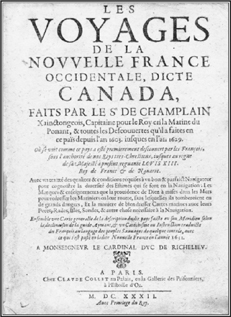
Champlain’s Voyages de la Nouvelle France Occidentale, dicte Canada (1632), his fourth and largest book, was dedicated to Cardinal Richelieu. It was part of a successful campaign to recover New France. Early in 1633, Richelieu appointed Champlain his lieutenant for Quebec and the St. Lawrence, with the utmost reluctance.
Champlain published the book with one major purpose in mind: to promote his grand design for New France in the court of Louis XIII. The Voyages were dedicated to Cardinal Richelieu. Another major goal was to establish the legitimacy of France’s claims to North America. It was also a tale of troubles, many of them caused by the lack of strong and stable support from chartered companies, and from the court. This was dangerous ground. Champlain made his case mainly by discussing particular problems in close detail, rather than by general indictments or personal attacks. The Voyages documented Champlain’s long record of his service, with detailed accounts of all his major voyages from 1603 to 1629, his labors during the reign of Henri IV, the regency of Catherine de Medici, and the reign of Louis XIII. The book was also a promotional tract for North America. It was a work of description, and an argument for the importance of discovery and colonization in New France. Champlain also described the American Indians in great detail. Most of his writing was very sympathetic to them and showed a sustained interest in their culture. He stressed the importance of converting the Indians to Christianity, celebrated their intelligence, and validated the Indians as human beings. Here again, a central part of his vision was an expansive idea of humanity that embraced the people of Europe and America. His book was a sustained appeal for that principle.
Champlain promoted his project for New France through other publications as well. Pieces on his grand design appeared in that magazine of news and opinion, Le Mercure François, especially after Richelieu intervened and chose for its editor Father Joseph, the cardinal’s éminence grise. Some of these promotional pieces were written by Champlain, and others were submitted anonymously, with his active encouragement.28
In 1632, Champlain also published a map of New France which many cartographers recognize as his best. It had a different character and purpose from the work he had done before. Most of his earlier cartography produced charts, intended as aids to navigation, with much information about coasts and harbors, rocks and shoals, depth of water, and other directions for seamen. The great map of 1632 had some of those elements. The Grand Bank and Green Bank and the Banquereaux were clearly indicated in the Atlantic Ocean, with extraordinary precision. The map includes a navigator’s scale framed by a pair of dividers, indicators of latitude and longitude, and two examples of a compass rose, each with thirty-two radiating rhumb lines. But in this work Champlain was not thinking primarily of navigation. Coastal features are only approximate here, and less accurate in shape and scale than in his earlier work. Examples are Cape Cod, Mount Desert Island, the Sainte-Croix River in Maine, Sable Island, and Halifax harbor.
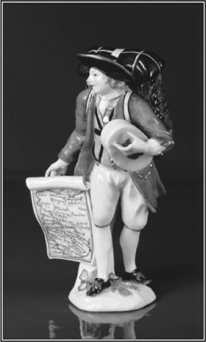
This itinerant map seller, in a ceramic figurine by Johann Joachim Kaendler (circa 1764), suggests the reach of Champlain’s cartography to an expanding public. His map of 1632 supported French claims to North America. It had an impact in London and also in Paris, where the major obstacles lay. The map appears on the back endpapers of this volume.
This work was a map rather than a chart, centering more on the land than the sea. It carefully marked places where the French had lived in North America from 1603 to 1629. Settlements were carefully named, accurately placed and marked by the maritime ensign of France. Missions, both Jesuit and Récollet, were also marked by a cross.
The map showed the names that were put on the land by French explorers, mostly by Champlain himself. The entire region of settlement was called by the single name of La Nouvelle France. It is interesting that Champlain no longer used the words Acadie or Norumbega. Gaspé and Cape Breton referred only to points of land, not to regions. The primary object of the map was to display the integrity and unity of New France. That name appeared twice: once on the Gaspé Peninsula, and again in larger letters on the huge regions to the west as far as the Great Lakes. All of this vast territory was claimed for France, and the royal arms of Louis XIII were displayed above it with the lilies of France, the Crown, and the cross of the Order of Malta—symbols of Bourbon sovereignty, French nationality, and the Roman Catholic faith.
Another layer of detail, very dense and carefully done, gave the location of Indian nations. Champlain’s legend explained that he was showing the nations of forest-dwelling people—many of whom were unknown to the larger world before he had met them and made alliances.29 To reinforce this visual display of French claims, Champlain added a very full gazetteer that was published at the same time. This map of 1632 was probably very similar to an earlier one that he made in 1629 and gave to the French ambassador in London, for use in negotiations with British rulers.30
Finally, in 1632, Champlain’s labor achieved its intended result. After much delay, Louis XIII agreed to pay the balance of Henrietta Maria’s dowry with interest: the very large sum of 1.8 million livres. After long negotiation, Charles agreed to restore New France. Both monarchs promised to stop doing what they should not have started to do in the first place. Each also agreed to keep treaty obligations that they had already broken. These terms were ratified by the Treaty of Saint-Germain-en-Laye in 1632.
While the two kings were moving toward a diplomatic solution, the Company of the Hundred Associates had been changing its operations in a fundamental way. After three ruinous failures in 1620, 1629, and 1630, the directors tried a new approach. They decided to sponsor a web of subsidiary companies, so that subcontractors could undertake smaller ventures with limited goals. The subject was the same: to recover control of New France. This approach was different: it leveraged the company’s capital, broadened its investor base, created drivers for particular ventures, and gave them a stake in the outcome.31
One of the first of these ventures was an attempt to reinforce an unexpected success by Champlain’s friend Captain Charles Daniel. In the spring of 1629, after the Peace of Susa and before the fall of Quebec, Daniel had been sent to New France by the Company of the Hundred Associates, with dispatches and supplies for Champlain. He sailed from La Rochelle on June 26, reached the Grand Banks, and was caught in dense fog. The ships lost sight of each other and Daniel sailed on alone. He met a small ship flying an English flag at the mainmast. Daniel boarded her, reported that their nations were at peace, and allowed her to continue to her destination, which was Plymouth Colony with a cargo of English cattle and other freight.32
Captain Daniel continued to Cape Breton in August 1629, stopping at Grand Cibou (now Bras d’Or Bay) and Port-aux-Baleines (now Baleine Cove) just west of Cape Breton. There he found a ship from Bordeaux and learned that another group of British mercenaries, led by Sir James Stewart, had seized a French fishing vessel, confiscated her catch, and robbed her crew—another illegal act after the Peace of Susa. Stewart had built a fort at Port-aux-Baleines and forbade any Frenchman to trade on the coast without paying a 10 percent fee of furs for permission to trade.33
Daniel was outraged by this “usurpation of territory belonging to the King, my master,” and took it upon himself to evict the Scots. On Sept. 18, 1629, at about two o’clock in the afternoon, fifty-three Frenchmen landed at Port-aux-Baleines and advanced on the British fort with orders to “attack at different points and make plentiful use of grenades, fire-pots, and other fireworks.” Daniel himself led the assault on the main gate, and personally seized the British commander. The defenders replied with a few rounds of musketry, and were overwhelmed. After a token resistance they raised a white flag and begged for “life and quarter.” Down came the “standards of the English king, and up went the lilies of France.34
In the fort Daniel freed a French fishing captain named René Cochran from the port of Brest, who had been held as a hostage until the owner of his vessel paid a ransom. Daniel loaded all the provisions, munitions, and weapons aboard a Spanish caravel that was aground near the fort. Then he ordered the Scottish fort to be demolished. All the usable material was carried to Cibou, and Daniel put fifty British captives to work building a new fort called Fort Sainte-Anne. He raised a habitation and chapel, filled the storehouse with a plentiful supply of provisions and munitions, and set up the arms of the king and “my lord the Cardinal.” Other refugees from Quebec made their way to the settlement, including the Jesuit fathers Vimond and Vieuxpont. A garrison of forty Frenchmen prepared to spend the winter of 1629–30 there, under the command of the sieur Claude de Beauvais. Then Daniel sailed home with his captives, landed them at Falmouth in England with their personal belongings, and took their commander to France, “awaiting the instructions of my lord the Cardinal.” The liberation of New France from England had begun by force of arms well before the Treaty of Saint-Germain-en-Laye.35
When Daniel returned to Paris, Champlain worked with him to send reports to the king, Richelieu, and other high officials. In 1631, the Hundred Associates created a subordinate company in Normandy to reinforce Fort Sainte-Anne and plant a settlement on Cape Breton Island.36 This small effort did not succeed. A larger company was formed in Dieppe by Captain Charles Daniel of Dieppe and merchant-hatters in Paris to revive the fur trade.37 The Hundred Associates sponsored another special voyage to Fort Sainte-Anne and Cape Breton in 1632. Its purpose was to strengthen the French presence on the fishing coast, and to prepare the way for the recovery of New France by controlling the approaches to the St. Lawrence River. Two leading historians of New France, Lucien Campeau and Marcel Trudel, believe that Champlain sailed with it and returned quickly to France in the late summer or fall.38
He strengthened the small French post at Sainte-Anne, a strategic site on the peninsula of Cape Breton with a protected harbor on the south side of the great gulf of the St. Lawrence. We are told that Champlain “worked there to put the fort in a better state,” so that this settlement could be used as an alternate site, “in case the company of the Hundred Associates would not be able to recover Quebec.”39
A second French effort developed at the same time. It began with a small success at a small French trading post at Cape Sable Island off the southeastern tip of what is now Nova Scotia. There a little band of French traders had survived the onslaught of the British mercenaries in 1628–29. They held the last remaining fort in New France, and their leader Charles de Saint-Étienne de la Tour was hanging on by his fingernails. To help him, the Hundred Associates sponsored a new subsidiary company in the southeast of France. Some of the investors were Basques, the central figure was Jean Tuffet, a merchant-adventurer of Bordeaux and a director of the Company of the Hundred Associates. He fitted out several ships to sail from Bordeaux for Cape Sable. The commander was Captain Bernard Marot, a Basque seaman from Saint-Jean de-Luz. The ships carried three Récollet fathers, “workers and artisans,” and supplies for the beleaguered settlement at Cape Sable. They arrived in time to save the settlement with provisions, arms, and men. Champlain wrote that young La Tour was delighted with this support, which he had scarcely dared to hope for.”40
The ships landed their cargo and laborers, who began to rebuild the small colony. The French at Cape Sable were in an expansive mood, and decided to plant another trading post across the Bay of Fundy at the Saint John River, near the modern city of Saint John in New Brunswick. It is a dramatic spot, where the river curves between high headlands and joins the sea. At a spectacular bend in the river, its strong current meets the great tides of the Bay of Fundy to create the reversing falls that fascinated Champlain and still attract a flow of tourists.41 This new French settlement was also a success. It was founded primarily for a flourishing trade in moosehides, beaver pelts, and sea otter skins, which were sold through a consortium of merchants in the Cardinal’s Ring. The Hundred Associates were beginning to revive as a network of small sub-companies and small ventures.42
Champlain had a hand in these events as a friend of Charles Daniel and associate of Charles de La Tour. In 1632, La Tour returned briefly to Paris. He made a great splash in the city, arriving with a party of Indian warriors, French traders, and their mixed offspring. La Tour lived on the rue Quincampoix in the financial district of Paris. One street away on the rue St. Martin were the offices of the Hundred Associates. There La Tour and Champlain worked together. In the winter of 1632–33, Nova Scotia historian M. A. MacDonald writes that these two men “were sure to have renewed their acquaintance, spending absorbed hours talking over affairs in New France, to which both would return the next Spring.”43
In this period, the Hundred Associates also sponsored a third subsidiary venture, and once again Champlain was a part of it. The object was to plant yet another small trading post and settlement at another strategic place on the fishing coast. The island of Miscou lay in the Bay of Chaleur, south of Gaspé Peninsula and northwest of Cape Breton. A fort there could control the approaches to the St. Lawrence estuary and much of the Atlantic coast. The French had operated a seasonal fishing station on Miscou since 1622, and had stayed the winter as early as 1626. It was the first permanent settlement on the fishing coast. But in July 1628, Miscou had been captured and looted by David Kirke. The French wanted it back.44
In 1632, while Champlain was in Paris, the Hundred Associates took an interest in Miscou, and sponsored a colonizing and commercial effort in the Bay of Chaleur and the Isle of Miscou. It authorized a subsidiary called the Company Cheffault-Rozée, with a capital of 100,000 livres. One third of the capital was contributed by the Hundred Associates. The rest was raised from individual entrepreneurs.45 Champlain himself became an active investor in the Company Cheffault-Rozée and paid 900 livres of his own money to develop the Miscou settlement. Here was an entirely new role for him. He participated not in the hope of realizing a profit, but with the intention of supporting an initiative that might help to recover New France. It worked. In 1632, the French successfully resettled Miscou, and Champlain’s friend and assistant Thierry Desdames became its commandant for many years.46 Champlain appears to have realized no monetary return from his capital investment, but Miscou Island became French again.47
These successes encouraged the Hundred Associates to think seriously about the recovery of Quebec. They turned to the de Caën family, who were still trading and fishing in troubled American waters. Protestant merchant Guillaume de Caën was the key figure. Richelieu was more comfortable working with Guillaume’s Catholic brother Émery. On March 4, 1632, Émery de Caën was asked to visit Quebec and see if it could be returned to French control. If so, he was authorized to take possession as acting commandant. He sailed for Quebec with the sieur Charles du Plessis-Bochart and Jesuit Father Paul Le Jeune.
On arrival, Émery de Caën found British traders still firmly in control of the fort and the settlement, and busily trading with the Indians. On June 29, 1632, de Caën and Father Le Jeune came ashore and boldly demanded that the occupiers should leave forthwith. The British delayed for a few days, and at last on July 13 they handed over the keys to Émery de Caën and departed. The colony was back under French control.48
The choice of a permanent leader for Quebec remained an open question. Richelieu was not pleased with Champlain. Perhaps the cardinal blamed him for the loss of the colony, though most people did not hold Champlain responsible, and it was amazing that he had held out as long as he did. Richelieu himself was more culpable for having interfered with the company at the critical moment and sending its largest fleet to destruction. Champlain’s open criticism of the cardinal and the king might have been another cause of Richelieu’s coolness. In negotiations with England, the relentless pressure that Champlain brought to bear at court must have been resented. Whatever the reason, Richelieu resolved in 1632 not to send Champlain to Quebec.
Many other people wanted the job. The merchant Guillaume de Caën had powerful friends in the Council of State, and they intervened in his support. He was a very able man, and his family had much experience of New France, but his Protestant religion made him unacceptable. Émery de Caën, although a Catholic, was not a strong candidate. The Caëns proposed du Plessis-Bochart, a good Catholic, but Richelieu had another idea. The Cardinal’s Ring was operating again. Richelieu decided to appoint his cousin Captain Isaac de Razilly. A commission was actually sent to Razilly with the name left blank.
It would have made a strong appointment. Razilly was an officer of ability, deeply interested in New France. Champlain had great respect for him. But to Richelieu’s surprise, Razilly refused the job. He returned the blank commission, with the message that he would be happy to serve under anyone whom it pleased the king to appoint. He is alleged to have added that he would prefer to serve as a lieutenant to Samuel Champlain, “because he is more competent in colonial affairs.”49
Richelieu yielded to that advice. After long delay and at the last possible moment, he reluctantly appointed Champlain to the top job in New France, with the title of lieutenant to the cardinal. It was not the title that Champlain wanted, and it did not come in the way he hoped. But once again Champlain was in command at Quebec.50
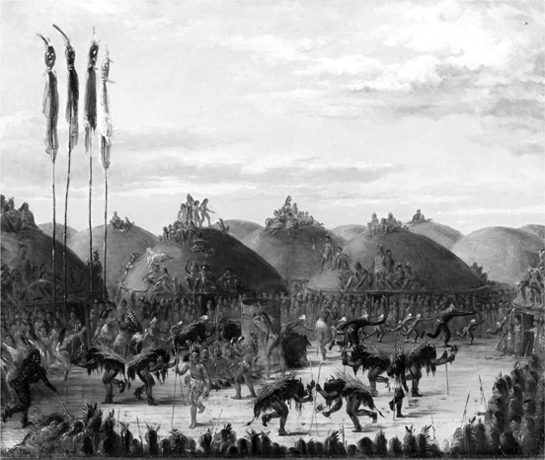
INDIAN FESTIVALS AND ALLIANCES
On Champlain’s first visit to New France (1603), he and Pont-Gravé walked boldly into a camp of a thousand Indians on the Saguenay River, joined a tabagie or tobacco feast, and made an alliance that lasted two centuries. He did it again with Penobscots, Mi’kmaq, Huron, Algonquins, and many other nations. In some ways, these scenes resembled George Catlin’s later painting of this festival among the Mandan nation, who lived near the Great Lakes in Champlain’s era, and later moved west to the Great Plains. (B1)
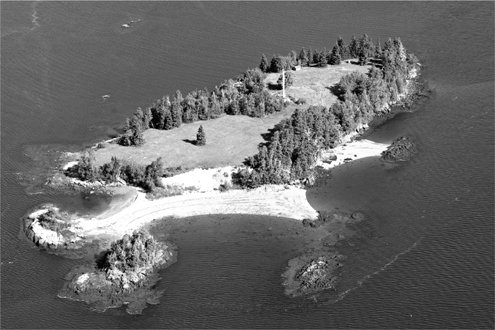
SAINT CROIX
Sainte-Croix Island in this aerial photo of 2004 is remarkably similar to Champlain’s map of 1604. The sieur de Mons and Champlain planted their first colony here, with disastrous results during the terrible winter of 1604–05. It is in the Saint Croix river, part of the present boundary between the United States and Canada. (B2)
PORT-ROYAL
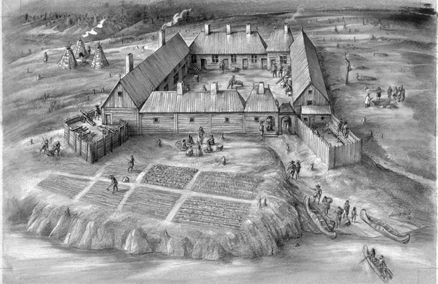
In 1605 the French moved from Sainte-Croix to Port-Royal, now Annapolis Royal in Nova Scotia. It flourished in America with strong support from the Mi’kmaq nation, but it failed in France when the Council ended its monopoly in 1607. Francis Back’s drawing rests on much contemporary evidence and archaeology. (B3)
MI’KMAQ WARRIORS
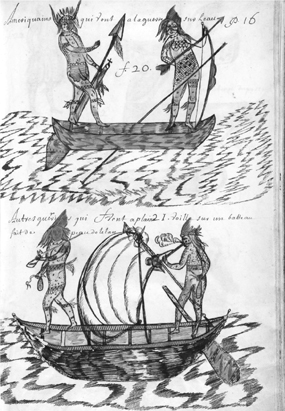
The seventeenth-century Codex Canadiensis of Louis Nicolas shows a seaborne war party of Champlain’s Souriquois or Mi’kmaqs on its way to fight hereditary enemies across the Gulf of Maine. Champlain worked to end incessant violence among the maritime Indian nations. (B4)
INDIAN FISHERMEN AT WORK
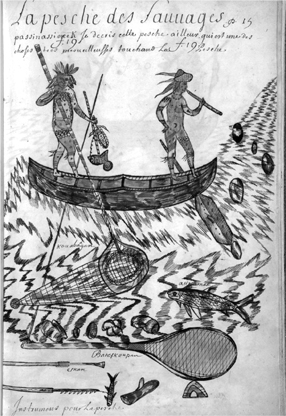
Indians of the St. Lawrence and Acadia were skilled watermen. The Codex Canadiensis of Louis Nicolas shows them at work. The bowman uses a flute to please the Spirit and summon the fish, while the sternman works with a weighted net and spear. Their catch included sturgeon, salmon, carp, flounder, mackerel, bass, and shad. (B5)
FUR-TRADING IN QUEBEC
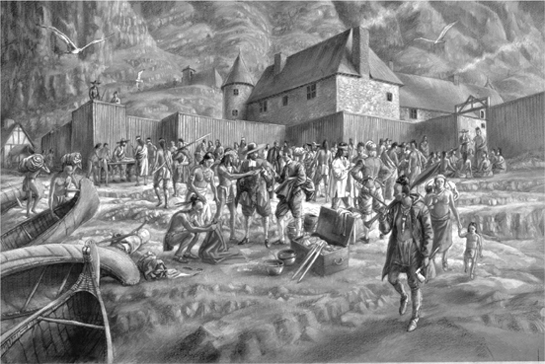
Champlain’s Second Habitation at Québec, 1624–35, stood in today’s Place Royale. This scene by Francis Back, derived from Champlain’s accounts and archaeology, shows a busy trading day. Hurons arrive (left), while Algonquins gather in the background, and a perfectly coiffed Cheveux-Relevé departs (right front). Champlain in his favorite red suit talks with a truchement and Montagnais, while other Indians move freely through his habitation. (B6)
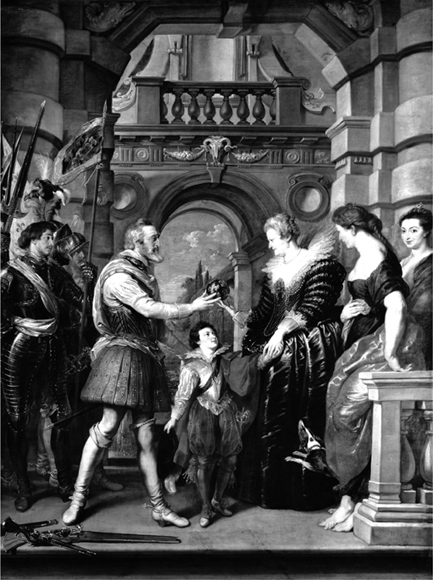
THREE RULERS IN CHAMPLAIN’S FRANCE
Champlain kept his American dream alive under three very different French rulers. He flourished with the support of Henri IV (1589–1610), survived the enmity of Marie de Medici (1610–1617), and won over young Louis XIII (1617–1635). It is a marvel to see how he managed it. Rubens shows the Queen taking the Orb from the King in one hand, while she grasps the Dauphin in the other. Is she helping him up, or holding him down? (B7)
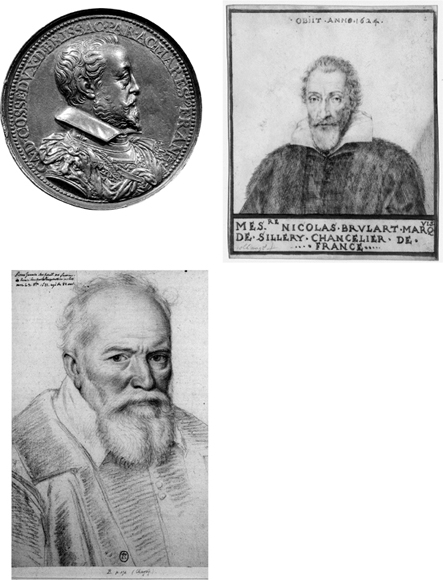
CHAMPLAIN’S AMERICAN CIRCLE AT COURT
At court, three powerful men helped Champlain during the regency of Marie de Medici and youth of Louis XIII. Charles II de Cossé-Brissac (top left) was a Maréchal of France, and Champlain’s former commander. Pierre Jeannin (1540–1622) (left) was president of the Dijon parlement, and royal councillor. Nicolas Brûlart de Sillery (1544–1624) was Lord Chancellor of France. All supported Champlain’s Grand Design. (B8)
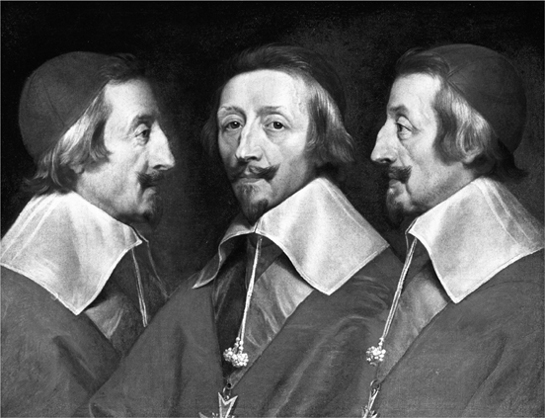
RICHELIEU AND CHAMPLAIN
Cardinal Richelieu (1585–1642) was chief minister under Louis XIII, architect of French absolutism, and ruler of its colonies. His ruthless realpolitik was far removed from the spirit of Champlain’s dream. The two men worked together but never got on. Their troubled history was a conflict of two ethics. This triple portrait by Philippe de Champaigne suggests something of the cardinal’s complexity. (B9)
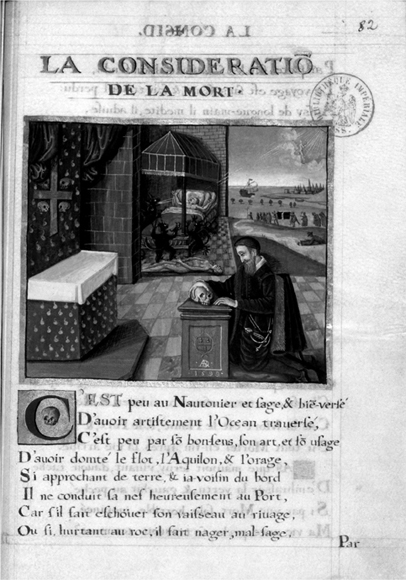
CHAMPLAIN’S LAST LABOR
In 1635, a stroke left Champlain paralyzed but keen of mind. He prepared for death with his accustomed prévoyance, and studied works such as The Pious Learning of the Christian Poet (1600), with its poem about “contemplation of death” by a “wise and well-versed navigator.” In his last months, Champlain dictated a will and testament in which he left much of his estate to support New France, subsidize settler marriages, and help his Indian godson. Even on his deathbed he served his dream of humanity and peace. (B10)