
Champlain and Razilly, 1632–35
The settlers whom Razilly placed here were the ancestors of the Acadian people, to whom this place should be endeared as the cradle of their race in America.
—William Ganong on Acadia1
WHILE QUEBEC began to grow in a new way, something similar happened in another part of New France. After three decades of struggle and frustration, settlements suddenly started to multiply in Acadia. We have followed the troubled history of that region from the moment when the sieur de Mons and Champlain planted the first settlement on Sainte-Croix Island in 1604. It was abandoned in 1605, refounded at Port-Royal, abandoned again in 1607, revived by Poutrincourt in 1610, burned by English raiders in 1613, rebuilt by Poutrincourt in 1614, abandoned for another site in 1618, occupied once more by the French in 1623, and seized by Scottish adventurers in 1629. Through all these events, a few Frenchmen remained in Acadia. Some formed unions with Indian women and made a precarious living from the fur trade, but nobody had been able to found a French settlement that took root and grew of itself.2
The critical moment came in 1632 when, at Champlain’s prompting, Acadia was added to the list of territories that England was obliged to return to France. The Hundred Associates quickly sponsored four subsidiary companies to support trading forts at strategic places along the coast. None were primarily colonizing ventures. That task went to a fifth subsidiary, the largest of them all, called the Compagnie de Razilly.3 Its leader, Isaac de Razilly, was one of the most able yet least remembered leaders in the drama of New France. He was a good friend of Champlain. They shared the same large purposes for North America and adopted similar policies. In difficult times they strongly supported each other, and they achieved similar results.
Isaac de Razilly was forty-five years old in 1632, a battle-scarred naval officer with a patch over one eye and a hard look in the other. His noble family had an ancient seat in Touraine forty miles inland from La Rochelle, and was well connected at court—Cardinal Richelieu was a cousin. Razilly was raised to the profession of arms, and became a captain in the king’s marine. He won fame in five campaigns against the corsairs of Morocco, fighting with such ferocity that he was called the Loup de Mer, the seawolf of France. At the age of eighteen he became a Knight of Malta—a high distinction in that honor-bound world.4
Razilly was also a devout Catholic. In 1625, he commanded a squadron at the siege of Protestant La Rochelle, won a battle against a relieving English force at the Isle of Ré, and lost an eye when a captured Huguenot ship blew up in his face.5 While Razilly was convalescing from his wounds, Richelieu consulted him on maritime affairs. Razilly was a man of many gifts, with a statesman’s vision and a scholar’s way with ideas. His naval service gave him a global perspective and an interest in colonies. As early as 1612, he and his brothers had tried to found a Capuchin mission near the Amazon River. When it failed, they turned to North America and began to work with Champlain.6
In 1626, Cardinal Richelieu asked Razilly to draft an aide-mémoire on colonies. The result was a document of great importance to the history of New France. Razilly made a strong argument for the role of colonies to the destiny of nations. He envisioned a global empire for France, with African fortresses at Guinea and Senegal, trading factories in South Asia and the East Indies, outposts in South America, and a major colony in North America. For New France he urged a new company with a capital of 300,000 livres, new settlements with 4,000 colonists, and military forces strong enough to expel British settlers north of Cape Hatteras in North Carolina.7
Razilly’s document had a major impact. Some of its language appeared in the charters that created the Company of One Hundred Associates. He and Champlain became members within five days of one another in 1628. They invested in its subsidiary ventures and actively supported each other in a common cause, even as they led different parts of it.8 Razilly persuaded Richelieu to send Champlain to Quebec as acting governor. Without his support Champlain would not have had the job at all.9 In turn Champlain supported Razilly’s plans for Acadia and wrote in glowing terms of “Monsieur the Commander de Razilly, who has all the requisite qualities of a good and perfect sea captain being prudent, wise and industrious, and possessed by a holy desire to increase the glory of God and to carry his courage to the country of New France.” Champlain predicted that his friend would “raise the standard of Jesus Christ and make the Lilies flourish there.”10
Champlain also assisted Razilly in another way, as one of the few seamen who had explored virtually every harbor and inlet on Acadia’s long indented coast. He had also studied the natural resources of Acadia, planted test-gardens, and found places of extraordinary fertility that could indeed make the lilies flourish there. To travel in Nova Scotia during the growing season is to be impressed by its pockets of rich farmland and flourishing field crops, which are more abundant than New England’s in the same latitude. Champlain had studied Acadia’s great stands of timber and its unrivaled fisheries. Like Razilly he also had an eye for beauty in the land.11
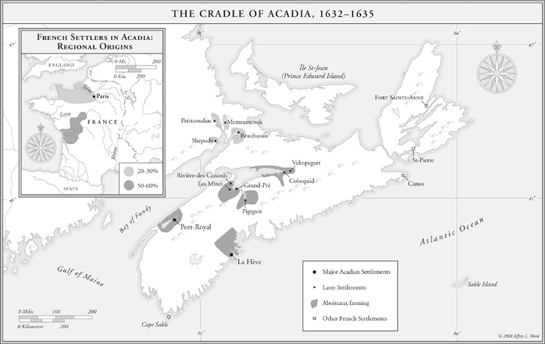
Champlain especially favored two sites for settlement. One was a very handsome and well-protected harbor on the east coast, which he named La Hève, today’s La Have. The other was Port-Royal on the west coast, with its great sheet of sheltered water inside the narrow entrance called Digby Gut today. Both places had protected harbors, defensible ground, sweetwater streams, abundant timber, fertile soil, and natural beauty. Many a good site was to be found along the coast of Acadia, but La Hève and Port-Royal were Champlain’s favorites. They moved to the top of Razilly’s list.
In 1632, while Champlain was planning a return to Quebec, Razilly raised a capital of 150,000 livres for Acadia. It was very much a family venture. Richelieu himself contributed 10,000 livres and a fully equipped French warship called L’Espérance-en-Dieu. Her captain was another Razilly cousin, Charles de Menou, sieur d’Aulnay, who would become a major figure in Acadia. Another large vessel was commanded by Razilly’s brother Claude de Launay-Rasilly [sic].12
Razilly made his plans for Acadia in much the same way that Champlain operated in the St. Lawrence Valley. Their purpose was the same: to plant a population that could sustain itself. Both found capital enough for a fleet of three immigrant ships in the first year. They planned to send other fleets in the next four years. Razilly selected a group of able leaders from his own rank and region. Some were of the nobility, as was d’Aulnay. Others were men of commerce such as Nicolas Denys, a man of modest origins and much ability who came from Razilly’s native province. He would be a major asset.13
Altogether Razilly recruited three hundred settlers. Like Champlain he selected them carefully. A Paris gazette described them as “hommes d’élite.” They were men with many skills that would be useful in the building of a colony. Both leaders were mindful of religion. Where Champlain decided to go with the Jesuits, Razilly recruited three Capuchin fathers of the order that he and Richelieu specially favored.14
Again like Champlain, Razilly made a particular effort to recruit families. For both men, this was the hardest part of their task and the most vital to the peopling of a colony. French families showed great reluctance to emigrate, unlike those from Britain, Germany, and other European countries. The anomaly of French attitudes toward emigration has never been explained. With great effort, Razilly found twelve or fifteen French families for his first voyage in 1632—not many, but enough to start a population growing.15
In one respect Champlain and Razilly did things differently. The settlers of Quebec came from French provinces north of the Loire, especially from Normandy. They sailed in three ships from the Norman port of Dieppe, with others following from Honfleur and Le Havre. Razilly’s colonists for Acadia came from provinces south of the Loire in the west-center of France. They sailed from the ports of Auray and La Rochelle on the Bay of Biscay.
Razilly’s fleet was the first to sail, late in the season of 1632. On September 8, 1632, they reached their destination and his colonists came ashore on the Atlantic coast of what is now Nova Scotia, in the beautiful harbor of La Hève. It was, and is, a very attractive place. At the mouth of the harbor was an island that the colonists called the Isle aux Framboises, “its top being nothing but raspberry bushes.” The island was said to be “completely covered with pigeons.” Thousands of them fattened on the raspberries, and the settlers fed on the pigeons.16
On one side of the harbor was a spectacular headland of yellow clay a hundred feet high. At first light of day it gleamed like gold, and they called it Cap Doré. Inside the entrance was a beautiful basin, big enough to hold many ships. A handsome river flowed into it through large groves of oaks and elms. There were open meadows, marshes, and “fine and good lands” with soil of deep fertility.17
To the settlers, Acadia seemed a place of unimaginable abundance. On both banks of the river they found “an infinity of scallops like those of Mont St. Michel and Saint Jacques.” In the waters off the coast they discovered “lobsters as big as little children,” with fore-claws that could hold a pint of good French wine. Salmon and shad swarmed in the river. There were large numbers of deer and moose, birds beyond imagining, wild blueberries and strawberries.18
Even in this earthly paradise, Razilly’s first concern (like that of Champlain for Quebec) was military security against European rivals. At La Hève he built a strong battery on what is still called Fort Point. At the same time he constructed a chapel for the Capuchin fathers and encouraged them to open the first boarding school in New France. Children of both French colonists and Mi’kmaq families were invited to study together. Again like Champlain, Razilly made a sustained effort to establish good relations with the Indians, encouraged them to settle close by, opened the colony to them, and treated them with humanity.19
The French had been slow getting started and arrived very late in the season. They suffered through a hard winter, but Razilly took precautions against scurvy that he may have learned from Champlain’s experience of Indian remedies. All the colonists survived. Some returned to France, but it was a healthy settlement. Its population began to grow by natural increase, slowly at first, but with gathering momentum.
Once begun, the flow of colonists continued the next year, mostly in ships sailing from La Rochelle and other ports in west-central France. On January 24, 1633, d’Aulnay returned to France, recruited more colonists, and sailed back again on March 12 in “a vessel filled with men, provisions, munitions, and other supplies that the company sent to Commander de Razilly.”20 In 1634, Isaac de Razilly’s brother Claude de Launay-Razilly combined with Jean Ordonnier, a bourgeois of Paris, to found another group sponsored by the Hundred Associates, which they called a “Society for the Peopling of Acadia.” Through their cousin Cardinal Richelieu they petitioned the king for five of His Majesty’s ships to be used for trade and fishing. On their outward-bound voyage from France, they carried supplies and settlers to Acadia. Richelieu himself took an active role in recruiting investors for the society of Razilly and Cordonnier, “to support the enterprise that they have made to populate the settlements of Port-Royal and La Hève on the coast of Acadia.”21
After the French colony at La Hève was well on its way, Razilly turned to another task. A few Scottish Freebooters were still living at Port-Royal on the other side of Acadia, and some of them were acting as if they meant to stay. Their leader, Andrew Forrester, was a violent, cruel, and angry man who had defied orders from his king to abandon the colony. He led a party of Scots in a surprise attack on the French trading post at Fort Sainte-Marie, across the Bay of Fundy on the Saint John River. Forrester entered the French fort with professions of peace, made prisoners of the habitants, clapped them in irons, tortured one of them to find things of value, stole their furs, food, and trade goods, pulled down a Catholic cross, removed the royal arms of Louis XIII, and returned to Port-Royal. He put his French captives aboard a passing New England pinnace and ordered the captain to maroon them on a barren island in Penobscot Bay—a sentence to death by starvation. The New England captain released them instead near the Saint John River, and they found their way back to Cape Sable on the southeast coast with a report of their cruel treatment.22
Forrester had crossed the line between freebooting and piracy, and the French went after him. Razilly mustered his men and led them ashore at Port-Royal. Forrester was overmatched, and asked for terms that he had denied to others. Razilly acted with wisdom and restraint. After a parley, he offered the Scots transportation to Britain and payment for their possessions, if they surrendered the fort intact. They were very quick to agree.23
Razilly occupied Port-Royal, and ordered some of his colonists to take possession of the old French settlement under the command of René Le Coq de la Saussaye, an old hand on the Acadian coast. They restored relations with the Mi’kmaq and a fur trade began to revive in 1633. A few of the Scots chose to remain with the French and were made welcome. They began to mix with French families in Port-Royal to form a hybrid culture that still exists in Nova Scotia, even as its proportions have changed. Here again Razilly was much like Champlain in his tolerance of diversity, as long as he had unity of command.24
In 1634, Razilly sent a long letter to Marc Lescarbot, describing in detail the success of his small colony at Port-Royal. He had spent his own wealth lavishly to supply the settlers with food from France and had brought over “cattle, pigs, goats and poultry,” which were doing well. He planted vegetables and kitchen gardens. Razilly told Lescarbot that the tools and building supplies had cost many thousands of livres, but that “a miserly man could never found a successful settlement.” His hope was to “give his wealth to such a cause if he could establish a place for the poor people of France in the abundance of the new world.25
Razilly also devoted himself to the economic development of his colony, with mixed results. He encouraged Nicolas Denys to organize a timber operation near La Hève, with workers cutting oak, squaring it into timbers and preparing it for export to France when the immigrant ships sailed home. Denys also founded a fishing settlement near La Hève at Port-Rossignol.26
At Canso, in northeastern Acadia, Razilly built another fortified trading post called Fort Saint-Francis. Its purpose was to organize the fur trade. Here he faced a challenge to his leadership. While Razilly’s men were building the fort, they were attacked by a French fishing captain named Jean Thomas, who traded wine for furs from the Mi’kmaq Indians—a lucrative business, but illegal. Thomas had a license from Cardinal Richelieu to operate on the Grand Bank but he was expressly forbidden to trade in furs or to sell wine to the Indians. He led a party of Mi’kmaq warriors in an assault on Fort Saint-Francis. The French commander was wounded and the post was looted. Razilly responded much as Champlain had done when faced with a rebellion in Quebec. He gathered his strength, moved quickly with all the strength at his command, arrested Tomas, and sent him in irons to La Rochelle.27
In three years, Razilly had succeeded in the same way that Champlain had done at Quebec. He had reclaimed the heartland of Acadia for France, removed British freebooters, established settlements at La Hève on the east coast and Port-Royal on the west, with a trading post at Canso, and he started a population growing. More French families arrived each year. The economy was developing, and good relations were established with the Mi’kmaq Indians.
Just as everything was going so well, Razilly died very suddenly in November 1635, at the age of forty-eight and the peak of his powers. It was a heavy loss for New France. He was mourned by those who knew him for his strength, integrity, and humanity. In Acadia his death was an especially heavy blow—heavier than anyone could have known at the time. But Razilly had laid a firm foundation.
Razilly’s cousin d’Aulnay became commander of the colony. He encouraged many settlers to move from La Hève to Port-Royal. That larger site became the center of the colony. By 1644, according to a memorandum from d’Aulnay, the habitants of Port-Royal numbered two hundred men, including soldiers, laborers and other artisans, plus Capuchins, women, and children who were not enumerated. D’Aulnay reported that more than twenty French households had migrated intact and many more begun to form in Acadia. He also noted that his count also did not include “enfants sauvages” who were taken into the French settlement. More than a few Frenchmen in that settlement made unions with Indian women. The Razillys in Acadia, again like Champlain in Quebec, encouraged métissage.28
Nicolas Denys visited Port-Royal in 1653, and reported, “All the inhabitants there are the ones that M. le Commandeur de Razilly had brought from France to La Hève” in 1632. They had continued to move from La Hève to Port-Royal after Razilly’s death in 1635. Denys observed, “Since that time they have multiplied much at Port-Royal, where they have a great number of cattle and swine.”29 In 1671 a census found 227 children in sixty-three households at Port-Royal alone. These families founded many settlements along the coast. A study of Acadian parishes in the early eighteenth century found that migrants to La Hève accounted for two-thirds of the entire Acadian population. The same evidence also showed an astonishing concentration of French family names. In the census of 1671, Acadians had a total of only fifty-three French names. That concentration persisted for many generations. In the mid-twentieth century, yet another census found that 86 percent of 34,000 French Acadians, had only seventy-six family names as late as the year 1938. Scholars have compared those two lists and they have found that fully two-thirds of twentieth-century Acadian names appeared in the census of 1671. Geneviève Massignon observes that “the cradle of the Acadian population was Port-Royal,” which in turn derived from the migration that began at La Hève in 1632.30
Where did Acadia’s founding families come from? Many studies have found a pattern, based on choices that Razilly and Champlain had made about the recruitment of colonists and the charter of their ships from 1632 to 1635. As we have seen, most immigrants to the St. Lawrence Valley came from Normandy, Perche, the Île de France, and other western provinces north of the Loire River. These provinces together supplied more than 51 percent of the colonists in Quebec, and less than 25 percent in Acadia. A different pattern appeared in Acadia. Colonists from Touraine, Poitou, Saintonge, Aunis, and other provinces in the center-west of France accounted for more than 51 percent of the Acadian population, but less than 25 percent in Quebec. Brittany was a small but important element in both populations, about 4 percent each. Very few immigrants came to either place from the north, the east, the southeast, or far southwest of France. English, Scots, Irish, Portuguese, and Basques, all mixed, added at least 7 percent of Acadian population.31
A distinctive French dialect took root in Acadia, and it was a clue to the importance of founding events in the era of Razilly and Champlain. Acadian speech derived in part from the patois of Poitou, Saintonge, Aunis, Anjou, and Touraine. To speakers of metropolitan French today, Acadian dialect sounds quaint and old-fashioned—and so it is in some ways. But it was another instance of that American paradox—stubbornly archaic in some ways, strongly inventive in others. Acadian pronunciation is so distinct that speakers of standard French sometimes have difficulty understanding what is said.
One defining feature is familiar to us all. Acadians were apt to drop an initial vowel, and add a j-sound before a second vowel. Thus Acadien became Cadjin or Cadjen in Canada, and later Cajun or parler le cajun in Louisiana. In the same way, bon dieu(Good God) became bon djeu, and braguette (trousers) is brajette. The letter r has a way of disappearing in the last syllable: libre is libe, and arbre is arbe. In many words an initial c or q or t is sounded like a sneeze: queue becomes tcheue, the imperativetiens! (hold on! or stop!) is tchin!; cuillère is tchuillère and quelque chose becomes tchecu’chouse.32
Some Acadien pronunciations derived directly from regional origins of the founding families in the 1630s. Linguist Yves Cormier estimates that 55 percent of Acadianisms of French origin are regional words, and 45 percent are archaic words peculiar to their period of origin in the seventeenth century. Among Acadian words of regional origin, more than half are from the centerwest of France, about 15 or 20 percent from Normandy and the northwest, fewer than 15 percent from other parts of France.33
The vocabulary of Acadia also had many nautical terms, as in amarrer (to moor) for “tie,” or piquer (to get a fish) for “open.” This was an industrious culture that valued honest toil. The praise word vaillant meant “brave, busy, and industrious.” It was a raw and muscular language. A metropolitan French baby will pleurer (cry); an Acadian baby will horler (howl). To disturb somebody in France is to déranger; in Acadia it is to boloxer. To have a difficulty is not, as in French, avoir de la difficulté but avoir de la misère. Acadian vêtements (clothing) are hardes; aussi is itou; et is pis (from et puis); se dépêcher (to hurry) is se haler, literally to haul oneself.34
Acadian speechways were also very inventive in the creation of new expressions for unfamiliar objects in a new world. The slender bright green glasswort that grows on northern beaches was called tétine-de-souris, literally, a mouse tit. Later, the Académie française did not approve and made it salicorne d’Europe. A cranberry is a canneberge in France; in Acadia it is a pomme de pré (literally a saltmarsh apple); in Quebec it is the Indian atoca. The hearty Acadian diet required new words for its cuisine: fricot for a wonderfully thick stew of meat, potatoes, onions, carrots, and lumps of dough; poutine râpée for a heavy ball of chopped potatoes with a piece of pork at the core. Some words appear in both Quebec and Acadian dialects, but these two distinct speech-ways came from different parts of France in the same period, 1632–35.35
The French-speaking families of Acadia rapidly outstripped the land available at Port-Royal, and began to found other settlements along the coast at Grand-Pré (today an Acadian shrine), at Pigiguit (today’s Windsor), and at Cobeguit (Truro). Other Acadian settlements were planted at Beaubassin, Petitcousdiac, and Memramcook at the head of the Bay of Fundy. Some of the most enduring were to the south at Sainte-Anne’s on St. Mary’s Bay, Pobompoup (Pubnico), and other sites along the south-western coast of Nova Scotia which are still strongly francophone today. On the opposite side of the Bay of Fundy, settlements were planted near the present city of Saint John in New Brunswick. Other Acadian descendants later moved to settlements in Maine at Madawaska, Caribou, Presqu’isle, Saint-Francis, Saint-Luce, and Saint-Joseph.
From an early date, Acadians in many of these places worked their land in a very distinctive way. They created grain fields by building dykes around marshes on tidal rivers and freshwater streams. The dyking of fertile marshlands in Acadia developed in the 1630s and was well advanced by 1650.36 An early reference to this practice was at Port-La-Tour, near Cape Sable. There the Récollet fathers had a mission, and one of them kept a garden of about half an acre, “on excellent fertile land … formerly a marsh or meadow, still called French meadow.” This marsh soil was extraordinarily productive. The younger La Tour did the same thing, and planted a garden where “the land is very flat near the bottom of the bay,” with similar success. The date was approximately 1630.37
The draining of marshlands multiplied along both coasts of Acadia in the mid-1630s. It was so important that Isaac de Razilly’s brother Claude de Launay-Razilly recruited five saulniers, or marshworkers, for service in Acadia. These men signed a contract in March, 1636, at the Three Kings Tavern in La Rochelle.38 In France they had been specialists in ditching and dyking tidal marshes for the salt industry. In 1632 Razilly had already recruited some of these skilled workers to make salt in Acadia for the fishing industry. Once there, they discovered the fertility of deep topsoil in the tidal marshes, and began to make salt marshes into arable fields. He also brought saulniers from Touraine, where they were well practiced in the dyking of freshwater marshes.39
The marshlands of Acadia were used in two ways: sometimes for the evaporation of salt from seawater, as in the area around Brouage in France, but mostly for the draining of cropland. The work of draining the land was heavy, but so also was the labor of clearing the forest for fields. Within a generation of settlement, these dykes had become very extensive. Denis commented on “the great extent of meadows which the sea used to cover and which sieur Aulnay had drained.”40 Visitors remarked on the size of “rich but hard-won grain fields behind the dykes.41 The French families of Acadia won this land from the sea by their unceasing labor, and they became strongly attached to it. They developed a different attitude from other colonists in North America, who favored extensive agriculture, mining the soil, and moving on to new land when it wore out. The Acadians gained a reputation for clinging stubbornly to the land when others tried to remove them.
• • •
Acadians also adopted a distinctive building style for their small settlements. Here again we find evidence that this unique culture began to take form in the time of Razilly and Champlain. As in many colonies, the earliest buildings were rough impermanentpoteaux-en-terre (post-in-ground) structures, with one or two rooms, clay chimneys, and thatched roofs. These houses were adapted in various ways to the cold northern climate. One account describes beds that were boarded all round, for warmth and privacy.
Permanent buildings evolved from these crude structures. In a timber-rich environment, a common design was the maison de charpente, a rectangular, single-pitched, post-and-beam house, with a heavy frame, carefully mortised, pegged, or dove-tailed together. It could have as many as three or four rooms, with a cellar below, and an attic above called a garconnière, where the boys slept. Walls and roofs were made of horizontal boards, insulated with birchbark, and covered with weather-tight wooden shingles.42 Other Acadian house-types varied in the construction of walls. A maison pièce-sur-pièce (piece-on-piece house) was made of large square timbers laid one above another and mortised into vertical posts. The maison de madrier, or plank house, had walls of vertical planks pegged tightly together. The very common maison de torchis was a post-and-beam house with the spaces between walls filled with various mixtures of clay, oat-straw, chopped hay, moss, or hair, stiffened with horizontal wood poles called palots orpalissons. As late as 1687–88, most Port-Royal houses were small maisons de torchis. Even the governor lived in a plank house.43
The Acadians also developed a unique political tradition. Unlike the habitants of Quebec, the people of Acadia adopted a customary practice of local self-government. Historian Peter Moogk writes, “Only in Acadia was there a form of village self-government provided by elders.” He thinks that this exception was “due to the French government’s indifference to what happened in Acadia.”44
That “attitude of indifference” might explain how this practice could persist, but not why it emerged in the first place. Clearly it came from the interplay of a cultural heritage with a new environment. The people of some provinces in southwestern France during the early seventeenth century still maintained parliamentary bodies that preserved traditional legislative powers of self-government, long after the parlements of northern France had become administrative and judicial bodies. The Acadians brought something of that heritage to North America. And in a new environment they found opportunities for economic development that required collective effort in the construction of dykes and aboiteaux. These complex hydraulic systems required constant maintenance and regulation. The people of Acadia responded by developing political systems of self-government and maintaining them for many generations. The land system of Acadia reinforced a heritage of local self-government.45

The buildings in Acadia followed house plans in west-central France, with many major changes in materials that were abundant in the American environment. This drawing by Bernard and Ronnie Gilles LeBlanc analyzes four house types that were expressions of a unique French culture that took root in Acadia ca. 1632–35.
The collective building of dykes to reclaim tidal marshes for cultivation and maintenance of the embankments also encouraged interfamilial cooperation among the Acadians. Spontaneous self-organized economic cooperation with other families was less common in the St. Lawrence Valley. In French-speaking settlements throughout Quebec, “the priest provided social leadership and the parish provided the framework for community life. It was not a framework that people created for themselves, and it was always subject to external authority.”46
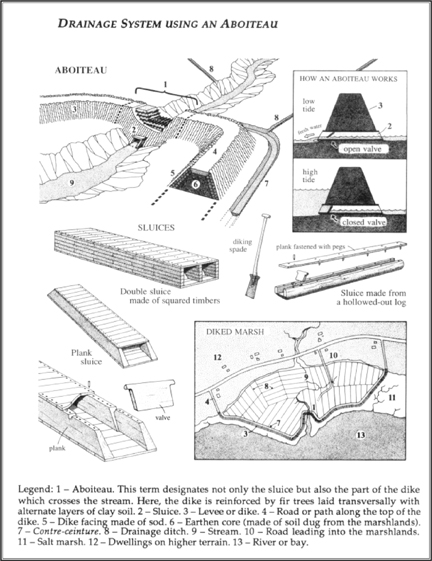
The aboiteaux, or earth and timber dykes of Acadia, were another important adaptation of coastal and river marsh cultures in Saintonge and Touraine to the American environment. They became a major part of the material base of Acadian culture, society, and politics. Their structure and function are analyzed in this excellent drawing by Bernard and Ronnie Gilles LeBlanc.
Acadians rapidly acquired a reputation for self-government and community building. One governor of New France complained that Acadians were “demi-républicains,” and very different from the stereotypical moutons (sheep) of Quebec and the loups(wolves) of Montreal. For their stubborn determination to keep their own ways, the Acadians were called “les entêtés,” hardheads—stubborn, obstinate, difficult, and very strong—a race of survivors. Acadians took that name to themselves as a badge of honor. They also gained a reputation in New France as a distinct people, deeply attached to their land, and strong in their determination to endure.47
The distinct culture that began to develop among the Acadians from a very early date was not a unitary thing. On the coast of Acadia there were a multiplicity of small settlements, which tended to be diverse in ecology, ethnicity, religion, culture, and language. Here again we find variations in speechways. A distinctive dialect is spoken around St. Mary’s Bay, with its flourishing institutions and its own college. In the late twentieth century, a popular song in Canada by the band nostalgically called Grand Dérangement (“Great Displacement”) was titled “L’homme à point d’accent” (“The man with no accent”). It is sung in the dialect of St. Mary’s Bay French. Across the Bay of Fundy in New Brunswick and Maine, there are other speechways.
The later history of these diverse cultures is a complex subject. Control of Acadia changed many times. It was French until 1629, British from 1629 to 1632, French from 1632 to 1654, British from 1654 to 1670, French from 1670 to 1710, British from 1710 to 1740; and in the 1740s and 1750s a battleground where the French and Abenaki were pitted against the British and other Indian nations. In 1755 a British governor in Nova Scotia, Colonel Charles Lawrence, proclaimed that all families who refused to take an oath of allegiance to the British crown would be required to leave Acadia. About 6,000 Acadians were expelled, mostly to colonies in the British empire. Others found their way to France, Louisiana, and other nations. Many lost their lives. But many Acadians did not leave. They disappeared into the woods and remained there. Others later came back in large numbers. Altogether, perhaps as many as one-third to one-half returned to Acadia. Even to this day French continues to be spoken along the southwest coast of Nova Scotia.
After that great dispersion, Acadian families continued to multiply remarkably throughout the world. In the United States alone, the census of 1990 reported that 668,000 people identified themselves as wholly or partly of “Acadian” or “Cajun” origin. Comparable estimates for Canada and other countries would certainly bring the numbers above a million. Most of these self-identified Acadians or Cajuns in the Acadian diaspora are descended from Razilly’s colonists who migrated to La Hève and Port-Royal.48
That process of population growth began in the years 1632–35, when Champlain was acting governor in Quebec and Isaac de Razilly was governor of Acadia, and it was largely due to their leadership. They worked in harmony together, and brought a period of order and stability to these colonies. After their deaths the next generation of leaders were not of the same character, and in Acadia they started another French civil war. But Champlain and Razilly kept the peace in New France during a critical period.
They also got along with the Indians. A leading scholar of Acadia, Andrew Hill Clark, wrote of a “harmonious modus vivendi” between French Acadians and Mi’kmaq that began in the early seventeenth century and continued for many generations. Clark observed that “an almost symbiotic relationship of mutual tolerance and support grew up between the two cultures.” It went back to the founding of Port-Royal in 1605 and was sustained by French humanists who included Champlain, de Mons, Poutrincourt, and Razilly. The French of Acadia differed in many ways from their cousins in Quebec, but they shared a common spirit in the way that they cooperated with the native populations. Here again the visions of Champlain and Razilly became a living reality.49