
New Ways in the West, 1634–35
Our young men will marry your daughters, and henceforth we shall be one people.
—Champlain’s prophecy to the Montagnais, 16331
They cherish freedom as they cherish life.
—an account of the Métis People, 18562
IN THE SUMMER OF 1634 Champlain launched another project in the St. Lawrence Valley. He planned to establish a chain of fortified posts to the west, strong enough to control the flow of traffic on the river. They were also to be trading posts, missionary stations, and permanent homes for adventurous young Frenchmen who would explore the country and live among the Indians.
He began by building a fort seventy-three miles upstream from Quebec at the mouth of the Rivière Saint-Maurice, which flowed into the St. Lawrence through three channels and was called Trois-Rivières. It was a strategic spot. The Saint-Maurice entered the St. Lawrence from the north; twelve miles away the Rivière des Iroquois joined the St. Lawrence from the south. Three major arteries came together in this part of the valley. One purpose of the settlement at Trois-Rivières was to control movement from the Iroquois country. Another was to provide a trading center for Indian nations to the north and west.3
On July 1, Champlain sent a barque under the command of the sieur de La Violette with orders to build a fort and trading post there. Little is known of La Violette, not even his full name. He is thought to have been an employee of the Hundred Associates. From the job that Champlain gave him, one might guess that he had a military background. La Violette brought a detachment of soldiers and a party of artisans and laborers to construct the fort. A fictional statue of La Violette with the face of historian Benjamin Sulte marks the approximate spot.4
Later in the summer of 1634, Champlain himself visited the site and appears to have supervised the building of a log fort with barracks, a magazine, a storehouse, and homes for French habitants. The settlement was protected by a strong palisade. Cannon were emplaced to control the approaches to the fort and movement on the rivers. La Violette remained as commandant from July 4, 1634, to August 15, 1636.5
Trois-Rivières rapidly became an important place for trade with Indians of many nations, who exchanged furs and pelts for European goods. Two interpreters, Jacques Hertel and Jean Godefroy, settled there, and many others soon made it their home. So also did Jesuit father Jacques Buteux, who built a mission and a chapel. Houses multiplied within the palisade and soon spread beyond it. By 1666, almost as many French families would be living at Trois-Rivières as in the town of Quebec.6
This small settlement quickly acquired another importance. A new culture began to form there, on what was then the western frontier of New France. Its creators were young men and women, French and Indian together, who improvised new ways of life from the meeting of their cultures. Once again Champlain played the seminal role. He had already set this cultural process in motion when he sent French youths to live among the Indians and learn their customs. At the same time, he and Indian leaders sent their youths to France on similar errands.
He called these young people “truchements,” or interpreters. It was an exotic word in French, borrowed from the Turkish tergiman and Arabic targuman on another cultural frontier, where Christians, Turks, and Arabs had met during the crusades. Champlain used the word in its literal meaning, but he thought of his truchements as more than merely translators. The interpreters were instructed to explore the country, live among Indian nations, master native languages, promote trade, build alliances, observe carefully, and report on what they saw.7
Champlain was not the first French leader to follow this practice. In 1602, Pont-Gravé recruited two Montagnais “princes,” took them to France, and brought them back to play a central role as interpreters in the great tabagie of 1603. Champlain followed this example, but on a much larger scale and with a broader purpose. He recruited an entire corps of truchements. Dozens of these young people can be identified by name, and many more appear anonymously in the records. They were vitally important to his grand design.8
Each of Champlain’s interpreters had a story to tell. Some lived briefly among the Indians and returned to European ways. Others liked the life of the Indians, took Indian women as consorts, and formed close ties to Indian communities. Most went back and forth. In many different ways they all contributed to the growth of hybrid cultures that were part-European, part-Indian, and entirely American. This was the new world that found its first home at Trois-Rivières.
Even as Champlain set this process in motion, he was not entirely happy with its results. Some of these young people troubled him. In his words, more than a few of them began to “live licentiously and freely, after the English fashion,” in what he called la vie angloise. Others acquired complex loyalties, and Champlain believed that some had no loyalties at all. Indian leaders shared his mixed feelings about several of these young people.9
He was concerned about two men in particular, Étienne Brûlé and Nicolas Marsolet. Their story began in June, 1610, with an understanding between Champlain and a young French lad who has appeared several times in our story. Brûlé (or Bruslé) was born around 1592, perhaps in Champignysur-Marne, southeast of Paris, where his brother was a wine producer. Probably he came to Quebec with Champlain in 1608, at the age of sixteen. He must have been an engaging youth—bright and lively, with extraordinary initiative. He spent some time among the Montagnais and in 1610 asked if he could also “go with the Algonquins and learn their language.” Champlain made the arrangements. He later recalled: “I went to see chief Iroquet, who was very friendly to me, and asked him if he would take this lad home with him to spend the winter in his country, and to bring him back in the spring. He promised to do so, and to treat him like his own son, saying he was much pleased.”10
It was an elaborate three-cornered arrangement between the French and two Indian nations. Iroquet was an Algonquin leader of the Petite nation, who wintered with his people near Huronia. He had close ties to the Huron leader Ochasteguin and his Arendahuronon people. Iroquet and Ochasteguin agreed to take in Brûlé, and made one request in turn. They asked Champlain to take a young Huron to France, teach him the ways of the French, and bring him home again. Champlain wrote that this young Indian, named Savignon, “was of the nation of Ochasteguin and it was done.” Brûlé departed in the care of two Indian leaders, with elaborate instructions from Champlain to learn the Huron language, explore the country, establish good relations with all Indian nations, and report in one year’s time. Amazingly he did it all, and learned Algonquian to boot.11
Exactly one year later, on June 13, 1611, Champlain returned. We might imagine the scene: French leaders with their burnished helmets, gleaming cuirasses, arquebuses, flags, and feathers; the Huron and Algonquin in vivid face paint, buckskins, bows, arrows, beadwork, and more feathers. Champlain was astonished to see his young Parisian lad looking very comfortable in a deerskin shirt, and chatting with the Huron and Algonquin in their own languages. Champlain urged him to continue among the Indians so that he could fully master their “mode of life.”12
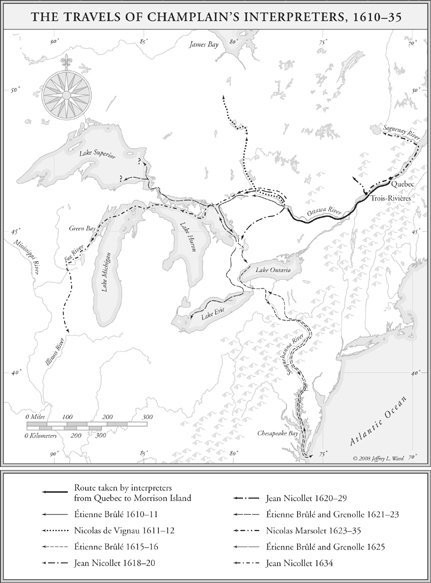
After that meeting, Champlain appears to have lost contact with Brûlé for several years. They met again at Huronia in 1615. Brûlé told Champlain that he had traveled widely through North America. With another French interpreter named Grenolle, he followed the north shore of what they called the “mer douce,” the sweetwater sea—today’s Lake Huron—as far as the great rapids of Sault Ste. Marie, where the waters of another grand lac (Lake Superior) entered Lake Huron. Brûlé saw at least four of the Great Lakes on his travels, possibly all five. In 1615 Brûlé went on yet another long mission with twelve Huron warriors. Their orders were to travel around the western side of the Seneca country and make contact with the Susquehanna Indians. Brûlé set off as Champlain requested, and vanished into the vast American forest. The French thought he had died in the wilderness. Three years later he suddenly reappeared in the St. Lawrence Valley. The year was 1618, and Brûlé seemed in no hurry to meet Champlain. The French leader had to demand a meeting. Brûlé said that he and his Huron companions had covered an immense territory. They probably explored the Ohio Valley, the Potomac River, Chesapeake Bay, and the Susquehanna country. On their way back, they ran into a Seneca war party, and Brûlé was taken prisoner. Some of the Seneca began to torture him but others intervened. He was released with a promise that he would try to establish relations with the French, which some of the Iroquois very much desired.13
Even after the experience of capture and torture, Brûlé wanted to return to Indian country. Champlain wrote: “He took leave of me to go back to the Indians, whose acquaintance and affinity he had acquired in his voyages and discoveries…. I encouraged him to keep to this good intention.”14 Brûlé remained among the Huron for several years and became active in the fur trade. Some time during that period, things started to go wrong for him. In 1621, Champlain heard reports from missionaries about “the bad life that most of the Frenchmen had led in the country of the Hurons.” In particular, he was told that “the interpreter Brûlé” was “very vicious and addicted to women,” and that he took bribes from traders. Champlain’s attitude toward his protégé began to change.15
In 1621 Brûlé appeared in Quebec again with four hundred beaver pelts, which he sold at a profit. He sailed back to France in 1622, returned to Canada in 1623, traded actively between Huronia and Quebec, and in 1626 returned again to Paris, where he married a French woman. His skills as an interpreter and his knowledge of North America were much in demand. The company of the Hundred Associates employed him on generous terms, but on his way back to New France with a Huron companion he was captured by the British and taken to London. There Brûlé agreed to join the Kirkes in 1628 against his own compatriots.16
Champlain was shocked, all the more so because something similar happened with another interpreter, Nicolas Marsolet. As early as 1613, Champlain had recruited Marsolet from a village near Rouen, brought him to New France, set him to work in the Saguenay Valley, and called him the “Montagnais interpreter.” This young man also learned other Indian languages, but mainly he worked as a trader at Tadoussac. Marsolet came to know the Saguenay River as well as any European, and Champlain gave him positions of responsibility there in 1623–24. Like Brûlé, he moved deep into the country of the Indian nations, and also traveled back and forth across the Atlantic. Marsolet was in Paris on March 24, 1627, and back in Canada later that year.17 Then came the Kirke brothers, and the conquest of Quebec in 1629. Marsolet turned his coat, and began to work for British employers.18
Champlain was appalled by the treachery of his interpreters. On August 1, 1629, he met Brûlé and Marsolet at Tadoussac and hard words were exchanged. “I remonstrated on their faithlessness to their King and to their Country,” Champlain wrote. He accused them of abandoning their Catholic faith and said: “You remain without religion, eating meat on Friday and Saturday, and you are living freely in unrestrained debauchery and libertinism…. You are losing your honor; you will be pointed at with scorn on all sides.”19
The two interpreters said that they had been forced to work for the British. Champlain refused to believe a word of it and answered, “You say that they gave each of you a hundred pistoles and a certain amount of trade, and … on these terms [you] promised them complete fidelity.” He warned them: “Remember that God will punish you if you do not mend your ways. You have no relative or friend who will not tell you the same thing; it is they rather who will be most eager to bring you to justice. If you knew that what you are doing is displeasing to God and to mankind, you would detest yourselves.”
The more they talked, the angrier Champlain became. “To think of you,” he said, “brought up from early boyhood in these parts, turning round now and selling those who put bread in your mouths! Do you think you will be es teemed by this nation? Be assured you will not, for they only make use of you from necessity.”20 Brûlé and Marsolet replied: “We know quite well that if they had us in France they would hang us; we are very sorry for that, but the thing is done; we have mixed the cup and we must drink it, and make up our minds never to return to France; we shall manage to live notwithstanding.”
Champlain broke decisively with them. By the time he came back to Quebec in 1632–33, Brûlé had retreated to the Huron country and ran into more trouble there. Social historians think that his relations with Huron women became increasingly disruptive. Economic historians believe that Brûlé trespassed on Huron trading networks. Political historians suspect that he may have betrayed the Huron to the Iroquois, as he had sold out the French to the British. It is possible that all these things happened. Whatever the cause, the Huron turned against Brûlé and ordered him to leave their country. But he had nowhere else to go. The Kirkes were gone, and the French despised him as a traitor. The nearest thing that Brûlé had to a home was Huronia, but now he was unwelcome there as well. Finally, in June, 1633, after much agonized discussion, the Huron were driven to a desperate measure. They killed him and then told Champlain what they had done. He is thought to have been the only Frenchman that the Huron ever killed.21 The French leader said that he understood and that their action would not be held against them. In the end, nobody wanted Étienne Brûlé. This very gifted young man who moved so easily in many cultures was ultimately rejected by all.22
Marsolet had a different fate. For a time he also got on the wrong side of the French. Jesuit father Paul Le Jeune wrote angrily, “In all the years we have been in this country no one has been able to learn anything from the interpreter named Marsolet, who, for excuse, said that he would never teach the Savage tongue to anyone.”23 But Marsolet dealt with his difficulties by continuing to work as an agent among the Montagnais. He acquired his own boat, traded in furs with much success, and his profits brought him wealth and respectability. He came to be called “the little king of Tadoussac.” After Champlain’s death, Marsolet settled down, married a French wife, raised a family of ten children, acquired a seigneury from the Company of the Hundred Associates, and accumulated land and offices. He lived to the ripe age of ninety and died in 1677, a respected citizen of New France.
After his troubles with Brûlé and Marsolet, Champlain gave more attention to qualities of character in his interpreters. The result was a second generation of these young men, and some of them were very different from the first. Two men in particular were outstanding in that regard. Both began their American careers as assistant clerks for commercial companies in Quebec. They lived among the Indians and learned several languages. During the 1620s they began to work with Champlain, shared his large purposes, and had a long reach in the history of New France.
Olivier Le Tardif (or Letardif, as he wrote his name) was born about 1604 in Brittany, where he was baptized in the bishopric of Saint Brieuc, and he moved to Normandy. Champlain called him “Olivier le Tardif de Honfleur,” and may have recruited him in that Norman port. He was in Quebec as early as 1621, perhaps earlier, working as an under-clerk for the Company de Caën. As a young man he traded actively with the Indians of the St. Lawrence Valley, lived among them, and learned their languages with remarkable success. Champlain began to refer to him as “Olivier le truchement” and wrote that he became as “skilled in the languages of the Montagnais and Algonquin as in those of the Huron,” an extraordinary achievement.24
People who worked with Le Tardif spoke highly of his ability and integrity. Pont-Gravé knew him well and wrote that “Olivier traded with the savages and … acquitted himself of his duties like a man of character.” Champlain praised him as a “very fit person” in character and ability. The Jesuit father Le Jeune called him “le sieur Olivier, truchement, honneste homme, and well suited to this country.” Le Tardif was described as “always pious and devout.” He gave strong support to Indian missions, encouraged the baptism of Indians and was godfather to many of them. The Indians held him in high esteem, and he remained very close to them. Like Champlain, he adopted three Indian children, raised them as his own, and helped them marry well.25
After the English conquest, Le Tardif left New France with Champlain and returned with him in 1633. He often appeared at Champlain’s side and worked closely with him as an interpreter in some of the most important meetings with the Indians from 1633 to 1635.26 After Champlain’s death, Le Tardif became a leading figure in New France. He rose steadily in the Company of the Hundred Associates, from sous-commis to premier commis, and then to commis général, and oversaw its affairs in the St. Lawrence Valley. He acquired seigneuries on the St. Lawrence River, became a developer of the Île d’Orléans, and married Louise Couillard, who connected him to the first family in New France. There would be a second wife and five children. Today his descendants include a progeny of Tardifs and Le Tardifs in Canada and the United States.27
A leader in Champlain’s second wave was his greatest interpreter, a man of extraordinary character and achievement. Jean Nicollet de Belleborne was a native of Normandy, born around 1598 in modest circumstances near the port of Cherbourg. His father was a royal courier who carried the mail between Cherbourg and Paris. Young Nicollet came to New France by 1619 as a trader for the old Company of Rouen and Saint-Malo.28 He was sent to winter with the Algonquin Indians on Allumette Island in the Ottawa River, a difficult assignment. Nicollet did well. He stayed two years as “the only Frenchman” in that place, learned the language and customs of the Allumette Algonquin, and explored the country. Unlike Brûlé, he impressed Indians and Europeans alike by his strength of character. The Algonquin accepted him in their lodges, admitted him to their councils, and were said to have made him one of their chiefs.29
After 1620, Nicollet moved to the Nipissing nation, who lived on the lake of the same name. Altogether he was with them for “eight or nine years,” built a trading post, went into business “fishing and trading for himself,” and returned to Quebec each year with his furs. He explored large areas of the western country and visited many Indian nations who lived between Huronia and Hudson Bay.30 While Nicollet was among the Nipissing, he lived with an Indian woman and had at least one child—a daughter named Madeleine-Euphrosine. Later he brought her to Quebec, where she married two Frenchmen in succession and had nine children or more.31
During the British conquest of New France from 1629 to 1632, Nicollet disappeared from Quebec and lived among the Indians on the western frontier. At least part of that time he was with the Huron, and learned their language. When Émery de Caën and a small party of French traders came back to Quebec in 1632, Nicollet returned and offered to help restore trade between the Indians and the French. Then Champlain and his immigrants reached Quebec in the spring of 1633. Soon after he arrived, Champlain heard that a large party of Nipissing in forty canoes had come to Sainte-Croix Island, the island of commerce in the St. Lawrence River upstream from Quebec. They were led by a “French interpreter” who must have been Jean Nicollet.32
Champlain tells us that he “went immediately to Sainte Croix” on June 20, 1633, and met Nicollet that very day. The two men began to talk.33 Together they planned a major expedition beyond the western frontier of New France. A Jesuit father who knew them well, Barthélemy Vimont, wrote that Nicollet was “delegated to a journey to the people called the Gens de Mer,” the People of the Sea who lived beyond the sweetwater sea.34
The mission was conceived in the same spirit as Champlain’s early voyages. One purpose was to explore the country that lay west of New France and to study the quality of its land. Another was to map the rivers and lakes. Water courses were of great interest to Champlain, and the French leaders shared the stubborn dream of Lachine—a route to China through North America. In 1633, the French knew very little about the Great Lakes. Champlain had knowledge of Lake Huron, Lake Ontario, and Lake Erie, but not enough to map them accurately. He knew of another huge lake to the northwest, and was aware that a torrent of water flowed from this grand lac (now Lake Superior) to the mer douce of Lake Huron, through two leagues of falls and rapids. Champlain called them the Sault de Gaston; we know them as the Sault Ste. Marie. The Indians told Champlain that to cross the two great lakes was a journey of thirty days by canoe. He wanted to know more about their size and shape, and what lay beyond.35
The Indians spoke to Champlain of a distant nation called the Puan, who lived beyond the great lakes, and also were reported to have traveled farther west to the coast of a big salt sea. Nicollet was instructed to seek them out and to meet other nations along the way. Champlain was interested in extending alliances and expanding the fur trade. As always, he also wished to encourage peaceful relations between Indian allies and nations to the west.36
In the summer of 1633, Nicollet departed from Quebec for Huronia, where he picked up an escort of seven warriors. It was a very long journey. They followed the north shore of Lake Huron as it curved toward an intersection with Lake Superior and Lake Michigan. After he reached the end of Lake Huron, his route is not clear. He could have gone northwest along the rapids of the Sault Ste. Marie to the north shore of Lake Superior, Champlain’s “grand lac.”37 It is more than likely (though less than certain) that he went another way. Nicollet probably crossed the narrow northwestern neck of Lake Huron, found a way through the straits of Mackinac, and reached the northern and western coast of Lake Michigan. A short journey along the lakeshore would have brought him to Green Bay and the home of the Winnebago nation, who were probably the Jesuits’ Ouinipigous. Nicollet wrote that “the Ouinipigous had an unknown language, neither Algonquin nor Huron.” The Winnebago spoke a Siouian tongue—a family of Indian languages different from those to the east. All of these linguistic clues reveal that Nicollet and his Huron guides reached what is now Green Bay, Wisconsin.38
Nicollet and his companions came ashore at Green Bay, placed two poles in the ground, and put gifts on them to indicate they had come in peace. Two Hurons were sent ahead to announce that a Frenchman was coming in a spirit of amity, and a huge crowd gathered. Nicollet had Champlain’s sense of an occasion. According to a Jesuit who read the journal that Nicollet wrote about his trip, he put on a “grand robe of China damask, all covered with flowers and birds of many colors.” In each hand he carried a pistol, and fired both of them in the air. We are told that “the women and children fled at the sight of a man who carried thunder in both hands.” A throng of between 4,000 and 5,000 warriors received him, and chiefs invited him to a series of feasts. At one meal alone they served an entrée of “six-score beavers.” With high ceremony, the Huron warriors and their French interpreter made peace with these nations.39
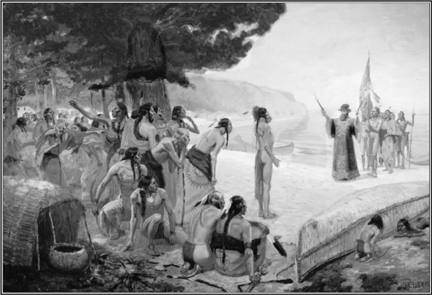
Jean Nicollet, greatest of Champlain’s interpreters, lived among the Algonquin and Huron, was sent by Champlain beyond the Great Lakes, and reached the Fox and Illinois Rivers in the Mississippi Valley. This image shows his visit to the Winnebago nation. He is remembered through much of the American middle west.
After that meeting, Nicollet is said to have explored the country to the west. Perhaps the Indians told him of rivers that flowed to the west, and he may have gone in search of them. The Fox and Illinois Rivers are not far from Green Bay. He was very close to the tributaries of the Mississippi, but never found that great waterway. Even so, he had explored a large part of North America, and was the first European to see much of it. Each of these epic journeys inspired others on the frontier of New France, and more interpreters followed in his tracks.
Nicollet and his Huron guides started the long journey home, and reached Quebec in 1634. He probably reported to Champlain, but no record of that meeting exists. The original of Nicollet’s journal has disappeared but it was read by Jesuit fathers Paul Le Jeune and Vimont. Portions of it appear in the Jesuit Relations.
After his return in 1634, Nicollet made several short trips and helped Jesuit missionaries to find their way up the Ottawa River. He decided to settle down, sought a position with the Company of the Hundred Associates, and appears to have set himself up as a trader at Trois-Rivières. He married the daughter of Guillemette Hébert and Guillaume Couillard, and had a son and a daughter, in addition to at least one Indian daughter. By his marriage he also became the brother-in-law of Olivier Le Tardif. The two men were close friends and co-owners of a seigneury.
By all accounts Nicollet was a sterling character. A spirit of selfless humanity ran deep in him, and it was the cause of his death. In 1642, while visiting Quebec, Nicollet received a message that a Huron party had taken an Iroquois captive and were preparing to torture him to death at Trois-Rivières. Nicollet rushed to the assistance of an Indian he did not know. He took a shallop and raced up the St. Lawrence River with all sail set. They ran into a sudden gust of wind and Nicollet’s boat capsized. This man who had explored many great lakes and rivers of North America was unable to swim, and he drowned at the age of forty-four. The Jesuits wrote that Jean Nicollet was “equally and singularly loved” by both the French and Indians. He shared Champlain’s dream and enlarged it by his spirit.
Altogether, Champlain sent several dozen French interpreters to live among the Indian nations, and he also worked with many Indian translators. He was always looking for bright young men who could be recruited for these purposes. In the year 1629 alone, eleven interpreters worked for Champlain in Quebec, and fourteen were employed by the Hundred Associates. He met ships from France, and searched for “some of those people from our settlement whom I sent with the natives into the interior.”40
They tended to be restless young men from seaport towns and commercial cities of France. Many appear briefly in Champlain’s writings and the records of the colony. It is interesting to observe their origins and the course of their careers as Champlain sent them to live among the Montagnais, Algonquin, Huron, Nipissing, and many other Indian nations.41
One of them, whom Champlain called “Bouvier’s young lad,” began as an apprentice working for the captain of a patache on the St. Lawrence River. In 1611 he became an interpreter with the Huron, living and trading with them.42 Jacques Hertel de la Fresnière migrated as soldier to Quebec around 1626. He went to live among the Algonquin, became an interpreter for Champlain and the Jesuits, then acquired land and raised a family in Trois-Rivières.43 Jean-Paul Godefroy, who may have been the “Jean Paul” that Champlain mentioned in 1623, was a young man of good family in Paris, where his father held high offices at Court. He worked as an interpreter for the trading companies at Trois-Rivières and later became a ship’s captain, entrepreneur, and in 1648 a member of the Council at Quebec.44
There were many more. Thomas Godefroy was an interpreter to the Algonquin and Huron.45 François Marguerie worked among the western Indians and settled in Trois-Rivières.46 Jean Richer came from Dieppe and went as an interpreter to the Nipissing and Algonquin.47 Jean Manet lived among the Nipissing.48 One of those two men might have been Champlain’s “Gross Jean de Dieppe,” or perhaps he was a third interpreter. Another named Grenolle appeared in New France in 1623 as an “apprentice interpreter” to the Huron and the Pétun. He was a companion of Brûlé on his journey to Sault Ste. Marie and Lake Superior and later visited the Neutral nation and the Pétun. Another interpreter, La Valleé, also went to the Neutral nation and the Pétun people.49Many of these interpreters made their homes in Trois-Rivières.50
Leaders who recruited these autonomous young men also tried to restrain them, but could not control them. Their numbers began to grow. Champlain’s dozens of interpreters and traders were followed by hundreds of free spirits who left the settlements of New France and went to trade among the Indians. They began to be called coureurs de bois, and French officials did not approve of their ways. In 1672, Intendant Talon wrote that they disrupted the agriculture of New France, shattered families, and created disorder. He tried to limit their numbers, with no success. In 1679, Intendant Duchesneau wrote a scathing report, and estimated the number of coureurs de bois at between 500 and 600, not counting others who were leaving “every day” for the woods. A year later he reckoned their numbers had grown to 800, out of a total population of 9,700 in New France. “There is at least one coureur de bois in every family,” he wrote.51
The coureurs de bois differed much from one another, but all were part of a great historical process that had a long reach in time and space. In the seventeenth century they advanced beyond the eastern woodlands to the great plains and the mountains in the middle of the continent. They followed the western rivers into the Mississippi Valley as far south as Louisiana, always in pursuit of furs and skins, which they gained by trading, hunting, and trapping. In the interior parts of North America, their small camps and trading posts grew into towns and later great cities that honor their memory. They became iconic figures in the cultural identity of North America and were living examples of the mixing and merging of people, in the spirit of Champlain’s dream. At the same time they became symbols of other ideas that Champlain did not share—of liberty and freedom on the western frontier.
French officials tried to limit the flow of these free spirits by a system of licenses called congés, which literally meant permissions to leave the settlements of New France. But the numbers kept growing. At Montreal and Detroit alone, 2,431 traders were licensed in 1777, according to records. Many more went west without asking anyone’s leave. One estimate reckoned that more than 5,000 coureurs de bois were functioning in North America during the late eighteenth century. French merchants organized this trade. A proprietor who had capital enough to invest in trading goods and supplies was called a bourgeois. He in turn hired workers who were called voyageurs. The voyageurs were divided into several types. Seasonal workers who returned every year to New France were called mangeurs de lard, pork eaters. Others who went farther into the west and stayed for more than a single season were called hivernants, the men who wintered in the wilderness. The culture of the fur trade was dominated by these voyageurs.
One traveler, Alexander Ross, met an old voyageur and recorded his memories. “I have now been forty-two years in this country,” the voyageur recalled. “For twenty-four I was a light canoeman; I required but little sleep, but sometimes got less than I required. No portage was too long for me; all portages were alike. My end of the canoe never touched the ground till I saw the end of it. Fifty songs a day were nothing to me. I could carry, paddle, walk, and sing with any man I ever saw…. over rapids, over cascades, over chutes, all were the same to me. No water, no weather, ever stopped the paddle or the song. I have had twelve wives in the country, and was once possessed of fifty horses and six running dogs trimmed in the first style…. No bourgeois had better dressed wives than I; no Indian chief finer horses; no white man better harnesses or swifter dogs…. There is no life so happy as a voyageur’s life; none so independent; no place where a man enjoys so much variety and freedom as in the Indian country. Huzza, Huzza pour le pays sauvage!”
“After this cri de joie,” Ross added, “he sat down in the boat and we could not help admiring the wild enthusiasm of the old Frenchman. He had boasted and excited himself till he was out of breath and then sighed with regret that he could no longer enjoy the scenes of his past life.”52
These voyageurs drew upon European and Indian ways to create new cultures in America. They invented new vocabularies by a creative process of cultural fusion, and coined new terms to describe the new world, its inhabitants, and its flora and fauna. The expression “Mush!” as a command of dogsled drivers, comes from the French Marche! for “Walk on.”53 The place name “Ozarks” derives from the French Aux Arcs, which was a slang word among voyageurs for the place of the Arkansas Indians, whose name in turn was an Indian slang word for the people who called themselves Quapaw and lived near the Arkansas River.54
This process of linguistic mixing produced not only new words but new languages. French and Indians invented hybrid contact-languages, part European and part Native American. Early hybrids emerged on the fishing coast in the form of pidgin speech, which was nobody’s native tongue. Pidgins are improvised contact languages with simplified grammar and vocabulary.
Other Franco-Indian contact languages developed in a form very different from pidgin speech. An example is Michif, or Métif, a combination of French and Cree, with elements of English, Assiniboine, and Ojibway. It emerged by the early nineteenth century on the western prairies of Canada and the United States. Michif was not a pidgin language, nor was it what linguists call a creole language (a pidgin that becomes a native tongue), which also has simplified rules of grammar and syntax. Informed observers have noted: “The Michif language is unusual among contact languages, in that rather than choosing to simplify its grammar, it chose the most complex and demanding elements of the chief languages that went into it. French noun phrases retain their lexical grammar and adjective agreement; Cree verbs retain their polysynthetic structure.” Linguists conclude from this pattern that “people who devised Michif were fully fluent in both French and Cree,” and they invented a new language by combining some of the most complex elements in several others.55
This mixing of language developed from a mixing of people. Champlain’s interpreters, the coureurs de bois and voyageurs formed families of combined Indian and French ancestry. These unions multiplied rapidly in the early and mid-seventeenth century. Some were made by Frenchmen of high rank. A leading example was the Baron de Saint-Castin, who came to Quebec with the Carignan-Salières regiment in 1665 and married an Indian woman whom he called Marie-Mathilde Madokawando. Her father was an Abenaki sachem, and she was described as “a beautiful and accomplished woman.” The baron made his home close to his Indian relations. Some of his many children and grandchildren married other Indians; others were wed to French nobility. There were many similar stories of mixed unions in the La Tour family of Acadia; the Denys family on the fishing coast; and the Le Tardif, Nicollet, and Prévost families in Quebec, to mention but a few. These mixed marriages were actively encouraged by French leaders and were blessed by the Catholic clergy. French Catholic leaders after Samuel Champlain were more tolerant of marriages with Indians than of unions with Protestants. A Mohawk whom they called the “Flemish bastard” was denounced as “the monstrous offspring of a Dutch heretic father and a Pagan woman.” The “pagan woman” was not a problem for them, but they were incensed by the fact that his father was Calvinist.56
Champlain actively encouraged the intermixing of French and Indians. Within his lifetime, the children of these mixed unions began to be called “Métis,” a term that was recorded as early as 1615. By the late eighteenth century, that word also acquired another meaning. It referred to an entire population of French-Indian descent.57 In the nineteenth century it began to be used in a third way to describe communities and cultures. A scholar who has studied narratives of western travel, reports, “During the 1820s, Englishmen and Americans travelling into the Great Lakes fur-trade universe discovered to their surprise that they had entered a foreign country.”58
In that region “Métis” became a term of pride. Métis writer Duke Redbird observes: “The Métis are the only ethnic group indigenous to the continent. All races, including Indian and Inuit, came from elsewhere.”59 Where Métis formed communities, as they did in both Canada and the United States, they also created societies in new forms, with distinct patterns of stratification, family life, material culture, and architecture. In the nineteenth century some Métis communities were nomadic wagon trains that followed the buffalo and were guided by leaders with flag signals. Others were circles of small cabins built around a large central building for meeting and dancing. Music and dance combined Indian and European forms in creative combinations. Their dress ran to highly patterned and richly decorated buckskin coats and leggings, blanket coats for men; and black dresses with bright shawls and sashes for women.60 Creative political systems were invented, as open and free as those of the Indians, but with a chief called le gouverneur and elected leaders called les soldats. This culture was marked by a very strong sense of liberty and freedom. American Indians sometimes called the Métis people otipemisiwak. Jennifer Brown explains that this complex Indian term “means ‘free people’ or ‘their own boss,’ and is a Cree rendering of gens libres.” It is a word drawn from the old French fur trade for engagés who served their time and went free. This idea of a people living in freedom was applied to entire mixed populations on the frontier of New France.61 Ross wrote on his travels: “While enjoying a sort of licentious freedom they are generous, warm-hearted and brave…. Feeling their own strength, from being constantly armed and free from control, they despise all others; but above all they are marvelously tenacious of their own original habits. They cherish freedom as they cherish life.”62
In the year 2001, the Canadian Census reported that 292,310 people in Canada identified themselves as Métis, and there are many more in the United States. These self-identified Métis have founded associations in every Canadian province and five American states. And yet they are only a fraction of North Americans who have both Indian and European ancestors. Demographers have reckoned that more than 750,000 Canadians are descended from Métis. Even those estimates do not come close to the full extent of intermixing. In 1970, a Canadian biologist reckoned that 40 percent of Canadian families had both Indians and Europeans in their family trees, which would yield eight million people of mixed ancestry in 1970, and twelve million in 2005. DNA analysis might soon be able to test the accuracy of these estimates.63
Other North Americans in even greater number have a cultural identity with Champlain’s interpreters, coureurs de bois, voyageurs, and Métis. A web survey turns up a large number of organizations who claim that heritage in our own time. That tradition is flourishing in the twenty-first century. It rose from Étienne Brûlé, Nicolas Marsolet, Olivier Le Tardif, Jean Nicollet, and behind them all was Samuel Champlain, four centuries ago.
Champlain thus had a pivotal role in founding three different francophone cultures in North America: Quebeçois, Acadian, and Métis. One could also add a fourth culture on the fishing coast, with early settlements at Miscou, the Bay of Chaleur, Cape Breton, and Placentia Bay in Newfoundland.
Each derived from different parts of France, and developed a distinct population, language, and material culture through a complex process of persistence and change. All of them began to crystallize in a pivotal moment of deep change, circa 1632–1635. Champlain played a seminal role in every one of them. In that special sense he can truly be called the father of French Canada.