
CONCLUSION
Would to God that all the French who first came to this country had been like him; we should not so often have to blush for them before our savages.
–A French missionary on Champlain1
IN THE YEAR 1832, an Indian warrior dictated a volume of his memoirs. He was Mà-Ka-Tai-Me-She-Kià-Kiàk, war chief of the Sac and Fox nations. English-speaking people knew him as Black Hawk. They held him in respect, even as they fought him in a struggle called the Black Hawk War, where Abraham Lincoln had his first experience of leadership.2 After the last campaign, Black Hawk asked a Métis interpreter named Antoine LeClaire to have “a history of his life written.” An enterprising Yankee journalist published it as The Autobiography of Black Hawk in 1833. Two centuries later it is still in print.3
The author dedicated his book to the general who had defeated him, in the hope that he “might never experience the humility that the power of the American government has reduced me to.” He explained, “This is the wish of him who in his native forests, was once as proud and bold as yourself.” The book was a warning to leaders of all nations, against the folly of false pride and blind prejudice.4
Black Hawk also wanted to share his memory of leaders who had avoided those errors, and he began the book with a story about two of them. One was his ancestor Na-Nà-Ma-Kee who lived “in the vicinity of Montreal” during the seventeenth century and became a war chief of his people. The other was a Frenchman who appeared in the St. Lawrence Valley at the same time.5
The story began one night when Na-Nà-Ma-Kee had a dream. The Great Spirit appeared to him and said that “at the end of four years,” he would “see a white man.” Na-Nà-Ma-Kee prepared himself for that event. For many months he blackened his face, ate only at sunset, and continued dreaming whenever he slept. Then the Great Spirit came again and told him to make a long journey. Na-Nà-Ma-Kee and his two brothers traveled five days down the St. Lawrence River, “in a direction to the left of the sun rising.”
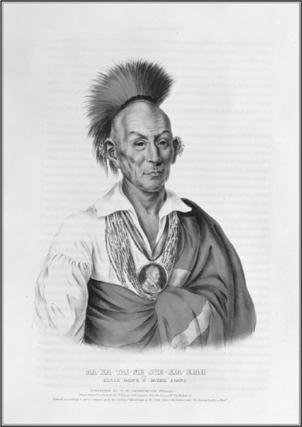
In the nineteenth century, Black Hawk, war chief of the Sac and Fox nations, vividly remembered Champlain through the oral traditions of his people. He began his autobiography with an account of Champlain and his own ancestor Na-Nà-Ma-Kee, as exemplars of wise and humane leadership.
At the end of their journey they met a white man, the first they had seen. He “took Na-Nà-Ma-Kee by the hand and welcomed him into his tent.” He said that he was “the son of the King of France” and that he also had been dreaming for many years. The Great Spirit had directed him to sail across the sea to a new world, where he would meet a nation “who had never seen a white man,” and they would live together as if they were members of one family. The white man said that he had shared this dream with his father, the King of France, who “laughed at him and called him a Ma-she-na,” but he insisted on coming to America, where the Spirit had directed him.
This white man was a “great and brave general,” but he came in peace. He brought trade goods but gave them to Na-Nà-Ma-Kee as gifts. They spoke different languages, but understood each other and made a bond. Then the white man departed, promising to meet again at the same place, “after the twelfth moon.” A year later he returned, just as he had promised. He was a man who kept his word. Na-Nà-Ma-Kee and the white war chief began a regular exchange of goods and purposes. The white man behaved honorably, and they became allies for many years.
After many years the white man stopped coming. The French said he was dead. Na-Nà-Ma-Kee also died, and his people were attacked by other white men. They moved west beyond the Great Lakes to Wisconsin, then south to Iowa, and east again to a village in the Illinois country. Black Hawk said, “At this village I was born, being a regular descendant of the first chief Na-Nà-Ma-Kee.” He also became a war chief, but the more he fought with others, the more he remembered the example of Na-Nà-Ma-Kee and the great white general who regarded other nations as their kin.
Black Hawk did not recall the name of this white man who lived long ago, but he was able to describe him in detail. Only one historical figure matched his description: Samuel Champlain. Black Hawk wanted his readers to remember this leader, who was unlike so many others. The memory had been preserved among the Sac and Fox nation, and carried more than a thousand miles from the St. Lawrence Valley to what is now the United States. In 1832 Black Hawk had it recorded on paper, in the hope that we might remember this story of Indian and European leaders who met in peace, and shared their dreams, and lived together.6
Many stories have been told about first encounters between American Indians and Europeans. Few of them are about harmony and peace. The more one reads of these accounts, the more one learns that something extraordinary happened in New France during the early seventeenth century—something different from what took place in New Spain, New England, and New Netherlands. Scholars of many nations agree that the founders of New France were able to maintain good relations with American Indians more effectively than any other colonizing power.7 This was not a simple contrast between all the French on one hand, and all the Spanish or English or Dutch on the other. Some Spaniards and Englishmen got on well with the Indians. Bartolemé de Las Casas and his Dominicans did so in New Spain, as did John Eliot and Roger Williams in New England.8 And other Frenchmen were very cruel. Jacques Cartier was welcomed by Indians of the St. Lawrence Valley in 1534. He repaid them by seizing their children and carrying them to France against their will. On his second voyage in 1535 Cartier kidnapped five Indians, including a chief, and their families never saw them again.9
But in the next century, something remarkable happened when a small group of French explorers landed among the Montagnais at Tadoussac in 1603. It happened again when they met the Penobscots at Kenduskeag in 1604, and once more when they settled among the Mi’kmaq of Acadia in 1605. The story was the same when these Frenchmen came among the Abenaki of Maine, the Canadien of Gaspésie, the Algonquin in the upper St. Lawrence Valley, the Huron near the Great Lakes, the Susquehannock to the south, the Winnebago in the west, and other nations. The only exceptions were their troubles with some of the Iroquois—some of the time.
These Frenchmen did not try to conquer the Indians and compel them to work, as in New Spain. They did not abuse them as in Virginia, or drive them away as in New England. In the region that they began to call Canada, from 1603 to 1635, small colonies of Frenchmen and large Indian nations lived close to one another in a spirit of amitéandconcorde. They formed a mutual respect for each other’s vital interests, and built a relationship of trust that endured for many years.
How did that happen? The search for an answer leads to small groups of leaders in many nations, and to one French leader in particular—the only man who was at the center of events in New France through the pivotal period from 1603 to 1635. Samuel de Champlain was able to maintain close relations with many Indian nations while he founded permanent European colonies in the new world. He lived among the Indians and spent much of his time with them, while he also helped to establish three francophone populations and cultures—Québécois, Acadien, and Métis. They were very small in Champlain’s lifetime, but by the end of his life all of them had taken root and were growing in a sustained way. From those small beginnings, millions of people in North America trace their descent today, and they still preserve something of their origins in the way that they talk, think, and act. The most important fact about Champlain is not that he did any one of these things, but that he did all of them together. And it was done through the span of three decades, in the face of many failures and defeats.
How did he do it? The first answer is that he did not act alone. Champlain always worked closely with others—Europeans and American Indians alike. He moved in a world of many circles, and worked with people who were unable to work with one another. Champlain could do that because he was genuinely interested in others and comfortable with their diversity. His origins made him so. As a child in Brouage he had lived in the presence of diversity through his early years. As a youth in Saintonge, he had grown up in a borderland between different cultures and regions. The folkways of this province had long been adapted to that environment, and they served him well through his career.
Something else shaped him too. He came to maturity in a time of cruel and bitter conflict: forty years of religious strife, nine civil wars in France, and millions of deaths. As a soldier he had witnessed atrocities beyond description. After that experience, this war-weary soldier dreamed of a new world where people lived at peace with others unlike themselves. After a long and terrible war, he traveled through the Spanish empire on a mission for his king. There he had another shaping experience when he met American Indians and African slaves. Champlain was genuinely shocked by the abuse that had been visited upon them, and he painted images of their suffering for his king.
In a world of cruelty and violence, Champlain was heir to an ethical tradition that had deep roots in the teachings of Christ. As a child he learned the Protestant paradox of God’s omnipotence and human responsibility. In later life, he became a Catholic, and believed deeply in its idea of a universal Church that was open to all humanity. He shared the large spirit of French Christian humanists who took the world for their province and regarded all God’s children as their kin. They were students of the world, with a passion for the pursuit of knowledge, as a way of understanding God’s purposes.
Champlain shared this way of thinking with many others in his time. In France he belonged to several circles of French humanists. They are important and neglected figures in modern history—men who inherited the Renaissance and inspired the Enlightenment. They kept the vital impulse of humanism alive in a dark and difficult time. In that way they were world figures of high importance, and Champlain had an important place among them.
In France from 1585 to 1610 these humanist circles formed around King Henri IV, and were inspired by his large ideas of peace and tolerance. Several circles centered their thoughts on North America. Champlain worked closely with three generations of French humanists who shared that impulse. He sought the advice of an older generation of Aymar De Chaste, Dugua de Mons, Pierre Jeannin, Cossé Brissac, and the elder Brûlart-Sillery. Closer to him in age was a middle generation of Marc Lescarbot. He also worked with a younger generation who included Isaac de Razilly, Charles de La Tour, and others. There were also several circles of Catholic humanists: Jesuits led by Paul Le Jeune and Récollets such as Theodat Sagard.
In America, some of Champlain’s most interesting circles formed among Indian leaders. He worked with Membertou in Acadia, Bessabez in Norumbega, Anadabijou of the Tadoussac Montagnais, Iroquet of the Algonquin Petite nation, Ochasteguin of the Arendarhonon Huron, and many more. Dozens of Indians are mentioned by name in Champlain’s Voyages, and often described at length. He wrote of them as individuals, almost always with respect and affection.
These Indian leaders, like Na-Nà-Ma-Kee’s ancestor, had their own visions and dreams. Their nations had long been at war with one another. That incessant strife had been reinforced by the coming of the Europeans. The result was a surge of violence that compounded on itself. Many Indians told Champlain that they were sick of war and wanted to find a way to end it. They were hard and practical men. But like the French leaders, they were men of vision who dreamed of a better world.
And yet, visions and dreams were not enough. We have seen that the sieur de Mons and Poutrincourt shared Champlain’s ideal of humanity and peace. But when these three men took turns leading expeditions south along the coast of Norembega, only Champlain succeeded in establishing good relations with the Indians. De Mons and Poutrincourt tried and failed. Even as they sought peace, they lost control of events and found themselves caught in an escalating cycle of fear and suspicion that ended in violence.
Champlain added another vital element to the purposes that these men shared. He was able to convert a dream into reality. By trial and error he learned how to lead men in large causes—and to do so in difficult circumstances, sometimes against desperate odds. It was typical of Champlain that he studied the problem of leadership with the same care that he brought to other questions. In 1632 he wrote a little book called Traitté de la marine, et du devoir d’un bon marinier, a Treatise on Marine Affairs, and the Duty of a Good Mariner.”10 It is also a treatise on leadership. Most of it was about mastering skills in a rigorous way and doing small things with great care.11 Much of it was on the qualities that a leader must have if he wishes to succeed, and some of it remains remarkably fresh and urgent after four centuries.
Champlain argued that a leader must be prévoyant, a word that has no exact equivalent in modern English. His idea of prévoyance was different from foresight in its common meaning. It is not a power to foresee the future. To the contrary, prevoyance was the ability to prepare for the unexpected in a world of danger and uncertainty. It was about learning to make sound judgments on the basis of imperfect knowledge. Mainly it is about taking a broad view in projects of large purpose, and about thinking for the long run. All these elements were important parts of Champlain’s leadership—so much so that this idea of prevoyance appeared even in the first sentence of his will and testament.12
Champlain’s idea of leadership was also an ethical idea. “Above all,” he wrote, a good leader “keeps his word in any agreement; for anyone who does not keep his word is looked upon as a coward, and forfeits his honor and reputation, however valiant a fighter he may be, and no confidence is ever placed in him.”13 He believed that leadership was about treating other people with humanity. He wrote that a leader “should be liberal according to his opportunities, and courteous even to his enemies, granting them all the rights to which they are entitled. Moreover, he should not practice cruelty or vengeance, like those who are accustomed to inhumane acts, and show themselves to be barbarians(barbares) rather than Christians, but if on the contrary he makes use of his success with courtesy and moderation, he will be esteemed by all, even by his enemies, who will pay him all honor and respect.”14
Champlain’s greatest achievement was not his career as an explorer, or his success as a founder of colonies. His largest contribution was the success of his principled leadership in the cause of humanity. That is what made him a world figure in modern history. It is his legacy to us all.