
Let the past show us its physiognomies. Yes! It’s time for statues! The books have spoken. Let the chisel do its work!
—Benjamin Sulte, 18841
IN FOUR CENTURIES, many claims have been made on the memory of Samuel de Champlain. To search library catalogues under his name is to find hundreds of books and articles in French and English. To scan the web for “Champlain” is to turn up six million Google pages, mostly on the man himself and things that were named for him. The books include many volumes for young readers (some very charming), a scattering of mystery novels and Harlequin romances (some incredibly bizarre), occasional works of poetry and drama, promotional literature, books of religious devotion, editions of Champlain’s works, monographs in many disciplines, and many major works of historical scholarship. Taken together, sixteen generations of scribbling about Champlain appear at first sight to confirm the old cliché that every generation writes its own history. This endless whirl of interpretation might also seem to support arguments for the relativity of historical knowledge.
But to look again is to find another pattern that is more interesting, and less clearly understood. Scholars do not merely rewrite history. They revise and improve it. They add new discoveries, correct old errors, deepen understanding, and enlarge the spirit of inquiry. Every serious book about Champlain, however flawed, has contributed something to what we know about the man himself, his world, and our own. To study this literature is to find a continuing growth of historical knowledge, through many generations of research.2
Champlain’s French Contemporaries: Lescarbot and Others
The first published historical writings about Champlain were written by men who served with him in New France. The most prolific author was Marc Lescarbot (1560/70?–1641), a gifted writer with a classical education. He was a lawyer in Paris who had trouble in the courts and came to Acadia in 1606 “to flee a corrupt world.” Lescarbot was in New France for only a year, then returned to Paris in 1607 and published an Histoire de la Nouvelle-France in 1609. The book was a success, with an English translation in the same year, another in German, and four French editions by 1618. It was followed by other works, among them La Conversion des sauvages (1610) and Relation dernière de ce qui s’est passé au voyage du sieur de Poutrincourt en la Nouvelle France depuis 20 mois ença (1612).3
Lescarbot’s early writings about Champlain were positive, even adulatory. While they were working together in New France, Lescarbot wrote a sonnet celebrating Champlain’s leadership in his “belle entreprise”:
TO SAMUEL CHAMPLAIN
Sonnet
CHAMPLAIN, I have long seen that your leisure
Is employed persistently and without respite …
And if you accomplish your beautiful enterprise,
One cannot estimate how much glory will one day
Accrue to your name which already everyone prizes.4
But then they had a falling out. In one brief passage of his History of New France, Lescarbot mocked Champlain for “credulity” in writing about the Indian spirit Gougou as the Devil himself. He also plagiarized Champlain’s Des Sauvages and, in the words of one editor, “made a sad hash of it.”5 Champlain in his next book mocked Lescarbot, writing that the farthest his critic had traveled in New France was to cross the Bay of Fundy to Sainte-Croix. This response outraged Lescarbot. In later editions of his work, he removed some favorable references to Champlain and sniped at him in small ways. It was a petty authors’ quarrel, unworthy of these two large-spirited men.6
But even as that feud continued, later editions of Lescarbot’s history drew on new sources. He confirmed the accuracy of Champlain’s accounts of the disaster at Sainte-Croix, the happy story of Port-Royal, the founding of Quebec, and explorations of North America. Lescarbot supported Champlain’s claim to have founded the Ordre de Bon Temps. From his own sources, he corroborated Champlain’s account of Duval’s conspiracy and the battle on Lake Champlain in 1609, even to the incredible first shot.
Lescarbot also substantiated Champlain’s account of events in France, including his relations with Henri IV, the sieur de Mons, President Jeannin and the American circle, the struggles with the trading companies, and politics at court. Even after their quarrel, both men were devoted to the cause of New France. They shared many of the same humanistic values, and wrote of the Indians with deep interest and respect. In all these ways, Lescarbot documented Champlain’s grand design for New France, and confirmed the main lines of its history.7
Other French contemporaries also wrote secular accounts of Champlain’s activities. Some were primary documents such as Charles Daniel’s Voyage à la Nouvelle France (1619). Others were secondary works, including Pierre Victor Palma Cayet’s Chronologie septenaire (1605) and Jacques-Auguste de Thou’s Histoire universelle depuis 1543 jusq’en 1607. De Thou copied freely from Champlain and Lescarbot, and wrote that he much preferred Champlain’s work. The most important journal of the period, Le Mercure François, published pieces on New France, and anonymous works by Champlain himself. All confirmed the main lines of Champlain’s Voyages and enlarged upon them.8
Indian Memories of Champlain
Native Americans also held Champlain in high esteem. In general the Huron cherished the memory of his acts and made a legend of his virtues. In the spring of 1636, they called at Quebec to express their sadness on his death and “made some presents to cause ‘our French’ to dry their tears and more easily swallow the sorrow that they had suffered on the death of Monsieur de Champlain.”9 As we have noted, Champlain also became a legendary figure in Algonquian oral traditions such as Na-Nà-Ma-Kee’s tale, which was preserved among the Fox and Sac nations in the Mississippi Valley. Stories were passed down by the Mi’kmaq in eastern Nova Scotia.10 Montagnais oral traditions preserved the memory of good relations with French settlers and the “chief of the French” in the early years, followed by growing trouble in later generations, such as in the memory of Na-Nà-Ma-Kee.11
An exception to this pattern was noted by Father Paul Le Jeune, who wrote that “a certain Algonquin, a very evil man, reported to [the Huron] last year that the late monsieur de Champlain, of happy memory, had told a captain of the Montagnais, just before giving up his soul, that he would take away with him the whole country of the Huron.” This story blamed Champlain’s spirit for having started the epidemics that ravaged the Indian nations of the St. Lawrence Valley. The account was attributed to Indian sorcerers, and to one man in particular—a Huron of the northern Attignawantan called Captain Aenon, who took the lead in torturing Iroquois captives and was thought “chiefly responsible” for the murder of Étienne Brûlé. But in general, Champlain’s reputation remained high among the Indian nations after his death.12
The Jesuit Relations: “Monsieur de Champlain of happy memory”
Every year the Jesuit fathers in New France were required to make full reports to their superiors. These extraordinary documents were published in Paris and have been reissued in two major scholarly editions. Today they are a treasure for historians. The Jesuits made frequent reference to Champlain during his lifetime and for many years afterward. The fullest accounts were those of Father Paul Le Jeune, head of the Jesuit mission during Champlain’s acting governorship. They could not have been more positive. Le Jeune described Champlain’s breadth of achievement, his success in working with the Indians, his devotion to the welfare of New France, his lack of self-seeking, his selfless support for settler-families, and his high standing among them. Most of all, the Jesuits celebrated Champlain’s faith and piety. They also portrayed a leader of great ability.
When Jesuit missionaries in the Huron country learned of Champlain’s death in 1635, they responded by renewing their vows in thanks to God for the gift of his leadership. Father Le Mercier wrote, “We could not do too much for a person of his merit, who had done and suffered so much for New France, for the welfare of which he seemed to have sacrificed all his means, yea, even his own life…. His memory will be forever honorable.”13
For many years, the Jesuits held up their memory of Champlain as an example for leaders who followed. Their interpretation made a striking contrast to their judgments on other lay leaders in New France. One declared, “Would to God that all the French who first came to this country had been like him; we should not so often have to blush for them before our Indians.”14
The Jesuit Relations started the hagiography of Champlain. Secular historians have mocked this hagiographic tradition, but they are its unwitting heirs. A Benedictine scholar, David Knowles, studied Champlain’s Catholic contemporaries, the Bollandists who compiled the Acta Sanctorum, and the Maurists who gathered the patristic texts. He found that these great hagiographers were pioneers of critical scholarship in their attempts to distinguish true saints from imposters, and genuine miracles from bogus claims. That combination of Christian faith and rigorous scholarship was strong among the Jesuits, who were good scholars and great admirers of Champlain. They constructed an interpretation that would persist through many generations.15
Récollet Historians: Sagard and Le Clercq
The Récollet brothers also wrote histories of New France. The best known was Gabriel Sagard (born circa 1590–95), a lay brother in this Franciscan order who took the name of Théodat (God given). Sagard was a delightful character. He loved all humanity except an Englishman, cherished God’s animal creatures, and made a pet of a baby muskrat that lived in the folds of his Franciscan robe. In the spring of 1623 he came to Canada and lived among the Huron as a missionary. The following year he visited the lower St. Lawrence Valley and got to know the Montagnais and Mi’kmaq. Then he went back to France and published two books. The first was called Le grand voyage du pays des Hurons (1632). The second, an expansion of the first, was his Histoire du Canada (1636).16
Sagard was an excellent naturalist, a gifted linguist, and a very good ethnographer. He studied Indian languages before he came to America, observed the customs of the Huron with keen attention and warm affection, described their culture, and even recorded their music. He did not write in the secular spirit of a modern anthropologist but studied the native people of North America as a way of understanding God’s purposes in the world. Sagard was a man of faith, and his primary purpose was to convert the Hurons to Christianity. He also worked within a strong moral philosophy, and noted the vices of the Huron—sadistic cruelty to enemies, the practice of torture and cannibalism, and incessant gambling, even with their wives as stakes. At the same time he observed their virtues as a people who were “faithful to their oaths” and had “a punctilious sense of justice” within the framework of their own culture.17
Sagard’s most enduring contribution was the extraordinary depth of his descriptions of the Huron people—their country and culture, economy and polity, society and history. He plagiarized freely from Champlain without credit, made a few sparse but very favorable references to him, and contributed bits and pieces of information about him. But in general he amplified Champlain’s account of Huronia and highly praised his character.
Another Récollet historian, two generations after Sagard, was Christian Le Clercq (1641—post-1700), a missionary who worked in Gaspésie and Acadia from 1675 to 1687. He published books on the history of missionary enterprise in New France and on his own work among the Indians of Gaspé.18 Le Clercq talked with many people who knew Champlain. He praised his “untiring” devotion to the founding of New France and the care with which he “forgot nothing to sustain his enterprise, in spite of all obstacles which he met at every step.” Le Clercq also spoke highly of Champlain’s attempts to settle French families in Quebec, his attention to the Indians, and his support of Récollet missions. The villains of Le Clercq’s account were the trading companies. He wrote, “Monsieur de Champlain, who had himself first formed that Company, had tried in vain during his stay in France to open their eyes and to appeal to honor and conscience.”19 Le Clercq made a contribution by his access to the records of the Récollets, and by publishing manuscript material from their archives. He made errors on events before he came to New France, but added useful information from his own experience. On the subject of Champlain the judgments of these Récollet writers were as positive as those of the Jesuits, even though the two orders differed on other subjects.20
Champlain in the Age of Reason: Charlevoix
In the eighteenth century, writers who were part of the Enlightenment brought a new perspective to the study of Champlain. A pivotal figure was Pierre-François-Xavier de Charlevoix (1682–1761), a Jesuit scholar of noble birth who had a broad interest in world history. In 1704, while still a student at the College Louis-le-Grand in Paris, he acted as a dormitory prefect for Voltaire, who remembered him as a great scholar and a good man, though “a bit longwinded.” The next year he taught at the Jesuit College in Quebec, traveled widely through the colony, returned to France and began to write global history, with three volumes on the history of Jesuits in Japan.21
In 1722 Charlevoix was sent back to New France with instructions to explore the continent and find a passage to Asia. The result was one of the epic journeys in American history. With two canoes and eight voyageurs he went up the St. Lawrence Valley to the Great Lakes, then down the Mississippi to Louisiana. He made his way east to Florida, was shipwrecked in the Keys, returned to New Orleans in a row boat, traveled through the Caribbean, and finally sailed home to France. Charlevoix failed to find a way to China, but he wrote a classic travel book, followed by a history of New France, and other studies of Haiti and the Jesuit regime in Paraguay.22
The first chapters of Charlevoix’s Travels were a running commentary on Champlain’s works, with much attention to their accounts of Indian ways, and their descriptions of flora and fauna. Charlevoix praised him as the founder of Quebec, and condemned the weakness and irresolution of his successors. He was very positive about Champlain, writing that “he won the goodwill of all, and spared himself in nothing [and] daily invented something new for the public good.”23
Charlevoix himself had faced many of Champlain’s challenges. Working from his own experience and from historical records, he was the first writer to bring out the full range of Champlain’s activities and the power of his mind: “He had good sense, much penetration, very upright views, and no man was ever more skilled in adopting a course in the most complicated affairs.” Charlevoix wrote: “What all admired most in him was his constancy in following up his enterprises; his firmness in the greatest dangers; a courage proof against the most unforeseen reverses and disappointments; ardent and disinterested patriotism; a heart tender and compassionate for the unhappy, and more attentive to the interests of his friends than his own; a high sense of honor, and great probity…. We find in him a faithful and sincere historian, an attentively observant traveler, a judicious writer, a good mathematician, and an able mariner. But what crowns all these good qualities is the fact that in his life, as well as his writings, he shows himself always a truly Christian man.”24
Charlevoix defended Champlain against Lescarbot, but praised both men for their humanity toward the Indians. He criticized Champlain for his campaigns against the Iroquois, with whom he “unfortunately embroiled himself on behalf of his allies.” But he added, “We must … do Mr. de Champlain the justice to say, that his intention was solely to humble the Iroquois, in order to succeed in uniting all the nations of Canada to our alliance by a solid peace, and that it is not his fault if circumstances which he could not foresee turned events quite differently from what he had believed.” Charlevoix noted that hostilities between the Iroquois and their northern neighbors had been endemic before Champlain arrived, but he observed that Champlain involved himself in this long war in ways “that did not serve our true interests.” He also criticized Champlain for allowing men such as Brûlé to move freely among the Indians.25
On balance he concluded, “We cannot too greatly admire the courage of Mr. de Champlain, who could not take a step without meeting fresh obstacles, who expended his own energies without ever dreaming of seeking any real personal advantage, and who never renounced an enterprise, for which he had constantly to endure the caprices of some, and the opposition of others.” Charlevoix concluded that Champlain was “beyond contradiction, a man of merit, and may well be called THE FATHER OF NEW FRANCE.” This may have been the first use of that phrase.26
The Philosophes on Champlain: Colden, Diderot, and d’Alembert
Charlevoix’s writings had a great impact on men of the Enlightenment throughout the western world. One example was the work of an Anglo-American philosophe in New York, Cadwallader Colden, who wrote about Champlain in exactly the same spirit as Charlevoix. Colden got a few of his facts wrong. He wrote inaccurately of “the French, who settled Canada under Mr. Champlain, their first governor in the year 1603.” He called Champlain’s Indian allies the Adirondacks, and wrote that “Mr. Champlain, desiring to give his Allies proof of his Love and the Valour of the French nation, put himself at the Head of a Body of Adirondacks, and passed with them into Coirlars Lake [sic], which from this time on the French have called by Mr. Champlain’s name.”27 Colden described the battle at the lake in 1609 in great detail from Champlain’s own writings, which he appeared to know well. Like Charlevoix he chastised Champlain for what he had done. “Thus began a War and hatred between the French and the Five Nations, which have cost the French much blood, and more than once had like to have occasioned the entire destruction of the colony.”28
The same memories of Champlain appeared in writings by French leaders of the enlightenment; they celebrated him and established his reputation as the founder of Quebec. In 1751 Denis Diderot and Jean d’Alembert identified him that way in their great Encyclopédie. They wrote, “It is to the Sieur de Champlain, a gentleman of Saintonge, that the French owe the first establishment in Quebec. He founded it in 1608 and died there in 1635, after twenty-seven years of labor.” They also drew on Champlain’s works of travel, botany, natural history, and ethnography. A vital part of the Enlightenment was this expanding interest in cultures and environments throughout the world, which derived in part from Champlain.29
An Image for an Age of Reason: Champlain as a Man of the Enlightenment
In the Archives nationales du Québec, there is an old sketch of Champlain. It is what artists call a sanguine, a drawing made with a crayon of red ocher that was much favored by Watteau, Boucher, and other artists in the eighteenth century. Champlain’s features are very clear and consistent with the small self-portrait in his own works: a high forehead and arched brows, eyes set widely apart, a fine-boned and slightly aquiline nose, pursed lips, a thin mustache, and a close trimmed beard. The hair is neatly back-combed, and the expression on the face is pleasant and engaging, with the hint of a smile. The gaze is open and direct, with a quality of candor in the classical sense. This is the image of a “gentleman of Saintonge,” as Diderot and d’Alembert called him, who is at ease with others and at peace with himself, a man of reason, observation, benevolence, and enlightenment. The drawing gives much attention to Champlain’s costume. He wears a soldier’s half-armor, an officer’s broad sash, and a gentleman’s laced collar. The drawing is of unknown provenance and uncertain date, but whatever its origin, it is true to interpretations of Champlain in the Enlightenment.30
Quebec’s Progressive Whig Historian: Garneau’s Liberal Catholic Champlain
After the second British conquest of New France in 1759–60, the memory of its founders tended to fade for a generation or two. Comparatively few references to Champlain appeared in the period from 1760 to 1815. But in the nineteenth century, interest began to revive. The leader was one of Canada’s greatest historians, François-Xavier Garneau (1800–1866). He came from a family with deep roots in Quebec and briefly attended its schools, but was largely self-taught. As a young man he became bilingual, traveled widely in the United States, England, and France, and moved easily in the cultural milieu of three nations. In his travels he met many young nationalists; a Polish leader in France had a particular impact. He adopted liberal and Catholic views, and returned to Canada with a deep attachment to its history. His goal was to combine the heritage of Quebec with an ideal of a Canadian nationalism that could unite its French and English inhabitants.
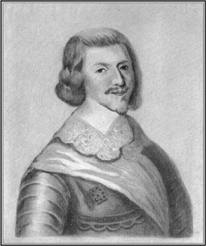
This anonymous sanguine of Samuel Champlain, of uncertain date and origin, matches the interpretations of 18th-century philosophes.
Garneau’s greatest work was his History of Canada, published in four small volumes (1845–52), and reprinted in many editions. It is a major work, remarkable for its command of primary sources, breadth of thought, accuracy of detail, and maturity of judgment. Garneau wrote as a Catholic and a Liberal in the nineteenth-century sense. His works were similar in outlook to the books of George Bancroft in the United States, and Thomas Babington Macaulay in Britain. Like these Whig historians, Garneau thought of history in teleological terms as the progress of liberty, freedom, democracy, and national self-determination. The result was another great work of Whig historiography, and a monument of Canadian literature.31
Garneau took a liking to Champlain and recognized him as the most important figure in the founding of New France. He associated him with Henri IV. “In losing Henry IV two years after the founding of Québec,” Garneau wrote, “he lost a friend and mentor [bon maître] whom he had served faithfully, and who had been of great assistance to him.” Garneau described Champlain’s work in detail, observing that he was important not merely for the things he did but for the way he did them. Garneau’s Champlain was himself a proto-whig, a man of reason, experience, liberality, and large purposes who had been endowed with a “judgment sound and penetrating [jugement droit et pénétrant], and a practical genius [génie pratique)], Champlain was able to conceive and follow without ever swerving an extended and complicated plan for thirty years of effort to found Canada [établir le Canada] which proved his perseverance and his strength of character.” He assured to France the possession of immense countries “without the help of almost any soldiers, by the sole means of missionaries and alliances with the indigenous people.”32
Garneau defended Champlain from Charlevoix’s criticism that he was responsible for hostilities with the Iroquois, and for the destruction of the Huron nation. Not so, Garneau insisted: “He had been blamed for having declared war against the Iroquois, but the war already existed between them and other nations in Canada. He never ceased his efforts to maintain them in peace.”33 Garneau also believed that the destruction of the Huron was the result of changes in French policy after Champlain: “His death was a great loss for the Huron, who had great confidence in him.” Garneau’s Champlain was a man of large spirit: “One finds him a faithful author, a judicious and attentive observer, whose works are filled with detail on the customs of the indigenous people and the geography of the country.” He was also a liberal supporter of toleration and even freedom of conscience, a vision of a union of the Canadas.34 Altogether Garneau’s Champlain was a truly heroic character, and looked the part. From sources that he did not identify Garneau wrote, “Champlain had a handsome appearance, a noble and military bearing, a vigorous constitution which gave him the strength to resist physical stress, and a spirit that he sustained throughout a hard life.35
The Canadian response to Garneau’s great work was mostly very positive. The book went through several French editions, and in 1860 Andrew Bell published it in English, informing his readers that he had tried to do a “moderately free rather than a slavishly literal translation” which was “shaped, to some extent, to meet the reasonable expectations (but not to flatter the prejudices) of Anglo-Canadian readers.” Bell’s translation gave little attention to Champlain’s Catholic faith, which was muted into a vaguely “religious turn of mind.” Bell’s Champlain “effected the exaltation of New France” by “equitable diplomacy and Christianising influences,” more than by a close connection to the Catholic Church.36
In Quebec, other reactions to Garneau’s history went the opposite way. Conservative Catholic clerics in Quebec liked its literary strength, but criticized Garneau’s interpretation of Champlain as a liberal Catholic, and rejected his vision of Canada as a bilingual nation. Garneau himself was called a Liberal (which he was) and a Protestant freethinker (which he was not). After Garneau’s death, Catholic conservatives writers worked with members of Garneau’s family to revise his work. Subsequent editions made the book less liberal, more conservative, and more supportive of the clerical establishment in Quebec. Marcel Trudel remembered: “We were referred to the work of François-Xavier Garneau as to a bible. As late as 1935 you didn’t speak of New France in classical colleges without citing Garneau.” But Trudel also recalled that “this veneration resulted in a falsified edition of Garneau’s work.” In 1913 Garneau’s grandson made many changes and marked them with brackets. Yet another revised edition in 1944 kept the changes but removed the brackets. Through it all, Garneau became a major figure in Canadian culture. Today his home is maintained in Quebec as a living shrine.37
Parkman’s Medieval Champlain
While Garneau’s liberal whig history had a major impact in Canada, a very different book on Champlain was published in the United States by Francis Parkman (1823–1893). He called it Pioneers of France in the New World, the first in a series of nine volumes called “France in America.” Parkman was a gentleman-scholar of independent means, and this great historical project was his life’s work. He prepared himself by traveling widely in his youth through New England, New York, and Canada, visiting the scenes of the history that he meant to write. His youthful rambles in New England and Canada had made him “familiar with most of the localities of the narrative.” He was deeply interested in American Indians, and after going west to study them he wrote a book about his experiences called The Oregon Trail.38
His first volume on New France was written during the American Civil War and dedicated to three kinsmen who had been “slain in battle.” Parkman wrote that the history of New France was about “the attempt of Feudalism, Monarchy and Rome to master a continent where, at this hour, half a million of bayonets are vindicating the ascendancy of a regulated freedom.”39 This Boston-born Anglo-Saxon Protestant was a conservative Whig who believed strongly in ideals of freedom and republicanism, but those large principles were bounded by a narrow arrogance of race, class, gender, nation, religion, and place. He hated slavery but showed no sympathy for the enslaved. He celebrated liberty but opposed the great liberal reforms of his day, and wrote polemics against women’s suffrage. Race was central to his thinking. He observed the American Indians in the years of their decline and despised them as a “fickle and bloodthirsty race.”40
Parkman’s national stereotypes also appeared in his contempt for the institutions of France. But he greatly admired individual Frenchmen, and most of all Champlain. Two-thirds of the first volume in his great work was called “Champlain and His Associates.” Parkman extolled Champlain for his selfless and “untiring” devotion to the cause of New France. “His books mark the man,” Parkman wrote of Champlain, “all for his theme and his purpose, nothing for himself.” He celebrated the character and achievements of Champlain, and wrote that he had been “fittingly called the father of New France. In him were embodied her religious zeal and romantic spirit of adventure.”41
Parkman raised Champlain to the stature of a world figure, but his understanding of the man was fundamentally misconceived. He thought of the French leader as a living anachronism, and wrote that “Champlain belonged rather to the Middle Age than to the seventeenth century … a true hero, after the chivalrous medieval type. His character was dashed largely with the spirit of romance.” From Lescarbot he took the false theme of Champlain’s credulity and reinforced it. “Though earnest, sagacious and penetrating, he leaned to the marvelous,” the historian wrote, and he judged Champlain as “prone to overstep the bounds of reason and invade the domain of fancy. Hence the erratic character of some of his exploits.”42 Parkman interpreted Champlain’s entire career in these terms, celebrated the medieval virtues of a “faithful soldier,” and wrote: “A soldier from his youth, in an age of unbridled license, his life answered to his maxims.” But he also judged Champlain severely for his attacks on the Iroquois, and suggested that he prepared the way for the conquest of a medieval and feudal New France by modern and progressive forces in New England.43
All this was deeply mistaken. Champlain was a man of his own age, not at all medieval. Parkman’s work was marred by major interpretive error, but it was important in another way. He created the most visually striking images of Champlain, ironically so. Parkman himself was nearly blind and said that his physical and mental condition “never permitted reading … continuously for more than five minutes, and often has not permitted it at all.” He could write only a few words a day, with his pen guided by wires across the page. But he saw his subject clearly in the mind’s eye, and this blind bard of Boston wrote some of the most vivid prose that any historian has put on paper.44
Parkman also drew on another strength in his command of sources. He worked carefully from primary materials—the published writings of Champlain in their original editions, the manuscript of the Brief Discours, the works of Lescarbot, LeClercq, Sagard, and the Jesuit Relations. He employed a researcher in French archives, and manuscripts came to him from friends, colleagues, and collectors.45 Large lacunae appeared on many subjects, especially economics, and there were many errors of detail. But he applied to his sources his gift of creative imagination. Ethnohistorians in the late twentieth century noted a surprising strength. Even as his work was marred by strong racist judgments on Indians, ethnographer Bruce Trigger observed that Parkman was the first general historian who understood the differences among Indian nations.
In the United States, anglophone scholars were drawn to the subject of Champlain by Parkman’s prose. In France and Quebec, others responded with deep and justified resentment against Parkman’s contempt for their culture and history. But here again, Parkman’s work inspired both groups to write their own correctives. His great contribution was to dramatize his subject in ways that attracted others to it.
The Abbé Ferland’s Filial Champlain: A Faithful Son of the Church
While Francis Parkman was toiling away in his Boston study, a circle of clerical scholars were writing on Champlain in Quebec. Chief among them was the Abbé J. B. A. Ferland, who published a major two-volume work called a Cours d’histoire du Canada (1861–65). It was a serious and substantive work, informed by a broad reading in the history of the French and British colonies, which he knew well.
Ferland thought of New France as “above all a missionary colony” whose primary purpose was to bring Christianity to the Indians. He believed that it succeeded in this divine mission, which was still ongoing at the time he was writing. He himself promoted a new surge of Catholic missionary activity in the 1860s, from Ontario to the Pacific. Ferland was very sympathetic to the Indians and attentive to the diversity of their cultures. He wrote that they could be “monsters of barbarity,” but he respected their pride, their strength, and their devotion to their own ways. It troubled him not at all that the Indians refused to become French—an attitude similar to Champlain’s. “Well,” Ferland wrote, “although they did not adopt the customs of the French, they became excellent Christians!” He believed that “life in the bush maintains them in their attachment to the Catholic faith and the purity of their morals. The less frequent their contacts with civilization, the more they keep to the dignity of nature and innocence of life which belong to Christ’s true disciplines.”46
This approach gave Champlain a new role. In Ferland’s judgment, his most important contribution was to assist French missionaries in America. Ferland agreed with many others that Champlain’s greatest error was his decision to attack the Iroquois: “The attack of the French against one of the Five Nations was probably the beginning, the cause of hostility which … stopped the progress of the colony and indeed nearly killed it in its infancy.” But in general Ferland celebrated Champlain for “establishing the small colony on the only solid foundations of a state: religion and honor.”47
The Abbé Laverdière’s Great Project of Champlain Scholarship
A landmark in the historiography of Champlain was the first publication of a major modern edition of his works in 1870. The editor was the Abbé Charles-Honoré Laverdière, a professor of history and librarian at the Séminaire de Québec. In the 1850s, Laverdière had begun to gather unpublished materials on the early history of Canada. He also edited an historical journal for young people and called it L’Abeille (The Bee). His office became a hive of historical activity.
In 1859, an English translation of Champlain’s Brief Discours on his voyage to New Spain had been published by the Hakluyt Society, with a brief biography that was judged “by no means remarkable for accuracy.”48 Clerical leaders in Quebec decided that the time had come to publish Champlain’s works in a French edition, with editorial notes that supported their interpretations. In 1864, Laverdière took on the job, with strong support from clerical administrators, who gave him a house, a staff, and the resources of the seminary. Laverdière made rapid progress, and finished his huge task five years later. The manuscript was sent to a printer and set in type.49
Just before the work was to be published, a fire destroyed the printing plant and melted the type, which had all been set—a scholar’s worst mightmare. But the author and his publisher were undeterred. A single set of proofs survived. From it they reset the book and printed it as the “second edition,” though there was no first. The entire set appeared in 1870, under the patronage of Laval University. It is a magnificent specimen of the printer’s art, beautifully set in monotype, and a monument of scholarship.50
Laverdière shared the conservative clerical memory of Champlain, tempered by a strong hostility to the Jesuit order. He was a great historian, devoted to scholarship and to the accuracy of his work. He corrected printers’ errors and garbled passages that abound in Champlain’s books, and subsequent editors have accepted his judgment in many cases. He also added notes and appendices that are still very valuable today. Some francophone historians still prefer Laverdière’s texts, and every serious scholar of Champlain will always consult them.
Laverdière greatly stimulated serious study of Champlain by making his major texts more accessible than ever before. In 1908, as heroic sculptures of Champlain were rising in many cities, the Abbé Gosselin wrote that Laverdière’s volumes were “the real monument in honour of Champlain.”51
Images of Champlain for a Catholic Revival
Clerical interpretations inspired a new image of Champlain. In 1854, a French lithograph was brought to Quebec, and registered as an authentic image of “Samuel de Champlain, governor general of Canada.” It was a formal portrait, attributed to Louis-César-Joseph Ducornet (1806–1856), an artist renowned in France for his physical disability, and for the quality of his work, which triumphed over it. Ducornet had been born without arms. He worked by gripping a brush in his mouth or holding it between his toes. He specialized in devotional images and individual portraits of extraordinary detail.52
This lithograph of Champlain was brought to Quebec by Pierre-Louis Morin, a designer and entrepreneur who claimed that it was the work of Ducornet. It represented Champlain in middle age. He appeared overweight and out of shape, with heavy jowls and a double chin. The features had a tentative expression, an air of passivity, and even a feeling of timidity. The hair and beard were impeccable and the dress was immaculate: a dark doublet cut to the latest fashion, with sleeves slashed to reveal a shirt of lustrous silk that shimmered in the light. In the background was a heavy Renaissance curtain, drawn back to reveal a distant scene of Quebec.53
Altogether this image was very surprising for a man of Champlain’s recorded acts. The face lacked strength, character, and authority. He looked less like a soldier, seaman, or explorer, and more like a man in a sedentary occupation—perhaps a merchant or minor public official. But Morin testified to its authenticity, and the engraving began to be reproduced in Canada, the United States, and France. The image matched the interpretation of the Abbé Ferland, who had represented Champlain as a pious son of the Church whose role had been to support the missionaries whom Catholic historians represented as the true founders of New France. It was also consistent with Laverdière’s idea of Champlain. One version of this engraving appeared as the frontispiece to Laverdière’s great work.54
It also inspired many copies. The painter Théophile Hamel did a handsome oil painting, which was made into a steel-plate engraving by artist J. A. O’Neil. Champlain’s face was much improved. Hamel and O’Neil elongated the head, removed the jowls, erased the double chin, refined the features, and created a more attractive portrait of Champlain that was an image of strength and authority. By the end of the nineteenth century the Ducornet-Morin engraving of Champlain and its variants were widely accepted as authentic, and became the conventional image of Champlain.55
But after 1900, two scholars in Canada and the United States began to study the Ducornet engraving and its provenance. Both came to the same conclusion: this was not an image of Champlain at all. Worse, it was not merely an error but a fraud. This was the finding of Victor-Hugo Paltsits, chief of manuscripts and the American History Division at the New York Public Library. Paltsits discovered evidence that the image was a deliberate counterfeit, concocted by a ring of French artists, bibliophiles, publishers, and literati—among them George-Barthélemi Faribault and publisher Léopold Massard.56
A Canadian scholar, H. P. Biggar, dug deeper and identified the source of the image. It had been copied from a portrait of Michel Particelli, an Italian courtier who became a superintendent of finance in France during the reigns of Louis XIII and Louis XIV. Particelli was reported to be a corrupt and despicable character. One court memoir described him as a “gross and vicious spiritual swine.” The portrait had been painted in 1654 by Balthazar Moncornet of this other man who was very different from Champlain.57
To an historian, the most astonishing part of the story followed after the fraud was discovered. The false portrait continued to be reproduced even more widely than before. Scholars who knew it to be a forgery published it over and over again in their works without any warning to the reader that it was false. Denis Martin writes that “among the most important historians of New France, only Marcel Trudel seems to have avoided the pitfall of the false portrait of Champlain.”58 The indefatigable Champlain Society has published an essay on its website, reproducing the Ducornet engraving and its variants with a stern warning: “These pictures are NOT Champlain.”59 But in vain. As recently as 2007, the false portrait was represented as genuine in publications by major institutions in Canada, Europe, and the United States. In the twenty-first century, the fraudulent Champlain is reproduced on the web more frequently than ever.60
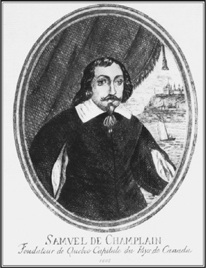
This image of Champlain began as a fraud by French promoters who reproduced a 17th-century painting of a corrupt and hated courtier and sold it in 1854 as a portrait of Champlain. Its tone matched an interpretation of Champlain as a pious son of the Church. This version, one of many, was published in good faith by the Abbé Laverdière as the frontispiece of his great Oeuvres de Champlain (1870).
Dionne’s Paternal Champlain: Founder of Quebec, Father of New France
In 1891, a new biography of Champlain appeared in Quebec. The author was Narcisse-Eutrope Dionne (1848–1917). Trained as a physician, he became a distinguished historian, an eminent scholar, and provincial archivist of Quebec. In the judgment of Marcel Trudel, Dionne became the leader of a generation of Canadian scholars who “advanced historical methodology.” He was careful with his sources and meticulous in his facts. At the same time, Dionne celebrated Champlain as a paragon of Catholic faith and virtue, a man “impossible to overpraise.” The book was revised in 1926, and reissued in 1962 in an abridged English translation.61 Other biographies followed quickly in the same vein. Leading works were by Abbé Henri-Raymond Casgrain in Quebec and Gabriel Gravier, who published in France. Gravier summarized his interpretation in two concluding sentences: “The name of Samuel de Champlain is inscribed in letters of gold on the frontispiece of the history of Canada…. He had been faithful to his God, his country, his work, and fundamentally, it is with good cause that he is called the First of Canadians.”62
Benjamin Sulte’s Plebian Champlain: A Rough-Hewn Man of the People
A new idea of Champlain appeared in the writing of Benjamin Sulte (1841–1923), a self-taught man of modest origins from Trois-Rivières, who fought against the Fenians, became a civil servant in Ottawa, and was a highly productive historian. His Histoire des Canadiens français in eight volumes (1882–84) was an extraordinary achievement by a prolific writer who is said to have published 3,500 articles in his career. History was Sulte’s life work and his great passion. “I wrote for the fun of it,” he said, “and made no money from any of it.”63
Sulte took an important step forward in his writing. He moved beyond an idea of an history of Canada to write a massive history of Canadians. He was part of a world movement in historical writing. A kindred spirit was John Bach McMaster, whose History of the People of the United States began to appear in 1883.64 These scholars were passionate nationalists who thought of the nation not as a territory or a state, but as a people and a popular culture. Sulte celebrated the people of Canada and fiercely attacked historians in France, England, and the United States—especially Francis Parkman, whom he despised. But like Parkman he also thought in racial terms. A student of his career observed that he “uses the terms ‘people’ and ‘race’ interchangeably.” He celebrated the French Canadians as a race, and thought of Indians as racially inferior, and “hardly more civilized than animals.” At the same time he was a liberal anti-clericalist, hostile to the Jesuits and Catholic clergy, who sought power for the Church. Most of all, he was an outspoken agrarian, who thundered against commercial exploitation, and celebrated honest Canadian farmers and tillers of the soil.65
Sulte brought all these passions to bear on the life of Samuel Champlain and created a new idea of him. He made Champlain his hero, and hoped that Canadian poets also would “study this great man’s career and celebrate his work.” Sulte described him as an honest, generous, disinterested man, who “died a victim of the egoism of the merchants and the pettiness of the Court.” In the many pages of Sulte’s work, Champlain was a man who opposed “mercantile interests” and worked to bring farmers to New France and establish an agrarian base for a new and more virtuous society. “Our forefathers were farmers,” Sulte wrote, and he thought of Champlain as their leader and patron.66 Sulte believed that the settlers of Sainte-Croix had failed because “most of them knew only city life; they were unable to fend for themselves; they were totally lacking in the initiative prevalent among rural people. It was a different matter when later Champlain was able to recruit farmers for the soil of Lower Canada! The resources of the country were available to these men of experience and good will; they took advantage of them; the Canadian spirit was in these men.”67 Altogether, Sulte thought of Champlain as a “patriot of the highest rank,” which in his thinking meant a man who served the welfare of ordinary French people in America. Sulte outraged conservatives of many stripes—businessmen, politicians of the right, and especially the clergy of Quebec, who preached and wrote against him. But his thinking was widely shared by others in his generation. His understanding of Champlain caught on, and his vision of a history for the people began to grow. Sulte and MacMaster were mocked by scholars of the old school, but they made a major contribution. Marcel Trudel wrote: “People derided Sulte, but he represents an important stage, because his work marks the advent of ordinary people—le petit peuple—as a subject for historians.”68
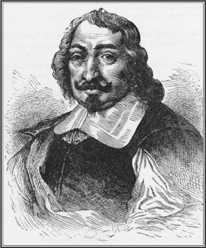
This coarse image of Champlain as a plebian figure was engraved by French artist Eugene Ronjat and was used by Benjamin Sulte in his new interpretation of Champlain as a rough-hewn man of the people, circa 1882–1884.
In 1870 the French artist Eugène Ronjat produced a new image of Champlain that perfectly matched Sulte’s plebian interpretation. The artist began with the fraudulent Ducornet-Morin engraving and rearranged its features. He enlarged the jowls and thickened the double chin. The features became more heavy and fleshy. The face bore marks of hard experience, and a scar ran downward from the mouth across the lower cheek. The bridge of the nose appeared to have be broken and badly healed. The eyes were large, sad, weary, and distant. It was the image of a man who had risen from poverty, identified with the people, experienced their suffering, shared their hopes, and known their sorrows. Ronjat’s engraving was reproduced in Benjamin Sulte’s Histoire des Canadiens français.
Canadian Anglophones: An Imperial Champlain
A very different Champlain emerged in the late nineteenth century, mainly from the work of English-speaking Canadians. A central figure was Sir Edmund Byron Walker (1848–1924), an eminent Victorian with a long white beard. He began as the son of English immigrant-farmers in Ontario. “I was taught,” he wrote, “to appreciate that the truth regarding nature was a divine thing, and that we must learn it so far as was possible.” His schooling ended at the age of twelve and he went to work as a clerk in a Hamilton bank, became its president, accumulated a large fortune, and devoted his wealth to the pursuit of the learning in Canada. A patron of the sciences and arts, Walker studied the Burgess Shale fossils, founded the Toronto Art Gallery, promoted the Canadian Group of Seven, supported classical music in Canada, and helped make the University of Toronto the great university that it is today. In 1905 he founded an organization to gather documents in Canadian history, and called it the Champlain Society.69
The society’s first major publication was an edition of Champlain’s books, maps, engravings, and some of his manuscripts. The editor was Henry Percival Biggar (1872–1938), who was born in Carrying Place, Ontario, studied at the University of Toronto and Oxford, and became chief archivist for Canada in Europe. The object was to create a definitive bilingual edition with accurate texts in old French and modern English.70 In general the editors and translators did a careful job of establishing authentic French texts. With some exceptions they produced accurate translations, but notes and commentaries have been superseded by subsequent research.71 The Champlain Society also published more than ninety volumes of primary material, including bilingual editions of major primary sources for Champlain’s era.72
Another scholar in this circle was William Francis Ganong (1864–1941). His Loyalist forbears had moved from New York to New Brunswick, and he preserved their strong sense of attachment to the British Empire. Ganong was a scientist who trained at the universities of New Brunswick, Harvard, and Munich and went on to become professor of Botany at Smith College in 1894. His hobby was the history of New Brunswick and Nova Scotia, and he applied his scientific discipline to the research, traveling through the region by canoe and on foot, interviewing Mi’kmaq and Maliseet informants, doing archaeological and documentary research in an empirical spirit. The result was a careful history of Champlain and the French settlement on Sainte-Croix, still in print and very useful.73 Ganong celebrated Champlain’s role as the founder of a bicultural New France that became part of Canada within the British Empire. He caught the mood of this interpretation when he wrote that Champlain’s career was part of the “expansion of two of the most virile races of Europe into the wonderful New World.”74
Hero-Images of Champlain: The Monumental Man, 1898–1925
This spirit flourished in Canada during the years from 1898 to 1925. Champlain became an heroic figure with many faces: a cultural hero for people of French identity throughout the world, a national hero for Canada, an imperial hero for the British Empire, and a Pan-American hero for admirers in the United States. A triggering event was the 300th anniversary of the founding of New France, which began to be celebrated as early as 1870 and continued for fifty years into the 1920s.
The most striking expression of these proud attitudes were monuments of Champlain in many cities and towns. They were ornate structures of bronze and stone—large full-length figures, mounted on massive pedestals and set in prominent places—altogether, seven major monuments and many smaller ones.
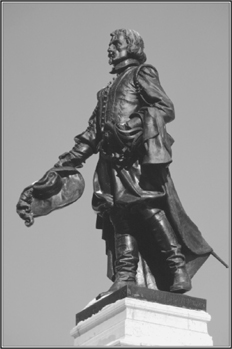
A new interpretation of Champlain as a powerful and energetic colonial leader appeared in this monument by French sculptor Paul Chevré, erected on Quebec’s Duff erin Terrace in 1898.
One of most important was erected at Quebec in 1898: a statue more than four meters high, atop a massive pedestal. It stands in a dramatic spot on the Dufferin Terrace near the Château Frontenac, high above the old town, with a long view down the St. Lawrence River. Champlain appears to be striding forward into a wind that catches the folds of his clothing and blows it back against his muscular frame. French sculptor Paul Chevré invented a very masculine image, far removed from Ducornet’s engraving. Champlain’s body has the strength of youth, and his face has the character of maturity. He wears a handsome doublet, broad breeches, and high-topped seven-league boots. Strapped to his side is his heavy sword, sheathed in its scabbard but ready for use. He has swept off his broad-brimmed hat with its great panache, in what historians have variously interpreted as a salute to the city of Quebec or to the land of Canada. In his other hand he holds a roll of papers, which might be his commission from the old world or his plans for the new. This is a portrait of Champlain as a great founder and a formidable leader.75
Other monuments stressed different aspects of Champlain’s life and work. In the maritime city of Saint John, New Brunswick, sculptor Hamilton MacCarthy created a full-length bronze monument to commemorate Champlain’s first visit on St. John’s Day, June 24, 1605. It is an image of Champlain as an explorer, holding one of his maps. For the tercentenary, a huge celebration was staged on the same day in 1905, with a reenactment, speeches, and parades. The monument itself was finally completed on June 24, 1910. One observer wrote that Champlain “was perched at a less lofty height than in Quebec city, but he appeared more dynamic, pointing toward the horizon, like a guide or a visionary.”76
On July 4, 1907, another monument to Champlain was erected in the United States, in the small town of Champlain, New York, on the border with Canada. This community had been settled by a francophone population from Quebec. Its Catholic priest, Father François-Xavier Chagnon, was the driving spirit. He raised $4,800, mainly from French Canadian immigrants throughout the United States. Patrice Groulx writes that “all of Franco-America was asked to contribute by its clergy and national societies.” The bronze monument was erected between the Catholic and Presbyterian churches within what Groulx calls “the symbolic perimeter of francophone Catholicism.” It still stands as a symbol of national pride in the history of Quebec, the heritage of New France and the values that Champlain personified.
At the same time it was very much a product of the pluralist culture of the United States, where many different ethnic and national groups met. In that setting, many people became even more conscious of their own national origins than they had been in the nations whence they came. And something else happened as well. When one ethnic group celebrated its heritage with pride, Americans of other ethnic groups rallied to their support, and even joined the celebration, as on St. Patrick’s Day when most Americans become a little bit Irish. So it was on July 4, 1907, when the English-speaking citizens of Champlain, New York, turned out and joined their francophone neighbors to honor a French Catholic hero. In that act they became a little bit French themselves in their cultural affiliation—a great unwritten theme in America, where historians and journalists tend to exaggerate the horrors of nativism, and ignore a larger and happier and more important countertheme.77
The largest monument of the tercentenary was erected in another part of the United States at Crown Point, New York. It is a heavy granite structure that still looms high above a steep bank overlooking Lake Champlain. It was built upon an error, and marks the spot where Champlain did not fight his battle against the Mohawk, despite fierce local claims. The monument was sponsored by a New York tercentenary commission. The Canadian government was invited to be a cosponsor but declined. In France another group was formed under the leadership of respected historian Gabriel Honotaux. Its purpose was to celebrate the spirit of France in the United States. A subscription was raised to pay for a bas-relief by the renowned sculptor Auguste Rodin. Titled “La France,” it was mounted at the base of the monument. Above the image of France is a sculpture of Champlain as the heroic discoverer, gazing at the lake that bears his name. New Yorkers added a functional purpose. They designed the monument to double as a lighthouse for the assistance of mariners who ventured down the great lake at night, as Champlain had done.78
Another tercentenary statue of Champlain also went up at Plattsburgh, New York. It is unusual among Champlain monuments. Sculptor Carl Augustus Heber represented Champlain as a soldier wearing a cuirass and carrying an arquebus—one of the few monuments that showed him arrayed for battle. It was dedicated on July 5–6, 1912, with much ceremony, as a symbol of peace and Franco-American unity.
The Canadian capital city of Ottawa erected yet another very large monument to Champlain that still dominates the skyline of the city. It was the work of Hamilton MacCarthy, who had already done the monument at Saint John. For Ottawa he made a change. Champlain is holding an astrolabe at full length above his head. It was meant to be a triumphant celebration of Champlain’s career as a navigator and the astrolabe was held high so that members of the Canadian Parliament could see it from their building as they embarked on projects of political navigation. It is not the most hopeful symbol, as astrolabes were normally suspended from a ring, and Champlain is holding his navigational instrument upside down.
MacCarthy modeled the face of Champlain on the features of the historian Benjamin Sulte. The project was supported by both anglophone and francophone Canadians and was meant to be a symbol of national unity. It was dedicated on May 27, 1915, after the First World War had begun. In Quebec that great struggle was widely regarded as an imperial venture for the greater glory of Britain, and many French Canadians chose not to serve. That attitude infuriated English-speaking Canadians, who believed that France was fighting for her survival. They could not understand why French Canadians would not support their own patrie. The dedication of the Champlain monument in Ottawa was diminished by those tensions. Patrice Groulx writes, “If the Royal Society and political leaders wanted to make Champlain a unifying symbol, they missed their mark.” To broaden the appeal, another figure was added to the base in 1917—an Algonquin guide. Champlain remained the dominant figure, but the addition of an allegorical Indian gave it yet another layer of symbolism.79
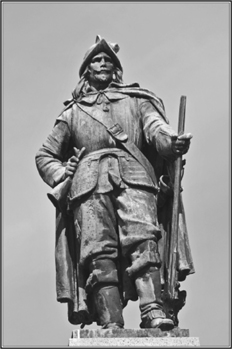
Another monumental theme appeared in Carl Augustus Heber’s sculpture, dedicated at Plattsburgh, New York, in 1912. It is one of the few monuments that shows Champlain as a soldier in armor and helmet, carrying an arquebus and arrayed for battle.
In 1925, one of the most elaborate Champlain monuments was erected in Orillia, a small town in the region he had known as Huronia. It had become a summer community where affluent Canadians built summer cottages. A monument was proposed in 1913, but the war delayed its completion until 1925. The sponsors selected a British sculptor, Vernon March. He created a narrative monument with many figures representing the history of the region: Indians, traders, missionaries, and above all the heroic statue of Champlain. It told the story of New France and Canada as an interplay of many actors.
In this same period from 1890 to 1929, smaller monuments honored Champlain’s friends and companions. The sieur de Mons was given a monument in Annapolis Royal, and La Violette at Trois-Rivières. Nearly nothing was known of La Violette beyond a reference to his name in Champlain’s Voyages. This project was the work of Trois-Riviére’s own historian Benjamin Sulte and his friend, the sculptor Louis Hébert. Sulte wrote: “The face of the person is unknown to us. Here, I will use my imagination. Lively eyes, thin cheeks accentuated aquiline nose, a thin mustache, light imperial beard, and the head set squarely on the shoulders in the attitude of a man on the lookout. A slight air of a musketeer.”80 This became a formula for the founders of Canada, who began to look like fraternal twins. Sulte offered the rationale of a scholar without a source: “When documents are unavailable,” he wrote, “it is customary to rely on things of the time and to convey our thought through forms that do not contradict the facts as a whole.”81
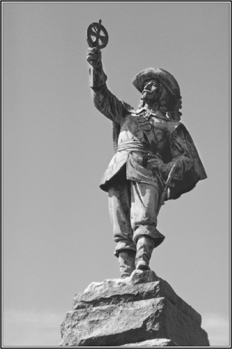
For a monument in Ottawa, Hamilton MacCarthey sculpted Champlain as an explorer and navigator with an astrolabe in hand. Perhaps it was meant to inspire Canadian legislators, who could see it from the Parliament buildings. But Champlain is holding his instrument upside down. One wonders if the artist was making a political statement.
Champlain and the Cataclysms of the Twentieth Century
In the early twentieth century, authors in America and Europe began to give more attention to the inner life of Champlain. This was not easily done. Champlain’s writings centered more on his acts than on his thoughts or feelings, and his biographers rarely wrote of him in an intimate way. Even so, twentieth-century writers became more attentive to his personality and searched Champlain’s writings in a new spirit, looking for clues to the man himself. They did so in conversation with the scholars of the nineteenth century—Garneau, Parkman, Sulte, Dionne, and others.
The new generation of scholars in the twentieth century were equally positive about Champlain, but they wrote about him with a different purpose and in a different historical context. The two leading examples were men who had served in the world wars and saw Champlain as a kindred spirit, who lived in an earlier age of conflict and cruelty comparable to their own time. From their experience they greatly admired his strength of character and the way that he conducted himself in an era of extreme violence and disorder.
Constantin-Weyer’s Champlain: A Portrait in Patience
In France, a leader of this literary generation was Maurice Constantin-Weyer (1881–1964). He was born to a “good family” of Bourbonne-les-Bains, and educated at the Lycée Henri IV. In 1904 he emigrated to Manitoba, where he lived in the French settlement of Saint-Claude, and worked as a rancher, hunter, trapper, horse-dealer, and journalist. He married a Métisse in 1910 and fathered three children. In 1914, he returned to France, fought on the western front and near east, received the Médaille Militaire and Légion d’Honneur, suffered fifty-three wounds, and left the army as an 80 percent invalid. He became a successful writer and won the Prix Goncourt in 1928 for his novel Un homme se penche sur son passé (A Man Considers His Past). Constantin-Weyer published forty-six books, many on Canadian themes. His purpose was to engage the history of Canada in the literature of France.82
In 1931, Constantin-Weyer brought out a short biography of Champlain in a series called “Les grandes figures coloniales.” It was done in a hurry, one of four books he published that year, and it was dedicated to young Canadians, particularly those educated in the universities of Laval and Montréal, as “the heirs of French thought.” Constantin-Weyer opened his book with a preface on Francis Parkman, “le grand historien américain.” He challenged Parkman’s thesis that the conflict between France and England in North America was an epic struggle between “feudalism, monarchy and Rome” on one side, and the cause of liberty and republicanism on the other. In particular, he took issue with Parkman’s claim that the moral advantage lay on the side of English-speaking people. Constantin-Weyer observed that the democracy of the English-speaking people became a tyranny of the majority. He argued that in the United States, a republic that loved liberty had destroyed many indigenous nations of America for its own gain.
His book was an argument that a higher ethic appeared in New France and that Champlain was its personification. Constantin-Weyer wrote that Champlain’s relations with the Indians and “the simple grandeur of that life, entirely consecrated to the King and the Faith (au Roi et à la Foi) [was] a better response than any other argument to the assertions of Francis Parkman.”83 The book was about Champlain’s devotion to his grand dessein, and his perseverance through thirty years of hardship, frustration, suffering, and defeat. It was also about Champlain’s concern for the Indians, his fidelity to French habitants, and his combination of “courage and humanity.” Most of all Constantin-Weyer admired Champlain’s ability to persist in the face of adversity, and wrote that Champlain “suffered fatigue, pain and sickness not only without complaint, but even with a smile!” He painted a word-portrait of Champlain as a saint for a secular age: “A saint, I say to you,” he wrote, “and the proof is that he has the greatest virtue of the saints: patience.”84 Altogether, Constantine-Weyer interpreted the life and work of Champlain as evidence of moral strength in French culture. The author added with pride: “Voilà qui est français! Voilà aussi qui est chrétien! That’s what it means to be French! That’s also what it means to be Christian!” He emphasized that others who are not French or Christian had much to learn from such a model.85
Bishop’s Champlain: The Life of Fortitude
A kindred interpretation appeared in another biography of Champlain by an American, Morris Gilbert Bishop (1893–1973). Bishop was a soldier in three wars. He served with the cavalry on the Mexican Border, the infantry in the First World War, and psychological warfare in the Second World War. He was also a businessman (advertising), a public servant (the American Relief Administration in Finland), a literary figure (frequently writing for the New Yorker), and a professor of Romance Literature at Cornell. Like many of his generation, Bishop was raised to high moral purposes in the reign of Queen Victoria and experienced at first hand the horror of total war in the twentieth century. He was a tough-minded idealist, all the more so because of the realities of his age.
Bishop’s most substantial book was his biography of Samuel de Champlain. Mainly he sought to answer one question: “What manner of man was he?” Bishop answered: “The passion of his mind was exploration, discovery. He was possessed of the old libido sciendi, the lust of knowing. His lust turned to the great unknown of his time, the white void on sailors’ maps.”86 Most of all, Bishop admired Champlain for his moral qualities. “He was a good man,” Bishop wrote. “He had the qualities necessary for the adventurer: toughness, tenacity, foresight, courage. But it was the natural virtue of his spirit that little by little impressed itself on the hard fur-traders and on the perfidious Indians. Not many of the great conquerors of our continent have been eminently good men…. The reader of Champlain’s works, the student of his life, must feel himself constantly in touch with a man to whom good was a reality; one who believed in the goodness of God’s purpose, and who sought to realize it in the welfare of his fellow men.”87
Bishop was quick to note Champlain’s flaws, but saw them as linked to his strengths. “He had the faults of the idealist,” Bishop wrote. “He stood a little apart from men. He was not sly enough to overreach the sly … he dreamed too far ahead. This was his passion. His character was fit for the fulfillment of his passion.” Bishop returned again and again to one great strength: “the mark of his character, as it had been developed through war, adventure, and privation, was fortitude.” Bishop explained: “Fortitude is, I think, the strength to endure for a purpose. Champlain possessed this strength. When others complained, he did his work. When others turned back, he persevered; when others died, he lived. His strength was physical, for only a man of extraordinary toughness could have survived his trials. His strength was also mental, for his whole long life was a battle against faint hearts, the mean-spirited, the avaricious, the sensual.” Altogether Bishop concluded, “the life of fortitude is a noble thing to contemplate.” He thought of Champlain as a model for others who live in troubled times.88
Deschamps’ Champlain: A Humane Imperialist
Another interpretation in the mid-twentieth century came from a French leader and scholar of great distinction. Hubert Deschamps was himself a son of Saintonge, born at Royan in 1900 to a prosperous middle class family. During the First World War he served in the French navy; he then went to the École Coloniale and was sent to Madagascar as a district officer, or in his words roi de la Brousse, a king of the bush.89 A democratic socialist, he joined Léon Blum’s Popular Front in 1936, became an aide to the Premier, and was later appointed governor of three colonies in Djibouti, Côte d’Ivoire, and Senegal. Deschamps continued to hold office under the Vichy government from 1939 to 1943, though he was not of its politics, until the Gaullists removed him from office. He changed careers, and became the first professor of African history at the Sorbonne. A superb French stylist, he published thirty books, mostly on exploration, African politics, and colonial administration.90
Deschamps had a great love for the African people. He favored the intermixing of Africans and Europeans, and practiced what he preached in a complicated personal life with two wives and many mistresses from both cultures. A keen student of history, he discovered a kindred spirit in his fellow son of Saintonge, Samuel de Champlain. In 1951, Deschamps published a one-volume anthology of Champlain’s works with the Presses Universitaires de France.91 A long introduction offered a new interpretation of Champlain by a man who had witnessed the worst of the twentieth century and remained an idealist. In an essay of luminous intelligence, Deschamps analyzed Champlain’s career as one colonial governor on the work of another. He thought of Champlain as “one of the most illustrious sons of Saintonge” and a leading model of “colonisation humaine.“92
The Debunkers’ Champlain: Imposter, Liar, Fraud, Fantasist
After the celebration of Champlain’s personal qualities by so many generations of writers, a reaction inevitably followed. The mid-twentieth century was an age of irreverence, and in 1922 Americans coined a new word for its attitude toward history. They called it “debunking,” after Henry Ford’s half-remembered axiom that “history is bunk.” For debunkers, things were never what they seemed to be. Reality was the underlying fact, and truth was “the lowdown” in more senses than one. Idealists of all varieties were suspect. Debunking was often done in good humor, almost as an intellectual prank, and with a knowing smile. Debunkers delighted in reviling leaders who had been heroes and saints to earlier generations. Champlain made a perfect target.
A leading example was a little book by Florian de la Horbe, L’incroyable secret de Champlain. The author, a French essayist and novelist, took his point of departure from Champlain’s obscure origins. He claimed that Champlain was an imposter. He was really Guy Elder de la Fontenelle, “a renowned ruffian who was sentenced to be broken on the wheel, and who is presumed to have escaped this punishment and turned up again as an honest man, under the name of Champlain.”93
Could it be true? Many things might have happened in the past, but not this hypothesis. Florian de la Horbe’s incroyable secret was unbelievable in more ways than one. Marcel Trudel wrote that it was “nothing more than a very inferior roman policier,” a crime fiction story that began with the mystery of Champlain’s origins and was developed as history “after the manner of Alexandre Dumas.” It was a classic example of the debunking impulse, and it represented a leading genre of debunkery—part fact, all fiction.
Much debunking was done in good humor, but some of it had a hard edge and a nasty bite. In Canada, Jean Bruchési published an essay in 1950 called “Champlain a-t-il menti?” Had he lied? Was he a liar? Bruchési strongly suggested that much of what Champlain wrote was false and even fraudulent—that he lied when he claimed military service in Brittany, lied again about many of his activities, lied once more when he claimed to have been captain of the Saint-Julien, never made a voyage to the West Indies, and used Captain Provençal’s logbooks “to write under his own name, an account of a voyage that he did not make.” All this was offered not as a set of firm conclusions, but a cunning set of strong suggestions. Nearly all of the suggestions were on one side of the question, and very hostile to the document and Champlain.94
Bruchési’s debunking essay was followed by others. Claude de Bonnault, a prominent Canadian archivist, adopted some of Bruchési’s suggestions and added arguments that Champlain was never in Blavet, that he invented the story of Captain Provençal, and that he was not in the West Indies at all. Bonnault topped it off with a conspiracy theory that the Brief Discours was concocted in 1612 to support the comte de Soissons and prince de Condé against the queen’s Spanish party in France, and to support rapprochement with England. Bonnault concluded that the entire Brief Discours was an “histoire fantaisiste,” a mere fantasy. Neither of these essays was supported by evidence, and both would be proven false by the research that they inspired. The debunkers themselves turned out to be the fantasists. It was a strange phenomenon, but in the mid-twentieth century, many people wanted desperately to disbelieve.95
The Growth of Professional Scholarship
Other tendencies were moving in a different direction. Through that troubled era, the study of history developed as a professional discipline in universities and other institutions. That trend began at a surprisingly late date. During the nineteenth century, history had been taught in American colleges mainly as a branch of moral philosophy, often in a single course of that name, taught by the college president to all students in their senior year.96
History as an autonomous academic discipline developed at the same time as did economics, anthropology, biochemistry, and many others. They became academic departments and acquired the full apparatus of a learned discipline during the late nineteenth and early twentieth centuries. Once begun, the profession of history developed rapidly. Today it is one of the largest academic disciplines, and also the most eclectic. It has an active interface with most other disciplines in a university. History is not only a discipline in its own right. It is also a method of inquiry in other disciplines. Today, much academic historical scholarship happens outside history departments. Increasingly it is difficult to tell what academic department a work of history comes from. The expanding eclecticism of history is its saving grace. In the twentieth century this eclectic spirit brought an extraordinary outpouring of historical knowledge, not only in academic history but in archival scholarship, archaeology, and other fields. That pattern clearly appears in scholarship on Champlain.
Professional Archivists and Champlain: Robert Le Blant’s Discoveries
Some of the most important work was done by professional archivists, in finding, preserving, and making primary sources more generally available. A major difficulty for students of Champlain was the loss of manuscripts. Champlain tried to preserve his papers, and Lescarbot used them for his history. On his deathbed, Champlain asked that they be sent to his wife in France, and they disappeared. The records of the Company of New France also vanished. They are believed to have been destroyed by the Communards of 1871 who hauled them out of the Châtelet and made a bonfire in the streets of Paris.97
Other manuscripts survived in the archives of French ministries. Materials relating to North America in the early seventeenth century were copied by the Library of Congress, mostly from the major French ministries: Colonies, Marine, and Foreign Affairs. They were very useful for this inquiry. Canadian archivists have also made a major effort to find manuscripts in public archives, with much success. Early leaders were H. P. Biggar, who worked in British and French archives; Claude de Bonnault, an archivist trained at the French École des Chartes, and more recently Raymonde Litalien, who has played a major role in supporting the history of New France. In many years of labor, Canadian archivists began by compiling inventories, then ordered manual transcriptions in the early twentieth century. After 1945, massive microfilm projects copied more than 2.5 million pages of records on New France. In 1988, the emphasis began to shift toward digital databases and electronic texts. Since 1999 these materials have been coming online in websites sponsored by Library and Archives Canada in Ottawa and its office in Paris.98
An effort of another kind has been made by a very able French archivist who had a particular interest in Champlain. Robert Le Blant was a lawyer, jurist, councillor of the French Court of Appeal at Douai in the north of France, and a highly skilled archivist who knew well the complex ways of French legal and archival institutions. He searched many French provincial and national archives, and found a trove of materials that had eluded earlier students of Champlain. Le Blant published his findings in historical journals, and also in a larger work called Nouveaux documents sur Champlain et son époque, edited with René Baudry. The first volume, covering the period from 1560 to 1622, was printed by the Public Archives of Canada, as it then was, in 1967. A second volume, from 1622 to 1635, was promised but not published. A careful bibliography of Le Blant’s work by M. A. MacDonald surveys a large body of primary scholarship that is indispensable for any serious student of Champlain.99
Documentary Historians and Champlain’s World: Lucien Campeau
Working closely with archivists were other scholars who might be called documentary historians. Many have worked under the auspices of the Champlain Society and have prepared scholarly editions of major texts for the early history of New France. The society’s work continues, and the first volume of a new translation of Champlain’s works is promised for 2008, under an editorial team headed by Conrad Heidenreich.
Another example of documentary history in the late twentieth century is the work of Lucien Campeau (circa 1915–2003), a Jesuit scholar who was trained at the Gregorian University in Rome and taught at the Université de Montréal. Campeau devoted his energy to a great historical project that he called Monumenta Novae Franciae. Conceived as a subseries of the Jesuits’ Monumenta Historica Societatis Jesu, Campeau’s project was to publish all major documents relating to the Jesuits in Canada and Acadia, with another series to follow for the Illinois country and Louisiana. He intended it to supersede a large bilingual collection of the Jesuit Relations edited by the American historian Reuben Gold Thwaites.
Campeau made two organizing decisions that expanded the scope of his project but limited its use. Roughly 80 percent of his documents had never been published before. He decided to publish them only in their original languages. His fourth volume, for example, includes 178 documents, of which more than 100 are in Latin, eight in Italian, and the rest in French. They are sources of importance—and frustration—for modern users who are not trained in Church Latin. Campeau’s volumes reproduce large quantities of material on the history of New France, but they were dated in their historiography and marked by expressions of strong identity to the Jesuits and bitter hostility to their enemies. At the same time, the documents are accompanied by helpful introductions, notes, and “notices biographiques,” which have been separately published as a Biographical Dictionary for the Jesuit Mission. Altogether, for all their flaws, they are a major contribution.100
Archaeology: Material Traces of Champlain’s Life
Historical archaeology, which made great strides in the twentieth century, has contributed in a major way to our knowledge of Champlain and his world. The first amateur archaeology in this field was done as early as 1797 at Sainte-Croix Island.101 Other amateur projects followed in the nineteenth century, and much professional work in the twentieth century. A major center is Quebec, where the Ministry of Cultural Affairs has sponsored archaeological research in the city of Quebec and throughout the province, with results that have been published in more than a hundred volumes of research reports. One of the most useful for students of Champlain is volume 58, L’Habitation de Champlain, by François Niellon and Marcel Mousett (1981). It established the sequence of buildings on that site, uncovered much evidence of their architecture, and found many artifacts, including what may have been Champlain’s writing set, his sword, and much more. This work also confirmed the accuracy of Champlain’s written accounts, and went far beyond them in documenting his material life. Other volumes in the same series have studied the origins of “la vie québécoise” and the material culture of American Indians in the same era. Many artifacts that came out of the ground are on display today in the cultural center at Place Royale in the old town of Québec.102
Several other archaeological projects have had an impact on our knowledge of Champlain’s career. A careful excavation at Cap Tourmente established the history of Champlain’s farm. A project of Indian archaeology in New York state made clear that Champlain’s expedition in 1615 was mounted against the Onondaga nation near Syracuse and not at Oneida sites to the east, as historians had mistakenly believed. Underwater archaeology on the fishing coast found much evidence of that era, including early Basque whaleboats and many material remains. Excavations on Sainte-Croix Island turned up evidence of the ravages of scurvy and the remains of its victims, exactly as Champlain described, and give his description a new depth of meaning. Field archaeology in Nova Scotia supplied evidence of life at Port-Royal including land management and agriculture, systems of stratification and material culture. At Castine in Maine another archaeological project excavated the history of a French trading post. Maritime archaeology in the West Indies yielded much evidence about the Spanish empire at the time of Champlain’s visit, and much detail about the ships he sailed. In France archaeological work has continued at the home of the Champlain family in Brouage, which is now open to the public as a visitor center. Archaeology in this historical period has proven to be a versatile tool and an important source of knowledge that interlocks with documentary materials.103
Prosopographers and Champlain
In the mid-twentieth century, another major contribution was a large project in what the Greeks called prosopography, or collective biography. A successful Canadian businessman, James Nicholson, left a bequest to the University of Toronto for a Canadian counterpart to the British Dictionary of National Biography. The result was theDictionary of Canadian Biography/ Dictionnaire Biographique du Canada, founded to provide critical biographies of major figures in Canadian history. Begun in 1959, the project expanded two years later into a joint Anglo-French enterprise directed by George Brown and Marcel Trudel. Historians were mobilized, and volume I appeared in 1966. The first series, for individuals who died before 1901, was completed in 1990. A second series followed for Canadians who lived in the twentieth century and was complete through 1920 at the time of this writing.
The DCB/DBC is an invaluable aid for any project in Canadian history. By comparison with the first British Dictionary of National Biography, and the original Dictionary of American Biography, the DCB/DBC is superior in coverage, documentation, and quality of writing. The Canadian project was also made more accessible than its British and American counterparts, a testament to the large purposes of its organizers. Sets were donated to schools throughout the country. The entire text was digitized and also made available on line without charge to all who wish to use it—a pattern very different from more proprietary practices in the United States and the United Kingdom.
The DCB/DBC has become an indispensable work for every period of Canadian history to the early twentieth century, especially for Champlain’s time. Much of the first volume is about his contemporaries. A particular strength of the DCB/DBC is the large number of biographies of Indians, including many who Champlain knew. Volume I also gives much attention to Champlain’s habirants, traders, interpreters, and seamen. For many of them, the biographies in the DCB/DBC are the only ones available. In interpretative terms, a major contribution of this great project is to make clear that Champlain rarely worked alone. His way of working with others appears more clearly in this large project of collective biography than in any other source.
Maritime History: Morisons Champlain
In the mid-twentieth century, highly specialized professional historians studied Champlain’s career in different ways. Many approaches emerged from the diversity of scholarship. One of these areas was maritime history, a special sub-discipline with organizations such as the Hakluyt Society, journals such as American Neptune and the Mariner’s Mirror, and scholars such as Robert Albion at Princeton, Frederic Lane at Johns Hopkins, and Samuel Eliot Morison at Harvard.
Morison was Boston-born and bred, a professional historian who taught at Oxford and Harvard and wrote history as literature for a large reading public, on the inspiration of his hero Francis Parkman. Morison was an extraordinary character, a cantankerous Yankee and a great scholar who did important work on the early American republic, the founding of Massachusetts, and the history of Harvard College. His deepest love was maritime history, which absorbed the last forty years of a long career. Among his major works were a great biography of Christopher Columbus, a maritime history of Massachusetts, and the official history of the United States Navy during the Second World War in fifteen volumes. He taught the history of exploration and discovery at Harvard, often with Champlain’s maps in hand.104
Morison summered on Mount Desert Island all his life, and sailed that beautiful coast. Even when he reached the rank of rear admiral, he preferred to call himself a sailor, and liked nothing better than to cruise the coast of Maine in his old wooden yawl, following in the wake of Champlain. Morison studied Champlain’s voyages for many years, and published a full-scale biography in 1972.105
It is a lively book, the product of long reflection. Morison was mainly interested in Champlain as a seaman and explorer. He followed every voyage in the Gulf of Maine “from Pemaquid to Port Royal,” as he said. Later he traced Champlain’s other voyages by air, in a small private plane. He wrote that his purpose was to celebrate great discoveries, “to honor one of the greatest pioneers, explorers and colonists of all time.” From his own experience, he especially admired Champlain’s seamanship, gave close attention to Champlain’s “Traitté de la Marine,” and retranslated parts of it as a guide to practical seamanship for young sailors. He was also interested in Champlain as a great captain, “a natural leader who inspired loyalty and commanded obedience.”106
Morison had a sailor’s keen awareness of contingency and he posed a set of counterfactual questions in his biography. What if Champlain had sailed another two hundred miles on his New England voyages in 1604–06 and reached Manhattan Island and its great river before the Dutch? What if the sieur de Mons had found his southern site for settlement before the founding of Jamestown? What if Poutrincourt’s party had not provoked the Indians to violence at Nauset in 1605? Morison suggested that the history of North America and the world might have been very different if those events had happened in another way.
Morison’s biography was thin on other aspects of Champlain’s career. It was one of his last books and not as well documented as his best work, but within its unique frame it was a contribution to our understanding of Champlain as a seaman.
Historical Geography: Heidenreich’s Champlain as Cartographer and Scientist
Another major contribution came from a distinguished Canadian scholar, Conrad Heidenreich, a geographer trained at both the University of Toronto and McMaster University, and founder of the Geography Department at York University, where he began to teach in 1962. His published works are models of interdisciplinary study in history, the natural sciences, social sciences, and humanities. Among them is a prize-winning history and geography of the Huron nation during the early seventeenth century. For students of Champlain it is doubly useful as a very close and detailed discussion of the Huron, and also for its careful assessment of Champlain as an observer. Heidenreich found some errors in Champlain’s account of the Huron economy, religion, politics, and society, but concluded that he was “an accurate observer of geographical detail and most material aspects of Huron culture.” He wrote that “his view of the Huron and other groups is essentially sympathetic, accounting for the excellent rapport he established with them.”107
Also of high importance was a monograph by Heidenreich on Champlain as a cartographer. It is a work of meticulous scholarship that carefully reconstructs Champlain’s travels, compares his maps with modern terrain studies, estimates the accuracy of his work, and observes that “by and large his observations are extremely accurate, and when one takes into account the enormous area covered by him are nothing less than phenomenal.” Heidenreich assessed the quality of Champlain’s maps and concluded that “Champlain emerges as the first scientific, or at least modern cartographer of Canada. His written observations and maps are so much better than earlier ones that a comparison is not really possible.” Heidenreich added that “with some justification the large 1612 and 1632 maps may be called the ‘mother maps’ of Canadian cartography.”108
Another perspective on Champlain’s career appeared in published work by historians of surveying. One scholar of this subject, Paul La Chance, wrote that Champlain was not merely the “fondateur du Québec.” He was also “le père des arpenteurs-géomètres du Canada, the father of Canadian surveyors.” This interpretation appeared in a treatise by Don W. Thomson, Men and Meridians: The History of Surveying and Mapping in Canada (1966). It adds material not available elsewhere on Champlain’s role as a pioneering surveyor of New France, and develops yet another dimension of a busy life.109
Other scholars in the burgeoning field of environmental history have studied Champlain as an ecologist. One of the first was Carl Sauer, a geographer and ecologist at Berkeley, who gave Champlain high marks for his ethnography and ecology. Chandra Mukerji, a scholar at the University of California at San Diego, studied Champlain’s interest in nature and horticulture and found a close connection between these two subjects in his thinking.110
The New Social History: Trudel’s Champlain
A major approach developed from the new social history of the 1960s. This was not merely a new subdiscipline of history, but the discipline itself in a new form. It developed simultaneously in Britain, the United States, Canada, and especially France, where a group of gifted scholars founded a new journal called Annales in 1929. The leaders were Marc Bloch and Lucien Febvre in the first generation, Fernand Braudel in the second, and Emmanuel Le Roy Ladurie in the third. Their ideal was an “histoire totale” of all people everywhere. Their protagonists were often not individuals but societies, economies, and cultures. Much of their work centered on the history of structuresandconjunctures (long trends or processes); they were less interested in the study of events, histoire événementielle, as they called it.
The new social history developed in many different forms. In Britain it was linked to issues of social class. In the United States, it gave more attention to race and gender. In Canada, social historians were very eclectic, and their work was among the best in the world. The leader was Marcel Trudel, a truly great and highly prolific historian. He was born in 1915 at the small country village of Saint-Narcisse-de-Champlain north of Trois-Rivières, one of eleven children. After the death of his mother, he was raised by his relatives in a very large extended family and educated in religious schools. “In my student days,” he remembered, “the nuns of Quebec City’s Hôtel-Dieu were still singing an annual mass for the Hundred Associates of 1627…. I myself as a youth, and even in recent years, lived under institutions established during the French Regime.”111
Trudel was raised in a culture of discipline, piety, and authority. He rebeled against it, and his early writings were about Pascal and Voltaire. In 1939 he won a scholarship to study in Paris, but the war intervened, and he went instead to Harvard. He explored the United States, wrote a novel, and decided that history was the path for him. Trudel taught at Université Laval, joined the Mouvement laïque de langue française, and sought the “entire laicization of society” and the growth of a pluralist society. In Quebec he was bitterly attacked, even by a close friend from the pulpit in his own parish. After that, he wrote, “I left the church, and at the same time I left the Church.”112 At Laval, he was passed over for promotion, and decided to leave the university. All his books and papers were burned in a mysterious fire. Offers came from many Canadian universities and he went to anglophone Carleton. Trudel wrote at the age of forty-eight, “I was beginning anew with a wonderful enthusiasm, in an atmosphere of freedom such as I had never known.”113
Trudel wrote in a large spirit, and published more than forty volumes, mostly on the history of New France from 1524 to 1760. Trudel’s scholarship was scientific, empirical, meticulous, distinguished by a quality of craftmanship and careful research. Marcel Gagnon observed that Trudel achieved an “authenticity that was probably without equal in French Canada.”114 His major project is an Histoire de la Nouvelle-France, of which five volumes have appeared. It has an extraordinary mastery of sources, and a depth of detailed description and analysis that is unrivaled in any other work. Altogether, it is one of the masterworks of modern history in any language.115
Among many other works, Trudel also published a book on Champlain, a collection of documents with an important interpretative essay. He also contributed a brief sketch on Champlain to the Dictionary of Canadian Biography.116 Where Parkman had thought of Champlain as a medieval man, Trudel saw him as a man caught up in the intellectual currents of his own time, and in the commercial revolution of the early modern era. Trudel argued that Champlain opposed the fur traders’ idea of a colonie comptoir, a colony that was a trading post, and had a larger vision of a colonie commerciale, which was stable and “well populated” with a rounded economy that would ensure a permanent commerce with France. “This,” wrote Trudel, “was the entire drama of his life.”117
Trudel was critical of Champlain and other Catholic leaders of New France in another way, for not doing more to promote Protestant settlement in New France, which “would have totally altered the history of Protestantism in America; French Protestantism would have had a dominant and long lasting influence here.”118 But mainly Trudel’s Champlain was “a man of ever-reviving plans,” who despite many defeats succeeded in founding three permanent French settlements in America. Trudel’s short biography concluded: “At the starting point of the uninterrupted history of Canada we find Champlain. He was at its origin by his own choice, and because of the principles in which he believed. In him we must salute the founder of Canada.” Trudel’s entire corpus of work is our leading history of that great process.119
The New Demographic History
Another advance came with the invention of historical demography. The leaders were French scholars at the Institut national d’études démographiques in Paris. There Louis Henry and others invented a rigorous new method for the study of populations before modern vital registration systems. It is called family reconstitution, and it laboriously reconstructs the demographic history of individual families from fragmentary records of baptism, marriage, and burial in the early modern era.120
One of its first successes was in the history of New France, where Catholic clergy kept meticulous parish records, and genealogists such as Cyprien Tanguey gathered materials of exceptional strength. In Canada these sources were combined with rigorous methods of family reconstitution to produce some of the best historical demography in the world. A pioneering work appeared in 1954, when Jacques Henripin applied the methods of Louis Henry to Canada, and studied 570 families in Quebec during the seventeenth century. With great care Henripin measured their astonishing fertility. He found that early Québécois families that remained intact to the mother’s age of fifty produced an average of nine children and the population had a doubling time of less than twenty years by natural increase.121
In 1966, Hubert Charbonneau and a team of Canadian historical demographers established a Programme de recherche en démographie historique at the Université de Montréal. They launched a larger reconstitution project on the entire population of Quebec to 1850, based on parish registers, genealogical materials, and census data that had been refined by Trudel and others. This great labor produced a study of unrivaled depth, rigor, and comprehension. It found that as many as eight million people of French-Québécois ancestry were living in North America during the early twenty-first century. They descended from a very small population of 1,425 women who crossed the Atlantic between 1608 and 1680, and perhaps 1,800 men. An even smaller number of forbears produced an Acadian population that has spread throughout the world, and other interesting patterns apppeared for Métis populations.122
This demographic research, when combined with the new social history of Trudel and with sources on Champlain, locates an inflection point for sustained population growth in Quebec and Acadia during the years from 1632 to 1635—a moment of deep change between two change-regimes. All this work gives new significance to the role of Champlain, and to his choices in that critical period of deep change.
Economic and Econometric History: From Biggar to Innis and Egnal
In the twentieth century, new research in economic history also enlarged our understanding of Champlain and his world. The early work was descriptive and institutional, and the best of it is still very useful. A leading example is H. P. Biggar’s study of trading companies in New France. On the basis of primary research, Biggar credited Champlain with playing the central role in the economic development of New France from 1608 to 1635, by strongly supporting commercial companies, developing a sound economic policy, and framing an Indian policy that worked. Biggar wrote, “It was the failure of his successors to adopt this policy which brought such ruin and disaster on the colony in later years.”123
In the mid-twentieth century, as the discipline of economics became more theoretical, a great Canadian scholar, Harold Innis, took the lead in developing a new theory of early modern economic growth which has come to be called the staple model. He and his followers hypothesized that when factors of production such as labor and capital shifted to a resource-rich environment, marginal returns rose and productivity increased without change in technology. A fisherman who moved from European waters to the Grand Bank suddenly became much more productive, by reason of the greater abundance of larger fish. The same thing happened in extractive industries such as furs and forest products. Innis’s staple model has since been applied throughout the world and is critically important in econometric history, as explaining a transitional stage of economic growth in the early modern era.124
The staple theory helps us to understand how the economy of New France grew, and why it did not grow more rapidly. The fur trade and fishing industries were so profitable that for two centuries they drew capital away from other patterns of investment that yielded less in the short term but much more in the long run. A new generation of theory-driven econometric history gives us a better way of understanding Champlain’s economic policies and acts. And Champlain’s career in turn helps us to understand how this process of staple-growth developed through the acts and choices of individual people. Other opportunities exist for the study of Champlain’s experiments in mixed enterprise, which took him beyond practices in his era, and also beyond the constraints of neo-classical economic theory in our own time.125
Images: A Streamlined Champlain as a Symbol of Economic Development
In 1958, Canadians observed yet another anniversary, the 350th birthday of Quebec, by creating a new image of Champlain. It appeared on a postage stamp designed specially for the occasion by an artist with a sense of humor. An imagined face of Champlain appears from a new angle. He is seen in profile. The features are consistent with earlier images and once again follow the formula of Benjamin Sulte: “lively eyes, thin cheeks, accentuated aquiline nose, a thin mustache, light imperial beard, and the head set squarely on the shoulders in the attitude of a man on the lookout. A slight air of a musketeer, in short.”
But this time that image is drawn in a different spirit. The founder’s profile is streamlined, with a bold simplicity of line that was typical of mid-twentieth century design. Much of the face is drawn with a few flowing curves. The curve of the brow and the aquiline nose make a single line. This streamlined Champlain is looking toward the modern city of Quebec, with its tall buildings and the Château Frontenac rising high above his own Old Town. In the foreground a passenger ship sails down the river, which is now part of the great St. Lawrence Seaway, begun in 1954 and completed in the spring of 1959. Champlain in his seventeenth century dress studies this twentieth century scene with a look of satisfaction. The interplay of past and present makes a charming, witty, and very gallic drôlerie historique.
Marxist and Neo-Marxist History: Hunt to Delâge
In the twentieth century, Marxists have contributed much important scholarship to our understanding of Champlain. Marx and Engels themselves were interested in applying their models to early stages of history, and studied Lewis Henry Morgan’s great work on the Iroquois with close attention.126 In the troubled years of the 1930s, Marxist historiography grew rapidly in North America. An important and provocative book appeared in George Hunt’s The Wars of the Iroquois, an exercise in historical materialism. It argued that the power of the Iroquois derived from their central position in trading relationships among European and Indian nations, and that their wars were driven by economic determinants. This thesis received much criticism from non-Marxists for its reductive model and its determinism, which in some forms made individuals into the objects of history, rather than its agents. But the best Marxist scholarship was careful in its chronology, precise in its causal models, and it deepened understanding of structure and process even for historians who did not share its ideological assumptions.127
In the late twentieth century, an academic movement called neo-Marxism gathered strength throughout the world. One of the best scholars of this school is the Canadian social scientist Denys Delâge. In 1985, he published a major work called Le pays renversé: Amérindiens et Européens en Amérique du Nordest, 1600–1664. It has been translated by Jane Brierley as Bitter Feast: Amerindians and Europeans in Northeastern North America.128 This work is Marxist in its historical materialism, its model of historical stages, and its attention to systems of production. It is neoMarxist in its attempt to integrate a materialist model with cultural history and in its efforts to combine a concern for individual actors with its attention to structure and process. Delâge summarized his frame in a sentence: “The race to accumulate capital drove European ships to the shores of northeastern North America, bringing into conflict two civilizations—one on the brink of the Industrial Revolution, the other still in the Stone Age.”129
Delâge gave much attention to individual acts and choices, especially those of Champlain. He wrote: “Champlain, more than anyone, understood that simply being a trader was not enough when engaging in the fur trade. Amerindian mores must be taken into account. This is the secret of his success—not just the force of his personality, but his ability to organize the fur trade in ways that were compatible to the two economies.” He also recognized that the Indians played equally vital roles: “Champlain would travel seated in the middle of a canoe manned by Amerindians…. Without the Amerindians, neither Champlain nor the Jesuits would have been able to draw maps of northeastern North America.” But at the same time he reminded the reader, “It is not so much the political acts of their leaders that interest us as the transition of these social groups to capitalism.”130
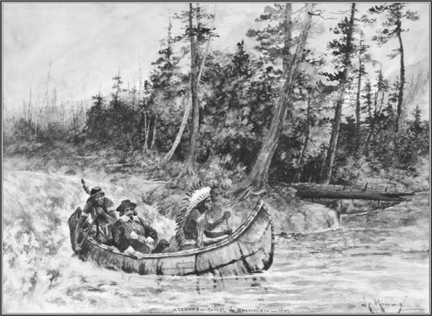
Denys Delâge constructed a neo-Marxist interpretation of Champlain as important for structuring the fur trade, and as a French leader who “would travel seated in the middle of a canoe manned by Amerindians,” and could not have functioned without them. Both themes were captured in this image.
Delâge was careful with his evidence and attentive to fact, but I would tend to disagree on one issue of interpretation. He observes that the early French settlers and Indians of Acadia and the St. Lawrence Valley lived close together, “traded, made treaties, and intermarried,” but he believes that “the relationship between First Nations and the French was based on a serious misunderstanding.” Here was the Marxist theme of “false consciousness” for historical actors who were in denial of the Dialectic. Another interpretation is a better fit for the evidence. The alliance of Champlain and the Indians rested on a solid basis of material interest, in terms of military security, trading networks, and political coalitions. One might ask, what choices would have served them better? These were highly intelligent people on both sides, and they had a deep understanding of their alliances in both their costs and benefits. Others will disagree.131
The New Ethnohistory: Bruce Trigger
While Trudel, the historical demographers, economic historians, and the new Marxists were at work on their projects, another important field for Champlain scholarship was rapidly developing. Historical ethnography emerged from the interplay of many academic disciplines. It transformed our knowledge of native culture in North America and had a major impact on Champlain studies.
Among its leaders was Bruce Trigger, an archaeologist and anthropologist at McGill University. His idea of ethnohistory was a step forward in two ways at once. It expanded historical methods in anthropology, and applied ethnographic methods to history.132 Trigger’s The Children of Aataen-tsic recast the history of an Indian nation in its own terms rather than those of Europeans. In that effort it brought a new depth of understanding to the history of the Huron in particular and American Indians in general, in large part by studying them as agents rather than objects of historical processes. Trigger found that Huron history had been dynamic before European contact, that it must be understood in terms of relations within and among indigenous populations, and that “Huron culture flourished as a result of European contact as long as the Huron people were not dominated by Europeans.” The book was less successful in its interpretation of the French, and denied to European actors the empathy and empirical understanding that it demanded for the Indians. Even so Trigger’s work on Huron remains a landmark of historical ethnography and a major contribution to the history of an indigenous nation.133
Academic Iconoclasts: Trigger Once More
In the 1960s and 1970s, a new generation of academic historians came of age. They were very diverse in their interests but shared an historical moment that framed their thought and set them apart from generations that preceded and followed. Many worked in the new social and cultural history, particularly in the study of race, class, gender, and ethnicity, and they greatly expanded the discipline of history in those dimensions. They tended to move toward the political left, even the far left; and they matured at a time when North American governments and electorates were shifting to the right. Their early work was positive in tone. The Civil Rights movement and liberal governments in the early sixties gave them much encouragement. But then came Vietnam, Watergate, and the world events of 1968, which many on the academic left remembered as a revolution that failed. In North America, historians of the left became deeply alienated from their own societies and institutions, and were filled with rage and bitterness.
The result was the growth of iconoclastic writing about American culture and American leaders. In scholarship on Champlain, the strongest iconoclastic voice was that of Bruce Trigger. In 1971 he brought out an article called “Champlain Judged by His Indian Policy: A Different View of Early Canadian History,” and followed with a larger work,Natives and Newcomers: Canada’s “Heroic Age” Reconsidered.134 Trigger argued persuasively that much writing in early American history had been ignorant and contemptuous of Indians, and he made a strong plea for an integration of historical and ethnographic approaches. Many historians were with him on that. But then he turned to the history of the French in America and dismissed out of hand much of what had been published on the subject. Trigger wrote that virtually all “biographies of Champlain, even recent ones, were mere hagiography.” Among them he included the work of Dionne, Bishop, Morison, Trudel, and many others. He launched a sweeping and highly personal attack on Champlain, reversing the judgments that most scholars had made before him.
Trigger allowed that Champlain was “obviously brave and adventurous, and apparently well-suited to win the support of Indian trading partners by accompanying them on their expeditions against their enemies.” But overall he was severely hostile to Champlain and described him as “insecure,” “ambitious,” and “cynical.” Where most historians had been impressed by Champlain’s humanity, decency, and devotion to a large cause, Trigger asserted that “he came to regard the Indians and even most Europeans with whom he had dealings, less as individuals than as means whereby he could advance his own career.” Further, Trigger asserted that Champlain was “extremely ethnocentric and inflexible,” that he cared little for the Indians, completely misunderstood their culture, and abused them, especially after 1612.135
This indictment of Champlain appeared briefly in the Children of Aataentsic and at greater length in Natives and Newcomers. Large parts of both works were correct and important. Trigger was right to argue that interactions between Indians and Europeans were fundamental to the history of New France and had been much misunderstood. He was right again to insist that scholars should write about that process in an evenhanded way, and study Indians with understanding and respect. He was also correct in asserting that European traders had been neglected figures in the early history of New France.
But he was mistaken about Champlain and other French leaders. Trigger made no sustained effort to understand these men in their own terms. His reading of Champlain’s writings was so hostile that it led to major inaccuracy, which in some cases reversed the meaning of what was actually written. Trigger violated his own ethnographic rules by treating Champlain, the Récollets, and other Frenchmen with the same contempt and misunderstanding that he complained about when it was directed to the Indians. The way forward is to apply the large spirit of Trigger’s best work on the Huron to all the people and cultures who met in North America, including the Europeans.136
Popular Iconoclasts and the Revival of Empathy
The iconoclastic impulse of the late twentieth century also appeared in popular culture and mass media, where it became even more negative and cynical than in academe. On the subject of Champlain, a startling example came from René Lévesque, the leader of Quebec’s separatist movement, who mounted an assault on the founder of Quebec. Lévesque wrote contemptuously in 1986, “Champlain? Not very stimulating, the old founding father. His wife seems to have been a lot more fun. Poor guy, always stuck with the building of his habitation at Quebec with the English overrunning it time and again, and all the while there was lovely Hélène living it up in those far away places perhaps giving secret rendezvous to a certain young soldier from Gascony, or to Athos with the velvet eyes, or to that Jesuit so quick to hoist up his skirts, Aramis by name.”137
Never mind the fact that the English overran Champlain’s Quebec only once, and he got it back again. Never mind that La Belle Hélène was on her way to a convent. Never mind the facts at all. For René Lévesque, history appears to have been a pastiche of Rabelais, Dumas, and Balzac’s Droll Stories. His assault on Champlain was an extraordinary statement, coming as it did from a leader of the Parti Québécois. Anglophone Canadian Joe Armstrong commented, “With this lack of pride in the French heritage, no wonder the revolution failed.”138 Worse was to come in the popular writings of Pierre Berton, who called Champlain an “assassin,” and accused him of murdering “unsuspecting Indians” in a complete reversal of his relations with his Indian neighbors. Lévesque had merely accused Champlain of being a bore. Berton insisted that he was a criminal.139
Iconoclasts will always be with us, but in the early twenty-first century their influence is waning. A new and more balanced mood is evident in popular writing about Champlain. An example is a wonderful book for children by Caroline Montel-Glénisson, called Champlain au Canada: les aventures d’un gentilhomme explorateur. It is cast as a story about Champlain for young readers, told by Guillaume Couillard who came to Canada in 1613, married Guillemette, daughter of the Hébert family. Champlain appears as a leader who was one of the people in Quebec. The violence and cruelty of the new world are made very clear. But Champlain appears as an engaging and very attractive figure, often surrounded by small children both Indian and European, as in fact he was. Charming illustrations by Michel Glénisson show him playing with children, working in his garden with children, ice-fishing with children. In many other scenes we see Champlain moving easily with the Indians, missionaries, traders, and people of all descriptions. The theme is Champlain’s humane spirit. The tone is irreverent and affectionate—a touch of the iconoclastic mood is combined with empathy and respect—a happy synthesis of older approaches with an impulse that was entirely new.140 The same approach appears in Caroline Montel-Glénisson’s Champlain, La découverte du Canada(2004), a brief biography for mature readers, with the same qualities of balance, insight, and empathy.
The Stirring of a New Spirit: The 400th Anniversary
In the early years of the twenty-first century, interest in Samuel de Champlain began to revive very rapidly. A stimulus was the 400th anniversary of the founding of New France, celebrated at Sainte-Croix Island in 2004, Acadia in 2005, Quebec in 2008, and the United States in 2009. The 400th anniversary has a different spirit from the monumental work inspired by the tercentenary. In the early twenty-first century, a new trend began to appear. After a period when political correctness, multiculturalism, postmodernism, relativism, and ideological rage were in fashion, scholars in many disciplines have rediscovered empirical possibilities in a different mood. Many examples appeared in new writing on Champlain, the founding of New France, and the interplay of Indian and European cultures in the new world. In the period from 2004 to 2007, historians from many nations published six volumes of new essays on Champlain and his world, with more than 100 articles, many of excellent quality.141
This effort was led by two French Canadian historians, Raymonde Litalien and Denis Vaugeois. In 2004, they published Champlain: la naissance de l’Amérique française (Champlain: The Birth of French America), a major work with many important essays on Champlain and his age. This book is full of clues about new directions for historical scholarship in the twenty-first century. We see in it the growth of a new global history and a revival of empirical work, after the relativism and postmodernism of the late twentieth century. New digital tools extend the historian’s reach and tighten his grasp. Among the results are new projects of primary synthesis (that is, broad works written from primary materials). This new scholarship makes more intensive use of images and artifacts, not merely as illustrations but as texts. In a process of fusion, it links separate sub-fields and combines strengths. The results are presented in braided narratives rather than analytic monographs, which combine story telling and problem solving in ways that realize the episetemic power of historical approaches. There is also a shift from ideological polemics to more open-ended inquiries, and a growing maturity of historical judgment. In writings on Champlain, this new generation of scholarship is beginning to get the balance right between European and American Indians.
One of the most hopeful new tendencies is the effort to study the past in its own terms and at the same time link it with the present. Only a generation ago, scholars held these two purposes to be mutually exclusive and came down on one side or another. Some insisted that any attempt to think of the present while studying the past is “unhistorical.” Others condemned that idea as academic antiquarianism. Scholars in the twenty-first century are finding a middle way, and they have opened new possibilities that we are only beginning to discover. In all these ways, the central theme is the growth of historical knowledge in the human sciences, and a larger idea of humanity, in the spirit of Champlain himself.