
The Arquebuse à Rouet
What European firearms did Champlain employ in his American campaigns? Many historians have written that Champlain used a matchlock, or a “matchlock musket,” in his major American engagements, ca. 1609–15.1 Close inquiry yields a different conclusion. Champlain’s texts and engravings, inventories of weapons in Quebec, and expert studies of the weapons themselves make clear that Champlain was using an arquebuse à rouet in his major engagements. This was not a matchlock but a wheel-lock. It was developed in the sixteenth century to correct some of the matchlock’s major problems.
In a matchlock, the smoldering end of a slow-burning cord was lowered into a pan of powder, and fired the charge. A wheel lock operated in a different way. The mechanism had a rough steel wheel which, when turned against a flint, sent a shower of sparks into priming powder, much like a modern cigarette lighter. Sometimes the wheel was a rough mineral that revolved against a steel platen, with the same result. This was the first self-igniting shoulder-fired weapon.
The advantages of a wheel lock were many. A slow-burning match cord was difficult to ignite and keep burning, especially in combat. Wet weather or even dampness and high humidity could render it useless. Once the cord was lighted, a matchlock was dangerous in another way, as the burning cord could ignite other powder in the vicinity. In battle, a matchlock with a lighted cord made surprise difficult, as its smoke and odor could alert others and betray the user’s position.
The wheel lock, or rouet, may have been invented by Johann Kiefuss in Germany in 1517. It solved some those problems but created others in their place. It was a complex and fragile mechanism that required frequent maintenance and careful handling. It was also very costly—twice the cost of a matchlock—and could not be produced on a large scale.
To solve those problems, other inventions followed. In the late sixteenth century, gunsmiths developed a new lock called a snaphance. A flint was fixed on a spring-mounted arm. When the trigger released the arm, the spring drove it forward with a snap against a metal plate and sent sparks flying into a separate priming pan.
The principle of the snaphance in turn was simplified by the invention of the flintlock, which combined the metal platen and the priming pan cover in one piece. It was invented by one of Henri IV’s expert gunsmiths, Marin le Bourgeois, who had his workshop in the basement of Louvre, and was in use by 1612. A flintlock was much cheaper to make, easier to maintain, and comparatively simple to use. In 1639–42, the average value of an arquebus à rouet was 80 livres; flintlock muskets were valued at 6 livres.
Champlain stated repeatedly that he and other Frenchmen with him used an arquebus, but what sort of arquebus? Russel Bouchard, an expert on firearms in New France, studied Champlain’s engravings, and concluded that he used an arquebuse à rouet, with a wheel lock. There is no sign of a match in Champlain’s engravings of his weapons, which look very much like a wheel lock. Inventories of weapons at Quebec refer explicitly to the presence of “harquebuses à rouet.” So also do probate records for the colony. Patterns of use changed after 1615. By 1619, the new flintlock muskets were becoming the weapon of choice in New France. A Quebec inventory in that year listed four “harquebuses à rouet” and forty “mousquets avec leurs bandoliers.” The proportion of muskets continued to increase in this period.2
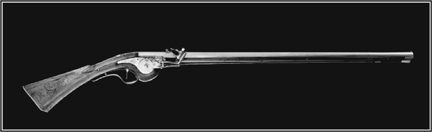
In 1609–10, Champlain fought the Mohawk with this arquebuse à rouet, a wheel lock weapon that did not require a burning match. It was also an arquebuse de chasse, a weapon light enough to be fired from the shoulder without a fork. A matchlock would have been very difficult to use at Lake Champlain, perhaps impossible.

Historians mistakenly assume that Champlain used this weapon, a matchlock that required a burning cord and was so heavy that it could not be presented without a fork to support its barrel. This would not have worked well for him at Lake Champlain, given his tactics.
Champlain’s weapons were also distinctive in another way. Many early models of an arquebus were heavy weapons. Some were mounted on a cart and fired a ball of three ounces. Others were carried by individual soldiers, but could be fired only with a fork or crutch supporting the barrel. This early model was called an arquebuse à croc, after the crutch that was needed to steady the weapon. By Champlain’s time, the wheel lock was combined with lighter weapons and shorter barrels, which could be fired from the shoulder without a fork. This lighter arquebus was developed for hunting and adopted by Champlain for use in America. It was between 32 and 52 inches long. It could be loaded with several one-ounce balls, which were lethal against large animals and men who were not wearing metal armor. These weapons were reported by contemporary writers to weigh in the range of 8.5 to 15 pounds, less than an arquebuse à croc. M. A. O. Paulin-Desormeaux, in his treatise on these weapons, called them the arquebuse de chasse, a hunting weapon. Champlain’s chosen weapon combined the characteristics of an arquebuse à rouet and an arquebuse de chasse.3
The technology that produced the arquebuse à rouet also led to the development of wheel-lock pistols, which were larger than modern handguns but small enough to be hidden in clothing. They became an assassin’s weapon, and were quickly put to that use. In 1584 a wheel-lock pistol was employed to kill William the Silent in the Netherlands and to murder Protestant leaders in France.4
In short, Champlain fought at Lake Champlain, and probably at the Rivière des Iroquois and the Onondaga Village, with an arquebuse à rouet that was fired by a wheel lock. It was light enough and short enough to be used as a shoulder weapon, but its barrel was forged with sufficient strength to allow triple or quadruple loading. This weapon did not require a slow match or a fork, which made it much easier to use in the field. The absence of a burning slow match helped Champlain to achieve surprise at Lake Champlain, and his independence of a fork permitted him to move more easily on the battlefield in all his engagements. The outcome of these battles, especially the first, might have been very different without the advantages of this highly developed, complex, and costly weapon.