
In more than forty years afloat, Champlain worked with ships and boats in great variety. He described them very briefly, usually in terms of tonnage and ship-types. His language of description is not self-evident to modern readers and problematic even to experts in the field. Notes and translations on ship types in the Biggar edition of Champlain’s works are frequently inaccurate, and even the sailor-historian Samuel Eliot Morison was mistaken on this subject.
Champlain’s ships were the products of a revolution in maritime technology during the early modern era. In his time, ships could move people and goods with more speed and efficiency than overland transportation, which had improved little since the Romans. Until the nineteenth century, water was more “permeable” than land, as today air is more permeable than water.1
The improvement of ships made it so. They were complex artifacts, the most highly developed industrial products of their age. Champlain’s ships were machines designed to convert the energy of winds and currents into motion. They were also homes for their crews, sometimes for months or years at a time. They were mobile warehouses for supplies, platforms for guns, tools of science, instruments of power, emblems of authority, and dynamic symbols of an expansive western culture that was spreading rapidly through the world. The characteristics of these ships created Champlain’s opportunities, and also set his limits. To understand them, let us begin with his terms of description: first the problem of tonnage, and then the problem of ship-types and their properties.
TONNAGE for Champlain, was primarily a measure of volume, not weight. It was an estimate of a ship’s capacity, in terms of the number of very large casks of wine or water, called tuns, that she could carry. This was an absurd way to measure a ship, but it was widely adopted because it was convenient to tax collectors and had long been used. In the ancient world, Cicero spoke of a “2,000 jar ship.” In medieval Europe, the unit of measurement changed from pottery jars to wooden “tuns.”2
By Champlain’s time this method was widely used throughout Europe, but the standard definition of a tun varied from one country to another, and also from one province and seaport to the next. In England a measurement-tun had a standard capacity of 252 gallons, and when full of water weighed 2,240 pounds, the origin of the English “long ton,” which became the basis of maritime measurement rather than the short ton of 2,000 pounds.3
In France, a standard tonneau de mer was equal to “four barriques bordelaises” of wine or water, which together equaled about 480 pots, and a pot was about .498164 of an English Exchequer gallon. French tonneaux de mer by that measure were approximately 239 English gallons, which made them about 5 per cent smaller than an English long tun.4
In Spain after 1590, the official unit of measure was the tonel macho or tonel de Vizcaya, which was “equivalent to the French sea ton (tonneau de mer) used in Bordeaux.” It was 1.2 times larger than the earlier tonelada or tonel de Andalusia.5
In ships of identical dimensions, the slightly larger size of an English ton yielded an estimate of total tonnage that was smaller by about 5 percent than did a French tonneau de mer or a Spanish tonel macho. But these variations were smaller than the range of error in actual measurements.
This idea of tonnage was called “tons burden,” because it measured not the ship itself, but the volume of what a ship could carry. All Champlain’s tonnage estimates were tons burden. This measure of “tunnage” as units of volume should not be confused with other measures of weight that developed later, such as “displacement tons.” This was the Archimedean idea that a ship’s tonnage should be the weight of water displaced by the ship. Displacement tonnage became the standard measure for warships in the twentieth century. For the same vessel, tons displacement came to a much larger number than tons burden, which Champlain used.
By Champlain’s era, most western states had settled on conventional ways of calculating tonnage by an equation from the length of keel, internal breadth, and interior depth of a vessel. In England, the number of tuns burden that a ship could take aboard was estimated by multiplying length of keel, times breadth, times depth, and dividing by 100.

The relationship between tonnage and dimensions such as length, breadth and depth was highly variable, mainly because of differences in design and construction from one ship-type to another. But rough estimates were made for specific classes of ships and boats, on the basis of actual measurement and prevailing patterns of proportion. Let us review them in order of size.
LARGE FULL-RIGGED SHIPS (350–1,000 tons burden) included vessels that Champlain and his contemporaries called navires, naos, hourques, felibotes, flutes, and galleons. One of his largest vessels was his uncle’s Saint-Julien. By Champlain’s reckoning and Spanish accounts, her size was estimated at 500 tons burden. He described her as a“grand navire,” a great ship. In Spanish records she was variously called a nao or felibote or hourque.
A grand navire was a generic noun for any large ocean-going vessel, usually a merchantman, and was also called a navire de commerce. One French treatise defined a navire as “un vaisseau rond et de hauts bords tels que sont ceux de l’océan, a round ship with high sides, such as those of oceangoing vessels.” These “round ships” were powered entirely by sail, unlike other “long ships” that used sails and oars.
A nao was a Portuguese term (nef or nau in French) for a full-rigged round ship, with large square-rigged sails on two or three masts, sometimes with a lateen-rigged mizzen and a smaller mast called a bonaventure abaft the mizzen.
A hourque (or hulk) denoted a large ship with a distinctive hull type, designed for maximum cargo volume, broad in the beam, with a rounded bow and stern, a comparatively flat bottom, high sides curved out and then in again, in a pattern that sailors called “tumble-home.” They were constructed in northern Europe, on the model of large freight-carrying Dutch canal boats.
A felibote (Spanish) or flibot (French) or “flyboat,” in one of its early meanings, was, as defined by R. M. Nance, “an enlarged, ship-rigged barge, contrived to carry as much merchandise as possible with the smallest possible crew.” Hourques and felibotes as large as 600 tons were not uncommon in Champlain’s era. They were reputed to be crudely constructed and slow sailors. Champlain described the Saint-Julien as “unfort navire et bon de voile, a staunch ship and a good sailor.” If so, she was exceptional for her class. In service she was unsound and leaked so badly that several times she was close to foundering. From the proportions of other ships in her era, we might guess that her deck length was about 100–120 feet, and her beam about 36–40 feet.6 Later, as we shall see, flyboats were given another and entirely different meaning: small fast-sailing vessels, often heavily armed for their size.
The galleon was another type of large ship that Champlain knew well. He sailed in company with these great ships during his visit to the Spanish empire, from 1598 to 1601. Their design evolved through time. In the mid-sixteenth century, galleons tended to be ships of moderate size, often about 200 tons, with high forecastles and sterncastles. They grew rapidly larger. The Spanish Armada in 1588 included three Portuguese galleons of 1,000 tons, and six Spanish galleons of 800 tons, which were among the largest ships of their time in the western world. By Champlain’s time they had changed again. In the early seventeenth century, they tended to stabilize in the range of 400–600 tons burden, with a deck-length of about 100–120 feet (120–140 feet overall including her prow but not her bowsprit), a beam of about 30–35 feet, and a ratio of about 1:3.5 to 1:4 compared with merchantmen such as the Saint-Julien, which would have been closer to 1:3.
By Champlain’s time the high forecastle had been cut down, and the sterncastle was higher than before. The foremast was canted forward, the main mast was nearly vertical, and a small mizzen was raked slightly to the stern. The big foremasts and mainmasts were surmounted by topmasts and sometimes topgallant masts. A spritsail on the bowsprit and lateen (or latine) on the mizzen were used for trim and balance, to make the helmsman’s work easier. There were no jibs, but extra sails called bonnets could be rigged in light breezes.

The Spanish galleon was a product of long development in the 16th and 17th centuries. This was the type that Champlain would have known in 1599—smaller than the biggest galleons in the Armada of 1588, but very capacious. The foremast was canted forward, and the mainmast was raked aft. The high poop gave a platform for fighting.
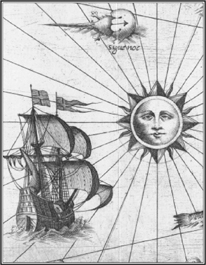
This navire (from Champlain’s 1612 map) was typical of vessels he used in North American trade—a midsized merchantman with square-rigged courses and topsails, a martingale beneath the bowsprit, and a lateen-rigged mizzen or bonaventure aft. They were not fast ships, but they were sturdy and seaworthy. Champlain never lost one.
These galleons carried battery of great guns on two or even three gun decks, and were crowded with men. Altogether they were highly refined ships, the product of long experience. Their officers in Spanish treasure fleets were highly skilled navigators. Champlain learned much from these ships, and from the men who sailed them.7
The vaisseau des indes, which the English called an East Indiaman, was another specialized type of large navire that developed in the early seventeenth century. This was a hybrid design: a large and very capacious merchantman designed for voyages as long as two or three years. She was built as stoutly as a man of war, heavily armed, and broad at the waterline to bear the weight of guns and cargo. Examples were two Norman ships owned by merchants of Rouen and Dieppe, which were sent to the East Indies and provisioned for two and a half years. One was Le Montmorency, 450 tons, 22 guns, and a crew of 126 men and boys. The other was L’Espérance, 400 tons, 26 guns, and a crew of 126. The officers and crew in these East Indiamen also sailed on American voyages in smaller ships. Robert Gravé, Claude du Boullay, Claude de Godet, and sieur des Maretz were all as familiar with the East Indies as with the waters of New France. But they used different ship-types when they moved from one theater to another. The vaisseau des Indes rarely appeared in North American waters, where voyages were shorter, capital was scarce, rivers and ports were shallow, security was less of a problem, and speed was more important than strength or endurance.
MID-SIZED SHIPS OF 100–350 tons were the result. These were Champlain’s “navires de moyen calibre.” Nearly all his Atlantic crossings were made in them. A great many mid-sized navires appear in his published Voyages. Most were in the range of 100–200 tons burden. Champlain’s crossings in 1603 and 1604 were made in La Bonne-Renommée, which was variously rated at 100–120 tons, with a length of about 90 feet overall including her long prow. In 1605, he sailed in Don-de-Dieu, which was estimated at 120–160 tons, with an overall length of about 100 feet. His largest ship in the North Atlantic was the Saint-Étienne, 350 tons, which he used in 1615 and again in 1620.8
These mid-sized navires tended to be longer in relation to their tonnage than grand navires such as the Saint-Julien, a proportion that gave them more speed. With good weather and fair winds, they were capable of sustained runs of eight knots, which meant, for shorter periods, speeds of ten knots or a little more.9
They were rigged in various ways. A manuscript by Jacques de Vaulx, a pilot from Le Havre, described them in detail. Most appear to have been three-masted and ship-rigged, like their larger cousins. Their fore and main masts were square-rigged, sometimes with topsails and sometimes not, but rarely with the topgallants that were beginning to appear aboard larger vessels. They carried a spritsail on a yard under the high-angled bowsprit, and a lateen sail on a mizzen or a bonaventure. The spritsail was square-rigged, but could be close-hauled so tight as to be nearly fore-and-aft. Maritime paintings of the seventeenth century often show spritsails braced that way, at angles that seem improbable to modern sailors, but may well have been correct. The purpose of the spritsail and the mizzen lateen was to trim or balance the ship, more than to add driving power. When properly trimmed, the ship could ride more easily, and helmsmen had an easier time. In light winds the main sails could be rigged with extra sails called bonnets to port and starboard, “when chased by an enemy.” This combination of hull-type and rigging plan created an extraordinarily safe and stable vessel—one reason why Champlain never lost a navire.10
Mid-sized navires were armed with a main battery of ten guns in Don-de-Dieu and Saint-Pierre, twelve in Saint-Jean, and sixteen “pieces of cannon in battery” in the navire Marguerite in 1629.11 This armament was more than enough to keep corsairs at bay and drive off small predators. This type of mid-sized navire was the mainstay of maritime commerce in New France. Champlain often sailed alone in one of them across the North Atlantic in peacetime, but in time of war convoys were the rule.
Another type of mid-sized ship, called a heus in the records of Normandy, was built in shipyards near the mouth of the River Seine. They were rigged in a different fashion from what were called navires communs. They were two-masted vessels with the mainmast forward, a lugsail, and a large lateen. They tended to be on the small side, perhaps 60–80 tons. Some examples of them appear as embellishments on Champlain’s maps. He called them barques, one of many applications of that generic term.12
The port records of Normandy also refer to a third type of mid-sized ship called the roberge or navire roberge in primary sources of the period, or in later sources rombarge. These vessels were long and narrow, designed to be propelled by sails and oars. They had as many as three masts, and all were rigged with large lateen sails. They also had a single bank of oars, and were similar to sailing galleys such as the barca longa that had developed in the Mediterranean. Specifications for one roberge survive in Norman port records for 1576. She was a vessel of 80 tons. Her keel was 45 feet long, her overall length 92 feet, and she had a draft of 11 feet. Her ratio of length to breadth was probably 5:1.13 The navire roberge did not appear in New France, but Norman port records show that merchants sent them on trading voyages to the Mediterranean and Africa.
SMALL OCEAN-GOING VESSELS, 20–100 tons, included two types that were important in New France and frequently mentioned in Champlain’s writings. Most common were vessels that he called barques. They are not to be confused with European barques or American “barks” of the nineteenth and twentieth centuries, which were defined by their rig: usually two square-rigged masts, and a third that was fore-and-aft rigged. These later barques were as large as full-rigged ships, and were much used in the nineteenth century for reasons of economy and versatility.
In the early seventeenth century, French barques were another sort of vessel altogether. Randall Cotgrave’s Dictionarie of the French and English Tongues (1611) offered a translation of a barque as “little ship, great boat.” Champlain wrote frequently of barques in both senses. Sometimes he had in mind a little ship of 30–100 tons. In other passages he was describing a great boat of 6–20 tons that could be carried aboard a ship.
Ocean-going barques tended to be broad of beam in proportion to their length—they were described as “blunt” and “stubby.” One example, built in 1590, was a barque of 35 tons burden, with a keel length of 35 feet, a breadth of 14 feet, and a hold 6 feet deep. She had a standard three-masted rig, with square courses, topsails, a mizzen sail (perhaps lateen), and bonnets for square sails. They were the first ships to be built in New France and the British colonies.14
Ocean-going barques as small as 30 tons were often three-masted, with fore and main masts square-rigged with courses and topsails, a lateen on the mizzen, and bonnets for the square sails. One example appears at anchor in Champlain’s chart of Beauport (now Gloucester, Massachusetts). She was three-masted, with a martingale below a high bowsprit, single square-rigged sails on the fore and main, and a lateen on a small mizzen. A very similar English vessel was the barque Kathryn, 35 tons burden, with two decks, a raised forecastle and a raised poop. Other French barques were two-masted and rigged in many ways. Many carried a bourcet, or lugsail, on the foremast (see below for an explanation), or two lugsails on the fore-and mainmasts as their only rig.15
The port records of Normandy show that barques as small as 20 tons burden were sent on long ocean voyages to North America, and even to the East Indies. On long voyages they sailed in the company of larger vessels. Many were lost at sea or wrecked on foreign shores. It was said that the outer banks of Sable Island on the Grand Bank were littered with the bones of French barques.
But Champlain never lost a barque. The only exception was an occasion when he was sailing as a passenger in a barque with Pont-Gravé as captain and Champdoré as master. This was a barque of 17 of 18 tons. Pont-Gravé suffered a “mal de coeur,” probably a heart attack. He lay below in his berth, refused to relinquish command, and ordered Champdoré to get underway in wind, rain, and fog. It was a crazy thing to do, but Champdoré obeyed. He ordered the “anchor raised and lugsail spread to the wind,” and tried desperately to get clear of a lee shore. The vessel was caught by the wind and tidal currents, and was driven onto the rocks in a heavy surf. Champlain rushed on deck, took command, and ordered the mainsail to be set, in hope of driving the doomed barque higher on the rocks so that the crew could get ashore. It was a desperate act, but it worked. The vessel was smashed but every soul on board survived, and most of her supplies were saved. Indians came in their canoes, and took the crew and cargo back to port. Champlain’s account of this misadventure reveals much about the barque, her rig, and her sailing properties.16
A second type of small ocean-going vessel in New France was called a patache by Champlain. English seamen called them pinnaces. Champlain’s pataches and his barques had a similar range of tonnage. He described “pataches of forty tons and six cannon each,” and others as small as seventeen or eighteen tons.17 Pataches were designed for purposes different from barques, and the two vessels had distinct hull-types. Barques were meant to be small freighters or transports, and were built to carry goods and people in an efficient way. Pataches were built for exploration, discovery, and reconnaissance. In 1628, one French maritime treatise defined a patache as “a small warship designed for the surveillance of coasts.”18 “They were built for speed, constructed man-of-war fashion, and strongly armed in proportion to their size. In France and Spain they were also used as dispatch boats, which Champlain called a patache d’avis. Spanish treasure fleets also employed them as tenders to larger vessels. Champlain wrote that every galleon had its patache.
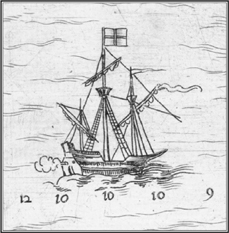
The patache was a purpose-built vessel for reconnaissance, surveys, and exploration. She was a small man-o-war, lean and heavily sparred ideal for surveys and exploration, designed for sailing into harm’s way, and rapidly out again. An example appears in Champlain’s map of Sainte-Croix Island.
In 1604, Champlain was given a patache for his exploration of the Maine coast. He described her as a small keel-built ship with a draft of five feet, and a burthen of seventeen or eighteen tons. Her length was probably about thirty-five or forty feet, her beam eight or nine feet. She was fully decked over and designed for voyages in dangerous seas—unlike the open-hulled shallops that Champlain used in more protected waters.
Champlain’s chart of Sainte-Croix Island includes a drawing of a lean mid-sized vessel that may have been his patache. She was built man-of-war fashion with a sharp prow, long lines that held the promise of speed, and a raised poop with a battery of small swivel-mounted brass falconets. Her mastheads were topped by large crow’s nests.19
Champlain mentioned a third type of ocean-going vessel, which he called a flibot, a flyboat. He described one example as “nearly a hundred tons, with ten cannon and a crew of about 75 men,” and distinguished her from a “pataches of forty tons and six cannon.” But this was an English vessel, more nearly the size of a navire.”20
SMALL COASTAL AND RIVER SAILING CRAFT were vital to the life of New France. Here again Champlain used two principal types of vessels: the moyenne (middling) barque and the chaloupe or shallop. They were of similar size, ranging from 2–3 tons to as many as 12–16 tons burden. Many were 6–8 tons. Champlain described one example as a small barque du port of 5–8 tons, and another as a barque moyenne of 10–13 tons. Barques were decked over, with a few dry berthing spaces below in a weathertight hold. Shallops were open-hulled, and offered no protection against wind or weather.
Barques were the workhorses of New France. Normally, navires of 100–200 tons anchored at Tadoussac, and transferred their cargo to barques, which carried them up the river. Champlain used these vessels to haul freight cargo on the St. Lawrence River and the coast of Acadia, and to move trade goods upriver to the head of navigation. He also employed barques to carry prefabricated houses to Port-Royal, cattle to the farm at Cap Tourmente, building supplies to Trois-Rivières, and trade goods to Montreal.21
Champlain’s open chaloupes, or shallops, were small enough to be built in sections or carried across the Atlantic en fagot, in bundles of pieces. They had one or two masts, each with a single sail. Rails were fitted with hard locust thole pins for oars or sweeps, which were used frequently on the river. They were shallow boats without a deep keel, often rigged with leeboards, and were at risk of capsizing in a sudden squall. One such accident on the St. Lawrence River took the life of Champlain’s interpreter Jean Nicollet.
Shallops were constructed with different hull-types. One common form was the Biscayan shallop, or the Basque shallop. It was a sharp-built, doubled-ended craft and was used as a whaleboat by Basques. A plan of such a chaloupe biscayenne is in the collection of the Fine Arts Museums of San Francisco.22 Accounts survive of Biscay shallops on the coast of New France, some of them owned by Indians, who probably acquired them from Basque whalers.
Other shallops were more bowl-shaped with rounded bows, molded sides and tumblehome. Several examples appear as illustrations in Champlain’s maps and charts. They were rigged in various ways: single-masted or double-masted with square sails, or sometimes gaff-rigged, or carrying a spritsail, or with something like what was called a leg-o-mutton rig on Chesapeake Bay log canoes in the author’s youth.23
VERY SMALL CRAFT: ESQUIFFES AND CANOTS (SKIFFS AND CANOES) Champlain also worked with very small boats in rivers and harbors. He made frequent use of esquiffes, translated through this book as skiffs. A skiff was commonly defined as a boat carried by a ship. Champlain often carried them aboard his navires and barques. In one scene on the St. Lawrence River near Montreal, he described his skiff as “a very small light boat,” but big enough to hold four mate-lots bending over their oars, a fifth at the tiller, and two officers aboard.24 He used skiffs to survey harbors, which might have required half a dozen hands—to work the boat, swing the lead line, and take cross-bearings that were the key to the accuracy of his charts, and note the location of each sounding on a log and draft-chart. From those descriptions Champlain’s skiff was more like a ship’s jolly boat or a captain’s gig or an admiral’s barge, clinker-built with overlapping strakes, rounded bows and molded sides, rather than a painter’s skiff today, which is often a very small flat-bottomed slab-sided rowboat that would be overcrowded with three people aboard.
Larger vessels were called bateaux or batteaux. They loomed large in the history of rivers and lakes throughout North America. They tended to be flat open boats, powered by oars, sweeps, and sails, and were used for many purposes, but Champlain rarely mentioned them.
By Champlain’s time, Basque whalers in New France had invented the beautiful and very light whaleboat, double-ended with incredibly thin strakes, which oarsmen could send skimming across the water. They were not invented by Nantucket Yankees. French and Spanish Basques developed them from Biscayan shallops, called chalupas in Basque. They were framed from naturally curved oak and planked with very thin oak strakes, clinker-built above the waterline and carvel-built below to reduce drag and increase speed. They could carry a crew of seven or eight. These chalupas were in use on the coast of Labrador and the lower St. Lawrence River by 1600. Maritime archaeologists have recovered early examples from Red Bay, Labrador, remarkably intact.25
Fishermen on the Grand Bank also developed their distinctive fishing boats, which were much bigger than the later dories, designed for a crew of half a dozen men, each with two compartments or working spaces called a rum, one for the man and one for his catch. The boats were big enough to hold 500 or 600 large cod or halibut. They were heavy, sturdy keel-boats with floor-timbers called varengues that were three inches thick, and high sides crowned by a gunwale two inches square. They were built for an era of vast abundance in the codfisheries, and after Champlain’s era were replaced by smaller dories.26
SMALL CRAFT of American Indians fascinated Champlain. He used them frequently, studied their construction, and described their characteristics in his Voyages. They existed in great variety, and might be divided into three types: canaux or canoes, pirogues or dugouts, and skin boats of various kinds.
Birchbark canoes were the boat of choice in the St. Lawrence Valley. Champlain delighted in them. He described them as “eight or nine yards long, about a yard or a yard and a half wide in the middle, tapering off towards the two ends. They are very liable to upset if one does not know how to manage them, and are made of birch-bark, strengthened inside by small ribs of white cedar very neatly arranged, and are so light that one man can easily carry one. Each of them can carry the weight of a hogshead (400–700 quarts).”27 On one trip Champlain traveled with a servant, an interpreter, and ten Indians in two canoes.28 The design of birchbark canoes varied from one Indian nation to another. They were built with astonishing speed, and in a variety of sizes. In general they were light, nimble, stable in the hands of a skilled paddler, and very fast.29
Elmbark canoes were used to the south of the St. Lawrence River by woodland Indians who lacked a large supply of canoe birch. The Iroquois made their boats out of elm, often from the bark of a single tree. They were big and strong, but slow and clumsy. The differences between elmbark and birchbark canoes had an impact on the battle between the Mohawk and Champlain’s Indian allies at Lake Champlain. An example of an Iroquoian elm boat survives today at the Peabody-Essex Museum in Salem, adorned with diagonal red stripes, in a motif that was repeated on paddles and fishing equipment.30
Pirogues or dugouts were used by Indian nations to the south, from Cape Ann in Massachusetts to Florida. Champlain took a professional interest in these small craft. He observed that Indians south of Cape Ann used pirogues made from solid tree trunks by “burning and scraping with stones, which they use in place of knives.” Champlain tried his hand at steering them and found that, like birchbark canoes, they were also “very liable to upset unless one is very skilled.”31 Pirogues were ancient watercraft, widely used throughout the world. Some were surprisingly light and maneuverable, much more so than modern versions. A very early example was found by archaeologists, perfectly preserved in an old bog within the city of Paris. It is thought to be more than 6,000 years old, and can be seen in the basement of the Musée Carnavalet in Paris. It is incredibly light, and beautifully carved, with long and very lean lines and would have been very fast in the water.
Kayaks were widely used by Indians north of the St. Lawrence Valley. Early designs in the east were remarkably similar to modern kayaks in appearance, construction, and use.32
Coracles were observed by Champlain’s interpreters who went west into the interior of North America. They were made of moose hides or buffalo skins sewn together and secured over a frame of saplings. Some had the proportions of a canoe. On the prairies, they were rounded and called bull boats. Bull boats were rarely more than five feet in diameter, mostly too small to carry a person. They were used by swimmers to ferry goods across a pond or river.33