
FROM their tree houses in the rhododendron forests, the Turret-Folk observed Pompey’s army on the march across Mithradates’ kingdom. As a young prince, Mithradates had befriended this fierce tribe. They knew the secrets of the local wild honey, the powerful neurotoxin that had felled Xenophon’s Greek army in 401 BC. After tasting the honey, his soldiers had collapsed, open to attack in hostile territory. To Xenophon’s great relief, his men eventually recovered.
In 66 BC, however, the poison honey would be deployed as a deliberate biological weapon against the Roman invaders, ignorant of Xenophon’s experience. The Turret-Folk placed tempting honeycombs along Pompey’s route. Mithradates had recently passed through their territory, ahead of Pompey. Were the Turret-Folk following Mithradates’ suggestion? That is unknown, but the ploy certainly would have pleased the Poison King, and it was a great success. Pompey’s advance cohorts stopped to enjoy the treat. Struck dumb and blind, wracked by violent vomiting and diarrhea, they lay paralyzed along the roadside. The Turret-Folk descended with their iron battle-axes. When Pompey arrived on the scene, a black cloud of flies buzzed over a thousand legionnaires sprawled on the road, sticky with honey and blood.1
And Mithradates? He was far away, a desperado on the run again from the long arm of Roman rule.
POMPEY
A year earlier, in 67 BC, Pompey had received a budget of 6,000 talents, an army of 120,000 soldiers, 4,000 cavalry, and 270 ships to quash the pirates, whose armadas of “odious extravagance” dominated the Mediterranean. Other Roman campaigns against the pirates had failed, but by skillfully marshaling his resources, Pompey caught or killed about 10,000 of the Mithra-worshipping buccaneers. Rome’s massive response to the piracy emergency persuaded most of the remaining pirates to relocate on land grants in Rome’s provinces.2
Pompey’s success gained him unlimited war powers to take over the command of Lucullus’s failed war on Mithradates. Cicero urged Pompey to “wipe out that stain . . . which has now fixed itself deeply and eaten its way into the Roman name.” Cicero was referring to the unavenged atrocity of 88 BC, when Mithradates had ordered “all the Roman citizens in all Asia, scattered as they were over so many cities, to be slaughtered and butchered.” Yet Mithradates “has never yet suffered any chastisement worthy of his wickedness,” continued Cicero. “Now, twenty-three years later, he is still a king, and a king not content to hide himself in Pontus, or in the recesses of Cappadocia, but a king who seeks to emerge from his hereditary kingdom, and ravage Rome’s revenues, in the broad light of Asia.”3
While Pompey was pounding the pirates, Mithradates had a year to secure his kingdom, raise armies, and ensure the safety of his remaining family members. Concubines were assigned to various strongholds; Stratonice and Xiphares held Kainon Chorion; his daughter Drypetina held Sinora; other children were with Mithradates’ sons Machares and Pharnaces in the Bosporan Kingdom. In Pontus, Mithradates stationed about thirty thousand infantry and three thousand cavalry to guard the frontiers. After the Roman depredations, provisions were scarce. This would hinder any new Roman invaders, but starvation also led to desertions. Mithradates harshly punished those caught abandoning the frontier outposts.
Many Roman officers and soldiers had defected from Lucullus to join Mithradates. In 66 BC, their connections reported that Pompey the Great was en route from Rhodes to Pontus with a large army and navy, authorized to make war on both Mithradates and Tigranes. Pompey had even forged an alliance with the king of Parthia.
Seeking an honorable way to avoid this new war and determined to retain his ancestral homeland—the kingdom he had just rescued from the grip of Roman occupation—Mithradates immediately sent envoys to Pompey. What terms would he demand for peace? Pompey’s blunt reply: “Unconditional surrender—and deliver up our Roman traitors.” Mithradates relayed this response to the Romans in his ranks. They urged the king to resist. The rest of his soldiers agreed with their Roman comrades.
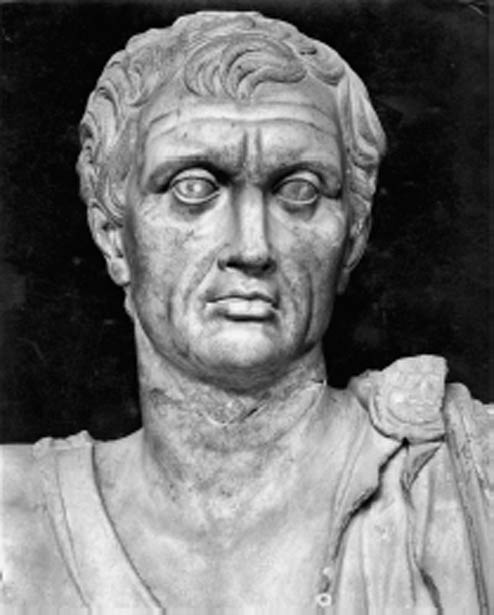
FIG. 14.1. Marble statue discovered near Pompey’s house, in Rome, identified as an idealized portrait of Pompey. Palazzo Spada, Rome, Alinari/Art Resource, NY.
Their reaction impressed Mithradates; Pompey’s intransigence enraged him. Confident of the loyalty of his supporters, Mithradates vowed that this would be a united struggle to the end: “No! I’ll never make peace with the rapacious Romans! I’ll never surrender anyone to them! I refuse to do anything that is not for the common advantage to all!”4
THE LAST CAMPAIGN
Pompey provoked an attack on the border outposts. Mithradates sent out his full infantry and the Romans retired. After ascertaining the extent of Pompey’s formidable forces, Mithradates withdrew to a mountain stronghold in southeastern Pontus that Pompey did not dare attack. Indeed, a large number of Pompey’s men deserted to Mithradates.
Mithradates created the impression that he was digging in. But one night, after lighting their campfires as usual, Mithradates’ army sneaked away from the stronghold—catching the Romans by surprise. Plutarch and Appian both claimed that Mithradates departed because he was ignorant of water and food in the region. That seems highly unlikely given his intimate knowledge of his homeland. Appian was puzzled: why did Mithradates “allow Pompey to enter his territory without opposition?”
Mithradates expected that Pompey would be unable to find food. But Pompey maintained his supply lines, dug deep wells for water, and set up a siege of Mithradates’ new position. After forty-five days, Mithradates killed his pack animals, keeping his cavalry horses and fifty days’ worth of provisions. According to Plutarch, his wounded men unable to march were killed by their comrades, to spare them from ignoble death at Roman hands. Again, Mithradates and his army “stole away silently by night over bad roads” to yet another stonghold.
Cassius Dio thought Mithradates had “become frightened [and] kept fleeing, because his forces were inferior.” Appian assumed these actions meant Mithradates must have been “suffering from fear and mental paralysis at the approach of calamity.” But these notions are dubious, given Mithradates’ history, character, and recent vow to resist. Instead, Mithradates’ evasive actions were in keeping with his new guerrilla tactics, modeled on nomadic warfare and on Alexander’s innovations in Afghanistan—and already tested successfully against Lucullus. Mithradates’ actions appear to have been calculated to lure Pompey deeper into the unfamiliar, rugged terrain between Pontus and Armenia. Indeed, in the next century, Frontinus, a Roman military strategist, would present these incidents as examples of Mithradates’ overall strategy to deceive Pompey.
Mithradates’ next movements confirm this explanation. Pompey followed Mithradates over the rough mountain paths with great difficulty, reported Appian. When Pompey caught up, Mithradates refused to fight directly. Instead, he “merely drove back the assailants with his cavalry—and then disappeared into the thick forest in the evening.” These new tactics perplexed the Romans—including the Roman friends who served in Mithradates’ own army. They tried in vain to convince the king to fight Pompey head-on. But Mithradates took up a strong position in the mountains, near Dasteira. The place was naturally defended by boulders and steep cliffs, accessible by only one path up the slope, guarded by about two thousand of Mithradates’ troops. Again, Mithradates counted on the scarcity of provisions to force Pompey to turn back.5
NIGHTMARE BY MOONLIGHT
At this place, during a full moon, Mithradates had a dream. It was written down by his soothsayers and discovered by Pompey among his papers after his death. The dream began happily. Mithradates was sailing with a good wind north across the Black Sea, enjoying the salt breeze, his face warmed by the sun’s rays. His mood was exuberant; he and his companions on the deck were all conversing pleasantly. Soon the green pastures and towers of Pantikapaion came into sight. Mithradates felt a glow of supreme confidence, joy, and security. He and his Amazon companion, Hypsicratea, would find peace in the Kingdom of the Bosporus on the northern shore of the Black Sea, with the freedom of the vast steppes at their backs. Suddenly the idyllic dream flipped into a nightmare. Mithradates found himself “bereft of all his companions, and tossed about in a rough sea, clinging to a bit of wreckage.” As the king thrashed in his sleep, his friends shook him awake. It was the middle of the night, but they were shouting: “Pompey is attacking!”6
Grabbing weapons and armor, Mithradates, Hypsicratea, and his generals rushed out to confront Pompey. Under the bright moon, Pompey observed their rapid deployment and called off his surprise attack. But his officers, eager to exterminate Mithradates once and for all, came up with a cunning plan. The full moon would be Pompey’s ally tonight. As it was setting behind the Roman position, the moonlight would shine forth behind their backs, illuminating the way as they advanced. But even more crucial, as the moon neared the horizon, it would cast extremely long shadows. As his officers sketched diagrams, Pompey suddenly saw that the elongated shadows would disorient the enemy, preventing them from correctly estimating the distance between the two armies (see plate 6).
In a lifetime of war and strife remarkable for extraordinary meteorological and astronomical events—comets, tempests at sea, cyclones, meteors—perhaps it was not surprising that yet another powerful force of Nature would be Mithradates’ undoing. Certainly it is ironic that the Moon, Queen of the Night, would bring about the downfall of Mithradates, champion of Sun and Light, in his epic struggle against the forces of Darkness represented by Rome. That Pompey would chose to attack at night was in keeping with Rome’s image in the Iranian-influenced East. Notably, Sulla had also attacked in the middle of the night. In contrast, Mithradates’ hero Alexander had famously rebuffed his generals’ advice to attack Darius at night, refusing to “steal victory like a thief.”7
The Romans advanced by the pale white light of the moon. The long blue shadows thrown far ahead gave the impression that the Romans were much closer than they really were. Mithradates’ archers, tricked by the optical illusion, let loose their arrows too soon. The missiles clattered harmlessly on the ground, far short of the mark. The Romans charged.
Many of Mithradates’ troops up the slope were still arming, rushing back to mount their chargers, in the rear with the pack camels. As the front ranks panicked and fell back in the Roman onslaught, terror coursed through Mithradates’ army, trapped in the rocky canyon. In the Moonlight Battle in the late summer of 66 BC, Pompey’s men cut down and captured nearly ten thousand of Mithradates’ warriors, many of them unarmed. Pompey seized his camp and supplies.8
But Pompey was disappointed. King Mithradates was not among the dead, the wounded, or the captured.
MITHRADATES AND HYPSICRATEA
At the outset of the battle, Mithradates, with Hypsicratea riding at his side, had led eight hundred of his riders to slice through the Roman advance. The fighting was ferocious—Pompey had ordered his infantrymen to stab Mithradates’ horses, to destroy his faith in his cavalry. Mithradates, Hypsicratea, and two other companions were cut off from the rest. These four finally broke out at the Roman rear and galloped up into the cliffs behind the battleground.9
Hypsicratea, in Persian-Amazonian garb—short tunic, cloak, pointed wool cap with earflaps, leather boots, and leggings with zigzag patterns—never tired of rough riding or combat. She wielded javelin, battle-axe, and bow with such “manly” expertise that it is not surprising that Mithradates called her “Hypsicrates.” And she was devoted to him. This “heroic amazon would accompany her lover to the very end of his long odyssey,” wrote Théodore Reinach. Mithradates had discovered the last, best love of his life, a stouthearted female companion for the desperate times ahead.10
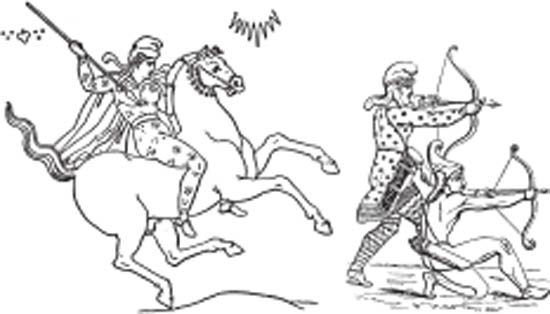
FIG. 14.2. Amazons, nomadic women warriors adept with javelin and bow, as portrayed in classical Greek art. They wear leopard skins, tunics, leggings, and Persian-Phrygian “liberty” caps. Drawings from vase paintings in Bulfinch, Age of Fable, 1897 and Smith 1873.
After the Mithradatic Wars, as anecdotes from the last stage of the seemingly endless conflict circulated in Italy, even the Romans thrilled to the story of Mithradates and Hypsicratea. Within a generation or so, their companionship had become a romantic tale of noble courage, adventure, and abiding love. In the imagination of Valerius Maximus, writing in the early first century AD, Hypsicratea was “a queen who loved Mithradates so deeply that for his sake she lived like a warrior, cutting her hair and taking up arms to share his toils and dangers.” When Mithradates was “cruelly defeated by Pompey” and fleeing among “wild peoples, she followed him with body and soul indefatigable.”11
In later tales of chivalry, Hypsicratea’s renown blossomed. She was the first in a long line of female pages, heroines in male disguise, featured in fairy tales, ballads, and Shakespearean plays. Medieval chroniclers depicted the king and the Amazon as friends and equals, and their love exemplified an ideal conjugal relationship. Boccaccio (1374) imagined Hypsicratea “choosing to make herself as tough and rugged as any man, journeying over hill and dale, traveling by day and night, bedding down in deserts and forests on the hard ground, in perpetual fear of the enemy and surrounded on all sides by wild beasts and serpents.” Mithradates’ comrade, wrote Boccaccio suggestively, “soothed him with the pleasures she knew he longed for.”
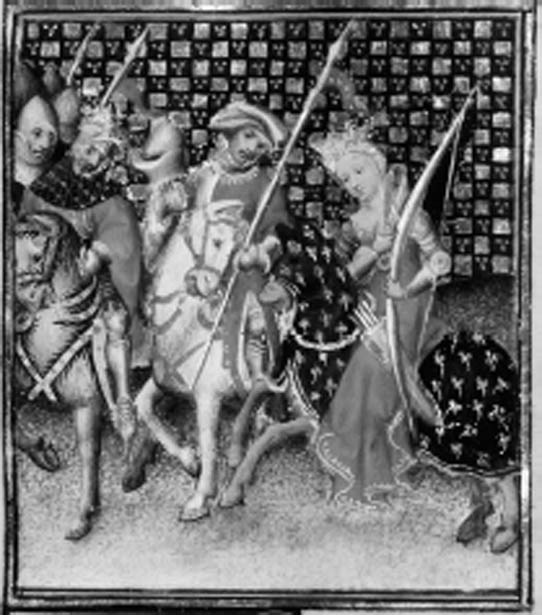
FIG. 14.3. Mithradates flanked by Hypsicratea (and Bituitus?). Des dames de renom, De mulierbus claris/Hypsicratea, Français 598, folio 116, Bibliothèque National de France.
Hypsicratea was included in the City of Ladies, a celebration by Christine de Pizan (b. 1364) of women who were the equals of men in war strength, intellect, and ingenuity. Like Boccaccio, Christine sympathized with Mithradates’ struggle, reflecting the negative European image of the Roman Republic’s avarice and antagonism toward popular monarchs. “The Romans waged a terrible war on Mithradates,” wrote Christine. “The fate of the kingdom was at stake and the threat of death at the hands of the Romans ever present,” yet Hypsicratea “travelled everywhere with him to far-off places and strange lands.” Christine pictured her as a courtly lady “made for softer living,” cutting off her “long, golden hair to disguise herself as a man,” giving “no thought to protecting her complexion from sweat and dust.” For love of Mithradates, Hypsicratea transformed her “graceful body” into that of a “powerfully built knight-in-arms” clad in helmet and “weighed down with a coat of chain mail” (see plate 2).13
In reality, of course, Hypsicratea was a robust horsewoman-warrior from a Eurasian nomadic culture in which girls and boys learned to ride, hunt, and make war together.
TAKE THE MONEY AND RUN
In the hills above the battlefield, Mithradates, Hypsicratea, and their two comrades caught their breath. The others were not named by Plutarch. Perhaps one was Bituitus, a cavalry officer from Gaul, praised for fighting valiantly by the king’s side. Maybe the other was Gaius son of Hermaeus, a childhood friend, or General Metrophanes. The band of four walked their horses on rough trails away from the battlefield. Other survivors of the Moonlight Battle joined them, a few cavalry and about three thousand on foot. Mithradates had lost nearly ten thousand in Pompey’s night attack, yet he and his most faithful followers had emerged from the ordeal.
Mithradates led this ragtag group to Sinora (Synorion, “Borderland”), his fortified treasury on the border of Armenia. Near a Turkish village still known as Sunur or Sinuri (“Border”), archaeologists have discovered the ruins of Sinora’s strong tower. Here, the fugitives were welcomed by Drypetina and the eunuch Meniphilus. In the Middle Ages, Drypetina’s devotion became an icon of filial love. “The girl was extremely ugly,” wrote Christine de Pizan, but “she loved her father so much that she never left his side.” As queen of Laodicea, Drypetina “could have lived a safe and comfortable life. . . . but she preferred to share her father’s sufferings and hardships when he went to war. Even when he was defeated by the mighty Pompey, she did not abandon him but looked after him with great care and dedication.”14
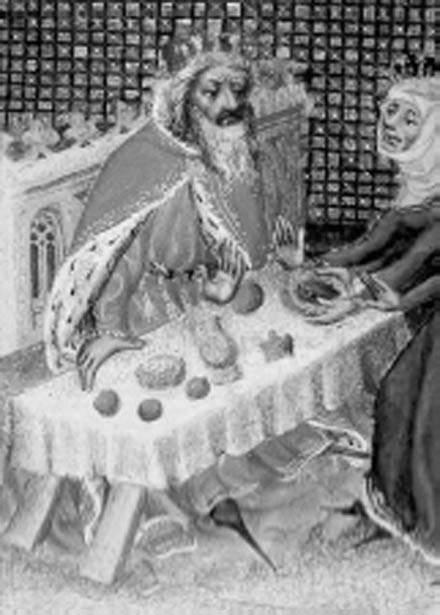
FIG. 14.4. Drypetina serves Mithradates a meal at Sinora. Des dames de renom, De mulieribus claris/Drypetin, Français 598, folio 113v, Bibliothèque Nationale de France.
The atmosphere at Sinora was fraught with anxiety and foreboding, but Mithradates had already devised a plan. He sent a messenger to Tigranes to request refuge again in Armenia. Mithradates needed to move fast: Pompey would soon pick up their trail. Sinora’s great treasure was essential. But how to transport the heavy load of money and goods? Mithradates’ wealth was useless—unless it could somehow be made portable. He had no pack animals, only some cavalry horses and a few thousand loyalists.
For Mithradates, as he had vowed, it was all for one, one for all. His solution was ingenious and generous. The king gave all that remained of his riches to his followers, thereby distributing the burden—and possession—among the many. Cedar chests filled with sumptuous raiment and jewelry were flung open. The king handed out robes, bracelets, necklaces, and rings to his soldiers. He then pried open bronze caskets filled with 6,000 talents’ worth of gold and silver coins (equal to a year’s pay for about 100,000 soldiers). He divided the coins, giving much more than a year’s pay to each follower and generous rewards to senior veterans. The rest was stuffed in leather saddlebags. In efficiently and equitably dispersing his treasure, Mithradates’ solution recalled Alexander, who had shared his possessions with his loyal troops. It was also a remarkable testament to the mutual trust and loyalty of Mithradates and his followers—his kingdom was lost, yet they would follow their leader into danger and exile for the rest of their lives.
Next, Mithradates and the eunuch Meniphilus went to the citadel’s apothecary and prepared poison pills. Plutarch reported that before departing Sinora the king gave Hypsicratea and “each of his friends a deadly poison to carry with them, so that none of them would fall into the hands of the Romans against their will.”15
The fugitive army must have been a bizarre sight: Mithradates’ battered armor topped with a purple cape, the Amazon draped in unaccustomed finery, and each foot soldier and rider decked out like royalty in fancy cloaks, gold and silver bangles, and bulging money belts. There had been a slight change in plans. Tigranes, worried about Roman retribution (and against the advice of his queen Cleopatra, Mithradates’ daughter), refused to shelter Mithradates in Armenia again. In fact, Tigranes had put a price on his old friend’s head. Mithradates couldn’t decide whether to be insulted or amused by the stingy reward Tigranes was offering for his capture: a mere one hundred talents. This was less than what Mithradates had offered for his enemies Chaeremon and his two sons back in 89 BC.16
Mithradates revised his escape plan. The outlaw army marched day and night north, beyond the headwaters of the Euphrates River. Some of Mithradates’ troops, natives of these mountains, served as guides. The region was teeming with snakes deadly to strangers (locals were not bothered by the venom). By hidden forest paths they passed through the land of the king’s allies the Heniochoi and the Turret-Folk. Three days later the group reached Colchis. At Phasis, they might have been reunited with the eunuch Bacchides and the pirate Seleucus, who had sailed to Colchis after the fall of Sinope in 70 BC. Here, Appian tells us, Mithradates halted to “organize and arm his forces and those who joined him,” Turret-Folk, Heniochoi, Iberi, Albanoi, and perhaps the Soanes of the noxious arrow poison, and the strange tribe known as the Lice-Eaters.17
IN THE LAND OF THE GOLDEN FLEECE
Mithradates’ army crossed the Phasis River. In the grassy meadows strutted beautiful golden-red birds with iridescent blue-green heads and long tail feathers. The “Phasian” bird, known today as pheasant, was prized for its succulent dark meat. Mithradates led his army further north: the road ended where the Caucasus range met the Black Sea. Here they camped for the winter of 66/65 BC, at Dioscurias, a market town with a mild climate.
Early in his reign, Mithradates’ army had tried to subdue the “wild” Achaeans in the mountains here, but he lost many men to ambushes and freezing cold. Since boyhood, Mithradates had been steeped in the mythology of this land. Somewhere in the alpine meadows above his camp Medea had once gathered magical plants and liquid fire. On a snowy crag in the Caucasus, Hercules freed Prometheus from his iron chains. The quest for the Golden Fleece ended here—ancient authors explained how the Colchians used lambskins to collect fine gold dust carried by streams flowing down from the Caucasus.18
During this strategic retreat, says Appian, Mithradates “conceived of a vast plan—a strange one for a fugitive on the run!” Pompey was closing in on Colchis, intending to trap Mithradates between the sea and the impassable mountains. Yet, marvels Appian, the irrepressible Mithradates pursued his “chimerical project” with supreme confidence and energy. The plan was indeed remarkable. Pantikapaion in the Crimea would become the new center of his Black Sea Kingdom. The Bosporus was presently in the hands of Machares, Mithradates’ last living son by Laodice, his sister and first wife. Sadly, Machares had inherited her treacherous ways, making peace with Lucullus while his father fought for his life and realm. So Mithradates “planned to take back the kingdom he had given his ungrateful son and confront the Romans once more.” The Black Sea itself was no longer in Mithradates’ control, but most of the lands around it were allies. So the first step of his master plan was to trek overland counterclockwise around the Black Sea. Rounding the Sea of Azov, Mithradates would march across Scythia and Sarmatia, down to the Crimea. All along the way, of course, he would gather more followers and allies.19
It sounds feasible on paper, but a glance at a topographic map reveals the plan’s breathtaking audacity (see map 5.1). Mithradates intended to cross over the Greater Caucasus Mountains, the monolithic barrier between Europe and Asia, stretching nearly a thousand miles from the Black Sea to the Caspian Sea. The highest peaks are eighteen thousand feet. Mithradates and his little army would attempt the crossing in early 65 BC, braving snow and ice, precipitous trails, and the danger of avalanche (see plate 7).
The final phase of this grand scheme, declared Appian, was even more audacious. After reclaiming the Bosporan Kingdom, Mithradates planned to take Rome by surprise. He would wage war on them from Europe while Pompey was still stuck in Asia. With his multitudes, he would march west, across the lands of the friendly Roxolani and Bastarnae, around the Carpathians to the Danube. His ever-growing army would push northwest across Pannonia, and then, repeating the feat of Hannibal, Mithradates would cross the Alps and invade Italy from the north.
CAT AND MOUSE IN COLCHIS
While Mithradates contemplated his grand strategy, where was Pompey? After the Moonlight Battle, Pompey’s movements in 66/65 BC are confusing in the ancient sources, but one can reconstruct a rough chronology. Appian and Plutarch say that Pompey pursued Mithradates with major difficulties. In the land of the Turret-Folk, he lost a thousand men to poison honey, as we have seen. Reaching Colchis in fall of 66 BC, Pompey heard rumors of Mithradates’ intention to escape over the Caucasus.
In Pompey’s mind he had already won the war. Mithradates, he reasoned, had been driven out of his kingdom for good, his son Machares was now Rome’s friend, and the Roman fleet owned the Black Sea. Pompey could not imagine that anyone, especially an old man of seventy, recovering from recent war wounds, could survive a journey over the mountain barrier. Assuming that Rome’s mortal enemy was doomed to an ice coffin, Pompey decided to indulge in some military tourism at the edge of the “civilized” world. He prided himself on being the first Roman to claim this fabled territory. He was eager to see for himself the haunts of Hercules, Prometheus, and the Argonauts, and to retrace Alexander’s route south of the Caspian Sea.20
Unsure of Mithradates’ whereabouts, Pompey’s expeditionary force marched east along the Phasis and Cyrus rivers. Skirting the foothills of the Caucasus, they encountered warlike bands, proud to have resisted the Medes, Persians, and Alexander. Now they were highly motivated allies of Mithradates. Iranian-influenced, they worshipped the Sun and Selene (Moon), and, noted Strabo, they “assembled by the tens of thousands whenever anything alarming occurs.” Halfway between the Black and Caspian seas, at Armazi, the ancient fort overlooking the confluence of the Aragus (“fast water”) and Cyrus rivers (near Tbilisi, Georgia), Pompey made winter camp, surrounded by the hostile Iberi and Albanoi.
While the Romans were celebrating Saturnalia, a jolly winter holiday of role reversals and heavy drinking, the Iberi, Albanoi, and allied bands ambushed the camp. The skirmishes were described by Appian, Plutarch, Strabo, and Cassius Dio. The barbarians numbered sixty thousand on foot and twelve thousand mounted. To the Romans, these tall, handsome people appeared “wretchedly armed, wearing the skins of wild beasts.” They were formidable guerrilla fighters who attacked, then took cover in the forest.21
Pompey methodically set the forest on fire, to drive them out. After the battle, stripping the nearly nine thousand dead bodies, the Romans discovered many women warriors with typical Amazon weapons and clothing, just like what was depicted in Greek vase paintings (see fig. 14.2). Their wounds showed that their bravery matched that of the men. Female fighters were also found among the thousands of captives. According to Strabo, Amazons dressed in wild animal skins inhabited these mountains and the steppes beyond. In detailing the Amazon lifestyle, Strabo stated that his information came from the writings (now lost) of Mithradates’ old friend the philosopher Metrodorus and from someone by the name of Hypsicrates (the masculine version of Hypsicratea) who was quite “familiar with this region.”
As noted earlier, “Amazons” referred to Eurasian groups in which both women and men hunted and made war. Since the nineteenth century, archaeologists have discovered numerous graves containing the skeletons of women warriors buried with their weapons in the same regions where the ancients located Amazons. It was said that Alexander the Great had met the Amazon queen Thalestris and her three hundred women warriors here, between the Phasis and the Caspian Sea, the very region now traversed by Pompey. According to the tale, Alexander had devoted thirteen nights to gratifying the queen’s desires. Now the Amazons were fighting on Mithradates’ side! Pompey was eager to show off these captive women warriors in his Triumph.22
Pompey’s winter camp was selected for its strategic location. Cassius Dio says Pompey occupied the citadel of Armazi (built in the third century BC) in order to “secure the nearly inpenetrable pass” over the mid-Caucasus, the main route between Scythia and Armenia. Armazi also blocked the way to the eastern end of the Caucasus. The citadel’s massive blocks can be seen today; the ancient bridge is still called “Pompey’s bridge.” In spring of 65 BC, assuming he was “master of the pass,” Pompey left a garrison there and ordered the Roman fleet to patrol the eastern Black Sea coast on the lookout for Mithradates. Then Pompey marched toward the Caspian, to explore and perhaps to assure himself that Mithradates had not somehow slipped around the eastern end of the mountains (through modern Azerbaijan and Dagestan). But Pom-pey was soon forced to turn back. The ground was crawling with deadly snakes, scorpions, and tarantulas.23
Filled with “wrath and resentment” (Plutarch’s words), Pompey now had to retrace his route. Struggling across the flooded Cyrus, his army revisited hostile territory: the Albanoi, Iberi, and their friends had risen up again. After a series of frustrating skirmishes, Pompey decided to try to pick up Mithradates’ trail. That summer, Pompey headed east again, fighting his way through “unknown and hostile tribes” along the Phasis to the Black Sea. Here, perceiving that Mithradates could not have escaped to the Crimea either by boat or by following the coast north, Pom-pey gave up the chase.24
Pompey’s seemingly aimless wanderings are best seen as a game of cat and mouse. Mithradates seemed to have vanished into thin air. Pom-pey was trying to intercept or locate his prey’s three likely escape routes out of Colchis: around the mountains by the Caspian Sea, along the Black Sea coast, or over the daunting pass at the highest point of the Caucasus—the pass Pompey thought he had blocked. But, as we shall see, the mouse enjoyed all the advantages and managed to slip away through a secret “mouse-hole,” virtually under the cat’s nose.
TIGRANES SURRENDERS, PONTUS OCCUPIED
Pompey now crossed the Lesser Caucasus range into northern Armenia, to attack Tigranes’ stronghold, Artaxata. His men suffered severe hardships, thirst, and ambush, because the guides—Albanoi, Iberi, and Amazon prisoners of war—deliberately misled him.25
In Artaxata, Tigranes, nearly seventy-five years old, had lost his will to fight. His son Tigranes (Mithradates’ grandson) had revolted, and it looked as though his old friend Mithradates was beaten at last. Tigranes accepted Pompey’s terms, prostrating himself on the ground and handing over his tiara in ancient Persian fashion. In exchange for six thousand talents and the surrender of Mesopotamia, Syria, and Phoenicia, Tigranes was pardoned. He ruled Armenia as a Friend of Rome until his death at age eighty-five in 55 BC. “Mithradates, he died old” is the familiar refrain, but Mithradates’ friend Tigranes would die even older.26
Considering the Mithradatic War won at last, in late 65 BC Pompey returned to Pontus and founded Nicopolis (“Victory City”) on the battlefield near Dasteira where he had defeated Mithradates by moonlight. He traversed Pontus seizing fortresses and treasures that “would add splendor to his triumph.” The vaults at Talaura yielded cups of onyx and gold, splendid furniture, bejeweled armor and gilded horse bridles, Persian antiques, and the treasure from Cos—including the precious cloak of Alexander the Great.27
When the Romans stormed Sinora Tower, the eunuch Meniphilus feared that his mistress Drypetina would be raped. He killed her and then himself with his sword. Several royal concubines were captured in other strongholds and brought to Pompey—Plutarch points out that he refrained from raping them. Stratonice, certain that she would never see her king alive again, surrendered Kainon Chorion to Pompey. In exchange for a promise to spare her young son Xiphares, she revealed the underground vault filled with Mithradates’ treasure and archives. Stratonice and Xiphares were allowed to sail to Phanagoria on the Taman Peninsula. They joined other members of Mithradates’ family there, overseen by Machares.28
Pompey spent long hours poring over Mithradates’ private papers, for they “shed much light on the king’s character.” Curiosity ran high about the man who had defied Rome for so many decades. Rumors and speculations arose later about what state and private secrets these documents revealed. Did Pompey discover the Mithridatium recipe? The papers were shipped to Rome to be translated into Latin verse by the freedman Cn. Pompeius Lenaeus, Pompey’s learned Greek secretary. Lenaeus’s life exemplifies the rapidly shifting fortunes of many in the Mithradatic Wars. Captured as a boy of twelve, during Sulla’s siege of Athens in 87 BC, Lenaeus somehow escaped and returned to Greece to study. He was recaptured but freed by Pompey, whom he accompanied on all his campaigns. It would be fascinating to read Lenaeus’s character sketch of Mithradates—but, sadly, that work and all of Lenaeus’s writings are lost.29
None of Mithradates’ archives, which passed through the hands of Pompey, Lenaeus, Plutarch, and Pliny, are extant. In the first century AD, Plutarch and Pliny consulted the original writings. The notes, according to Plutarch, named victims of Mithradates’ poisons and included interpretations of the dreams of the king and his lovers. There were sheaves of royal and personal correspondence, including the racy love letters penned by Mithradates and Monime.
Plutarch says that Pompey shrugged off pursuing Mithradates beyond Colchis because—just as Lucullus had warned—the king was far more slippery in flight than in battle. Lucullus’s premonition, that Mithradates’ strength could multiply a thousandfold if he escaped to the Caucasus, was more accurate than Pompey realized. Remarking that “famine” would finish off Mithradates, should he somehow survive the mountain snows, Pompey established a blockade to cut off trade to the Bosporus (apparently forgetting that the Crimea had access to abundant fish and grain). Then Pompey set off to embellish his résumé of conquests, from the Atlantic Ocean to the Red Sea. Leaving Pontus far behind, Pompey marched south to subdue Commagene, Cilicia, Phoenicia, Syria, and the lands of the Arabs and Jews.30
THE TREK OVER THE CAUCASUS MOUNTAINS
While Pompey was traipsing around Colchis, Mithradates accomplished his most daring exploit, crossing the Caucasus Mountains in early 65 BC. To the great surprise of his son Machares, Mithradates and his army suddenly appeared in the capital of the Bosporan Kingdom that summer. Four ancient historians provide imprecise, contradictory information on Mithradates’ route over the mountain barrier and around the Sea of Asov to Pantikapaion (unfortunately, Livy’s account has not survived). Mithradates’ stunning feat was a mystery in antiquity and remains a puzzle today. Drawing on the ancient evidence and topographical conditions, I propose a mountain trek that differs from the coastal route accepted by historians since Reinach in 1890.
Cassius Dio said Mithradates “outstripped Pompey’s pursuit, fleeing by the Phasis River” to “reach the Sea of Azov and the Bosporus on foot.” Plutarch says he traveled all the way around the Sea of Asov and down to Pantikapaion. Strabo states that Mithradates “despaired of the route north of Dioscurias [the Klukhor Pass] owing to the rugged mountains and ferocious inhabitants, the Zygi,” and “embarked on another route, along the sea, traversed with great difficulty.” Perhaps because he himself was uncertain, Strabo’s passage is ambiguous: the Greek word for “embark” can mean “to set off marching” or “to set off in boats” (English has similar dual meanings for “embark,” and “launch an attack”). Both translations appear in scholarly translations of Strabo’s passage. A further difficulty is that Strabo claims the Achaeans were friendly to Mithradates; Appian says they were hostile.
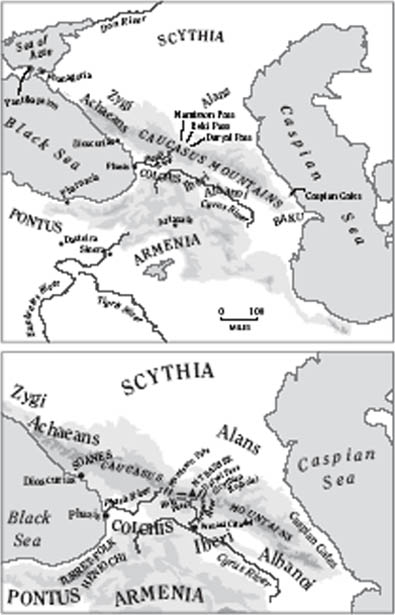
MAP 14.1. Caucasia, between the Black and Caspian seas: Pontus, Armenia, Colchis, Scythia. (Top) Pursued by Pompey, Mithradates escaped from Pontus into Colchis, reaching Pantikapaion by way of Daryal Pass into Scythia, across the Don River and around the Sea of Azov. (Bottom) Detail of Mithradates’ probable route over the Caucasus Mountains. Map by Michele Angel.
It is Appian who offers the most specific details. In describing Machares’ shock at his father’s unexpected arrival, Appian states that Mithradates traveled over the pass known as the “Scythian Keyhole, which no [army] had ever done before,” and then journeyed through the lands of strange Scythian tribes around the Sea of Asov and the River Don, arriving in Pantikapaion.31
Mithradates had several options to consider. He rejected the Klukhor Pass north of Dioscurias because of forbidding topography and fierce Zygi (rumored in antiquity to be cannibals). The Caspian Gates pass at the far eastern end of the Caucasus range was nearly nine hundred miles distant. And the Iberi, Albanoi, and other allies would have advised him that the way east was blocked by the Roman garrison at Armazi Citadel, and that Pompey’s army was exploring near the Caspian. Armazi also controlled the main approach to the high pass over the central Caucasus, the Scythian Gates mentioned by Appian.
Believing that crossing the central Caucasus, as implied in the other three sources, was impossible for even a small army, Reinach interpreted Strabo to mean that Mithradates marched along the shore from Dioscurias, emerging at the Taman Peninsula (this raises the question of why Mithradates would then travel all around the Sea of Azov instead of going directly to Phanagoria and Pantakapaion). By Reinach’s day a modern road had been dynamited above the sea coast. But in antiquity, there was only a narrow strip of beach obstructed by deep gorges, marshes, and sheer cliffs. Reinach imagined that Mithradates and his army bypassed these obstacles by taking camarae (dugout kayaks) provided by friendly “pirates” (the Achaeans).
Reinach’s route entails several drawbacks. An army of three thousand, stretched out single file along the narrow beach, would be vulnerable to attack by Zygi and Achaean bandits. As Appian and others state, the Achaeans could not be counted on; this rugged coast had never been pacified as part of Mithradates’ Black Sea Empire. Moreover, according to Strabo, each camara held only twenty-five people, requiring more than one hundred dugouts for Mithradates’ army and equipment. And Pom-pey’s navy was patrolling the coast, looking for Mithradates. If Reinach’s theory is correct, this would have been an impressive feat. But I suggest that the route described by Appian, the pass over the mid-Caucasus known as the “Scythian Keyhole,” is the more likely route. This would take Mithradates on foot through friendly tribes, to the heartland of the Scythian tribes around the Sea of Asov, matching the details preserved by Cassius Dio and Plutarch.32
The so-called Scythian Keyhole (or Gates) was only a faint rumor for Romans at the time, but in fact it was the most reliable way over the Caucasus, the major migration route for Eurasian nomads, traders, and invaders. The Persians had named this strategic pass Daryal, Dar-e Alan, “Gate of the Alans,” one of the nomadic tribes of Scythia whose territory lay over the pass (Tigranes’ mother was an Alan; the region is now Alania-North Ossetia). Fortification ruins dating from 150 BC or earlier, mentioned by Strabo, are still visible in the pass. The Daryal’s narrow defile with vertical walls accounts for its ancient nickname “Scythian Keyhole.” Famed for its wild grandeur, the Daryal Pass is featured in romantic Russian art and literature. The Georgian Military Road (begun in 1799) follows (and obliterates) the ancient route. Today, this region is violently contested by Georgia, Russia, Chechnya, Ossetia, Ingushetia, and others.33
The main route to the Scythian Keyhole/Daryal followed the Aragus River up from its confluence with the Cyrus to the Daryal Gorge. Pom-pey had secured this approach, guarded by Armazi Citadel. But he was unaware that there was an alternate route, a “back way,” to the Daryal Pass.
From Dioscurias, a march of less than 150 miles would take Mithradates to a lesser-known trail (near modern Kutaisi), separated from Pom-pey’s garrison at Armazi by 100 miles of rugged foothills. Described by Strabo, this steep, winding path followed the Phasis River to its source in the Caucasus. The route crossed 120 footbridges over rushing torrents and yawning gorges to the Mamisson (Mamisoni) Pass, at an elevation of nearly 10,000 feet (the Ossetian Military Road, built in 1854–89, followed this ancient route). After crossing another pass (Roki, 9,800 feet, in South Ossetia, ancient Iberia), this path joined the main route to the Daryal Pass (about 8,000 feet). I propose that this daunting route, avoiding hostile tribes and the Roman navy, and bypassing Pompey’s garrison at Armazi, was Mithradates’ only hope of escape.34
Pompey and the Romans believed it was certain death to attempt to cross the massive wall of eternal snows at the edge of the known world. But Mithradates’ plan—though extremely dangerous—was not as unrealistic as it seemed. Many of his warriors—including Hypsicratea—were recruited from Caucasia. They were already familiar with this traditional migration route, and they were used to cold weather at high altitude. Indeed, it may have been their local knowledge that led Mithradates to camp at Dioscurias and to cross at Daryal, taking the lesser-known route up the Phasis River. Mithradates could also have learned of this important pass from his Scythian allies and his study of Cyrus the Great, who was the first to fortify Daryal.
The Caucasus is one of the most linguistically and ethnically diverse regions in the world. According to Strabo, seventy tribes—speaking seventy dialects—dwelled in the high Caucasus, living on milk, wild fruit, and game. In the winter, says Strabo, these peoples came down from the mountains to camp at Dioscurias and barter for salt and other goods (the northern branch of the Silk Route linked the Caspian and Black seas).35 We know that in the winter of 66/65 BC, Mithradates was camped at Dioscurias. It follows that he learned the logistics of the Daryal and other passes from these mountaineers, benefiting from their survival tips and scouts.
Mithradates’ experiences with winter battles in Achaea and Cyzicus, and the battles on ice fought by his general Neoptolemus in the Bosporus, as well as details in Xenophon’s March of the Ten Thousand, could have helped him to anticipate the dangers of crossing the high snowfields. Xenophon had trekked forty-five miles over snowbound mountains from Armenia to Pontus, a shorter journey at a lower elevation but with a much larger army. He was harassed by hostile tribes, something Mithradates could avoid. The freezing north wind cut Xenophon’s men’s faces like a knife; many animals and soldiers were lost in snowdrifts. The men suffered frostbite and snowblindness. Remove your boots at night and shade your eyes with dark cloth, advised Xenophon.36
In planning his mountaineering expedition, Mithradates enjoyed three crucial advantages over Pompey. His small army was lightly armed, mountain trained, and locally supplied; the Iranian-influenced tribes in the central Caucasus were his allies; and he possessed local information and friendly guides.
According to Strabo, the strenuous passage through the Daryal Pass was a journey of about 130 miles, perhaps a week in good weather. But 2,000 or 3,000 people traveling single file would stretch out at least 5 miles. Mithradates’ crossing may have taken a month. Although the elevation of this route is consistently higher than the highest passes of the Alps, Strabo remarked that this pass could be traversable by early spring—but only with the right equipment. In Dioscurias, Mithradates could provide his army with winter clothing and boots, dried food, and hardy pack animals, all paid for with gold coins from the Sinora hoard.
Snow gear could be obtained from the mountain people wintering in Dioscurias. For ascending the summits, Strabo described their snow-shoelike footwear: “The people fasten to their feet broad ‘shoes’ made of rawhide, like drum covers, furnished with spikes to grip the snow and ice.” Others “tie large spiked wooden disks” to their boots. For transporting loads, they made sleds of animal hides. On this route, continued Strabo, “whole caravans are often swallowed up in the snow by extremely violent blizzards” and avalanches. For this reason, says Strabo, travelers carry long, hollow sticks, which they can push to the surface of snow drifts to breathe and signal their location so they can be dug out. He also told how to find drinking water trapped in large air bubbles under the ice and even mentioned the clouds of tiny, high-altitude insects that hatch in the snow.37
Mithradates’ allies would have kept him informed about Pompey’s movements in the winter and spring of 65 BC. Pompey’s early spring expedition to the Caspian provided Mithradates the opportunity to sneak up to the Daryal Pass, avoiding the garrison at Armazi.
The adventure of setting off once again into the unknown was reminiscent of Mithradates’ previous daring journeys with loyal entourages. Now he was about sixty-nine years old, vigorous and optimistic, this time accompanied by the love of his life, Hypsicratea. Let us follow them as they ascend the trail north along the Phasis torrent. The oak, almond, and maple trees give way to beech, spruce, and pine. Golden finches flit through the forest. The band crosses alpine meadows dotted with the first purple primroses and cobalt gentians of spring. The path begins to climb, crossing stone bridges over tremendous waterfalls and gaping gorges, up steep switchbacks. Each night, the long line of soldiers make campfires; they sleep wrapped in furs wherever they have halted on the narrow trail.38 There is game to hunt (ibex, mountain goats, hares), but there are dangers too: bears, Persian leopards, wolves, and frostbite, blizzards, and avalanches.
Here and there, the travelers glimpse Caucasian wallcreepers, tiny crimson birds often mistaken for butterflies clinging to the sheer granite walls. Turning east, the guides lead Mithradates’ band across the dangerous ice fields of the high Mamisson Pass, then the Roki Pass. As they approach the snow line at 9,000 feet, trees disappear, the temperature drops, oxygen thins. The desolate call of the Caucasian snowcock echoes in the bare rocks. Then, as the army turns north to join the main Daryal footpath, ahead looms the 16,500-foot peak of Mount Kazbek, mantled in perpetual snows. Large Eurasian griffon-vultures soar over the black basalt crags, the fabled site of Prometheus’s ordeal. Single file, Mithradates’ army threads through the narrow “keyhole” of Daryal, two perpendicular walls of rock (the “gates”) less than 30 feet apart, surrounded by glacier-capped peaks.39

FIG. 14.5. The approach to the Daryal Gorge from the south, with Mount Kazbek looming ahead. Photo courtesy of Hans Heiner Buhr, Tbilisi, Georgia, www.hansheinerbuhr.com.
Mithradates’ trek over the highest passes of the snowbound Caucasus Mountains in early spring, with an army, was an epic journey in a long career distinguished by daring exploits. The exhilaration of accomplishing this astonishing feat, while Pompey searched in vain for his quarry on the other side of the mountains, must have restored Mithradates’ sense of invincibility and destiny.
ACROSS SCYTHIA TO THE CRIMEA
The descent through alpine pastures was relatively easy, onto the steppes of what is now south Russia. Here the enormity of the land and sky stuns the senses, with monotony so vast that it achieves majestic proportions. The sight of unbroken horizons in every direction overwhelms some travelers, but I imagine that for someone like Mithradates (and Hypsicratea), who loved to ride and hated to be boxed in, the sea of grass represented freedom. The only features on the flat prairie were kurgans, tomb mounds, some ancient, others recent. It has been said that the steppes seem incomplete without a horse and rider, and these soon appeared to meet Mithradates’ army. In the territories of “strange and warlike Scythian tribes,” says Appian, they traveled “partly by permission and partly by force, so respected and feared was Mithradates still, even though he was a fugitive” (see plate 10).40
Around the Azov and across the Don, nomadic chieftains and their bands rode out to greet Mithradates, bestowing gifts and horses and escorting him to the next territory. His reception was very different from that of Darius—it must have thrilled Mithradates to be welcomed in these immense, fertile lands of his fellow nomads. Appian points out that he was a celebrity here: his deeds were legendary, his great empire renowned, and most of all, his courage and perseverance in defying Rome deeply admired. An exuberant Mithradates renewed alliances, heartily promising to send his beautiful daughters to marry the chieftains and engaging them in his grand design to march across Europe and over the Alps to destroy the Roman wolves in their den.
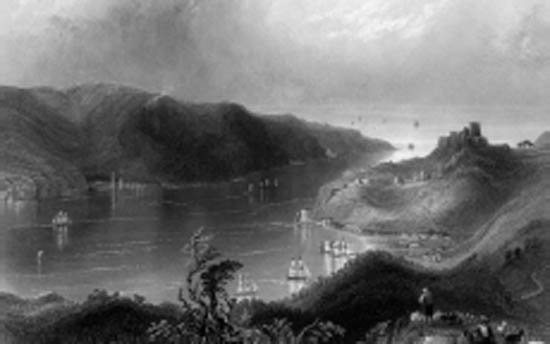
FIG. 14.6. The Kerch Straits between the Crimea (Pantikapaion) (left) and Phanagorea on the Taman Peninsula (right), looking toward the Sea of Azov. Steel engraving by W. H. Bartlett, 1838, courtesy of F. Dechow.
Meanwhile, in Pantikapaion (Kerch), Machares was stunned to hear that his father had crossed the Caucasus by way of the Scythian Gates. Knowing his father’s fearsome temper, Machares killed himself. His brother Pharnaces welcomed his father—Mithradates was often heard to say Pharnaces would be his successor. Taking charge of his Kingdom of the Bosporus and Scythia, Mithradates put to death several disloyal former friends there, including some Romans who had plotted against him. Mithradates’ eunuch Gauros was said to be the instigator of many cruel tortures and executions. True to his ideals, Mithradates spared inferiors who acted out of loyalty to corrupt superiors. There were two shocking exceptions, however. Mithradates killed a son named Exipodras for conspiracy. And he was enraged by Stratonice’s bargain with Pompey. Betrayal by sons or women he loved was unendurable to Mithradates, and his revenge was particularly spiteful. He seized their son Xiphares and killed him on the deck of a ship in view of Phanagoria’s castle. He threw the body overboard while Stratonice in her tower watched in anguish.41
In this descent into suspicion and cruelty, Mithradates resembled Alexander, who near the end of his life became violently suspicious, seeing plots and conspiracies everywhere, spying on companions and torturing friends. But perhaps Mithradates’ paranoia and fury were exacerbated at this time by a serious illness. According to Appian, the king withdrew from public view because of an outbreak of nasty ulcers on his face. For some time, he remained inside his palace on the acropolis (Mount Mithradates) overlooking Pantikapaion. Only three eunuch-doctors were allowed in his presence. Had the king been poisoned?
This intriguing ancient medical mystery has not been seriously investigated by modern historians. Duggan supposed Mithradates suffered a rash caused by “strange food eaten during his terrible journey.” It seems more likely that the lesions resulted from a severe case of frostbite, from the trek over the Caucasus. Frostbite causes the skin to blister and redden, resulting in hard, purple-black areas of necrosis and gangrene.42
Another strong possibility is that the facial ulcerations—as well as the episode of acute paranoia—were the result of long-term ingestion of arsenic, part of Mithradates’ antipoisoning regimen. Prolonged exposure to arsenic can cause bouts of mental imbalance, hallucinations, and paranoia. Arsenic also causes keratoses, which progress after ten to twenty years to skin cancers. Notably, frostbite causes arsenic-related skin cancers to putrify. Frostbite, combined with a lifetime of tiny doses of arsenic and other photosensitizing toxins such as rue and Saint-John’s-wort, appears to be the best explanation of Mithradates’ skin ailment.43 Appian says the ulcers were “healed” (or perhaps covered up) by the eunuch-doctors. It is unknown how long Mithradates remained out of the public eye—apparently some months—curtailing crucial face-to-face contact with his followers.
PETITION FOR PEACE
Mithradates usually went to war as a last resort after what he saw as rejection of his attempts to negotiate with the Romans. Now that he had regained the Bosporan Kingdom and in light of recent events (including Tigranes’ humiliating surrender to Pompey), Mithradates first considered options for avoiding further wars with Rome. He felt optimistic that he could make a deal similar to that given to Tigranes. So it came to pass that while Pompey was busy annexing Syria in 64 BC, he received a message from Mithradates. Not only was the indestructible renegade king alive in the Crimea, but he had kept track of Pompey’s movements.
Mithradates promised that if Rome would restore his paternal Kingdom of Pontus, he would pay tribute to Rome. His request asked for nothing more than what Tigranes had received. But Pompey rejected the petition—demanding that Mithradates pay obeisance in person as Tigranes had done. Understandably wary and characteristically proud, Mithradates refused. But he offered to send an adult son (probably Pharnaces, his designated heir) to petition Pompey.
DENIED
Pompey rejected this offer too. Ignoring Mithradates, he pushed further south, seeking adventure and glory. He made war on the Jews in Palestine, capturing their king and the holy city of Jerusalem. In late summer of 64 BC, Pompey attacked the Nabataean Arabs in Petra (Jordan). Some of his soldiers began to murmur that their general was evading his patriotic duty to destroy Rome’s real enemy, Mithradates. They had heard rumors that the “new Hannibal” was preparing to march a new army across the Alps to invade their fatherland.44
Indeed, Mithradates always had contingency plans and usually found the means to carry them out. He had “fought the Romans over a period of 46 years with intermittent successes,” wrote the historian Justin. He had suffered “defeat before Rome’s greatest generals—only to rise again greater and more glorious than before in renewing his struggle.” As Cassius Dio remarked, “relying more on his willpower now than on his actual power, Mithradates did not falter.” Sustained by his dream of saving the East from Roman rule and by his own astonishing resilience, Mithradates prepared to make war for what would prove to be the last time.
His illustrious ancestors must have been much on his mind at this point in his life. Darius had sent spies to Italy and contemplated an invasion of Carthage, Persia’s great rival empire across the Mediterranean. Alexander, who dreamed of conquering all India, had persevered despite great dangers and obstacles. Like his hero, Mithradates had suffered grievous wounds and shared hardships and treasures with his soldiers, “drinking from rivers fouled with blood, crossing streams bridged by corpses, surviving on grass and seeds, digging through snowbound mountains,” sailing rough seas, and traversing parched lands. Yet, inspite of all the setbacks dealt by Fortune, all the “sieges, pursuits, revolts, desertions, riots of subject peoples, and defections of kings,” Mithradates, like Alexander, set his mind on “high enterprise,” clung to his “high hopes [and] refused to submit to defeat.”45
Believing that his request to rule peacefully in his homeland of Pontus was unfairly denied, Mithradates had three options: surrender, flee, or attack. Accept Pompey’s unconditional terms, groveling like Tigranes? Out of the question. Mithradates rejected flight, too, but if he stayed, war with Rome was inevitable. He chose a bold offensive strategy. The king resumed his Hannibalistic plan to invade Italy.
Appian called this scheme “chimerical.” Modern historians debate whether it was a rational strategy or the sign of a desperate, even deranged mind. McGing, analyzing Mithradates’ foreign policy, wondered whether the “wildly unrealistic” plan was invented by the Romans or Pharnaces to paint Mithradates as a would-be world conquerer. But, notably, in 74 BC, when the Senate financed Lucullus’s campaign, Rome had believed that Mithradates intended to invade Italy by sea. It is telling that Roman historians of this era argued over whether or not Alexander the Great could have successfully invaded Italy, as Hannibal had done. As we saw, Mithradates had promised the Italian rebels that he would come to help them when the time was right. Some Romans thought his invasion plan was feasible. In the Senate, Cicero declared that Mithradates, despite “having lost his army and having been driven from his kingdom, is even now planning something against us in the most distant corners of the earth.”46
Adaptability, surprise, and creativity were strong features of Mithradates’ character. Duggan saw the plan as the “stupendous fantasy of a solitary mind,” yet he appreciated the logic of it. From the Crimea, it was an easy march across friendly lands to the mouth of the Danube. Following the Danube to the Alps was a journey of about six hundred miles—half the distance Mithradates’ beleaguered band had traveled from Pontus to Colchis and on to Pantikapaion. After the first obstacle, the Iron Gates gorge in the Carpathians, the Alps crossing (over Brennus Mons, Brenner Pass, 4,500-foot elevation) would be easy compared to that of the Scythian Keyhole in the Caucasus. One would emerge in the lands of the Gauls and Etrurians, chafing under Rome’s rule. Reinach also recognized the feasibility of the plan. Who could predict what would happen, he asked, if suddenly a vast army of 100,000 barbarians, led by an invincible and brilliant king, appeared on the plains of northern Italy?47
“By nature attracted to grand projects,” wrote Cassius Dio, Mithradates considered his many victories and failures and decided, “nothing ventured nothing gained.” Should he fail, “he preferred to perish along with his kingdom, with pride, honor, and liberty intact.” Mithradates directed his commanders, Roman officers, and Pharnaces to prepare for war on Italy. They levied heavy tributes and taxes to make up for the loss of his wealth in Pontus, began a massive fort-building program, and drafted workers and soldiers. By 64 BC, his new army numbered six thousand crack troops trained in Roman-style fighting and “a great multitude of others”—steppe nomads, mountain fighters, archers, lancers, and slingers. Mithradates minted coins at a high rate; stored grain and other supplies; cut timber for ships and seige machines; set up factories to make armor, spears, swords, and projectiles; and killed many plowoxen, whose tough sinews were needed for catapults.48
These war preparations dismayed and burdened many in the peaceable Kingdom of the Bosporus, so far untouched by Rome’s Mithradatic Wars. Then, in 64/63 BC, a frightening natural calamity—a strong earthquake—seemed to portend a regime change. Some recalled the devastating quake that had foretold Tigranes’ loss of Syria. The earthquake was described by Cassius Dio, Livy, and Orosius: it occurred while Mithradates was celebrating the festival of the goddess Demeter. The epicenter is unknown, but the tremor was severe at Pantikapaion, according to evidence discovered by Russian archaeologists in the ruins of the fortress and other structures. According to Cassius Dio, the quake was felt even in Rome. Several cities allied with Mithradates suffered destruction, which fueled anxiety about the old king’s future.49
REVOLT IN THE BOSPORUS
In order to secure both sides of the Bosporus, Mithrdates dispatched his eunuch Trypho (a Hebrew name) to take charge of Phanagoria.50 Inside the citadel, under the care of other eunuchs, were Stratonice (mourning her murdered son Xiphares) and Mithradates’ children Artaphernes, Eupatra, Orsabaris, Cleopatra the Younger, and their little brothers Darius, Xerxes, Cyrus, and Oxathres.
Things seemed to be proceeding according to plan, until an act of revenge and terror intervened. A citizen of Phanagoria rushed up and stabbed the eunuch Trypho. The killer, a Greek named Castor, incited Phanagoria to revolt. Inflamed by Mithradates’ unpopular war preparations, a mob set fire to the citadel to smoke out the royal family. Artaphernes and the children were taken prisoner. One courageous daughter—Cleopatra the Younger—resisted and escaped on a ship sent by Mithradates to rescue her.
The rebellion at Phanagoria sparked a domino effect in the Bosporan Kingdom. Mithradates distrusted his army—compulsory service under a commander perceived to be unlucky was a formula for mutiny. He quickly gathered his daughters in Pantikapaion’s harem. Guarded by palace eunuchs with an escort of five hundred soldiers, these girls were sent to the Scythian chieftains to whom they had been promised, with an urgent request that they send reinforcements to Pantikapaion. The two youngest girls, Nyssa and Mithradatis, betrothed to the kings of Egypt and Cyprus, remained with Mithradates.
Mithradates’ overbearing eunuch advisers were despised by the soldiers, because they isolated the king from his subjects and carried out purges. The caravan to Scythia was not long on the road before the soldiers killed the eunuchs and kidnapped the young princesses, intending to deliver them to Pompey for a reward. Appian expresses wonder at Mithradates’ energetic and resourceful response to these new calamities. “Although bereft of so many of his children and castles—and of his whole kingdom—and too old for war and and unable to expect any immediate help from the Scythians, there was still no trace of humility befitting his present circumstances!”51
Mithradates stubbornly pursued his idea of invading Italy by land. After all, his feat of crossing the Caucasus surpassed Hannibal’s crossing of the Alps. He knew that Hannibal’s ability to attract insurgent Italians to join him had terrified Rome. Similar opportunities for an invader of Italy existed now. As Appian points out, Mithradates knew that “almost all of Italy had recently revolted because of hatred of Rome,” and that tens of thousands had joined the Thracian gladiator Spartacus. Mithradates had long cultivated the friendship of the Gauls of Europe, who resisted Rome, and he could count on the Scythians and other northern allies. In Mithradates’ grand vision, he and an enormous army of Rome-hating warriors from the Caspian Sea to Gaul would smash the empire once and for all.
It was, acknowledged Appian, a very bold plan. If he could succeed, Mithradates would cover himself with spectacular glory. His mind filled with these ideas, Mithradates hastened to contact the Gauls.52
But his officers and soldiers, even the Roman exiles, were taken aback by the sweeping design. They began to get cold feet. The awesome scale of Mithradates’ vision was intimidating. Many shrank from the idea of waging war in a distant foreign land, says Appian, against an enemy they had not been able to overcome in their own countries. His Bosporan subjects had enjoyed autonomy for the past twenty-five years; now heavy taxes and mandatory army service seemed to contradict Mithradates’ core values and former promises. Some soldiers who had served him for years were becoming disillusioned; they had hoped to retire in the wealthy Bosporan Kingdom. The two or three thousand who had come over the Caucasus with their king each had a full year’s pay; they had hoped to make a new life. And it is worth noting that half a century separated the septuagenarian Mithradates from his rawest recruits.
Some older followers perceived the king’s grandiose plan as a suicidal exit strategy. Not unreasonably, they believed it was a sign of despair. It offered a way for Mithradates to end his life honorably, fighting for a noble lost cause rather than surrendering. How much better to die on the battlefield than to be strangled at the end of Pompey’s Triumph! Yet Mithradates was still so deeply respected and beloved for his courage, his generosity, and his unbowed perseverance that the majority of his followers remained loyal and silent about their doubts. For even in his dire misfortunes, marveled Appian, “there was nothing petty or contemptible” about King Mithradates. He was the last independent monarch left standing in the new Roman world.53
But one key figure dared to act decisively on his fears and doubts. Pharnaces, Mithradates’ favorite son and successor, was alarmed and motivated. The kingdom he was to inherit would be ruined if his father really attempted to invade Italy. Pharnaces (in his thirties) believed he could bargain with Pompey, but he had to prevent his father from carrying out his crazy plan. Pharnaces began secret talks with friends about usurping his father’s crown.
PHARNACES’ REBELLION
Pharnaces’ treachery was discovered by the omniscient Mithradates, of course. The conspirators were tortured and killed. Except for Pharnaces. According to Appian, Pharnaces was spared thanks to Mithradates’ old friend General Metrophanes. He persuaded Mithradates that it would be wrong and inauspicious to put to death the son he loved most, his designated heir. Disagreements were common in wartime, counseled the old general, but they healed once the wars were over. Perhaps Metrophanes spoke of the sorrow such an act would bring to Mithradates’ grand children, Pharnaces’ children Darius and Dynamis (“Power”).54 It seems that affection for Pharnaces and concern for the future of his kingdom overcame Mithradates’ instinct for self-preservation. Mithradates, who had lost so many and so much, pardoned his son. It was the first time he had ever forgiven a traitor. As the king retired to his bedchamber, did he have second thoughts? Or was he already reconciled to the reality that Pharnaces would become king either now or in the near future?
Pharnaces, perhaps thinking of the fate of so many of his brothers, most recently the murders of Xiphares and Exipodras, and Machares’ suicide, could not believe his father could ever truly forgive him. He sneaked to the camp of the Roman exiles and “magnified the dangers—which they well knew—of invading Italy.” Promising great rewards, Pharnaces convinced them to desert Mithradates. Then he sent emissaries to other camps and ships in the harbor and won them over too. All agreed that the next morning they would rise up and demand that the king abdicate in favor of Pharnaces.
In his castle, Mithradates was awakened by angry voices. Many citizens joined the army’s revolt because, in Appian’s view, they were fickle and worried about the king’s string of bad luck, or because they feared being the only outsiders in an overwhelming rebellion. Mithradates sent retainers to find out what the commotion was about. The mob surrounded the castle. Soon he could hear for himself the people shouting out their grievances and demands:
We don’t want a king ruled by eunuchs!
We don’t want a king who kills his own sons, his generals, and his friends!
We want a young king instead of an old one!
We want Pharnaces to be king!
Mithradates went down to the square to reason with the people. At the same time, some fearful guards from the palace ran to join the mob. But rabble-rousers in the crowd pointed at the king, refusing to welcome the guards until they proved their commitment by “doing something irreparable.” Some of the mob ran to the royal stables and killed Mithradates’ horses. Mithradates quickly returned to his castle. He climbed the spiral stone stairs to the highest tower.55
From the tower window, Mithradates saw Pharnaces appear in the square below. He heard the people hail his son as their new king. Someone rushed up with a sacred papyrus leaf from the temple garden and offered Pharnaces this makeshift crown. A great roar of approval went up from the crowd.