
WHEN we last saw Mithradates, he was swept away by a desperate mob, fleeing Kabeira. The ancient sources tell us what happened next, but we can only imagine the king’s emotions. No doubt his mind was replaying an anguished panorama of his disasters on land and sea. Anxiety for his companions and kingdom mingled with images of the deaths he himself had ordered for his family, queen, lovers, children. But there can be no doubt that Mithradates also forced himself to think ahead, to calculate options for survival. If only he had a horse. . . . Suddenly he hears a familiar voice shouting his name, addressing him as king. Across the sea of fugitives he spies Ptolemaeus, one of his eunuch-advisers, with other friends on horseback, leading mules loaded with the royal treasure. The eunuch offers his mount to the king. After hurried words, Mithradates and his companions spur their horses toward Comana. The Roman cavalry is in hot pursuit.
An advance party of Lucullus’s Galatians catches up with them. It looks like curtains for Rome’s elusive foe. But Mithradates whips out his dagger and leans down to slash open the bags on the back of the nearest mule. A cascade of golden coins pours out. While the squabbling Galatians gather up the trail of gold in the road, Mithradates escapes.
These greedy soldiers cheated Lucullus out of capturing his prize quarry, the great adversary whom the Romans had chased for nearly twenty years of hardship and danger. The story of how Mithradates finessed his narrow escape by dazzling his pursuers with gold was retold often in Rome. The incident seemed to confirm the sense that Lucullus’s campaign was more about robbing Mithradates’ riches than crushing the mortal enemy of Rome. In the Senate, Cicero compared the king’s ploy of scattering gold to the famous escape of the witch Medea, who scattered the severed limbs of her victims to distract her pursuers.
Yet another group of soldiers disobeyed Lucullus’s orders to bring Mithradates’ personal secretary back alive. Callistratus was carrying Mithradates’ private papers, a highly desirable prize. Roman soldiers did capture Callistratus—but then killed him in a melee over his money belt stuffed with five hundred gold coins. The king’s bloodstained private papers were carelessly flung away, never to be recovered (was the secret formula for the Mithridatium among them?).1
Meanwhile, the fugitives from Kabeira reached Comana, the Temple of Love where Mithradates had tarried with Dorylaus and his friends so long ago. They were joined by about two thousand cavalry. Mithradates’ little party included key players: General Taxiles and other officers, field medic Timotheus, and the Agari shamans. Taking on supplies, the fugitives rode to Talaura, where Mithradates had stashed heirlooms and gold. Then they made their way over mountain passes toward Armenia.2
With the Pontic navy no longer supreme in the Black Sea and his army destroyed amid mounting defections, Mithradates had to expect his son Machares to make a deal with the Romans. His only hope for personal survival lay with Tigranes, who would surely shelter his father-in-law. But could Mithradates somehow also convince Tigranes—now the most formidable bulwark against Roman rule in the East—to help him regain his kingdom?
Lucullus and his army arrived four days later at Talaura. Too late! The Roman commander absorbed the dismal news. His prey had escaped yet again. Mithradates and two thousand horsemen had already slipped over the frontier into Armenia, ruled by the all-powerful Tigranes and his barbarian hordes.
PLENTY OF PLUNDER, NO PREY
In 70 BC, Lucullus completely lost track of his quarry. When he learned that Mithradates had also deprived him of capturing the royal family alive, Lucullus expressed sorrow for the loss of innocent lives. Historians portray Lucullus as humane, but he also regretted the loss of trophies to show off in Rome. Now, capturing or killing Mithradates was the missing capstone of his mission. Lucullus dispatched a stolid young officer named Appius to demand that King Tigranes turn over the fugitive war criminal.
Lucullus continued taking over Pontic strongholds and besieging cities faithful to Mithradates. The historian Strabo’s grandfather was a local Pontic leader, overseeing fifteen forts. But because Mithradates had executed some kinfolk for treason, Strabo’s grandfather decided to surrender the forts to Lucullus. That was a mistake, Strabo reported: not only did the Romans renege on the promised rewards, but after Lucullus returned to Rome, his successor Pompey actually arrested Strabo’s grandfather and other relatives as enemy combatants.
Thanks to Callimachus’s countersiege machines, Amisus fought off the Romans for a long time. In the end, Callimachus set fire to the city before escaping by sea. As the flames enveloped the walls, Lucullus desperately begged his troops to save the beautiful city before looting it. But the soldiers shouted him down, clashing their shields and banging their spears, baying for booty. They rushed in to pillage and slaughter all night, setting more fires with torches. Just before dawn, a cold rain doused the fires. But the destruction was total. At daybreak Lucullus viewed the ruins and burst into tears. Callimachus had deprived him of an opportunity to make a grand gesture of mercy. Luculus devoted himself to rebuilding Amisus. Alexander the Great had restored the town’s democracy when he liberated it from Persia, and Mithradates was not the only leader in this era who strove to emulate Alexander. Lucullus, a philhellene, deliberately invoked Alexander’s gesture, claiming he had “liberated” the destroyed city from Mithradates.3
In Sinope, Mithradates had left a eunuch and a pirate in command. They were an unlikely pair: Bacchides had saved the royal consorts from fates worse than death, and Seleucus of Cilicia had rescued Mithradates in the storm. They vigorously resisted the Romans (although at one point Seleucus considered killing the citizens and handing the city over to Lucullus for a reward). When it became obvious that Sinope would fall, Bacchides and Seleucus burned all their warships, crammed treasure into a few pirate biremes, and sailed to Colchis.
Lucullus was able to save Sinope from total destruction by his loot-crazed men, but they killed more than eight thousand Sinopeans. Lucullus personally plundered Mithradates’ most valuable possessions, including his great library, masterpieces of art, and scientific instruments. Two outstanding trophies were singled out by Strabo. One was the statue of the city’s founder, Autolycus the Argonaut (the Sinopeans had tried to protect it by swathing it in linen, but the Romans found the bundle abandoned on the seashore). The other prize was an object taken from Mithradates’ palace, the “Globe of Billarus.” This astronomical “globe” or “sphere” (terms used for mechanized planetariums) was not described by Strabo, but there is reason to believe that it was an invention of renown.Mithradates had a keen interest in technology and collected precious things.4
Italian historian Attilio Mastrocinque proposes an intriguing theory. Could the Globe of Billarus be the mysterious Antikythera device, the oldest complex scientific instrument ever discovered? This intricate, gear-driven bronze mechanism—the world’s first computer—was recovered in 1901 by sponge divers from a Roman shipwreck near Antikythera, an island north of Crete. The three-hundred-ton ship sank between 70 and 60 BC on the way to Italy, crammed with plunder from the Third Mithradatic War. The divers also brought up superb marble and bronze statues, jewelry, datable coins, and an ornate bronze throne—all treasures looted from defeated Anatolian cities allied with Mithradates, perhaps including Sinope. The strange bronze instrument apparently belonged to Mithradates or someone in his circle.
In 2008, advanced technology deciphered the Antikythera device’s complex workings and revealed inscriptions. The device’s sophistication is astounding: it calculated the precise movements of celestial bodies (a particular concern for the Magi and Mithradates). The newfound inscription suggests that the device was created in 150–100 BC, in (or by a scientist associated with) Syracuse or Alexandria, places linked to the famous scientist Archimedes. A similar but older “celestial globe,” invented by Archimedes himself, was looted from Syracuse by the Romans in 212 BC.
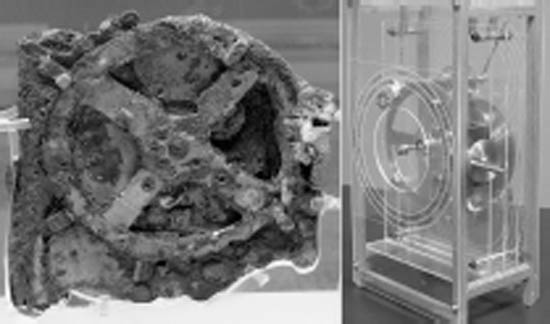
FIG. 13.1. Antikythera mechanism, Athens National Museum. Replica, American Computer Museum, Bozeman, Montana, photo by Michelle Maskiell.
Scholars who study the Antikythera device are puzzled: how did this amazing instrument in the Archimedian tradition come to be among Mithradatic treasures seized by Romans? They assume that the device must have belonged to a pro-Roman Greek living in Rhodes. But Mastrocinque’s idea that the Antikythera device could be the lost Globe of Billarus, taken by Lucullus from Sinope, is persuasive. As we know, Mithradates befriended leading scientists and had an interest in technology. Mastrocinque argues convincingly that the Billarus sphere was an astronomical instrument, and he notes that it was never mentioned again after Strabo. It would be quite a coincidence if two rare and important “celestial globes” were lost in this same time period. It is not unreasonable to suppose that the Billarus sphere from Sinope was on the Roman treasure ship lost at sea near Antikythera. If Mastrocinque is right, Mithradates’ passion for technology, Lucullus’s cultivated eye for fabulous plunder, and a sponge diver’s lucky find combined to give us a unique glimpse into a high point of ancient science.5
After the fall of Sinope, Mithradates’ son Machares, viceroy of Bosporus and Scythia, sent Lucullus a golden crown worth one thousand gold pieces—a crystal-clear message that he wanted to be an official “Friend of Rome.” According to Plutarch, this was the moment that convinced Lucullus that he had decisively completed the war with Mithradates.6
Yet Lucullus remained awkwardly at loose ends until his man Appius returned with Mithradates in tow. Lucullus set about reorganizing Pontus as a new Roman province of Asia. As we saw, Sulla’s war penalty of 20,000 talents had resulted in “unspeakable and incredible misfortunes” perpetrated by tax collectors, who tortured and enslaved debtors. Even though the Anatolians had already paid more than 40,000 talents to the moneylenders, because of sky-high interest rates the outstanding public debt now totaled 120,000 talents, a staggering amount of silver. All the Roman sources praise Lucullus for his honest efforts to alleviate the tax burden and establish order in Anatolia.7
In 69 BC, still no word from Appius. Nevertheless, Lucullus celebrated his defeat of Mithradates with festivals, gladiator contests, and sacrifices. The only thing lacking was a humbled Mithradates in chains, the perpetrator of so many crimes against Rome and its allies. More than a year and a half had passed since Mithradates—and Appius’s search party—had vanished into Armenia. Where could they be?
TIGRANES THE GREAT
Tigranes’ devious guides had promised to conduct Appius to Antioch, Syria. For many months they led the Romans on a circuitous route. Finally, a former Syrian slave in Appius’s party pointed out the direct route to Antioch. There Appius was commanded to await the pleasure of the King of Kings, busy subduing Phoenicia. While he waited—for a whole year!—Appius met many vassals of Tigranes. They regaled him with tales of the breathtaking riches and haughty omnipotence of the monarch who conquered great nations and moved diverse peoples around the chessboard of the Middle East.
At last, Shahanshah Tigranes appeared in all his glory, clad in a red-and-white tunic, a purple mantle with gilt stars, and his comet-studded tiara, riding a white horse, with four vassals running alongside. As his bodyguards took their places on the dais, arms folded across their chests, the monarch arranged himself on his magnificent throne. Appius was summoned to the great hall. It was Tigranes’ first audience with a Roman legate. Unimpressed by the grandeur and the majestic personage, Appius brusquely handed over the letter from Lucullus and stated his mission in plain—and tactless—language (probably Greek). “Hail Tigranes. Lucullus, Imperator of the Roman Army and Governor of the Province of Asia, has sent me to take charge of Mithradates, who is to be brought to Rome as our prisoner and as an ornament in our Triumph. Surrender Mithradates now. If you do not, Rome will declare war on you.”
Plutarch’s description is amusing: “It must have been five and twenty years since His Majesty had heard such rude speech in his court. Tigranes made every effort to listen to Appius with a pleasant expression and forced smile.” But all in attendance winced at the arrogant Roman who did not even address Tigranes as “King of Kings.” Everyone could sense Tigranes’ rage. But Tigranes replied evenly: “I will not surrender Mithradates. If the Romans begin a war, the King of Kings will defend himself. You are dismissed.”
Appius prepared to depart. He was interrupted by Tigranes’ servants bearing heaps of splendid farewell gifts. Appius refused them. More arrived. Appius selected one simple silver bowl and “marched off with all speed to join the Imperator Lucullus.”
Upon Appius’s return with nothing but an empty silver bowl, Lucullus felt compelled to follow up on his own rash ultimatum. The war on Mithradates of Pontus that had begun back in 88 BC—the war Lucullus had twice declared over and won—suddenly expanded into a “reckless attack on a boundless region,” in Plutarch’s words. Driven by pride and seeking glory, Lucullus was now committing to an unlimited war over an unknown land, stretching from the Caucasus to the Red Sea, from Antioch to Seleucia, a wilderness of deep rivers and nameless deserts and impassable mountains covered in perpetual snow, defended by “untold thousands of nomad-warriors from countless warlike tribes.” Lucullus’s soldiers, unruly in the best of times, were near rebellion when they heard the orders to advance into Tigranes’ empire. Earlier, Lucullus had played on his men’s terror of Tigranes’ barbarian armies. Moreover—as Tigranes and Mithradates knew—Lucullus had no authority to expand his campaign beyond the Euphrates. Back in Rome, there was a great outcry in the Senate, with the Populars accusing Lucullus of deliberately perpetuating a needless war in order to accrue personal power and profit. Lucullus was clearly the aggressor in this new campaign.
Leaving his two least reliable legions (the defiant Fimbrians) to occupy Pontus, Lucullus marched into Armenia with twelve thousand infantrymen and about three thousand cavalry, to confront Tigranes and arrest Mithradates—whereabouts unknown.8
FORTRESS OF SOLITUDE
We left Mithradates riding into Armenia with two thousand horsemen. Tigranes had arranged for Mithradates to stay on one of his hunting estates, ordering retainers to provide necessities and entertainments, cooks, thespians, musicians, fine Armenian wine, and dancing girls. With Mithradates’ well-known love of history and literature, it is likely that a library of Greek classics was at hand. This long interlude—a year and eight months to be exact—in Armenia was an important respite.9
Here in safety, Mithradates could mourn his devastating losses. But, from what we know of his character, it would not take him long to regain equilibrium. Hiding out in the mountain fastness might have evoked bittersweet memories of roaming Pontus with his friends, in the anxious years after his father’s assassination. As in the tales of his Greek and Persian ancestors and myths in which heroes overcome incredible odds, adversity seemed to invigorate Mithradates. Lucullus appeared to be crashing and burning, but the danger remained—sooner or later, the Romans would renew the war. How should he prepare? After the flight from Kabeira in 70 BC, Mithradates returned to basic survival, essentially following a mature version of his youthful exile, taking on a nomadic life, striking obliquely, eluding direct conflict. Come defeat or victory, Mithradates would remain on the move for the rest of his days, a decision that was both personal and militarily strategic.
During nearly two years in Armenia, Mithradates and his advisers devised new tactics that would define the rest of his epic struggle with Rome. The new approach appears to have been partly inspired by classical history—Herodotus’s and Xenophon’s accounts of the conflicts between the Persian Empire and Scythia and later accounts of Alexander’s cavalry innovations in Afghanistan. Jugurtha and Aristonicus had also practiced “asymmetrical” warfare against Romans. In the past, Mithradates had depended on set battles, sending his numerically superior, formally arrayed hoplite armies marching out onto a plain for pitched combat. In battles to come, light, flexible cavalry attacks would be the key. From now on, his military strategy would mirror his diplomatic strategies: he would probe for weakness, feint, jab, and withdraw, keeping the Romans confused, exhausted, impotent to strike back.
Besides studying past mistakes and planning strategies, how did the fugitives from Pontus spend their days? We would expect Mithradates and his men to maintain top physical condition, with military exercises and athletic contests. Another pastime may have been visits to Armenia’s temples of love, similar to those in Pontus and Cappadocia. Scattered throughout Armenia, these idyllic sanctuaries were temporary dormitories for maidens consecrated to the goddess Anaitis/Anahit for a year before marriage. Many of the young women came from wealthy families. According to Strabo, they selected sexual partners of equal rank and enjoyed giving the men valuable gifts. The dashing King Mithradates would have been warmly welcomed. Beavers abound in Armenia’s lakes and streams—perhaps their testicles contributed to Mithradates’ celebrated vigor.
Armenia’s pastures provided grazing for horses, and Mithradates and his men could hunt stags, boars, lions, lynxes, bears, snow leopards, and fowl. The high plateaus held a profusion of herbs and wild flowers. In the short summers, the mountain air was perfumed by sage, juniper, and honeysuckle-scented thistles called “flowers of the sun,” sacred to Zoroastrians. Brilliant yellow irises dotted the mountain slopes, along with poisonous blue monkshood, the mysterious narcotic silphium, and a strange wormwood parasite, a lilylike blossom of velvet crimson. Another curious, highly toxic plant bore drooping bunches of dark-red berries on a tall stalk. About 10 percent of Armenia’s thousands of plant species are now recognized by modern science as medicinal. Mithradates and his doctors would have been familiar with all these and more. Rich veins of gold ore and purple sandyx (Armenian arsenic) lay in the mountains. As the seasons turned, we can imagine Mithradates and his Agari gathering and testing novel ingredients for theriac.10
Plutarch claimed that Tigranes insulted Mithradates by shunting him off to a remote, inhospitable landscape. But the evidence indicates that the two kings enjoyed mutual esteem and rapport.11 They had been friends since their alliance in 94 BC. True, their political styles certainly differed: King Tigranes, about seventy, was an absolute autocrat with little understanding of the Roman threat, while King Mithradates, about sixty-five, accommodated democratic traditions and had dealt with Rome for decades. Both men enjoyed extraordinary physical stamina and intellectual vitality all their long lives (did Tigranes, as one of the king’s friends, benefit from a daily dose of Mithridatium?). Both rulers had been raised to carry out Persian fire rituals, and each believed that divine Mithraic comets had blessed their reigns. While Mithradates’ appreciation for Greek culture ran deeper than Tigranes’, they shared Persian culture, love of hunting, erudition, and grandiose ambitions. Moreover, their goals were compatible, and each man hated Rome as the dark force that opposed righteousness. Another strong link was Mithradates’ daughter, Cleopatra—she was Tigranes’ chosen queen and adviser, favored above all his concubines.
A dependable military ally when called on, Tigranes was never enthusiastic about Mithradates’ Roman wars, preferring to carve out his own empire beyond Rome’s notice. Mithradates’ empire was a useful buffer. Instead of snubbing Mithradates, Tigranes arranged for Mithradates’ safety and comfort from afar, without arousing Roman ire. Then he simply went about his own pressing business—until Appius delivered Lucullus’s insolent demand.
Lucullus’s ultimatum spurred Tigranes to meet personally with his father-in-law. Tigranes warmly welcomed Mithradates to his palace. The reunion with Queen Cleopatra carried special meaning given the fates of so many of Mithradates’ other children. The two monarchs spent three days together in private. No translators. No witnesses. Based on papers discovered after Mithradates’ death, Plutarch speculated that their conversation revolved around casting blame on others. He pointed to the case of Metrodorus (the Rome-Hater), long a favorite of Mithradates, who had been sent to request aid from Tigranes. Tigranes revealed that Metrodorus had urged him to honor the request, but then honestly acknowledged that it might not be in Armenia’s best interest. The philosopher died mysteriously. Plutarch implies that Metrodorus may have been killed by Mithradates, whose unerring instinct for detecting betrayal had kept him alive for more than half a century.12
KILL THE MESSENGER
The two monarchs surely did compare notes about who could be trusted, but they also conversed about practical, urgent matters. Tigranes generously gave his old friend ten thousand expert Armenian cavalrymen. With renewed hope, Mithradates prepared to set off from his hunting lodge base camp for Pontus with his new army. Case closed, thought Tigranes.
But then a messenger arrived, shouting that the Romans were coming. Before the man could catch his breath, the King of Kings had him beheaded for disturbing the peace. As McGing pointed out, Tigranes reasonably thought such a report was false; he was confident that Lucullus was not authorized to invade Armenia. That was a logical assumption, but Lucullus was following his own irrational agenda, aggressively attacking Armenia because of Tigranes’ refusal to surrender Mithradates. After Tigranes’ execution of the messenger, no one else dared to inform him of Lucullus’s approach. It is safe to assume that no one spoke, either, of the great earthquake that had recently destroyed several cities in Syria. The quake killed 170,000 people; soothsayers were interpreting this as a sign that Tigranes would no longer rule Syria. Unlike Mithradates, who always sought out the freshest intelligence however dire, the King of Kings, commented Plutarch, sat in a cocoon of “ignorance while the fires of war blazed around him.”13
While Tigranes was camped with his army in the Taurus Mountains, Lucullus coaxed his grumbling army of 15,000–20,000 men across the Euphrates into Armenia. His target was Tigranocerta, where Tigranes kept his concubines and other treasures. An attack there would compel Tigranes to fight, reckoned Lucullus, and after his defeat he would surrender Mithradates. And there would be plenty of booty for the soldiers. Although the city was still under construction, Tigranocerta’s walls rose seventy feet high. A contingent of Romans dug in for a siege, while Lucullus camped on the plain across the Tigris.
Finally Tigranes’ brave general Mithrobarzanes dared to inform His Majesty about the Roman invasion and threat to Tigranocerta. Mithradates, at the hunting lodge, also received the startling news from his own spies. Mithradates immediately canceled plans to recover his kingdom and turned back with his cavalry to help Tigranes. This was a thrilling if daunting new development—here was a chance to crush the Romans using Tigranes’ great resources. Mithradates sent letters and messengers ahead to Tigranes, offering excellent advice, based on his own failures and his new ideas for resisting legions. “Do not fight the Romans head-on,” he warned. “Harass and surround them with your cavalry. Devastate the countryside to reduce them by exhaustion and famine.” Mithradates sent General Taxiles ahead with the same advice: “Stay defensive! Avoid clashing directly with the invincible Romans.”
But Tigranes decided to attack head-on. It was not an insane decision, given his vastly superior numbers, but he would have done better to follow Mithradates’ wise counsel and knowledge of the Romans’ battle prowess even when they were outnumbered. According to Plutarch and Appian, Tigranes called up an army of about 250,000, including 20,000 nomadic archers and slingers and 55,000 cavalry (17,000 were cataphracts, knights in heavy chain mail wielding long lances, riding large armored Nisaean horses). Trailing behind came a horde of carpenters, road and bridge builders, baggage handlers, grooms, cooks, supply agents, and families, totaling 35,000. This immense barbarian force, some trained as traditional hoplites and others in tribal warfare (like the fierce headhunters from the Taurus range), each division in native armor, carrying traditional weapons and speaking hundreds of dialects, came from Armenia, Media, Syria, Commagene, Gordyene, Sophene, Mesopotamia, Atropatene, Mardia, Adiabene, Arabia, Parthia, and Bactria.14
Inside the city-in-progress, Tigranocerta’s population was another great melting pot, made up of Cappadocians, Jews, Greeks, Arabs, Assyrians, Adiabeni, Gordyeni, and other nameless displaced peoples—including a large contingent of professional actors—all transplanted by Tigranes and now besieged by the Romans.
Tigranes led his massive army down from the Taurus. Queen Cleopatra was safe in Artaxata, Armenia’s old fortified capital. But—as Lucullus expected—Tigranes worried about the Romans’ capturing his concubine Zosimé and the rest of his harem in Tigranocerta. Mithradates had been unable to defend his own harem during the defeat of Pontus. Perhaps he or Taxiles helped plan the daring rescue of Tigranes’ harem, which featured his new hit-and-run strategy. Suddenly six thousand nomad horsemen burst through the Roman besiegers surrounding the city. The riders dashed to the tower and roughly scooped up Tigranes’ concubines, children, and valuables, and galloped back behind the lines.
From a hill high above the Tigris River, Tigranes and his eldest son (Tigranes, by Cleopatra) looked down on the antlike Roman army across the river. They seemed so insignificant. His men made witty jokes about the doomed Romans, while his Armenian, Median, and Adiabeni generals lazily cast lots to divide up the anticipated spoils. Tigranes’ famous quip has come down in history as ironic last words: “If those Romans have come as ambassadors, there are far too many of them. If they have come as an invading army, there are far too few!”
Only Taxiles, Mithradates’ experienced general, was worried as he watched the Romans don their gleaming helmets and armor, raise their polished shields and standards, and begin to form ranks. Where was Mithradates? He was on the way but saw no need to hurry, because he expected Lucullus to continue with the cautious approach he had followed in Bithynia and Pontus. No one imagined that Lucullus would provoke a battle.15
But Lucullus’s strategy was the opposite of what Mithradates anticipated. Seriously outnumbered, the Roman used a lightning strike against Tigranes’ cumbersome masses. Riding out at the head of his army, in a red cloak with golden tassels, his steel breastplate flashing in the October sun, Lucullus had his finest hour. For once, his men were impressed. Dismounting, Lucullus raised his sword, shouting “This day is ours, my fellow soldiers!” He gave the signal for attack before Tigranes’ archers could let fly, and directed his Thracian and Galatian cavalry to slash the enemy’s mail-clad horses from behind, giving them no time to maneuver.
Incredulous that such a piddling force would actually initiate the attack, Tigranes could only choke out the same words over and over again: “What!? Are they really attacking us?” It was a tremendous rout. Tigranes’ wall of cataphracts reared up and bolted, running down their own infantry, trampling tens of thousands. The heavily armored horses collided with Tigranes’ baggage train. Confusion and terror clotted the multitudes. The Romans closed in for the slaughter and pursued the fleeing enemy till nightfall. For once, Lucullus’s legionnaires followed orders and did not stop for plunder, bypassing mile after mile of glittering armor, weapons, and ornaments lying in the road.
Shocked out of his fantasy of easy vistory, aghast at the disaster, Tigranes rushed with his son and attendants into the foothills. With great emotion, the King of Kings removed his tiara and handed it to his son, urging him to save himself. Not wanting to stand out as royalty, the prince entrusted the crown to his slave for safekeeping. Father and son fled by different routes into the mountains.
Lucullus tallied only 100 men wounded and 5 killed, while he claimed that more than 100,000 of Tigranes’ infantry and most of the cavalry perished. Many escaped; many were taken captive. Among the prisoners was the slave carrying Tigranes’ tiara: his capture might explain how we know of Tigranes’ personal reactions to the battle. Ancient and modern historians marvel at this spectacular upset, a battle like no other. Never had the Romans been so outnumbered, and never had they won so decisively against overwhelming odds. Alfred Duggan, writing in the 1950s, described the battle in racist-colonialist terms, comparing the Syrian and Mesopotamian soldiers to “feeble cattle” and commenting that the “Arabs of the desert think only of joining the winning side.” Duggan even stated that the outcome was a striking example of Westerners ascendant over “cringing Asiatics.”16
Yet Tigranes’ diverse, sprawling army—reminiscent of Xerxes’ great multinational army in 480 BC—had been spectacularly successful in all his conquests so far. Obviously, however, Tigranes’ massive, polyglot forces also suffered problems of logistics and command and control similar to those faced by Xerxes. Tigranes’ armies were ill-prepared and immobilized by Lucullus’s blitzkrieg strategy and experienced legions. Indeed, historians praise Lucullus’s military accomplishments: with delay and caution he had worn down the lightning-fast Mithradates, and now with speed and surprise he defeated Tigranes’ ponderous juggernaut. Yet despite all his successes in battles, Lucullus failed to lay his hands on Mithradates or Tigranes, nor could he prevent them from surging back with renewed forces.
RISING FROM THE ASHES
Riding down from the mountains toward the Tigris Valley with his twelve thousand cavalrymen, Mithradates was unaware that the battle had already been lost. His heart sank when he met the first of Tigranes’ soldiers fleeing in panic. As he encountered thousands of wounded fugitives streaming up from the plain, Mithradates learned the extent of the catastrophe. At this extremely bleak moment, after surviving a barrage of personal calamities and cutting short his own hope of recovering at least his Kingdom of Pontus, one might expect Mithradates to criticize Tigranes’ foolish arrogance and think only of saving himself. But, as Plutarch pointed out, it is praiseworthy and revealing of Mithradates’ character that instead of abandoning Tigranes, Mithradates continued down the mountain in search of his old friend.
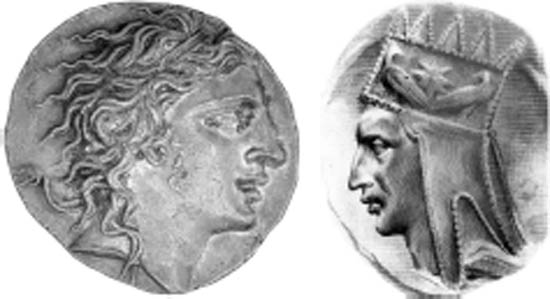
FIG. 13.2. (Left) Mithradates’ coin portrait, 75/74 BC. As crises accumulated, Mithradates’ image on coins seems to be more Dionysian than Alexandrian, with wild, disheveled hair; and the coins appear to be hastily produced. Silver tetradrachm, 1944.100.41479, bequest of E. T. Newell, courtesy of the American Numismatic Society. (Right) Tigranes the Great, Getty Images.
Mithradates found the king crying alone by the side of the road, forlorn and humiliated, without his crown or attendants. Leaping down from his horse, Mithradates embraced Tigranes. The two men wept together over their misfortunes. Mithradates quickly regained composure and inner fortitude. Placing his cloak over Tigranes’ shoulders, Mithradates offered his own horse. He spoke encouragingly as they turned and hurried up into the mountains toward Artaxata. Mithradates must have persuaded Tigranes that they could still fulfill their grand—and now intertwined—destinies. The battle’s outcome would have convinced Mithradates that his new indirect strategy was the only way to resist the Romans.17
In the face of overwhelming losses, the battered pair of kings began to forge plans to assemble yet another army. Tigranes graciously appointed Mithradates as the commander and strategist of their new combined forces, citing his old friend’s wisdom and experiences with the Romans.
MISSION IMPOSSIBLE
While Mithradates and Tigranes disappeared into northern Armenia, Lucullus remained on the plain to besiege Tigranocerta. For the first time, a Roman army experienced an extraordinary secret weapon, a flaming substance that burned everything, wood, metal, leather, horses, and human flesh. “This strange chemical,” marveled the historian Cassius Dio, “is so fiery that it consumes whatever it touches and cannot be extinguished with any kind of liquid.”18
Many men and machines were burned, but Lucullus finally took the imperial city after Tigranes’ mercenaries opened the gates. He seized the royal coffers, containing eight thousand talents of silver, unimaginably costly raiment, jewels, and other valuables. Each legionnaire received eight hundred drachmas (the equivalent of more than two years’ pay) and all the plunder he could carry. When Lucullus discovered the company of dramatic actors cowering in the theater, he ordered them to perform plays to celebrate his victory. Then, commanding his men to raze Tigranocerta to rubble, the Roman imperator saved the wives of prominent men from rape and arranged for the displaced people from Cappadocia and elsewhere to return to their native lands. All traces of Tigranocerta were erased. Its location is unknown, although in 2006 Armenian archaeologists announced the exciting discovery of the walls of a large, fortified Hellenistic city near the Tigris.19
Elated by his success, Lucullus decided to ignore the fact that Mithradates and Tigranes were still free in the north. Turning west, he stormed Samosata, the wealthy capital of Commagene, a small kingdom on the Euphrates. Allied with Mithradates and Tigranes, Samosata controlled the strategic trade routes from Asia north to Pontus. But the Samosatans wielded the same horrendous weapon used by the Tigranocertans: a “flammable mud called maltha that oozes up from pools in the desert,” wrote Pliny. The defenders on the wall poured maltha over the Romans below. It clings like burning honey to anyone who tries to flee, said Pliny, and water only causes it to burn more furiously. Maltha destroyed Lucullus’s siege machines and melted his soldiers’ armor and flesh. The incendiary was well known in the Middle East to the worshippers of Ahuramazda and Mithra, but unknown in Rome at this time. Maltha was viscous, highly combustible naphtha, skimmed from petroleum lakes in the deserts of northern Iraq, Syria, and eastern Turkey.
The terror of the burning maltha forced Lucullus to withdraw from Samosata. Venturing into Gordyene, his army suffered another biochemical attack. Archers on horseback suddenly bore down, shooting arrows even as they galloped away and vanished into the hills. Lucullus lost a great many men in these ambushes. Their wounds were “dangerous and incurable,” wrote Cassius Dio. Not only did the nomads dip their iron arrows in deadly viper venom, but the tips were designed to break off inside the wound.20Lucullus retreated to the Tigris, with his soldiers vehemently protesting the hardships and lack of fresh loot. After the first flush of victory and plunder, the campaign now seemed endless, pointless. Why were they continuing to battle new barbarian enemies in these godforsaken lands, while the renegade kings Mithradates and Tigranes escaped to Artaxata?
According to Plutarch, Lucullus had convinced himself that he had already neutralized Mithradates and Tigranes. They were old men, Lucullus told himself, no longer worthy of notice. Like an athlete in a triathlon, wrote Plutarch, Lucullus now dreamed of vanquishing the Big Three, the greatest empires in the known world. First Mithradates, then Tigranes, and now—Parthia! Parthia’s military power had been steadily growing in what is now Iran and Pakistan. Loosely allied with Mithradates and Tigranes, the king of Parthia refused to promise neutrality. Using this refusal to justify an invasion of Parthia, Lucullus dispatched a messenger back to Pontus with new orders for the two legions—the Fimbrian bad apples—left behind in Mithradates’ kingdom. They were to join him in Mesopotamia, to help conquer Parthia.
But the two Fimbrian legions refused to obey—they even threatened to abandon Pontus. Word of their mutiny spread to Lucullus’s soldiers on the Tigris. They berated Lucullus for leading them on a such a dangerous wild-goose chase. Suddenly, Lucullus, despite his strategic brilliance, was no longer the imperator of the Roman army in the East. His authority evaporated. Lucullus—who for all his courage and intellect had never connected with the common soldier—was now a virtual nonentity in the midst of a disobedient, battle-weary mob.21
MEANWHILE IN ARMENIA
Mithradates and Tigranes, from their base in Artaxata, energetically crisscrossed the countryside in 69 BC, raising fresh armies. They recruited fighters from Armenia and the warlike tribes of Colchis, Caucasia, and the steppes beyond the Caspian Sea. Mithradates, as supreme commander, personally selected seventy thousand Armenians to be trained as infantry. The rest were set to manufacturing armor and weapons. Taxiles divided the new army into Roman-style cohorts and drilled them in Roman battle tactics, which would be needed to drive the Romans out of Pontus.
But Mithradates also dipped into his Greco-Persian heritage, the experiences of Darius and Alexander. He counted on the maneuverability of smaller, flexible formations to fight the Romans in Armenia and eastern Pontus, where Lucullus’s cavalry would be hobbled by rugged terrain. Mithradates recruited an unusually large cavalry force, about thirty-five thousand horsemen and -women from Caucasia (between the Black and Caspian seas) and the lands beyond. Among the nomads of Caucasia and the steppes, each man and woman was a potential warrior, since both genders were raised to ride and shoot the bow and arrow (thus influencing Greek and Roman tales of Amazons). Mounted on shaggy ponies, this light-armed, nimble cavalry would be the heart of Mithradates’ new army.
It might have been during this recruiting drive that Mithradates met the nomadic horsewoman named Hypsicratea (“Mountain Strength”). Her age is unknown, but she could have been thirty or forty years younger than Mithradates. Her name suggests that that she came from the Caucasus region. Hypsicratea first served as the king’s groom, caring for his horses; then she became his personal attendant and lover. They enjoyed riding and hunting together. The Amazon’s endurance and courage rivaled the king’s, and given Mithradates’ love of literature, history, art, and intelligent women, we can guess that she was also his intellectual equal. Praising her “manly spirit and extravagant daring,” he called her by the masculine form of her name, “Hypsicrates.” Mithradates’ relationship with Hypsicratea recalls famous mythic pairs—Theseus and Antiope, Achilles and Penthesilea, Hercules and Hippolyte—and he knew the story of Alexander and the Amazon queen from Caucasia. As we shall see, Hypsicratea’s companionship would sustain Mithradates in future adventures.22
Mithradates and Tigranes stockpiled large supplies of grain, and sent envoys to Parthia to solicit money and troops. Mithradates’ personal letter to the Parthian king was preserved by the Roman historian Sallust. Whether or not it is the actual wording of Mithradates’ message is debated by historians, but the content and tone match his other letters and speeches. Mithradates did keep copies of his correspondence, discovered after his death, and early in his reign he enjoyed friendly relations with Parthian royalty (included among his friends in the Delos monument). Here is the essence of the letter of 69 BC, showcasing Mithradates’ animosity toward Rome and persuasive diplomacy (so different from the approach of Lucullus and Appius).23
King Mithradates to the King of Parthia, greeting [the letter begins]. As one who is enjoying prosperity and glory, you may wonder why you should listen to my request for a military alliance. You may ask whether such an alliance is honorable, wise, or risky. If I did not believe that you too were exposed to the same wicked enemies and that to crush Roman aggression would bring you glorious fame, I would not venture to ask for an alliance and I would never hope to try to unite my misfortunes with your glorious success.
Rome has always had the same motive for making war upon all nations and kings. That motive is a deep-seated desire for domination and riches. These Romans turned to the East only because the Atlantic Ocean ended their westward expansion. From their very origins, Romans have possessed only what they could steal from others—their homes, their wives, their lands, their empire—all stolen! Nothing prevents them from attacking and destroying allies and friends alike, weak and powerful, near and far. Rome is viciously hostile to every government not subject to Rome—especially monarchies.
Mithradates lambastes Rome’s hypocrisy and betrayals of those they pretend to befriend. “The Romans stripped Anatolia of 10,000 talents when they betrayed Antiochus the Great; they enslaved King Eumenes of Pergamon; they forged the wills of Attalus III and Nicomedes IV so that they could take over all Anatolia.” Here Mithradates describes the Roman murder of the tragic hero Aristonicus, the true son of King Attalus. That he brings up Aristonicus’s rebellion now, more than fifty years after the fact, indicates that the Sun Citizens’ uprising still resonated in the anti-Roman East, as far away as Parthia, the birthplace of Persian Sun-worship.
You have great resources of men, weapons, and gold [writes Mithradates]. It is inevitable that Rome will make war on you to obtain those resources. Ask yourself, if Tigranes and I are defeated, would you really be better able to resist the Romans? There is no end to war with the Romans. They must be crushed.
Here Mithradates makes his pitch: “Ally with us, while Tigranes’ kingdom is intact and while I have an army of soldiers trained in warfare with Romans. If you send us help now, Tigranes and I can win this war at the expense of our armies, far fromyourborders, and with no effort, losses, or risk on your part.” He concludes,
The Romans hate us as the avengers of all those they subjugate. You possess all the riches and grandeur of Persia, but you can expect nothing but deceit and war from Rome. Romans want power over all, but they always aim their deadliest weapons against those with the richest spoils. It is through arrogance, treachery, and never-ending warfare that Rome has grown great. Believe me, they will blot out everything or perish in the attempt.
Mithradates had lost his strong ally in the West, Sertorius. Spartacus was dead. Now he endeavored to convince Parthia that Rome was a real threat, and that helping Mithradates and Tigranes was in Parthia’s best interests. Ultimately, however, the king of Parthia negotiated with Mithradates and with Lucullus, but aided neither side.
LUCULLUS CHASES SHADOWS
Mutiny by his army forced Lucullus to abandon the dream of subduing the Parthian Empire. In summer of 68 BC, Lucullus took up his old goal, to wrest Mithradates away from Tigranes’ protection (indeed, as long as Mithradates was alive, he was a threat to Rome). Lucullus’s soldiers agreed to march to Tigranes’ headquarters in Artaxata, designed by Hannibal. Lucullus liked to refer to Artaxata as the “Armenian Carthage.”24
Marching up into Armenia, the Romans were surprised to find no food even though it was midsummer. Armenia’s high plateau of 4,000 to 7,000 feet is surrounded by 10,000-foot, snowy mountain ranges. At such high altitudes, the grain and fruit had not yet ripened. The soldiers were continually harassed by mounted archers. To the great consternation of the legionnaires, these male and female warriors skirmished in typical nomadic fashion, swooping in and then scattering. To the Romans, it seemed a cowardly way to fight. But it was effective: the legions were constantly under fire without being able to land a blow.
Finally, a vast cloud of dust announced the approach of Tigranes and Mithradates. The two enemy commanders appeared, flanked by cavalry units from Atropatene (Azerbaijan), leading an army of such splendor and might that Lucullus was suddenly struck with fear. He turned to attack the Atropateni flanks, but they melted away into the hillsides instead of meeting him head-on. It may have been in this battle that Lucullus’s Macedonian cavalrymen decided to desert en masse to Mithradates.25
Lucullus found it impossible to engage with Tigranes or Mithradates. They had become shadows, constantly withdrawing. Lucullus doggedly pursued. He took a lot of captives and amassed a great deal of exotic booty. Yet skirmish after skirmish proved indecisive. Lucullus and his army seemed to be chasing an illusion. Fleeting engagements were followed by unnerving silence. They never really lost, but they could not win either. By autumn, Lucullus had been drawn onto Armenia’s highlands of golden-brown parched grass and alkaline lakes. Plutarch says he was still hoping for a decisive battle that would “subdue the barbarian realm utterly.”
Plutarch, Appian, and other ancient (and modern) historians have criticized the “poor” battle performance of Mithradates and Tigranes and their army of barbarians, accusing them of “shamefully” running away over and over again. Appian, for example, remarked that all that summer and fall, Lucullus could not “draw Mithradates out to fight.” Plutarch even claimed that Mithradates “fled disgracefully” because he “could not endure the shouting” and clamor of battle. The barbarian warriors “did not shine in action,” continued Plutarch. “Even in a slight skirmish with the Roman cavalry, they would give way before the advancing infantry, scattering to the right and left.” Maddeningly, the Gordyeni and Atropateni kept galloping off instead of “engaging at close quarters with the Romans.” The “pursuit was long and exhausting. The Romans,” concluded Plutarch, “were worn out.”26
Exactly. The historians—and Lucullus—failed to understand the new guerrilla tactics that Mithradates had put in place, adopting the asymmetrical style of fighting that his barbarian warriors excelled in. Mithradates and Tigranes gave way in close quarters, avoiding direct conflict and turning the enemies’ own momentum against them. While the Romans grew more frustrated and baffled, the barbarians and their tough little ponies were at home in the harsh landscape as fall turned to winter. They knew exactly where to find food, water, shelter, and hideouts. They monitored the movements of Lucullus and his men, while Lucullus had no idea where he himself was, where the enemy was hiding, or when they would strike next.
Mithradates, astute student of history, appears to have studied Xenophon’s discussions of his Greek hoplite army’s difficulties fighting the mounted archers native to this same region where Lucullus now found himself. As noted above, Mithradates was also aware of Alexander’s creation of new, mountain-trained, light-armed, highly mobile cavalry to match the mounted resistance fighters he faced after his invasion of Afghanistan (330 BC). The tactics were similar to those used by Jugurtha, and by Mithradates’ allies, the Scordisci horsemen from the Danube, against Lucullus in Pontus.
Mithradates could also recall how the nomads of Scythia had out-witted Darius and his Persian army in 512 BC. As the Greek historian Herodotus commented, the nomads “understood self-preservation better than anyone on earth. . . . if they wish to avoid engaging with an enemy, that enemy can never come to grips with them.” Luring Darius to penetrate deep into Scythian territory, the nomads melted away whenever Darius attempted to attack. Darius sent an exasperated message to the Scythian chief: “Why on earth do you keep running away? Why are you wandering all over the place trying to escape? If you are so weak, surrender! If you think you are strong enough to oppose me, stand and fight!” But as Herodotus pointed out, the Scythian strategy was not employed out of fear or cowardice; it was psychologically and militarily sound. As a result of their falling back whenever the Persians had the upper hand, and then unpredictably striking and fading away, Darius was kept off balance, and his supply lines were stretched to the breaking point. “Again and again,” wrote Herodotus, “Darius’s momentary success gave way to acute embarrassment.” In this way the nomads led Darius to march across the entire Scythian territory, all the way to the Danube, without ever engaging with the enemy.27
In 68/67 BC, Mithradates ensured that Lucullus was in the same predicament as Darius had been. The Roman army, unused to high-altitude weather, trudged on, wary, hungry, complaining. Where was the enemy hiding? How could the air be so frigid when the sun shone brightly in an azure sky? Suddenly, long before the Romans expected it, winter arrived. Snow blanketed the ground; icicles crusted the pine boughs; streams froze solid. The sun’s rays gave no heat, and the glare on the snow blinded the men. The freezing temperature gnawed at toes and fingers and caused the breath to “congeal upon mustaches and beards, speedily forming icicles, which hurt horribly.” Ice on the dark rivers shattered when the horses tried to cross, and the jagged shards cut their legs. Wrapped in skimpy cloaks, legionnaires marched single file through narrow canyons and over frozen marshes. They were always shivering now, huddling in frosty tents and melting ice to drink.28
The soldiers’ complaints escalated into “tumultuous assemblies” in their tents at night and threats of desertion. Trying to avert another mutiny, Lucullus urged them to persevere—they would soon destroy the city built by Hannibal and seize Mithradates, triumphing over “Rome’s two most hated foes.” But Plutarch reports that the soldiers forced Lucullus to abandon his pursuit of the renegade kings. He accompanied his army back down from the mountains, to the mild winter of the Tigris.
There Lucullus roused his men to storm Nisibis, held by Tigranes’ brother Gouras. Defending this city was none other than Mithradates’ engineer Callimachus, Lucullus’s nemesis at Amisus, as we have seen. Gouras surrendered; he was saved for the Triumph. Callimachus was brought before Lucullus. He promised to reveal Mithradates’ secret stores of fabulous treasures, but Lucullus tortured Callimachus to death for burning Amisus, denying him the chance to spare the Greek city. When Callimachus died, the knowledge of many of Mithradates’ most cleverly hidden caches of gold and valuables was lost, hoards overlooked by the Romans and perhaps still awaiting discovery today.29
Lucullus and his army were burned out. The officers and men castigated him as arrogant and distant, thinking only of enriching himself. Comparing their leader unfavorably to Pompey, who triumphed in Spain and Italy and looked after the welfare of his soldiers, they ignored Lucullus’s pleas to resume the pursuit of Mithradates. In 67 BC, Lucullus’s army camped at Nisibis and refused to budge.
MITHRADATES’ SURGE IN PONTUS
Mithradates was free to recover his Kingdom of Pontus. Tigranes would arrive later to retake Cappadocia. Accompanied by the Agari, Timotheus, Hypsicratea, his bodyguard Bituitus, Roman deserters, and a highly trained army of about eight thousand infantrymen and cavalry, Mithradates received a joyful welcome from his people. Many eagerly joined his new army, as he visited old strongholds to establish garrisons.30
Filled with optimism, in spring of 67 BC, the old warrior, now about sixty-seven years old, led his army against the two Fimbrian legions (about twelve thousand men) still occuping Pontus. These were the soldiers who had refused to leave their lax tour of duty to join Lucullus in Mesopotamia. As the historian Eutropius remarked, it was their negligence and greed that gave Mithradates the chance to recover Pontus. Taken by surprise, the Roman legate desperately sought to increase his forces by arming the slaves kept by the Fimbrians. Could he be the one finally to stop Mithradates the Great? He led his crew of slaves and legionnaires onto the field, where the battle lasted all day. The Romans retreated, leaving behind five hundred dead.31
Although the Roman threat still loomed, this was a rousing victory. Rising phoenixlike from the ashes, Mithradates was surging back. But fighting in the front lines, the king was wounded, his first war injury. An arrow pierced his cheek, just missing his eye. He had to be carried from the battlefield. For several days, his worried troops feared for his life, as he hovered in critical condition. The Agari shamans successfully treated the arrow wound, using their secret knowledge of serpent venom as a coagulant to stop hemorrhage. Mithradates was back in the saddle in time to repulse a renewed Roman assault a few days later.
Now Nature intervened, once again sending extraordinary meteorological events. Before the battle began, wrote Appian, a freak tornado struck with howling winds “the likes of which were unknown in living memory.” The cyclone blew away the canvas tents in both camps, sweeping men and pack animals over precipices. Both sides regrouped. The next battle would prove decisive.
The Romans attacked Mithradates at night, at Zela. Throwing on his helmet and armor, Mithradates rallied his men. They drove the legionnaires into trenches filled with rainwater and mud, soon clogged with dead Romans. But in the heat of the battle, a brave centurion came running up alongside Mithradates’ horse. The centurion stabbed his sword into Mithradates’ thigh with all his might. Those nearby—maybe Bituitus and Hypsicratea—immediately chopped the Roman to pieces, but Mithradates was felled, bleeding profusely. Again, the king was carried off the field. The high spirits of victory descended into alarm and despair. Would their intrepid commander survive such a grave wound? The soldiers crowded together on the plain, trying to catch a glimpse of Mithradates lying on the muddy ground, attended by the field medic Timotheus and the Agari wizards. For the second time in this campaign, medical history was made. Again the Agari staunched the flow of blood, using snake venom. Mithradates regained consciousness. Everyone knew that Alexander had suffered a similar grievous thigh wound, and they recalled how his doctors had raised him high up above the Macedonian army to reassure the men that their beloved leader still lived. Now Mithradates’ doctor Timotheus lifted Mithradates up so that he could be seen by his cheering soldiers.32
By late afternoon, Mithradates the invincible was back on his horse, storming the Roman camp. But the camp was empty: the survivors had fled in terror, leaving behind 7,000 dead. As Mithradates and his men viewed the carnage, they counted 24 tribunes and 150 centurions, the largest number of officers ever killed in a single ancient battle. Mithradates’ recovery of Pontus in this great battle at Zela in 67 BC was one of the most unexpected, remarkable feats in his long career. He erected a large victory trophy on the battlefield, thanking Zeus Stratios.
Lucullus arrived in Pontus after the devastating defeat at the muddy trenches. He took command of the shattered Fimbrian units but did not arrange for burial of the 7,000 Roman corpses strewn over the battleground. This neglect, according to Plutarch, was the last straw for his demoralized soldiers.
And Mithradates was long gone. True to his new strategy, Mithradates had withdrawn out of reach in western Armenia. Tigranes was coming to help secure his kingdom. Lucullus gave the order to march to the point where the two grand armies would meet, hoping to defeat the two rogue kings once and for all. But the battered Fimbrians deserted their posts. The mutiny spread throughout Lucullus’s legions. At this point, says Plutarch, Fortune completely abandoned Lucullus. “So ill-starred and wandering had his course become, that Lucullus nearly lost all that he had accomplished, through no fault but his own.” Lucullus went from tent to tent in tears, begging the men to obey. The soldiers mocked their commander, hurling their empty purses at his feet, telling him to fight the enemies alone since he alone knew how to get rich from them.33
Lucullus sat by helplessly as Tigranes the Great rolled through Cappadocia, taking it over for the third time since the Mithradatic Wars first began. One wonders whether Lucullus gave any thought to the masses of wandering Cappadocian refugees, who had been transplanted to Tigranocerta by Tigranes, and now had been liberated by Lucullus and sent back to their homeland—just in time to meet Tigranes’ reinvasion.
In Rome, the Populars denounced Lucullus for prolonging the war and stripping the palaces of Mithradates and Tigranes for his own profit. He had wasted years, money, and lives, railed his critics, “compelling his soldiers to conduct caravans of camels and carts laden with golden beakers set with gems” when he should have annihilated Rome’s great enemy. Lucullus had assured the Senate that he had completely subdued Mithradates. Now officials arrived from Rome and observed the utter anarchy and collapse of the mission—the mission Sulla had failed to accomplish, the mission that Lucullus had claimed to achieve. Lucullus, fifty-two years old, was relieved of his command, his soldiers released from military service.
In 66 BC, Gnaeus Pompey—dubbed “the Great” by his patron Sulla who admired his ruthlessness—was appointed to take over the war on Mithradates. At age forty, Pompey had already celebrated two Triumphs; he claimed credit (many said unfairly) for defeating both Sertorius and Spartacus. Pompey and his older rival Lucullus met at a village in Galatia. Through gritted teeth they congratulated each other, then proceeded to snipe. Pompey belittled Lucullus, and Lucullus likened Pompey to a lazy vulture alighting on the kills of others. He warned that Mithradates was an illusory shadow-enemy. Pompey assigned a mere sixteen hundred soldiers to accompany the disgraced commander to Rome. The rest of the legionnaires eagerly reenlisted under Pompey.34
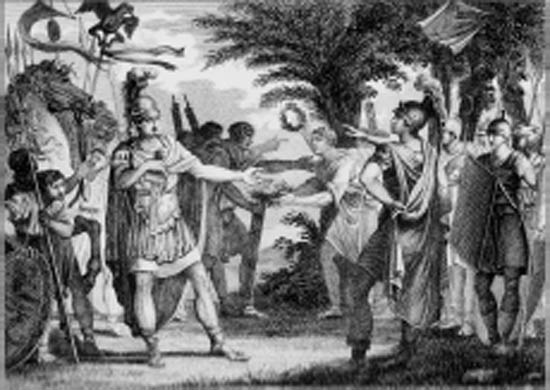
FIG. 13.3. Pompey (left) takes over the command of the Mithradatic Wars from Lucullus (right). Engraving, Augustyn Mirys, ca. 1750.
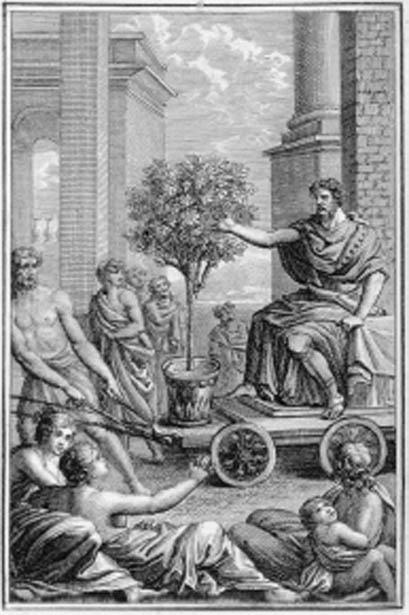
FIG. 13.4. Lucullus introduces the cherry tree to Rome. Journal des gourmands, Paris 1806–07. Courtesy of the Boston Athenaeum.
Returning to Italy with shiploads of plunder, captives, and his precious cherry tree saplings, Lucullus was allowed to celebrate a Triumph. His parade began with mail-clad Parthian knights, followed by ten of Mithradates’ scythed chariots. Tigranes’ hapless brother Gouras carried the tiara of Tigranes: these had to stand in for Tigranes himself. Mithradates, of course, was also conspicuous by his absence. He was represented by a life-sized golden statue and a huge bronze shield adorned with precious stones. Trudging behind the statue came Mithradates’ downcast sister Nyssa captured in Kabeira, and about 60 of Mithradates’ generals and advisers. Next, 110 bronze prows from Mithradates’ warships trundled by. There were 50 litters heaped with Mithradates’ gold, and 56 mules loaded with more than 2.5 million silver coins, all looted by Lucullus from Pontus and Tigranocerta.35
Lucullus used his war profits to take up a life of such excess that he went down in history as Rome’s most notorious libertine and gastronome, lolling in luxurious villas and staging lavish banquets featuring exotic delicacies (the adjective “lucullan” now describes an extravagant feast). Anecdotes were told about Lucullus’s outrageous lifestyle, while gourmands praised him for introducing the cherry to Italy. Within a few years of handing over his command to Pompey, however, Lucullus began to lose his mind. He died insane in 57 BC, poisoned, some whispered, by an overdose of a love potion.36
But those events were far in the future. For Mithradates, buoyed by his success in regaining his kingdom, battered though it was, the future looked bright again. Tenacity and his new tactics had paid off. He knew that Pompey could not afford to take up a new war against him right now. Rome—and Pompey—faced a crisis on the high seas that could not be ignored. During the wars, the pirates—more than a thousand ships equipped with silver oars, gilded sails, and awnings of purple silk—had infested the entire Mediterranean, from Cilicia to Gibraltar, plundering, raiding, and kidnapping to their hearts’ content.37 While Pompey took on the task of destroying the pirate nests across the Mediterranean, Mithradates rebuilt power and wealth from his headquarters in Pontus.