
An old Japanese tale depicts the warrior Kumagai Naozane fighting a solitary horseman on an Inland Sea beach in 1184. Ripping off the horseman’s helmet, he discovered a teenager “so handsome that he could find no place to strike” and had nearly decided to spare him when he saw fifty of his own fellows approaching. Certain that they would be merciless, he decided he had no choice. “In tears, he took the head,” the story tells us, only to discover that the lad, named Atsumori, was carrying the flute whose melodies had wafted out from the enemy camp that morning. “After that, Naozane thought increasingly of becoming a monk.”
This tale, one of scores in the Tales of Heike that blind, wandering minstrels recited during Japan’s medieval centuries, has long been a children’s favorite. The episode’s primary import at the time, however, lay in its evidence that new historical currents were flowing. In Atsumori’s death we see unbridled warfare, of a sort unimaginable a century earlier; we see warriors obsessed with beauty (not only was he handsome; he wore makeup); and we see soldiers seeking solace in religion. We also see intimations of an era when the center of national activity would change, when the emperors’ and officials’ power would be usurped by those in the hinterlands—where rivals sought influence through swords, farmers congregated in villages and produced new crops, merchants and traders spurred a remarkable commercial revolution, and Zen priests introduced wholly new artistic forms. These medieval years would also see renewed engagement with the continent.
Notions that change was afoot were encouraged by an upsurge of violence late in the 1150s, giving Heian (now called Kyoto or “capital city”) its first experience with full-fledged military clashes between pretenders for power. The warrior clans that had begun asserting themselves in the late Heian years moved onto center stage now, with the Taira and Minamoto families vying for control. After two crucial battles, the Taira became ascendant in Kyoto in 1160, adopting the ruling techniques that had proved effective for the Fujiwara and the insei. The family head, Kiyomori, commandeered key offices, secured high court ranks, married his daughters into the aristocratic lines, and amassed wealth through trade and land acquisition. Although he never achieved the strength of earlier power-holders, he dominated capital life for two decades. He also alienated people with an abrasive approach that included the arrest of the retired emperor Goshirakawa in 1179 for an anti-Taira conspiracy, and the temporary shifting of the capital to Fukuhara on the Inland Sea, where “the roar of the waves made a constant din, and the salt winds were of a terrible severity.”
Kiyomori’s harsh measures created enemies, and by 1180 a nationwide conflagration known as the Genpei War was under way, led by the thirty-three-year-old Minamoto Yoritomo, whom Kiyomori had exiled as a child to Kamakura, some 300 miles to the east. Fighting was brutal but sporadic at first, with few clearcut victories, as rival Minamoto chiefs struggled against each other as much as against the Taira. Gradually, however, the Minamoto became more unified, and in 1185 they triumphed in a climactic sea battle at Dannoura off Honshu island’s western tip. According to the Tales of the Heike, the battle ended when Lady Nii picked up Kiyomori’s grandson, the eight-year-old emperor Antoku, and jumped into the sea with the declaration: “In the depths of the Ocean we have a Capital!”
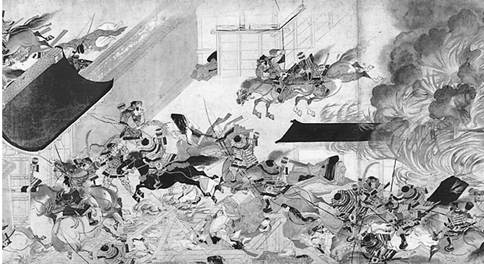 A scroll painting depicts the pivotal 1160 Heiji battle in which Minamoto family horsemen set fire to the palace and kidnapped former emperor Goshirakawa. Soon thereafter, the Taira family recaptured Goshirakawa, defeated the Minamoto, and took control of Heian, thus bringing an end to Fujiwara family power. Photograph © 2010, Museum of Fine Arts, Boston (Night Attack on the Sanjo Palace, from the Illustrated Scrolls of the Events of the Heiji Era, Fenollosa-Weld Collection, 11.4000).
For the next 150 years, the government had two centers, with the imperial clan dominating civil affairs in Kyoto while the warrior families in Kamakura—first the Minamoto and then their in-laws, the Hojo—commanded the newly empowered warrior networks. Although the military alliances provided a stiff new challenge, official life in Kyoto remained much as it had been for centuries: officials there collected the taxes; the court appointed officials and adjudicated civilian disputes; the emperors dispensed ranks. And courtiers patronized the arts, though in reduced circumstances. A century after the Genpei War, Kyoto’s prominent Lady Nijo described the court ceremonies that marked a shogun’s visit; they included streets lined with observers, officials in green and white robes, block on block of “smartly dressed” military lords, and “a splendid ceremonial viewing of horses.” She was impressed by the splendor yet said “these events saddened me with memories of distant days at court.”
The reason for the faded glory lay, of course, in Kamakura. While Yoritomo’s initial goal had been limited to assuring himself control of the warriors in his own region, the Genpei War turned him into a national peacekeeper. By the 1200s, his administrative offices were assigning lands, providing security, and adjudicating disputes among warrior families throughout Japan. They also had devised mechanisms to ensure Kyoto’s cooperation, much as the Fujiwara aristocrats had done in earlier centuries. The difference now was that the emperors had to work not with Kyoto noblemen but with eastern warriors, a rising class called samurai or bushi.
This new arrangement had a number of practical consequences. First, after half a millennium of Kinai dominance, Japan had a rival power center in the east, a city hewed from the coastal mountainsides at great cost to the forested environment. Second, power struggles were frequently handled by violence. Yoritomo wiped out rivals within his own family—including his younger half-brother, the legendary hero Yoshitsune—with a brutality that brooked no sentiment. In 1189, he eradicated the northern Fujiwara branch at Hiraizumi. And when the retired emperor Gotoba challenged the Kamakura government in 1221, Yoritomo’s widow, Hojo Masako, quashed his rebellion violently and confiscated the lands of his Kyoto supporters. The ostensible goal of the Kamakura administration was to prevent warfare; the reality was that challenges were often settled on the battlefield.
A third result of dual rule was the continued evolution—or devolution—of the ritsuryo) system. While the basic concept of rule by court-oriented law continued, the new military rulers initiated processes that would, in time, destroy traditional governance. One sign of change was the name Yoritomo gave to his Kamakura headquarters: bakufu (tent government), a term that traditionally had denoted the offices of a general sent to fight the Emishi or other “barbarian” groups. Neither that name nor the title shogun (generalissimo), which Yoritomo took in 1192, held much prestige at the time; indeed, Yoritomo was more interested in securing court ranks than in being called shogun. But the application of military terms to important administrative offices suggested the fundamental changes under way. Even more significant was the emergence of new military offices. Kamakura began appointing a shugo (constable) over each province to punish criminals and certify families as Minamoto vassals. Even more important, it started naming men and women across Japan to the crucial post of jito (estate steward), making them responsible for administering land, collecting taxes, and enforcing laws at the estate level—and thereby challenging the Kyoto aristocrats’ hold on the private estate system.
These new arrangements gave rise, in their turn, to an increasingly diverse population in the countryside. The existence of rival power centers in Kamakura and Kyoto encouraged an expansion of roads and sea routes, which attracted a great traveling population: storytellers, horse dealers, peddlers, and magicians, along with thieves and prostitutes. It was not unusual now to see a blind, itinerant priest standing under an umbrella at a crossroads, reciting popular stories from the Tales of the Heike to a provincial crowd. Nor could one miss the constant movements of hunters, craftsmen, and traders who sold their meat and wares to the great temples and the aristocratic city families. The roadsides also provided space for some of Japan’s earliest markets and for its first inns with public baths. And they eased travel to and from the coastal villages, where the men made salt and went fishing, while the women prepared the fish, which they then took to the cities for sale. Although officials tended to think of Japan simplistically—as divided between the agricultural and governmental spheres—life along the roads made it clear that things were more complex. The wanderers, the peddlers, the women fishmongers, and the hunters who traveled the country’s roads made up a crucial part of thirteenth-century society, spreading fashions and culture even as they provided the goods that made life possible.
One practical feature of the old system that did not change was the deep influence of regents, or people whose titles hid their actual roles. The prime example was Masako, Yoritomo’s widow, who exercised real power after he died in 1199, allegedly by falling from a horse. Two sons succeeded him as shogun, but she was in charge. She dominated Kamakura offices, issued instructions to troops, and confirmed landholdings, resorting when necessary to secret plots against the lives of her own children. After her death in 1225, her father’s family, the Hojo, dominated Kamakura for generations, with actual power residing not in the reigning emperor or in the shogun, but in the shogunal regent.
Masako was not the only influential woman of her period. When the thirteenth-century priest-historian Jien described Japan as “a state where ‘women are the finishing touches,’ ” he had in mind both Masako and her Kyoto rival, Fujiwara Kaneko, who shaped many of the court’s most important appointments and policies. Another Kyoto woman, Emperor Goshirakawa’s concubine Tango Tsubone, was known in the late 1100s for her consummate skill in countering many of Yoritomo’s and Masako’s schemes. Women were important on the battlefield too; whereas the feats of the legendary woman warrior Tomoe may have been mythical, those of many other female horsemen were solidly historical, even if less dramatic. And under the Kamakura period’s major legal codes, the Formulary of Adjudications, women continued to own estates and head families. The era produced fewer prominent female writers, but as in Heian, women colluded with men at the heart of power.
If the sword brought influence to the Minamoto and Hojo families, it also hastened their demise. By the second half of the 1200s, the Kamakura bakufu was in trouble, weakened by factional infighting and the increasing independence of many jito, as well as by many officials’ luxurious lifestyles. The difficulties were heightened by Japan’s first direct foreign threat in 500 years, when an envoy from the Mongol regime that had overrun Korea and China appeared in Kamakura in 1268 with a message from Kublai Khan purporting to desire “friendly relations” yet warning ominously: “Nobody would wish to resort to arms.” When Kamakura ignored several similar requests over the next few years, the Mongols made good on the threat and dispatched several thousand soldiers to Japan in November 1274. The Japanese fought valiantly and then were assisted by a serious storm—what a courtier referred to as “a reverse (easterly) wind” that “must have arisen [as a result of] the protection of the gods”—that sent the Mongols fleeing, minus a third of their men. Over next years, the Hojo prepared for another invasion by raising new forces and building a twelve-mile-long defensive wall along the northern Kyushu invasion site. When the Mongols returned with even more troops early in the summer of 1281, the Japanese fought the invaders to a draw before nature assisted again, with a typhoon that settled the Mongols’ fate.
The Hojo regime benefited from these victories in the short run. The wartime mobilization broadened its power base and many saw the kamikaze (divine winds) as evidence of the gods’ protection of Japan and its rulers. In the longer run, however, the invasions undermined the regime. The defense effort drained government coffers, even as it disrupted agricultural production. The demands of bakufu allies for compensation after the Mongol battles ended multiplied the economic difficulties. Traditionally, troops had been rewarded with spoils taken from the vanquished, but these invaders left no spoils. So Kamakura was forced to pay its supporters, including the priests who prayed for divine intervention, from its own treasury. When the hard-pressed government finally stopped such payments, disaffection mushroomed. One fighter whose valor had been “proved to the authorities” complained: “I have been left out of the general recognition of merit, and my grief is extreme.”
Particularly ominous was a rise in lawlessness in the post-invasion years, typified by the appearance of great numbers of akuto or “evil bands” of disaffected people who resorted to military-style violence throughout the countryside, destroying fields, burning houses, and demanding land rights or lower taxes. Coming from both the dispossessed lower classes and the samurai ranks, these bands employed a wide range of weapons—from slingshots and logs to swords and catapults—in an effort to gain redress from money-grubbing temples, government tax collectors, and a host of other offenders. Some of them wore unusual clothing, including the sleeveless kimonos of women and the yellow scarves of the lowest classes. All of them evoked wide fear that the country was approaching a cataclysm.
The Hojo government struggled on until the 1330s, when another civil war, the Kemmu Restoration, brought it to an end and restored administrative functions to Kyoto. The trigger for the Restoration was the culmination of a long-running succession dispute between rival claimants to the throne. Convinced that one of the imperial rivals, Godaigo, wanted not just the emperor’s chair but Kamakura’s power, the Hojo exiled him in 1331 to Oki island off western Honshu. That did not end matters. He escaped the next year and quickly won the support of several warrior families, including the Ashikaga. His new allies first combined to drive the Hojo from power, and then the Ashikaga turned on the emperor himself, triggering several years of chaotic violence. By 1338, Godaigo again had been vanquished, and Ashikaga Takauji had become shogun. An anonymous observer posted a sign in Kyoto commenting that the day’s fads included “assaults in the night, armed robberies, falsified documents, easy women . . . chopped-off heads, monks who defrock themselves and laymen who shave their heads.”
The Kemmu Restoration initiated another shift in Japan’s governing structure. Dual government largely vanished now, as the military administration was moved back to Kyoto, to a section of the city called Muromachi. Warfare flourished, and the provinces asserted increasing independence. After midcentury, the Ashikaga family won a wide enough network of military and religious supporters to establish themselves in solid control of the central region, where they created an array of new income-producing schemes and a relatively effective bureaucracy. In 1392, they ended the imperial succession dispute, first brokering a compromise between the rival lines, then reneging and rejecting the Godaigo line’s claims. But they were never able to secure a firm grasp in the provinces.
One key to the Muromachi years lay in the Ashikaga’s heavy focus on Kyoto, on working with the old civilian rulers and emulating their ways. Mirroring the Fujiwara, the family played marriage politics vigorously. At the same time, they developed an administrative structure in which the Ashikaga family head typically served as shogun, while a kanrei, or deputy shogun, from one of three powerful allied families exercised day-to-day power. Since their army was relatively small, they signed agreements with local power holders, some of whom were called daimyo (great names), that secured these local lords’ allegiance by granting them relative autonomy and the right to retain half of the estate fees they collected. One effect of these policies was that regional military alliances multiplied in the late 1300s; another was that the jito saw their authority decline, as local estate managers felt less compelled to heed Kyoto’s demands; yet another was the continuing slippage of Kyoto’s influence outside the capital region.
The resultant drop in revenues from private estates caused many difficulties for the bakufu, but, ironically, the Kyoto power-holders’ search for alternative revenue sources had a salutary economic impact on the country as a whole, spreading the wealth in new ways and encouraging the rise of small-scale capitalism. The old noble families struggled to maintain their revenue flow by turning themselves into financial organizations, loaning out money at high interest rates and charging fees in return for giving protection to emerging merchant groups. The great temples created a variety of schemes to increase income: serving as tax collectors, lending out money at usurious rates, controlling shipping on Lake Biwa to Kyoto’s north. The authorities supplemented declining land tax revenues with roadway tolls, fees on temples for the right to ordain priests, and perhaps most important, heavy surcharges on moneylenders. Private families without formal ties to any of the old ruling groups devised money-making schemes of their own. Banking, for example, got its start in this period, and sake brewers flourished. By the 1400s, the Kyoto-Nara region boasted a thousand money-lending firms and breweries. The period even spawned a new word for private businessmen: utokunin, which contained the double meaning “virtuous person” and “profit maker.”
The most controversial income-producing scheme was enacted by Ashikaga Yoshimitsu, who served as shogun from 1369 until 1395 and then dominated affairs from retirement until his death in 1408. An active administrator, an intimate of emperors, and a lavish spender on buildings such as the gold-covered Kinkakuji villa, he agreed in 1402 that the bakufu would dispatch tribute missions to China in exchange for the Ming Dynasty’s recognition of Ashikaga supremacy in Japan. Along with a huge shipment of gifts, he sent a statement attributing to Emperor Yongle “the brightness . . . of the radiant sun”; the Chinese ruler in return called him the “King of Japan.” The relationship yielded a significant increase in trade—enough to keep the tribute relationship going for 150 years, even though many Japanese denounced Yoshimitsu for accepting “vassal” status.
Yoshimitsu was probably the strongest of the Ashikaga rulers, and while some of his successors worked assiduously at strengthening the central institutions, the general trend was toward decentralization. Vassal families fought with each other, local rebellions against debt collections and unfair levies spilled into Kyoto, and the most effective of Yoshimitsu’s successors was murdered at a banquet in 1441. Affairs reached a crisis during the 1460s under the shogun Yoshimasa, whose love of the arts overshadowed his interest in governing. A Zen priest captured the decade’s tone in a diary entry during the spring of 1460. He had seen an old woman carrying a dead child and wailing about greedy officials who would not help her: “While I was still humbly mulling over her sad story, I encountered a group of noblemen out to admire the blossoms. Some sneered at the people in the streets; others swore at the menials in the path of their horses; others laughingly stole blossoms; others, drunkenly singing, drew their swords.”
When a dispute over who would be the next shogun arose in the mid-1460s, the regime had few resources to deal with it, and the result was a disastrous war named for the era in which it began: the Onin Upheaval. Most of the leading samurai families took part in what can only be called an orgy of violence, burning temples, ransacking shops, massacring hostages, and defiling the dead. By the war’s end in 1477, the fighting had moved to the countryside because all vestiges of central control had been destroyed and Kyoto had been wiped out. “For blocks on end,” said the conflict’s leading chronicler, “birds are the sole sign of life.” Ironically, the Upheaval did not even produce a victor. The warring families simply lost their sources of income and influence, while Shogun Yoshimasa retreated to a life of the arts, and his successors followed each other in relatively meaningless fashion. The imperial family descended into poverty.
One figure who benefited from the disaster was the daimyo in the countryside. Having replaced the jito, the shugo, and the bakufu as local power brokers, these lords would take advantage of the empty center to hew out a new age, a sengoku (warring states) period in which provincial power was exercised by military chieftains and fighting was almost continuous. The heroic, violent actions of the period’s leaders fired the popular imagination for centuries, giving rise to the samurai genre of fiction, film, and anime. And the decentralized, warrior-based nature of power later invoked comparisons to European feudalism. In reality, the time had a brutal yet dynamic quality that was unique to itself, an energy that produced new institutions even as it demolished old ones.
For generations, students of this era focused on things that declined: imperial authority, bakufu power, the national military clans. Even as those institutions experienced troubles, however, vibrant local forces were producing fresh styles of national life pervasive enough to make the period seminal in Japanese development. Villages became more organized in these years; agriculture and commerce flourished in vibrant and unexpected ways; religion and art took on different forms; living standards rose throughout the countryside. And the source of much of this change was the daimyo, who ruled by dominating the lands immediately surrounding him. It was this figure, the local military lord who—along with his allies (or, just as often, his rivals) in farming, religion, and commerce—made the sengoku years such an innovative period. He was the one too who gave the era its mystique as a time of insubordination (gekokujo), when power sprang from ability rather than pedigree.
Most sengoku daimyo lived initially in fortified residences on the plains, but as the era progressed, many built larger, permanent castles on mountain ridges and peaks. Surrounded by trenches and defense towers, these structures foreshadowed the multistoried castles that the great domains used for defense and administration in a more settled time after the early 1600s. Revenues came from trade, commerce, and taxes on farmers in the domain. And security came from the sword, as sengoku daimyo marshalled ever-larger armies to defend and expand territory. In time, they began requiring their vassals to move off their own farms and villages and into the domain headquarters, where loyalty could more easily be assured. These rulers also drafted detailed legal codes for their vassals, demonstrating that they believed in rule by law.
Warfare was a constant in these years, but fighting styles changed. After the Onin conflict, where most combat had been hand to hand, a typical fief’s forces numbered a few hundred; by the mid-1500s, many domains had tens of thousands of fighters. Armies became complex; masses of lightly dressed foot soldiers, called ashigaru, were led by elite units of armed horsemen and followed by workers who provided food and supplies. Lighter weapons were developed to facilitate mobility: halberds, pikes, and eventually matchlock guns. A rising mystique of loyalty and discipline laid the foundation for the bushido myth of later centuries. At the same time, the era saw more than its share of treachery, as each daimyo sought every means to gain an advantage. In an often-repeated story, the warrior Hojo Soun of Izu announced that blind people in his region would be killed, as a cover for sending them into neighboring areas as spies.
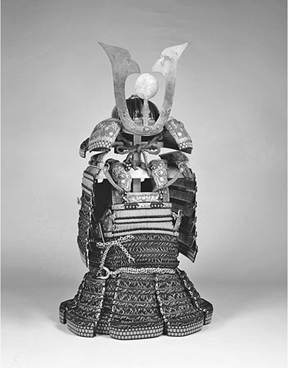 The armor of a typical daimyo in the warring states period of the late 1400s and early 1500s, with iron bars wrapped in colorful cords, beneath a helmet of lacquer and metal. Though highly effective for defense, the weight of the armor made it impossible for a daimyo to participate actively in battle; his role was to sit or stand in a protected place and give directions. TNM Image Archives.
Many of the medieval era’s most significant changes, especially after the 1300s, came in the agricultural sector. Production already had increased in the Kamakura period, thanks to better fertilizers, sharper tilling instruments, and the introduction of mountainside orchards that required less water—along with experiments in raising two crops per year along the Inland Sea. The shipping of timbers from Honshu’s far regions to the temples of Nara illustrates how integrated Japan’s provincial commerce was becoming. By the twelfth century, fewer adult villagers were dying of epidemics, as smallpox and measles generally became diseases of childhood alone. The true revolution in rural life, however, came in the 1300s and 1400s, when double cropping spread to a quarter of the nation’s fields, and productivity soared.
The most surprising factor in all this was the emergence of villages. Through the Kamakura years, peasants typically had lived in simple dwellings scattered across a valley. Now, farmers and low-ranking samurai began coming together in hamlets to coordinate planting efforts and protect themselves from marauders. By the fifteenth century, communal building projects were producing fresh ridges between rice paddies, new ditches to bring water from nearby rivers, and lodgings for an increasingly prosperous peasant class. Villages began forming self-governing councils, called so, which met in local shrines and oversaw a range of functions, from protecting residents against outsiders (including rapacious landowners) to coordinating the use of irrigation water and staging festivals to honor the local spirits. Villages also administered their own justice systems. The regulations of a village on Lake Biwa in 1492 revealed the typical approach. People who did not pay their taxes, they stated, would be evicted from their homes and denied fishing permits, and “mountain fields and collective possessions of the village that have been lent to them will be confiscated.” The ordinances of another village warned: “Do not give lodging to travelers.” “Keeping dogs is forbidden.”
Many hamlets also joined together in ikki (leagues) or sokoku (regional communes) to defend themselves against central authorities. Led by low-ranking warriors and prominent farmers, these groups used armed units and political tactics in the decades after the Onin Upheaval to secure their own autonomy and gain relief from debts and fees. Many wrote constitutions. They played a major role during the early 1500s in delaying the reemergence of central power. Ikko, the largest league, brought together Pure Land Buddhists, peasants, and local samurai to create what its leaders called an “estate of Buddha,” which for nearly a century after the 1470s controlled two entire provinces along the Sea of Japan coast.
With the emergence of villages came an end to serfdom, as peasants who had been indentured—or enslaved—to the shoen managers of earlier years now became small farmers, secured in their independence by the defensive village structure and the income from new crops such as dry-land vegetables and grains. That does not mean that life became easy for the former slaves, or for their hamlet neighbors. Natural disasters still produced famines; leprosy and epidemics devastated families; and domain or village taxes were heavy. The countryside was populated, too, by thieves, and tensions often arose between villagers and outcasts—people labeled hinin (nonpeople) or eta (filthy ones) because they engaged in despised occupations such as tanning, night soil collection, and public execution. Rural life nonetheless became more stable for most people during these centuries, and village products increased in number and variety.
Women also had a mixed experience. Most women found life more restrictive after Kamakura, but some, particularly those in the realm of religion, made strides. The standardization of marriage and of the wife’s role as household manager made women more secure in the family, but brides now were required to move into the husband’s household, as servant to the men and the mother-in-law—and that took away independence, rendering many wives little more than property. Women were hurt, too, by the rise of primogeniture, a system designed to keep family property intact by having the eldest male heir inherit everything. On the positive side, women still owned and managed property in some families, including the homes of Kyoto’s shrunken nobility. Upper-class women also continued to produce high quality literary works, though without the renown of earlier times. And women became more fully integrated into popular Buddhist sects, often in leading roles. The nun Mugai Nyodai, for example, headed a network of convents in the Rinzai Zen tradition, insisting vigorously on the priest Dogen’s assertion that “learning the Law of Buddha and achieving release from illusion have nothing to do with whether one happens to be a man or a woman.”
Japan also experienced dynamic economic changes in the sengoku years. Towns and cities flourished, and by 1500 the country was dotted with rudimentary castle towns, alongside trade cities such as Sakai on the Inland Sea and Hakata in Kyushu. Most of these towns, with populations as large as 30,000, became both commercial and administrative hubs, alive with petty officials, construction workers, street performers, and merchants. In the countryside, the early Muromachi years saw the emergence of thrice-monthly local markets, offering everything from sesame seeds to barley and fish to knives—and in prosperous areas, silks from China and celadon bowls from Korea. By the era’s end, many of the markets were open every sixth day. The country’s roads now crisscrossed Honshu and Kyushu. Coins, imported from Ming China, largely replaced bartering as the unit of exchange, and money-lending made both temples and private families rich, with yearly interest rates as high as 300 percent.
Commerce was facilitated by the spread of za (guilds), typically made up of 10 to 100 firms in a given craft or specialty. The original purpose of the guilds was to secure a patron, perhaps a powerful temple or a daimyo, who would exempt them from taxes or tolls and give them a monopoly on their field, but the practical effect of their emergence was an increase in specialization and trade. The businesses organized by these guilds included nearly everything that was made and sold: oil, cotton, swords, fish, ink, clothing. Even actors’ troupes formed za, to assure their monopoly on theaters in a particular region. The poet-priest Socho captured the guilds’ spirit with his 1525 quip that those who enter “business for profit . . . never speak of gods or Buddhas” but “spend every waking moment thinking of making money.” That, he said, “is how to get on in the world.”
This economic growth was accompanied by a significant expansion in international trade. Already in the late Heian years engagement with the continent had revived among private merchants, who traded everything from textiles and medicines to exotic birds and ceramics. By the Kamakura years, thirty-ton ships were making their way to eastern Japan, exchanging Japanese lumber for Chinese coins, cotton, silks, and luxury items. Then, in the Muromachi period, the Asian waters became truly international. The trade centered less on China now, thanks in part to the Ming dynasty’s attempt to prohibit private trade, but the exchanges with Korea and southeast Asia grew. Okinawa became part of Japan’s trade world, too, as merchants from the Ryukyu Islands kingdom visited Japanese ports in search of swords and copper, and then provided ships for Japan’s own exchanges with other countries. In 1458, the kingdom produced a bell with the inscription “By sailing our ships, we shall make Okinawa a bridge between countries.”
These interchanges led to a dramatically improved Japanese understanding of the nature of the Asian world. They also brought new wealth to a network of temples, daimyo, and merchant families, particularly in Kyushu and along the Inland Sea. Some sent out 250-ton ships now, carrying huge cargoes meant for exchange at high profits. A sunken fourteenth-century ship recovered off Korea in 1976 gives some sense of the scale of this trade. Apparently heading from China to Japan, the ninety-foot vessel was captained by a Japanese, had a multinational crew, and carried more than 18,000 ceramic objects, along with thousands of pounds of Chinese coins. Profits from such voyages could be immense, with Chinese silk selling in Japan for twenty times its original cost, for example, and Japanese swords marketed in China at a 500 percent profit.
This private trade was supplemented by the tribute trade that Yoshimitsu had initiated. On one level, the tribute embassies played a diplomatic role, undergirding the region’s international relations system; on another level, they were trade missions. During Yoshimitsu’s life, two ships a year went back and forth between China and Japan, carrying swords and gold to be exchanged for coins and textiles. The official embassies were more sporadic after his death, as daimyo and temples gained increasing control of the tribute trade, but missions continued until the mid-1500s. A flourishing trade also developed with Korea, as the kings of the Choson dynasty signed agreements with the bakufu and various daimyo, as well as with the So family on Tsushima Island. The Japanese were particularly eager to secure Korean cotton (nearly six million yards were purchased in 1486) and full sets of the Buddhist scriptures, which had been printed in Korea but not in Japan. Over the 1400s, they prided themselves on being able to secure forty-three complete sets of the Buddhist canon.
Pirates engaged in a less savory but no less extensive brand of trade. Officials had long struggled to control the brigands who plundered ships (sometimes at the behest of Japanese temples), but the problem remained manageable until the mid-1300s, when piracy soared. By the late 1370s, Japanese pirates were making more than forty yearly raids along the Korean coasts, with as many as 400 ships, 3,000 men, and a bevy of horses in a raiding party. Sometimes they captured hostages for labor back in Japan. Other times they seized shipments of rice that were being sent to the capital as tax payments. The Korean kings protested, and so did the Chinese after coming under heavy attack in the late 1300s; but the Muromachi officials were powerless to suppress them. Yongle, the frustrated Ming emperor, commented: “Ships could not readily reach them, nor could spears or arrows readily touch them.
We could not move them by bestowing benefits on them; nor could we awe them by pressing them with our might.”
No area of life remained immune to the vast changes in society— not even religion, which took on a more popular tone during this era, even as Buddhist priests pioneered new approaches to the arts. As in earlier times, the established organizations remained powerful and affluent, equally active in the worlds of commerce, politics, and religion, but the greatest changes, particularly in the Kamakura period, came with the impressive expansion of the populist Buddhist branches, particularly the Pure Land movements and the exclusivist Nichiren sect. All of these proclaimed the Buddhist idea of mappo (end of the law), which held that humankind had entered its last days. They also maintained that faith alone—either in the Buddha Amida or in Buddhism’s central scripture, the Lotus Sutra—would bring people enlightenment. And they insisted that salvation was available to all people: poor and rich, female and male.
These sects grew in part because they were propagated by charismatic, controversial leaders. Pure Land founder Honen, who said people should perpetually recite the praise-to-Amida chant (nembutsu), offended the establishment with his appeal to the masses and was banished as an old man to the island of Shikoku. His spiritual heir, Shinran, founder of the True Pure Land sect, went even further, arguing that a single recitation of the nembutsu was sufficient for rebirth in the Pure Land. “If a good man can attain salvation,” he said, “even more so a wicked man”—so all-encompassing was the power of Amida’s compassion. The first Buddhist priest to marry publicly, he, too, was exiled. Nichiren’s style was different. While agreeing that salvation was for everyone, he propounded an exclusivist theology, railing against other religious and secular authorities and arguing that salvation was available only through belief in the Lotus Sutra. He scoffed that “the nembutsu leads to hell” and called for Pure Land temples to “be burned to the ground and their priests beheaded.” He, too, was exiled—twice. All three men attracted great numbers of followers.
Zen, another sect that emerged in Kamakura, reached full flower in the Muromachi years, when its Rinzai branch established some 300 monasteries. Nurtured by priests who had studied in China, Zen maintained Buddhism’s more traditional emphasis on the centrality of temples and was more intellectual than the Amida sects, maintaining that enlightenment was found within one’s self, through meditation and discipline. As the Zen pioneer Dogen expressed it: “Enlightenment is something like the reflection of the moon in water. . . . Though the light of the moon is vast and immense, it finds a home in water only a foot long and an inch wide.” The reason Zen prospered lay less in its intellectualism, which many warriors found obscure, than in its ties to the samurai establishment. Its Chinese orientation appealed to bakufu officials, and the expertise of monks who had studied on the continent was useful in diplomacy and trade. Its emphasis on austere arts such as ink painting and calligraphy also held great appeal.
Nowhere was the spreading impact of Buddhism more apparent than in medieval art and literature. Buddhist ideas such as evanescence and nonattachment pervaded nearly all Kamakura writings. The Tales of the Heike, for example, which chronicled the fall of the Taira family, begins: “The sound of the bell of Jetavana echoes the impermanence of all things They who flourish must be brought low.” Kamo Chomei’s Account of My Hut relates a priest’s search for solace in a ten-foot-square mountainside cottage after becoming disillusioned by the troubles of the world. “I rejoice in the absence of grief,” he says. He loves his tiny hut, yet at the end he sighs: “My attachment to its solitude may also be a hindrance to salvation.” These stories have a heaviness, a consciousness of conflict, that is not present in the courtly Heian writings.
Similar themes suffused Muromachi literature. Essays in Idleness, a miscellany of reflections reminiscent of the Pillow Book, brims with witty yet melancholy comments: on life’s brevity, on the foolishness of heavy drinking, on the way we forget those who have died. The representative works of this period are the No drama scripts, which use spare prose to narrate tales of dead warriors, priests, and officials who have come back as ghosts, often to meet a lover or to repair some damage. The opening lines of the play Atsumori are typical. Kumagai, the warrior who took the head of the young flute player, proclaims: “Life is a lying dream, he only wakes who casts the world aside.” The play ends with Atsumori’s ghost beseeching Kumagai (now a priest): “Pray for me again, oh pray for me again.” Not all Muromachi literature is dark. Short, witty kyogen plays were presented during the interludes between No performances, and traveling storytellers recounted tales that were as entertaining as they were didactic. Most of the major works, however, reflect the Buddhist preoccupation with impermanence, reinforced by the somber times in which they were written.
Zen’s greatest influence may have been in the visual sphere, where its emphasis on meditation and discipline inspired many of Japan’s most innovative art forms. Priests like Sesshu and Shubun gave us the era’s angular mountain-filled landscapes, along with its richly suggestive brush paintings. Monks also gave us the spare arts of flower arrangement, calligraphy, tea-bowl pottery, and the tatami-mat flooring of elite Muromachi homes. The era’s visual culture was not devoid of the colorful or the gaudy; witness the gold plating of Yoshimitsu’s Kinkakuji or the colorful screen paintings of the late Muromachi Kano school. But the dominating tone was rustic simplicity.
 Hasegawa Tohaku was famed for ink paintings such as the six-panel Pine Trees, done late in the sixteenth century. The trees illustrate the impact of Zen Buddhism on medieval Japanese painters, who sought to convey complex natural scenes with ink alone, employing a minimum number of brush strokes. Shading was used to suggest a forest in the mists—or perhaps in a snowstorm. TNM Image Archives.
Gardening and the tea ceremony illustrate the Zen influence with particular force. The Japanese had built gardens for centuries, but Muromachi priests and craftsmen took them in radical directions. The purpose of the Zen viewing garden was to encourage tranquility by symbolizing the natural world in a small space. To that end, elites of the 1400s commissioned commoners, known as “dry riverbed people” (for the place of their poor forebears’ dwellings), to design areas that used simple objects to invoke a bigger universe: ragged rocks to suggest a waterfall, grouped pebbles a flowing stream. The most famous Muromachi garden remaining today is the rock garden of Kyoto’s Ryoanji temple, a space that contains nothing but fifteen stones in a rectangle of raked sand, surrounded by clay walls and tall conifers. These gardens also served, on many occasions, as a setting for the tea ceremony, which some see as Japan’s quintessential art. Tea drinking had been popular since the twelfth century, and in the 1300s rich families held lavish tea-tasting parties. Now, in the violent sengoku years, this pursuit was turned into a contemplative art: a few people, sitting on the floor of a bare hut, drinking the bitter liquid in three and a half sips, then eating a small sweet, as the breeze outside evokes life’s vicissitudes. Life’s deepest meaning, Zen says, is found in the ordinary; so is the soul of art.
Taken as a whole, the medieval years gave birth to a dramatic evolution in the nature of Japanese life, stimulated by the rise of the warrior class and the innovations of merchants, villagers, and priests. To be sure, the political system underwent highly important changes: from a two-headed military/civilian government in the 1200s through an increasingly weak center under Ashikaga leadership, to a collapse of the central order after the Onin Upheaval. At least as important were the cultural and social changes that derived only part of their force from the old systems. Commerce flourished along new transportation routes and in new cities. Influences and income from the continent provided both ideas and wealth. Peasants formed villages and markets. Religion became the possession of the weak as well as the mighty. And the arts took radically new forms. People who limit their vision to central institutions find much that is frustrating in medieval Japan; those who focus on the countryside see an era rich in innovation and full of energy.