
On an April day in 1771, the physician Sugita Genpaku watched, rapt, while an old man of the outcast class dissected the corpse of a criminal known as Old Mother Green Tea. Days before, Sugita had acquired two Dutch anatomy books filled with sketches of human organs that “looked so different from the pictures in the Chinese anatomical books” that he decided he had to see the inside of a body for himself. “Comparing the things we saw with the pictures in the Dutch book,” he said, “we were amazed at their perfect agreement.” He and a friend decided to translate one of the books, Ontleedkundige Tafelen (Anatomical tables), into Japanese, even though they did not know Dutch, an act that, in its turn, fed a growing intellectual movement known as Dutch studies.
Sugita’s discovery hints at the many ways Japan had changed since the Tokugawa family had assumed the reins of government in 1600. The presence of the Dutch books shows that Japan had become part of a broader world, while the ignorance of anatomy suggests a society closed to many Western influences. The doctor’s determination to get at the truth typifies the passion for knowledge that drove Japan’s intellectuals, whereas his later difficulties in getting the translation published illustrate the government’s determination to control ideas. The outcast origins of the dissector reveal a society in which classes and social groups were defined quite strictly, even as peoples intermingled in wholly new ways. The fact that Sugita hailed from the Japan Sea regions yet grew up in the capital city shows how interconnected the country had become. The Tokugawa system brought Japan 250 years of peace; it also gave it two centuries of commercial and intellectual energy, along with a new way of seeing the world—and the most comprehensive government system the country had known. It was in these years that Japan, for the first time, came close to being a true national unit.
The backdrop for this era was a half-century of intensified warfare, leading toward reunification. By the mid-sixteenth century, several regional coalitions of daimyo had emerged from the sengoku period’s political chaos, and after the 1560s, two daimyo and a foot soldier’s son—known to history as the “three unifiers”—successively took control of ever-wider regions, until by 1600 Japan had become a single political domain. The first of the three was a short man named Oda Nobunaga who lived by the slogan “Rule by force.” He drove the last Ashikaga shogun from Kyoto in 1573, destroyed the powerful Tendai Buddhist temples on Mount Hiei and the Ikko league on the Japan Sea by slaughtering thousands of their priests and defenders, constructed an ostentatious castle north of Kyoto, and took control of most of central and western Honshu. In 1582, he was assassinated by one of his own lieutenants as he headed off toward new conquests in the west, whereupon the foot soldier’s son Toyotomi Hideyoshi, now a general, took control of the Oda forces.
Toyotomi, whom Oda nicknamed “Monkey,” took less than a decade to complete Japan’s unification, sending armies of up to 200,000 against rivals in Kyushu, Shikoku, and finally Sendai far to the north. Still not satisfied with his accomplishments, he then sent troops to Korea in 1592 and again in 1597—determined to become ruler of the East Asian world. The Korean adventures were disastrous in every respect: undermining China’s Ming dynasty, which overspent itself in defending Korea, wreaking havoc within Korea, and humiliating Hideyoshi himself. More successful were his administrative initiatives at home, which laid the foundation for centuries of stable rule. He used land surveys and rice production records to create a tax system rooted in reliable data about who lived where and what they produced. He seized control of the country’s gold and silver mines and promoted foreign trade. In an effort to get control of the military, he denied farmers the right “to possess long swords, short swords, bows, spears, muskets, or any other form of weapon,” and then melted down their confiscated weapons to make temple bells and other implements. He also patronized the arts, particularly the tea ceremony. The complexity of the man—militarist, megalomaniac, charmer, art lover, astute administrator—is symbolized by the two teahouses he maintained, one a rustic hut that evoked the simplicity of Zen, the other an ostentatious structure gilded inside and out.
The Korean fiasco was not the only challenge to Hideyoshi’s longterm ambitions; another lay in his inability to produce a strong heir. When he died in 1598, his only potential successor was a five-year-old son. As a result, his ally-turned-rival Tokugawa Ieyasu wrested power from the Toyotomi family two years later, and established a new regime 300 miles to the east in Edo, where Tokyo sits today. A popular children’s story has it that if a canary had refused to sing, Oda would have crushed it; Toyotomi would have persuaded it to sing; and Tokugawa would simply have waited it out. That, as it turned out, was the strategy that succeeded. It was not, however, a strategy designed to give confidence in Tokugawa’s ability to govern well. Japan, after all, faced massive challenges in 1600. It still was mired in the mental habits of war. Its imperial institution was in shambles. There were few models for countrywide administration.
And there was a relatively new threat, which would profoundly influence the way the Tokugawa governed: hundreds of gun-and Bible-bearing Westerners who had come to make a profit and save souls. The first Europeans had reached Japan by accident in 1543, shipwrecked on Tanegashima, an island off southern Kyushu. Over the rest of the sixteenth century, traders and missionaries came in significant numbers, opening windows to the non-Asian world, enriching coastal daimyo through trade, and converting perhaps 300,000 Japanese to Christianity. Most Europeans were impressed by the Japanese, echoing the Jesuit pioneer Francis Xavier, who pronounced them “the best who have yet been discovered,” a people of “very good manners, good in general and not malicious.” The response of most Japanese is reflected in the label they gave the newcomers: southern barbarians. While Oda used their muskets and coastal daimyo employed their ships to trade with Southeast Asians and Chinese, the Europeans’ politics and religion worried them. Hideyoshi, for his part, turned on the Westerners in 1587, despite his desire for trade, and ordered all foreign Christians to leave the country, fearful about their territorial ambitions. He never enforced the order, but several years later he had twenty-six Christians (including six European priests) crucified, after hearing rumors that Spanish priests often prepared an area for conquest. Ieyasu harbored similar suspicions and acted forcefully, brutally at times, to keep the foreign threat under control.
Despite the many threats, the Tokugawa succeeded in establishing a stable state. The contrast between their world and that of the sengoku years was great. Two and a half centuries of peace replaced endemic warfare. The administrative capital shifted to the Tokugawa home base of Edo. Warring daimyo domains gave way to an intricate structure that divided power between the center and the peripheries. Whereas Japan excluded foreigners more systematically than ever before, it became more fully integrated into the global world. These changes were more evolutionary than revolutionary, because Ieyasu’s goal was to keep rivals in check rather than to eradicate enemies or secure absolute power over the domains of individual daimyo. Nevertheless, by the mid-1600s he and his successors had created the most all-encompassing administrative structure Japan had ever known, a structure that allowed roughly 250 domains (called han after the early 1700s) to coexist peacefully for a quarter of a millennium, while commerce and culture developed dramatically.
The first goal of the Tokugawa government was to maintain peace. More interested in order than innovation, Ieyasu and his followers showed little interest in developing nationwide tax, military, or judicial systems but endeavored instead to ensure their own ascendancy within a stable, relatively decentralized system. To that end, they left the emperors on the throne in Kyoto, assuring their material well-being while insisting that Kyoto follow the Tokugawa will. They retained the traditional religious institutions but turned temples into census-taking branches of the government. And they devised an administrative structure that used old names—shogun and bakufu—to invoke an aura of antiquity and legitimacy yet created new mechanisms designed to give each daimyo autonomy in his own domain while Edo administered Tokugawa lands and handled regime-wide duties such as the supervision of international relations and the maintenance of highways, mines, and mints.
Scholars call the system bakuhan because of the balance it maintained between the Edo bakufu and the regional han. The Tokugawa retained the right to eradicate or relocate daimyo, but they never considered wiping out their main rivals, and after an initial period of reorganization and consolidation, they left most domains intact. Each han was permitted to maintain its own military and tax systems and to make its own laws, as long as it followed certain rules, which included securing Edo’s permission for daimyo family marriages and providing monetary and labor support for Edo projects such as palace construction and flood prevention. The result was that regional Japan experienced significant growth and diversity, while Ieyasu’s descendants got the stability they sought.
The most effective—and interesting—means of assuring daimyo cooperation was the sankin kotai or alternate attendance system, which by 1635 required lords to leave their wives and children in Edo permanently, as hostages, and to spend alternating periods (usually a year) there themselves, assisting the shogun. This system was effective as a control technique, keeping lords away from their han half the time and burdening them with the expenses of maintaining large residential compounds in Edo and making regular trips with hundreds of retainers to and from the capital. Its unanticipated impact in stimulating national development was equally important. The ceaseless travel of hundreds of daimyo contingents required a more extensive nationwide network than ever of well-maintained highways and towns for lodging, eating, and entertainment. The intermingling of the han elites in Edo, where they competed for prestige and status, created nationwide fashions and tastes. The fact that nearly all daimyo grew up in Edo, as part of the hostage system, intensified the growing sense of a common culture.
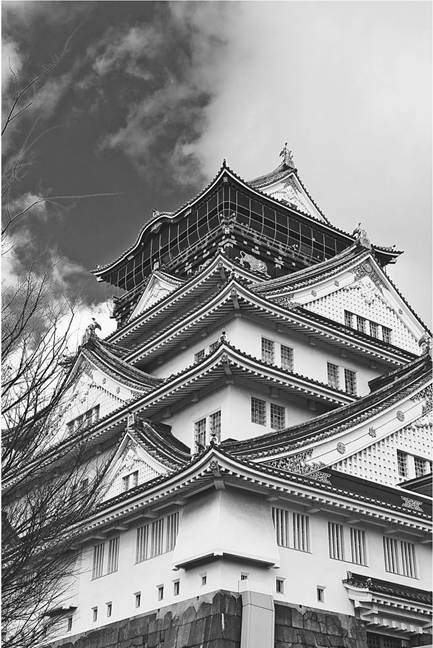 Osaka castle, a modern reconstruction of one of the massive, multistoried daimyo structures that served as headquarters of each domain in the Tokugawa years (1600-1868). These castles served as living quarters and administrative centers for the daimyo, typically housing hundreds of family members and servants. Surrounded by one or more moats, set on a base of hewn stone, and topped by white plastered walls and tile roofs, the castles were intended as much to show the lord’s strength as to provide defense. Photo by Chris McCooey.
That sense was also encouraged by the bakufu’s efforts to create a unified ideology and to handle foreign affairs at the national level. The regime used religion as a support for the state from the first, enshrining Ieyasu as a Buddhist avatar at the huge Shinto shrines in Nikko. As the generations passed, the focus shifted to Neo-Confucianism, a system barely known in Japan until the late 1500s. Under a series of state advisors, including the brilliant Confucian thinker Ogyu Sorai early in the 1700s, the Tokugawa came to be seen as the rightful guardians of the “heavenly way,” legitimized by their ability to discern and implement the principles necessary for keeping society orderly. “One’s first concern,” Ogyu wrote, “should be Humane Government.” He said, “The lord of a province should regard his warriors and the general population as a family that has been given him by Heaven, a family that he cannot abandon.” The duty of a subject, he added, was loyalty: “serving one’s lord and nurturing and putting him at ease.” At the practical level, this ideology divided society into four descending classes or status groups—samurai, farmers, craftsmen, and merchants, in that order—and gave expression to a new term, bushido, which maintained that the “way of the warrior” was to lead society and live by a rigorous ethical code.
In foreign relations, the regime had two goals: security and prosperity. To ensure the latter, bakufu officials established Nagasaki as a center for trade with China and Europe, and they fostered relations with Korea and the Ryukyu islands through the daimyo of Tsushima Island and the southern domain of Satsuma, respectively. Both Korea and the Ryukyus sent large missions to Edo to celebrate major events such as the accession of a new shogun, with the Korean delegations typically numbering more than 400 members. On occasion, the Tokugawa also used force, particularly to assure the cooperation of the Ryukyu islanders and the indigenous people of Hokkaido in the north, the Ainu. All of this resulted in lively trade exchanges in the 1600s, with silver and gold flowing out and silks flowing in. As the century neared an end, however, officials began focusing more on security and less on profit, with the result that trade declined after 1700.
Security measures were most obvious in Nagasaki. Partly to avoid being placed in a subordinate position in Asia’s China-centered order and partly to prevent Western aggression, the bakufu issued a series of regulations that, by the 1630s, limited the Chinese to a community of 2,000 traders in a sector of Nagasaki and restricted Western trade to a man-made island in Nagasaki harbor called Dejima. The main target of these rules was Christianity, which was proscribed. Under Ieyasu’s grandson, Iemitsu, as many as 5,000 Christians were executed, sometimes by crucifixion. In 1635, a sweeping edict proclaimed, “No Japanese is permitted to go abroad” and “If any Japanese returns from overseas after residing there, he must be put to death.” An unsuccessful uprising two years later by 25,000 commoners carrying Christian banners on Kyushu’s Shimabara peninsula confirmed Tokugawa security fears and spurred still harsher policies. By 1641, the Spaniards and Portuguese had been banned and the British had stopped coming, leaving the Dutch as the only Europeans in Japan.
Even the Dutch were regulated vigorously—restricted to tiny Dejima, where they were secluded from ordinary Japanese. Visited by just three trading ships a year on average, they led dreary lives. Englebert Kaempfer, a Dejima physician in the early 1690s, likened the island’s buildings to goat-pens and said its inhabitants were treated “not like honest men but like criminals, traitors, spies, prisoners, or, to say the least, as . . . hostages of the shogun, as the locals always (thoughtfully) call us.” Profits kept the traders coming, however, and the information about Europe that they provided on annual visits to Edo persuaded officials that the system should be maintained. In other words, the Dutch and Chinese gave the bakufu exactly what it desired at the end of the 1600s: prosperity and knowledge, within a stable trading system.
The regime’s dominance was less pronounced on the domestic level, where it did a better job of fostering security than of controlling national life. As the centuries unfolded, development initiative was taken increasingly by the villages, towns, and domains. Although bakufu policies remained important to the end of the era, the country’s most dynamic changes were inspired by people outside the capital, the commoners and elites in far-flung domains who generated economic, literary, and cultural transformations that could not have been predicted in 1600. These changes were crucial in moving Japan toward nationhood.
The 1600s saw remarkable gains in nearly every area of society, and though the momentum slowed after that, growth in many regions continued into the 1800s. Population, for example, soared in the seventeenth century, from 12 million to perhaps 25 million. Land planted in rice doubled. Living standards improved for all classes (though not for all individuals), providing bigger homes, better foods, more comfortable clothes, and greater longevity. The country’s transportation system advanced: sign-dotted highways like the Edo-to-Kyoto Tokaido were crowded with pilgrim groups traveling to shrines, villagers off to hot springs, peddlers carrying their wares, and daimyo) processions heading to and from the capital, alongside begging nuns and pickpockets. The roadways were “as crowded as the streets of a populous European city,” Kaempfer said, because “the Japanese travel more often than other people.” Moreover, travel had become safer than in the medieval years, as one eighteenth-century samurai noted: “Wherever I go [the inhabitants], from lords and officials to poor fishermen and woodcutters, treat me politely, and I have been able to wander with ease.”
The han gave birth to many of the era’s most significant changes. Autonomy allowed each domain to develop its own distinctive commercial and administrative practices, thereby spurring both economic growth and regional differences. Interdomain trade created national commercial networks and credit systems, as well as a cash economy, but each domain created its own currency. When labor grew scarce, one domain might encourage outsiders to immigrate, while another subsidized its own households to keep them from leaving. When hard times hit, one han encouraged samurai wives to go into silk weaving; another suggested that warriors become farmers—both deviations from the neo-Confucian ethos. Even the era’s terminology suggested local independence: domains often referred to themselves not as han but as kuni (countries). When the lord of Yonezawa in the far north asserted that he thought “of the entire country [kuni] as one family,” he meant not Japan but his han.
A vivid illustration of the changes that swept regional Japan came in the rapid growth of villages and cities, with small localities undergoing even more sustained transformation than the cities. Villagers made up some 80 percent of Tokugawa Japan’s population. They flooded the rice paddies in the spring, transplanted seedlings into the muddy fields, harvested the grain in autumn, and then paid taxes and rents from their harvest. Other villagers fished the coasts, mined the mountains, and fed mulberry leaves to silkworms. They demonstrated the two sides of Tokugawa development: continuing poverty for many, set against impressive growth for increasing numbers of rural residents.
The difficult side of village life was everywhere apparent. A quick reading of early Edo village regulations suggests how restricted—and grim—village life could be: “sake must not be brewed in villages”; “no design is permitted” in peasant clothing; “bean-jam buns, bean curds and the like may not be traded.” And economic realities often turned grimness to darkness. Poverty was everywhere. Famines ravaged wide areas, as did epidemics of smallpox and syphilis. Taxes wore people down. And pollution took a toll in mining regions. In the words of a 1745 peasant petition in Sachiu village of the northeast: “Polluted water reaches the fields, and farmers suffer the extreme inconvenience of having crops that do not ripen. When mining was conducted in this location previously, rice fields . . . all became barren.”
Problems also sprang from a status system that sometimes provoked conflicts between villagers and the outcast groups of leather-workers, jailhouse employees, and undertakers who frequently lived nearby. While the eta and hinin experienced a great deal of autonomy within their own group structures, Tokugawa rules made the separation between commoners and outcasts more rigid than in earlier centuries. They required that eta and hinin live in their own spaces, outside the farming villages, and forbade them from entering commoners’ homes, socializing with them, or dressing like them. That did not keep some outcastes from doing well financially, since many of their functions were in high demand. But it exacerbated tensions between groups and intensified the stigma that went with outsider status.
More surprising—and even more remarkable—was the dynamic side of Tokugawa village life. Regulations notwithstanding, most villagers could conduct life as they pleased, as long as they paid their taxes and avoided calling attention to themselves. As one village headman put it: “So long as he can get to his paddies and fields to work, he can make his living without hardship. The only one who can . . . say whatever he pleases is the peasant.” Having helped to fuel the economy in the 1600s, the villages kept growing in the 1700s, after the cities lost their momentum. One evidence of this lies in the villages’ increased productivity. Although the amount of arable land stayed relatively constant in the 1700s, output continued to rise, thanks to better farming techniques. Crop varieties expanded as farmers supplemented rice with corn, sweet potatoes, cotton, silk, sugar, and tobacco. Many villages developed nonagricultural businesses, too. The people of mountainous Shimoina in Nagano, for example, prospered from their packhorse transportation and wood products. The fishermen of Hokkaido sold herring-meal fertilizer for cotton fields.
Indeed, the dominant rural trait of this increasingly industrial era may have been the commercial spirit, as farmers everywhere read treatises on agricultural techniques, worked to create economies of scale, and borrowed money to secure seed grain and to live better. One indignant moralist said early in the 1800s: “The most lamentable abuse of the present day among the peasants is that those who have become wealthy forget their status and live luxuriously like city aristocrats.” One wonders if he also was angry that bathing and the regular washing of clothes had become widespread. Or that commoners in small towns now got to watch touring sumo wrestlers?
Growth in the cities may not have been as sustained, but was impressive, too, particularly in the early Tokugawa period. During the 1600s, cities proliferated across the country, mainly as a result of the new political structure. Each domain had its castle town, often with a population of more than 10,000, and villages expanded into towns along the major highways, partly to service the sankin kotai processions. Major centers such as Osaka (the commercial hub) and Kyoto (the manufacturing center) grew dramatically in the seventeenth century, with populations reaching 375,000 in Kyoto and 500,000 in Osaka by the early 1700s. The most spectacular expansion came in Edo, the bay-side swampland Ieyasu chose as his administrative center. Within decades, its diverse sections had been crisscrossed by canals, linked by bridges, bedecked with daimyo quarters—and filled with hundreds of thousands of samurai and commoners, come to work for the bakufu. By the 1700s, Edo’s population numbered more than a million, making it the world’s largest city. According to one estimate, towns and cities, which made up about 1 percent of Japan’s population in 1600, constituted 15 percent in the early 1700s.
Samurai made up a significant portion of most cities’ populations, even though they constituted only 7 percent of Japan’s people overall. In theory, these warriors lived off government stipends in return for administering public life. In reality, there were not enough government jobs for them, and their official incomes generally were meager. As a result, many had to look elsewhere for money. Some became physicians; some started schools; some taught swordsmanship; many engaged in work considered beneath their class; most borrowed money. Poverty was common. Katsu Kokichi, an Edo samurai of fairly distinguished lineage, wrote a memoir about his life as a ne’er-do-well in the early 1800s. At age twenty-one, he wrote, he was “penniless. I had no choice but to sell my everyday sword. . . . I had only the clothes on my back. To take my mind off my woes, I went to the Yoshiwara” pleasure quarters. In some regions, a full 70 percent of these warriors put food on the table by means of unorthodox money-making schemes—everything from making dolls to hiring out their daughters as servants. And many frequented the gambling halls that spread across the country in the 1700s.
Much of the samurai spending went into the coffers of the chonin, or townsmen classes, who provided the bulk of the cities’ energy. Technically, the term chonin denoted all nonsamurai urbanites, at least half of whom were the workers who built the houses, carried away the night soil, fought the fires, and provided the transportation that kept urban life functioning. In common use, however, the term referred to the merchants and craftsmen who were free from taxation and from ideological constraints on profit-making—and thus able to exploit every city dweller’s needs and desires. While most chonin were poor, many were entrepreneurs. In Osaka, they created the world’s first commodity futures market and facilitated a nationwide rice trade. In Kyoto, they handled the shogun’s finances and produced Japan’s best textiles. In Edo, they designed daimyo residences, ran factories, and worked for the samurai. In castle towns, they exchanged goods between city and countryside. And everywhere, firms with names like Mitsui and Noda Shoyu (later Kikkoman) operated soy sauce factories, invented mining technologies, brewed sake, and operated fish markets and entertainment quarters. They also sold Buddhist relics, ran bathhouses, organized specialized trade guilds, and generally turned Japan’s cities into profit-making engines.
The chonin also inspired a noticeable leveling of society, status distinctions notwithstanding. No one could have doubted that some kind of social transformation was afoot when walking through the evening and morning marketplaces around Osaka’s and Edo’s bridges, thronged by shoppers from all strata, out to sample everything from radishes to candy, from street entertainment to smoked herring—or when observing the colorful tattoos sported by shoppers from nearly all classes except the samurai after the early 1800s. One of the most important engines of this leveling was an explosion in printing, mostly wood block but also moveable type, in the early Tokugawa decades. The era saw a flood of published works: travel guides, farmers’ manuals, sermon collections, joke books, and one-page broadsides, called kawaraban, that gave Japan its first taste of journalism, with sensational stories about castle fires or temple sex scandals—all for a profit, of course. An average of 3,000 published works a year bound people together in an intellectual community rendered possible by printing.
Social leveling was stimulated, too, by the spread of schools. Until 1600, education had been limited to the elite. Now, the expansion of commerce and printing, along with a more expansive political system, made the benefits of learning obvious everywhere and prompted the widespread creation of schools: private schools run by intellectuals, official han and bakufu institutions, and thousands of local academies run by priests, husband-and-wife teams, or underemployed samurai. Teachers, many of whom were women and nearly half of whom were commoners, were often paid in gifts rather than cash, and instruction involved tedious hours of writing from copybooks. By the early 1800s, roughly 40 percent of Japan’s males and 10 percent of its females had achieved literacy—a remarkable figure for the nineteenth-century world. The impact of these schools on social attitudes is apparent in an 1843 bakufu order: “Teachers who run schools both within the city of Edo and without should instruct children enthusiastically and treat them equally. Everyone—boys and girls, high and low—should be able to read and write appropriate to their station.” Class and status still mattered, but less than they once had.
Most people went to school to learn to do accounts or read instructions. The schools, however, also supported a lively intellectual life among chonin and samurai elites. Indeed, by the end of the second Tokugawa century, the system had produced great numbers of scholars and commentators who engaged in lively exchanges about the direction of national life. There were Confucian scholars who looked to China for models. There were kokugaku (national learning) advocates who sought direction in Japan’s own past, merchant ethicists who lauded hard work, and, increasingly, students of “Dutch learning,” a sobriquet for anything Western. The last group remained small in number until the late eighteenth century because of the ban on the study of anything related to Christianity, but after that works such as Sugita’s Dutch anatomy gained increasing attention even from officials.
Then there were the arts, the sphere on which the chonin put their most colorful stamp. Within the governing class and among families who cared about pedigree, the prestigious arts, called ga, still thrived, perpetuating traditional forms such as No theater and the tea ceremony. But it was the entertainment pursuits of the townsman, activities the samurai labeled zoku (coarse), that gave theater, literature, and the visual arts their greatest energy, leveling urban culture almost as much as education did.
The cities’ entertainment centers, or pleasure quarters, spawned many of the zoku artistic developments. By the late 1600s, each major city boasted an area called the ukiyo or “floating world,” where men (and more than a few women) from all classes sought relief from the strictures of daily life. At the heart of these quarters—Shinmachi in Osaka, Shimabara in Kyoto, Yoshiwara in Edo—was an assortment of bathhouses, theaters, teahouses, and brothels offering pleasures of every sort. The key figures were the female entertainers, known after the mid-1700s as geisha, who danced, sang, and made conversation with male visitors. Oiran, or courtesans, also were important to each entertainment district, prompting the travel writer Hiraga Gennai to comment in the 1760s: “The lanterns burned brighter than daylight, illuminating the sumptuously bedecked courtesans as they sat before tobacco trays cooly smoking, or writing letters. Wayward strands of black hair lay quaintly against their white collars. . . . Women such as this could not be of this world.”
From the ukiyo quarters came a multifaceted set of art and literary forms. On the stage, the lively spectacles and intricate plots of kabuki attracted attendees from all classes, even though samurai attendance was theoretically forbidden. Kabuki acting, which had originated in provocative dances by women along Kyoto’s Kamo River in the late 1500s, was restricted to adult males after the 1650s, and eventually the onnagata, or female impersonators, were among its most popular figures. Fantasy also gave bunraku (puppet theater) much of its allure, with men in black manipulating realistic puppets in full view of the audience. Like kabuki, bunraku attracted adults from all walks of life, and its greatest playwright, Chikamatsu Monzaemon, produced many literary masterpieces, including Love Suicide at Sonezaki, in which a clerk and a prostitute die together rather than accept prohibitions on cross-class marriage. The era’s major visual innovation, the woodblock print, derived both its name and its initial content from the ukiyo. Known as ukiyo-e or “floating world pictures,” the first of these prints were stylized portraits of leading courtesans in the entertainment world; later woodblocks depicted broader subjects such as commoner life and landscapes. Although they were not respected as genuine art at the time, they were immensely popular, displayed on the walls of huts and mansions alike.
The era’s most highly regarded literature came from chonin society, too. While officials may have praised Buddhist sermons and Confucian discourses, the denizens of the pleasure quarters turned out the masterpieces, bringing new realism to fiction and boasting sales large enough to allow writers, for the first time, to earn a living from their brushes. The era’s leading novelist was the Osaka native Ihara Saikaku, who first won renown for poetry, then produced more than twenty books about lovers, samurai, and merchants. His first famous work, A Man Who Chose Love, recounted the amorous experiences of a man who retired at age sixty to an island inhabited only by women. Another, Five Women Who Chose Love, described the passionate affairs of women in respectable society, while a third portrayed homosexual attraction. His wittiest novel was probably The Eternal Storehouse of Japan, a description of merchants making money. In one episode, several visitors sit in wealthy Fuji-ichi’s home speculating on what food is being prepared in the kitchen. After a discourse on frugality, Fuji-ichi concludes: “It is high time that refreshments were served. But not to provide refreshments is one way of becoming a millionaire. The noise of the mortar which you heard . . . was the pounding of starch for the covers of the Account Book.”
 For two years (1794-95), the popular woodblock artist Sharaku produced numerous exaggerated portraits of kabuki actors, such as this one of Otani Oniji II, and then he mysteriously disappeared from public life—a fact that gave him a special mystique and increased his popularity among art lovers. The major dramatic form of the Tokugawa years, kabuki was performed only by male actors, many of whom became nationwide celebrities. TNM Image Archives.
Saikaku’s Genroku-period contemporary, Matsuo Basho, also exemplified the era’s social leveling. His father was a samurai, but of lowly status, barely able to make a living teaching and possibly farming. Basho’s great contribution was to poetry and travel writing. Revered as history’s greatest writer of the three-line haiku form, he is best known for his “frog verse”:
The old pond
A frog jumps in—
A sound of splashing.
The popularity of haiku among peoples across the land is illustrated in a tale from one of his trips, when he reputedly happened on a group of villagers composing poems beneath a full moon. Posing as a pilgrim priest, he first declined when asked to compose something, then finally responded:
’Twas the new moon
Since then I waited—
And lo! tonight!
The farmers gasped when they learned that their visitor was Basho, “whose fragrant name was known to all the world.” The next centuries would produce a plethora of popular haiku poets, along with emulators of Saikaku’s witty, earthy fiction style.
For all of the dynamism of the first two Tokugawa centuries, a sense of national crisis dominated public discussions as the 1800s approached. Bakufu leadership had failed to keep up with social changes, and officials seemed adrift; economic development had stagnated, particularly in the urban sphere, and writers had begun to invoke the impending doom suggested by the Chinese concept of naiyu gaikan—“troubles within, dangers without.” On the domestic side, mounting financial difficulties were cited frequently as the cause of the problems. Official admonitions about frugality notwithstanding, by the early 1800s the shogun’s government was taking in 500,000 fewer gold coins, called ryo, than it was spending each year. Some domains did better than the Tokugawa, but most of them struggled, too; the relatively affluent Choshu han, for example, owed all of its tax revenues in 1840 to merchants from whom it had taken out loans. Administrators resorted to a raft of income-producing measures: reducing the metal content of coins, forcing merchants to loan them money, cutting samurai stipends—and occasionally carrying out drastic reform programs, as in the cost-cutting administration of the senior bakufu councillor Mizuno Tadakuni early in the 1840s. But the fiscal crises only worsened as time passed.
The sense of domestic crisis was compounded by a rise in commoner protests after the 1780s, provoked sometimes by famines, sometimes by taxes, and often by corrupt or heavy-handed officials. One of the most destructive uprisings was led by the idealistic Osaka constable Oshio Heihachiro in 1837 against what he perceived as government insensitivity to the poor during a famine. After pilfering food from the warehouses of the rich, his followers ran riot and destroyed a quarter of the city’s buildings before being forcefully put down. Other protests were quieter, as in the case of northern villagers who, a chronicler said, greeted visiting officials rudely in 1788: “Some presented themselves stark naked, others bowed their heads only to raise their buttocks, and some remained inside their huts sleeping with their legs sprawled.” Still other actions took the form of petitions, peaceful demonstrations, or the smashing of a village headman’s property. The protests, which numbered more than thirty a year during the 1780s, sought short-term solutions rather than systemic change, but they heightened the widespread perception that the social order was disintegrating.
Foreign threats also fueled the sense of crisis, as Western ships began to challenge the bakufu seclusion policies. In the 1790s and early 1800s, several Russian and American vessels made incursions into Japanese waters, seeking trade and safety from storms. In1808, panic set in after the British vessel Phaeton sailed into Nagasaki harbor, prompting the city’s commissioner to commit suicide. In 1825, after another incident, the bakufu decreed that “whenever a foreign ship is sighted approaching any point on our coast, all persons on hand should fire on and drive it off . . . without hesitation. Never be caught offguard.” The decree was never fully enforced, and a decade later the policy was moderated. But the incursions provoked increasingly open debates about whether Tokugawa administrators were up to the challenge of dealing with the mounting foreign and domestic threats. When Britain demonstrated its military might by defeating China in the opium wars of the early 1840s, the tone of discussions became more urgent.
Analyses of the causes of these crises were as varied as the ideological camps from which their authors came. Traditionalists cited moral decline in the ruling class, arguing that “the samurai have become effeminate and resemble a body that contracts with illness after exposure to cold, wind, or heat.” Some young samurai blamed incompetent bureaucrats, calling officials “wooden monkeys”—like the “see no evil, hear no evil, speak no evil” carvings at Nikko—and demanding more decisive leadership. Rather ominously for the Tokugawa, daimyo in several of the outer domains began showing increasing (albeit discreet) signs of independence and less inclination to follow bakufu orders. Certain Confucian scholars urged greater practicality and innovation in matters of trade and finance, while those in the Dutch learning camp advocated a Western-style military and more interaction with the West.
Critics were united, however, in assuming that everyone belonged to a single, imperiled realm, and their varied arguments bear witness to the advent of what some call proto-nationalism. As the bakuhan and trade systems had integrated far-flung regions spatially, the new sense of danger united people spiritually. Confucianists speculated less about universal forces now and more about Japanese particularities. Dutch learners spoke in terms of national necessities. The kokugaku scholars talked about what made Japan special, in particular the heaven-descended imperial line that set it apart from other countries, and by extension called the legitimacy of Tokugawa rule into question. When the nationalist scholar Aizawa Seishisai began his influential 1825 collection of essays, New Theses, with the assertion “Our Divine Realm is where the sun emerges,” a place that “rightly constitutes the head and shoulders of the world and controls all nations,” he was expressing a shared sense of Japanese superiority that would have been unthinkable in the pre-Tokugawa days. Peace, new levels of national integration, and increased prosperity had come to the islands during the first two Tokugawa centuries, made possible in part by a stable regime in Edo. Now that regime had grown old and ineffective, and scholars had created a nation-oriented vocabulary to express their growing worries about the country’s health—a vocabulary that would facilitate Japan’s encounters with the global world after 1850.