
Our Reporter Hashimoto Shigeru—Slashed by Police Officers,” proclaimed the Tokyo Nichi Nichi newspaper on Wednesday, February 11, 1914. Hashimoto, whose bandaged visage accompanied the story, had been covering a protest rally at Tokyo’s Hibiya Park the previous day when policemen had stabbed him. A few days later, security guards beat up another journalist, who was seeking information at the home minister’s residence. In both cases, the authorities were skittish about press stories regarding bribes taken by naval officials from the German industrial and engineering conglomerate Siemens.
Public outrage over the bribes and bullying toppled the cabinet; the whole episode showed how complicated Japan’s public life had become in the early twentieth century. First, there were the people on the streets—40,000 of them at that rally. By the 1910s, Japan’s masses had become citizens, demanding a hearing on issues such as taxes, prices, and corruption. The people’s era had arrived. But it was not that simple; the police reactions suggested another feature of these years: the authorities’ determination to maintain control at any cost. The scandal suggested a third theme: Japan’s integration into the international sphere. The bribery deal, between Germans and Japanese, was uncovered when a Tokyo worker sold documents to a British journalist. All of these forces—engaged commoners, authoritarianism, contorted international relations—would interact in shifting patterns across the first half of Japan’s twentieth century to make the Meiji years seem tranquil by comparison.
When Meiji died in July 1912, people mourned a man whose dignified persona had captured an era, a half-century that propelled Japan along a relatively straight path to world prominence. His son, the emperor Taisho, who reigned from 1912 to 1926, would preside over a different period, a mere decade and a half that exploded with competing, conflicting energies.
The explosion was most apparent in urban Japan. Metropolises continued their late Meiji growth, while new technologies and institutions revolutionized the cities’ appearance and rhythms. By the end of the 1920s, a quarter of Japan’s urban homes had radios; Tokyo’s central train station was as modern as any in Europe, its subway the first in Asia. Equally significant, more than a fifth of Tokyoites now called themselves middle class, affluent enough to spark a blaze of consumerism. Multistory department stores went up in the 1910s, with elevators, escalators, and glass showcases containing everything from fountain pens to lipstick. Shoppers purchased the latest dresses, the most fashionable cigarettes, and the newest gadgets. Young people created a cafe culture, which embraced every pleasure imaginable: drinking, moviegoing, jazz, fashion consciousness, sex. Reporters dubbed it the world of ero guro nansensu—the erotic, the grotesque, and the nonsensical. At its center were the mobo (modern boy) and, even more important, the moga (modern girl), who dressed modishly and demanded sexual freedom—a Western-style woman like Aguri in Tanizaki Jun’ichiro’s 1922 short story of that name, who “imagines herself . . . fixing jewels on her ears, hanging a necklace around her throat, slipping into a near-transparent blouse of rustling silk or cambric, swaying elegantly on tiptoes in fragile high-heeled shoes.”
 By the beginning of the Taisho era in 1912, electric lines crowded city skyscapes and streetcars had became the fastest form of urban transportation. At left is the Shinbashi Hakuhinkan, built in 1899, which housed a collection of different shops, much like the shopping centers of a later era; it is regarded as a forerunner of Japan’s first department stores. Photograph courtesy Peabody Essex Museum, Salem, Massachusetts.
A remarkable feature of Taisho urban culture was its embrace of people from all classes and regions. As one journalist said of the period’s proliferating beer halls, everyone “drinks the same beer as everyone else. Jinrikisha men [rickshaw pullers] meet gentlemen, workers meet merchant princes, and frock coats touch army uniforms. . . . Smiles blossom as beer and foam disappear into people’s mouths.” The mass media particularly facilitated this class mingling. By the mid-1920s, several Osaka and Tokyo papers had daily circulations of nearly a million, with readers from all income groups. Magazines like King and Success attracted up to 1.5 million readers each, with tabloid-style gossip and articles on achieving success. Women’s journals proliferated, running instructions on household management alongside fashion advice and rumors about stars’ sexual escapades. A “mountain hamlet” reader wrote in to say that Housewife’s Companion was “the only friend I have to teach me about all the new things going on in the world.” This exploding urban culture was described and analyzed endlessly by intellectuals. The most astute chroniclers may have been the writers of “I novels,” who produced individualistic, confessional writing, much of it about what the novelist Kambayashi Akatsuki called the “monster of loneliness” that “dwells deep within the human heart, and . . .cannot be appeased.” The most insistent analysts, though, were the social commentators, whose critiques ranged from hand-wringing over hedonism to condemnation of the ongoing, pervasive discrimination against groups like Hokkaido’s Ainu, the still-sequestered burakumin communities, and Korean immigrants, who numbered nearly 300,000 by the end of the 1920s. Writers also debated the changing roles of women. In 1911, a new women’s journal named Seito (Blue stockings) began its first issue with the declaration “In the beginning, woman was the sun Today, woman is the moon, dependent on others for her birth, radiant only in others’ light.” Over the next two decades, writers for Seito and other journals debated gender issues vigorously, with traditionalists calling for a return to the “good wife/wise mother” ideal and progressives demanding equality and sexual freedom. Journalists also discussed the growing numbers of women who were themselves making news: the international track star Hitomi Kinue; the women’s suffrage activist Ichikawa Fusae; and the free-living actress Matsui Sumako, who played Nora in the Japanese version of Henrik Ibsen’s play A Doll’s House.
The Taisho social vibrancy was made possible in part by a strong, if uneven, economy. The net domestic product grew by 60 percent in the decade after 1910, and industrial output quintupled, to nearly 7 billion yen. By the late 1920s, Japan had become heavily industrialized, with manufacturing surpassing agricultural output. Unfortunately, the process was spasmodic, as growth spurts were followed by downturns; one significant decline came after World War I, another after the Great Kanto Earthquake of 1923, which destroyed three-fifths of the homes in Yokohama and Tokyo and claimed nearly 140,000 lives, even as it tore apart the region’s transportation, industrial, and firefighting systems. A grim joke made the rounds that fall—that “we have earthquakes for breakfast, dinner, supper, and earthquakes to sleep upon.” Many found it difficult even to chuckle though, for the disaster left 1.9 million people homeless and sent the economy into a temporary tailspin. What was more, economic benefits were spread unequally across the Taisho years, with wages declining for workers in smaller industries, inflation hurting the majority, and government imports of cheap rice hitting farmers hard, particularly after World War I.
These economic inequalities spurred activism and protests among consumers and workers. In the summer of 1918, for example, when wartime inflation pushed up rice prices, a million people staged protests across the islands, many of them violent. More than 300,000 renters had joined tenant unions by the mid-1920s to fight high rents and bad housing. Labor organizations flourished, as workers fought against low wages and capricious management. “I was psychologically on the verge of exploding,” munitions worker Uchida Toshida said. “The arsenal was rigidly stratified and those on the bottom stayed on the bottom. There were many wrong and unfair practices.” Like thousands of others, he joined Japan’s first major union, the Yuaikai (Friendly Society). While unions initially emphasized moderate goals such as worker solidarity, they became more aggressive after a federation of labor organizations was created in 1919. The period’s largest strike, by 27,000 Kobe shipyard workers in the summer of 1921, lasted for six weeks and sparked violent clashes between workers and police.
This activism in turn prompted wide-ranging debates about how the political system should be adapted to accommodate a changing citizenry. The most influential theorists, Yoshino Sakuzo and Minobe Tatsukichi, advocated, respectively, minponshugi (people-based democracy) and an “organ theory” of governance that treated the emperor as just one of several state organs—a key one, but not the entire body and soul of the state, as traditionalists had long insisted. Less mainstream was an emerging cadre of socialists, whose views ranged from the anarchism of Kotoku Shusui and Kanno Suga, who were executed following secret trials in 1911 for a plot against the emperor, to the Christian-Marxist blend of the economist Kawakami Hajime. In between were communist workers like Tanno Setsu, who wrote in 1928: “Woman workers! Farm women! We must realize that our living conditions will not improve merely by fighting the capitalists and the landlords We . . . must . . . fight the government as well.” While officials harassed the socialists, the Taisho milieu provided space for all but the most radical to speak out.
At the practical level, commoners entered the political sphere in greater numbers than ever. At first, their engagement took place mostly on the streets, where they demonstrated, often quite effectively, for a wide range of causes. In 1906, citizens protested streetcar fare increases; in 1908, they fought higher taxes; in 1913 and 1914, high-handed, corrupt government; and in 1918, rice prices. They also demonstrated repeatedly for a broader role in decision-making, insisting on the removal of all tax requirements from an electoral law that kept three-quarters of adult males from voting. A few even demanded the vote for women. Until mid-Taisho, prime ministers were selected by a group of patriarchs called the genre) (elder statesmen). But when the cabinet was toppled by the rice riots in 1918, the genre) decided that the only way to restore calm was to make the head of the majority political party, Hara Kei, prime minister. And once they had made that decision, there was no going back. For all but two of the next fourteen years, the head of the leading party would be prime minister. When the Diet passed a universal male suffrage bill in 1925, quadrupling the electorate to twelve million, most observers concluded that democracy had moved off the streets and into the voting booth.
Social energy and rising democracy were not, however, the period’s sole features. Challenging every defender of cafe culture or worker rights was a traditionalist worried about order and power, someone who argued, like one official in 1913, that “political party fever is poisoning the provinces.” And the authorities did more than moan; they attempted to counter radical thoughts by nurturing patriotism and conservative values. In 1911, for example, the government created a Committee on Literature to give awards to those who wrote “wholesome” works. The plan foundered when several respected writers damned it as an attempt to control art, but the effort made clear the traditionalists’ determination to safeguard the old ways. During the Taisho years, officials channeled funds to conservative elements in burakumin organizations, created a Harmonization Society to foster management-worker cooperation, and threw their prestige behind the expanding Patriotic Women’s Society. They added martial training to the school curriculum in 1925, with a military officer assigned to each middle school. And they created an Imperial Military Reservist Association to foster patriotic values in local communities.
Officials also used more repressive means to assure conformity. Censorship of “dangerous” speeches and publications became pervasive in the 1920s, and efforts to suppress socialism increased, especially after mid-decade. From 1918 to 1930, some 350 newspapers a year were banned for articles that threatened public order, and following the 1923 earthquake, police arrested socialists and spread xenophobic rumors that led to the massacre of several thousand Korean residents by vigilantes. Military police also murdered several jailed socialists in the earthquake’s aftermath. This bare-knuckled approach intensified after the passage in April 1925 of a “peace preservation law” that provided for up to ten years’ imprisonment for persons who sought to abolish the private property system or change Japan’s kokutai (national polity). A special law enforcement division, the Special Higher Police, known popularly as the “thought police,” was charged with administering the law, and while enforcement was uneven in the 1920s, radical thought became increasingly unacceptable. On the night of March 15, 1928, police raided more than a hundred locations and took 1,600 suspected communists into custody.
Nothing illustrated the Taisho clash between progressive and conservative forces more vividly than Japan’s actions in the arena of foreign affairs, where progressive internationalists largely held sway through the 1920s, agreeing with the diplomat Makino Nobuaki that Japan should “honor pacifism and reject aggression,” in keeping with “trends of the world.” In that spirit, Japan joined the League of Nations and signed history’s first international arms limitation agreement, the Washington Naval Treaty of 1922, despite wide concern that the treaty’s five-five-three formula allowed Japan to maintain only 60 percent of the warship tonnage permitted the Americans and the British. Japan also eschewed military interference in China’s domestic affairs during the 1920s and pursued peaceful relations with the Soviets.
This cooperative approach did not, however, signify a rejection of empire-building. National policy remained committed to the late Meiji goals of developing colonies and maintaining equality with the world’s powers. Even as Japanese officials cooperated with the Western giants, they had no more compunction against expansive moves than the Europeans and Americans did—a fact illustrated by their actions during World War I. In 1915, for example, they took advantage of Europe’s preoccupation with the war to issue to China a set of Twenty-one Demands intended to extend Japan’s leases in Manchuria and assure themselves control of important segments of Chinese affairs. China’s response, which was to accept all but the most egregious demands, demonstrated Japan’s potency in the region. While the Japanese stayed out of the European fighting, they carried out several military operations in Asia, using the Anglo-Japanese Alliance as justification for taking over most of Germany’s possessions in China and the Pacific. They also sent troops into Siberia near the end of the war, a disastrous move apparently aimed at establishing a buffer zone against the newly established Soviet Union.
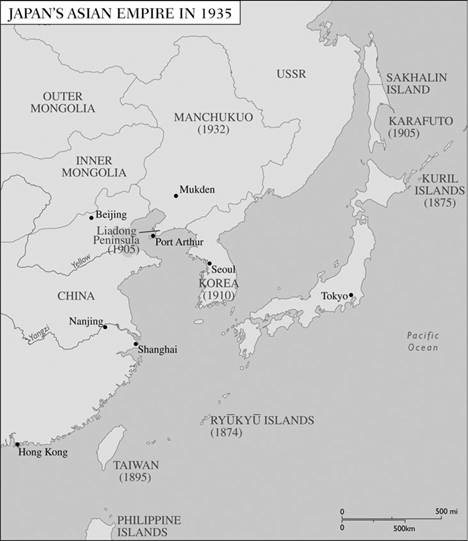
Taisho foreign policy played out most vividly in Japan’s colonies. By the early 1920s, the empire included Taiwan, Korea, Karafuto (secured in the Russo-Japanese War), and the Micronesian islands (taken from Germany, and then mandated to Japan as a trusteeship after World War I), in addition to semicolonial holdings in Manchuria. The colony that mattered most to the Japanese in these years was Korea, which was turned into a protectorate after the Russo-Japanese War and annexed in 1910. The ostensible goal was to bring “civilization” to Korea, and during the Taisho years the Japanese worked effectively to develop Korea’s infrastructure, creating schools, building transportation networks, and improving agriculture. They also encouraged industries, paving the way for some Koreans to found lucrative businesses that later would grow into financial empires. However, Korean prosperity was never Japan’s priority; above all, Japan sought to use Korea to improve its own economy and enhance its international standing, which meant that individual Koreans received few benefits. Indeed, tens of thousands of farm families had their land confiscated, and most new business permits were given to Japanese, not Koreans. As a result, Korean nationalists resisted forcefully, killing more than 7,000 Japanese during the first five years of control. And on March 1, 1919, more than a million demonstrators throughout the peninsula supported a declaration demanding “independence in the interest of the eternal and free development of our people.” Although the demonstrations drew international attention, they did not threaten Japan’s standing in the world, since the other powers employed similar policies in their own colonies.
The Taisho emperor died in 1926. Over the next few years, as his son Hirohito matured in office as the Showa emperor, the country’s mood changed. The social and intellectual energies of the Taisho years lost momentum; the government became even more intrusive; right-wing voices grew louder; and Japanese troops became more aggressive in Asia. The Taisho balance came apart. Why? Although no simple answers present themselves, one explanation clearly lies in the impact of unforeseen events. Three quite distinct episodes occurred at the turn of the decade, interacting in a way that, by the time they had run their course, left the country in a different place.
First came the Great Depression. Japan’s economy, which had stagnated in the late 1920s, plummeted after the New York stock market crash in October 1929. Over the next several years, foreign firms cut back on their purchases of Japanese goods, and by 1931 the country’s exports to the United States had dropped 40 percent, those to China 50 percent, and its GNP had fallen 18 percent. The personal costs were horrendous: more than a million unemployed workers, labor violence, soaring bankruptcies. Things were especially bad in rural regions where declining markets, along with crop failures in 1931 and 1934, took food from the table and made it impossible to pay rents. The protagonist in Mishima Yukio’s novel Runaway Horses said of Japan’s northwest in 1931: “Whatever could be sold was sold, land and homes were lost, . . . and people held starvation at bay by eating acorns and roots. Even in front of the township hall one saw notices such as: ‘Anyone wishing to sell his daughters, inquire within.’ ” The sense of vulnerability led people to seek scapegoats, which they found in party politicians who proved incapable of preventing the crisis and in foreign-oriented businesses that profited from the price fluctuations and changes in monetary policy. Many people began to question Japan’s participation in an international system that rendered it susceptible to Western markets.
A second crisis was ignited by the 1930 London naval conference, which was held to update the 1922 Washington agreements. Japan’s delegates went into the sessions hoping to improve their warship tonnage to 70 percent of that allowed the Americans and British. After intense discussions, however, they accepted an extension of Washington’s five-five-three formula on large cruisers, with the desired 70 percent on small cruisers and a promise that the proposal would be revisited in five years. Back home, naval officials and the public expressed outrage over this capitulation, thinking that their diplomats had been outmaneuvered—and convinced that the international system was skewed against Japan. In November, a right-wing youth shot Prime Minister Hamaguchi Osachi, apparently out of anger over the London agreement; Hamaguchi died the following August.
If the depression and the naval conference inspired skepticism about the world system, an event in northeast China convinced millions that it was time for Japan to be more aggressive on the continent. Japan had expanded its activities in Manchuria steadily after winning that region in the Russo-Japanese War, and by 1930 Manchuria had become a colony in all but name. Using the South Manchuria Railway Company as their engine and the Manchuria-based Guandong (Kwantung) Army to enforce security, Japanese officials had developed a vast structure controlling more than 100 towns, the continent’s most impressive railroad system, and a network of mines, power plants, ports, and farms. By 1930, a quarter of a million Japanese lived in Manchuria, and railway company revenues totaled 34 million yen annually.
As in Korea, the Japanese presence provoked local resistance, especially as battle-torn China became increasingly unified under Chiang Kai-shek in the late 1920s. Students staged boycotts, and workers struck Japanese firms, demanding withdrawal. By the late 1920s, Japanese officials were divided about how to respond. While many thought Japan should be more sensitive to Manchurian interests, others wanted firmer responses. The hand of the latter group was strengthened late in 1928 by the arrival in Port Arthur of Ishiwara Kanji, an army lieutenant colonel with his own plans for making Japan stronger. Convinced by his reading of apocalyptic Buddhist writings that Japan must prepare for an approaching “final war,” Ishiwara led several officers in bombing a section of the South Manchuria Railway outside Mukden (Shenyang) on the night of September 18, 1931, and blaming it on Chinese activists. The damage was slight, but he achieved his purpose. While the Tokyo cabinet debated how to respond to China’s “attack,” Ishiwara’s group created another incident north of Mukden, in the city of Jilin, to make Japanese residents there appear to be in danger. The Guandong Army then took over Jilin, and an irate cabinet, left with few options, approved the Manchurian moves. Thus began a series of episodes that would culminate in the creation of the state of Manchukuo on February 15, presided over nominally by China’s last Manchu emperor, Pu Yi, and controlled by Japan. To citizens back home, long accustomed to bowing before Westerners, it appeared that Japan finally had stood up. Unilateralism was new—and it was popular.
Though the 1930s are often painted in a militarist monochrome, they actually were multihued. On the surface, public life continued much as it had before. Cafe society flourished. Magazines publicized scandals and successes, and the radio broadcast popular tunes, as the number of radios quintupled to five million. Professional baseball began in 1934, making a star of Sawamura Eiji, who struck out Babe Ruth during an exhibition game. Youthful materialism still worried traditionalists, but most people were more interested in the 1936 Berlin Olympics than in the traditionalists’ rants. Despite several terrorist episodes, city streets remained safe, and normal legal procedures remained intact. When the courts found the defendants innocent in a 1937 stock-purchase scandal, they were showcasing their independence, defying both right-wing opinion and the Justice Ministry.
The economy, too, returned to normal. Government spending on public works and the military poured cash into the country, and the December 1931 decision to go off the gold standard made Japanese goods cheaper abroad and fueled foreign trade. By mid-decade, Japan’s recovery had surpassed that of the United States and the Europeans. A number of new commercial giants emerged in the 1930s, among them the conglomerate Nissan and the Japan Nitrogen Fertilizer Company (Nichitsu). By the late 1930s, leading economists were talking about Japan’s “economic miracle.” Political life also continued in generally healthy fashion, with elections won by the relatively liberal Minseito in three of the decade’s four Lower House elections. Political party heads no longer served as prime minister after 1932, but the parties themselves remained influential. Opposition voices rang out forcefully, to the end of the decade. In 1935, for example, the Nagoya journalist Kiryu Yuyu worried in his magazine Stones from A Different Mountain that militarism would lead Japan to war. “The thing we fear so greatly,” he said, “is that the second world war will be more cruel, more inhuman, even than the first one. . . . It is conceivable that people in every civilized country will come to know the tragedy of death.”
Neither prosperity nor opposition essays, however, could mask the fact that society was changing significantly as the 1930s progressed. No one, for example, could miss the upsurge in hyperpatriotic rhetoric. Nationalist voices, an important submelody in Taisho, became dominant now. Old organizations such as the Black Sea Society and the Amur River Society demanded with new vigor that Japan be more active on the continent, and newer groups like the State Foundation Society sought to eradicate socialism and replace “the anti-nationalist political parties” with “the Emperor at the centre of political life.” Membership in these groups ran into the tens of thousands and included increasing numbers of officials and businessmen, almost all of whom demanded a “Showa Restoration”: code for removing Western-oriented politicians, bureaucrats, and big businessmen from leadership, much as the Meiji Restoration had removed the Tokugawa “usurpers.”
The influence of these groups was multiplied by increasing activism among right-wingers in the military and the government. In the army, two dozen young officers formed the secretive Sakurakai (Cherry Blossom Society) late in 1930 to counter a system in which “top leaders engage in immoral conduct” and “political parties are corrupt.” And in the government, the military maneuvered admirals and generals into the office of prime minister repeatedly after 1932. One of the rare nonmilitary prime ministers, Hirota Koki, said the military became “like an untamed horse left to run wild. . . . The only hope is to jump on from the side and try to get it under control while still allowing it to have its head to a certain extent.” Rightist bureaucrats succeeded in 1937 in getting the Education Ministry to produce a school booklet called Kokutai no hongi (Cardinal principles of the national polity), which asserted that Japan was superior to other countries because of the divine lineage of its emperors.
Ultranationalism showed its most frightening face in the streets, where true believers sought to publicize their agenda through what today would be called acts of terrorism. On May 15, 1932, young naval officers, cooperating with the nationalist society League of Blood, assassinated prime minister Inukai Tsuyoshi, hoping to force the military to declare martial law and take over the government. They failed in that aim, but the assassination ended political party government, and the perpetrators’ passionate courtroom defenses, given free rein by judges, inspired wide public sympathy. Similar acts followed in the mid-1930s. Then, on February 26, 1936, a larger incident forced a change in national policy. During a morning snowstorm, 1,400 members of the army’s Imperial Way faction seized central Tokyo, assassinating three leading officials and demanding a Showa Restoration. They surrendered two days later in the face of a massive army crackdown, after the emperor raged against “these criminally brutal officers who killed my aged subjects who were my hands and feet” and threatened that if the army did not quell the rising quickly, “I will personally lead the Imperial Guard Division and subdue them.” The scale of the uprising shocked society and prompted a strong government response, which brought terrorism to an end. But nationalist fervor did not wane.
Indeed, it had become a matter of personal survival by the mid-1930s for citizens to make a show of their patriotism, to the point that even leading communists had begun announcing their conversion to nationalism. When Minobe was forced to resign his Diet seat in 1935 for defending his organ theory, many decided the price of resisting the tide had become too high. Novelists like Kawabata Yasunari, an eventual Nobel Prize winner, turned to traditional Japanese themes. Women’s movement leaders like Ichikawa Fusae, known earlier as peace advocates, pushed for the inclusion of women in the nationalist program. Internationalists like Nitobe Inazo, disillusioned by Western colonial hypocrisy, became defenders of expansionism. In academia, too, nationalist ideologies triumphed. When Ienaga Saburo entered Tokyo University as a liberal-leaning graduate student in 1934, he found that “the whole atmosphere . . . had undergone a total change from what it had been before I arrived.” Japanism, he said, made the history department “an awful place.”
Japan’s colonial policies also were affected by the changing mood, as economic vitality replaced power and prestige as the prime goal. Shocked during the depression by the West’s economic nationalism and the unreliability of international markets, which had sent Manchurian exports into a tailspin, Japan’s leaders began talking about the need to make the empire self-sufficient economically. Independence from the Western powers; self-sufficiency within the empire; total Japanese dominance—these became the central goals.
The change was evident across the Tsushima Straits. The colonial government turned in a harsher direction in Korea in the 1930s; by decade’s end, families were being forced to adopt Japanese surnames, and students were allowed to use only Japanese in the classroom. By 1940, three-fourths of Korea’s capital investment was in Japanese hands. The movement toward a tightly controlled, Japan-oriented economy was clearer still in Manchuria, which now took central place in the empire. Administrative authority shifted away from the South Manchurian Railway Company to the Guandong Army, with its 270,000 troops. Japan poured almost six billion yen into the colony during the decade after 1932: building railway lines to nearly fifty new cities; constructing automobile, weapons, and farm equipment factories; and digging coal mines. As the 1940s began, more than 750,000 Japanese farmers were living in a thousand Manchurian towns and villages.
Not surprisingly, the new colonial policies spawned a growing sense of isolation from the Western powers, even as they pulled the military farther into north China. When the League of Nations condemned the creation of Manchukuo in February 1933, Japan left the League, giving a hollow ring to the emperor’s assurance that Japan would not “isolate itself thereby from the fraternity of nations.” When 350,000 Chinese joined resistance units, officials began discussing the need for more troops and additional buffer zones around Manchukuo. Following fighting that spring in Hebei Province to the south, Japan pressured Chiang Kai-shek into signing the Tanggu Truce, which gave Japan control of the area east of Beijing and created a demilitarized zone between Beijing and the Great Wall. Then, moving still farther afield, the Guandong Army created its own north China regional government a year later, agreeing as compensation to help Chiang defend his Nationalist government against the communists.
All of these initiatives set the stage for a sharp increase in authoritarian, anti-Western domestic behavior after mid-decade. Moving away from free market policies, officials nationalized the electrical power industry in 1936, and then created a Cabinet Policy Bureau a year later to guide the economy. A ministers’ conference in mid-1936 drew up a list of eventualities that might make it necessary to take control of all East Asia. In November, the government signaled its strategic drift by signing an Anti-Comintern Pact with Germany, agreeing to share information about the spread of Soviet communism. Scholars debate whether Japan turned fascist in the late 1930s; no one questions, however, that the military’s influence had become dominant and that Japan was becoming increasingly isolated from its former allies.
The spark that turned all of China into an inferno was another incident, on July 7, 1937, when shots fired at Japanese troops on maneuvers southwest of Beijing led to skirmishes with local troops. As in 1931, an isolated incident expanded into something bigger. The immediate impetus this time was Chiang Kai-shek, who sent troops to Beijing in contravention of the Tanggu Truce and proclaimed with considerable bluster that he would allow no more Japanese expansion in northeast China. Tokyo countered with its own bravado, despite Ishiwara’s warning that if Japan responded harshly, “we may . . . find ourselves with a full-scale war on our hands. The result would be the same sort of disaster which overtook Napoleon in Spain—a slow sinking into the deepest sort of bog.” By late July, the two countries were at war. Japan took Beijing, Shanghai, and Nanjing during the next six months, and eventually created its own puppet government in China. But things did not go well. It took three months of vicious fighting for Japan to win in Shanghai. Then in Nanjing, after an easier triumph, Japanese troops went on a seven-week rampage, raping and murdering 100,000—perhaps even 200,000—civilians in a barbaric massacre that would trouble East Asian relations for decades. And Chiang, rather than capitulating, moved his capital inland to Chongqing, where he mounted an ongoing resistance that rendered Japan’s puppet government meaningless. The politicians and generals had predicted easy victory, but it was soon clear that Ishiwara was the prescient one.
Over the next few years, Japan experienced increasing frustration. Despite official promises of a prosperous “New Order for East Asia,” Japanese troops were thwarted by communist fighters in China’s north and Chiang’s resistance in the central highlands. Making things worse, a combination of cunning, desperation, and racism led to barbarous acts by Japan’s military—acts that most Japanese would have believed impossible—including the theft of farmers’ land for food and the torture and killing of villagers. Most notorious, after the Nanjing massacre, was Unit 731, which conducted biological experiments on perhaps 3,000 Manchurians, injecting them with various diseases, including bubonic plague, in an effort to develop techniques in bacteriological warfare. Asked after the war to account for his willingness to take part in the experiments, one soldier blamed racism: “If we didn’t have a feeling of racial superiority, we couldn’t have done it.” He added, “I have to say war is a dirty thing I am a war criminal.”
At home, existence became more regulated and more difficult after the General Mobilization Law of April 1938 gave the state the right to control nearly all areas of national life in a time of emergency. When an emergency was declared a month later, the government began taking steps to bring the economy wholly under its supervision, regulating prices and the flow of money, assigning workers to crucial industries, and providing assistance to favored businesses and institutions. A full three-quarters of government spending went to the military now. The press was monitored more rigorously. In 1940, the government replaced political parties with a single overarching organization, the Imperial Rule Assistance Association, intended to stifle disagreements. The justice minister told legislators: “This is a matter of wartime. Because this is a situation in which the nation must fight for victory or defeat, subjects tender all their strength and all their goods.”
Meanwhile, the rift with Western allies widened. A 1939 battle against the Soviets in the west Manchurian region of Nomonhan resulted in a drubbing, and 18,000 Japanese deaths. The estrangement from the United States was more gradual. The Americans renounced the bilateral commercial treaty in 1939 and then stopped selling aviation gas and scrap iron to Japan in 1940, in response to its continued aggression in China, as well as its growing ties with Germany and Italy. The two nations spent much of 1941 in negotiations, as Japan sought recognition of its Manchurian holdings while the United States demanded that the Japanese withdraw from all of China. After Japan invaded southern Indochina (a French colony) in July 1941, the United States froze Japan’s American assets, but the talks continued, and Japan eventually offered to withdraw from Indochina, as well as from significant parts of China. When the Americans flatly rejected all of Japan’s proposals, a late November liaison conference, held to coordinate the views of the cabinet and the military, set the final date for an attack on the United States. One of the conferees suggested that the decision be worded so “that there will be some room for negotiations”; the navy chief of staff replied, “There is no time for that.”
Japan bombed the U.S. naval forces at Pearl Harbor, Hawaii, on December 7, 1941, following an imperial declaration that “Our Empire for its existence and self-defense has no other recourse,” and for several months the army devoured everything in its path, taking Hong Kong on December 25, Malaya and Singapore in February, the Dutch East Indies (Indonesia) in March, and Burma and the Philippines in May. One American general said, “We were out-shipped, out-planed, out-manned and out-gunned.” These successes were temporary, however. Japan’s army remained mired in China, and after fighting to a near draw in the Battle of the Coral Sea off southern New Guinea in early May, Japan’s navy suffered a crushing defeat by the Americans in the battle of Midway in June, losing nearly as many men as it had killed at Pearl Harbor. After that, the “holy war” turned defensive. A vicious fight for Guadalcanal, east of New Guinea, during the fall and winter of 1942-1943 resulted in heavy losses on both sides but a Japanese defeat. Over the next two years, the Allies took back all they had lost and more, island by island. By mid-1944, the Japanese were defending the last of their central Pacific islands in vicious encounters that killed most of the Japanese and up to three-fourths of the attackers. At Saipan, which was typical, nearly 95 percent of Japan’s 43,000 troops were killed before the July surrender, and 4,000 civilians committed mass suicide.
Writers often refer to the homeland in these years as a “dark valley.” While a semblance of normalcy marked daily life in the early months of the war, the mobilization was massive. Neighborhood associations dispensed information and sold war bonds. Middle school boys were drafted into war industries, twelve-year-old girls pressured to go to work alongside foreigners and war prisoners. Mass organizations were created to inculcate patriotism among workers, women, and farmers. Authorities punished nonconformist journalists by sending them off to the army. At the same time, the country’s growing desperation became harder and harder to hide. By 1944, the economy was in complete shambles: hunger was endemic, worker absenteeism was soaring, and urbanites were fleeing in droves to the countryside. “Today I heard that the radish we grate for one meal now will be our vegetable allotment for three days,” wrote a Tokyo housewife in January 1945. “What are we to do?” Civilians were under direct military attack by late 1944, too, targets of Allied bombs that eventually wiped out a quarter of Japan’s homes and left thirteen million homeless, witnesses to scenes such as that in Kyoto on March 10, 1945, when “corpses, arms, and legs were hanging from the electric wires; household goods were strewn on railroad tracks.” “How,” a billiards parlor owner asked in his diary, “could there be a living heart in all this?”
Confronted by this spreading disaster, many officials had begun searching for ways to end the war by the spring of 1945, and they intensified their efforts after Okinawa fell in June, following a horrific battle that claimed perhaps 250,000 civilian and military lives. They were stalemated, however, by the army’s old guard, which refused to stop fighting, at least until assured that the imperial institution would survive. It took the world’s first atomic bombs, dropped by the United States on Hiroshima and Nagasaki on August 6 and 9, combined with the Soviets’ July 8 declaration of war against Japan, to break the stalemate. Early firebombings had created nearly as much damage, but the 200,000 deaths this time had resulted from just two small weapons. And the human nightmares had been even more graphic. “I saw men and women all red, burned,” a Korean resident of Hiroshima said. “Faces hung down like icicles. . . . You couldn’t walk the streets without stepping over the dead.” That, plus fear of the Soviets, prompted the emperor at last to speak up for surrender. On August 15, he announced in a scratchy radio recording that continuing the war “would lead to the total extinction of human civilization”; he had “ordered the acceptance of the provisions of the Joint Declaration of the Powers.”
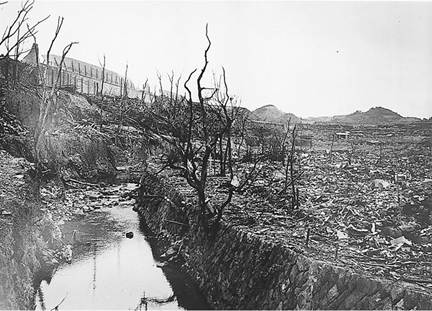 The view from the Urakami branch of Nagasaki prison, about 300 meters from the hypocenter of the atomic bomb dropped by the United States on August 9, 1945. All 134 prisoners and workers were killed. Photo by H. J. Peterson. Courtesy of Nagasaki Atomic Bomb Museum.
Thus the war came to an end—leaving in its wake a host of issues that would stir debate and reflection for decades. There was, for example, the question of human depravity: the massacres carried out by Japanese troops, the experiments on living people, the brutal treatment of prisoners, the famine caused by cynical policies in Vietnam, and the conscription of at least 100,000 “comfort women,” 80 percent of them Korean, to provide sex for Japanese troops. That other Allied and Axis nations had carried out similar atrocities simply underscored the questions raised by these behaviors. Another issue was the human cost of war. Nearly two million Japanese soldiers perished, and millions more Asians died at Japanese hands, perhaps fifteen million in China alone. Half a million Japanese died in Allied attacks on civilians; families across the continent were ripped apart. If the Japanese became pacifists after the war, it probably was due more to the pain inflicted by this carnage than to postwar policies. Finally, there was an ironic consequence: the end of colonialism. By driving the Europeans out of Southeast Asia during the war, Japan had changed local dynamics in ways that ended the viability of colonialism for the long term. Japan had begun the twentieth century in optimism and approached its midpoint in ashes. The colonies had experienced the reverse. Long oppressed, they greeted 1946 with hope, ready for freedom from their colonial masters.