
It is the warm season. On the floor of a tiny apartment sits a barefoot mother, shoulders bent, kimono soiled, an infant in her arms and a lightly clothed youngster to her right. Behind her, her prostrate husband naps, shirtless, and beyond him the room opens onto what appears to be an alley, where the family’s wash hangs. The space is cramped, the faces somber; everyone looks tired and in need of a bath.
The scene, depicted in the 1908 oil painting Shafu no katei (Puller’s family) by Mitsutani Kunishiro, won people’s hearts partly because of its sensitivity to life in Tokyo’s crowded slums and partly because it portrayed a character everyone knew: the rickshaw puller. More than 100,000 pullers plied Tokyo’s streets in the early 1890s, filling neighborhoods with clickety-clacks, singsongs, and curses, irritating flop-house companions with exhausted snores during their off hours, and providing urban tales of compassion, crime, and sass. Who uses the rickshaw? asked a reporter in 1893: “Old people. Infants. Most women. Secluded folk. The sedentary people. Men of rank. Even the poor. There are not many who don’t ride rickshaws. . . . One rider is prosperous; another is old and feeble. One is obese, like a pig, another poor and thin, with legs like mosquitoes.”
These larger-than-life transporters have much to tell us about the era named Meiji (1868-1912), when Japan moved to the front ranks of modern nations. Their labors bespoke rapid change: the migration of millions to the cities, the invention of efficient transportation, the internationalization of the archipelago, as the pullers’ customers hailed from ever more distant parts of the globe. They also spoke to the era’s darker side, to the poverty in which most workers lived, the crowded conditions, filth, and clamor that accompanied progress, and the class consciousness that caused the affluent to treat their transporters like chattel. The Meiji years shine brightly in most stories, as a time of breathtaking transformation, but any honest story must also take account of the darker side.
There is no way to calculate how long the late Tokugawa crises might have continued, if left to the bureaucrats and critics alone, before the bakuhan system collapsed. It is clear, however, that change was hastened by the intrusion of a new element: foreigners determined to force the country open. On July 8, 1853, U.S. Commodore Matthew Perry sailed into Edo Bay, triggering a new wave of public debates with his demand that Japan open its ports to American vessels. When he returned for an answer the following February, this time with almost a quarter of the American navy (eight warships), the Japanese negotiated strenuously and then agreed, signing the Treaty of Kanagawa, which opened two ports for the provisioning of ships (but not for trade) and provided for an exchange of diplomats. Perry and his hosts drank toasts and exchanged gifts. One of Perry’s gifts was a quarter-scale model train, which attracted crowds who, in the account of the expedition’s official scribe, watched its “repeated circlings . . . with unabated pleasure and surprise, unable to repress a shout of delight at each blast of the steam whistle.” The train also induced fears—because Japan had now entered an imperialist world for which Tokugawa foreign policy had left it unprepared.
 This 1853 watercolor of Matthew Perry, by an unknown Japanese artist, illustrates the way most Japanese thought of the intruding Americans: hairy, with large noses and demonic eyes. Honolulu Academy of Arts, Gift of Mrs. Walter F. Dillingham in memory of Alice Perry Grew, 1960 (2732.1).
Challenges to the shogun’s government came from every direction now. First, there were the foreigners. The U.S. consul, Townsend Harris, arrived in August 1856, determined to negotiate a commercial treaty, and from then on the demands never let up. By 1858, Harris had his treaty, permitting trade and setting sharp limits on the tariffs Japan could assess; then he and other Western envoys secured promises for half a dozen additional treaty ports. By the 1860s, they had created rowdy foreign communities in Yokohama, Kobe, and Nagasaki, where merchants frequented trading houses by day, bars and brothels at night, and churches on Sunday. Most fearsome to the Japanese was the foreigners’ willingness to secure their demands through force. When Satsuma domain refused to pay an indemnity after the 1862 murder of a British citizen, for example, seven English ships bombarded Kagoshima, the Satsuma capital, causing massive damage—an action described by an American reporter as “not an endeavor to establish . . . sound principles of civilization” but “a sordid intrigue for the benefit of British trade.” Behind each Western demand after the mid-1850s lay the threat of guns.
Officials also felt wave after wave of domestic opposition in these years. Peasants and common city folk bought a million copies of broadsides about the foreigners, many of them demanding expulsion of the “foreign devils.” In the 1860s, they staged more than 800 uprisings, mostly to protest financial difficulties sparked by crop failures, food shortages, and inflation. In 1866, when thousands of peasants rioted over food shortages, overturning miso vats, smashing houses, and stealing cash in what is now Fukushima Prefecture, one rich farmer blamed the high interest rates charged by heartless moneylenders (he called them “leeches”), while a village headman said the rioters were motivated by class envy: “They had come to hate men of property and simply wanted to reduce them to utter poverty.”
Even more worrisome to the regime was the violent opposition of disaffected samurai, called shishi (men of valor), many of whom were studying at fencing academies in Edo and Kyoto. Upset by the foreign incursion and Tokugawa ineptitude, Yoshida Shoin, a teacher of many shishi, wrote, “How can any red-blooded person bear to see our great Japan, which has remained independent and unconquered for three thousand years, suddenly become enslaved by other powers?” “Sonno joi” was the shishi cry: “Revere the emperor; throw out the barbarians!” Action was their motif. They came to be known on city streets for both their unwashed, unkempt personal style and their violent actions. Like terrorists of the twenty-first century, they signed blood oaths and assassinated those they held responsible for Japan’s troubles, including the regent, Ii Naosuke, who had negotiated the 1858 commercial treaties. Although their terrorism did not itself threaten the regime’s existence, they created a climate in which ever more troublesome elements might flourish.
The regime’s most serious threat rose from the official classes, especially the leadership in several of the largest domains. When bakufu officials asked advice from the daimyo about how to respond to Perry, they were regarded as weak for having had to ask, and as the years passed a series of daimyo maneuvers increasingly undermined Tokugawa authority. By the early 1860s, large han such as Choshu on the western tip of Honshu and Satsuma in southern Kyushu were showing signs of independence, and after financial straits forced the Tokugawa to discontine the alternate attendance system in 1862, domain lords stopped coming regularly to Edo and their independence turned to challenge. In 1864, troops with ties to Choshu staged an attack on Kyoto, intending to remove the emperor from the Tokugawa system and turn him into a tool for their anti-Tokugawa schemes. They failed, but their boldness inspired others, and a year later a combined peasant-samurai force toppled the relatively moderate government of Choshu domain, placing one of Japan’s five largest han under the control of rebels. Thereafter, Satsuma’s leaders signed a secret agreement that they would not support any bakufu attacks on the rebel regime, and when the Tokugawa sent a punitive expedition to Choshu in the summer of 1866, Satsuma stood aside, dooming the attacking forces to failure. Japan’s leadership struggle now resembled “a ball balanced on a mountain peak,” said the young rebel Kido Takayoshi, ready to “plunge downwards for thousands of feet.”
The final stages of the Tokugawa demise began with the Meiji Restoration of January 3, 1868, when Satsuma troops seized the palace grounds and proclaimed a new government in the name of the fifteen-year-old emperor, Mutsuhito, who now was called the emperor Meiji. They replaced the shogun with a temporary council of princes and demanded that Tokugawa lands be returned to the throne. Shogun Tokugawa Yoshinobu resisted briefly, and then decided, to the consternation of many of his followers, to submit to the new regime rather than plunge Japan into all-out civil war. “Now that foreign intercourse becomes daily more extensive,” he wrote in his letter of resignation, “unless the government is directed from one central authority, the foundations of the state will fall to pieces.” He said duty required him to surrender his post so that unity could be maintained.
Few people expected his statesman-like statement to settle things. Many of his own followers fought on without him, in what became an eighteen-month civil war claiming 8,200 lives. The country’s problems—the foreign threat, soaring debts, chaotic financial structures, rivalries among regional lords, and commoner unrest, to name a few—gave instability an air of inevitability. Yet the Meiji rebels did more than survive. They thrived, cobbling together an administration in the name of a shy teenaged emperor and turning a “restoration” into a revolution of national goals and systems. How did they do it? One answer lies in the Tokugawa legacy. Recall the high literacy rates of that era, the commercial revolution, the bustling cities, and the sophisticated intellectual sphere. Even in its last, desperate decade, the bakufu had engaged Westerners rather than merely resisting them, Chinese-style. Big as the problems were, the Meiji innovators inherited a structure with strong foundations.
Another explanation lies in the men who took charge in 1868, a coterie that included a few court nobles and a larger group of young samurai from southern and western domains, especially Choshu and Satsuma. The oldest, Prince Iwakura Tomomi and the Satsuma samurai Saigo Takamori, were only in their early forties, and none had top-level administrative experience. What they shared, however, was vision, talent, and realism, along with a commitment to nation-building. Advocating slogans such as “Kuni no tame” (for the good of the country) and “Fukoku kyohei” (rich country/strong army), they threw themselves into consolidating the new regime. Their pragmatism was illustrated by their approach to the West. Most of this leadership group had entered public life as ideologues, passionate about ridding Japan of the barbarians. Now, in power, they concluded realistically that expulsion was impossible; Japan must compete with the West on its own terms. So when they issued a “charter oath” on April 6, outlining the Meiji government’s principles, they promised: “knowledge shall be sought throughout the world,” “matters of state shall be decided by public discussion,” and “classes high and low shall unite.” They issued the proclamation in a formal Shinto ceremony—evidence that they understood the political wisdom of clothing modern policies in comfortable traditional symbols.
Two contrasting, equally crucial tasks occupied officials during the first Meiji decade: destroying old structures and building new ones. Facing a world that required not just stability but diplomatic, business, and military prowess, the Meiji leaders saw much in the Tokugawa order that would not work. The geographic separation of the imperial palace (Kyoto) and administrative center (Edo), for example, contained the seeds of intrigue; so they brought the emperor to Edo and renamed the city Tokyo. The han structure burdened—and threatened—the country with hundreds of regional governments, each with its own army and tax system. To deal with that, the officials first persuaded, then coerced, the regional lords to submit their domains to the emperor and give up the title of daimyo. The process provoked opposition, but by balancing military threats with financial inducements, the Meiji rulers succeeded in turning 261 domains into 302 prefectures, which were later reshaped into 72 prefectures and three urban districts. Another impediment to modernity was the Tokugawa status system, under which the two million samurai lived on government stipends. Not only did the stipends consume 30 percent of the national budget, they reinforced the anachronistic class divisions. The Meiji government confronted this problem in several ways. In 1869, it replaced the status system with three categories: nobles, samurai, and commoners (a designation that included everyone from farmers to former outcasts), and in 1870 it allowed commoners to take surnames, a right that previously had belonged to samurai alone. Then the officials abolished the warrior class itself, decreeing in 1876 that ex-samurai must stop wearing swords and that after being given a final, interest-bearing bond, they no longer would receive government funds. While most grudgingly accepted the reforms, samurai in several provinces rose in rebellion. In 1877, the now disillusioned Saigo was persuaded by Kyushu followers to lead the massive Satsuma Rebellion, which lasted eight months and cost 30,000 lives. When army chief Yamagata Aritomo looked at the fallen Saigo that October and said, “Now I am at peace,” he was thinking about Japan as much as about himself; for with this hero’s death had come the end of armed resistance to the new regime.
Even as the dismantling process continued, the Meiji leaders were furiously creating new institutions to centralize control and modernize Japan. They experimented with several ruling structures, eventually creating a Council of State under which cabinet-style ministries operated. They constructed railroads and telegraph lines, created experimental factories, adopted the Western calendar, built an effective postal system, devised administrative structures to bring the far-flung provinces under closer control, and encouraged the growth of a press—all the while struggling to stabilize the country’s desperate financial situation.
The engine for these changes was wholly Japanese. Many of the models, by contrast, came from Europe and the United States. Recognizing that much of the world’s wealth and power resided on the other side of the globe, officials began examining Western ideas and institutions with an enthusiasm that called to mind Suiko and Shotoku Taishi sending missions to seventh-century China. During the 1870s, they invited thousands of well-paid foreigners to teach and give advice: surveyors and engineers, English and geology teachers, advisors on educational policy, constitutional theorists, newspaper editors. The Japanese went West, too, sending promising young men—and occasionally, women—to study in American and European secondary schools and colleges, and sponsoring short-term professional missions to observe banks, schools, and weapons factories. Most impressive was the 1871-1873 Iwakura Mission, in which fifty leaders, including five top officials, spent eighteen months traveling throughout the West to observe foreign affairs, negotiate treaties, and report to the rest of the world on Japan’s progress. Many things befuddled the travelers, including Christians worshiping crucifixes “profuse with ruby-red blood” and women “wearing men’s clothes.” Following one social event, mission secretary Kume Kunitake remarked, “To our eyes the sight of the young men dancing in the embrace of women after the music began was extremely indecent.” If this was the way of the future, he said, “the Way of Loyalty and Filial Piety will be in peril.” But the journey’s most remarkable aspect lay in the mere fact that it happened, that officials considered Western models important enough to leave Japan for such a long time, even as their regime was still finding its feet.
All of this study inspired a wave of westernization in the 1870s. Referred to as bunmei kaika (civilization and enlightenment), the onslaught inundated Japan with barber shops, beef eating, literary translations (the Bible, Shakespeare, Jules Verne), brick buildings, beer guzzling, dairy farms (even in the city), ideas such as individualism and natural rights, wristwatches, and girls’ schools—as well as a government-sponsored hall where Kume’s worries must have seemed prescient as Japanese and foreigners congregated for Western ballroom dancing and masked balls. An English resident of Tokyo quipped, “Old things pass away between a night and a morning. The Japanese boast that they have done in thirty or forty years what it took Europe half as many centuries to accomplish.” Few disputed him.
Accompanying bunmei kaika was a host of new institutions designed to help Japan compete with the West. First came an 1872 law—the world’s first—making four years of school compulsory for all girls and boys. Decades would be required for full implementation, partly because schools were costly and partly because many farmers opposed the intrusion of schools into their family work calendars, with villagers in some areas even burning the new school buildings down. But the measure illustrated the modernizers’ conviction that education was essential to successful nation-building. Two equally controversial, equally fundamental, changes came in 1873: a 3 percent land tax (later reduced to 2.5 percent) to standardize the revenue system, and a military draft, requiring males to provide three years of service followed by four years in the reserves, beginning at age twenty. The draft was widely regarded as a “blood tax” on commoners, because the rich could buy their way out.
 Opened in 1890, the twelve-story, 225-foot-high Ryounkaku (Cloud Scraper), depicted in this woodblock print by Ichiju Kunimasa, was Tokyo’s tallest building and foremost tourist attraction. Equipped with Japan’s first elevator, it was filled with shops selling goods from around the world, and topped by two observatory floors, complete with telescopes. Edo Tokyo Hakubutsukan; no. 88132878.
If these reforms were intended to lay the groundwork for a modern state, another innovation was designed to assure loyalty by appealing to largely fabricated traditions. The one-time rebel Kido, now a leader in the new government, wrote in his diary on March 11, 1868, that in order “to establish a foundation for the Empire enduring for all ages,” he had “quietly been making efforts to clarify the principle that the focus of the highest loyalty should be fixed on the Emperor.” Agreeing with him, the Meiji rulers created a host of ceremonies and institutions—many of them new, though they appeared old—to turn the emperor simultaneously into a sovereign, a high priest, and a loving father. They made Shinto into a state religion, pressuring some Buddhist temples to become Shinto shrines and requiring priests to teach respect for the nation and its kami. They also created holidays celebrating the nation, sent the emperor on visits among the people, commissioned a national song, and created a new shrine, Yasukuni, to the war dead. The impact of these programs, many of which were modeled on the Western governments’ use of Christianity, would continue long after the end of the Meiji era.
The early Meiji officials struggled hardest, perhaps, to create a constitutional system. Early in 1874, after Saigo had left the government over its handling of foreign affairs and its insensitivity to samurai concerns, several of his supporters sent a memorial to the throne demanding a legislature on the grounds that “the people whose duty it is to pay taxes to the government have the right of sharing in their government’s affairs.” The petition touched off a firestorm of discussion, giving rise to the jiyu minken (freedom and people’s rights) crusade, Japan’s first popular political movement. For nearly a decade, former samurai and wealthy agriculturalists agitated for an assembly and a constitution, while officials debated what kind of constitutional system Japan should have. As journalist Fukuchi Gen’ichiro wrote, “The discussion about a popular assembly has become like Forty-Seven Masterless Warriors at the theater; whatever the date or the weather, there is always a full house.”
A turning point in the process came in mid-1881, when a corruption scandal over the sale of government-developed lands in Hokkaido triggered another popular outburst, with jiyu minken activists declaring that without a constitution or a legislature, government could not be held to account. Stunned by the furor, officials stopped the sale and promised to establish an assembly in 1890. The activists then began forming political parties in anticipation of coming elections, while officials began working on a constitution under the supervision of Ito Hirobumi (another rebel turned official) and with the assistance of several German advisors. In addition to writing constitutional drafts, officials also created new institutions, such as a cabinet and a peerage system, to ensure a smooth path toward constitutional government. Their most controversial—and troubling—creation was the draconian Peace Regulations of December 1887, which banished some 570 activists from Tokyo on the pretext that they were a threat to national order.
The emperor Meiji promulgated the constitution, Asia’s first, on February 11, 1889, a day marked by festivals at home and praise abroad. The document was moderately conservative, creating a sovereign emperor who appointed the cabinet members and held final legislative power over everything but the budget. At the same time, it created a popularly elected legislature, the Diet, along with an independent judiciary, and it gave the Diet the crucial right to veto budgets. People would argue for decades about how democratic the document was, but all regarded it as a monumental step toward modernity. “Where there is a nation there is necessarily a constitution,” a provincial editorialist wrote. Japan had become a nation indeed, and for the first time, the people would have a formal voice in national decision-making—a loud and insistent one, as the 1890s would show.
One reason so many people had come to see constitutional government as essential was that modernity had now reached nearly every part of society, nurtured as much by private forces as by government officials. Businessmen built factories and installed electric lights in the mid-Meiji years so they could keep laborers working all night in twelve-hour shifts. Distant governors created English-language schools and lobbied for funds to build dams. Activist women joined the people’s rights movement and schemed to export “civilization” to Korea. Capitalistic journalists devised sales gimmicks to secure readers. Farmers grumbled about the solar calendar but used the latest tools and fertilizers to increase their annual harvests. Children in rural provinces repeated rumors that meat-eating gave foreigners a “peculiar animal odour”; then, on being given their own first bite of meat, “confided to each other that we liked the taste.”
For many groups, the era’s changes brought more hardships than benefits, at least in the short run. While some women, for example, enjoyed new political opportunities, tens of thousands were sent off to work in textile factories, where the salaries were paltry, working conditions were cruel, and crowded dorms were filthy. Suicides and desertions were common, and most of the female workers, many in their early teens, empathized with one who recalled, “I don’t know how many times I thought I would rather jump into Lake Suwa and drown.” Even middle-class women often found their lives more restricted now, as officials bent on creating a stable system began demanding that women marry and stay at home as “good wives and wise mothers.” After 1890, female participation in politics was banned altogether.
Most farmers, too, saw times grow worse with the adoption of the land tax, which made them responsible for more than 80 percent of the government’s revenue. After finance minister Matsukata Masayoshi responded to debts and inflation by raising taxes and decreasing the currency in circulation in the early 1880s, many farmers fell into destitution. “Poor farmers withered up like the vegetation around them,” a village teacher commented a few years later. “While the frogs and insects hibernated peacefully, farmers had to consume their meager stores of grain just to keep themselves alive from day to day. Inevitably a time would come when they had nothing left to eat.” Record numbers began protesting. Burakumin, as the former outcasts now were called, also suffered bitterly, sometimes from ongoing discrimination and almost always from hard living conditions. And then there were the coal miners, sent into the earth to work naked, or in loincloths, in temperatures up to 120 degrees, to produce fuel for the modernizing factories—and for export. Newspapers reported frequently on mine explosions and cave-ins that took countless lives. The miners’ miseries were compounded by coldhearted officials, such as the one who recommended convicts for mine work in the 1880s because “if they keep dying from this work, it will just decrease their numbers.”
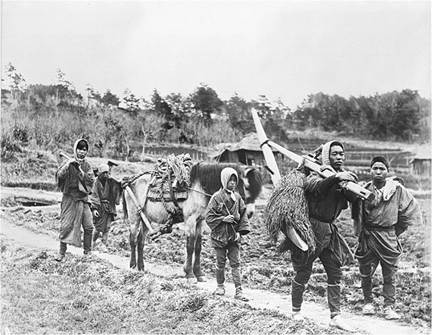 Villagers walk home after a day of farming, about 1900. The farmer in front carries the plow pulled in the fields by the horse. City life may have turned modern, but rural life remained much as it had been for generations. Photograph courtesy Peabody Essex Museum, Salem, Massachusetts, A5132.
By contrast, these years smiled on the entrepreneurial classes, who lived largely free of taxes. The first Meiji decades saw the steady growth of an increasingly diverse economy. A silkworm blight in Europe allowed the Japanese to begin exporting first cocoons and then silk threads in great quantities after the late 1860s. Silk made up more than a third of Japan’s early Meiji exports. Industrial production expanded more slowly, but by the era’s third decade, manufacturing was growing 5 percent a year, while coal production increased ten times between 1874 and 1888, to more than two million tons. Railway lines were laid with impressive speed, too: in 1872, Japan had eighteen miles of tracks; by century’s end, it boasted nearly 4,000, three-quarters of it in private hands. The entrepreneur Shibusawa Eiichi, who founded more than fifty companies, used the rhetoric of the Meiji merchant class when he proclaimed that “the secret to success in business is the determination to work for the sake of society and of mankind as well as for the future of the nation, even if it means sacrificing oneself.” He used the methods of that class when he subjected girls at his Osaka Spinning Mill to inhuman hours and low wages. Profit had become Japan’s bottom line.
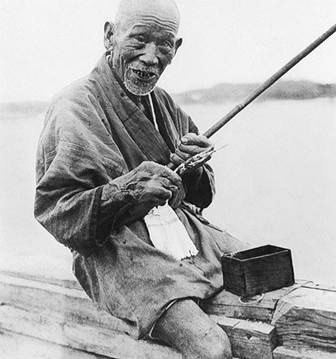 An old fisherman, photographed in about 1890, wears the rough cotton jacket—and wizened face—typical of his profession. Photograph courtesy Peabody Essex Museum, Salem, Massachusetts.
By the late 1880s, the foundations of modern Japan had largely been laid. During the next two decades, the country saw an explosion of two relatively new forces: nationalism and mass urban culture. Several factors lay behind the former, including an understandable pride in the early Meiji achievements and the ever-greater efforts of officials to nurture loyalty. “There are two indispensable elements in the field of foreign policy,” education minister-to-be Inoue Kowashi wrote; “the armed forces first and education second. If the Japanese people are not imbued with patriotic spirit, the nation cannot be strong.” To that end, he and others drafted the best known document of that generation, the 1890 Imperial Rescript on Education, which made loyalty to the emperor and respect for parents the basis of education. Recited at important school functions, much like the Pledge of Allegiance in the United States, it reinforced the view that love of the emperor was an ancient tradition, even though most Japanese had known next to nothing about their emperors before Meiji.
Another source of nationalism was resentment of the West, particularly among younger Japanese tired of hearing about foreign superiority. “A Westerner abroad takes pride in his country,” wrote one young scholar in 1890; “not so with our countryman. When a [Japanese] comes in contact with foreigners, he is like a mouse emerging hesitantly on a bright morning.” For others, the resentment sprang from humiliating experiences under the unequal treaties that had been imposed on Japan in the 1850s: from anger over Japan’s inability to set its own tariffs, and from indignation about extraterritoriality, which deprived Japan of legal jurisdiction over foreigners living in Japan. Antiforeign sentiment peaked when the British captain of the ship Normanton let all twenty-three of its Japanese passengers drown in an 1886 shipwreck while saving himself and his crew, and then was absolved by Britain’s consular court in Kobe.
Struggles over relations with neighbors also raised national consciousness—and with it, patriotism—in the early Meiji years. Officials began clarifying Japan’s borders by establishing a colonial office in the newly named northern island of Hokkaido in 1869; they poured millions of yen into development of the area and sent two million “main-landers” there, even as they drove the native Ainu, widely thought to have had ancient links to the Emishi, from their homes. Four years later, in 1873, the regime provoked a major split in the government when it blocked a scheme by Saigo to invade Korea. A year after that, officials won wide domestic acclaim for sending troops to southern Taiwan, ostensibly to punish mountaineers who had massacred fifty-four shipwrecked Ryukyuans, but really to back up Japan’s claim of suzerainty over the Ryukyus, which long had been an independent kingdom with close ties to both China and Japan. When Japan forcibly turned the Ryukyu chain into Okinawa Prefecture in 1879, over vigorous Chinese objections, the domestic press again was overwhelmingly supportive. All of these border-defining moves made it clear that the early Meiji officials were interested as much in international matters as in domestic programs. The moves also fueled national pride.
Nationalist sentiments soared in the mid-1890s when Japan and China fought over Korea. Following Perry’s pattern, Japan had forced Korea in 1876 to sign a commercial treaty, and thereafter China and Japan clashed repeatedly on the peninsula, with the Chinese emphasizing their historic ties to Korea and Japan proclaiming its desire to “civilize” the country. The two came close to war in the mid-1880s before negotiations quieted things. Then in the spring of 1894, when China responded positively (and in line with treaty stipulations), to Korea’s request for military aid in quelling a domestic uprising, Japan’s press turned jingoistic, demanding that China be challenged. When the Japanese cabinet deliberated about what to do, the newspaper (Osaka Asahi worried that Japan was missing a providential opportunity to assert itself in Asia: “If we lose this chance, all ages will regret it We should take the lead in making Korea’s independence clear; instead we look on in a daze.” Hostilities began in July; the Sino-Japanese War was declared on August 1; and by late autumn Japan had won such smashing victories that China was suing for peace. When a peace treaty was signed the following April 17, Japan received Taiwan and southern Manchuria’s Liaodong Peninsula, as well as a large indemnity and extensive commercial rights in China. More important than the victory, however, were two wartime developments that would reverberate in succeeding decades. The first occurred in Port Arthur, where Japanese troops massacred hundreds of civilians after defeating the Chinese. Tokyo launched an investigation and apologized, but foreign reporters expressed shock and outrage. Even more significant was the explosion of patriotic fervor the war ignited at home. “The excitement generated among the Japanese people was beyond imagination,” the commentator Ubukata Toshiro recalled; “every adult, every child, every elderly person, every woman talked day and night of nothing but the war.” By war’s end, Japan had become a different place: proud of defeating Asia’s giant, confident in its military might, thirsty for more territory. The thirst grew even stronger days after the conclusion of peace, when Japan was coerced by Russia, Germany, and France, which had interests of their own, to give Liaodong back to China. Called the Triple Intervention, the episode sparked another public explosion, with editorialists across the political spectrum damning the cabinet for giving in to the European trio and declaring that Japan must strengthen itself so that it could stand up to Westerners in the future. “Having been crushed now,” one said, “we will have our chance to succeed another day.”
The postwar years saw a rush of support for this vision of strength, even as Japan’s cities became both modern and massive. While the rural regions lost population, Japan’s metropolises grew by a combined 10 million in the last two decades of the 1800s, with Tokyo reaching more than 2.5 million by 1910 and Osaka nearly 2 million. In part, that reflected a rise in industry—and city jobs—as the Sino-Japanese War indemnity poured more than 360 million yen into the economy. Exports tripled in the 1890s; imports quadrupled; factories quintupled. As a result, by early in the twentieth century the number of Japan’s workers had doubled to more than a million—three-fifths of them women. Many economists call this the takeoff stage of Japan’s first industrial revolution.
As the cities grew, they changed in nature. People became better educated, with male literacy passing the 90 percent mark at the turn of the century and female literacy reaching 82 percent. They also became newspaper readers, subscribing to papers that were cheap, sensational, and easy to read. And they became increasingly active in looking out for themselves, ready to struggle publicly for better wages and working conditions. In the 1890s, scores of strikes and protests broke out in Japan’s major cities, while workers at the Furukawa copper mine in Ashio north of Tokyo staged Japan’s first antipollution protests. The miners also protested pollution and working conditions in 1907, laying waste to scores of buildings before government troops stopped the violence. One miner was overheard telling his fellows: “There must be no looting, because that would shame us. But let’s make sure we smash everything thoroughly.”
One cause of the urban activism lay in the concentration of workers in city slums, where families of four typically shared a three-mat (fifty-four-square-foot) room without indoor cooking facilities or toilets, while their poorer friends stayed in flophouses where the summer air reeked of sweat and the winter “wind came through the cracks, penetrating until you couldn’t bear it.” The middle classes saw these people as “an almost subhuman species only slightly related to other human beings,” in the words of one journalist. In truth, they represented Japan’s future, sending their children to city schools and demanding, increasingly, to be treated not just as humans but as citizens. All the while, the more affluent classes were changing the face of Japan’s cities with their electric lights, their erudite opinion journals, and their attraction to fashionable department stores. Between 1889 and 1900, Japan’s cities produced the country’s first beer halls, first multistory observation towers, and first movies, as well as Japan’s own Ebisu beer, not to mention a toilet stool that played music. Magazines like Taiyo (The sun) offered social commentary interspersed with ads for everything from cigarettes to fire insurance. The circulations of some individual newspapers rose to 250,000 by the end of Meiji. And the annual blossom-viewing festivals and fireworks displays brought people together from every part of the country.
For the authorities, this class-mingling and activism conjured up visions of a breakdown in values, even revolution, so they worked assiduously to constrain potential opposition and promote national strength. When the leftist Social Democratic Party was formed in 1901, the government shut it down, and when Heimin Shimbun, a Marxist newspaper, appeared two years later, the bureaucrats watched for a year and then banished it, too. In the effort to project strength, officials devoted 40 percent of the country’s annual budgets to building the army and navy between 1896 and 1903, and in 1900 the government adopted a regulation that only generals or admirals on active duty could serve in the cabinet, a move that gave the military a virtual veto over the formation of the cabinet. When Japan provided roughly half of the international force that put down China’s Boxer Rebellion in 1900, and then shared handsomely in the indemnity, the pride that had marked the Sino-Japanese War was reignited. That pride showed itself again two years later when Japan signed the Anglo-Japanese Alliance, recognizing Great Britain’s predominance in China in return for the British recognition of Japan’s key role in Korea. Intended as a restraint on Russian expansion in the East, it was the first equal alliance between Asian and European powers.
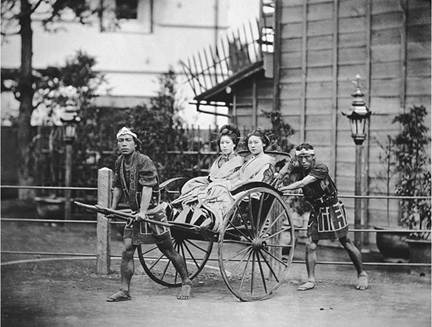 Rickshaw pullers were among the most common sights in Japanese cities of the late 1800s. They came from the poorest classes, carried people from every walk of life, and became legendary for their strong, irrepressible personalities. By the 1920s, they had been replaced by streetcars and automobiles. This photo was taken early in the 1880s. Photograph courtesy of Peabody Essex Museum, Salem, Massachusetts, A9053.
Ironically, this expansiveness stimulated insecurity as often as pride, with each advance inviting a worrisome challenge. In the new colony of Taiwan, for example, 4,600 Japanese soldiers were killed putting down local resistance, and the cost of running the colony sapped Tokyo’s finances in the late 1890s. In Seoul, where the Japanese had expected to push reforms through easily after driving China out, Korean officials resisted, prompting the Japanese minister to assassinate Korea’s recalcitrant Queen Min, and the Koreans, in turn, to seek protection from Russia. In China, the Japanese felt threat-ened—and angered—in the late 1890s when Russia used treaties to grasp control of Liaodong, the very peninsula it had pressured Japan to give back. When Russia moved troops into the peninsula after the Boxer Rebellion, journalists demanded that steps be taken to resist Russian expansion and assure Korea’s “independence.” If the government would not stand up to Russia, the prominent editor Tokutomi Soho predicted late in 1903, “the righteous indignation of our people could not be held back.”
The rising tension led to Japanese-Russian negotiations, and when talks failed, the Russo-Japanese War broke out on February 8, 1904, with Japan’s surprise attack on Russian ships at Liaodong’s Port Arthur. This was a very different conflict from the Sino-Japanese War. It was much longer and much larger; it pitted Japan against a Western power; and the results were less clear-cut. Over seventeen months, the conflict threw up staggering statistics for Japan: more than a million troops mobilized, more than 1.5 billion yen expended (half of it borrowed from foreigners), and 100,000 troops killed. The battles were massive. Japan’s victorious, eight-month siege of Port Arthur resulted in more than 90,000 casualties. The battle for Mukden (Shenyang), which followed in March 1905, pitted 250,000 Japanese against 320,000 Russians. Though Japan won again, it suffered 70,000 casualties and used up nearly all of its resources. Only a stunning naval victory over Russia’s fleet in the Tsushima Straits in late May gave Japan the victory, and even then the peace treaty, mediated by U.S. president Theodore Roosevelt and signed in September at Portsmouth, New Hampshire, failed to yield either an indemnity or as much territory as Japanese expansionists craved.
The treaty did recognize Japan’s “paramount interest” in Korea and transferred Russia’s Manchurian holdings to Japan, along with the southern half of Sakhalin island; it also pushed Japan into the ranks of world leadership. But that was not enough for a public that had become clamorously patriotic. When the treaty produced no indemnity, editorialists lambasted the negotiators, and citizens erupted in a rage more violent than after the Triple Intervention. A huge Tokyo demonstration on September 5 turned into three days of rioting. The next month, a different yet equally patriotic sentiment drew even more Tokyoites to Ueno Park, this time to welcome the navy home from war. Clearly, two contrasting commitments had taken hold of Japan’s people by 1905: a nearly universal belief in Japan’s right to assert itself abroad and a widespread commitment to the citizen’s right to express personal convictions in the public arena.
The contrast between the early years of the twentieth century and the beginning of the Meiji era challenges one’s imaginative powers. In 1868, the capital’s population had numbered about 500,000; now it exceeded two million. Then, the government had been run by rebels; now, offices were allocated under a constitutional system. Provincial samurai had used swords against the Tokugawa; today, soldiers had defeated a Western power with modern weapons. Once cowering, Japan had become audacious. The material change was monumental too: the rich now enjoyed modern water systems, ate under electric lights, and talked on telephones. The middle classes went to movies, read newspapers, and listened to phonographs. The poor lived in urban slums or hardscrabble villages yet sent their children to public schools to study English and math with their affluent peers. History’s harsh reality tells us that modernity had other narratives yet to spin, that it was about to thrust Japan into a maelstrom. Now, however, in the afterglow of victory over Russia, the Meiji story spoke primarily of transformation. Japan had become modern—and mighty.