
Since the Holocaust was perpetrated by a totalitarian regime, whose distinguishing feature was a murderous racist ideology, it has been assumed that the enemies of Nazism were committed to eradicating genocide. The democracies, however, did not wage war against Germany because it was a genocidal dictatorship but to protect their own political and strategic interests. Had Hitler killed Jews within internationally sanctioned borders, they would have not tried to thwart him; had he promised to stop killing the Jews late in the war, they would not have made peace. Indeed, one reason for the Western Allies’ reluctance to use the Holocaust for propagandistic purposes was their fear that Hitler would suggest that they accept “his” Jews in response to their accusations of genocide. Moreover, the destruction of the Third Reich could not have been accomplished without the massive efforts of the Soviet Union, whose own record as a brutal totalitarian regime may lead us to conclude that it took one evil system to put an end to another.
The tendency to exaggerate the differences between Germany and the West has also contributed to some false lessons. The “Final Solution” was organized and implemented in a manner quite consistent with the industrial and bureaucratic structures of contemporary modern states. The current notion that the best guarantee against a recurrence of genocide is a firm belief in progress, science, and the rule of law can hardly be maintained considering the rhetoric of improving the lot of (part of) humanity, the ostensibly rational scientific assertions, and the seemingly reasonable legal arguments, that were crucial to the legitimization, organization, and implementation of the Holocaust. Indeed, numerous members of these professions actively collaborated in perpetrating murder. To be sure, saying that the Holocaust was a modern undertaking should not obscure its particular origins and characteristics. But what made the Final Solution unique was precisely its heavy reliance on the structures and mentalities typical of modern industrial societies of the kind that we still inhabit today.
Interpretations of Nazism and the Holocaust have, of course, served very different national and ideological agendas. Thus the German Democratic Republic (GDR) never accepted responsibility, or felt a need for its government and citizenry to atone, for the Holocaust. Following Marxist theory, the GDR presented fascism as the last phase of a degenerate capitalism from which the Communist Party had liberated the German “masses,” who were now engaged in building a socialist society with a perfectly clear conscience. Conversely, the Federal Republic of Germany (FRG) claimed to be the only legitimate successor German state, which in turn implied at least a qualified acceptance of responsibility for Nazi crimes. But by adopting the Cold War rhetoric of identifying between Nazi and Soviet totalitarianism, the FRG presented its anti-Soviet policies as a valuable lesson of the Nazi past—even though the Soviet Union (allegedly led by the Jews) had also been the Third Reich’s greatest enemy. This political rhetoric had the added benefit of facilitating the integration of the German conservative elites into the FRG in the 1950s. The numerous generals, top civil servants, leaders of industry and scholars, who had given their support to Hitler because of his anti-Bolshevik crusade, could now feel both vindicated and more comfortable with a democratic Germany that was part of an anti-Soviet alliance.
Turning to the Holocaust’s victims, we should note that since Zionism was largely predicated on the assumption of an approaching catastrophe for European Jewry long before the rise of Nazism, after the war it tended to present the mass murder of the Jews as the final—if, for millions, belated—proof of the need for a Jewish national home. The notion that the victims had mostly gone “like sheep to the slaughter” was interpreted by Zionist leaders as having taught postwar Jews another lesson, namely, that only as citizens of their own state could they ensure their survival and, by implication, even rectify the “shame” of the ghettos and the gas chambers. Yet behind this confident rhetoric there were profound anxieties and uncertainties. Israeli Zionists in particular were haunted by the loss of the Jewish state’s potential “manpower reserves” in Eastern Europe incurred during the Holocaust and even more so by their own failure to rescue more victims of Nazism. The sense of anguish and frustration at having been too weak to matter, and the partially repressed sense of guilt for having led a relatively normal existence during the Holocaust while refusing to believe the ominous news from Europe until late in the war, have cast a shadow over the ostensibly positive lessons of Zionism.
Nevertheless, the Zionist interpretation of the Holocaust constitutes a major component of Israeli national identity, encapsulated in the (traditionally Jewish) exhortation “Remember!” and its modern, future-oriented response “Never Again!” The state, in fact, is founded on the undiminished memory of past national disasters—the destruction of both Temples, catastrophic rebellions against foreign rule, pogroms and expulsions in the Diaspora, and the Holocaust—while at the same time it claims to be the embodiment of the promise that cataclysms of that nature and magnitude will never happen to the Jewish people again. In other words Israel legitimizes its existence by apocalyptic visions of the past and the promise to thwart apocalypse in the future.
The slogan “Never again,” inscribed in many languages on camp memorials in Europe (fig. 14), refers primarily to the determination never to allow such inhumanity as displayed by the Nazis to recur in the world (a vow mocked, of course, by the innumerable massacres and genocides since 1945). It also reflects the early postwar tendency to see all camp inmates as political resisters rather than helpless “racial” victims. The Israeli interpretation of this slogan indicates the diametrically opposed lessons derived from the event by Zionism, which provides an ethnocentric reading with a powerfully nationalist and militant message: Israel is presented as the sole repository of the Holocaust’s memory and as the official representative of its Jewish victims. It was on the basis of such assertions that Israel negotiated the restitution agreement with the FRG, built Yad Vashem, a national memorial to the Holocaust to which visiting foreign dignitaries are taken (fig. 15), and linked its foreign policies to fears of another genocide. Hence that unique melange of realpolitik, deep-seated anxieties, manipulation, determination, and outbursts of excessive violence and aggression, which have come to characterize Israeli policy and public sentiment since the establishment of the state.
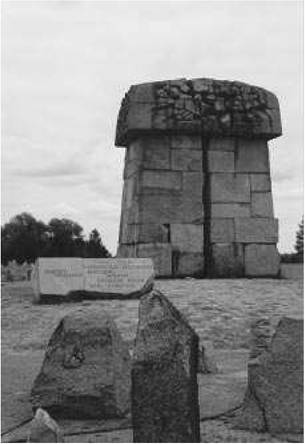
FIGURE 14. Mass death as universal redemption. Monument at Treblinka, Poland. Plaque carries the words “never again” in Yiddish, Russian, English, French, German, and Polish.