
The cataclysmic nature of the Holocaust has prompted profound disagreements over its theological and moral lessons. Having occasioned a final break with God by some Jews, the Holocaust has impelled others to seek religious comfort in the face of man-made atrocity and to reassert Jewish survival and continuity by adhering to Judaic tradition. The complicity in, or indifference to, Nazi policies of many established Christian churches has led to both denial by those religious bodies of their role in the Holocaust and, often rather belatedly, to admissions of guilt and revisions of dogma. Conversely, it is also true that individual Christians were at times motivated by their faith to resist Nazism and rescue victims and that some of the Christian clergy attempted to set moral limits to inhumanity in the Third Reich, Nazi-occupied Europe, and among Germany’s allies and satellites. Against those who see Auschwitz as the anus mundi of humanity, others assert that the extraordinary individual acts of heroism and sacrifice in the camps redeemed the human race by demonstrating the ability of men and women to produce a moral life even in the heart of evil.
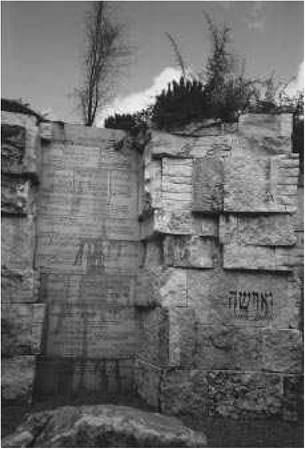
FIGURE 15. Appropriated martyrdom. A section of the commemoration complex “Valley of the Communities” (Bik-at ha-kehilot), next to Yad Vashem, Jerusalem. The names of all major European Jewish communities destroyed by the Nazis are inscribed on the steep walls of tunnels dug into the mountain. This section commemorates Warsaw and other Polish towns.
West Germany demonstrates some of the ambiguities of seeking religious and moral lessons in atrocity. Dominated for the first two decades of its existence by the old conservative elites, politics in the FRG was guided by the premise that Nazism had exemplified a pagan, anti-Christian, and immoral ideology, whose worst aspects were a lack of respect for traditional authority, religion, gender roles, and the family. In fact, of course, Hitler could not have consolidated his power without the support, or at least the acquiescence, of the traditional elites and the churches, whose prejudices against Jews, the Left, and modern society made them susceptible to Nazi rhetoric. Indicatively, in the 1930s both the Lutheran and the Catholic Churches tended to accuse the Jews of precisely the same kind of godlessness with which they charged the Nazis after the collapse of the Third Reich. It was only when Hitler failed to deliver the goods, bringing chaos and destruction instead of social order and tranquillity, that the church stepped in once more, this time as the postwar and allegedly anti-Nazi enforcer of order, tradition, and family values. The silence of the evangelical leaders and the Vatican during and after the Holocaust thus greatly facilitated the remarkably smooth transition of the church from the Third Reich to the Federal Republic.
For the ultra-Orthodox Jewish enclaves in the United States and Israel, the wartime destruction of their great counterpart communities in Eastern Europe underlined the urgent necessity to sustain a traditional Jewish way of life elsewhere. Conversely, secular and in large part socialist Israeli Zionists perceived the Holocaust as the final proof of the need to do away with the Diaspora altogether. Yet among the Israeli extreme right wing, whose numbers include many immigrants from the United States, the recent revival of religion has been accompanied by apocalyptic visions informed by vicarious memories of the Holocaust, or what has come to be called Holocaust consciousness. Complicating the picture even further, radical Sephardi activists in the 1970s claimed that the Holocaust was being instrumentalized by the Ashkenazi elite as a means to downplay Sephardi suffering. Paradoxically, one sign of Sephardi integration into Israeli society in the intervening years is that this community has by now come to see the Holocaust as part of a collective Jewish trauma, rather than an experience that “belongs” only to Jews who came from Europe. At the same time, the new Shas party, which now serves as the political representative of many Sephardim in Israel, has reinterpreted Zionism as a return to tradition and religion, and presents secular Zionists as Westernized, hedonistic Ashkenazim. From this perspective we can say that drawing political borders in Israel—a process that overlaps with attempts to define national identity—is closely linked to the religious and moral lessons that various sectors of the population claim to derive from the Holocaust.
A different but related set of questions concerns the moral lessons of the Holocaust. The German sociologist Wolfgang Sofsky has recently argued that the exercise of absolute power in the Nazi concentration camps caused the total disintegration of morality among the inmates, since the struggle for physical survival overwhelmed any considerations of moral conduct. This position has been rejected by the Bulgarian-born French critic Tzvetan Todorov, whose own recent work on this issue constitutes a passionate plea to recognize what he calls moral life in the concentration camps as a guide for posterity. These polar positions represent, of course, a larger trend of reevaluating the lessons of this century, in which we can also often recognize an explicit or implicit tendency to compare the Soviet and Nazi systems. Interestingly, Todorov identifies moral life in the camps by considering the wider societal context in which the “concentrationary universe” was established, whereas Sofsky’s rejection of the possibility of morality in the camps relies heavily on viewing them in isolation from the rest of society and on his consequent insistence on the irrelevance of ideology.
Thus the different lessons Todorov and Sofsky draw from their analyses of life in the camps depend largely on their differing perspectives. Conversely, their agreement on the—to my mind, false— equivalence of the Soviet Gulags and the Nazi concentration camps results from a similar failure to distinguish between racial genocide and political persecution. It should be noted that while many Soviet prisoners actually shared the ideology of the regime, the victims of the Nazis were either ideologically opposed to Nazism or were considered to be “biologically” barred from belonging to the “racial community.” But this distinction must be maintained even if we focus only on the Nazi camps. There was a crucial difference between the Nazis’ political prisoners, men and women who were often bound together by ideological commitment and the mass of Jewish in-mates—including numerous children—whose only link to each other was often merely the racial label attached to them by the regime. These objective realities could not but produce a very different moral existence, quite apart from the fact that “racial” victims suffered a far higher death rate than the “politicals.” Moreover, political prisoners could hope that if they survived, their families would be waiting for them, their countries and towns would give them a hero’s welcome; the Jewish inmates understood that even if they survived, there would be nothing to return to, neither family nor community. The “politicals” believed that if they, as individuals, perished, their cause would eventually win; the Jews often felt that they were the last Jews in the world and that their individual deaths could quite possibly spell the end of Jewish existence. Simha Rottem, one of a handful of survivors of the Warsaw Ghetto uprising, returned from a mission on the “Aryan” side on the night of May 8—9,1943. As he told Claude Lanzmann many years later, on climbing out of the sewer “I didn’t meet a living soul. At one point I recall feeling a kind of peace, of serenity. I said to myself: ‘I’m the last Jew. I’ll wait for morning, and for the Germans.’” Todorov concedes that there is “a threshold of suffering beyond which an individual’s actions teach us nothing more about the individual but only about the reactions that unbearable suffering elicits from the human mechanism” and explains that he does not “dwell at length on situations where that threshold has been crossed.” But by saying this, Todorov in fact implies his inability to face the extremes of the mussulmen, Primo Levi’s “drowned,” in other words, the mass of the totally emaciated and dehumanized Jewish victims and the vast majority of the inmate population in the Nazi camps who were mentally dead even before they expired. In seeking the moral essence of humanity even under the most inhuman conditions devised by man, Todorov underlines the wholly unselfish acts of caring for others, as well as the continuation of what he calls the life of the mind. Even if they were anything but numerous, he argues, such acts constituted vital proof of the inability of the Nazis to reduce the camps’ populations to utter bestiality and worthlessness. But the moral problem we are faced with is that such laudable conduct was more prevalent among inmates treated less severely by the Nazis—that is, the non-Jewish political prisoners—and was ruled out in most cases for the mass of Jewish victims who were either murdered outright or rapidly debilitated by physical violence and hunger. Moreover, as Sofsky shows, such moral life among the primarily communist “politicals” was predicated on their ability to maintain a privileged position in the camps by lording it over the less fortunate “racial” victims and on sustaining a system of ideological solidarity that excluded everyone else. Altruism within the group thus often depended on sacrificing those who did not belong to it:
This was not a Leidensgemeinschaft—there was no community of suffering here. The laws of the jungle prevailed in the daily struggle for survival. ... Frequently, the only way to survive was at the expense of others. One prisoner’s death was another’s bread. ... Solidarity is based on the principle of mutual aid and sharing. But where there is nothing to share, except at the cost of common destruction and doom, solidarity lacks a material basis. . . . Absolute power is based on a cleverly devised system of classification and collaboration, gradation of power and privilege. ... [It] thrusts individuals into a condition where what is ultimately decisive is the right of the stronger.
The difference in the moral lives of “politicals” and Jews in the camps was therefore an outcome of the crucial distinctions made between them by the Nazis. This is reflected in Todorov’s own examples of moral conduct, such as the case of a young Jewish woman who voluntarily joined her mother on a transport to Treblinka. While this was indeed an act of caring, valued most highly by Todorov on his scale of morally motivated actions, it was also an instance of fully conscious suicide. As Primo Levi noted, a Jewish working inmate who cared for another was likely to waste away himself and die within a few days or weeks. Survival depended on gaining some privilege through luck, coincidence, and skill, as happened to Levi himself. Only a position of privilege made it possible to act humanely without risking rapid deterioration and annihilation. Similarly, when speaking, as Todorov does, of the “life of the mind,” we must note the vast difference between Levi, who desperately, and not very successfully, tried to recall a few lines from Dante while in a state of near physical and mental collapse in Auschwitz, and such political prisoners as the writer Jorge Semprun, who recounts in a recently published memoir how his privileged position in Buchenwald actually allowed him to borrow books in the camp’s modest library. Indeed, when the young Jewish Hungarian protagonist of Imre Kertesz’s quasi-autobiographical novel Fateless is saved and sheltered by the Communists, their part of Buchenwald appears to him as paradise, compared to the Jewish compound where the vast majority of the inmates died. No wonder that the Communists, among whom was the young Semprun, had the physical and mental strength to take over the camp shortly before it was liberated.
In 1976 the American scholar Terrence Des Pres argued in his book The Survivor that survival in the camps depended on the ability to preserve one’s humanity even in the face of the most terrible horror. But beyond the question of moral life in the camps as ameans for survival, what Des Pres and Todorov assert with great urgency is that humanity did not die in the camps, indeed, that while people were murdered en masse, humanity as a moral concept survived. Others, including camp survivors such as Levi, Tadeusz Borowski, Jean Amery, and Ka-Tzetnik (Yehiel Dinur), have—each in his own way—pointed to what the younger philosopher Alain Finkielkraut has described as the realization after the Holocaust that humanity as an idea is mortal, that it is, in fact, possible to assassinate the very concept of moral existence along with millions of individual human beings. The fragility and precariousness of the idea of humanity and the need to preserve it with utmost care is the lesson that these writers see as the enduring legacy of the Holocaust. Where they differ from Des Pres and Todorov is in their lack of confidence about humanity’s ability to refrain from self-annihilation. Todorov’s and Des Pres’s view is one with which most people can live more comfortably. Levi’s belief that the Holocaust destroyed the best while the worst were saved, is a notion that makes post-Holocaust existence almost unbearable. Indeed, one of the most frightening consequences of the Holocaust may well be that rather than serving as a warning to preserve humanity at all cost, it has provided a license to privilege physical survival over moral existence. This may be one reason, along with the realization that mass murder has continued unabated since 1945, that such men as Borowski, Amery, Paul Celan, and Levi finally decided to put an end to their own lives.