
Exorcism is a body of beliefs and practices within the major religious traditions that entail the identification and extraction of evil spirits thought to inhabit a person, building, or locale. Closely associated with demonic possession, exorcism is practiced within Christianity, Judaism, Islam, Hinduism, and other traditions that teach doctrines of spiritual warfare, as a means of purifying or cleansing an individual who is perceived as polluted by demons. Its connection to supernatural forces and to the occult encouraged the early proliferation of local myths and legends, and more recently, the emergence of literary and cinematic genres devoted to exploring and sensationalizing the practice.
Belief in evil spirits and the practice of exorcism was present in ancient Babylonian, Egyptian, and Greek religions. Likewise, ancient Hebrew and Christian writers perceived the existence of evil spirits and described their capacity to afflict or even overpower an individual. For example, in I Samuel 18:10–11, Saul’s aggression toward David is attributed to a controlling demonic presence: “And on the morrow an evil spirit from God rushed upon Saul, and he raved within his house, while David was playing the lyre, as he did day by day. Saul had his spear in his hand; [11] and Saul cast the spear, for he thought, ‘I will pin David to the wall.’ But David evaded him twice” (RSV). In the New Testament, Jesus frequently encounters people who are possessed by evil spirits, and he often performs exorcisms. In the Gospel of Matthew, chapter 8, Jesus crosses the Sea of Galilee and meets two “demoniacs” who cry out, “Have you come here to torment us before the time?” (Matt. 8:29 RSV). The demons recognize Jesus as the Son of God and request that, if he casts them out, they should be sent into a herd of swine nearby. Jesus tells the demons to go, and they comply. When the demons enter the pigs, the herd runs down the steep bank and perishes in the sea. Building from these sacred texts, the literatures of medieval Judaism and Roman Catholicism contain numerous references to demonic possession and even lengthy instruction manuals for diagnosing and purging victims of evil spirits, notably the Thesaurus Exorcismorum, a compendium of texts that trained clergy in the arts of exorcism during the Middle Ages.
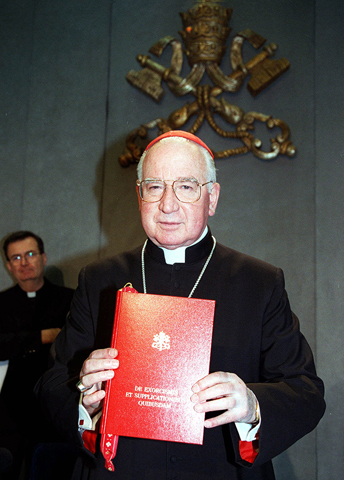
Cardinal Jorge Medina Estevez of Chile holds the book De Exorcismis et Supplicationibus Quibusdam (Concerning Exorcisms and Supplications), the Vatican’s updated guidelines on exorcism, presented during a news conference at the Vatican. These 1999 Latin guidelines update the last set, which were written in 1614. Although rituals regarding the identification and expulsion of evil spirits have been common in many religions across the globe since the earliest times, the Roman Catholic Church is generally agreed to have developed the most complex and highly codified systematic approach to exorcism. (AP Photo)
While most traditional cultures and organized religions believe in the existence of evil spirits, the Roman Catholic Church worked out the most extensive and widely practiced system of exorcism. Generally, the procedure begins with a process of discernment to establish the credibility of the report. The church traditionally taught and continues to teach that not all people who believe they are possessed by demons are considered to be so by clerical authorities. This entails a series of interviews and tests that seek to provoke the demon to reveal its supernatural powers and to disclose its identity. In at least one instance in the Middle Ages, the priest showed the victim a portrait of Saint Jerome, which allegedly inflicted pain upon the demon (Caciola 2003, 244). In a more recent incident in Merrillville, Indiana, the priest placed a crucifix on the chest of the victim, which caused her to convulse. This led to the priest’s conclusion, “You are possessed” (Armstrong 2014). In the seventeenth and eighteenth centuries, possession and exorcism were practiced so frequently that church authorities, both Catholic and Protestant, were sensitive to the likelihood of fraud and used extensive examinations to expose imposters and judicial proceedings to punish offenders. In the Lutheran tradition, demons are said to be present if they have special knowledge (as of future events), speak a language unknown to the victim, and have extraordinary physical abilities. Given these criteria, most cases are diagnosed not as demonic possession, but as evidence of mental illness, physical affliction, or just plain fakery.
Once the possession is authenticated to the satisfaction of the attending priest, the rite of exorcism is performed. Over time, the rite of exorcism increased in sophistication and detail. The current form, approved and released by the Vatican in 1998 to replace the 1614 rite, runs to eighty-four pages in length. Contemporary American Catholic exorcism features elaborate litanies, lengthy prayers, laying on of hands, readings from scripture, sprinkling with holy water, and of course a series of commands to the demon to depart. A short excerpt from the old rite, translated by Philip T. Weller, offers a flavor of the language used to confront demons during exorcism:
I cast you out, unclean spirit, along with every satanic power of the enemy, every spectre from hell, and all your fell companions; in the name of our Lord Jesus + Christ Begone and stay far from this creature of God. (Weller 1964)
Following this declaration, the priest proclaims the power of God over nature and over Satan himself, making reference to biblical passages where divine power is on display, and then rebukes Satan using a series of derogatory terms like “corrupter of justice” and “seducer of men.” This particular part of the rite ends with another charge:
Begone, then, in the name of the Father, + and of the Son, + and of the Holy + Spirit. Give place to the Holy Spirit by this sign of the holy + cross of our Lord Jesus Christ, who lives and reigns with the Father and the Holy Spirit, God, forever and ever. (Weller 1964)
The exorcism continues with a series of prayers interspersed with more insults and commands directed at the evil spirit. The tense interaction between demon and priest (or minister) serves as the key dramatic moment in the performance of the ceremony. One such exchange occurred in 1928 during perhaps the most well-known exorcism in the United States. It took place in Earling, Iowa, when Anna Ecklund underwent a twenty-three-day ordeal punctuated with episodes of vomiting enormous quantities of fluid, “gravity events” like levitating and unnatural heaviness, speaking previously unknown languages, and superhuman contortions. After weeks of labor over the victim, Father Theophilus confronted Satan in physical form. One account described the figure of Lucifer as fiery in appearance, with a crown on his head and carrying a sword of flame, with Beelzebub standing next to him. Lucifer cursed and blasphemed the priest and told him that he would have destroyed him if he had his former powers. At the end of the tense encounter, the priest asked, “What can you accomplish, you helpless Lucifer?” The reply: “What could you do, if you were bound as I am?” (Vogl 1994, 31).
Traditional cultures contain beliefs and practices that bear some relation to Christian doctrines of demonic possession and exorcism, though with marked differences. In some Native American religions and some of the religions of African and Asian immigrants, shamans are responsible for diagnosing the presence of evil spirits and supervising rituals of spiritual healing. Northeastern and Plains Indians in the United States conduct smudging ceremonies to heal those afflicted by bad spirits or negative energy. The ceremony entails burning sage, cedar, sweetgrass, and other herbs, which releases the healing power of the plants, and fanning the smoke over the victim to encourage the smoke’s cleansing and purification effects. One native healer spoke of seeing holes in the person’s spirit-body during the smudging ceremony and fanning the smoke into the holes to close and heal the individual (Borden and Coyote 2014).
Before the advent of modern medicine and behavioral science in the nineteenth and twentieth centuries, religious leaders and native healers associated sickness and unexplained physical phenomena with supernatural forces, and these traditions contributed an important current of stories and beliefs to the American folk tradition. This collection of stories offered powerful subject matter for novelists, journalists, and filmmakers in the twentieth century. The most well-known example in fiction is William Peter Blatty’s novel The Exorcist (1971), which drew inspiration from a famous 1949 exorcism involving an anonymous child dubbed “Roland Doe” by the Roman Catholic Church. The success of the film adaptation, The Exorcist (1973), led to a proliferation of similar treatments of the subject matter, and film critics believe that popular media treatments of exorcism in the 1970s invigorated the long-dormant horror film genre. Thomas B. Allen’s reexamination of the Roland Doe case in his book Possessed (1993) and a subsequent film adaptation by the same title (2000) ensured the continuation of exorcism-themed programming in the broad stream of popular culture. Films like Stigmata (1999), The Exorcism of Emily Rose (2005), The Rite (2011), and The Devil Inside (2012), along with television shows like Constantine (NBC), Supernatural (CW), and The Real Exorcist (Syfy) keep demonic possession and exorcism alive in the popular imagination.
The Exorcist Curse
Perhaps the most famous film curse of American history is that associated with the 1973 film The Exorcist, directed by William Friedkin with screenplay by William Peter Blatty, based upon his novel. Just as the novel was purported to be grounded in real—if otherworldly—events from 1949, the release of the film caused its own real-life backlash, certainly involving hysterical responses from theater audiences, but also purporting to include the deaths of two of the stars, as well as severe misfortune on the set and in the lives of many of those involved in the production.
C. Fee
Jeffrey B. Webb
See also Demonic Possession; Folk Medicine; Shamans
Further Reading
Almond, Philip C. 2004. Demonic Possession and Exorcism in Early Modern England: Contemporary Texts and Their Cultural Contexts. Cambridge: Cambridge University Press.
Armstrong, Patti. 2014. “Parish Priest Aids Family in Fight Against Demons.” National Catholic Register, February 11.
Borden, Adrienne, and Steve Coyote. 2014. “The Smudging Ceremony.” http://www.asunam.com/smudge_ceremony.html. Accessed June 13, 2015.
Caciola, Nancy. 2003. Discerning Spirits: Divine and Demonic Possession in the Middle Ages. Ithaca, NY: Cornell University Press.
Vogl, Carl Fr. 1994. Begone Satan! A True Account of an Exorcism in Earling, Iowa in 1928. Rockford, IL: TAN Books.
Weller, Philip T., trans. The Roman Ritual. 1964. Milwaukee, WI: Bruce.