
Sailors bellow sea shanties as work songs, but the harsh realities of maritime life and culture were also chronicled in these functional tunes. Cycles of economic depression from the seventeenth to nineteenth centuries carried immigrating populations over the oceans in search of better economic opportunity. In careers on the oceans, only the strongest survived; work songs with simple but powerful melodies served the purpose of carrying life-lessons of maritime culture from generation to generation. Shanties often additionally served as a safety call, whereas others were “call-and-response,” with alternating solos and choruses similar to other work songs and military drills. It was said that when the men sang well, the ship sailed well.
Ships manned by crews with varying levels of experience and from different cultural and ethnic backgrounds benefited from the universality of shanties to aid in social bonding on long voyages. Certain shanties were dedicated to certain jobs: capstan shanties refer to hard tasks related to the capstan, which is an apparatus consisting of a vertical cylinder rotated manually and used to hoist heavy objects like an anchor or cat davit (a pair of curved arms used to lower or lift boats), which requires a great deal of manpower. “Drunken Sailor,” for instance, is a classic capstan shanty sung to make the brute labor at the capstan go more smoothly: “Hey, hey, up she rises” warns that the heavy anchor is getting raised. Halyard shanties were used when masts and rigging were frozen by wintry winds. Pumping shanties were characterized by jerky rhythms that were suited for the motions needed to pump the rocker bars. Sing-out shanties were bellowed when hauling heavy cordage, and there were specific cargo working songs for loading and unloading ships. “Santiana” was a popular windlass shanty, used for pulley hauling during the Mexican American War.
As working songs, shanties serve as a chronicle of maritime culture across time. A handful of songs in a loose, commercial, Massachusetts-based fraternity of Pacific Ocean mariners (with connections to John Jacob Astor) opened up American maritime reach as far north as the Bering Straits during economically turbulent times in the early nineteenth century. “Rolling Down to Old Maui” is a Pacific shanty that dates back to the early nineteenth century, when international powers vied for control over whaling around the Hawaiian Islands, then known as the Sandwich Islands. “Blow the Man Down” is also attributed to Pacific mariners, who sang it to warn quarrelsome crew members that they might be “blown down” by the fists of the first mate if they caused problems as they raised heavy sails on masts.
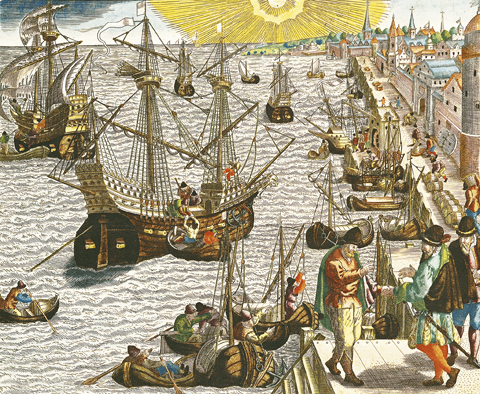
Before the twentieth century, millions of Americans experienced the excitement and terror of oceanic travel by sailing ship. Workingmen aboard these vessels passed the time by singing sea shanties, which expressed the frustrations, ambitions, and values of a lost maritime culture. Departure from Lisbon for Brazil, the East Indies and America by Theodore de Bry, 1592. (The Gallery Collection/Corbis)
The Kanaka, indigenous to the Hawaiian Islands, became the primary subjects of Pacific Rim sea shanties. The Kanaka language was orally taught; many learned to read and write English from American missionaries in the Hawaiian Islands. They spoke some English mixed with other languages used on the beach, which was understood by other mariners. The long name of Hawaiian Islanders and other Polynesians was dropped and they were simply called “Kanákas,” derived from a word in their own language; whites, in turn, were called “Haole.” Pacific Islanders, as a result, identified as “Kanaka.” Their proper names were difficult to pronounce, so captains or crews may have chosen to give them common names such as Jack, Tom, and Bill.
During the California gold rush, a number of Shanghai fraternities along the Pacific Coast preyed on unsuspecting sailors. Many shanties were cautionary tales warning men of maritime landlords who ran up sailors’ bills to exceed wage advances, and then ordered them to ship out en masse. “Shanghai Brown” and “Big Ten Gallon Jar” chronicled particularly dangerous crimps on Davis Street in San Francisco. If debts did not get enough men to crew a ship, unsuspecting victims were drugged with a brew comprised of whiskey, brandy, gin, opium, or even cigars laced with opium, along with other drugs that guaranteed a knockout for at least twelve hours. Men of all walks of life could awaken and find themselves in involuntary servitude at sea in a strange vessel minus their wages—and most of their clothing. Those who were shanghaied made the long journey to Hong Kong; there they could catch a ship back to the West Coast, but if the sailor went as far as Shanghai, he was compelled to continue the voyage around the world.
Meredith Eliassen
See also Ballad; Captain Alfred Bulltop Stormalong
Further Reading
Bolster, W. Jeffrey. 2012. The Mortal Sea: Fishing the Atlantic in the Age of Sail. Cambridge, MA: Belknap Press.
Dana, Richard Henry. 1936. Two Years before the Mast. New York: Modern Library.
Gilje, Paul A. 2007. Liberty on the Waterfront: American Maritime Culture in the Age of Revolution. Philadelphia: University of Pennsylvania Press.
Hugill, Stan. 1969. Shanties and Sailors’ Songs with Illustrations by the Author. London: Herbert Jenkins.
Terry, Richard Runciman. 2009. The Way of the Ship: Sailors, Shanties and Shantymen. Tucson, AZ: Fireship Press.